Sampling in Quantitativevs. Qualitative
Research
Quantitative Research (Random Sampling):
• Aims for statistical representativeness
• Requires prior knowledge of population
characteristics
• Assumes randomness, which may not reflect
real-world social structures
• Seeks generalizability through statistical
inference
Rethinking Representativeness and
Generalizability
Representativeness≠ Generalizability
– A representative sample may still lead to non-
generalizable findings due to measurement errors
– A non-representative sample can offer valuable
theoretical insights
Qualitative Perspective:
– Generalizability is based on emergent patterns and
transferable insights
– Seen in methods like conversation analysis, where
findings apply across similar settings
5.
Qualitative Approaches toGeneralizability
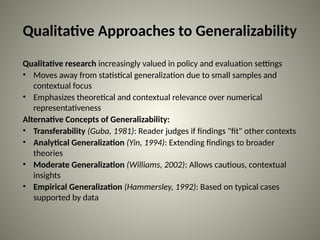
Qualitative research increasingly valued in policy and evaluation settings
• Moves away from statistical generalization due to small samples and
contextual focus
• Emphasizes theoretical and contextual relevance over numerical
representativeness
Alternative Concepts of Generalizability:
• Transferability (Guba, 1981): Reader judges if findings "fit" other contexts
• Analytical Generalization (Yin, 1994): Extending findings to broader
theories
• Moderate Generalization (Williams, 2002): Allows cautious, contextual
insights
• Empirical Generalization (Hammersley, 1992): Based on typical cases
supported by data
6.
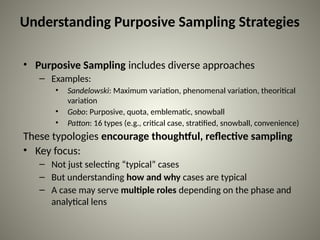
Understanding Purposive SamplingStrategies
• Purposive Sampling includes diverse approaches
– Examples:
• Sandelowski: Maximum variation, phenomenal variation, theoritical
variation
• Gobo: Purposive, quota, emblematic, snowball
• Patton: 16 types (e.g., critical case, stratified, snowball, convenience)
These typologies encourage thoughtful, reflective sampling
• Key focus:
– Not just selecting “typical” cases
– But understanding how and why cases are typical
– A case may serve multiple roles depending on the phase and
analytical lens
7.
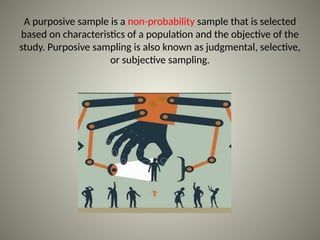
A purposive sampleis a non-probability sample that is selected
based on characteristics of a population and the objective of the
study. Purposive sampling is also known as judgmental, selective,
or subjective sampling.
8.
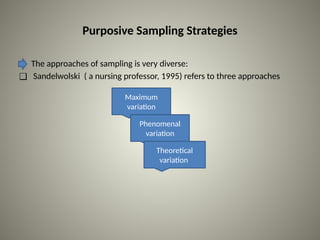
Purposive Sampling Strategies
•The approaches of sampling is very diverse:
❑ Sandelwolski ( a nursing professor, 1995) refers to three approaches
Maximum
variation
Phenomenal
variation
Theoretical
variation
9.
Purposive sampling strategies
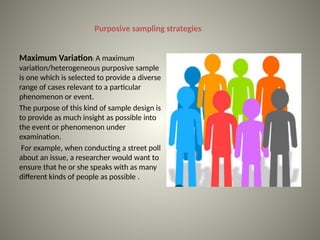
MaximumVariation: A maximum
variation/heterogeneous purposive sample
is one which is selected to provide a diverse
range of cases relevant to a particular
phenomenon or event.
The purpose of this kind of sample design is
to provide as much insight as possible into
the event or phenomenon under
examination.
For example, when conducting a street poll
about an issue, a researcher would want to
ensure that he or she speaks with as many
different kinds of people as possible .
10.
CONT.
Phenomenal variation buildson the assumption that the
universal essence of anything ultimately depends on how
its audience experiences it.
Example of Phenomenal Variation
Research Topic:
Exploring the experiences of patients with chronic pain.
Key Phenomenal Variations to Explore:
Type of Pain, Duration of Pain, Impact on Daily Life,
Coping Mechanisms.
By focusing on phenomenal variation, the study aims to
uncover the core essence of the chronic pain experience
while also highlighting the different ways in which it
manifests in individuals' lives. This approach allows for a
deep and nuanced understanding of the phenomenon
from multiple perspectives.
11.
CONT.
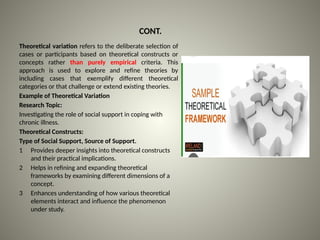
Theoretical variation refersto the deliberate selection of
cases or participants based on theoretical constructs or
concepts rather than purely empirical criteria. This
approach is used to explore and refine theories by
including cases that exemplify different theoretical
categories or that challenge or extend existing theories.
Example of Theoretical Variation
Research Topic:
Investigating the role of social support in coping with
chronic illness.
Theoretical Constructs:
Type of Social Support, Source of Support.
1 Provides deeper insights into theoretical constructs
and their practical implications.
2 Helps in refining and expanding theoretical
frameworks by examining different dimensions of a
concept.
3 Enhances understanding of how various theoretical
elements interact and influence the phenomenon
under study.
12.
Michael Quinn Patton
Patton, Founding figure in 20th-century program
evaluation. Creator of Utilization-Focused evaluation, 2002)
refers to 16 different types –
1. extreme case sampling,
2. deviant case sampling,
3. Intensity sampling,
4. maximum variation sampling,
5. homogeneous sampling,
6. typical case sampling,
7. stratified purposeful sampling,
8. critical case sampling,
9. snowball or chain sampling,
10. criterion sampling,
11. theory-based sampling,
12. opportunistic sampling,
13. random purposeful sampling,
14. sampling politically important cases,
15. convenience sampling and
16. mixed purposeful sampling.
13.
CONT.
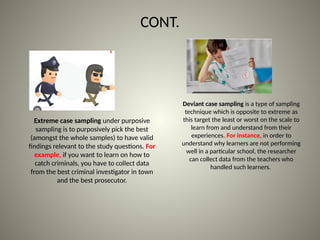
Extreme case samplingunder purposive
sampling is to purposively pick the best
(amongst the whole samples) to have valid
findings relevant to the study questions. For
example, if you want to learn on how to
catch criminals, you have to collect data
from the best criminal investigator in town
and the best prosecutor.
Deviant case sampling is a type of sampling
technique which is opposite to extreme as
this target the least or worst on the scale to
learn from and understand from their
experiences. For instance, in order to
understand why learners are not performing
well in a particular school, the researcher
can collect data from the teachers who
handled such learners.
14.
CONT.
Intensity sampling isinformation rich cases
that manifest the phenomenon intensely, but
not extremely. Such as good students, poor
students, above average/below average. In
other words, this type of sample is rather
mixed and relevant to the topic at hand and
does not limit participation to few individuals.
What is Intensity Sampling ??
Maximum variation sampling
In this type of sampling, the researcher targets
participants who have the same characteristics
but have different experiences which are
unique to each other. The same characteristics
maybe age, religion, gender and education
while they come from different homes and
backgrounds.
What is Maximum
variation sampling??
15.
Cont.
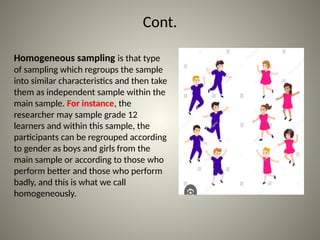
Homogeneous sampling isthat type
of sampling which regroups the sample
into similar characteristics and then take
them as independent sample within the
main sample. For instance, the
researcher may sample grade 12
learners and within this sample, the
participants can be regrouped according
to gender as boys and girls from the
main sample or according to those who
perform better and those who perform
badly, and this is what we call
homogeneously.
16.
CONT.
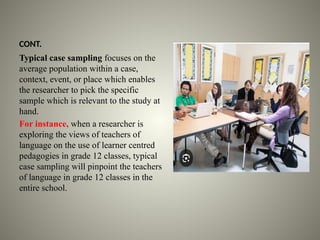
Typical case samplingfocuses on the
average population within a case,
context, event, or place which enables
the researcher to pick the specific
sample which is relevant to the study at
hand.
For instance, when a researcher is
exploring the views of teachers of
language on the use of learner centred
pedagogies in grade 12 classes, typical
case sampling will pinpoint the teachers
of language in grade 12 classes in the
entire school.
17.
CONT.
What is Stratifiedsampling ??
❑ Stratified sampling means to divide the sample into groups or categories
according to the similarities or differences which they exhibit in a study.
For instance, if you want to find out how a learner performs in class, the
research should use the results of the learners and create three strata
being, those who perform the least, average performers and top
performing students and interview them or hold focus group discussions
separately
18.
CONT.
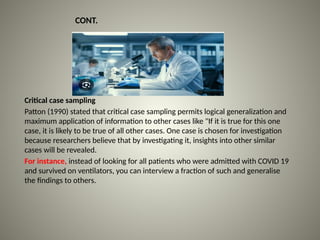
Critical case sampling
Patton(1990) stated that critical case sampling permits logical generalization and
maximum application of information to other cases like "If it is true for this one
case, it is likely to be true of all other cases. One case is chosen for investigation
because researchers believe that by investigating it, insights into other similar
cases will be revealed.
For instance, instead of looking for all patients who were admitted with COVID 19
and survived on ventilators, you can interview a fraction of such and generalise
the findings to others.
19.
CONT.
Snowball or chainsampling
This involve the identification of one participant who
is relevant to the study and that participant should
lead you to another participant who is of the same
characteristics until the planed sample is achieved.
Patton (1990) noted that the researcher identifies
one case of interest from people who know people
who know what cases are information rich. The
argument is that when you find one participant, he
or she will tell you where you can get more others
and the chain continues.
20.
What is Criterionsampling?????
Example:
CONT.
Criterion sampling
This type of sampling calls for the researcher to set a specific
criterion which should be followed for participants to take part in
the study. criterion sampling differs from one study to the other and
its implementation is according to the study set research question
and available population. For instance: Choosing patients who
have been diagnosed with diabetes for a study on managing chronic
illness.
21.
CONT.
Opportunistic Sampling
This involvesis a type of sampling which
makes the researcher to include new
participants as the study is being conducted or
during data collection as a result of new
development whilst in the field. For instance,
a researcher goes to investigate the type of
counselling which pastors offer to couples in
church when they want to divorce and finds
that pastors are not part of the counsellors but
their spouses. The researcher then has to add
the spouses in the sample after learning this
reality. This is very common in areas where
the researcher is not familiar with, like African
communities
22.
What is Randompurposeful sampling?????
Example?
Random purposeful sampling
Patton (1990) stated that this adds credibility when the purposeful sample is
larger than one can handle. It reduces judgement within a purposeful
category. But it is not for generalizations or representativeness. This is a type
of purposive sampling which picks participants from a larger group and are
streamlined to specific numbers which are manageable for qualitative study.
For instance, you may need to collect data on the prevalences of smoking in
secondary schools. Your population will be too large to settle on few
participants. Therefore, you have to deal with the guidance teacher who will
isolate few participants who you will deal with in such cases.
23.
What is Conveniencesampling ????
CONT.
Convenience sampling
It is the type of sampling where the researcher handpicks the participants
who he or she feels are relevant to the study and are near to his site. This
reduces expenses and saves on time as well as reduces chances of data
collection inconveniences to places where you cannot be welcomed. The
researcher choses a site, sample, participants and research instruments
because they are convenient for certain purposes. It should be noted that
this is unprofessional in researcher as there is likely to be high chances of
data manipulation since the participants are known to the researcher and
the coverage may be limited hence data quality might be compromised
too.
24.
Sampling politically important
cases
Samplingpolitically important cases
This is a type of sampling which is targeted at politically aligned
participants so that they can give views on the topic at hand which is
political in nature. The participants are usually political figures whose
input is very relevant for the study to be completed. For instance ,when a
researcher is comparing political violence between the immediate past
political party and the current ruling party, the researcher has to make
appointments to meet the executive leadership of the previous ruling and
the current ruling parties so that their sides of the story can be told.
These participants are sampled because they are politically important
cases for the study and their contribution is what will make the researcher
draw conclusions.
25.
What is Mixedpurposeful
sampling??????
Mixed purposeful sampling
This combines various sampling strategies to achieve the desired
sample in line with there search objective parameters of the study. This
helps in triangulation, allows for flexibility, and meets multiple interests
and needs (Patton, 1990). When selecting a sampling strategy, it is
necessary that it fits the purpose of the study, the resources available,
the question being asked, and the constraints being faced. This holds
true for sampling strategy as well as sample size as these are key .
26.
Information-Rich Cases:
Purposive samplingcenters on selecting
“information-rich cases”—cases that offer
deep insights into the core issues being studied
(Patton, 2002). However, cases are not naturally
occurring entities; they are constructed by the
researcher through a process called “casing”
(Ragin, 1992). The goal is to explore a particular
aspect of a phenomenon, not just to document
people’s voices or experiences in general.
27.
CONT.
Instead of focusingonly on socio-demographic traits
like age or ethnicity, sampling should be guided
by conceptual and relational units, such as:
• Actions (behaviors, motivations),
• Interactions (processes, outcomes),
• Identities (roles, categories),
• Events (rituals, timelines),
• Settings/spaces (locations, organizations),
• Objects (texts, devices).
28.
Cont.
Additionally, within-case sampling—shifting
focusduring fieldwork—is often useful,
especially in ethnographic research.
For instance, a study in a children’s hospital
ward might start with junior doctors, but later
include parents or other settings like
emergency rooms. Sampling may evolve
based on emerging analytical needs, ensuring
the research stays focused and meaningful.
29.
Two main approachesto using theory in
qualitative sampling:
Theoretical Sampling (Grounded Theory Approach)
• Originates from grounded theory (e.g., Glaser & Strauss, 1967).
• Begins with initial sampling based on preliminary ideas.
• Further sampling is driven by the need to develop emerging
concepts, codes, categories, and theory.
• Decisions are inductive, emergent, and progressive, aiming to
refine and saturate the theory—not to represent the
population.
• The emphasis is on conceptual robustness and the
transportability of theoretical ideas, not statistical
generalizability.
30.
CONT.
Sampling Based onA Priori Theory
• Sampling is guided by pre-existing theoretical ideas, not
just emerging ones.
• Often used to test or refine existing theories.
• Example: Silverman (1984) tested Strong’s (1983) theory
of doctor–patient interactions in a different context (a
private clinic).
• Especially common in ethnographic research, where
resource constraints often limit the number of sites.
• Validity is based on showing that the case reflects a
general theoretical principle, not a population.
31.
In both approaches,theory plays a central role in guiding
purposeful and strategic sampling, whether it's developed
during the research or drawn from existing literature.
Thank You




![Sampling1[1]](https://cdn.slidesharecdn.com/ss_thumbnails/sampling11-120509162836-phpapp02-thumbnail.jpg?width=640&height=640&fit=bounds)


