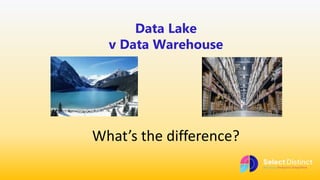

Data Lake
v Data Warehouse
What’s the difference?
While both data lakes and data warehouses are used for storing and
managing data, they differ in terms of their architecture, usage, and
capabilities
we will explore the key differences between a Data Lake and a Data
Warehouse to help you choose the one that best fits your needs.
What is a Data Warehouse?
Data warehouses are a great choice for organizations that
require standardized reporting and analytics on structured
data from multiple sources.
With data warehouses, users can store data in a predefined
schema, which can be easily queried and analysed for
business intelligence (BI) applications.
Data warehouses are optimized for read-heavy workloads
and can support complex queries and reporting
What is a Data Lake?
Data lakes are well-suited for organizations that
require a flexible and scalable storage system to
handle large amounts of raw and unstructured data
from diverse sources.
With data lakes, users can store data without worrying
about its structure or schema, and process it into a
structured format later on.
Additionally, data lakes enable users to store data of
any type, size, or format, making them a versatile
solution for complex analyses.
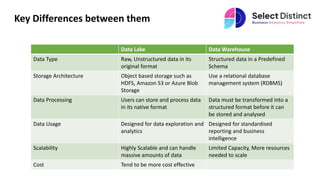
Key Differences between them
Data Lake Data Warehouse
Data Type Raw, Unstructured data in its
original format
Structured data in a Predefined
Schema
Storage Architecture Object based storage such as
HDFS, Amazon S3 or Azure Blob
Storage
Use a relational database
management system (RDBMS)
Data Processing Users can store and process data
in its native format
Data must be transformed into a
structured format before it can
be stored and analysed
Data Usage Designed for data exploration and
analytics
Designed for standardised
reporting and business
intelligence
Scalability Highly Scalable and can handle
massive amounts of data
Limited Capacity, More resources
needed to scale
Cost Tend to be more cost effective
So the data lake wins?
Not exactly
it depends on the use case
If you use a broad range of data sources and you have the
skills of data engineers to add structure when you need to
use it
then use a data lake
If your data is already structured, coming from business
applications and databases already
then use a data warehouse
You may need both
In summary, data lakes and data warehouses are two
distinct data storage solutions with unique strengths and
use cases.
Data lakes are best for storing large amounts of raw and
unstructured data,
Data warehouses are ideal for standardized reporting
and BI applications.
For more Tips, Tricks and
Timesavers or explanations in
plain English visit our website
Business Analytics Blog – Select Distinct
Credit: david.laws@selectdistinct.co.uk

Data Lake v Data Warehouse. What is the difference?

  • 1.
    Data Lake v DataWarehouse What’s the difference?
  • 2.
    While both datalakes and data warehouses are used for storing and managing data, they differ in terms of their architecture, usage, and capabilities we will explore the key differences between a Data Lake and a Data Warehouse to help you choose the one that best fits your needs.
  • 3.
    What is aData Warehouse? Data warehouses are a great choice for organizations that require standardized reporting and analytics on structured data from multiple sources. With data warehouses, users can store data in a predefined schema, which can be easily queried and analysed for business intelligence (BI) applications. Data warehouses are optimized for read-heavy workloads and can support complex queries and reporting
  • 4.
    What is aData Lake? Data lakes are well-suited for organizations that require a flexible and scalable storage system to handle large amounts of raw and unstructured data from diverse sources. With data lakes, users can store data without worrying about its structure or schema, and process it into a structured format later on. Additionally, data lakes enable users to store data of any type, size, or format, making them a versatile solution for complex analyses.
  • 5.
    Key Differences betweenthem Data Lake Data Warehouse Data Type Raw, Unstructured data in its original format Structured data in a Predefined Schema Storage Architecture Object based storage such as HDFS, Amazon S3 or Azure Blob Storage Use a relational database management system (RDBMS) Data Processing Users can store and process data in its native format Data must be transformed into a structured format before it can be stored and analysed Data Usage Designed for data exploration and analytics Designed for standardised reporting and business intelligence Scalability Highly Scalable and can handle massive amounts of data Limited Capacity, More resources needed to scale Cost Tend to be more cost effective
  • 6.
    So the datalake wins? Not exactly it depends on the use case If you use a broad range of data sources and you have the skills of data engineers to add structure when you need to use it then use a data lake If your data is already structured, coming from business applications and databases already then use a data warehouse You may need both
  • 7.
    In summary, datalakes and data warehouses are two distinct data storage solutions with unique strengths and use cases. Data lakes are best for storing large amounts of raw and unstructured data, Data warehouses are ideal for standardized reporting and BI applications.
  • 8.
    For more Tips,Tricks and Timesavers or explanations in plain English visit our website Business Analytics Blog – Select Distinct Credit: david.laws@selectdistinct.co.uk