Himani Pandya
Data Collection | Definition,
Methods & Examples
Data collection is a systematic process of gathering observations or
measurements.
Whether you are performing research for thesis, governmental or
academic purposes, data collection allows you to gain first-hand
knowledge and original insights into your research problem.
While methods and aims may differ between fields, the overall process
of data collection remains largely the same. Before you begin collecting
data, you need to consider:
• The aim of the research
• The type of data that you will collect
• The methods and procedures you will use to collect, store, and process
the data
Step 1: Define the aim of your research
• Before you start the process of data collection, you need to identify exactly what you
want to achieve.
• You can start by writing a problem statement: what is the practical or scientific issue
that you want to address and why does it matter?
• Next, formulate one or more research questions that precisely define what you want to
find out. Depending on your research questions, you might need to collect quantitative
or qualitative data:
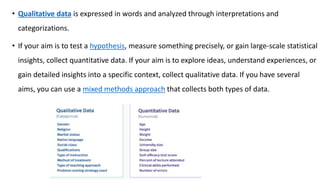
• Quantitative data is expressed in numbers and graphs and is analyzed
through statistical methods.
• Qualitative data is expressed in words and analyzed through interpretations and
categorizations.
• If your aim is to test a hypothesis, measure something precisely, or gain large-scale statistical
insights, collect quantitative data. If your aim is to explore ideas, understand experiences, or
gain detailed insights into a specific context, collect qualitative data. If you have several
aims, you can use a mixed methods approach that collects both types of data.
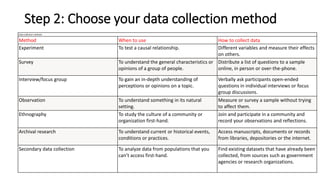
Step 2: Choose your data collection method
Data collection methods
Method When to use How to collect data
Experiment To test a causal relationship. Different variables and measure their effects
on others.
Survey To understand the general characteristics or
opinions of a group of people.
Distribute a list of questions to a sample
online, in person or over-the-phone.
Interview/focus group To gain an in-depth understanding of
perceptions or opinions on a topic.
Verbally ask participants open-ended
questions in individual interviews or focus
group discussions.
Observation To understand something in its natural
setting.
Measure or survey a sample without trying
to affect them.
Ethnography To study the culture of a community or
organization first-hand.
Join and participate in a community and
record your observations and reflections.
Archival research To understand current or historical events,
conditions or practices.
Access manuscripts, documents or records
from libraries, depositories or the internet.
Secondary data collection To analyze data from populations that you
can’t access first-hand.
Find existing datasets that have already been
collected, from sources such as government
agencies or research organizations.
Step 3: Plan your data collection procedures
Sampling
• You may need to develop a sampling plan to obtain data systematically.
This involves defining a population, the group you want to draw
conclusions about, and a sample.
• Your sampling method will determine how you recruit participants or
obtain measurements for your study. To decide on a sampling method
you will need to consider factors like the required sample size,
accessibility of the sample, and timeframe of the data collection.
Creating a data management plan
• Before beginning data collection, you should also decide how you will organize
and store your data.
• If you are collecting data from people, you will likely need to remove identity
and safeguard the data to prevent leaks of sensitive information (e.g. names or
identity numbers).
• If you are collecting data via interviews or pencil-and-paper formats, you will
need to perform transcriptions or data entry in systematic ways to minimize
distortion.
• You can prevent loss of data by having an organization system that is routinely
backed up.
Standardizing procedures
• If multiple researchers are involved, write a detailed manual to standardize data collection
procedures in your study.
• This means laying out specific step-by-step instructions so that everyone in your research
team collects data in a consistent way – for example, by conducting experiments under
the same conditions and using objective criteria to record and categorize observations.
• This helps ensure the reliability of your data, and you can also use it to replicate the study
in the future.
Measurement scale
Measurement Scale
• The Scales of Measurement are used to quantify or categorize the
variables and before any research one must identify the type of the
variable under study. As different methods are used to measure
different variables.
Objective
The Measurement & Scaling Technique helps us to :
• explain the concepts of measurement and scaling,
• discuss four levels of measurement scales,
• classify and discuss different scaling techniques, and select an
appropriate attitude measurement scale for our research problem.
Introduction
• As we discussed earlier, the data consists of quantitative variables like
Age, height, weight etc., and qualitative variables like knowledge,
performance , Gender, Religion, character etc. The qualitative
information must be converted into numerical form for further
analysis. This is possible through measurement and scaling
techniques.
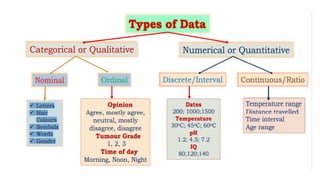
Types of measurement scale
• There are four levels of measurement scales or methods of assigning
numbers:
(a) Nominal scale,
(b) Ordinal scale,
(c) Interval scale, and
(d) Ratio scale.
Nominal Scale
• It is the crudest among all measurement scales but it is also the simplest scale. In this
scale the different scores on a measurement simply indicate different categories.
• The nominal scale does not express any values or relationships between variables.
• The nominal scale is often referred to as a categorical scale.
• The assigned numbers have no arithmetic properties and act only as labels. The only
statistical operation that can be performed on nominal scales is a frequency count.
• We cannot determine an average except mode.(The mode is the value that appears most
often in a set of data values.)
For example: labeling men as ‘1’ and women as ‘2’ which is the most common way of
labeling gender for data recording purpose does not mean women are ‘twice something or
other’ than men.
Nor it suggests that men are somehow ‘better’ than women.
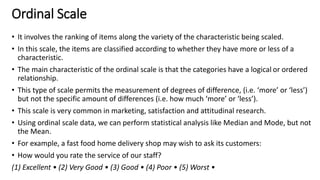
Ordinal Scale
• It involves the ranking of items along the variety of the characteristic being scaled.
• In this scale, the items are classified according to whether they have more or less of a
characteristic.
• The main characteristic of the ordinal scale is that the categories have a logical or ordered
relationship.
• This type of scale permits the measurement of degrees of difference, (i.e. ‘more’ or ‘less’)
but not the specific amount of differences (i.e. how much ‘more’ or ‘less’).
• This scale is very common in marketing, satisfaction and attitudinal research.
• Using ordinal scale data, we can perform statistical analysis like Median and Mode, but not
the Mean.
• For example, a fast food home delivery shop may wish to ask its customers:
• How would you rate the service of our staff?
(1) Excellent • (2) Very Good • (3) Good • (4) Poor • (5) Worst •
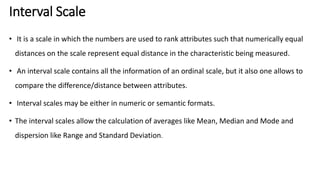
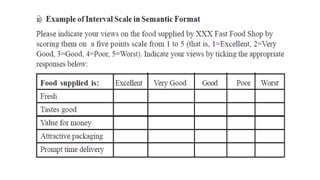
Interval Scale
• It is a scale in which the numbers are used to rank attributes such that numerically equal
distances on the scale represent equal distance in the characteristic being measured.
• An interval scale contains all the information of an ordinal scale, but it also one allows to
compare the difference/distance between attributes.
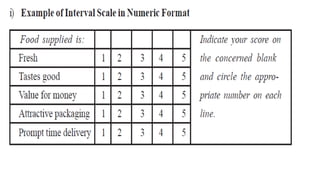
• Interval scales may be either in numeric or semantic formats.
• The interval scales allow the calculation of averages like Mean, Median and Mode and
dispersion like Range and Standard Deviation.
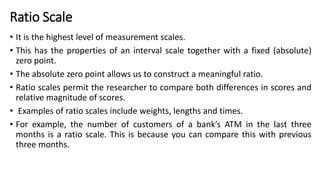
Ratio Scale
• It is the highest level of measurement scales.
• This has the properties of an interval scale together with a fixed (absolute)
zero point.
• The absolute zero point allows us to construct a meaningful ratio.
• Ratio scales permit the researcher to compare both differences in scores and
relative magnitude of scores.
• Examples of ratio scales include weights, lengths and times.
• For example, the number of customers of a bank’s ATM in the last three
months is a ratio scale. This is because you can compare this with previous
three months.
Scaling technique
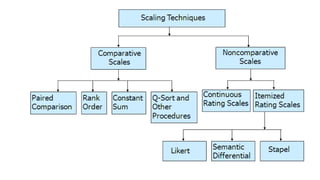
Comparative scale
In comparative scaling, the respondent is asked to compare one
object with another.
The comparative scales can further be divided into the following four
types of scaling techniques:
(a) Paired Comparison Scale,
(b) Rank Order Scale,
(c) Constant Sum Scale, and
(d) Q-sort Scale
1) Paired Comparison Scale:
• This is a comparative scaling technique in which a respondent is
presented with two objects at a time and asked to select one object
according to some criterion.
• The data obtained are ordinal in nature.
• For example, there are four types of cold drinks -
Coke, Pepsi, Sprite, and Limca. The respondents can prefer
• Pepsi to Coke or Coke to Sprite, etc.
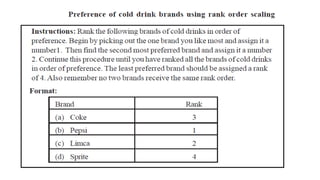
Rank Order Scale:
• This is another type of comparative scaling technique in which
respondents are presented with several items simultaneously and
asked to rank them in the order of priority.
• This is an ordinal scale that describes the favoured and unfavoured
objects, but does not reveal the distance between the objects.
• This yields better results when direct comparison are required
between the given objects.
• The major disadvantage of this technique is that only ordinal data can
be generated.
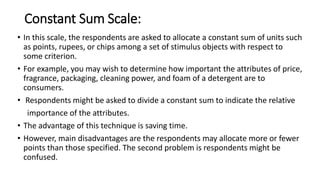
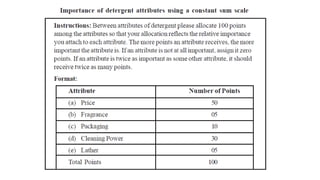
Constant Sum Scale:
• In this scale, the respondents are asked to allocate a constant sum of units such
as points, rupees, or chips among a set of stimulus objects with respect to
some criterion.
• For example, you may wish to determine how important the attributes of price,
fragrance, packaging, cleaning power, and foam of a detergent are to
consumers.
• Respondents might be asked to divide a constant sum to indicate the relative
importance of the attributes.
• The advantage of this technique is saving time.
• However, main disadvantages are the respondents may allocate more or fewer
points than those specified. The second problem is respondents might be
confused.
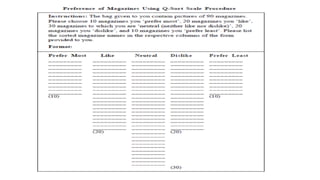
Q-Sort Scale:
• This is a comparative scale that uses a rank order procedure to sort objects
based on similarity with respect to some criterion.
• The important characteristic of this methodology is that it is more important
to make comparisons among different responses of a respondent than the
responses between different respondents.
• Therefore, it is a comparative method of scaling rather than an absolute
rating scale.
• In this method the respondent is given statements in a large number for
describing the characteristics of a product or a large number of brands of a
product.
Non-Comparative scale
• In non-comparative scaling respondents need only evaluate a single
object. Their evaluation is independent of the other object which the
researcher is studying.
• The non-comparative scaling techniques can be further divided into:
(a)Continuous Rating Scale, and
(b)Itemized Rating Scale.
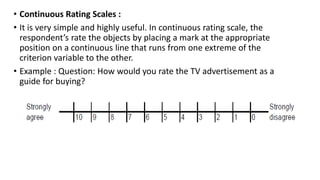
• Continuous Rating Scales :
• It is very simple and highly useful. In continuous rating scale, the
respondent’s rate the objects by placing a mark at the appropriate
position on a continuous line that runs from one extreme of the
criterion variable to the other.
• Example : Question: How would you rate the TV advertisement as a
guide for buying?
Itemized Rating Scales :
• Itemized rating scale is a scale having numbers or brief descriptions
associated with each category.
• The categories are ordered in terms of scale position and the respondents
are required to select one of the limited number of categories that best
describes the product, brand, company, or product attribute being rated.
Itemized rating scales are widely used in marketing research.
• Itemized rating scales is further divided into three parts, namely
(a) Likert scale,
(b) Semantic Differential Scale, and
(c) Stapel Scale.
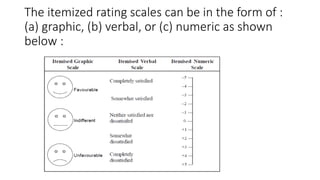
The itemized rating scales can be in the form of :
(a) graphic, (b) verbal, or (c) numeric as shown
below :
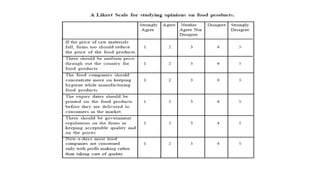
Likert Scale:
• Likert, is extremely popular for measuring attitudes, because, the method is
simple to administer.
• With the Likert scale, the respondents indicate their own attitudes by checking
how strongly they agree or disagree with carefully worded statements that range
from very positive to very negative towards the object.
• Respondents generally choose from five alternatives (say strongly agree, agree,
neither agree nor disagree, disagree, strongly disagree).
• A Likert scale may include a number of items or statements.
• Disadvantage of Likert Scale is that it takes longer time to complete than other
itemized rating scales because respondents have to read each statement.
• Despite the above disadvantages, this scale has several advantages. It is easy to
construct, administer and use.
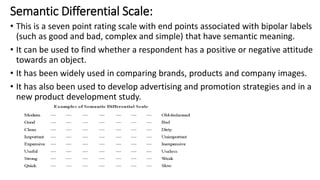
Semantic Differential Scale:
• This is a seven point rating scale with end points associated with bipolar labels
(such as good and bad, complex and simple) that have semantic meaning.
• It can be used to find whether a respondent has a positive or negative attitude
towards an object.
• It has been widely used in comparing brands, products and company images.
• It has also been used to develop advertising and promotion strategies and in a
new product development study.
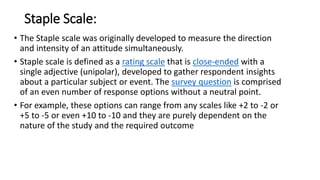
Staple Scale:
• The Staple scale was originally developed to measure the direction
and intensity of an attitude simultaneously.
• Staple scale is defined as a rating scale that is close-ended with a
single adjective (unipolar), developed to gather respondent insights
about a particular subject or event. The survey question is comprised
of an even number of response options without a neutral point.
• For example, these options can range from any scales like +2 to -2 or
+5 to -5 or even +10 to -10 and they are purely dependent on the
nature of the study and the required outcome

5.Measurement and scaling technique.pptx

  • 1.
    Himani Pandya Data Collection| Definition, Methods & Examples
  • 2.
    Data collection isa systematic process of gathering observations or measurements. Whether you are performing research for thesis, governmental or academic purposes, data collection allows you to gain first-hand knowledge and original insights into your research problem.
  • 3.
    While methods andaims may differ between fields, the overall process of data collection remains largely the same. Before you begin collecting data, you need to consider: • The aim of the research • The type of data that you will collect • The methods and procedures you will use to collect, store, and process the data
  • 4.
    Step 1: Definethe aim of your research • Before you start the process of data collection, you need to identify exactly what you want to achieve. • You can start by writing a problem statement: what is the practical or scientific issue that you want to address and why does it matter? • Next, formulate one or more research questions that precisely define what you want to find out. Depending on your research questions, you might need to collect quantitative or qualitative data: • Quantitative data is expressed in numbers and graphs and is analyzed through statistical methods.
  • 5.
    • Qualitative datais expressed in words and analyzed through interpretations and categorizations. • If your aim is to test a hypothesis, measure something precisely, or gain large-scale statistical insights, collect quantitative data. If your aim is to explore ideas, understand experiences, or gain detailed insights into a specific context, collect qualitative data. If you have several aims, you can use a mixed methods approach that collects both types of data.
  • 6.
    Step 2: Chooseyour data collection method Data collection methods Method When to use How to collect data Experiment To test a causal relationship. Different variables and measure their effects on others. Survey To understand the general characteristics or opinions of a group of people. Distribute a list of questions to a sample online, in person or over-the-phone. Interview/focus group To gain an in-depth understanding of perceptions or opinions on a topic. Verbally ask participants open-ended questions in individual interviews or focus group discussions. Observation To understand something in its natural setting. Measure or survey a sample without trying to affect them. Ethnography To study the culture of a community or organization first-hand. Join and participate in a community and record your observations and reflections. Archival research To understand current or historical events, conditions or practices. Access manuscripts, documents or records from libraries, depositories or the internet. Secondary data collection To analyze data from populations that you can’t access first-hand. Find existing datasets that have already been collected, from sources such as government agencies or research organizations.
  • 7.
    Step 3: Planyour data collection procedures Sampling • You may need to develop a sampling plan to obtain data systematically. This involves defining a population, the group you want to draw conclusions about, and a sample. • Your sampling method will determine how you recruit participants or obtain measurements for your study. To decide on a sampling method you will need to consider factors like the required sample size, accessibility of the sample, and timeframe of the data collection.
  • 8.
    Creating a datamanagement plan • Before beginning data collection, you should also decide how you will organize and store your data. • If you are collecting data from people, you will likely need to remove identity and safeguard the data to prevent leaks of sensitive information (e.g. names or identity numbers). • If you are collecting data via interviews or pencil-and-paper formats, you will need to perform transcriptions or data entry in systematic ways to minimize distortion. • You can prevent loss of data by having an organization system that is routinely backed up.
  • 9.
    Standardizing procedures • Ifmultiple researchers are involved, write a detailed manual to standardize data collection procedures in your study. • This means laying out specific step-by-step instructions so that everyone in your research team collects data in a consistent way – for example, by conducting experiments under the same conditions and using objective criteria to record and categorize observations. • This helps ensure the reliability of your data, and you can also use it to replicate the study in the future.
  • 10.
  • 11.
    Measurement Scale • TheScales of Measurement are used to quantify or categorize the variables and before any research one must identify the type of the variable under study. As different methods are used to measure different variables.
  • 12.
    Objective The Measurement &Scaling Technique helps us to : • explain the concepts of measurement and scaling, • discuss four levels of measurement scales, • classify and discuss different scaling techniques, and select an appropriate attitude measurement scale for our research problem.
  • 13.
    Introduction • As wediscussed earlier, the data consists of quantitative variables like Age, height, weight etc., and qualitative variables like knowledge, performance , Gender, Religion, character etc. The qualitative information must be converted into numerical form for further analysis. This is possible through measurement and scaling techniques.
  • 14.
    Types of measurementscale • There are four levels of measurement scales or methods of assigning numbers: (a) Nominal scale, (b) Ordinal scale, (c) Interval scale, and (d) Ratio scale.
  • 16.
    Nominal Scale • Itis the crudest among all measurement scales but it is also the simplest scale. In this scale the different scores on a measurement simply indicate different categories. • The nominal scale does not express any values or relationships between variables. • The nominal scale is often referred to as a categorical scale. • The assigned numbers have no arithmetic properties and act only as labels. The only statistical operation that can be performed on nominal scales is a frequency count. • We cannot determine an average except mode.(The mode is the value that appears most often in a set of data values.) For example: labeling men as ‘1’ and women as ‘2’ which is the most common way of labeling gender for data recording purpose does not mean women are ‘twice something or other’ than men. Nor it suggests that men are somehow ‘better’ than women.
  • 18.
    Ordinal Scale • Itinvolves the ranking of items along the variety of the characteristic being scaled. • In this scale, the items are classified according to whether they have more or less of a characteristic. • The main characteristic of the ordinal scale is that the categories have a logical or ordered relationship. • This type of scale permits the measurement of degrees of difference, (i.e. ‘more’ or ‘less’) but not the specific amount of differences (i.e. how much ‘more’ or ‘less’). • This scale is very common in marketing, satisfaction and attitudinal research. • Using ordinal scale data, we can perform statistical analysis like Median and Mode, but not the Mean. • For example, a fast food home delivery shop may wish to ask its customers: • How would you rate the service of our staff? (1) Excellent • (2) Very Good • (3) Good • (4) Poor • (5) Worst •
  • 19.
    Interval Scale • Itis a scale in which the numbers are used to rank attributes such that numerically equal distances on the scale represent equal distance in the characteristic being measured. • An interval scale contains all the information of an ordinal scale, but it also one allows to compare the difference/distance between attributes. • Interval scales may be either in numeric or semantic formats. • The interval scales allow the calculation of averages like Mean, Median and Mode and dispersion like Range and Standard Deviation.
  • 22.
    Ratio Scale • Itis the highest level of measurement scales. • This has the properties of an interval scale together with a fixed (absolute) zero point. • The absolute zero point allows us to construct a meaningful ratio. • Ratio scales permit the researcher to compare both differences in scores and relative magnitude of scores. • Examples of ratio scales include weights, lengths and times. • For example, the number of customers of a bank’s ATM in the last three months is a ratio scale. This is because you can compare this with previous three months.
  • 23.
  • 25.
    Comparative scale In comparativescaling, the respondent is asked to compare one object with another. The comparative scales can further be divided into the following four types of scaling techniques: (a) Paired Comparison Scale, (b) Rank Order Scale, (c) Constant Sum Scale, and (d) Q-sort Scale
  • 26.
    1) Paired ComparisonScale: • This is a comparative scaling technique in which a respondent is presented with two objects at a time and asked to select one object according to some criterion. • The data obtained are ordinal in nature. • For example, there are four types of cold drinks - Coke, Pepsi, Sprite, and Limca. The respondents can prefer • Pepsi to Coke or Coke to Sprite, etc.
  • 27.
    Rank Order Scale: •This is another type of comparative scaling technique in which respondents are presented with several items simultaneously and asked to rank them in the order of priority. • This is an ordinal scale that describes the favoured and unfavoured objects, but does not reveal the distance between the objects. • This yields better results when direct comparison are required between the given objects. • The major disadvantage of this technique is that only ordinal data can be generated.
  • 29.
    Constant Sum Scale: •In this scale, the respondents are asked to allocate a constant sum of units such as points, rupees, or chips among a set of stimulus objects with respect to some criterion. • For example, you may wish to determine how important the attributes of price, fragrance, packaging, cleaning power, and foam of a detergent are to consumers. • Respondents might be asked to divide a constant sum to indicate the relative importance of the attributes. • The advantage of this technique is saving time. • However, main disadvantages are the respondents may allocate more or fewer points than those specified. The second problem is respondents might be confused.
  • 31.
    Q-Sort Scale: • Thisis a comparative scale that uses a rank order procedure to sort objects based on similarity with respect to some criterion. • The important characteristic of this methodology is that it is more important to make comparisons among different responses of a respondent than the responses between different respondents. • Therefore, it is a comparative method of scaling rather than an absolute rating scale. • In this method the respondent is given statements in a large number for describing the characteristics of a product or a large number of brands of a product.
  • 33.
    Non-Comparative scale • Innon-comparative scaling respondents need only evaluate a single object. Their evaluation is independent of the other object which the researcher is studying. • The non-comparative scaling techniques can be further divided into: (a)Continuous Rating Scale, and (b)Itemized Rating Scale.
  • 34.
    • Continuous RatingScales : • It is very simple and highly useful. In continuous rating scale, the respondent’s rate the objects by placing a mark at the appropriate position on a continuous line that runs from one extreme of the criterion variable to the other. • Example : Question: How would you rate the TV advertisement as a guide for buying?
  • 35.
    Itemized Rating Scales: • Itemized rating scale is a scale having numbers or brief descriptions associated with each category. • The categories are ordered in terms of scale position and the respondents are required to select one of the limited number of categories that best describes the product, brand, company, or product attribute being rated. Itemized rating scales are widely used in marketing research. • Itemized rating scales is further divided into three parts, namely (a) Likert scale, (b) Semantic Differential Scale, and (c) Stapel Scale.
  • 36.
    The itemized ratingscales can be in the form of : (a) graphic, (b) verbal, or (c) numeric as shown below :
  • 37.
    Likert Scale: • Likert,is extremely popular for measuring attitudes, because, the method is simple to administer. • With the Likert scale, the respondents indicate their own attitudes by checking how strongly they agree or disagree with carefully worded statements that range from very positive to very negative towards the object. • Respondents generally choose from five alternatives (say strongly agree, agree, neither agree nor disagree, disagree, strongly disagree). • A Likert scale may include a number of items or statements. • Disadvantage of Likert Scale is that it takes longer time to complete than other itemized rating scales because respondents have to read each statement. • Despite the above disadvantages, this scale has several advantages. It is easy to construct, administer and use.
  • 39.
    Semantic Differential Scale: •This is a seven point rating scale with end points associated with bipolar labels (such as good and bad, complex and simple) that have semantic meaning. • It can be used to find whether a respondent has a positive or negative attitude towards an object. • It has been widely used in comparing brands, products and company images. • It has also been used to develop advertising and promotion strategies and in a new product development study.
  • 40.
    Staple Scale: • TheStaple scale was originally developed to measure the direction and intensity of an attitude simultaneously. • Staple scale is defined as a rating scale that is close-ended with a single adjective (unipolar), developed to gather respondent insights about a particular subject or event. The survey question is comprised of an even number of response options without a neutral point. • For example, these options can range from any scales like +2 to -2 or +5 to -5 or even +10 to -10 and they are purely dependent on the nature of the study and the required outcome