Kurukshetra University
University School Of Management
Thanesar,Haryana136119
A Dissertation Entitled
Data Collection
Presented By
MAYANK (67)
SUMANT (43)
GUIDED BY
MOHAMMADQAIS REZVANI SIR
Disclaimer
THIS PRESENTATION IS MADE FOR EDUCATIONAL PURPOSE ONLY. WE
DOES NOT SUPPORT AND PROMOTE ANY UNLAWFUL ACTIVITY AND
HARMFUL THINGS. Despite this, if you do this then you may have to face the
problem / PUNISHMENT.
consumption of alcohol is injurious to health
यह प्रस्तुतत क
े वल शैक्षिक उद्देश्यों क
े ललए बनाई गई है। हम
ककसी भी गैरकानूनी गततववधि और हातनकारक चीजों का
समर्थन और प्रचार नह ीं करते हैं। इसक
े बावजूद अगर आप
ऐसा करते हैं तो आपको समस्या/सजा का सामना करना पड़
सकता है।
शराब का सेवन स्वास््य क
े ललए हातनकारक है
CONTENTS
INTRODUCTION
PRIMARY DATA
SOURCES OF PRIMARY DATA
ADVANTAGES OF PRIMARY DATA
DISADVANTAGES OF PRIMARY DATA
SECONDARY DATA
SOURCES OF SECONDARY DATA
ADVANTAGES OF SECONDARY DATA
DISADVANTAGES OF SECONDARY DATA
CONCLUSION
WHAT IS DATA ?
DATA- Tool to reach suitable conclusion of any problem.
Example
NAME MARKS
ROBIN LAMBA
AJAY SHARMA
ANUJ ROHILLA
SOHAN
HIMANSHU
VINAY
RISHABH JAIN
NAME % of
Attendance
MARKS
ROBIN
LAMBA
80% 3
AJAY
SHARMA
95% 5
ANUJ
ROHILLA
70% 3
SOHAN 33% 2
HIMANSHU 10% 0
VINAY 88% 4
RISHABH
JAIN
98% 5
INTRODUCTION
Data collection is done with a purpose of gathering information about
the topic being studied by the researcher.
It is a process of finding appropriate sources of information and
compiling the information to reach a particular solution. It helps the
managers in recording, analysing, and making decisions regarding
significant issues.
Any research cannot be completed without proper
collection and analysis of data.
Hence it is known as
"Life Blood of Research".
PRIMARY DATA
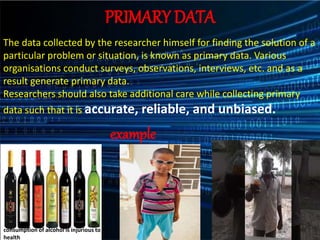
The data collected by the researcher himself for finding the solution of a
particular problem or situation, is known as primary data. Various
organisations conduct surveys, observations, interviews, etc. and as a
result generate primary data.
Researchers should also take additional care while collecting primary
data such that it is accurate, reliable, and unbiased.
example
consumption of alcohol is injurious to
health
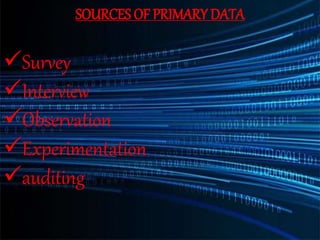
SOURCES OF PRIMARY DATA
Survey
Interview
Observation
Experimentation
auditing
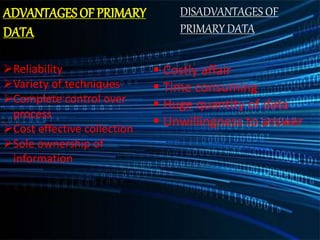
ADVANTAGES OF PRIMARY
DATA
DISADVANTAGES OF
PRIMARY DATA
Reliability
Variety of techniques
Complete control over
process
Cost effective collection
Sole ownership of
information
 Costly affair
 Time consuming
 Huge quantity of data
 Unwillingness to answer
SECONDARY DATA
When a researcher uses data which are previously collected
by some other researchers, institutions or agencies for their
own purposes are called secondary data.
The researchers collected data either from an internal source
of an organisation or from the published sources like reports
and journals.
example
Total contribution of different sectors to the GDP are published by the
government or some trade association which may be a secondary data
source for the analysing the current market position of a particular
organisation within a particular industry.
SOURCES OF SECONDARY DATA
Books, Magazines and Newspapers - Newspapers and magazines also
carry out surveys and interviews of their own on various aspects like
socio-economic conditions, crimes in the country etc.
Reports - Industries and trade associations also publish reports
periodically which contain data regarding trade, production, exports,
imports and the like. The information in these reports will facilitate
different types of secondary research.
GovernmentData - Data released by the government of any country is
one of the largest sources of secondary data. Sometimes, the central
or state government sets up committees to look into some issues.
These committees publish reports based on their investigation, which
function as a valuable source of secondary data.
ADVANTAGES OF
SECONDARY DATA
DISADVANTAGES OF
SECONDARY DATA
Economic
Less Time Taking
Measuring
Instruments are
not Required
Availability
 Relevance
 Accuracy
 Difficulty in Tracing-Out
Sources
 You are not the owner of
the information
CONCLUSION
Data collection is done with a purpose of gathering
information about the topic being studied by the
researcher. Any research cannot be completed
without proper collection and analysis of data. The
popular ways to collect primary data consist of
surveys, interviews and focus groups, which shows
that direct relationship between potential customers
and the companies. Whereas secondary research is a
means to reprocess and reuse collected information
as an indication for betterments of the service or
product.
some questions for you
Q- why the data is known as life blood of research.
Q- give two DISADVANTAGES OF PRIMARY DATA
Q- are public records and historical documents primary or secondary sources of
data?
Q- did you understand anythingfromthe 3 idiots movie video.
Thank you
I remain most grateful for the rapt attention with which you sat
through this lecture. I’m confident that you’ve learned
something from it. Thank you very much.
special thank to
MOHAMMAD QAIS REZVANI SIR
FOR ACCEPTING AND APPROVING THIS PPT

Data Collection

  • 1.
    Kurukshetra University University SchoolOf Management Thanesar,Haryana136119 A Dissertation Entitled Data Collection Presented By MAYANK (67) SUMANT (43) GUIDED BY MOHAMMADQAIS REZVANI SIR
  • 2.
    Disclaimer THIS PRESENTATION ISMADE FOR EDUCATIONAL PURPOSE ONLY. WE DOES NOT SUPPORT AND PROMOTE ANY UNLAWFUL ACTIVITY AND HARMFUL THINGS. Despite this, if you do this then you may have to face the problem / PUNISHMENT. consumption of alcohol is injurious to health यह प्रस्तुतत क े वल शैक्षिक उद्देश्यों क े ललए बनाई गई है। हम ककसी भी गैरकानूनी गततववधि और हातनकारक चीजों का समर्थन और प्रचार नह ीं करते हैं। इसक े बावजूद अगर आप ऐसा करते हैं तो आपको समस्या/सजा का सामना करना पड़ सकता है। शराब का सेवन स्वास््य क े ललए हातनकारक है
  • 3.
    CONTENTS INTRODUCTION PRIMARY DATA SOURCES OFPRIMARY DATA ADVANTAGES OF PRIMARY DATA DISADVANTAGES OF PRIMARY DATA SECONDARY DATA SOURCES OF SECONDARY DATA ADVANTAGES OF SECONDARY DATA DISADVANTAGES OF SECONDARY DATA CONCLUSION
  • 5.
    WHAT IS DATA? DATA- Tool to reach suitable conclusion of any problem. Example NAME MARKS ROBIN LAMBA AJAY SHARMA ANUJ ROHILLA SOHAN HIMANSHU VINAY RISHABH JAIN NAME % of Attendance MARKS ROBIN LAMBA 80% 3 AJAY SHARMA 95% 5 ANUJ ROHILLA 70% 3 SOHAN 33% 2 HIMANSHU 10% 0 VINAY 88% 4 RISHABH JAIN 98% 5
  • 6.
    INTRODUCTION Data collection isdone with a purpose of gathering information about the topic being studied by the researcher. It is a process of finding appropriate sources of information and compiling the information to reach a particular solution. It helps the managers in recording, analysing, and making decisions regarding significant issues. Any research cannot be completed without proper collection and analysis of data. Hence it is known as "Life Blood of Research".
  • 7.
    PRIMARY DATA The datacollected by the researcher himself for finding the solution of a particular problem or situation, is known as primary data. Various organisations conduct surveys, observations, interviews, etc. and as a result generate primary data. Researchers should also take additional care while collecting primary data such that it is accurate, reliable, and unbiased. example consumption of alcohol is injurious to health
  • 8.
    SOURCES OF PRIMARYDATA Survey Interview Observation Experimentation auditing
  • 9.
    ADVANTAGES OF PRIMARY DATA DISADVANTAGESOF PRIMARY DATA Reliability Variety of techniques Complete control over process Cost effective collection Sole ownership of information  Costly affair  Time consuming  Huge quantity of data  Unwillingness to answer
  • 10.
    SECONDARY DATA When aresearcher uses data which are previously collected by some other researchers, institutions or agencies for their own purposes are called secondary data. The researchers collected data either from an internal source of an organisation or from the published sources like reports and journals. example Total contribution of different sectors to the GDP are published by the government or some trade association which may be a secondary data source for the analysing the current market position of a particular organisation within a particular industry.
  • 11.
    SOURCES OF SECONDARYDATA Books, Magazines and Newspapers - Newspapers and magazines also carry out surveys and interviews of their own on various aspects like socio-economic conditions, crimes in the country etc. Reports - Industries and trade associations also publish reports periodically which contain data regarding trade, production, exports, imports and the like. The information in these reports will facilitate different types of secondary research. GovernmentData - Data released by the government of any country is one of the largest sources of secondary data. Sometimes, the central or state government sets up committees to look into some issues. These committees publish reports based on their investigation, which function as a valuable source of secondary data.
  • 12.
    ADVANTAGES OF SECONDARY DATA DISADVANTAGESOF SECONDARY DATA Economic Less Time Taking Measuring Instruments are not Required Availability  Relevance  Accuracy  Difficulty in Tracing-Out Sources  You are not the owner of the information
  • 13.
    CONCLUSION Data collection isdone with a purpose of gathering information about the topic being studied by the researcher. Any research cannot be completed without proper collection and analysis of data. The popular ways to collect primary data consist of surveys, interviews and focus groups, which shows that direct relationship between potential customers and the companies. Whereas secondary research is a means to reprocess and reuse collected information as an indication for betterments of the service or product.
  • 15.
    some questions foryou Q- why the data is known as life blood of research. Q- give two DISADVANTAGES OF PRIMARY DATA Q- are public records and historical documents primary or secondary sources of data? Q- did you understand anythingfromthe 3 idiots movie video.
  • 16.
    Thank you I remainmost grateful for the rapt attention with which you sat through this lecture. I’m confident that you’ve learned something from it. Thank you very much. special thank to MOHAMMAD QAIS REZVANI SIR FOR ACCEPTING AND APPROVING THIS PPT