Prof. Percival A.
Advance Database System
Prof. Percival A.
Advance Database System
Prof. Percival A.
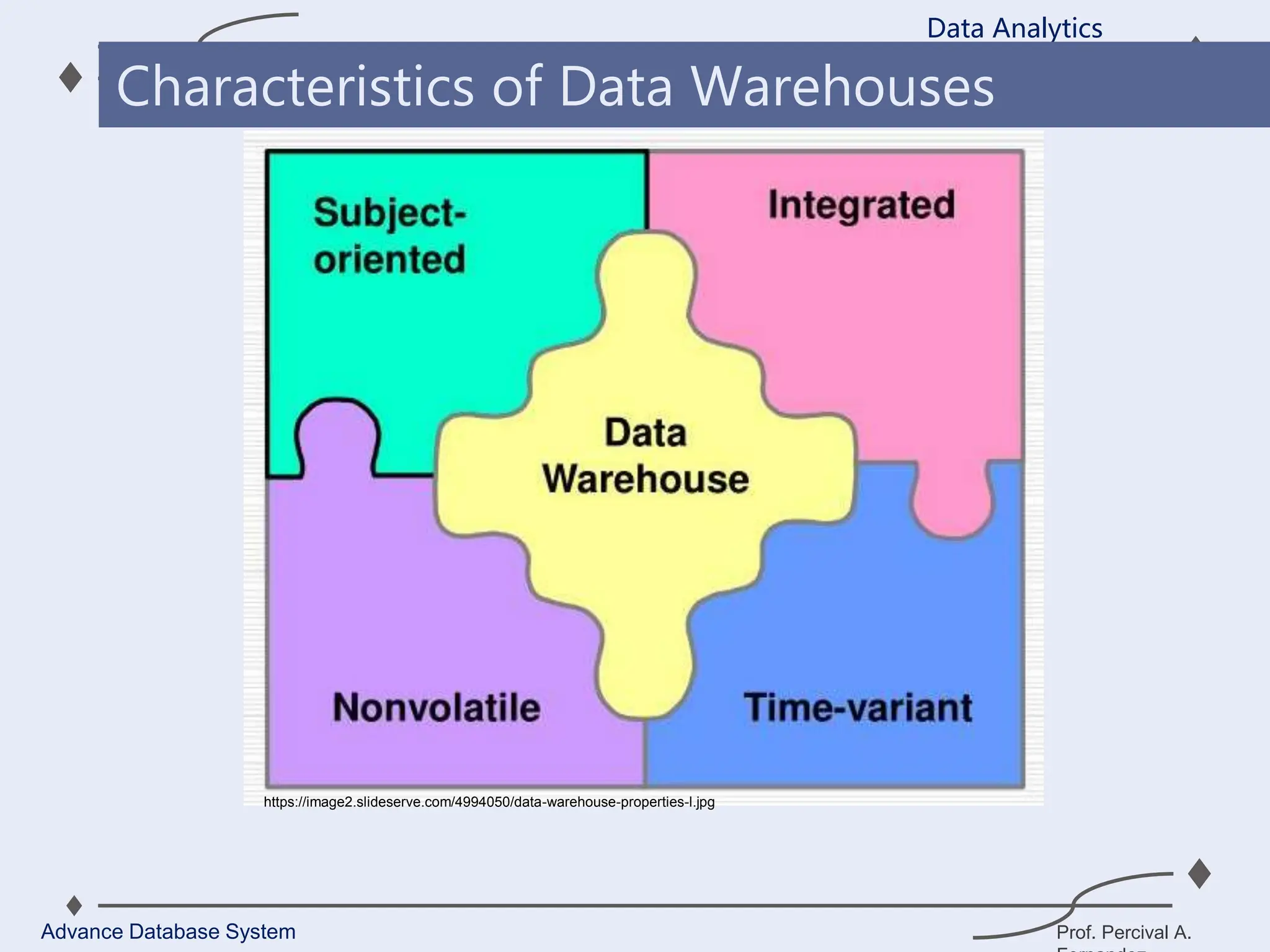
 A data warehouse is a database designed to enable and support
business intelligence (BI) activities, especially analytics.
intended to perform queries and analysis
optimized for data retrieval, not for transaction processing
centralizes and consolidates large amounts of data from multiple
sources
allows organizations to derive valuable business insights from
their data to improve decision-making
can be considered an organization’s “single source of truth"
Data Analytics
Advance Database System
What is a data warehouse?
Prof. Percival A.
 A data warehouse pulls together data from many different sources
into a single data repository for sophisticated analytics and
decision support
 A data warehouse, or enterprise data warehouse (EDW), is a system
that aggregates data from different sources into a single, central,
consistent data store to support data analysis, data mining, artificial
intelligence (AI), and machine learning.
 A data warehouse system enables an organization to run powerful
analytics on huge volumes (petabytes and petabytes) of historical
data in ways that a standard database cannot.
Data Analytics
Advance Database System
What is a data warehouse?
Prof. Percival A.
 A data warehouse is a repository (collection of resources that can
be accessed to retrieve information) of an organization's
electronically stored data, designed to facilitate reporting and
analysis. In simple form data warehouse is a collection of large
amount of data.
 A DWH is a historical database because the database contains
many years of historical business data for Decision making purpose.
 A DWH system is designed to read the business data for business
analysis processing but not for Transactional processing. Hence it is
called as a Read only database.
 A DWH is designed to take the decision. Hence it is also known
as DSS (Decision Supportive System).
Data Analytics
Advance Database System
Data Warehouse Concepts
Prof. Percival A.
Data Analytics
Advance Database System
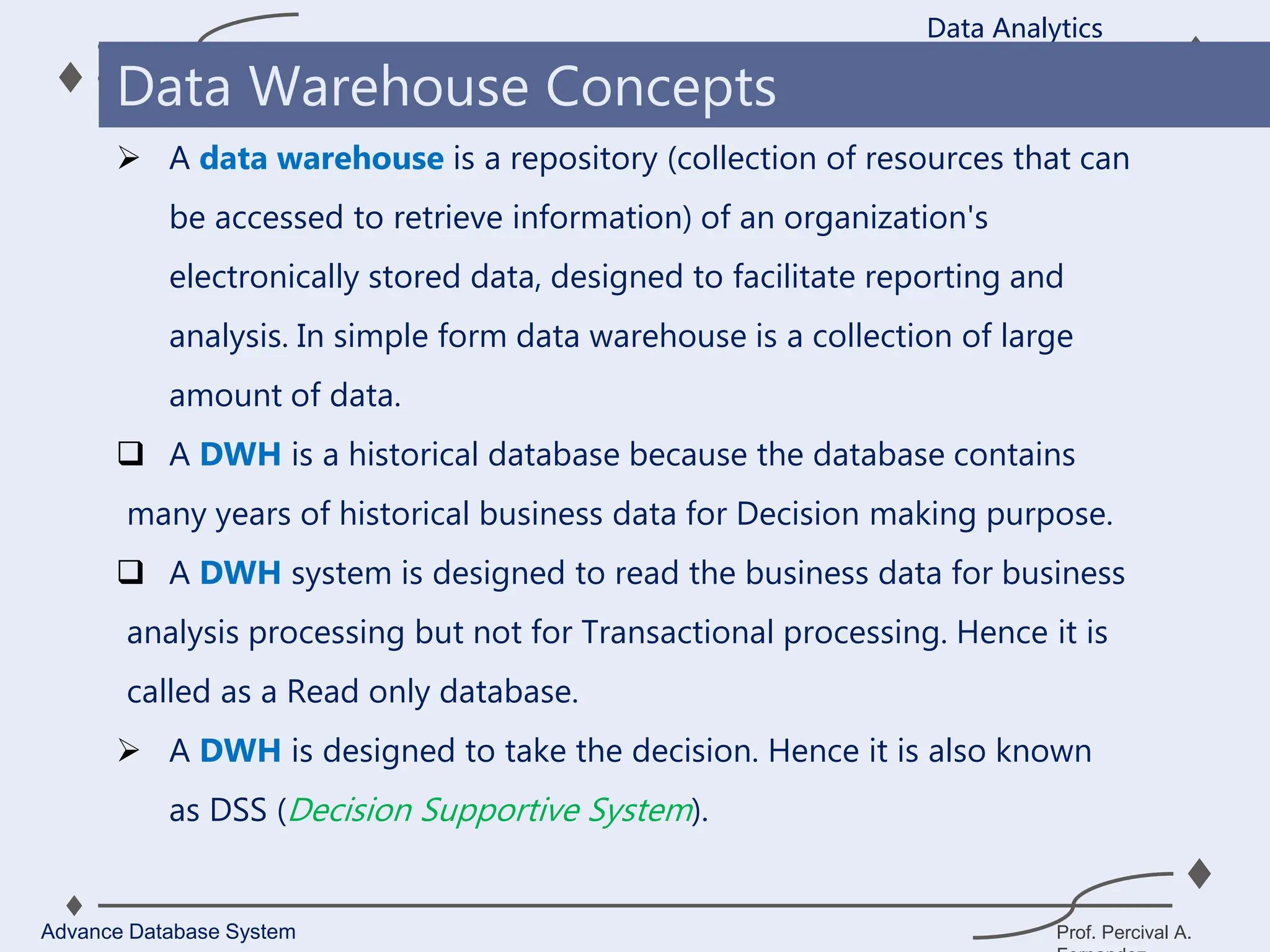
Characteristics of Data Warehouses
https://image2.slideserve.com/4994050/data-warehouse-properties-l.jpg
Prof. Percival A.
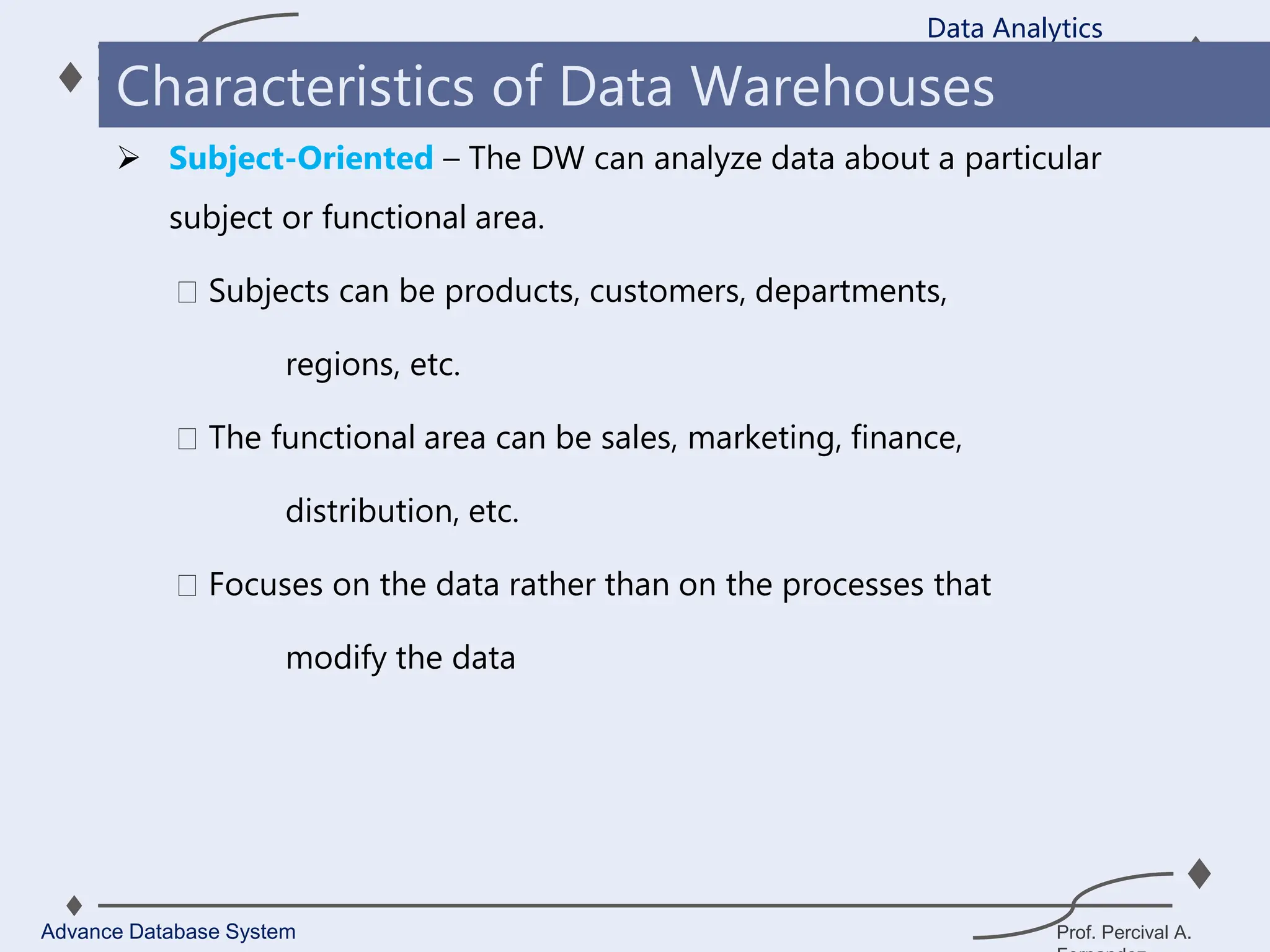
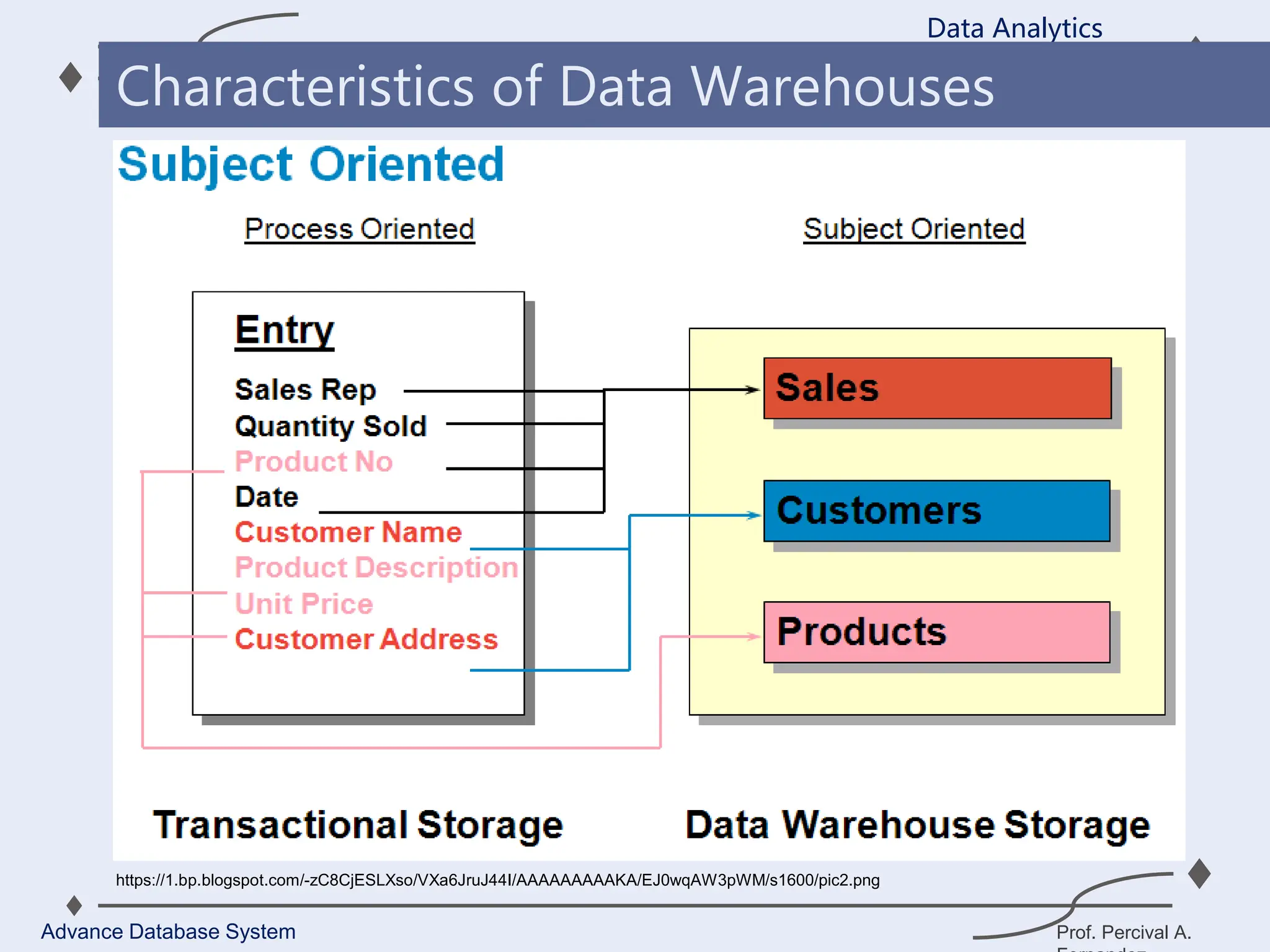
 Subject-Oriented – The DW can analyze data about a particular
subject or functional area.
Subjects can be products, customers, departments,
regions, etc.
The functional area can be sales, marketing, finance,
distribution, etc.
Focuses on the data rather than on the processes that
modify the data
Data Analytics
Advance Database System
Characteristics of Data Warehouses
Prof. Percival A.
Data Analytics
Advance Database System
Characteristics of Data Warehouses
https://1.bp.blogspot.com/-zC8CjESLXso/VXa6JruJ44I/AAAAAAAAAKA/EJ0wqAW3pWM/s1600/pic2.png
Prof. Percival A.
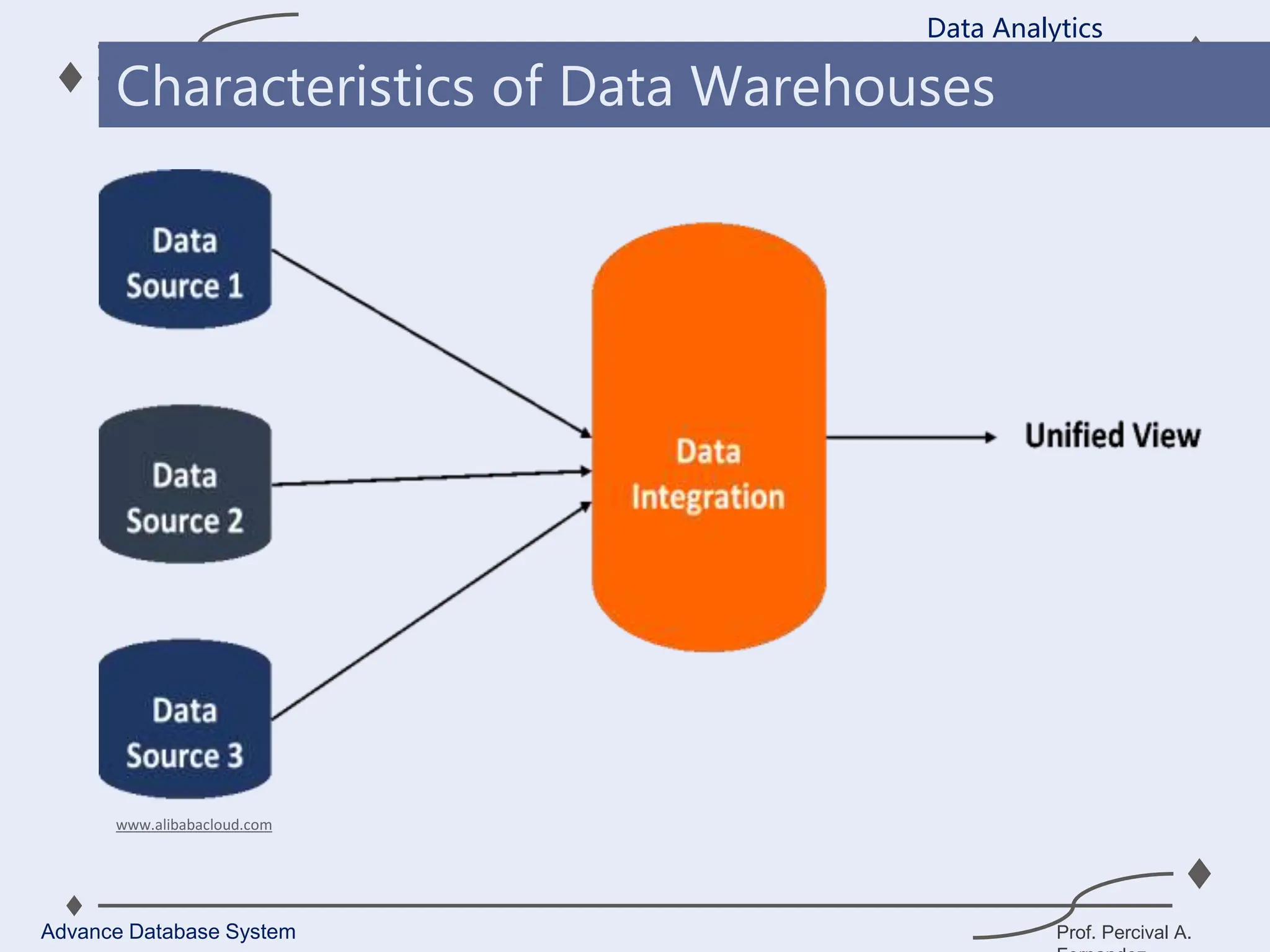
 Integrated – The DW creates consistency among different data
types from different sources.
o Example: A student’s level in the database might be defined as
“freshman”, “sophomore”, “junior”, or “senior” in the accounting
department, and “FR”, “SO”, “JR”, “SR” in the computer information
systems department.
 DW must conform to a common format that is acceptable
throughout the organization.
Data Analytics
Advance Database System
Characteristics of Data Warehouses
Prof. Percival A.
Data Analytics
Advance Database System
Characteristics of Data Warehouses
www.alibabacloud.com
Prof. Percival A.
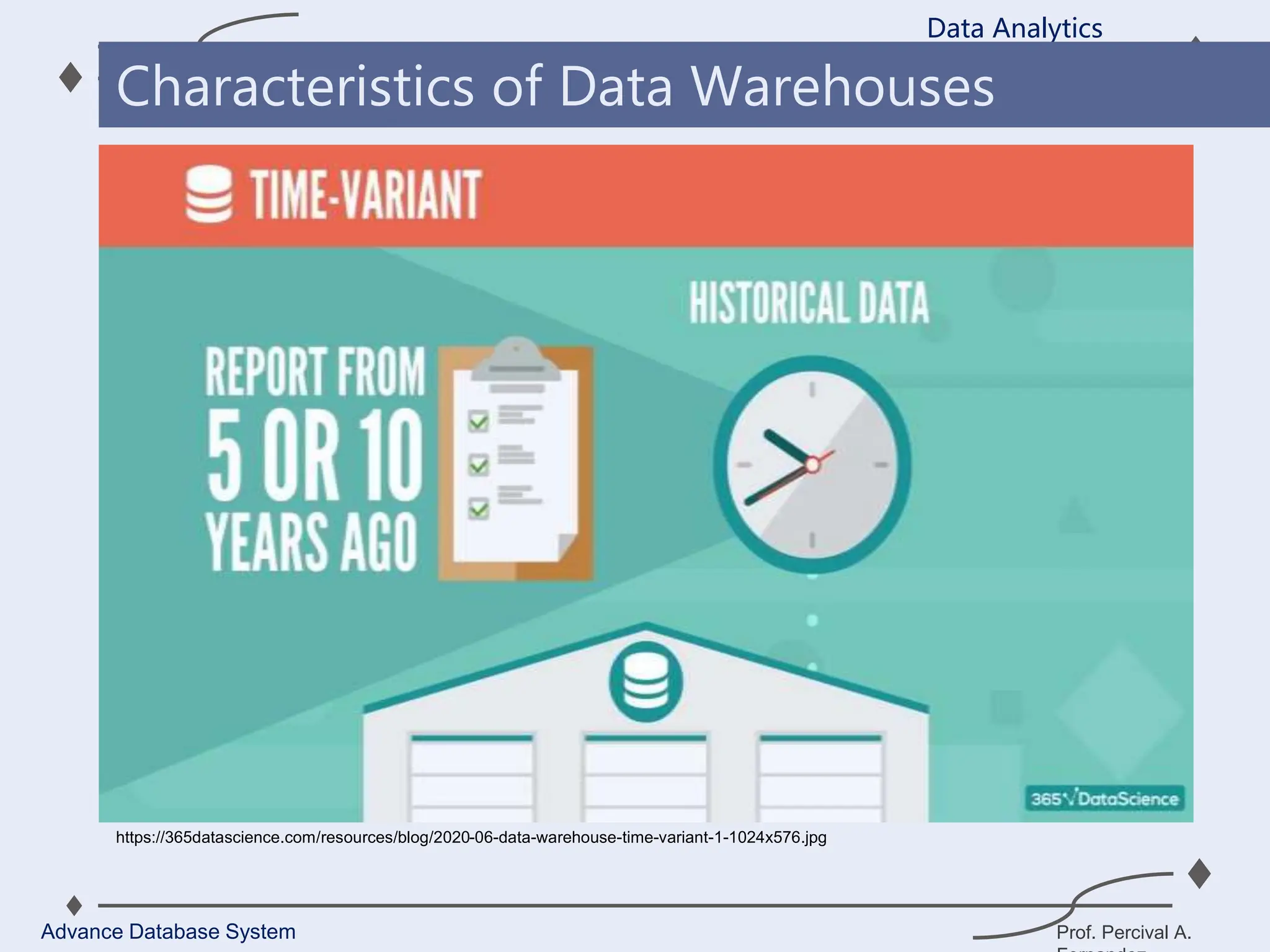
 Time-variant – Data in DW represents the flow of data through
time. It can be organized weekly, monthly, or annually, etc.
o Example: When data for previous weekly sales is uploaded to the
data warehouse, the weekly, monthly, yearly, and other time-
dependent subjects such as products, customers, stores, etc. are
also updated.
Data Analytics
Advance Database System
Characteristics of Data Warehouses
Prof. Percival A.
Data Analytics
Advance Database System
Characteristics of Data Warehouses
https://365datascience.com/resources/blog/2020-06-data-warehouse-time-variant-1-1024x576.jpg
Prof. Percival A.
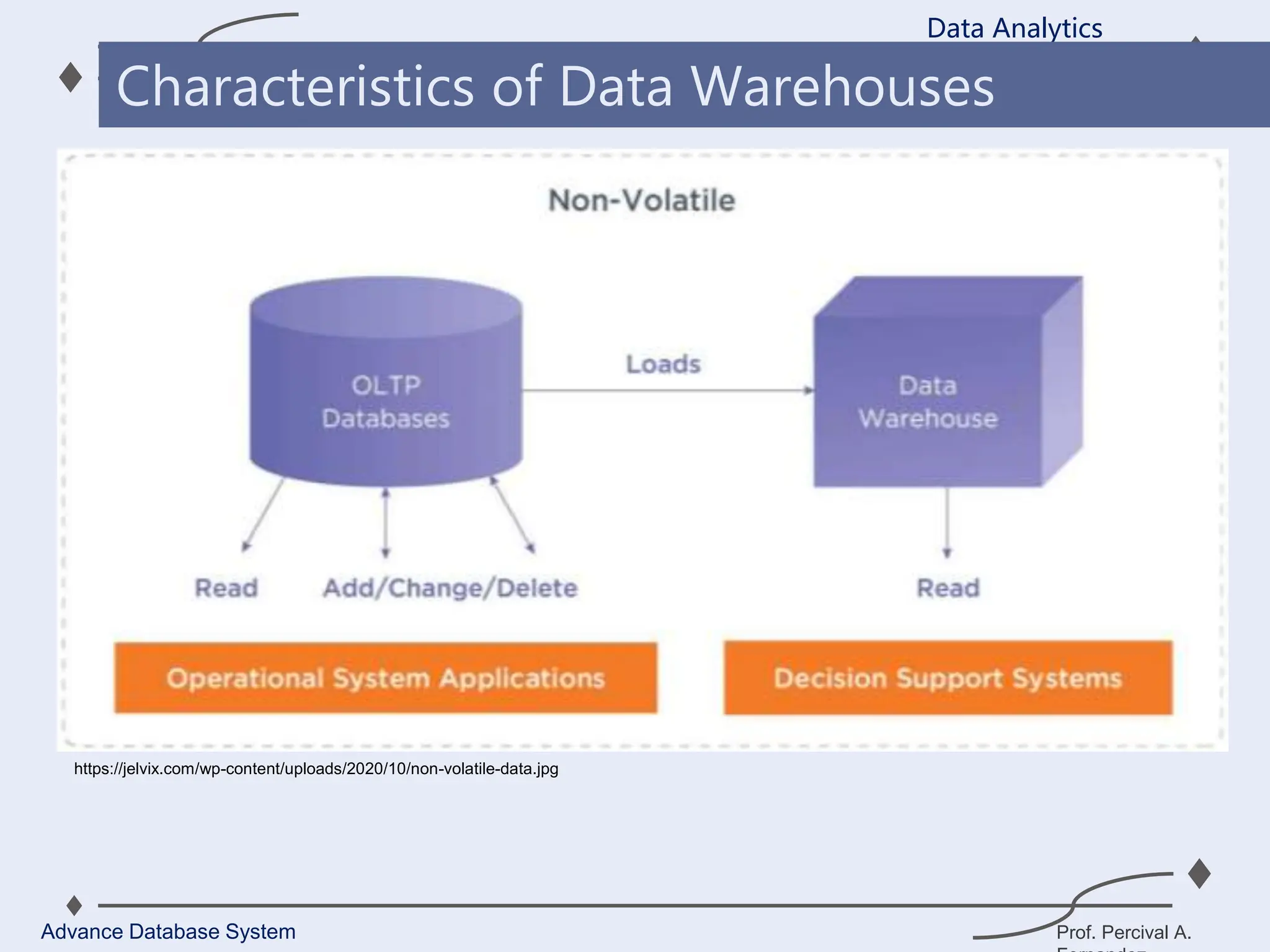
 Non-volatile – Once data is in a data warehouse, it is stable and
does not change.
o Data warehouse is also non-volatile means the previous data is not
erased when new data is entered in it.
o Data is read-only and periodically refreshed. This also helps to
analyze historical data and understand what & when happened. It
does not require transaction process, recovery and concurrency
control mechanisms.
o Activities like delete, update, and insert which are performed in an
operational application environment are omitted in Data
warehouse environment.
Data Analytics
Advance Database System
Characteristics of Data Warehouses
Prof. Percival A.
Data Analytics
Advance Database System
Characteristics of Data Warehouses
https://jelvix.com/wp-content/uploads/2020/10/non-volatile-data.jpg
Prof. Percival A.
 Data Warehouse Database – This is a databank that stocks all
enterprise data and makes it manageable for reporting.
always implemented on the relational database
management system (RDBMS) technology like SQL •
Data Analytics
Advance Database System
Components of Data Warehouse
Prof. Percival A.
Data Analytics
Advance Database System
Components of Data Warehouse
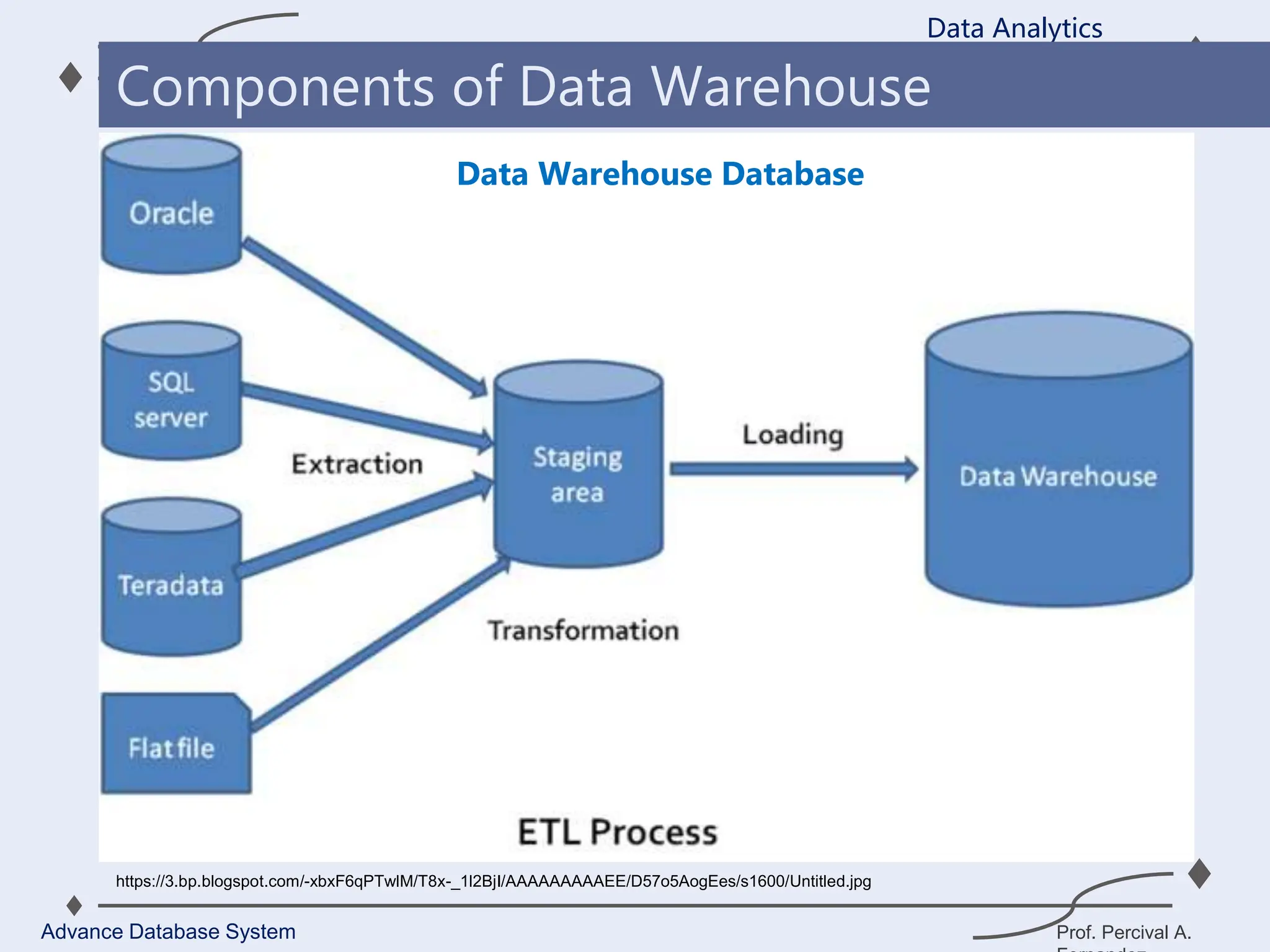
https://3.bp.blogspot.com/-xbxF6qPTwlM/T8x-_1l2BjI/AAAAAAAAAEE/D57o5AogEes/s1600/Untitled.jpg
Data Warehouse Database
Prof. Percival A.
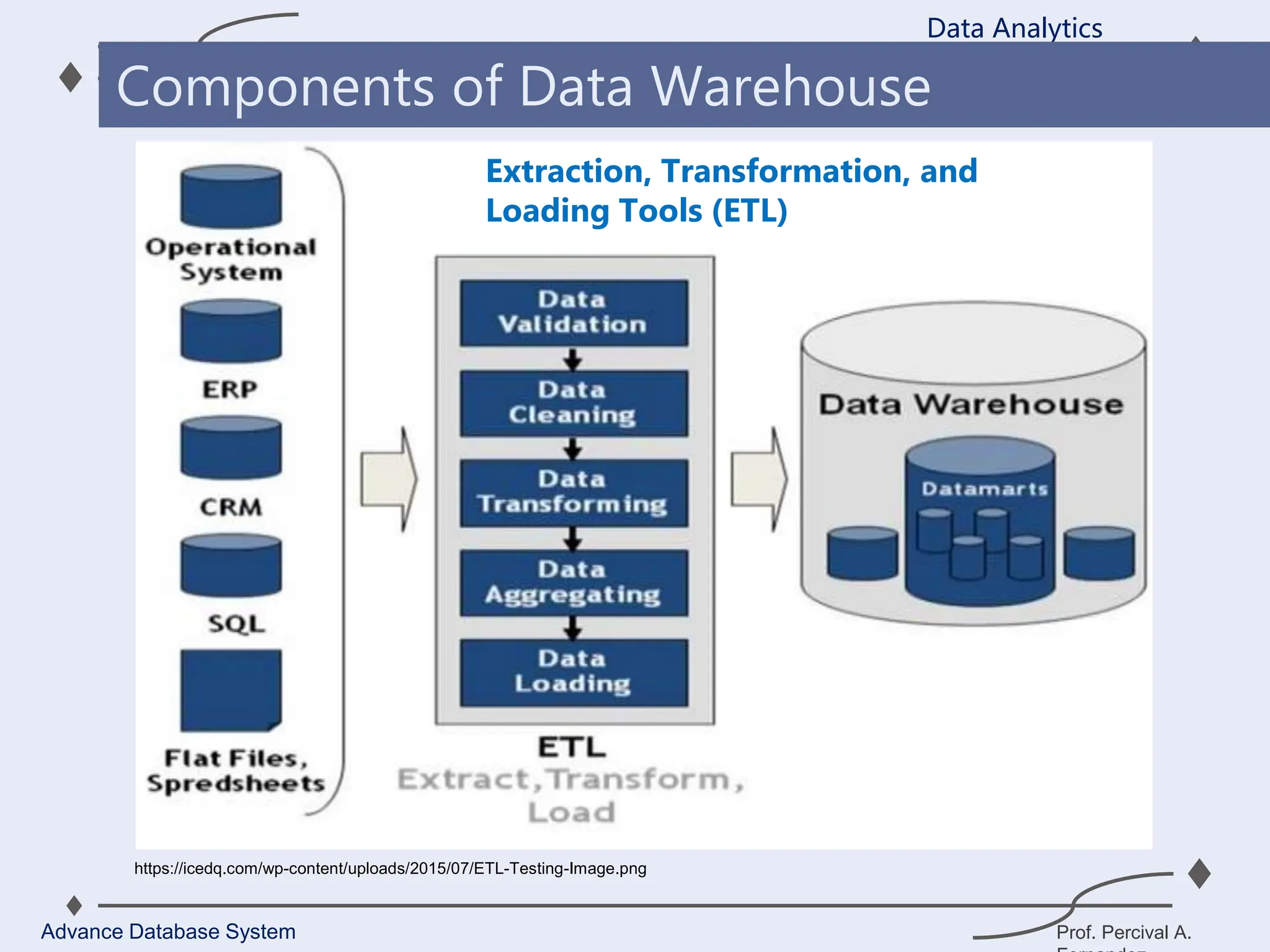
 Extraction, Transformation, and Loading Tools (ETL) – These
tools are used for performing all the conversions, summarizations,
and all the changes needed to transform data into a unified format
in the data warehouse. These include:
In case of missing data, populating them with defaults
Calculating summaries and derived data
Eliminating unwanted data in operational databases from
loading into the data warehouse
Converting to common data names and definitions
Data Analytics
Advance Database System
Components of Data Warehouse
Prof. Percival A.
Data Analytics
Advance Database System
Components of Data Warehouse
https://icedq.com/wp-content/uploads/2015/07/ETL-Testing-Image.png
Extraction, Transformation, and
Loading Tools (ETL)
Prof. Percival A.
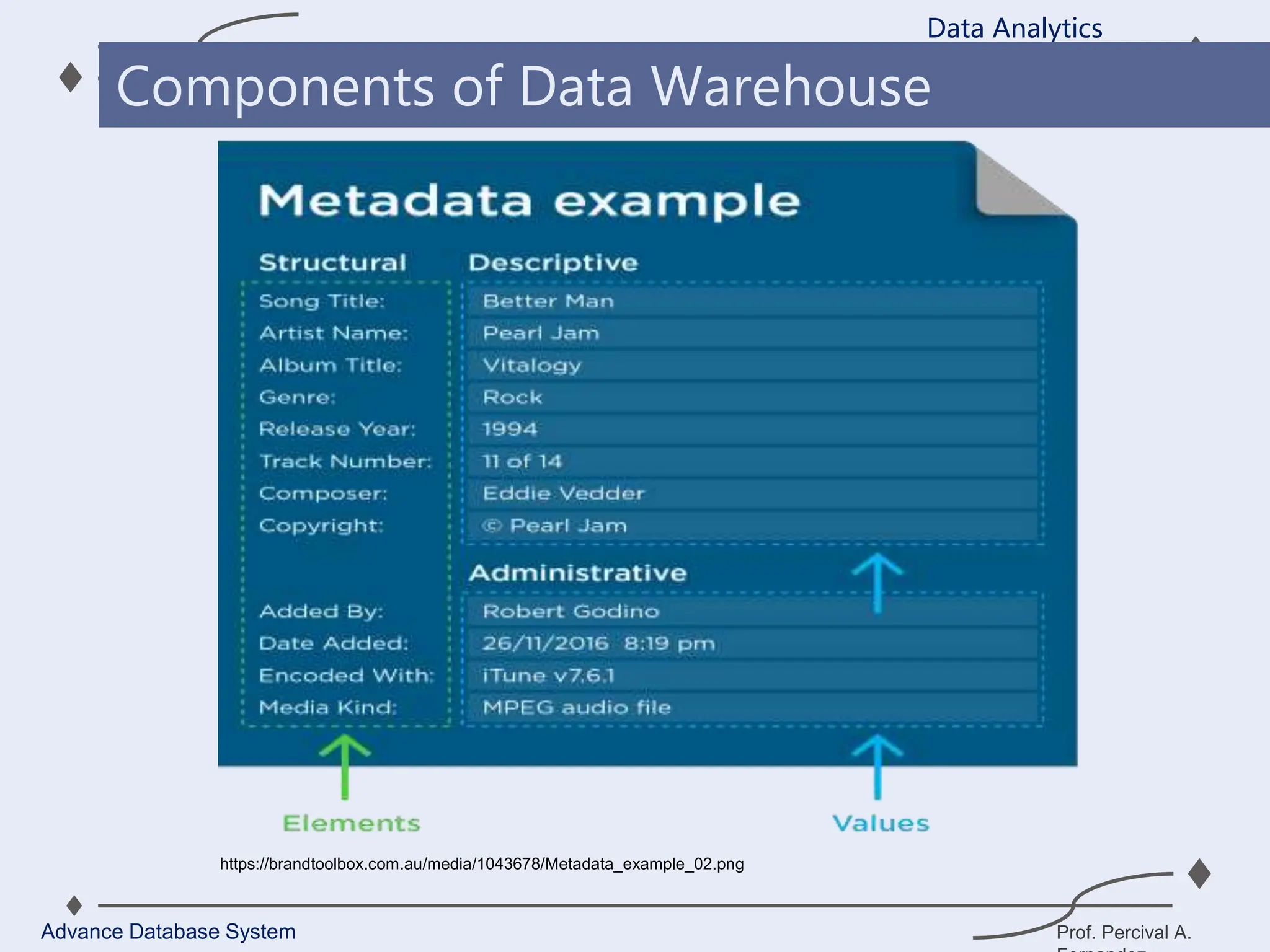
 Metadata – is data about data that describes the data
warehouse. It provides the source, transformation, integration,
storage, usage, relationships, and history of each data element.
o Example: A line in a sales department database contains: SNY-JP-
0010-15000
Data Analytics
Advance Database System
Components of Data Warehouse
Prof. Percival A.
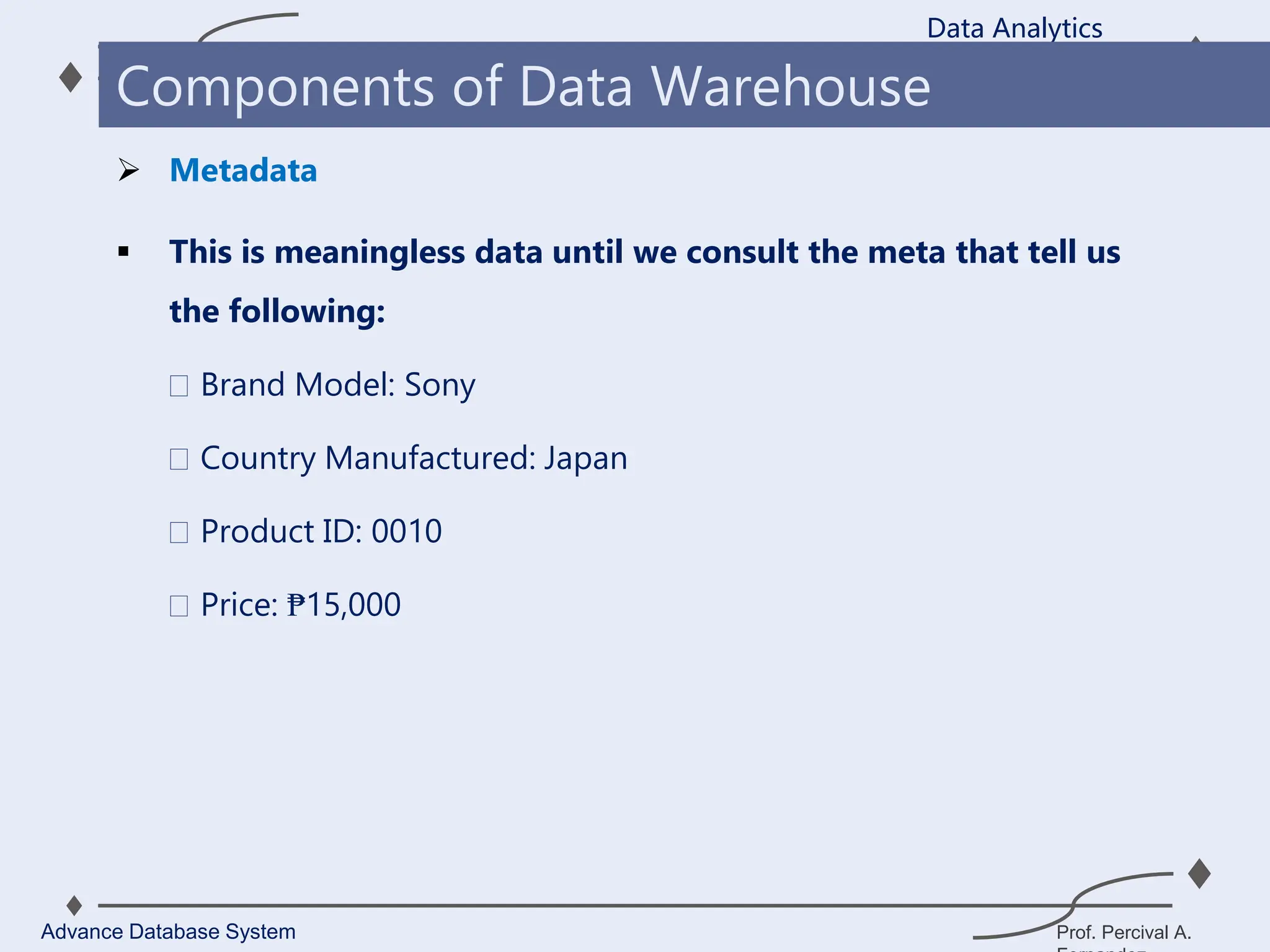
 This is meaningless data until we consult the meta that tell us
the following:
Brand Model: Sony
Country Manufactured: Japan
Product ID: 0010
Price: ₱15,000
Data Analytics
Advance Database System
Components of Data Warehouse
 Metadata
Prof. Percival A.
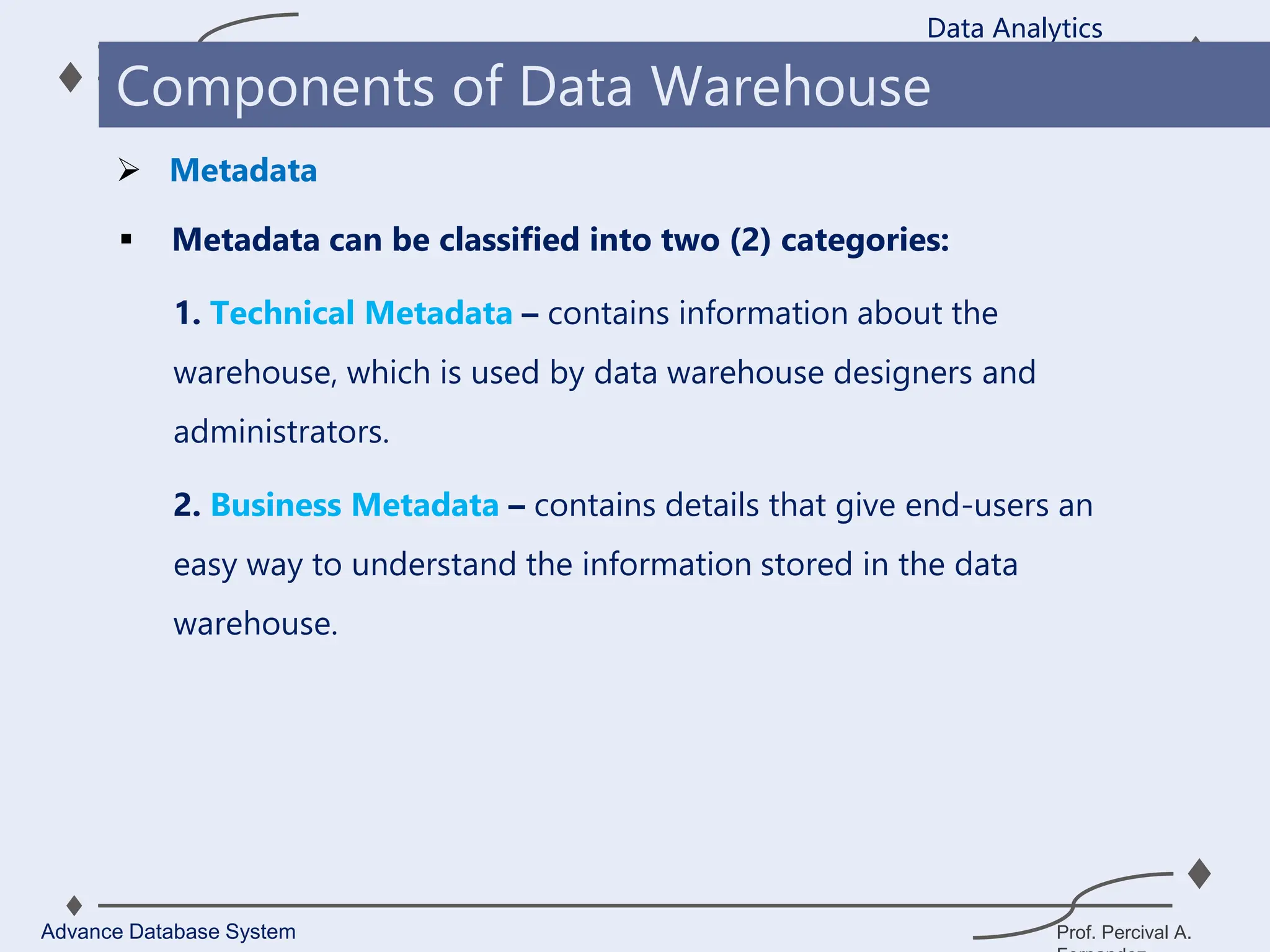
 Metadata can be classified into two (2) categories:
1. Technical Metadata – contains information about the
warehouse, which is used by data warehouse designers and
administrators.
2. Business Metadata – contains details that give end-users an
easy way to understand the information stored in the data
warehouse.
Data Analytics
Advance Database System
Components of Data Warehouse
 Metadata
Prof. Percival A.
Data Analytics
Advance Database System
Components of Data Warehouse
https://brandtoolbox.com.au/media/1043678/Metadata_example_02.png
Prof. Percival A.
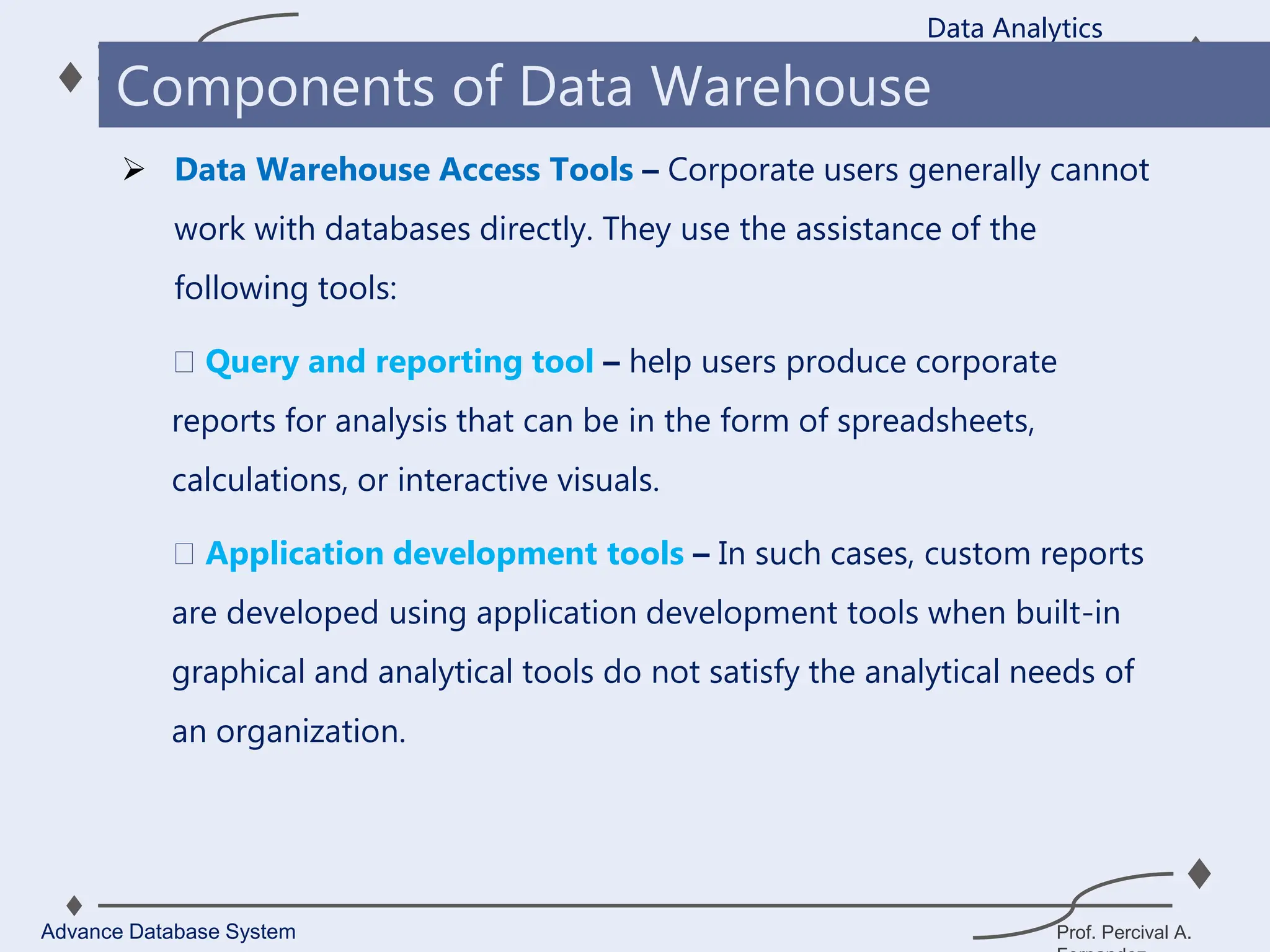
 Data Warehouse Access Tools – Corporate users generally cannot
work with databases directly. They use the assistance of the
following tools:
Query and reporting tool – help users produce corporate
reports for analysis that can be in the form of spreadsheets,
calculations, or interactive visuals.
Application development tools – In such cases, custom reports
are developed using application development tools when built-in
graphical and analytical tools do not satisfy the analytical needs of
an organization.
Data Analytics
Advance Database System
Components of Data Warehouse
Prof. Percival A.
Data mining – a process of discovering meaningful new
correlations, patterns, and trends by mining a large amount of
data. Data mining tools are used to make this process automatic.
OLAP tools – allow users to analyze the data using elaborate
and complex multi-dimensional views.
Data Analytics
Advance Database System
Components of Data Warehouse
Prof. Percival A.
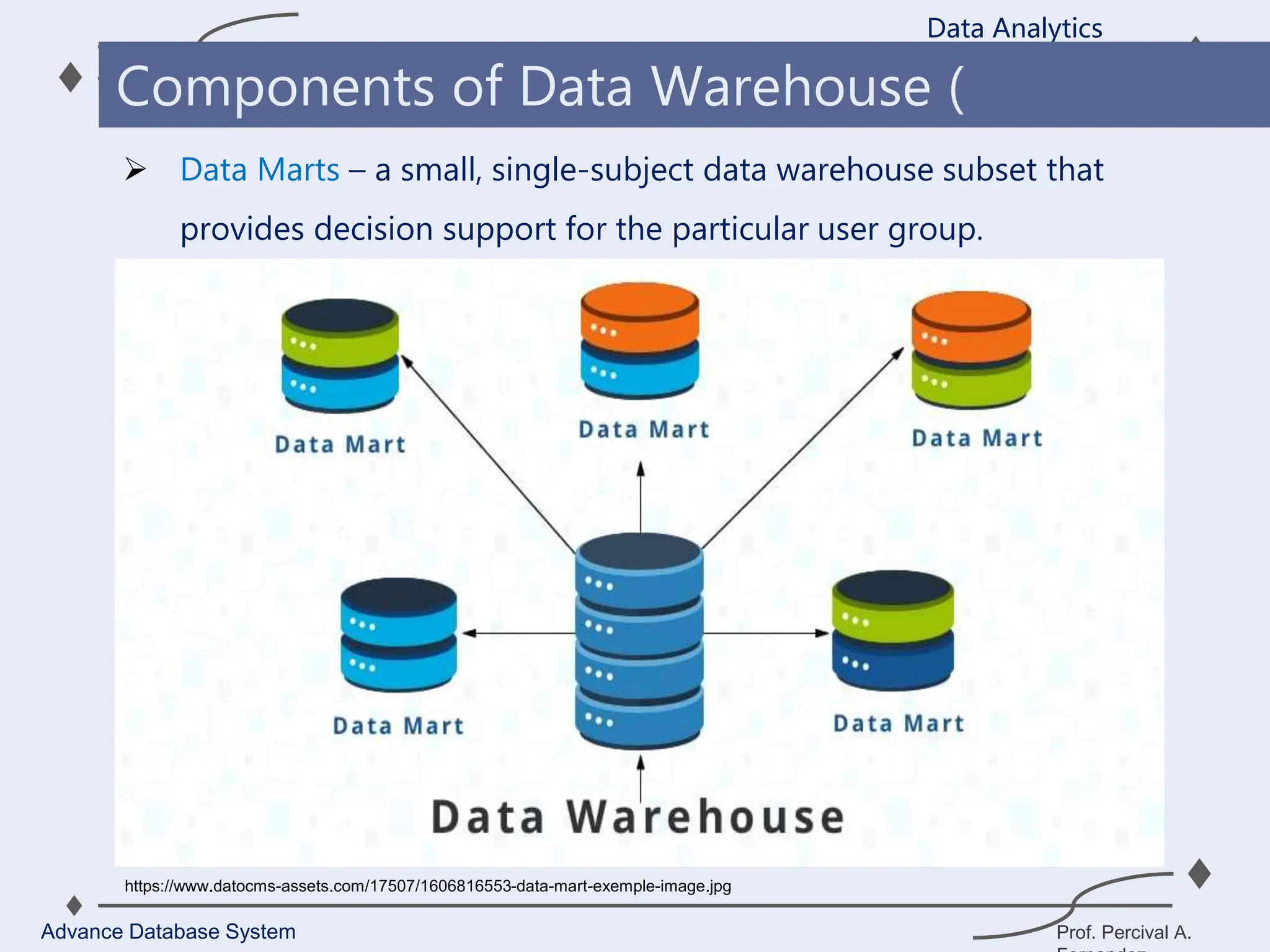
 Data Marts – a small, single-subject data warehouse subset that
provides decision support for the particular user group.
Data Analytics
Advance Database System
Components of Data Warehouse (
https://www.datocms-assets.com/17507/1606816553-data-mart-exemple-image.jpg
Prof. Percival A.
Data Analytics
Advance Database System
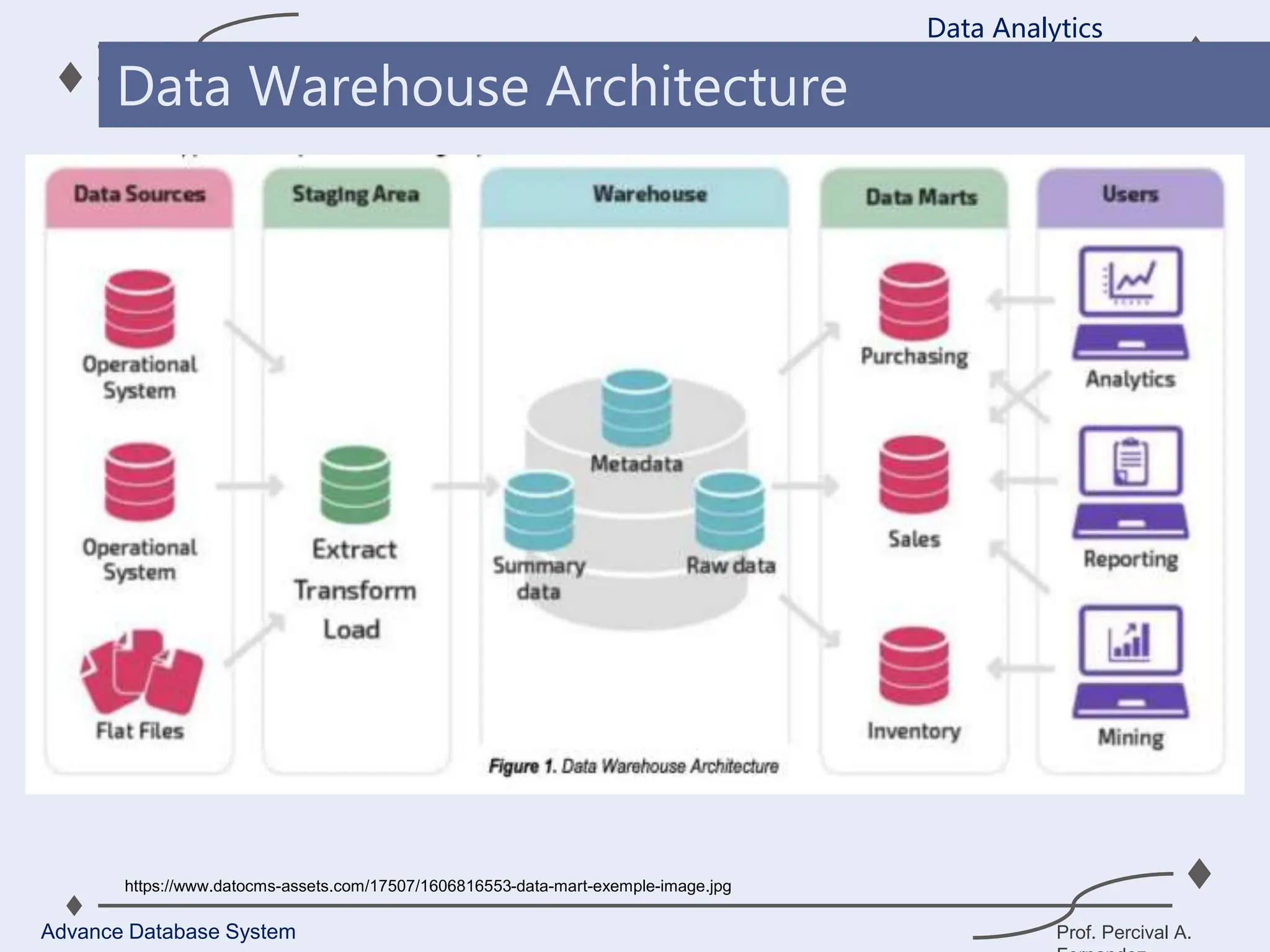
Data Warehouse Architecture
https://www.datocms-assets.com/17507/1606816553-data-mart-exemple-image.jpg
Prof. Percival A.
1. Allows business users to quickly access critical data from some
sources all in one place. Therefore, it saves the user's time of
retrieving data from multiple sources
2. Provides consistent information on various cross-functional
activities. It is also supporting ad-hoc reporting and query.
3. Helps to integrate many sources of data to reduce stress on the
production system
4. Helps to reduce total turnaround time for analysis and reporting
5. Restructuring and integration make it easier for the user to use
for reporting and analysis.
6. Stores a large amount of historical data. This helps users to
analyze different time periods and trends to make future
predictions.
Data Analytics
Advance Database System
Benefits of Data Warehouse
Prof. Percival A.
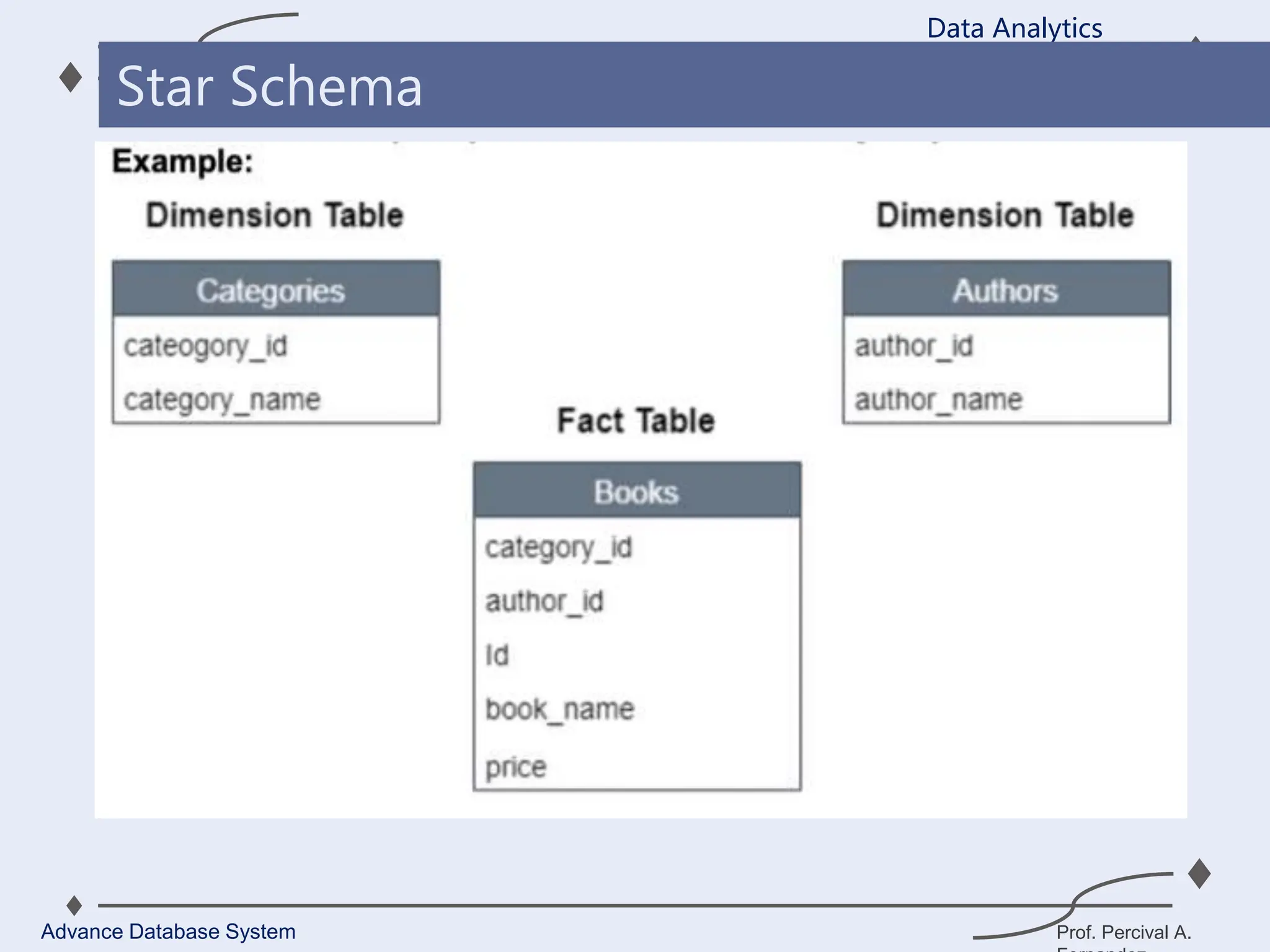
 A star schema is a data-modeling technique used to map multi-
dimensional decision support data into a relational database.
 It has two (2) common components:
Facts table – are data that will be included in reports and used
as the basis of business decisions. It contains measurement or
facts to the data and foreign key to dimension table.
Dimension table – are attributes that qualify and provide more
information about facts. It contains dimensions of a fact and they
are joined to fact table via foreign key.
Data Analytics
Advance Database System
Star Schema
Prof. Percival A.
Data Analytics
Advance Database System
Star Schema
Prof. Percival A.
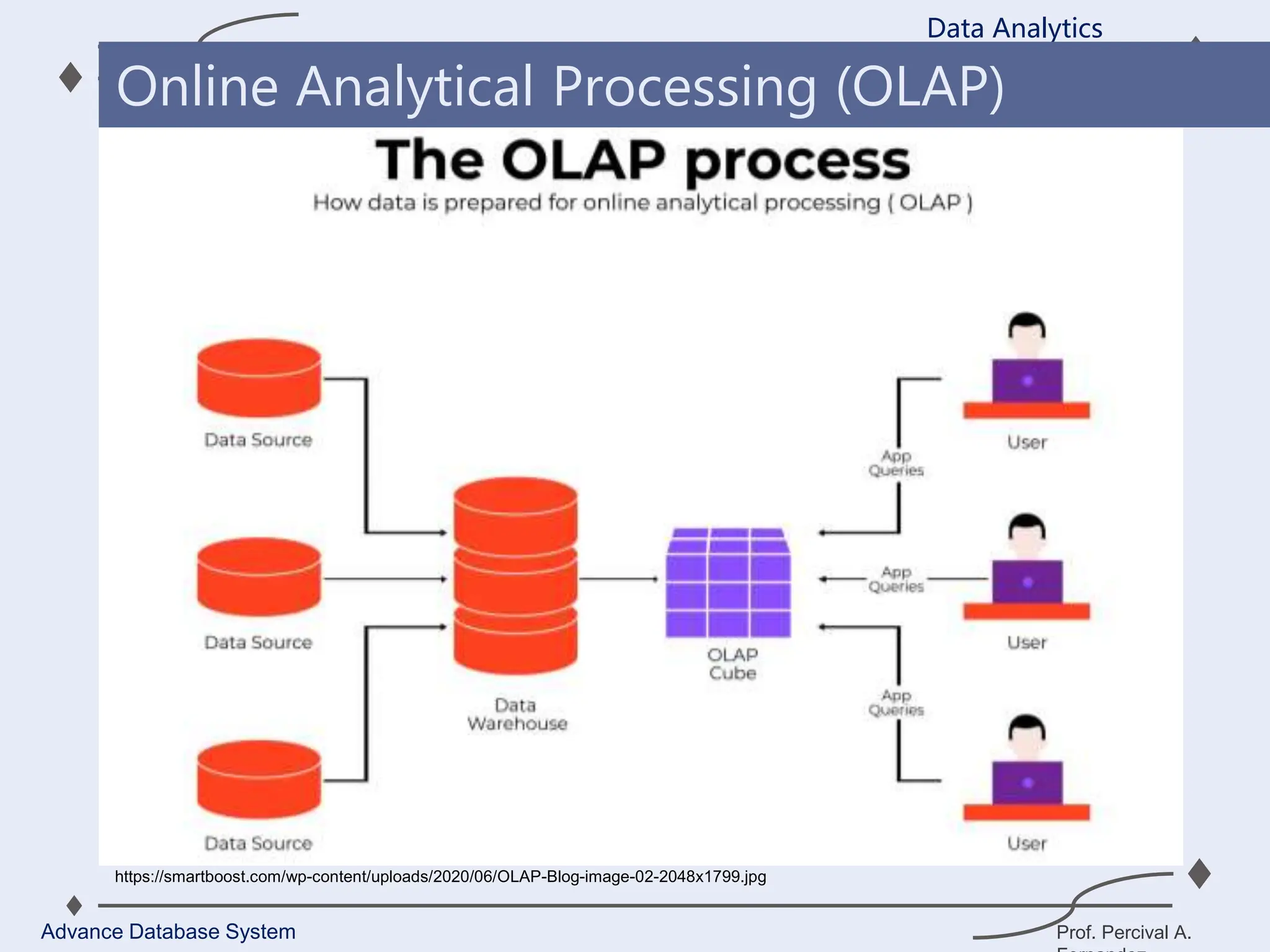
 Online Analytical Processing (OLAP)
a software tool that is used for data analysis and reporting
purposes for business decisions
used by business analysts, managers, and executives.
o Example: In Netflix, OLAP was used for movie recommendations
based on watch history.
Data Analytics
Advance Database System
Online Analytical Processing (OLAP)
Prof. Percival A.
Data Analytics
Advance Database System
Online Analytical Processing (OLAP)
https://smartboost.com/wp-content/uploads/2020/06/OLAP-Blog-image-02-2048x1799.jpg
Prof. Percival A.
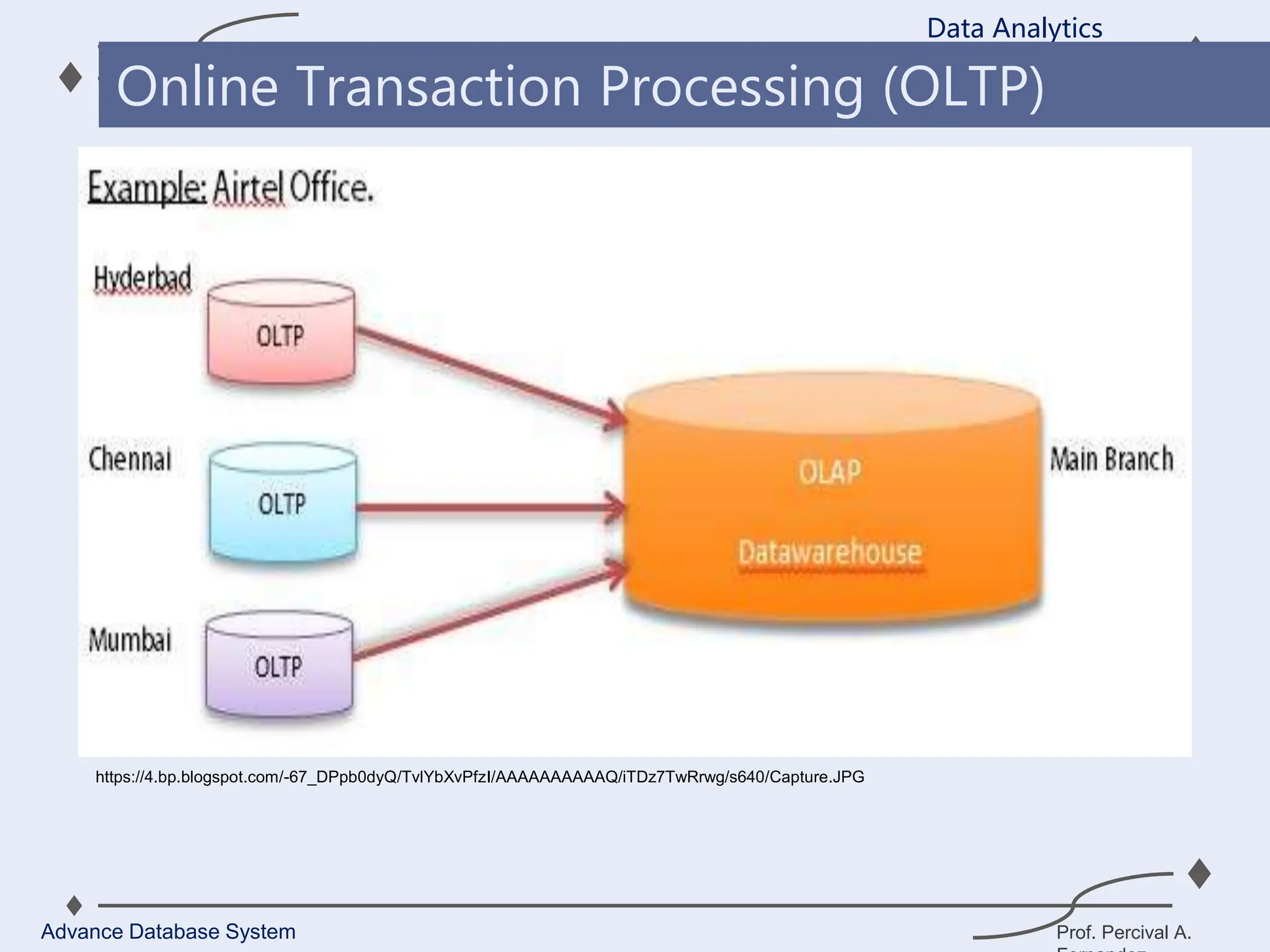
 Online Transaction Processing (OLTP)
an operational system that manages the day-to-day
transactions of an organization
used by the Database Administrator (DBA) and Database
Professionals
o Example: In ATM centers, OLTP is used for money withdrawals,
transfers, deposits, and inquiries.
Data Analytics
Advance Database System
Online Transaction Processing (OLTP)
Prof. Percival A.
Data Analytics
Advance Database System
Online Transaction Processing (OLTP)
https://4.bp.blogspot.com/-67_DPpb0dyQ/TvlYbXvPfzI/AAAAAAAAAAQ/iTDz7TwRrwg/s640/Capture.JPG
Prof. Percival A.
Data Analytics
Advance Database System
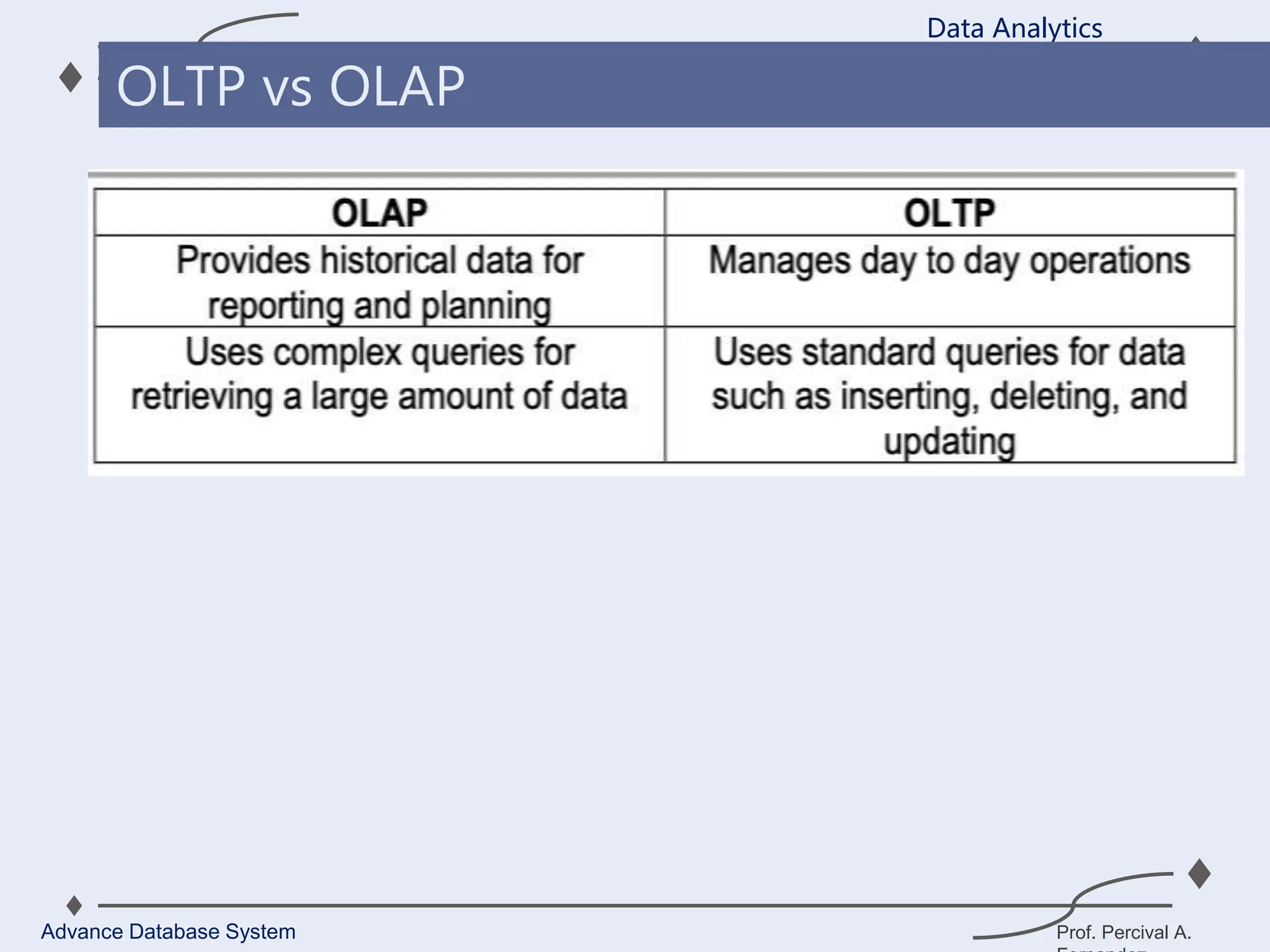
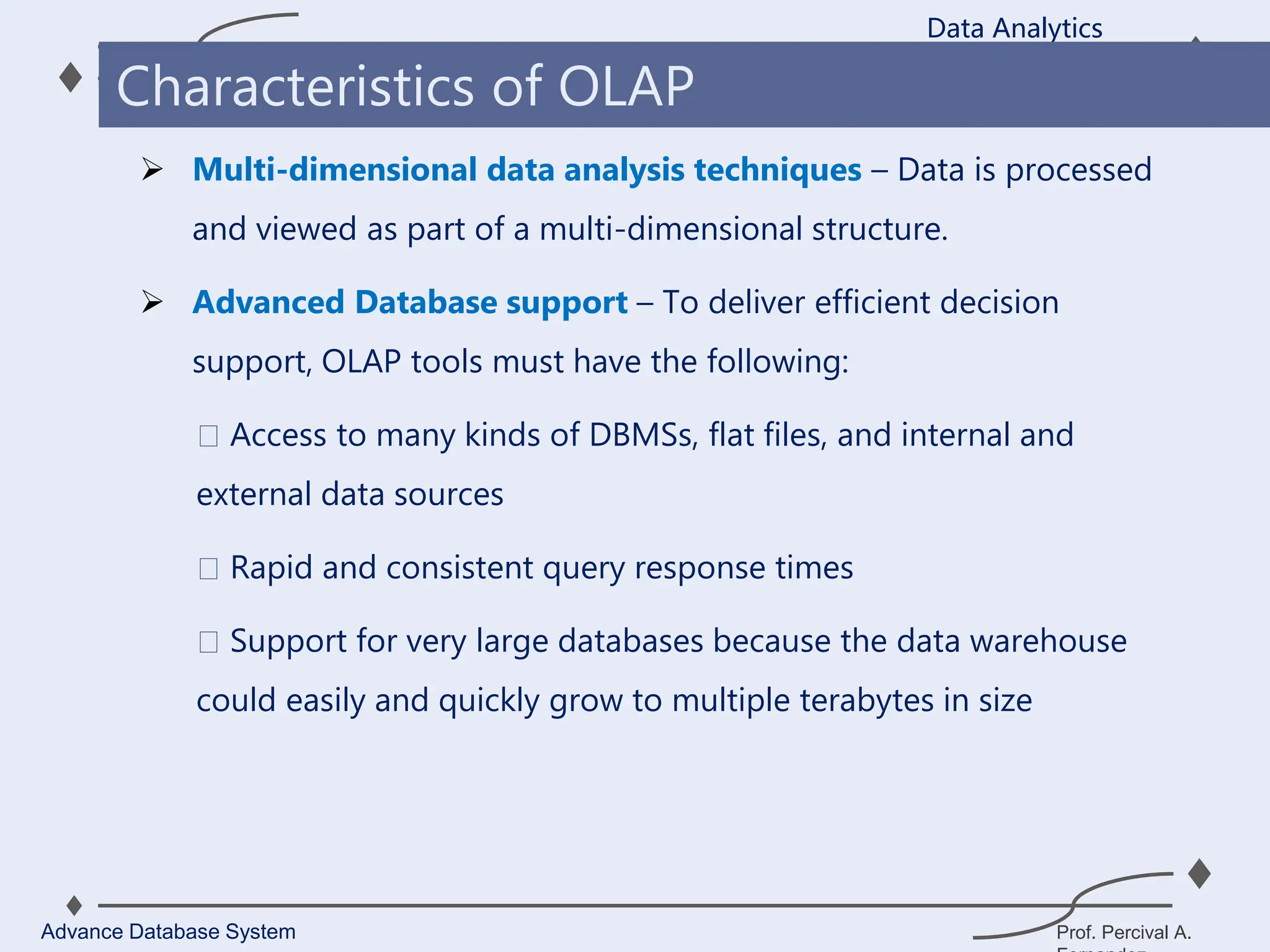
OLTP vs OLAP
Prof. Percival A.
Data Analytics
Advance Database System
OLTP vs OLAP
Prof. Percival A.
Data Analytics
Advance Database System
OLTP vs OLAP
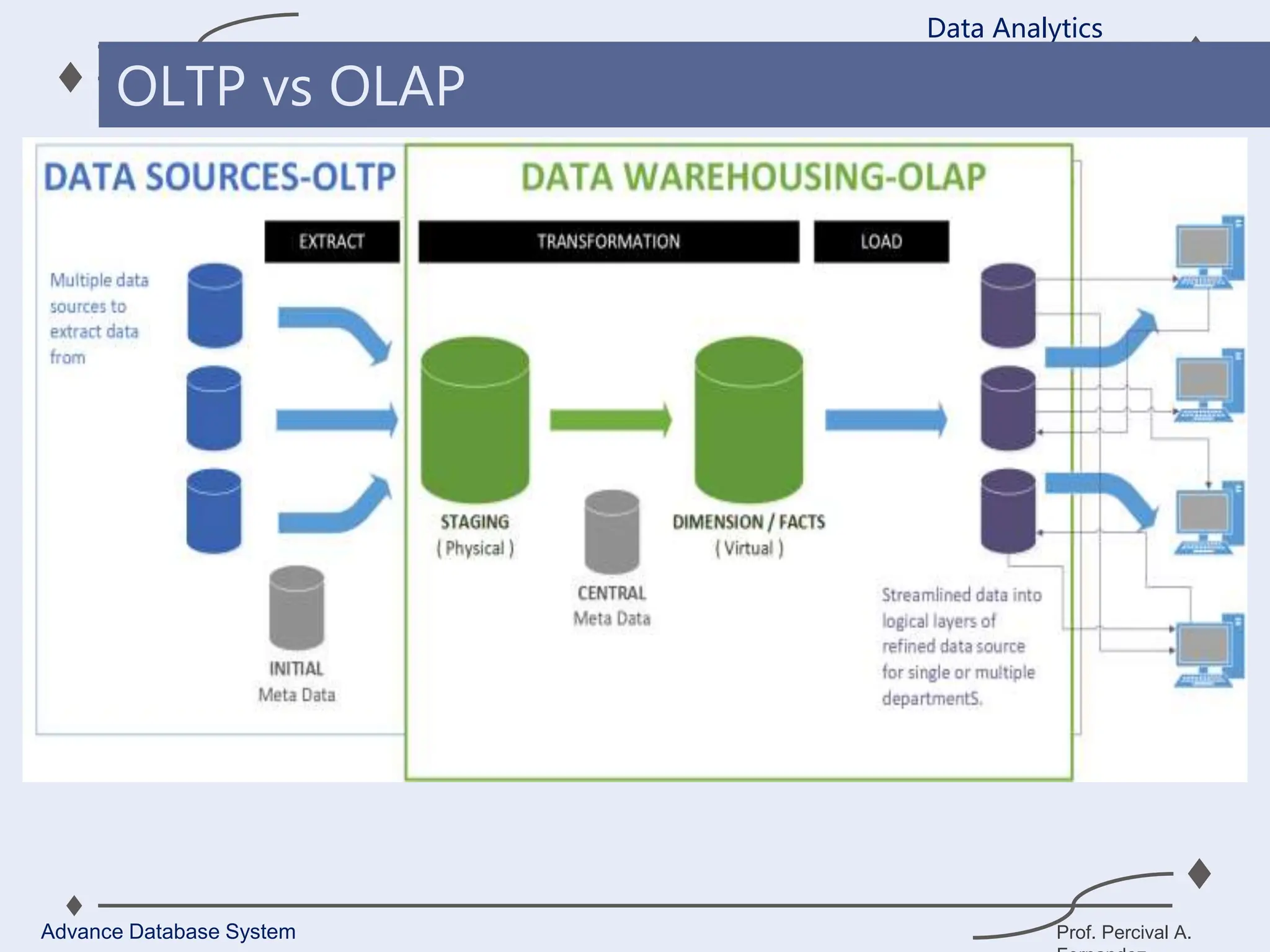
https://miro.medium.com/v2/resize:fit:1400/1*kDxyqz9MqDuFb5AyYu53AA.png
Prof. Percival A.
Data Analytics
Advance Database System
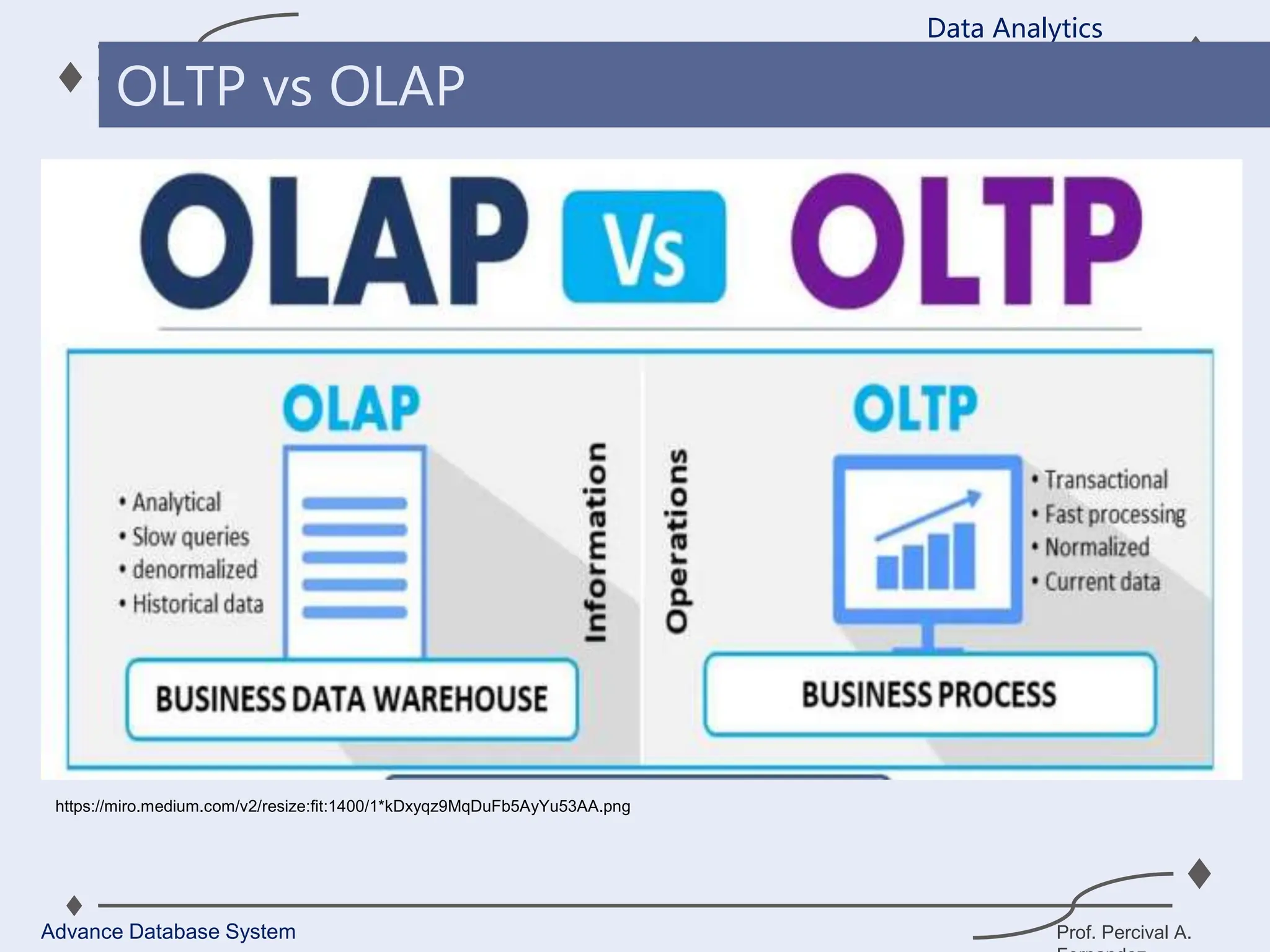
OLTP vs OLAP
https://i.pinimg.com/originals/71/99/13/719913456c15c1fe0870b1496c399bc3.png
Prof. Percival A.
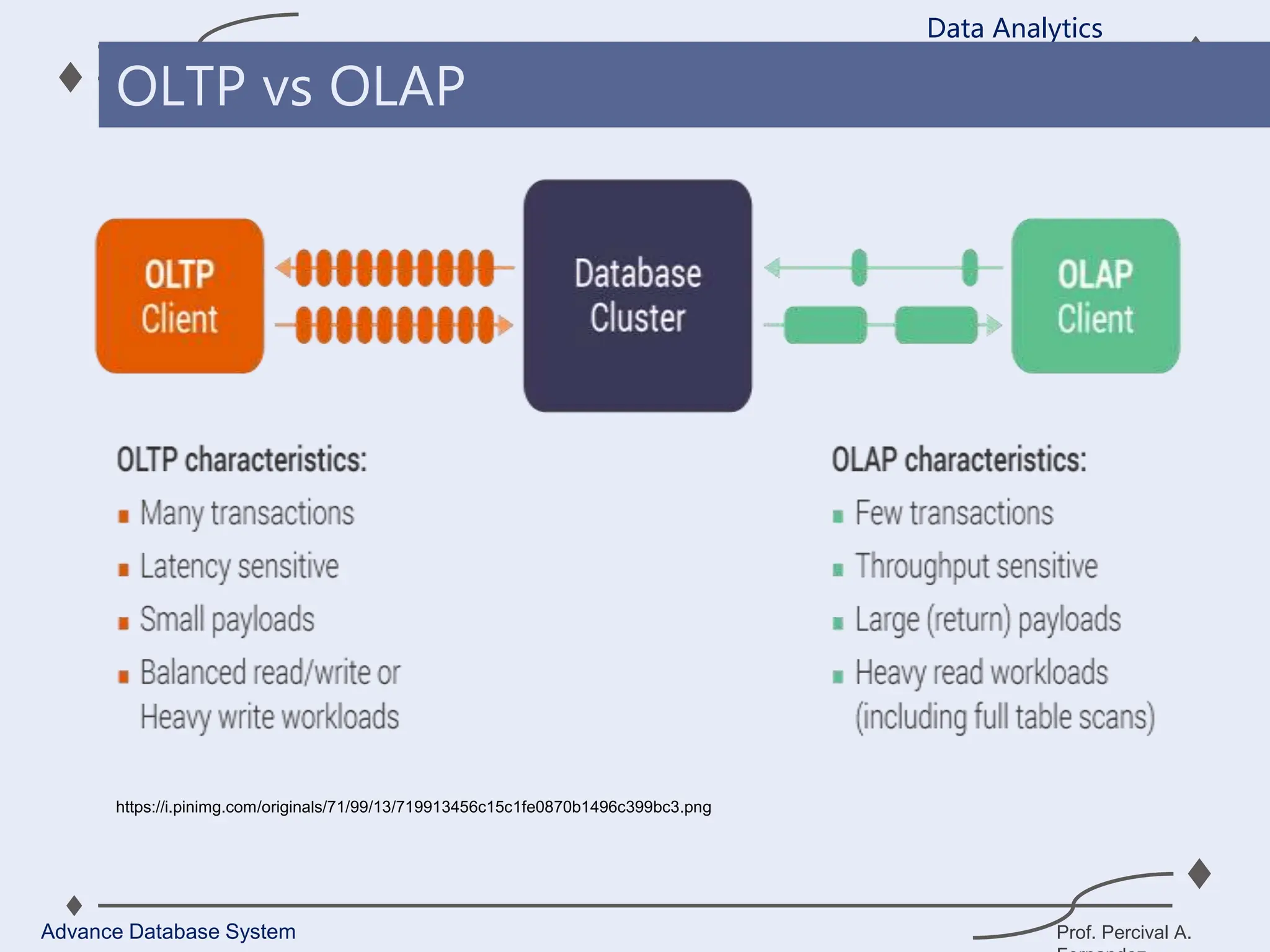
 Multi-dimensional data analysis techniques – Data is processed
and viewed as part of a multi-dimensional structure.
 Advanced Database support – To deliver efficient decision
support, OLAP tools must have the following:
Access to many kinds of DBMSs, flat files, and internal and
external data sources
Rapid and consistent query response times
Support for very large databases because the data warehouse
could easily and quickly grow to multiple terabytes in size
Data Analytics
Advance Database System
Characteristics of OLAP
Prof. Percival A.
 Easy-to-use end-user interfaces – permit the user to navigate the
data in a way that simplifies and accelerates decision making or
data analysis with easy-to-use graphical interfaces
Data Analytics
Advance Database System
Characteristics of OLAP
Prof. Percival A.
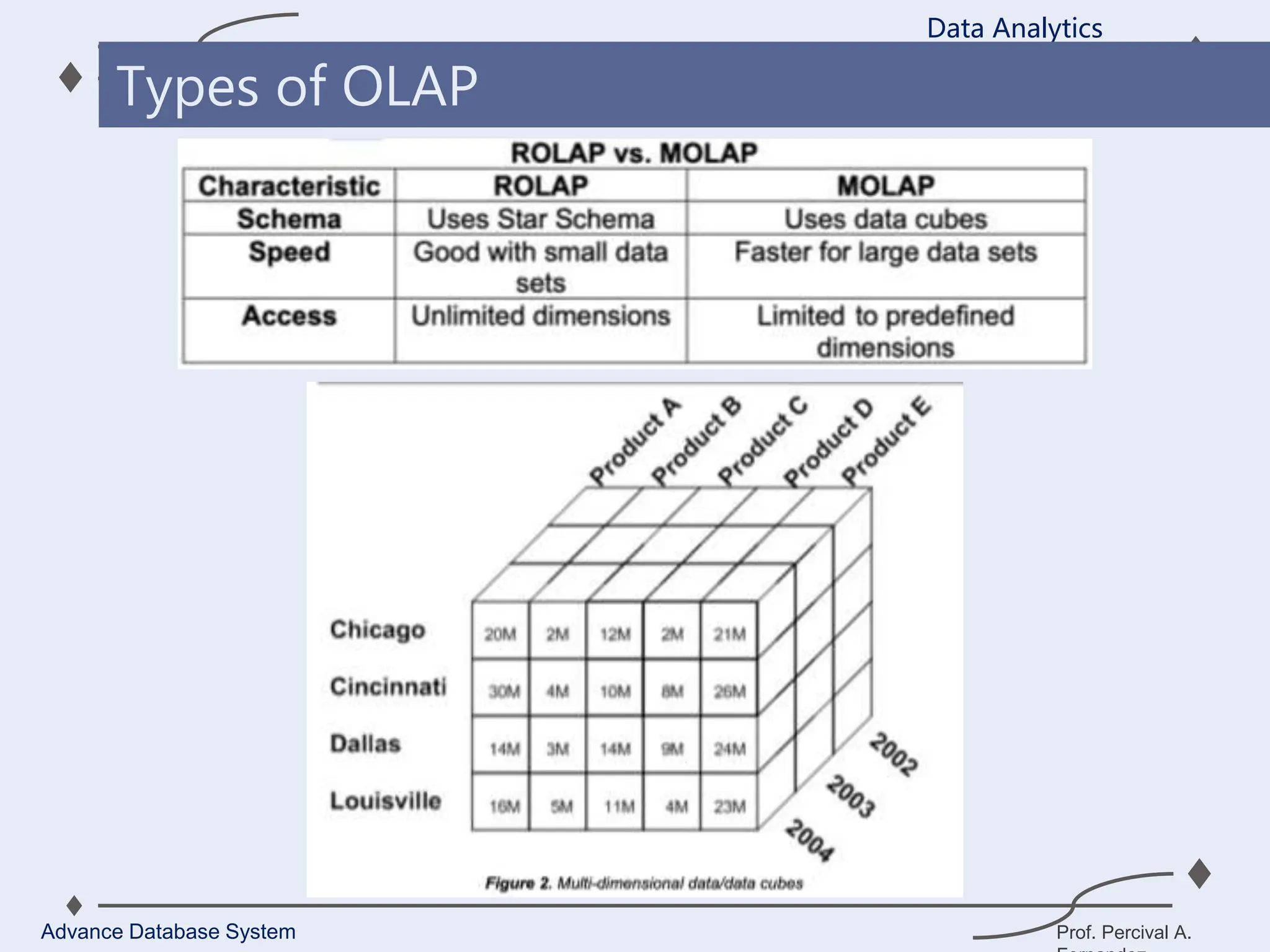
 Relational OLAP (ROLAP)
Works directly with relational databases
Fact and dimension tables are stored as relations.
 Multi-dimensional OLAP (MOLAP)
extends OLAP functionality to multi-dimensional database
management systems (MDBMS)
best suited to manage, store, and analyze multi-dimensional
data
Data Analytics
Advance Database System
Types of OLAP
Prof. Percival A.
Data Analytics
Advance Database System
Types of OLAP
Prof. Percival A.
 SQL has been enhanced with analytic functions that support
OLAP-type processing. This includes:
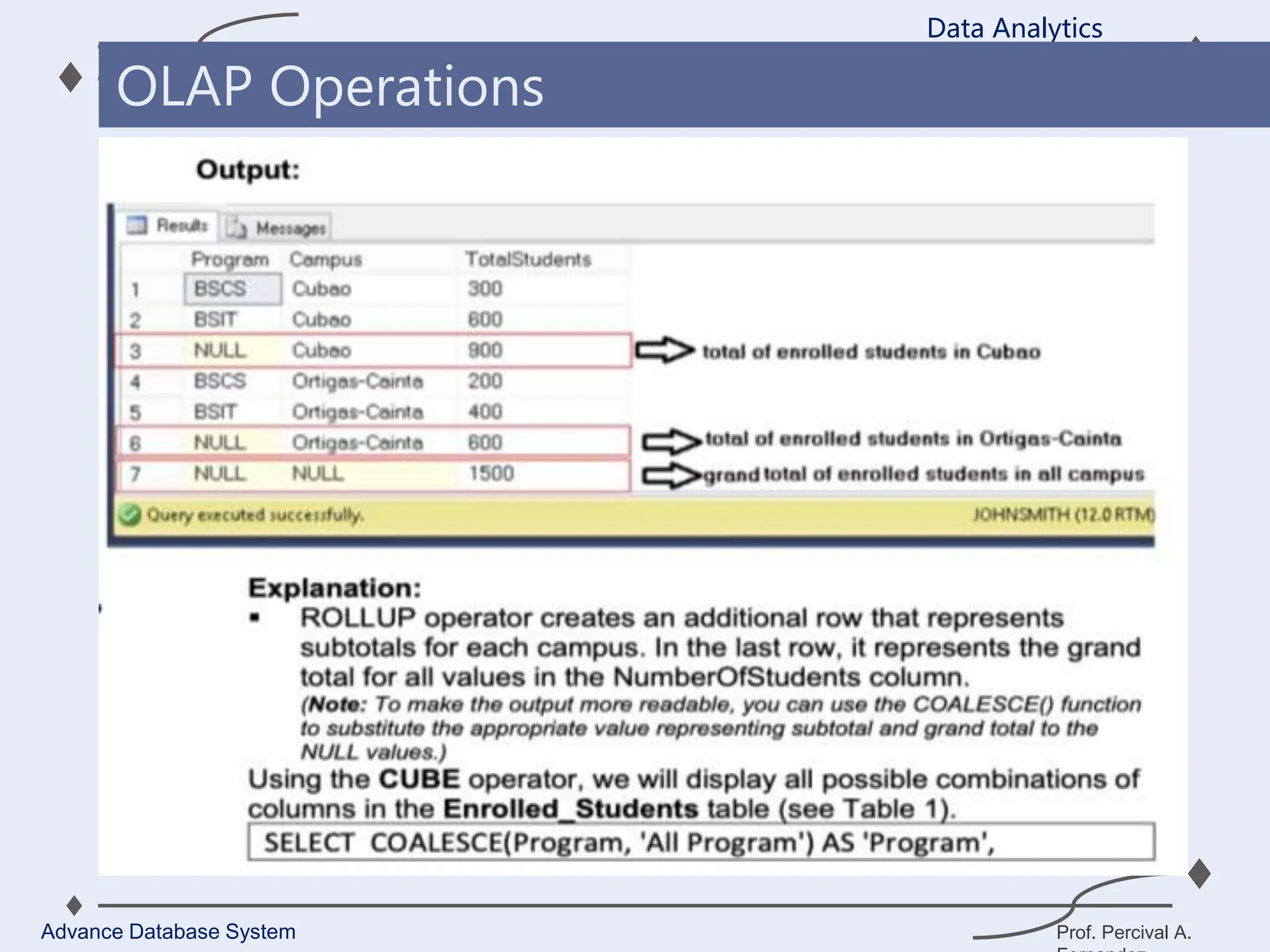
 ROLLUP operator – an extension of the GROUP BY clause that is
used to create subtotals and grand totals for a set of columns
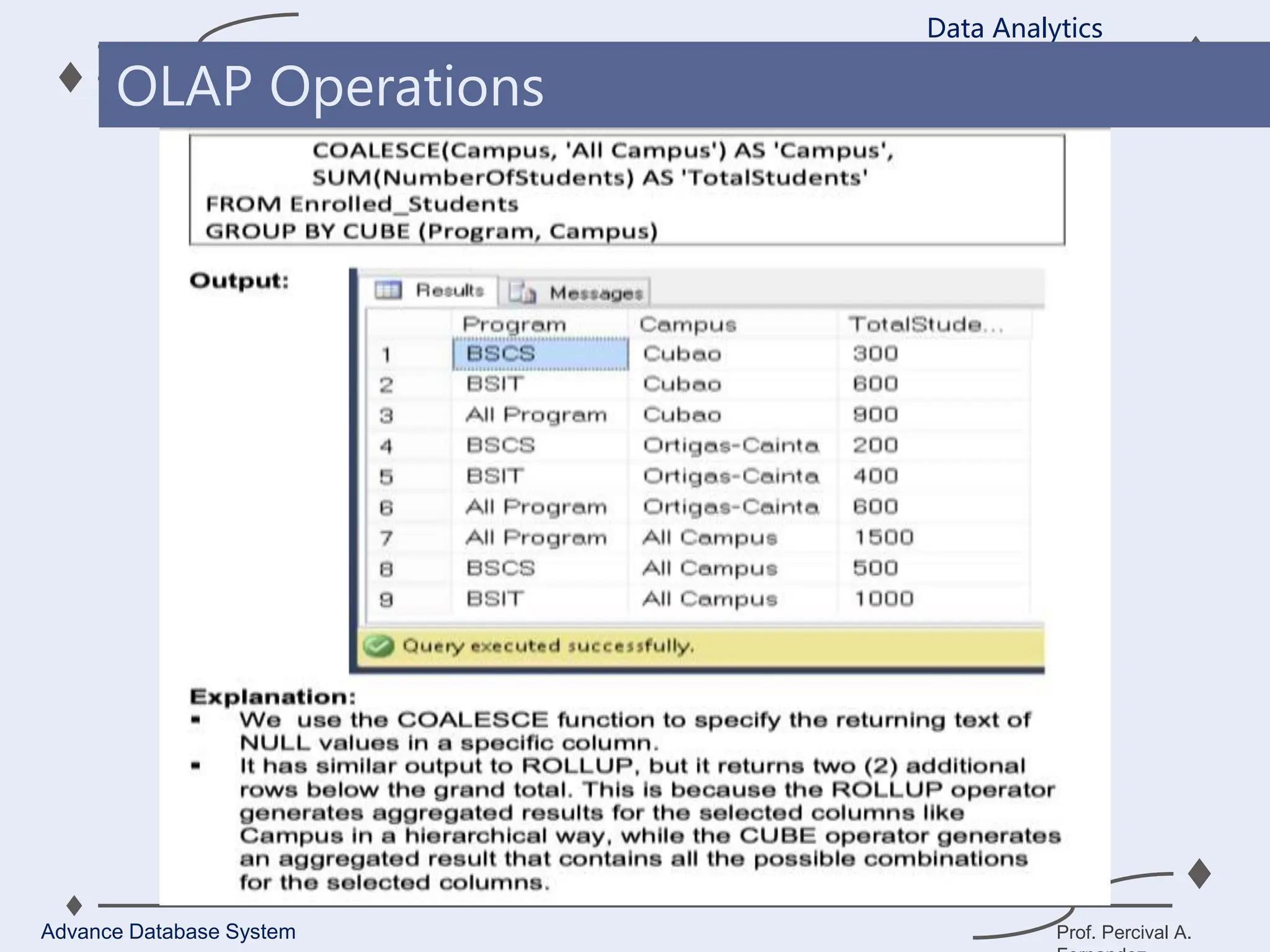
 CUBE operator – Like ROLLUP, this generates subtotals for all the
combinations of grouping column s specified in the GROUP BY
clause.
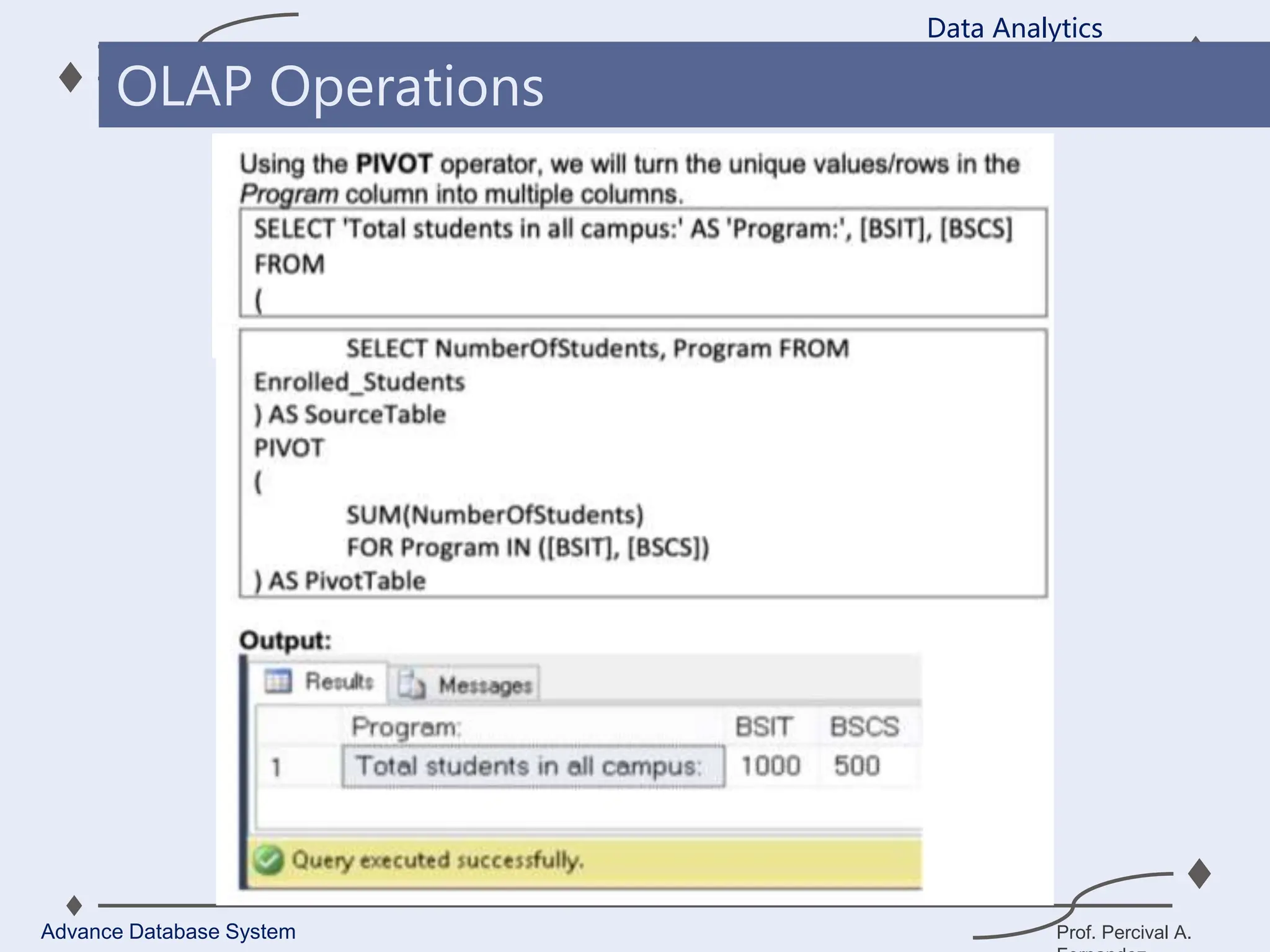
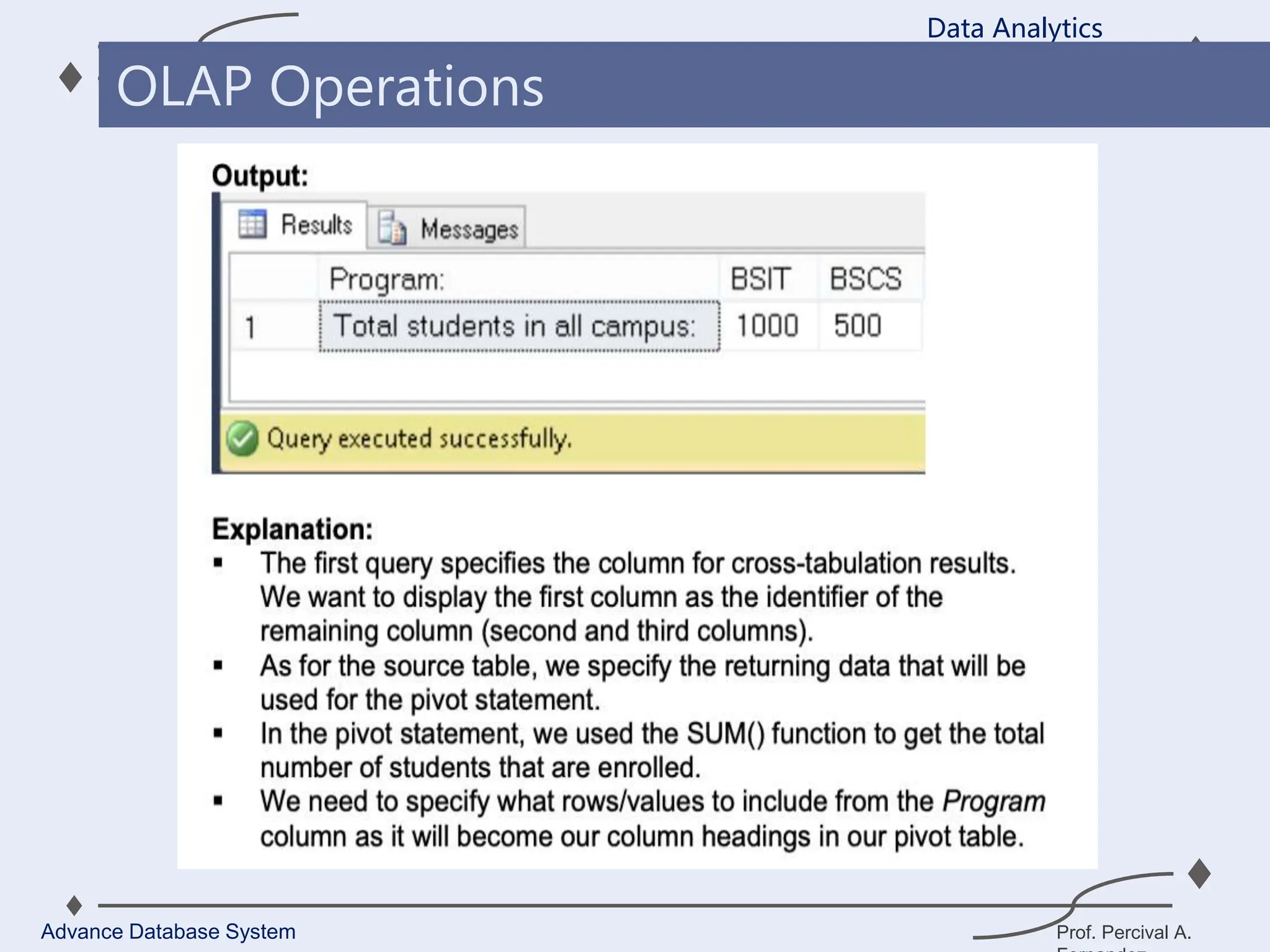
 PIVOT operator – allows you to write a cross-tabulation, which
means you can aggregate your results and rotate rows into
columns
Data Analytics
Advance Database System
OLAP Operations
Prof. Percival A.
Data Analytics
Advance Database System
OLAP Operations
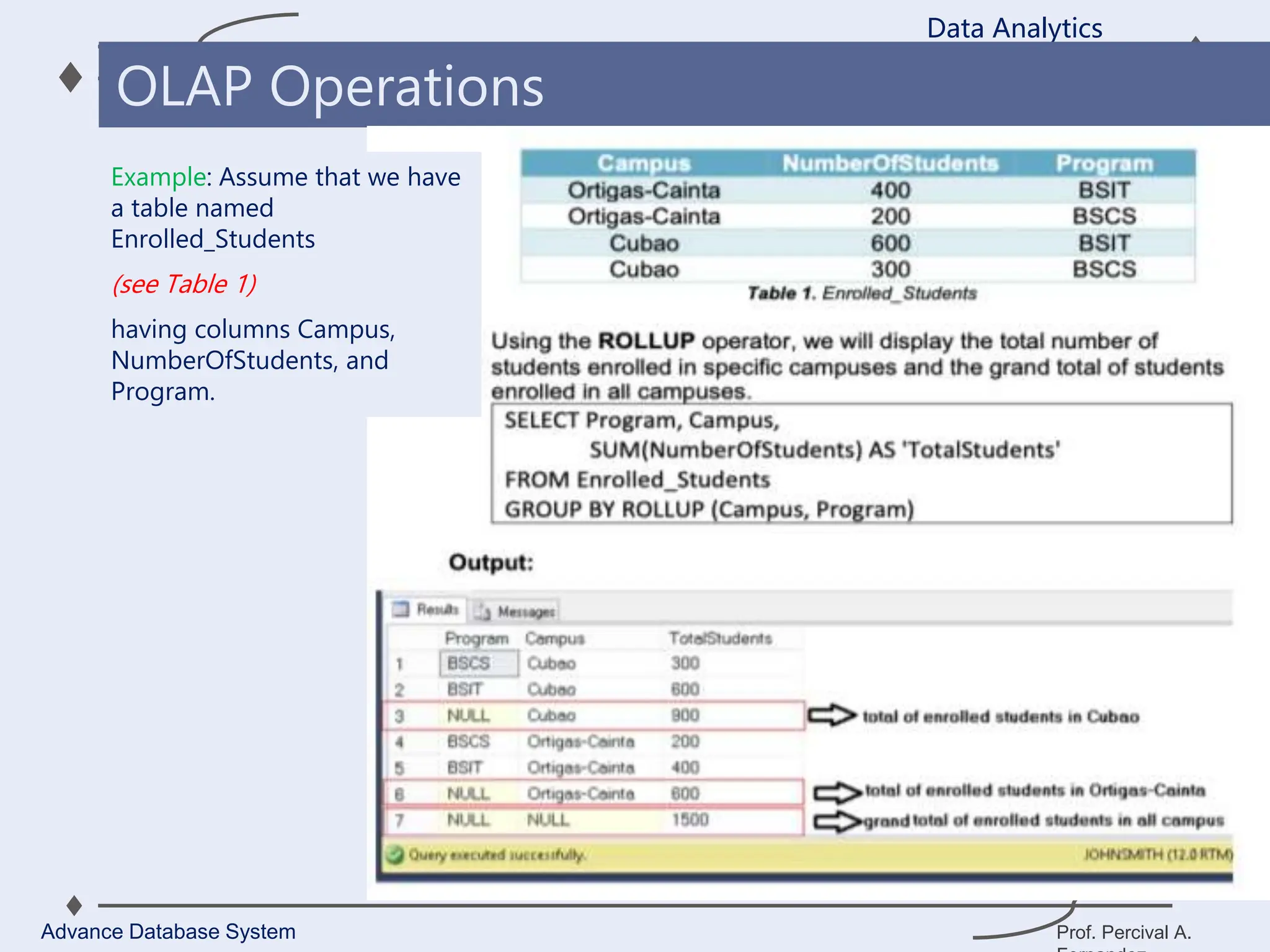
Example: Assume that we have
a table named
Enrolled_Students
(see Table 1)
having columns Campus,
NumberOfStudents, and
Program.
Prof. Percival A.
Data Analytics
Advance Database System
OLAP Operations
Prof. Percival A.
Data Analytics
Advance Database System
OLAP Operations
Prof. Percival A.
Data Analytics
Advance Database System
OLAP Operations
Prof. Percival A.
Data Analytics
Advance Database System
OLAP Operations
Prof. Percival A.
Data Analytics
Advance Database System
Prof. Percival A.
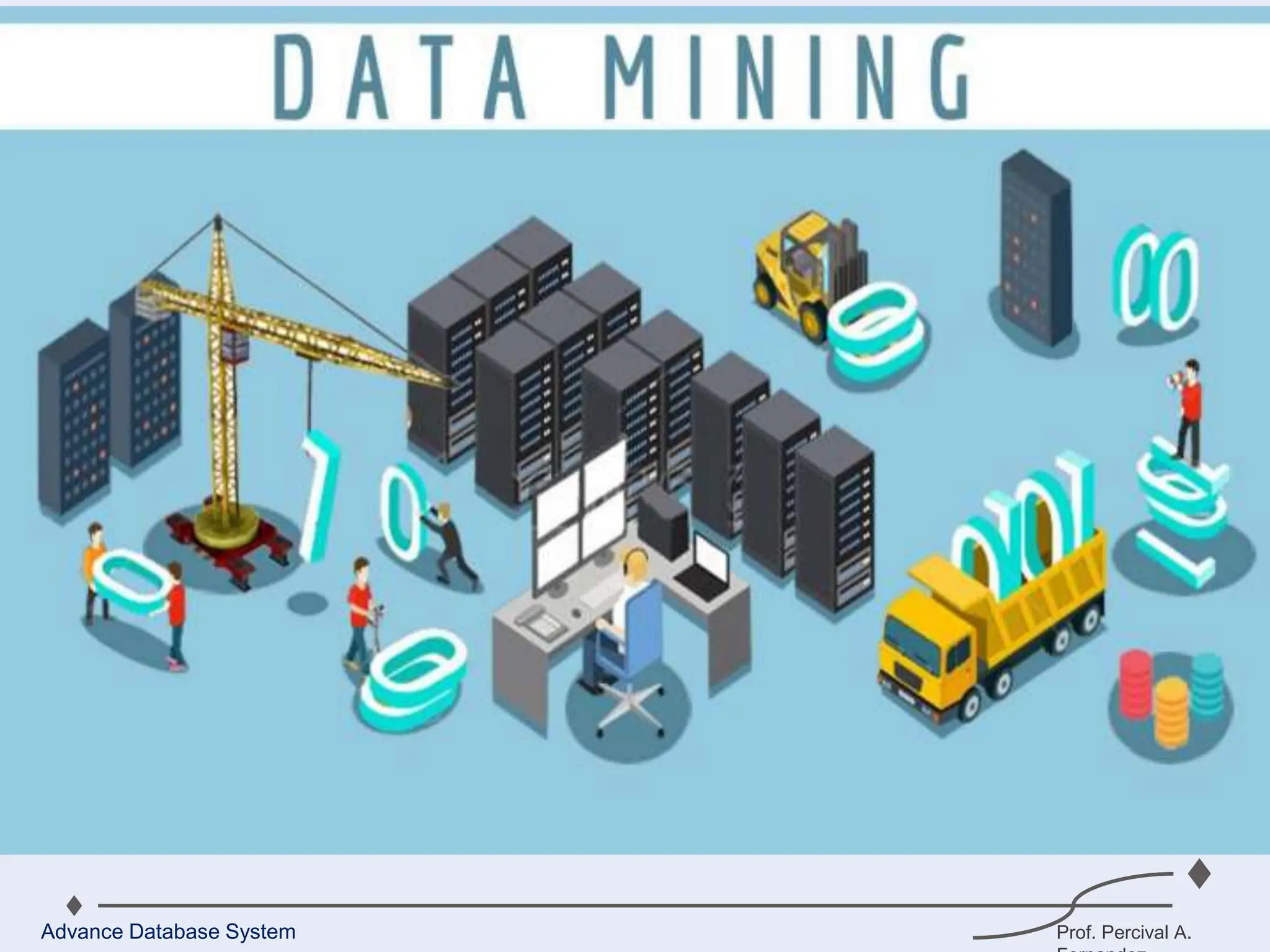
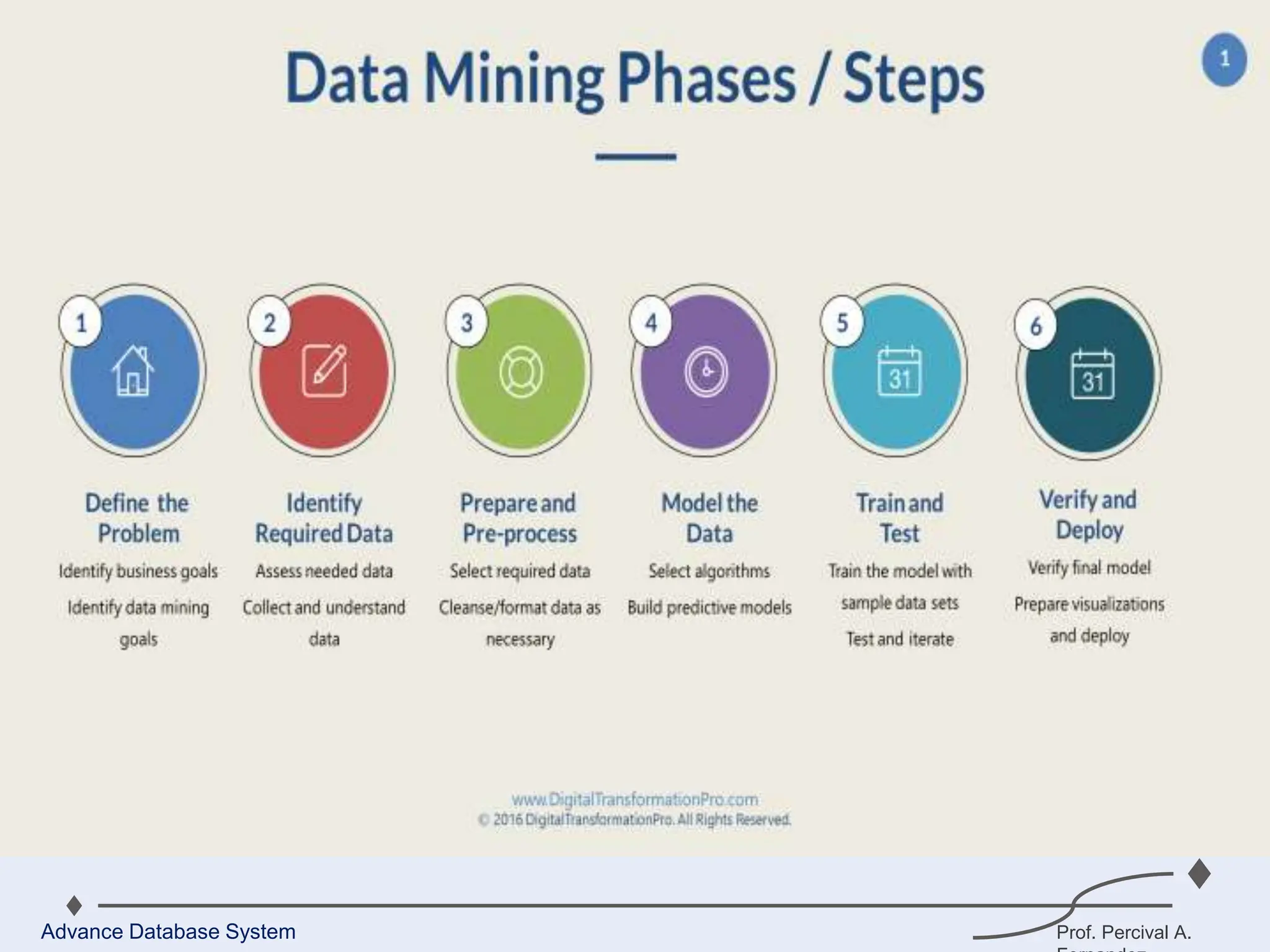
 Data mining refers to analyzing massive amounts of data in a
data warehouse or other sources to uncover hidden trends,
patterns, and relationships. This explains the past and predicting
the future for analysis. Data Mining Implementation Process
1. Business Understanding: In this step, the goals of the businesses
are set, and the important factors that will help in achieving the
goal are discovered.
2. Data Understanding: This step will collect the entire data and
populate the data in the tool (if using any tool).
Data Analytics
Advance Database System
Data Mining
Prof. Percival A.
 Data mining
3. Data Preparation: This step involves selecting the appropriate
data, cleaning, constructing attributes from data, integrating data
from multiple databases.
4. Modeling: Selection of the data mining technique such as
decision-tree, generate test design for evaluating the selected
model, building models from the dataset, and assessing the built
model with experts to discuss the result is done in this step.
Data Analytics
Advance Database System
Data Mining
Prof. Percival A.
 Data mining
5. Evaluation: This step will determine the degree to which the
resulting model meets the business requirements. The model is
reviewed for any mistakes or steps that should be repeated.
6. Deployment: In this step, a deployment plan is made. The
strategy to monitor and maintain the data mining model results
to check for its usefulness is formed. Final reports are also made,
and a review of the whole process is done to check any mistake
and see if any step is repeated.
Data Analytics
Advance Database System
Data Mining
Prof. Percival A.
1. Classification: used to retrieve important and relevant
information about data and metadata.
2. Clustering: used to identify data that are like each other. This
process helps to understand the differences and similarities
between the data.
3. Regression: used to identify and analyze the relationship
between variables.
4. Association Rules: used to help find the association between
two or more Items. It discovers a hidden pattern in the data set.
Data Analytics
Advance Database System
Data Mining Techniques
Prof. Percival A.
5. Outer detection: used to observe data items in the dataset that
do not match an expected pattern or expected behavior.
6. Sequential Patterns: used to discover or identify similar patterns
or trends in transaction data for a certain period.
7. Prediction: used to combine other data mining techniques like
trends, sequential patterns, clustering, classification, etc. It
analyzes past events or instances in the right sequence for
predicting a future event
Data Analytics
Advance Database System
Data Mining Techniques
Prof. Percival A.
1. Helps with the decision-making process
2. Helps companies to get knowledge-based information
3. Facilitates automated prediction of trends and behaviors as well
as the automated discovery of hidden patterns •
4. The speedy process which makes it easy for the users to analyze
a huge amount of data in less time
Data Analytics
Advance Database System
Benefits of Data Mining
Prof. Percival A.
Data Analytics
Advance Database System
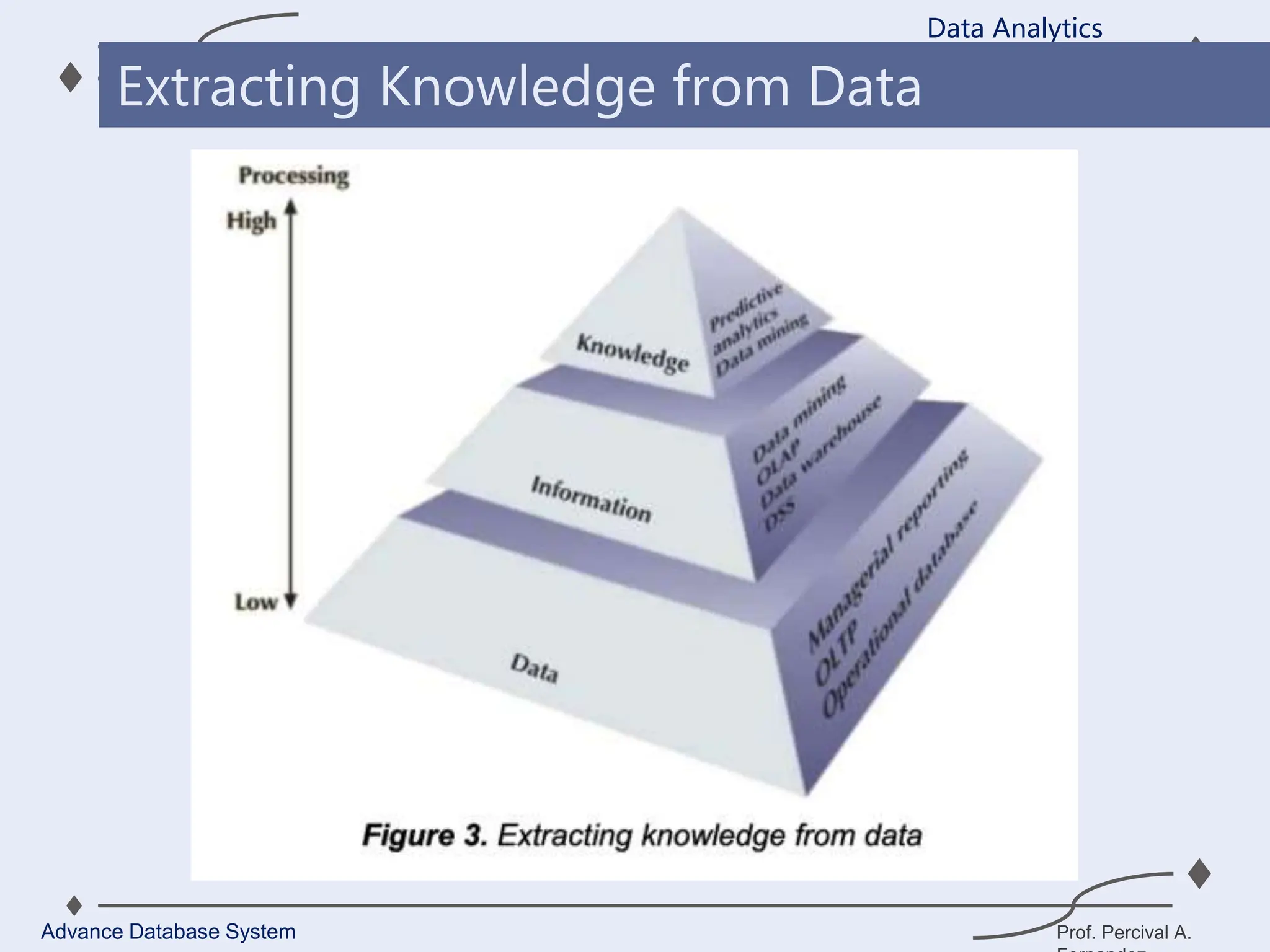
Extracting Knowledge from Data
Prof. Percival A.
Data Analytics
Advance Database System
Prof. Percival A.
• https://www.ibm.com/topics/data-warehouse
• https://azure.microsoft.com/en-us/resources/cloud-computing-dictionary/what-
is-a-data-warehouse/
• https://shiva-kota.blogspot.com/2015/06/data-warehouse-concepts.html
• https://www.guru99.com/data-warehouse-architecture.html
Data Analytics
Advance Database System
References:

Data Analytics.pptx

  • 1.
  • 2.
  • 3.
    Prof. Percival A. A data warehouse is a database designed to enable and support business intelligence (BI) activities, especially analytics. intended to perform queries and analysis optimized for data retrieval, not for transaction processing centralizes and consolidates large amounts of data from multiple sources allows organizations to derive valuable business insights from their data to improve decision-making can be considered an organization’s “single source of truth" Data Analytics Advance Database System What is a data warehouse?
  • 4.
    Prof. Percival A. A data warehouse pulls together data from many different sources into a single data repository for sophisticated analytics and decision support  A data warehouse, or enterprise data warehouse (EDW), is a system that aggregates data from different sources into a single, central, consistent data store to support data analysis, data mining, artificial intelligence (AI), and machine learning.  A data warehouse system enables an organization to run powerful analytics on huge volumes (petabytes and petabytes) of historical data in ways that a standard database cannot. Data Analytics Advance Database System What is a data warehouse?
  • 5.
    Prof. Percival A. A data warehouse is a repository (collection of resources that can be accessed to retrieve information) of an organization's electronically stored data, designed to facilitate reporting and analysis. In simple form data warehouse is a collection of large amount of data.  A DWH is a historical database because the database contains many years of historical business data for Decision making purpose.  A DWH system is designed to read the business data for business analysis processing but not for Transactional processing. Hence it is called as a Read only database.  A DWH is designed to take the decision. Hence it is also known as DSS (Decision Supportive System). Data Analytics Advance Database System Data Warehouse Concepts
  • 6.
    Prof. Percival A. DataAnalytics Advance Database System Characteristics of Data Warehouses https://image2.slideserve.com/4994050/data-warehouse-properties-l.jpg
  • 7.
    Prof. Percival A. Subject-Oriented – The DW can analyze data about a particular subject or functional area. Subjects can be products, customers, departments, regions, etc. The functional area can be sales, marketing, finance, distribution, etc. Focuses on the data rather than on the processes that modify the data Data Analytics Advance Database System Characteristics of Data Warehouses
  • 8.
    Prof. Percival A. DataAnalytics Advance Database System Characteristics of Data Warehouses https://1.bp.blogspot.com/-zC8CjESLXso/VXa6JruJ44I/AAAAAAAAAKA/EJ0wqAW3pWM/s1600/pic2.png
  • 9.
    Prof. Percival A. Integrated – The DW creates consistency among different data types from different sources. o Example: A student’s level in the database might be defined as “freshman”, “sophomore”, “junior”, or “senior” in the accounting department, and “FR”, “SO”, “JR”, “SR” in the computer information systems department.  DW must conform to a common format that is acceptable throughout the organization. Data Analytics Advance Database System Characteristics of Data Warehouses
  • 10.
    Prof. Percival A. DataAnalytics Advance Database System Characteristics of Data Warehouses www.alibabacloud.com
  • 11.
    Prof. Percival A. Time-variant – Data in DW represents the flow of data through time. It can be organized weekly, monthly, or annually, etc. o Example: When data for previous weekly sales is uploaded to the data warehouse, the weekly, monthly, yearly, and other time- dependent subjects such as products, customers, stores, etc. are also updated. Data Analytics Advance Database System Characteristics of Data Warehouses
  • 12.
    Prof. Percival A. DataAnalytics Advance Database System Characteristics of Data Warehouses https://365datascience.com/resources/blog/2020-06-data-warehouse-time-variant-1-1024x576.jpg
  • 13.
    Prof. Percival A. Non-volatile – Once data is in a data warehouse, it is stable and does not change. o Data warehouse is also non-volatile means the previous data is not erased when new data is entered in it. o Data is read-only and periodically refreshed. This also helps to analyze historical data and understand what & when happened. It does not require transaction process, recovery and concurrency control mechanisms. o Activities like delete, update, and insert which are performed in an operational application environment are omitted in Data warehouse environment. Data Analytics Advance Database System Characteristics of Data Warehouses
  • 14.
    Prof. Percival A. DataAnalytics Advance Database System Characteristics of Data Warehouses https://jelvix.com/wp-content/uploads/2020/10/non-volatile-data.jpg
  • 15.
    Prof. Percival A. Data Warehouse Database – This is a databank that stocks all enterprise data and makes it manageable for reporting. always implemented on the relational database management system (RDBMS) technology like SQL • Data Analytics Advance Database System Components of Data Warehouse
  • 16.
    Prof. Percival A. DataAnalytics Advance Database System Components of Data Warehouse https://3.bp.blogspot.com/-xbxF6qPTwlM/T8x-_1l2BjI/AAAAAAAAAEE/D57o5AogEes/s1600/Untitled.jpg Data Warehouse Database
  • 17.
    Prof. Percival A. Extraction, Transformation, and Loading Tools (ETL) – These tools are used for performing all the conversions, summarizations, and all the changes needed to transform data into a unified format in the data warehouse. These include: In case of missing data, populating them with defaults Calculating summaries and derived data Eliminating unwanted data in operational databases from loading into the data warehouse Converting to common data names and definitions Data Analytics Advance Database System Components of Data Warehouse
  • 18.
    Prof. Percival A. DataAnalytics Advance Database System Components of Data Warehouse https://icedq.com/wp-content/uploads/2015/07/ETL-Testing-Image.png Extraction, Transformation, and Loading Tools (ETL)
  • 19.
    Prof. Percival A. Metadata – is data about data that describes the data warehouse. It provides the source, transformation, integration, storage, usage, relationships, and history of each data element. o Example: A line in a sales department database contains: SNY-JP- 0010-15000 Data Analytics Advance Database System Components of Data Warehouse
  • 20.
    Prof. Percival A. This is meaningless data until we consult the meta that tell us the following: Brand Model: Sony Country Manufactured: Japan Product ID: 0010 Price: ₱15,000 Data Analytics Advance Database System Components of Data Warehouse  Metadata
  • 21.
    Prof. Percival A. Metadata can be classified into two (2) categories: 1. Technical Metadata – contains information about the warehouse, which is used by data warehouse designers and administrators. 2. Business Metadata – contains details that give end-users an easy way to understand the information stored in the data warehouse. Data Analytics Advance Database System Components of Data Warehouse  Metadata
  • 22.
    Prof. Percival A. DataAnalytics Advance Database System Components of Data Warehouse https://brandtoolbox.com.au/media/1043678/Metadata_example_02.png
  • 23.
    Prof. Percival A. Data Warehouse Access Tools – Corporate users generally cannot work with databases directly. They use the assistance of the following tools: Query and reporting tool – help users produce corporate reports for analysis that can be in the form of spreadsheets, calculations, or interactive visuals. Application development tools – In such cases, custom reports are developed using application development tools when built-in graphical and analytical tools do not satisfy the analytical needs of an organization. Data Analytics Advance Database System Components of Data Warehouse
  • 24.
    Prof. Percival A. Datamining – a process of discovering meaningful new correlations, patterns, and trends by mining a large amount of data. Data mining tools are used to make this process automatic. OLAP tools – allow users to analyze the data using elaborate and complex multi-dimensional views. Data Analytics Advance Database System Components of Data Warehouse
  • 25.
    Prof. Percival A. Data Marts – a small, single-subject data warehouse subset that provides decision support for the particular user group. Data Analytics Advance Database System Components of Data Warehouse ( https://www.datocms-assets.com/17507/1606816553-data-mart-exemple-image.jpg
  • 26.
    Prof. Percival A. DataAnalytics Advance Database System Data Warehouse Architecture https://www.datocms-assets.com/17507/1606816553-data-mart-exemple-image.jpg
  • 27.
    Prof. Percival A. 1.Allows business users to quickly access critical data from some sources all in one place. Therefore, it saves the user's time of retrieving data from multiple sources 2. Provides consistent information on various cross-functional activities. It is also supporting ad-hoc reporting and query. 3. Helps to integrate many sources of data to reduce stress on the production system 4. Helps to reduce total turnaround time for analysis and reporting 5. Restructuring and integration make it easier for the user to use for reporting and analysis. 6. Stores a large amount of historical data. This helps users to analyze different time periods and trends to make future predictions. Data Analytics Advance Database System Benefits of Data Warehouse
  • 28.
    Prof. Percival A. A star schema is a data-modeling technique used to map multi- dimensional decision support data into a relational database.  It has two (2) common components: Facts table – are data that will be included in reports and used as the basis of business decisions. It contains measurement or facts to the data and foreign key to dimension table. Dimension table – are attributes that qualify and provide more information about facts. It contains dimensions of a fact and they are joined to fact table via foreign key. Data Analytics Advance Database System Star Schema
  • 29.
    Prof. Percival A. DataAnalytics Advance Database System Star Schema
  • 30.
    Prof. Percival A. Online Analytical Processing (OLAP) a software tool that is used for data analysis and reporting purposes for business decisions used by business analysts, managers, and executives. o Example: In Netflix, OLAP was used for movie recommendations based on watch history. Data Analytics Advance Database System Online Analytical Processing (OLAP)
  • 31.
    Prof. Percival A. DataAnalytics Advance Database System Online Analytical Processing (OLAP) https://smartboost.com/wp-content/uploads/2020/06/OLAP-Blog-image-02-2048x1799.jpg
  • 32.
    Prof. Percival A. Online Transaction Processing (OLTP) an operational system that manages the day-to-day transactions of an organization used by the Database Administrator (DBA) and Database Professionals o Example: In ATM centers, OLTP is used for money withdrawals, transfers, deposits, and inquiries. Data Analytics Advance Database System Online Transaction Processing (OLTP)
  • 33.
    Prof. Percival A. DataAnalytics Advance Database System Online Transaction Processing (OLTP) https://4.bp.blogspot.com/-67_DPpb0dyQ/TvlYbXvPfzI/AAAAAAAAAAQ/iTDz7TwRrwg/s640/Capture.JPG
  • 34.
    Prof. Percival A. DataAnalytics Advance Database System OLTP vs OLAP
  • 35.
    Prof. Percival A. DataAnalytics Advance Database System OLTP vs OLAP
  • 36.
    Prof. Percival A. DataAnalytics Advance Database System OLTP vs OLAP https://miro.medium.com/v2/resize:fit:1400/1*kDxyqz9MqDuFb5AyYu53AA.png
  • 37.
    Prof. Percival A. DataAnalytics Advance Database System OLTP vs OLAP https://i.pinimg.com/originals/71/99/13/719913456c15c1fe0870b1496c399bc3.png
  • 38.
    Prof. Percival A. Multi-dimensional data analysis techniques – Data is processed and viewed as part of a multi-dimensional structure.  Advanced Database support – To deliver efficient decision support, OLAP tools must have the following: Access to many kinds of DBMSs, flat files, and internal and external data sources Rapid and consistent query response times Support for very large databases because the data warehouse could easily and quickly grow to multiple terabytes in size Data Analytics Advance Database System Characteristics of OLAP
  • 39.
    Prof. Percival A. Easy-to-use end-user interfaces – permit the user to navigate the data in a way that simplifies and accelerates decision making or data analysis with easy-to-use graphical interfaces Data Analytics Advance Database System Characteristics of OLAP
  • 40.
    Prof. Percival A. Relational OLAP (ROLAP) Works directly with relational databases Fact and dimension tables are stored as relations.  Multi-dimensional OLAP (MOLAP) extends OLAP functionality to multi-dimensional database management systems (MDBMS) best suited to manage, store, and analyze multi-dimensional data Data Analytics Advance Database System Types of OLAP
  • 41.
    Prof. Percival A. DataAnalytics Advance Database System Types of OLAP
  • 42.
    Prof. Percival A. SQL has been enhanced with analytic functions that support OLAP-type processing. This includes:  ROLLUP operator – an extension of the GROUP BY clause that is used to create subtotals and grand totals for a set of columns  CUBE operator – Like ROLLUP, this generates subtotals for all the combinations of grouping column s specified in the GROUP BY clause.  PIVOT operator – allows you to write a cross-tabulation, which means you can aggregate your results and rotate rows into columns Data Analytics Advance Database System OLAP Operations
  • 43.
    Prof. Percival A. DataAnalytics Advance Database System OLAP Operations Example: Assume that we have a table named Enrolled_Students (see Table 1) having columns Campus, NumberOfStudents, and Program.
  • 44.
    Prof. Percival A. DataAnalytics Advance Database System OLAP Operations
  • 45.
    Prof. Percival A. DataAnalytics Advance Database System OLAP Operations
  • 46.
    Prof. Percival A. DataAnalytics Advance Database System OLAP Operations
  • 47.
    Prof. Percival A. DataAnalytics Advance Database System OLAP Operations
  • 48.
    Prof. Percival A. DataAnalytics Advance Database System
  • 49.
    Prof. Percival A. Data mining refers to analyzing massive amounts of data in a data warehouse or other sources to uncover hidden trends, patterns, and relationships. This explains the past and predicting the future for analysis. Data Mining Implementation Process 1. Business Understanding: In this step, the goals of the businesses are set, and the important factors that will help in achieving the goal are discovered. 2. Data Understanding: This step will collect the entire data and populate the data in the tool (if using any tool). Data Analytics Advance Database System Data Mining
  • 50.
    Prof. Percival A. Data mining 3. Data Preparation: This step involves selecting the appropriate data, cleaning, constructing attributes from data, integrating data from multiple databases. 4. Modeling: Selection of the data mining technique such as decision-tree, generate test design for evaluating the selected model, building models from the dataset, and assessing the built model with experts to discuss the result is done in this step. Data Analytics Advance Database System Data Mining
  • 51.
    Prof. Percival A. Data mining 5. Evaluation: This step will determine the degree to which the resulting model meets the business requirements. The model is reviewed for any mistakes or steps that should be repeated. 6. Deployment: In this step, a deployment plan is made. The strategy to monitor and maintain the data mining model results to check for its usefulness is formed. Final reports are also made, and a review of the whole process is done to check any mistake and see if any step is repeated. Data Analytics Advance Database System Data Mining
  • 52.
    Prof. Percival A. 1.Classification: used to retrieve important and relevant information about data and metadata. 2. Clustering: used to identify data that are like each other. This process helps to understand the differences and similarities between the data. 3. Regression: used to identify and analyze the relationship between variables. 4. Association Rules: used to help find the association between two or more Items. It discovers a hidden pattern in the data set. Data Analytics Advance Database System Data Mining Techniques
  • 53.
    Prof. Percival A. 5.Outer detection: used to observe data items in the dataset that do not match an expected pattern or expected behavior. 6. Sequential Patterns: used to discover or identify similar patterns or trends in transaction data for a certain period. 7. Prediction: used to combine other data mining techniques like trends, sequential patterns, clustering, classification, etc. It analyzes past events or instances in the right sequence for predicting a future event Data Analytics Advance Database System Data Mining Techniques
  • 54.
    Prof. Percival A. 1.Helps with the decision-making process 2. Helps companies to get knowledge-based information 3. Facilitates automated prediction of trends and behaviors as well as the automated discovery of hidden patterns • 4. The speedy process which makes it easy for the users to analyze a huge amount of data in less time Data Analytics Advance Database System Benefits of Data Mining
  • 55.
    Prof. Percival A. DataAnalytics Advance Database System Extracting Knowledge from Data
  • 56.
    Prof. Percival A. DataAnalytics Advance Database System
  • 57.
    Prof. Percival A. •https://www.ibm.com/topics/data-warehouse • https://azure.microsoft.com/en-us/resources/cloud-computing-dictionary/what- is-a-data-warehouse/ • https://shiva-kota.blogspot.com/2015/06/data-warehouse-concepts.html • https://www.guru99.com/data-warehouse-architecture.html Data Analytics Advance Database System References: