© Waher Data AB, 2018.
Smart City Lecture 2
Privacy in the Smart City
© Waher Data AB, 2018.
1. Recapture
© Waher Data AB, 2018.
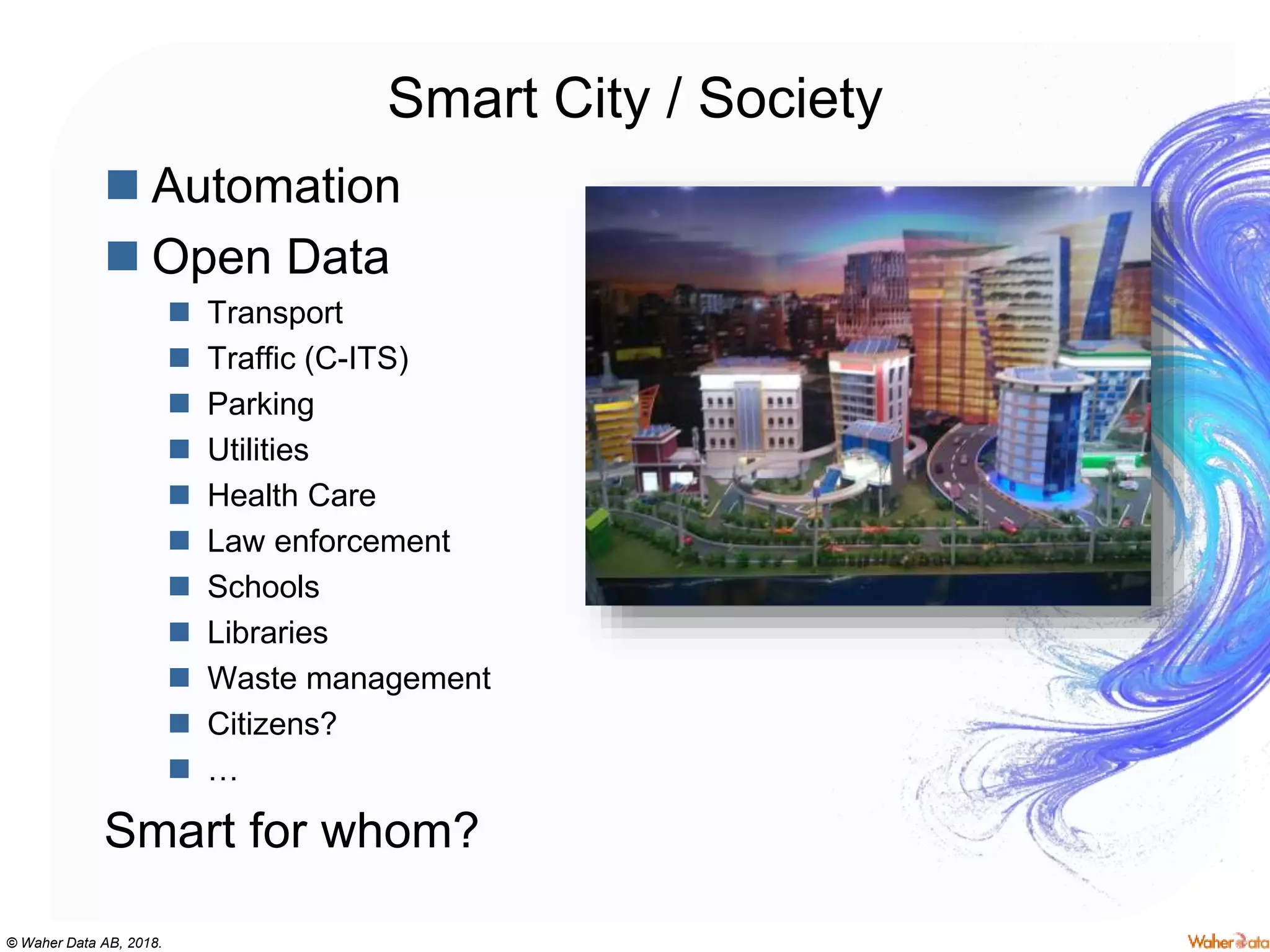
Smart City / Society
 Automation
 Open Data
 Transport
 Traffic (C-ITS)
 Parking
 Utilities
 Health Care
 Law enforcement
 Schools
 Libraries
 Waste management
 Citizens?
 …
Smart for whom?
© Waher Data AB, 2018.
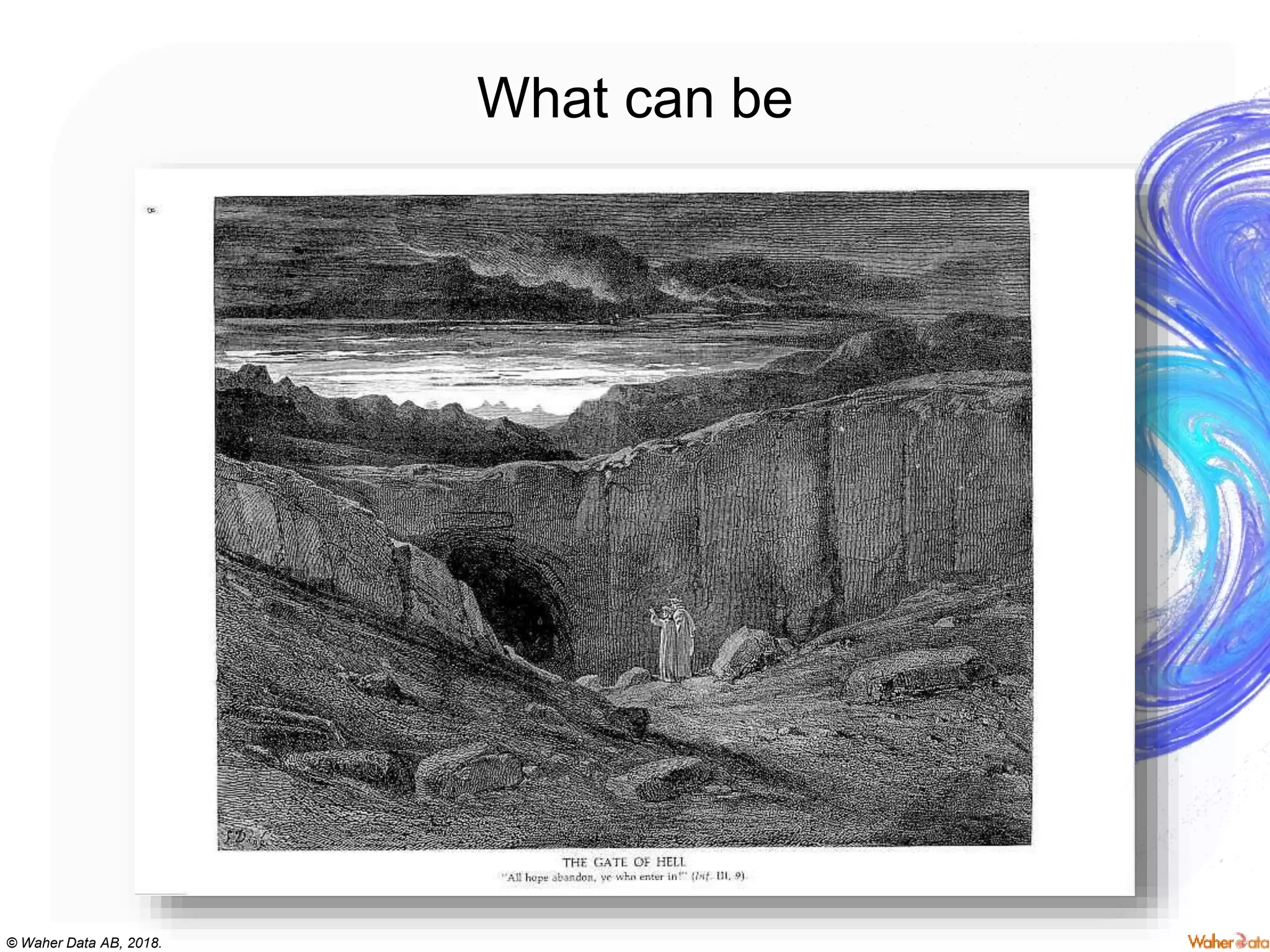
What can be
© Waher Data AB, 2018.
Chinese Social Credit System
(World’s most?) ambitious “Smart City”
project.
Calculates economic and social
reputation, based on mass surveillance
and AI:
 Honesty
 Commercial Integrity
 Social Integrity
 Judicial Credibility
© Waher Data AB, 2018.
Chinese Social Credit System
Collects data from:
 Online activity
 Searches
 Shopping behavior
 Locations
 Friends
 Health
 Bank accounts
 Messages
 Smart Home appliances
 News sources
 Dating
 …
© Waher Data AB, 2018.
Chinese Social Credit System
Affects:
 Job positions
 Salaries
 Living
 Travel restrictions
 Visa restrictions
 Access to schools
 Social status
 Loans
 Internet bandwidth
 …
© Waher Data AB, 2018.
Universal Declaration of Human Rights
Article 12:
No one shall be subjected to arbitrary
interference with his privacy, family,
home or correspondence, nor to attacks
upon his honour and reputation. Everyone
has the right to the protection of the
law against such interference or
attacks.
https://www.un.org/en/universal-declaration-human-rights/
Well… it all depends on how you choose to interpret
“arbitrary” and “attack”…
© Waher Data AB, 2018.
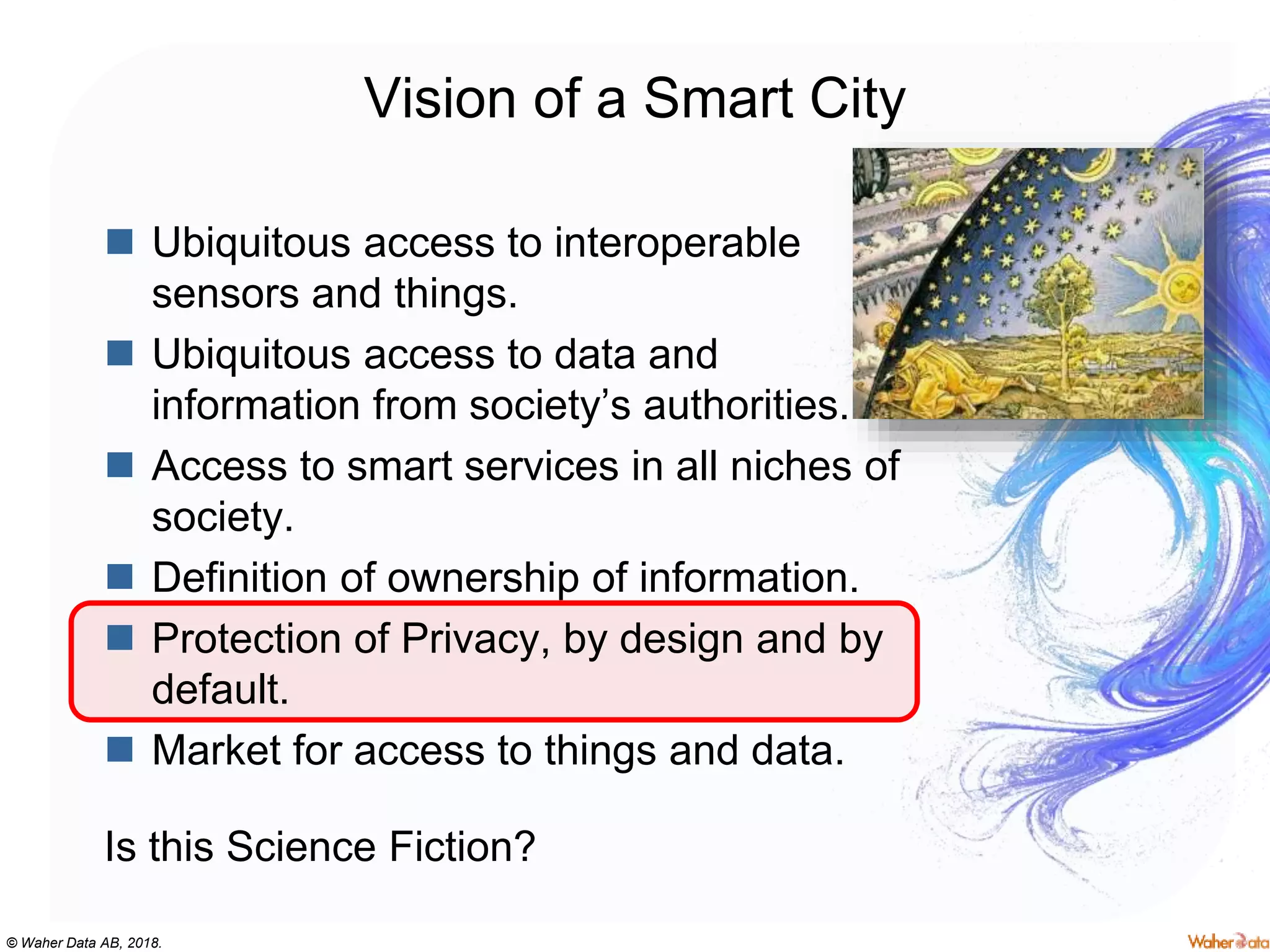
Vision of a Smart City
 Ubiquitous access to interoperable
sensors and things.
 Ubiquitous access to data and
information from society’s authorities.
 Access to smart services in all niches of
society.
 Definition of ownership of information.
 Protection of Privacy, by design and by
default.
 Market for access to things and data.
Is this Science Fiction?
© Waher Data AB, 2018.
2. Privacy
© Waher Data AB, 2018.
What is privacy?
A fundamental human right:
 The right to have confidential conversations.
 The ability to select with whom we communicate.
 Protection against unwarranted monitoring or
searches.
© Waher Data AB, 2018.
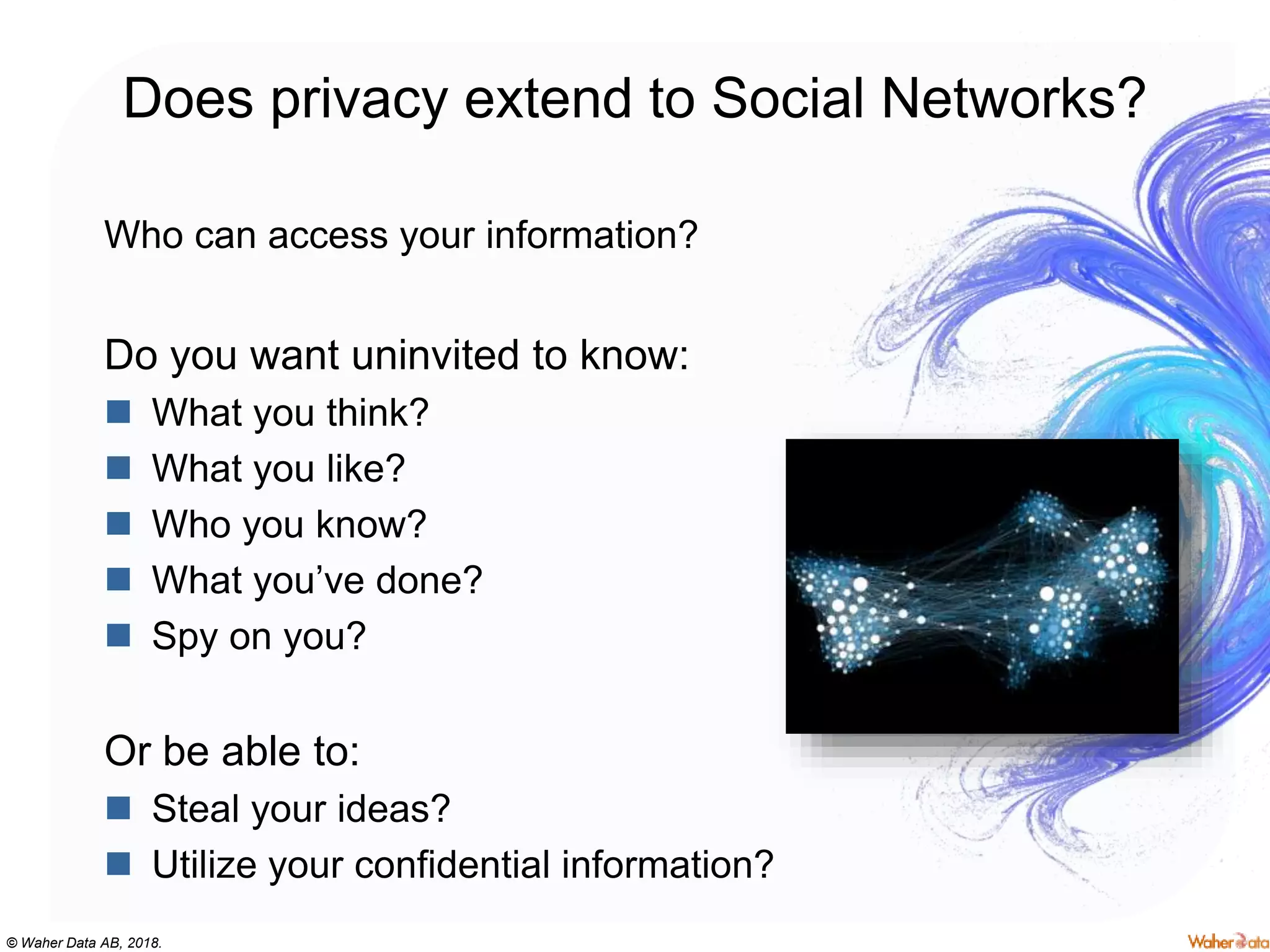
Does privacy extend to Social Networks?
Who can access your information?
Do you want uninvited to know:
 What you think?
 What you like?
 Who you know?
 What you’ve done?
 Spy on you?
Or be able to:
 Steal your ideas?
 Utilize your confidential information?
© Waher Data AB, 2018.
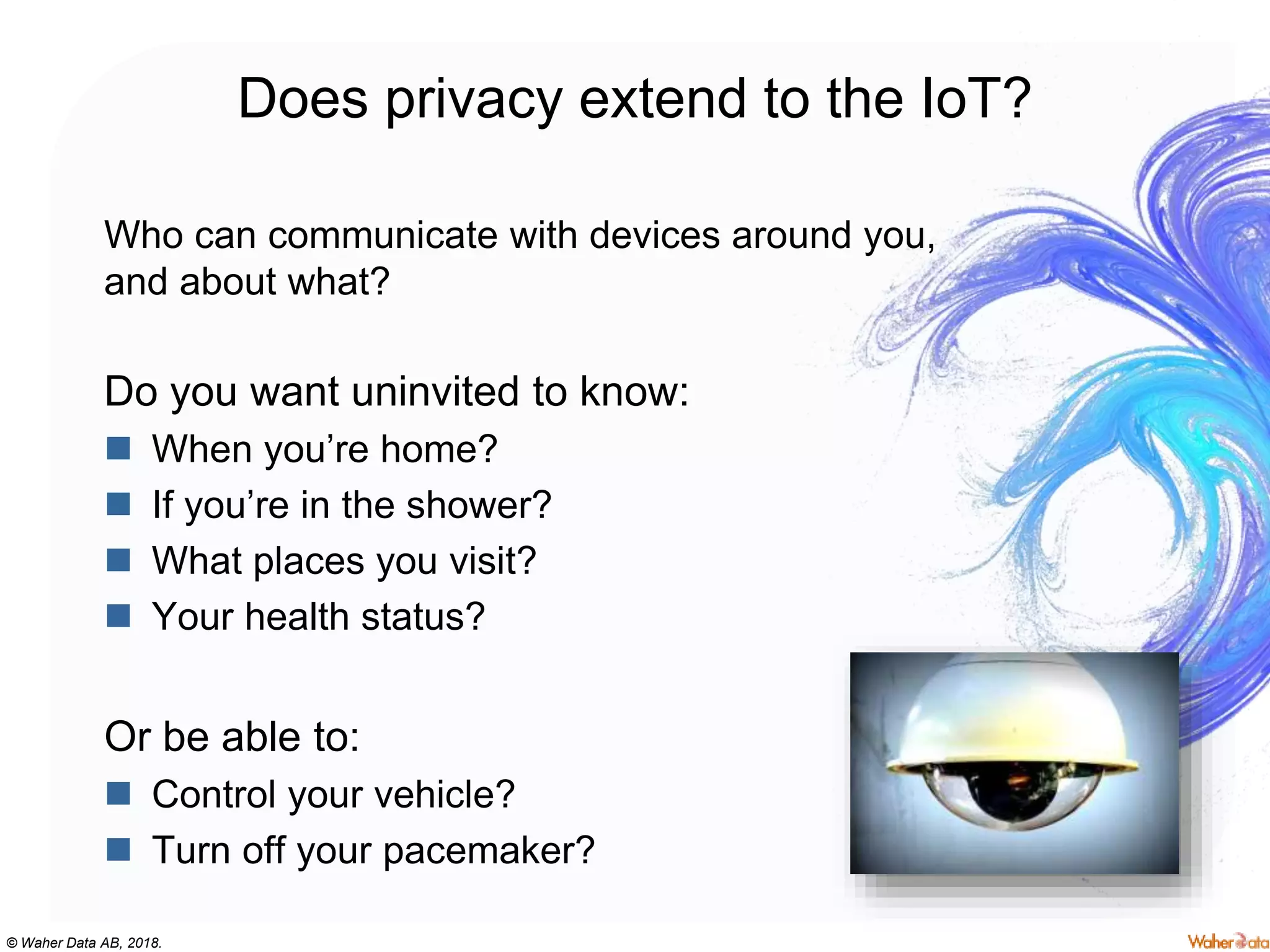
Does privacy extend to the IoT?
Who can communicate with devices around you,
and about what?
Do you want uninvited to know:
 When you’re home?
 If you’re in the shower?
 What places you visit?
 Your health status?
Or be able to:
 Control your vehicle?
 Turn off your pacemaker?
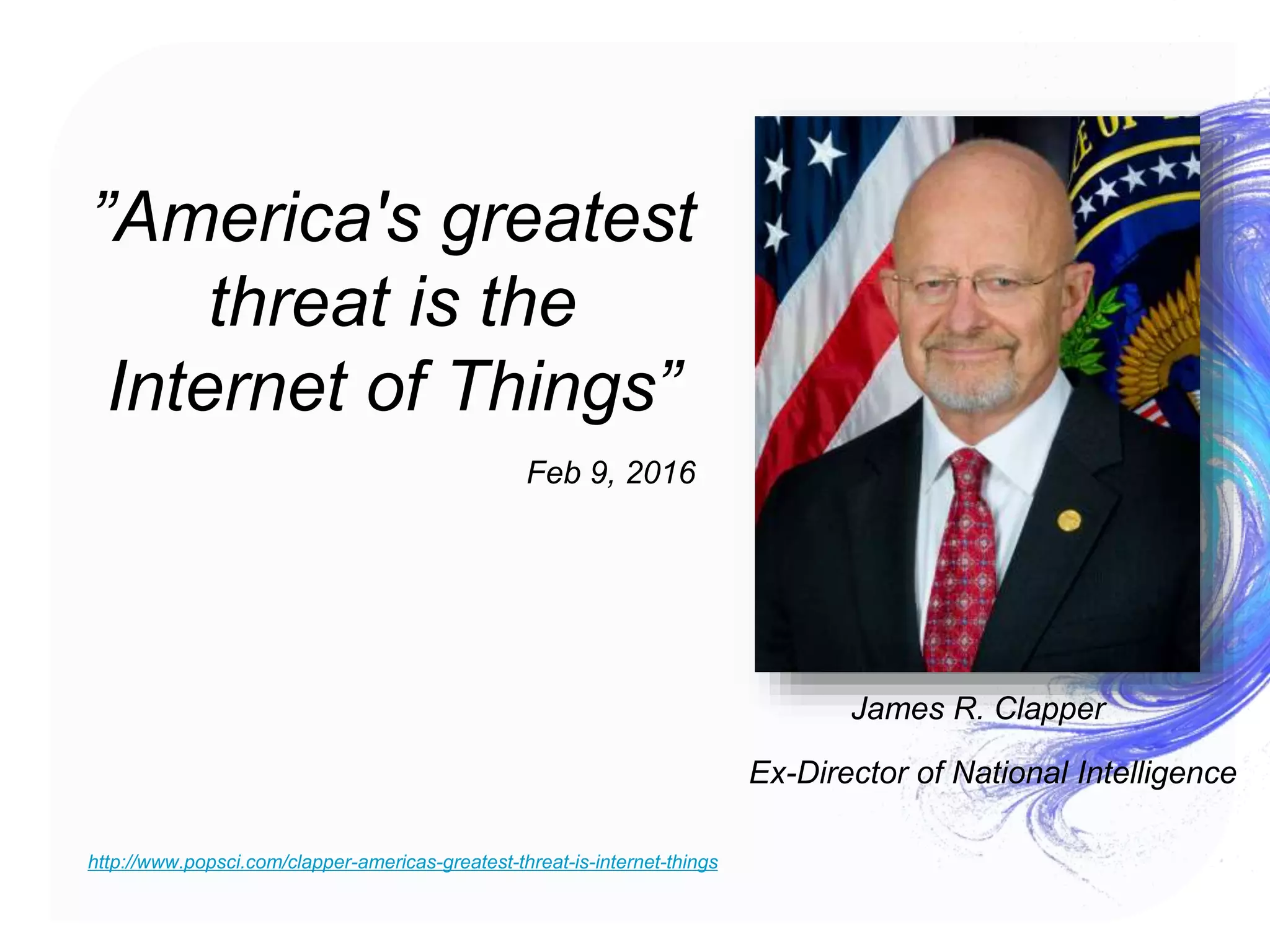
Ex-Director of National Intelligence
James R. Clapper
http://www.popsci.com/clapper-americas-greatest-threat-is-internet-things
”America's greatest
threat is the
Internet of Things”
Feb 9, 2016
© Waher Data AB, 2018.
3. GDPR
General Data Protection Regulation
Can it help?
© Waher Data AB, 2018.
Goals
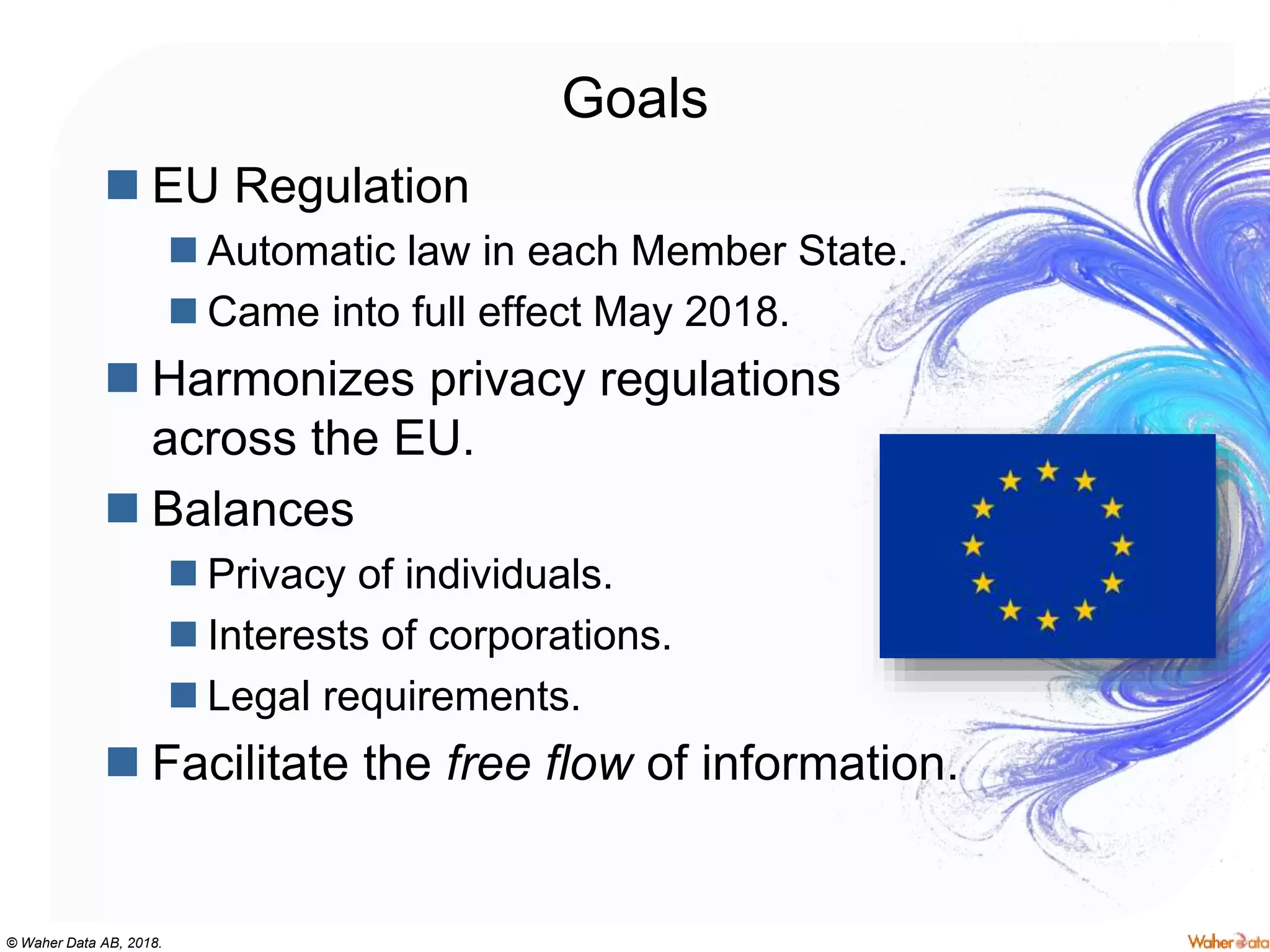
 EU Regulation
 Automatic law in each Member State.
 Came into full effect May 2018.
 Harmonizes privacy regulations
across the EU.
 Balances
 Privacy of individuals.
 Interests of corporations.
 Legal requirements.
 Facilitate the free flow of information.
© Waher Data AB, 2018.
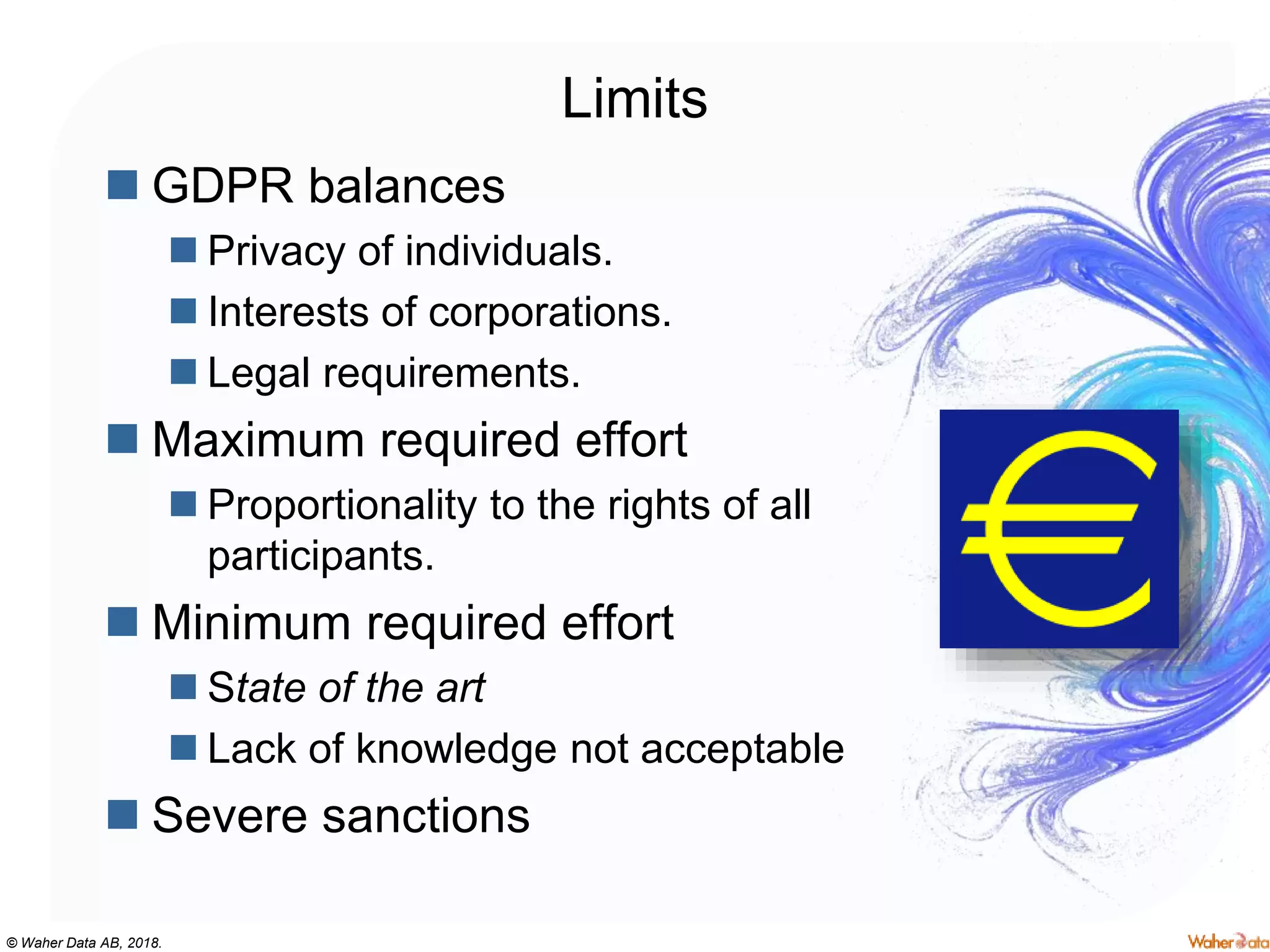
Limits
 GDPR balances
 Privacy of individuals.
 Interests of corporations.
 Legal requirements.
 Maximum required effort
 Proportionality to the rights of all
participants.
 Minimum required effort
 State of the art
 Lack of knowledge not acceptable
 Severe sanctions
© Waher Data AB, 2018.
Personal Data
Any information relating
directly, or indirectly, to an
identified or identifiable
natural person.
“Personality is contagious”
© Waher Data AB, 2018.
Processing
Any operation or set of operations
which is performed on personal data
or on sets of personal data.
“Automatic” is not mentioned. Manual processes are included.
© Waher Data AB, 2018.
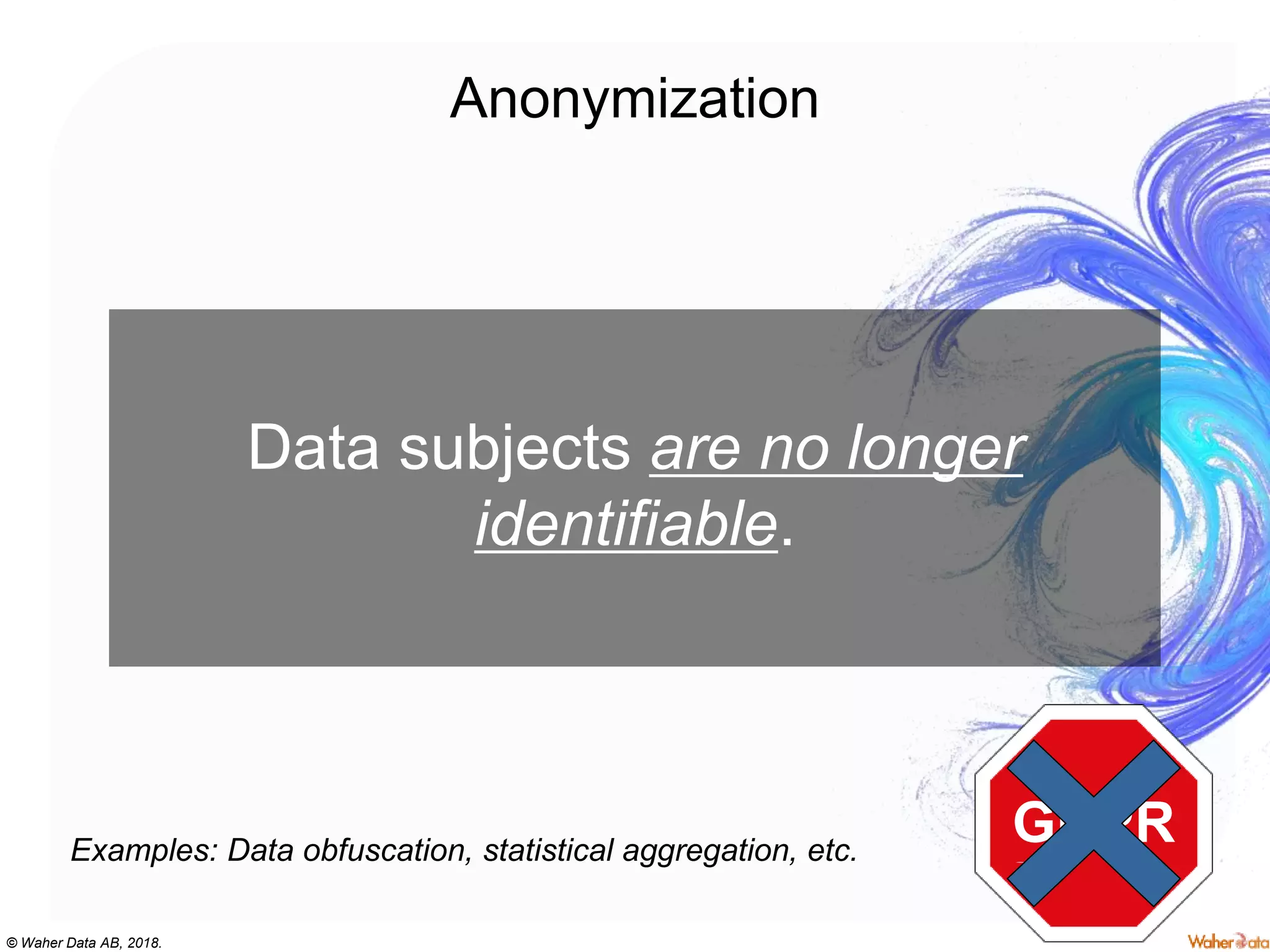
Anonymization
Data subjects are no longer
identifiable.
Examples: Data obfuscation, statistical aggregation, etc.
GDPR
© Waher Data AB, 2018.
Pseudonymization
Data subjects can be identified with
the use of separate data
Examples: Pseudonyms, ordinal numbers, hashes.
GDPR
© Waher Data AB, 2018.
What is allowed?
 As little as possible
 For as short a time as possible
 Share with as few as possible
 For as few purposes as possible
 As correctly as possible
 If there are no other means
 After providing transparent
information
Minimalistic definition: Minimalism
Always with proportional data protection mechanisms.
© Waher Data AB, 2018.
Data Protection
Data must be protected*:
 By design
 By default
 State of the art
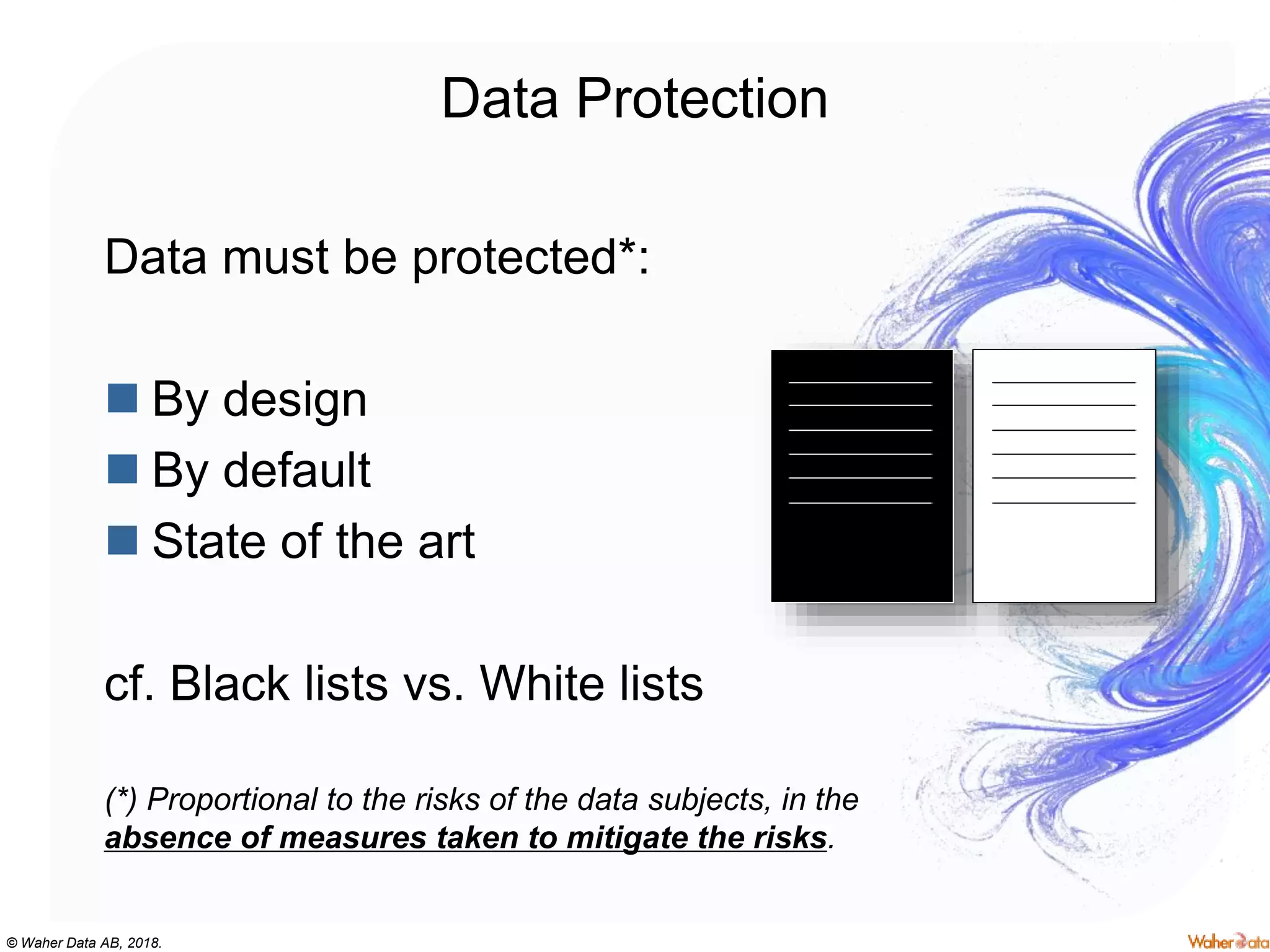
cf. Black lists vs. White lists
(*) Proportional to the risks of the data subjects, in the
absence of measures taken to mitigate the risks.
© Waher Data AB, 2018.
Transparent Information
 Easily accessible
 Easily understood
 Clear and plain language
 Explicit
 Purposes of processing
 Risks to the subject
 Safeguards
 Rights of the subjects
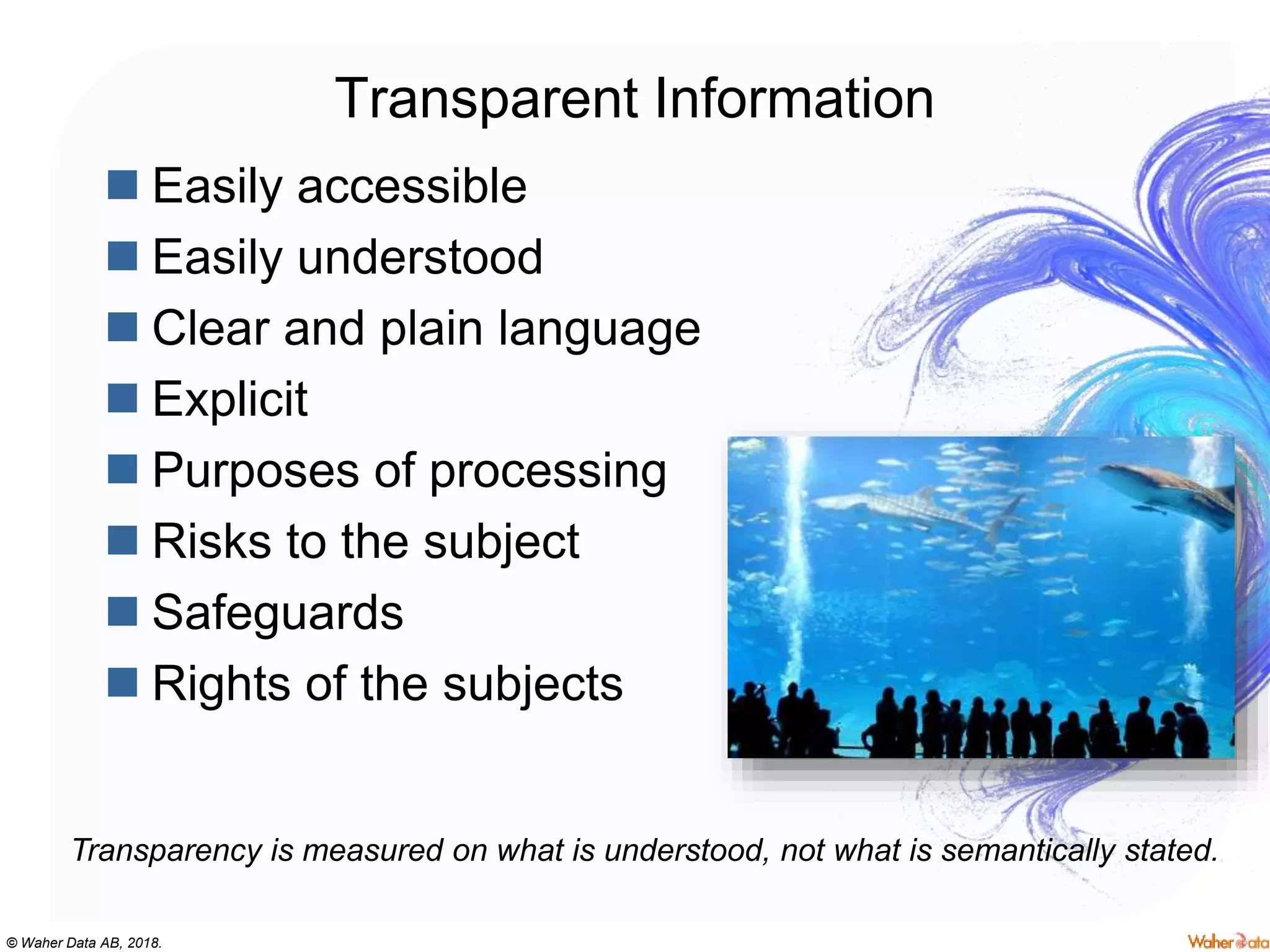
Transparency is measured on what is understood, not what is semantically stated.
© Waher Data AB, 2018.
Lawfulness
 Consent
 Legal obligation
 Legitimate interest
 Based on contract
 Vital interest
 Public interest
Research & Development has to be argued is a Legitimate Interest.
© Waher Data AB, 2018.
Individual Rights
 Transparent Information
 Access to ones personal data
 Export personal data provided by oneself
 Correct erroneous data
 Erase data*
 Object to processing*
 Restrict processing*
 Withdrawal of consent (if based on consent)
 Avoid being subject to automatic decisions
(with negative legal consequences) based
on automatic profiling.
(*) in certain cases
© Waher Data AB, 2018.
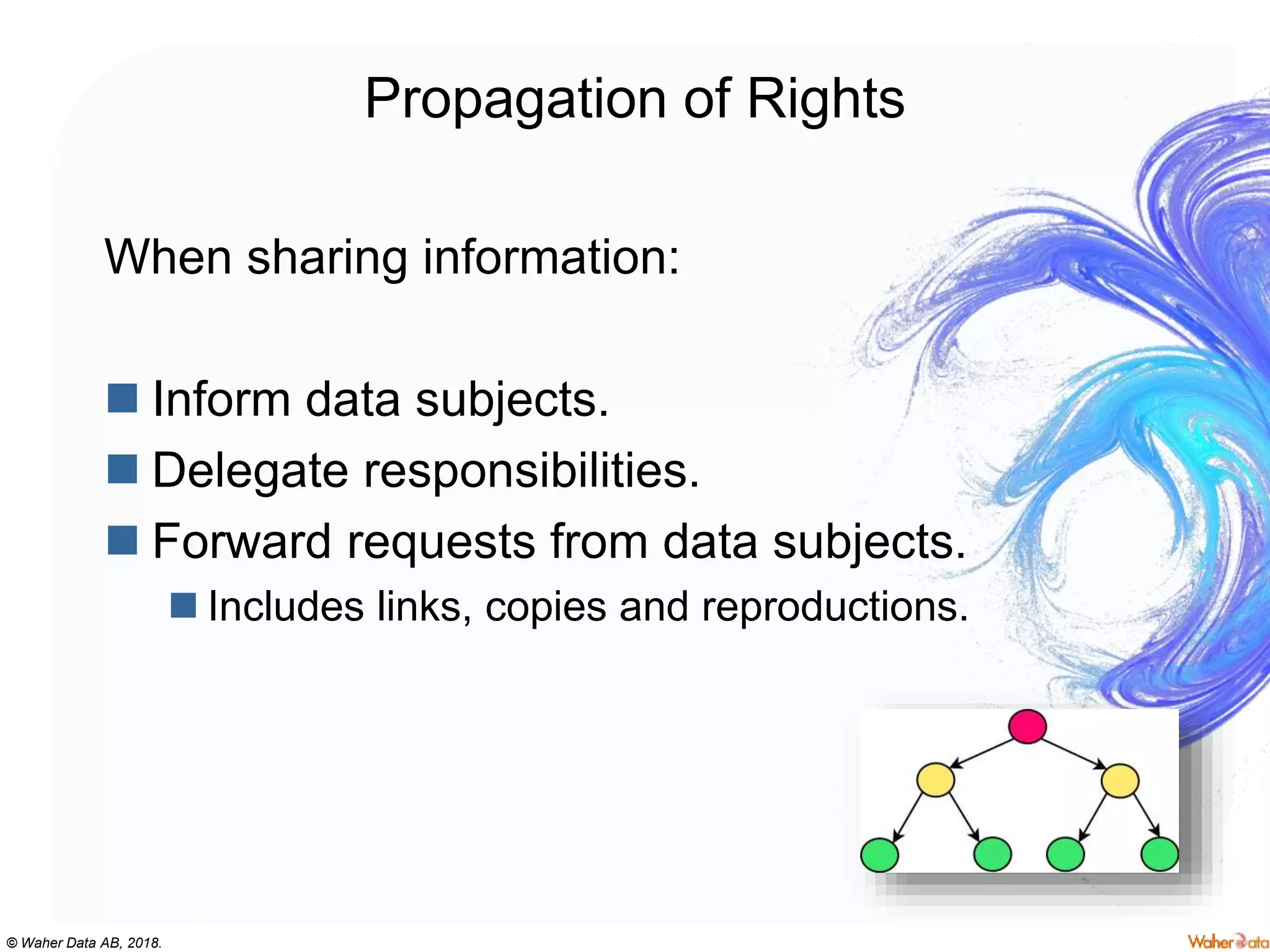
Propagation of Rights
When sharing information:
 Inform data subjects.
 Delegate responsibilities.
 Forward requests from data subjects.
 Includes links, copies and reproductions.
© Waher Data AB, 2018.
Sanctions
 Authorities are granted access to all
 Information
 Machines
 Data
 Warnings
 Reprimands
 Restrictions
 Shut down processes
 Fines (up to 4% of global annual turnover)
 Damages (even indirect, unless you prove you’re
not responsible)
GDPR
© Waher Data AB, 2018.
Paradigm Shift
Previous paradigm:
The more you collect, the more potential value you have.
This is no longer true.
New paradigm:
The more you collect, the greater the risk, and the greater
the responsibility.
You should only collect that to which you can assign value.
© Waher Data AB, 2018.
4. Ownership
© Waher Data AB, 2018.
Who owns the data?
Who is the owner of data?
 The person/entity generating (inventing) the data?
 The person/entity storing (controlling) the data?
 The person about whom the data relates to?
Is it important?
© Waher Data AB, 2018.
Legislation
Which law is applicable?
 Copyright?
 Trade secrets?
 Intellectual Property?
 Privacy?
Enforcing ownership through legal means
is difficult.
© Waher Data AB, 2018.
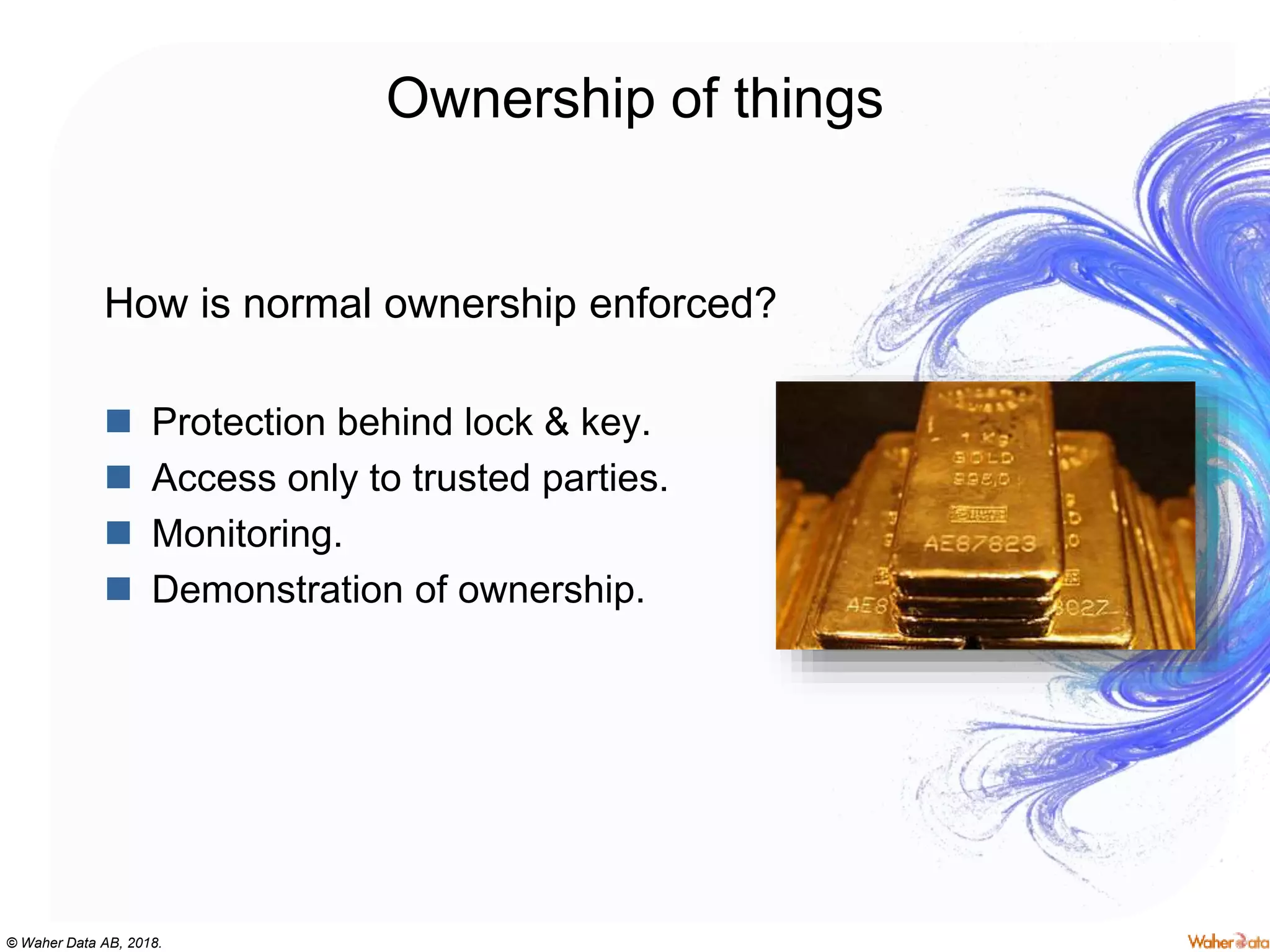
Ownership of things
How is normal ownership enforced?
 Protection behind lock & key.
 Access only to trusted parties.
 Monitoring.
 Demonstration of ownership.
© Waher Data AB, 2018.
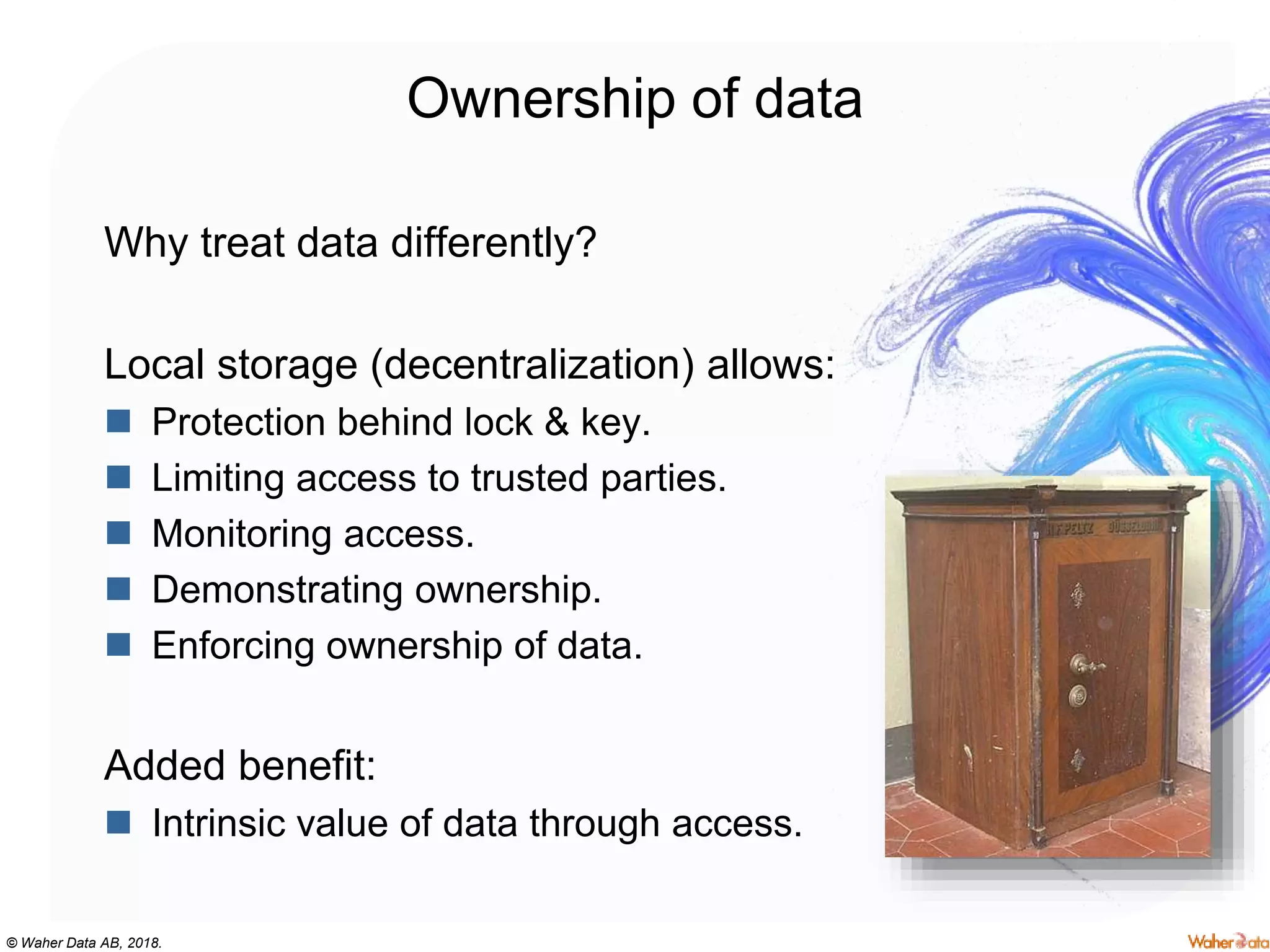
Ownership of data
Why treat data differently?
Local storage (decentralization) allows:
 Protection behind lock & key.
 Limiting access to trusted parties.
 Monitoring access.
 Demonstrating ownership.
 Enforcing ownership of data.
Added benefit:
 Intrinsic value of data through access.
© Waher Data AB, 2018.
Edge Computing
Processing “on the Edge” instead of
“in the Cloud” allows:
 Access = Value
 Scalability
 Resilience
 Security
And it helps protect privacy…
© Waher Data AB, 2018.
5. Needless problems
© Waher Data AB, 2018.
Making privacy more problematic
Technologies making protecting
privacy more difficult:
 Centralized processing
 HTTP(S)
 CoAP, LWM2M
 MQTT
 Blockchain
You have to develop data protection mechanisms just to
counter-act the side effects of using such technologies.
© Waher Data AB, 2018.
Centralized processing
 Less attack surfaces
 Value of central nodes is huge
 Value/Effort ratio large
 Difficult to protect
External use
Internal use
 Consequences huge
Massive leaks
© Waher Data AB, 2018.
HTTP
 Good for
 Publishing documents
 Providing public services
 Bad at
 Authentication
 Authorization
 Distribution
 Asynchronous processing
 Topology problem promotes
 Centralized processing
 … or “hole punching”
© Waher Data AB, 2018.
CoAP & LWM2M
Tries to solve aspects of HTTP for IoT
 Still has topology problem
 Assumes middleware for Internet use
 LWM2M is standardized middleware
 Some interoperability
 IPSO Smart Objects
 Only for data collection
 Difficult to interoperate between things
© Waher Data AB, 2018.
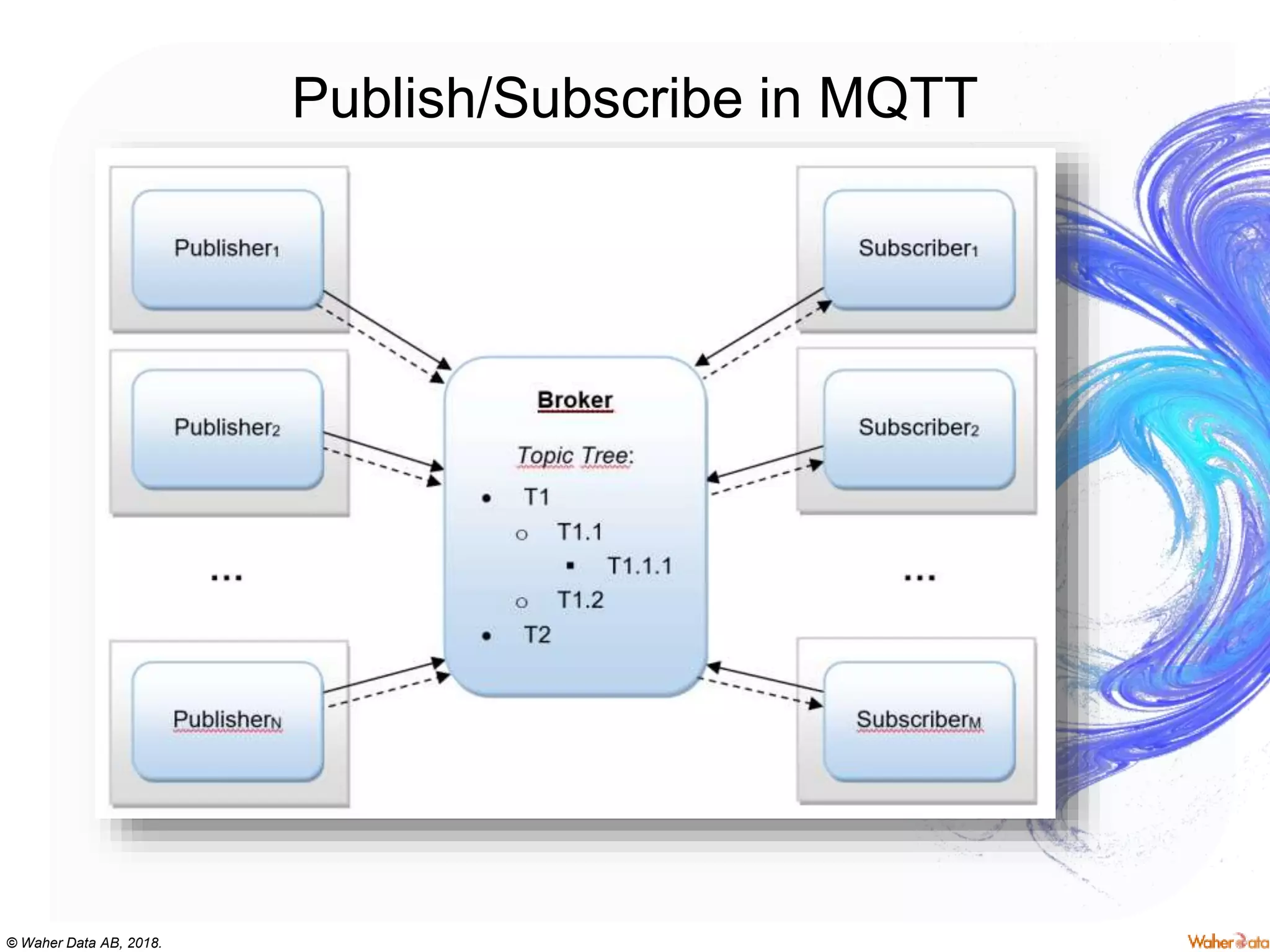
Publish/Subscribe in MQTT
© Waher Data AB, 2018.
Privacy issues by design in MQTT
 No forwarded identities
 Authorization becomes impossible by things
 Makes injection a great threat
 Control signals
 False data
 Bandwidth depletion
 Lack of privacy
 No negotiation of who can subscribe
 Access control out-of-band (proprietary)
 Wildcards
 Makes it easy to eavesdrop
 Relies on careful operation of broker
 Overview of topic tree difficult
 Who operates the broker across domains?
 Interoperability a problem.
… and many more security-related issues exist.
© Waher Data AB, 2018.
Warnings
 Governments warn against bad
MQTT implementations.
 MQTT is notoriously difficult to use
securely.
 Use it only in internal secured networks.
https://cert.se/2016/09/mqtt-i-sverige
© Waher Data AB, 2018.
Blockchain
 Blocks cannot
 be deleted
 on request
 after a given time
 … or ever
 be corrected
 Access is given to all or nothing
 Public access has to be assumed
 Hashes of personal information is still personal
 Cryptographic Algorithms fixed
 Lends itself to future frauds
Blockchain is not suitable for personal information at all.
© Waher Data AB, 2018.
6. Neutral
© Waher Data AB, 2018.
Security ≠ Privacy
Technologies that do not help, or work
against the protection of privacy:
 TLS
 DTLS
 X.509
 VPN
 …
Using such technologies doesn’t solve any privacy issues.
But at least they don’t add new issues by themselves.
© Waher Data AB, 2018.
7. Ambivalence
© Waher Data AB, 2018.
Identities
Technologies that either help or make it
more difficult to protect privacy:
 Anonymity
 Strong identities
Pseudonyms
Using such technologies have strong privacy-related
implications. Which-way is determined by how they are used.
© Waher Data AB, 2018.
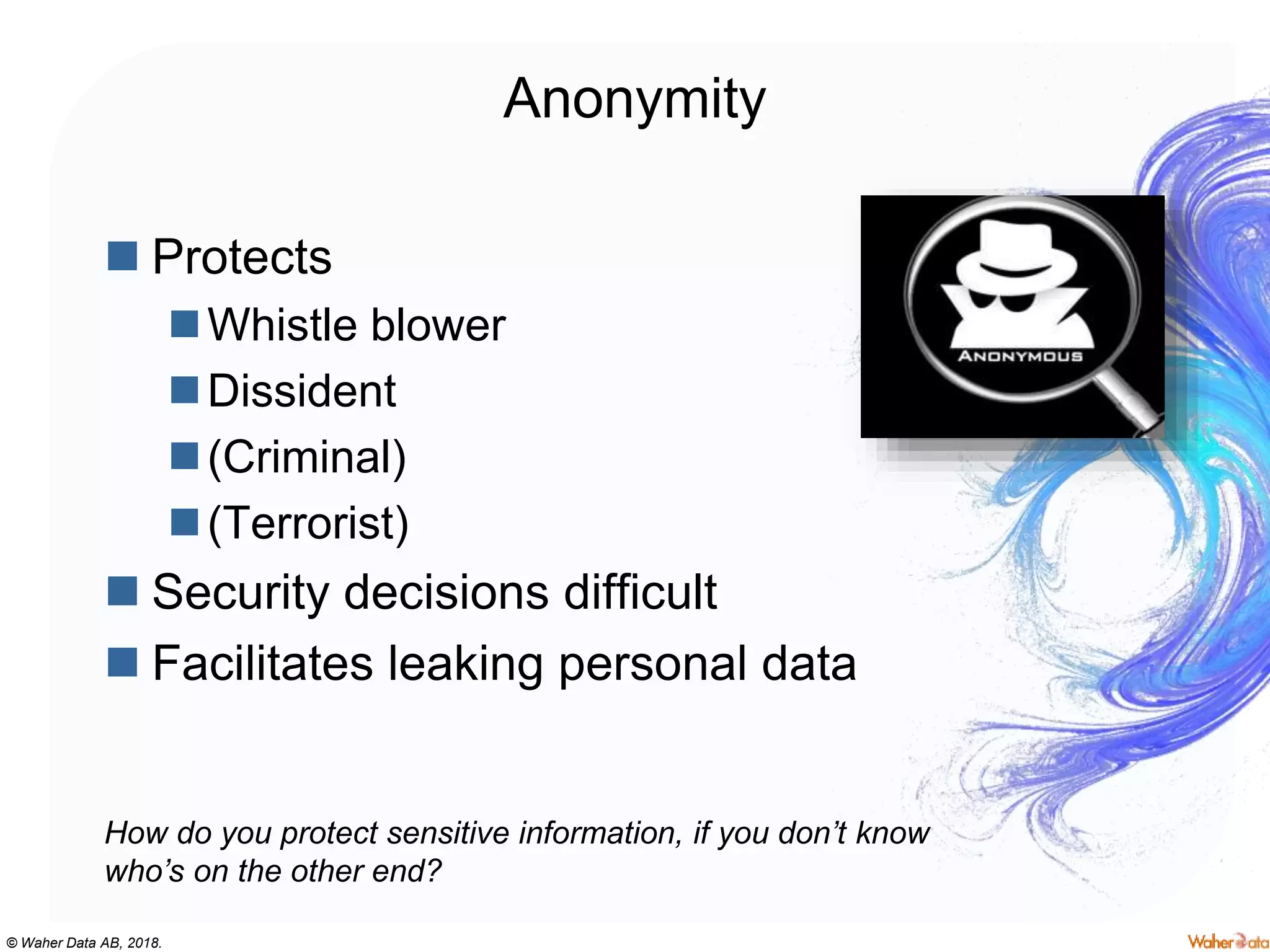
Anonymity
 Protects
Whistle blower
Dissident
(Criminal)
(Terrorist)
 Security decisions difficult
 Facilitates leaking personal data
How do you protect sensitive information, if you don’t know
who’s on the other end?
© Waher Data AB, 2018.
Strong Identities
 Protects information owners
 Allows selective responses
 Can be used to track
individuals
Logging for security purposes is legitimate. How can you
make sure logging is only used for security purposes?
(One answer: Use of standardized, open software that are
agnostic to the purposes of processing, such as brokers and
End-to-End encryption of payloads.)
© Waher Data AB, 2018.
8. Solutions
© Waher Data AB, 2018.
Solving Privacy-related problems
Examples of technologies that help
protect privacy:
 Decentralized Processing
 Edge computing
 XMPP
 Consent-based communication
 IEEE IoT Harmonization
 Data ownership in Smart Cities
Using such technologies solve many privacy related issues
by design and by default.
© Waher Data AB, 2018.
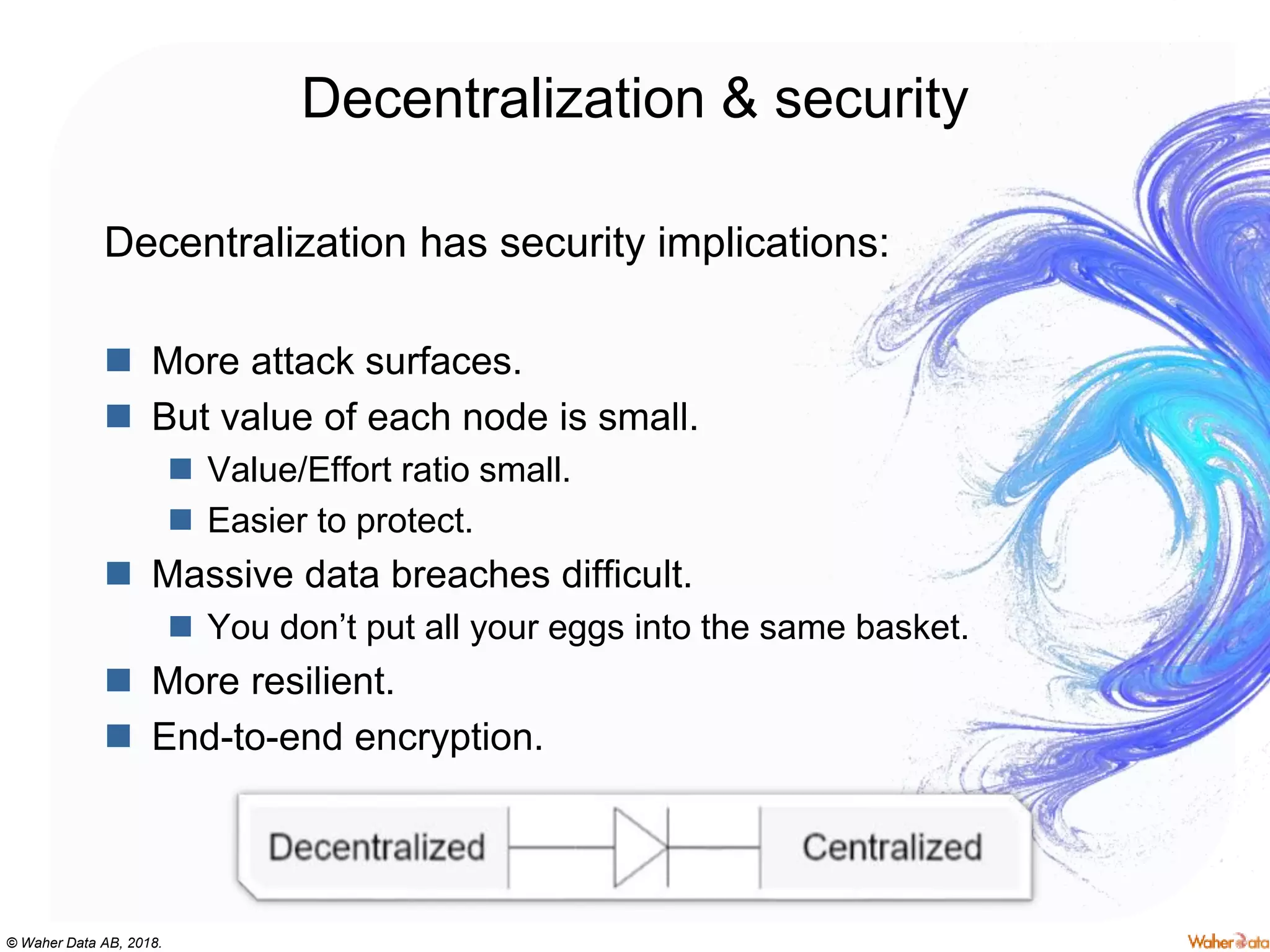
Decentralization & security
Decentralization has security implications:
 More attack surfaces.
 But value of each node is small.
 Value/Effort ratio small.
 Easier to protect.
 Massive data breaches difficult.
 You don’t put all your eggs into the same basket.
 More resilient.
 End-to-end encryption.
© Waher Data AB, 2018.
XMPP
 Authentication of clients
 SASL
 Cooperation (federation)
 Forwarding identities
 Authorization
 Roster
 Presence
 Subscription
 Solves
 Topology problem.
 Latency problem.
 Scalability problem.
© Waher Data AB, 2018.
Communication Patterns
Async.
Msg.
Req/Resp Pub/Sub Federation Broker P2P7
MQTT ✓ ✓
HTTP ✓ ✓
CoAP ✓ ✓ ✓
XMPP ✓ ✓ ✓✓✓ ✓ ✓* ✓
* Note: XMPP supports server-less communication as well.
© Waher Data AB, 2018.
XMPP & Data Protection by Design
XMPP supports data protection by design:
 Decentralization
 Ubiquitous encryption
 Even end-to-end encryption
 Global identities
 Authenticated
 Forwarded
 Federated
 Basic communication authorized
© Waher Data AB, 2018.
XMPP & Data Protection by Default
XMPP supports data protection by default:
 Presence negotiation
 Consent-based authorization
 Required to be able to communicate
properly.
 Consent can be withdrawn.
© Waher Data AB, 2018.
IEEE IoT Harmonization (1451-99)
 Sensor Data
 Control Operations
 Localization (M2M, M2H)
 Tokens for distributed transactions
 Decision Support (for devices)
 Provisioning (for owners)
 Peer-to-Peer communication
 End-to-end encryption
 Concentrator/Bridge (“Thing of things”)
 Discovery
 Ownership
 Clock Synchronization
 Secure Account Creation
 Legal Identities
 Contracts
 Automated provisioning
 Economic feedback
https://gitlab.com/IEEE-SA/XMPPI/IoT
© Waher Data AB, 2018.
9. Events
© Waher Data AB, 2018.
Smart City Lectures*
1. How to build a Smart City (Oct 4th)
2. Privacy in the Smart City (Oct 18th)
3. An Open and/or Secure Smart City (Oct 25th)
4. Harmonizing the Internet of Things (Nov 8th)
5. Introduction to Encryption (Nov 15th)
6. Earning by Sharing in the Smart City (Nov 22th)
7. …
8. …
(*) Funded by Swedish Internet Fund.
© Waher Data AB, 2018.
Smart City Labs*
1. Sensors and actuators (Oct 10th)
2. Connect and chat with your device (Oct 17th)
3. Publishing data from your sensor (Oct 24th)
4. Publishing and discovering devices (Nov 7th)
5. Controlling actuators (Nov 14th)
6. Decision Support for your devices (Nov 21th)
7. …
8. …
(*) Funded by Swedish Internet Fund.
© Waher Data AB, 2018.
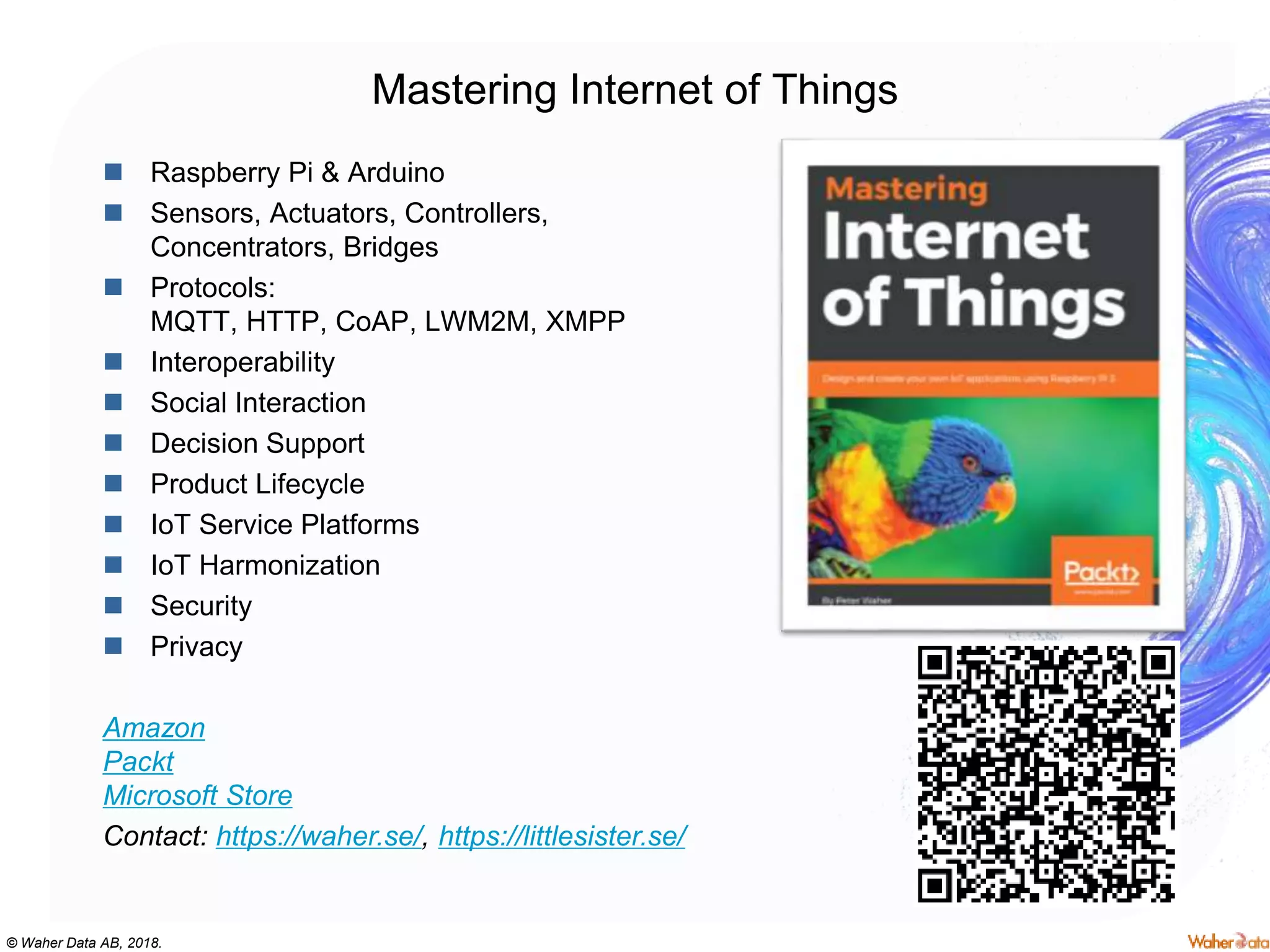
 Raspberry Pi & Arduino
 Sensors, Actuators, Controllers,
Concentrators, Bridges
 Protocols:
MQTT, HTTP, CoAP, LWM2M, XMPP
 Interoperability
 Social Interaction
 Decision Support
 Product Lifecycle
 IoT Service Platforms
 IoT Harmonization
 Security
 Privacy
Amazon
Packt
Microsoft Store
Contact: https://waher.se/, https://littlesister.se/
Mastering Internet of Things
© Waher Data AB, 2018.
10. Open Discussion
Ownership?
Privacy?
Security?
Surveillance?
Interoperability?
Cool stuff?
Qué?
Where’s the Money?
Who pays?
What could go wrong?
Little Sister?
Harmonization?

Smart City Lecture 2 - Privacy in the Smart City

  • 1.
    © Waher DataAB, 2018. Smart City Lecture 2 Privacy in the Smart City
  • 2.
    © Waher DataAB, 2018. 1. Recapture
  • 3.
    © Waher DataAB, 2018. Smart City / Society  Automation  Open Data  Transport  Traffic (C-ITS)  Parking  Utilities  Health Care  Law enforcement  Schools  Libraries  Waste management  Citizens?  … Smart for whom?
  • 4.
    © Waher DataAB, 2018. What can be
  • 5.
    © Waher DataAB, 2018. Chinese Social Credit System (World’s most?) ambitious “Smart City” project. Calculates economic and social reputation, based on mass surveillance and AI:  Honesty  Commercial Integrity  Social Integrity  Judicial Credibility
  • 6.
    © Waher DataAB, 2018. Chinese Social Credit System Collects data from:  Online activity  Searches  Shopping behavior  Locations  Friends  Health  Bank accounts  Messages  Smart Home appliances  News sources  Dating  …
  • 7.
    © Waher DataAB, 2018. Chinese Social Credit System Affects:  Job positions  Salaries  Living  Travel restrictions  Visa restrictions  Access to schools  Social status  Loans  Internet bandwidth  …
  • 8.
    © Waher DataAB, 2018. Universal Declaration of Human Rights Article 12: No one shall be subjected to arbitrary interference with his privacy, family, home or correspondence, nor to attacks upon his honour and reputation. Everyone has the right to the protection of the law against such interference or attacks. https://www.un.org/en/universal-declaration-human-rights/ Well… it all depends on how you choose to interpret “arbitrary” and “attack”…
  • 9.
    © Waher DataAB, 2018. Vision of a Smart City  Ubiquitous access to interoperable sensors and things.  Ubiquitous access to data and information from society’s authorities.  Access to smart services in all niches of society.  Definition of ownership of information.  Protection of Privacy, by design and by default.  Market for access to things and data. Is this Science Fiction?
  • 10.
    © Waher DataAB, 2018. 2. Privacy
  • 11.
    © Waher DataAB, 2018. What is privacy? A fundamental human right:  The right to have confidential conversations.  The ability to select with whom we communicate.  Protection against unwarranted monitoring or searches.
  • 12.
    © Waher DataAB, 2018. Does privacy extend to Social Networks? Who can access your information? Do you want uninvited to know:  What you think?  What you like?  Who you know?  What you’ve done?  Spy on you? Or be able to:  Steal your ideas?  Utilize your confidential information?
  • 13.
    © Waher DataAB, 2018. Does privacy extend to the IoT? Who can communicate with devices around you, and about what? Do you want uninvited to know:  When you’re home?  If you’re in the shower?  What places you visit?  Your health status? Or be able to:  Control your vehicle?  Turn off your pacemaker?
  • 14.
    Ex-Director of NationalIntelligence James R. Clapper http://www.popsci.com/clapper-americas-greatest-threat-is-internet-things ”America's greatest threat is the Internet of Things” Feb 9, 2016
  • 15.
    © Waher DataAB, 2018. 3. GDPR General Data Protection Regulation Can it help?
  • 16.
    © Waher DataAB, 2018. Goals  EU Regulation  Automatic law in each Member State.  Came into full effect May 2018.  Harmonizes privacy regulations across the EU.  Balances  Privacy of individuals.  Interests of corporations.  Legal requirements.  Facilitate the free flow of information.
  • 17.
    © Waher DataAB, 2018. Limits  GDPR balances  Privacy of individuals.  Interests of corporations.  Legal requirements.  Maximum required effort  Proportionality to the rights of all participants.  Minimum required effort  State of the art  Lack of knowledge not acceptable  Severe sanctions
  • 18.
    © Waher DataAB, 2018. Personal Data Any information relating directly, or indirectly, to an identified or identifiable natural person. “Personality is contagious”
  • 19.
    © Waher DataAB, 2018. Processing Any operation or set of operations which is performed on personal data or on sets of personal data. “Automatic” is not mentioned. Manual processes are included.
  • 20.
    © Waher DataAB, 2018. Anonymization Data subjects are no longer identifiable. Examples: Data obfuscation, statistical aggregation, etc. GDPR
  • 21.
    © Waher DataAB, 2018. Pseudonymization Data subjects can be identified with the use of separate data Examples: Pseudonyms, ordinal numbers, hashes. GDPR
  • 22.
    © Waher DataAB, 2018. What is allowed?  As little as possible  For as short a time as possible  Share with as few as possible  For as few purposes as possible  As correctly as possible  If there are no other means  After providing transparent information Minimalistic definition: Minimalism Always with proportional data protection mechanisms.
  • 23.
    © Waher DataAB, 2018. Data Protection Data must be protected*:  By design  By default  State of the art cf. Black lists vs. White lists (*) Proportional to the risks of the data subjects, in the absence of measures taken to mitigate the risks.
  • 24.
    © Waher DataAB, 2018. Transparent Information  Easily accessible  Easily understood  Clear and plain language  Explicit  Purposes of processing  Risks to the subject  Safeguards  Rights of the subjects Transparency is measured on what is understood, not what is semantically stated.
  • 25.
    © Waher DataAB, 2018. Lawfulness  Consent  Legal obligation  Legitimate interest  Based on contract  Vital interest  Public interest Research & Development has to be argued is a Legitimate Interest.
  • 26.
    © Waher DataAB, 2018. Individual Rights  Transparent Information  Access to ones personal data  Export personal data provided by oneself  Correct erroneous data  Erase data*  Object to processing*  Restrict processing*  Withdrawal of consent (if based on consent)  Avoid being subject to automatic decisions (with negative legal consequences) based on automatic profiling. (*) in certain cases
  • 27.
    © Waher DataAB, 2018. Propagation of Rights When sharing information:  Inform data subjects.  Delegate responsibilities.  Forward requests from data subjects.  Includes links, copies and reproductions.
  • 28.
    © Waher DataAB, 2018. Sanctions  Authorities are granted access to all  Information  Machines  Data  Warnings  Reprimands  Restrictions  Shut down processes  Fines (up to 4% of global annual turnover)  Damages (even indirect, unless you prove you’re not responsible) GDPR
  • 29.
    © Waher DataAB, 2018. Paradigm Shift Previous paradigm: The more you collect, the more potential value you have. This is no longer true. New paradigm: The more you collect, the greater the risk, and the greater the responsibility. You should only collect that to which you can assign value.
  • 30.
    © Waher DataAB, 2018. 4. Ownership
  • 31.
    © Waher DataAB, 2018. Who owns the data? Who is the owner of data?  The person/entity generating (inventing) the data?  The person/entity storing (controlling) the data?  The person about whom the data relates to? Is it important?
  • 32.
    © Waher DataAB, 2018. Legislation Which law is applicable?  Copyright?  Trade secrets?  Intellectual Property?  Privacy? Enforcing ownership through legal means is difficult.
  • 33.
    © Waher DataAB, 2018. Ownership of things How is normal ownership enforced?  Protection behind lock & key.  Access only to trusted parties.  Monitoring.  Demonstration of ownership.
  • 34.
    © Waher DataAB, 2018. Ownership of data Why treat data differently? Local storage (decentralization) allows:  Protection behind lock & key.  Limiting access to trusted parties.  Monitoring access.  Demonstrating ownership.  Enforcing ownership of data. Added benefit:  Intrinsic value of data through access.
  • 35.
    © Waher DataAB, 2018. Edge Computing Processing “on the Edge” instead of “in the Cloud” allows:  Access = Value  Scalability  Resilience  Security And it helps protect privacy…
  • 36.
    © Waher DataAB, 2018. 5. Needless problems
  • 37.
    © Waher DataAB, 2018. Making privacy more problematic Technologies making protecting privacy more difficult:  Centralized processing  HTTP(S)  CoAP, LWM2M  MQTT  Blockchain You have to develop data protection mechanisms just to counter-act the side effects of using such technologies.
  • 38.
    © Waher DataAB, 2018. Centralized processing  Less attack surfaces  Value of central nodes is huge  Value/Effort ratio large  Difficult to protect External use Internal use  Consequences huge Massive leaks
  • 39.
    © Waher DataAB, 2018. HTTP  Good for  Publishing documents  Providing public services  Bad at  Authentication  Authorization  Distribution  Asynchronous processing  Topology problem promotes  Centralized processing  … or “hole punching”
  • 40.
    © Waher DataAB, 2018. CoAP & LWM2M Tries to solve aspects of HTTP for IoT  Still has topology problem  Assumes middleware for Internet use  LWM2M is standardized middleware  Some interoperability  IPSO Smart Objects  Only for data collection  Difficult to interoperate between things
  • 41.
    © Waher DataAB, 2018. Publish/Subscribe in MQTT
  • 42.
    © Waher DataAB, 2018. Privacy issues by design in MQTT  No forwarded identities  Authorization becomes impossible by things  Makes injection a great threat  Control signals  False data  Bandwidth depletion  Lack of privacy  No negotiation of who can subscribe  Access control out-of-band (proprietary)  Wildcards  Makes it easy to eavesdrop  Relies on careful operation of broker  Overview of topic tree difficult  Who operates the broker across domains?  Interoperability a problem. … and many more security-related issues exist.
  • 43.
    © Waher DataAB, 2018. Warnings  Governments warn against bad MQTT implementations.  MQTT is notoriously difficult to use securely.  Use it only in internal secured networks. https://cert.se/2016/09/mqtt-i-sverige
  • 44.
    © Waher DataAB, 2018. Blockchain  Blocks cannot  be deleted  on request  after a given time  … or ever  be corrected  Access is given to all or nothing  Public access has to be assumed  Hashes of personal information is still personal  Cryptographic Algorithms fixed  Lends itself to future frauds Blockchain is not suitable for personal information at all.
  • 45.
    © Waher DataAB, 2018. 6. Neutral
  • 46.
    © Waher DataAB, 2018. Security ≠ Privacy Technologies that do not help, or work against the protection of privacy:  TLS  DTLS  X.509  VPN  … Using such technologies doesn’t solve any privacy issues. But at least they don’t add new issues by themselves.
  • 47.
    © Waher DataAB, 2018. 7. Ambivalence
  • 48.
    © Waher DataAB, 2018. Identities Technologies that either help or make it more difficult to protect privacy:  Anonymity  Strong identities Pseudonyms Using such technologies have strong privacy-related implications. Which-way is determined by how they are used.
  • 49.
    © Waher DataAB, 2018. Anonymity  Protects Whistle blower Dissident (Criminal) (Terrorist)  Security decisions difficult  Facilitates leaking personal data How do you protect sensitive information, if you don’t know who’s on the other end?
  • 50.
    © Waher DataAB, 2018. Strong Identities  Protects information owners  Allows selective responses  Can be used to track individuals Logging for security purposes is legitimate. How can you make sure logging is only used for security purposes? (One answer: Use of standardized, open software that are agnostic to the purposes of processing, such as brokers and End-to-End encryption of payloads.)
  • 51.
    © Waher DataAB, 2018. 8. Solutions
  • 52.
    © Waher DataAB, 2018. Solving Privacy-related problems Examples of technologies that help protect privacy:  Decentralized Processing  Edge computing  XMPP  Consent-based communication  IEEE IoT Harmonization  Data ownership in Smart Cities Using such technologies solve many privacy related issues by design and by default.
  • 53.
    © Waher DataAB, 2018. Decentralization & security Decentralization has security implications:  More attack surfaces.  But value of each node is small.  Value/Effort ratio small.  Easier to protect.  Massive data breaches difficult.  You don’t put all your eggs into the same basket.  More resilient.  End-to-end encryption.
  • 54.
    © Waher DataAB, 2018. XMPP  Authentication of clients  SASL  Cooperation (federation)  Forwarding identities  Authorization  Roster  Presence  Subscription  Solves  Topology problem.  Latency problem.  Scalability problem.
  • 55.
    © Waher DataAB, 2018. Communication Patterns Async. Msg. Req/Resp Pub/Sub Federation Broker P2P7 MQTT ✓ ✓ HTTP ✓ ✓ CoAP ✓ ✓ ✓ XMPP ✓ ✓ ✓✓✓ ✓ ✓* ✓ * Note: XMPP supports server-less communication as well.
  • 56.
    © Waher DataAB, 2018. XMPP & Data Protection by Design XMPP supports data protection by design:  Decentralization  Ubiquitous encryption  Even end-to-end encryption  Global identities  Authenticated  Forwarded  Federated  Basic communication authorized
  • 57.
    © Waher DataAB, 2018. XMPP & Data Protection by Default XMPP supports data protection by default:  Presence negotiation  Consent-based authorization  Required to be able to communicate properly.  Consent can be withdrawn.
  • 58.
    © Waher DataAB, 2018. IEEE IoT Harmonization (1451-99)  Sensor Data  Control Operations  Localization (M2M, M2H)  Tokens for distributed transactions  Decision Support (for devices)  Provisioning (for owners)  Peer-to-Peer communication  End-to-end encryption  Concentrator/Bridge (“Thing of things”)  Discovery  Ownership  Clock Synchronization  Secure Account Creation  Legal Identities  Contracts  Automated provisioning  Economic feedback https://gitlab.com/IEEE-SA/XMPPI/IoT
  • 59.
    © Waher DataAB, 2018. 9. Events
  • 60.
    © Waher DataAB, 2018. Smart City Lectures* 1. How to build a Smart City (Oct 4th) 2. Privacy in the Smart City (Oct 18th) 3. An Open and/or Secure Smart City (Oct 25th) 4. Harmonizing the Internet of Things (Nov 8th) 5. Introduction to Encryption (Nov 15th) 6. Earning by Sharing in the Smart City (Nov 22th) 7. … 8. … (*) Funded by Swedish Internet Fund.
  • 61.
    © Waher DataAB, 2018. Smart City Labs* 1. Sensors and actuators (Oct 10th) 2. Connect and chat with your device (Oct 17th) 3. Publishing data from your sensor (Oct 24th) 4. Publishing and discovering devices (Nov 7th) 5. Controlling actuators (Nov 14th) 6. Decision Support for your devices (Nov 21th) 7. … 8. … (*) Funded by Swedish Internet Fund.
  • 62.
    © Waher DataAB, 2018.  Raspberry Pi & Arduino  Sensors, Actuators, Controllers, Concentrators, Bridges  Protocols: MQTT, HTTP, CoAP, LWM2M, XMPP  Interoperability  Social Interaction  Decision Support  Product Lifecycle  IoT Service Platforms  IoT Harmonization  Security  Privacy Amazon Packt Microsoft Store Contact: https://waher.se/, https://littlesister.se/ Mastering Internet of Things
  • 63.
    © Waher DataAB, 2018. 10. Open Discussion Ownership? Privacy? Security? Surveillance? Interoperability? Cool stuff? Qué? Where’s the Money? Who pays? What could go wrong? Little Sister? Harmonization?