RESEARCH METHODOLOGY
Submitted To: Dr. Deepshikha Kalra
• Submitted By:
Rhythm Kochar - 03115101718
Riya Katoch - 03215101718
Sanchit Kapoor - 03315101718
Saumya Sukant - 03415101718
DATA
ANALYTICS:
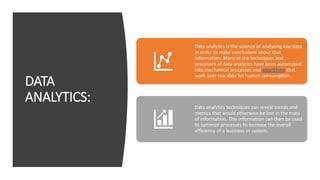
Data analytics is the science of analyzing raw data
in order to make conclusions about that
information. Many of the techniques and
processes of data analytics have been automated
into mechanical processes and algorithms that
work over raw data for human consumption.
Data analytics techniques can reveal trends and
metrics that would otherwise be lost in the mass
of information. This information can then be used
to optimize processes to increase the overall
efficiency of a business or system.
DATA
ANALYTICS
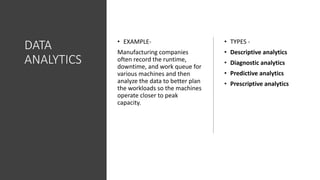
• EXAMPLE-
Manufacturing companies
often record the runtime,
downtime, and work queue for
various machines and then
analyze the data to better plan
the workloads so the machines
operate closer to peak
capacity.
• TYPES -
• Descriptive analytics
• Diagnostic analytics
• Predictive analytics
• Prescriptive analytics
PROCESS OF
DATA
ANALYTICS
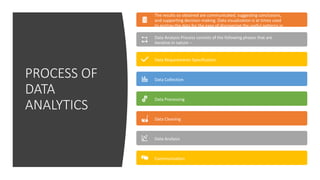
Data Analysis is a process of collecting, transforming, cleaning, and
modeling data with the goal of discovering the required information.
The results so obtained are communicated, suggesting conclusions,
and supporting decision-making. Data visualization is at times used
to portray the data for the ease of discovering the useful patterns in
the data. The terms Data Modeling and Data Analysis mean the
same.Data Analysis Process consists of the following phases that are
iterative in nature −
Data Requirements Specification
Data Collection
Data Processing
Data Cleaning
Data Analysis
Communication
WHY DATA
ANALYTICS
MATTER ?
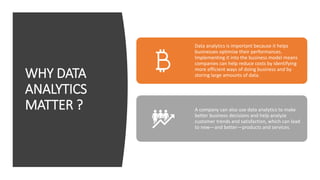
Data analytics is important because it helps
businesses optimize their performances.
Implementing it into the business model means
companies can help reduce costs by identifying
more efficient ways of doing business and by
storing large amounts of data.
A company can also use data analytics to make
better business decisions and help analyze
customer trends and satisfaction, which can lead
to new—and better—products and services.
INDIAN FILM INDUSTRY:
Cinema is immensely popular in
India, with as many as 2,000 films
produced in
various languages every
year.[9][10] Indian cinema produces
more films watched by more
people than any other country; in
2011, over 3.5 billion tickets were
sold across India, 900,000 (0.03%)
more
than Hollywood. Mumbai, Hyderab
ad, Kolkata, Chennai, Kochi and Ba
ngalore are the major centres of
film production in India.
As of 2013, India ranked first in
terms of annual film output,
followed
by Nollywood,[9][11] Hollywood and
China.[12] In 2012, India produced
1,602 feature films.[9] The Indian
film industry reached overall
revenues of $1.86 billion (₹93
billion) in 2011. In 2015, India had
a total box office gross of US$2.1
billion,[6][13] third largest in the
world.
The overall revenue of Indian
cinema reached US$1.3 billion in
2000.
Indian cinema is a global
enterprise.[16] Its films have a
following throughout Southern
Asia and across Europe, North
America, Asia, the Greater Middle
East, Eastern Africa, China and
elsewhere, reaching in over 90
countries.[17] Biopics including Dan
gal became
transnational blockbusters grossin
g over $300 million
worldwide.[18] Millions of Indians
overseas watch Indian films,
accounting for some 12% of
revenues.[19] Music rights alone
account for 4–5% of net revenues.
REASONS WHY
INDIAN FILM
REQUIRES DATA
SCIENCE
• Data Science will help you out with the various
and exact variables of a movie that will let you
know which movie your audiences will prefer
over others. While analysing the data, you will
recognise the components which are not
required for developing the movie. Below are
the four reasons why Indian films require Data
Science:-
1. Blocks Failure
Data Science is completely based on the facts and the numbers, that
includes the data of the productions, actors, songs and almost every
possible variables. The data is extracted through the actual information
gathered from the people or social media, which is then calculated to find
out if the movie will work or succeed and also this data helps to avoid
undesired consequences with lessening the chance of failure.
2. Determination of Release Time and Day
Data Science results in determining the release time and the day by using
machine learning, natural language processing or through social media in
order to earn the maximum audiences. This data gives a way to the
directors by providing the specific information required for the release of
the movies of different genres on different days. For example, most of the
animated movies get released during the time of children’s vacations and
most of the movies of Salman Khan’s get releases on the day of Eid.
3. Your Movie can make more Money
This is not more than a fact that the Data Science can boost your movie to
earn more money than any others. The analysis of data is conducted
before the release of every movie, considering all the factors like
production, songs, actors, directors, locations, story and what not. The
Data Science also helps you to know which part of the city, state or country
will help you to gain more audiences which will help you to make more
money. For example, the movies of the actor Dharmendera used to run
really well in Punjab or other northern parts of India.
4. Story Based on Interest of the Audiences
Data Science recognizes the top trends going all around the world through
social media and other mediums to know what can get you the success.
Nowadays maximum of the movie-makers in the industry started utilizing
the data received through the analysis to generate a story or plot in which
the audiences will genuinely show their deep interest.
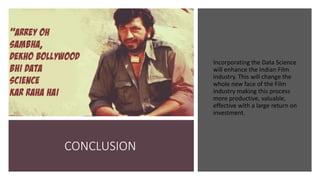
CONCLUSION
Incorporating the Data Science
will enhance the Indian Film
industry. This will change the
whole new face of the Film
industry making this process
more productive, valuable,
effective with a large return on
investment.
ROLE OF
DATA
ANALYTICS IN
INDIAN FILM
INDUSTRY
• Data analytics evolution in the film industry
Historically, movies have always been about arts; the only data relating to a
film would come from box office numbers and ticket sales. It was
impossible to predict the success of the movie beforehand, and producers
would usually have to rely on their judgment. However, that’s no more the
case today as alternative distribution platforms have given players in the
film industry a source to collect data. They have replaced traditional
approaches of predicting success through data mining and data analytics. It
is not surprising that the film industry is turning toward big data to increase
the success rate of their movies.
Data points to look out for
It is not uncommon for certain movie trailers to go viral and a specific
movie to be hyped about a lot, regardless of if it’s actually good. Today,
such interests and curiosity can be accurately measured from different
online sources including search engine results, social media feedback,
video views and comments, and ratings on critic’s website. Data analysts
can look at past success of a similar genre of movie with similar casts to
improve the accuracy of prediction. To accurately forecast a movie’s
revenue potential, data scientists need to have a large repository of data
including the success of titles by the same director, production company,
or casts, movies of the same genre, type of story, and marketing and
promotional channels
• Achieving accurate results
To get more precise, fine-tuned results, data scientists should consider the data
points for analysis. They have to create prediction models and algorithms to
judge the success of the movie accurately. With an abundance of data available
to analyze, the algorithms should consider the right target audience to achieve
the desired level of accuracy. The right target audience can be pinpointed by
analyzing moviegoers on an individual level. It is important to ascertain which of
these potential customers are the most likely to influence the opinion of others.
Additionally, seasonality also plays a vital role in determining the success of the
movie. It is the major reason why similar movies generate varying revenues as its
launched for events like major festivals, holidays, or weekends. Competitiveness
is another factor that influences the earning potential of a movie, for instance,
an average moviegoer would only watch one movie a week, so a particular title
would have to compete with various others released in the same week.
• Predictive analytics in the future
The advancements in data sciences and constant improvement in the movie
success algorithms would redefine the way the film industry approaches movie
production. In the future, it would be unlikely to see flops denting profits in the
quarterly sheets of production houses. With a wide range of data available for
decision makers in the film industry, the data analytics and prediction models
will only get better. As a result, we will see the film industry releasing the movie
more systematically with data analytics gaining as much prominence as the
director and casts of the movie
PROBLEM FACED BY INDIAN
FILM INDUSTRY
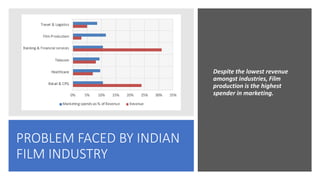
Despite the lowest revenue
amongst industries, Film
production is the highest
spender in marketing.
SOLUTION TO THE
PROBLEM
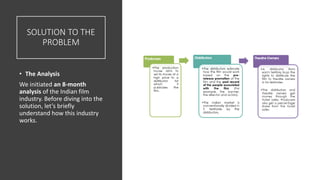
• The Analysis
We initiated an 8-month
analysis of the Indian film
industry. Before diving into the
solution, let’s briefly
understand how this industry
works.
Accounting for the rising trends while encompassing the above
discussed process flow of distribution, we’ve come up with a solution
to quantitatively plan and optimize a film’s marketing activities. The
solution has three components:
• Estimating the first week revenue from ticket sales
• Allocating Spend
• Finding Constraints and Optimizing
ESTIMATING
THE FIRST
WEEK
REVENUE
FROM TICKET
SALES
First week box office collection= 9 territories * No.
of screens * Average No. of seats * Average ticket
price * 7 days of week
Producers have the information about the no. of
screens in each territory. By classifying these
screens into regular theatres, small multiplexes
and large multiplexes, we can estimate the total
no. of seats. For example- on an average, there
are 200 seats in a regular theatre, 150 in a small
multiplex and 225 in a large multiplex.
Based on past records of the region and the films
with similar banner, production budget, crew,
genre, time of release etc., the average ticket
price can be assumed to define a realistic box
office target.
EFFECTIVELY
ALLOCATING
SPENDS
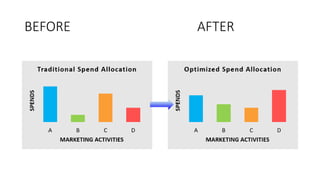
Let’s identify different factors that go into the success of
film at box office in its first week. For each of the
marketing activities, we’ve considered the factors listed
below :
• Spend – It is the most important factor that needs to
be optimized in order to achieve high ROI.
• Duration – Time is money. The producer is charged for
every single day in case of posters/banners, for every
single second in case of TV/radio ads. Hence, duration
too needs to be optimized.
• Gap between activity and film launch – Long gap
between two marketing activities may kill the hype
created by the former, hence careful planning is
required to account for audience memory.
• We often hear people saying that “it’s a Shahrukh Khan film or it’s a Yash Raj Banner, it will
definitely make hundreds of crores at the box office.” This suggests that audience does pay
attention to the star cast and production house of the film, before deciding to watch it. The
following factors are also important:
• Team – Audiences often have expectations from the actors, directors, music directors etc.
who have previously shown a good performance. Therefore, first week office collections
are less dependent on the content and more on the famous names of the team members.
• Genre – Past records of other films in the similar genre (action/drama/comedy etc) are a
good indicator of new film’s performance. Other indicators that answer ‘whether the film
is a remake or sequel of a hit film? Does the film have VFX effects or is it a 3D film?’ are
also factored in.
Now comes the external factors that determine the footfall of audience to the theatres.
• Release season – With the proliferation in the number of films released, the release date
has become critical now. Hence, tent pole films are released on important weekends like
that of festivals, summer holiday etc. On the contrary, a film might not do well if its release
date coincides with major events such as Cricket world cup or Indian Premiere League (IPL)
season.
• Number of concurrently released films – If other films (including Hollywood and regional
films) are also released in the same weekend, then the odds of the film to attract footfall
to its theatres decreases.
• Genre and team of these films – It is not possible to muster data on marketing activities of
competing films but their genre and team information can be passed into the model.
FINDING
CONSTRAINTS
& OPTIMIZING
While optimizing spends, we accounted for following
constraints
• Financial constraints– fixed marketing budget decided
by the production house
• Operational constraints- a minimum amount of spend
required by a media channel, for example a hoarding
cannot be taken down in 3 days
• We gathered and used data for all the above factors
and created a predictive algorithm to forecast first
week collection at box office. The model had 94%
accuracy. The algorithm (back tracing algorithm) was
used to optimize and distribute spends across
marketing activities in order to achieve the forecasted
box office collection. The methodology incorporates
time decay and position based algorithms to
effectively spread marketing activities over time.
BEFORE AFTER
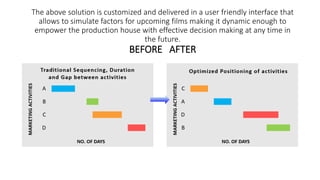
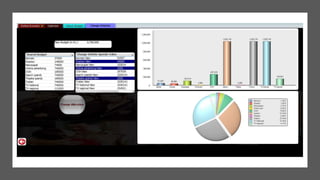
The above solution is customized and delivered in a user friendly interface that
allows to simulate factors for upcoming films making it dynamic enough to
empower the production house with effective decision making at any time in
the future.
BEFORE AFTER
END NOTE
The emergence of new technology and the era of ‘big data’ has
enabled such unconventional sectors as film industry to reap the
benefits of analytics.
Moreover, the latest trends witnessed by this industry have
brought in a plethora of platforms to connect with the consumers,
a scenario that calls for a more systematic approach to increase
both the efficiency and efficacy of promotions through each
platform in order to achieve maximum possible ROI from
minimum possible investments.
On top of this, the last decade has not only seen an increase in the
diversity of devices on which entertainment is consumed but also
in the profile of the audience that is now getting used to custom
content. Profiling of customers for better targeting,
personalization of content on select mediums etc. comprise
endless opportunities to benefit from analytics.
To conclude, we will not be wrong to say that such industries are
like gold mines awaiting new frameworks to extract the most out
of it
THANK YOU

Data Analytics in INDIAN FILM INDUSTRY

  • 1.
    RESEARCH METHODOLOGY Submitted To:Dr. Deepshikha Kalra • Submitted By: Rhythm Kochar - 03115101718 Riya Katoch - 03215101718 Sanchit Kapoor - 03315101718 Saumya Sukant - 03415101718
  • 2.
    DATA ANALYTICS: Data analytics isthe science of analyzing raw data in order to make conclusions about that information. Many of the techniques and processes of data analytics have been automated into mechanical processes and algorithms that work over raw data for human consumption. Data analytics techniques can reveal trends and metrics that would otherwise be lost in the mass of information. This information can then be used to optimize processes to increase the overall efficiency of a business or system.
  • 3.
    DATA ANALYTICS • EXAMPLE- Manufacturing companies oftenrecord the runtime, downtime, and work queue for various machines and then analyze the data to better plan the workloads so the machines operate closer to peak capacity. • TYPES - • Descriptive analytics • Diagnostic analytics • Predictive analytics • Prescriptive analytics
  • 4.
    PROCESS OF DATA ANALYTICS Data Analysisis a process of collecting, transforming, cleaning, and modeling data with the goal of discovering the required information. The results so obtained are communicated, suggesting conclusions, and supporting decision-making. Data visualization is at times used to portray the data for the ease of discovering the useful patterns in the data. The terms Data Modeling and Data Analysis mean the same.Data Analysis Process consists of the following phases that are iterative in nature − Data Requirements Specification Data Collection Data Processing Data Cleaning Data Analysis Communication
  • 5.
    WHY DATA ANALYTICS MATTER ? Dataanalytics is important because it helps businesses optimize their performances. Implementing it into the business model means companies can help reduce costs by identifying more efficient ways of doing business and by storing large amounts of data. A company can also use data analytics to make better business decisions and help analyze customer trends and satisfaction, which can lead to new—and better—products and services.
  • 6.
    INDIAN FILM INDUSTRY: Cinemais immensely popular in India, with as many as 2,000 films produced in various languages every year.[9][10] Indian cinema produces more films watched by more people than any other country; in 2011, over 3.5 billion tickets were sold across India, 900,000 (0.03%) more than Hollywood. Mumbai, Hyderab ad, Kolkata, Chennai, Kochi and Ba ngalore are the major centres of film production in India. As of 2013, India ranked first in terms of annual film output, followed by Nollywood,[9][11] Hollywood and China.[12] In 2012, India produced 1,602 feature films.[9] The Indian film industry reached overall revenues of $1.86 billion (₹93 billion) in 2011. In 2015, India had a total box office gross of US$2.1 billion,[6][13] third largest in the world. The overall revenue of Indian cinema reached US$1.3 billion in 2000. Indian cinema is a global enterprise.[16] Its films have a following throughout Southern Asia and across Europe, North America, Asia, the Greater Middle East, Eastern Africa, China and elsewhere, reaching in over 90 countries.[17] Biopics including Dan gal became transnational blockbusters grossin g over $300 million worldwide.[18] Millions of Indians overseas watch Indian films, accounting for some 12% of revenues.[19] Music rights alone account for 4–5% of net revenues.
  • 7.
    REASONS WHY INDIAN FILM REQUIRESDATA SCIENCE • Data Science will help you out with the various and exact variables of a movie that will let you know which movie your audiences will prefer over others. While analysing the data, you will recognise the components which are not required for developing the movie. Below are the four reasons why Indian films require Data Science:-
  • 8.
    1. Blocks Failure DataScience is completely based on the facts and the numbers, that includes the data of the productions, actors, songs and almost every possible variables. The data is extracted through the actual information gathered from the people or social media, which is then calculated to find out if the movie will work or succeed and also this data helps to avoid undesired consequences with lessening the chance of failure. 2. Determination of Release Time and Day Data Science results in determining the release time and the day by using machine learning, natural language processing or through social media in order to earn the maximum audiences. This data gives a way to the directors by providing the specific information required for the release of the movies of different genres on different days. For example, most of the animated movies get released during the time of children’s vacations and most of the movies of Salman Khan’s get releases on the day of Eid.
  • 9.
    3. Your Moviecan make more Money This is not more than a fact that the Data Science can boost your movie to earn more money than any others. The analysis of data is conducted before the release of every movie, considering all the factors like production, songs, actors, directors, locations, story and what not. The Data Science also helps you to know which part of the city, state or country will help you to gain more audiences which will help you to make more money. For example, the movies of the actor Dharmendera used to run really well in Punjab or other northern parts of India. 4. Story Based on Interest of the Audiences Data Science recognizes the top trends going all around the world through social media and other mediums to know what can get you the success. Nowadays maximum of the movie-makers in the industry started utilizing the data received through the analysis to generate a story or plot in which the audiences will genuinely show their deep interest.
  • 10.
    CONCLUSION Incorporating the DataScience will enhance the Indian Film industry. This will change the whole new face of the Film industry making this process more productive, valuable, effective with a large return on investment.
  • 11.
    ROLE OF DATA ANALYTICS IN INDIANFILM INDUSTRY • Data analytics evolution in the film industry Historically, movies have always been about arts; the only data relating to a film would come from box office numbers and ticket sales. It was impossible to predict the success of the movie beforehand, and producers would usually have to rely on their judgment. However, that’s no more the case today as alternative distribution platforms have given players in the film industry a source to collect data. They have replaced traditional approaches of predicting success through data mining and data analytics. It is not surprising that the film industry is turning toward big data to increase the success rate of their movies. Data points to look out for It is not uncommon for certain movie trailers to go viral and a specific movie to be hyped about a lot, regardless of if it’s actually good. Today, such interests and curiosity can be accurately measured from different online sources including search engine results, social media feedback, video views and comments, and ratings on critic’s website. Data analysts can look at past success of a similar genre of movie with similar casts to improve the accuracy of prediction. To accurately forecast a movie’s revenue potential, data scientists need to have a large repository of data including the success of titles by the same director, production company, or casts, movies of the same genre, type of story, and marketing and promotional channels
  • 12.
    • Achieving accurateresults To get more precise, fine-tuned results, data scientists should consider the data points for analysis. They have to create prediction models and algorithms to judge the success of the movie accurately. With an abundance of data available to analyze, the algorithms should consider the right target audience to achieve the desired level of accuracy. The right target audience can be pinpointed by analyzing moviegoers on an individual level. It is important to ascertain which of these potential customers are the most likely to influence the opinion of others. Additionally, seasonality also plays a vital role in determining the success of the movie. It is the major reason why similar movies generate varying revenues as its launched for events like major festivals, holidays, or weekends. Competitiveness is another factor that influences the earning potential of a movie, for instance, an average moviegoer would only watch one movie a week, so a particular title would have to compete with various others released in the same week. • Predictive analytics in the future The advancements in data sciences and constant improvement in the movie success algorithms would redefine the way the film industry approaches movie production. In the future, it would be unlikely to see flops denting profits in the quarterly sheets of production houses. With a wide range of data available for decision makers in the film industry, the data analytics and prediction models will only get better. As a result, we will see the film industry releasing the movie more systematically with data analytics gaining as much prominence as the director and casts of the movie
  • 13.
    PROBLEM FACED BYINDIAN FILM INDUSTRY Despite the lowest revenue amongst industries, Film production is the highest spender in marketing.
  • 14.
    SOLUTION TO THE PROBLEM •The Analysis We initiated an 8-month analysis of the Indian film industry. Before diving into the solution, let’s briefly understand how this industry works.
  • 15.
    Accounting for therising trends while encompassing the above discussed process flow of distribution, we’ve come up with a solution to quantitatively plan and optimize a film’s marketing activities. The solution has three components: • Estimating the first week revenue from ticket sales • Allocating Spend • Finding Constraints and Optimizing
  • 16.
    ESTIMATING THE FIRST WEEK REVENUE FROM TICKET SALES Firstweek box office collection= 9 territories * No. of screens * Average No. of seats * Average ticket price * 7 days of week Producers have the information about the no. of screens in each territory. By classifying these screens into regular theatres, small multiplexes and large multiplexes, we can estimate the total no. of seats. For example- on an average, there are 200 seats in a regular theatre, 150 in a small multiplex and 225 in a large multiplex. Based on past records of the region and the films with similar banner, production budget, crew, genre, time of release etc., the average ticket price can be assumed to define a realistic box office target.
  • 17.
    EFFECTIVELY ALLOCATING SPENDS Let’s identify differentfactors that go into the success of film at box office in its first week. For each of the marketing activities, we’ve considered the factors listed below : • Spend – It is the most important factor that needs to be optimized in order to achieve high ROI. • Duration – Time is money. The producer is charged for every single day in case of posters/banners, for every single second in case of TV/radio ads. Hence, duration too needs to be optimized. • Gap between activity and film launch – Long gap between two marketing activities may kill the hype created by the former, hence careful planning is required to account for audience memory.
  • 18.
    • We oftenhear people saying that “it’s a Shahrukh Khan film or it’s a Yash Raj Banner, it will definitely make hundreds of crores at the box office.” This suggests that audience does pay attention to the star cast and production house of the film, before deciding to watch it. The following factors are also important: • Team – Audiences often have expectations from the actors, directors, music directors etc. who have previously shown a good performance. Therefore, first week office collections are less dependent on the content and more on the famous names of the team members. • Genre – Past records of other films in the similar genre (action/drama/comedy etc) are a good indicator of new film’s performance. Other indicators that answer ‘whether the film is a remake or sequel of a hit film? Does the film have VFX effects or is it a 3D film?’ are also factored in. Now comes the external factors that determine the footfall of audience to the theatres. • Release season – With the proliferation in the number of films released, the release date has become critical now. Hence, tent pole films are released on important weekends like that of festivals, summer holiday etc. On the contrary, a film might not do well if its release date coincides with major events such as Cricket world cup or Indian Premiere League (IPL) season. • Number of concurrently released films – If other films (including Hollywood and regional films) are also released in the same weekend, then the odds of the film to attract footfall to its theatres decreases. • Genre and team of these films – It is not possible to muster data on marketing activities of competing films but their genre and team information can be passed into the model.
  • 19.
    FINDING CONSTRAINTS & OPTIMIZING While optimizingspends, we accounted for following constraints • Financial constraints– fixed marketing budget decided by the production house • Operational constraints- a minimum amount of spend required by a media channel, for example a hoarding cannot be taken down in 3 days • We gathered and used data for all the above factors and created a predictive algorithm to forecast first week collection at box office. The model had 94% accuracy. The algorithm (back tracing algorithm) was used to optimize and distribute spends across marketing activities in order to achieve the forecasted box office collection. The methodology incorporates time decay and position based algorithms to effectively spread marketing activities over time.
  • 20.
  • 21.
    The above solutionis customized and delivered in a user friendly interface that allows to simulate factors for upcoming films making it dynamic enough to empower the production house with effective decision making at any time in the future. BEFORE AFTER
  • 23.
    END NOTE The emergenceof new technology and the era of ‘big data’ has enabled such unconventional sectors as film industry to reap the benefits of analytics. Moreover, the latest trends witnessed by this industry have brought in a plethora of platforms to connect with the consumers, a scenario that calls for a more systematic approach to increase both the efficiency and efficacy of promotions through each platform in order to achieve maximum possible ROI from minimum possible investments. On top of this, the last decade has not only seen an increase in the diversity of devices on which entertainment is consumed but also in the profile of the audience that is now getting used to custom content. Profiling of customers for better targeting, personalization of content on select mediums etc. comprise endless opportunities to benefit from analytics. To conclude, we will not be wrong to say that such industries are like gold mines awaiting new frameworks to extract the most out of it
  • 24.