LEARNING-BASED ONLINE
TRANSMISSION PATH SELECTION
FOR SECURE ESTIMATION IN
EDGE COMPUTING SYSTEMS
ABSTRACT
E-learning is becoming an increasingly popular form of
education but what about security that is an important
issue in the actual educational context where e-learning
increases in popularity and more and more people are
taking online courses. The approach to teach many
students at the same time, and the students possibility to
learn material at their own pace have been very
successful. There are many important elements that must
be taken into consideration: access control,
authentication, data integrity, content protection, etc.
Information security can be obtained using functions such
as cryptography and network protocols. In this paper, we
will highpoint some important security issues that must
be taken into consideration in developing and using an e-
learning platform. We will also inspect some security
aspects of one of the most popular open-source e-learning
systems.
EXISTING SYSTEM
E-learning is becoming an increasingly popular form of
education but what about security that is an important
issue in the actual educational context where e-learning
increases in popularity and more and more people are
taking online courses. The approach to teach many
students at the same time, and the students possibility to
learn material at their own pace have been very successful.
There are many important elements that must be taken
into consideration: access control, authentication, data
integrity, content protection, etc. Information security can
be obtained using functions such as cryptography and
network protocols. In this paper, we will highpoint some
important security issues that must be taken into
consideration in developing and using an e-learning
platform. We will also inspect some security aspects of one
of the most popular open-source e-learning systems.
DRAWBACKS:
 It’s not Secure it can be attacked by Dos attack.
 It is Complex to use.
 It use document are not safe which can be
modified.
 It does not have privacy
PROPOSED SYSTEM
In our System e-learning it is secure using cryptography by
encoding and decoding for the documents sent on the system. In
this a mobile agent continuously monitors the learner’s actions
for identifying optimal learning conditions and notes the weak
knowledge area of user. The architecture supports the process
of composing personalized content for an individual mobile user,
rapid course development and collaboration .The architecture
for simplifying and automating the process of creating the
domain model for an intelligent online e-learning system, which
is based on knowledge representation of educational resources
using World Wide Web.
Advantages:
 It is secure using Cryptography by encoding and Decoding.
 It is easy to use.
 The documents are secure with encryption.
 It has privacy securing system.
ADVANTAGES:
 It is secure using Cryptography by encoding and
Decoding.
 It is easy to use.
 The documents are secure with encryption.
 It has privacy securing system.
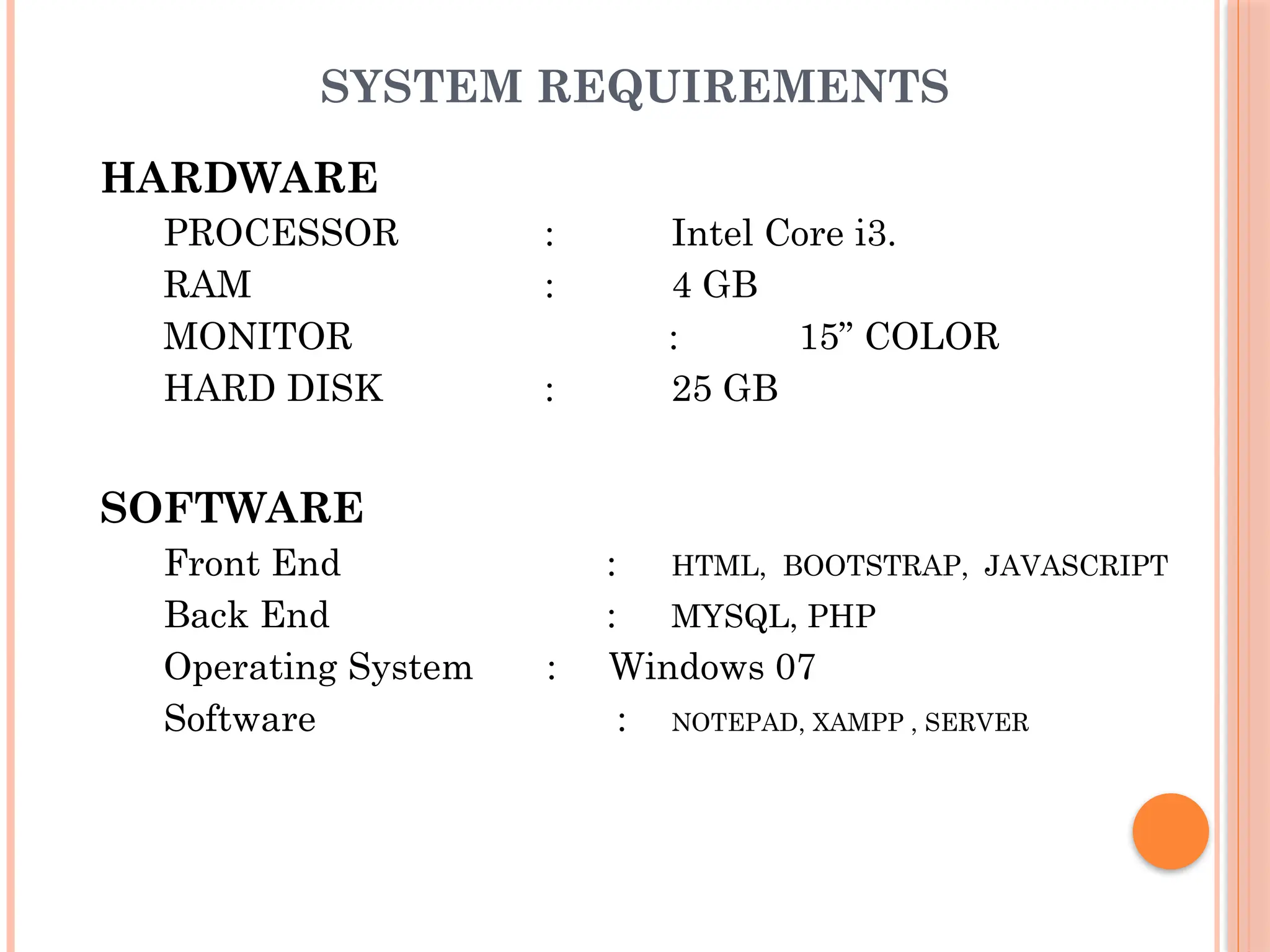
SYSTEM REQUIREMENTS
HARDWARE
PROCESSOR : Intel Core i3.
RAM : 4 GB
MONITOR : 15” COLOR
HARD DISK : 25 GB
SOFTWARE
Front End : HTML, BOOTSTRAP, JAVASCRIPT
Back End : MYSQL, PHP
Operating System : Windows 07
Software : NOTEPAD, XAMPP , SERVER
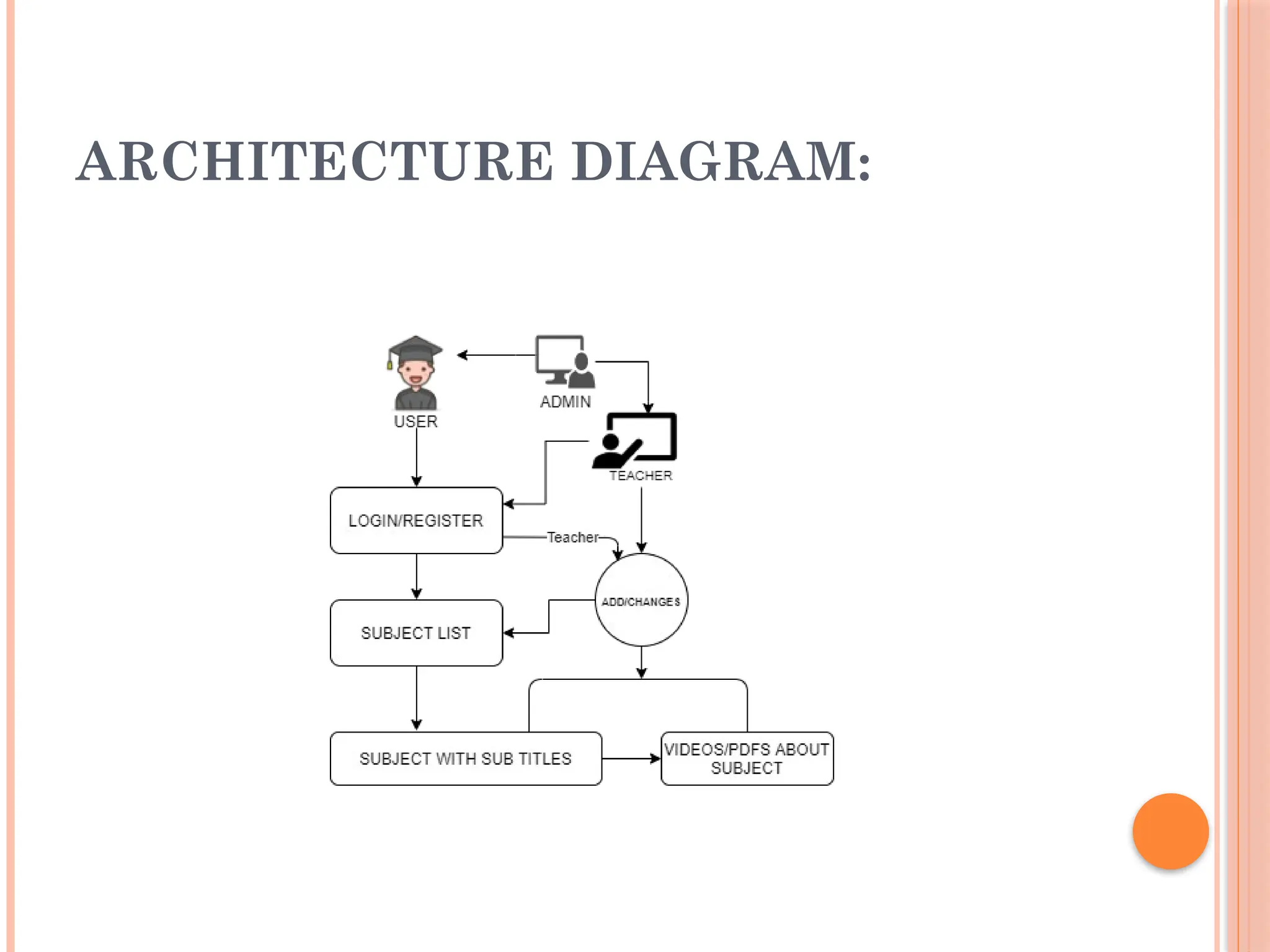
ARCHITECTURE DIAGRAM:
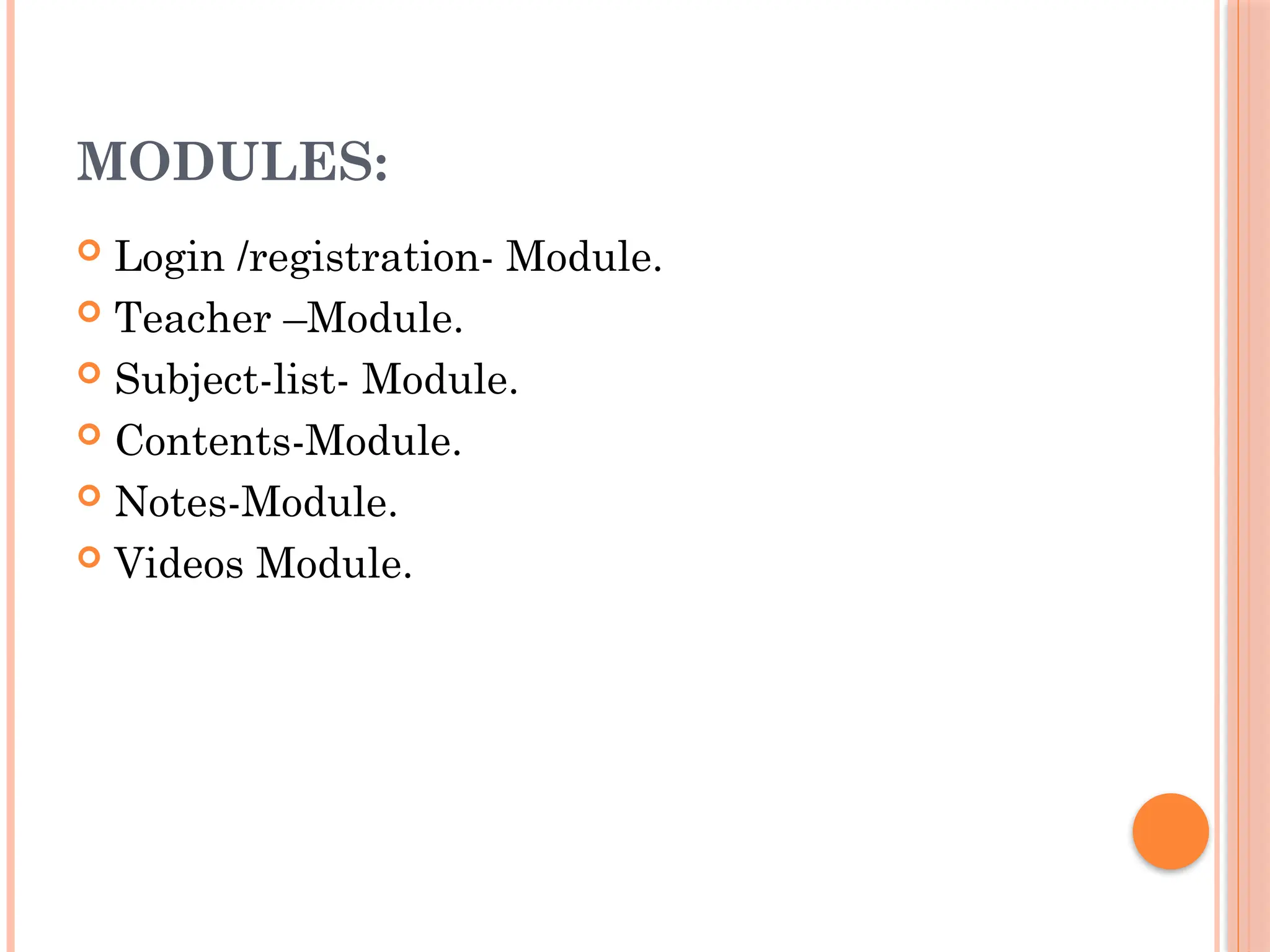
MODULES:
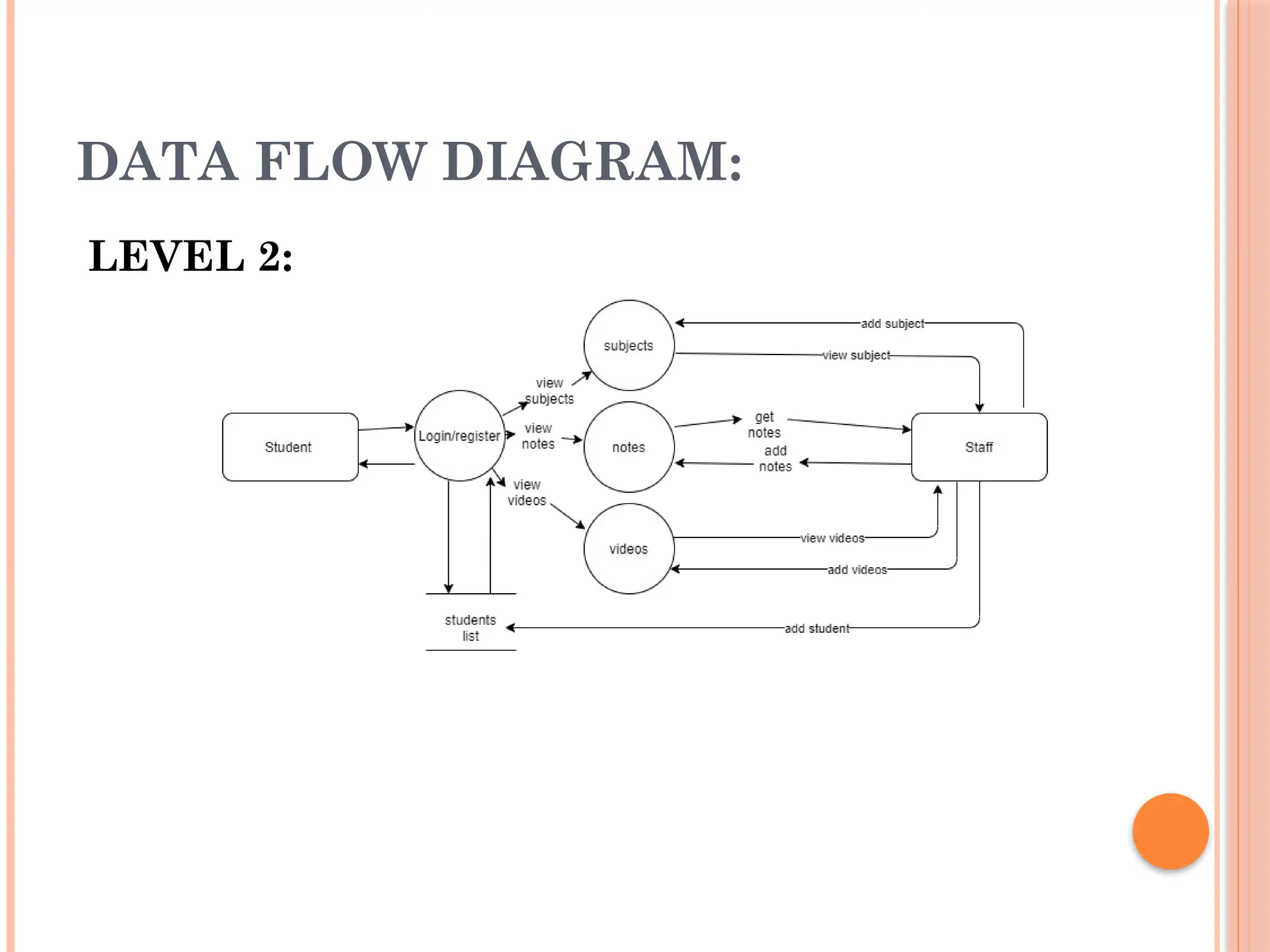
 Login /registration- Module.
 Teacher –Module.
 Subject-list- Module.
 Contents-Module.
 Notes-Module.
 Videos Module.
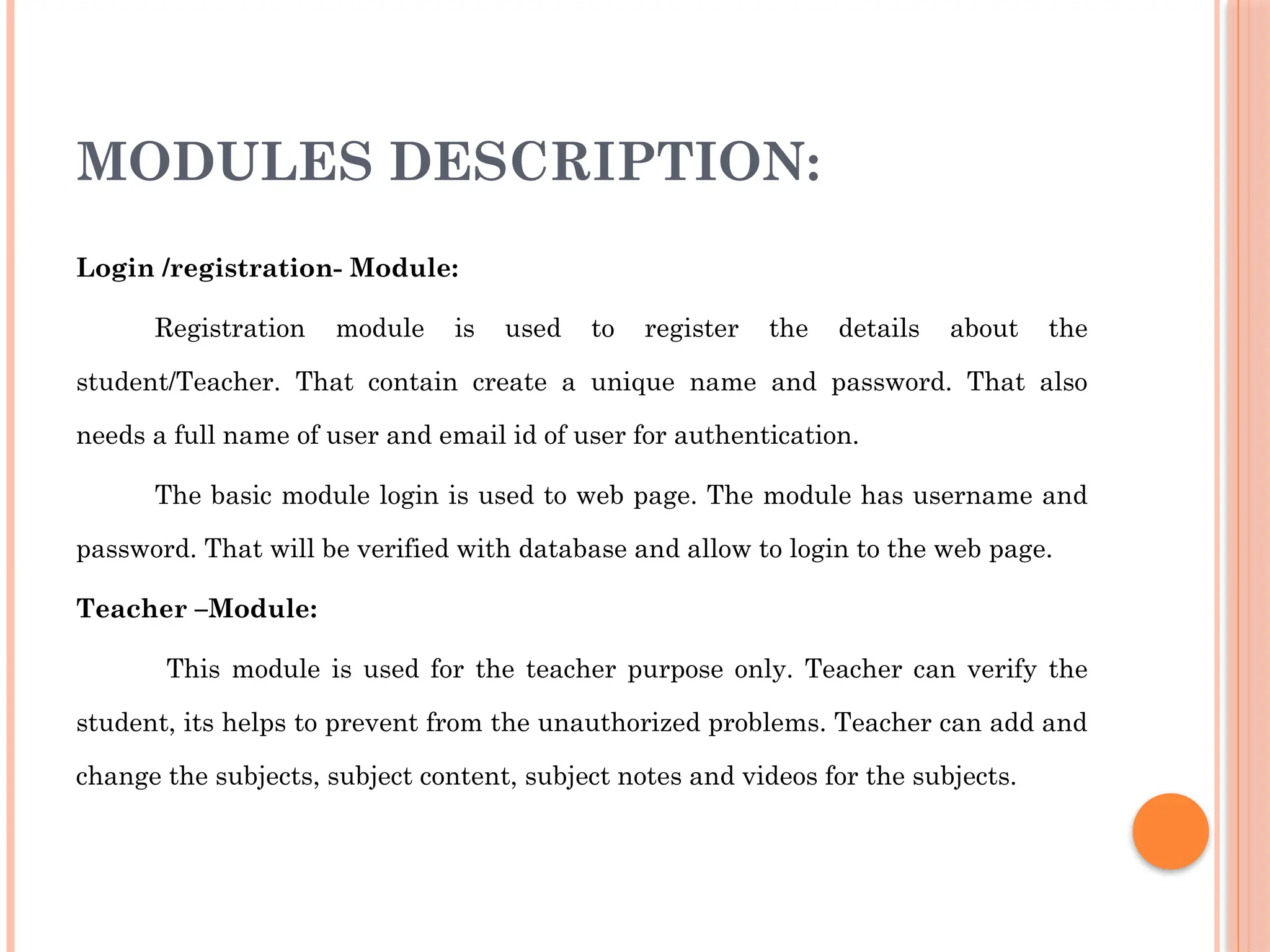
MODULES DESCRIPTION:
Login /registration- Module:
Registration module is used to register the details about the
student/Teacher. That contain create a unique name and password. That also
needs a full name of user and email id of user for authentication.
The basic module login is used to web page. The module has username and
password. That will be verified with database and allow to login to the web page.
Teacher –Module:
This module is used for the teacher purpose only. Teacher can verify the
student, its helps to prevent from the unauthorized problems. Teacher can add and
change the subjects, subject content, subject notes and videos for the subjects.
MODULES DESCRIPTION:
Subject List- Module:
The subject module can contain the list of subjects, the
teachers add the subjects from their account. Lot of top trending
computer subjects in the subject list. Students can choose the
subject want they like and using for the career and exams.
Content- Module:
This module is used to show the content of the student
selected specific subject. This module is having introduction of
the subject and variety of chapters show to the students for
improving knowledge and help to exams.
MODULES DESCRIPTION:
Notes- Module:
Notes module has a lot of Portable Document
Format (PDF) files for the student selected specific
subjects. Students can download the PDF file from
the notes module and use it for our preparations.
Practical- Module:
Some students have a problem with theory.
This module is help for their students. This module
is showing the important topic related videos.
Those videos should be updated by the teacher.
Student can view the videos and improving their
knowledge.
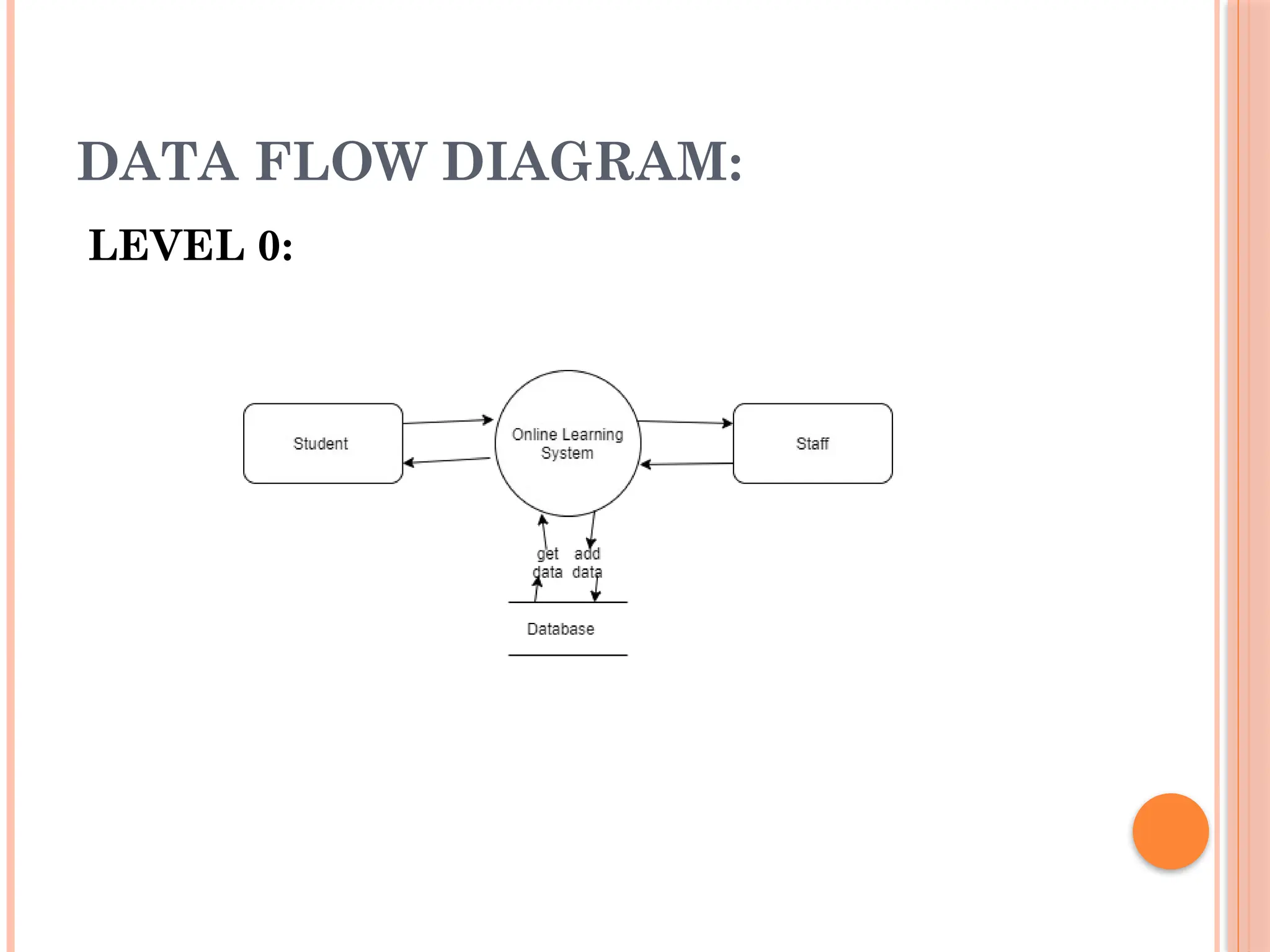
DATA FLOW DIAGRAM:
LEVEL 0:
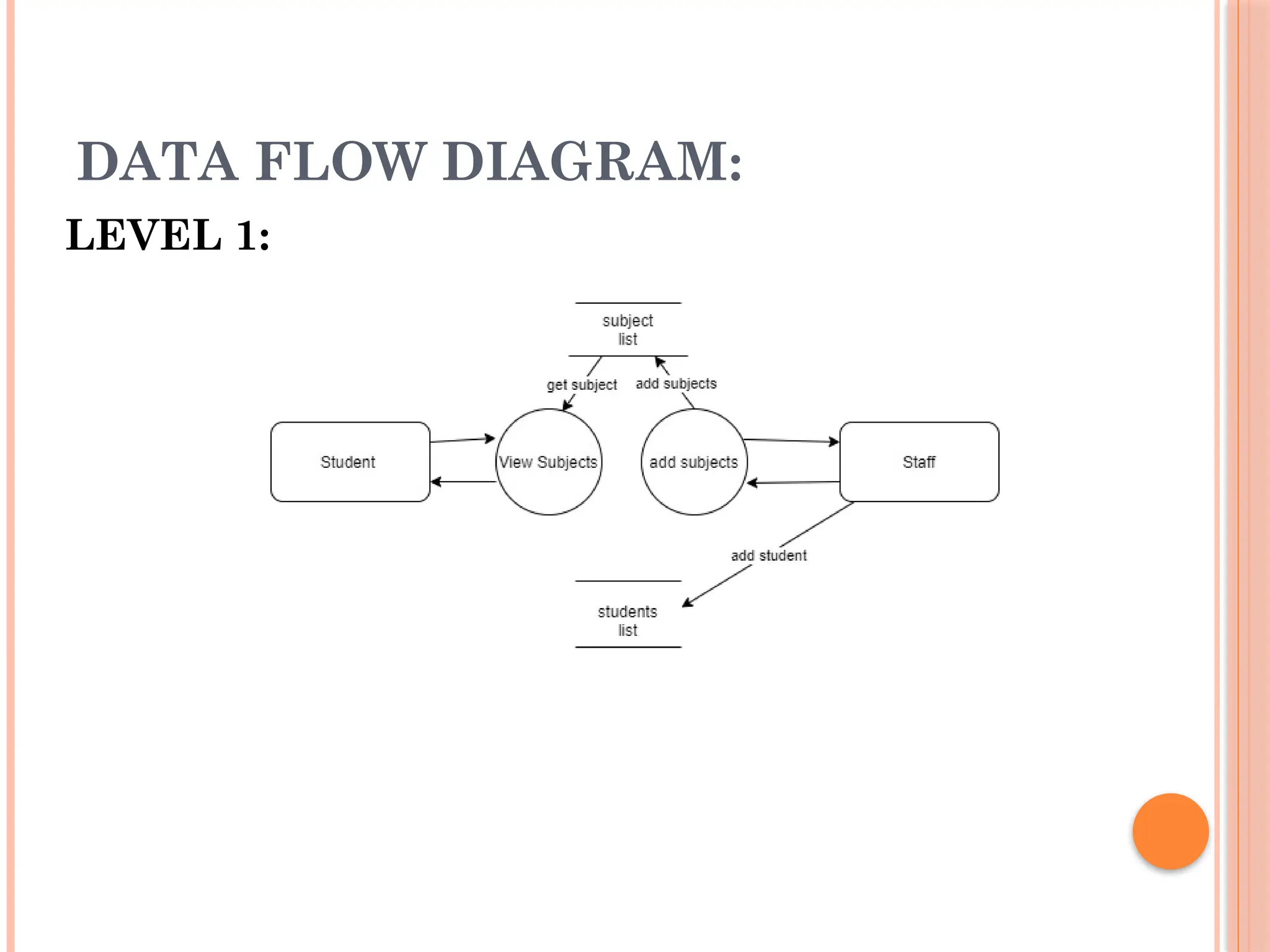
DATA FLOW DIAGRAM:
LEVEL 1:
DATA FLOW DIAGRAM:
LEVEL 2:
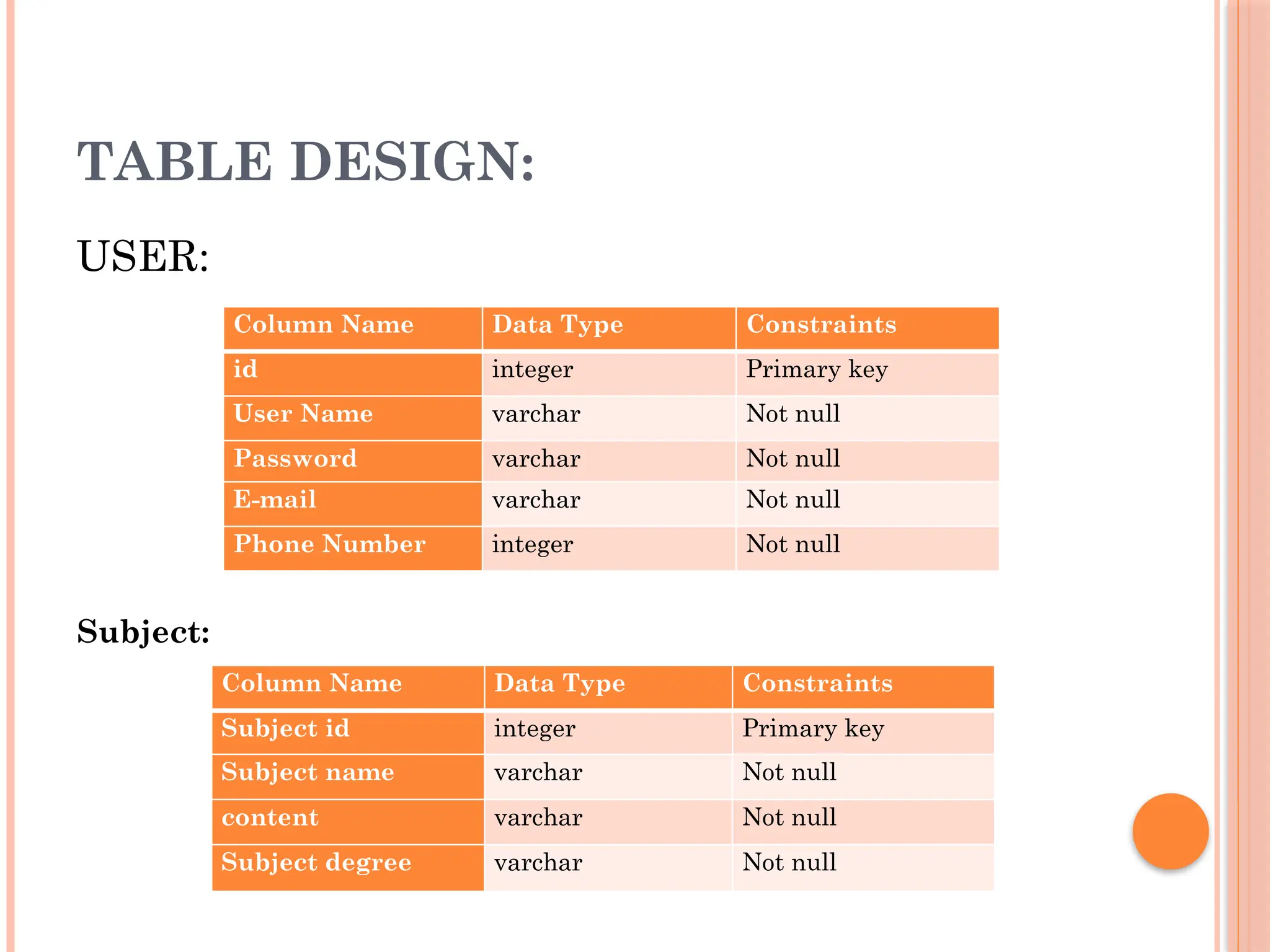
TABLE DESIGN:
USER:
Column Name Data Type Constraints
id integer Primary key
User Name varchar Not null
Password varchar Not null
E-mail varchar Not null
Phone Number integer Not null
Subject:
Column Name Data Type Constraints
Subject id integer Primary key
Subject name varchar Not null
content varchar Not null
Subject degree varchar Not null
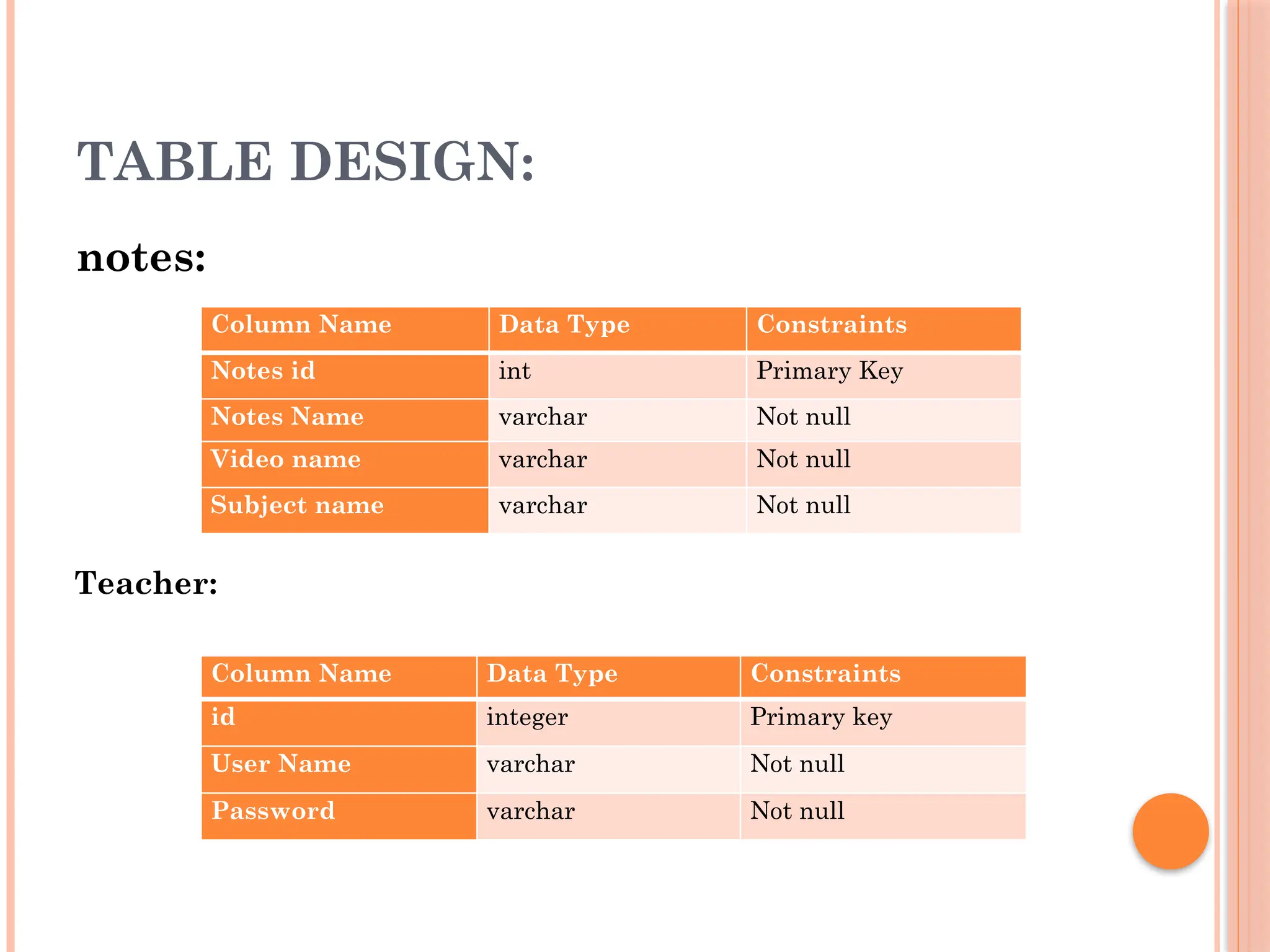
TABLE DESIGN:
notes:
Teacher:
Column Name Data Type Constraints
Notes id int Primary Key
Notes Name varchar Not null
Video name varchar Not null
Subject name varchar Not null
Column Name Data Type Constraints
id integer Primary key
User Name varchar Not null
Password varchar Not null
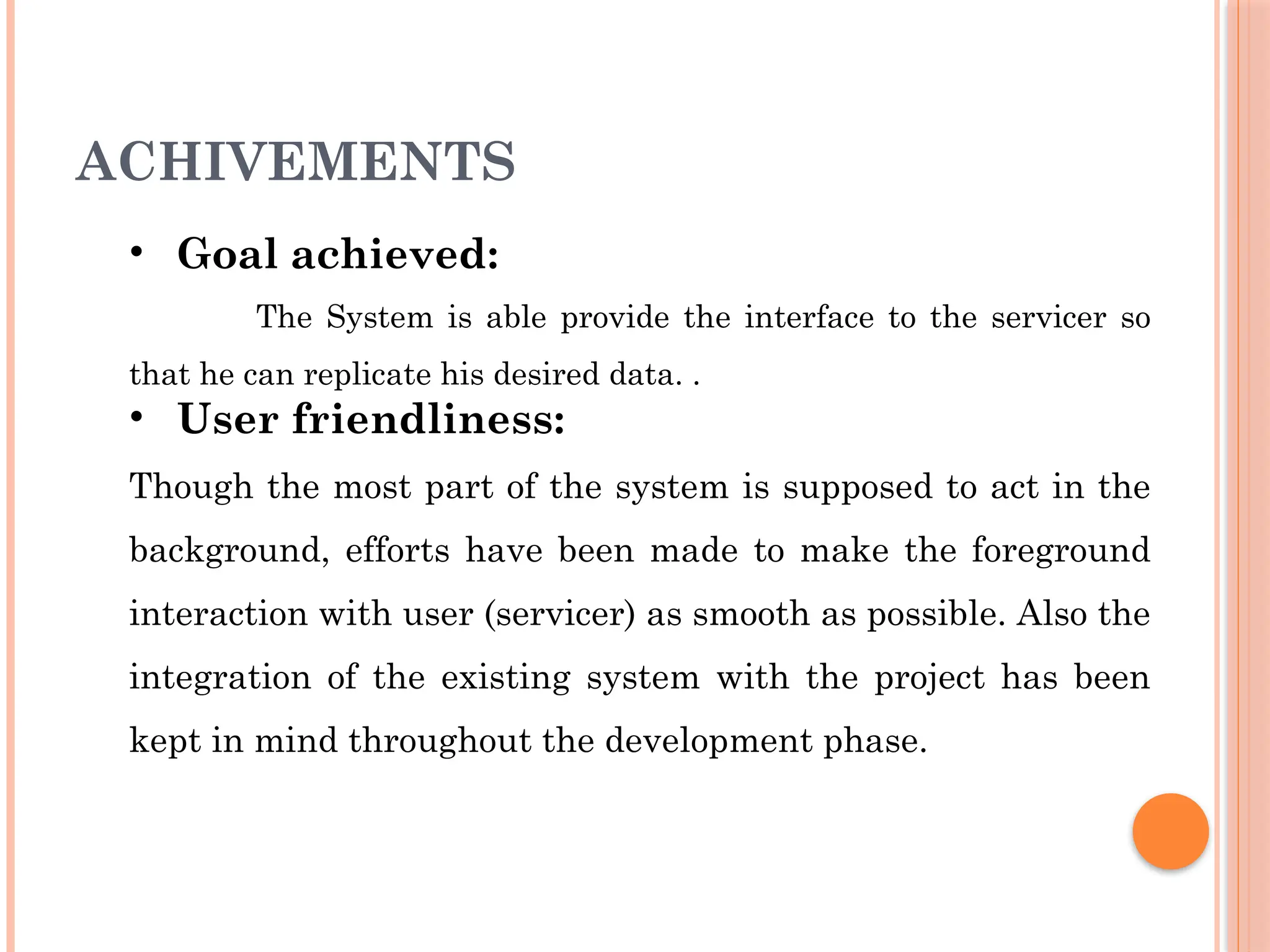
ACHIVEMENTS
• Goal achieved:
The System is able provide the interface to the servicer so
that he can replicate his desired data. .
• User friendliness:
Though the most part of the system is supposed to act in the
background, efforts have been made to make the foreground
interaction with user (servicer) as smooth as possible. Also the
integration of the existing system with the project has been
kept in mind throughout the development phase.
CONCLUSION:
This System can help make personalized buying decisions and improve the
products. We accomplish this by first converting the unstructured data into
structured data; then, we extract the sentences comprising our feature keywords;
then, we were able to provide the feature-level ratings through sentiment
analysis of these sentences. We rank the phones based on the number of features
that they are best at, and accordingly, we were able to recommend the best
phones for a feature. We tested our methodology on the “phone” named feature by
considering the overall customer ratings as ground-truth ratings. The
performance of our method is found to be decent. The proposed approach is
unsupervised. As an extension, we will work on improving the performance by
taking a weakly supervised or supervised approach to this problem, for which we
will have to annotate the available data in terms of all our 108 features.
ITPHP0 REVIEW OF THE PYTHON PROJECT Kpptx

  • 1.
    LEARNING-BASED ONLINE TRANSMISSION PATHSELECTION FOR SECURE ESTIMATION IN EDGE COMPUTING SYSTEMS
  • 2.
    ABSTRACT E-learning is becomingan increasingly popular form of education but what about security that is an important issue in the actual educational context where e-learning increases in popularity and more and more people are taking online courses. The approach to teach many students at the same time, and the students possibility to learn material at their own pace have been very successful. There are many important elements that must be taken into consideration: access control, authentication, data integrity, content protection, etc. Information security can be obtained using functions such as cryptography and network protocols. In this paper, we will highpoint some important security issues that must be taken into consideration in developing and using an e- learning platform. We will also inspect some security aspects of one of the most popular open-source e-learning systems.
  • 3.
    EXISTING SYSTEM E-learning isbecoming an increasingly popular form of education but what about security that is an important issue in the actual educational context where e-learning increases in popularity and more and more people are taking online courses. The approach to teach many students at the same time, and the students possibility to learn material at their own pace have been very successful. There are many important elements that must be taken into consideration: access control, authentication, data integrity, content protection, etc. Information security can be obtained using functions such as cryptography and network protocols. In this paper, we will highpoint some important security issues that must be taken into consideration in developing and using an e-learning platform. We will also inspect some security aspects of one of the most popular open-source e-learning systems.
  • 4.
    DRAWBACKS:  It’s notSecure it can be attacked by Dos attack.  It is Complex to use.  It use document are not safe which can be modified.  It does not have privacy
  • 5.
    PROPOSED SYSTEM In ourSystem e-learning it is secure using cryptography by encoding and decoding for the documents sent on the system. In this a mobile agent continuously monitors the learner’s actions for identifying optimal learning conditions and notes the weak knowledge area of user. The architecture supports the process of composing personalized content for an individual mobile user, rapid course development and collaboration .The architecture for simplifying and automating the process of creating the domain model for an intelligent online e-learning system, which is based on knowledge representation of educational resources using World Wide Web. Advantages:  It is secure using Cryptography by encoding and Decoding.  It is easy to use.  The documents are secure with encryption.  It has privacy securing system.
  • 6.
    ADVANTAGES:  It issecure using Cryptography by encoding and Decoding.  It is easy to use.  The documents are secure with encryption.  It has privacy securing system.
  • 7.
    SYSTEM REQUIREMENTS HARDWARE PROCESSOR :Intel Core i3. RAM : 4 GB MONITOR : 15” COLOR HARD DISK : 25 GB SOFTWARE Front End : HTML, BOOTSTRAP, JAVASCRIPT Back End : MYSQL, PHP Operating System : Windows 07 Software : NOTEPAD, XAMPP , SERVER
  • 8.
  • 9.
    MODULES:  Login /registration-Module.  Teacher –Module.  Subject-list- Module.  Contents-Module.  Notes-Module.  Videos Module.
  • 10.
    MODULES DESCRIPTION: Login /registration-Module: Registration module is used to register the details about the student/Teacher. That contain create a unique name and password. That also needs a full name of user and email id of user for authentication. The basic module login is used to web page. The module has username and password. That will be verified with database and allow to login to the web page. Teacher –Module: This module is used for the teacher purpose only. Teacher can verify the student, its helps to prevent from the unauthorized problems. Teacher can add and change the subjects, subject content, subject notes and videos for the subjects.
  • 11.
    MODULES DESCRIPTION: Subject List-Module: The subject module can contain the list of subjects, the teachers add the subjects from their account. Lot of top trending computer subjects in the subject list. Students can choose the subject want they like and using for the career and exams. Content- Module: This module is used to show the content of the student selected specific subject. This module is having introduction of the subject and variety of chapters show to the students for improving knowledge and help to exams.
  • 12.
    MODULES DESCRIPTION: Notes- Module: Notesmodule has a lot of Portable Document Format (PDF) files for the student selected specific subjects. Students can download the PDF file from the notes module and use it for our preparations. Practical- Module: Some students have a problem with theory. This module is help for their students. This module is showing the important topic related videos. Those videos should be updated by the teacher. Student can view the videos and improving their knowledge.
  • 13.
  • 14.
  • 15.
  • 16.
    TABLE DESIGN: USER: Column NameData Type Constraints id integer Primary key User Name varchar Not null Password varchar Not null E-mail varchar Not null Phone Number integer Not null Subject: Column Name Data Type Constraints Subject id integer Primary key Subject name varchar Not null content varchar Not null Subject degree varchar Not null
  • 17.
    TABLE DESIGN: notes: Teacher: Column NameData Type Constraints Notes id int Primary Key Notes Name varchar Not null Video name varchar Not null Subject name varchar Not null Column Name Data Type Constraints id integer Primary key User Name varchar Not null Password varchar Not null
  • 18.
    ACHIVEMENTS • Goal achieved: TheSystem is able provide the interface to the servicer so that he can replicate his desired data. . • User friendliness: Though the most part of the system is supposed to act in the background, efforts have been made to make the foreground interaction with user (servicer) as smooth as possible. Also the integration of the existing system with the project has been kept in mind throughout the development phase.
  • 19.
    CONCLUSION: This System canhelp make personalized buying decisions and improve the products. We accomplish this by first converting the unstructured data into structured data; then, we extract the sentences comprising our feature keywords; then, we were able to provide the feature-level ratings through sentiment analysis of these sentences. We rank the phones based on the number of features that they are best at, and accordingly, we were able to recommend the best phones for a feature. We tested our methodology on the “phone” named feature by considering the overall customer ratings as ground-truth ratings. The performance of our method is found to be decent. The proposed approach is unsupervised. As an extension, we will work on improving the performance by taking a weakly supervised or supervised approach to this problem, for which we will have to annotate the available data in terms of all our 108 features.