RIGHT TIME, RIGHT STRATEGY
Importance of observations in ECE settings
Goals of the workshop
• Define Developmentally Appropriate Practices (DAP)
• Identify essential components of DAP and give examples
from your classroom practices
• Recognize the important role of observation in working with
young children
• Illustrate ways to apply the essential components of DAP to
their classroom practices
2
3
4
What is Developmentally
Appropriate Practice (DAP)?
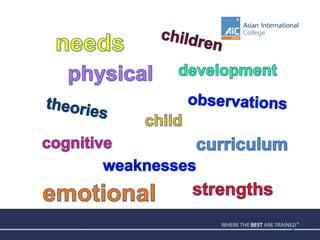
A setting or a curriculum that meets the cognitive, emotional,
and physical needs of children based on child development
theories and observations of children's individual strengths and
weaknesses.
5
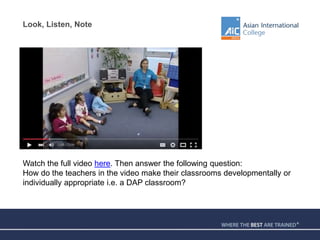
Look, Listen, Note
Watch the full video here. Then answer the following question:
How do the teachers in the video make their classrooms developmentally or
individually appropriate i.e. a DAP classroom?
What does one see in a a
truly“DAP” classroom?
• Engaging materials
• Plan for transitions
• Student directed
• Materials are age-appropriate
• Scope for children’s initiative and choice
• Adapting curriculum and teaching strategies to suit the needs
of the child
• Children are actively engaged
• Creative room arrangement
• Provision of daily schedule
7
Observations are accurate
when we:
• Take note of specific details
• Know the person we are observing
• Make observations over time
• Apply our full attention and focus
• Give sufficient time to the observation
8
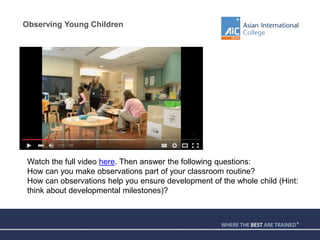
Observing Young Children
Watch the full video here. Then answer the following questions:
How can you make observations part of your classroom routine?
How can observations help you ensure development of the whole child (Hint:
think about developmental milestones)?
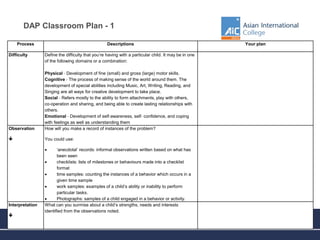
DAP Classroom Plan - 1
Process Descriptions Your plan
Difficulty Define the difficulty that you’re having with a particular child. It may be in one
of the following domains or a combination:
Physical ‐ Development of fine (small) and gross (large) motor skills.
Cognitive ‐ The process of making sense of the world around them. The
development of special abilities including Music, Art, Writing, Reading, and
Singing are all ways for creative development to take place.
Social ‐ Refers mostly to the ability to form attachments, play with others,
co‐operation and sharing, and being able to create lasting relationships with
others.
Emotional ‐ Development of self‐awareness, self‐ confidence, and coping
with feelings as well as understanding them
Observation

How will you make a record of instances of the problem?
You could use:
 ‘anecdotal’ records: informal observations written based on what has
been seen
 checklists: lists of milestones or behaviours made into a checklist
format
 time samples: counting the instances of a behavior which occurs in a
given time sample
 work samples: examples of a child’s ability or inability to perform
particular tasks.
 Photographs: samples of a child engaged in a behavior or activity.
Interpretation

What can you surmise about a child’s strengths, needs and interests
identified from the observations noted.
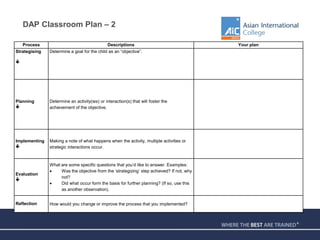
DAP Classroom Plan – 2
Process Descriptions Your plan
Strategising

Determine a goal for the child as an “objective”.
Planning

Determine an activity(ies) or interaction(s) that will foster the
achievement of the objective.
Implementing

Making a note of what happens when the activity, multiple activities or
strategic interactions occur.
Evaluation

What are some specific questions that you’d like to answer. Examples:
 Was the objective from the ‘strategizing’ step achieved? If not, why
not?
 Did what occur form the basis for further planning? (If so, use this
as another observation).
Reflection How would you change or improve the process that you implemented?
Resource Bank – 1
1. Recognizing the Essentials of Developmentally Appropriate Practice by Marjore J.
Kostelnik, Ph.D.
This article helps in understanding the concepts and misconceptions of developmentally
appropriate practices. Developmentally appropriate practices advocates that every child is
an unique individual and each child care professional should gain adequate and appropriate
knowledge about child development and respect each child’s ability to carry out their daily
activities.
You can find the whole article here: http://www.campbellcdc.org/art2.html
2. Providing developmentally appropriate learning
This website helps to get an insight into the ways developing young child think about the
world and his environment. It is a reference resource to help discover, identify, develop a
child’s strength and address weaknesses as well as self control their emotions, behaviors
and moods
To learn more visit:http://www.resourcesforearlylearning.org/educators/module/20/10/39/
Resource Bank - 2
3. Developmentally appropriate practices
http://www.naeyc.org/DAP
4.Forman, G., & Hall, E. (n.d.). Wondering with Children: The Importance of
Observation in Early Education. Early Childhood Research and Practice,7(2).
This article goes to state on how the process of observation, documentation etc. are tools
that help the child care giver or the teachers on the ways that children think. These process
only help the child care professional or teachers to act and react in conducive ways with
children wherein the children are comfortable, more responsive to the learning processes
developed for them. The article is an excellent source to teachers to better understand the
behavioral aspects of children thereby making the teaching and learning experience a lot
more effective. It also make a mention of using videos as a tool to look back upon
observations that have been recorded and use them to analyse actions of students.
Read the whole article here: http://ecrp.uiuc.edu/v7n2/forman.html
Resource Bank - 3
5. Observing with Purpose: Strategies for Observing Young Children’s Learning and
Development
There are many ways to assess a child’s early learning development. This video shows how
purposeful observation is a tool for learning about young children’s learning, development,
and interests. This video explores key strategies for observing young children.
https://www.youtube.com/watch?v=BwzSn1VHvCQ
6. Observing children in action
http://www.teachertube.com/video/observing-children-in-action-part-three-406214
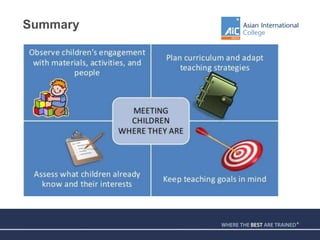
Summary
Summary
• Children are observed for developmental progress through
observation.
• Observation takes place primarily in their daily activities, their
use of language and social interaction with others.
• Observations can be both planned and spontaneous
Really, Its All About Me!!!
Just the right CONTENT, to
Just the right PERSON, at
Just the right, TIME, on
Just the right DEVICE, in
Just the right CONTEXT, and
Just the right WAY
www.busybeesasia.com
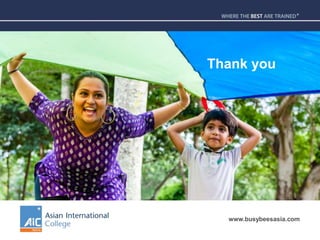
Thank you

Right Time, Right Strategy

  • 1.
    RIGHT TIME, RIGHTSTRATEGY Importance of observations in ECE settings
  • 2.
    Goals of theworkshop • Define Developmentally Appropriate Practices (DAP) • Identify essential components of DAP and give examples from your classroom practices • Recognize the important role of observation in working with young children • Illustrate ways to apply the essential components of DAP to their classroom practices 2
  • 3.
  • 4.
  • 5.
    What is Developmentally AppropriatePractice (DAP)? A setting or a curriculum that meets the cognitive, emotional, and physical needs of children based on child development theories and observations of children's individual strengths and weaknesses. 5
  • 6.
    Look, Listen, Note Watchthe full video here. Then answer the following question: How do the teachers in the video make their classrooms developmentally or individually appropriate i.e. a DAP classroom?
  • 7.
    What does onesee in a a truly“DAP” classroom? • Engaging materials • Plan for transitions • Student directed • Materials are age-appropriate • Scope for children’s initiative and choice • Adapting curriculum and teaching strategies to suit the needs of the child • Children are actively engaged • Creative room arrangement • Provision of daily schedule 7
  • 8.
    Observations are accurate whenwe: • Take note of specific details • Know the person we are observing • Make observations over time • Apply our full attention and focus • Give sufficient time to the observation 8
  • 9.
    Observing Young Children Watchthe full video here. Then answer the following questions: How can you make observations part of your classroom routine? How can observations help you ensure development of the whole child (Hint: think about developmental milestones)?
  • 10.
    DAP Classroom Plan- 1 Process Descriptions Your plan Difficulty Define the difficulty that you’re having with a particular child. It may be in one of the following domains or a combination: Physical ‐ Development of fine (small) and gross (large) motor skills. Cognitive ‐ The process of making sense of the world around them. The development of special abilities including Music, Art, Writing, Reading, and Singing are all ways for creative development to take place. Social ‐ Refers mostly to the ability to form attachments, play with others, co‐operation and sharing, and being able to create lasting relationships with others. Emotional ‐ Development of self‐awareness, self‐ confidence, and coping with feelings as well as understanding them Observation  How will you make a record of instances of the problem? You could use:  ‘anecdotal’ records: informal observations written based on what has been seen  checklists: lists of milestones or behaviours made into a checklist format  time samples: counting the instances of a behavior which occurs in a given time sample  work samples: examples of a child’s ability or inability to perform particular tasks.  Photographs: samples of a child engaged in a behavior or activity. Interpretation  What can you surmise about a child’s strengths, needs and interests identified from the observations noted.
  • 11.
    DAP Classroom Plan– 2 Process Descriptions Your plan Strategising  Determine a goal for the child as an “objective”. Planning  Determine an activity(ies) or interaction(s) that will foster the achievement of the objective. Implementing  Making a note of what happens when the activity, multiple activities or strategic interactions occur. Evaluation  What are some specific questions that you’d like to answer. Examples:  Was the objective from the ‘strategizing’ step achieved? If not, why not?  Did what occur form the basis for further planning? (If so, use this as another observation). Reflection How would you change or improve the process that you implemented?
  • 12.
    Resource Bank –1 1. Recognizing the Essentials of Developmentally Appropriate Practice by Marjore J. Kostelnik, Ph.D. This article helps in understanding the concepts and misconceptions of developmentally appropriate practices. Developmentally appropriate practices advocates that every child is an unique individual and each child care professional should gain adequate and appropriate knowledge about child development and respect each child’s ability to carry out their daily activities. You can find the whole article here: http://www.campbellcdc.org/art2.html 2. Providing developmentally appropriate learning This website helps to get an insight into the ways developing young child think about the world and his environment. It is a reference resource to help discover, identify, develop a child’s strength and address weaknesses as well as self control their emotions, behaviors and moods To learn more visit:http://www.resourcesforearlylearning.org/educators/module/20/10/39/
  • 13.
    Resource Bank -2 3. Developmentally appropriate practices http://www.naeyc.org/DAP 4.Forman, G., & Hall, E. (n.d.). Wondering with Children: The Importance of Observation in Early Education. Early Childhood Research and Practice,7(2). This article goes to state on how the process of observation, documentation etc. are tools that help the child care giver or the teachers on the ways that children think. These process only help the child care professional or teachers to act and react in conducive ways with children wherein the children are comfortable, more responsive to the learning processes developed for them. The article is an excellent source to teachers to better understand the behavioral aspects of children thereby making the teaching and learning experience a lot more effective. It also make a mention of using videos as a tool to look back upon observations that have been recorded and use them to analyse actions of students. Read the whole article here: http://ecrp.uiuc.edu/v7n2/forman.html
  • 14.
    Resource Bank -3 5. Observing with Purpose: Strategies for Observing Young Children’s Learning and Development There are many ways to assess a child’s early learning development. This video shows how purposeful observation is a tool for learning about young children’s learning, development, and interests. This video explores key strategies for observing young children. https://www.youtube.com/watch?v=BwzSn1VHvCQ 6. Observing children in action http://www.teachertube.com/video/observing-children-in-action-part-three-406214
  • 15.
  • 16.
    Summary • Children areobserved for developmental progress through observation. • Observation takes place primarily in their daily activities, their use of language and social interaction with others. • Observations can be both planned and spontaneous
  • 17.
    Really, Its AllAbout Me!!! Just the right CONTENT, to Just the right PERSON, at Just the right, TIME, on Just the right DEVICE, in Just the right CONTEXT, and Just the right WAY
  • 18.