1 www.arabbusinessreview.com 
UAE – Innovating to Grow & Diversify 
 The UAE has been able to quickly and successfully transform itself from an oil-based 
economy into an innovative, knowledge-based economy; actively promoting 
innovation through policies and initiatives aimed at developing the three pillars of the 
innovation ecosystem – human, financial and technological capital 
 Being the first-ever World Expo to be held in the MENA region and themed as 
‘Connecting Minds, Creating the Future’, Dubai Expo 2020 is expected to strengthen 
the innovation ecosystem in the region. 
 UAE’s private sector will need to play an increasingly important role in supporting the 
government’s agenda and promoting the national innovation ecosystem to ensure 
that the UAE is able to maintain and strengthen its position as a hub for innovation, 
not just in the Middle East, but across the world. 
The United Arab Emirates (UAE), which used to be known as an oil-based economy, has been 
able to quickly and successfully transform itself into an innovative, knowledge-based 
economy over the past decade. In fact, knowledge-based revenues now constitute a greater
2 www.arabbusinessreview.com 
proportion of the nation’s GDP than oil revenues, having grown from 32.1% in 2001 to 37.5% in 
2012. In its move towards becoming a knowledge-based economy, the UAE has diversified its 
economy, becoming a key player in the real estate and renewable energy sectors, in addition to 
becoming a global hub for trade, financial services and tourism. This vision to become a 
knowledge economy is evident in the UAE’s Vision 2021, which aims to build a nation where 
‘knowledgeable and innovative Emiratis will confidently build a competitive and resilient 
economy’. 
The nation has been actively promoting innovation through policies and initiatives aimed at 
developing the three pillars of the innovation ecosystem – human, financial and technological 
capital. 
Let’s talk about the human capital first as it is the most critical and fundamental pillar for all 
innovative changes. UAE has advanced its human capital on numerous fronts. Thanks to 
consistent investments across all education levels, UAE boasts one of the most advanced 
education systems in the MENA region. Moreover, advancing women’s education and 
economic participation has led to women taking up leadership roles throughout the country. 
The UAE government’s budget allocation to education makes up more than 20% of the overall 
budget amount — this is way above than the benchmark average of 13%. Besides overhauling 
primary, secondary, and higher education systems, the nation is facilitating expansion of higher 
education institutes by establishing world-class local universities, attracting foreign universities 
to open branches in the nation, and entering into international partnerships. For instance, the 
Masdar Institute was established in 2007 in close cooperation with the Massachusetts Institute 
of Technology (MIT). All these efforts have paid off, with the UAE’s rank on the Education sub-pillar 
of the Global Innovation Index going up from 65th in 2011 to 15th in 2013.
3 www.arabbusinessreview.com 
Second key element of knowledge economy is the financial capital because even the highly 
skilled human capital can fail to perform to its full potential without sufficient funds. Several 
sources of funding are available in the nation, including government funds, equity investing and 
crowd funding. Government funds typically provide early-stage funding and include the Khalifa 
Fund, the Expo 2020 fund, among others. In terms of equity investment, venture capital is the 
most accessible, despite the low risk tolerance of VC funds. The number of regional VC funds 
actively investing in the region is going up. Also, the number of VC deals has increased by 50% 
between 2010 and 2012, with 47% of the investment focused on technology. 
Along with human capital and financial capital, technology accounts for another critical 
element for facilitating ground-zero innovation. Although the UAE’s R&D expenditure as a 
percentage of its GDP (0.47% in 2011) is still below international benchmarks (global average of 
2.08% and the OECD average of 2.32%), it is launching several targeted initiatives to develop its 
R&D efforts. Besides driving R&D in universities, the UAE government is keen to establish 
scientific hubs, for example, TechnoPark was set-up as a science and technology park managed 
by the Dubai Institute of Technology (DIT). Also, the Masdar Institute is developing a technology 
for desalinating sea water using renewable energy sources, and building the London Array, the 
world’s largest offshore wind farm. 
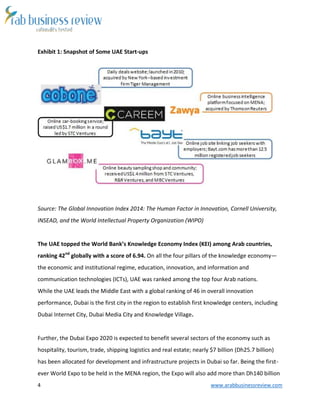
The UAE’s innovation ecosystem has been encouraging many residents to become 
entrepreneurs. UAE-based technology start-up launches are expected to increase at a faster 
rate than the MENA average. By 2015, the UAE is expected to witness 185 new technology-based 
start-ups. Furthermore, the UAE government has reviewed its intellectual property and 
copyright laws with an aim to align them with international standards.
4 www.arabbusinessreview.com 
Exhibit 1: Snapshot of Some UAE Start-ups 
Source: The Global Innovation Index 2014: The Human Factor in Innovation, Cornell University, 
INSEAD, and the World Intellectual Property Organization (WIPO) 
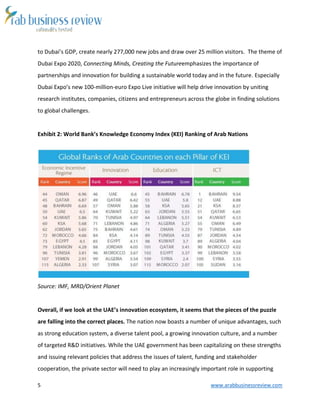
The UAE topped the World Bank’s Knowledge Economy Index (KEI) among Arab countries, 
ranking 42nd globally with a score of 6.94. On all the four pillars of the knowledge economy— 
the economic and institutional regime, education, innovation, and information and 
communication technologies (ICTs), UAE was ranked among the top four Arab nations. 
While the UAE leads the Middle East with a global ranking of 46 in overall innovation 
performance, Dubai is the first city in the region to establish first knowledge centers, including 
Dubai Internet City, Dubai Media City and Knowledge Village. 
Further, the Dubai Expo 2020 is expected to benefit several sectors of the economy such as 
hospitality, tourism, trade, shipping logistics and real estate; nearly $7 billion (Dh25.7 billion) 
has been allocated for development and infrastructure projects in Dubai so far. Being the first-ever 
World Expo to be held in the MENA region, the Expo will also add more than Dh140 billion
5 www.arabbusinessreview.com 
to Dubai’s GDP, create nearly 277,000 new jobs and draw over 25 million visitors. The theme of 
Dubai Expo 2020, Connecting Minds, Creating the Futureemphasizes the importance of 
partnerships and innovation for building a sustainable world today and in the future. Especially 
Dubai Expo’s new 100-million-euro Expo Live initiative will help drive innovation by uniting 
research institutes, companies, citizens and entrepreneurs across the globe in finding solutions 
to global challenges. 
Exhibit 2: World Bank’s Knowledge Economy Index (KEI) Ranking of Arab Nations 
Source: IMF, MRD/Orient Planet 
Overall, if we look at the UAE’s innovation ecosystem, it seems that the pieces of the puzzle 
are falling into the correct places. The nation now boasts a number of unique advantages, such 
as strong education system, a diverse talent pool, a growing innovation culture, and a number 
of targeted R&D initiatives. While the UAE government has been capitalizing on these strengths 
and issuing relevant policies that address the issues of talent, funding and stakeholder 
cooperation, the private sector will need to play an increasingly important role in supporting
6 www.arabbusinessreview.com 
the government’s agenda and promoting the national innovation ecosystem to ensure that the 
UAE is able to maintain and strengthen its position as a hub for innovation, not just in the 
Middle East, but across the world. 
The article was originally published at: Arab Business Review 
To read more thought-leadership stuff by leaders from Arab Region, please visit Arab Business Review

Uae – innovating to grow & diversify

  • 1.
    1 www.arabbusinessreview.com UAE– Innovating to Grow & Diversify  The UAE has been able to quickly and successfully transform itself from an oil-based economy into an innovative, knowledge-based economy; actively promoting innovation through policies and initiatives aimed at developing the three pillars of the innovation ecosystem – human, financial and technological capital  Being the first-ever World Expo to be held in the MENA region and themed as ‘Connecting Minds, Creating the Future’, Dubai Expo 2020 is expected to strengthen the innovation ecosystem in the region.  UAE’s private sector will need to play an increasingly important role in supporting the government’s agenda and promoting the national innovation ecosystem to ensure that the UAE is able to maintain and strengthen its position as a hub for innovation, not just in the Middle East, but across the world. The United Arab Emirates (UAE), which used to be known as an oil-based economy, has been able to quickly and successfully transform itself into an innovative, knowledge-based economy over the past decade. In fact, knowledge-based revenues now constitute a greater
  • 2.
    2 www.arabbusinessreview.com proportionof the nation’s GDP than oil revenues, having grown from 32.1% in 2001 to 37.5% in 2012. In its move towards becoming a knowledge-based economy, the UAE has diversified its economy, becoming a key player in the real estate and renewable energy sectors, in addition to becoming a global hub for trade, financial services and tourism. This vision to become a knowledge economy is evident in the UAE’s Vision 2021, which aims to build a nation where ‘knowledgeable and innovative Emiratis will confidently build a competitive and resilient economy’. The nation has been actively promoting innovation through policies and initiatives aimed at developing the three pillars of the innovation ecosystem – human, financial and technological capital. Let’s talk about the human capital first as it is the most critical and fundamental pillar for all innovative changes. UAE has advanced its human capital on numerous fronts. Thanks to consistent investments across all education levels, UAE boasts one of the most advanced education systems in the MENA region. Moreover, advancing women’s education and economic participation has led to women taking up leadership roles throughout the country. The UAE government’s budget allocation to education makes up more than 20% of the overall budget amount — this is way above than the benchmark average of 13%. Besides overhauling primary, secondary, and higher education systems, the nation is facilitating expansion of higher education institutes by establishing world-class local universities, attracting foreign universities to open branches in the nation, and entering into international partnerships. For instance, the Masdar Institute was established in 2007 in close cooperation with the Massachusetts Institute of Technology (MIT). All these efforts have paid off, with the UAE’s rank on the Education sub-pillar of the Global Innovation Index going up from 65th in 2011 to 15th in 2013.
  • 3.
    3 www.arabbusinessreview.com Secondkey element of knowledge economy is the financial capital because even the highly skilled human capital can fail to perform to its full potential without sufficient funds. Several sources of funding are available in the nation, including government funds, equity investing and crowd funding. Government funds typically provide early-stage funding and include the Khalifa Fund, the Expo 2020 fund, among others. In terms of equity investment, venture capital is the most accessible, despite the low risk tolerance of VC funds. The number of regional VC funds actively investing in the region is going up. Also, the number of VC deals has increased by 50% between 2010 and 2012, with 47% of the investment focused on technology. Along with human capital and financial capital, technology accounts for another critical element for facilitating ground-zero innovation. Although the UAE’s R&D expenditure as a percentage of its GDP (0.47% in 2011) is still below international benchmarks (global average of 2.08% and the OECD average of 2.32%), it is launching several targeted initiatives to develop its R&D efforts. Besides driving R&D in universities, the UAE government is keen to establish scientific hubs, for example, TechnoPark was set-up as a science and technology park managed by the Dubai Institute of Technology (DIT). Also, the Masdar Institute is developing a technology for desalinating sea water using renewable energy sources, and building the London Array, the world’s largest offshore wind farm. The UAE’s innovation ecosystem has been encouraging many residents to become entrepreneurs. UAE-based technology start-up launches are expected to increase at a faster rate than the MENA average. By 2015, the UAE is expected to witness 185 new technology-based start-ups. Furthermore, the UAE government has reviewed its intellectual property and copyright laws with an aim to align them with international standards.
  • 4.
    4 www.arabbusinessreview.com Exhibit1: Snapshot of Some UAE Start-ups Source: The Global Innovation Index 2014: The Human Factor in Innovation, Cornell University, INSEAD, and the World Intellectual Property Organization (WIPO) The UAE topped the World Bank’s Knowledge Economy Index (KEI) among Arab countries, ranking 42nd globally with a score of 6.94. On all the four pillars of the knowledge economy— the economic and institutional regime, education, innovation, and information and communication technologies (ICTs), UAE was ranked among the top four Arab nations. While the UAE leads the Middle East with a global ranking of 46 in overall innovation performance, Dubai is the first city in the region to establish first knowledge centers, including Dubai Internet City, Dubai Media City and Knowledge Village. Further, the Dubai Expo 2020 is expected to benefit several sectors of the economy such as hospitality, tourism, trade, shipping logistics and real estate; nearly $7 billion (Dh25.7 billion) has been allocated for development and infrastructure projects in Dubai so far. Being the first-ever World Expo to be held in the MENA region, the Expo will also add more than Dh140 billion
  • 5.
    5 www.arabbusinessreview.com toDubai’s GDP, create nearly 277,000 new jobs and draw over 25 million visitors. The theme of Dubai Expo 2020, Connecting Minds, Creating the Futureemphasizes the importance of partnerships and innovation for building a sustainable world today and in the future. Especially Dubai Expo’s new 100-million-euro Expo Live initiative will help drive innovation by uniting research institutes, companies, citizens and entrepreneurs across the globe in finding solutions to global challenges. Exhibit 2: World Bank’s Knowledge Economy Index (KEI) Ranking of Arab Nations Source: IMF, MRD/Orient Planet Overall, if we look at the UAE’s innovation ecosystem, it seems that the pieces of the puzzle are falling into the correct places. The nation now boasts a number of unique advantages, such as strong education system, a diverse talent pool, a growing innovation culture, and a number of targeted R&D initiatives. While the UAE government has been capitalizing on these strengths and issuing relevant policies that address the issues of talent, funding and stakeholder cooperation, the private sector will need to play an increasingly important role in supporting
  • 6.
    6 www.arabbusinessreview.com thegovernment’s agenda and promoting the national innovation ecosystem to ensure that the UAE is able to maintain and strengthen its position as a hub for innovation, not just in the Middle East, but across the world. The article was originally published at: Arab Business Review To read more thought-leadership stuff by leaders from Arab Region, please visit Arab Business Review