Daniel Dumitrescu
Master anul I TI
Software Project
Management
PRESENTATION PLAN
 Articles
 “Know Your Enemy”: Software Risk Management
 "Stop promising miracles" – Wideband Delphi method
 General project
 LCA System Software Project Plan
ARTICLES
“KNOW YOUR ENEMY”: SOFTWARE RISK
MANAGEMENT
“STOP PROMISING MIRACLES”
WIDEBAND DELPHI METHOD
WHAT IS THE RISK?
 A problem that can endanger the success of the
project. It causes losses.
 It can have a negative influence over the cost,
planning and the quality of the project and for the
team.
 The Risk Management indetifies, addresses and
solves the risk problems before they damage the
project.
 We can absorb the risk without allowing the
avoiding of any measure (action) or to eliminate
them
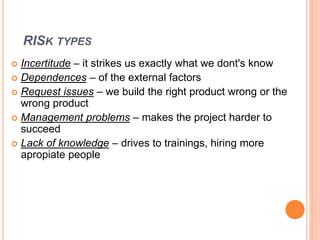
RISK TYPES
 Incertitude – it strikes us exactly what we dont's know
 Dependences – of the external factors
 Request issues – we build the right product wrong or the
wrong product
 Management problems – makes the project harder to
succeed
 Lack of knowledge – drives to trainings, hiring more
apropiate people
RISK MANAGEMENT
 Apreciating the risk – identifying the potential risk zones
 Identifying the risk – verifies the previewsly identified
risks databases
 Analizing the risk– verifies the outcoming of the project
in accordance with the risk variables
 The risk priority– focuses on the most severe risks
 Avoiding the risk
 Control the risk– it's the process of management of the
risk
 Keeping data about the risk– monitoring and solving each
risk problem
CONCLUZIONS
 From these articles we learned a few basic rules
of how to better plan and develop a project and
14 good lessons about how to become a good
manager
 A manager is put to help people do their job
better. They have to create good working
conditions for the employees in order to do the
job in time
 We have to pay attention to the risk problems
that may occur and to take the right measures to
solve them
ARTICLES – “STOP PROMISING MIRACLES”
WIDEBAND DELPHI METHOD
 must provide estimates for the work
 but few of us are skillful estimators
 this can be improved
 principle that multiple heads are better than one.
ARTICLES – “STOP PROMISING MIRACLES”
WIDEBAND DELPHI METHOD
 Wideband Delphi
 can be used to estimate virtually anything:
 the number of labor months needed
 the lines of code or number of classes, etc.
ARTICLES – “STOP PROMISING MIRACLES”
WIDEBAND DELPHI METHOD
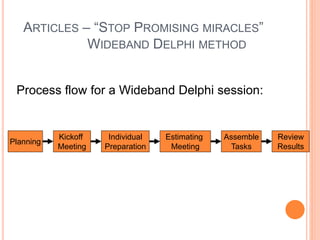
Process flow for a Wideband Delphi session:
Planning
Kickoff
Meeting
Individual
Preparation
Estimating
Meeting
Assemble
Tasks
Review
Results
ARTICLES – “STOP PROMISING MIRACLES”
WIDEBAND DELPHI METHOD
 Planning
 defining and scoping the problem
 large problems are broken down into manageable
portions
 estimation participants
 moderator- plans and coordinates the activity
 project manager
 and two to four other estimators.
ARTICLES – “STOP PROMISING MIRACLES”
WIDEBAND DELPHI METHOD
 The Kickoff
 up to an hour
 gets all participants up to speed on the estimation
problem
 moderator supplies the other estimators with the
problem specification and any assumptions or
project constraints
 the team reviews the estimation objectives and
discusses the problem and any estimation issues; the
participants agree on the estimation units.
ARTICLES – “STOP PROMISING MIRACLES”
WIDEBAND DELPHI METHOD
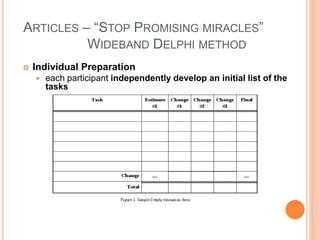
 Individual Preparation
 each participant independently develop an initial list of the
tasks
ARTICLES – “STOP PROMISING MIRACLES”
WIDEBAND DELPHI METHOD
 Individual Preparation
 The estimation should have no relationship to the answer you think the
project manager or other stakeholders want to hear
 record any tasks for related or supporting activities
 quality control and assurance
 configuration management etc.
 include rework tasks following testing or inspection activities.
 if estimating a schedule
 also think of any overhead activities (meetings, vacation, training,
other project assignments etc).
 record any assumptions
 radically different assumptions can lead to wide estimate variations
ARTICLES – “STOP PROMISING MIRACLES”
WIDEBAND DELPHI METHOD
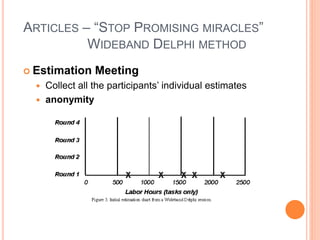
 Estimation Meeting
 Collect all the participants’ individual estimates
 anonymity
ARTICLES – “STOP PROMISING MIRACLES”
WIDEBAND DELPHI METHOD
 Estimation Meeting
 Each estimator
 presents his initial task list, assumptions
 raise any questions.
 Then the team will begin to converge
 a shared set of assumptions
 a common task list.
 all participants modify their estimates concurrently (and
silently) in the meeting room.
ARTICLES – “STOP PROMISING MIRACLES”
WIDEBAND DELPHI METHOD
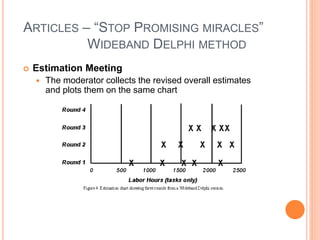
 Estimation Meeting
 The moderator collects the revised overall estimates
and plots them on the same chart
ARTICLES – “STOP PROMISING MIRACLES”
WIDEBAND DELPHI METHOD
 Estimation Meeting
 The cycle continues until:
 you have completed four rounds;
 the estimates have converged to an acceptably narrow range
(defined in advance);
 the allotted estimation meeting time (typically two hours) is
over; or
 all participants are unwilling to alter their latest estimates.
ARTICLES – “STOP PROMISING MIRACLES”
WIDEBAND DELPHI METHOD
 Assembling Tasks
 the moderator or the project manager
 assembles the project tasks and their individual estimates into a
single master task list
 merges the individual lists of
 assumptions
 quality- and process-related activities
 overhead tasks
 wait times.
ARTICLES – “STOP PROMISING MIRACLES”
WIDEBAND DELPHI METHOD
 Review Results
 in the final step, the estimation team reviews the
summarized results and reaches agreement on the final
outcome
ARTICLES – “STOP PROMISING MIRACLES”
WIDEBAND DELPHI METHOD
 Completing the Estimation
 when specified exit criteria are satisfied.
 Typical Wideband Delphi exit criteria are that:
 The overall task list has been assembled
 You have a summarized list of estimating assumptions
 The estimators have reached consensus on how their
individual estimates were synthesized into a single set
with an acceptable range.
ARTICLES – “STOP PROMISING MIRACLES”
WIDEBAND DELPHI METHOD
 Conclusions
 no estimation method is perfect; if it were, it would
be called prediction, not estimation.
 However, the Wideband Delphi technique
incorporates some solid estimating principles
 the team approach acknowledges the value of
combining multiple expert perspectives
 Wideband Delphi removes some of the politics from
estimation and filters out extreme initial values.
LCA SYSTEM
SW PROJECT PLAN
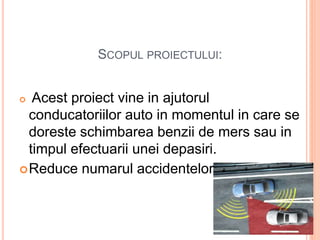
SCOPUL PROIECTULUI:
 Acest proiect vine in ajutorul
conducatoriilor auto in momentul in care se
doreste schimbarea benzii de mers sau in
timpul efectuarii unei depasiri.
Reduce numarul accidentelor.
DESCRIERE PROIECT:
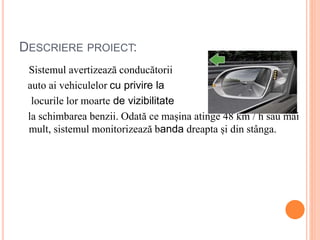
Sistemul avertizează conducătorii
auto ai vehiculelor cu privire la
locurile lor moarte de vizibilitate
la schimbarea benzii. Odată ce mașina atinge 48 km / h sau mai
mult, sistemul monitorizează banda dreapta și din stânga.
CONTINUARE DESCRIERE PROIECT:
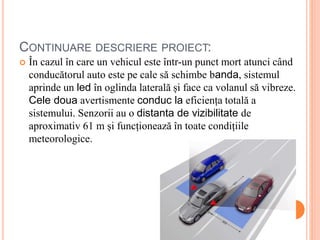
 În cazul în care un vehicul este într-un punct mort atunci când
conducătorul auto este pe cale să schimbe banda, sistemul
aprinde un led în oglinda laterală și face ca volanul să vibreze.
Cele doua avertismente conduc la eficiența totală a
sistemului. Senzorii au o distanta de vizibilitate de
aproximativ 61 m și funcționează în toate condițiile
meteorologice.
CERINTE DE FUNCTIONARE A
SISTEMULUI LCA
 Masina sa fie proiectata dupa 2009.
 Masina sa prezinte o iesire de pe magistrala CAN pentru
a se putea conecta sistemul LCA.
 Conditi impuse de materialele din care este construita
masina si grosimea bumper-ului.
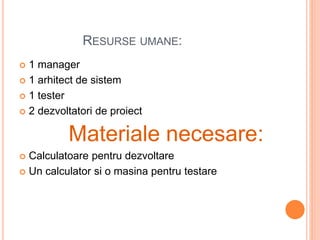
RESURSE UMANE:
 1 manager
 1 arhitect de sistem
 1 tester
 2 dezvoltatori de proiect
Materiale necesare:
 Calculatoare pentru dezvoltare
 Un calculator si o masina pentru testare
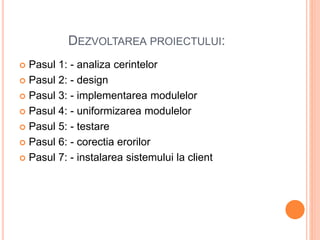
DEZVOLTAREA PROIECTULUI:
 Pasul 1: - analiza cerintelor
 Pasul 2: - design
 Pasul 3: - implementarea modulelor
 Pasul 4: - uniformizarea modulelor
 Pasul 5: - testare
 Pasul 6: - corectia erorilor
 Pasul 7: - instalarea sistemului la client
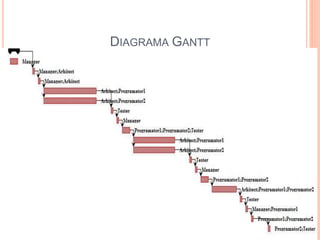
DIAGRAMA GANTT
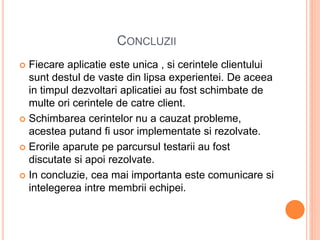
CONCLUZII
 Fiecare aplicatie este unica , si cerintele clientului
sunt destul de vaste din lipsa experientei. De aceea
in timpul dezvoltari aplicatiei au fost schimbate de
multe ori cerintele de catre client.
 Schimbarea cerintelor nu a cauzat probleme,
acestea putand fi usor implementate si rezolvate.
 Erorile aparute pe parcursul testarii au fost
discutate si apoi rezolvate.
 In concluzie, cea mai importanta este comunicare si
intelegerea intre membrii echipei.
VA MULTUMESC PENTRU ATENTIE!

Daniel dumitrescu

  • 1.
    Daniel Dumitrescu Master anulI TI Software Project Management
  • 2.
    PRESENTATION PLAN  Articles “Know Your Enemy”: Software Risk Management  "Stop promising miracles" – Wideband Delphi method  General project  LCA System Software Project Plan
  • 3.
    ARTICLES “KNOW YOUR ENEMY”:SOFTWARE RISK MANAGEMENT “STOP PROMISING MIRACLES” WIDEBAND DELPHI METHOD
  • 4.
    WHAT IS THERISK?  A problem that can endanger the success of the project. It causes losses.  It can have a negative influence over the cost, planning and the quality of the project and for the team.  The Risk Management indetifies, addresses and solves the risk problems before they damage the project.  We can absorb the risk without allowing the avoiding of any measure (action) or to eliminate them
  • 5.
    RISK TYPES  Incertitude– it strikes us exactly what we dont's know  Dependences – of the external factors  Request issues – we build the right product wrong or the wrong product  Management problems – makes the project harder to succeed  Lack of knowledge – drives to trainings, hiring more apropiate people
  • 6.
    RISK MANAGEMENT  Apreciatingthe risk – identifying the potential risk zones  Identifying the risk – verifies the previewsly identified risks databases  Analizing the risk– verifies the outcoming of the project in accordance with the risk variables  The risk priority– focuses on the most severe risks  Avoiding the risk  Control the risk– it's the process of management of the risk  Keeping data about the risk– monitoring and solving each risk problem
  • 7.
    CONCLUZIONS  From thesearticles we learned a few basic rules of how to better plan and develop a project and 14 good lessons about how to become a good manager  A manager is put to help people do their job better. They have to create good working conditions for the employees in order to do the job in time  We have to pay attention to the risk problems that may occur and to take the right measures to solve them
  • 8.
    ARTICLES – “STOPPROMISING MIRACLES” WIDEBAND DELPHI METHOD  must provide estimates for the work  but few of us are skillful estimators  this can be improved  principle that multiple heads are better than one.
  • 9.
    ARTICLES – “STOPPROMISING MIRACLES” WIDEBAND DELPHI METHOD  Wideband Delphi  can be used to estimate virtually anything:  the number of labor months needed  the lines of code or number of classes, etc.
  • 10.
    ARTICLES – “STOPPROMISING MIRACLES” WIDEBAND DELPHI METHOD Process flow for a Wideband Delphi session: Planning Kickoff Meeting Individual Preparation Estimating Meeting Assemble Tasks Review Results
  • 11.
    ARTICLES – “STOPPROMISING MIRACLES” WIDEBAND DELPHI METHOD  Planning  defining and scoping the problem  large problems are broken down into manageable portions  estimation participants  moderator- plans and coordinates the activity  project manager  and two to four other estimators.
  • 12.
    ARTICLES – “STOPPROMISING MIRACLES” WIDEBAND DELPHI METHOD  The Kickoff  up to an hour  gets all participants up to speed on the estimation problem  moderator supplies the other estimators with the problem specification and any assumptions or project constraints  the team reviews the estimation objectives and discusses the problem and any estimation issues; the participants agree on the estimation units.
  • 13.
    ARTICLES – “STOPPROMISING MIRACLES” WIDEBAND DELPHI METHOD  Individual Preparation  each participant independently develop an initial list of the tasks
  • 14.
    ARTICLES – “STOPPROMISING MIRACLES” WIDEBAND DELPHI METHOD  Individual Preparation  The estimation should have no relationship to the answer you think the project manager or other stakeholders want to hear  record any tasks for related or supporting activities  quality control and assurance  configuration management etc.  include rework tasks following testing or inspection activities.  if estimating a schedule  also think of any overhead activities (meetings, vacation, training, other project assignments etc).  record any assumptions  radically different assumptions can lead to wide estimate variations
  • 15.
    ARTICLES – “STOPPROMISING MIRACLES” WIDEBAND DELPHI METHOD  Estimation Meeting  Collect all the participants’ individual estimates  anonymity
  • 16.
    ARTICLES – “STOPPROMISING MIRACLES” WIDEBAND DELPHI METHOD  Estimation Meeting  Each estimator  presents his initial task list, assumptions  raise any questions.  Then the team will begin to converge  a shared set of assumptions  a common task list.  all participants modify their estimates concurrently (and silently) in the meeting room.
  • 17.
    ARTICLES – “STOPPROMISING MIRACLES” WIDEBAND DELPHI METHOD  Estimation Meeting  The moderator collects the revised overall estimates and plots them on the same chart
  • 18.
    ARTICLES – “STOPPROMISING MIRACLES” WIDEBAND DELPHI METHOD  Estimation Meeting  The cycle continues until:  you have completed four rounds;  the estimates have converged to an acceptably narrow range (defined in advance);  the allotted estimation meeting time (typically two hours) is over; or  all participants are unwilling to alter their latest estimates.
  • 19.
    ARTICLES – “STOPPROMISING MIRACLES” WIDEBAND DELPHI METHOD  Assembling Tasks  the moderator or the project manager  assembles the project tasks and their individual estimates into a single master task list  merges the individual lists of  assumptions  quality- and process-related activities  overhead tasks  wait times.
  • 20.
    ARTICLES – “STOPPROMISING MIRACLES” WIDEBAND DELPHI METHOD  Review Results  in the final step, the estimation team reviews the summarized results and reaches agreement on the final outcome
  • 21.
    ARTICLES – “STOPPROMISING MIRACLES” WIDEBAND DELPHI METHOD  Completing the Estimation  when specified exit criteria are satisfied.  Typical Wideband Delphi exit criteria are that:  The overall task list has been assembled  You have a summarized list of estimating assumptions  The estimators have reached consensus on how their individual estimates were synthesized into a single set with an acceptable range.
  • 22.
    ARTICLES – “STOPPROMISING MIRACLES” WIDEBAND DELPHI METHOD  Conclusions  no estimation method is perfect; if it were, it would be called prediction, not estimation.  However, the Wideband Delphi technique incorporates some solid estimating principles  the team approach acknowledges the value of combining multiple expert perspectives  Wideband Delphi removes some of the politics from estimation and filters out extreme initial values.
  • 23.
  • 24.
    SCOPUL PROIECTULUI:  Acestproiect vine in ajutorul conducatoriilor auto in momentul in care se doreste schimbarea benzii de mers sau in timpul efectuarii unei depasiri. Reduce numarul accidentelor.
  • 25.
    DESCRIERE PROIECT: Sistemul avertizeazăconducătorii auto ai vehiculelor cu privire la locurile lor moarte de vizibilitate la schimbarea benzii. Odată ce mașina atinge 48 km / h sau mai mult, sistemul monitorizează banda dreapta și din stânga.
  • 26.
    CONTINUARE DESCRIERE PROIECT: În cazul în care un vehicul este într-un punct mort atunci când conducătorul auto este pe cale să schimbe banda, sistemul aprinde un led în oglinda laterală și face ca volanul să vibreze. Cele doua avertismente conduc la eficiența totală a sistemului. Senzorii au o distanta de vizibilitate de aproximativ 61 m și funcționează în toate condițiile meteorologice.
  • 27.
    CERINTE DE FUNCTIONAREA SISTEMULUI LCA  Masina sa fie proiectata dupa 2009.  Masina sa prezinte o iesire de pe magistrala CAN pentru a se putea conecta sistemul LCA.  Conditi impuse de materialele din care este construita masina si grosimea bumper-ului.
  • 28.
    RESURSE UMANE:  1manager  1 arhitect de sistem  1 tester  2 dezvoltatori de proiect Materiale necesare:  Calculatoare pentru dezvoltare  Un calculator si o masina pentru testare
  • 29.
    DEZVOLTAREA PROIECTULUI:  Pasul1: - analiza cerintelor  Pasul 2: - design  Pasul 3: - implementarea modulelor  Pasul 4: - uniformizarea modulelor  Pasul 5: - testare  Pasul 6: - corectia erorilor  Pasul 7: - instalarea sistemului la client
  • 30.
  • 31.
    CONCLUZII  Fiecare aplicatieeste unica , si cerintele clientului sunt destul de vaste din lipsa experientei. De aceea in timpul dezvoltari aplicatiei au fost schimbate de multe ori cerintele de catre client.  Schimbarea cerintelor nu a cauzat probleme, acestea putand fi usor implementate si rezolvate.  Erorile aparute pe parcursul testarii au fost discutate si apoi rezolvate.  In concluzie, cea mai importanta este comunicare si intelegerea intre membrii echipei.
  • 32.