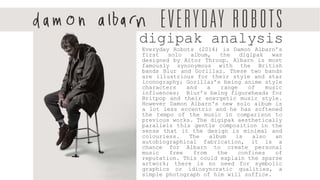
Everyday Robots (2014) is Damon Albarn’s
first solo album, the digipak was
designed by Aitor Throup. Albarn is most
famously synonymous with the British
bands Blur and Gorillaz. These two bands
are illustrious for their style and star
iconography; Gorillaz’s being anime style
characters and a range of music
influences; Blur’s being figureheads for
Britpop and their energetic music style.
However Damon Albarn's new solo album is
a lot less eccentric and he has softened
the tempo of the music in comparison to
previous works. The digipak aesthetically
parallels this gentle composition in the
sense that it the design is minimal and
colourless. The album is also an
autobiographical fabrication, it is a
chance for Albarn to create personal
music free from the confines of
reputation. This could explain the sparse
artwork; there is no need for symbolic
graphics or idiosyncratic qualities, a
simple photograph of him will suffice.
digipak analysis
the outside
front
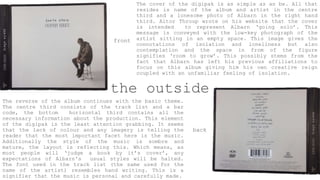
The cover of the digipak is as simple as an be. All that
resides is name of the album and artist in the centre
third and a lonesome photo of Albarn in the right hand
third. Aitor Throup wrote on his website that the cover
is intended to represent Albarn ‘going solo’. This
message is conveyed with the low-key photograph of the
artist sitting in an empty space. This image gives the
connotations of isolation and loneliness but also
contemplation and the space in from of the figure
signifies ‘room to grow’. This possibly stems from the
fact that Albarn has left his previous affiliations to
focus on this album giving him his own creative reign
coupled with an unfamiliar feeling of isolation.
The reverse of the album continues with the basic theme.
The centre third consists of the track list and a bar
code, the bottom horizontal third contains all the
necessary information about the production. This element
of the digipak is the least attention grabbing. It seems
that the lack of colour and any imagery is telling the
reader that the most important facet here is the music.
Additionally the style of the music is sombre and
mature, the layout is reflecting this. Which means, as
most people will ‘judge a book by it’s cover’, any
expectations of Albarn's usual styles will be halted.
The font used in the track list (the same used for the
name of the artist) resembles hand writing. This is a
signifier that the music is personal and carefully made.
back
the inside fold
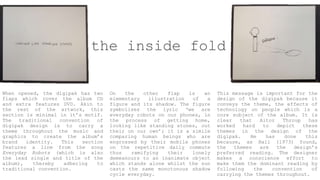
When opened, the digipak has two
flaps which cover the album CD
and extra features DVD. Akin to
the rest of the artwork, this
section is minimal in it’s motif.
The traditional convention of
digipak design is to carry a
theme throughout the music and
graphics to create the album’s
brand identity. This section
features a line from the song
Everyday Robots (which is also
the lead single and title of the
album), thereby adhering to
traditional convention.
On the other flap is an
elementary illustration of a
figure and its shadow. The figure
symbolises the lyric ‘we are
everyday robots on our phones, in
the process of getting home,
looking like standing stones, out
their on our own’; it is a simile
comparing human beings who are
engrossed by their mobile phones
on the repetitive daily commute
thus ramifying their lonely
demeanours to an inanimate object
which stands alone whilst the sun
casts the same monotonous shadow
cycle everyday.
This message is important for the
design of the digipak because it
conveys the theme, the effects of
technology on people which is a
core subject of the album. It is
clear that Aitor Throup has
worked hard to depict these
themes in the design of the
digipak. He has done this
because, as Hall (1973) found,
the themes are the design’s
preferred reading. The designer
makes a conscience effort to
make them the dominant reading by
following the convention of
carrying the themes throughout.
the inside spread
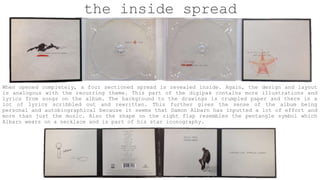
When opened completely, a four sectioned spread is revealed inside. Again, the design and layout
is analogous with the recurring theme. This part of the digipak contains more illustrations and
lyrics from songs on the album. The background to the drawings is crumpled paper and there is a
lot of lyrics scribbled out and rewritten. This further gives the sense of the album being
personal and autobiographical because it seems that Damon Albarn has inputted a lot of effort and
more than just the music. Also the shape on the right flap resembles the pentangle symbol which
Albarn wears on a necklace and is part of his star iconography.
the booklet
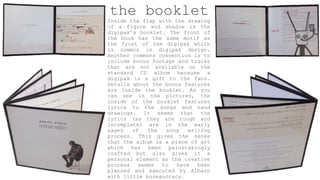
Inside the flap with the drawing
of a figure and shadow is the
digipak’s booklet. The front of
the book has the same motif as
the front of the digipak which
is common in digipak design.
Another commons convention is to
include bonus footage and tracks
that are not available on the
standard CD album because a
digipak is a gift to the fans.
Details about the bonus features
are inside the booklet. As you
can see in the pictures, the
inside of the booklet features
lyrics to the songs and hand
drawings. It seems that the
lyrics (as they are rough and
incomplete) are in the early
sages of the song writing
process. This gives the sense
that the album is a piece of art
which has been painstakingly
crafted but also gives it a
personal element as the creative
process seems to have been
planned and executed by Albarn
with little bureaucracy.

Everyday Robots analysis

  • 1.
    Everyday Robots (2014)is Damon Albarn’s first solo album, the digipak was designed by Aitor Throup. Albarn is most famously synonymous with the British bands Blur and Gorillaz. These two bands are illustrious for their style and star iconography; Gorillaz’s being anime style characters and a range of music influences; Blur’s being figureheads for Britpop and their energetic music style. However Damon Albarn's new solo album is a lot less eccentric and he has softened the tempo of the music in comparison to previous works. The digipak aesthetically parallels this gentle composition in the sense that it the design is minimal and colourless. The album is also an autobiographical fabrication, it is a chance for Albarn to create personal music free from the confines of reputation. This could explain the sparse artwork; there is no need for symbolic graphics or idiosyncratic qualities, a simple photograph of him will suffice. digipak analysis
  • 2.
    the outside front The coverof the digipak is as simple as an be. All that resides is name of the album and artist in the centre third and a lonesome photo of Albarn in the right hand third. Aitor Throup wrote on his website that the cover is intended to represent Albarn ‘going solo’. This message is conveyed with the low-key photograph of the artist sitting in an empty space. This image gives the connotations of isolation and loneliness but also contemplation and the space in from of the figure signifies ‘room to grow’. This possibly stems from the fact that Albarn has left his previous affiliations to focus on this album giving him his own creative reign coupled with an unfamiliar feeling of isolation. The reverse of the album continues with the basic theme. The centre third consists of the track list and a bar code, the bottom horizontal third contains all the necessary information about the production. This element of the digipak is the least attention grabbing. It seems that the lack of colour and any imagery is telling the reader that the most important facet here is the music. Additionally the style of the music is sombre and mature, the layout is reflecting this. Which means, as most people will ‘judge a book by it’s cover’, any expectations of Albarn's usual styles will be halted. The font used in the track list (the same used for the name of the artist) resembles hand writing. This is a signifier that the music is personal and carefully made. back
  • 3.
    the inside fold Whenopened, the digipak has two flaps which cover the album CD and extra features DVD. Akin to the rest of the artwork, this section is minimal in it’s motif. The traditional convention of digipak design is to carry a theme throughout the music and graphics to create the album’s brand identity. This section features a line from the song Everyday Robots (which is also the lead single and title of the album), thereby adhering to traditional convention. On the other flap is an elementary illustration of a figure and its shadow. The figure symbolises the lyric ‘we are everyday robots on our phones, in the process of getting home, looking like standing stones, out their on our own’; it is a simile comparing human beings who are engrossed by their mobile phones on the repetitive daily commute thus ramifying their lonely demeanours to an inanimate object which stands alone whilst the sun casts the same monotonous shadow cycle everyday. This message is important for the design of the digipak because it conveys the theme, the effects of technology on people which is a core subject of the album. It is clear that Aitor Throup has worked hard to depict these themes in the design of the digipak. He has done this because, as Hall (1973) found, the themes are the design’s preferred reading. The designer makes a conscience effort to make them the dominant reading by following the convention of carrying the themes throughout.
  • 4.
    the inside spread Whenopened completely, a four sectioned spread is revealed inside. Again, the design and layout is analogous with the recurring theme. This part of the digipak contains more illustrations and lyrics from songs on the album. The background to the drawings is crumpled paper and there is a lot of lyrics scribbled out and rewritten. This further gives the sense of the album being personal and autobiographical because it seems that Damon Albarn has inputted a lot of effort and more than just the music. Also the shape on the right flap resembles the pentangle symbol which Albarn wears on a necklace and is part of his star iconography.
  • 5.
    the booklet Inside theflap with the drawing of a figure and shadow is the digipak’s booklet. The front of the book has the same motif as the front of the digipak which is common in digipak design. Another commons convention is to include bonus footage and tracks that are not available on the standard CD album because a digipak is a gift to the fans. Details about the bonus features are inside the booklet. As you can see in the pictures, the inside of the booklet features lyrics to the songs and hand drawings. It seems that the lyrics (as they are rough and incomplete) are in the early sages of the song writing process. This gives the sense that the album is a piece of art which has been painstakingly crafted but also gives it a personal element as the creative process seems to have been planned and executed by Albarn with little bureaucracy.