Agricultural Growth, Urbanization and Poverty:
Implications of Alternative Development Strategies
in Africa
Paul A. Dorosh
International Food Policy Research Institute (IFPRI)
Workshop on “Economic Transformation in West Africa:
What it Means for Food Security and Poverty Reduction”
Dakar, Senegal
May 15, 2013 1
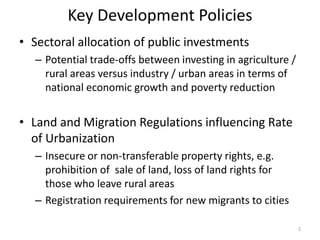
Key Development Policies
• Sectoral allocation of public investments
– Potential trade-offs between investing in agriculture /
rural areas versus industry / urban areas in terms of
national economic growth and poverty reduction
• Land and Migration Regulations influencing Rate
of Urbanization
– Insecure or non-transferable property rights, e.g.
prohibition of sale of land, loss of land rights for
those who leave rural areas
– Registration requirements for new migrants to cities
2
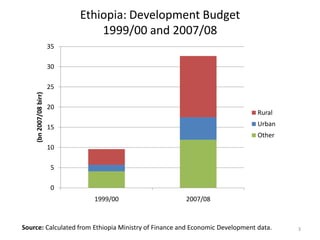
Ethiopia: Development Budget
1999/00 and 2007/08
3Source: Calculated from Ethiopia Ministry of Finance and Economic Development data.
0
5
10
15
20
25
30
35
1999/00 2007/08
(bn2007/08birr)
Rural
Urban
Other
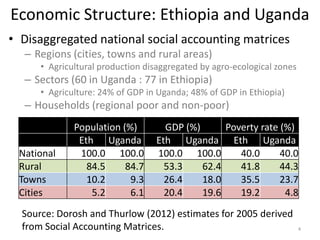
Economic Structure: Ethiopia and Uganda
• Disaggregated national social accounting matrices
– Regions (cities, towns and rural areas)
• Agricultural production disaggregated by agro-ecological zones
– Sectors (60 in Uganda : 77 in Ethiopia)
• Agriculture: 24% of GDP in Uganda; 48% of GDP in Ethiopia)
– Households (regional poor and non-poor)
Population (%) GDP (%) Poverty rate (%)
Eth Uganda Eth Uganda Eth Uganda
National 100.0 100.0 100.0 100.0 40.0 40.0
Rural 84.5 84.7 53.3 62.4 41.8 44.3
Towns 10.2 9.3 26.4 18.0 35.5 23.7
Cities 5.2 6.1 20.4 19.6 19.2 4.8
4
Source: Dorosh and Thurlow (2012) estimates for 2005 derived
from Social Accounting Matrices.
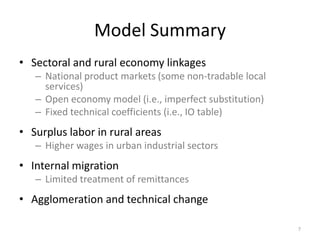
Model Summary
• Sectoral and rural economy linkages
– National product markets (some non-tradable local
services)
– Open economy model (i.e., imperfect substitution)
– Fixed technical coefficients (i.e., IO table)
• Surplus labor in rural areas
– Higher wages in urban industrial sectors
• Internal migration
– Limited treatment of remittances
• Agglomeration and technical change
7
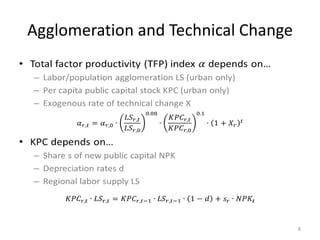
Agglomeration and Technical Change
8
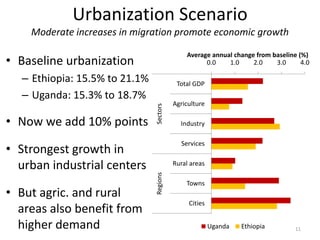
Urbanization Scenario
Moderate increases in migration promote economic growth
• Baseline urbanization
– Ethiopia: 15.5% to 21.1%
– Uganda: 15.3% to 18.7%
• Now we add 10% points
• Strongest growth in
urban industrial centers
• But agric. and rural
areas also benefit from
higher demand
0.0 1.0 2.0 3.0 4.0
Total GDP
Agriculture
Industry
Services
Rural areas
Towns
Cities
SectorsRegions
Average annual change from baseline (%)
Uganda Ethiopia 11
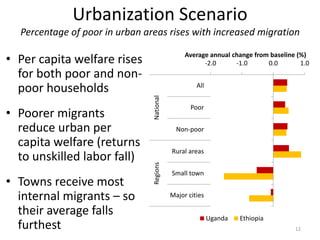
Urbanization Scenario
Percentage of poor in urban areas rises with increased migration
• Per capita welfare rises
for both poor and non-
poor households
• Poorer migrants
reduce urban per
capita welfare (returns
to unskilled labor fall)
• Towns receive most
internal migrants – so
their average falls
furthest
-2.0 -1.0 0.0 1.0
All
Poor
Non-poor
Rural areas
Small town
Major cities
NationalRegions
Average annual change from baseline (%)
Uganda Ethiopia
12
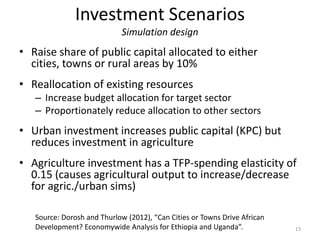
Investment Scenarios
Simulation design
• Raise share of public capital allocated to either
cities, towns or rural areas by 10%
• Reallocation of existing resources
– Increase budget allocation for target sector
– Proportionately reduce allocation to other sectors
• Urban investment increases public capital (KPC) but
reduces investment in agriculture
• Agriculture investment has a TFP-spending elasticity of
0.15 (causes agricultural output to increase/decrease
for agric./urban sims)
Source: Dorosh and Thurlow (2012), “Can Cities or Towns Drive African
Development? Economywide Analysis for Ethiopia and Uganda”. 13
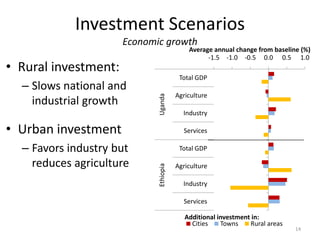
Investment Scenarios
Economic growth
• Rural investment:
– Slows national and
industrial growth
• Urban investment
– Favors industry but
reduces agriculture
-1.5 -1.0 -0.5 0.0 0.5 1.0
Total GDP
Agriculture
Industry
Services
Total GDP
Agriculture
Industry
Services
UgandaEthiopia
Average annual change from baseline (%)
Cities Towns Rural areas
Additional investment in:
14
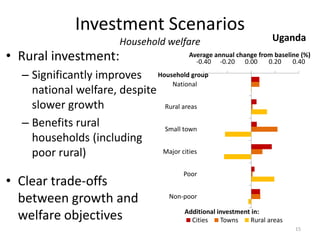
Investment Scenarios
Household welfare
• Rural investment:
– Significantly improves
national welfare, despite
slower growth
– Benefits rural
households (including
poor rural)
• Clear trade-offs
between growth and
welfare objectives
-0.40 -0.20 0.00 0.20 0.40
National
Rural areas
Small town
Major cities
Poor
Non-poor
Average annual change from baseline (%)
Cities Towns Rural areas
Uganda
Additional investment in:
15
Household group
Summary
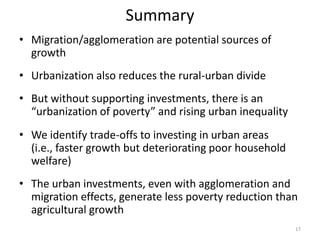
• Migration/agglomeration are potential sources of
growth
• Urbanization also reduces the rural-urban divide
• But without supporting investments, there is an
“urbanization of poverty” and rising urban inequality
• We identify trade-offs to investing in urban areas
(i.e., faster growth but deteriorating poor household
welfare)
• The urban investments, even with agglomeration and
migration effects, generate less poverty reduction than
agricultural growth
17
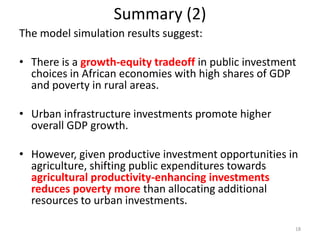
Summary (2)
The model simulation results suggest:
• There is a growth-equity tradeoff in public investment
choices in African economies with high shares of GDP
and poverty in rural areas.
• Urban infrastructure investments promote higher
overall GDP growth.
• However, given productive investment opportunities in
agriculture, shifting public expenditures towards
agricultural productivity-enhancing investments
reduces poverty more than allocating additional
resources to urban investments.
18

Dakar seminar dorosh may 2013

  • 1.
    Agricultural Growth, Urbanizationand Poverty: Implications of Alternative Development Strategies in Africa Paul A. Dorosh International Food Policy Research Institute (IFPRI) Workshop on “Economic Transformation in West Africa: What it Means for Food Security and Poverty Reduction” Dakar, Senegal May 15, 2013 1
  • 2.
    Key Development Policies •Sectoral allocation of public investments – Potential trade-offs between investing in agriculture / rural areas versus industry / urban areas in terms of national economic growth and poverty reduction • Land and Migration Regulations influencing Rate of Urbanization – Insecure or non-transferable property rights, e.g. prohibition of sale of land, loss of land rights for those who leave rural areas – Registration requirements for new migrants to cities 2
  • 3.
    Ethiopia: Development Budget 1999/00and 2007/08 3Source: Calculated from Ethiopia Ministry of Finance and Economic Development data. 0 5 10 15 20 25 30 35 1999/00 2007/08 (bn2007/08birr) Rural Urban Other
  • 4.
    Economic Structure: Ethiopiaand Uganda • Disaggregated national social accounting matrices – Regions (cities, towns and rural areas) • Agricultural production disaggregated by agro-ecological zones – Sectors (60 in Uganda : 77 in Ethiopia) • Agriculture: 24% of GDP in Uganda; 48% of GDP in Ethiopia) – Households (regional poor and non-poor) Population (%) GDP (%) Poverty rate (%) Eth Uganda Eth Uganda Eth Uganda National 100.0 100.0 100.0 100.0 40.0 40.0 Rural 84.5 84.7 53.3 62.4 41.8 44.3 Towns 10.2 9.3 26.4 18.0 35.5 23.7 Cities 5.2 6.1 20.4 19.6 19.2 4.8 4 Source: Dorosh and Thurlow (2012) estimates for 2005 derived from Social Accounting Matrices.
  • 5.
    Model Summary • Sectoraland rural economy linkages – National product markets (some non-tradable local services) – Open economy model (i.e., imperfect substitution) – Fixed technical coefficients (i.e., IO table) • Surplus labor in rural areas – Higher wages in urban industrial sectors • Internal migration – Limited treatment of remittances • Agglomeration and technical change 7
  • 6.
  • 7.
    Urbanization Scenario Moderate increasesin migration promote economic growth • Baseline urbanization – Ethiopia: 15.5% to 21.1% – Uganda: 15.3% to 18.7% • Now we add 10% points • Strongest growth in urban industrial centers • But agric. and rural areas also benefit from higher demand 0.0 1.0 2.0 3.0 4.0 Total GDP Agriculture Industry Services Rural areas Towns Cities SectorsRegions Average annual change from baseline (%) Uganda Ethiopia 11
  • 8.
    Urbanization Scenario Percentage ofpoor in urban areas rises with increased migration • Per capita welfare rises for both poor and non- poor households • Poorer migrants reduce urban per capita welfare (returns to unskilled labor fall) • Towns receive most internal migrants – so their average falls furthest -2.0 -1.0 0.0 1.0 All Poor Non-poor Rural areas Small town Major cities NationalRegions Average annual change from baseline (%) Uganda Ethiopia 12
  • 9.
    Investment Scenarios Simulation design •Raise share of public capital allocated to either cities, towns or rural areas by 10% • Reallocation of existing resources – Increase budget allocation for target sector – Proportionately reduce allocation to other sectors • Urban investment increases public capital (KPC) but reduces investment in agriculture • Agriculture investment has a TFP-spending elasticity of 0.15 (causes agricultural output to increase/decrease for agric./urban sims) Source: Dorosh and Thurlow (2012), “Can Cities or Towns Drive African Development? Economywide Analysis for Ethiopia and Uganda”. 13
  • 10.
    Investment Scenarios Economic growth •Rural investment: – Slows national and industrial growth • Urban investment – Favors industry but reduces agriculture -1.5 -1.0 -0.5 0.0 0.5 1.0 Total GDP Agriculture Industry Services Total GDP Agriculture Industry Services UgandaEthiopia Average annual change from baseline (%) Cities Towns Rural areas Additional investment in: 14
  • 11.
    Investment Scenarios Household welfare •Rural investment: – Significantly improves national welfare, despite slower growth – Benefits rural households (including poor rural) • Clear trade-offs between growth and welfare objectives -0.40 -0.20 0.00 0.20 0.40 National Rural areas Small town Major cities Poor Non-poor Average annual change from baseline (%) Cities Towns Rural areas Uganda Additional investment in: 15 Household group
  • 12.
    Summary • Migration/agglomeration arepotential sources of growth • Urbanization also reduces the rural-urban divide • But without supporting investments, there is an “urbanization of poverty” and rising urban inequality • We identify trade-offs to investing in urban areas (i.e., faster growth but deteriorating poor household welfare) • The urban investments, even with agglomeration and migration effects, generate less poverty reduction than agricultural growth 17
  • 13.
    Summary (2) The modelsimulation results suggest: • There is a growth-equity tradeoff in public investment choices in African economies with high shares of GDP and poverty in rural areas. • Urban infrastructure investments promote higher overall GDP growth. • However, given productive investment opportunities in agriculture, shifting public expenditures towards agricultural productivity-enhancing investments reduces poverty more than allocating additional resources to urban investments. 18