





OCCUPATIONAL SAFETY
& H E A LT H S E R V I C E
HEALTH AND SAFETY IN EMPLOYMENT ACT 1992
APPROVED CODE OF PRACTICE FOR THE
PREVENTION, DETECTION AND CONTROL
OF FIRE AND EXPLOSION IN
NEW ZEALAND
DAIRY INDUSTRY
SPRAY DRYING
PLANT
ISSUED
AND
APPRO
VED
BY
TH
E
M
INISTER
O
F
LABO
UR
JUNE
1993L A B O U R
D E P A R T M E N T O F
T E T A R I M A H I
Published by the Occupational Safety and Health Service
Department of Labour
Wellington
New Zealand
October 1993
ISBN 0-477-03470-5
$10 (incl. GST)
Contents
NOTICE OF ISSUE 5
FOREWORD 6
SUMMARY OF THE HEALTH AND SAFETY IN
EMPLOYMENT ACT 1992 7
Approved Codes of Practice 7
Employers' Duties 7
Hazard Management 7
Information for Employees 8
Employers to Involve Employees in the Development of Health and Safety
Procedures 9
Training of Employees and the Safety of Others 9
Employees' Duties 9
Accidents and Serious Harm (Records and Notification) 9
1. INTRODUCTION 11
1.1 Preamble 11
1.2 Background 11
1.3 Application of Code 11
1.4 Definitions 14
2. HAZARDS AND HAZARD PREVENTION 16
2.1 Fire and Explosion: General 16
2.2 Fires 16
2.3 Explosions 17
2.4 Sources of Ignition 19
3. RECOMMENDATIONS AND REQUIREMENTS 22
3.1 Processing Equipment 22
3.2 Management Responsibilities 29
4. EXPLOSION PROTECTION 34
4.1 General 34
4.2 Explosion Venting 34
4.3 Process Isolation 41
4.4 Use of Pressure Vessels 41
4.5 Explosion Suppression 42
4.6 Drying in an Inert Gas Atmosphere 42
4.7 Specific Requirements for Explosion Protection 42
4.8 Plans and Designs 43
5. FIRE CONTROL AND PROTECTION 44
5.1 General 44
5.2 General Recommendations 44
4 DAIRY INDUSTRY SPRAY DRYING PLANT
5.3 General Requirements 45
5.4 Specific Requirements 45
5.5 Testing and Maintenance 49
APPENDIX 1: EXPLOSION TEST METHODS 50
APPENDIX 2: OPERATOR’S CHECKLIST 51
APPENDIX 3: EXAMPLES OF PERMIT TO WORK
SYSTEMS 52
Confined Space Entry Permit 52
Permit for Cutting and Welding with Portable Gas or Arc Equipment (Front) 54
Checklist (Back) 55
Entry Permit 56
Hot Work Permit 57
APPENDIX 4: EXPLOSION SUPPRESSION 58
Background 58
Principle of Operation 58
Design Considerations 59
APPENDIX 5: DRYING IN AN INERT GAS ATMOSPHERE
60
Background 60
Design Considerations 60
RELATED DOCUMENTS 61
BIBLIOGRAPHY 63
DAIRY INDUSTRY SPRAY DRYING PLANT 5
NOTICE OF ISSUE
I have issued this Approved Code of Practice for the Prevention, Detection and Control of
Fire and Explosion in New Zealand Dairy Industry Spray Drying Plant, being a statement
of preferred work practices or arrangements, for the purpose of ensuring the health and
safety of people to which this code applies and those who may be affected by the
activities covered by the code.
C J McKenzie
Secretary of Labour
June 1993
6 DAIRY INDUSTRY SPRAY DRYING PLANT
FOREWORD
I have approved this statement of preferred work practices, which is an Approved Code
of Practice for the Prevention, Detection and Control of Fire and Explosion in New
Zealand Dairy Industry Spray Drying Plant, under section 20 of the Health and Safety
in Employment Act 1992.
When a code is approved a court may have regard to it in relation to compliance with
the relevant sections of the Health and Safety in Employment Act 1992. This means that
if an employer in an industry or using a process to which an approved code applies can
show compliance with that code in all matters it covers, a court may consider this to be
compliance with the provisions of the Act to which the code relates.
Hon Maurice McTigue
Minister of Labour
June 1993
DAIRY INDUSTRY SPRAY DRYING PLANT 7
SUMMARY OF THE HEALTH
AND SAFETY IN EMPLOYMENT
ACT 1992
The principal object of the Health and Safety in Employment Act 1992 is to prevent
harm to employees at work. To do this it imposes duties on, and promotes excellent
health and safety management by, employers. It also provides for the making of
regulations and codes of practice.
APPROVED CODES OF PRACTICE
The Act provides for the development and approval of statements of preferred work
practice, or arrangements, that may be approved as “approved codes of practice”. These
are recommended means of compliance with provisions of the Act, and may include
procedures which could be taken into account when deciding on the practicable steps to
be taken. Compliance with codes of practice will not be mandatory. However, approved
codes may be used in court as evidence of good practice.
EMPLOYERS' DUTIES
Employers have the most duties to perform to ensure the health and safety of employees.
If you are an employer then you have a general duty to take all practicable steps to ensure
the safety of employees while at work. (This is set out in section 6 of the Act.) In
particular, you are required to take all practicable steps to:
• Provide and maintain a safe working environment;
• Provide and maintain facilities for the safety and health of employees at work;
• Ensure that machinery and equipment in the place of work is designed, made,
set up, and maintained to be safe for employees;
• Ensure that employees are not exposed to hazards in the course of their work;
and
• Develop procedures for dealing with emergencies that may arise while
employees are at work.
HAZARD MANAGEMENT
Employers must identify hazards in the place of work (previously existing, new and
8 DAIRY INDUSTRY SPRAY DRYING PLANT
potential) and regularly review them to determine whether or not they are significant
hazards requiring further action. Where there occurs any accident or harm in respect of
which an employer is required to record particulars, section 7 of the Act requires the
employer to take all practicable steps to ensure that the occurrence is so investigated as to
determine whether it was caused by or arose from a significant hazard.
Significant hazard means a hazard that is an actual or potential cause or source of —
(a) Serious harm; or
(b) Harm (being more than trivial) the severity of whose effects on any person
depend (entirely or among other things) on the extent or frequency of the
person’s exposure to the hazard; or
(c) Harm that does not usually occur, or usually is not easily detectable, until a
significant time after exposure to the hazard.
WHERE THE HAZARD IS SIGNIFICANT
The Act sets out the steps an employer must take:
• Where practicable, the hazard must be eliminated;
• If elimination is not practicable, the hazard must be isolated;
• If it is impracticable to eliminate or isolate the hazard completely, then the
employer must minimise the hazard to employees.
In addition, the employer must, where appropriate:
• Ensure that protective clothing and equipment is provided, accessible and used;
• Monitor employees’ exposure to the hazard;
• Seek the consent of employees to monitor their health; and
• With informed consent, monitor employees’ health.
INFORMATION FOR EMPLOYEES
(a) Before an employee begins work their employer must inform them of:
• Emergency procedures;
• Hazards the employee may be exposed to while at work;
• Hazards the employee may create while at work which could harm other
people;
• How to minimise the likelihood of these hazards becoming a source of harm to
others; and
• The location of safety equipment.
(b) The employer is also required to inform employees of:
• The results of any health and safety monitoring. In doing so, the privacy of
individual employees must be protected.
DAIRY INDUSTRY SPRAY DRYING PLANT 9
EMPLOYERS TO INVOLVE EMPLOYEES IN THE
DEVELOPMENT OF HEALTH AND SAFETY PROCEDURES
Employers need to ensure that all employees have the opportunity to be fully involved in
the development of procedures for the purpose of identifying hazards and dealing with
significant hazards or dealing with or reacting to emergencies and imminent dangers
(section 14).
TRAINING OF EMPLOYEES AND THE SAFETY OF
OTHERS
The employer must ensure employees are either sufficiently experienced to do their work
safely, or supervised by an experienced person. In addition, the employee must be
adequately trained in the safe use of equipment in the place of work, including
protective clothing and equipment (section 13).
An employer is also responsible for the health and safety of people who are not
employees. An employer must take all practicable steps to ensure that an employee does
not harm any other person while at work, including members of the public or visitors to
the place of work (section 15).
EMPLOYEES' DUTIES
If you are an employee, the Act gives you responsibility for your own safety and health
while at work. You must also ensure that your actions do not harm anyone else.
ACCIDENTS AND SERIOUS HARM (RECORDS AND
NOTIFICATION)
The Act offers the following definition:
“Accident” means an event that—
a) Causes any person to be harmed; or
b) In different circumstances, might have caused any person to be harmed:
This means that “accident” includes both near misses and accidents that result in harm
to a person or might have caused any person to be harmed.
Every employer is required to maintain a register of accidents and serious harm; and
record particulars relating to:-
a) Every accident that harmed (or, as the case may be, might have harmed):
i) Any employee at work; or
ii) Any person in a place of work controlled by the employer; and
b) Every occurrence of serious harm to an employee at work, or as a result of any
hazard to which the employee was exposed while at work, in the employment of
the employer.
10 DAIRY INDUSTRY SPRAY DRYING PLANT
Where there occurs any serious harm or accident an employer must:
a) As soon as possible after its occurrence, notify the Secretary of Labour the
occurrence; and
b) Within 7 days of the occurrence, give the Secretary of Labour (OSH) written
notice, in the prescribed form, of the circumstances of the occurrence.
The notification to the Secretary applies to:-
a) Every occurrence of serious harm to an employee at work, or the occurrence of
serious harm as a result of any hazard to which the employee was exposed while
at work, in the employment of the employer; and
b) Accidents of a kind or description required by regulations.
Note: Regulations have yet to be promulgated.
DAIRY INDUSTRY SPRAY DRYING PLANT 11
1. INTRODUCTION
1.1 PREAMBLE
1.1.1 This code of practice has been developed to provide practical guidance for the dairy
industry on the design, operation and maintenance of spray drying plant and
ancillary plant for the avoidance of fire and explosion, and minimising the effects of
fire and explosion.
1.1.1 Casein and other non-spray-dried dairy powders will be covered in a subsequent
code of practice.
1.2 BACKGROUND
1.2.1 The inherent hazard involving plant and processes using or generating dust or
powders of such a character likely to give rise to an explosion or fire has been known
for some time. Following a dust explosion in a Masterton plastics factory in 1965, in
which four people died, the Factories Act 1946 was amended to ensure factory
occupiers took practicable steps to prevent such explosions. These provisions have
been retained in the present legislation. There have been a number of dust
explosions and associated fires reported overseas and in New Zealand. Incidents
have occurred frequently enough to warrant the development of this code. Attention
has been focused on existing standards of explosion protection and the potential for
devastation of plant and buildings.
1.3 APPLICATION OF CODE
1.3.1 SCOPE
1.3.1.1 This code is intended for designers, manufacturers and users of food spray drying
plant and equipment used in the dairy industry. It applies to all new and existing:
• Spray drying plant including two-stage dryers with integrated fluidised beds and
“Filtermat” dryers;
• Fluidised bed dryers and other powder handling equipment;
• Dust collection equipment;
• Bulk storage facilities including silos and bins used to hold dry powder;
• Ducting; and
• Bag sealing and shrink wrapping equipment.
1.3.1.2 This code sets standards for the design, installation and the operation of the above
plant and equipment and the training of operators.
12 DAIRY INDUSTRY SPRAY DRYING PLANT
1.3.2 GUIDELINES TO IMPLEMENTATION
1.3.2.1 All new plant and equipment including spray dryers, fluidised beds, cyclones,
ducting, bag filters, dust collection equipment, bulk storage facilities, silos, bins, heat
sealers, and shrink wrappers, if not specifically exempted under section 1.3.3 of this
code, shall be expected to comply in full with the code’s requirements from the date
of approval of this code.
1.3.2.2 All existing plant and equipment (as listed in section 1.3.1), if not specifically
exempted under section 1.3.3 of this code, shall be expected to comply in full with
the code’s requirements from the date of approval of this code within the following
time scale.
1.3.2.3 All existing spray dryers with an expected life-span exceeding 7 years shall be
expected to comply with the explosion protection requirements of this code within 7
years of the date of approval of this code.
1.3.2.4 All other existing plant and equipment (i.e. bag filters, silos, bins, etc.) shall be
expected to comply within 2 years of the date of approval of this code.
1.3.2.5 All other requirements of this code (i..e. all matters not covered elsewhere and
including sections 2 and 4 of this code) shall be expected to be complied with in full.
1.3.2.6 Where it is considered to be impractical, or where problems arise in the application
of the requirements of the code to any new or existing plant or equipment the matter
must be fully discussed with OSH as soon as possible. This will allow an alternative
safety standard, that adequately safeguards the safety and health of all persons
engaged, employed or legally on the premises, and members of the general public, to
be put in place.
1.3.2.7 It is recommended that this code be reviewed at least every 5 years by a working
party representing interested parties.
1.3.3 SPECIFIC EXEMPTIONS
1.3.3.1 The requirements of section 4 of the code, Explosion protection, only, shall not
apply to the following types of existing plant or equipment.
1.3.3.2 Spray dryers
(i) All existing spray dryers due for replacement within 7 years from the date of
approval of this code are exempt from the code’s provisions, but attention is drawn
to section 1.3.4.
(ii) The following existing types of spray dryers not due to be replaced within 7
years from the date of approval of this code (excluding associated bag filters) will be
considered for exemption from the code on application to OSH:
• Flat bottom dryers; or
• Box dryers.
All new spray dryers falling within these categories installed and operated after the
date of approval of this code shall comply in full with the provisions of the code.
1.3.3.3 Fluidised beds and cyclones
(i) All existing fluidised beds and cyclones are exempt from the provisions of this
code on the condition and providing that all openings (manholes) and removable
DAIRY INDUSTRY SPRAY DRYING PLANT 13
inspection panels are firmly secured; flexi-couplings shall have deflectors fitted; and
the immediate area in the vicinity of the fluidised bed or cyclone (flexicouplings,
inspection panels, openings, or other pressure relief openings) must be treated as a
“no go”, or “restricted access” areas. In the event of extensive alteration,
modification, repair or maintenance being carried out on any fluidised bed or
cyclone, full explosion protection must be considered and any problem in carrying
this out must be fully discussed with OSH.
(ii) All new fluidised beds and cyclones (see 1.3.2) installed and operated after the
date of approval of this code must be provided with explosion protection in
accordance with the requirements of the code. Where it is considered that it is
impractical to comply, or where problems arise, the matter must be fully discussed
with OSH at the planning and design stage and prior to installation and operation.
This will enable alternative safety measures to be considered.
1.3.4 GENERAL INFORMATION
1.3.4.1 The above guidelines on the application and implementation of this code are
designed to assist industry in meeting the requirements of the code in a planned and
cost-effective manner.
1.3.4.2 It does not relieve the industry or individual occupiers, owners or employers from
their duties and responsibilities under the Act and OSH will not accept any
responsibility should fire or explosion occur involving plant or equipment or work
procedure not complying with the Act or this code.
1.3.4.3 The onus to comply rests with the industry, occupier, owner, employer, or employee,
and OSH reserves the right to require full compliance in the event of an immediate
and serious hazard being identified or brought to its attention. In the event of an
injury accident occurring involving any plant, equipment or work procedure, OSH
will be obliged to consider and instigate court proceedings for non compliance.
Therefore, it is recommended that the industry or individual undertaking take all
practical steps to comply, in full, with the requirements of this code in respect of all
new and existing plant, equipment and work procedures, as soon as possible after
approval of the code. This code may also be useful in the production of other food
products or products falling into the same dust explosion class. However, it should
be noted that any exemption under the code or the guidelines given for
implementation would not apply, and it is recommended that full discussions with
OSH be held before applying the provisions of the code to such plant and
equipment.
1.3.4.4 Although this code may be applied to both class St 1 and 2 products, its main
application will be to class St 1 products. Most food products fall into this class, e.g.
dried milk powder, sugar fines, coffee, and maize starch. A few food products
exhibit the more severe characteristics of class St 2, the most common being corn
starch.
1.3.4.5 Dusts may be grouped into four classes based on their Kst
value.
14 DAIRY INDUSTRY SPRAY DRYING PLANT
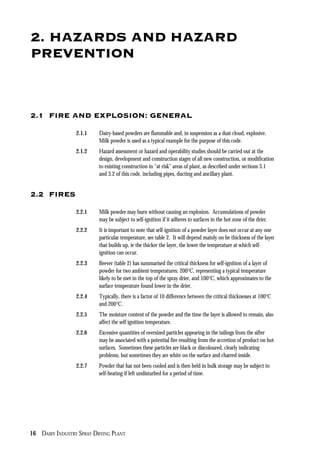
Table 1: Dust explosion classes
Dust explosion Kst
(MPa m/s)
St 0 0
St 1 0-20
St 2 20.1-30
St 3 30 +
Dust explosion classes are discussed in more detail in the standards.
1.4 DEFINITIONS
In this code, unless inconsistent with the context, the following definitions apply:
Act: Means the Health and Safety in Employment Act 1992.
Approving authority: The Occupational Safety and Health Service of the Department of
Labour.
Bulk storage: Hoppers or silos in which dry products may be stored.
Drying system (plant): The complete spray drying apparatus; including air heating,
atomisation, powder collection, secondary drying, powder cooling, powder sifting and
conveying equipment (including ducting) but excluding bulk storage, packaging and
warehousing.
Dust: Small solid particles that may be suspended in air for some time, which may settle
out under the influence of gravity.
Fast acting temperature sensor: A temperature sensor with a first order time constant of
less than 20 seconds under conditions of use.
Hazardous area: A delineated area in which all electrical installations and equipment
used must be of a type approved by the electrical authority for installation and use in the
area.
Inspector: Unless specified means an inspector appointed under the Act.
Kst
: Constant of the equation – (dP/dt)max. V0.333
= Kst
where (dP/dt) max is the
maximum rate of pressure rise in a closed vessel of volume, V. Kst
is normally
determined from measurements of maximum rate of pressure rise in a 1 m3
or 20 litre
test apparatus with a 10 kJ ignition source.
Minimum ignition temperature: The lowest temperature at which flame propagation
occurs in a dust suspension.
No-go area: An area that personnel shall be prohibited from entering when the plant is
operating.
OSH: The Occupational Safety and Health Service of the Department of Labour.
Pred
: Reduced pressure. Maximum explosion pressure in a vented vessel.
Pstat
: The static pressure at which the vent cover opens or bursts.
Restricted access area: An area that all personnel are prohibited from entering during
plant operation, with the exception of authorised personnel, who may enter the area for
short periods to carry out process inspections and checks, sampling of product, and
during emergency procedures. Routine maintenance work shall not be carried out in
restricted access areas during operation of the plant.
DAIRY INDUSTRY SPRAY DRYING PLANT 15
Standard: Means the current standard published by Standards New Zealand or an
equivalent overseas organisation. A list of the relevant standards current at the time of
publication is appendixed. However, as they are regularly updated, their current status
should be checked.
Thermodisc: Thermally-operated switch; used to detect excess temperatures.
16 DAIRY INDUSTRY SPRAY DRYING PLANT
2. HAZARDS AND HAZARD
PREVENTION
2.1 FIRE AND EXPLOSION: GENERAL
2.1.1 Dairy-based powders are flammable and, in suspension as a dust cloud, explosive.
Milk powder is used as a typical example for the purpose of this code.
2.1.2 Hazard assessment or hazard and operability studies should be carried out at the
design, development and construction stages of all new construction, or modification
to existing construction in “at risk” areas of plant, as described under sections 3.1
and 3.2 of this code, including pipes, ducting and ancillary plant.
2.2 FIRES
2.2.1 Milk powder may burn without causing an explosion. Accumulations of powder
may be subject to self-ignition if it adheres to surfaces in the hot zone of the drier.
2.2.2 It is important to note that self-ignition of a powder layer does not occur at any one
particular temperature, see table 2. It will depend mainly on he thickness of the layer
that builds up, ie the thicker the layer, the lower the temperature at which self-
ignition can occur.
2.2.3 Beever (table 2) has summarised the critical thickness for self-ignition of a layer of
powder for two ambient temperatures: 200°C, representing a typical temperature
likely to be met in the top of the spray drier, and 100°C, which approximates to the
surface temperature found lower in the drier.
2.2.4 Typically, there is a factor of 10 difference between the critical thicknesses at 100°C
and 200°C.
2.2.5 The moisture content of the powder and the time the layer is allowed to remain, also
affect the self ignition temperature.
2.2.6 Excessive quantities of oversized particles appearing in the tailings from the sifter
may be associated with a potential fire resulting from the accretion of product on hot
surfaces. Sometimes these particles are black or discoloured, clearly indicating
problems, but sometimes they are white on the surface and charred inside.
2.2.7 Powder that has not been cooled and is then held in bulk storage may be subject to
self-heating if left undisturbed for a period of time.
DAIRY INDUSTRY SPRAY DRYING PLANT 17
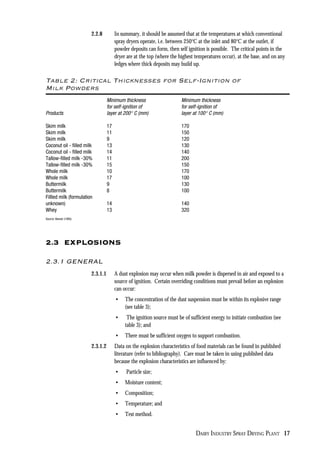
2.2.8 In summary, it should be assumed that at the temperatures at which conventional
spray dryers operate, i.e. between 250°C at the inlet and 80°C at the outlet, if
powder deposits can form, then self ignition is possible. The critical points in the
dryer are at the top (where the highest temperatures occur), at the base, and on any
ledges where thick deposits may build up.
Table 2: Critical Thicknesses for Self-Ignition of
Milk Powders
Minimum thickness Minimum thickness
for self-ignition of for self-ignition of
Products layer at 200° C (mm) layer at 100° C (mm)
Skim milk 17 170
Skim milk 11 150
Skim milk 9 120
Coconut oil - filled milk 13 130
Coconut oil - filled milk 14 140
Tallow-filled milk -30% 11 200
Tallow-filled milk -30% 15 150
Whole milk 10 170
Whole milk 17 100
Buttermilk 9 130
Buttermilk 8 100
Fillled milk (formulation
unknown) 14 140
Whey 13 320
Source: Beever (1985)
2.3 EXPLOSIONS
2.3.1 GENERAL
2.3.1.1 A dust explosion may occur when milk powder is dispersed in air and exposed to a
source of ignition. Certain overriding conditions must prevail before an explosion
can occur:
• The concentration of the dust suspension must be within its explosive range
(see table 3);
• The ignition source must be of sufficient energy to initiate combustion (see
table 3); and
• There must be sufficient oxygen to support combustion.
2.3.1.2 Data on the explosion characteristics of food materials can be found in published
literature (refer to bibliography). Care must be taken in using published data
because the explosion characteristics are influenced by:
• Particle size;
• Moisture content;
• Composition;
• Temperature; and
• Test method.
18 DAIRY INDUSTRY SPRAY DRYING PLANT
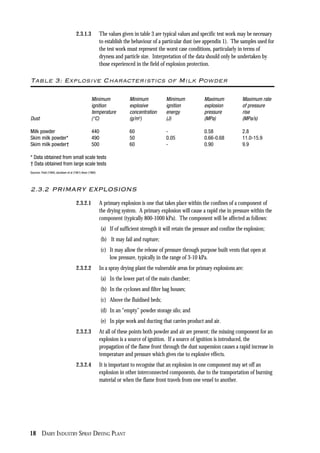
2.3.1.3 The values given in table 3 are typical values and specific test work may be necessary
to establish the behaviour of a particular dust (see appendix 1). The samples used for
the test work must represent the worst case conditions, particularly in terms of
dryness and particle size. Interpretation of the data should only be undertaken by
those experienced in the field of explosion protection.
Table 3: Explosive Characteristics of Milk Powder
Minimum Minimum Minimum Maximum Maximum rate
ignition explosive ignition explosion of pressure
temperature concentration energy pressure rise
Dust (°C) (g/m3
) (J) (MPa) (MPa/s)
Milk powder 440 60 - 0.58 2.8
Skim milk powder* 490 50 0.05 0.66-0.68 11.0-15.9
Skim milk powder† 500 60 - 0.90 9.9
* Data obtained from small scale tests
† Data obtained from large scale tests
Sources: Field (1984) Jacobsen et al (1961) Anon (1980)
2.3.2 PRIMARY EXPLOSIONS
2.3.2.1 A primary explosion is one that takes place within the confines of a component of
the drying system. A primary explosion will cause a rapid rise in pressure within the
component (typically 800-1000 kPa). The component will be affected as follows:
(a) If of sufficient strength it will retain the pressure and confine the explosion;
(b) It may fail and rupture;
(c) It may allow the release of pressure through purpose built vents that open at
low pressure, typically in the range of 3-10 kPa.
2.3.2.2 In a spray drying plant the vulnerable areas for primary explosions are:
(a) In the lower part of the main chamber;
(b) In the cyclones and filter bag houses;
(c) Above the fluidised beds;
(d) In an “empty” powder storage silo; and
(e) In pipe work and ducting that carries product and air.
2.3.2.3 At all of these points both powder and air are present; the missing component for an
explosion is a source of ignition. If a source of ignition is introduced, the
propagation of the flame front through the dust suspension causes a rapid increase in
temperature and pressure which gives rise to explosive effects.
2.3.2.4 It is important to recognise that an explosion in one component may set off an
explosion in other interconnected components, due to the transportation of burning
material or when the flame front travels from one vessel to another.
DAIRY INDUSTRY SPRAY DRYING PLANT 19
2.3.3 SECONDARY EXPLOSIONS
2.3.3.1 If a component ruptures or a vent opens during an explosion, a pressure wave will
emerge, followed by a cloud of as yet unburned powder. The expansion effect and
consequent turbulence to the surrounding atmosphere will cause any dust that may
have settled and accumulated to be dispersed into a dust cloud. This dust cloud may
then be ignited by the combustion products of the primary explosion, usually
resulting in a more severe explosion than the primary explosion.
2.3.3.2 To minimise the risk of a secondary explosion, good housekeeping is essential.
2.3.3.3 A secondary explosion may be retained within the confines of the building.
Alternatively, if the magnitude of the explosion relative to the size and strength of
the building is sufficiently high, the pressure may rise to the point where wall panels,
ceiling/roof panels and windows are blown out or, in extreme cases, more serious
structural damage results.
2.4 SOURCES OF IGNITION
Explosions develop initially from a fire or from other sources of ignition. The possibility
of explosions and fires occurring can be reduced by removing known sources of ignition.
2.4.1 FLAMES
2.4.1.1 Sources of naked flames include:
• Cigarettes;
• Flames used to sterilise laboratory sampling equipment;
• Hand-held gas torches; and
• Direct-fired air heaters.
These sources of ignition must be prevented from coming into contact with any
powder.
2.4.2 CHARRED PARTICLES
2.4.2.1 Charred particles are the result of combustion and are another possible source of
ignition. Usually they are too small to cause ignition, but they can provide an early
warning that a hazardous situation is developing.
2.4.2.2 It is possible that particles passing through a direct fired heater may become
incandescent. Gibson and Schofield (1977) have shown that incandescent particles
would need to be at least 3-5 mm in diameter, at temperatures of 600°C, to cause
ignition.
20 DAIRY INDUSTRY SPRAY DRYING PLANT
2.4.3 HOT SURFACES AND SELF-IGNITION
2.4.3.1 Hot surfaces are inherent in the operation of a spray dryer and occur in the hot air
inlet sections, on the surface of air heating units and on mechanical equipment that
malfunctions.
2.4.3.2 Minimum ignition temperatures of milk powder clouds vary between about 440°C
and 500°C depending on the characteristics of the product (see table 3). Such
temperatures do not occur during normal operation.
2.4.3.3 Component parts of the structure of spray dryers, in direct contact with primary
drying air, can heat up to temperatures in excess of 200°C. Such temperatures are
more than sufficient to initiate accelerated oxidation and self-heating, leading to
ignition of accumulations of product adhering to internal surfaces or components of
a dryer. This is of particular concern in cases where inlet temperatures of 250°C or
more are used. These accumulations can become a source of ignition elsewhere in
the system when particles of incandescent material become detached and travel on
the air stream to high risk areas where the product is dry and in suspension with air.
2.4.3.4 In addition, where a system for returning fines to the atomising zone in the dryer is
in use, the fines could be ignited by incandescent material adhering to the top of the
dryer.
2.4.3.5 Other hot surfaces which are potential ignition sources include exposed electrical
heating elements (e.g. hand drying units, heat sealers associated with packaging
equipment), and improperly located incandescent filament light bulbs.
2.4.4 MECHANICAL FRICTION
2.4.4.1 Frictional heating will occur whenever two contacting surfaces move relative to each
other. It is important to recognise that this phenomenon is not limited to faults
arising from two surfaces meeting unintentionally but can also occur in lubricated
items such as gearboxes and bearings. Rotary atomisers, because of their rotational
speed and high stress, are a high risk area.
2.4.5 IMPACT SPARKS
2.4.5.1 Impact sparks are one of the more common sources of ignition. They may be
created when metal drying system components fall into the chamber or ducts. Most
commonly, impact sparks have been caused by the atomiser wheel parting from the
shaft and hitting the chamber walls. A lower risk area is the outlet fan for the drier.
Dust present in the exhaust air may impinge on the impeller, resulting in product
build-up. This may cause dynamic imbalance and excessive vibration resulting in
premature failure of the bearings. Whilst the bearings for these units are normally
mounted externally to the fan casing, failure may cause the impeller of the fan to
touch the casing and create a hazard.
DAIRY INDUSTRY SPRAY DRYING PLANT 21
2.4.6 ELECTRICAL SPARKS
2.4.6.1 Electrical energy may be a source of ignition, with sparks containing energy
substantially in excess of that required to ignite dusts. Sparks produced during the
normal working of switches, contact breakers, fuses, motor brushes, etc. can readily
ignite dusts unless precautions are taken. Portable appliances such as electric vacuum
cleaners (see section 3.1.15), drills, grinding and welding equipment, should be
considered as potential sources of electrical sparks.
2.4.7 ELECTROSTATIC DISCHARGE SPARKS
2.4.7.1 Electrostatic discharge sparks are generally of low energy, often below the 50 mJ
minimum for ignition of milk powders. However, variations in this energy and the
flammability of the powder can occur. Electrostatic discharge, therefore, needs to be
taken into account as a potential source of ignition.
2.4.8 HOT WORK
2.4.8.1 Welding and cutting produces sparks and localised heating of plant. Similar hazards
arise from operations such as soldering, burning and the use of power tools.
2.4.8.2 Flammable material left in the vicinity of welding operations (e.g. wooden structures,
tarpaulins) can be ignited and remain smouldering for several hours (see section
3.2.7).
22 DAIRY INDUSTRY SPRAY DRYING PLANT
3. RECOMMENDATIONS AND
REQUIREMENTS
3.1 PROCESSING EQUIPMENT
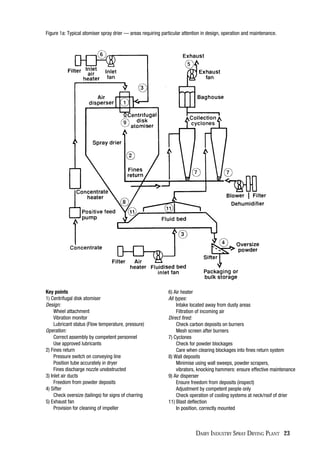
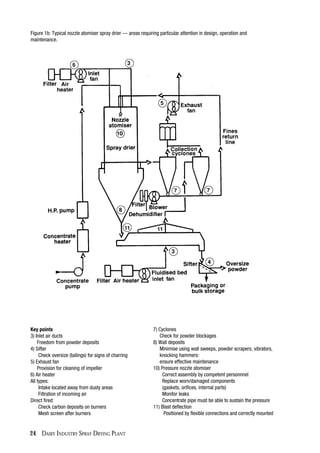
Figures 1a and 1b illustrate areas where particular attention should be paid in the
design, operation and maintenance of the two most common configurations of spray
dryers.
3.1.1 AIR HEATERS
High temperatures occur on the surface of air heating units. Filter units must be
provided prior to each air heat exchanger either by a “filter room” concept or by
individually filtering each air heater supply inlet.
3.1.1.1 Indirect oil or gas-fired air heaters
Indirect air heating units employing a flame or using hot oil should be situated in a
separate compartment. The structure of the compartment shall have a fire resistance
rating of two hours in respect of load bearing capacity, insulation and integrity as
determined by the relevant standards.
Doors shall have a fire resistance rating of two hours or be a type C door in
compliance with the standard.
Glazing should be avoided on any side of the compartment facing the process.
Methods to minimise the ingress of dust into the compartment should be adopted,
e.g:
• Pressurising of the room;
• Air locks; or
• Isolation of the air heating compartment from the processing area.
3.1.1.2 Direct fired air heaters
Air heating units employing a flame shall have a separate combustion chamber
and should be situated to keep flames well away from flammable dust. It is possible
that incandescent particles could enter the dryer through the air supply. This can be
prevented by:
• Locating the air intake in a clean area;
• The provision of a suitable filter on the air intake (e.g. standard MAF filter);
• Keeping the inside of the heating systems clean and dust free.
• Installing a mesh screen downstream of the burner with a maximum grid space
of 3 mm (Institution of Chemical Engineers, 1977). The mesh filters should be
inspected and cleaned regularly.
DAIRY INDUSTRY SPRAY DRYING PLANT 23
Figure 1a: Typical atomiser spray drier — areas requiring particular attention in design, operation and maintenance.
Key points
1) Centrifugal disk atomiser
Design:
Wheel attachment
Vibration monitor
Lubricant status (Flow temperature, pressure)
Operation:
Correct assembly by competent personnel
Use approved lubricants
2) Fines return
Pressure switch on conveying line
Position tube accurately in dryer
Fines discharge nozzle unobstructed
3) Inlet air ducts
Freedom from powder deposits
4) Sifter
Check oversize (tailings) for signs of charring
5) Exhaust fan
Provision for cleaning of impeller
6) Air heater
All types:
Intake located away from dusty areas
Filtration of incoming air
Direct fired:
Check carbon deposits on burners
Mesh screen after burners
7) Cyclones
Check for powder blockages
Care when clearing blockages into fines return system
8) Wall deposits
Minimise using wall sweeps, powder scrapers,
vibrators, knocking hammers: ensure effective maintenance
9) Air disperser
Ensure freedom from deposits (inspect)
Adjustment by competent people only
Check operation of cooling systems at neck/roof of drier
11) Blast deflection
In position, correctly mounted
24 DAIRY INDUSTRY SPRAY DRYING PLANT
Figure 1b: Typical nozzle atomiser spray drier — areas requiring particular attention in design, operation and
maintenance.
Key points
3) Inlet air ducts
Freedom from powder deposits
4) Sifter
Check oversize (tailings) for signs of charring
5) Exhaust fan
Provision for cleaning of impeller
6) Air heater
All types:
Intake located away from dusty areas
Filtration of incoming air
Direct fired:
Check carbon deposits on burners
Mesh screen after burners
7) Cyclones
Check for powder blockages
8) Wall deposits
Minimise using wall sweeps, powder scrapers, vibrators,
knocking hammers:
ensure effective maintenance
10) Pressure nozzle atomiser
Correct assembly by competent personnnel
Replace worn/damaged components
(gaskets, orifices, internal parts)
Monitor leaks
Concentrate pipe must be able to sustain the pressure
11) Blast deflection
Positioned by flexible connections and correctly mounted
DAIRY INDUSTRY SPRAY DRYING PLANT 25
Direct fired burners should be operated in such a way as to ensure complete
combustion. Erratic burning and flame blow out shall be investigated and remedied
immediately. Detailed advice for the installation of gas burners is available in the
standards.
3.1.2 AIR DISPERSER
3.1.2.1 Excessive temperatures are most likely to occur in the area of the dryer where the
inlet air enters the drying chamber. By employing insulation and cooling
techniques, the design of this area should ensure that the temperature of this risk area
is:
• Low enough to prevent ignition or browning of any product deposits which might
accumulate; and
• High enough to prevent moisture condensation which would cause accumulation
of powder deposits.
3.1.3 ATOMISATION
3.1.3.1 Centrifugal disk
The feed line to the atomiser should be fitted with a duplex filler. Blockages of the
filter can be monitored using a differential pressure measuring device.
The design of the atomiser wheel assembly must ensure that a properly assembled
wheel will not come apart from the shaft.
The atomiser assembly shall be fitted with vibration monitoring instrumentation
which will allow the generation of alarms; (see section 5.4.2).
Oil temperature and oil pressure monitoring equipment should be an integral feature
of atomiser protection, and alarms should be generated as appropriate.
3.1.3.2 Pressure nozzle
All components of a pressure nozzle atomisation system including the high pressure
pump, feed line, flexible couplings, valves, nozzles and other fittings shall be
constructed of appropriate materials with adequate strength to withstand the
pressures necessary for effective atomisation.
Care must be exercised when selecting combinations and positioning nozzle
assemblies in the dryer to ensure that concentrate does not impinge directly on hot
surfaces because of inappropriate spray trajectories.
3.1.4 FINES RETURN
3.1.4.1 Because of the risk of partial blockage of the fines return conveying line which could
cause the powder to penetrate the atomisation zone and impinge on the air disperser,
the fines return conveying line shall be monitored by a pressure-operated switch.
This switch shall interrupt the powder flow into the fines return system when
pressures exceed predetermined safe limits. Where fines are introduced from above
26 DAIRY INDUSTRY SPRAY DRYING PLANT
(pointing downwards into the dryer), it will assist in eliminating the risk of getting
powder into the hot air stream from the air dispenser (see section 3.2.3).
3.1.5 FANS
3.1.5.1 All fans carrying powder laden air shall be designed to allow periodic cleaning of the
impeller and casing.
3.1.5.2 Consideration should be given to the provision of vibration monitoring equipment
on any fans handling powder laden air. Alarms should be generated as appropriate
(see section 5.4.2).
3.1.6 TEMPERATURE CONTROL SYSTEM
3.1.6.1 Abnormally high temperatures can be caused in the dryer if the feed is interrupted
with the danger of powder deposits in the dryer subsequently igniting.
To minimise this danger the dryer shall be fitted with a temperature activated alarm
and fire control system as described in section 5.4.5.1.
3.1.7 EQUIPMENT CONTAINING POWDER
3.1.7.1 Surfaces such as the dryer cone, walls and transfer duct-work must be designed so
that the angle of any surface will discourage a build-up of powder. Precautions such
as air scouring, mechanical sweeping or knocking devices should be employed
wherever a build-up is likely.
3.1.8 REMOVABLE INSPECTION PANELS
3.1.8.1 Removable inspection panels may be provided in order to examine whether build-up
of powder is taking place under operating conditions. The panels shall be designed
such that they maintain the strength of the parent vessel. The panels may be
provided in every closed vessel, such as cyclones, fluidised beds and filter casings, and
at each otherwise inaccessible location. When the dryer is commissioned, these areas
shall be examined frequently and modifications made to the plant to remove any
detected problems. Under normal running conditions, less frequent, but regular
(e.g. monthly) inspections should take place.
3.1.8.2 All removable inspection panels must be secured in such a manner so as to prevent
them becoming missiles in the event of an explosion.
3.1.9 ELECTRICAL EQUIPMENT
3.1.9.1 As a general precaution the installation of electrical equipment should be avoided
where an explosive dust is likely to be present. For example, switch-gear may be
installed in a room separated from the main working area. Where this precaution
DAIRY INDUSTRY SPRAY DRYING PLANT 27
cannot be taken and the equipment must be used in the presence of combustible
dust suitable electrical wiring and fittings shall be provided.
3.1.9.2 A T classification
A T classification (or any subsequent modification to this classification) shall be
given to all electrical equipment in the spray dryer process stream, or any other
designated hazardous area. Temperature ratings shall follow the temperature profile
of the process with a 50°C margin over and above that of the process temperature.
Note: The classification of the hazardous area is made with reference to the
standard by an inspector.
Electrical equipment suitable for such areas is determined by the Energy Resource
Division of the Ministry of Commerce according to the standards.
3.1.9.3 Process and plant lighting
All lighting for process inspection and plant environs shall be enclosed, suitable for
the hazard involved and must take account of the dangers of overheating of
enclosures and transparent panels on which powder deposits may accumulate.
3.1.9.4 Insect killers
Insect killers utilising electricity are not permitted in any area where explosive
concentrations of dusts may be present.
3.1.9.5 Heat sealers
All heat sealers are to be soundly constructed and properly maintained at all times.
Heat sealers shall not be sited within 2 metres of any bag filling equipment and
extraction systems shall be provided between the bag filling equipment and the heat
sealer to remove airborne concentrations of powder. The heating element must be
interlocked to “fail safe” with the extraction system to ensure it is switched off in the
event of the extraction system failing or not being operated.
3.1.9.6 Hot air hand dryers
Hot air hand dryers are not permitted in any area where explosive concentrations of
dusts may be present.
3.1.9.7 Shrink wrappers
All shrink wrapping machines shall be soundly constructed and properly maintained
at all times.
“No go” areas shall be established and fenced off to ensure that no worker can
accidentally or inadvertently come into contact with any moving parts. All shrink
wrapped products shall be inspected before removal to any storage area for scorched
or burning areas. The correct sized wrap shall be used for the size of package being
covered at all times. A suitable fire extinguisher shall be provided and sited at the
shrink wrapping machine.
3.1.10 EARTHING
3.1.10.1 Electrostatic sparks may be of sufficient energy to ignite milk powder. The most
common danger is the retention of charge on a conductor. The accepted method of
avoiding the hazard is to connect all components to each other and to earth by low
28 DAIRY INDUSTRY SPRAY DRYING PLANT
resistance electrical paths which permit the dissipation of charge. A resistance of 10
ohms is generally suitable for wholly metallic systems but may not be appropriate for
systems involving non-metallic components.
3.1.10.2 All plant and equipment shall be earthed and a regular monitoring system shall be
established. All earthing devices shall be inspected visually on a regular basis. In
addition, measurements of earthing resistance should be made before the plant is
brought into use, at each scheduled maintenance and after any other modification or
maintenance, and a log kept in order to indicate any changes.
3.1.11 LIGHTNING PROTECTION
3.1.11.1 The building must be protected against lightning strike.
3.1.12 FLEXIBLE CONNECTIONS
3.1.12.1 Flexible connections or couplings in areas where people are likely to be exposed to a
hazard shall be adequately protected (see section 4.7.40.
3.1.13 PROCESS ISOLATION
3.1.13.1 Individual plant items should be protected against the effect of explosion and fire
and should be isolated from each other by means of baffles, chokes, quick acting
valves, etc. (see section 4.3).
3.1.14 MACHINERY
3.1.14.1 All machinery, shall be soundly constructed, properly maintained and safely operated
at all times. All prime movers, transmission machinery and dangerous parts of
machines shall be provided with and operated with suitable guards fitted.
3.1.14.2 All operators of machinery shall be trained or supervised.
3.1.15 HOUSEKEEPING
3.1.15.1 A housekeeping programme shall be put in place to ensure a safe and good working
environment. The programme shall ensure:
• That all refuse is removed on a regular basis, daily or weekly as necessary.
• That all powder accumulations wherever lodged are removed safely on a
regular basis.
• That all powder spills are dealt with safely as soon as possible or at least daily.
• That all facilities provided for persons engaged or employed and work areas are
cleaned regularly on a daily or weekly basis as necessary to ensure a clean and
healthy environment.
DAIRY INDUSTRY SPRAY DRYING PLANT 29
• That all equipment, stores and materials of any kind are stored, used and kept
so as to ensure a safe and accident free environment in both working and
facility areas.
There are available in New Zealand, pneumatically powered vacuum cleaners
suitable for collecting explosive dusts. Electric powered vacuum cleaners can be a
potential source of ignition unless they are designed for use in hazardous areas (see
section 2.4.6).
3.1.16 NOISE
3.1.16.1 All practicable steps shall be taken to:
(a) Control at source the noise arising from any machinery, process or activity
carried on; or by
(b) Isolation or insulation of any machinery, process or activity;
to ensure that no person engaged or employed is exposed to any noise that would be
likely to impair their hearing.
3.1.16.2 Where, during the interim period, steps are being taken to control at source, isolate
or insulate such noise, or where it is shown to be impractical or technically not
feasible to do so, all workers exposed to the noise shall be provided with a suitable
individual hearing protection device. Workers shall be required to wear such devices
at all times while exposed to the noise.
3.1.17 PROTECTIVE CLOTHING AND EQUIPMENT
3.1.17.1 All workers shall be provided with such protective clothing and equipment as
necessary to safeguard their safety and health. All workers have a duty to wear or use
any protective clothing and equipment provided whenever the circumstances for
which it is provided prevail.
3.1.17.2 No person shall interfere with or misuse any protective clothing and equipment
provided for their safety and health or the safety of the plant and equipment. No
person shall do anything likely to endanger themselves or any other person.
3.2 MANAGEMENT RESPONSIBILITIES
3.2.1 GENERAL
3.2.1.1 To ensure compliance with the legal requirements and to reduce the possibility of a
fire or explosion developing it is necessary for a contribution to be made by everyone
concerned with the operation.
30 DAIRY INDUSTRY SPRAY DRYING PLANT
3.2.1.2 Management shall clearly define levels of authority with regard to operational duties,
cleaning and maintenance. Emergency procedures shall be established. All these
matters should be in writing and should form part of an operator’s manual, and the
company safety policy.
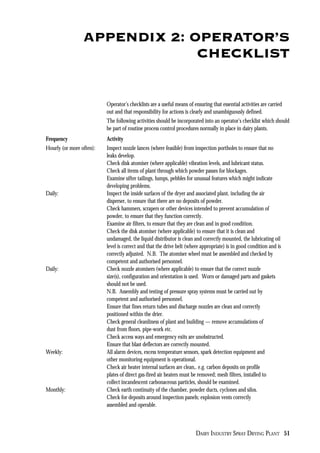
3.2.1.3 An example of inspection procedures for operators is given in appendix 2. This may
be used as a checklist amended as necessary to suit local conditions.
3.2.1.4 The operation and maintenance of the plant should be in accordance with the plant
manufacturers’ instructions and this code of practice, and personnel involved in these
operations must be adequately trained and made aware of the provisions of the code
(see section 3.2.6).
3.2.1.5 It would be beneficial if a planned preventative maintenance schedule was
incorporated within the engineering and maintenance department to ensure all
electrical, mechanical and pneumatic plant and machinery is maintained to design
specification.
3.2.1.6 Records should be maintained of inspections conducted and include details of date
of inspection, defects identified, action taken and identification of the person
conducting the inspection.
3.2.2 ATOMISERS
3.2.2.1 Centrifugal disk
The dismantling and assembly of the wheel must be carried out by a competent,
trained person, using correct tools, procedures and spare parts.
Care must be taken to avoid damaging critical rotating components such as the
atomiser wheel during assembly and disassembly and the use of a protective rubber
mat is recommended.
Approved lubricants of a grade no lower than that recommended by the
manufacturer shall be used.
Modifications to, or departures from, the manufacturer's settings, specifications or
procedures relating to the operation and maintenance of the atomiser shall not be
permitted.
3.2.2.2 Pressure nozzle
Nozzles must be correctly assembled by trained and competent personnel. Correct
tools and spare parts must be provided for this purpose.
If frequent changes of product type occur, (with an associated need to use a variety of
nozzle sizes), it is important to ensure that the proper nozzle parts are installed.
Damaged or worn nozzle parts should be removed from the area in which the
maintenance is conducted.
3.2.3 CONTROL OF DEPOSITS
3.2.3.1 It has been stated previously (section 2.2) that self ignition of powder deposits is
possible and steps must be taken during operation to reduce the chance of this
occurring. Powder deposits can be formed in several ways:
DAIRY INDUSTRY SPRAY DRYING PLANT 31
• Air currents can cause material to build up near the top of the dryer. This is
more likely to be a problem in dryers fitted with centrifugal disk atomisers and
it is important that the air flow and the atomiser speed are correctly adjusted to
minimise this problem.
In multipurpose dryers air disperser vanes may also require adjustment. Fires
have occurred within 30 minutes of improper adjustment of the air disperser
vanes. Only suitably qualified persons should perform any adjustment.
• All powder accumulations should be removed during wet washing of the plant.
Any remaining deposits will provide sites for further deposit formation. A
visual inspection of the internal surfaces should be carried out to ensure no
powder deposits remain.
• The correct start-up procedure shall be used. Failure to do so may result in
wetting of the chamber wall which will provide sites for the formation of
deposits.
• If separate fractions of fat and skim milk concentrate are atomised, fat deposits
will accumulate on the wall of the dryer. Fat-containing concentrates must
therefore be well mixed.
• If fines are returned directly below the atomiser disk, care must be taken that
the return tube is centred accurately otherwise powder may be blown on to the
hot surfaces at the top of the dryer. If the fines return tube outlet is partially
blocked, the increased discharge velocity may cause powder to be projected
through the atomiser cloud on to hot surfaces (see section 3.1.4).
Overloading of the fines return system, which may result from the clearance of
cyclone blockages, must be avoided.
• Explosion panels/doors shall be checked regularly to ensure that they are
operating correctly and are free from powder accumulations.
3.2.3.2 In many cases, air sweeps, powder scrapers, vibrators and knocking hammers are
provided to prevent powder accumulating on the chamber walls during operation. It
is important to ensure that these are maintained correctly.
3.2.3.3 The inner surfaces of the chamber around the hot air inlet(s) must be inspected
(using a battery operated hand torch) after each run and before any cleaning of the
chamber. If any powder deposits in this area appear charred, the cooling
arrangements must be checked.
3.2.3.4 Should any of the operating conditions change significantly, then more frequent
inspection should be established.
3.2.4 CONTROL OF BLOCKAGES
Operators must undertake process checks on a routine basis to ensure that blockages do
not occur. If powder begins to accumulate in the base of the chamber, the dryer should
be shut down. Unless this is done, the temperature of product in the dryer will begin to
rise and ignition may occur. Stopping the operation may also reduce the amount of
material in the dryer that may become involved in any subsequent fire or explosion.
32 DAIRY INDUSTRY SPRAY DRYING PLANT
3.2.5 START-UP AND SHUTDOWN PROCEDURE
3.2.5.1 At each start-up, stable drying conditions should be established on water before
switching to product feed.
3.2.5.2 At each shutdown, the plant should be run on water for a period long enough for
airborne powder residues to be substantially removed from the dryer. This method
of operation should preclude powder flowing back into the air disperser and heating
section as a result of the “chimney” effect. See shutdown procedures, section 5.4.5.
3.2.6 TRAINING AND EDUCATION OF OPERATORS
3.2.6.1 In addition to instruction provided to facilitate normal operation of the plant,
operators must receive training enabling them to:
• Appreciate the importance of carrying out the checks detailed in appendix 2;
• Be aware of the characteristic smell of burnt powder; and
• Detect charred particles in powder and in oversized product (tailings) from the
sifter, and must know the appropriate action to take if these are found.
Sampling points must be provided to enable the operator to perform this task
(see also section 3.1.16, 3.1.17, and 5.2).
3.2.6.2 All personnel receiving operator training shall be instructed in basic fire prevention
and fire fighting including:
• Triangle of fire (temperature, fuel, oxygen);
• Causes of ignition;
• Dust explosion hazards;
• Dangers of fire fighting where dust is present; and
• Vital actions in the event of fire.
3.2.7 PERMIT-TO-WORK
3.2.7.1 To ensure compliance with the statutory requirements summarised at the beginning
of this code, management should develop and introduce a written permit-to-work
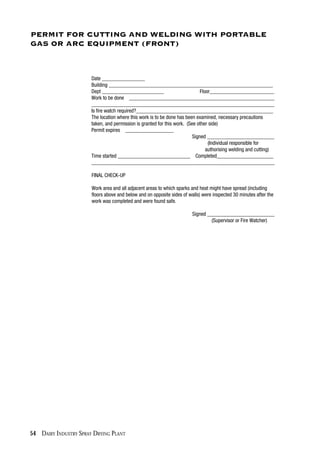
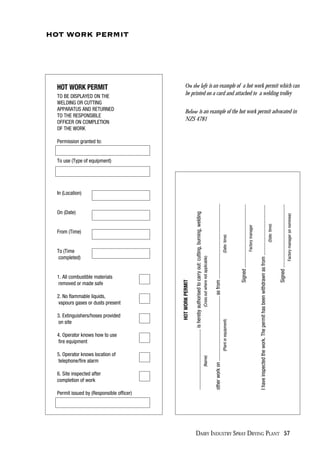
system into the workplace. Examples of permit-to-work systems are given in
appendix 3. A permit-to-work system should predetermine a safe procedure and be a
clear record that all foreseeable hazards have been considered and taken in correct
sequence. It does not, in itself, make the work safe, but is dependent for its
effectiveness on the persons concerned carrying it out conscientiously.
3.2.7.2 Special care should be taken to ensure that contractors who may be engaged to carry
out specific tasks are included in any permit-to-work system that may be operating.
Contractors, employees or representatives may be completely unaware of the nature
of any special risks inherent in the process plant, be inexperienced in the use of safety
equipment, and be unaware of safety or rescue procedures.
3.2.7.3 Hot work must not be carried out unless the plant has been shut down, emptied and
cleared of dust or the dust rendered non-explosive (see section 2.4.8).
DAIRY INDUSTRY SPRAY DRYING PLANT 33
3.2.8 WORK IN CONFINED SPACES
3.2.8.1 Work that must be carried out in confined spaces is also extremely hazardous.
Hazards can arise not only from the risk of fire or explosion but also from toxic
fumes or the lack of oxygen. Such conditions may be present within the confined
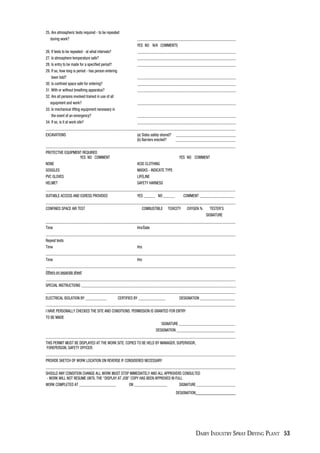
space or generated by the work carried out. An “entry permit” and “lock-out”
system must be introduced (examples are given in appendix 3) which may also
incorporate a “hot work” permit-to-work.
3.2.9 DEVELOPMENT OF PERMIT-TO-WORK SYSTEMS.
3.2.9.1 Further advice on the development of a “permit-to-work” system and the
precautions to be taken can be obtained from OSH branch offices.
34 DAIRY INDUSTRY SPRAY DRYING PLANT
4. EXPLOSION PROTECTION
4.1 GENERAL
4.1.1 The options available to the designer to minimise the impact of a dust explosion are:
(a) Explosion venting;
(b) Process isolation;
(c) Use of pressure vessels;
(d) Explosion suppression; or
(e) Drying in an inert atmosphere.
4.1.2 The designer must consider the total plant in order to achieve an integrated
protection system. Several options may be used in one plant to achieve the most
effective protection system.
4.2 EXPLOSION VENTING
4.2.1 BACKGROUND
4.2.1.1 The basic principle of venting provides for the rapid opening of a vent of sufficient
area to allow unburned dust and explosion products to escape, thus limiting the
pressure rise to an acceptable level. The acceptable pressure rise is determined by the
requirement that the vessel should not rupture and, in some cases, that it should not
deform.
4.2.1.2 The maximum explosion pressure in a vented vessel is called the “reduced explosion
pressure”, or Pred
. This is usually designed to be approximately two-thirds of the
pressure required to rupture the vessel.
4.2.1.3 In a given vessel the “reduced explosion pressure” will depend upon the size, number
and location of the vents, the opening pressure and inertia of the vent cover, the
presence of ducts from the vent, the presence of obstructions inside the vessel and the
state of the dust cloud. The explosive characteristics of the dust will also have a
bearing on the vent area.
4.2.1.1 On most existing equipment the size of vents is based on an estimate of the full
volume. Industry experience has shown that in the case of a spray dryer only one
third of the volume needs to be considered to calculate the explosion relief vent area.
However, for all other plant in which powder is present the full volume must be used
to determine the area of the explosion relief vents. The general subject of explosion
protection, including identification of the key points and their relevance to class St 1
materials, is detailed by Lunn (1992). With care, this information may also be used
to evaluate options for handling class St 2 materials.
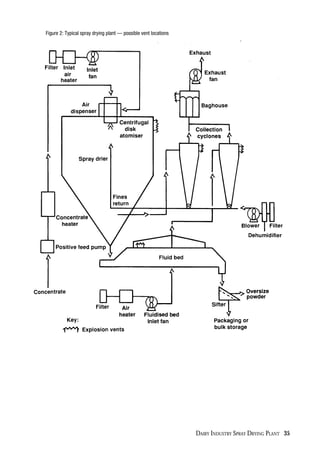
4.2.1.1 Possible vent locations are shown in figure 2.
DAIRY INDUSTRY SPRAY DRYING PLANT 35
Figure 2: Typical spray drying plant — possible vent locations
36 DAIRY INDUSTRY SPRAY DRYING PLANT
4.2.2 SIZING OF VENTS: VENT RATIO METHOD
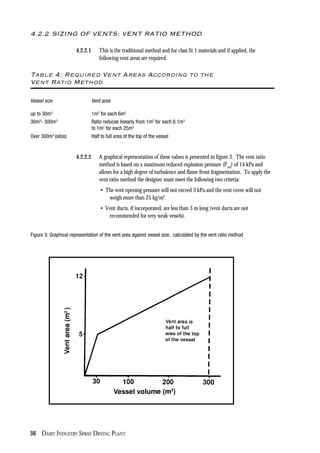
4.2.2.1 This is the traditional method and for class St 1 materials and if applied, the
following vent areas are required.
Table 4: Required Vent Areas According to the
Vent Ratio Method
Vessel size Vent area
up to 30m3
1m2
for each 6m3
30m3
- 300m3
Ratio reduces linearly from 1m2
for each 6.1m3
to 1m2
for each 25m3
Over 300m3
(silos) Half to full area of the top of the vessel
4.2.2.2 A graphical representation of these values is presented in figure 3. The vent ratio
method is based on a maximum reduced explosion pressure (Pred
) of 14 kPa and
allows for a high degree of turbulence and flame front fragmentation. To apply the
vent ratio method the designer must meet the following two criteria:
• The vent opening pressure will not exceed 3 kPa and the vent cover will not
weigh more than 25 kg/m2
.
• Vent ducts, if incorporated, are less than 3 m long (vent ducts are not
recommended for very weak vessels).
Figure 3: Graphical representation of the vent area against vessel size, calculated by the vent ratio method
DAIRY INDUSTRY SPRAY DRYING PLANT 37
4.2.3 SIZING OF VENTS: NOMOGRAPH OR CUBIC LAW METHOD
4.2.3.1 This method is considered to be a more precise calculation technique and may result
in smaller vent areas on larger vessels. The standards detail the procedure.
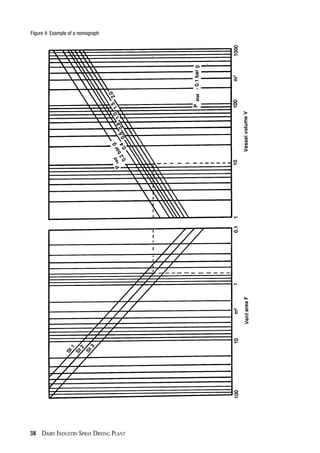
4.2.3.2 The vent area appropriate to a particular vessel volume is read from a nomograph, an
example of which is given in figure 4. A family of nomographs has been produced
covering a range of values of Pstat
the opening pressure of the vent, and Pred
the
reduced explosion pressure.
4.2.3.3 Families of curves are available for classes St 1, St 2 and St 3. Further families of
curves are available for different Kst
values within the 0-20 MPa m/s range covered
by class St 1 materials.
4.2.3.4 The calculation technique also allows the effect of duct design on Pred
to be
estimated.
4.2.3.5 The specific areas of application of the nomograph method and the necessary
conditions may be summarised as follows:
(a) Kst
determination: the minimum enclosed volume of the test sphere shall be 20
litres.
The test methods are detailed in appendix 1.
(b) The turbulence in the vessel to be protected must not exceed that encountered
in the dust explosion test method.
(c) The vessel should have a length-to-diameter ratio of less than 5:1 (less than 3:1
for class St 2 dusts).
(d) The vessel volume used when applying the nomograph method shall be the
total free volume of the vessel except in the case of spray dryers where only one
third of the volume shall be considered.
(e) Advice should be sought from OSH for vessels over 1,000 m3
.
(f) Calculations of relief vent size using the nomograph method are not normally
permitted for Pred
less than 20 kPa (see section 4.2.4).
(g) The vent cover inertia should be low; the weight of the cover should be less than
10 kg per square metre of vent cover area (see section 4.2.3).
(h) The basic method does not take account of vent ducts. Separate graphs allow
the duct effect to be estimated. An example is given in figure 5.
38 DAIRY INDUSTRY SPRAY DRYING PLANT
Figure 4: Example of a nomograph
DAIRY INDUSTRY SPRAY DRYING PLANT 39
4.2.4 VENT AREAS FOR WEAK VESSELS
4.2.4.1 The nomograph method described in section 4.2.3 has been extended by Lunn
(1988) for the British Materials Handling Board (BMHB), to include special
provision for venting explosions occurring in weak vessels (see bibliography). The
advantages of the BMHB refinements over the other standards are:
• Calculation of relief vent sizing is possible for reduced explosion pressures, Pred
as low as 5 kPa. This allows the bursting strengths of vessels to be as low as 7.5
kPa, i.e. 50% above Pred
for all Kst
values in the range 10600 bar m sec-1
.
• As a precondition for the above the vent release pressure, Pstat
must be as low as
possible and in no case exceed half the reduced explosion pressure, Pred
.
• The ability to assess the effect on Pred
of long vent ducts. The ducts may be
either straight, or contain a single bend at either 45° or 90°.
4.2.4.2 When the area of the explosion doors used to vent the spray dryer is calculated by the
BMHB method, the weight of the doors may be increased up to a maximum of 30
kg/m2
provided the width of each door from the hinge does not exceed 1.0 m.
4.2.5 VENT DUCTS
4.2.5.1 Explosion vents must discharge to a safe location. This is normally achieved on new
plant by ducting vents to the outside of the building or locating plant externally.
Venting of the building may be necessary in certain instances and especially in the
case of existing plant where venting to the outside may be impractical or not
possible.
4.2.5.2 A frame building with lightweight cladding is preferred for buildings handling
explosive dusts in order to prevent severe damage or collapse from secondary
explosions.
4.2.5.3 Where plant, including the ducting, is allowed to vent into a building, as may occur
on some existing equipment, full consideration must be given to:
• The risk of secondary explosion; and
• The building design and its ability to withstand pressure rise from the primary
and secondary explosions.
4.2.5.4 Where it is necessary for vents to discharge within buildings:
(a) Suitable deflectors shall be provided at potential discharge points to protect staff
in the event of an incident (see section 4.7);
(b) Suitable barriers shall be provided to fence off or otherwise delineate “no go”
areas; such barriers shall be effective when the plant is in operation and shall be
interlocked to the alarm system to initiate a class I (defect) alarm (see section
5.4.2.1) if the barriers are not in place.
40 DAIRY INDUSTRY SPRAY DRYING PLANT
4.2.5.5 Large vessels shall not be allowed to vent into a room unless the room is designated
as having “restricted access”. OSH shall be consulted if venting into a room is being
considered at the design stage and prior to installation.
4.2.5.6 Duct design affects the maximum pressure reached in a vessel (Pred
). The guidelines
for duct designs can be summarised as follows:
(a) Vent ducts should be as short as possible and less than 3 m in length. For vent
ducts in excess of 3 m advice must be sought. Such advice may be obtained
from OSH.
(b) The cross-sectional area of the duct shall be the same as, or up to 10% greater
than, the vent panel size. An increase in cross-sectional area in the direction of
flow is desirable.
(c) The vent cross section can be round, square or rectangular. Circular ducts are
often preferred because of their greater strength for the same gauge of metal.
(d) There shall not be a change of shape of the vent duct along its length that could
impede the flow of combustion products or the movement of vent covers.
(e) Vent ducts should be straight because of the unpredictable effects of bends.
Bends may be acceptable to divert the discharge. Advice should be sought from
OSH.
(f) The vent duct shall be constructed to a standard equivalent to or in excess of the
pressure-shock resistance of the vessel being protected.
4.2.5.7 The effect of the duct on the reduced explosion pressure in the vessel depends on its
length to diameter ratio, (L/D) and is illustrated in figure 5. It can be seen that the
increase in pressure may be large especially with ducts at high L/D ratios, and could
cause the vessel to rupture.
4.2.5.8 A full treatment on this subject is given by Lunn in Guide to dust explosion protection,
Part 1-Venting, which should be consulted.
Figure 5: The effect of vent ducts on the pressure in a vented vessel. Source: VDI 3673: 1979
DAIRY INDUSTRY SPRAY DRYING PLANT 41
4.3 PROCESS ISOLATION
4.3.1 GENERAL CONSIDERATIONS
4.3.1.2 An effective method of explosion protection is to isolate the particular piece of plant
in question by placing it in a separate room that must be constructed with sufficient
strength to withstand the effects of an explosion or that has its own explosion relief
vents sited in the wall or the roof. Doors and windows to such an isolated room
must be capable of withstanding the effects of an explosion. Where a building itself
is to be explosion protected OSH must be consulted. The room must be treated as a
“no-go” area or have restricted access to plant personnel during operation.
4.3.1.3 Individual plant items should be protected against the effect of explosion and should
be isolated from each other in order to:
• Control the transfer of burning and smouldering material;
• Allow the protection system to be matched to a specific volume of plant; and
• Avoid an explosion in the first vessel causing re-compression, increased
turbulence and a subsequent increase in the rate of pressure rise in the second
vessel.
4.3.1.4 Full account must be taken of the handling problems and essential hygiene
requirements associated with food products when isolating sections of the plant. The
risk of vessel collapse must be considered when isolation of sections of plant exposes
a vessel to increased pressure differences.
4.3.1.4 Lunn (1992) discusses process isolation techniques. Rotary valves and screw
conveyors can be used. Where under normal operation it is preferable to maintain
an uninterrupted process flow, quick-acting slide valves, baffles, chokes or
suppressant barriers can be built in.
4.3.2 ISOLATION OF FINES MATERIAL
4.3.2.1 In spray drying plant that have a fines return there must be a means of preventing
burning or charring particles from being “recycled” back into the spray dryer.
Isolation can be achieved by interlocking the rotary valve and/or the fines return air
flow system with the fire protection system. To ensure full protection of the spray
dryer it is recommended that a divert valve, interlocked to the fire protection system,
be placed as close as possible to the spray dryer and any diverted material be returned
to the external fluid beds, or into an area free from dust and designated as a “no go”
area.
4.4 USE OF PRESSURE VESSELS
4.4.1 BACKGROUND
4.4.1.1 For a given material and configuration of equipment, the maximum explosion
pressure may be predicted from small scale test data.
42 DAIRY INDUSTRY SPRAY DRYING PLANT
4.4.1.2 Where the equipment is relatively small, or hygiene constraints limit applicability of
other systems, it may be preferable to design the vessel to withstand the pressure,
rather than use other protection systems.
4.4.1.3 This technique is often applied to cylindrical components such as duct-work.
4.4.2 DESIGN CONSIDERATIONS
4.4.2.1 Vessel design can be based on either pressure resistant vessels or pressure-shock
resistant vessels.
In both design cases, the pressure rating of the vessel must be able to withstand the
maximum pressure rise for the dust concerned.
4.4.2.2 Pressure resistant vessels
These vessels are designed to contain an explosion without rupture or deformation.
4.4.2.3 Pressure-shock resistant vessels
These vessels are designed to withstand the maximum explosion pressure without
rupture but would be liable to permanent deformation. This approach reduces
capital cost but accepts that following an explosion the vessel might need substantial
repair or replacement.
4.5 EXPLOSION SUPPRESSION
4.5.1 Explosion suppression systems exploit the time (typically 30-100 ms) that it takes for
an explosion to generate a destructive pressure in a containing vessel. The method is
usually restricted to vessels less than 100 cubic metres. These sophisticated systems
require a high standard of regular maintenance. The principles of explosion
suppression are discussed in appendix 4.
4.6 DRYING IN AN INERT GAS ATMOSPHERE
4.6.1 Prevention of fires and explosions may be achieved by reducing the oxygen
concentration in the drying gases to less than that required to support combustion.
The technique is generally neither suited to nor applied to large food manufacturing
plants. The principles of drying in an inert gas atmosphere are discussed in appendix
5.
4.7 SPECIFIC REQUIREMENTS FOR EXPLOSION
PROTECTION
4.7.1 The spray dryer and dust collector must be explosion protected. Other spray drying
plant such as cyclones and the bulk storage silos or bins must be explosion protected
wherever practical.
4.7.2 Connecting ducting must be explosion protected where necessary and practical. For
removable inspection panels see 3.1.8.
4.7.3 It is recognised that it is difficult to explosion-protect existing fluidised beds, so only
minimum precautions have been included in this code (see 1.3.3 (b), 3.1.8 and
4.2.5.4. (a) (b)). Further protection can be achieved in many existing fluidised beds
DAIRY INDUSTRY SPRAY DRYING PLANT 43
by converting existing hatches to vents and allowing the explosion to vent into the
building. In this way the reduced explosion pressure can be kept below 50 kPa.
However, many of the newer types of fluidised beds are weak vessels which will
rupture at their ends, at pressures below 10 kPa.
In general, these vessels should be strengthened to withstand at least 20 kPa without
bursting and explosion relief obtained either by allowing one end of the vessel to act
as a vent or allowing the explosion products to rupture the flexi-couplings. In all
cases due regard must be given to the additional requirements set out in section
4.2.5.
These improvements should be considered during any maintenance work carried out
to the existing fluidised beds, and when undertaken, further advice can be obtained
from OSH.
Future designs may well enable further improvements to be made to protect fluidised
beds from the effects of explosions.
4.7.4 Flexible connections are particularly vulnerable to rupture when pressure builds up.
Protection may be accomplished using any of the following methods:
• Fitting of blast deflectors which are strong enough to withstand the force of an
explosion, thereby protecting people. In practice it is often impractical to
consider blast deflectors for the flexi-couplings unless the pressure produced by
the explosion is 50 kPa or less.
• Strengthen or replace the existing flexicoupling material using fabrics which will
withstand fire and explosion pressures up to at least 50 kPa.
• Delineate areas as “no go” areas where people are likely to be exposed to a hazard
as a result of a flexible connection rupturing.
4.7.5 Where explosion vents are fitted, they must be inspected at 6-monthly intervals (or
more frequently) to ensure correct assembly and safe operation. With sticky food
products more frequent inspections are recommended.
Assessing the explosion protection requirements of a plant is a complex process.
Further advice should be obtained from OSH.
4.8 PLANS AND DESIGNS
5.8.1 All drawings, plans or designs of any structure, buildings, plant or equipment shall
be prepared by a suitably qualified person and be certified with that person’s
qualification. All related calculations and workings shall be similarly certified.
5.8.2 All vessels (including spray dryers, cyclones, fluidised beds, bag filters, bins, silos and
similar powder holding plant) and buildings used to isolate plant in respect of
explosion protection shall have the internal pressure they can withstand without
rupturing determined and certified as described above.
5.8.3 All the above drawings, designs, plans and calculations shall be made available to
OSH on request.
44 DAIRY INDUSTRY SPRAY DRYING PLANT
5. FIRE CONTROL AND
PROTECTION
5.1 GENERAL
5.1.1 Fires are likely to occur:
• Within the drying system;
• Within the dryer building; or
• In plant or buildings adjacent to the dryer(s) and the dryer building.
Such fires are potential sources of ignition for:
• Explosions within the drying system;
• Explosions within the confines of the drying building where there may be a
dust-laden atmosphere.
5.1.2 Fire fighting in general should be left to the Fire Service but it is acknowledged that
immediate fire fighting by staff may prevent the development of a major incident.
5.1.3 Water is the best extinguishing agent, although extensive uncontrolled use of water
can result in unnecessary product damage. Where used, water should be in the form
of a spray rather than a solid jet to enable it to deal more effectively with the nature
of dust fires.
5.1.4 Additional information in planning fire control and emergency procedures may be
obtained from:
• The local area commander, New Zealand Fire Service;
• Fire protection companies, installers and manufacturers; and
• The Insurance Council of New Zealand Inc.
5.2 GENERAL RECOMMENDATIONS
5.2.1 Training in relevant aspects of fire control and the use of fire fighting appliances shall
be provided for all personnel (see section 3.2.6).
5.2.2 Specific responsibilities for emergency duties shall be allocated to appropriate
personnel.
5.2.3 There shall be a regular and documented procedure for checking and maintenance of
escape routes, route marking, emergency lighting. Escape routes shall remain free
from obstruction at all times.
5.2.4 An operator shall be stationed within the control room or the immediate vicinity at
all times during processing ready to respond in the event of an emergency and to
initiate the shut down of the plant if this can be carried out safely.
DAIRY INDUSTRY SPRAY DRYING PLANT 45
5.2.5 It is recommended that all buildings be fitted with automatic fire sprinkler systems in
accordance with the standard, whether or not these are required by the territorial
authority.
5.2.6 The spray drying equipment nominated in section 1.3.1 shall be protected in
accordance with the requirements of this code, which shall take precedence over the
standard.
5.2.7 Process water storage tanks are a good source of fire fighting water. These should be
adapted to enable connection to fire brigade equipment.
5.3 GENERAL REQUIREMENTS
5.3.1 Emergency plans shall be developed and shall include the provision of:
• Written instructions for personnel evacuation; procedures and assembly points
shall be displayed in a prominent place;
• Fire fighting and evacuation drills on a regular basis;
• Practical trials and discussions with the fire brigade including tests to ensure
that fire-fighting equipment is adequate;
• A telephone in the control room which may be used to raise an alarm in the
event of an emergency; and
• A fire alarm system complying with the standard and connected to the brigade.
5.3.2 A manually operated fire alarm call point connected to the fire alarm system should
be located in the control room. Activation of the manual call points in the spray
dryer zone shall also activate extinguishing systems as required by clauses 5.4.3.2 and
5.4.4.
5.3.3 Specific instructions on fire fighting should include the following statements:
Do not attempt to fight a fire unless you have ensured that:
• The alarm is activated;
• The Fire Service has been called; and
• You have a safe line of retreat from the fire area to a safe place.
Do not open doors, hatches or vents to dryers, cyclones or any other closed vessel until you
are quite satisfied that the fire has been extinguished.
Note: This system only applies to process plant and equipment.
5.4 SPECIFIC REQUIREMENTS
5.4.1 DETECTION
5.4.1.1 Temperature sensors for drying air
Fast-acting temperature sensors or “thermodisc” sensors shall be fitted to measure the
temperature of the incoming heated air to the dryer except for steam radiators and
hot water heaters on fluidised beds.
46 DAIRY INDUSTRY SPRAY DRYING PLANT
5.4.1.2 Temperature sensors for powder-laden air
Fast-acting temperature sensors shall be fitted in the main exhaust flow, the cyclone
exhaust manifold, in any exhaust air filters and in any device, such as sound
attenuators, where it is possible for powder to accumulate and receive burning
particles. Where an external fluidised bed is provided, this shall be fitted with
temperature sensors in the outlet air system.
5.4.1.3 Spark detection
Infra-red or similar spark detection equipment of a type approved by the Insurance
Council of New Zealand Inc. and the New Zealand Dairy Research Institute shall be
installed with sensors located at appropriate positions throughout the plant. This
equipment must be properly maintained and inspected regularly. Records of such
inspections must be kept and made available to the inspector on request, together
with the appropriate documentation.
5.4.1.4 Sensor integrity
All sensors shall be scanned/polled automatically at specific intervals to prove that
they are operational.
5.4.2 CLASSIFICATION OF ALARMS
There shall be two classes of alarm.
5.4.2.1 Class I (Defect)
Shall be automatically activated when:
• Abnormally high but safe temperatures are detected by thermodiscs, or over-
temperature sensors (see sections 5.4.1.1 and 5.4.1.2);
• Abnormally high but safe levels of vibration associated with a centrifugal disk
atomiser are detected;
• Automatic fire protection equipment is disabled, under test or otherwise
inoperative;
• Infra-red radiation (sparks) is detected (see section 5.4.1.3); and
• Mechanical interlocks, safety switches (eg fitted to explosion vents, “no-go”
access barriers, etc.) indicate an unsafe plant condition.
5.4.2.2 Class II (Fire)
Shall be automatically activated when:
• Abnormally high and unsafe temperatures are detected by thermodiscs, or over
temperature sensors (see sections 5.4.1.1 and 5.4.1.2); and
• Manual fire alarm switches associated with the spray drying plant are operated.
5.4.3 RESPONSE TO ALARMS
5.4.3.1 Class I (Defect)
A class I alarm condition, (see section 5.4.2.1), shall immediately and automatically:
• Alert operators by activating prominent visible warning lights and audible
alarms which are distinctive and identifiable from any others in the premises.
DAIRY INDUSTRY SPRAY DRYING PLANT 47
• Activate an orderly shutdown of the plant, with the objective of minimising the
risk of damage to the plant or product within. It is not required that fire
extinguishing equipment be activated or that general fire alarms be activated
(see section 5.4.2.1).
5.4.3.2 Class II (Fire)
A class II alarm condition, (see section 5.4.2.2), shall immediately and automatically:
• Activate general fire alarms;
• Actuate appropriate fire extinguishing equipment;
• Initiate emergency shutdown of the affected plant as described in section 5.4.5.2.
In addition:
• A fire call shall be transmitted to the nearest fire brigade; and
• Procedures for the protection of personnel shall be invoked.
5.4.4 EXTINGUISHING SYSTEMS
5.4.4.1 General
Water supplies to the dryer sprinkler/CIP system and the fluidised bed sprinkler
system shall be available at the required pressure close to the point of demand.
Water supplies may be controlled by solenoid valve devices as a part of the automatic
suppression system.
Water supplies shall be manually operable by the plant operator. A control switch to
activate the water supply shall be clearly identified and shall be located in an
accessible position within the control room.
Manual shutdown of fire-fighting facilities by the person or persons responsible for
fire control is permitted.
5.4.4.2 Dryer
A sprinkler system shall be installed in the dryer to provide a water spray, with a
minimum density of 10 mm/min. The pressure measured under duty at the nozzles
shall be not less than 100 kPa. The sprinkler nozzles shall be kept dust free by
suitable means such as seals or low pressure warm air flow.
A CIP system exceeding the basic requirements shall be regarded as a sprinkler
system for this code. The sprinkler/CIP system shall be automatically activated as
described in section 5.4.3.2 in response to a class II (fire) alarm condition.
5.4.4.3 Fluidised bed dryer and/or cooler
A sprinkler system shall be installed in the fluidised bed to provide a water spray,
with a minimum density of 5 mm/min. The pressure measured under duty at the
nozzles shall be not less than 100 kPa. The sprinkler nozzles shall be kept dust free
by suitable means such as seals or low pressure warm air flow. The sprinkler system
shall be automatically activated as described in section 5.4.3.2, in response to a class
II (fire) alarm condition.
5.4.4.4 Filter bag houses
The filter bag house (if installed) shall be protected by either:
48 DAIRY INDUSTRY SPRAY DRYING PLANT
(a) A fire sprinkler installation providing a nominal 5 mm/min density and fitted
with link type sprinklers rated at the maximum operating temperature of the
bag house, plus 30°C; or
(b) Installation of a sprinkler system to provide a water spray, with a minimum
density of 5 mm/min. The pressure measured under duty at the nozzles shall
be not less than 100 kPa. The sprinkler nozzles shall be kept dust free by
suitable means such as seals or low pressure warm air flow. The sprinkler
system shall be automatically activated as described in section 5.4.3.2 in
response to a class II (fire) alarm condition.
5.4.5 SHUTDOWN PROCEDURES
There shall be two shutdown procedures:
5.4.5.1 Controlled shutdown
Initiated by a class I (defect) alarm condition signalling impending, but not
immediate danger of an “event”. The plant should be closed down promptly and in
an orderly fashion. The following actions should be incorporated into the shutdown
sequence:
• Feed atomiser with water (nozzle or disk);
• Shutdown air heaters; and
• When temperatures are low enough, shut-off feed, airflow, powder transport,
sifter.
Note: In other words, a normal shutdown procedure with no unnecessary delays in the
sequence. The plant shall not be restarted until the condition which caused the defect
alarm has been investigated and rectified. No operator intervention, which might delay
or circumvent the shutdown procedure, shall be permitted.
Note: False alarms due to faulty equipment, poor design or improper operating
procedures must be rectified at the source, not by suppression of the automatic actions.
5.4.5.2 Emergency shutdown
Initiated by either a class II (fire) alarm condition or a manually activated emergency
shutdown when there is significant risk of propagation of fire to other parts of the
plant or danger to life resulting from continued operation of the plant.
The following actions shall be immediate and simultaneous:
• Activate fire extinguishing equipment;
• Switch off fans;
• Shut-down air heating;
• Shut-down atomiser;
• Stop rotary valves;
• Stop feeding dryer with concentrate;
• Isolate (bypass) bag house(s);
• Shut-down product transport system and sifter.
DAIRY INDUSTRY SPRAY DRYING PLANT 49
5.5 TESTING AND MAINTENANCE
5.5.1 Equipment must be regularly tested to ensure fitness for use. The testing procedures
applied must be appropriate for this purpose but should take into account the
conditions of use and the recommendations of the equipment manufacturer, supplier
and installer.
5.5.2 Excess temperature sensors shall be cleaned at appropriate intervals. Sprinkler/CIP
systems shall be tested by activating the over-temperature sensors at not more than
12-monthly intervals.
5.5.3 All testing and servicing of fire extinguishers shall be carried out by competent,
trained personnel as per the standard.
50 DAIRY INDUSTRY SPRAY DRYING PLANT
Graviner Ltd
Poyle Road
Colnbrook Slough SL3 OHB
Buckinghamshire
Wolfson Applied Electrostatics Ltd
University of Southhampton
Highfield
Southhampton S09 5NH
Hampshire
In Australia the following laboratory can carry out quantitative dust explosion
testing:
The Londonderry Occupational Safety Centre
132 Londonderry Road
Londonderry
NSW 2753
APPENDIX 1: EXPLOSION
TEST METHODS
In New Zealand, dusts are tested qualitatively for their explosibility in the Vertical Tube
test. Dusts which ignite and propagate a flame in the Vertical Tube test are considered
explosible and dusts which do not propagate flame are considered non-explosible.
The Vertical Tube test, which is described in detail by Field (1983), is accepted by OSH
for the purposes of classification.
OSH can arrange for dust to be tested in a spherical dust bomb in Australia if
quantitative results, such as Kst
or lower explosive limit values, are required.
Quantitative testing is expensive and is normally only carried out when it is believed
necessary to obtain such specific values. Therefore, OSH may seek cost recovery where a
company requested such a test to be carried out. Alternatively, the company could
approach any recognised testing laboratory and make its own arrangements for such
testing.
Lunn (1992) lists a number of laboratories in the United Kingdom which are able to
carry out quantitative dust explosion testing. These are listed below.
Building Research Establishment
Fire Research Station
Borehamwood WD6 2BL
Hertfordshire
Fenwal International
Lyons House
2A Station Road
Frimley
Camberley GU16 SMF
Surrey
Imperial Chemical Industries Ltd
Hazards and Process Studies Group
Organics Division
PO Box 42
Hexagon House
Blackley
Manchester M9 3DA
DAIRY INDUSTRY SPRAY DRYING PLANT 51
APPENDIX 2: OPERATOR’S
CHECKLIST
Operator’s checklists are a useful means of ensuring that essential activities are carried
out and that responsibility for actions is clearly and unambiguously defined.
The following activities should be incorporated into an operator’s checklist which should
be part of routine process control procedures normally in place in dairy plants.
Frequency Activity
Hourly (or more often): Inspect nozzle lances (where feasible) from inspection portholes to ensure that no
leaks develop.
Check disk atomiser (where applicable) vibration levels, and lubricant status.
Check all items of plant through which powder passes for blockages.
Examine sifter tailings, lumps, pebbles for unusual features which might indicate
developing problems.
Daily: Inspect the inside surfaces of the dryer and associated plant, including the air
disperser, to ensure that there are no deposits of powder.
Check hammers, scrapers or other devices intended to prevent accumulation of
powder, to ensure that they function correctly.
Examine air filters, to ensure that they are clean and in good condition.
Check the disk atomiser (where applicable) to ensure that it is clean and
undamaged, the liquid distributor is clean and correctly mounted, the lubricating oil
level is correct and that the drive belt (where appropriate) is in good condition and is
correctly adjusted. N.B. The atomiser wheel must be assembled and checked by
competent and authorised personnel.
Daily: Check nozzle atomisers (where applicable) to ensure that the correct nozzle
size(s), configuration and orientation is used. Worn or damaged parts and gaskets
should not be used.
N.B. Assembly and testing of pressure spray systems must be carried out by
competent and authorised personnel.
Ensure that fines return tubes and discharge nozzles are clean and correctly
positioned within the drier.
Check general cleanliness of plant and building — remove accumulations of
dust from floors, pipe-work etc.
Check access ways and emergency exits are unobstructed.
Ensure that blast deflectors are correctly mounted.
Weekly: All alarm devices, excess temperature sensors, spark detection equipment and
other monitoring equipment is operational.
Check air heater internal surfaces are clean,. e.g. carbon deposits on profile
plates of direct gas-fired air heaters must be removed; mesh filters, installed to
collect incandescent carbonaceous particles, should be examined.
Monthly: Check earth continuity of the chamber, powder ducts, cyclones and silos.
Check for deposits around inspection panels; explosion vents correctly
assembled and operable.
52 DAIRY INDUSTRY SPRAY DRYING PLANT
APPENDIX 3: EXAMPLES OF
PERMIT TO WORK SYSTEMS
CONFINED SPACE ENTRY PERMIT
_______________________
_____________________________
________________________________________________________________________________________________
THIS PERMIT IS ISSUED ONLY FOR WORK DESCRIBED
DESCRIPTION OF WORK AND LOCATION __________________________________________________________
________________________________________________________________________________________________
SAFETY CHECK
State Yes. No or Not Applicable (NA) - All spaces must be completed
YES NO N/A COMMENTS
___________________________________________________
1. Has steam, air, gas coils etc. been depressurised? ___________________________________________________
2. Are valves locked and tagged? ___________________________________________________
3. Are pipelines disconnected or blanked? ___________________________________________________
4. Are electrical switches locked and tagged? ___________________________________________________
5. Is all machinery isolated - disconnected - tagged? ___________________________________________________
6. Has confined space been purged? ___________________________________________________
7. Is space ventilated— Naturally? Mechanically? ___________________________________________________
8. Is continuous forced ventilation in effect? ___________________________________________________
9. Has space been steamed and why? ___________________________________________________
10. Has space been flushed with water and why? ___________________________________________________
11. Have sewers, drains, trenches within 15 m of work
been sealed? ___________________________________________________
12. Is there a fire hazard in or around the space? ___________________________________________________
13. Is adequate fire protection close to work?
14. Is fire and emergency alarm close to work? ___________________________________________________
15. Is each person entering space equipped with safety
harness? ___________________________________________________
16. Is rope securely fastened to person entering space? ___________________________________________________
17. Is rope attended by competent person outside acting
as an observer? ___________________________________________________
18. Does outside attendant know how to get immediate
assistant? ___________________________________________________
19. Are sufficient standby personnel detailed? — Inside
— Outside ___________________________________________________
20. Is resuscitation equipment with attendants? ___________________________________________________
21. Does attendant know how to use resuscitation
equipment? ___________________________________________________
22. Is self-contained breathing equipment required,
convenient? ___________________________________________________
23. Is self-contained breathing equipment suitable or is
other life support available? ___________________________________________________
24. Are non-metallic or non-sparking tools used where
scraping activities are carried out? ___________________________________________________
DAIRY INDUSTRY SPRAY DRYING PLANT 53
25. Are atmospheric tests required - to be repeated
during work? ___________________________________________________
YES NO N/A COMMENTS
26. If tests to be repeated - at what intervals? ___________________________________________________
27. Is atmosphere temperature safe? ___________________________________________________
28. Is entry to be made for a specified period? ___________________________________________________
29. If so, how long is period - has person entering
been told? ___________________________________________________
30. Is confined space safe for entering? ___________________________________________________
31. With or without breathing apparatus? ___________________________________________________
32. Are all persons involved trained in use of all
equipment and work? ___________________________________________________
33. Is mechanical lifting equipment necessary in
the event of an emergency? ___________________________________________________
34. If so, is it at work site? ___________________________________________________
__________________________________________________________________________________________________
EXCAVATIONS (a) Sides safely shored? _______________________________
(b) Barriers erected? _______________________________
__________________________________________________________________________________________________
PROTECTIVE EQUIPMENT REQUIRED
YES NO COMMENT YES NO COMMENT
NONE ACID CLOTHING
GOGGLES MASKS - INDICATE TYPE
PVC GLOVES LIFELINE
HELMET SAFETY HARNESS
__________________________________________________________________________________________________
SUITABLE ACCESS AND EGRESS PROVIDED YES ______ NO ______ COMMENT __________________
__________________________________________________________________________________________________
CONFINED SPACE AIR TEST COMBUSTIBLE TOXIClTY OXYGEN % TESTER’S
SIGNATURE
__________________________________________________________________________________________________
Time Hrs/Date
__________________________________________________________________________________________________
Repeat tests
Time Hrs
__________________________________________________________________________________________________
Time Hrs
__________________________________________________________________________________________________
Others on separate sheet
__________________________________________________________________________________________________
SPECIAL INSTRUCTIONS ________________________________________________________________________________
__________________________________________________________________________________________________
ELECTRICAL ISOLATION BY ___________ CERTIFIED BY ______________ DESIGNATION __________________
__________________________________________________________________________________________________
I HAVE PERSONALLY CHECKED THE SITE AND CONDITIONS. PERMISSION IS GRANTED FOR ENTRY
TO BE MADE
SIGNATURE _____________________________
DESIGNATION ______________________________
__________________________________________________________________________________________________
THIS PERMIT MUST BE DISPLAYED AT THE WORK SITE. COPIES TO BE HELD BY MANAGER, SUPERVISOR,
FOREPERSON, SAFETY OFFICER.
__________________________________________________________________________________________________
PROVIDE SKETCH OF WORK LOCATION ON REVERSE IF CONSIDERED NECESSARY
__________________________________________________________________________________________________
SHOULD ANY CONDITION CHANGE ALL WORK MUST STOP IMMEDIATELY AND ALL APPROVERS CONSULTED
- WORK WILL NOT RESUME UNTIL THE “DISPLAY AT JOB” COPY HAS BEEN APPROVED IN FULL
WORK COMPLETED AT ___________________ ON _________________ SIGNATURE ____________________
DESIGNATION_______________
54 DAIRY INDUSTRY SPRAY DRYING PLANT
PERMIT FOR CUTTING AND WELDING WITH PORTABLE
GAS OR ARC EQUIPMENT (FRONT)
Date ________________
Building _____________________________________________________________
Dept _______________________ Floor________________________
Work to be done ______________________________________________________
________________________________________________________________________________
Is fire watch required?___________________________________________________
The location where this work is to be done has been examined, necessary precautions
taken, and permission is granted for this work. (See other side)
Permit expires __________________
Signed _________________________
(Individual responsible for
authorising welding and cutting)
Time started ___________________________ Completed_____________________
________________________________________________________________________________________________________________________________________________________________
FINAL CHECK-UP
Work area and all adjacent areas to which sparks and heat might have spread (including
floors above and below and on opposite sides of walls) were inspected 30 minutes after the
work was completed and were found safe.
Signed _________________________
(Supervisor or Fire Watcher)
DAIRY INDUSTRY SPRAY DRYING PLANT 55
CHECK LIST (BACK)
Before approving any cutting and welding work the fire safety supervisor or his appointee
shall inspect the work area and confirm that precautions have been taken to prevent fire in
accordance with the standard.
PRECAUTIONS
Sprinklers in service
Cutting and welding equipment in good repair
WITHIN 10 METRES OF WORK
Floors swept clean of combustibles
Combustible floors wet down, covered with damp sand, metal or other shields
No combustible material or flammable liquids
Combustibles protected with covers, guards or metal shields
All wall and floor openings covered
Covers suspended beneath work to collect sparks
WORK ON WALLS AND CEILINGS
Construction non-combustible and without combustible covering
Combustibles moved away from opposite side of wall
WORK ON ENCLOSED EQUIPMENT
(Tanks, containers, ducts, dust collectors, etc.)
Equipment cleaned of all combustibles
Containers purged of flammable vapours
FIRE WATCH
To be provided during and 30 minutes after operation
Supplied with extinguisher, bucket pumps and small hose
Trained in use of equipment and in sounding fire alarm
FINAL CHECK-UP
To be made 30 minutes after completion of any operation
56 DAIRY INDUSTRY SPRAY DRYING PLANT
Special instructions:
Electrical isolation by: Certified by: Designation:
I have personally checked the site and conditions, permission is granted for entry to be made.
Signature: Superintendent
This permit must be held at the worksite, a duplicate (where required) is to be displayed in the service's supervisor's office.
Completion and acceptance will be recorded on the third copy which will be held by the superintendent.
* Provide sketch of work location on reverse if considered necessary.
Work completed at on Work accepted at on
Signature Signature
I/C work Superintendent
ENTRY PERMIT
Location of work site*
Description of work
SAFETY CHECK
STATE YES, NO OR NOT APPLICABLE (N/A) — ALL SPACES MUST BE COMPLETED
1. Has equipment been completely:
(a) Depressurised?
(b) Drained?
(c) Isolated by: Blanking?
Disconnecting?
Valving?
(d) Steamed?
(e) Water flushed?
(f) Ventilated: Naturally?
Mechanically?
2. Electrical equipment
disconnected and tagged?
3. (a) Sewers, drains and trenches within
15m of worksite sealed?
(b) Combustible material cleared?
(c) Fire protection sited?
(d) Suitable access and egress provided?
(e) Standby personnel detailed?
(f) Lifebelts, ropes and breathing
apparatus?
4. Are repeat gas tests required?
5. Excavations:
(a) Sides safely shored?
(b) Barriers erected?
OXYGEN TEST COMBUSTIBLE
GAS TEST
TOXIC GAS
TEST
PROTECTIVE EQUIPMENT REQD,
INDICATE BY "X"
NONE
GOGGLES
PVC GLOVES
READING
TIME
SIGNATURE
ACID CLOTHING
CANISTER MASK
FRESH AIR MASK
LIFELINE
DAIRY INDUSTRY SPRAY DRYING PLANT 57
HOT WORK PERMIT
HOT WORK PERMIT
TO BE DISPLAYED ON THE
WELDING OR CUTTING
APPARATUS AND RETURNED
TO THE RESPONSIBLE
OFFICER ON COMPLETION
OF THE WORK
Permission granted to:
To use (Type of equipment)
In (Location)
On (Date)
From (Time)
To (Time
completed)
1. All combustible materials
removed or made safe
2. No flammable liquids,
vapours gases or dusts present
3. Extinguishers/hoses provided
on site
4. Operator knows how to use
fire equipment
5. Operator knows location of
telephone/fire alarm
6. Site inspected after
completion of work
Permit issued by (Responsible officer)
On the left is an example of a hot work permit which can
be printed on a card and attached to a welding trolley
Below is an example of the hot work permit advocated in
NZS 4781
HOTWORKPERMIT
...............................................isherebyauthorisedtocarryout:cutting,burning,welding
(Name)(Crossoutwherenotapplicable)
otherworkon..................................................asfrom..........................................................
(Plantorequipment)(Date:time)
Signed.................................................
Factorymanager
Ihaveinspectedthework.Thepermithasbeenwithdrawnasfrom.......................................
(Date:time)
Signed.................................................
Factorymanager(ornominee)
58 DAIRY INDUSTRY SPRAY DRYING PLANT
APPENDIX 4: EXPLOSION
SUPPRESSION
BACKGROUND
Explosion suppression is a technique by which a developing explosion in a confined
volume is detected and arrested during its incipient stage. In order to prevent or
minimise damage, sufficient chemical suppressant has to be discharged into the growing
fireball in the vessel at a fast enough rate to extinguish all flames before a destructive
over-pressure develops. Explosion suppression is often used where it is not possible to
vent the contents of the vessel to a safe place or the hygienic considerations make the
design of venting systems difficult. However, suppression may introduce additional
hygiene problems.
PRINCIPLE OF OPERATION
An explosion suppression system may consist of explosion detectors, explosion
suppressors and a central control unit. For a given explosion hazard in a vessel the
reduced explosion pressure for a suppressed explosion depends on:
• The type of detector (pressure or radiation);
• The threshold level of detection at which the explosion is recognised;
• The suppression efficiency of the suppressant;
• The number of suppressors fitted;
• The mass of suppressant; and
• The throw and dispersion of the suppressant.
The pressure created at an early stage of an explosion within an enclosure spreads itself
evenly at the speed of sound in all directions.
The explosion detector is required to recognise the existence of an explosion immediately
after ignition. Pressure sensors are well suited for the detection of incipient explosions in
explosion suppression systems.
The control system detects changes in the explosion sensor output, activates the
suppressors in a very short period of time and automatically shuts down the plant in a
safe manner, e.g. cutting off the supply of fresh product into the protected vessel and the
fans supplying air. The control system must prevent the plant restarting unless the
suppression system is rearmed.
The hardware used to store the suppressant comes in various forms depending on the
manufacturer, but when discharged must:
(a) Give a high mass discharge rate;
DAIRY INDUSTRY SPRAY DRYING PLANT 59
(b) Have high suppressant discharge velocity to give effective throw; and
(c) Give good angular dispersion of suppressant.
Discharging a spray of liquid or powder into a growing fireball results in a number of
complex effects, the most important for dust explosions being quenching (heat
abstraction from the combustion zone by energy transfer).
DESIGN CONSIDERATIONS
Unlike venting, the design methods for suppression are based on proprietary
information. The systems have to be specified and designed in conjunction with the
suppliers.
Specification of the system will require:
• Dust explosive characteristics (maximum explosion pressure and the maximum
rate of pressure rise);
• Plant shape and layout;
• Plant component shock resistance (the maximum pressure that the component is
designed to withstand);
• Processing parameters, such as pressure and temperature;
• Processing conditions (in particular, the level of turbulence).
Particular care must be taken if systems are to be specified for plant with any of the
following characteristics:
(a) Vessel aspect ratio is greater than 2:1;
(b) Partially vented vessels;
(c) Vessel is fitted with fixed or mobile apparatus which could impede the
distribution of suppressant;
(d) Operating pressures and temperatures are substantially higher or lower than
normal atmospheric conditions;
(e) High level of turbulence and/or product throughput;
(f) Vessel volumes are substantially greater or lower than those used in the efficacy
test.
60 DAIRY INDUSTRY SPRAY DRYING PLANT
APPENDIX 5: DRYING IN AN
INERT GAS ATMOSPHERE
BACKGROUND
The application of inert gas atmosphere drying in food industry spray dryers is rare. The
technique is applied occasionally on ancillary equipment such as conveying systems,
hoppers, filters, silos and mills.
The technique involves the partial or complete substitution of the air in which the dust
is mixed with an inert gas. Typically nitrogen, carbon dioxide or flue gases are used.
For a given dust and assuming ignition with an electric spark, carbon dioxide tends to be
more effective than nitrogen because of its greater molar heat capacity. With carbon
dioxide containing slightly higher oxygen levels than nitrogen, ignition is still prevented.
The design of the system requires data on the lower explosive limit of the product with
the specified inert gas. Test methods are discussed in Field (1983).
As a general guide the levels of oxygen required to prevent ignition and explosion of
most dusts are in the ranges 8-15% with carbon dioxide and 6-13% with nitrogen.
The plant normally operates at positive pressure to avoid the uncontrolled ingress of
oxygen which would defeat the inert gas atmosphere system.
DESIGN CONSIDERATIONS
Inert gas systems are sophisticated and specification and design is normally handled by
specialists. The design would consider the following:
(a) Effective and efficient gas supply and control systems to produce and maintain
the inert atmosphere;
(b) Oxygen monitoring at key points coupled with automatic shutdown and alarm
systems;
(c) The need to maintain minimum leakage to avoid oxygen entry, to avoid risk to
operators from a build-up of the inert gas in the operating area and to minimise
operating costs;
(d) Start-up and shutdown sequences to ensure that the plant is protected through
all phases of operation;
(e) That operating at elevated temperatures above 100°C requires careful
interpretation and extrapolation of the test data from which target oxygen levels
are established;
(f) The need for back-up systems in the event of a failure of the inert gas
atmosphere system.
DAIRY INDUSTRY SPRAY DRYING PLANT 61
RELATED DOCUMENTS
Warning: The following information has been updated at the time of publication,
however it is subject to change without notice at any time.
NEW ZEALAND LEGISLATION
Building Act 1991
Building Regulations 1992
Dairy Industry Act 1952
Dairy Industry Regulations 1990
Electrical Wiring Regulations 1976
Food Hygiene Regulations 1974
Health Act 1956
Health and Safety in Employment Act 1992
Local Government Amendment Act (No 2) 1981
Resource Management Act 1991
NEW ZEALAND STANDARDS AND ASSOCIATED DOCUMENTS
COP section Reference No Subject
1.3.4 / 4.2.3 NFPA, No 68-1988 Explosion venting guide
1.3.4 / 4.2.3 VDI 3673: 1979 Guidelines on venting dust explosions
3 NZS/AS 1020: 1984 The control of undesirable static
electricity
3 NZS/AS 1768: 1991 Lightning protection
3 NZS 4232: 1988 Performance criteria for fire resisting
enclosures
3 NZS 5261: 1990 Code of practice for the installation of gas
appliances and equipment
3 NZS 6101: 1990 Pt.2 Classification of hazardous areas -
combustible dusts
3 AS 1530: 1990 Pt.4 Fire-resistance tests of elements of
construction methods for fire tests on building
materials, components and structure
3 AS 2381: 1981 Electrical equipment for explosive
atmospheres selection, installation and
maintenance — Pt.10, Equipment for
combustible dust (class 11) areas
62 DAIRY INDUSTRY SPRAY DRYING PLANT
3 AS 3000: 1991 Section 9, Wiring in hazardous areas
3 BS 476: 1972 Pt.8 Test methods and criteria for the fire
resistance of elements of building
construction
3 ISO 834: 1975 Fire-resistance tests - Elements of building
construction
5.2 NZS 4541: 1987 Automatic fire sprinkler systems
5.3 NZS 4561: 1973 Fire alarms systems manual
5.5 NZS 4503: 1974 Code of practice for the distribution,
installation and maintenance of hand
operated fire fighting equipment for use
in buildings
—— NZS 1900: 1988 Chapter 5. Fire resisting construction and
means of egress
—— NZS 4504: 1981 Fire hose reels
—— NFPA, No 78-1975 Lightning protection code
Appendix 3 NZS 4781: 1973 Code of practice for safety in welding
and cutting
DAIRY INDUSTRY SPRAY DRYING PLANT 63
BIBLIOGRAPHY
1. Forschungsbereicht staubexplosionen brenn und explosions kengrosen von staben
schriftenreihe des hauptverbandes der gerwerblichen berufsgenosschaften e.v. Bonn, FRG,
1980.
2. Beever, P.F. “Fire and explosion hazards in the spray drying of milk”. Journal of Food
Technology, 20, 637-645, 1985.
3. Field, P. Explosibility assessment of industrial powders and dusts. Building Research
Establishment Report, Fire Research Station, Dept. of Environment, HMSO, 1983.
4. Field, P. Explosibility of industrial powders and dusts. Building Establishment Report
K6, HMSO, 1984.
5. Gibson, N. and Schofield S. Fire and explosion hazards in spray dryers. Institution of
Chemical Engineers Symposium Series No. 49,1984.
6. Institution of Chemical Engineers. User guide to fire and explosion hazards in the drying
of particulate materials. Institution of Chemical Engineers, Rugby, 1977
7. Jacobson, M., Nagy, J., Cooper, A.R. and Ball, F.J. Explosibility of agricultural dusts.
Report of Investigations 5373, U.S. Dept of the Interior, Bureau of Mines, Washington,
USA, 1961.
8. Lunn, G.A. Guide to dust explosion and protection. Part 3 Venting of weak explosions
and the effect of vent ducts. Institution of Chemical Engineers and British Materials
Handling Board, Rugby, 1988.
9. Lunn, GA. Guide to dust explosion prevention and protection. Part 1 - Venting.
Institution of Chemical Engineers, Rugby, 1992.
Note: The above information has been updated at the time of publication, however, it is
subject to change without notice at any time.

dairy-ac

  • 1.
    OCCUPATIONAL SAFETY & HE A LT H S E R V I C E HEALTH AND SAFETY IN EMPLOYMENT ACT 1992 APPROVED CODE OF PRACTICE FOR THE PREVENTION, DETECTION AND CONTROL OF FIRE AND EXPLOSION IN NEW ZEALAND DAIRY INDUSTRY SPRAY DRYING PLANT ISSUED AND APPRO VED BY TH E M INISTER O F LABO UR JUNE 1993L A B O U R D E P A R T M E N T O F T E T A R I M A H I
  • 2.
    Published by theOccupational Safety and Health Service Department of Labour Wellington New Zealand October 1993 ISBN 0-477-03470-5 $10 (incl. GST)
  • 3.
    Contents NOTICE OF ISSUE5 FOREWORD 6 SUMMARY OF THE HEALTH AND SAFETY IN EMPLOYMENT ACT 1992 7 Approved Codes of Practice 7 Employers' Duties 7 Hazard Management 7 Information for Employees 8 Employers to Involve Employees in the Development of Health and Safety Procedures 9 Training of Employees and the Safety of Others 9 Employees' Duties 9 Accidents and Serious Harm (Records and Notification) 9 1. INTRODUCTION 11 1.1 Preamble 11 1.2 Background 11 1.3 Application of Code 11 1.4 Definitions 14 2. HAZARDS AND HAZARD PREVENTION 16 2.1 Fire and Explosion: General 16 2.2 Fires 16 2.3 Explosions 17 2.4 Sources of Ignition 19 3. RECOMMENDATIONS AND REQUIREMENTS 22 3.1 Processing Equipment 22 3.2 Management Responsibilities 29 4. EXPLOSION PROTECTION 34 4.1 General 34 4.2 Explosion Venting 34 4.3 Process Isolation 41 4.4 Use of Pressure Vessels 41 4.5 Explosion Suppression 42 4.6 Drying in an Inert Gas Atmosphere 42 4.7 Specific Requirements for Explosion Protection 42 4.8 Plans and Designs 43 5. FIRE CONTROL AND PROTECTION 44 5.1 General 44 5.2 General Recommendations 44
  • 4.
    4 DAIRY INDUSTRYSPRAY DRYING PLANT 5.3 General Requirements 45 5.4 Specific Requirements 45 5.5 Testing and Maintenance 49 APPENDIX 1: EXPLOSION TEST METHODS 50 APPENDIX 2: OPERATOR’S CHECKLIST 51 APPENDIX 3: EXAMPLES OF PERMIT TO WORK SYSTEMS 52 Confined Space Entry Permit 52 Permit for Cutting and Welding with Portable Gas or Arc Equipment (Front) 54 Checklist (Back) 55 Entry Permit 56 Hot Work Permit 57 APPENDIX 4: EXPLOSION SUPPRESSION 58 Background 58 Principle of Operation 58 Design Considerations 59 APPENDIX 5: DRYING IN AN INERT GAS ATMOSPHERE 60 Background 60 Design Considerations 60 RELATED DOCUMENTS 61 BIBLIOGRAPHY 63
  • 5.
    DAIRY INDUSTRY SPRAYDRYING PLANT 5 NOTICE OF ISSUE I have issued this Approved Code of Practice for the Prevention, Detection and Control of Fire and Explosion in New Zealand Dairy Industry Spray Drying Plant, being a statement of preferred work practices or arrangements, for the purpose of ensuring the health and safety of people to which this code applies and those who may be affected by the activities covered by the code. C J McKenzie Secretary of Labour June 1993
  • 6.
    6 DAIRY INDUSTRYSPRAY DRYING PLANT FOREWORD I have approved this statement of preferred work practices, which is an Approved Code of Practice for the Prevention, Detection and Control of Fire and Explosion in New Zealand Dairy Industry Spray Drying Plant, under section 20 of the Health and Safety in Employment Act 1992. When a code is approved a court may have regard to it in relation to compliance with the relevant sections of the Health and Safety in Employment Act 1992. This means that if an employer in an industry or using a process to which an approved code applies can show compliance with that code in all matters it covers, a court may consider this to be compliance with the provisions of the Act to which the code relates. Hon Maurice McTigue Minister of Labour June 1993
  • 7.
    DAIRY INDUSTRY SPRAYDRYING PLANT 7 SUMMARY OF THE HEALTH AND SAFETY IN EMPLOYMENT ACT 1992 The principal object of the Health and Safety in Employment Act 1992 is to prevent harm to employees at work. To do this it imposes duties on, and promotes excellent health and safety management by, employers. It also provides for the making of regulations and codes of practice. APPROVED CODES OF PRACTICE The Act provides for the development and approval of statements of preferred work practice, or arrangements, that may be approved as “approved codes of practice”. These are recommended means of compliance with provisions of the Act, and may include procedures which could be taken into account when deciding on the practicable steps to be taken. Compliance with codes of practice will not be mandatory. However, approved codes may be used in court as evidence of good practice. EMPLOYERS' DUTIES Employers have the most duties to perform to ensure the health and safety of employees. If you are an employer then you have a general duty to take all practicable steps to ensure the safety of employees while at work. (This is set out in section 6 of the Act.) In particular, you are required to take all practicable steps to: • Provide and maintain a safe working environment; • Provide and maintain facilities for the safety and health of employees at work; • Ensure that machinery and equipment in the place of work is designed, made, set up, and maintained to be safe for employees; • Ensure that employees are not exposed to hazards in the course of their work; and • Develop procedures for dealing with emergencies that may arise while employees are at work. HAZARD MANAGEMENT Employers must identify hazards in the place of work (previously existing, new and
  • 8.
    8 DAIRY INDUSTRYSPRAY DRYING PLANT potential) and regularly review them to determine whether or not they are significant hazards requiring further action. Where there occurs any accident or harm in respect of which an employer is required to record particulars, section 7 of the Act requires the employer to take all practicable steps to ensure that the occurrence is so investigated as to determine whether it was caused by or arose from a significant hazard. Significant hazard means a hazard that is an actual or potential cause or source of — (a) Serious harm; or (b) Harm (being more than trivial) the severity of whose effects on any person depend (entirely or among other things) on the extent or frequency of the person’s exposure to the hazard; or (c) Harm that does not usually occur, or usually is not easily detectable, until a significant time after exposure to the hazard. WHERE THE HAZARD IS SIGNIFICANT The Act sets out the steps an employer must take: • Where practicable, the hazard must be eliminated; • If elimination is not practicable, the hazard must be isolated; • If it is impracticable to eliminate or isolate the hazard completely, then the employer must minimise the hazard to employees. In addition, the employer must, where appropriate: • Ensure that protective clothing and equipment is provided, accessible and used; • Monitor employees’ exposure to the hazard; • Seek the consent of employees to monitor their health; and • With informed consent, monitor employees’ health. INFORMATION FOR EMPLOYEES (a) Before an employee begins work their employer must inform them of: • Emergency procedures; • Hazards the employee may be exposed to while at work; • Hazards the employee may create while at work which could harm other people; • How to minimise the likelihood of these hazards becoming a source of harm to others; and • The location of safety equipment. (b) The employer is also required to inform employees of: • The results of any health and safety monitoring. In doing so, the privacy of individual employees must be protected.
  • 9.
    DAIRY INDUSTRY SPRAYDRYING PLANT 9 EMPLOYERS TO INVOLVE EMPLOYEES IN THE DEVELOPMENT OF HEALTH AND SAFETY PROCEDURES Employers need to ensure that all employees have the opportunity to be fully involved in the development of procedures for the purpose of identifying hazards and dealing with significant hazards or dealing with or reacting to emergencies and imminent dangers (section 14). TRAINING OF EMPLOYEES AND THE SAFETY OF OTHERS The employer must ensure employees are either sufficiently experienced to do their work safely, or supervised by an experienced person. In addition, the employee must be adequately trained in the safe use of equipment in the place of work, including protective clothing and equipment (section 13). An employer is also responsible for the health and safety of people who are not employees. An employer must take all practicable steps to ensure that an employee does not harm any other person while at work, including members of the public or visitors to the place of work (section 15). EMPLOYEES' DUTIES If you are an employee, the Act gives you responsibility for your own safety and health while at work. You must also ensure that your actions do not harm anyone else. ACCIDENTS AND SERIOUS HARM (RECORDS AND NOTIFICATION) The Act offers the following definition: “Accident” means an event that— a) Causes any person to be harmed; or b) In different circumstances, might have caused any person to be harmed: This means that “accident” includes both near misses and accidents that result in harm to a person or might have caused any person to be harmed. Every employer is required to maintain a register of accidents and serious harm; and record particulars relating to:- a) Every accident that harmed (or, as the case may be, might have harmed): i) Any employee at work; or ii) Any person in a place of work controlled by the employer; and b) Every occurrence of serious harm to an employee at work, or as a result of any hazard to which the employee was exposed while at work, in the employment of the employer.
  • 10.
    10 DAIRY INDUSTRYSPRAY DRYING PLANT Where there occurs any serious harm or accident an employer must: a) As soon as possible after its occurrence, notify the Secretary of Labour the occurrence; and b) Within 7 days of the occurrence, give the Secretary of Labour (OSH) written notice, in the prescribed form, of the circumstances of the occurrence. The notification to the Secretary applies to:- a) Every occurrence of serious harm to an employee at work, or the occurrence of serious harm as a result of any hazard to which the employee was exposed while at work, in the employment of the employer; and b) Accidents of a kind or description required by regulations. Note: Regulations have yet to be promulgated.
  • 11.
    DAIRY INDUSTRY SPRAYDRYING PLANT 11 1. INTRODUCTION 1.1 PREAMBLE 1.1.1 This code of practice has been developed to provide practical guidance for the dairy industry on the design, operation and maintenance of spray drying plant and ancillary plant for the avoidance of fire and explosion, and minimising the effects of fire and explosion. 1.1.1 Casein and other non-spray-dried dairy powders will be covered in a subsequent code of practice. 1.2 BACKGROUND 1.2.1 The inherent hazard involving plant and processes using or generating dust or powders of such a character likely to give rise to an explosion or fire has been known for some time. Following a dust explosion in a Masterton plastics factory in 1965, in which four people died, the Factories Act 1946 was amended to ensure factory occupiers took practicable steps to prevent such explosions. These provisions have been retained in the present legislation. There have been a number of dust explosions and associated fires reported overseas and in New Zealand. Incidents have occurred frequently enough to warrant the development of this code. Attention has been focused on existing standards of explosion protection and the potential for devastation of plant and buildings. 1.3 APPLICATION OF CODE 1.3.1 SCOPE 1.3.1.1 This code is intended for designers, manufacturers and users of food spray drying plant and equipment used in the dairy industry. It applies to all new and existing: • Spray drying plant including two-stage dryers with integrated fluidised beds and “Filtermat” dryers; • Fluidised bed dryers and other powder handling equipment; • Dust collection equipment; • Bulk storage facilities including silos and bins used to hold dry powder; • Ducting; and • Bag sealing and shrink wrapping equipment. 1.3.1.2 This code sets standards for the design, installation and the operation of the above plant and equipment and the training of operators.
  • 12.
    12 DAIRY INDUSTRYSPRAY DRYING PLANT 1.3.2 GUIDELINES TO IMPLEMENTATION 1.3.2.1 All new plant and equipment including spray dryers, fluidised beds, cyclones, ducting, bag filters, dust collection equipment, bulk storage facilities, silos, bins, heat sealers, and shrink wrappers, if not specifically exempted under section 1.3.3 of this code, shall be expected to comply in full with the code’s requirements from the date of approval of this code. 1.3.2.2 All existing plant and equipment (as listed in section 1.3.1), if not specifically exempted under section 1.3.3 of this code, shall be expected to comply in full with the code’s requirements from the date of approval of this code within the following time scale. 1.3.2.3 All existing spray dryers with an expected life-span exceeding 7 years shall be expected to comply with the explosion protection requirements of this code within 7 years of the date of approval of this code. 1.3.2.4 All other existing plant and equipment (i.e. bag filters, silos, bins, etc.) shall be expected to comply within 2 years of the date of approval of this code. 1.3.2.5 All other requirements of this code (i..e. all matters not covered elsewhere and including sections 2 and 4 of this code) shall be expected to be complied with in full. 1.3.2.6 Where it is considered to be impractical, or where problems arise in the application of the requirements of the code to any new or existing plant or equipment the matter must be fully discussed with OSH as soon as possible. This will allow an alternative safety standard, that adequately safeguards the safety and health of all persons engaged, employed or legally on the premises, and members of the general public, to be put in place. 1.3.2.7 It is recommended that this code be reviewed at least every 5 years by a working party representing interested parties. 1.3.3 SPECIFIC EXEMPTIONS 1.3.3.1 The requirements of section 4 of the code, Explosion protection, only, shall not apply to the following types of existing plant or equipment. 1.3.3.2 Spray dryers (i) All existing spray dryers due for replacement within 7 years from the date of approval of this code are exempt from the code’s provisions, but attention is drawn to section 1.3.4. (ii) The following existing types of spray dryers not due to be replaced within 7 years from the date of approval of this code (excluding associated bag filters) will be considered for exemption from the code on application to OSH: • Flat bottom dryers; or • Box dryers. All new spray dryers falling within these categories installed and operated after the date of approval of this code shall comply in full with the provisions of the code. 1.3.3.3 Fluidised beds and cyclones (i) All existing fluidised beds and cyclones are exempt from the provisions of this code on the condition and providing that all openings (manholes) and removable
  • 13.
    DAIRY INDUSTRY SPRAYDRYING PLANT 13 inspection panels are firmly secured; flexi-couplings shall have deflectors fitted; and the immediate area in the vicinity of the fluidised bed or cyclone (flexicouplings, inspection panels, openings, or other pressure relief openings) must be treated as a “no go”, or “restricted access” areas. In the event of extensive alteration, modification, repair or maintenance being carried out on any fluidised bed or cyclone, full explosion protection must be considered and any problem in carrying this out must be fully discussed with OSH. (ii) All new fluidised beds and cyclones (see 1.3.2) installed and operated after the date of approval of this code must be provided with explosion protection in accordance with the requirements of the code. Where it is considered that it is impractical to comply, or where problems arise, the matter must be fully discussed with OSH at the planning and design stage and prior to installation and operation. This will enable alternative safety measures to be considered. 1.3.4 GENERAL INFORMATION 1.3.4.1 The above guidelines on the application and implementation of this code are designed to assist industry in meeting the requirements of the code in a planned and cost-effective manner. 1.3.4.2 It does not relieve the industry or individual occupiers, owners or employers from their duties and responsibilities under the Act and OSH will not accept any responsibility should fire or explosion occur involving plant or equipment or work procedure not complying with the Act or this code. 1.3.4.3 The onus to comply rests with the industry, occupier, owner, employer, or employee, and OSH reserves the right to require full compliance in the event of an immediate and serious hazard being identified or brought to its attention. In the event of an injury accident occurring involving any plant, equipment or work procedure, OSH will be obliged to consider and instigate court proceedings for non compliance. Therefore, it is recommended that the industry or individual undertaking take all practical steps to comply, in full, with the requirements of this code in respect of all new and existing plant, equipment and work procedures, as soon as possible after approval of the code. This code may also be useful in the production of other food products or products falling into the same dust explosion class. However, it should be noted that any exemption under the code or the guidelines given for implementation would not apply, and it is recommended that full discussions with OSH be held before applying the provisions of the code to such plant and equipment. 1.3.4.4 Although this code may be applied to both class St 1 and 2 products, its main application will be to class St 1 products. Most food products fall into this class, e.g. dried milk powder, sugar fines, coffee, and maize starch. A few food products exhibit the more severe characteristics of class St 2, the most common being corn starch. 1.3.4.5 Dusts may be grouped into four classes based on their Kst value.
  • 14.
    14 DAIRY INDUSTRYSPRAY DRYING PLANT Table 1: Dust explosion classes Dust explosion Kst (MPa m/s) St 0 0 St 1 0-20 St 2 20.1-30 St 3 30 + Dust explosion classes are discussed in more detail in the standards. 1.4 DEFINITIONS In this code, unless inconsistent with the context, the following definitions apply: Act: Means the Health and Safety in Employment Act 1992. Approving authority: The Occupational Safety and Health Service of the Department of Labour. Bulk storage: Hoppers or silos in which dry products may be stored. Drying system (plant): The complete spray drying apparatus; including air heating, atomisation, powder collection, secondary drying, powder cooling, powder sifting and conveying equipment (including ducting) but excluding bulk storage, packaging and warehousing. Dust: Small solid particles that may be suspended in air for some time, which may settle out under the influence of gravity. Fast acting temperature sensor: A temperature sensor with a first order time constant of less than 20 seconds under conditions of use. Hazardous area: A delineated area in which all electrical installations and equipment used must be of a type approved by the electrical authority for installation and use in the area. Inspector: Unless specified means an inspector appointed under the Act. Kst : Constant of the equation – (dP/dt)max. V0.333 = Kst where (dP/dt) max is the maximum rate of pressure rise in a closed vessel of volume, V. Kst is normally determined from measurements of maximum rate of pressure rise in a 1 m3 or 20 litre test apparatus with a 10 kJ ignition source. Minimum ignition temperature: The lowest temperature at which flame propagation occurs in a dust suspension. No-go area: An area that personnel shall be prohibited from entering when the plant is operating. OSH: The Occupational Safety and Health Service of the Department of Labour. Pred : Reduced pressure. Maximum explosion pressure in a vented vessel. Pstat : The static pressure at which the vent cover opens or bursts. Restricted access area: An area that all personnel are prohibited from entering during plant operation, with the exception of authorised personnel, who may enter the area for short periods to carry out process inspections and checks, sampling of product, and during emergency procedures. Routine maintenance work shall not be carried out in restricted access areas during operation of the plant.
  • 15.
    DAIRY INDUSTRY SPRAYDRYING PLANT 15 Standard: Means the current standard published by Standards New Zealand or an equivalent overseas organisation. A list of the relevant standards current at the time of publication is appendixed. However, as they are regularly updated, their current status should be checked. Thermodisc: Thermally-operated switch; used to detect excess temperatures.
  • 16.
    16 DAIRY INDUSTRYSPRAY DRYING PLANT 2. HAZARDS AND HAZARD PREVENTION 2.1 FIRE AND EXPLOSION: GENERAL 2.1.1 Dairy-based powders are flammable and, in suspension as a dust cloud, explosive. Milk powder is used as a typical example for the purpose of this code. 2.1.2 Hazard assessment or hazard and operability studies should be carried out at the design, development and construction stages of all new construction, or modification to existing construction in “at risk” areas of plant, as described under sections 3.1 and 3.2 of this code, including pipes, ducting and ancillary plant. 2.2 FIRES 2.2.1 Milk powder may burn without causing an explosion. Accumulations of powder may be subject to self-ignition if it adheres to surfaces in the hot zone of the drier. 2.2.2 It is important to note that self-ignition of a powder layer does not occur at any one particular temperature, see table 2. It will depend mainly on he thickness of the layer that builds up, ie the thicker the layer, the lower the temperature at which self- ignition can occur. 2.2.3 Beever (table 2) has summarised the critical thickness for self-ignition of a layer of powder for two ambient temperatures: 200°C, representing a typical temperature likely to be met in the top of the spray drier, and 100°C, which approximates to the surface temperature found lower in the drier. 2.2.4 Typically, there is a factor of 10 difference between the critical thicknesses at 100°C and 200°C. 2.2.5 The moisture content of the powder and the time the layer is allowed to remain, also affect the self ignition temperature. 2.2.6 Excessive quantities of oversized particles appearing in the tailings from the sifter may be associated with a potential fire resulting from the accretion of product on hot surfaces. Sometimes these particles are black or discoloured, clearly indicating problems, but sometimes they are white on the surface and charred inside. 2.2.7 Powder that has not been cooled and is then held in bulk storage may be subject to self-heating if left undisturbed for a period of time.
  • 17.
    DAIRY INDUSTRY SPRAYDRYING PLANT 17 2.2.8 In summary, it should be assumed that at the temperatures at which conventional spray dryers operate, i.e. between 250°C at the inlet and 80°C at the outlet, if powder deposits can form, then self ignition is possible. The critical points in the dryer are at the top (where the highest temperatures occur), at the base, and on any ledges where thick deposits may build up. Table 2: Critical Thicknesses for Self-Ignition of Milk Powders Minimum thickness Minimum thickness for self-ignition of for self-ignition of Products layer at 200° C (mm) layer at 100° C (mm) Skim milk 17 170 Skim milk 11 150 Skim milk 9 120 Coconut oil - filled milk 13 130 Coconut oil - filled milk 14 140 Tallow-filled milk -30% 11 200 Tallow-filled milk -30% 15 150 Whole milk 10 170 Whole milk 17 100 Buttermilk 9 130 Buttermilk 8 100 Fillled milk (formulation unknown) 14 140 Whey 13 320 Source: Beever (1985) 2.3 EXPLOSIONS 2.3.1 GENERAL 2.3.1.1 A dust explosion may occur when milk powder is dispersed in air and exposed to a source of ignition. Certain overriding conditions must prevail before an explosion can occur: • The concentration of the dust suspension must be within its explosive range (see table 3); • The ignition source must be of sufficient energy to initiate combustion (see table 3); and • There must be sufficient oxygen to support combustion. 2.3.1.2 Data on the explosion characteristics of food materials can be found in published literature (refer to bibliography). Care must be taken in using published data because the explosion characteristics are influenced by: • Particle size; • Moisture content; • Composition; • Temperature; and • Test method.
  • 18.
    18 DAIRY INDUSTRYSPRAY DRYING PLANT 2.3.1.3 The values given in table 3 are typical values and specific test work may be necessary to establish the behaviour of a particular dust (see appendix 1). The samples used for the test work must represent the worst case conditions, particularly in terms of dryness and particle size. Interpretation of the data should only be undertaken by those experienced in the field of explosion protection. Table 3: Explosive Characteristics of Milk Powder Minimum Minimum Minimum Maximum Maximum rate ignition explosive ignition explosion of pressure temperature concentration energy pressure rise Dust (°C) (g/m3 ) (J) (MPa) (MPa/s) Milk powder 440 60 - 0.58 2.8 Skim milk powder* 490 50 0.05 0.66-0.68 11.0-15.9 Skim milk powder† 500 60 - 0.90 9.9 * Data obtained from small scale tests † Data obtained from large scale tests Sources: Field (1984) Jacobsen et al (1961) Anon (1980) 2.3.2 PRIMARY EXPLOSIONS 2.3.2.1 A primary explosion is one that takes place within the confines of a component of the drying system. A primary explosion will cause a rapid rise in pressure within the component (typically 800-1000 kPa). The component will be affected as follows: (a) If of sufficient strength it will retain the pressure and confine the explosion; (b) It may fail and rupture; (c) It may allow the release of pressure through purpose built vents that open at low pressure, typically in the range of 3-10 kPa. 2.3.2.2 In a spray drying plant the vulnerable areas for primary explosions are: (a) In the lower part of the main chamber; (b) In the cyclones and filter bag houses; (c) Above the fluidised beds; (d) In an “empty” powder storage silo; and (e) In pipe work and ducting that carries product and air. 2.3.2.3 At all of these points both powder and air are present; the missing component for an explosion is a source of ignition. If a source of ignition is introduced, the propagation of the flame front through the dust suspension causes a rapid increase in temperature and pressure which gives rise to explosive effects. 2.3.2.4 It is important to recognise that an explosion in one component may set off an explosion in other interconnected components, due to the transportation of burning material or when the flame front travels from one vessel to another.
  • 19.
    DAIRY INDUSTRY SPRAYDRYING PLANT 19 2.3.3 SECONDARY EXPLOSIONS 2.3.3.1 If a component ruptures or a vent opens during an explosion, a pressure wave will emerge, followed by a cloud of as yet unburned powder. The expansion effect and consequent turbulence to the surrounding atmosphere will cause any dust that may have settled and accumulated to be dispersed into a dust cloud. This dust cloud may then be ignited by the combustion products of the primary explosion, usually resulting in a more severe explosion than the primary explosion. 2.3.3.2 To minimise the risk of a secondary explosion, good housekeeping is essential. 2.3.3.3 A secondary explosion may be retained within the confines of the building. Alternatively, if the magnitude of the explosion relative to the size and strength of the building is sufficiently high, the pressure may rise to the point where wall panels, ceiling/roof panels and windows are blown out or, in extreme cases, more serious structural damage results. 2.4 SOURCES OF IGNITION Explosions develop initially from a fire or from other sources of ignition. The possibility of explosions and fires occurring can be reduced by removing known sources of ignition. 2.4.1 FLAMES 2.4.1.1 Sources of naked flames include: • Cigarettes; • Flames used to sterilise laboratory sampling equipment; • Hand-held gas torches; and • Direct-fired air heaters. These sources of ignition must be prevented from coming into contact with any powder. 2.4.2 CHARRED PARTICLES 2.4.2.1 Charred particles are the result of combustion and are another possible source of ignition. Usually they are too small to cause ignition, but they can provide an early warning that a hazardous situation is developing. 2.4.2.2 It is possible that particles passing through a direct fired heater may become incandescent. Gibson and Schofield (1977) have shown that incandescent particles would need to be at least 3-5 mm in diameter, at temperatures of 600°C, to cause ignition.
  • 20.
    20 DAIRY INDUSTRYSPRAY DRYING PLANT 2.4.3 HOT SURFACES AND SELF-IGNITION 2.4.3.1 Hot surfaces are inherent in the operation of a spray dryer and occur in the hot air inlet sections, on the surface of air heating units and on mechanical equipment that malfunctions. 2.4.3.2 Minimum ignition temperatures of milk powder clouds vary between about 440°C and 500°C depending on the characteristics of the product (see table 3). Such temperatures do not occur during normal operation. 2.4.3.3 Component parts of the structure of spray dryers, in direct contact with primary drying air, can heat up to temperatures in excess of 200°C. Such temperatures are more than sufficient to initiate accelerated oxidation and self-heating, leading to ignition of accumulations of product adhering to internal surfaces or components of a dryer. This is of particular concern in cases where inlet temperatures of 250°C or more are used. These accumulations can become a source of ignition elsewhere in the system when particles of incandescent material become detached and travel on the air stream to high risk areas where the product is dry and in suspension with air. 2.4.3.4 In addition, where a system for returning fines to the atomising zone in the dryer is in use, the fines could be ignited by incandescent material adhering to the top of the dryer. 2.4.3.5 Other hot surfaces which are potential ignition sources include exposed electrical heating elements (e.g. hand drying units, heat sealers associated with packaging equipment), and improperly located incandescent filament light bulbs. 2.4.4 MECHANICAL FRICTION 2.4.4.1 Frictional heating will occur whenever two contacting surfaces move relative to each other. It is important to recognise that this phenomenon is not limited to faults arising from two surfaces meeting unintentionally but can also occur in lubricated items such as gearboxes and bearings. Rotary atomisers, because of their rotational speed and high stress, are a high risk area. 2.4.5 IMPACT SPARKS 2.4.5.1 Impact sparks are one of the more common sources of ignition. They may be created when metal drying system components fall into the chamber or ducts. Most commonly, impact sparks have been caused by the atomiser wheel parting from the shaft and hitting the chamber walls. A lower risk area is the outlet fan for the drier. Dust present in the exhaust air may impinge on the impeller, resulting in product build-up. This may cause dynamic imbalance and excessive vibration resulting in premature failure of the bearings. Whilst the bearings for these units are normally mounted externally to the fan casing, failure may cause the impeller of the fan to touch the casing and create a hazard.
  • 21.
    DAIRY INDUSTRY SPRAYDRYING PLANT 21 2.4.6 ELECTRICAL SPARKS 2.4.6.1 Electrical energy may be a source of ignition, with sparks containing energy substantially in excess of that required to ignite dusts. Sparks produced during the normal working of switches, contact breakers, fuses, motor brushes, etc. can readily ignite dusts unless precautions are taken. Portable appliances such as electric vacuum cleaners (see section 3.1.15), drills, grinding and welding equipment, should be considered as potential sources of electrical sparks. 2.4.7 ELECTROSTATIC DISCHARGE SPARKS 2.4.7.1 Electrostatic discharge sparks are generally of low energy, often below the 50 mJ minimum for ignition of milk powders. However, variations in this energy and the flammability of the powder can occur. Electrostatic discharge, therefore, needs to be taken into account as a potential source of ignition. 2.4.8 HOT WORK 2.4.8.1 Welding and cutting produces sparks and localised heating of plant. Similar hazards arise from operations such as soldering, burning and the use of power tools. 2.4.8.2 Flammable material left in the vicinity of welding operations (e.g. wooden structures, tarpaulins) can be ignited and remain smouldering for several hours (see section 3.2.7).
  • 22.
    22 DAIRY INDUSTRYSPRAY DRYING PLANT 3. RECOMMENDATIONS AND REQUIREMENTS 3.1 PROCESSING EQUIPMENT Figures 1a and 1b illustrate areas where particular attention should be paid in the design, operation and maintenance of the two most common configurations of spray dryers. 3.1.1 AIR HEATERS High temperatures occur on the surface of air heating units. Filter units must be provided prior to each air heat exchanger either by a “filter room” concept or by individually filtering each air heater supply inlet. 3.1.1.1 Indirect oil or gas-fired air heaters Indirect air heating units employing a flame or using hot oil should be situated in a separate compartment. The structure of the compartment shall have a fire resistance rating of two hours in respect of load bearing capacity, insulation and integrity as determined by the relevant standards. Doors shall have a fire resistance rating of two hours or be a type C door in compliance with the standard. Glazing should be avoided on any side of the compartment facing the process. Methods to minimise the ingress of dust into the compartment should be adopted, e.g: • Pressurising of the room; • Air locks; or • Isolation of the air heating compartment from the processing area. 3.1.1.2 Direct fired air heaters Air heating units employing a flame shall have a separate combustion chamber and should be situated to keep flames well away from flammable dust. It is possible that incandescent particles could enter the dryer through the air supply. This can be prevented by: • Locating the air intake in a clean area; • The provision of a suitable filter on the air intake (e.g. standard MAF filter); • Keeping the inside of the heating systems clean and dust free. • Installing a mesh screen downstream of the burner with a maximum grid space of 3 mm (Institution of Chemical Engineers, 1977). The mesh filters should be inspected and cleaned regularly.
  • 23.
    DAIRY INDUSTRY SPRAYDRYING PLANT 23 Figure 1a: Typical atomiser spray drier — areas requiring particular attention in design, operation and maintenance. Key points 1) Centrifugal disk atomiser Design: Wheel attachment Vibration monitor Lubricant status (Flow temperature, pressure) Operation: Correct assembly by competent personnel Use approved lubricants 2) Fines return Pressure switch on conveying line Position tube accurately in dryer Fines discharge nozzle unobstructed 3) Inlet air ducts Freedom from powder deposits 4) Sifter Check oversize (tailings) for signs of charring 5) Exhaust fan Provision for cleaning of impeller 6) Air heater All types: Intake located away from dusty areas Filtration of incoming air Direct fired: Check carbon deposits on burners Mesh screen after burners 7) Cyclones Check for powder blockages Care when clearing blockages into fines return system 8) Wall deposits Minimise using wall sweeps, powder scrapers, vibrators, knocking hammers: ensure effective maintenance 9) Air disperser Ensure freedom from deposits (inspect) Adjustment by competent people only Check operation of cooling systems at neck/roof of drier 11) Blast deflection In position, correctly mounted
  • 24.
    24 DAIRY INDUSTRYSPRAY DRYING PLANT Figure 1b: Typical nozzle atomiser spray drier — areas requiring particular attention in design, operation and maintenance. Key points 3) Inlet air ducts Freedom from powder deposits 4) Sifter Check oversize (tailings) for signs of charring 5) Exhaust fan Provision for cleaning of impeller 6) Air heater All types: Intake located away from dusty areas Filtration of incoming air Direct fired: Check carbon deposits on burners Mesh screen after burners 7) Cyclones Check for powder blockages 8) Wall deposits Minimise using wall sweeps, powder scrapers, vibrators, knocking hammers: ensure effective maintenance 10) Pressure nozzle atomiser Correct assembly by competent personnnel Replace worn/damaged components (gaskets, orifices, internal parts) Monitor leaks Concentrate pipe must be able to sustain the pressure 11) Blast deflection Positioned by flexible connections and correctly mounted
  • 25.
    DAIRY INDUSTRY SPRAYDRYING PLANT 25 Direct fired burners should be operated in such a way as to ensure complete combustion. Erratic burning and flame blow out shall be investigated and remedied immediately. Detailed advice for the installation of gas burners is available in the standards. 3.1.2 AIR DISPERSER 3.1.2.1 Excessive temperatures are most likely to occur in the area of the dryer where the inlet air enters the drying chamber. By employing insulation and cooling techniques, the design of this area should ensure that the temperature of this risk area is: • Low enough to prevent ignition or browning of any product deposits which might accumulate; and • High enough to prevent moisture condensation which would cause accumulation of powder deposits. 3.1.3 ATOMISATION 3.1.3.1 Centrifugal disk The feed line to the atomiser should be fitted with a duplex filler. Blockages of the filter can be monitored using a differential pressure measuring device. The design of the atomiser wheel assembly must ensure that a properly assembled wheel will not come apart from the shaft. The atomiser assembly shall be fitted with vibration monitoring instrumentation which will allow the generation of alarms; (see section 5.4.2). Oil temperature and oil pressure monitoring equipment should be an integral feature of atomiser protection, and alarms should be generated as appropriate. 3.1.3.2 Pressure nozzle All components of a pressure nozzle atomisation system including the high pressure pump, feed line, flexible couplings, valves, nozzles and other fittings shall be constructed of appropriate materials with adequate strength to withstand the pressures necessary for effective atomisation. Care must be exercised when selecting combinations and positioning nozzle assemblies in the dryer to ensure that concentrate does not impinge directly on hot surfaces because of inappropriate spray trajectories. 3.1.4 FINES RETURN 3.1.4.1 Because of the risk of partial blockage of the fines return conveying line which could cause the powder to penetrate the atomisation zone and impinge on the air disperser, the fines return conveying line shall be monitored by a pressure-operated switch. This switch shall interrupt the powder flow into the fines return system when pressures exceed predetermined safe limits. Where fines are introduced from above
  • 26.
    26 DAIRY INDUSTRYSPRAY DRYING PLANT (pointing downwards into the dryer), it will assist in eliminating the risk of getting powder into the hot air stream from the air dispenser (see section 3.2.3). 3.1.5 FANS 3.1.5.1 All fans carrying powder laden air shall be designed to allow periodic cleaning of the impeller and casing. 3.1.5.2 Consideration should be given to the provision of vibration monitoring equipment on any fans handling powder laden air. Alarms should be generated as appropriate (see section 5.4.2). 3.1.6 TEMPERATURE CONTROL SYSTEM 3.1.6.1 Abnormally high temperatures can be caused in the dryer if the feed is interrupted with the danger of powder deposits in the dryer subsequently igniting. To minimise this danger the dryer shall be fitted with a temperature activated alarm and fire control system as described in section 5.4.5.1. 3.1.7 EQUIPMENT CONTAINING POWDER 3.1.7.1 Surfaces such as the dryer cone, walls and transfer duct-work must be designed so that the angle of any surface will discourage a build-up of powder. Precautions such as air scouring, mechanical sweeping or knocking devices should be employed wherever a build-up is likely. 3.1.8 REMOVABLE INSPECTION PANELS 3.1.8.1 Removable inspection panels may be provided in order to examine whether build-up of powder is taking place under operating conditions. The panels shall be designed such that they maintain the strength of the parent vessel. The panels may be provided in every closed vessel, such as cyclones, fluidised beds and filter casings, and at each otherwise inaccessible location. When the dryer is commissioned, these areas shall be examined frequently and modifications made to the plant to remove any detected problems. Under normal running conditions, less frequent, but regular (e.g. monthly) inspections should take place. 3.1.8.2 All removable inspection panels must be secured in such a manner so as to prevent them becoming missiles in the event of an explosion. 3.1.9 ELECTRICAL EQUIPMENT 3.1.9.1 As a general precaution the installation of electrical equipment should be avoided where an explosive dust is likely to be present. For example, switch-gear may be installed in a room separated from the main working area. Where this precaution
  • 27.
    DAIRY INDUSTRY SPRAYDRYING PLANT 27 cannot be taken and the equipment must be used in the presence of combustible dust suitable electrical wiring and fittings shall be provided. 3.1.9.2 A T classification A T classification (or any subsequent modification to this classification) shall be given to all electrical equipment in the spray dryer process stream, or any other designated hazardous area. Temperature ratings shall follow the temperature profile of the process with a 50°C margin over and above that of the process temperature. Note: The classification of the hazardous area is made with reference to the standard by an inspector. Electrical equipment suitable for such areas is determined by the Energy Resource Division of the Ministry of Commerce according to the standards. 3.1.9.3 Process and plant lighting All lighting for process inspection and plant environs shall be enclosed, suitable for the hazard involved and must take account of the dangers of overheating of enclosures and transparent panels on which powder deposits may accumulate. 3.1.9.4 Insect killers Insect killers utilising electricity are not permitted in any area where explosive concentrations of dusts may be present. 3.1.9.5 Heat sealers All heat sealers are to be soundly constructed and properly maintained at all times. Heat sealers shall not be sited within 2 metres of any bag filling equipment and extraction systems shall be provided between the bag filling equipment and the heat sealer to remove airborne concentrations of powder. The heating element must be interlocked to “fail safe” with the extraction system to ensure it is switched off in the event of the extraction system failing or not being operated. 3.1.9.6 Hot air hand dryers Hot air hand dryers are not permitted in any area where explosive concentrations of dusts may be present. 3.1.9.7 Shrink wrappers All shrink wrapping machines shall be soundly constructed and properly maintained at all times. “No go” areas shall be established and fenced off to ensure that no worker can accidentally or inadvertently come into contact with any moving parts. All shrink wrapped products shall be inspected before removal to any storage area for scorched or burning areas. The correct sized wrap shall be used for the size of package being covered at all times. A suitable fire extinguisher shall be provided and sited at the shrink wrapping machine. 3.1.10 EARTHING 3.1.10.1 Electrostatic sparks may be of sufficient energy to ignite milk powder. The most common danger is the retention of charge on a conductor. The accepted method of avoiding the hazard is to connect all components to each other and to earth by low
  • 28.
    28 DAIRY INDUSTRYSPRAY DRYING PLANT resistance electrical paths which permit the dissipation of charge. A resistance of 10 ohms is generally suitable for wholly metallic systems but may not be appropriate for systems involving non-metallic components. 3.1.10.2 All plant and equipment shall be earthed and a regular monitoring system shall be established. All earthing devices shall be inspected visually on a regular basis. In addition, measurements of earthing resistance should be made before the plant is brought into use, at each scheduled maintenance and after any other modification or maintenance, and a log kept in order to indicate any changes. 3.1.11 LIGHTNING PROTECTION 3.1.11.1 The building must be protected against lightning strike. 3.1.12 FLEXIBLE CONNECTIONS 3.1.12.1 Flexible connections or couplings in areas where people are likely to be exposed to a hazard shall be adequately protected (see section 4.7.40. 3.1.13 PROCESS ISOLATION 3.1.13.1 Individual plant items should be protected against the effect of explosion and fire and should be isolated from each other by means of baffles, chokes, quick acting valves, etc. (see section 4.3). 3.1.14 MACHINERY 3.1.14.1 All machinery, shall be soundly constructed, properly maintained and safely operated at all times. All prime movers, transmission machinery and dangerous parts of machines shall be provided with and operated with suitable guards fitted. 3.1.14.2 All operators of machinery shall be trained or supervised. 3.1.15 HOUSEKEEPING 3.1.15.1 A housekeeping programme shall be put in place to ensure a safe and good working environment. The programme shall ensure: • That all refuse is removed on a regular basis, daily or weekly as necessary. • That all powder accumulations wherever lodged are removed safely on a regular basis. • That all powder spills are dealt with safely as soon as possible or at least daily. • That all facilities provided for persons engaged or employed and work areas are cleaned regularly on a daily or weekly basis as necessary to ensure a clean and healthy environment.
  • 29.
    DAIRY INDUSTRY SPRAYDRYING PLANT 29 • That all equipment, stores and materials of any kind are stored, used and kept so as to ensure a safe and accident free environment in both working and facility areas. There are available in New Zealand, pneumatically powered vacuum cleaners suitable for collecting explosive dusts. Electric powered vacuum cleaners can be a potential source of ignition unless they are designed for use in hazardous areas (see section 2.4.6). 3.1.16 NOISE 3.1.16.1 All practicable steps shall be taken to: (a) Control at source the noise arising from any machinery, process or activity carried on; or by (b) Isolation or insulation of any machinery, process or activity; to ensure that no person engaged or employed is exposed to any noise that would be likely to impair their hearing. 3.1.16.2 Where, during the interim period, steps are being taken to control at source, isolate or insulate such noise, or where it is shown to be impractical or technically not feasible to do so, all workers exposed to the noise shall be provided with a suitable individual hearing protection device. Workers shall be required to wear such devices at all times while exposed to the noise. 3.1.17 PROTECTIVE CLOTHING AND EQUIPMENT 3.1.17.1 All workers shall be provided with such protective clothing and equipment as necessary to safeguard their safety and health. All workers have a duty to wear or use any protective clothing and equipment provided whenever the circumstances for which it is provided prevail. 3.1.17.2 No person shall interfere with or misuse any protective clothing and equipment provided for their safety and health or the safety of the plant and equipment. No person shall do anything likely to endanger themselves or any other person. 3.2 MANAGEMENT RESPONSIBILITIES 3.2.1 GENERAL 3.2.1.1 To ensure compliance with the legal requirements and to reduce the possibility of a fire or explosion developing it is necessary for a contribution to be made by everyone concerned with the operation.
  • 30.
    30 DAIRY INDUSTRYSPRAY DRYING PLANT 3.2.1.2 Management shall clearly define levels of authority with regard to operational duties, cleaning and maintenance. Emergency procedures shall be established. All these matters should be in writing and should form part of an operator’s manual, and the company safety policy. 3.2.1.3 An example of inspection procedures for operators is given in appendix 2. This may be used as a checklist amended as necessary to suit local conditions. 3.2.1.4 The operation and maintenance of the plant should be in accordance with the plant manufacturers’ instructions and this code of practice, and personnel involved in these operations must be adequately trained and made aware of the provisions of the code (see section 3.2.6). 3.2.1.5 It would be beneficial if a planned preventative maintenance schedule was incorporated within the engineering and maintenance department to ensure all electrical, mechanical and pneumatic plant and machinery is maintained to design specification. 3.2.1.6 Records should be maintained of inspections conducted and include details of date of inspection, defects identified, action taken and identification of the person conducting the inspection. 3.2.2 ATOMISERS 3.2.2.1 Centrifugal disk The dismantling and assembly of the wheel must be carried out by a competent, trained person, using correct tools, procedures and spare parts. Care must be taken to avoid damaging critical rotating components such as the atomiser wheel during assembly and disassembly and the use of a protective rubber mat is recommended. Approved lubricants of a grade no lower than that recommended by the manufacturer shall be used. Modifications to, or departures from, the manufacturer's settings, specifications or procedures relating to the operation and maintenance of the atomiser shall not be permitted. 3.2.2.2 Pressure nozzle Nozzles must be correctly assembled by trained and competent personnel. Correct tools and spare parts must be provided for this purpose. If frequent changes of product type occur, (with an associated need to use a variety of nozzle sizes), it is important to ensure that the proper nozzle parts are installed. Damaged or worn nozzle parts should be removed from the area in which the maintenance is conducted. 3.2.3 CONTROL OF DEPOSITS 3.2.3.1 It has been stated previously (section 2.2) that self ignition of powder deposits is possible and steps must be taken during operation to reduce the chance of this occurring. Powder deposits can be formed in several ways:
  • 31.
    DAIRY INDUSTRY SPRAYDRYING PLANT 31 • Air currents can cause material to build up near the top of the dryer. This is more likely to be a problem in dryers fitted with centrifugal disk atomisers and it is important that the air flow and the atomiser speed are correctly adjusted to minimise this problem. In multipurpose dryers air disperser vanes may also require adjustment. Fires have occurred within 30 minutes of improper adjustment of the air disperser vanes. Only suitably qualified persons should perform any adjustment. • All powder accumulations should be removed during wet washing of the plant. Any remaining deposits will provide sites for further deposit formation. A visual inspection of the internal surfaces should be carried out to ensure no powder deposits remain. • The correct start-up procedure shall be used. Failure to do so may result in wetting of the chamber wall which will provide sites for the formation of deposits. • If separate fractions of fat and skim milk concentrate are atomised, fat deposits will accumulate on the wall of the dryer. Fat-containing concentrates must therefore be well mixed. • If fines are returned directly below the atomiser disk, care must be taken that the return tube is centred accurately otherwise powder may be blown on to the hot surfaces at the top of the dryer. If the fines return tube outlet is partially blocked, the increased discharge velocity may cause powder to be projected through the atomiser cloud on to hot surfaces (see section 3.1.4). Overloading of the fines return system, which may result from the clearance of cyclone blockages, must be avoided. • Explosion panels/doors shall be checked regularly to ensure that they are operating correctly and are free from powder accumulations. 3.2.3.2 In many cases, air sweeps, powder scrapers, vibrators and knocking hammers are provided to prevent powder accumulating on the chamber walls during operation. It is important to ensure that these are maintained correctly. 3.2.3.3 The inner surfaces of the chamber around the hot air inlet(s) must be inspected (using a battery operated hand torch) after each run and before any cleaning of the chamber. If any powder deposits in this area appear charred, the cooling arrangements must be checked. 3.2.3.4 Should any of the operating conditions change significantly, then more frequent inspection should be established. 3.2.4 CONTROL OF BLOCKAGES Operators must undertake process checks on a routine basis to ensure that blockages do not occur. If powder begins to accumulate in the base of the chamber, the dryer should be shut down. Unless this is done, the temperature of product in the dryer will begin to rise and ignition may occur. Stopping the operation may also reduce the amount of material in the dryer that may become involved in any subsequent fire or explosion.
  • 32.
    32 DAIRY INDUSTRYSPRAY DRYING PLANT 3.2.5 START-UP AND SHUTDOWN PROCEDURE 3.2.5.1 At each start-up, stable drying conditions should be established on water before switching to product feed. 3.2.5.2 At each shutdown, the plant should be run on water for a period long enough for airborne powder residues to be substantially removed from the dryer. This method of operation should preclude powder flowing back into the air disperser and heating section as a result of the “chimney” effect. See shutdown procedures, section 5.4.5. 3.2.6 TRAINING AND EDUCATION OF OPERATORS 3.2.6.1 In addition to instruction provided to facilitate normal operation of the plant, operators must receive training enabling them to: • Appreciate the importance of carrying out the checks detailed in appendix 2; • Be aware of the characteristic smell of burnt powder; and • Detect charred particles in powder and in oversized product (tailings) from the sifter, and must know the appropriate action to take if these are found. Sampling points must be provided to enable the operator to perform this task (see also section 3.1.16, 3.1.17, and 5.2). 3.2.6.2 All personnel receiving operator training shall be instructed in basic fire prevention and fire fighting including: • Triangle of fire (temperature, fuel, oxygen); • Causes of ignition; • Dust explosion hazards; • Dangers of fire fighting where dust is present; and • Vital actions in the event of fire. 3.2.7 PERMIT-TO-WORK 3.2.7.1 To ensure compliance with the statutory requirements summarised at the beginning of this code, management should develop and introduce a written permit-to-work system into the workplace. Examples of permit-to-work systems are given in appendix 3. A permit-to-work system should predetermine a safe procedure and be a clear record that all foreseeable hazards have been considered and taken in correct sequence. It does not, in itself, make the work safe, but is dependent for its effectiveness on the persons concerned carrying it out conscientiously. 3.2.7.2 Special care should be taken to ensure that contractors who may be engaged to carry out specific tasks are included in any permit-to-work system that may be operating. Contractors, employees or representatives may be completely unaware of the nature of any special risks inherent in the process plant, be inexperienced in the use of safety equipment, and be unaware of safety or rescue procedures. 3.2.7.3 Hot work must not be carried out unless the plant has been shut down, emptied and cleared of dust or the dust rendered non-explosive (see section 2.4.8).
  • 33.
    DAIRY INDUSTRY SPRAYDRYING PLANT 33 3.2.8 WORK IN CONFINED SPACES 3.2.8.1 Work that must be carried out in confined spaces is also extremely hazardous. Hazards can arise not only from the risk of fire or explosion but also from toxic fumes or the lack of oxygen. Such conditions may be present within the confined space or generated by the work carried out. An “entry permit” and “lock-out” system must be introduced (examples are given in appendix 3) which may also incorporate a “hot work” permit-to-work. 3.2.9 DEVELOPMENT OF PERMIT-TO-WORK SYSTEMS. 3.2.9.1 Further advice on the development of a “permit-to-work” system and the precautions to be taken can be obtained from OSH branch offices.
  • 34.
    34 DAIRY INDUSTRYSPRAY DRYING PLANT 4. EXPLOSION PROTECTION 4.1 GENERAL 4.1.1 The options available to the designer to minimise the impact of a dust explosion are: (a) Explosion venting; (b) Process isolation; (c) Use of pressure vessels; (d) Explosion suppression; or (e) Drying in an inert atmosphere. 4.1.2 The designer must consider the total plant in order to achieve an integrated protection system. Several options may be used in one plant to achieve the most effective protection system. 4.2 EXPLOSION VENTING 4.2.1 BACKGROUND 4.2.1.1 The basic principle of venting provides for the rapid opening of a vent of sufficient area to allow unburned dust and explosion products to escape, thus limiting the pressure rise to an acceptable level. The acceptable pressure rise is determined by the requirement that the vessel should not rupture and, in some cases, that it should not deform. 4.2.1.2 The maximum explosion pressure in a vented vessel is called the “reduced explosion pressure”, or Pred . This is usually designed to be approximately two-thirds of the pressure required to rupture the vessel. 4.2.1.3 In a given vessel the “reduced explosion pressure” will depend upon the size, number and location of the vents, the opening pressure and inertia of the vent cover, the presence of ducts from the vent, the presence of obstructions inside the vessel and the state of the dust cloud. The explosive characteristics of the dust will also have a bearing on the vent area. 4.2.1.1 On most existing equipment the size of vents is based on an estimate of the full volume. Industry experience has shown that in the case of a spray dryer only one third of the volume needs to be considered to calculate the explosion relief vent area. However, for all other plant in which powder is present the full volume must be used to determine the area of the explosion relief vents. The general subject of explosion protection, including identification of the key points and their relevance to class St 1 materials, is detailed by Lunn (1992). With care, this information may also be used to evaluate options for handling class St 2 materials. 4.2.1.1 Possible vent locations are shown in figure 2.
  • 35.
    DAIRY INDUSTRY SPRAYDRYING PLANT 35 Figure 2: Typical spray drying plant — possible vent locations
  • 36.
    36 DAIRY INDUSTRYSPRAY DRYING PLANT 4.2.2 SIZING OF VENTS: VENT RATIO METHOD 4.2.2.1 This is the traditional method and for class St 1 materials and if applied, the following vent areas are required. Table 4: Required Vent Areas According to the Vent Ratio Method Vessel size Vent area up to 30m3 1m2 for each 6m3 30m3 - 300m3 Ratio reduces linearly from 1m2 for each 6.1m3 to 1m2 for each 25m3 Over 300m3 (silos) Half to full area of the top of the vessel 4.2.2.2 A graphical representation of these values is presented in figure 3. The vent ratio method is based on a maximum reduced explosion pressure (Pred ) of 14 kPa and allows for a high degree of turbulence and flame front fragmentation. To apply the vent ratio method the designer must meet the following two criteria: • The vent opening pressure will not exceed 3 kPa and the vent cover will not weigh more than 25 kg/m2 . • Vent ducts, if incorporated, are less than 3 m long (vent ducts are not recommended for very weak vessels). Figure 3: Graphical representation of the vent area against vessel size, calculated by the vent ratio method
  • 37.
    DAIRY INDUSTRY SPRAYDRYING PLANT 37 4.2.3 SIZING OF VENTS: NOMOGRAPH OR CUBIC LAW METHOD 4.2.3.1 This method is considered to be a more precise calculation technique and may result in smaller vent areas on larger vessels. The standards detail the procedure. 4.2.3.2 The vent area appropriate to a particular vessel volume is read from a nomograph, an example of which is given in figure 4. A family of nomographs has been produced covering a range of values of Pstat the opening pressure of the vent, and Pred the reduced explosion pressure. 4.2.3.3 Families of curves are available for classes St 1, St 2 and St 3. Further families of curves are available for different Kst values within the 0-20 MPa m/s range covered by class St 1 materials. 4.2.3.4 The calculation technique also allows the effect of duct design on Pred to be estimated. 4.2.3.5 The specific areas of application of the nomograph method and the necessary conditions may be summarised as follows: (a) Kst determination: the minimum enclosed volume of the test sphere shall be 20 litres. The test methods are detailed in appendix 1. (b) The turbulence in the vessel to be protected must not exceed that encountered in the dust explosion test method. (c) The vessel should have a length-to-diameter ratio of less than 5:1 (less than 3:1 for class St 2 dusts). (d) The vessel volume used when applying the nomograph method shall be the total free volume of the vessel except in the case of spray dryers where only one third of the volume shall be considered. (e) Advice should be sought from OSH for vessels over 1,000 m3 . (f) Calculations of relief vent size using the nomograph method are not normally permitted for Pred less than 20 kPa (see section 4.2.4). (g) The vent cover inertia should be low; the weight of the cover should be less than 10 kg per square metre of vent cover area (see section 4.2.3). (h) The basic method does not take account of vent ducts. Separate graphs allow the duct effect to be estimated. An example is given in figure 5.
  • 38.
    38 DAIRY INDUSTRYSPRAY DRYING PLANT Figure 4: Example of a nomograph
  • 39.
    DAIRY INDUSTRY SPRAYDRYING PLANT 39 4.2.4 VENT AREAS FOR WEAK VESSELS 4.2.4.1 The nomograph method described in section 4.2.3 has been extended by Lunn (1988) for the British Materials Handling Board (BMHB), to include special provision for venting explosions occurring in weak vessels (see bibliography). The advantages of the BMHB refinements over the other standards are: • Calculation of relief vent sizing is possible for reduced explosion pressures, Pred as low as 5 kPa. This allows the bursting strengths of vessels to be as low as 7.5 kPa, i.e. 50% above Pred for all Kst values in the range 10600 bar m sec-1 . • As a precondition for the above the vent release pressure, Pstat must be as low as possible and in no case exceed half the reduced explosion pressure, Pred . • The ability to assess the effect on Pred of long vent ducts. The ducts may be either straight, or contain a single bend at either 45° or 90°. 4.2.4.2 When the area of the explosion doors used to vent the spray dryer is calculated by the BMHB method, the weight of the doors may be increased up to a maximum of 30 kg/m2 provided the width of each door from the hinge does not exceed 1.0 m. 4.2.5 VENT DUCTS 4.2.5.1 Explosion vents must discharge to a safe location. This is normally achieved on new plant by ducting vents to the outside of the building or locating plant externally. Venting of the building may be necessary in certain instances and especially in the case of existing plant where venting to the outside may be impractical or not possible. 4.2.5.2 A frame building with lightweight cladding is preferred for buildings handling explosive dusts in order to prevent severe damage or collapse from secondary explosions. 4.2.5.3 Where plant, including the ducting, is allowed to vent into a building, as may occur on some existing equipment, full consideration must be given to: • The risk of secondary explosion; and • The building design and its ability to withstand pressure rise from the primary and secondary explosions. 4.2.5.4 Where it is necessary for vents to discharge within buildings: (a) Suitable deflectors shall be provided at potential discharge points to protect staff in the event of an incident (see section 4.7); (b) Suitable barriers shall be provided to fence off or otherwise delineate “no go” areas; such barriers shall be effective when the plant is in operation and shall be interlocked to the alarm system to initiate a class I (defect) alarm (see section 5.4.2.1) if the barriers are not in place.
  • 40.
    40 DAIRY INDUSTRYSPRAY DRYING PLANT 4.2.5.5 Large vessels shall not be allowed to vent into a room unless the room is designated as having “restricted access”. OSH shall be consulted if venting into a room is being considered at the design stage and prior to installation. 4.2.5.6 Duct design affects the maximum pressure reached in a vessel (Pred ). The guidelines for duct designs can be summarised as follows: (a) Vent ducts should be as short as possible and less than 3 m in length. For vent ducts in excess of 3 m advice must be sought. Such advice may be obtained from OSH. (b) The cross-sectional area of the duct shall be the same as, or up to 10% greater than, the vent panel size. An increase in cross-sectional area in the direction of flow is desirable. (c) The vent cross section can be round, square or rectangular. Circular ducts are often preferred because of their greater strength for the same gauge of metal. (d) There shall not be a change of shape of the vent duct along its length that could impede the flow of combustion products or the movement of vent covers. (e) Vent ducts should be straight because of the unpredictable effects of bends. Bends may be acceptable to divert the discharge. Advice should be sought from OSH. (f) The vent duct shall be constructed to a standard equivalent to or in excess of the pressure-shock resistance of the vessel being protected. 4.2.5.7 The effect of the duct on the reduced explosion pressure in the vessel depends on its length to diameter ratio, (L/D) and is illustrated in figure 5. It can be seen that the increase in pressure may be large especially with ducts at high L/D ratios, and could cause the vessel to rupture. 4.2.5.8 A full treatment on this subject is given by Lunn in Guide to dust explosion protection, Part 1-Venting, which should be consulted. Figure 5: The effect of vent ducts on the pressure in a vented vessel. Source: VDI 3673: 1979
  • 41.
    DAIRY INDUSTRY SPRAYDRYING PLANT 41 4.3 PROCESS ISOLATION 4.3.1 GENERAL CONSIDERATIONS 4.3.1.2 An effective method of explosion protection is to isolate the particular piece of plant in question by placing it in a separate room that must be constructed with sufficient strength to withstand the effects of an explosion or that has its own explosion relief vents sited in the wall or the roof. Doors and windows to such an isolated room must be capable of withstanding the effects of an explosion. Where a building itself is to be explosion protected OSH must be consulted. The room must be treated as a “no-go” area or have restricted access to plant personnel during operation. 4.3.1.3 Individual plant items should be protected against the effect of explosion and should be isolated from each other in order to: • Control the transfer of burning and smouldering material; • Allow the protection system to be matched to a specific volume of plant; and • Avoid an explosion in the first vessel causing re-compression, increased turbulence and a subsequent increase in the rate of pressure rise in the second vessel. 4.3.1.4 Full account must be taken of the handling problems and essential hygiene requirements associated with food products when isolating sections of the plant. The risk of vessel collapse must be considered when isolation of sections of plant exposes a vessel to increased pressure differences. 4.3.1.4 Lunn (1992) discusses process isolation techniques. Rotary valves and screw conveyors can be used. Where under normal operation it is preferable to maintain an uninterrupted process flow, quick-acting slide valves, baffles, chokes or suppressant barriers can be built in. 4.3.2 ISOLATION OF FINES MATERIAL 4.3.2.1 In spray drying plant that have a fines return there must be a means of preventing burning or charring particles from being “recycled” back into the spray dryer. Isolation can be achieved by interlocking the rotary valve and/or the fines return air flow system with the fire protection system. To ensure full protection of the spray dryer it is recommended that a divert valve, interlocked to the fire protection system, be placed as close as possible to the spray dryer and any diverted material be returned to the external fluid beds, or into an area free from dust and designated as a “no go” area. 4.4 USE OF PRESSURE VESSELS 4.4.1 BACKGROUND 4.4.1.1 For a given material and configuration of equipment, the maximum explosion pressure may be predicted from small scale test data.
  • 42.
    42 DAIRY INDUSTRYSPRAY DRYING PLANT 4.4.1.2 Where the equipment is relatively small, or hygiene constraints limit applicability of other systems, it may be preferable to design the vessel to withstand the pressure, rather than use other protection systems. 4.4.1.3 This technique is often applied to cylindrical components such as duct-work. 4.4.2 DESIGN CONSIDERATIONS 4.4.2.1 Vessel design can be based on either pressure resistant vessels or pressure-shock resistant vessels. In both design cases, the pressure rating of the vessel must be able to withstand the maximum pressure rise for the dust concerned. 4.4.2.2 Pressure resistant vessels These vessels are designed to contain an explosion without rupture or deformation. 4.4.2.3 Pressure-shock resistant vessels These vessels are designed to withstand the maximum explosion pressure without rupture but would be liable to permanent deformation. This approach reduces capital cost but accepts that following an explosion the vessel might need substantial repair or replacement. 4.5 EXPLOSION SUPPRESSION 4.5.1 Explosion suppression systems exploit the time (typically 30-100 ms) that it takes for an explosion to generate a destructive pressure in a containing vessel. The method is usually restricted to vessels less than 100 cubic metres. These sophisticated systems require a high standard of regular maintenance. The principles of explosion suppression are discussed in appendix 4. 4.6 DRYING IN AN INERT GAS ATMOSPHERE 4.6.1 Prevention of fires and explosions may be achieved by reducing the oxygen concentration in the drying gases to less than that required to support combustion. The technique is generally neither suited to nor applied to large food manufacturing plants. The principles of drying in an inert gas atmosphere are discussed in appendix 5. 4.7 SPECIFIC REQUIREMENTS FOR EXPLOSION PROTECTION 4.7.1 The spray dryer and dust collector must be explosion protected. Other spray drying plant such as cyclones and the bulk storage silos or bins must be explosion protected wherever practical. 4.7.2 Connecting ducting must be explosion protected where necessary and practical. For removable inspection panels see 3.1.8. 4.7.3 It is recognised that it is difficult to explosion-protect existing fluidised beds, so only minimum precautions have been included in this code (see 1.3.3 (b), 3.1.8 and 4.2.5.4. (a) (b)). Further protection can be achieved in many existing fluidised beds
  • 43.
    DAIRY INDUSTRY SPRAYDRYING PLANT 43 by converting existing hatches to vents and allowing the explosion to vent into the building. In this way the reduced explosion pressure can be kept below 50 kPa. However, many of the newer types of fluidised beds are weak vessels which will rupture at their ends, at pressures below 10 kPa. In general, these vessels should be strengthened to withstand at least 20 kPa without bursting and explosion relief obtained either by allowing one end of the vessel to act as a vent or allowing the explosion products to rupture the flexi-couplings. In all cases due regard must be given to the additional requirements set out in section 4.2.5. These improvements should be considered during any maintenance work carried out to the existing fluidised beds, and when undertaken, further advice can be obtained from OSH. Future designs may well enable further improvements to be made to protect fluidised beds from the effects of explosions. 4.7.4 Flexible connections are particularly vulnerable to rupture when pressure builds up. Protection may be accomplished using any of the following methods: • Fitting of blast deflectors which are strong enough to withstand the force of an explosion, thereby protecting people. In practice it is often impractical to consider blast deflectors for the flexi-couplings unless the pressure produced by the explosion is 50 kPa or less. • Strengthen or replace the existing flexicoupling material using fabrics which will withstand fire and explosion pressures up to at least 50 kPa. • Delineate areas as “no go” areas where people are likely to be exposed to a hazard as a result of a flexible connection rupturing. 4.7.5 Where explosion vents are fitted, they must be inspected at 6-monthly intervals (or more frequently) to ensure correct assembly and safe operation. With sticky food products more frequent inspections are recommended. Assessing the explosion protection requirements of a plant is a complex process. Further advice should be obtained from OSH. 4.8 PLANS AND DESIGNS 5.8.1 All drawings, plans or designs of any structure, buildings, plant or equipment shall be prepared by a suitably qualified person and be certified with that person’s qualification. All related calculations and workings shall be similarly certified. 5.8.2 All vessels (including spray dryers, cyclones, fluidised beds, bag filters, bins, silos and similar powder holding plant) and buildings used to isolate plant in respect of explosion protection shall have the internal pressure they can withstand without rupturing determined and certified as described above. 5.8.3 All the above drawings, designs, plans and calculations shall be made available to OSH on request.
  • 44.
    44 DAIRY INDUSTRYSPRAY DRYING PLANT 5. FIRE CONTROL AND PROTECTION 5.1 GENERAL 5.1.1 Fires are likely to occur: • Within the drying system; • Within the dryer building; or • In plant or buildings adjacent to the dryer(s) and the dryer building. Such fires are potential sources of ignition for: • Explosions within the drying system; • Explosions within the confines of the drying building where there may be a dust-laden atmosphere. 5.1.2 Fire fighting in general should be left to the Fire Service but it is acknowledged that immediate fire fighting by staff may prevent the development of a major incident. 5.1.3 Water is the best extinguishing agent, although extensive uncontrolled use of water can result in unnecessary product damage. Where used, water should be in the form of a spray rather than a solid jet to enable it to deal more effectively with the nature of dust fires. 5.1.4 Additional information in planning fire control and emergency procedures may be obtained from: • The local area commander, New Zealand Fire Service; • Fire protection companies, installers and manufacturers; and • The Insurance Council of New Zealand Inc. 5.2 GENERAL RECOMMENDATIONS 5.2.1 Training in relevant aspects of fire control and the use of fire fighting appliances shall be provided for all personnel (see section 3.2.6). 5.2.2 Specific responsibilities for emergency duties shall be allocated to appropriate personnel. 5.2.3 There shall be a regular and documented procedure for checking and maintenance of escape routes, route marking, emergency lighting. Escape routes shall remain free from obstruction at all times. 5.2.4 An operator shall be stationed within the control room or the immediate vicinity at all times during processing ready to respond in the event of an emergency and to initiate the shut down of the plant if this can be carried out safely.
  • 45.
    DAIRY INDUSTRY SPRAYDRYING PLANT 45 5.2.5 It is recommended that all buildings be fitted with automatic fire sprinkler systems in accordance with the standard, whether or not these are required by the territorial authority. 5.2.6 The spray drying equipment nominated in section 1.3.1 shall be protected in accordance with the requirements of this code, which shall take precedence over the standard. 5.2.7 Process water storage tanks are a good source of fire fighting water. These should be adapted to enable connection to fire brigade equipment. 5.3 GENERAL REQUIREMENTS 5.3.1 Emergency plans shall be developed and shall include the provision of: • Written instructions for personnel evacuation; procedures and assembly points shall be displayed in a prominent place; • Fire fighting and evacuation drills on a regular basis; • Practical trials and discussions with the fire brigade including tests to ensure that fire-fighting equipment is adequate; • A telephone in the control room which may be used to raise an alarm in the event of an emergency; and • A fire alarm system complying with the standard and connected to the brigade. 5.3.2 A manually operated fire alarm call point connected to the fire alarm system should be located in the control room. Activation of the manual call points in the spray dryer zone shall also activate extinguishing systems as required by clauses 5.4.3.2 and 5.4.4. 5.3.3 Specific instructions on fire fighting should include the following statements: Do not attempt to fight a fire unless you have ensured that: • The alarm is activated; • The Fire Service has been called; and • You have a safe line of retreat from the fire area to a safe place. Do not open doors, hatches or vents to dryers, cyclones or any other closed vessel until you are quite satisfied that the fire has been extinguished. Note: This system only applies to process plant and equipment. 5.4 SPECIFIC REQUIREMENTS 5.4.1 DETECTION 5.4.1.1 Temperature sensors for drying air Fast-acting temperature sensors or “thermodisc” sensors shall be fitted to measure the temperature of the incoming heated air to the dryer except for steam radiators and hot water heaters on fluidised beds.
  • 46.
    46 DAIRY INDUSTRYSPRAY DRYING PLANT 5.4.1.2 Temperature sensors for powder-laden air Fast-acting temperature sensors shall be fitted in the main exhaust flow, the cyclone exhaust manifold, in any exhaust air filters and in any device, such as sound attenuators, where it is possible for powder to accumulate and receive burning particles. Where an external fluidised bed is provided, this shall be fitted with temperature sensors in the outlet air system. 5.4.1.3 Spark detection Infra-red or similar spark detection equipment of a type approved by the Insurance Council of New Zealand Inc. and the New Zealand Dairy Research Institute shall be installed with sensors located at appropriate positions throughout the plant. This equipment must be properly maintained and inspected regularly. Records of such inspections must be kept and made available to the inspector on request, together with the appropriate documentation. 5.4.1.4 Sensor integrity All sensors shall be scanned/polled automatically at specific intervals to prove that they are operational. 5.4.2 CLASSIFICATION OF ALARMS There shall be two classes of alarm. 5.4.2.1 Class I (Defect) Shall be automatically activated when: • Abnormally high but safe temperatures are detected by thermodiscs, or over- temperature sensors (see sections 5.4.1.1 and 5.4.1.2); • Abnormally high but safe levels of vibration associated with a centrifugal disk atomiser are detected; • Automatic fire protection equipment is disabled, under test or otherwise inoperative; • Infra-red radiation (sparks) is detected (see section 5.4.1.3); and • Mechanical interlocks, safety switches (eg fitted to explosion vents, “no-go” access barriers, etc.) indicate an unsafe plant condition. 5.4.2.2 Class II (Fire) Shall be automatically activated when: • Abnormally high and unsafe temperatures are detected by thermodiscs, or over temperature sensors (see sections 5.4.1.1 and 5.4.1.2); and • Manual fire alarm switches associated with the spray drying plant are operated. 5.4.3 RESPONSE TO ALARMS 5.4.3.1 Class I (Defect) A class I alarm condition, (see section 5.4.2.1), shall immediately and automatically: • Alert operators by activating prominent visible warning lights and audible alarms which are distinctive and identifiable from any others in the premises.
  • 47.
    DAIRY INDUSTRY SPRAYDRYING PLANT 47 • Activate an orderly shutdown of the plant, with the objective of minimising the risk of damage to the plant or product within. It is not required that fire extinguishing equipment be activated or that general fire alarms be activated (see section 5.4.2.1). 5.4.3.2 Class II (Fire) A class II alarm condition, (see section 5.4.2.2), shall immediately and automatically: • Activate general fire alarms; • Actuate appropriate fire extinguishing equipment; • Initiate emergency shutdown of the affected plant as described in section 5.4.5.2. In addition: • A fire call shall be transmitted to the nearest fire brigade; and • Procedures for the protection of personnel shall be invoked. 5.4.4 EXTINGUISHING SYSTEMS 5.4.4.1 General Water supplies to the dryer sprinkler/CIP system and the fluidised bed sprinkler system shall be available at the required pressure close to the point of demand. Water supplies may be controlled by solenoid valve devices as a part of the automatic suppression system. Water supplies shall be manually operable by the plant operator. A control switch to activate the water supply shall be clearly identified and shall be located in an accessible position within the control room. Manual shutdown of fire-fighting facilities by the person or persons responsible for fire control is permitted. 5.4.4.2 Dryer A sprinkler system shall be installed in the dryer to provide a water spray, with a minimum density of 10 mm/min. The pressure measured under duty at the nozzles shall be not less than 100 kPa. The sprinkler nozzles shall be kept dust free by suitable means such as seals or low pressure warm air flow. A CIP system exceeding the basic requirements shall be regarded as a sprinkler system for this code. The sprinkler/CIP system shall be automatically activated as described in section 5.4.3.2 in response to a class II (fire) alarm condition. 5.4.4.3 Fluidised bed dryer and/or cooler A sprinkler system shall be installed in the fluidised bed to provide a water spray, with a minimum density of 5 mm/min. The pressure measured under duty at the nozzles shall be not less than 100 kPa. The sprinkler nozzles shall be kept dust free by suitable means such as seals or low pressure warm air flow. The sprinkler system shall be automatically activated as described in section 5.4.3.2, in response to a class II (fire) alarm condition. 5.4.4.4 Filter bag houses The filter bag house (if installed) shall be protected by either:
  • 48.
    48 DAIRY INDUSTRYSPRAY DRYING PLANT (a) A fire sprinkler installation providing a nominal 5 mm/min density and fitted with link type sprinklers rated at the maximum operating temperature of the bag house, plus 30°C; or (b) Installation of a sprinkler system to provide a water spray, with a minimum density of 5 mm/min. The pressure measured under duty at the nozzles shall be not less than 100 kPa. The sprinkler nozzles shall be kept dust free by suitable means such as seals or low pressure warm air flow. The sprinkler system shall be automatically activated as described in section 5.4.3.2 in response to a class II (fire) alarm condition. 5.4.5 SHUTDOWN PROCEDURES There shall be two shutdown procedures: 5.4.5.1 Controlled shutdown Initiated by a class I (defect) alarm condition signalling impending, but not immediate danger of an “event”. The plant should be closed down promptly and in an orderly fashion. The following actions should be incorporated into the shutdown sequence: • Feed atomiser with water (nozzle or disk); • Shutdown air heaters; and • When temperatures are low enough, shut-off feed, airflow, powder transport, sifter. Note: In other words, a normal shutdown procedure with no unnecessary delays in the sequence. The plant shall not be restarted until the condition which caused the defect alarm has been investigated and rectified. No operator intervention, which might delay or circumvent the shutdown procedure, shall be permitted. Note: False alarms due to faulty equipment, poor design or improper operating procedures must be rectified at the source, not by suppression of the automatic actions. 5.4.5.2 Emergency shutdown Initiated by either a class II (fire) alarm condition or a manually activated emergency shutdown when there is significant risk of propagation of fire to other parts of the plant or danger to life resulting from continued operation of the plant. The following actions shall be immediate and simultaneous: • Activate fire extinguishing equipment; • Switch off fans; • Shut-down air heating; • Shut-down atomiser; • Stop rotary valves; • Stop feeding dryer with concentrate; • Isolate (bypass) bag house(s); • Shut-down product transport system and sifter.
  • 49.
    DAIRY INDUSTRY SPRAYDRYING PLANT 49 5.5 TESTING AND MAINTENANCE 5.5.1 Equipment must be regularly tested to ensure fitness for use. The testing procedures applied must be appropriate for this purpose but should take into account the conditions of use and the recommendations of the equipment manufacturer, supplier and installer. 5.5.2 Excess temperature sensors shall be cleaned at appropriate intervals. Sprinkler/CIP systems shall be tested by activating the over-temperature sensors at not more than 12-monthly intervals. 5.5.3 All testing and servicing of fire extinguishers shall be carried out by competent, trained personnel as per the standard.
  • 50.
    50 DAIRY INDUSTRYSPRAY DRYING PLANT Graviner Ltd Poyle Road Colnbrook Slough SL3 OHB Buckinghamshire Wolfson Applied Electrostatics Ltd University of Southhampton Highfield Southhampton S09 5NH Hampshire In Australia the following laboratory can carry out quantitative dust explosion testing: The Londonderry Occupational Safety Centre 132 Londonderry Road Londonderry NSW 2753 APPENDIX 1: EXPLOSION TEST METHODS In New Zealand, dusts are tested qualitatively for their explosibility in the Vertical Tube test. Dusts which ignite and propagate a flame in the Vertical Tube test are considered explosible and dusts which do not propagate flame are considered non-explosible. The Vertical Tube test, which is described in detail by Field (1983), is accepted by OSH for the purposes of classification. OSH can arrange for dust to be tested in a spherical dust bomb in Australia if quantitative results, such as Kst or lower explosive limit values, are required. Quantitative testing is expensive and is normally only carried out when it is believed necessary to obtain such specific values. Therefore, OSH may seek cost recovery where a company requested such a test to be carried out. Alternatively, the company could approach any recognised testing laboratory and make its own arrangements for such testing. Lunn (1992) lists a number of laboratories in the United Kingdom which are able to carry out quantitative dust explosion testing. These are listed below. Building Research Establishment Fire Research Station Borehamwood WD6 2BL Hertfordshire Fenwal International Lyons House 2A Station Road Frimley Camberley GU16 SMF Surrey Imperial Chemical Industries Ltd Hazards and Process Studies Group Organics Division PO Box 42 Hexagon House Blackley Manchester M9 3DA
  • 51.
    DAIRY INDUSTRY SPRAYDRYING PLANT 51 APPENDIX 2: OPERATOR’S CHECKLIST Operator’s checklists are a useful means of ensuring that essential activities are carried out and that responsibility for actions is clearly and unambiguously defined. The following activities should be incorporated into an operator’s checklist which should be part of routine process control procedures normally in place in dairy plants. Frequency Activity Hourly (or more often): Inspect nozzle lances (where feasible) from inspection portholes to ensure that no leaks develop. Check disk atomiser (where applicable) vibration levels, and lubricant status. Check all items of plant through which powder passes for blockages. Examine sifter tailings, lumps, pebbles for unusual features which might indicate developing problems. Daily: Inspect the inside surfaces of the dryer and associated plant, including the air disperser, to ensure that there are no deposits of powder. Check hammers, scrapers or other devices intended to prevent accumulation of powder, to ensure that they function correctly. Examine air filters, to ensure that they are clean and in good condition. Check the disk atomiser (where applicable) to ensure that it is clean and undamaged, the liquid distributor is clean and correctly mounted, the lubricating oil level is correct and that the drive belt (where appropriate) is in good condition and is correctly adjusted. N.B. The atomiser wheel must be assembled and checked by competent and authorised personnel. Daily: Check nozzle atomisers (where applicable) to ensure that the correct nozzle size(s), configuration and orientation is used. Worn or damaged parts and gaskets should not be used. N.B. Assembly and testing of pressure spray systems must be carried out by competent and authorised personnel. Ensure that fines return tubes and discharge nozzles are clean and correctly positioned within the drier. Check general cleanliness of plant and building — remove accumulations of dust from floors, pipe-work etc. Check access ways and emergency exits are unobstructed. Ensure that blast deflectors are correctly mounted. Weekly: All alarm devices, excess temperature sensors, spark detection equipment and other monitoring equipment is operational. Check air heater internal surfaces are clean,. e.g. carbon deposits on profile plates of direct gas-fired air heaters must be removed; mesh filters, installed to collect incandescent carbonaceous particles, should be examined. Monthly: Check earth continuity of the chamber, powder ducts, cyclones and silos. Check for deposits around inspection panels; explosion vents correctly assembled and operable.
  • 52.
    52 DAIRY INDUSTRYSPRAY DRYING PLANT APPENDIX 3: EXAMPLES OF PERMIT TO WORK SYSTEMS CONFINED SPACE ENTRY PERMIT _______________________ _____________________________ ________________________________________________________________________________________________ THIS PERMIT IS ISSUED ONLY FOR WORK DESCRIBED DESCRIPTION OF WORK AND LOCATION __________________________________________________________ ________________________________________________________________________________________________ SAFETY CHECK State Yes. No or Not Applicable (NA) - All spaces must be completed YES NO N/A COMMENTS ___________________________________________________ 1. Has steam, air, gas coils etc. been depressurised? ___________________________________________________ 2. Are valves locked and tagged? ___________________________________________________ 3. Are pipelines disconnected or blanked? ___________________________________________________ 4. Are electrical switches locked and tagged? ___________________________________________________ 5. Is all machinery isolated - disconnected - tagged? ___________________________________________________ 6. Has confined space been purged? ___________________________________________________ 7. Is space ventilated— Naturally? Mechanically? ___________________________________________________ 8. Is continuous forced ventilation in effect? ___________________________________________________ 9. Has space been steamed and why? ___________________________________________________ 10. Has space been flushed with water and why? ___________________________________________________ 11. Have sewers, drains, trenches within 15 m of work been sealed? ___________________________________________________ 12. Is there a fire hazard in or around the space? ___________________________________________________ 13. Is adequate fire protection close to work? 14. Is fire and emergency alarm close to work? ___________________________________________________ 15. Is each person entering space equipped with safety harness? ___________________________________________________ 16. Is rope securely fastened to person entering space? ___________________________________________________ 17. Is rope attended by competent person outside acting as an observer? ___________________________________________________ 18. Does outside attendant know how to get immediate assistant? ___________________________________________________ 19. Are sufficient standby personnel detailed? — Inside — Outside ___________________________________________________ 20. Is resuscitation equipment with attendants? ___________________________________________________ 21. Does attendant know how to use resuscitation equipment? ___________________________________________________ 22. Is self-contained breathing equipment required, convenient? ___________________________________________________ 23. Is self-contained breathing equipment suitable or is other life support available? ___________________________________________________ 24. Are non-metallic or non-sparking tools used where scraping activities are carried out? ___________________________________________________
  • 53.
    DAIRY INDUSTRY SPRAYDRYING PLANT 53 25. Are atmospheric tests required - to be repeated during work? ___________________________________________________ YES NO N/A COMMENTS 26. If tests to be repeated - at what intervals? ___________________________________________________ 27. Is atmosphere temperature safe? ___________________________________________________ 28. Is entry to be made for a specified period? ___________________________________________________ 29. If so, how long is period - has person entering been told? ___________________________________________________ 30. Is confined space safe for entering? ___________________________________________________ 31. With or without breathing apparatus? ___________________________________________________ 32. Are all persons involved trained in use of all equipment and work? ___________________________________________________ 33. Is mechanical lifting equipment necessary in the event of an emergency? ___________________________________________________ 34. If so, is it at work site? ___________________________________________________ __________________________________________________________________________________________________ EXCAVATIONS (a) Sides safely shored? _______________________________ (b) Barriers erected? _______________________________ __________________________________________________________________________________________________ PROTECTIVE EQUIPMENT REQUIRED YES NO COMMENT YES NO COMMENT NONE ACID CLOTHING GOGGLES MASKS - INDICATE TYPE PVC GLOVES LIFELINE HELMET SAFETY HARNESS __________________________________________________________________________________________________ SUITABLE ACCESS AND EGRESS PROVIDED YES ______ NO ______ COMMENT __________________ __________________________________________________________________________________________________ CONFINED SPACE AIR TEST COMBUSTIBLE TOXIClTY OXYGEN % TESTER’S SIGNATURE __________________________________________________________________________________________________ Time Hrs/Date __________________________________________________________________________________________________ Repeat tests Time Hrs __________________________________________________________________________________________________ Time Hrs __________________________________________________________________________________________________ Others on separate sheet __________________________________________________________________________________________________ SPECIAL INSTRUCTIONS ________________________________________________________________________________ __________________________________________________________________________________________________ ELECTRICAL ISOLATION BY ___________ CERTIFIED BY ______________ DESIGNATION __________________ __________________________________________________________________________________________________ I HAVE PERSONALLY CHECKED THE SITE AND CONDITIONS. PERMISSION IS GRANTED FOR ENTRY TO BE MADE SIGNATURE _____________________________ DESIGNATION ______________________________ __________________________________________________________________________________________________ THIS PERMIT MUST BE DISPLAYED AT THE WORK SITE. COPIES TO BE HELD BY MANAGER, SUPERVISOR, FOREPERSON, SAFETY OFFICER. __________________________________________________________________________________________________ PROVIDE SKETCH OF WORK LOCATION ON REVERSE IF CONSIDERED NECESSARY __________________________________________________________________________________________________ SHOULD ANY CONDITION CHANGE ALL WORK MUST STOP IMMEDIATELY AND ALL APPROVERS CONSULTED - WORK WILL NOT RESUME UNTIL THE “DISPLAY AT JOB” COPY HAS BEEN APPROVED IN FULL WORK COMPLETED AT ___________________ ON _________________ SIGNATURE ____________________ DESIGNATION_______________
  • 54.
    54 DAIRY INDUSTRYSPRAY DRYING PLANT PERMIT FOR CUTTING AND WELDING WITH PORTABLE GAS OR ARC EQUIPMENT (FRONT) Date ________________ Building _____________________________________________________________ Dept _______________________ Floor________________________ Work to be done ______________________________________________________ ________________________________________________________________________________ Is fire watch required?___________________________________________________ The location where this work is to be done has been examined, necessary precautions taken, and permission is granted for this work. (See other side) Permit expires __________________ Signed _________________________ (Individual responsible for authorising welding and cutting) Time started ___________________________ Completed_____________________ ________________________________________________________________________________________________________________________________________________________________ FINAL CHECK-UP Work area and all adjacent areas to which sparks and heat might have spread (including floors above and below and on opposite sides of walls) were inspected 30 minutes after the work was completed and were found safe. Signed _________________________ (Supervisor or Fire Watcher)
  • 55.
    DAIRY INDUSTRY SPRAYDRYING PLANT 55 CHECK LIST (BACK) Before approving any cutting and welding work the fire safety supervisor or his appointee shall inspect the work area and confirm that precautions have been taken to prevent fire in accordance with the standard. PRECAUTIONS Sprinklers in service Cutting and welding equipment in good repair WITHIN 10 METRES OF WORK Floors swept clean of combustibles Combustible floors wet down, covered with damp sand, metal or other shields No combustible material or flammable liquids Combustibles protected with covers, guards or metal shields All wall and floor openings covered Covers suspended beneath work to collect sparks WORK ON WALLS AND CEILINGS Construction non-combustible and without combustible covering Combustibles moved away from opposite side of wall WORK ON ENCLOSED EQUIPMENT (Tanks, containers, ducts, dust collectors, etc.) Equipment cleaned of all combustibles Containers purged of flammable vapours FIRE WATCH To be provided during and 30 minutes after operation Supplied with extinguisher, bucket pumps and small hose Trained in use of equipment and in sounding fire alarm FINAL CHECK-UP To be made 30 minutes after completion of any operation
  • 56.
    56 DAIRY INDUSTRYSPRAY DRYING PLANT Special instructions: Electrical isolation by: Certified by: Designation: I have personally checked the site and conditions, permission is granted for entry to be made. Signature: Superintendent This permit must be held at the worksite, a duplicate (where required) is to be displayed in the service's supervisor's office. Completion and acceptance will be recorded on the third copy which will be held by the superintendent. * Provide sketch of work location on reverse if considered necessary. Work completed at on Work accepted at on Signature Signature I/C work Superintendent ENTRY PERMIT Location of work site* Description of work SAFETY CHECK STATE YES, NO OR NOT APPLICABLE (N/A) — ALL SPACES MUST BE COMPLETED 1. Has equipment been completely: (a) Depressurised? (b) Drained? (c) Isolated by: Blanking? Disconnecting? Valving? (d) Steamed? (e) Water flushed? (f) Ventilated: Naturally? Mechanically? 2. Electrical equipment disconnected and tagged? 3. (a) Sewers, drains and trenches within 15m of worksite sealed? (b) Combustible material cleared? (c) Fire protection sited? (d) Suitable access and egress provided? (e) Standby personnel detailed? (f) Lifebelts, ropes and breathing apparatus? 4. Are repeat gas tests required? 5. Excavations: (a) Sides safely shored? (b) Barriers erected? OXYGEN TEST COMBUSTIBLE GAS TEST TOXIC GAS TEST PROTECTIVE EQUIPMENT REQD, INDICATE BY "X" NONE GOGGLES PVC GLOVES READING TIME SIGNATURE ACID CLOTHING CANISTER MASK FRESH AIR MASK LIFELINE
  • 57.
    DAIRY INDUSTRY SPRAYDRYING PLANT 57 HOT WORK PERMIT HOT WORK PERMIT TO BE DISPLAYED ON THE WELDING OR CUTTING APPARATUS AND RETURNED TO THE RESPONSIBLE OFFICER ON COMPLETION OF THE WORK Permission granted to: To use (Type of equipment) In (Location) On (Date) From (Time) To (Time completed) 1. All combustible materials removed or made safe 2. No flammable liquids, vapours gases or dusts present 3. Extinguishers/hoses provided on site 4. Operator knows how to use fire equipment 5. Operator knows location of telephone/fire alarm 6. Site inspected after completion of work Permit issued by (Responsible officer) On the left is an example of a hot work permit which can be printed on a card and attached to a welding trolley Below is an example of the hot work permit advocated in NZS 4781 HOTWORKPERMIT ...............................................isherebyauthorisedtocarryout:cutting,burning,welding (Name)(Crossoutwherenotapplicable) otherworkon..................................................asfrom.......................................................... (Plantorequipment)(Date:time) Signed................................................. Factorymanager Ihaveinspectedthework.Thepermithasbeenwithdrawnasfrom....................................... (Date:time) Signed................................................. Factorymanager(ornominee)
  • 58.
    58 DAIRY INDUSTRYSPRAY DRYING PLANT APPENDIX 4: EXPLOSION SUPPRESSION BACKGROUND Explosion suppression is a technique by which a developing explosion in a confined volume is detected and arrested during its incipient stage. In order to prevent or minimise damage, sufficient chemical suppressant has to be discharged into the growing fireball in the vessel at a fast enough rate to extinguish all flames before a destructive over-pressure develops. Explosion suppression is often used where it is not possible to vent the contents of the vessel to a safe place or the hygienic considerations make the design of venting systems difficult. However, suppression may introduce additional hygiene problems. PRINCIPLE OF OPERATION An explosion suppression system may consist of explosion detectors, explosion suppressors and a central control unit. For a given explosion hazard in a vessel the reduced explosion pressure for a suppressed explosion depends on: • The type of detector (pressure or radiation); • The threshold level of detection at which the explosion is recognised; • The suppression efficiency of the suppressant; • The number of suppressors fitted; • The mass of suppressant; and • The throw and dispersion of the suppressant. The pressure created at an early stage of an explosion within an enclosure spreads itself evenly at the speed of sound in all directions. The explosion detector is required to recognise the existence of an explosion immediately after ignition. Pressure sensors are well suited for the detection of incipient explosions in explosion suppression systems. The control system detects changes in the explosion sensor output, activates the suppressors in a very short period of time and automatically shuts down the plant in a safe manner, e.g. cutting off the supply of fresh product into the protected vessel and the fans supplying air. The control system must prevent the plant restarting unless the suppression system is rearmed. The hardware used to store the suppressant comes in various forms depending on the manufacturer, but when discharged must: (a) Give a high mass discharge rate;
  • 59.
    DAIRY INDUSTRY SPRAYDRYING PLANT 59 (b) Have high suppressant discharge velocity to give effective throw; and (c) Give good angular dispersion of suppressant. Discharging a spray of liquid or powder into a growing fireball results in a number of complex effects, the most important for dust explosions being quenching (heat abstraction from the combustion zone by energy transfer). DESIGN CONSIDERATIONS Unlike venting, the design methods for suppression are based on proprietary information. The systems have to be specified and designed in conjunction with the suppliers. Specification of the system will require: • Dust explosive characteristics (maximum explosion pressure and the maximum rate of pressure rise); • Plant shape and layout; • Plant component shock resistance (the maximum pressure that the component is designed to withstand); • Processing parameters, such as pressure and temperature; • Processing conditions (in particular, the level of turbulence). Particular care must be taken if systems are to be specified for plant with any of the following characteristics: (a) Vessel aspect ratio is greater than 2:1; (b) Partially vented vessels; (c) Vessel is fitted with fixed or mobile apparatus which could impede the distribution of suppressant; (d) Operating pressures and temperatures are substantially higher or lower than normal atmospheric conditions; (e) High level of turbulence and/or product throughput; (f) Vessel volumes are substantially greater or lower than those used in the efficacy test.
  • 60.
    60 DAIRY INDUSTRYSPRAY DRYING PLANT APPENDIX 5: DRYING IN AN INERT GAS ATMOSPHERE BACKGROUND The application of inert gas atmosphere drying in food industry spray dryers is rare. The technique is applied occasionally on ancillary equipment such as conveying systems, hoppers, filters, silos and mills. The technique involves the partial or complete substitution of the air in which the dust is mixed with an inert gas. Typically nitrogen, carbon dioxide or flue gases are used. For a given dust and assuming ignition with an electric spark, carbon dioxide tends to be more effective than nitrogen because of its greater molar heat capacity. With carbon dioxide containing slightly higher oxygen levels than nitrogen, ignition is still prevented. The design of the system requires data on the lower explosive limit of the product with the specified inert gas. Test methods are discussed in Field (1983). As a general guide the levels of oxygen required to prevent ignition and explosion of most dusts are in the ranges 8-15% with carbon dioxide and 6-13% with nitrogen. The plant normally operates at positive pressure to avoid the uncontrolled ingress of oxygen which would defeat the inert gas atmosphere system. DESIGN CONSIDERATIONS Inert gas systems are sophisticated and specification and design is normally handled by specialists. The design would consider the following: (a) Effective and efficient gas supply and control systems to produce and maintain the inert atmosphere; (b) Oxygen monitoring at key points coupled with automatic shutdown and alarm systems; (c) The need to maintain minimum leakage to avoid oxygen entry, to avoid risk to operators from a build-up of the inert gas in the operating area and to minimise operating costs; (d) Start-up and shutdown sequences to ensure that the plant is protected through all phases of operation; (e) That operating at elevated temperatures above 100°C requires careful interpretation and extrapolation of the test data from which target oxygen levels are established; (f) The need for back-up systems in the event of a failure of the inert gas atmosphere system.
  • 61.
    DAIRY INDUSTRY SPRAYDRYING PLANT 61 RELATED DOCUMENTS Warning: The following information has been updated at the time of publication, however it is subject to change without notice at any time. NEW ZEALAND LEGISLATION Building Act 1991 Building Regulations 1992 Dairy Industry Act 1952 Dairy Industry Regulations 1990 Electrical Wiring Regulations 1976 Food Hygiene Regulations 1974 Health Act 1956 Health and Safety in Employment Act 1992 Local Government Amendment Act (No 2) 1981 Resource Management Act 1991 NEW ZEALAND STANDARDS AND ASSOCIATED DOCUMENTS COP section Reference No Subject 1.3.4 / 4.2.3 NFPA, No 68-1988 Explosion venting guide 1.3.4 / 4.2.3 VDI 3673: 1979 Guidelines on venting dust explosions 3 NZS/AS 1020: 1984 The control of undesirable static electricity 3 NZS/AS 1768: 1991 Lightning protection 3 NZS 4232: 1988 Performance criteria for fire resisting enclosures 3 NZS 5261: 1990 Code of practice for the installation of gas appliances and equipment 3 NZS 6101: 1990 Pt.2 Classification of hazardous areas - combustible dusts 3 AS 1530: 1990 Pt.4 Fire-resistance tests of elements of construction methods for fire tests on building materials, components and structure 3 AS 2381: 1981 Electrical equipment for explosive atmospheres selection, installation and maintenance — Pt.10, Equipment for combustible dust (class 11) areas
  • 62.
    62 DAIRY INDUSTRYSPRAY DRYING PLANT 3 AS 3000: 1991 Section 9, Wiring in hazardous areas 3 BS 476: 1972 Pt.8 Test methods and criteria for the fire resistance of elements of building construction 3 ISO 834: 1975 Fire-resistance tests - Elements of building construction 5.2 NZS 4541: 1987 Automatic fire sprinkler systems 5.3 NZS 4561: 1973 Fire alarms systems manual 5.5 NZS 4503: 1974 Code of practice for the distribution, installation and maintenance of hand operated fire fighting equipment for use in buildings —— NZS 1900: 1988 Chapter 5. Fire resisting construction and means of egress —— NZS 4504: 1981 Fire hose reels —— NFPA, No 78-1975 Lightning protection code Appendix 3 NZS 4781: 1973 Code of practice for safety in welding and cutting
  • 63.
    DAIRY INDUSTRY SPRAYDRYING PLANT 63 BIBLIOGRAPHY 1. Forschungsbereicht staubexplosionen brenn und explosions kengrosen von staben schriftenreihe des hauptverbandes der gerwerblichen berufsgenosschaften e.v. Bonn, FRG, 1980. 2. Beever, P.F. “Fire and explosion hazards in the spray drying of milk”. Journal of Food Technology, 20, 637-645, 1985. 3. Field, P. Explosibility assessment of industrial powders and dusts. Building Research Establishment Report, Fire Research Station, Dept. of Environment, HMSO, 1983. 4. Field, P. Explosibility of industrial powders and dusts. Building Establishment Report K6, HMSO, 1984. 5. Gibson, N. and Schofield S. Fire and explosion hazards in spray dryers. Institution of Chemical Engineers Symposium Series No. 49,1984. 6. Institution of Chemical Engineers. User guide to fire and explosion hazards in the drying of particulate materials. Institution of Chemical Engineers, Rugby, 1977 7. Jacobson, M., Nagy, J., Cooper, A.R. and Ball, F.J. Explosibility of agricultural dusts. Report of Investigations 5373, U.S. Dept of the Interior, Bureau of Mines, Washington, USA, 1961. 8. Lunn, G.A. Guide to dust explosion and protection. Part 3 Venting of weak explosions and the effect of vent ducts. Institution of Chemical Engineers and British Materials Handling Board, Rugby, 1988. 9. Lunn, GA. Guide to dust explosion prevention and protection. Part 1 - Venting. Institution of Chemical Engineers, Rugby, 1992. Note: The above information has been updated at the time of publication, however, it is subject to change without notice at any time.