1
Department ofComputerScience &InformationTechnology
PROJECT
Daewoo Reservation and Transport system
Submitted To:
Sir Hafiz Faisal
Submitted By:
NAME Roll NO
Efrah Shakir BITF13E113
Iqra Rafiq BITF13E096
Syeda Stara Hassan BITF13E071
Sonia Akhtar BITF13E107
Class: BSIT4th
SS2
2
Contents
Contents ............................................................... Error!Bookmark not defined.
1. ABSTRACT...................................................................................................... 3
2. INTRODUCTION............................................................................................. 3
3. PROBLEM SPECIFICATION.............................................................................. 4
3.1. Existing system......................................................................................... 5
3.2. Proposed system...................................................................................... 5
4. SOFTWARE REQUIREMENT SPECIFICATION.................................................... 6
4.1. Hard ware Requirement Specification:...................................................... 6
4.2. Software Requirement Specification: ........................................................ 6
5. NORMALIZATION OF TABLES......................................................................... 7
5.1 Database normalization............................................................................. 7
5.1.1 First Normalization form...................................................................... 7
5.1.2 2nd
Normalization form........................................................................ 7
5.1.3 3rd Normalization form........................................................................ 7
6. Normalization All Tables In Database............................................................. 8
6.1 normalized Form:...................................................................................... 8
7. Architecture of tables in SQL Server 2008 And Records................................ 11
7.1First Table in Class................................................................................... 11
7.2 DATABASEDIAGRAMINSQL SERVER ....................................................... 19
8. Entity Relation Diagram In Microsoft VISIO.................................................. 20
9. Relational Model of ERD.............................................................................. 21
10. Conclusion………………………………………………………………………………………………..22
3
1. ABSTRACT
Traveling is a large growing business across all countries. Daewoo reservation /transport system
deals with maintenance of records of details of each passenger who had reserved a seat for a
journey. It also includes maintenance of information like schedule and details of each bus.
We observed the working of the Bus reservation system and after going through it, we get to
know that there are many operations, which they have to do manually. It takes a lot of time and
causes many errors. Due to this, sometimes a lot of problems occur and they were facing many
disputes with customers. To solve the above problem, and further maintaining records of items,
seat availability for customers, price of per seat, bill generation and other things, we are offering
this proposal of reservation system.
By using this software, we can reserve tickets from any part of the world, through telephone
lines, via internet. Customer can check availability of bus and reserve selective seats. The project
provides and checks all sorts of constraints so that user does give only useful data and thus
validation is done in an effective way
2. INTRODUCTION
The focus of the project is to computerize traveling company to manage data, so that all the
transactions become fast and there should not be any error in transaction like calculation mistake,
bill generation and other things. It replaces all the paper work. It keeps records of all bills also,
giving to ensure 100% successful implementation of the computerized Bus reservation system.
This reservation system has three modules. First module helps the customer to enquire the
availability of seats in a particular bus at particular date. Second module helps him to reserve a
ticket. Using third module he can cancel a reserved ticket.
 First module retrieves data from tables required for enquire.
 Second module inserts values into the tables on reservation.
 Third module deletes values into from the table on cancellation of tickets.
As the database is hosted using Oracle Server onto internet, the application can access data from
any part of the world, by many number of people concurrently.
4
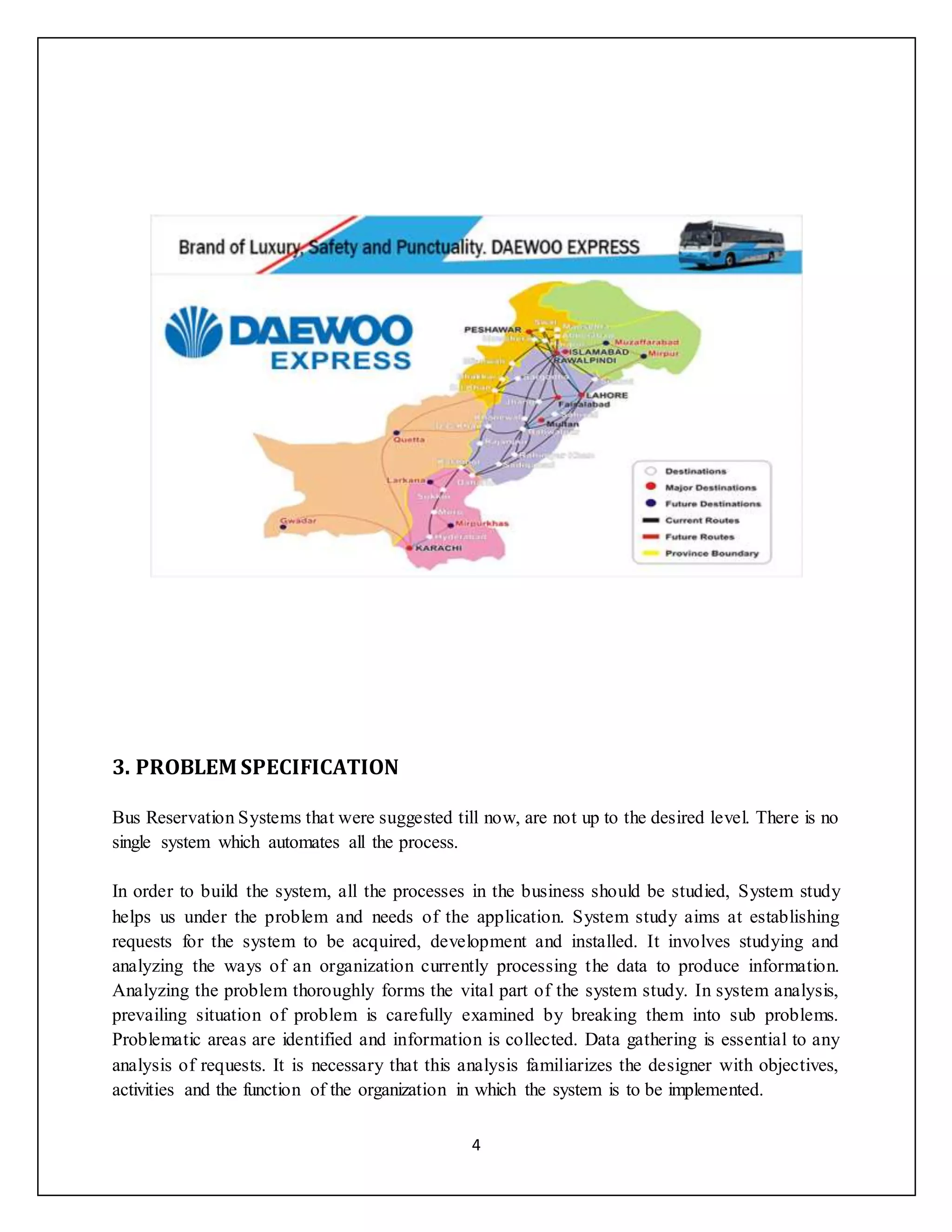
3. PROBLEM SPECIFICATION
Bus Reservation Systems that were suggested till now, are not up to the desired level. There is no
single system which automates all the process.
In order to build the system, all the processes in the business should be studied, System study
helps us under the problem and needs of the application. System study aims at establishing
requests for the system to be acquired, development and installed. It involves studying and
analyzing the ways of an organization currently processing the data to produce information.
Analyzing the problem thoroughly forms the vital part of the system study. In system analysis,
prevailing situation of problem is carefully examined by breaking them into sub problems.
Problematic areas are identified and information is collected. Data gathering is essential to any
analysis of requests. It is necessary that this analysis familiarizes the designer with objectives,
activities and the function of the organization in which the system is to be implemented.
5
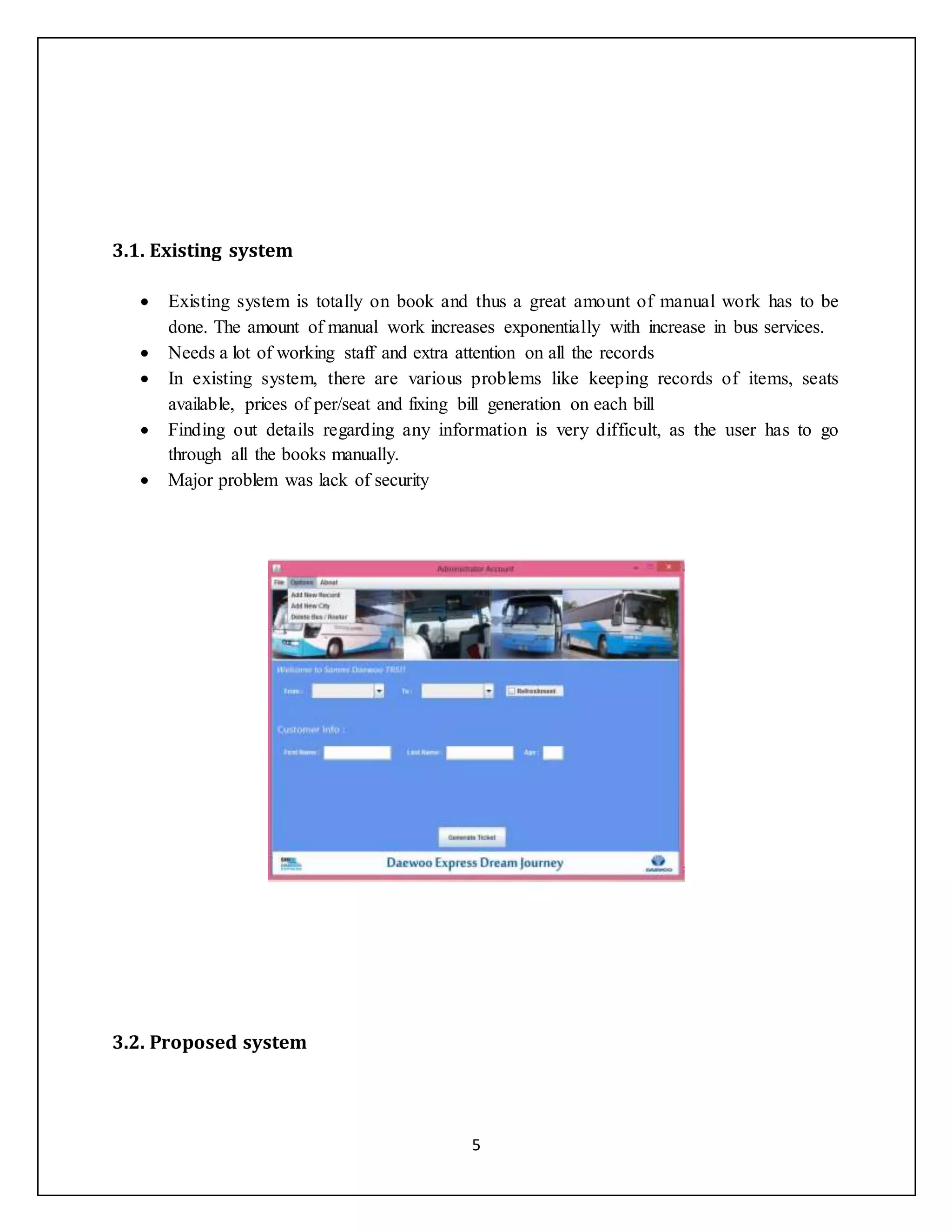
3.1. Existing system
 Existing system is totally on book and thus a great amount of manual work has to be
done. The amount of manual work increases exponentially with increase in bus services.
 Needs a lot of working staff and extra attention on all the records
 In existing system, there are various problems like keeping records of items, seats
available, prices of per/seat and fixing bill generation on each bill
 Finding out details regarding any information is very difficult, as the user has to go
through all the books manually.
 Major problem was lack of security
3.2. Proposed system
6
The system is very simple in design and to implement. The system requires very low system
resources and the system will work in almost all configurations. It has got following features:
 Ensure data accuracy
 Records are efficiently maintained by DBMS
 DBMS also provides security for the information
 Any person across the world, having internet can access this service
 Availability of seats can be enquired very easily.
 Passengers can also cancel their tickets easily.
 Minimum time needed for the various processing
 Better Service
 Minimum time required
 This would help the corporation prepare and organize its schedules more efficiently on
the basis of traffic demand.
4. SOFTWARE REQUIREMENTSPECIFICATION
4.1. Hard ware Requirement Specification:
Processor: 2.2 GHz or higher CPU
Hard disk: 2GB or above
Ram: 256 MB or more
Internet: 54 Kbps and more
4.2. Software Requirement Specification:
Operating system: Windows 8
Microsoft Visio 2007
SQL 2008
7
5. NORMALIZATION OFTABLES
8.1 Why Normalization:
5.1 Database normalization
5.1.1 First Normalizationform
 Order to improve storage efficiency, data integrity, and scalability.
 Normalization generally involves re-joined or linked each time
8.2 First Normal Form
Given table is converted to its 1NF as follows.
STEP NUMBER 1: elimination of duplicative columns from table 1.
•Step number 2: create separate table for each group of related data and identify each row with
unique column (primary key).
5.1.2 2nd Normalizationform
8.3 2nd Normal Form
A table is in first normal form and each non key
 Now we'll take the table above and design new tables that will eliminate the in the non-
key fields.
 To decide what fields belong together in a table, think about which field determines the
values in other fields. Create a table for those fields and enter the sample data.
 Think about what the primary key for each table would be and about the relationship
between the tables.
 Mark the primary key for each table and make sure non-key fields.
5.1.3 3rd Normalizationform.4 3rd Normal Form
 Third normal form (3NF) requires that there are no functional dependencies of non
attributes on something other than a candidate key.
 A table is in 3NF if all of the non
 There should not be transitive d
8.5 Normalization of Tables
8
6. Normalization All Tables In Database
In passenger table there is repeating group.
After normalization
Passeger_Id Manager_Id Ticket_ID Route_ID Buss_No Driver_ID Hostest_ID
P001 M001 T1 R001 B0111 D111 Ho1
Poo1 M001 T1 R002 B0112 D111 Ho2
Poo1 Moo1 T1 R002 B0112 D111 Ho3
There is no repeating group.
Second normalized Form:
In the following Passenger relation all attributes are dependent on the primary
Passeger_Id Manager_Id Ticket_ID Route_ID Buss_No Driver_ID Hostest_ID
P001 M001 T1 R001,Roo2 B0111,Bo112 D111 Ho1,H02,Ho3
9
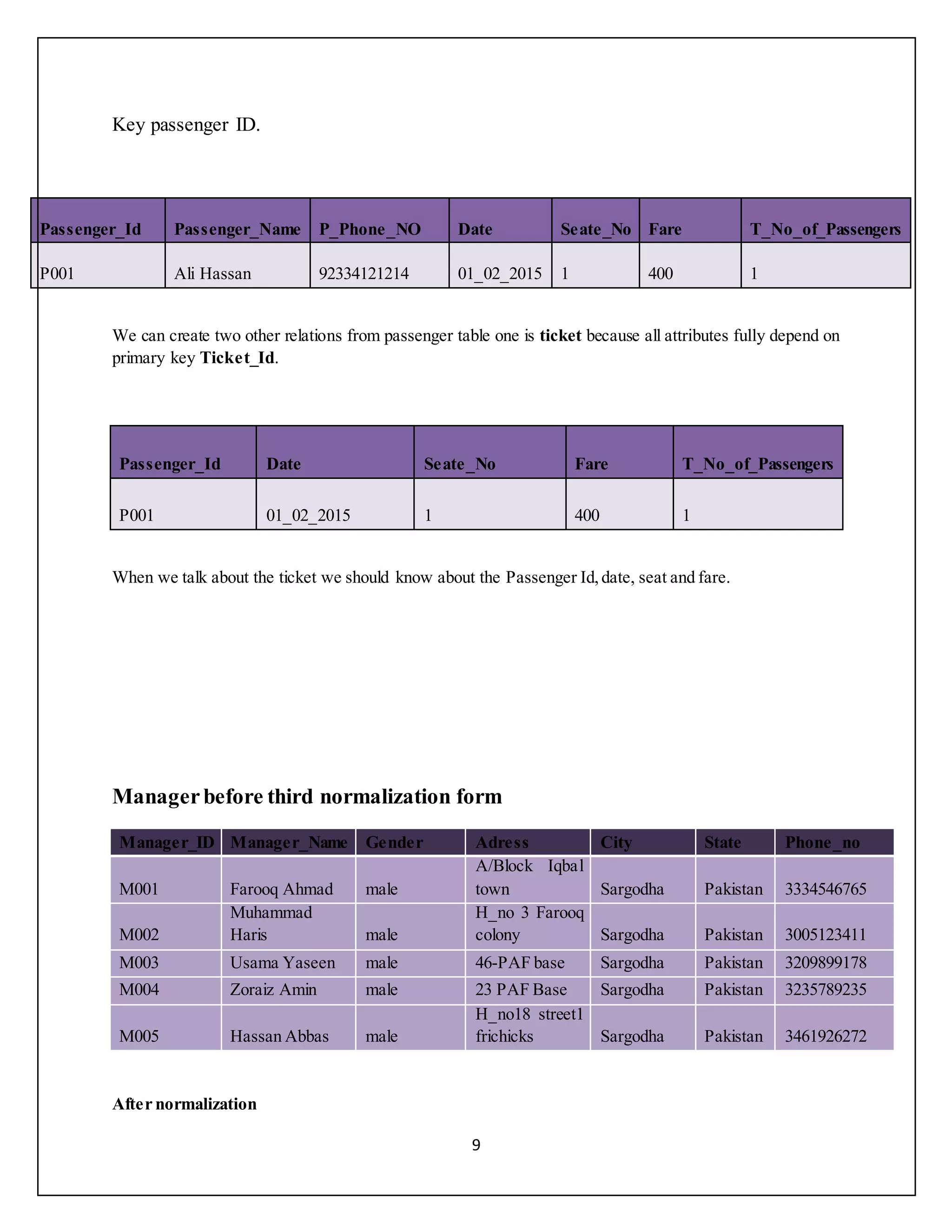
Key passenger ID.
Passenger_Id Passenger_Name P_Phone_NO Date Seate_No Fare T_No_of_Passengers
P001 Ali Hassan 92334121214 01_02_2015 1 400 1
We can create two other relations from passenger table one is ticket because all attributes fully depend on
primary key Ticket_Id.
Passenger_Id Date Seate_No Fare T_No_of_Passengers
P001 01_02_2015 1 400 1
When we talk about the ticket we should know about the Passenger Id,date, seat and fare.
Managerbefore third normalization form
Manager_ID Manager_Name Gender Adress City State Phone_no
M001 Farooq Ahmad male
A/Block Iqbal
town Sargodha Pakistan 3334546765
M002
Muhammad
Haris male
H_no 3 Farooq
colony Sargodha Pakistan 3005123411
M003 Usama Yaseen male 46-PAF base Sargodha Pakistan 3209899178
M004 Zoraiz Amin male 23 PAF Base Sargodha Pakistan 3235789235
M005 Hassan Abbas male
H_no18 street1
frichicks Sargodha Pakistan 3461926272
After normalization
10
Manager_ Table
Manager_Id Manager_Name Gender
Manager_Id Address City State Phone_no
ARCHITECTURE
RECORDS
10.1 First table is CLASSES
11
7. Architecture of tables in SQL Server 2008 And Records
First Table inClass
DesignView
Records in Table:
12
DesignView
Records in Table:
13
DesignView
Records in Table:
14
DesignView
Records in Table:
15
DesignView
16
Records in Table:
Records in Table:
17
DesignView
Records in Table:
18
DesignView
19
7.2 DATABASE DIAGRAM IN SQL SERVER
20
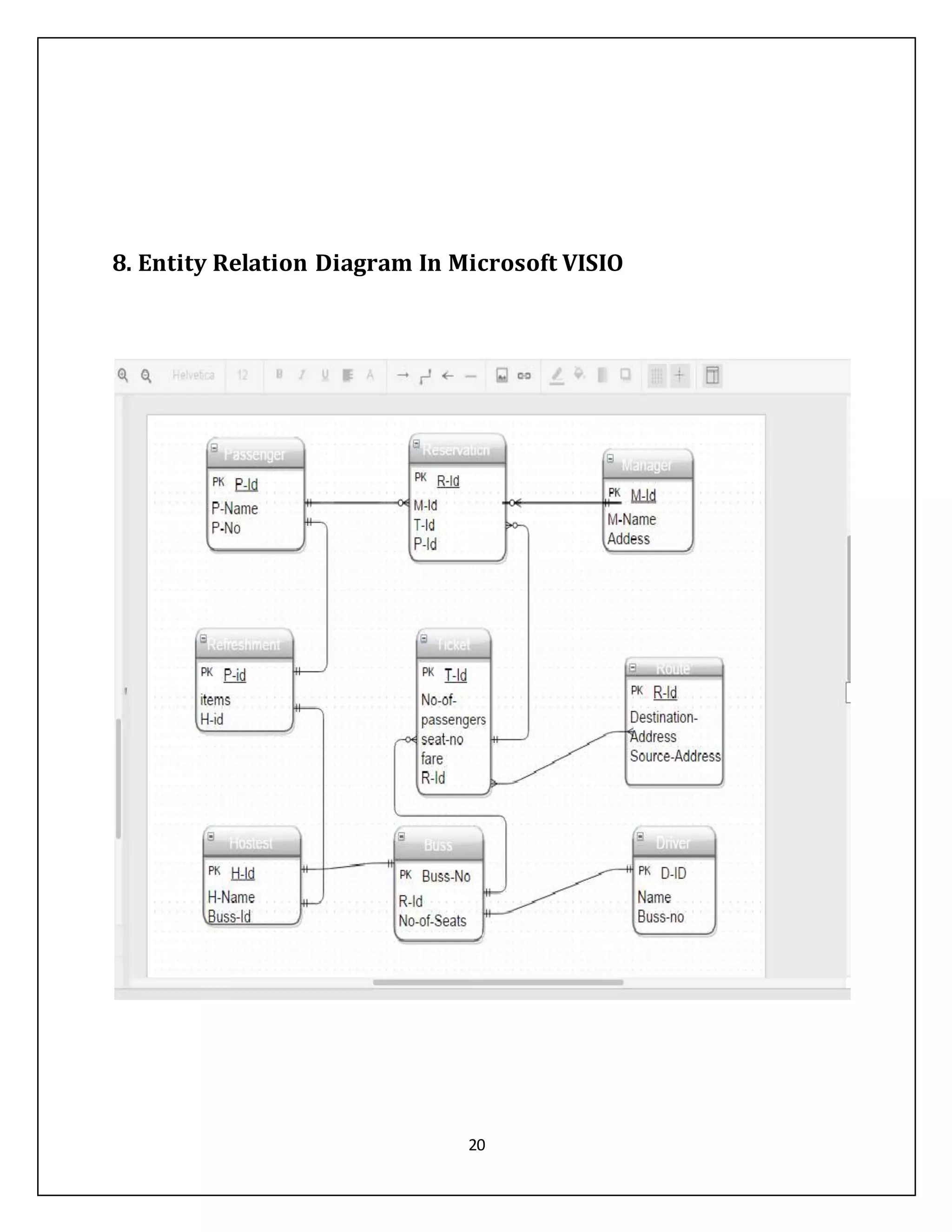
8. Entity Relation Diagram In Microsoft VISIO
21
9. Relational Model of ERD
Passenger
Reservation
Reservation_Id Passenger_Id Manager_Id Ticket_Id
Manager
Manager_Id Manager_Name Manager_City State
Ticket
Ticket_Id No_Of_Passenger Seat_No Fare
Route
Route_Id Dest_Addres Source_Addres Ticket_Id
Buss
Passenger_Id Passenger_Name Phone_no
22
Buss_No Route_Id Item
Driver
Driver_Id Name Buss_Id
Hostes
Hostest_Id Name Buss_Id
Refershment
Passenger_Id Hostest_Id Item
Conclusion
We have tried our information effectively, yet, there can be further enhancement in
the Application.
Like the things this project also has some limitations and can further be enhances
by certain drawbacks that do not permit the system to be 100% accurate.
PROJECT

Daewoo reservation and transport system database

  • 1.
    1 Department ofComputerScience &InformationTechnology PROJECT DaewooReservation and Transport system Submitted To: Sir Hafiz Faisal Submitted By: NAME Roll NO Efrah Shakir BITF13E113 Iqra Rafiq BITF13E096 Syeda Stara Hassan BITF13E071 Sonia Akhtar BITF13E107 Class: BSIT4th SS2
  • 2.
    2 Contents Contents ............................................................... Error!Bookmarknot defined. 1. ABSTRACT...................................................................................................... 3 2. INTRODUCTION............................................................................................. 3 3. PROBLEM SPECIFICATION.............................................................................. 4 3.1. Existing system......................................................................................... 5 3.2. Proposed system...................................................................................... 5 4. SOFTWARE REQUIREMENT SPECIFICATION.................................................... 6 4.1. Hard ware Requirement Specification:...................................................... 6 4.2. Software Requirement Specification: ........................................................ 6 5. NORMALIZATION OF TABLES......................................................................... 7 5.1 Database normalization............................................................................. 7 5.1.1 First Normalization form...................................................................... 7 5.1.2 2nd Normalization form........................................................................ 7 5.1.3 3rd Normalization form........................................................................ 7 6. Normalization All Tables In Database............................................................. 8 6.1 normalized Form:...................................................................................... 8 7. Architecture of tables in SQL Server 2008 And Records................................ 11 7.1First Table in Class................................................................................... 11 7.2 DATABASEDIAGRAMINSQL SERVER ....................................................... 19 8. Entity Relation Diagram In Microsoft VISIO.................................................. 20 9. Relational Model of ERD.............................................................................. 21 10. Conclusion………………………………………………………………………………………………..22
  • 3.
    3 1. ABSTRACT Traveling isa large growing business across all countries. Daewoo reservation /transport system deals with maintenance of records of details of each passenger who had reserved a seat for a journey. It also includes maintenance of information like schedule and details of each bus. We observed the working of the Bus reservation system and after going through it, we get to know that there are many operations, which they have to do manually. It takes a lot of time and causes many errors. Due to this, sometimes a lot of problems occur and they were facing many disputes with customers. To solve the above problem, and further maintaining records of items, seat availability for customers, price of per seat, bill generation and other things, we are offering this proposal of reservation system. By using this software, we can reserve tickets from any part of the world, through telephone lines, via internet. Customer can check availability of bus and reserve selective seats. The project provides and checks all sorts of constraints so that user does give only useful data and thus validation is done in an effective way 2. INTRODUCTION The focus of the project is to computerize traveling company to manage data, so that all the transactions become fast and there should not be any error in transaction like calculation mistake, bill generation and other things. It replaces all the paper work. It keeps records of all bills also, giving to ensure 100% successful implementation of the computerized Bus reservation system. This reservation system has three modules. First module helps the customer to enquire the availability of seats in a particular bus at particular date. Second module helps him to reserve a ticket. Using third module he can cancel a reserved ticket.  First module retrieves data from tables required for enquire.  Second module inserts values into the tables on reservation.  Third module deletes values into from the table on cancellation of tickets. As the database is hosted using Oracle Server onto internet, the application can access data from any part of the world, by many number of people concurrently.
  • 4.
    4 3. PROBLEM SPECIFICATION BusReservation Systems that were suggested till now, are not up to the desired level. There is no single system which automates all the process. In order to build the system, all the processes in the business should be studied, System study helps us under the problem and needs of the application. System study aims at establishing requests for the system to be acquired, development and installed. It involves studying and analyzing the ways of an organization currently processing the data to produce information. Analyzing the problem thoroughly forms the vital part of the system study. In system analysis, prevailing situation of problem is carefully examined by breaking them into sub problems. Problematic areas are identified and information is collected. Data gathering is essential to any analysis of requests. It is necessary that this analysis familiarizes the designer with objectives, activities and the function of the organization in which the system is to be implemented.
  • 5.
    5 3.1. Existing system Existing system is totally on book and thus a great amount of manual work has to be done. The amount of manual work increases exponentially with increase in bus services.  Needs a lot of working staff and extra attention on all the records  In existing system, there are various problems like keeping records of items, seats available, prices of per/seat and fixing bill generation on each bill  Finding out details regarding any information is very difficult, as the user has to go through all the books manually.  Major problem was lack of security 3.2. Proposed system
  • 6.
    6 The system isvery simple in design and to implement. The system requires very low system resources and the system will work in almost all configurations. It has got following features:  Ensure data accuracy  Records are efficiently maintained by DBMS  DBMS also provides security for the information  Any person across the world, having internet can access this service  Availability of seats can be enquired very easily.  Passengers can also cancel their tickets easily.  Minimum time needed for the various processing  Better Service  Minimum time required  This would help the corporation prepare and organize its schedules more efficiently on the basis of traffic demand. 4. SOFTWARE REQUIREMENTSPECIFICATION 4.1. Hard ware Requirement Specification: Processor: 2.2 GHz or higher CPU Hard disk: 2GB or above Ram: 256 MB or more Internet: 54 Kbps and more 4.2. Software Requirement Specification: Operating system: Windows 8 Microsoft Visio 2007 SQL 2008
  • 7.
    7 5. NORMALIZATION OFTABLES 8.1Why Normalization: 5.1 Database normalization 5.1.1 First Normalizationform  Order to improve storage efficiency, data integrity, and scalability.  Normalization generally involves re-joined or linked each time 8.2 First Normal Form Given table is converted to its 1NF as follows. STEP NUMBER 1: elimination of duplicative columns from table 1. •Step number 2: create separate table for each group of related data and identify each row with unique column (primary key). 5.1.2 2nd Normalizationform 8.3 2nd Normal Form A table is in first normal form and each non key  Now we'll take the table above and design new tables that will eliminate the in the non- key fields.  To decide what fields belong together in a table, think about which field determines the values in other fields. Create a table for those fields and enter the sample data.  Think about what the primary key for each table would be and about the relationship between the tables.  Mark the primary key for each table and make sure non-key fields. 5.1.3 3rd Normalizationform.4 3rd Normal Form  Third normal form (3NF) requires that there are no functional dependencies of non attributes on something other than a candidate key.  A table is in 3NF if all of the non  There should not be transitive d 8.5 Normalization of Tables
  • 8.
    8 6. Normalization AllTables In Database In passenger table there is repeating group. After normalization Passeger_Id Manager_Id Ticket_ID Route_ID Buss_No Driver_ID Hostest_ID P001 M001 T1 R001 B0111 D111 Ho1 Poo1 M001 T1 R002 B0112 D111 Ho2 Poo1 Moo1 T1 R002 B0112 D111 Ho3 There is no repeating group. Second normalized Form: In the following Passenger relation all attributes are dependent on the primary Passeger_Id Manager_Id Ticket_ID Route_ID Buss_No Driver_ID Hostest_ID P001 M001 T1 R001,Roo2 B0111,Bo112 D111 Ho1,H02,Ho3
  • 9.
    9 Key passenger ID. Passenger_IdPassenger_Name P_Phone_NO Date Seate_No Fare T_No_of_Passengers P001 Ali Hassan 92334121214 01_02_2015 1 400 1 We can create two other relations from passenger table one is ticket because all attributes fully depend on primary key Ticket_Id. Passenger_Id Date Seate_No Fare T_No_of_Passengers P001 01_02_2015 1 400 1 When we talk about the ticket we should know about the Passenger Id,date, seat and fare. Managerbefore third normalization form Manager_ID Manager_Name Gender Adress City State Phone_no M001 Farooq Ahmad male A/Block Iqbal town Sargodha Pakistan 3334546765 M002 Muhammad Haris male H_no 3 Farooq colony Sargodha Pakistan 3005123411 M003 Usama Yaseen male 46-PAF base Sargodha Pakistan 3209899178 M004 Zoraiz Amin male 23 PAF Base Sargodha Pakistan 3235789235 M005 Hassan Abbas male H_no18 street1 frichicks Sargodha Pakistan 3461926272 After normalization
  • 10.
    10 Manager_ Table Manager_Id Manager_NameGender Manager_Id Address City State Phone_no ARCHITECTURE RECORDS 10.1 First table is CLASSES
  • 11.
    11 7. Architecture oftables in SQL Server 2008 And Records First Table inClass DesignView Records in Table:
  • 12.
  • 13.
  • 14.
  • 15.
  • 16.
  • 17.
  • 18.
  • 19.
  • 20.
    20 8. Entity RelationDiagram In Microsoft VISIO
  • 21.
    21 9. Relational Modelof ERD Passenger Reservation Reservation_Id Passenger_Id Manager_Id Ticket_Id Manager Manager_Id Manager_Name Manager_City State Ticket Ticket_Id No_Of_Passenger Seat_No Fare Route Route_Id Dest_Addres Source_Addres Ticket_Id Buss Passenger_Id Passenger_Name Phone_no
  • 22.
    22 Buss_No Route_Id Item Driver Driver_IdName Buss_Id Hostes Hostest_Id Name Buss_Id Refershment Passenger_Id Hostest_Id Item Conclusion We have tried our information effectively, yet, there can be further enhancement in the Application. Like the things this project also has some limitations and can further be enhances by certain drawbacks that do not permit the system to be 100% accurate. PROJECT