DAA
1
UNIT-4
UNIT – IV
BACKTRACKING : General method, Applications – n-queens problem, Sum of
subsets problem, Graph coloring, Hamiltonian cycles.
GENENRAL METHOD
 Backtracking is used to solve problem in which a sequence of objects is
chosen from a specified set so that the sequence satisfies some criterion.
 The desired solution is expressed as an n-tuple (x1. . . xn) where each xi Є S,
S being a finite set.
 The solution is based on finding one or more vectors that maximize,
minimize, or satisfy a criterion function P (x1. . . xn).
 Form a solution and check at every step if this has any chance of success. If
the solution at any point seems not promising, ignore it. All solutions requires
a set of constraints divided into two categories:
1. Explicit constraints and
2. Implicit constraints.
Definition 1:
Explicit constraints are rules that restrict each xi to take on values only from a given
set. Explicit constraints depend on the particular instance I of problem being solved.
All tuples that satisfy the explicit constraints define a possible solution space for I.
Example : xi>=0 or s={set of all non regular real number} xi=0 or xi=1 or s={0,1}
Definition 2:
Implicit constraints are rules that determine which of the tuples in the solution space
of I satisfy the criterion function. Thus, implicit constraints describe the way in which
the xi’s must relate to each other.
Backtracking is a modified depth first search of a tree. Backtracking algorithms
determine problem solutions by systematically searching the solution space for the
DAA
2
UNIT-4
given problem instance. This search is facilitated by using a tree organization for the
solution space.
Backtracking is the procedure where by, after determining that a node can lead
to nothing but dead end, we go back (backtrack) to the nodes parent and proceed with
the search on the next child.
A backtracking algorithm need not actually create a tree. Rather, it only needs
to keep track of the values in the current branch being investigated. This is the way we
implement backtracking algorithm. We say that the state space tree exists implicitly in
the algorithm because it is not actually constructed.
Terminology:
1. Problem state is each node in the depth first search tree.
2. Solution states are the problem states ‘S’ for which the path from the root node
to ‘S’ defines a tuple in the solution space.
3. Answer states are those solution states for which the path from root node to s
defines a tuple that is a member of the set of solutions.
4. State space is the set of paths from root node to other nodes. State space tree is
the tree organization of the solution space. The state space trees are called static
trees. This terminology follows from the observation that the tree organizations
are independent of the problem instance being solved. For some problems it is
advantageous to use different tree organizations for different problem instance.
In this case the tree organization is determined dynamically as the solution space
is being searched. Tree organizations that are problem instance dependent are
called dynamic trees.
5. Live node is a node that has been generated but whose children have not yet
been generated.
6. E-node is a live node whose children are currently being explored. In other
words, an E-node is a node currently being expanded.
7. Dead node is a generated node that is not to be expanded or explored any further.
All children of a dead node have already been expanded.
DAA
3
UNIT-4
Algorithm:
Algorithm Backtracking (n)
// Describes the backtracking procedure .All solutions are generated in X[1:n]
{
k=1;
While (k ≠ 0) do
{
if (there remains all untried
X[k] ϵ T (X[1],[2],…..X[k-1]) and Bk (X[1],…..X[k])) is true ) then
{
if(X[1],……X[k] )is the path to the answer node)
Then write(X[1:k]);
k=k+1; //consider the next step.
}
else k=k-1; //consider backtracking to the previous set.
}
}
 All solutions are generated in X[1:n]
 T(X[1]…..X[k-1]) is all possible values of X[k] gives that X[1],..........X[k-1]
have already been chosen.
 Bk(X[1]………X[k]) is a bounding function which determines the elements of
X[k] which satisfies the implicit constraint.
DAA
4
UNIT-4
APPLICATIONS
Applications includes,
 N- Queens Problem
 Sum of Subsets Problem
 Graph Coloring
 Hamiltonian Cycle
N- QUEEN PROBLEMS
One of the most common examples of the backtracking is to arrange N queens
on an N x N chessboard such that no queen can strike down any other queen. A queen
can attack horizontally, vertically, or diagonally. The solution to this problem is also
attempted in a similar way. We first place the first queen anywhere arbitrarily and then
place the next queen in any of the safe places. We continue this process until the number
of unplaced queens becomes zero (a solution is found) or no safe place is left. If no safe
place is left, then we change the position of the previously placed queen.
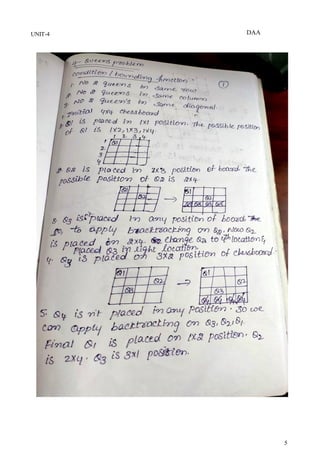
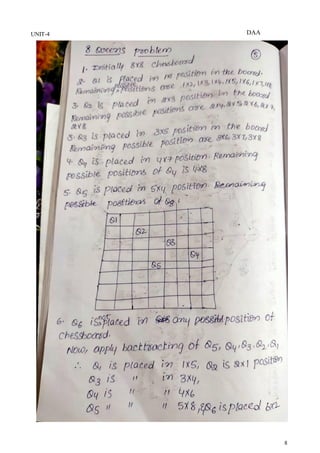
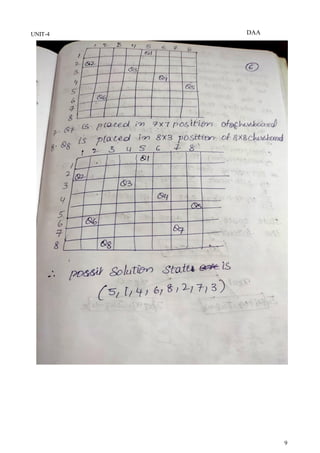
 Let us consider, N = 4. Then 4-Queens Problem is to place eight queens on an 4
x 4 chessboard so that no two ‘attack’, that is, no two of them are on the same
row, column, or diagonal.
 All solutions to the 4-queens problem can be represented as 4-tuples (x1. . . x4),
where xi is the column of the ith
row where the ith
queen is placed.
 The explicit constraints using this formulation is Si = {1, 2, 3, 4}, 1 < i < 4.
Therefore the solution space consists of 44
4-tuples.
 The implicit constraints for this problem are that no two xi’s can be the same
(i.e., all queens must be on different columns) and no two queens can be on
the same diagonal.
 This realization reduces the size of the solution space from 44
tuples to 4! tuples.
The promising function must check whether two queens are in the same column
or diagonal.
DAA
5
UNIT-4
DAA
6
UNIT-4
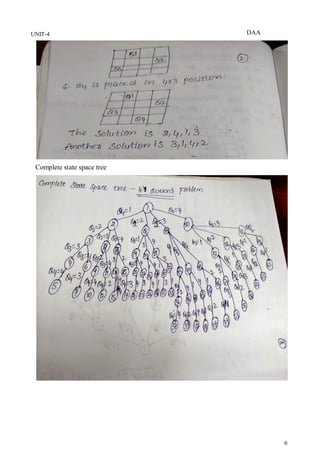
Complete state space tree
DAA
7
UNIT-4
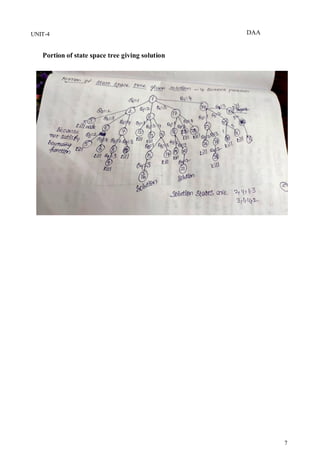
Portion of state space tree giving solution
DAA
8
UNIT-4
DAA
9
UNIT-4
DAA
10
UNIT-4
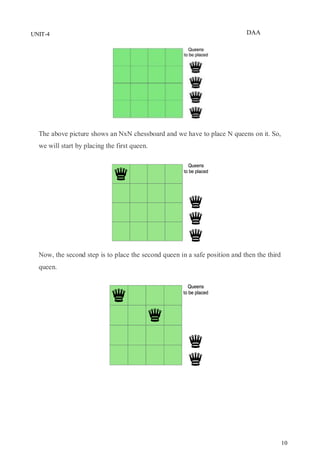
The above picture shows an NxN chessboard and we have to place N queens on it. So,
we will start by placing the first queen.
Now, the second step is to place the second queen in a safe position and then the third
queen.
DAA
11
UNIT-4
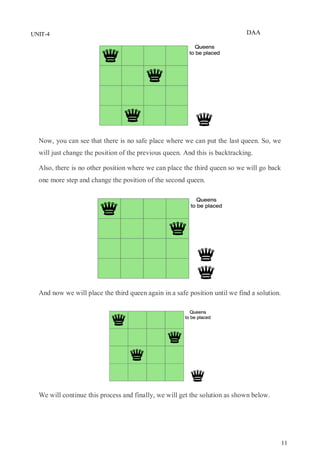
Now, you can see that there is no safe place where we can put the last queen. So, we
will just change the position of the previous queen. And this is backtracking.
Also, there is no other position where we can place the third queen so we will go back
one more step and change the position of the second queen.
And now we will place the third queen again in a safe position until we find a solution.
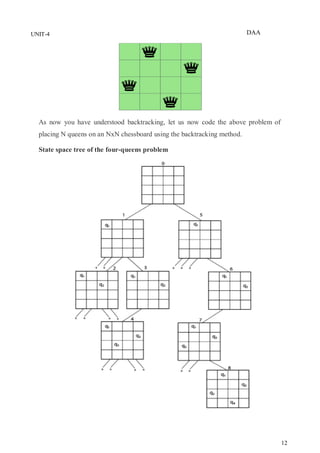
We will continue this process and finally, we will get the solution as shown below.
DAA
12
UNIT-4
As now you have understood backtracking, let us now code the above problem of
placing N queens on an NxN chessboard using the backtracking method.
State space tree of the four-queens problem
DAA
13
UNIT-4
 Built the state space tree
- Root represents an initial state
- Bodes reflect the specific choices made for the components of a solution
- Promising and non-promising nodes are present in the tree
 Explore the state space tree using depth-first search
 Prune non-promising nodes
- DFS stops exploring subtree rooted at nodes leading to no solution and
- backtracks to its parent node.
N-Queen Algorithm:
Algorithm N - Queens (k, n)
{
For i ← 1 to n
do if Place (k, i) then
{
x [k] ← i;
if (k ==n) then
write (x [1 ...n));
else
N - Queens (k + 1, n);
}
}
Place (k, i)
{
For j ← 1 to k - 1
do if (x [j] = i)
or (Abs x [j]) - i) = (Abs (j - k))
then return false;
DAA
14
UNIT-4
return true;
} }
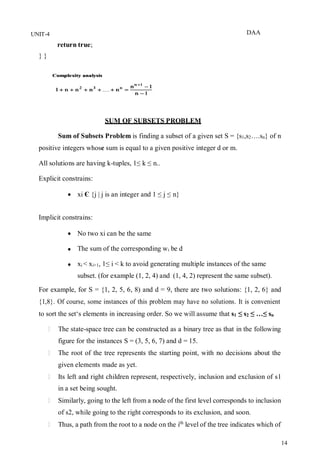
SUM OF SUBSETS PROBLEM
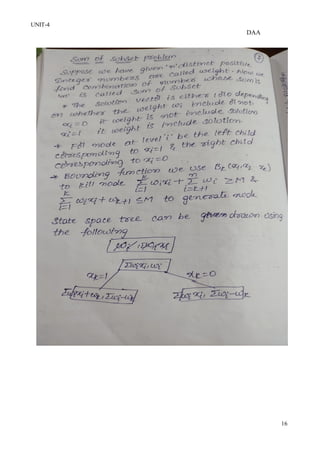
Sum of Subsets Problem is finding a subset of a given set S = {s1,s2….sn} of n
positive integers whose sum is equal to a given positive integer d or m.
All solutions are having k-tuples, 1≤ k ≤ n..
Explicit constrains:
 xi Є {j | j is an integer and 1 ≤ j ≤ n}
Implicit constrains:
 No two xi can be the same
 The sum of the corresponding wi be d
 xi < xi+1, 1≤ i < k to avoid generating multiple instances of the same
subset. (for example (1, 2, 4) and (1, 4, 2) represent the same subset).
For example, for S = {1, 2, 5, 6, 8) and d = 9, there are two solutions: {1, 2, 6} and
{1,8}. Of course, some instances of this problem may have no solutions. It is convenient
to sort the set‘s elements in increasing order. So we will assume that s1 ≤ s2 ≤ …≤ sn
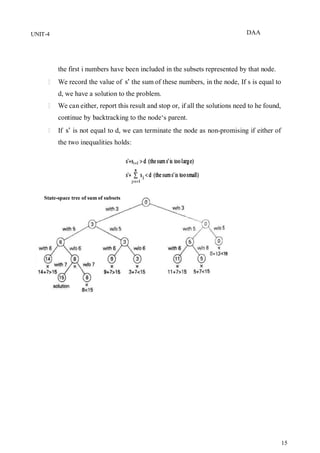
The state-space tree can be constructed as a binary tree as that in the following
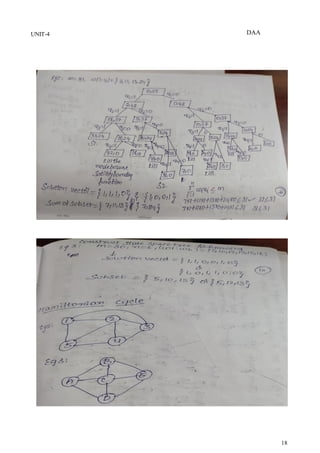
figure for the instances S = (3, 5, 6, 7) and d = 15.
The root of the tree represents the starting point, with no decisions about the
given elements made as yet.
Its left and right children represent, respectively, inclusion and exclusion of s1
in a set being sought.
Similarly, going to the left from a node of the first level corresponds to inclusion
of s2, while going to the right corresponds to its exclusion, and soon.
Thus, a path from the root to a node on the ith
level of the tree indicates which of
DAA
15
UNIT-4
the first i numbers have been included in the subsets represented by that node.
We record the value of s' the sum of these numbers, in the node, If s is equal to
d, we have a solution to the problem.
We can either, report this result and stop or, if all the solutions need to he found,
continue by backtracking to the node‘s parent.
If s' is not equal to d, we can terminate the node as non-promising if either of
the two inequalities holds:
State-space tree of sum of subsets
DAA
16
UNIT-4
DAA
17
UNIT-4
DAA
18
UNIT-4
DAA
19
UNIT-4
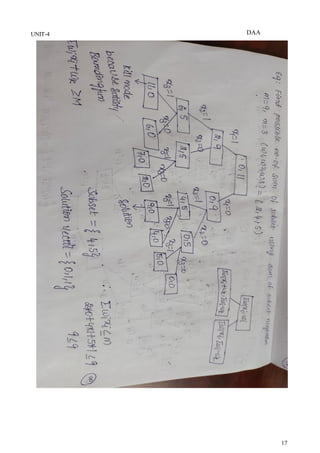
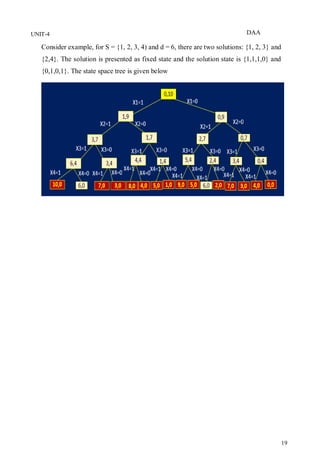
Consider example, for S = {1, 2, 3, 4) and d = 6, there are two solutions: {1, 2, 3} and
{2,4}. The solution is presented as fixed state and the solution state is {1,1,1,0} and
{0,1,0,1}. The state space tree is given below
DAA
20
UNIT-4
Sum of Subset Algorithm
Algorithm sumofsubset(s,k,r)
// find all subsets of w[1:n] that sum to m.
{
// Generate left child node. Note: s + w[k] ≤ m, since Bk-1 is true
x[k]=1;
if (s+w[k]=m) then write(x[1:k]); // Subset found
else if (s+w[k]+w[k+1] ≤ m)
then sumofsubset(s+w[k], k+1,r- w[k]);
// Generate right child and evaluate Bk
if ((s + r – w[k] ≥ m ) and (s + w[k+1] ≤ m)) then // exceeds m
{
x[k]=0;
sumofsubset(s, k+1, r-w[k]);
}}
Complexity
Time complexity = θ (2n
)
Space complexity = θ (1)
DAA
21
UNIT-4
What is Graph Coloring Problem?
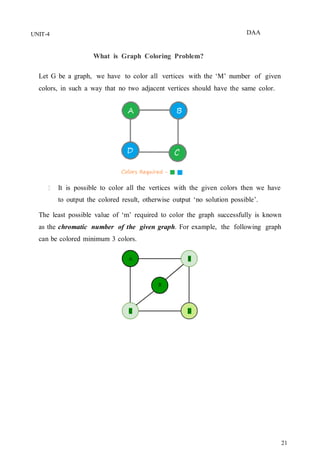
Let G be a graph, we have to color all vertices with the ‘M’ number of given
colors, in such a way that no two adjacent vertices should have the same color.
It is possible to color all the vertices with the given colors then we have
to output the colored result, otherwise output ‘no solution possible’.
The least possible value of ‘m’ required to color the graph successfully is known
as the chromatic number of the given graph. For example, the following graph
can be colored minimum 3 colors.
DAA
22
UNIT-4
Working principle of graph coloring using backtracking
1. In backtracking approach, we color a single vertex and then move to its
adjacent (connected) vertex to color it with different color.
2. After coloring, we again move to another adjacent vertex that is uncolored
and repeat the process until all vertices of the given graph a re colored.
3. In case, we find a vertex that has all adjacent vertices colored and no color
is left to make it color different, we backtrack and change the color of the
last colored vertices and again proceed further.
4. By backtracking, we come back to the same vertex from where we started
and all colors were tried on it, then it means the given number of colors
(i.e. ‘m’) is insufficient to color the given graph and we require more
colors (i.e. a bigger chromatic number).
For many years it was known that five colors were sufficient to color any map, but
no map that required more than four colors had ever been found. After several hundred
years, this problem was solved by a group of mathematicians with the help of a
computer. They showed that in fact four colors are sufficient for planar graphs.
The function m-coloring will begin by first assigning the graph to its adjacency
matrix, setting the array x [] to zero. The colors are represented by the integers 1, 2, . .
. , m and the solutions are given by the n-tuple (x1, x2, . . ., xn), where xi is the color of
node i.
DAA
23
UNIT-4
A recursive backtracking algorithm for graph coloring is carried out by invoking the
statement mcoloring(1);
Algorithm mcoloring (k)
// This algorithm was formed using the recursive backtracking schema.
//The graph is represented by its Boolean adjacency matrix G [1: n, 1: n].
//All assignments of 1,2, ...m to the vertices of the graph such that adjacent vertices are
//assigned. k is the index of the next vertex to color.
{
repeat
{ // Generate all legal assignments for x[k].
NextValue (k); // Assign to x [k] a legal color.
If (x [k] = 0) then return; // No new color possible
If (k = n) then // at most m colors have been used to color the n vertices.
write (x [1: n]);
else mcoloring (k+1);
} until (false);
}
Algorithm NextValue (k)
// x[1],.......... x[k-1]have been assigned integer values in the range[1,m]such that
// adjacent vertices have distinct integers. A value for x [k] is determined in the range
// [0, m].x[k] is assigned the next highest numbered color while maintaining
distinctness
// from the adjacent vertices of vertex k. If no such color exists, then x [k] is 0.
{
repeat
{
DAA
24
UNIT-4
x [k]: = (x [k] +1) mod(m+1) // Next highest color.
If (x [k] = 0) then return; // All colors have been used
for j := 1 to n do
{ // check if this color is distinct from adjacent colors
if ((G [k, j] ≠ 0) and (x [k] = x[j]))
// If (k, j) is and edge and if adj. vertices have the same color.
then break;
}
if (j = n+1) then return; // New colorfound
}until(false); // Otherwise try to find anothercolor.
}
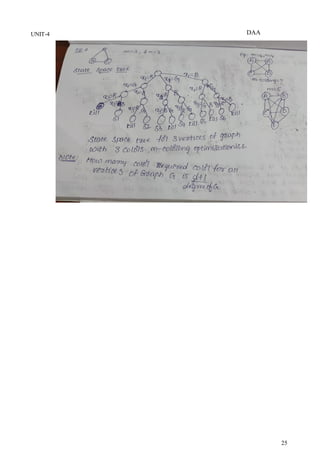
Example:
Color the graph given below with minimum number of colors by backtracking using
state space tree
DAA
25
UNIT-4
DAA
26
UNIT-4
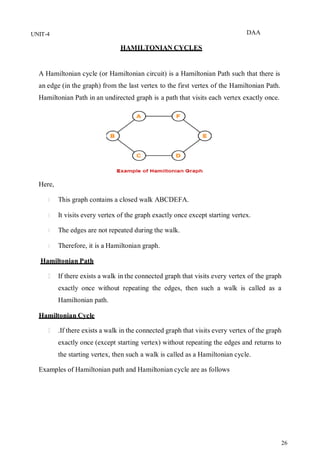
HAMILTONIAN CYCLES
A Hamiltonian cycle (or Hamiltonian circuit) is a Hamiltonian Path such that there is
an edge (in the graph) from the last vertex to the first vertex of the Hamiltonian Path.
Hamiltonian Path in an undirected graph is a path that visits each vertex exactly once.
Here,
This graph contains a closed walk ABCDEFA.
It visits every vertex of the graph exactly once except starting vertex.
The edges are not repeated during the walk.
Therefore, it is a Hamiltonian graph.
Hamiltonian Path
If there exists a walk in the connected graph that visits every vertex of the graph
exactly once without repeating the edges, then such a walk is called as a
Hamiltonian path.
Hamiltonian Cycle
.If there exists a walk in the connected graph that visits every vertex of the graph
exactly once (except starting vertex) without repeating the edges and returns to
the starting vertex, then such a walk is called as a Hamiltonian cycle.
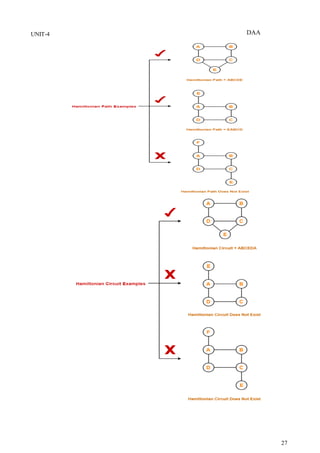
Examples of Hamiltonian path and Hamiltonian cycle are as follows
DAA
27
UNIT-4
DAA
28
UNIT-4
Important Notes
Any Hamiltonian cycle can be converted to a Hamiltonian path by removing one
of its edges.
Every graph that contains a Hamiltonian cycle also contains a Hamiltonian path
but vice versa is not true.
There may exist more than one Hamiltonian paths and Hamiltonian cycles in a
graph.
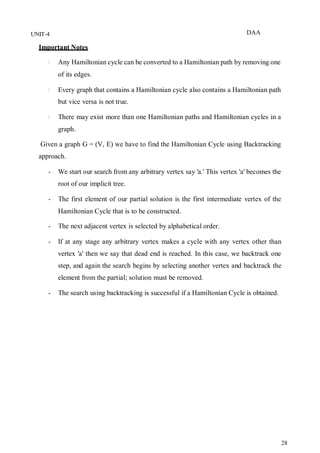
Given a graph G = (V, E) we have to find the Hamiltonian Cycle using Backtracking
approach.
- We start our search from any arbitrary vertex say 'a.' This vertex 'a' becomes the
root of our implicit tree.
- The first element of our partial solution is the first intermediate vertex of the
Hamiltonian Cycle that is to be constructed.
- The next adjacent vertex is selected by alphabetical order.
- If at any stage any arbitrary vertex makes a cycle with any vertex other than
vertex 'a' then we say that dead end is reached. In this case, we backtrack one
step, and again the search begins by selecting another vertex and backtrack the
element from the partial; solution must be removed.
- The search using backtracking is successful if a Hamiltonian Cycle is obtained.
DAA
29
UNIT-4
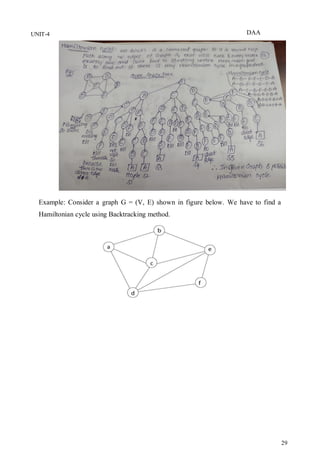
Example: Consider a graph G = (V, E) shown in figure below. We have to find a
Hamiltonian cycle using Backtracking method.
DAA
30
UNIT-4
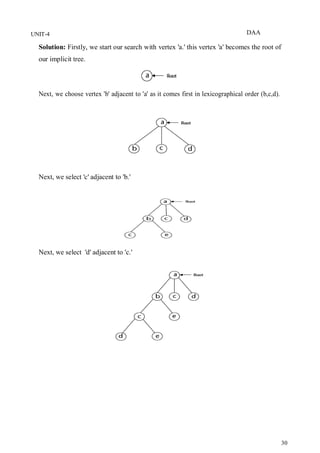
Solution: Firstly, we start our search with vertex 'a.' this vertex 'a' becomes the root of
our implicit tree.
Next, we choose vertex 'b' adjacent to 'a' as it comes first in lexicographical order (b,c,d).
Next, we select 'c' adjacent to 'b.'
Next, we select 'd' adjacent to 'c.'
DAA
31
UNIT-4
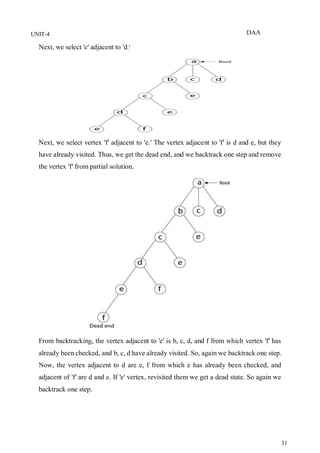
Next, we select 'e' adjacent to 'd.'
Next, we select vertex 'f' adjacent to 'e.' The vertex adjacent to 'f' is d and e, but they
have already visited. Thus, we get the dead end, and we backtrack one step and remove
the vertex 'f' from partial solution.
From backtracking, the vertex adjacent to 'e' is b, c, d, and f from which vertex 'f' has
already been checked, and b, c, d have already visited. So, again we backtrack one step.
Now, the vertex adjacent to d are e, f from which e has already been checked, and
adjacent of 'f' are d and e. If 'e' vertex, revisited them we get a dead state. So again we
backtrack one step.
DAA
32
UNIT-4
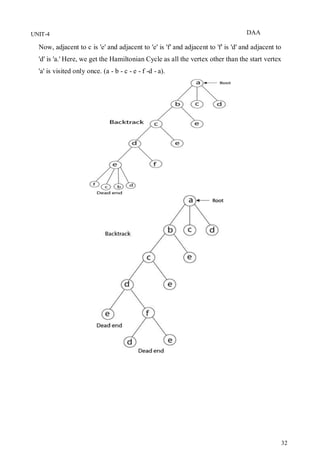
Now, adjacent to c is 'e' and adjacent to 'e' is 'f' and adjacent to 'f' is 'd' and adjacent to
'd' is 'a.' Here, we get the Hamiltonian Cycle as all the vertex other than the start vertex
'a' is visited only once. (a - b - c - e - f -d - a).
DAA
33
UNIT-4
Again Backtrack
Here we have generated one Hamiltonian circuit, but another Hamiltonian circuit can
also be obtained by considering another vertex.
The backtracking solution vector (x1, . . . . . xn) is defined so that xi represents the ith
visited vertex of the proposed cycle. If k = 1, then x1 can be any of the n vertices. To
avoid printing the same cycle n times, we require that x1 = 1. If 1 < k < n, then xk can
be any vertex v that is distinct from x1,x2,...,xk–1 and v is connected by an edge to
kx-1. The vertex xn can only be one remaining vertex and it must be connected to both
xn-1 and x1.
Using NextValue algorithm we can particularize the recursive backtracking
schema to find all Hamiltonian cycles. This algorithm is started by first initializing the
adjacency matrix G[1: n, 1: n], then setting x[2: n] to zero and x[1] to 1, and then
executing Hamiltonian(2).
The traveling salesperson problem using dynamic programming asked for a tour that
has minimum cost. This tour is a Hamiltonian cycles. For the simple case of a graph all
of whose edge costs are identical, Hamiltonian will find a minimum-cost tour if a tour
exists.
DAA
34
UNIT-4
Algorithm NextValue (k)
// x [1: k-1] is a path of k – 1 distinct vertices . If x[k] = 0, then no vertex has as yet been
//assignedtox[k].Afterexecution,x[k]isassignedtothenexthighestnumberedvertex
//which does not already appear in x[1:k–1] and is connected by an edge to x[k–1].
// Otherwise x [k] = 0. If k = n, then in addition x [k] is connected to x [1].
{
repeat
x { [k] := (x [k] +1) mod(n+1); // Next vertex.
If(x[k] = 0) then return;
If (G [x [k – 1], x [k]] ≠ 0) then
{ // Is there an edge?
for j := 1 to k – 1 do
if (x [j] = x [k]) then break;
// check for distinctness.
If (j = k)then // If true, then the vertex is distinct.
If ((k < n) or ((k = n) and G [x [n], x [1]] ≠ 0))
then return;
}
} until (false);
}
Algorithm Hamiltonian (k)
// This algorithm uses the recursive formulation of backtracking to find all the
// Hamiltonian cycles of a graph. The graph is stored as an adjacency
// matrix G [1: n, 1: n]. All cycles begin at node 1.
{
DAA
35
UNIT-4
repeat
{
// Generate values for x[k].
NextValue (k); //Assign a legal Next value to x [k].
if (x [k] = 0) then return;
if (k = n) then
write (x [1: n]);
else
Hamiltonian (k + 1)
} until (false)

DAA UNIT-4 (1).pdf

  • 1.
    DAA 1 UNIT-4 UNIT – IV BACKTRACKING: General method, Applications – n-queens problem, Sum of subsets problem, Graph coloring, Hamiltonian cycles. GENENRAL METHOD  Backtracking is used to solve problem in which a sequence of objects is chosen from a specified set so that the sequence satisfies some criterion.  The desired solution is expressed as an n-tuple (x1. . . xn) where each xi Є S, S being a finite set.  The solution is based on finding one or more vectors that maximize, minimize, or satisfy a criterion function P (x1. . . xn).  Form a solution and check at every step if this has any chance of success. If the solution at any point seems not promising, ignore it. All solutions requires a set of constraints divided into two categories: 1. Explicit constraints and 2. Implicit constraints. Definition 1: Explicit constraints are rules that restrict each xi to take on values only from a given set. Explicit constraints depend on the particular instance I of problem being solved. All tuples that satisfy the explicit constraints define a possible solution space for I. Example : xi>=0 or s={set of all non regular real number} xi=0 or xi=1 or s={0,1} Definition 2: Implicit constraints are rules that determine which of the tuples in the solution space of I satisfy the criterion function. Thus, implicit constraints describe the way in which the xi’s must relate to each other. Backtracking is a modified depth first search of a tree. Backtracking algorithms determine problem solutions by systematically searching the solution space for the
  • 2.
    DAA 2 UNIT-4 given problem instance.This search is facilitated by using a tree organization for the solution space. Backtracking is the procedure where by, after determining that a node can lead to nothing but dead end, we go back (backtrack) to the nodes parent and proceed with the search on the next child. A backtracking algorithm need not actually create a tree. Rather, it only needs to keep track of the values in the current branch being investigated. This is the way we implement backtracking algorithm. We say that the state space tree exists implicitly in the algorithm because it is not actually constructed. Terminology: 1. Problem state is each node in the depth first search tree. 2. Solution states are the problem states ‘S’ for which the path from the root node to ‘S’ defines a tuple in the solution space. 3. Answer states are those solution states for which the path from root node to s defines a tuple that is a member of the set of solutions. 4. State space is the set of paths from root node to other nodes. State space tree is the tree organization of the solution space. The state space trees are called static trees. This terminology follows from the observation that the tree organizations are independent of the problem instance being solved. For some problems it is advantageous to use different tree organizations for different problem instance. In this case the tree organization is determined dynamically as the solution space is being searched. Tree organizations that are problem instance dependent are called dynamic trees. 5. Live node is a node that has been generated but whose children have not yet been generated. 6. E-node is a live node whose children are currently being explored. In other words, an E-node is a node currently being expanded. 7. Dead node is a generated node that is not to be expanded or explored any further. All children of a dead node have already been expanded.
  • 3.
    DAA 3 UNIT-4 Algorithm: Algorithm Backtracking (n) //Describes the backtracking procedure .All solutions are generated in X[1:n] { k=1; While (k ≠ 0) do { if (there remains all untried X[k] ϵ T (X[1],[2],…..X[k-1]) and Bk (X[1],…..X[k])) is true ) then { if(X[1],……X[k] )is the path to the answer node) Then write(X[1:k]); k=k+1; //consider the next step. } else k=k-1; //consider backtracking to the previous set. } }  All solutions are generated in X[1:n]  T(X[1]…..X[k-1]) is all possible values of X[k] gives that X[1],..........X[k-1] have already been chosen.  Bk(X[1]………X[k]) is a bounding function which determines the elements of X[k] which satisfies the implicit constraint.
  • 4.
    DAA 4 UNIT-4 APPLICATIONS Applications includes,  N-Queens Problem  Sum of Subsets Problem  Graph Coloring  Hamiltonian Cycle N- QUEEN PROBLEMS One of the most common examples of the backtracking is to arrange N queens on an N x N chessboard such that no queen can strike down any other queen. A queen can attack horizontally, vertically, or diagonally. The solution to this problem is also attempted in a similar way. We first place the first queen anywhere arbitrarily and then place the next queen in any of the safe places. We continue this process until the number of unplaced queens becomes zero (a solution is found) or no safe place is left. If no safe place is left, then we change the position of the previously placed queen.  Let us consider, N = 4. Then 4-Queens Problem is to place eight queens on an 4 x 4 chessboard so that no two ‘attack’, that is, no two of them are on the same row, column, or diagonal.  All solutions to the 4-queens problem can be represented as 4-tuples (x1. . . x4), where xi is the column of the ith row where the ith queen is placed.  The explicit constraints using this formulation is Si = {1, 2, 3, 4}, 1 < i < 4. Therefore the solution space consists of 44 4-tuples.  The implicit constraints for this problem are that no two xi’s can be the same (i.e., all queens must be on different columns) and no two queens can be on the same diagonal.  This realization reduces the size of the solution space from 44 tuples to 4! tuples. The promising function must check whether two queens are in the same column or diagonal.
  • 5.
  • 6.
  • 7.
    DAA 7 UNIT-4 Portion of statespace tree giving solution
  • 8.
  • 9.
  • 10.
    DAA 10 UNIT-4 The above pictureshows an NxN chessboard and we have to place N queens on it. So, we will start by placing the first queen. Now, the second step is to place the second queen in a safe position and then the third queen.
  • 11.
    DAA 11 UNIT-4 Now, you cansee that there is no safe place where we can put the last queen. So, we will just change the position of the previous queen. And this is backtracking. Also, there is no other position where we can place the third queen so we will go back one more step and change the position of the second queen. And now we will place the third queen again in a safe position until we find a solution. We will continue this process and finally, we will get the solution as shown below.
  • 12.
    DAA 12 UNIT-4 As now youhave understood backtracking, let us now code the above problem of placing N queens on an NxN chessboard using the backtracking method. State space tree of the four-queens problem
  • 13.
    DAA 13 UNIT-4  Built thestate space tree - Root represents an initial state - Bodes reflect the specific choices made for the components of a solution - Promising and non-promising nodes are present in the tree  Explore the state space tree using depth-first search  Prune non-promising nodes - DFS stops exploring subtree rooted at nodes leading to no solution and - backtracks to its parent node. N-Queen Algorithm: Algorithm N - Queens (k, n) { For i ← 1 to n do if Place (k, i) then { x [k] ← i; if (k ==n) then write (x [1 ...n)); else N - Queens (k + 1, n); } } Place (k, i) { For j ← 1 to k - 1 do if (x [j] = i) or (Abs x [j]) - i) = (Abs (j - k)) then return false;
  • 14.
    DAA 14 UNIT-4 return true; } } SUMOF SUBSETS PROBLEM Sum of Subsets Problem is finding a subset of a given set S = {s1,s2….sn} of n positive integers whose sum is equal to a given positive integer d or m. All solutions are having k-tuples, 1≤ k ≤ n.. Explicit constrains:  xi Є {j | j is an integer and 1 ≤ j ≤ n} Implicit constrains:  No two xi can be the same  The sum of the corresponding wi be d  xi < xi+1, 1≤ i < k to avoid generating multiple instances of the same subset. (for example (1, 2, 4) and (1, 4, 2) represent the same subset). For example, for S = {1, 2, 5, 6, 8) and d = 9, there are two solutions: {1, 2, 6} and {1,8}. Of course, some instances of this problem may have no solutions. It is convenient to sort the set‘s elements in increasing order. So we will assume that s1 ≤ s2 ≤ …≤ sn The state-space tree can be constructed as a binary tree as that in the following figure for the instances S = (3, 5, 6, 7) and d = 15. The root of the tree represents the starting point, with no decisions about the given elements made as yet. Its left and right children represent, respectively, inclusion and exclusion of s1 in a set being sought. Similarly, going to the left from a node of the first level corresponds to inclusion of s2, while going to the right corresponds to its exclusion, and soon. Thus, a path from the root to a node on the ith level of the tree indicates which of
  • 15.
    DAA 15 UNIT-4 the first inumbers have been included in the subsets represented by that node. We record the value of s' the sum of these numbers, in the node, If s is equal to d, we have a solution to the problem. We can either, report this result and stop or, if all the solutions need to he found, continue by backtracking to the node‘s parent. If s' is not equal to d, we can terminate the node as non-promising if either of the two inequalities holds: State-space tree of sum of subsets
  • 16.
  • 17.
  • 18.
  • 19.
    DAA 19 UNIT-4 Consider example, forS = {1, 2, 3, 4) and d = 6, there are two solutions: {1, 2, 3} and {2,4}. The solution is presented as fixed state and the solution state is {1,1,1,0} and {0,1,0,1}. The state space tree is given below
  • 20.
    DAA 20 UNIT-4 Sum of SubsetAlgorithm Algorithm sumofsubset(s,k,r) // find all subsets of w[1:n] that sum to m. { // Generate left child node. Note: s + w[k] ≤ m, since Bk-1 is true x[k]=1; if (s+w[k]=m) then write(x[1:k]); // Subset found else if (s+w[k]+w[k+1] ≤ m) then sumofsubset(s+w[k], k+1,r- w[k]); // Generate right child and evaluate Bk if ((s + r – w[k] ≥ m ) and (s + w[k+1] ≤ m)) then // exceeds m { x[k]=0; sumofsubset(s, k+1, r-w[k]); }} Complexity Time complexity = θ (2n ) Space complexity = θ (1)
  • 21.
    DAA 21 UNIT-4 What is GraphColoring Problem? Let G be a graph, we have to color all vertices with the ‘M’ number of given colors, in such a way that no two adjacent vertices should have the same color. It is possible to color all the vertices with the given colors then we have to output the colored result, otherwise output ‘no solution possible’. The least possible value of ‘m’ required to color the graph successfully is known as the chromatic number of the given graph. For example, the following graph can be colored minimum 3 colors.
  • 22.
    DAA 22 UNIT-4 Working principle ofgraph coloring using backtracking 1. In backtracking approach, we color a single vertex and then move to its adjacent (connected) vertex to color it with different color. 2. After coloring, we again move to another adjacent vertex that is uncolored and repeat the process until all vertices of the given graph a re colored. 3. In case, we find a vertex that has all adjacent vertices colored and no color is left to make it color different, we backtrack and change the color of the last colored vertices and again proceed further. 4. By backtracking, we come back to the same vertex from where we started and all colors were tried on it, then it means the given number of colors (i.e. ‘m’) is insufficient to color the given graph and we require more colors (i.e. a bigger chromatic number). For many years it was known that five colors were sufficient to color any map, but no map that required more than four colors had ever been found. After several hundred years, this problem was solved by a group of mathematicians with the help of a computer. They showed that in fact four colors are sufficient for planar graphs. The function m-coloring will begin by first assigning the graph to its adjacency matrix, setting the array x [] to zero. The colors are represented by the integers 1, 2, . . . , m and the solutions are given by the n-tuple (x1, x2, . . ., xn), where xi is the color of node i.
  • 23.
    DAA 23 UNIT-4 A recursive backtrackingalgorithm for graph coloring is carried out by invoking the statement mcoloring(1); Algorithm mcoloring (k) // This algorithm was formed using the recursive backtracking schema. //The graph is represented by its Boolean adjacency matrix G [1: n, 1: n]. //All assignments of 1,2, ...m to the vertices of the graph such that adjacent vertices are //assigned. k is the index of the next vertex to color. { repeat { // Generate all legal assignments for x[k]. NextValue (k); // Assign to x [k] a legal color. If (x [k] = 0) then return; // No new color possible If (k = n) then // at most m colors have been used to color the n vertices. write (x [1: n]); else mcoloring (k+1); } until (false); } Algorithm NextValue (k) // x[1],.......... x[k-1]have been assigned integer values in the range[1,m]such that // adjacent vertices have distinct integers. A value for x [k] is determined in the range // [0, m].x[k] is assigned the next highest numbered color while maintaining distinctness // from the adjacent vertices of vertex k. If no such color exists, then x [k] is 0. { repeat {
  • 24.
    DAA 24 UNIT-4 x [k]: =(x [k] +1) mod(m+1) // Next highest color. If (x [k] = 0) then return; // All colors have been used for j := 1 to n do { // check if this color is distinct from adjacent colors if ((G [k, j] ≠ 0) and (x [k] = x[j])) // If (k, j) is and edge and if adj. vertices have the same color. then break; } if (j = n+1) then return; // New colorfound }until(false); // Otherwise try to find anothercolor. } Example: Color the graph given below with minimum number of colors by backtracking using state space tree
  • 25.
  • 26.
    DAA 26 UNIT-4 HAMILTONIAN CYCLES A Hamiltoniancycle (or Hamiltonian circuit) is a Hamiltonian Path such that there is an edge (in the graph) from the last vertex to the first vertex of the Hamiltonian Path. Hamiltonian Path in an undirected graph is a path that visits each vertex exactly once. Here, This graph contains a closed walk ABCDEFA. It visits every vertex of the graph exactly once except starting vertex. The edges are not repeated during the walk. Therefore, it is a Hamiltonian graph. Hamiltonian Path If there exists a walk in the connected graph that visits every vertex of the graph exactly once without repeating the edges, then such a walk is called as a Hamiltonian path. Hamiltonian Cycle .If there exists a walk in the connected graph that visits every vertex of the graph exactly once (except starting vertex) without repeating the edges and returns to the starting vertex, then such a walk is called as a Hamiltonian cycle. Examples of Hamiltonian path and Hamiltonian cycle are as follows
  • 27.
  • 28.
    DAA 28 UNIT-4 Important Notes Any Hamiltoniancycle can be converted to a Hamiltonian path by removing one of its edges. Every graph that contains a Hamiltonian cycle also contains a Hamiltonian path but vice versa is not true. There may exist more than one Hamiltonian paths and Hamiltonian cycles in a graph. Given a graph G = (V, E) we have to find the Hamiltonian Cycle using Backtracking approach. - We start our search from any arbitrary vertex say 'a.' This vertex 'a' becomes the root of our implicit tree. - The first element of our partial solution is the first intermediate vertex of the Hamiltonian Cycle that is to be constructed. - The next adjacent vertex is selected by alphabetical order. - If at any stage any arbitrary vertex makes a cycle with any vertex other than vertex 'a' then we say that dead end is reached. In this case, we backtrack one step, and again the search begins by selecting another vertex and backtrack the element from the partial; solution must be removed. - The search using backtracking is successful if a Hamiltonian Cycle is obtained.
  • 29.
    DAA 29 UNIT-4 Example: Consider agraph G = (V, E) shown in figure below. We have to find a Hamiltonian cycle using Backtracking method.
  • 30.
    DAA 30 UNIT-4 Solution: Firstly, westart our search with vertex 'a.' this vertex 'a' becomes the root of our implicit tree. Next, we choose vertex 'b' adjacent to 'a' as it comes first in lexicographical order (b,c,d). Next, we select 'c' adjacent to 'b.' Next, we select 'd' adjacent to 'c.'
  • 31.
    DAA 31 UNIT-4 Next, we select'e' adjacent to 'd.' Next, we select vertex 'f' adjacent to 'e.' The vertex adjacent to 'f' is d and e, but they have already visited. Thus, we get the dead end, and we backtrack one step and remove the vertex 'f' from partial solution. From backtracking, the vertex adjacent to 'e' is b, c, d, and f from which vertex 'f' has already been checked, and b, c, d have already visited. So, again we backtrack one step. Now, the vertex adjacent to d are e, f from which e has already been checked, and adjacent of 'f' are d and e. If 'e' vertex, revisited them we get a dead state. So again we backtrack one step.
  • 32.
    DAA 32 UNIT-4 Now, adjacent toc is 'e' and adjacent to 'e' is 'f' and adjacent to 'f' is 'd' and adjacent to 'd' is 'a.' Here, we get the Hamiltonian Cycle as all the vertex other than the start vertex 'a' is visited only once. (a - b - c - e - f -d - a).
  • 33.
    DAA 33 UNIT-4 Again Backtrack Here wehave generated one Hamiltonian circuit, but another Hamiltonian circuit can also be obtained by considering another vertex. The backtracking solution vector (x1, . . . . . xn) is defined so that xi represents the ith visited vertex of the proposed cycle. If k = 1, then x1 can be any of the n vertices. To avoid printing the same cycle n times, we require that x1 = 1. If 1 < k < n, then xk can be any vertex v that is distinct from x1,x2,...,xk–1 and v is connected by an edge to kx-1. The vertex xn can only be one remaining vertex and it must be connected to both xn-1 and x1. Using NextValue algorithm we can particularize the recursive backtracking schema to find all Hamiltonian cycles. This algorithm is started by first initializing the adjacency matrix G[1: n, 1: n], then setting x[2: n] to zero and x[1] to 1, and then executing Hamiltonian(2). The traveling salesperson problem using dynamic programming asked for a tour that has minimum cost. This tour is a Hamiltonian cycles. For the simple case of a graph all of whose edge costs are identical, Hamiltonian will find a minimum-cost tour if a tour exists.
  • 34.
    DAA 34 UNIT-4 Algorithm NextValue (k) //x [1: k-1] is a path of k – 1 distinct vertices . If x[k] = 0, then no vertex has as yet been //assignedtox[k].Afterexecution,x[k]isassignedtothenexthighestnumberedvertex //which does not already appear in x[1:k–1] and is connected by an edge to x[k–1]. // Otherwise x [k] = 0. If k = n, then in addition x [k] is connected to x [1]. { repeat x { [k] := (x [k] +1) mod(n+1); // Next vertex. If(x[k] = 0) then return; If (G [x [k – 1], x [k]] ≠ 0) then { // Is there an edge? for j := 1 to k – 1 do if (x [j] = x [k]) then break; // check for distinctness. If (j = k)then // If true, then the vertex is distinct. If ((k < n) or ((k = n) and G [x [n], x [1]] ≠ 0)) then return; } } until (false); } Algorithm Hamiltonian (k) // This algorithm uses the recursive formulation of backtracking to find all the // Hamiltonian cycles of a graph. The graph is stored as an adjacency // matrix G [1: n, 1: n]. All cycles begin at node 1. {
  • 35.
    DAA 35 UNIT-4 repeat { // Generate valuesfor x[k]. NextValue (k); //Assign a legal Next value to x [k]. if (x [k] = 0) then return; if (k = n) then write (x [1: n]); else Hamiltonian (k + 1) } until (false)