© Fieke Sluijs
Design Thinking
Workshop 3 | Define & Frame
Fieke Sluijs | Oct, 2022
Check-in
How are you doing?
Express your mood in terms
of the weather
Recap Empathy
Today
•Recap Empathy
•Sensemaking
•Problem Statement
•Framing & Reframing
Design Thinking Model
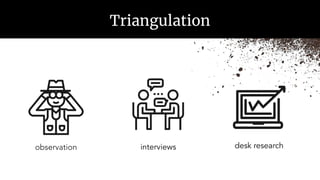
Triangulation
observation interviews desk research
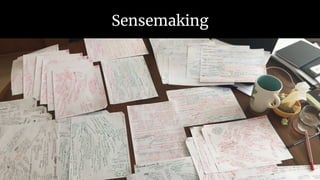
Sensemaking
Sensemaking Session
Insights from sensemaking
EMPATHY MAP
DA VINCI PROGRAM
WHO?
THINK SAY
FEEL DO
An empathy map is an overview of insights of what people do, say, think, and feel when they are engaged in doing something.
The purpose of an empathy map is a collaborative understanding of the people you design for.
Who are we empathizing with?
PAINS
What are their fears, frustrations, and anxieties?
GAINS
What do they want, what are their needs, hopes, and dreams?
WHAT do they need to DO?
What is the job to be done?
What do they say?
What do they do?
What do they think?
What do they feel?
CONTEXT
What is the situation?
Sensemaking with Empathy Map
Transfer the data from the
interviews to the empathy
map to create an overview
and collaboratively gain
insights.
15 min
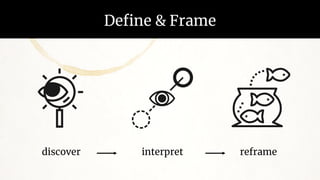
Define & Frame
interpret
discover reframe
Start with a Problem Statement
We want to make the shipping process more
sustainable, but that requires huge investments
and greener alternatives are more expensive
and we can’t simply raise our prices due to
competition.
Problem Statement
What is the problem?
Define the problem statement for your project
in one sentence.
Silent solo first
Then share and align
WHAT SEEMS TO
BE THE PROBLEM?
15 min
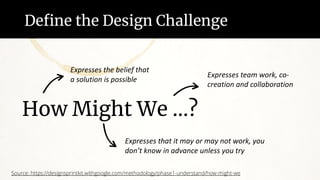
Define the Design Challenge
How Might We …?
Source: https://designsprintkit.withgoogle.com/methodology/phase1-understand/how-might-we
Expresses that it may or may not work, you
don’t know in advance unless you try
Expresses the belief that
a solution is possible
Expresses team work, co-
creation and collaboration
Define the Design Challenge
How might we make the shipping proces more
sustainable and still be competitive?
Define the Design Challenge
How might we …?
Define the Design Challenge
with a HMW-question
Silent solo first, then share
WHAT SEEMS TO
BE THE CHALLENGE?
5 min
Remember this?
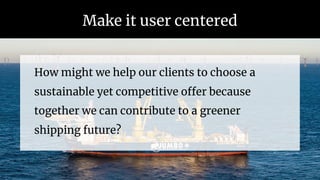
Make it user centered
How might we help our clients to choose a
sustainable yet competitive offer because
together we can contribute to a greener
shipping future?
Make it user centered
How might we …………………………………... (help / enable /…)
…………………………… (description of the people you design for)
to ……………………………………… (direct need / immediate goal)
because ……………………… (purpose / value / desired outcome) ?
Silent solo first, then share 10 min
Framing the problem
Framing
Write down a wrong answer to the question:
What’s the capital of France?
What frames do we recognize?
Framing
Romeo and Juliet lay down on the floor, dead. Next to them a puddle
of water and glass shards. The window is open and the wind was
crying.
What happened?
You can ask questions. I can only answer yes or no.
“
We see the world,
not as it is, but as we
are - or, as we are
conditioned to see it
Steven Covey
Covey, Stephen R. The 7 Habits of Highly Effective People: Powerful Lessons in Personal Change. (1989) Free Press
The construction of our frames
What we assume
How we judge it
Our opinion about it
What we want to see
How we feel (about it)
What we recognize…
Framing the problem
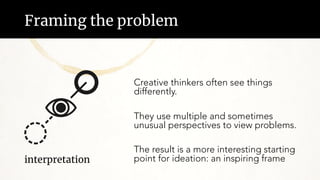
Creative thinkers often see things
differently.
They use multiple and sometimes
unusual perspectives to view problems.
The result is a more interesting starting
point for ideation: an inspiring frame
interpretation
Framing the problem
a frame =
an interpretation of the situation
A frame is subjective by definition.
framing =
exploring multiple (unusual) perspectives
to view the problem
interpretation
Reframing
1. Be aware of your personal frames
2. Escape from your frame
3. View the problem from multiple perspectives
Why design thinking works
Defining problems in obvious,
conventional ways, not
surprisingly, often leads to
obvious, conventional solutions.
“
Liedtka, J. (2018). Why design thinking works.
Harvard Business Review, 96(5), 72-79.
Asking more interesting
questions can help teams
discover more original ideas.
How might we … stage a company party?
How might we … enable the employees experience the
intimacy of a Christmas dinner at a company party?
50%
of Dutch adults are
overweight
Problem > Design Challenge
How might we help people to
do more exercise?
How might we encourage
people to take the stairs
instead of the escalator?
Reframing Exercise: Alter Ego’s
View the problem through the eyes of…
What do you see?
Write down the new perspectives
After 5 min silent solo, share them with your group
10 min
Reframe the design challenge
How might we…?
Generate 10 new HMW-questions
Silent Solo first (5 min)
• Single minded (purpose)
• Positive
• Ambitious (not 10% but 100%)
• Inspiring (use metaphores)
15 min
Ideate
Ideate from a unusual frame
Choose one original HMW-question
Generate ideas
Silent Solo first (5 min)
Then share (5 min)
Create a Frame Board (10 min)
20 min
Homework: Lightning demo’s
Find inspiring examples of solutions to a similar problem
Preferably from outside the industry
Give a short presentation for your team on Monday
Lightning demo’s
Check out
Give a number, from 1 to 10
To what extend were you able to stretch
from your personal frame today?
DID YOU STRETCH
YOUR FRAME?

Da Vinci Project Design Thinking Workshop 4: Define & Reframe.pdf

  • 1.
  • 2.
    Design Thinking Workshop 3| Define & Frame Fieke Sluijs | Oct, 2022
  • 3.
    Check-in How are youdoing? Express your mood in terms of the weather
  • 4.
  • 5.
  • 6.
  • 7.
  • 8.
  • 9.
  • 10.
  • 11.
    EMPATHY MAP DA VINCIPROGRAM WHO? THINK SAY FEEL DO An empathy map is an overview of insights of what people do, say, think, and feel when they are engaged in doing something. The purpose of an empathy map is a collaborative understanding of the people you design for. Who are we empathizing with? PAINS What are their fears, frustrations, and anxieties? GAINS What do they want, what are their needs, hopes, and dreams? WHAT do they need to DO? What is the job to be done? What do they say? What do they do? What do they think? What do they feel? CONTEXT What is the situation? Sensemaking with Empathy Map Transfer the data from the interviews to the empathy map to create an overview and collaboratively gain insights. 15 min
  • 12.
  • 13.
    Start with aProblem Statement We want to make the shipping process more sustainable, but that requires huge investments and greener alternatives are more expensive and we can’t simply raise our prices due to competition.
  • 14.
    Problem Statement What isthe problem? Define the problem statement for your project in one sentence. Silent solo first Then share and align WHAT SEEMS TO BE THE PROBLEM? 15 min
  • 15.
    Define the DesignChallenge How Might We …? Source: https://designsprintkit.withgoogle.com/methodology/phase1-understand/how-might-we Expresses that it may or may not work, you don’t know in advance unless you try Expresses the belief that a solution is possible Expresses team work, co- creation and collaboration
  • 16.
    Define the DesignChallenge How might we make the shipping proces more sustainable and still be competitive?
  • 17.
    Define the DesignChallenge How might we …? Define the Design Challenge with a HMW-question Silent solo first, then share WHAT SEEMS TO BE THE CHALLENGE? 5 min
  • 18.
  • 19.
    Make it usercentered How might we help our clients to choose a sustainable yet competitive offer because together we can contribute to a greener shipping future?
  • 20.
    Make it usercentered How might we …………………………………... (help / enable /…) …………………………… (description of the people you design for) to ……………………………………… (direct need / immediate goal) because ……………………… (purpose / value / desired outcome) ? Silent solo first, then share 10 min
  • 21.
  • 22.
    Framing Write down awrong answer to the question: What’s the capital of France? What frames do we recognize?
  • 23.
    Framing Romeo and Julietlay down on the floor, dead. Next to them a puddle of water and glass shards. The window is open and the wind was crying. What happened? You can ask questions. I can only answer yes or no.
  • 24.
    “ We see theworld, not as it is, but as we are - or, as we are conditioned to see it Steven Covey Covey, Stephen R. The 7 Habits of Highly Effective People: Powerful Lessons in Personal Change. (1989) Free Press
  • 25.
    The construction ofour frames What we assume How we judge it Our opinion about it What we want to see How we feel (about it) What we recognize…
  • 26.
    Framing the problem Creativethinkers often see things differently. They use multiple and sometimes unusual perspectives to view problems. The result is a more interesting starting point for ideation: an inspiring frame interpretation
  • 27.
    Framing the problem aframe = an interpretation of the situation A frame is subjective by definition. framing = exploring multiple (unusual) perspectives to view the problem interpretation
  • 28.
    Reframing 1. Be awareof your personal frames 2. Escape from your frame 3. View the problem from multiple perspectives
  • 29.
    Why design thinkingworks Defining problems in obvious, conventional ways, not surprisingly, often leads to obvious, conventional solutions. “ Liedtka, J. (2018). Why design thinking works. Harvard Business Review, 96(5), 72-79. Asking more interesting questions can help teams discover more original ideas.
  • 30.
    How might we… stage a company party?
  • 31.
    How might we… enable the employees experience the intimacy of a Christmas dinner at a company party?
  • 32.
    50% of Dutch adultsare overweight Problem > Design Challenge How might we help people to do more exercise? How might we encourage people to take the stairs instead of the escalator?
  • 34.
    Reframing Exercise: AlterEgo’s View the problem through the eyes of… What do you see? Write down the new perspectives After 5 min silent solo, share them with your group 10 min
  • 35.
    Reframe the designchallenge How might we…? Generate 10 new HMW-questions Silent Solo first (5 min) • Single minded (purpose) • Positive • Ambitious (not 10% but 100%) • Inspiring (use metaphores) 15 min
  • 37.
    Ideate Ideate from aunusual frame Choose one original HMW-question Generate ideas Silent Solo first (5 min) Then share (5 min) Create a Frame Board (10 min) 20 min
  • 38.
    Homework: Lightning demo’s Findinspiring examples of solutions to a similar problem Preferably from outside the industry Give a short presentation for your team on Monday
  • 39.
  • 40.
    Check out Give anumber, from 1 to 10 To what extend were you able to stretch from your personal frame today? DID YOU STRETCH YOUR FRAME?