CAPSTONE
PROJECT
Presented By Gunjan Khanna
ARTIFICAL INTELLIGENCE
• Don’t hesitate to answer when I ask you.
• Nothing is right or wrong! Only Participation is important.
• Raise your hand and wait for your turn to share your
answer/query.
Learning Outcomes:
• Understand the meaning of the
Capstone Project and its goals.
• Understand how problems can be
identified, decomposed and solved
using Design Thinking Methodology.
• Learn the steps of Design Thinking
and apply for solving simple issues.
• Learn to create Empathy maps.
MEANING OF
CAPSTONE WORD
A stone at the top of a wall or building.
Someone's greatest achievement or
the greatest part of something:
WHAT IS CAPSTONE
PROJECT?
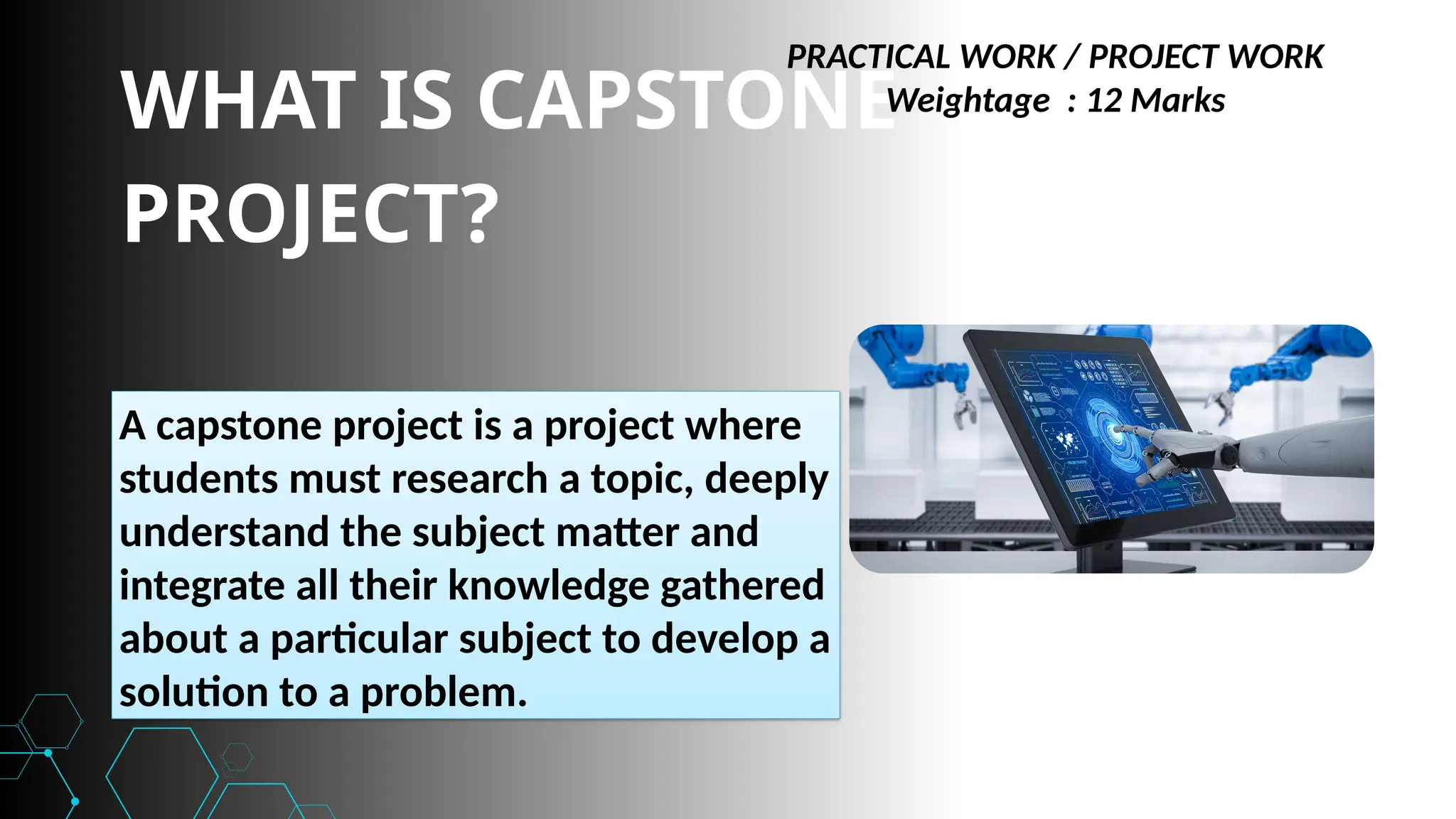
A capstone project is a project where
students must research a topic, deeply
understand the subject matter and
integrate all their knowledge gathered
about a particular subject to develop a
solution to a problem.
PRACTICAL WORK / PROJECT WORK
Weightage : 12 Marks
EXAMPLES FOR CAPSTONE PROJECT
1. Stock Prices Predictor
2. Develop A Sentiment Analyzer
3. Movie Ticket Price Predictor
4. Students Results Predictor
5. Human Activity Recognition
using Smartphone Dataset
6. Classifying humans and
animals in a photo
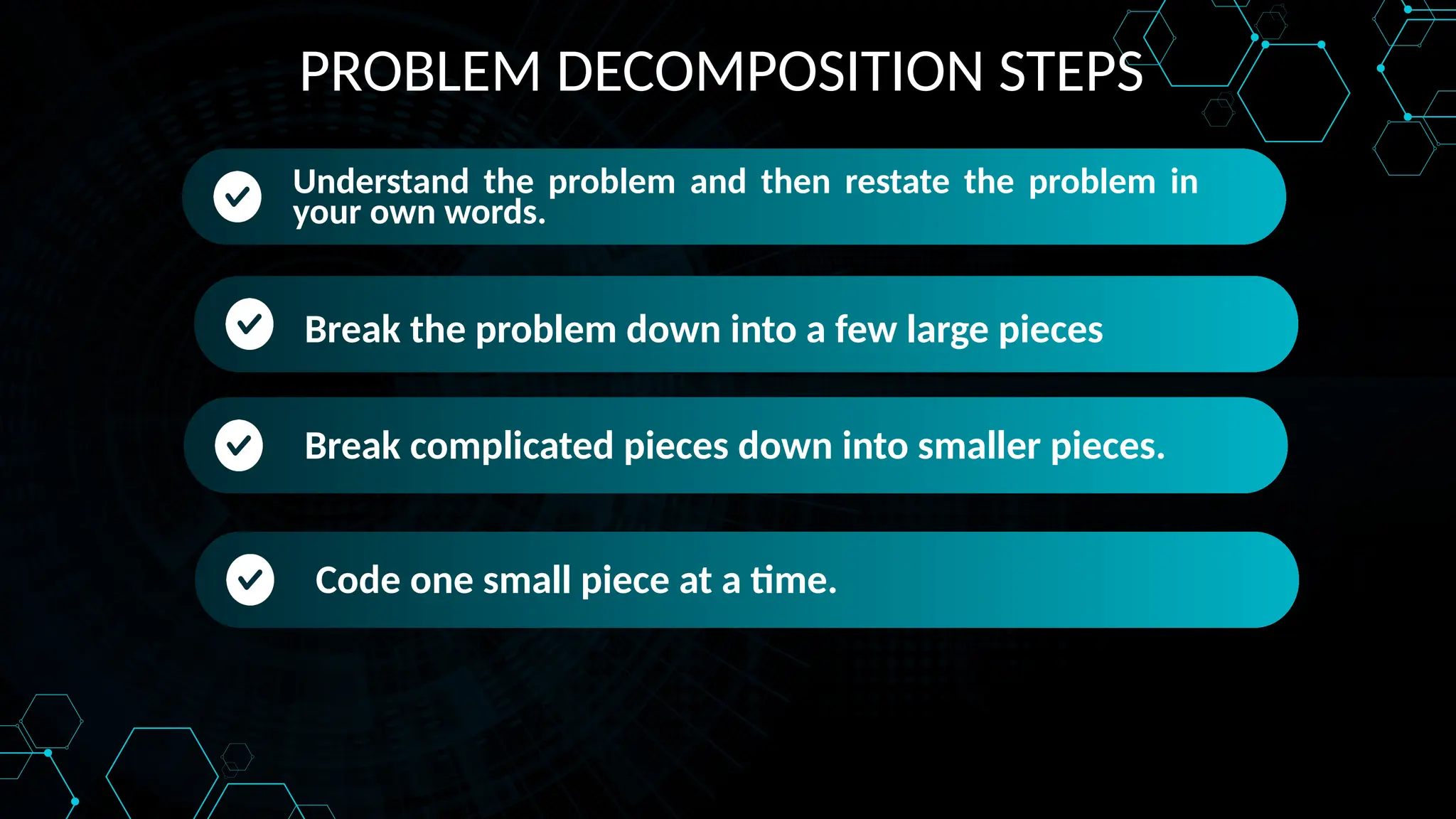
PROBLEM DECOMPOSITION STEPS
Understand the problem and then restate the problem in
your own words.
Understand the problem and then restate the problem in
your own words.
Break the problem down into a few large pieces
Break complicated pieces down into smaller pieces.
Code one small piece at a time.
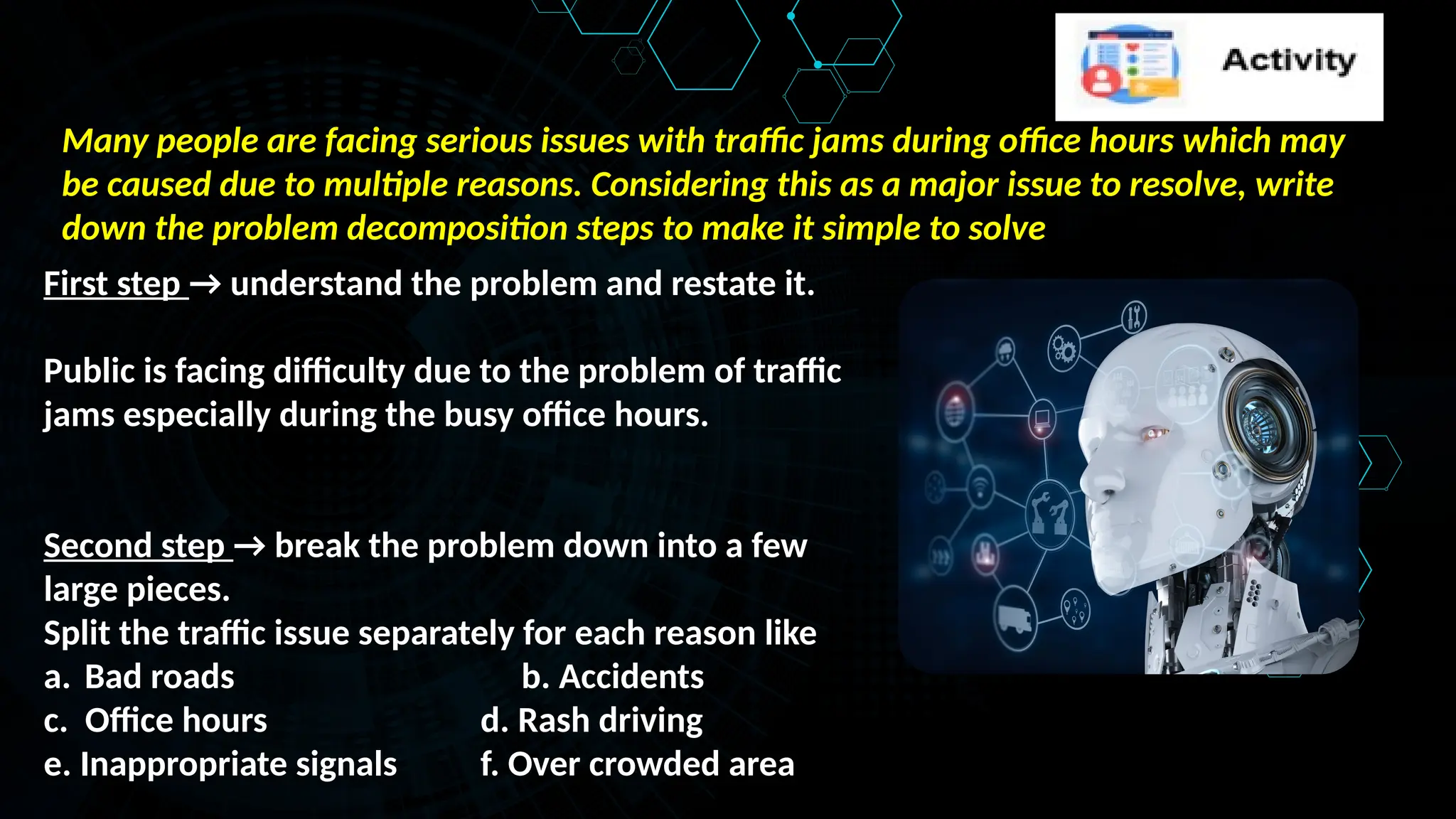
Many people are facing serious issues with traffic jams during office hours which may
be caused due to multiple reasons. Considering this as a major issue to resolve, write
down the problem decomposition steps to make it simple to solve
First step → understand the problem and restate it.
Public is facing difficulty due to the problem of traffic
jams especially during the busy office hours.
Second step → break the problem down into a few
large pieces.
Split the traffic issue separately for each reason like
a. Bad roads b. Accidents
c. Office hours d. Rash driving
e. Inappropriate signals f. Over crowded area
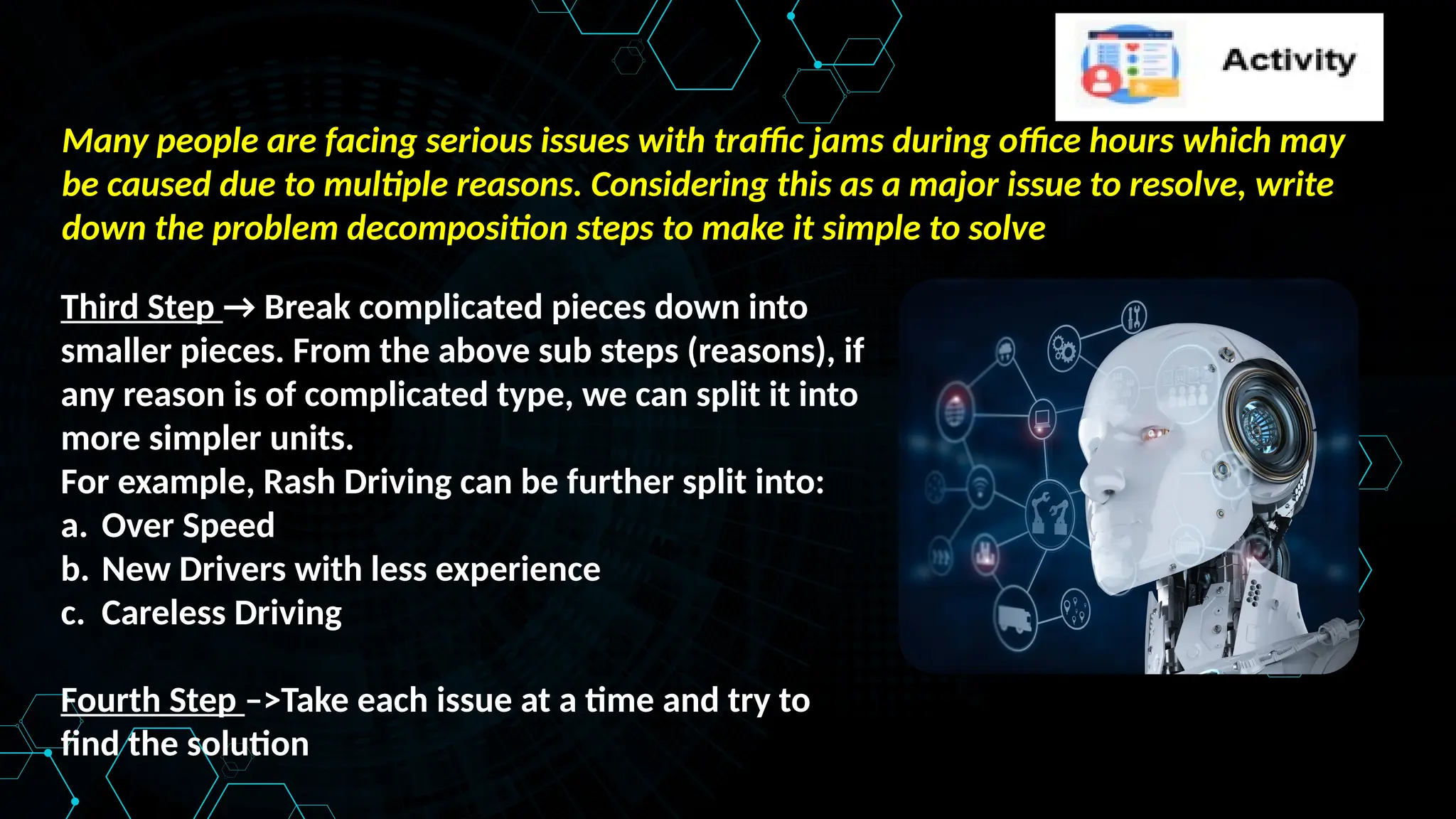
Many people are facing serious issues with traffic jams during office hours which may
be caused due to multiple reasons. Considering this as a major issue to resolve, write
down the problem decomposition steps to make it simple to solve
Third Step → Break complicated pieces down into
smaller pieces. From the above sub steps (reasons), if
any reason is of complicated type, we can split it into
more simpler units.
For example, Rash Driving can be further split into:
a. Over Speed
b. New Drivers with less experience
c. Careless Driving
Fourth Step –>Take each issue at a time and try to
find the solution
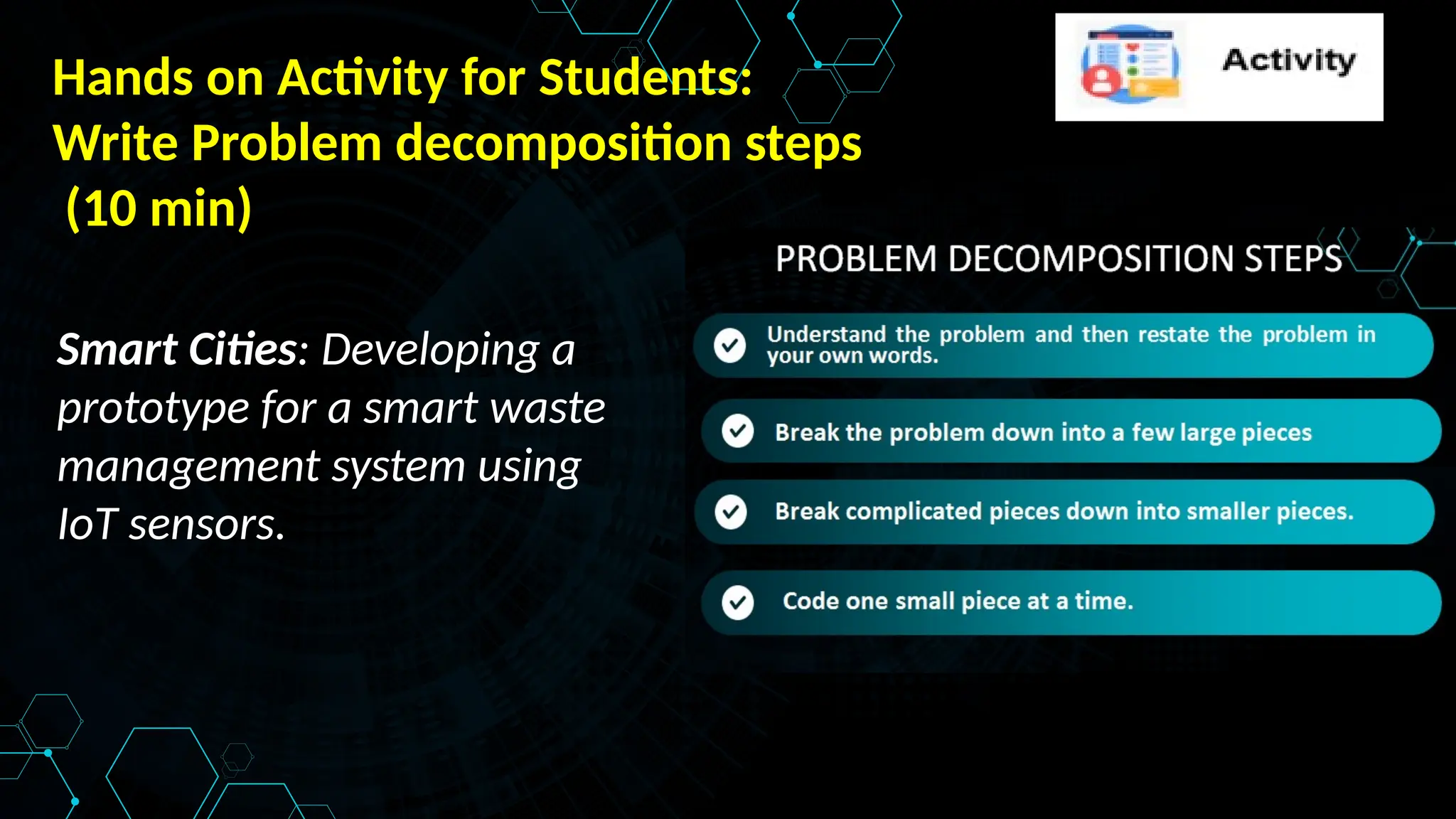
Hands on Activity for Students:
Write Problem decomposition steps
(10 min)
Smart Cities: Developing a
prototype for a smart waste
management system using
IoT sensors.
INTRODUCTION TO DESIGN
THINKING
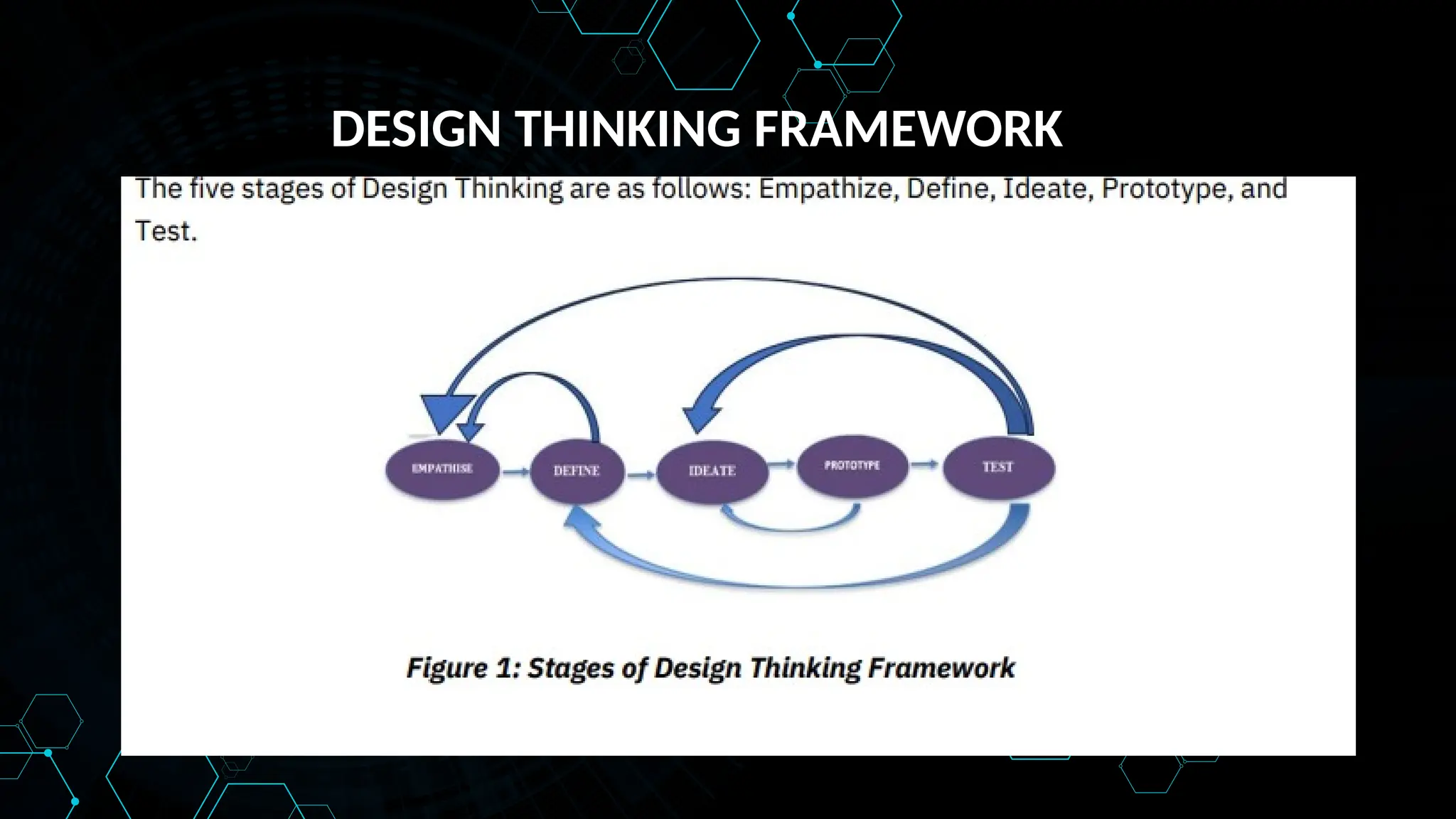
Design thinking is a non-linear,
iterative process that expert teams
use to understand users, challenge
assumptions, redefine problems and
create innovative solutions to
prototype and test.
DESIGN THINKING FRAMEWORK
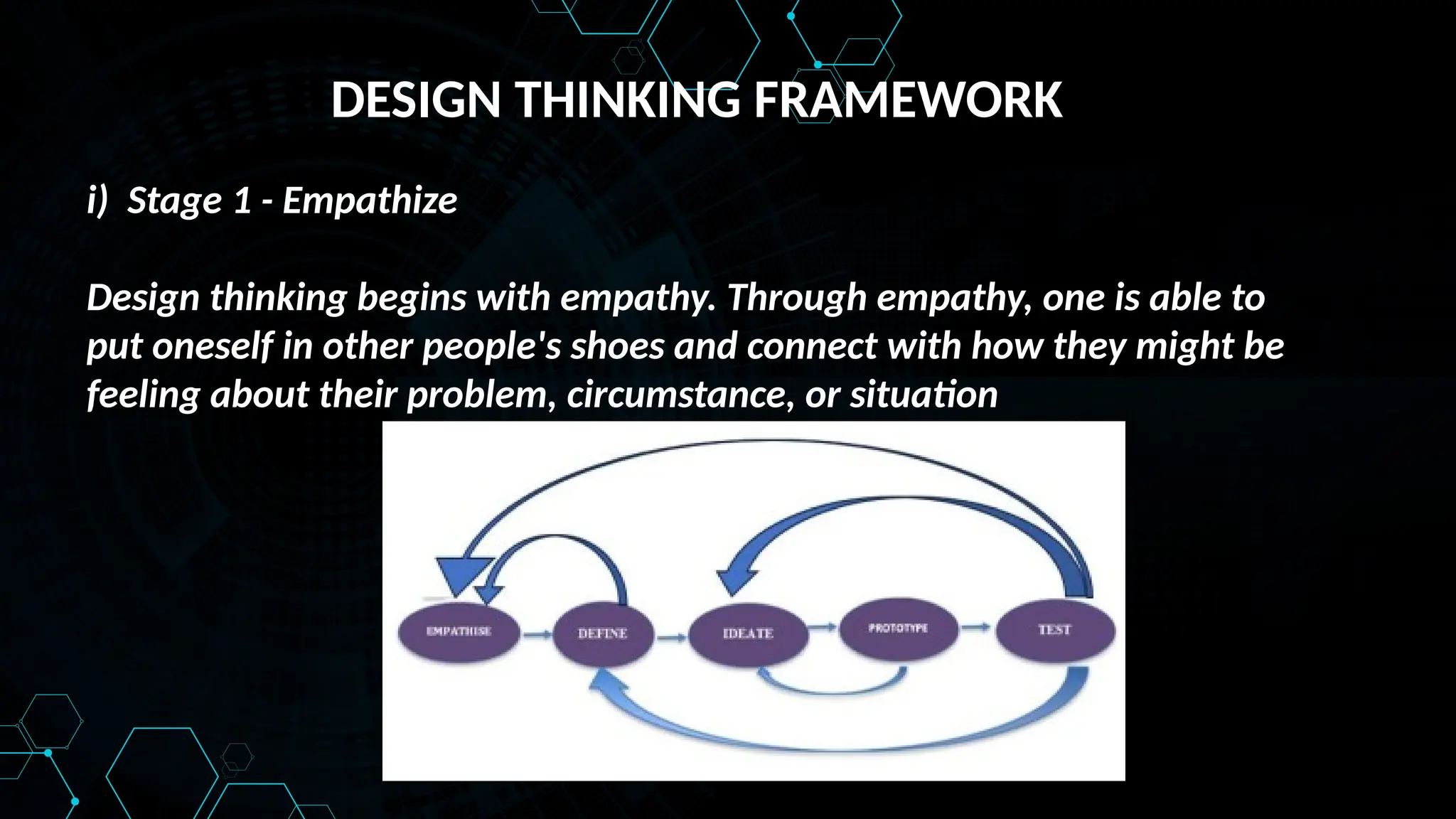
i) Stage 1 - Empathize
Design thinking begins with empathy. Through empathy, one is able to
put oneself in other people's shoes and connect with how they might be
feeling about their problem, circumstance, or situation
DESIGN THINKING FRAMEWORK
EMPATHY MAP
An extremely useful tool for understanding the users’ needs and gaining a deeper
insight into the problem at hand is the empathy map. It also helps in deepening
that understanding, gaining insight into the user’s behavior.
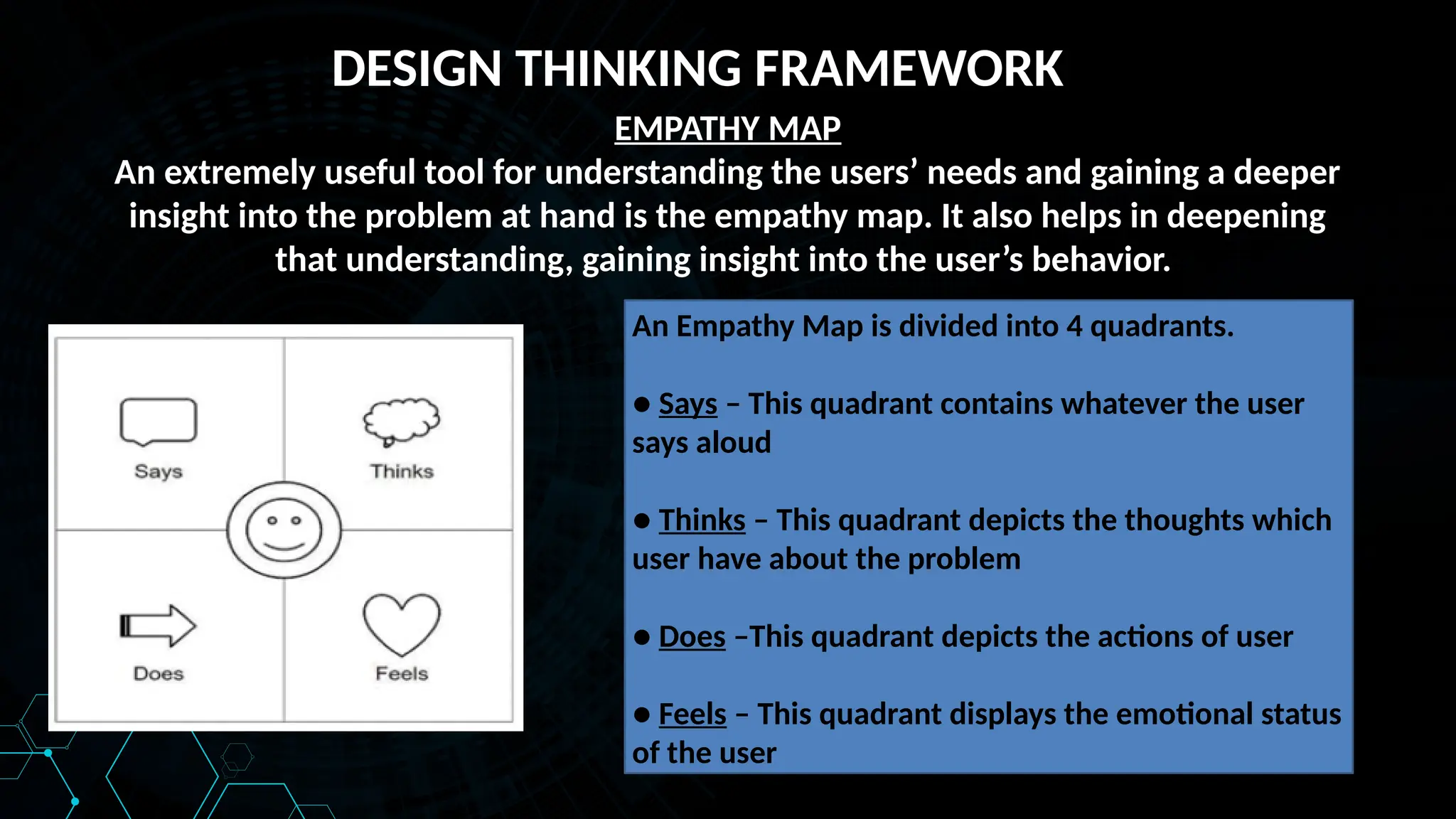
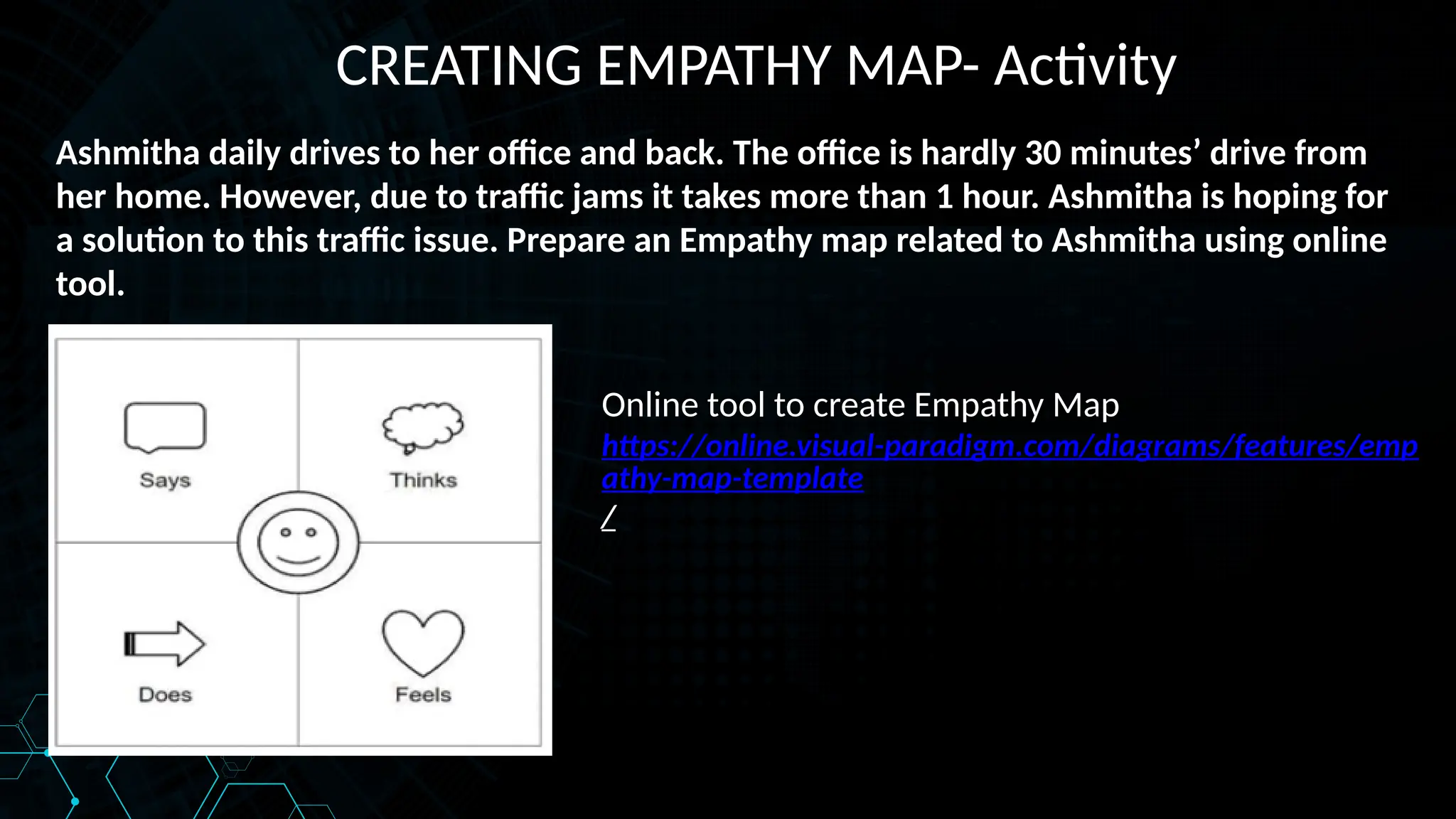
An Empathy Map is divided into 4 quadrants.
● Says – This quadrant contains whatever the user
says aloud
● Thinks – This quadrant depicts the thoughts which
user have about the problem
● Does –This quadrant depicts the actions of user
● Feels – This quadrant displays the emotional status
of the user
CREATING EMPATHY MAP
Activity
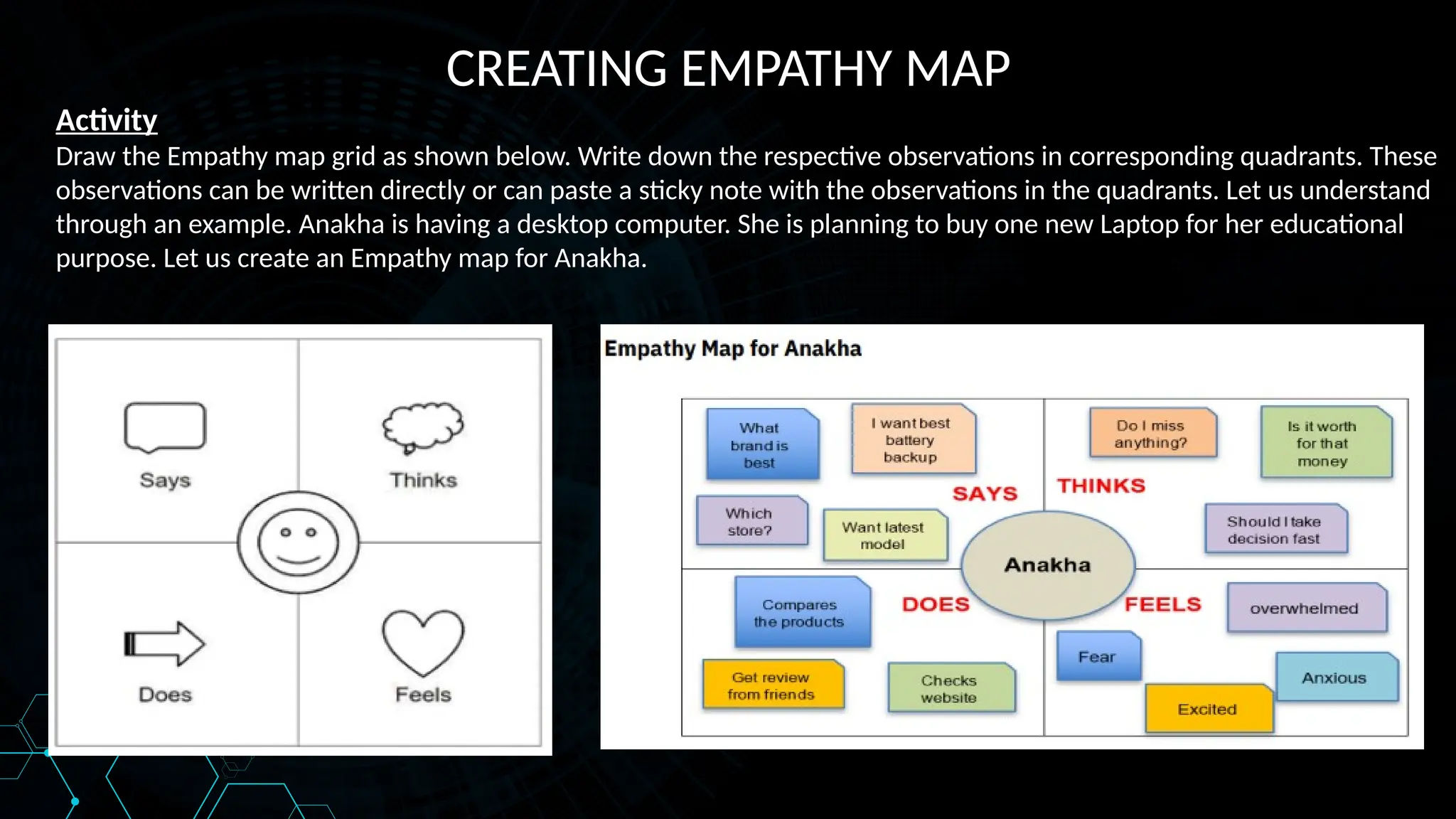
Draw the Empathy map grid as shown below. Write down the respective observations in corresponding quadrants. These
observations can be written directly or can paste a sticky note with the observations in the quadrants. Let us understand
through an example. Anakha is having a desktop computer. She is planning to buy one new Laptop for her educational
purpose. Let us create an Empathy map for Anakha.
CREATING EMPATHY MAP- Activity
Online tool to create Empathy Map
https://online.visual-paradigm.com/diagrams/features/emp
athy-map-template
/
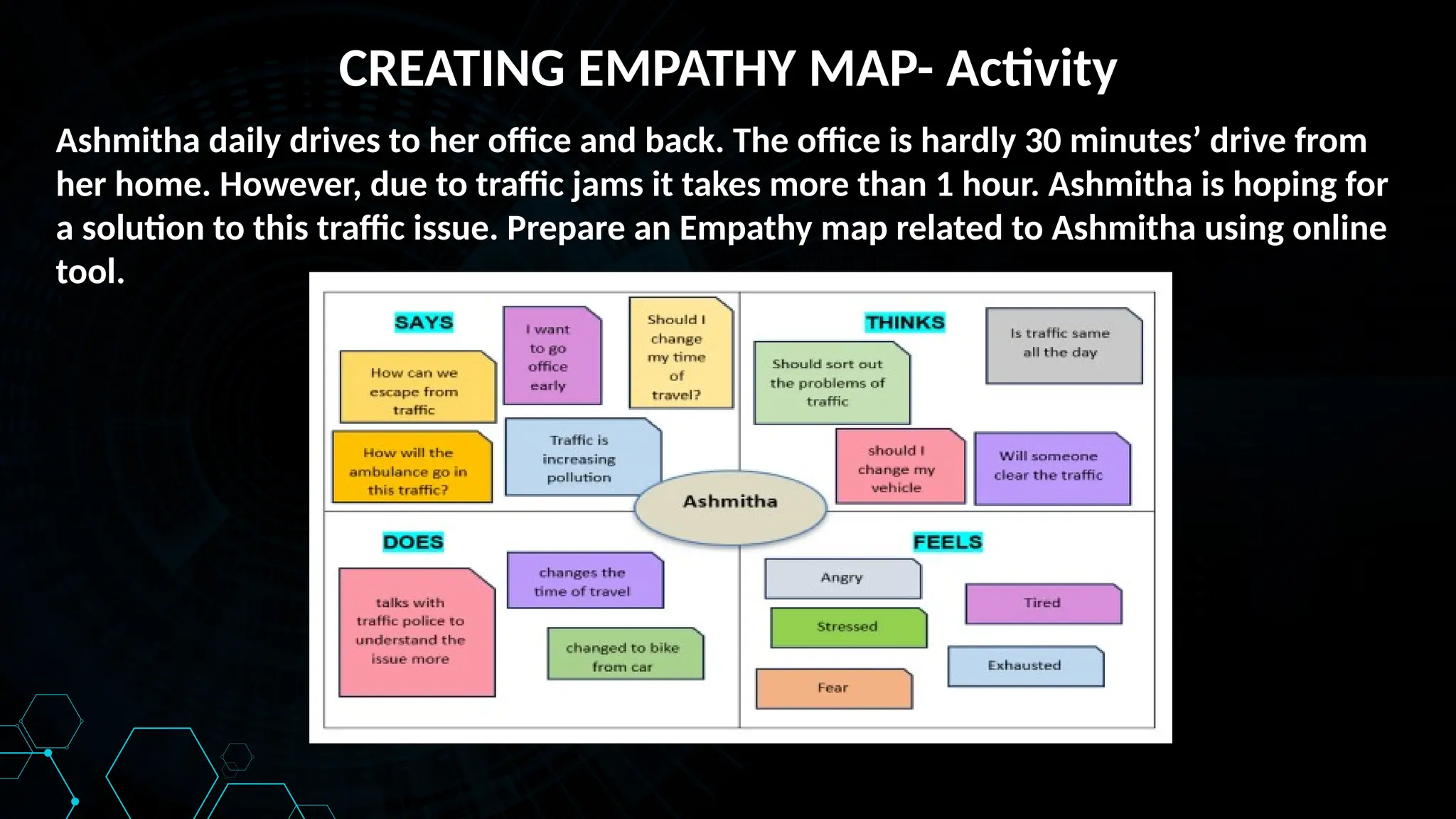
Ashmitha daily drives to her office and back. The office is hardly 30 minutes’ drive from
her home. However, due to traffic jams it takes more than 1 hour. Ashmitha is hoping for
a solution to this traffic issue. Prepare an Empathy map related to Ashmitha using online
tool.
CREATING EMPATHY MAP- Activity
Ashmitha daily drives to her office and back. The office is hardly 30 minutes’ drive from
her home. However, due to traffic jams it takes more than 1 hour. Ashmitha is hoping for
a solution to this traffic issue. Prepare an Empathy map related to Ashmitha using online
tool.
DESIGN THINKING FRAMEWORK
Stage 2- Define
In the Define stage, information collected
during Empathize is used to draw insights
and is instrumental in stating the problem
that needs to be solved.
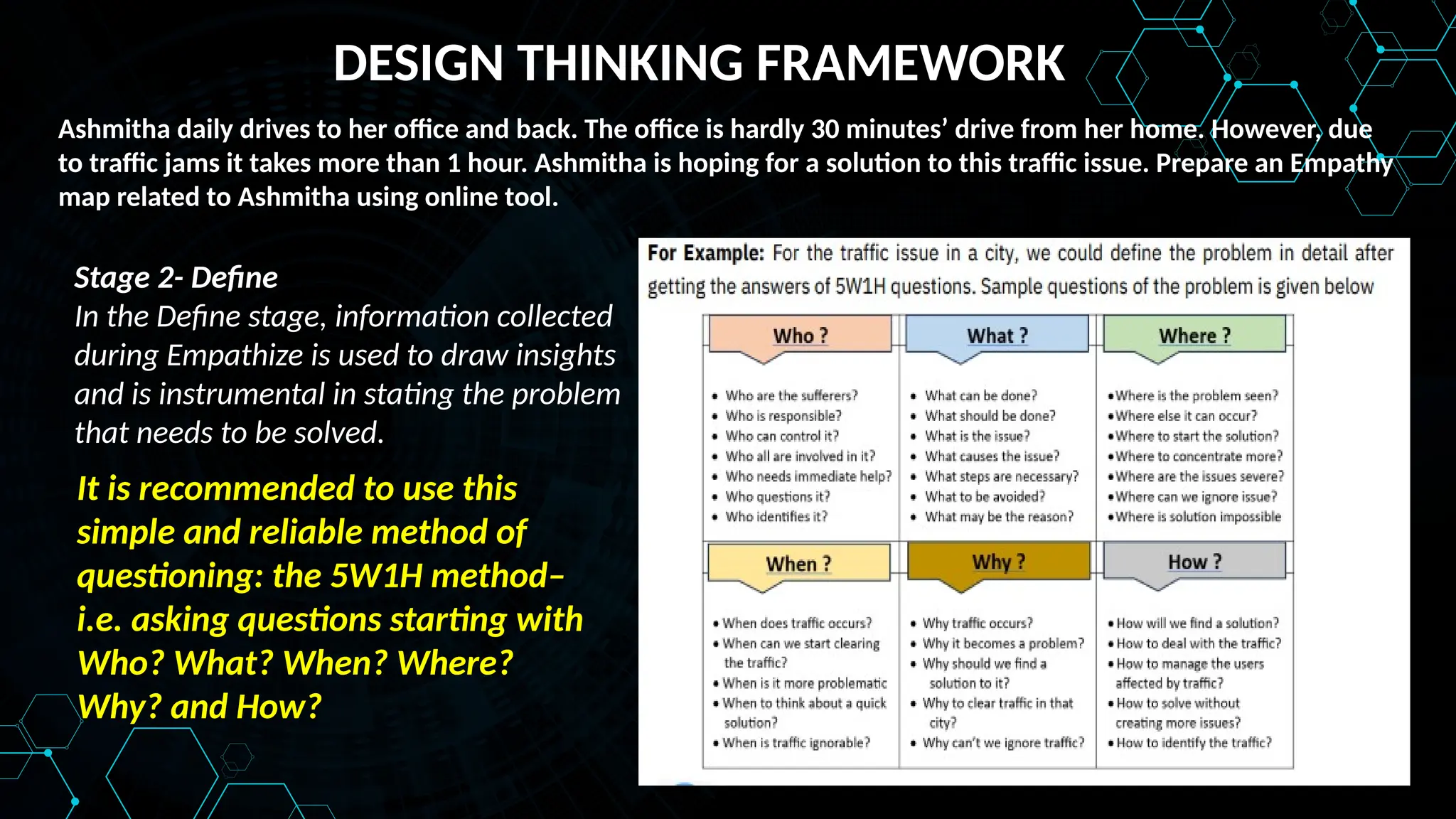
It is recommended to use this
simple and reliable method of
questioning: the 5W1H method–
i.e. asking questions starting with
Who? What? When? Where?
Why? and How?
Ashmitha daily drives to her office and back. The office is hardly 30 minutes’ drive from her home. However, due
to traffic jams it takes more than 1 hour. Ashmitha is hoping for a solution to this traffic issue. Prepare an Empathy
map related to Ashmitha using online tool.
Quiz Time
1. Which is NOT correct about the Capstone project?
a. It is a project where students must research independently
b. Students can integrate all their knowledge to develop a solution to the problem
c. It is the final project of an academic program.
d. Students are made to look at real world situations, exchange their point of view and discuss
potential solutions to the problem.
Solution: Option A - as many Capstone projects may involve collaboration with peers, faculty, or
industry professionals
Solution: Option b- Is there a solution?
2. Which is the fundamental question which is asked before deciding to embark on an AI
development journey?
a. Should we do the project?
b. Is there a solution?
c. Can we leave the problem?
d. Is there a pattern?
Quiz Time
3. Which stage in Design Thinking is missing (Prototype, Ideate, Test, Define)?
a. Evaluation b. Empathise
b. Evolution d. Enrichment
Solution: Option b. Empathize
4. Real computational tasks are complicated. To accomplish them, you need to _____ before
coding.
a. Test the problem causing variables
b. Ask for finance help from stakeholders
c. Break down the problem into smaller units
d. write it in a paper and read it to your partners
Solution: Option c. Break down the problem into smaller units
Home Fun
Create an Empathy Map :
That helps students manage their study
schedules, share resources, and collaborate on
projects.

Thank You

Artificial Intelligence Capstone project presentation

  • 1.
    CAPSTONE PROJECT Presented By GunjanKhanna ARTIFICAL INTELLIGENCE
  • 2.
    • Don’t hesitateto answer when I ask you. • Nothing is right or wrong! Only Participation is important. • Raise your hand and wait for your turn to share your answer/query.
  • 3.
    Learning Outcomes: • Understandthe meaning of the Capstone Project and its goals. • Understand how problems can be identified, decomposed and solved using Design Thinking Methodology. • Learn the steps of Design Thinking and apply for solving simple issues. • Learn to create Empathy maps.
  • 4.
    MEANING OF CAPSTONE WORD Astone at the top of a wall or building. Someone's greatest achievement or the greatest part of something:
  • 5.
    WHAT IS CAPSTONE PROJECT? Acapstone project is a project where students must research a topic, deeply understand the subject matter and integrate all their knowledge gathered about a particular subject to develop a solution to a problem. PRACTICAL WORK / PROJECT WORK Weightage : 12 Marks
  • 6.
    EXAMPLES FOR CAPSTONEPROJECT 1. Stock Prices Predictor 2. Develop A Sentiment Analyzer 3. Movie Ticket Price Predictor 4. Students Results Predictor 5. Human Activity Recognition using Smartphone Dataset 6. Classifying humans and animals in a photo
  • 7.
    PROBLEM DECOMPOSITION STEPS Understandthe problem and then restate the problem in your own words. Understand the problem and then restate the problem in your own words. Break the problem down into a few large pieces Break the problem down into a few large pieces Break complicated pieces down into smaller pieces. Code one small piece at a time.
  • 8.
    Many people arefacing serious issues with traffic jams during office hours which may be caused due to multiple reasons. Considering this as a major issue to resolve, write down the problem decomposition steps to make it simple to solve First step → understand the problem and restate it. Public is facing difficulty due to the problem of traffic jams especially during the busy office hours. Second step → break the problem down into a few large pieces. Split the traffic issue separately for each reason like a. Bad roads b. Accidents c. Office hours d. Rash driving e. Inappropriate signals f. Over crowded area
  • 9.
    Many people arefacing serious issues with traffic jams during office hours which may be caused due to multiple reasons. Considering this as a major issue to resolve, write down the problem decomposition steps to make it simple to solve Third Step → Break complicated pieces down into smaller pieces. From the above sub steps (reasons), if any reason is of complicated type, we can split it into more simpler units. For example, Rash Driving can be further split into: a. Over Speed b. New Drivers with less experience c. Careless Driving Fourth Step –>Take each issue at a time and try to find the solution
  • 10.
    Hands on Activityfor Students: Write Problem decomposition steps (10 min) Smart Cities: Developing a prototype for a smart waste management system using IoT sensors.
  • 11.
    INTRODUCTION TO DESIGN THINKING Designthinking is a non-linear, iterative process that expert teams use to understand users, challenge assumptions, redefine problems and create innovative solutions to prototype and test.
  • 12.
  • 13.
    DESIGN THINKING FRAMEWORK i)Stage 1 - Empathize Design thinking begins with empathy. Through empathy, one is able to put oneself in other people's shoes and connect with how they might be feeling about their problem, circumstance, or situation
  • 14.
    DESIGN THINKING FRAMEWORK EMPATHYMAP An extremely useful tool for understanding the users’ needs and gaining a deeper insight into the problem at hand is the empathy map. It also helps in deepening that understanding, gaining insight into the user’s behavior. An Empathy Map is divided into 4 quadrants. ● Says – This quadrant contains whatever the user says aloud ● Thinks – This quadrant depicts the thoughts which user have about the problem ● Does –This quadrant depicts the actions of user ● Feels – This quadrant displays the emotional status of the user
  • 15.
    CREATING EMPATHY MAP Activity Drawthe Empathy map grid as shown below. Write down the respective observations in corresponding quadrants. These observations can be written directly or can paste a sticky note with the observations in the quadrants. Let us understand through an example. Anakha is having a desktop computer. She is planning to buy one new Laptop for her educational purpose. Let us create an Empathy map for Anakha.
  • 16.
    CREATING EMPATHY MAP-Activity Online tool to create Empathy Map https://online.visual-paradigm.com/diagrams/features/emp athy-map-template / Ashmitha daily drives to her office and back. The office is hardly 30 minutes’ drive from her home. However, due to traffic jams it takes more than 1 hour. Ashmitha is hoping for a solution to this traffic issue. Prepare an Empathy map related to Ashmitha using online tool.
  • 17.
    CREATING EMPATHY MAP-Activity Ashmitha daily drives to her office and back. The office is hardly 30 minutes’ drive from her home. However, due to traffic jams it takes more than 1 hour. Ashmitha is hoping for a solution to this traffic issue. Prepare an Empathy map related to Ashmitha using online tool.
  • 18.
    DESIGN THINKING FRAMEWORK Stage2- Define In the Define stage, information collected during Empathize is used to draw insights and is instrumental in stating the problem that needs to be solved. It is recommended to use this simple and reliable method of questioning: the 5W1H method– i.e. asking questions starting with Who? What? When? Where? Why? and How? Ashmitha daily drives to her office and back. The office is hardly 30 minutes’ drive from her home. However, due to traffic jams it takes more than 1 hour. Ashmitha is hoping for a solution to this traffic issue. Prepare an Empathy map related to Ashmitha using online tool.
  • 19.
    Quiz Time 1. Whichis NOT correct about the Capstone project? a. It is a project where students must research independently b. Students can integrate all their knowledge to develop a solution to the problem c. It is the final project of an academic program. d. Students are made to look at real world situations, exchange their point of view and discuss potential solutions to the problem. Solution: Option A - as many Capstone projects may involve collaboration with peers, faculty, or industry professionals Solution: Option b- Is there a solution? 2. Which is the fundamental question which is asked before deciding to embark on an AI development journey? a. Should we do the project? b. Is there a solution? c. Can we leave the problem? d. Is there a pattern?
  • 20.
    Quiz Time 3. Whichstage in Design Thinking is missing (Prototype, Ideate, Test, Define)? a. Evaluation b. Empathise b. Evolution d. Enrichment Solution: Option b. Empathize 4. Real computational tasks are complicated. To accomplish them, you need to _____ before coding. a. Test the problem causing variables b. Ask for finance help from stakeholders c. Break down the problem into smaller units d. write it in a paper and read it to your partners Solution: Option c. Break down the problem into smaller units
  • 21.
    Home Fun Create anEmpathy Map : That helps students manage their study schedules, share resources, and collaborate on projects.

  • 22.