UNIT 3: DIFFUSION OF PEOPLE AND CULTURES
INDIA AND SOUTH ASIA: FROM AREA STUDIES TO ETHNIC STUDIES
DEVELOPED BY RACHEL HEILMAN (ISSAQUAH HIGH SCHOOL) WITH SUPPORT FROM THE SOUTH ASIA CENTER AT THE UNIVERSITY OF WASHINGTON WITH FUNDING FROM THE U.S.
DEPARTMENT OF EDUCATION NATIONAL RESOURCE CENTERS PROGRAM.
REFLECT
When I say “migration” you say…
…what? What does “migration” mean to you as a concept?
…my experience or my family’s experience of migration has been ______.
MIGRATION
The term means the movement of people from one place to
another – it could be from rural to urban areas, within a single
country or region, or international.
Migrants may be intending to move permanently or plan to
work in order to send remittances home before returning
themselves. And plans can change depending on a huge variety
of factors.
Also, migration can be voluntary or involuntary. There is a lot to
consider!
Brainstorm with your
neighbor:
Why do people
migrate?
List as many possible
factors as you can.
PUSH AND PULL FACTORS
 Pull factors draw people to a place
 Push factors motivate people to leave a place
Label each of the factors you and your partner
brainstormed as either “pull” or “push”
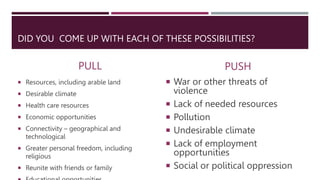
DID YOU COME UP WITH EACH OF THESE POSSIBILITIES?
PULL
 Resources, including arable land
 Desirable climate
 Health care resources
 Economic opportunities
 Connectivity – geographical and
technological
 Greater personal freedom, including
religious
 Reunite with friends or family
PUSH
 War or other threats of
violence
 Lack of needed resources
 Pollution
 Undesirable climate
 Lack of employment
opportunities
 Social or political oppression
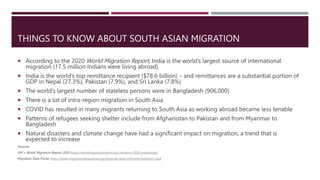
THINGS TO KNOW ABOUT SOUTH ASIAN MIGRATION
 According to the 2020 World Migration Report, India is the world’s largest source of international
migration (17.5 million Indians were living abroad)
 India is the world’s top remittance recipient ($78.6 billion) – and remittances are a substantial portion of
GDP in Nepal (27.3%), Pakistan (7.9%), and Sri Lanka (7.8%)
 The world’s largest number of stateless persons were in Bangladesh (906,000)
 There is a lot of intra-region migration in South Asia
 COVID has resulted in many migrants returning to South Asia as working abroad became less tenable
 Patterns of refugees seeking shelter include from Afghanistan to Pakistan and from Myanmar to
Bangladesh
 Natural disasters and climate change have had a significant impact on migration, a trend that is
expected to increase
Sources:
UN’’s World Migration Report 2020 https://worldmigrationreport.iom.int/wmr-2020-interactive/
Migration Data Portal https://www.migrationdataportal.org/regional-data-overview/southern-asia
CULTURAL DIFFUSION
The phrase means the spread of ideas, values, beliefs,
technology, clothing styles, language, foods…all of
those different cultural factors you learned about
earlier in the course!
Cultural diffusion can happen through the expansion
of a particular country’s economic or political
influence, through trade routes, through media, and
of course through migration.
Brainstorm with your
neighbor:
Which forms of culture
can you think of that
have diffused from
South Asia?
List as many possibilities as
you can.
EXAMPLES OF CULTURAL DIFFUSION FROM SOUTH ASIA:
How many did your class come up with?
Was it difficult or easy to make a list?
EXAMPLES OF CULTURAL DIFFUSION FROM SOUTH ASIA
Just a short list of possible responses:
 Pajamas
 Bhangra
 Buddhism
 Curry
 Tunics
 The concept of zero
 Ramayana Re-tellings
 This could go on for a looooong time….
LABOR AND MIGRATION FROM SOUTH ASIA
SOURCE: MIGRATION DATA PORTAL
 The British Empire used indentured
servitude to provide labor for its territories
in the 19th and early 20th centuries
 Post-WWII Britain drew workers
 Today South Asia remains a source of labor,
particularly for the Gulf States
 Environmental disasters, including due to
climate change, are significant sources of
displacement
 In 2019, India was the world’s largest
recipient of remittances (and 20% of
remittances globally were sent to South
Asia)
 Around a quarter of Nepal’s GDP in
2019 was made up of remittances
 Pre-COVID patterns of migration have
been disrupted – over time we’ll be
able to examine to what extent these
trends remain in place
MAP OF MAJOR SOUTH ASIAN FLOWS
Visit NYU Libraries’ South Asian Diaspora Homepage:
https://guides.nyu.edu/southasiandiaspora/Immigrantion-Histories
 What do you notice?
 What questions do you hope to have answered in the coming
weeks?
THE HUMAN GEOGRAPHER’S APPROACH
Migration and cultural diffusion are concepts that many different disciplines study.
Let’s wrap up our introductory exploration of these concepts by watching Crash Course
Geography’s “Race, Ethnicity, and the Cultural Landscape” to get a look at one discipline’s
approach to applying these topics.
https://www.youtube.com/watch?v=lVGJxaogu5A

D10-W9-L2-Migration-and-Cultural-Diffusion-PPT.pptx

  • 1.
    UNIT 3: DIFFUSIONOF PEOPLE AND CULTURES INDIA AND SOUTH ASIA: FROM AREA STUDIES TO ETHNIC STUDIES DEVELOPED BY RACHEL HEILMAN (ISSAQUAH HIGH SCHOOL) WITH SUPPORT FROM THE SOUTH ASIA CENTER AT THE UNIVERSITY OF WASHINGTON WITH FUNDING FROM THE U.S. DEPARTMENT OF EDUCATION NATIONAL RESOURCE CENTERS PROGRAM.
  • 2.
    REFLECT When I say“migration” you say… …what? What does “migration” mean to you as a concept? …my experience or my family’s experience of migration has been ______.
  • 3.
    MIGRATION The term meansthe movement of people from one place to another – it could be from rural to urban areas, within a single country or region, or international. Migrants may be intending to move permanently or plan to work in order to send remittances home before returning themselves. And plans can change depending on a huge variety of factors. Also, migration can be voluntary or involuntary. There is a lot to consider!
  • 4.
    Brainstorm with your neighbor: Whydo people migrate? List as many possible factors as you can.
  • 5.
    PUSH AND PULLFACTORS  Pull factors draw people to a place  Push factors motivate people to leave a place Label each of the factors you and your partner brainstormed as either “pull” or “push”
  • 6.
    DID YOU COMEUP WITH EACH OF THESE POSSIBILITIES? PULL  Resources, including arable land  Desirable climate  Health care resources  Economic opportunities  Connectivity – geographical and technological  Greater personal freedom, including religious  Reunite with friends or family PUSH  War or other threats of violence  Lack of needed resources  Pollution  Undesirable climate  Lack of employment opportunities  Social or political oppression
  • 7.
    THINGS TO KNOWABOUT SOUTH ASIAN MIGRATION  According to the 2020 World Migration Report, India is the world’s largest source of international migration (17.5 million Indians were living abroad)  India is the world’s top remittance recipient ($78.6 billion) – and remittances are a substantial portion of GDP in Nepal (27.3%), Pakistan (7.9%), and Sri Lanka (7.8%)  The world’s largest number of stateless persons were in Bangladesh (906,000)  There is a lot of intra-region migration in South Asia  COVID has resulted in many migrants returning to South Asia as working abroad became less tenable  Patterns of refugees seeking shelter include from Afghanistan to Pakistan and from Myanmar to Bangladesh  Natural disasters and climate change have had a significant impact on migration, a trend that is expected to increase Sources: UN’’s World Migration Report 2020 https://worldmigrationreport.iom.int/wmr-2020-interactive/ Migration Data Portal https://www.migrationdataportal.org/regional-data-overview/southern-asia
  • 8.
    CULTURAL DIFFUSION The phrasemeans the spread of ideas, values, beliefs, technology, clothing styles, language, foods…all of those different cultural factors you learned about earlier in the course! Cultural diffusion can happen through the expansion of a particular country’s economic or political influence, through trade routes, through media, and of course through migration.
  • 9.
    Brainstorm with your neighbor: Whichforms of culture can you think of that have diffused from South Asia? List as many possibilities as you can.
  • 10.
    EXAMPLES OF CULTURALDIFFUSION FROM SOUTH ASIA: How many did your class come up with? Was it difficult or easy to make a list?
  • 11.
    EXAMPLES OF CULTURALDIFFUSION FROM SOUTH ASIA Just a short list of possible responses:  Pajamas  Bhangra  Buddhism  Curry  Tunics  The concept of zero  Ramayana Re-tellings  This could go on for a looooong time….
  • 12.
    LABOR AND MIGRATIONFROM SOUTH ASIA SOURCE: MIGRATION DATA PORTAL  The British Empire used indentured servitude to provide labor for its territories in the 19th and early 20th centuries  Post-WWII Britain drew workers  Today South Asia remains a source of labor, particularly for the Gulf States  Environmental disasters, including due to climate change, are significant sources of displacement  In 2019, India was the world’s largest recipient of remittances (and 20% of remittances globally were sent to South Asia)  Around a quarter of Nepal’s GDP in 2019 was made up of remittances  Pre-COVID patterns of migration have been disrupted – over time we’ll be able to examine to what extent these trends remain in place
  • 13.
    MAP OF MAJORSOUTH ASIAN FLOWS Visit NYU Libraries’ South Asian Diaspora Homepage: https://guides.nyu.edu/southasiandiaspora/Immigrantion-Histories  What do you notice?  What questions do you hope to have answered in the coming weeks?
  • 14.
    THE HUMAN GEOGRAPHER’SAPPROACH Migration and cultural diffusion are concepts that many different disciplines study. Let’s wrap up our introductory exploration of these concepts by watching Crash Course Geography’s “Race, Ethnicity, and the Cultural Landscape” to get a look at one discipline’s approach to applying these topics. https://www.youtube.com/watch?v=lVGJxaogu5A