8 D and F Block elements. Class 12th Chemistry Chapter pptx
1.
Prepared by
Mr. SandeepKumar
PGT CHEMISTRY
KV RECKONG PEO,KINNAUR
HIMACHAL PRADESH
CHAPTER-4
The d and f Block Elements
CLASS-XII
2.
The transition elements
(d-block)
Introduction
d-blockelements:
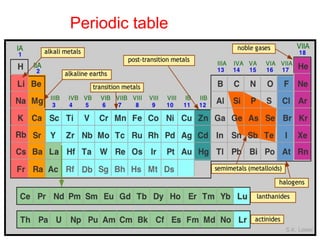
•Elements belonging to group 3 to12 of the
periodic table are known as d-block elements.
•In these elements last electron enter into
penultimate d-orbital.
•d-block elements lie between s and p-block
elements.
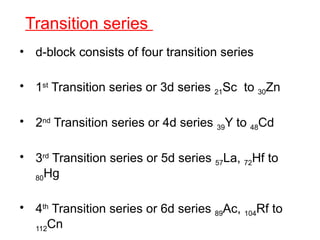
Transition series
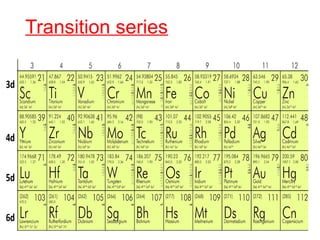
• d-blockconsists of four transition series
• 1st
Transition series or 3d series 21Sc to 30Zn
• 2nd
Transition series or 4d series 39Y to 48Cd
• 3rd
Transition series or 5d series 57La, 72Hf to
80Hg
• 4th
Transition series or 6d series 89Ac, 104Rf to
112Cn
6.
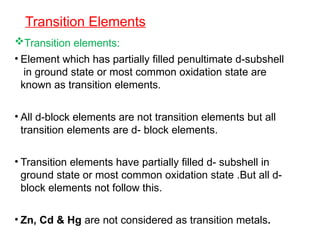
Transition Elements
Transition elements:
•Element which has partially filled penultimate d-subshell
in ground state or most common oxidation state are
known as transition elements.
• All d-block elements are not transition elements but all
transition elements are d- block elements.
• Transition elements have partially filled d- subshell in
ground state or most common oxidation state .But all d-
block elements not follow this.
• Zn, Cd & Hg are not considered as transition metals.
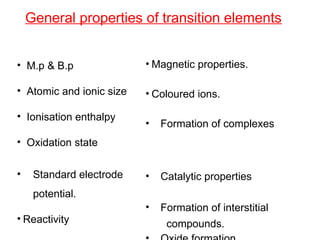
General properties oftransition elements
• Magnetic properties.
• Coloured ions.
• Formation of complexes
• Catalytic properties
• Formation of interstitial
compounds.
• M.p & B.p
• Atomic and ionic size
• Ionisation enthalpy
• Oxidation state
• Standard electrode
potential.
• Reactivity
9.
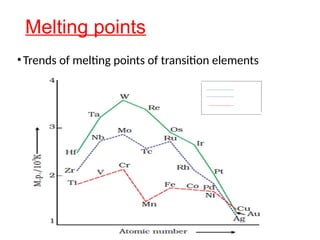
Melting and BoilingPoint
Melting and Boiling Point: Generally High
• d block elements have large no. of unpaired electrons
hence they form strong metallic bond. Their melting
and boiling points are high.
Specific cases:
• Exceptionally Zn ,Cd and Hg have low melting and
boiling point.
• Mn and Tc have abnormally low m.p.
• Group 6 elements have highest m.p in corresponding
period (Cr, Mo, W).
• Tungsten has highest m.p among metals.
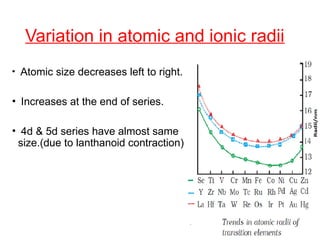
Variation in atomicand ionic radii
• Atomic size decreases left to right.
• Increases at the end of series.
• 4d & 5d series have almost same
size.(due to lanthanoid contraction)
12.
Ionisation Enthalpy
• Generallyincreases due to increases in nuclear charge
from left to right in series .
• IE1<IE2< IE3 in each group due to positive charge on
them.
• IE1 of 5d series is much higher than those of 4d and 3d
due to weak shielding by 4f electrons.
13.
Oxidation State
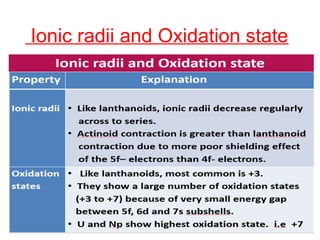
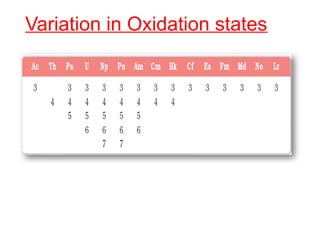
• Transitionelements have variable oxidation state , due
to very small energy difference between(n-1)d and ns
subshell . Electrons from both the subshell take part in
bonding.
• No. of Oxidation states α no. of unpaired electrons.
• Mn shows all oxidation states from +2 to +7 .
14.
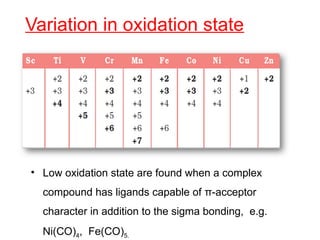
Variation in oxidationstate
• Low oxidation state are found when a complex
compound has ligands capable of π-acceptor
character in addition to the sigma bonding, e.g.
Ni(CO)4, Fe(CO)5.
15.
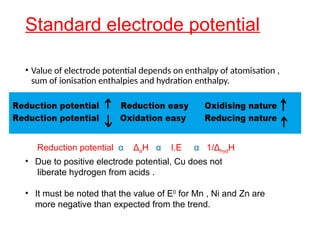
Standard electrode potential
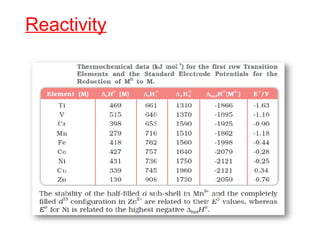
•Value of electrode potential depends on enthalpy of atomisation ,
sum of ionisation enthalpies and hydration enthalpy.
Reduction potential α ΔaH α I.E α 1/ΔhydH
• Due to positive electrode potential, Cu does not
liberate hydrogen from acids .
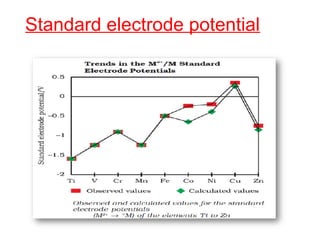
• It must be noted that the value of E0
for Mn , Ni and Zn are
more negative than expected from the trend.
Reactivity
• Though thetransition elements are moderately
electropositive, yet they are not very
reactive
because of their
(i) High heat of sublimation
(ii) High ionisation enthalpy
Magnetic Moment
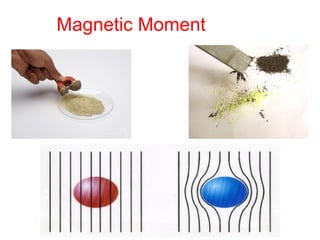
• Transitionmetals and compounds are paramagnetic due to the
presence of unpaired electrons in their d-subshell.
• Substances which do not contain unpaired electrons and repel by
magnetic field are dia-magnetic.
• Weakly attracted-----Paramagnetic
• Strongly attracted-----Ferromagnetic
• The spin only magnetic moment can be calculated by the formula
µ=√ n(n+2) BM where n is the no .of unpaired electrons.
Outline
General characteristicsof d-Block elements:
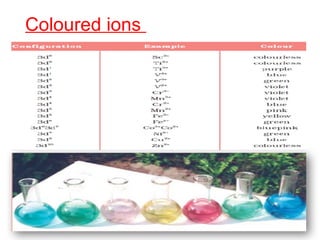
• Formation of coloured ions.
• Formation of complex compound.
• Catalytic property.
• Formation of interstitial compounds.
• Alloy formation.
23.
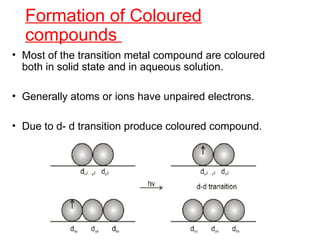
Formation of Coloured
compounds
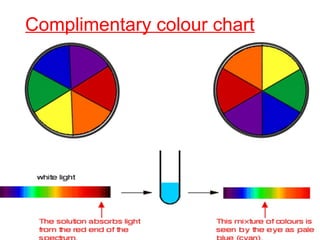
•Most of the transition metal compound are coloured
both in solid state and in aqueous solution.
• Generally atoms or ions have unpaired electrons.
• Due to d- d transition produce coloured compound.
Complex Formation
• Thetendency to form complex compounds is due to-
• Small size of the ion
• High charge on the transition metal ion.
• The availability of d orbitals for accommodating
electrons donated by the ligands.
• Cu2+
(aq) + 4 NH3 (aq) [Cu(NH3)4]2+
(aq)
(blue) (deep blue)
• AgCl (s) + 2 NH3 (aq) → [Ag (NH3)2]Cl (aq)
(white ppt) (Colourless )
28.
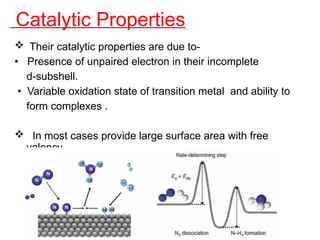
Catalytic Properties
Theircatalytic properties are due to-
• Presence of unpaired electron in their incomplete
d-subshell.
• Variable oxidation state of transition metal and ability to
form complexes .
In most cases provide large surface area with free
valency .
29.
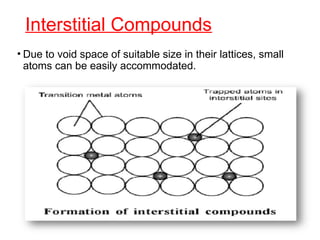
Interstitial Compounds
• Dueto void space of suitable size in their lattices, small
atoms can be easily accommodated.
30.
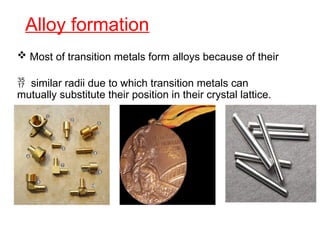
Alloy formation
Mostof transition metals form alloys because of their
similar radii due to which transition metals can
mutually substitute their position in their crystal lattice.
31.
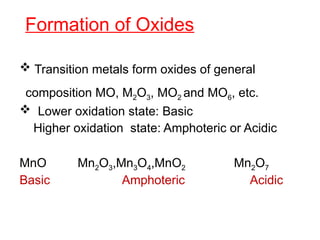
Formation of Oxides
Transition metals form oxides of general
composition MO, M2O3, MO2 and MO6, etc.
Lower oxidation state: Basic
Higher oxidation state: Amphoteric or Acidic
MnO Mn2O3,Mn3O4,MnO2 Mn2O7
Basic Amphoteric Acidic
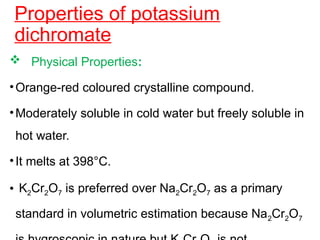
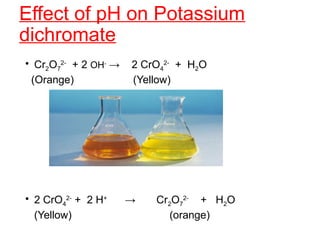
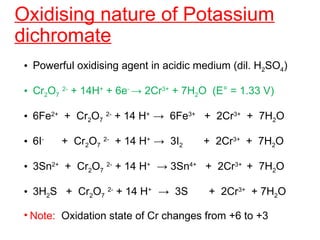
Properties of potassium
dichromate
Physical Properties:
•Orange-red coloured crystalline compound.
•Moderately soluble in cold water but freely soluble in
hot water.
•It melts at 398°C.
• K2Cr2O7 is preferred over Na2Cr2O7 as a primary
standard in volumetric estimation because Na2Cr2O7
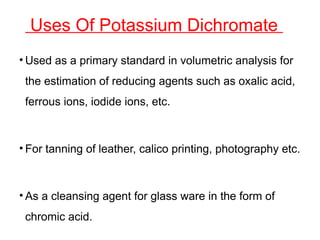
Uses Of PotassiumDichromate
• Used as a primary standard in volumetric analysis for
the estimation of reducing agents such as oxalic acid,
ferrous ions, iodide ions, etc.
• For tanning of leather, calico printing, photography etc.
• As a cleansing agent for glass ware in the form of
chromic acid.
Properties
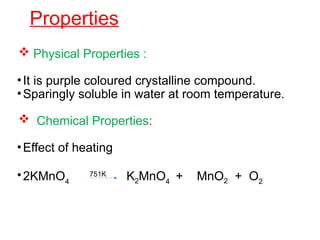
Physical Properties:
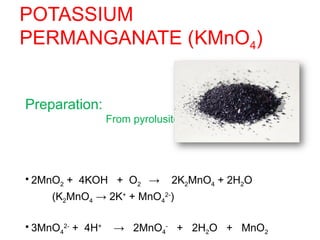
•It is purple coloured crystalline compound.
•Sparingly soluble in water at room temperature.
Chemical Properties:
•Effect of heating
•2KMnO4
751K
K2MnO4
+ MnO2 + O2
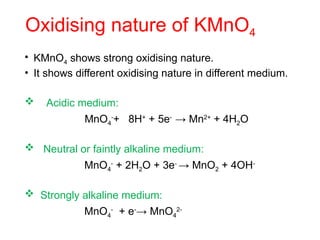
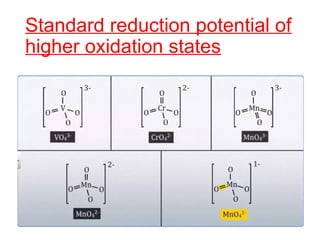
Oxidising nature ofKMnO4
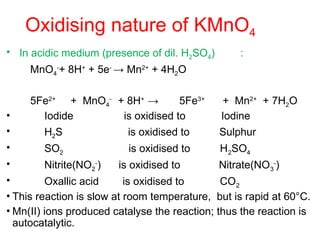
• In acidic medium (presence of dil. H2SO4) :
MnO4
-
+ 8H+
+ 5e-
→ Mn2+
+ 4H2O
5Fe2+
+ MnO4
-
+ 8H+
→ 5Fe3+
+ Mn2+
+ 7H2O
• Iodide is oxidised to Iodine
• H2S is oxidised to Sulphur
• SO2 is oxidised to H2SO4
• Nitrite(NO2
-
) is oxidised to Nitrate(NO3
-
)
• Oxallic acid is oxidised to CO2
• This reaction is slow at room temperature, but is rapid at 60°C.
• Mn(II) ions produced catalyse the reaction; thus the reaction is
autocatalytic.
44.
Oxidising nature ofKMnO4
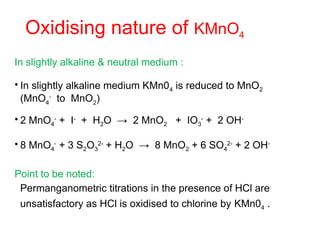
In slightly alkaline & neutral medium :
• In slightly alkaline medium KMn04 is reduced to MnO2
(MnO4
-
to MnO2
)
• 2 MnO4
-
+ I-
+ H2O → 2 MnO2 + IO3
-
+ 2 OH-
• 8 MnO4
-
+ 3 S2O3
2-
+ H2O → 8 MnO2 + 6 SO4
2-
+ 2 OH-
Point to be noted:
Permanganometric titrations in the presence of HCl are
unsatisfactory as HCl is oxidised to chlorine by KMn04 .
45.
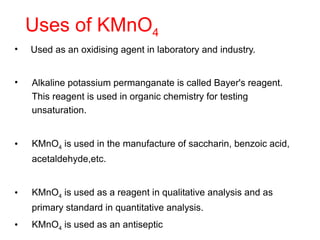
Uses of KMnO4
•Used as an oxidising agent in laboratory and industry.
• Alkaline potassium permanganate is called Bayer's reagent.
This reagent is used in organic chemistry for testing
unsaturation.
• KMnO4 is used in the manufacture of saccharin, benzoic acid,
acetaldehyde,etc.
• KMnO4 is used as a reagent in qualitative analysis and as
primary standard in quantitative analysis.
• KMnO4 is used as an antiseptic
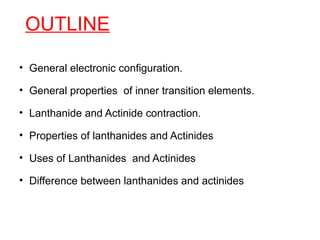
OUTLINE
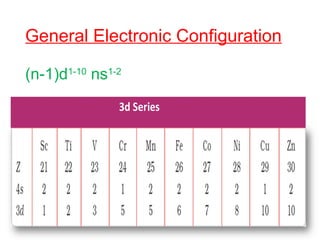
• General electronicconfiguration.
• General properties of inner transition elements.
• Lanthanide and Actinide contraction.
• Properties of lanthanides and Actinides
• Uses of Lanthanides and Actinides
• Difference between lanthanides and actinides
49.
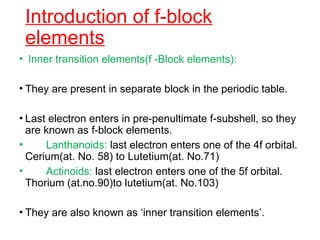
Introduction of f-block
elements
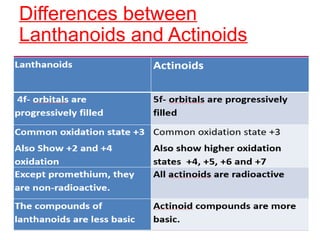
•Inner transition elements(f -Block elements):
• They are present in separate block in the periodic table.
• Last electron enters in pre-penultimate f-subshell, so they
are known as f-block elements.
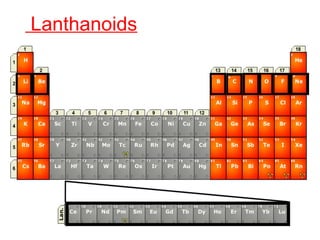
• Lanthanoids: last electron enters one of the 4f orbital.
Cerium(at. No. 58) to Lutetium(at. No.71)
• Actinoids: last electron enters one of the 5f orbital.
Thorium (at.no.90)to lutetium(at. No.103)
• They are also known as ‘inner transition elements’.
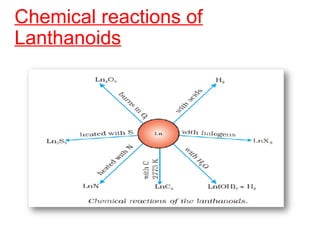
Lanthanoids
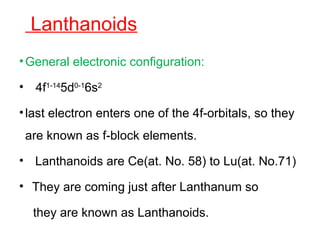
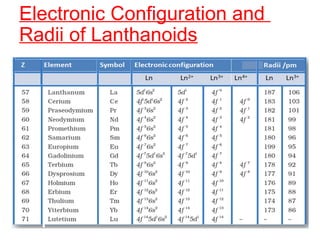
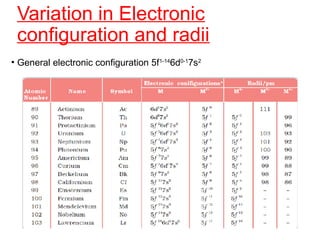
•General electronic configuration:
•4f1-14
5d0-1
6s2
•last electron enters one of the 4f-orbitals, so they
are known as f-block elements.
• Lanthanoids are Ce(at. No. 58) to Lu(at. No.71)
• They are coming just after Lanthanum so
they are known as Lanthanoids.
Lanthanoid Contraction
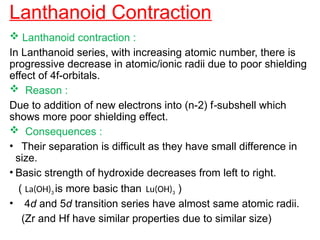
Lanthanoidcontraction :
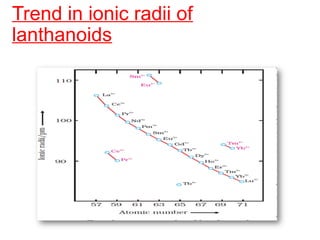
In Lanthanoid series, with increasing atomic number, there is
progressive decrease in atomic/ionic radii due to poor shielding
effect of 4f-orbitals.
Reason :
Due to addition of new electrons into (n-2) f-subshell which
shows more poor shielding effect.
Consequences :
• Their separation is difficult as they have small difference in
size.
• Basic strength of hydroxide decreases from left to right.
( La(OH)3 is more basic than Lu(OH)3 )
• 4d and 5d transition series have almost same atomic radii.
(Zr and Hf have similar properties due to similar size)
Physical properties of
Lanthanoids
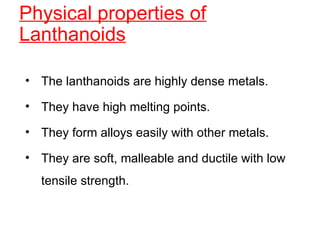
•The lanthanoids are highly dense metals.
• They have high melting points.
• They form alloys easily with other metals.
• They are soft, malleable and ductile with low
tensile strength.
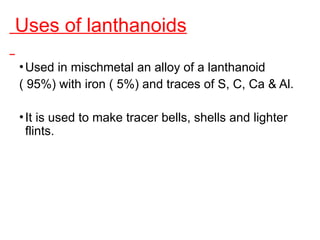
Uses of lanthanoids
•Usedin mischmetal an alloy of a lanthanoid
( 95%) with iron ( 5%) and traces of S, C, Ca & Al.
•It is used to make tracer bells, shells and lighter
flints.
59.
Actinoids
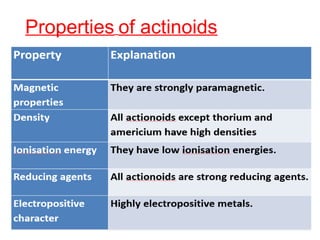
• The actinoidsinclude the fourteen elements from
Th(at.no.90) to Lr(at.no.103)
•The actinoids are radioactive elements.
•The earlier members have relatively long half-
lives, latter ones have half life values ranging
from a day to 3 minutes for lawrencium (Z =103).
Uses
• Uses ofactinoids :
• Th is used in atomic reactor and
treatment of cancer.
• U and Pu are used as fuel in nuclear
reactor.
66.
Summary
• Transition (d-block ) elements.
• Transition series.
• General electronic configuration.
• Trends of properties in series.
• General characteristics
67.
General characteristicsof d-Block elements:
• Formation of coloured ions.
• Formation of complex compound.
• Catalytic property.
• Formation of interstitial compounds.
• Alloy formation.
68.
Potassium dichromate:
Methodsof preparation , Properties and Uses.
Potassium permanganate:
Methods of preparation , Properties and Uses.
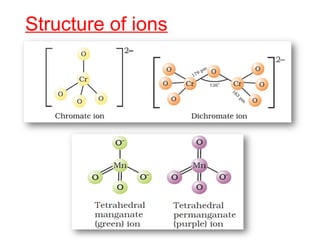
Structure of Permanganate and Dichromate ions.
69.
• General propertiesof inner transition elements.
• General electronic configuration.
• Lanthanoid and Actinoids contraction.
• Properties of lanthanoids and Actinoids
• Uses of Lanthanoids and Actinoids
• Differences between lanthanoids and Actinoids
70.
Home Assignment
Account forthe following:
• Transition elements exhibit higher enthalpies of atomization.
• Transition metals show paramagnetic behaviour.
• Transition metal ions form complexs .
• Transition metals form interstitial compounds.
• Most of the transition metals form alloys.
• Transition element form generally coloured compounds
• Transition elements show variable oxidation state.
71.
• How Potassiumdichromate is prepare from Chromite
ore.
• Write the chemical reactions involved in the preparation
of potassium permanganate.
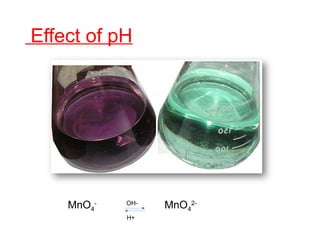
• The chromates and dichromates are interconvertible in
aqueous solution depending upon pH of solution. Give
reactions.
• What is meant by ‘disproportionation of an oxidation
state ? Give two example.
72.
• Give reasonsfor the following questions:
• Chemistry of all the lanthanoids are quite similar.
• Size of trivalent lanthanoid cations decreases with increase
in the atomic number.
• It is difficult to separate lanthanoid elements in pure state.
• Ce4+
in aqueous solution is a good oxidizing agent.
• Ce3+
can be easily oxidized to Ce4+
.
• d-block elements exhibit more oxidation states than
f - block elements

![Complex Formation
• The tendency to form complex compounds is due to-
• Small size of the ion
• High charge on the transition metal ion.
• The availability of d orbitals for accommodating
electrons donated by the ligands.
• Cu2+
(aq) + 4 NH3 (aq) [Cu(NH3)4]2+
(aq)
(blue) (deep blue)
• AgCl (s) + 2 NH3 (aq) → [Ag (NH3)2]Cl (aq)
(white ppt) (Colourless )](https://image.slidesharecdn.com/8dandfblockelements-250917051302-3751c8f1/85/8-D-and-F-Block-elements-Class-12th-Chemistry-Chapter-pptx-27-320.jpg)