Cybersecurity for
Emergency Managers
Cybersecurity is everyone’s problem
• Cybersecurity is NOT
just IT’s problem.
IT
Emergency Management
Law Enforcement
And everyone in your
organization
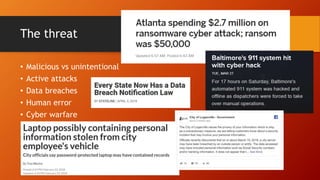
The threat
• Malicious vs unintentional
• Active attacks
• Data breaches
• Human error
• Cyber warfare
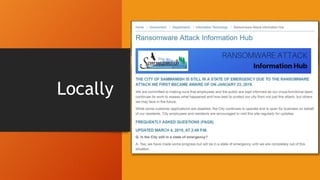
Locally
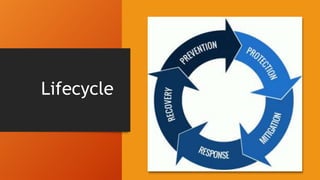
Lifecycle
Prevention
• What have you done to
prepare?
• What policies are in place?
• What training is in place?
• How are the policies
enforced?
• THINGS YOU MUST HAVE
• Emergency Operations Plan
• Cybersecurity Policy
• Acceptable Use Policy
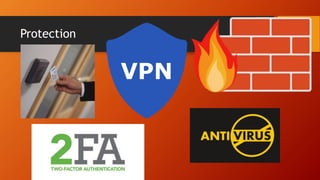
Protection
Mitigation
• What steps have you
taken?
• What steps can you take?
• Insurance
• Backups
• Redundancy
• Monitoring
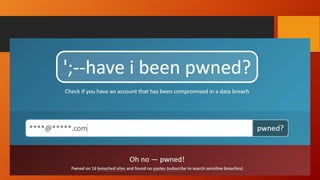
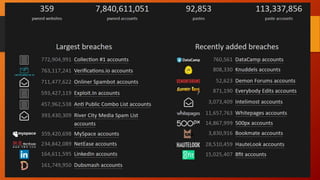
• https://haveibeenpwned.com
• Early Reporting
• Training
Response
Do you have a
response plan?
Does everybody
know how to
recognize an
incident?
Does your staff
know what to do
if they suspect
an incident?
Who do you call
for help?
Recovery
What’s your recovery plan?
Beyond just the technology
Who do you call for help?
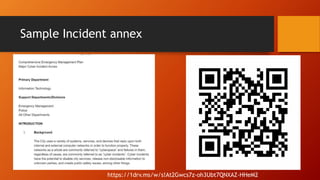
Sample Incident annex
https://1drv.ms/w/s!At2Gwcs7z-oh3Ubt7QNXAZ-HHeM2
References
• National Cyber Incident Response Plan, Department of Homeland Security,
2016
• Computer Security Incident Handling Guide (Revision 2) National Institute of
Standards and Technology, 2012
• Washington State Significant Cyber Incident Annex, Washington Military
Department – Emergency Management Division, 2015
• ISO/IEC 27032 – Information Technology – Security techniques – Guidelines
for cybersecurity, International Standards Organization, 2012
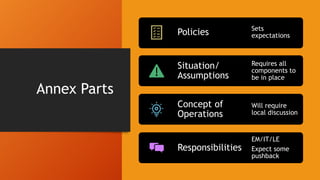
Annex Parts
Policies Sets
expectations
Situation/
Assumptions
Requires all
components to
be in place
Concept of
Operations
Will require
local discussion
Responsibilities
EM/IT/LE
Expect some
pushback
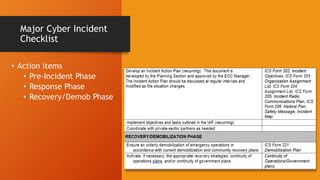
Major Cyber Incident
Checklist
• Action items
• Pre-Incident Phase
• Response Phase
• Recovery/Demob Phase
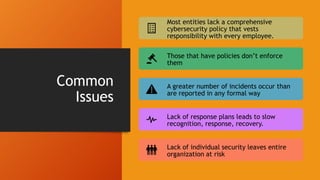
Common
Issues
Most entities lack a comprehensive
cybersecurity policy that vests
responsibility with every employee.
Those that have policies don’t enforce
them
A greater number of incidents occur than
are reported in any formal way
Lack of response plans leads to slow
recognition, response, recovery.
Lack of individual security leaves entire
organization at risk
Human Factor
Phishing, social
engineering
• Enabled by agency and
employee use of social
media and other things
Careless info
access/dissemination
• Public spaces
• Public wifi
• Unlocked computers
• Lack of caution
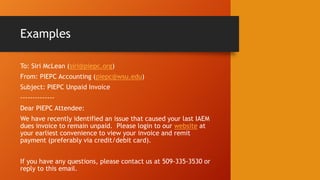
Examples
To: Siri McLean (siri@piepc.org)
From: PIEPC Accounting (piepc@wsu.edu)
Subject: PIEPC Unpaid Invoice
--------------
Dear PIEPC Attendee:
We have recently identified an issue that caused your last IAEM
dues invoice to remain unpaid. Please login to our website at
your earliest convenience to view your invoice and remit
payment (preferably via credit/debit card).
If you have any questions, please contact us at 509-335-3530 or
reply to this email.
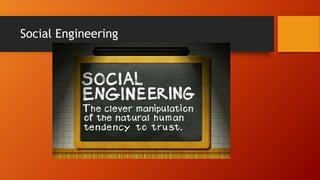
Social Engineering
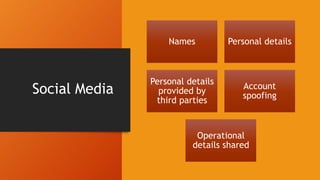
Social Media
Names Personal details
Personal details
provided by
third parties
Account
spoofing
Operational
details shared
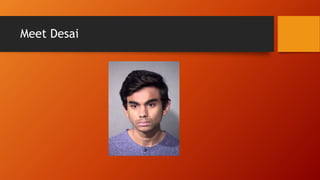
Meet Desai
Meetkumar Hiteshbhai Desai
• Investigators traced the calls and discovered they
originated from a link posted to Twitter and YouTube.
The link was to a site named "Meet Desai" and its domain
was hosted out of San Francisco. When the link was
clicked, it continually called 911 and would not let the
caller hang up.
• His page received 151,000 hits
• Desai said his intent was to make a non-harmful, yet
annoying, bug that was meant to be funny, officials said.
It was not
funny
• Surprise Police Department notified
the Maricopa County Sheriff's Office
of more than 100 hang-up 911 calls
within a few minutes.
• The volume put authorities "in
immediate danger of losing service
to their switches."
• The emergency systems for the
nearby Peoria Police Department
and the Maricopa County Sheriff's
Office also received a large number
of repeated calls.
• Agencies in California and Texas
were also affected.
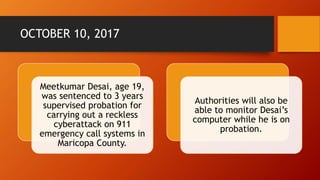
OCTOBER 10, 2017
Meetkumar Desai, age 19,
was sentenced to 3 years
supervised probation for
carrying out a reckless
cyberattack on 911
emergency call systems in
Maricopa County.
Authorities will also be
able to monitor Desai’s
computer while he is on
probation.
Other Examples
This Photo by Unknown Author is licensed under CC BY-NC-SA
QUESTIONS?
Contact me:
Sarah Miller, MPA, CEM
President, IAEM Region 10
Past Chair, IAEM Emerging Tech Caucus
sarah@skmillerconsulting.com
twitter: @scba

Cybersecurity for Emergency Managers

  • 1.
  • 2.
    Cybersecurity is everyone’sproblem • Cybersecurity is NOT just IT’s problem. IT Emergency Management Law Enforcement And everyone in your organization
  • 3.
    The threat • Maliciousvs unintentional • Active attacks • Data breaches • Human error • Cyber warfare
  • 4.
  • 7.
  • 8.
    Prevention • What haveyou done to prepare? • What policies are in place? • What training is in place? • How are the policies enforced? • THINGS YOU MUST HAVE • Emergency Operations Plan • Cybersecurity Policy • Acceptable Use Policy
  • 9.
  • 10.
    Mitigation • What stepshave you taken? • What steps can you take? • Insurance • Backups • Redundancy • Monitoring • https://haveibeenpwned.com • Early Reporting • Training
  • 11.
    Response Do you havea response plan? Does everybody know how to recognize an incident? Does your staff know what to do if they suspect an incident? Who do you call for help?
  • 12.
    Recovery What’s your recoveryplan? Beyond just the technology Who do you call for help?
  • 13.
  • 14.
    References • National CyberIncident Response Plan, Department of Homeland Security, 2016 • Computer Security Incident Handling Guide (Revision 2) National Institute of Standards and Technology, 2012 • Washington State Significant Cyber Incident Annex, Washington Military Department – Emergency Management Division, 2015 • ISO/IEC 27032 – Information Technology – Security techniques – Guidelines for cybersecurity, International Standards Organization, 2012
  • 15.
    Annex Parts Policies Sets expectations Situation/ Assumptions Requiresall components to be in place Concept of Operations Will require local discussion Responsibilities EM/IT/LE Expect some pushback
  • 16.
    Major Cyber Incident Checklist •Action items • Pre-Incident Phase • Response Phase • Recovery/Demob Phase
  • 17.
    Common Issues Most entities lacka comprehensive cybersecurity policy that vests responsibility with every employee. Those that have policies don’t enforce them A greater number of incidents occur than are reported in any formal way Lack of response plans leads to slow recognition, response, recovery. Lack of individual security leaves entire organization at risk
  • 18.
    Human Factor Phishing, social engineering •Enabled by agency and employee use of social media and other things Careless info access/dissemination • Public spaces • Public wifi • Unlocked computers • Lack of caution
  • 19.
    Examples To: Siri McLean(siri@piepc.org) From: PIEPC Accounting (piepc@wsu.edu) Subject: PIEPC Unpaid Invoice -------------- Dear PIEPC Attendee: We have recently identified an issue that caused your last IAEM dues invoice to remain unpaid. Please login to our website at your earliest convenience to view your invoice and remit payment (preferably via credit/debit card). If you have any questions, please contact us at 509-335-3530 or reply to this email.
  • 21.
  • 22.
    Social Media Names Personaldetails Personal details provided by third parties Account spoofing Operational details shared
  • 23.
  • 24.
    Meetkumar Hiteshbhai Desai •Investigators traced the calls and discovered they originated from a link posted to Twitter and YouTube. The link was to a site named "Meet Desai" and its domain was hosted out of San Francisco. When the link was clicked, it continually called 911 and would not let the caller hang up. • His page received 151,000 hits • Desai said his intent was to make a non-harmful, yet annoying, bug that was meant to be funny, officials said.
  • 25.
    It was not funny •Surprise Police Department notified the Maricopa County Sheriff's Office of more than 100 hang-up 911 calls within a few minutes. • The volume put authorities "in immediate danger of losing service to their switches." • The emergency systems for the nearby Peoria Police Department and the Maricopa County Sheriff's Office also received a large number of repeated calls. • Agencies in California and Texas were also affected.
  • 26.
    OCTOBER 10, 2017 MeetkumarDesai, age 19, was sentenced to 3 years supervised probation for carrying out a reckless cyberattack on 911 emergency call systems in Maricopa County. Authorities will also be able to monitor Desai’s computer while he is on probation.
  • 27.
    Other Examples This Photoby Unknown Author is licensed under CC BY-NC-SA
  • 28.
    QUESTIONS? Contact me: Sarah Miller,MPA, CEM President, IAEM Region 10 Past Chair, IAEM Emerging Tech Caucus sarah@skmillerconsulting.com twitter: @scba