CYBERNETICS AND COMUNICATION
DEPT:LIBRARY AND INFORMATION
SCIENCE
YEAR:2019-2020
What is cybernetics?
 Cybernetics began as the science of communication and control in
the animal, machine, and society; i.e. special types of systems. It
operates on two levels: study of an observed system & study of the
people studying a system. Originated from R & D process in the
development of the atomic bomb- applied scientific theory &
principles in real-world setting.
Cybernetics is a transdisciplinary approach for exploring regulatory
systems—their structures, constraints, and possibilities. .. Cybernetics
includes the study of feedback, and derived concepts such as communication
and control in living organisms, machines and organizations including self-
organization.
Who is the Father of Cybernetics?
Norbert Wiener
In general it is Norbert Wiener who is considered the founding father of
cybernetics – he also coined the word “cybernetics” which is derived from the
Greek word kybernetes (steersman).
 The word cybernetics comes from Greek κυβερνητική (kybernētikḗ),
meaning "governance", i.e., all that are pertinent to κυβερνάω (kybernáō),
the latter meaning "to steer, navigate or govern", hence κυβέρνησις
(kybérnēsis), meaning "government", is the government while κυβερνήτης
(kybernḗtēs) is the governor or "helmperson" of the "ship".
 Cybernetics as the theory of control mechanisms in technology and nature is
founded on the concepts of information and feedback, but as part of a general
theory of systems.
 EXAMPLES OF CYBERNETICS
 An example of a cybernetic system is the home
furnace that responds via thermostatic control to
changes in temperature for the purpose of
maintaining a reasonably constant temperature
in the home.
 In Automobiles the Automatic Cruise Control can
also be considered as example of Cybernetics.
Definitions
Cybernetics has been defined in a variety of ways, by a variety of people; from a variety
of discipline. cybernetician Stuart unplay reports some notable definition:
“science concerned with the study of systems of any nature which are capable of
receiving, storing and processing information so as to use it for control”-
A.N.Kolmogorow.
‘“the art of steersmanship’ :deals with all forms of behavior in so far as they regular ,or
determinate, or reproducible: stand to the real machine-electronic, mechanical, neural
,or economic-much as geometry stands to real object in our terrestraial space; offers a
method for the scientific treatment of the system in which complexity is outstanding and
too important to be ignored.”-W.Ross Ashby.
Methodology
Consideration of cybernetics as the science that studies the general
principles of CC in the animal and the machine has the merit and the
shortcoming that it covers a wide class of study objects. Biological
objects have significant differences from technical objects: both have
their peculiarities of CC
Communication
In the most fundamental sense , communication involves implicitly the
transmission of information from one point to another through a succession of
processed, as described here :
1. The generation of through pattern or image in the mind of an originator.
2. The description of that image, with a certain measure of precision, by a set
of aural or visual symbol
3. The encoding of these symbols in a form that is suitable for transmission
over physical medium of interest.
4. The transmission of the encoded symbols to the desired destination. There
are, of course, many other forms of communication that do not directly involve
the human mind in real time. For Ex, in computer communication involving
communication between two or more computers, human decisions may enter
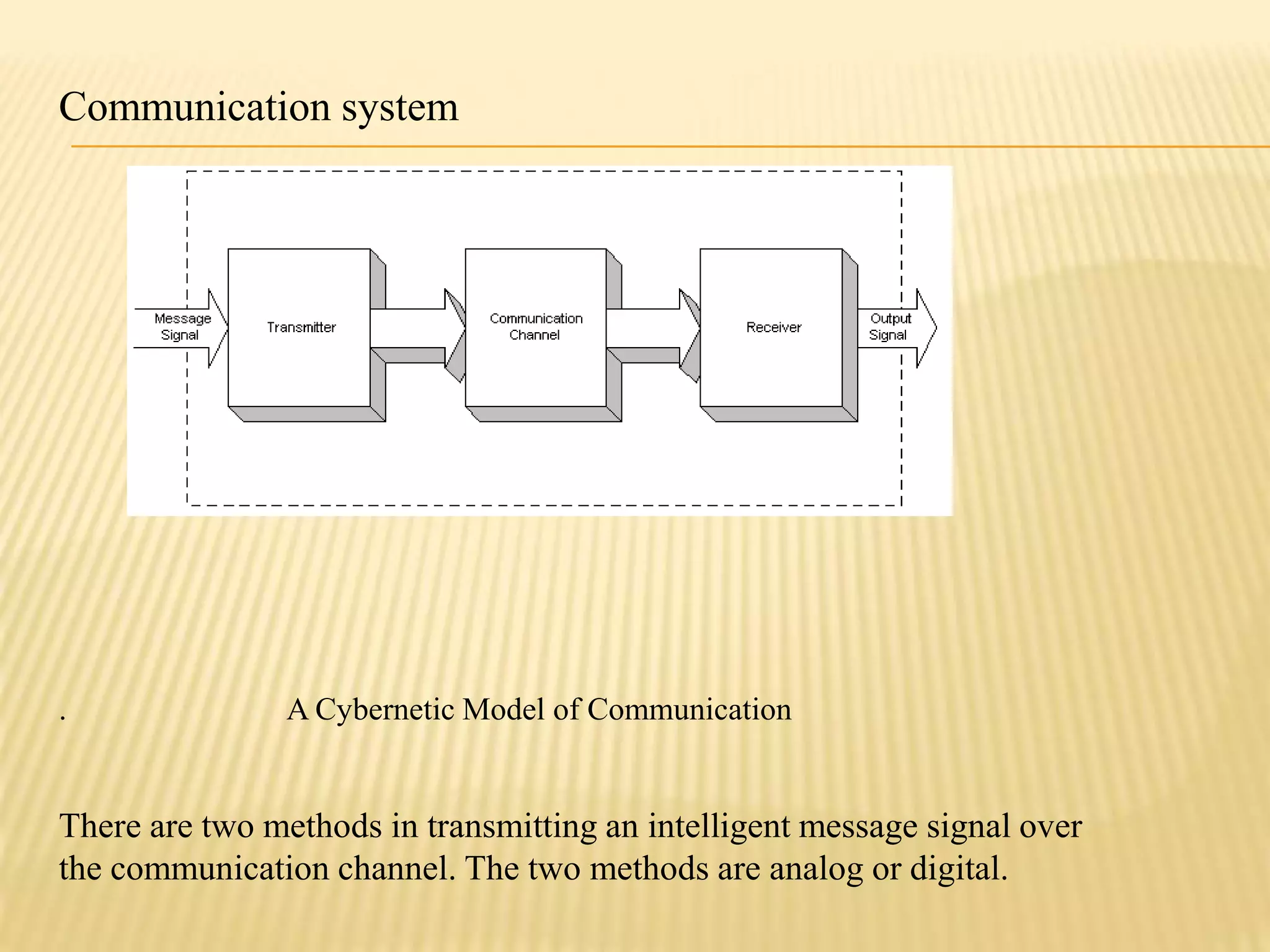
Communication system
. A Cybernetic Model of Communication
There are two methods in transmitting an intelligent message signal over
the communication channel. The two methods are analog or digital.
Feedback
The central concept in cybernetics is feedback: the ability of systems to receive
information from the environment about their own behavior and to adjust their
behavior to conform to the system's objective. In other words, the system self-
regulates to the extent that it can observe its behavior, compare actual behavior with
desired behavior, and correct discre-pancy. In machines the desired behavior needs to
be programmed into the system.
Conclusion
Cybernetics looks at the major patterns of values found in the political system.
Cybernetics also assesses realistically present and prospective decision
making capacity of the system. Its criteria are objective enough to have
universal adaptability, although the technological advancement in
communication is not uniform, it can still be adaptable in that both social and
technological phenomena of communication are involved. Superiority in
technological advancement helps only to facilitate the study.The interesting
part of the model is its use of the middle level power of the communication
channel in the decision making process.

Cybernetics and communication

  • 1.
    CYBERNETICS AND COMUNICATION DEPT:LIBRARYAND INFORMATION SCIENCE YEAR:2019-2020
  • 2.
    What is cybernetics? Cybernetics began as the science of communication and control in the animal, machine, and society; i.e. special types of systems. It operates on two levels: study of an observed system & study of the people studying a system. Originated from R & D process in the development of the atomic bomb- applied scientific theory & principles in real-world setting. Cybernetics is a transdisciplinary approach for exploring regulatory systems—their structures, constraints, and possibilities. .. Cybernetics includes the study of feedback, and derived concepts such as communication and control in living organisms, machines and organizations including self- organization.
  • 3.
    Who is theFather of Cybernetics? Norbert Wiener In general it is Norbert Wiener who is considered the founding father of cybernetics – he also coined the word “cybernetics” which is derived from the Greek word kybernetes (steersman).
  • 4.
     The wordcybernetics comes from Greek κυβερνητική (kybernētikḗ), meaning "governance", i.e., all that are pertinent to κυβερνάω (kybernáō), the latter meaning "to steer, navigate or govern", hence κυβέρνησις (kybérnēsis), meaning "government", is the government while κυβερνήτης (kybernḗtēs) is the governor or "helmperson" of the "ship".  Cybernetics as the theory of control mechanisms in technology and nature is founded on the concepts of information and feedback, but as part of a general theory of systems.
  • 5.
     EXAMPLES OFCYBERNETICS  An example of a cybernetic system is the home furnace that responds via thermostatic control to changes in temperature for the purpose of maintaining a reasonably constant temperature in the home.  In Automobiles the Automatic Cruise Control can also be considered as example of Cybernetics.
  • 6.
    Definitions Cybernetics has beendefined in a variety of ways, by a variety of people; from a variety of discipline. cybernetician Stuart unplay reports some notable definition: “science concerned with the study of systems of any nature which are capable of receiving, storing and processing information so as to use it for control”- A.N.Kolmogorow. ‘“the art of steersmanship’ :deals with all forms of behavior in so far as they regular ,or determinate, or reproducible: stand to the real machine-electronic, mechanical, neural ,or economic-much as geometry stands to real object in our terrestraial space; offers a method for the scientific treatment of the system in which complexity is outstanding and too important to be ignored.”-W.Ross Ashby.
  • 7.
    Methodology Consideration of cyberneticsas the science that studies the general principles of CC in the animal and the machine has the merit and the shortcoming that it covers a wide class of study objects. Biological objects have significant differences from technical objects: both have their peculiarities of CC
  • 8.
    Communication In the mostfundamental sense , communication involves implicitly the transmission of information from one point to another through a succession of processed, as described here : 1. The generation of through pattern or image in the mind of an originator. 2. The description of that image, with a certain measure of precision, by a set of aural or visual symbol 3. The encoding of these symbols in a form that is suitable for transmission over physical medium of interest. 4. The transmission of the encoded symbols to the desired destination. There are, of course, many other forms of communication that do not directly involve the human mind in real time. For Ex, in computer communication involving communication between two or more computers, human decisions may enter
  • 9.
    Communication system . ACybernetic Model of Communication There are two methods in transmitting an intelligent message signal over the communication channel. The two methods are analog or digital.
  • 10.
    Feedback The central conceptin cybernetics is feedback: the ability of systems to receive information from the environment about their own behavior and to adjust their behavior to conform to the system's objective. In other words, the system self- regulates to the extent that it can observe its behavior, compare actual behavior with desired behavior, and correct discre-pancy. In machines the desired behavior needs to be programmed into the system.
  • 11.
    Conclusion Cybernetics looks atthe major patterns of values found in the political system. Cybernetics also assesses realistically present and prospective decision making capacity of the system. Its criteria are objective enough to have universal adaptability, although the technological advancement in communication is not uniform, it can still be adaptable in that both social and technological phenomena of communication are involved. Superiority in technological advancement helps only to facilitate the study.The interesting part of the model is its use of the middle level power of the communication channel in the decision making process.