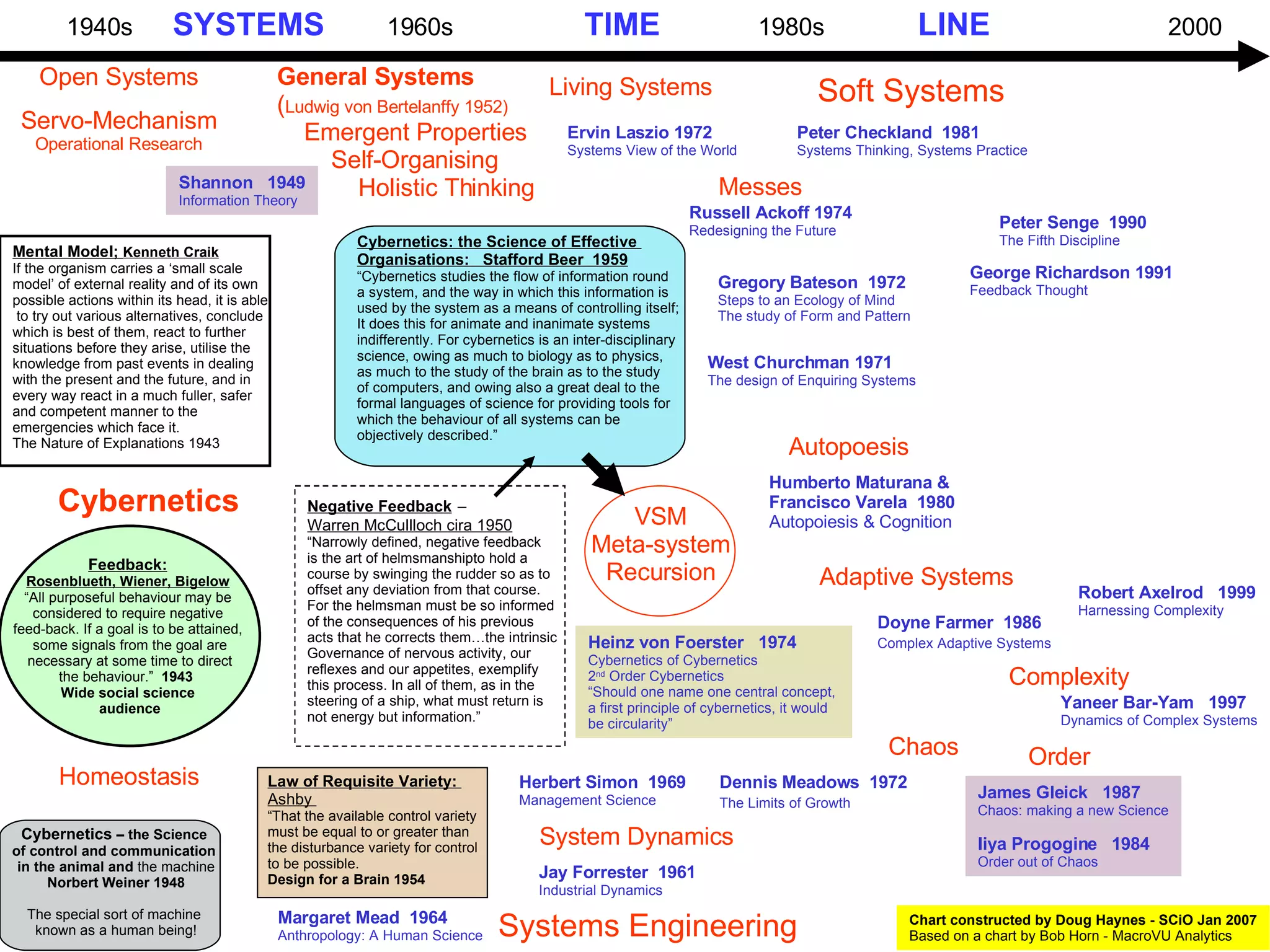
1940s  SYSTEMS  1960s  TIME  1980s  LINE  2000   Feedback:   Rosenblueth, Wiener, Bigelow   “ All purposeful behaviour may be  considered to require negative  feed-back. If a goal is to be attained,  some signals from the goal are necessary at some time to direct  the behaviour.”  1943  Wide social science  audience Open Systems Servo-Mechanism Operational Research Homeostasis General Systems   ( Ludwig von Bertelanffy 1952) Emergent Properties Self-Organising Holistic Thinking Ervin Laszio 1972 Systems View of the World Russell Ackoff 1974 Redesigning the Future  Gregory Bateson  1972 Steps to an Ecology of Mind The study of Form and Pattern West Churchman 1971 The design of Enquiring Systems Shannon  1949 Information Theory Jay Forrester  1961 Industrial Dynamics Dennis Meadows  1972 The Limits of Growth   Margaret Mead  1964 Anthropology: A Human Science Heinz von Foerster  1974 Cybernetics of Cybernetics  2 nd  Order Cybernetics “ Should one name one central concept,  a first principle of cybernetics, it would  be circularity” Humberto Maturana & Francisco Varela  1980 Autopoiesis & Cognition Herbert Simon  1969 Management Science James Gleick  1987 Chaos: making a new Science Iiya Progogine  1984 Order out of Chaos Peter Senge  1990 The Fifth Discipline Peter Checkland  1981 Systems Thinking, Systems Practice Yaneer Bar-Yam  1997 Dynamics of Complex Systems Robert Axelrod  1999 Harnessing Complexity Doyne Farmer  1986 Complex Adaptive Systems   Chaos Soft Systems Order Complexity Cybernetics VSM Meta-system Recursion Living Systems Systems Engineering System Dynamics Autopoesis Messes George Richardson 1991 Feedback Thought Adaptive Systems Chart constructed by Doug Haynes - SCiO Jan 2007 Based on a chart by Bob Horn - MacroVU Analytics  Mental Model;  Kenneth Craik If the organism carries a ‘small scale  model’ of external reality and of its own  possible actions within its head, it is able to try out various alternatives, conclude  which is best of them, react to further  situations before they arise, utilise the  knowledge from past events in dealing  with the present and the future, and in  every way react in a much fuller, safer  and competent manner to the  emergencies which face it. The Nature of Explanations 1943 Cybernetics  – the Science  of control and communication  in the animal and  the machine Norbert Weiner 1948 The special sort of machine  known as a human being! Law of Requisite Variety:  Ashby  “ That the available control variety  must be equal to or greater than  the disturbance variety for control  to be possible. Design for a Brain 1954 Negative Feedback   –  Warren McCullloch cira 1950 “ Narrowly defined, negative feedback  is the art of helmsmanshipto hold a  course by swinging the rudder so as to  offset any deviation from that course.  For the helmsman must be so informed  of the consequences of his previous  acts that he corrects them…the intrinsic  Governance of nervous activity, our  reflexes and our appetites, exemplify  this process. In all of them, as in the  steering of a ship, what must return is  not energy but information.” Cybernetics: the Science of Effective  Organisations:  Stafford Beer  1959 “ Cybernetics studies the flow of information round a system, and the way in which this information is  used by the system as a means of controlling itself; It does this for animate and inanimate systems  indifferently. For cybernetics is an inter-disciplinary  science, owing as much to biology as to physics,  as much to the study of the brain as to the study  of computers, and owing also a great deal to the  formal languages of science for providing tools for  which the behaviour of all systems can be  objectively described.”
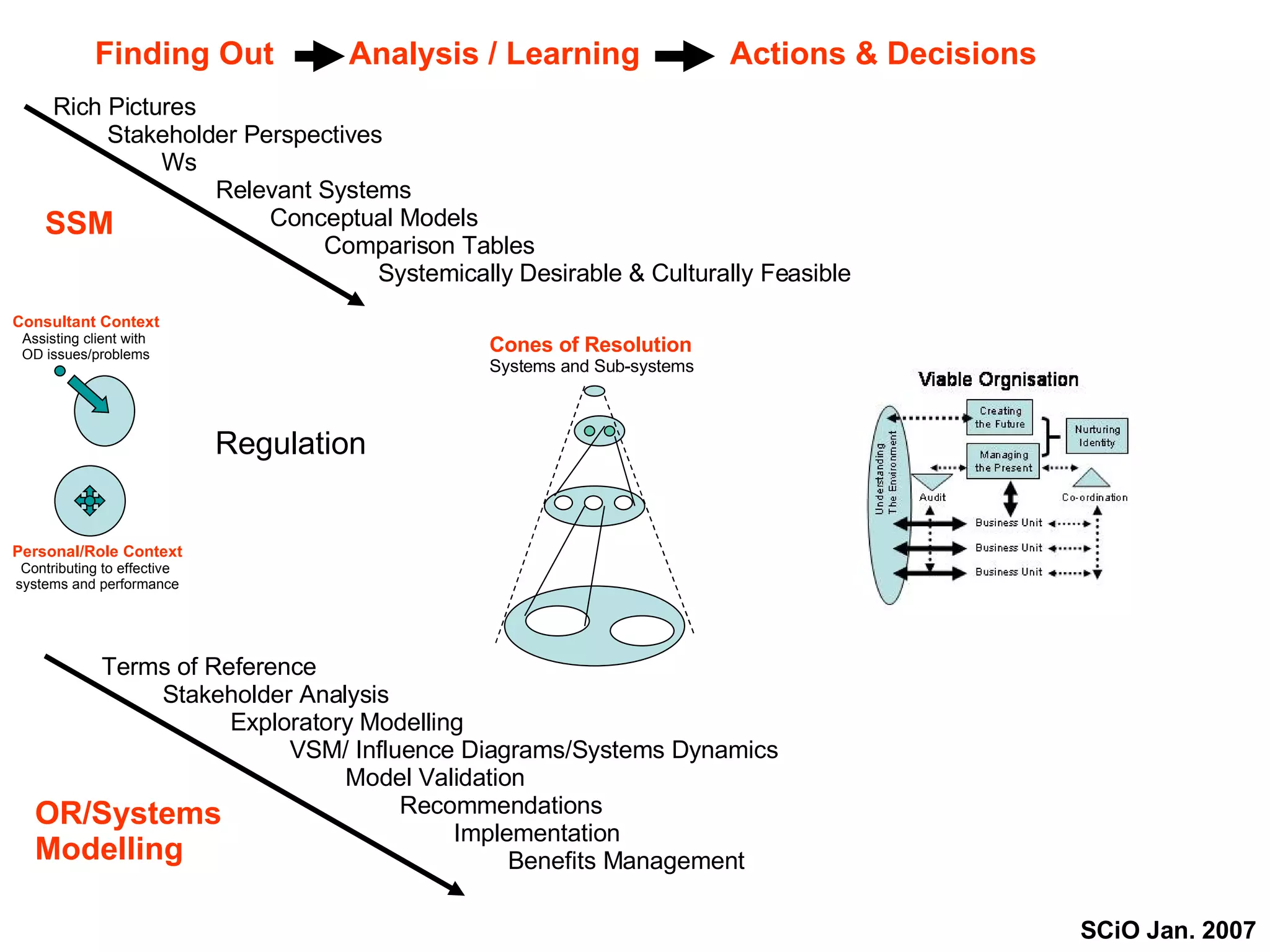
Rich Pictures Stakeholder Perspectives Ws Relevant Systems Conceptual Models Comparison Tables Systemically Desirable & Culturally Feasible Finding Out Analysis / Learning Actions & Decisions SSM Terms of Reference Stakeholder Analysis Exploratory Modelling    VSM/ Influence Diagrams/Systems Dynamics Model Validation Recommendations Implementation Benefits Management Regulation OR/Systems Modelling   SCiO Jan. 2007 Consultant Context Assisting client with  OD issues/problems Personal/Role Context Contributing to effective  systems and performance Cones of Resolution Systems and Sub-systems

Systems Time Line V2

  • 1.
    1940s SYSTEMS 1960s TIME 1980s LINE 2000 Feedback: Rosenblueth, Wiener, Bigelow “ All purposeful behaviour may be considered to require negative feed-back. If a goal is to be attained, some signals from the goal are necessary at some time to direct the behaviour.” 1943 Wide social science audience Open Systems Servo-Mechanism Operational Research Homeostasis General Systems ( Ludwig von Bertelanffy 1952) Emergent Properties Self-Organising Holistic Thinking Ervin Laszio 1972 Systems View of the World Russell Ackoff 1974 Redesigning the Future Gregory Bateson 1972 Steps to an Ecology of Mind The study of Form and Pattern West Churchman 1971 The design of Enquiring Systems Shannon 1949 Information Theory Jay Forrester 1961 Industrial Dynamics Dennis Meadows 1972 The Limits of Growth Margaret Mead 1964 Anthropology: A Human Science Heinz von Foerster 1974 Cybernetics of Cybernetics 2 nd Order Cybernetics “ Should one name one central concept, a first principle of cybernetics, it would be circularity” Humberto Maturana & Francisco Varela 1980 Autopoiesis & Cognition Herbert Simon 1969 Management Science James Gleick 1987 Chaos: making a new Science Iiya Progogine 1984 Order out of Chaos Peter Senge 1990 The Fifth Discipline Peter Checkland 1981 Systems Thinking, Systems Practice Yaneer Bar-Yam 1997 Dynamics of Complex Systems Robert Axelrod 1999 Harnessing Complexity Doyne Farmer 1986 Complex Adaptive Systems Chaos Soft Systems Order Complexity Cybernetics VSM Meta-system Recursion Living Systems Systems Engineering System Dynamics Autopoesis Messes George Richardson 1991 Feedback Thought Adaptive Systems Chart constructed by Doug Haynes - SCiO Jan 2007 Based on a chart by Bob Horn - MacroVU Analytics Mental Model; Kenneth Craik If the organism carries a ‘small scale model’ of external reality and of its own possible actions within its head, it is able to try out various alternatives, conclude which is best of them, react to further situations before they arise, utilise the knowledge from past events in dealing with the present and the future, and in every way react in a much fuller, safer and competent manner to the emergencies which face it. The Nature of Explanations 1943 Cybernetics – the Science of control and communication in the animal and the machine Norbert Weiner 1948 The special sort of machine known as a human being! Law of Requisite Variety: Ashby “ That the available control variety must be equal to or greater than the disturbance variety for control to be possible. Design for a Brain 1954 Negative Feedback – Warren McCullloch cira 1950 “ Narrowly defined, negative feedback is the art of helmsmanshipto hold a course by swinging the rudder so as to offset any deviation from that course. For the helmsman must be so informed of the consequences of his previous acts that he corrects them…the intrinsic Governance of nervous activity, our reflexes and our appetites, exemplify this process. In all of them, as in the steering of a ship, what must return is not energy but information.” Cybernetics: the Science of Effective Organisations: Stafford Beer 1959 “ Cybernetics studies the flow of information round a system, and the way in which this information is used by the system as a means of controlling itself; It does this for animate and inanimate systems indifferently. For cybernetics is an inter-disciplinary science, owing as much to biology as to physics, as much to the study of the brain as to the study of computers, and owing also a great deal to the formal languages of science for providing tools for which the behaviour of all systems can be objectively described.”
  • 2.
    Rich Pictures StakeholderPerspectives Ws Relevant Systems Conceptual Models Comparison Tables Systemically Desirable & Culturally Feasible Finding Out Analysis / Learning Actions & Decisions SSM Terms of Reference Stakeholder Analysis Exploratory Modelling VSM/ Influence Diagrams/Systems Dynamics Model Validation Recommendations Implementation Benefits Management Regulation OR/Systems Modelling SCiO Jan. 2007 Consultant Context Assisting client with OD issues/problems Personal/Role Context Contributing to effective systems and performance Cones of Resolution Systems and Sub-systems