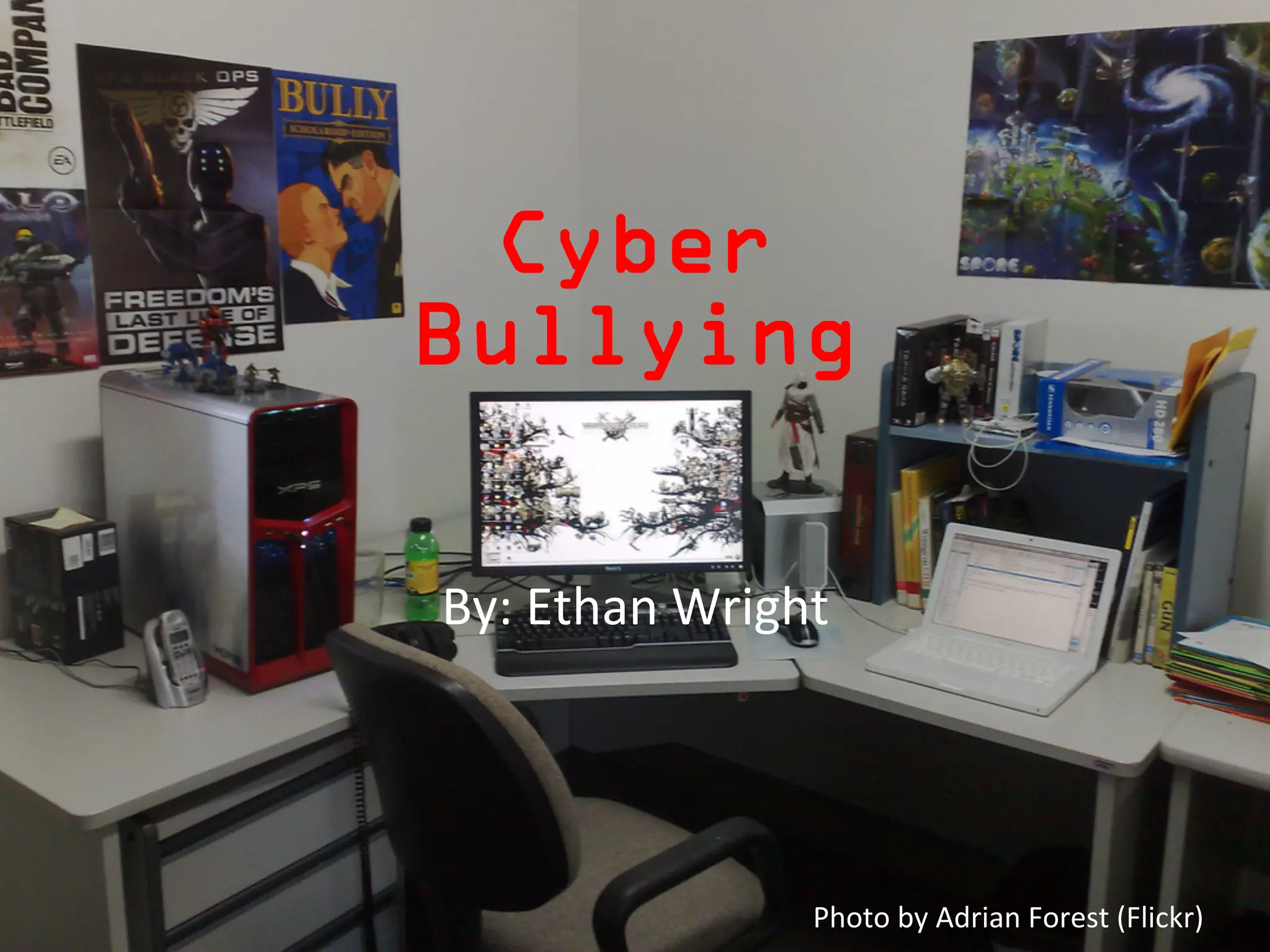
Cyber
Bullying
By:	
  Ethan	
  Wright	
  
Photo	
  by	
  Adrian	
  Forest	
  (Flickr)	
  
Table	
  of	
  Contents	
  
•  Slide	
  3-­‐	
  Defining	
  “Cyber”	
  
•  Slide	
  4-­‐	
  Defining	
  “Bullying”	
  
Slide	
  5-­‐	
  Defining	
  “Cyberbullying”	
  
•  Slide	
  6-­‐	
  Which	
  Way	
  to	
  Go?	
  
•  Slide	
  7-­‐Join	
  the	
  Online	
  Community	
  
•  Slide	
  8-­‐	
  Start	
  of	
  ExploraRon	
  
•  Slide	
  9-­‐Our	
  Own	
  Seats	
  
•  Slide	
  10-­‐	
  ConnecRons	
  
•  Slide	
  11-­‐Dangers	
  are	
  Lurking	
  
•  Slide	
  12-­‐Anger	
  Issues	
  
•  Slide	
  13-­‐No	
  One	
  is	
  Truly	
  Safe	
  
•  Slide	
  14-­‐StaRsRcal	
  Survey	
  
•  Slide	
  15-­‐i-­‐SAFE	
  America	
  Stats	
  
•  Slide	
  16-­‐	
  A	
  Wired	
  World	
  
•  Slide	
  17-­‐We	
  Become	
  the	
  Bullies	
  
•  Slide	
  18-­‐	
  Know	
  Our	
  Limits	
  
•  Slide	
  19-­‐From	
  Bullying	
  to	
  RelaRonships	
  
•  Slide	
  20-­‐	
  How	
  Can	
  We	
  Help	
  Them?	
  
•  Slide	
  21-­‐Kids	
  Help	
  Phone	
  
•  Slide	
  22-­‐	
  Conclusion	
  
•  Slider	
  23-­‐	
  CitaRon	
  Page	
  
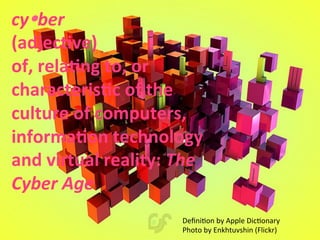
cyŸber	
  
(adjec've)	
  
of,	
  rela'ng	
  to,	
  or	
  
characteris'c	
  of	
  the	
  
culture	
  of	
  computers,	
  
informa'on	
  technology	
  
and	
  virtual	
  reality:	
  The	
  
Cyber	
  Age	
  
DefiniRon	
  by	
  Apple	
  DicRonary	
  
Photo	
  by	
  Enkhtuvshin	
  (Flickr)	
  	
  
DefiniRon	
  by	
  Apple	
  DicRonary	
  
Photo	
  by	
  Lieven	
  Soete	
  (Flickr)	
  
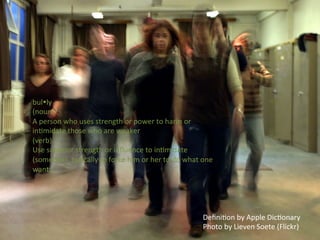
bulŸly	
  
(noun)	
  
A	
  person	
  who	
  uses	
  strength	
  or	
  power	
  to	
  harm	
  or	
  
inRmidate	
  those	
  who	
  are	
  weaker	
  
(verb)	
  
Use	
  superior	
  strength	
  or	
  influence	
  to	
  inRmidate	
  
(someone),	
  typically	
  to	
  force	
  him	
  or	
  her	
  to	
  do	
  what	
  one	
  
wants	
  
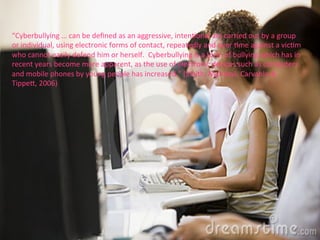
“Cyberbullying	
  …	
  can	
  be	
  defined	
  as	
  an	
  aggressive,	
  intenRonal	
  act	
  carried	
  out	
  by	
  a	
  group	
  
or	
  individual,	
  using	
  electronic	
  forms	
  of	
  contact,	
  repeatedly	
  and	
  over	
  Rme	
  against	
  a	
  vicRm	
  
who	
  cannot	
  easily	
  defend	
  him	
  or	
  herself.	
  	
  Cyberbullying	
  is	
  a	
  form	
  of	
  bullying	
  which	
  has	
  in	
  
recent	
  years	
  become	
  more	
  apparent,	
  as	
  the	
  use	
  of	
  electronic	
  devices	
  such	
  as	
  computers	
  
and	
  mobile	
  phones	
  by	
  young	
  people	
  has	
  increased.”	
  (Smith,	
  Mahdavi,	
  Carvahlo	
  &	
  
Tippef,	
  2006)	
  
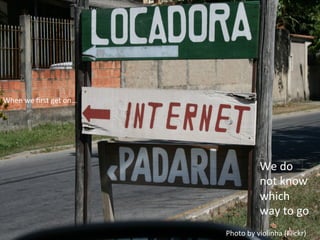
When	
  we	
  first	
  get	
  on…	
  
We	
  do	
  
not	
  know	
  
which	
  
way	
  to	
  go	
  
Photo	
  by	
  violinha	
  (Flickr)	
  
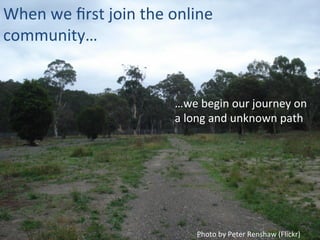
When	
  we	
  first	
  join	
  the	
  online	
  
community…	
  
Photo	
  by	
  Peter	
  Renshaw	
  (Flickr)	
  
…we	
  begin	
  our	
  journey	
  on	
  
a	
  long	
  and	
  unknown	
  path	
  
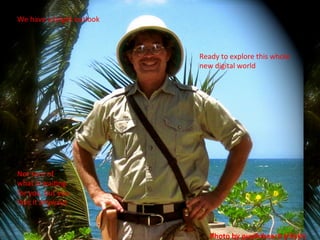
We	
  have	
  a	
  bright	
  outlook	
  
Ready	
  to	
  explore	
  this	
  whole	
  
new	
  digital	
  world	
  
Not	
  sure	
  of	
  
what	
  is	
  waiRng	
  
for	
  you,	
  but	
  you	
  
face	
  it	
  anyways	
  
Photo	
  by	
  puuikibeach	
  (Flickr)	
  
Photo	
  by	
  Ed	
  Yourdon	
  (Flickr)	
  
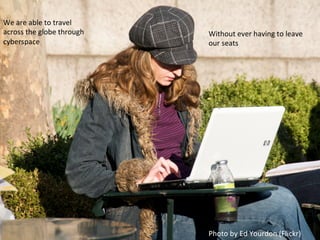
We	
  are	
  able	
  to	
  travel	
  
across	
  the	
  globe	
  through	
  
cyberspace	
  	
  
Without	
  ever	
  having	
  to	
  leave	
  
our	
  seats	
  
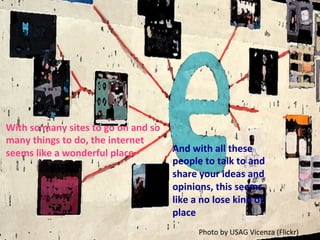
With	
  so	
  many	
  sites	
  to	
  go	
  on	
  and	
  so	
  
many	
  things	
  to	
  do,	
  the	
  internet	
  
seems	
  like	
  a	
  wonderful	
  place	
   And	
  with	
  all	
  these	
  
people	
  to	
  talk	
  to	
  and	
  
share	
  your	
  ideas	
  and	
  
opinions,	
  this	
  seems	
  
like	
  a	
  no	
  lose	
  kind	
  of	
  
place	
  
Photo	
  by	
  USAG	
  Vicenza	
  (Flickr)	
  
But there are unseen
dangers lurking online…
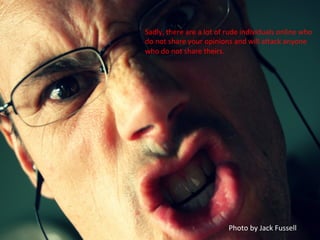
Sadly,	
  there	
  are	
  a	
  lot	
  of	
  rude	
  individuals	
  online	
  who	
  
do	
  not	
  share	
  your	
  opinions	
  and	
  will	
  afack	
  anyone	
  
who	
  do	
  not	
  share	
  theirs.	
  
Photo	
  by	
  Jack	
  Fussell	
  
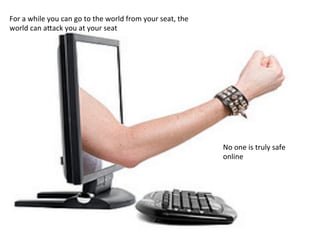
For	
  a	
  while	
  you	
  can	
  go	
  to	
  the	
  world	
  from	
  your	
  seat,	
  the	
  
world	
  can	
  afack	
  you	
  at	
  your	
  seat	
  
No	
  one	
  is	
  truly	
  safe	
  
online	
  
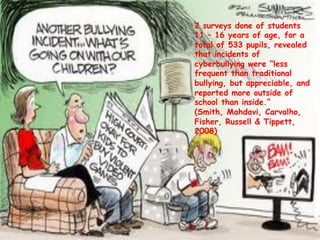
2 surveys done of students
11 – 16 years of age, for a
total of 533 pupils, revealed
that incidents of
cyberbullying were “less
frequent than traditional
bullying, but appreciable, and
reported more outside of
school than inside.”
(Smith, Mahdavi, Carvalho,
Fisher, Russell & Tippett,
2008)
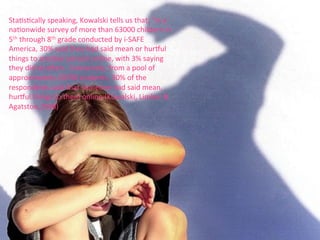
StaRsRcally	
  speaking,	
  Kowalski	
  tells	
  us	
  that,	
  “in	
  a	
  
naRonwide	
  survey	
  of	
  more	
  than	
  63000	
  childern	
  in	
  
5th	
  through	
  8th	
  grade	
  conducted	
  by	
  i-­‐SAFE	
  
America,	
  30%	
  said	
  they	
  had	
  said	
  mean	
  or	
  hurlul	
  
things	
  to	
  another	
  person	
  online,	
  with	
  3%	
  saying	
  
they	
  did	
  so	
  omen.	
  	
  Conversely,	
  from	
  a	
  pool	
  of	
  
approximately	
  20700	
  students,	
  30%	
  of	
  the	
  
respondents	
  said	
  that	
  someone	
  had	
  said	
  mean,	
  
hurlul	
  things	
  to	
  them	
  online.(Kowalski,	
  Limber	
  &	
  
Agatston,2008)	
  
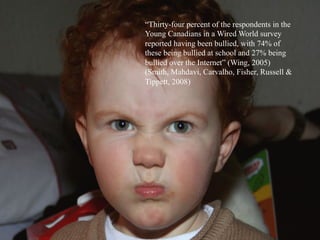
“Thirty-four percent of the respondents in the
Young Canadians in a Wired World survey
reported having been bullied, with 74% of
these being bullied at school and 27% being
bullied over the Internet” (Wing, 2005)
(Smith, Mahdavi, Carvalho, Fisher, Russell &
Tippett, 2008)
	
  
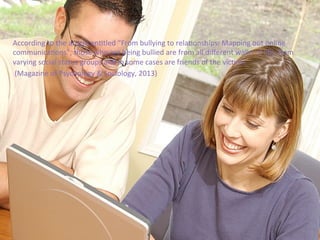
According	
  to	
  the	
  arRcle	
  enRtled	
  “From	
  bullying	
  to	
  relaRonships:	
  Mapping	
  out	
  online	
  
communicaRons”,	
  those	
  who	
  are	
  being	
  bullied	
  are	
  from	
  all	
  different	
  walks	
  of	
  life,	
  from	
  
varying	
  social	
  status	
  groups	
  and	
  in	
  some	
  cases	
  are	
  friends	
  of	
  the	
  vicRms.	


  (Magazine	
  of	
  Psychology	
  &	
  Sociology,	
  2013)	
  	
  
While	
  most	
  would	
  think	
  cyberbullying	
  is	
  to	
  be	
  blamed	
  on	
  simply	
  allowing	
  bullies	
  
access	
  to	
  the	
  Internet,	
  we	
  need	
  to	
  realize	
  that	
  someRmes	
  the	
  Internet	
  can	
  bring	
  out	
  
the	
  worst	
  in	
  us;	
  all	
  that	
  freedom	
  can	
  make	
  us	
  think	
  there	
  is	
  nothing	
  that	
  can	
  stop	
  us,	
  
so	
  if	
  there	
  is	
  a	
  person	
  we	
  do	
  not	
  like	
  we	
  can	
  afack	
  them	
  with	
  hurlul	
  comments	
  and	
  
we	
  ourselves	
  then	
  become	
  the	
  bullies.	
  
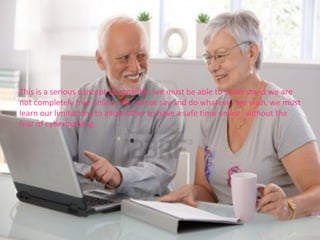
This	
  is	
  a	
  serious	
  concept	
  to	
  consider,	
  we	
  must	
  be	
  able	
  to	
  understand	
  we	
  are	
  
not	
  completely	
  free	
  online,	
  we	
  cannot	
  say	
  and	
  do	
  whatever	
  we	
  wish,	
  we	
  must	
  
learn	
  our	
  limitaRons	
  to	
  allow	
  other	
  to	
  have	
  a	
  safe	
  Rme	
  online,	
  without	
  the	
  
fear	
  of	
  cyberbullying	
  
How	
  Can	
  We	
  Help	
  Them?	
  
Recently	
  the	
  Government	
  of	
  Ontario	
  has	
  enacted	
  Bill	
  14	
  –	
  AnR-­‐Bullying	
  Act,	
  2012	
  
which,	
  “Requires	
  all	
  school	
  boards	
  to	
  take	
  preventaRve	
  measures	
  against	
  bullying,	
  
issue	
  tougher	
  consequences	
  for	
  bullying	
  and	
  support	
  students	
  who	
  want	
  to	
  promote	
  
understanding	
  and	
  respect	
  for	
  all.”	
  
	
  (www.edu.gov.on.ca/eng/parents/bullying.pdf)	
  	
  
Kids	
  Help	
  Phone	
  
“Kids	
  Help	
  Phone	
  (1-­‐800-­‐668-­‐6868)	
  is	
  Canada’s	
  
only	
  free,	
  naRonal,	
  bilingual,	
  confidenRal	
  and	
  
anonymous,	
  24	
  hour	
  telephone	
  and	
  online	
  
consoling	
  service	
  for	
  kids	
  and	
  teens.”	
  	
  
(www.kidshelpphone.ca)	
  
In	
  conclusion,	
  I	
  have	
  learned	
  working	
  on	
  this	
  
presentaRon	
  that,	
  although	
  the	
  Internet	
  is	
  a	
  
wonderful	
  tool,	
  we	
  must	
  learn	
  how	
  to	
  properly	
  
use	
  it.	
  We	
  cannot	
  simply	
  afack	
  others	
  online.	
  
We	
  should	
  accept	
  their	
  differences	
  and	
  move	
  on	
  
with	
  our	
  own	
  lives	
  and	
  leave	
  others	
  in	
  peace	
  so	
  
they	
  can	
  enjoy	
  their	
  own	
  online	
  experiences.	
  
CitaRons	
  
•  Cyberbullying:Its	
  nature	
  and	
  impact	
  in	
  secondary	
  school	
  pupils,	
  Peter	
  K	
  Smith,	
  Jess	
  Mahdavi,	
  Manuel	
  
Carvalho,	
  Sonja	
  Fisher,	
  Shanefe	
  Russell	
  &	
  Neil	
  Tippef,	
  19	
  March	
  2008,	
  Journal	
  of	
  Child	
  Psychology	
  and	
  
Psychiatry,	
  Volume	
  49,	
  issue	
  4,	
  pages	
  376-­‐385,	
  April	
  2008	
  
•  Research	
  Brief,	
  Brief	
  No:RBX03-­‐06,	
  July	
  2006,	
  An	
  InvesRgaRon	
  Into	
  Cyberbullying,	
  Its	
  Forms,	
  Awareness	
  
and	
  Impact	
  and	
  the	
  RelaRonship	
  Between	
  Age	
  and	
  Gender	
  in	
  Cyberbullying,	
  ,	
  Peter	
  K	
  Smith,	
  Jess	
  Mahdavi,	
  
Manuel	
  Carvalho	
  &	
  Neil	
  Tippef,	
  University	
  of	
  London,	
  England	
  
•  Cyberbullying:	
  Bullying	
  in	
  the	
  Digital	
  Age,	
  Robin	
  M	
  Kowalski,	
  Susan	
  P	
  Limber,	
  Patricia	
  W	
  Agatson,	
  John	
  
Wiley	
  &	
  Sons,	
  April	
  23	
  2012,	
  Blackwell	
  Publishing	
  Lt	
  (2008)	
  
•  www.ontla.ca/web/bills/bills_detail.do?locale=en&BillD=2550	
  
•  www.edu.gov.on.ca/eng/parents/bullying.pdf	
  
•  www.kidshelpphone.ca	
  

Cyber bullying

  • 1.
    Cyber Bullying By:  Ethan  Wright   Photo  by  Adrian  Forest  (Flickr)  
  • 2.
    Table  of  Contents   •  Slide  3-­‐  Defining  “Cyber”   •  Slide  4-­‐  Defining  “Bullying”   Slide  5-­‐  Defining  “Cyberbullying”   •  Slide  6-­‐  Which  Way  to  Go?   •  Slide  7-­‐Join  the  Online  Community   •  Slide  8-­‐  Start  of  ExploraRon   •  Slide  9-­‐Our  Own  Seats   •  Slide  10-­‐  ConnecRons   •  Slide  11-­‐Dangers  are  Lurking   •  Slide  12-­‐Anger  Issues   •  Slide  13-­‐No  One  is  Truly  Safe   •  Slide  14-­‐StaRsRcal  Survey   •  Slide  15-­‐i-­‐SAFE  America  Stats   •  Slide  16-­‐  A  Wired  World   •  Slide  17-­‐We  Become  the  Bullies   •  Slide  18-­‐  Know  Our  Limits   •  Slide  19-­‐From  Bullying  to  RelaRonships   •  Slide  20-­‐  How  Can  We  Help  Them?   •  Slide  21-­‐Kids  Help  Phone   •  Slide  22-­‐  Conclusion   •  Slider  23-­‐  CitaRon  Page  
  • 3.
    cyŸber   (adjec've)   of,  rela'ng  to,  or   characteris'c  of  the   culture  of  computers,   informa'on  technology   and  virtual  reality:  The   Cyber  Age   DefiniRon  by  Apple  DicRonary   Photo  by  Enkhtuvshin  (Flickr)    
  • 4.
    DefiniRon  by  Apple  DicRonary   Photo  by  Lieven  Soete  (Flickr)   bulŸly   (noun)   A  person  who  uses  strength  or  power  to  harm  or   inRmidate  those  who  are  weaker   (verb)   Use  superior  strength  or  influence  to  inRmidate   (someone),  typically  to  force  him  or  her  to  do  what  one   wants  
  • 5.
    “Cyberbullying  …  can  be  defined  as  an  aggressive,  intenRonal  act  carried  out  by  a  group   or  individual,  using  electronic  forms  of  contact,  repeatedly  and  over  Rme  against  a  vicRm   who  cannot  easily  defend  him  or  herself.    Cyberbullying  is  a  form  of  bullying  which  has  in   recent  years  become  more  apparent,  as  the  use  of  electronic  devices  such  as  computers   and  mobile  phones  by  young  people  has  increased.”  (Smith,  Mahdavi,  Carvahlo  &   Tippef,  2006)  
  • 6.
    When  we  first  get  on…   We  do   not  know   which   way  to  go   Photo  by  violinha  (Flickr)  
  • 7.
    When  we  first  join  the  online   community…   Photo  by  Peter  Renshaw  (Flickr)   …we  begin  our  journey  on   a  long  and  unknown  path  
  • 8.
    We  have  a  bright  outlook   Ready  to  explore  this  whole   new  digital  world   Not  sure  of   what  is  waiRng   for  you,  but  you   face  it  anyways   Photo  by  puuikibeach  (Flickr)  
  • 9.
    Photo  by  Ed  Yourdon  (Flickr)   We  are  able  to  travel   across  the  globe  through   cyberspace     Without  ever  having  to  leave   our  seats  
  • 10.
    With  so  many  sites  to  go  on  and  so   many  things  to  do,  the  internet   seems  like  a  wonderful  place   And  with  all  these   people  to  talk  to  and   share  your  ideas  and   opinions,  this  seems   like  a  no  lose  kind  of   place   Photo  by  USAG  Vicenza  (Flickr)  
  • 11.
    But there areunseen dangers lurking online…
  • 12.
    Sadly,  there  are  a  lot  of  rude  individuals  online  who   do  not  share  your  opinions  and  will  afack  anyone   who  do  not  share  theirs.   Photo  by  Jack  Fussell  
  • 13.
    For  a  while  you  can  go  to  the  world  from  your  seat,  the   world  can  afack  you  at  your  seat   No  one  is  truly  safe   online  
  • 14.
    2 surveys doneof students 11 – 16 years of age, for a total of 533 pupils, revealed that incidents of cyberbullying were “less frequent than traditional bullying, but appreciable, and reported more outside of school than inside.” (Smith, Mahdavi, Carvalho, Fisher, Russell & Tippett, 2008)
  • 15.
    StaRsRcally  speaking,  Kowalski  tells  us  that,  “in  a   naRonwide  survey  of  more  than  63000  childern  in   5th  through  8th  grade  conducted  by  i-­‐SAFE   America,  30%  said  they  had  said  mean  or  hurlul   things  to  another  person  online,  with  3%  saying   they  did  so  omen.    Conversely,  from  a  pool  of   approximately  20700  students,  30%  of  the   respondents  said  that  someone  had  said  mean,   hurlul  things  to  them  online.(Kowalski,  Limber  &   Agatston,2008)  
  • 16.
    “Thirty-four percent ofthe respondents in the Young Canadians in a Wired World survey reported having been bullied, with 74% of these being bullied at school and 27% being bullied over the Internet” (Wing, 2005) (Smith, Mahdavi, Carvalho, Fisher, Russell & Tippett, 2008)  
  • 17.
    According  to  the  arRcle  enRtled  “From  bullying  to  relaRonships:  Mapping  out  online   communicaRons”,  those  who  are  being  bullied  are  from  all  different  walks  of  life,  from   varying  social  status  groups  and  in  some  cases  are  friends  of  the  vicRms.      (Magazine  of  Psychology  &  Sociology,  2013)    
  • 18.
    While  most  would  think  cyberbullying  is  to  be  blamed  on  simply  allowing  bullies   access  to  the  Internet,  we  need  to  realize  that  someRmes  the  Internet  can  bring  out   the  worst  in  us;  all  that  freedom  can  make  us  think  there  is  nothing  that  can  stop  us,   so  if  there  is  a  person  we  do  not  like  we  can  afack  them  with  hurlul  comments  and   we  ourselves  then  become  the  bullies.  
  • 19.
    This  is  a  serious  concept  to  consider,  we  must  be  able  to  understand  we  are   not  completely  free  online,  we  cannot  say  and  do  whatever  we  wish,  we  must   learn  our  limitaRons  to  allow  other  to  have  a  safe  Rme  online,  without  the   fear  of  cyberbullying  
  • 20.
    How  Can  We  Help  Them?   Recently  the  Government  of  Ontario  has  enacted  Bill  14  –  AnR-­‐Bullying  Act,  2012   which,  “Requires  all  school  boards  to  take  preventaRve  measures  against  bullying,   issue  tougher  consequences  for  bullying  and  support  students  who  want  to  promote   understanding  and  respect  for  all.”    (www.edu.gov.on.ca/eng/parents/bullying.pdf)    
  • 21.
    Kids  Help  Phone   “Kids  Help  Phone  (1-­‐800-­‐668-­‐6868)  is  Canada’s   only  free,  naRonal,  bilingual,  confidenRal  and   anonymous,  24  hour  telephone  and  online   consoling  service  for  kids  and  teens.”     (www.kidshelpphone.ca)  
  • 22.
    In  conclusion,  I  have  learned  working  on  this   presentaRon  that,  although  the  Internet  is  a   wonderful  tool,  we  must  learn  how  to  properly   use  it.  We  cannot  simply  afack  others  online.   We  should  accept  their  differences  and  move  on   with  our  own  lives  and  leave  others  in  peace  so   they  can  enjoy  their  own  online  experiences.  
  • 23.
    CitaRons   •  Cyberbullying:Its  nature  and  impact  in  secondary  school  pupils,  Peter  K  Smith,  Jess  Mahdavi,  Manuel   Carvalho,  Sonja  Fisher,  Shanefe  Russell  &  Neil  Tippef,  19  March  2008,  Journal  of  Child  Psychology  and   Psychiatry,  Volume  49,  issue  4,  pages  376-­‐385,  April  2008   •  Research  Brief,  Brief  No:RBX03-­‐06,  July  2006,  An  InvesRgaRon  Into  Cyberbullying,  Its  Forms,  Awareness   and  Impact  and  the  RelaRonship  Between  Age  and  Gender  in  Cyberbullying,  ,  Peter  K  Smith,  Jess  Mahdavi,   Manuel  Carvalho  &  Neil  Tippef,  University  of  London,  England   •  Cyberbullying:  Bullying  in  the  Digital  Age,  Robin  M  Kowalski,  Susan  P  Limber,  Patricia  W  Agatson,  John   Wiley  &  Sons,  April  23  2012,  Blackwell  Publishing  Lt  (2008)   •  www.ontla.ca/web/bills/bills_detail.do?locale=en&BillD=2550   •  www.edu.gov.on.ca/eng/parents/bullying.pdf   •  www.kidshelpphone.ca