CyberbullyingWhat can help me help my students?
What is cyberbullying?Cyberbullying has many definitions but can be summed up as any inappropriate use of technology that is intended to harass, humiliate, stalk, threaten, terrorize, or slander others.
It is not uncommon for cyberbullying to be prevalent in students ages 8-15 and beyond.Webb 2010
Vehicles for CyberbullyingCell phones
Text messages
Picture messages
Email
Internet
Social networking sites
Chatrooms
Chat tools                                       and more…Webb 2010
StatisticsApprox. 160,000 children miss school because they fear bullying
One in three teens (ages 12-17) have been victims of cyberbullying
One in six pre-teens (ages 6-11) have been victims of cyberbullying
Children are just as likely to receive threatening messages at school as they are at home
The impact on the victims of bullying often include truancy, depression, poor academic performance, and sometimes suicideWebb 2010
Is it against the law?That depends…In the First Amendment we are all given the right of freedom of speech.There have been numerous court cases concerning cyberbullying, however each is individual and rulings remain just as unique and difficult to predict.Webb 2010
LawFifteen states (including Illinois) have legislation requiring districts to create policies about cyberbullying.
On this website, each state receives a letter grade based on the occurrences of cyberbullying cases and how they are handled. www.bullypolice.org
Also in Illinois schools are required to provide a minimum of two hours of Internet safety instruction annually to their K-12 students.Webb 2010
Challenges for TeachersWhat constitutes an offense of cyberbullying?
Is bullying that takes place at home able to be disciplined within the school?
When do teachers step in?
What steps should be taken to decrease occurrences?Webb 2010
Challenges for TeachersNone of these questions can be answered definitively.  So…What does the research say?Webb 2010

Cyberbully presentation

  • 1.
    CyberbullyingWhat can helpme help my students?
  • 2.
    What is cyberbullying?Cyberbullyinghas many definitions but can be summed up as any inappropriate use of technology that is intended to harass, humiliate, stalk, threaten, terrorize, or slander others.
  • 3.
    It is notuncommon for cyberbullying to be prevalent in students ages 8-15 and beyond.Webb 2010
  • 4.
  • 5.
  • 6.
  • 7.
  • 8.
  • 9.
  • 10.
  • 11.
    Chat tools and more…Webb 2010
  • 12.
    StatisticsApprox. 160,000 childrenmiss school because they fear bullying
  • 13.
    One in threeteens (ages 12-17) have been victims of cyberbullying
  • 14.
    One in sixpre-teens (ages 6-11) have been victims of cyberbullying
  • 15.
    Children are justas likely to receive threatening messages at school as they are at home
  • 16.
    The impact onthe victims of bullying often include truancy, depression, poor academic performance, and sometimes suicideWebb 2010
  • 17.
    Is it againstthe law?That depends…In the First Amendment we are all given the right of freedom of speech.There have been numerous court cases concerning cyberbullying, however each is individual and rulings remain just as unique and difficult to predict.Webb 2010
  • 18.
    LawFifteen states (includingIllinois) have legislation requiring districts to create policies about cyberbullying.
  • 19.
    On this website,each state receives a letter grade based on the occurrences of cyberbullying cases and how they are handled. www.bullypolice.org
  • 20.
    Also in Illinoisschools are required to provide a minimum of two hours of Internet safety instruction annually to their K-12 students.Webb 2010
  • 21.
    Challenges for TeachersWhatconstitutes an offense of cyberbullying?
  • 22.
    Is bullying thattakes place at home able to be disciplined within the school?
  • 23.
  • 24.
    What steps shouldbe taken to decrease occurrences?Webb 2010
  • 25.
    Challenges for TeachersNoneof these questions can be answered definitively. So…What does the research say?Webb 2010
  • 26.
    Research:Bullying is arelatively recent research focus with work beginning in the early 70’s. Because of the even more recent nature of cyberbullying, there are several issues that characterize research in this area, and there are not many helpful conclusions.Webb 2010
  • 27.
    Research:With frequent andconsiderable advances in technology, the issue of cyberbullying is quickly growing, but very little research exists that deals with intervention methods or programs. These are two questions teachers may ask: What are some effective methods proven to reduce instances of cyberbullying in school settings?
  • 28.
    What aresome effective intervention methods from previous studies in traditional bullying that could effect work on cyberbullying?Webb 2010
  • 29.
    Research:There is asignificant body of research on the phenomenon itself, but not any research on prevention methods.
  • 30.
    Several pieces ofcyberbullying research cite previous studies of traditional bullying, but it is difficult to transfer any prevention methods because of the often secretive nature of cyberbullying
  • 31.
  • 32.
  • 33.
  • 34.
    What now?For now,short of conducting more research, teachers can choose to follow their school’s technology policy and/or compose their own. Having a classroom technology policy could prevent problems from happening before they occur. It can also provide teachers with a set of fair and equal consequences for policy violations.Webb 2010
  • 35.
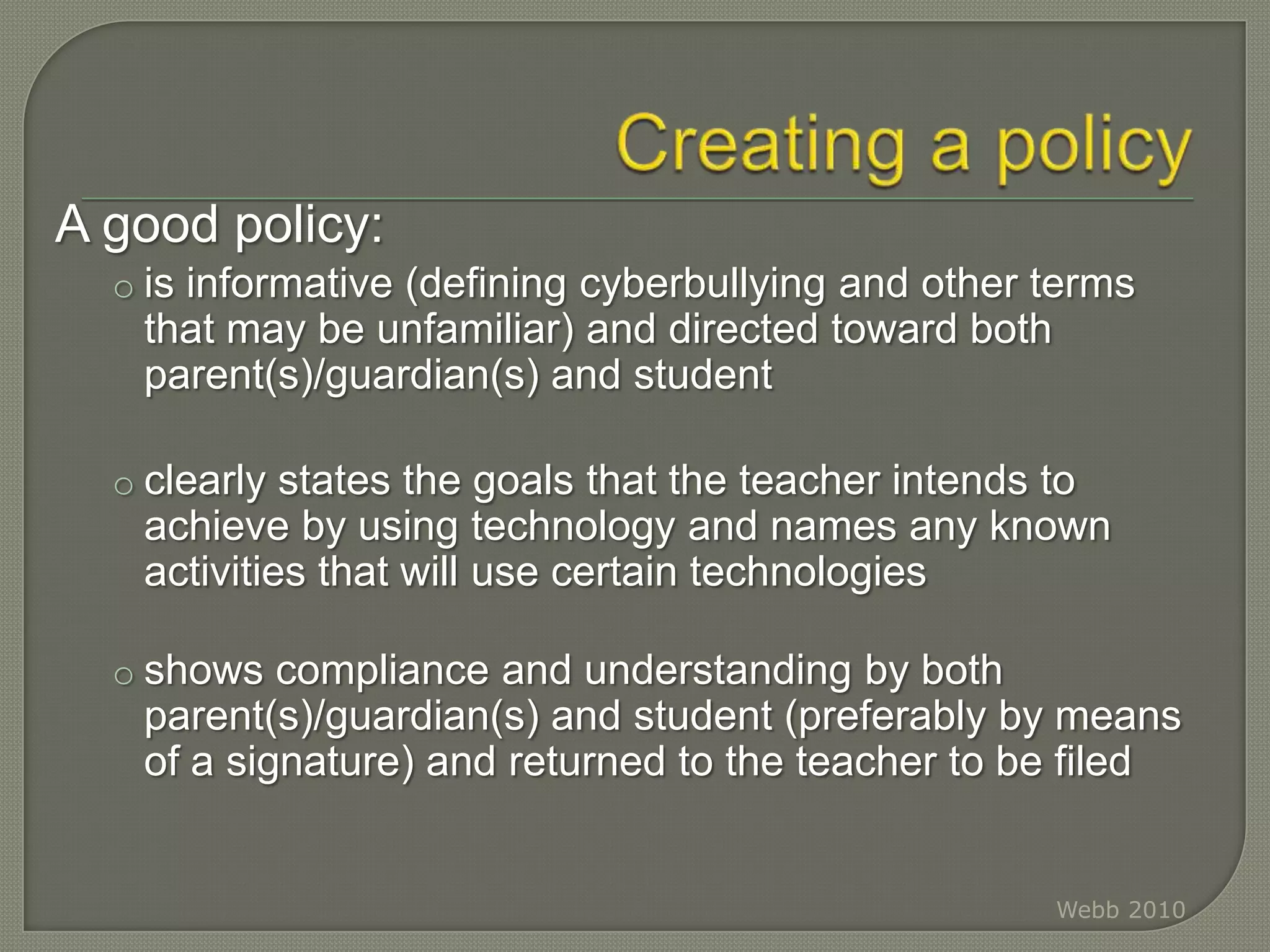
    Creating a policyAgood policy:is informative (defining cyberbullying and other terms that may be unfamiliar) and directed toward both parent(s)/guardian(s) and student
  • 36.
    clearly states thegoals that the teacher intends to achieve by using technology and names any known activities that will use certain technologies
  • 37.
    shows compliance andunderstanding by both parent(s)/guardian(s) and student (preferably by means of a signature) and returned to the teacher to be filedWebb 2010
  • 38.
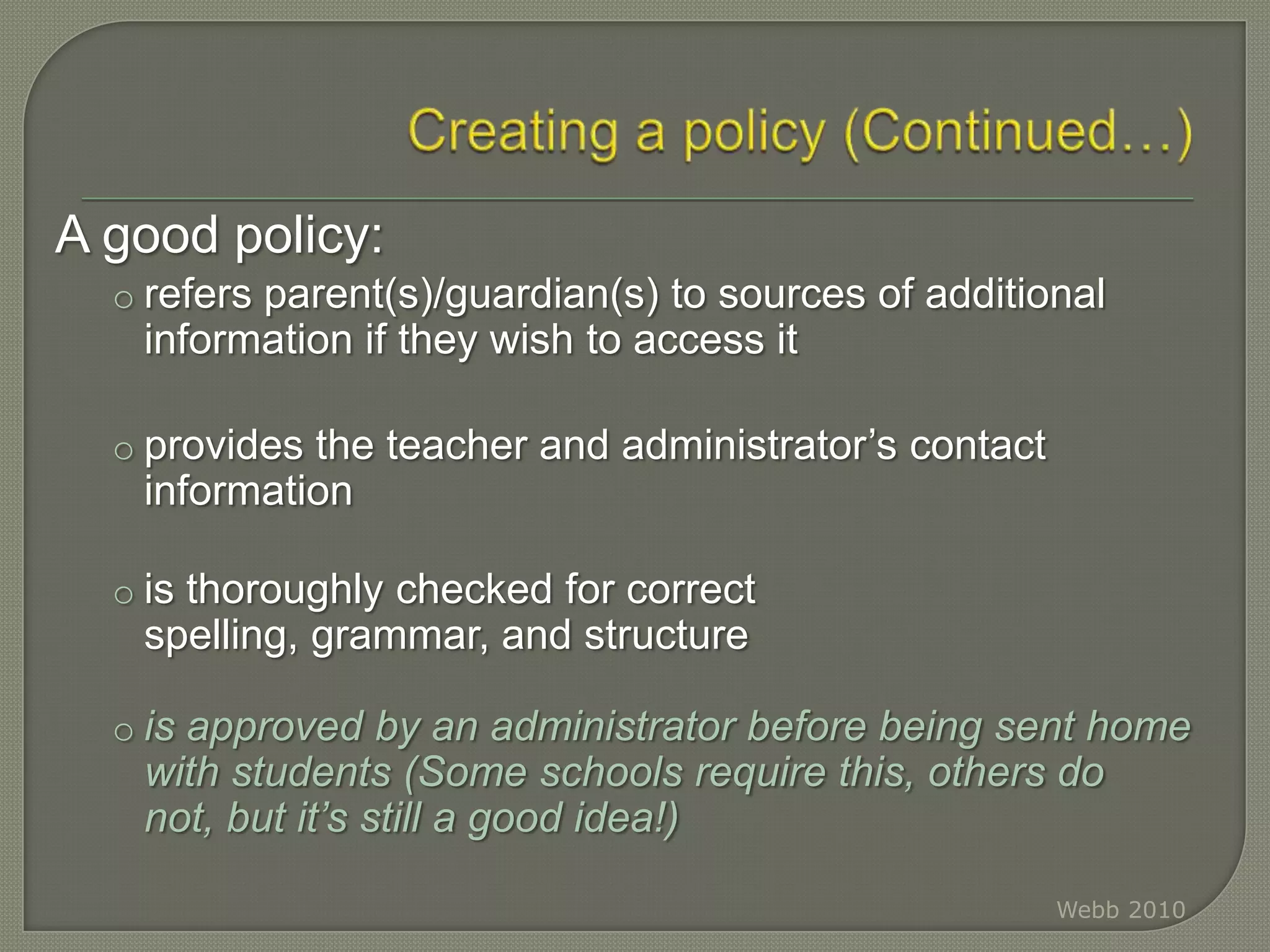
    Creating a policy(Continued…)A good policy:refers parent(s)/guardian(s) to sources of additional information if they wish to access it
  • 39.
    provides the teacherand administrator’s contact information
  • 40.
    is thoroughly checkedfor correct spelling, grammar, and structure
  • 41.
    is approved byan administrator before being sent home with students (Some schools require this, others do not, but it’s still a good idea!)Webb 2010
  • 42.
    HINTBetween the previoustwo slides and several additional slides that will be seen shortly in this presentation, you will be easily able to compose a technology policy for your desired setting and fulfill the assignment requirements. Note those slides!
  • 43.
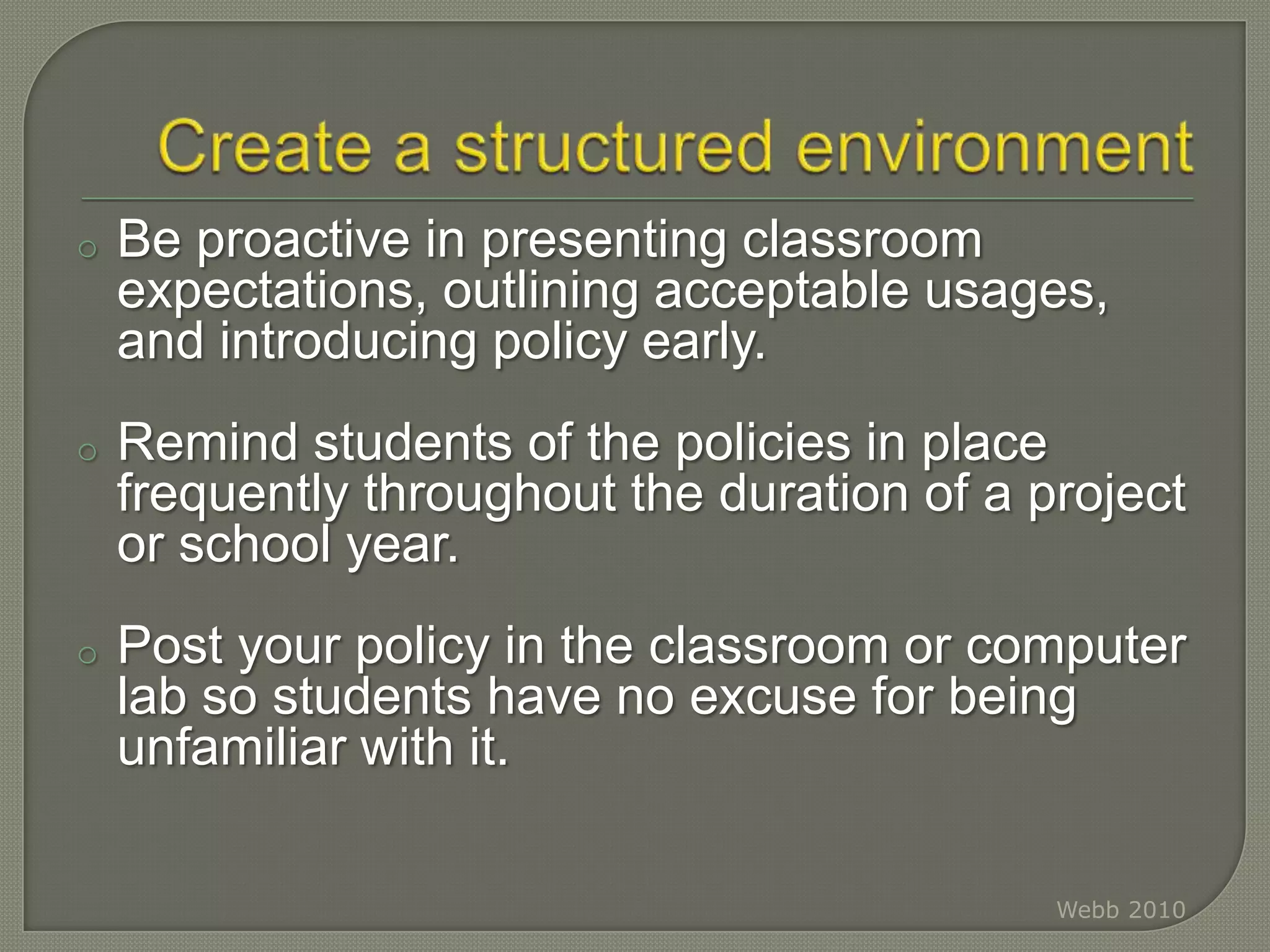
    Create a structuredenvironmentBe proactive in presenting classroom expectations, outlining acceptable usages, and introducing policy early.
  • 44.
    Remind students ofthe policies in place frequently throughout the duration of a project or school year.
  • 45.
    Post your policyin the classroom or computer lab so students have no excuse for being unfamiliar with it.Webb 2010
  • 46.
    Complete the Activity:Locatethe Cyberbullying Activity on WesternOnline. Read it carefully and complete it by the posted due date. Worth 40 pts.Don’t forget to review the rubric before starting! The following slides will help you create your submission. Read the instructions and use this presentation to guide your progress.Webb 2010
  • 47.
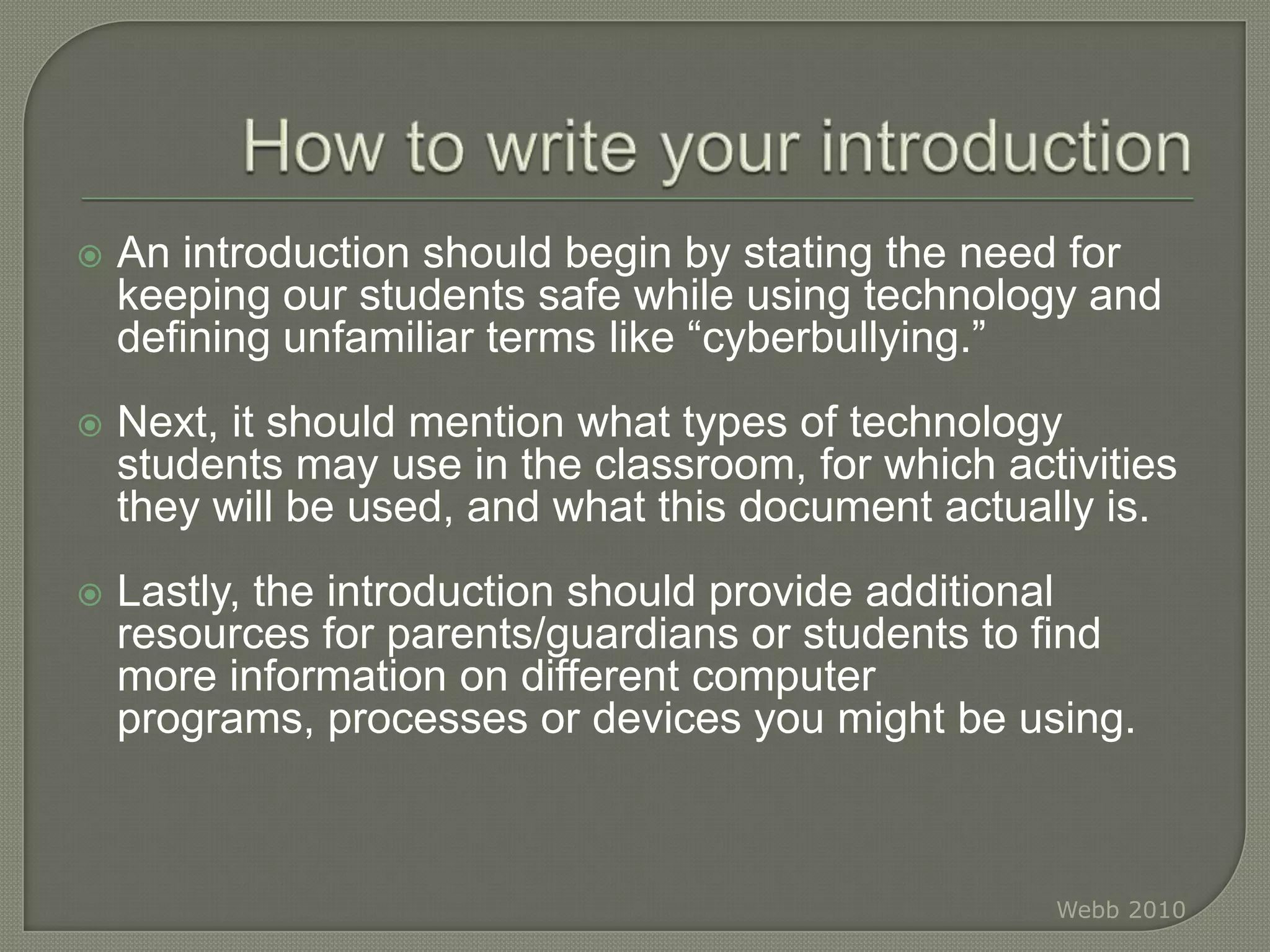
    How to writeyour introductionAn introduction should begin by stating the need for keeping our students safe while using technology and defining unfamiliar terms like “cyberbullying.”Next, it should mention what types of technology students may use in the classroom, for which activities they will be used, and what this document actually is.Lastly, the introduction should provide additional resources for parents/guardians or students to find more information on different computer programs, processes or devices you might be using.Webb 2010
  • 48.
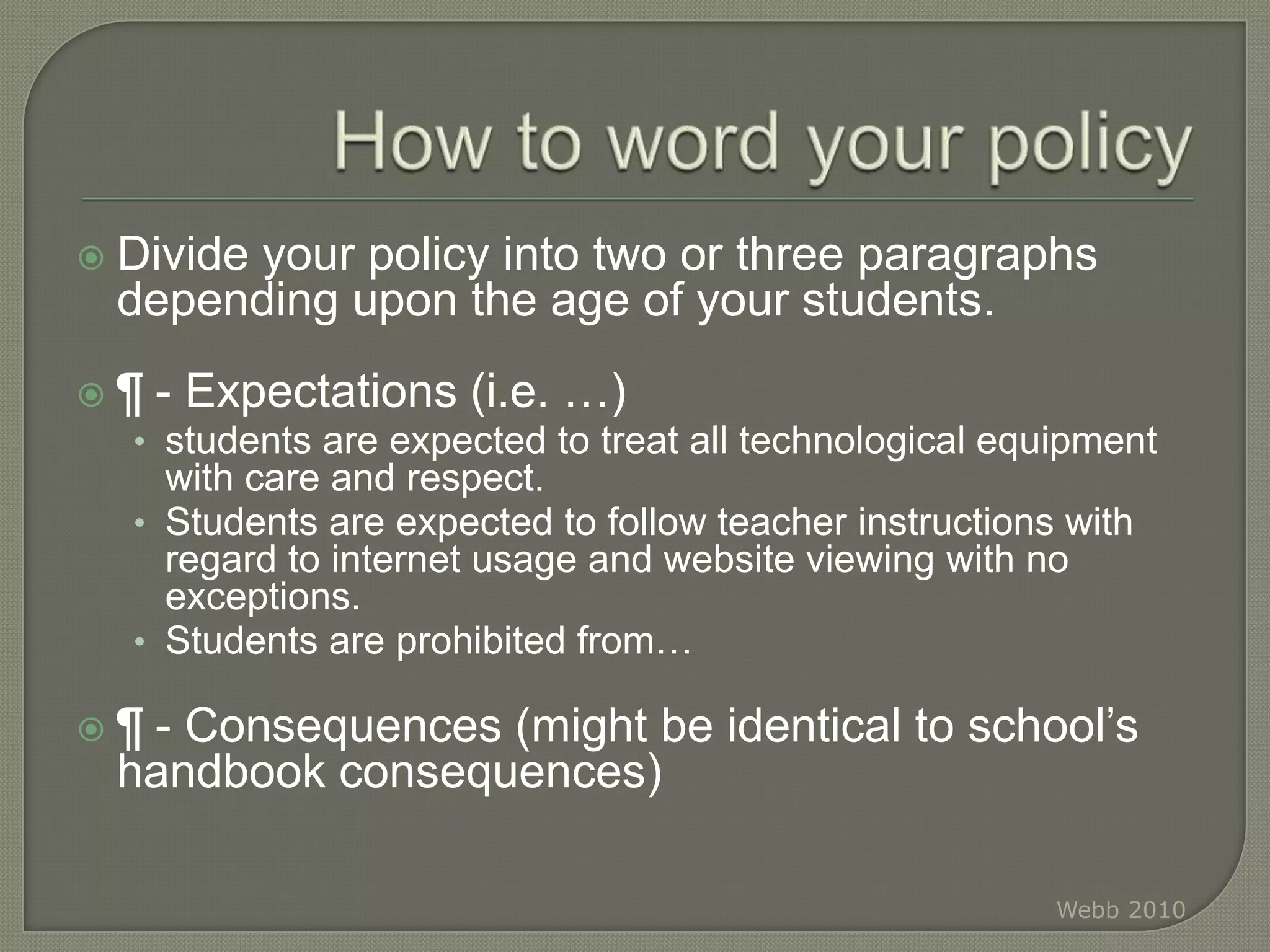
    How to wordyour policyDivide your policy into two or three paragraphs depending upon the age of your students.¶ - Expectations (i.e. …)students are expected to treat all technological equipment with care and respect.Students are expected to follow teacher instructions with regard to internet usage and website viewing with no exceptions.Students are prohibited from…¶ - Consequences (might be identical to school’s handbook consequences)Webb 2010
  • 49.
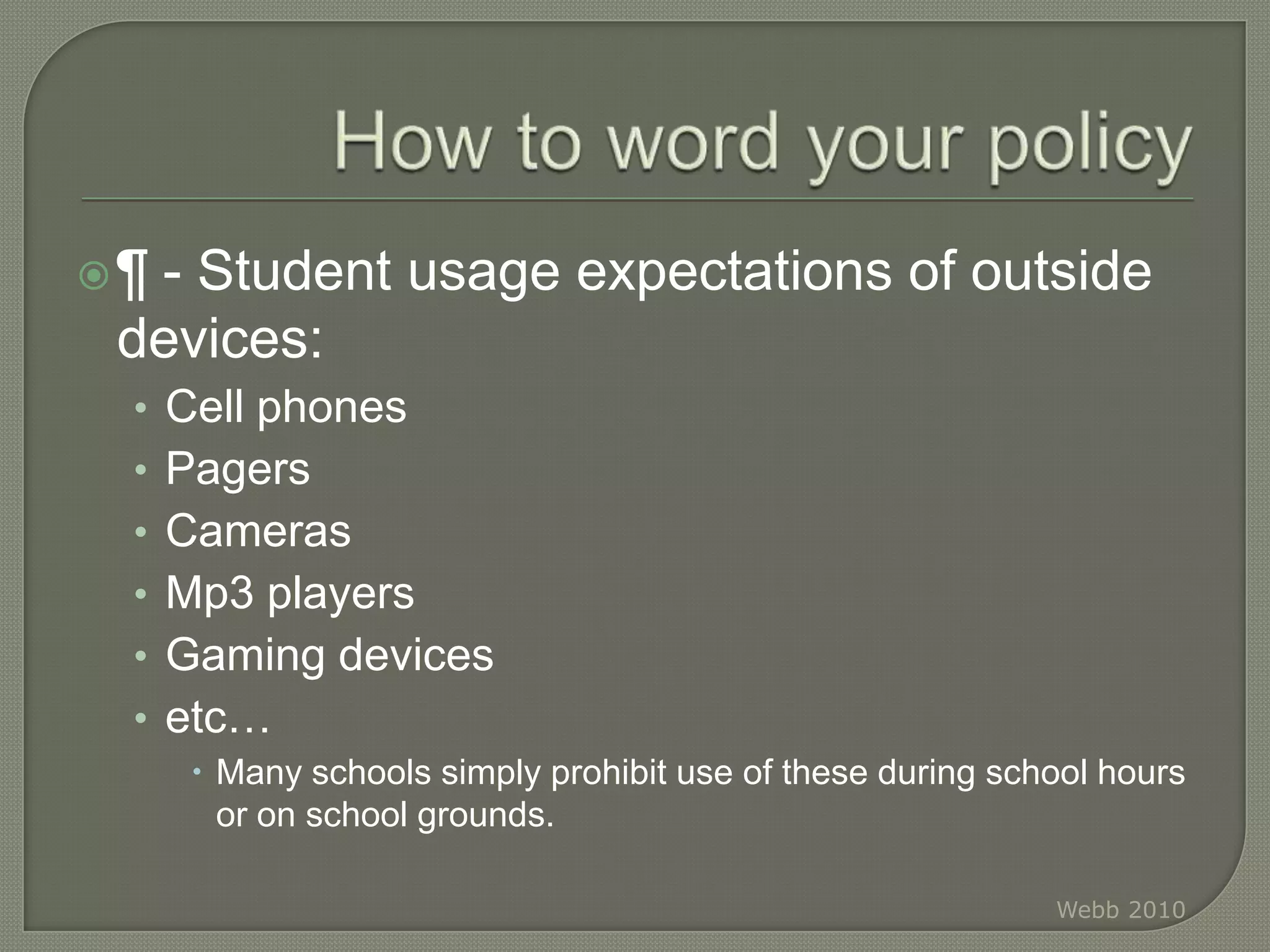
    How to wordyour policy¶ - Student usage expectations of outside devices:Cell phonesPagersCamerasMp3 playersGaming devicesetc…Many schools simply prohibit use of these during school hours or on school grounds.Webb 2010
  • 50.
    How to incorporatecomplianceThis consists of a couple simple sentences.All the sentences need to state is that a signature at the bottom of the document represents agreement with the policies outlined in the document, and that students who do not comply will not be allowed to participate in such activities.Both student and parent(s)/guardian(s) signatures should be present.Webb 2010
  • 51.
    How to includecontact informationFinally, include your personal as well as school office contact information for families to use if they have any questions. Ms. Doe, 3rd grade, 555-1234, jdoe@school.eduElementary office, West Best School: 555-5678Webb 2010
  • 52.
    ReferencesBully Police U.S.A.(2009). Retrieved from website: www.bullypolice.orgMeyers, J. J. (2009). Censoring cyber speech on campus??? Unpublished manuscript. Presented September 29, 2009 at Western Illinois University.Meyers, J. J., & Carper, G. T. (2009). Cyberbullying: The legal challenge for educators. West’s Educational Law Reporter.Meyers, J. J., Carper, G. T., & Hemphill, L. S. (2009). Cyber Bullies Come to Campus: Are Administrators and Faculty Ready? Roskamp, T. J. (2009). Cyberbullying in Illinois public schools. Unpublished doctoral dissertation, Western Illinois University.Webb 2010
  • 53.
    ReferencesBacker, T. E.,& Russ, A. (2007). Implementing evidence-based youth violence prevention programs: one community’s experiences. Human Interaction Research Institute, Retrieved from: http://www.humaninteract.org/images/finalrep149.pdf.Hirschstein, M. K., Van Schoiack Edstrom, L., Frey, K. S., Snell, J. L., & MacKenzie, E. P. (2007). Walking the talk in bullying prevention: teacher implementation variables related to initial impact of the Steps to Respect program. School Psychology Review, 36(1), 3-21.Hoff, D. L., & Mitchell, S. N. (2008). Cyberbullying: causes, effects, and remedies. Journal of Educational Administration, 47(5), 652-665.Juvonen, J., & Gross, E. F. (2008). Extending the school grounds? Bullying experiences in cyberspace. Journal of School Health, 78(9), 496-505.Webb 2010
  • 54.
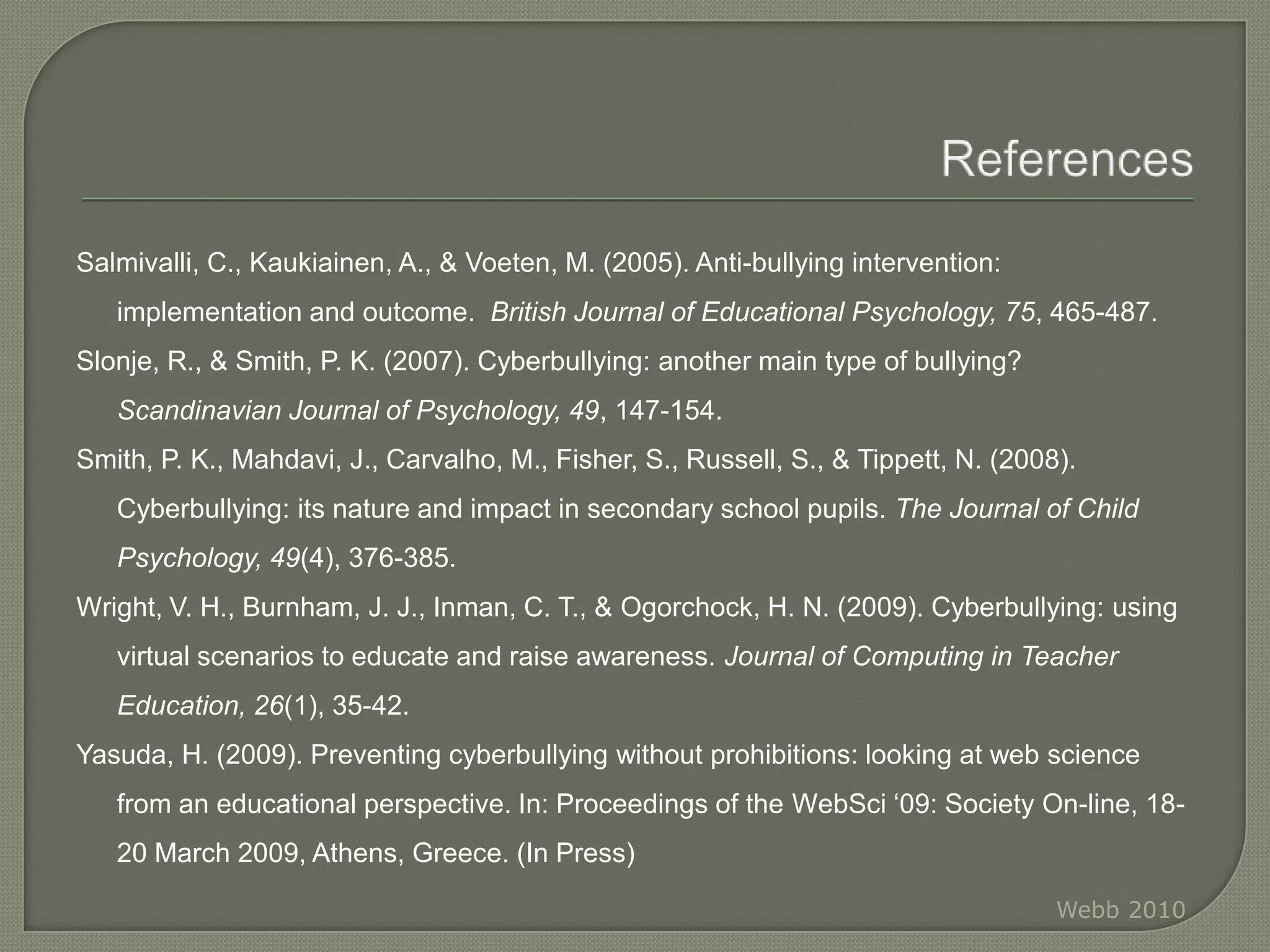
    ReferencesSalmivalli, C., Kaukiainen,A., & Voeten, M. (2005). Anti-bullying intervention: implementation and outcome. British Journal of Educational Psychology, 75, 465-487.Slonje, R., & Smith, P. K. (2007). Cyberbullying: another main type of bullying? Scandinavian Journal of Psychology, 49, 147-154.Smith, P. K., Mahdavi, J., Carvalho, M., Fisher, S., Russell, S., & Tippett, N. (2008). Cyberbullying: its nature and impact in secondary school pupils. The Journal of Child Psychology, 49(4), 376-385.Wright, V. H., Burnham, J. J., Inman, C. T., & Ogorchock, H. N. (2009). Cyberbullying: using virtual scenarios to educate and raise awareness. Journal of Computing in Teacher Education, 26(1), 35-42. Yasuda, H. (2009). Preventing cyberbullying without prohibitions: looking at web science from an educational perspective. In: Proceedings of the WebSci ‘09: Society On-line, 18-20 March 2009, Athens, Greece. (In Press)Webb 2010