

1© 2018 Rogue Wave Software, Inc. All Rights Reserved. 1
Making Camel Work
for You
• Justin Reock
• Sr. Director and Lead Architect
• Rogue Wave OSS Support
2© 2018 Rogue Wave Software, Inc. All Rights Reserved. 2
Who’s speaking to me?
3© 2018 Rogue Wave Software, Inc. All Rights Reserved. 3
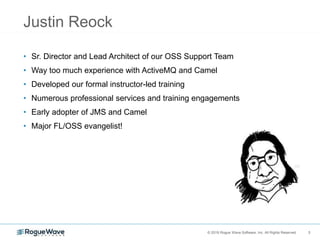
Justin Reock
• Sr. Director and Lead Architect of our OSS Support Team
• Way too much experience with ActiveMQ and Camel
• Developed our formal instructor-led training
• Numerous professional services and training engagements
• Early adopter of JMS and Camel
• Major FL/OSS evangelist!
4© 2018 Rogue Wave Software, Inc. All Rights Reserved. 4
What are we going to solve?
5© 2018 Rogue Wave Software, Inc. All Rights Reserved. 5
Quick exercise…
• I’m going to show you three slides
• They all have something in common….
• See if you can figure out what it is!
6© 2018 Rogue Wave Software, Inc. All Rights Reserved. 6
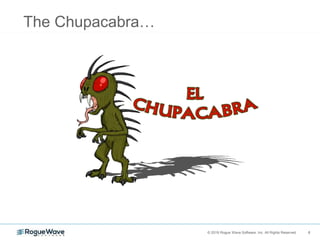
The Chupacabra…
7© 2018 Rogue Wave Software, Inc. All Rights Reserved. 7
A magical unicorn…
8© 2018 Rogue Wave Software, Inc. All Rights Reserved. 8
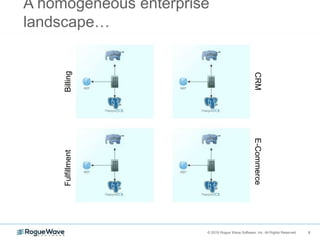
BillingFulfillment
CRME-Commerce
A homogeneous enterprise
landscape…
9© 2018 Rogue Wave Software, Inc. All Rights Reserved. 9
Answer
 None of these things exist in real life!
10© 2018 Rogue Wave Software, Inc. All Rights Reserved. 10
A Word on ESBs
• An Enterprise Service Bus is an architectural design pattern that
focuses on providing federation between systems using a common
runtime
• Ideally, a Service Bus will provide loosely coupled endpoints to which
various, heterogeneous systems can communicate with one another via
their native frameworks
• So, for instance, a .NET SOAP-driven application should be able to send
data along the bus, which could be received by, say, a Java-based JMS
destination
• The ESB will provide payload and protocol normalization to facilitate
that communication
• Loose coupling will ensure that services can remain unaware of
federated services’ languages and frameworks
11© 2018 Rogue Wave Software, Inc. All Rights Reserved. 11
Examples of ESBs
12© 2018 Rogue Wave Software, Inc. All Rights Reserved. 12
Common Enterprise Architecture Problems
• No Universal Rules and Routing
– Many application frameworks and protocols exist, but they are
fragmented
– They may use different protocols, data formats, and remote
communication methods
• Need for scale
– Business tend to grow their infrastructure and federate more systems
– As they do, the need for better scalability presents itself
• Heterogeneous clients
– Server frameworks aside, the application layer also tends to be highly
fragmented
– You will no doubt have applications in different languages that have a
need to communicate with one another
13© 2018 Rogue Wave Software, Inc. All Rights Reserved. 13
Common problems with ESBs
• Custom Adapters
– When not using something like SOAP, often there is a need to customize
an ESB client to fit into a particular framework
– This refutes an ESB’s notion of loose coupling and platform agnosticism
• Non-standard implementations
– Often an ESB provider will implement a protocol “their way” which can be
problematic for more standard platforms
• Disorganized Dependencies
– With all of the various transports, frameworks, and protocols an ESB
should be capable of delivering, our dependency libraries can get messy
• Deployment Governance
– And with so many developers contributing to an organization’s ESB logic,
controlling all of that deployment creates its own set of challenges
14© 2018 Rogue Wave Software, Inc. All Rights Reserved. 14
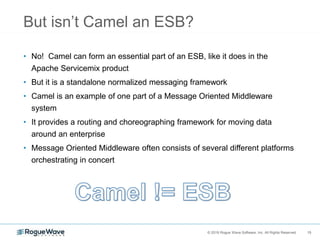
But isn’t Camel an ESB?
• No! Camel can form an essential part of an ESB, like it does in the
Apache Servicemix product
• But it is a standalone normalized messaging framework
• Camel is an example of one part of a Message Oriented Middleware
system
• It provides a routing and choreographing framework for moving data
around an enterprise
• Message Oriented Middleware often consists of several different platforms
orchestrating in concert
15© 2018 Rogue Wave Software, Inc. All Rights Reserved. 15
But isn’t Camel an ESB?
• No! Camel can form an essential part of an ESB, like it does in the
Apache Servicemix product
• But it is a standalone normalized messaging framework
• Camel is an example of one part of a Message Oriented Middleware
system
• It provides a routing and choreographing framework for moving data
around an enterprise
• Message Oriented Middleware often consists of several different platforms
orchestrating in concert
16© 2018 Rogue Wave Software, Inc. All Rights Reserved. 16
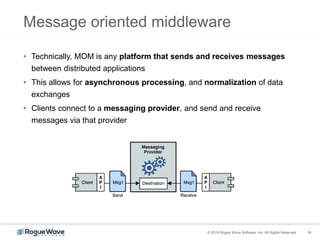
Message oriented middleware
• Technically, MOM is any platform that sends and receives messages
between distributed applications
• This allows for asynchronous processing, and normalization of data
exchanges
• Clients connect to a messaging provider, and send and receive
messages via that provider
17© 2018 Rogue Wave Software, Inc. All Rights Reserved. 17
What’s it good for?
• Data normalization makes it a lot easier for disparate applications to
trade information
• Just like in web services, heterogeneous systems can agree on a data
“contract” and send and receive data in that format
• All the application needs is a client compatible with the messaging
provider
• And since messages are allowed to queue up on the message provider,
it also makes it very easy to perform asynchronous processing
• Most message providers offer additional benefits, like guaranteed
delivery, options for traffic shaping, high availability, and scaling
18© 2018 Rogue Wave Software, Inc. All Rights Reserved. 18
What is Camel?
19© 2018 Rogue Wave Software, Inc. All Rights Reserved. 19
The repetitive world of integration
• So, data routing and transformation in the Enterprise lends itself to a lot of what
you would call “boilerplate” code
• Boilerplate text, in publishing, is text that can be used and reused in many
places
• Boilerplate code is the same concept
• How many times have you written code to open up a web server, push a file to
an ftp site or drop a message into a message broker?
• Have you ever felt that you’re just writing different versions of the same thing
over and over again?
• You’re not alone
• Enter the concept of an Enterprise Integration Pattern…
20© 2018 Rogue Wave Software, Inc. All Rights Reserved. 20
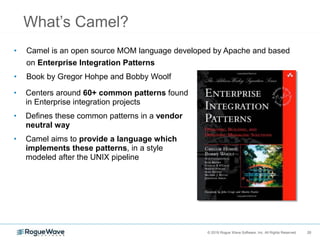
What’s Camel?
• Camel is an open source MOM language developed by Apache and based
on Enterprise Integration Patterns
• Book by Gregor Hohpe and Bobby Woolf
• Centers around 60+ common patterns found
in Enterprise integration projects
• Defines these common patterns in a vendor
neutral way
• Camel aims to provide a language which
implements these patterns, in a style
modeled after the UNIX pipeline
21© 2018 Rogue Wave Software, Inc. All Rights Reserved. 21
Project notes
• Camel is maintained by the Apache Camel community
• It is a top-level project hosted at http://camel.apache.org
• The project’s chief maintainer is Claus Ibsen, author of Camel in Action
• As of August of 2017, the project has had almost 400 distinct committers,
spanning over 30,000 commits
• It is written primarily in Java, and also contains some Scala code
• The project is licensed under the ALv2 (Apache License v2.0), which is
considered a permissive license
• So, Camel has been folded in to many other projects, including the Mule ESB
and the Switchyard project
• Camel can be run standalone, packaged into a WAR, or deployed as an OSGI
bundle
• A POJO syntax as well as a Spring DSL XML syntax are made available for
developers
22© 2018 Rogue Wave Software, Inc. All Rights Reserved. 22
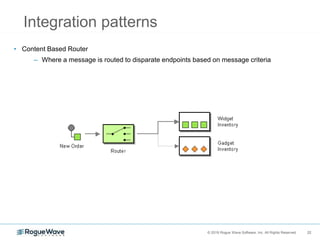
Integration patterns
• Content Based Router
– Where a message is routed to disparate endpoints based on message criteria
23© 2018 Rogue Wave Software, Inc. All Rights Reserved. 23
Integration patterns
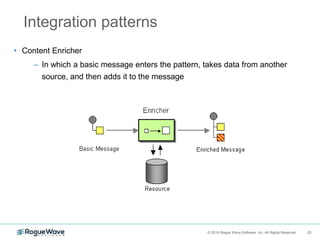
• Content Enricher
– In which a basic message enters the pattern, takes data from another
source, and then adds it to the message
24© 2018 Rogue Wave Software, Inc. All Rights Reserved. 24
Integration patterns
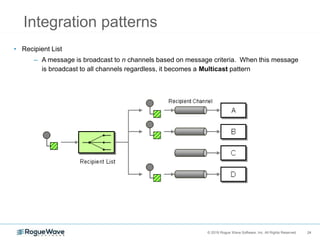
• Recipient List
– A message is broadcast to n channels based on message criteria. When this message
is broadcast to all channels regardless, it becomes a Multicast pattern
25© 2018 Rogue Wave Software, Inc. All Rights Reserved. 25
Integration patterns
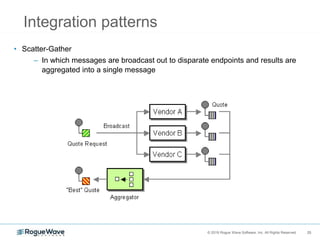
• Scatter-Gather
– In which messages are broadcast out to disparate endpoints and results are
aggregated into a single message
26© 2018 Rogue Wave Software, Inc. All Rights Reserved. 26
How does it work?
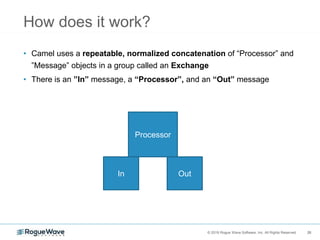
• Camel uses a repeatable, normalized concatenation of “Processor” and
”Message” objects in a group called an Exchange
• There is an ”In” message, a “Processor”, and an “Out” message
Processor
In Out
27© 2018 Rogue Wave Software, Inc. All Rights Reserved. 27
How does it work?
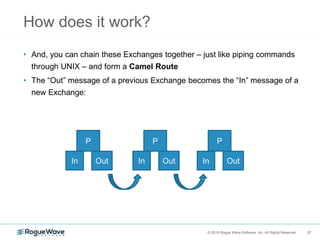
• And, you can chain these Exchanges together – just like piping commands
through UNIX – and form a Camel Route
• The “Out” message of a previous Exchange becomes the “In” message of a
new Exchange:
P
In Out
P
In Out
P
In Out
28© 2018 Rogue Wave Software, Inc. All Rights Reserved. 28
Camel magic
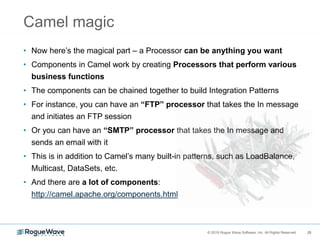
• Now here’s the magical part – a Processor can be anything you want
• Components in Camel work by creating Processors that perform various
business functions
• The components can be chained together to build Integration Patterns
• For instance, you can have an “FTP” processor that takes the In message
and initiates an FTP session
• Or you can have an “SMTP” processor that takes the In message and
sends an email with it
• This is in addition to Camel’s many built-in patterns, such as LoadBalance,
Multicast, DataSets, etc.
• And there are a lot of components:
http://camel.apache.org/components.html
29© 2018 Rogue Wave Software, Inc. All Rights Reserved. 29
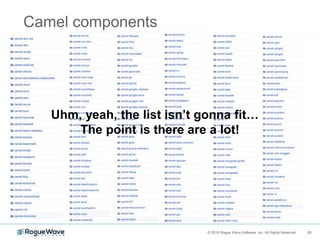
Camel components
Uhm, yeah, the list isn’t gonna fit…
The point is there are a lot!
30© 2018 Rogue Wave Software, Inc. All Rights Reserved. 30
Embedded scripting languages
• Camel also contains a number of embedded script languages that can be
used for various purposes
• Simple: The Simple query language can be used to introspect message
headers, payloads, and properties, and is useful when routing messages
based on their content
• Xpath: The XPath query language will let you traverse XML structures
and query for attribute and entity values, which is great for routing
messages based on their XML content
• JSONPath: Just like XPath, except for JSON-structured messages
• Groovy: The Groovy scripting language can be used for more advanced
data introspection and manipulation
• JavaScript: Yes, you can do entire processors in JavaScript
31© 2018 Rogue Wave Software, Inc. All Rights Reserved. 31
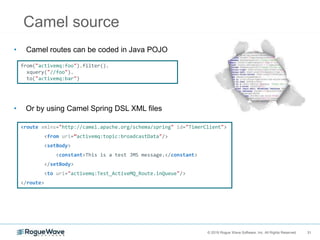
Camel source
• Camel routes can be coded in Java POJO
• Or by using Camel Spring DSL XML files
from("activemq:foo").filter().
xquery("//foo").
to("activemq:bar")
<route xmlns="http://camel.apache.org/schema/spring" id="TimerClient">
<from uri=”activemq:topic:broadcastData"/>
<setBody>
<constant>This is a test JMS message.</constant>
</setBody>
<to uri="activemq:Test_ActiveMQ_Route.inQueue"/>
</route>
32© 2018 Rogue Wave Software, Inc. All Rights Reserved. 32
Camel deployment
• Camel can be deployed in a number of ways:
• It can be deployed as a Java Web App using Spring or POJO
• Standalone Camel routes can also be deployed using Maven and Camel
• Spring Boot can launch Camel routes
• Camel can be embedded within another Java application
• Or within a Java-based container such as Jetty, Tomcat, JBoss/Wildfly, and
others
• ActiveMQ contains the Camel core libraries and can launch and deploy
Camel routes
• And OSGI containers like Karaf or its Servicemix counterpart can launch
Camel routes
• Standalone Camel routes scale very nicely in microservice containers as
well
33© 2018 Rogue Wave Software, Inc. All Rights Reserved. 33
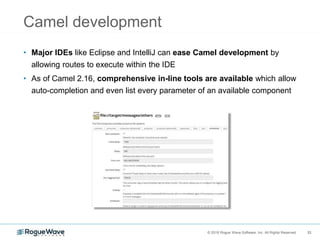
Camel development
• Major IDEs like Eclipse and IntelliJ can ease Camel development by
allowing routes to execute within the IDE
• As of Camel 2.16, comprehensive in-line tools are available which allow
auto-completion and even list every parameter of an available component
34© 2018 Rogue Wave Software, Inc. All Rights Reserved. 34
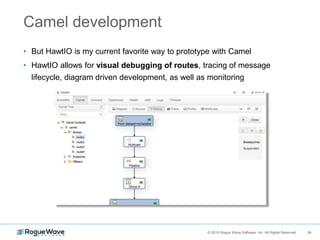
Camel development
• But HawtIO is my current favorite way to prototype with Camel
• HawtIO allows for visual debugging of routes, tracing of message
lifecycle, diagram driven development, as well as monitoring
35© 2018 Rogue Wave Software, Inc. All Rights Reserved. 35
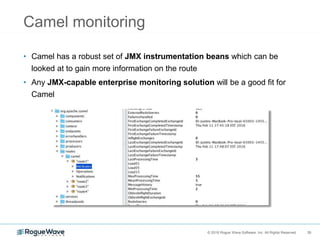
Camel monitoring
• Camel has a robust set of JMX instrumentation beans which can be
looked at to gain more information on the route
• Any JMX-capable enterprise monitoring solution will be a good fit for
Camel
36© 2018 Rogue Wave Software, Inc. All Rights Reserved. 36
So Camel is pretty awesome…
• Camel provides many benefits for enterprise messaging applications
• It comes with a free library of over a hundred integration components, as well
as a powerful framework for creating your own components
• Camel routes can be visually debugged, similar to jBPM or BPEL
• Camel cuts down on boilerplate code enormously, by providing Spring-based
integration components for popular applications and frameworks
• Camel is FOSS under Apache 2.0 License
• As Camel improves its underlying Spring libraries, you can take advantage of
better functionality with very little if any development effort
• Camel’s syntax is very easy to understand and provides a low learning curve
for developers
37© 2018 Rogue Wave Software, Inc. All Rights Reserved. 37
Demo: Content based router
• In this example, we will be using a very simple content based router
• In fact, we’ll be using the Simple query language to introspect a JMS
header in a message, and routing it to a destination based on the contents
of that header
• We will use Camel deployed directly into ActiveMQ, and we’ll write it from
scratch against a clean ActiveMQ install
38© 2018 Rogue Wave Software, Inc. All Rights Reserved. 38
Demo: File content translator
• Here we will read the contents of new files entering into a file directory, and
convert these files into JMS messages
39© 2018 Rogue Wave Software, Inc. All Rights Reserved. 39
Demo: JMS to JMS Bridge
• We will use Camel to connect two ActiveMQ instances to one another
• Messages will be consumed from a destination on the external instance,
and produced into another destination on the internal instance
40© 2018 Rogue Wave Software, Inc. All Rights Reserved. 40
Claim check pattern
• Here we will implement a basic claim check pattern
• Messages will be stored in a local Postgres database, the payload
contents will be altered in the route, and then the original payload will be
retrieved
41© 2018 Rogue Wave Software, Inc. All Rights Reserved. 41
Questions?
Feel free to reach out after, too!
justin.reock@roguewave.com

The forgotten route: Making Apache Camel work for you

  • 1.
    1© 2018 RogueWave Software, Inc. All Rights Reserved. 1 Making Camel Work for You • Justin Reock • Sr. Director and Lead Architect • Rogue Wave OSS Support
  • 2.
    2© 2018 RogueWave Software, Inc. All Rights Reserved. 2 Who’s speaking to me?
  • 3.
    3© 2018 RogueWave Software, Inc. All Rights Reserved. 3 Justin Reock • Sr. Director and Lead Architect of our OSS Support Team • Way too much experience with ActiveMQ and Camel • Developed our formal instructor-led training • Numerous professional services and training engagements • Early adopter of JMS and Camel • Major FL/OSS evangelist!
  • 4.
    4© 2018 RogueWave Software, Inc. All Rights Reserved. 4 What are we going to solve?
  • 5.
    5© 2018 RogueWave Software, Inc. All Rights Reserved. 5 Quick exercise… • I’m going to show you three slides • They all have something in common…. • See if you can figure out what it is!
  • 6.
    6© 2018 RogueWave Software, Inc. All Rights Reserved. 6 The Chupacabra…
  • 7.
    7© 2018 RogueWave Software, Inc. All Rights Reserved. 7 A magical unicorn…
  • 8.
    8© 2018 RogueWave Software, Inc. All Rights Reserved. 8 BillingFulfillment CRME-Commerce A homogeneous enterprise landscape…
  • 9.
    9© 2018 RogueWave Software, Inc. All Rights Reserved. 9 Answer  None of these things exist in real life!
  • 10.
    10© 2018 RogueWave Software, Inc. All Rights Reserved. 10 A Word on ESBs • An Enterprise Service Bus is an architectural design pattern that focuses on providing federation between systems using a common runtime • Ideally, a Service Bus will provide loosely coupled endpoints to which various, heterogeneous systems can communicate with one another via their native frameworks • So, for instance, a .NET SOAP-driven application should be able to send data along the bus, which could be received by, say, a Java-based JMS destination • The ESB will provide payload and protocol normalization to facilitate that communication • Loose coupling will ensure that services can remain unaware of federated services’ languages and frameworks
  • 11.
    11© 2018 RogueWave Software, Inc. All Rights Reserved. 11 Examples of ESBs
  • 12.
    12© 2018 RogueWave Software, Inc. All Rights Reserved. 12 Common Enterprise Architecture Problems • No Universal Rules and Routing – Many application frameworks and protocols exist, but they are fragmented – They may use different protocols, data formats, and remote communication methods • Need for scale – Business tend to grow their infrastructure and federate more systems – As they do, the need for better scalability presents itself • Heterogeneous clients – Server frameworks aside, the application layer also tends to be highly fragmented – You will no doubt have applications in different languages that have a need to communicate with one another
  • 13.
    13© 2018 RogueWave Software, Inc. All Rights Reserved. 13 Common problems with ESBs • Custom Adapters – When not using something like SOAP, often there is a need to customize an ESB client to fit into a particular framework – This refutes an ESB’s notion of loose coupling and platform agnosticism • Non-standard implementations – Often an ESB provider will implement a protocol “their way” which can be problematic for more standard platforms • Disorganized Dependencies – With all of the various transports, frameworks, and protocols an ESB should be capable of delivering, our dependency libraries can get messy • Deployment Governance – And with so many developers contributing to an organization’s ESB logic, controlling all of that deployment creates its own set of challenges
  • 14.
    14© 2018 RogueWave Software, Inc. All Rights Reserved. 14 But isn’t Camel an ESB? • No! Camel can form an essential part of an ESB, like it does in the Apache Servicemix product • But it is a standalone normalized messaging framework • Camel is an example of one part of a Message Oriented Middleware system • It provides a routing and choreographing framework for moving data around an enterprise • Message Oriented Middleware often consists of several different platforms orchestrating in concert
  • 15.
    15© 2018 RogueWave Software, Inc. All Rights Reserved. 15 But isn’t Camel an ESB? • No! Camel can form an essential part of an ESB, like it does in the Apache Servicemix product • But it is a standalone normalized messaging framework • Camel is an example of one part of a Message Oriented Middleware system • It provides a routing and choreographing framework for moving data around an enterprise • Message Oriented Middleware often consists of several different platforms orchestrating in concert
  • 16.
    16© 2018 RogueWave Software, Inc. All Rights Reserved. 16 Message oriented middleware • Technically, MOM is any platform that sends and receives messages between distributed applications • This allows for asynchronous processing, and normalization of data exchanges • Clients connect to a messaging provider, and send and receive messages via that provider
  • 17.
    17© 2018 RogueWave Software, Inc. All Rights Reserved. 17 What’s it good for? • Data normalization makes it a lot easier for disparate applications to trade information • Just like in web services, heterogeneous systems can agree on a data “contract” and send and receive data in that format • All the application needs is a client compatible with the messaging provider • And since messages are allowed to queue up on the message provider, it also makes it very easy to perform asynchronous processing • Most message providers offer additional benefits, like guaranteed delivery, options for traffic shaping, high availability, and scaling
  • 18.
    18© 2018 RogueWave Software, Inc. All Rights Reserved. 18 What is Camel?
  • 19.
    19© 2018 RogueWave Software, Inc. All Rights Reserved. 19 The repetitive world of integration • So, data routing and transformation in the Enterprise lends itself to a lot of what you would call “boilerplate” code • Boilerplate text, in publishing, is text that can be used and reused in many places • Boilerplate code is the same concept • How many times have you written code to open up a web server, push a file to an ftp site or drop a message into a message broker? • Have you ever felt that you’re just writing different versions of the same thing over and over again? • You’re not alone • Enter the concept of an Enterprise Integration Pattern…
  • 20.
    20© 2018 RogueWave Software, Inc. All Rights Reserved. 20 What’s Camel? • Camel is an open source MOM language developed by Apache and based on Enterprise Integration Patterns • Book by Gregor Hohpe and Bobby Woolf • Centers around 60+ common patterns found in Enterprise integration projects • Defines these common patterns in a vendor neutral way • Camel aims to provide a language which implements these patterns, in a style modeled after the UNIX pipeline
  • 21.
    21© 2018 RogueWave Software, Inc. All Rights Reserved. 21 Project notes • Camel is maintained by the Apache Camel community • It is a top-level project hosted at http://camel.apache.org • The project’s chief maintainer is Claus Ibsen, author of Camel in Action • As of August of 2017, the project has had almost 400 distinct committers, spanning over 30,000 commits • It is written primarily in Java, and also contains some Scala code • The project is licensed under the ALv2 (Apache License v2.0), which is considered a permissive license • So, Camel has been folded in to many other projects, including the Mule ESB and the Switchyard project • Camel can be run standalone, packaged into a WAR, or deployed as an OSGI bundle • A POJO syntax as well as a Spring DSL XML syntax are made available for developers
  • 22.
    22© 2018 RogueWave Software, Inc. All Rights Reserved. 22 Integration patterns • Content Based Router – Where a message is routed to disparate endpoints based on message criteria
  • 23.
    23© 2018 RogueWave Software, Inc. All Rights Reserved. 23 Integration patterns • Content Enricher – In which a basic message enters the pattern, takes data from another source, and then adds it to the message
  • 24.
    24© 2018 RogueWave Software, Inc. All Rights Reserved. 24 Integration patterns • Recipient List – A message is broadcast to n channels based on message criteria. When this message is broadcast to all channels regardless, it becomes a Multicast pattern
  • 25.
    25© 2018 RogueWave Software, Inc. All Rights Reserved. 25 Integration patterns • Scatter-Gather – In which messages are broadcast out to disparate endpoints and results are aggregated into a single message
  • 26.
    26© 2018 RogueWave Software, Inc. All Rights Reserved. 26 How does it work? • Camel uses a repeatable, normalized concatenation of “Processor” and ”Message” objects in a group called an Exchange • There is an ”In” message, a “Processor”, and an “Out” message Processor In Out
  • 27.
    27© 2018 RogueWave Software, Inc. All Rights Reserved. 27 How does it work? • And, you can chain these Exchanges together – just like piping commands through UNIX – and form a Camel Route • The “Out” message of a previous Exchange becomes the “In” message of a new Exchange: P In Out P In Out P In Out
  • 28.
    28© 2018 RogueWave Software, Inc. All Rights Reserved. 28 Camel magic • Now here’s the magical part – a Processor can be anything you want • Components in Camel work by creating Processors that perform various business functions • The components can be chained together to build Integration Patterns • For instance, you can have an “FTP” processor that takes the In message and initiates an FTP session • Or you can have an “SMTP” processor that takes the In message and sends an email with it • This is in addition to Camel’s many built-in patterns, such as LoadBalance, Multicast, DataSets, etc. • And there are a lot of components: http://camel.apache.org/components.html
  • 29.
    29© 2018 RogueWave Software, Inc. All Rights Reserved. 29 Camel components Uhm, yeah, the list isn’t gonna fit… The point is there are a lot!
  • 30.
    30© 2018 RogueWave Software, Inc. All Rights Reserved. 30 Embedded scripting languages • Camel also contains a number of embedded script languages that can be used for various purposes • Simple: The Simple query language can be used to introspect message headers, payloads, and properties, and is useful when routing messages based on their content • Xpath: The XPath query language will let you traverse XML structures and query for attribute and entity values, which is great for routing messages based on their XML content • JSONPath: Just like XPath, except for JSON-structured messages • Groovy: The Groovy scripting language can be used for more advanced data introspection and manipulation • JavaScript: Yes, you can do entire processors in JavaScript
  • 31.
    31© 2018 RogueWave Software, Inc. All Rights Reserved. 31 Camel source • Camel routes can be coded in Java POJO • Or by using Camel Spring DSL XML files from("activemq:foo").filter(). xquery("//foo"). to("activemq:bar") <route xmlns="http://camel.apache.org/schema/spring" id="TimerClient"> <from uri=”activemq:topic:broadcastData"/> <setBody> <constant>This is a test JMS message.</constant> </setBody> <to uri="activemq:Test_ActiveMQ_Route.inQueue"/> </route>
  • 32.
    32© 2018 RogueWave Software, Inc. All Rights Reserved. 32 Camel deployment • Camel can be deployed in a number of ways: • It can be deployed as a Java Web App using Spring or POJO • Standalone Camel routes can also be deployed using Maven and Camel • Spring Boot can launch Camel routes • Camel can be embedded within another Java application • Or within a Java-based container such as Jetty, Tomcat, JBoss/Wildfly, and others • ActiveMQ contains the Camel core libraries and can launch and deploy Camel routes • And OSGI containers like Karaf or its Servicemix counterpart can launch Camel routes • Standalone Camel routes scale very nicely in microservice containers as well
  • 33.
    33© 2018 RogueWave Software, Inc. All Rights Reserved. 33 Camel development • Major IDEs like Eclipse and IntelliJ can ease Camel development by allowing routes to execute within the IDE • As of Camel 2.16, comprehensive in-line tools are available which allow auto-completion and even list every parameter of an available component
  • 34.
    34© 2018 RogueWave Software, Inc. All Rights Reserved. 34 Camel development • But HawtIO is my current favorite way to prototype with Camel • HawtIO allows for visual debugging of routes, tracing of message lifecycle, diagram driven development, as well as monitoring
  • 35.
    35© 2018 RogueWave Software, Inc. All Rights Reserved. 35 Camel monitoring • Camel has a robust set of JMX instrumentation beans which can be looked at to gain more information on the route • Any JMX-capable enterprise monitoring solution will be a good fit for Camel
  • 36.
    36© 2018 RogueWave Software, Inc. All Rights Reserved. 36 So Camel is pretty awesome… • Camel provides many benefits for enterprise messaging applications • It comes with a free library of over a hundred integration components, as well as a powerful framework for creating your own components • Camel routes can be visually debugged, similar to jBPM or BPEL • Camel cuts down on boilerplate code enormously, by providing Spring-based integration components for popular applications and frameworks • Camel is FOSS under Apache 2.0 License • As Camel improves its underlying Spring libraries, you can take advantage of better functionality with very little if any development effort • Camel’s syntax is very easy to understand and provides a low learning curve for developers
  • 37.
    37© 2018 RogueWave Software, Inc. All Rights Reserved. 37 Demo: Content based router • In this example, we will be using a very simple content based router • In fact, we’ll be using the Simple query language to introspect a JMS header in a message, and routing it to a destination based on the contents of that header • We will use Camel deployed directly into ActiveMQ, and we’ll write it from scratch against a clean ActiveMQ install
  • 38.
    38© 2018 RogueWave Software, Inc. All Rights Reserved. 38 Demo: File content translator • Here we will read the contents of new files entering into a file directory, and convert these files into JMS messages
  • 39.
    39© 2018 RogueWave Software, Inc. All Rights Reserved. 39 Demo: JMS to JMS Bridge • We will use Camel to connect two ActiveMQ instances to one another • Messages will be consumed from a destination on the external instance, and produced into another destination on the internal instance
  • 40.
    40© 2018 RogueWave Software, Inc. All Rights Reserved. 40 Claim check pattern • Here we will implement a basic claim check pattern • Messages will be stored in a local Postgres database, the payload contents will be altered in the route, and then the original payload will be retrieved
  • 41.
    41© 2018 RogueWave Software, Inc. All Rights Reserved. 41 Questions? Feel free to reach out after, too! justin.reock@roguewave.com