Cyber Safety
Presented by
Mrs. Taylor, Teacher-Librarian
Freedom Middle School
Goals of the Lesson
STUDENTS WILL IDENTIFY STRATEGIES FOR INTERNET
SAFETY.
STUDENTS WILL DESCRIBE CONSEQUENCES OF
CYBERBULLYING.
Class Assignment
Compete handout
as
Mrs. Taylor present the lesson.
What can you do to be safe
on the Internet?
Question:
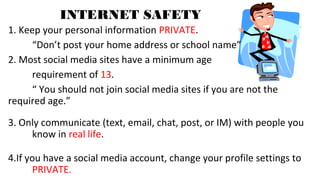
INTERNET SAFETY
1. Keep your personal information PRIVATE.
“Don’t post your home address or school name”
2. Most social media sites have a minimum age
requirement of 13.
“ You should not join social media sites if you are not the
required age.”
3. Only communicate (text, email, chat, post, or IM) with people you
know in real life.
4.If you have a social media account, change your profile settings to
PRIVATE.
Friend or Fake
(video)
Question:
When you post online or send a
text, how fast does information
travel?
Information Travels Fast
1. Once you put information on the Internet, it is out of
your control FOREVER.
2. If you receive an inappropriate message, THINK
before you send it to someone else.
3. If you are MAD at a friend, do not send a hateful
message online or text. You can get in big trouble.
4. TALK to an adult if you receive any obscene or
inappropriate messages.
Information Travels Fast! (video)
Question:
What can you do if you are a
victim of cyberbullying?
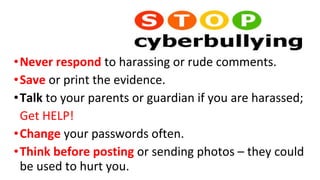
•Never respond to harassing or rude comments.
•Save or print the evidence.
•Talk to your parents or guardian if you are harassed; 
Get HELP! 
•Change your passwords often.
•Think before posting or sending photos – they could 
be used to hurt you.
WHAT IS CYBERBULLYING? (video)
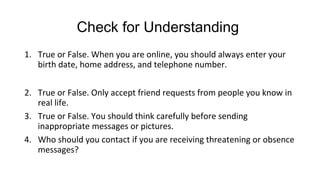
Check for Understanding
1. True or False. When you are online, you should always enter your
birth date, home address, and telephone number.
2. True or False. Only accept friend requests from people you know in
real life.
3. True or False. You should think carefully before sending
inappropriate messages or pictures.
4. Who should you contact if you are receiving threatening or obsence
messages?
References
"Helping You Make Safer Choices Online." <i>NSTeens</i>. National
Center for Missing or Exploited Children. Web. 23 Oct. 2014.

Cyber safety training for 6th grade