Guyana Water Incorporated
Optimized Design for Multiple Tray Aerators for
pH Correction of Groundwater
18th October, 2017
Name of Presenter: Riaz Zalil
Project Engineer (PI&PB)
Email: riazzalil@hotmail.com / riazz@gwi.gy
WELCOME!
Caribbean Water and Waste Water Association
Topic: Non-chemical Water Treatment
Title: Optimized Design for Multiple Tray
Aerators for pH Correction of Groundwater
Outline of Presentation
• Introduction
• Background
• Is Lime really needed?
• Analysis of Data
• Proposed Improvements in
the Design of Multiple Tray
Aerators
• Summary of Design
Improvements
• Conclusion
• Further Research
Introduction
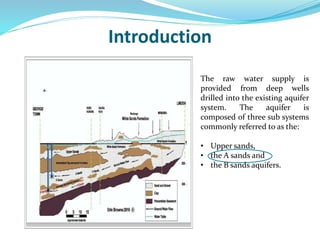
The raw water supply is
provided from deep wells
drilled into the existing aquifer
system. The aquifer is
composed of three sub systems
commonly referred to as the:
• Upper sands,
• the A sands and
• the B sands aquifers.
Background
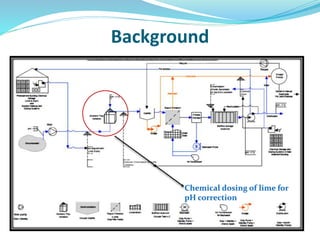
Chemical dosing of lime for
pH correction
Is Lime Really Needed?
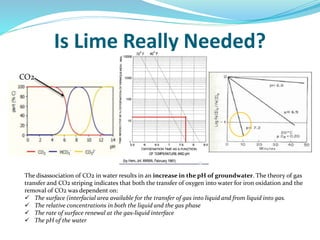
The disassociation of CO2 in water results in an increase in the pH of groundwater. The theory of gas
transfer and CO2 striping indicates that both the transfer of oxygen into water for iron oxidation and the
removal of CO2 was dependent on:
 The surface (interfacial area available for the transfer of gas into liquid and from liquid into gas.
 The relative concentrations in both the liquid and the gas phase
 The rate of surface renewal at the gas-liquid interface
 The pH of the water
CO2
Analysis – Simulated Aeration
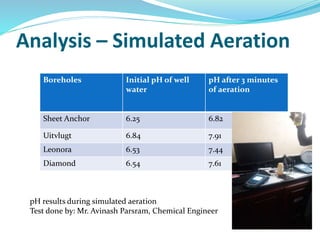
Boreholes Initial pH of well
water
pH after 3 minutes
of aeration
Sheet Anchor 6.25 6.82
Uitvlugt 6.84 7.91
Leonora 6.53 7.44
Diamond 6.54 7.61
pH results during simulated aeration
Test done by: Mr. Avinash Parsram, Chemical Engineer
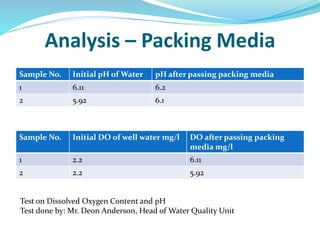
Analysis – Packing Media
Sample No. Initial pH of Water pH after passing packing media
1 6.11 6.2
2 5.92 6.1
Sample No. Initial DO of well water mg/l DO after passing packing
media mg/l
1 2.2 6.11
2 2.2 5.92
Test on Dissolved Oxygen Content and pH
Test done by: Mr. Deon Anderson, Head of Water Quality Unit
The Question is now?
Why does the existing aeration system isn’t capable
of achieving the pH increase?
 The problem seems to lie with the design of the
multiple tray aerators itself.
Solution:
Fix the
Design!!!
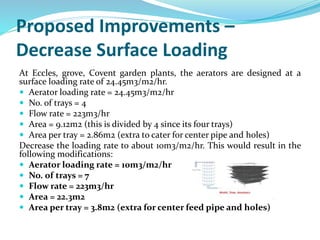
Proposed Improvements –
Decrease Surface Loading
At Eccles, grove, Covent garden plants, the aerators are designed at a
surface loading rate of 24.45m3/m2/hr.
 Aerator loading rate = 24.45m3/m2/hr
 No. of trays = 4
 Flow rate = 223m3/hr
 Area = 9.12m2 (this is divided by 4 since its four trays)
 Area per tray = 2.86m2 (extra to cater for center pipe and holes)
Decrease the loading rate to about 10m3/m2/hr. This would result in the
following modifications:
 Aerator loading rate = 10m3/m2/hr
 No. of trays = 7
 Flow rate = 223m3/hr
 Area = 22.3m2
 Area per tray = 3.8m2 (extra for center feed pipe and holes)
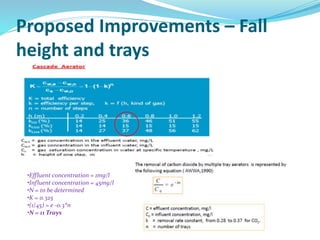
Proposed Improvements – Fall
height and trays
•Effluent concentration = 1mg/l
•Influent concentration = 45mg/l
•N = to be determined
•K = 0.325
•(1/45) = e -0.3*n
•N = 11 Trays
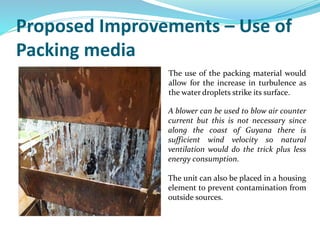
Proposed Improvements – Use of
Packing media
The use of the packing material would
allow for the increase in turbulence as
the water droplets strike its surface.
A blower can be used to blow air counter
current but this is not necessary since
along the coast of Guyana there is
sufficient wind velocity so natural
ventilation would do the trick plus less
energy consumption.
The unit can also be placed in a housing
element to prevent contamination from
outside sources.
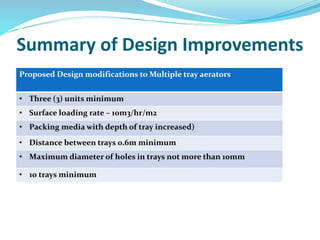
Summary of Design Improvements
Proposed Design modifications to Multiple tray aerators
• Three (3) units minimum
• Surface loading rate – 10m3/hr/m2
• Packing media with depth of tray increased)
• Distance between trays 0.6m minimum
• Maximum diameter of holes in trays not more than 10mm
• 10 trays minimum
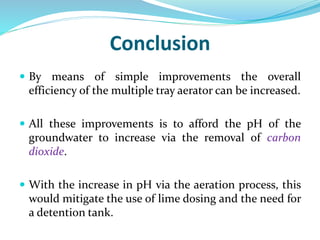
Conclusion
 By means of simple improvements the overall
efficiency of the multiple tray aerator can be increased.
 All these improvements is to afford the pH of the
groundwater to increase via the removal of carbon
dioxide.
 With the increase in pH via the aeration process, this
would mitigate the use of lime dosing and the need for
a detention tank.
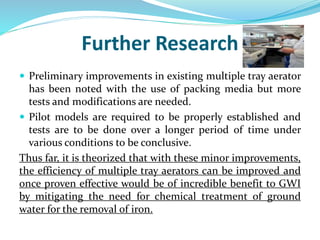
Further Research
 Preliminary improvements in existing multiple tray aerator
has been noted with the use of packing media but more
tests and modifications are needed.
 Pilot models are required to be properly established and
tests are to be done over a longer period of time under
various conditions to be conclusive.
Thus far, it is theorized that with these minor improvements,
the efficiency of multiple tray aerators can be improved and
once proven effective would be of incredible benefit to GWI
by mitigating the need for chemical treatment of ground
water for the removal of iron.
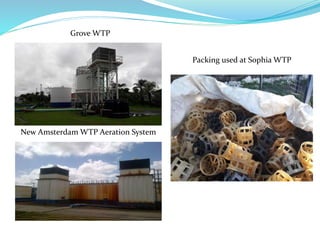
Packing used at Sophia WTP
Grove WTP
New Amsterdam WTP Aeration System
End of Presentation
Water is Life, Save
it!
General Discussion
 Questions - ?
 Comments - …..
 Concerns - ……

Cwwa optimized design for multiple tray aerators - riaz zalil

  • 1.
    Guyana Water Incorporated OptimizedDesign for Multiple Tray Aerators for pH Correction of Groundwater 18th October, 2017 Name of Presenter: Riaz Zalil Project Engineer (PI&PB) Email: riazzalil@hotmail.com / riazz@gwi.gy
  • 2.
    WELCOME! Caribbean Water andWaste Water Association Topic: Non-chemical Water Treatment Title: Optimized Design for Multiple Tray Aerators for pH Correction of Groundwater
  • 3.
    Outline of Presentation •Introduction • Background • Is Lime really needed? • Analysis of Data • Proposed Improvements in the Design of Multiple Tray Aerators • Summary of Design Improvements • Conclusion • Further Research
  • 4.
    Introduction The raw watersupply is provided from deep wells drilled into the existing aquifer system. The aquifer is composed of three sub systems commonly referred to as the: • Upper sands, • the A sands and • the B sands aquifers.
  • 5.
    Background Chemical dosing oflime for pH correction
  • 6.
    Is Lime ReallyNeeded? The disassociation of CO2 in water results in an increase in the pH of groundwater. The theory of gas transfer and CO2 striping indicates that both the transfer of oxygen into water for iron oxidation and the removal of CO2 was dependent on:  The surface (interfacial area available for the transfer of gas into liquid and from liquid into gas.  The relative concentrations in both the liquid and the gas phase  The rate of surface renewal at the gas-liquid interface  The pH of the water CO2
  • 7.
    Analysis – SimulatedAeration Boreholes Initial pH of well water pH after 3 minutes of aeration Sheet Anchor 6.25 6.82 Uitvlugt 6.84 7.91 Leonora 6.53 7.44 Diamond 6.54 7.61 pH results during simulated aeration Test done by: Mr. Avinash Parsram, Chemical Engineer
  • 8.
    Analysis – PackingMedia Sample No. Initial pH of Water pH after passing packing media 1 6.11 6.2 2 5.92 6.1 Sample No. Initial DO of well water mg/l DO after passing packing media mg/l 1 2.2 6.11 2 2.2 5.92 Test on Dissolved Oxygen Content and pH Test done by: Mr. Deon Anderson, Head of Water Quality Unit
  • 9.
    The Question isnow? Why does the existing aeration system isn’t capable of achieving the pH increase?  The problem seems to lie with the design of the multiple tray aerators itself. Solution: Fix the Design!!!
  • 10.
    Proposed Improvements – DecreaseSurface Loading At Eccles, grove, Covent garden plants, the aerators are designed at a surface loading rate of 24.45m3/m2/hr.  Aerator loading rate = 24.45m3/m2/hr  No. of trays = 4  Flow rate = 223m3/hr  Area = 9.12m2 (this is divided by 4 since its four trays)  Area per tray = 2.86m2 (extra to cater for center pipe and holes) Decrease the loading rate to about 10m3/m2/hr. This would result in the following modifications:  Aerator loading rate = 10m3/m2/hr  No. of trays = 7  Flow rate = 223m3/hr  Area = 22.3m2  Area per tray = 3.8m2 (extra for center feed pipe and holes)
  • 11.
    Proposed Improvements –Fall height and trays •Effluent concentration = 1mg/l •Influent concentration = 45mg/l •N = to be determined •K = 0.325 •(1/45) = e -0.3*n •N = 11 Trays
  • 12.
    Proposed Improvements –Use of Packing media The use of the packing material would allow for the increase in turbulence as the water droplets strike its surface. A blower can be used to blow air counter current but this is not necessary since along the coast of Guyana there is sufficient wind velocity so natural ventilation would do the trick plus less energy consumption. The unit can also be placed in a housing element to prevent contamination from outside sources.
  • 13.
    Summary of DesignImprovements Proposed Design modifications to Multiple tray aerators • Three (3) units minimum • Surface loading rate – 10m3/hr/m2 • Packing media with depth of tray increased) • Distance between trays 0.6m minimum • Maximum diameter of holes in trays not more than 10mm • 10 trays minimum
  • 14.
    Conclusion  By meansof simple improvements the overall efficiency of the multiple tray aerator can be increased.  All these improvements is to afford the pH of the groundwater to increase via the removal of carbon dioxide.  With the increase in pH via the aeration process, this would mitigate the use of lime dosing and the need for a detention tank.
  • 15.
    Further Research  Preliminaryimprovements in existing multiple tray aerator has been noted with the use of packing media but more tests and modifications are needed.  Pilot models are required to be properly established and tests are to be done over a longer period of time under various conditions to be conclusive. Thus far, it is theorized that with these minor improvements, the efficiency of multiple tray aerators can be improved and once proven effective would be of incredible benefit to GWI by mitigating the need for chemical treatment of ground water for the removal of iron.
  • 16.
    Packing used atSophia WTP Grove WTP New Amsterdam WTP Aeration System
  • 17.
    End of Presentation Wateris Life, Save it!
  • 18.
    General Discussion  Questions- ?  Comments - …..  Concerns - ……