printed by
www.postersession.com
Analysis and Modeling of Eclipsing Binary
AI Hydrae
Cindy J. Villamil, A. Prsa, S. Engle, B. M. Kirk, J. A. Robertson (Villanova U.)
The parameters of AI Hydrae that have been previously derived from the
photometric data, as well as the spectroscopic data, are based on observations that are over
thirty years old. Their data were taken on photographic plates as opposed to ours which we
acquired using a photoelectric multiplier on the 0.8 meter Four College Automatic
Photoelectric Telescope, located in Arizona and through data from the All Sky Automated
Survey.
Bonanos, Alceste Z. "Eclipsing Binaries: Tools for Calibrating the Extragalactic Distance Scale." Binary Stars as Critical Tools & Tests in Contemporary Astrophysics, Proceedings of IAU Symposium #240, held 22-25 August, 2006 in Prague, Czech Republic. (2007): 79-87. Print.
Fleming, Scott W. et al "Binary Research with Dedicated Spectroscopy." NOAO Observing Proposal for Low Mass Stars (2009). Print.
Popper, D. M. et al "U, B, V photometric program on eclipsing binaries at Palomar and Kitt Peak." Astronomical Journal 82 (1977): 216-22. Print.
Prsa, Andrej. et al "A Computational Guide to Physics of Eclipsing Binaries. I. Demonstrations and Perspectives." The Astrophysical Journal 628.1 (2005): 426-38. Print.
Prsa, Andrej. et al"Artificial Intelligence Approach to the Determination of Physical Properties of Eclipsing Binaries. I. The EBAI Project." The Astrophysical Journal 687.1 (2008): 542-65. Print.
We gratefully acknowledge NSF/RUI grant AST-05-07542 and a special thanks to Jessica Tabares.
In December 2009 and January 2010 we used the Kitt Peak National Optical
Astronomy Observatory 2.1 meter telescope in Arizona to collect our spectroscopic data for
research. The spectra were acquired with a fiber fed echelle spectrometer, having a
significantly higher resolution and, thus,
superior in accuracy to those taken in 1976 and
1977.The criterion we used for selection of the
binaries was that these binaries are not character
to chromospheric activity, significant gravitational
distortion, or any other unique features; rather,
they behave like clockwork, providing the precise
fundamentals required for theoretical progression
(Torres et al 2008). AI Hydrae was chosen from
this batch.
We then underwent the lengthy process
of preparing the raw data for analysis. Using various IRAF packages and programs we
performed cosmic ray removal, flux normalization, dispersion correction and wavelength
calibration of the echelle spectra. We then synthesized spectra for the system for cross-
correlation to extract radial velocities using TODCOR (Zucker & Mazeh 1994). In
September of 2010 we revisited Kitt Peak National Observatory in Arizona, but this time
used the Mayall 4m telescope and collected more echelle spectra of AI Hya to use for further
calibration. The data has already been reduced and is now waiting to be analyzed. The
figures below depict images of raw echelle spectra from both the 2.1(above) and 4
meter(below) telescopes and examples of various steps of the data reduction.
Spectroscopic Data Acquisition and Reduction
Abstract
Bibliography
AI Hydrae is an F-type detached eclipsing binary with a δ scuti companion that we know a considerable amount about. In 1988, Popper analyzed light curves and spectra of AI Hydrae to
determine parameters such as the spectral type, period, orbital eccentricity, systemic velocity, and argument of periastron. We have retaken photometry of the system using the Four
College Automated Photoelectric Telescope and acquired echelle spectra with the 2.1 and 4 meter telescopes at Kitt Peak National Observatory, both located in Arizona. We reduced the
echelle spectra using IRAF to remove the cosmic rays in the data, perform wavelength calibration, and measure the Doppler shifts of the spectral lines to obtain radial velocity curves.
After reducing the spectroscopic data we simultaneously analyzed the radial velocities with the light curves for AI Hydrae to compare those results with the previous values from the
literature. With this analysis, we aim to reduce the error margin of the system’s physical parameters such as masses, luminosities, radii, and velocities, and consequently, further calibrate
the mass-luminosity relationship. This poster presents preliminary results of our analysis and modeling based on our acquired data.
Parameter Value
Spectral Type F2/F0
Flux 9th magnitude
Period 8.29 days
Orbital Eccentricity .23
Inclination 90° ± 2
Argument of
periastron
.245°
Parameter Value
KH 90.1 ± 0.7 km/s
KC 83.1 ± 0.7 km/s
γ 45.1 ± 0.6 km/s
σH 2.4 km/s
σC 2.3 km/s
Asini 27.68 ± 0.17 solar radii
MHsin3i 1.98 ± 0.04 solar masses
MCsin3i 2.14 ± 0.04 solar masses
Photometric Data Acquisition
Previous Analysis
Previous analysis of AI Hya was performed by Daniel Popper in 1988 yielding many
parameters for the system. He did his own spectroscopic analysis but relied on
Joergensen and Gronbech’s photometric analysis of the system done in 1978 .
Analysis of Spectroscopic and Photometric Data
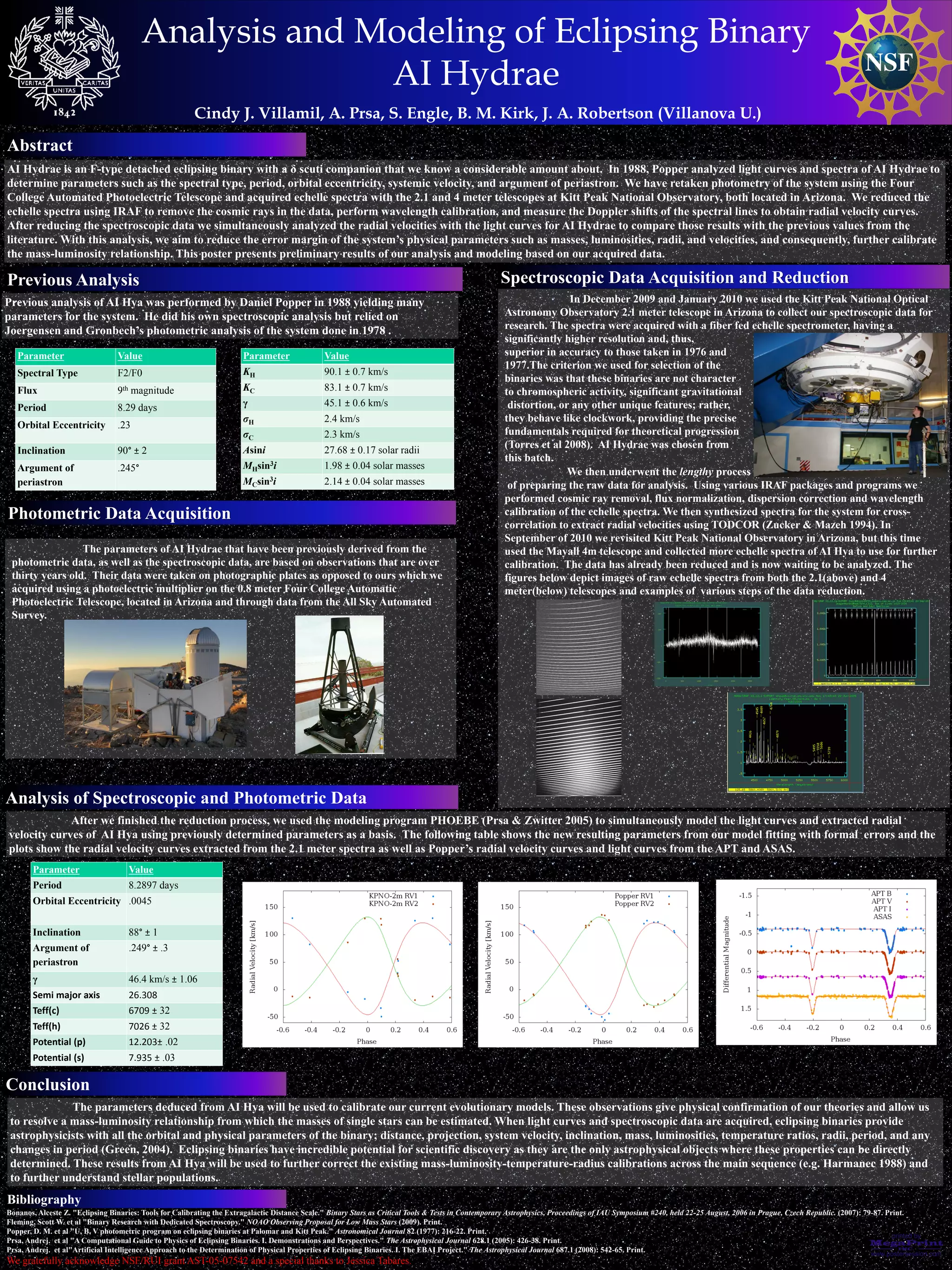
After we finished the reduction process, we used the modeling program PHOEBE (Prsa & Zwitter 2005) to simultaneously model the light curves and extracted radial
velocity curves of AI Hya using previously determined parameters as a basis. The following table shows the new resulting parameters from our model fitting with formal errors and the
plots show the radial velocity curves extracted from the 2.1 meter spectra as well as Popper’s radial velocity curves and light curves from the APT and ASAS.
Conclusion
The parameters deduced from AI Hya will be used to calibrate our current evolutionary models. These observations give physical confirmation of our theories and allow us
to resolve a mass-luminosity relationship from which the masses of single stars can be estimated. When light curves and spectroscopic data are acquired, eclipsing binaries provide
astrophysicists with all the orbital and physical parameters of the binary; distance, projection, system velocity, inclination, mass, luminosities, temperature ratios, radii, period, and any
changes in period (Green, 2004). Eclipsing binaries have incredible potential for scientific discovery as they are the only astrophysical objects where these properties can be directly
determined. These results from AI Hya will be used to further correct the existing mass-luminosity-temperature-radius calibrations across the main sequence (e.g. Harmanec 1988) and
to further understand stellar populations.
Parameter Value
Period 8.2897 days
Orbital Eccentricity .0045
Inclination 88° ± 1
Argument of
periastron
.249° ± .3
γ 46.4 km/s ± 1.06
Semi major axis 26.308
Teff(c) 6709 ± 32
Teff(h) 7026 ± 32
Potential (p) 12.203± .02
Potential (s) 7.935 ± .03

CV-AIHyaAAS

  • 1.
    printed by www.postersession.com Analysis andModeling of Eclipsing Binary AI Hydrae Cindy J. Villamil, A. Prsa, S. Engle, B. M. Kirk, J. A. Robertson (Villanova U.) The parameters of AI Hydrae that have been previously derived from the photometric data, as well as the spectroscopic data, are based on observations that are over thirty years old. Their data were taken on photographic plates as opposed to ours which we acquired using a photoelectric multiplier on the 0.8 meter Four College Automatic Photoelectric Telescope, located in Arizona and through data from the All Sky Automated Survey. Bonanos, Alceste Z. "Eclipsing Binaries: Tools for Calibrating the Extragalactic Distance Scale." Binary Stars as Critical Tools & Tests in Contemporary Astrophysics, Proceedings of IAU Symposium #240, held 22-25 August, 2006 in Prague, Czech Republic. (2007): 79-87. Print. Fleming, Scott W. et al "Binary Research with Dedicated Spectroscopy." NOAO Observing Proposal for Low Mass Stars (2009). Print. Popper, D. M. et al "U, B, V photometric program on eclipsing binaries at Palomar and Kitt Peak." Astronomical Journal 82 (1977): 216-22. Print. Prsa, Andrej. et al "A Computational Guide to Physics of Eclipsing Binaries. I. Demonstrations and Perspectives." The Astrophysical Journal 628.1 (2005): 426-38. Print. Prsa, Andrej. et al"Artificial Intelligence Approach to the Determination of Physical Properties of Eclipsing Binaries. I. The EBAI Project." The Astrophysical Journal 687.1 (2008): 542-65. Print. We gratefully acknowledge NSF/RUI grant AST-05-07542 and a special thanks to Jessica Tabares. In December 2009 and January 2010 we used the Kitt Peak National Optical Astronomy Observatory 2.1 meter telescope in Arizona to collect our spectroscopic data for research. The spectra were acquired with a fiber fed echelle spectrometer, having a significantly higher resolution and, thus, superior in accuracy to those taken in 1976 and 1977.The criterion we used for selection of the binaries was that these binaries are not character to chromospheric activity, significant gravitational distortion, or any other unique features; rather, they behave like clockwork, providing the precise fundamentals required for theoretical progression (Torres et al 2008). AI Hydrae was chosen from this batch. We then underwent the lengthy process of preparing the raw data for analysis. Using various IRAF packages and programs we performed cosmic ray removal, flux normalization, dispersion correction and wavelength calibration of the echelle spectra. We then synthesized spectra for the system for cross- correlation to extract radial velocities using TODCOR (Zucker & Mazeh 1994). In September of 2010 we revisited Kitt Peak National Observatory in Arizona, but this time used the Mayall 4m telescope and collected more echelle spectra of AI Hya to use for further calibration. The data has already been reduced and is now waiting to be analyzed. The figures below depict images of raw echelle spectra from both the 2.1(above) and 4 meter(below) telescopes and examples of various steps of the data reduction. Spectroscopic Data Acquisition and Reduction Abstract Bibliography AI Hydrae is an F-type detached eclipsing binary with a δ scuti companion that we know a considerable amount about. In 1988, Popper analyzed light curves and spectra of AI Hydrae to determine parameters such as the spectral type, period, orbital eccentricity, systemic velocity, and argument of periastron. We have retaken photometry of the system using the Four College Automated Photoelectric Telescope and acquired echelle spectra with the 2.1 and 4 meter telescopes at Kitt Peak National Observatory, both located in Arizona. We reduced the echelle spectra using IRAF to remove the cosmic rays in the data, perform wavelength calibration, and measure the Doppler shifts of the spectral lines to obtain radial velocity curves. After reducing the spectroscopic data we simultaneously analyzed the radial velocities with the light curves for AI Hydrae to compare those results with the previous values from the literature. With this analysis, we aim to reduce the error margin of the system’s physical parameters such as masses, luminosities, radii, and velocities, and consequently, further calibrate the mass-luminosity relationship. This poster presents preliminary results of our analysis and modeling based on our acquired data. Parameter Value Spectral Type F2/F0 Flux 9th magnitude Period 8.29 days Orbital Eccentricity .23 Inclination 90° ± 2 Argument of periastron .245° Parameter Value KH 90.1 ± 0.7 km/s KC 83.1 ± 0.7 km/s γ 45.1 ± 0.6 km/s σH 2.4 km/s σC 2.3 km/s Asini 27.68 ± 0.17 solar radii MHsin3i 1.98 ± 0.04 solar masses MCsin3i 2.14 ± 0.04 solar masses Photometric Data Acquisition Previous Analysis Previous analysis of AI Hya was performed by Daniel Popper in 1988 yielding many parameters for the system. He did his own spectroscopic analysis but relied on Joergensen and Gronbech’s photometric analysis of the system done in 1978 . Analysis of Spectroscopic and Photometric Data After we finished the reduction process, we used the modeling program PHOEBE (Prsa & Zwitter 2005) to simultaneously model the light curves and extracted radial velocity curves of AI Hya using previously determined parameters as a basis. The following table shows the new resulting parameters from our model fitting with formal errors and the plots show the radial velocity curves extracted from the 2.1 meter spectra as well as Popper’s radial velocity curves and light curves from the APT and ASAS. Conclusion The parameters deduced from AI Hya will be used to calibrate our current evolutionary models. These observations give physical confirmation of our theories and allow us to resolve a mass-luminosity relationship from which the masses of single stars can be estimated. When light curves and spectroscopic data are acquired, eclipsing binaries provide astrophysicists with all the orbital and physical parameters of the binary; distance, projection, system velocity, inclination, mass, luminosities, temperature ratios, radii, period, and any changes in period (Green, 2004). Eclipsing binaries have incredible potential for scientific discovery as they are the only astrophysical objects where these properties can be directly determined. These results from AI Hya will be used to further correct the existing mass-luminosity-temperature-radius calibrations across the main sequence (e.g. Harmanec 1988) and to further understand stellar populations. Parameter Value Period 8.2897 days Orbital Eccentricity .0045 Inclination 88° ± 1 Argument of periastron .249° ± .3 γ 46.4 km/s ± 1.06 Semi major axis 26.308 Teff(c) 6709 ± 32 Teff(h) 7026 ± 32 Potential (p) 12.203± .02 Potential (s) 7.935 ± .03