Article https://doi.org/10.1038/s41467-024-54748-3
A binary system in the S cluster close to the
supermassive black hole Sagittarius A*
Florian Peißker 1
, Michal Zajaček 1,2
, Lucas Labadie 1
, Emma Bordier 1
,
Andreas Eckart 1,3
, Maria Melamed1
& Vladimír Karas 4
High-velocity stars and peculiar G objects orbit the central supermassive black
hole (SMBH) Sagittarius A* (Sgr A*). Together, the G objects and high-velocity
stars constitute the S cluster. In contrast with theoretical predictions, no bin-
ary system near Sgr A* has been identified. Here, we report the detection of a
spectroscopic binary system in the S cluster with the masses of the compo-
nents of 2.80 ± 0.50 M⊙ and 0.73 ± 0.14 M⊙, assuming an edge-on config-
uration. Based on periodic changes in the radial velocity, we find an orbital
period of 372±3 days for the two components. The binary system is stable
against the disruption by Sgr A* due to the semi-major axis of the secondary
being 1.59±0.01 AU, which is well below its tidal disruption radius of
approximately 42.4 AU. The system, known as D9, shows similarities to the G
objects. We estimate an age for D9 of 2:7+ 1:9
0:3 × 10⁶
yr that is comparable to the
timescale of the SMBH-induced von Zeipel-Lidov-Kozai cycle period of about
106
yr, causing the system to merge in the near future. Consequently, the
population of G objects may consist of pre-merger binaries and post-merger
products. The detection of D9 implies that binary systems in the S cluster have
the potential to reside in the vicinity of the supermassive black hole Sgr A* for
approximately 106
years.
The central parsec around the supermassive black hole (SMBH) Sgr A*
contains a large number of stars that constitute the Nuclear Star
Cluster (NSC)1
, which is one of the densest and most massive stellar
systems in the Galaxy. These stars vary in terms of their ages, masses,
sizes, and luminosities2
. In the vicinity of Sgr A* of about 40 mpc, there
is a high concentration of stars3
that orbit the black hole at velocities of
up to several thousand km/s4,5
inside the S cluster. The presence of
stars close the Sgr A* is not surprising because it was expected that old
and evolved stars would gradually descend towards Sgr A* due to the
cluster relaxation timescale of ~1010
yr6
. This is because star formation
is significantly inhibited by tidal forces and high energetic radiation in
the vicinity of the SMBH. In fact, a cusp of late-type stars with stellar
ages of 3 × 10⁹
yr was identified7
. Interestingly, these late-type stars
coexist with massive early-type S cluster members that exhibit an
average age of ~4−6 × 10⁶
yr8,9
, resulting in the formulation of the
“paradox of youth”10
. Until now, no companions have been identified
for these young B-type stars11
, although binary rates close to 100% have
been proposed12
. Therefore, the presence of binary systems in the S
cluster is a crucial question to investigate the dynamical evolution of
stars in the vicinity of Sgr A*13,14
. Given that the evolution of high-mass
stars is altered by their binary interactions15
, it is important to under-
stand the prevalence of putative binary systems in this cluster.
In this work, we present the detection of a spectroscopic binary in
the S cluster. Based on the photometric characteristics of the binary
system, known as D9, it can be considered to be a member of the
G-object population16,17
. The age of the system is ~2.7 × 10⁶
yr, which is
comparable to the von Zeipel-Lidov-Kozai cycle period of approxi-
mately 106
years. The dusty source D9 is most likely composed of a
Herbig Ae/Be star associated with the primary. The lower-mass com-
panion can be classified as a T-Tauri star. In the near future, the binary
Received: 26 April 2024
Accepted: 18 November 2024
Check for updates
1
1.Physikalisches Institut, Universität zu Köln, Zülpicher Str. 77, Cologne 50937, Germany. 2
Department of Theoretical Physics and Astrophysics, Masaryk
University, Kotlářpská 2, Brno 61137, Czech Republic. 3
Max-Plank-Institut für Radioastronomie, Max-Planck-Gesellschaft, Auf dem Hügel 69, Bonn 53121,
Germany. 4
Astronomical Institute, Czech Academy of Sciences, Boční II 1401, Prague 141 00, Czech Republic. e-mail: peissker@ph1.uni-koeln.de
Nature Communications| (2024)15:10608 1
1234567890():,;
1234567890():,;
may undergo a merging event due to the ongoing three-body inter-
action of the system with Sgr A*. The uncertain nature of the G objects
can thus be resolved, at least in part, thanks to the binary system D9
whose imminent fate appears to be a stellar merger.
Results
Observations
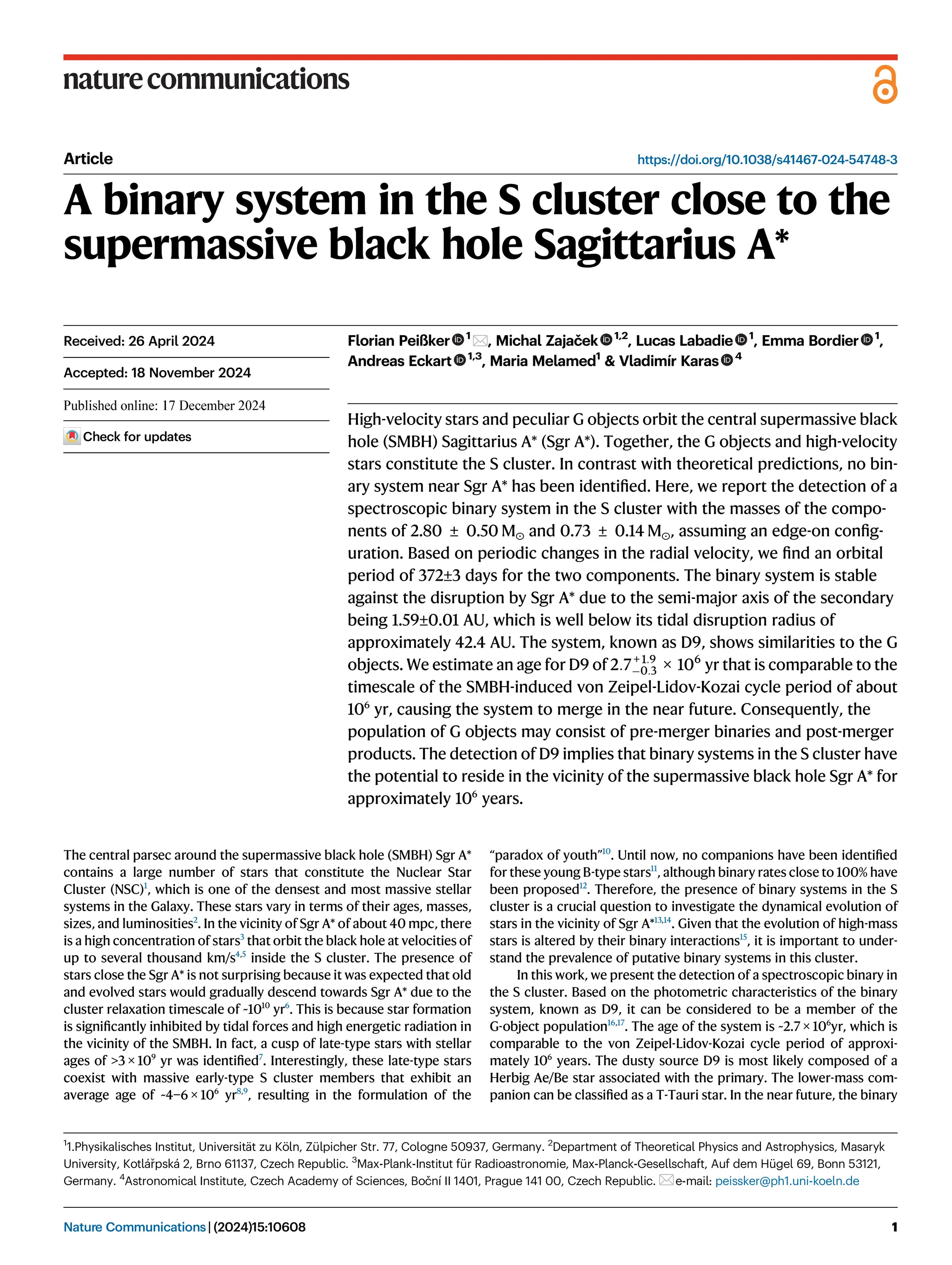
Using archival data observed with the decommissioned near-infrared
integral field unit (IFU) of Spectrograph for INtegral Field Observations
in the Near Infrared (SINFONI, mounted at the Very Large
Telescope)18,19
in the H+K band (1.4−2.4 μm) between 2005 and 2019,
we investigate the blue-shifted Brackettγ (Brγ) emission of the source
D9 (Fig. 1), which is part of the G-object population in the S
cluster16,17,20
. In addition, we include recent Enhanced Resolution Ima-
ging Spectrograph (ERIS) observations carried out by the ERIS Team as
part of the commissioning run in 202221
. For the analysis of the three-
dimensional data cubes that consist of two spatial and one spectral
dimension, we perform standard reduction steps (flat-fielding, dark,
and distortion corrections). We obtain single barycentric and helio-
centric corrected data cubes that are stacked for each year individually
to construct a final mosaic of the entire S cluster region. Based on the
best-fit Keplerian solution, we obtain an estimate of the periapse dis-
tance of the D9 system from Sgr A* of 29.9 mpc (0.75 arcseconds)
adopting MSgrA* = 4 × 10⁶
M⊙ and 8 kpc for the mass and the distance of
Sgr A*, respectively22,23
. Furthermore, we find a close to edge-on orbital
inclination of (102.55 ± 2.29)°. With an eccentricity of 0.32 and a semi-
major axis of 44 mpc, D9 qualifies as an S cluster member with orbital
parameters comparable to other S stars3,24
. Due to the orbit of the B2V
star S2 (S0-2) that intercepts with the trajectory of D9, we focus on the
data set of 2019 to identify a continuum counterpart in the H and K
band to the Brγ line-emitting source.
Magnitudes
To increase the photometric baseline, we incorporate Near-infrared
Camera 2 (NIRC2, mounted at the Keck telescope) L band imaging data
from 2019 to cover the near- and mid-infrared25
. The science-ready
data was downloaded from the Keck Observatory Archive26
. Due to the
high stellar density of the S cluster27
, dominant point spread function
(PSF) wings are a common obstacle that hinders confusion-free
detection of fainter objects such as G128
, DSO/G229
, or D920
. There-
fore, we used an image sharpener on the continuum data of 2019 to
reduce the impact of the challenging crowding situation in the S
cluster (Supplementary Fig. 1 and Supplementary Table 1). With this
procedure, we enhance fainter structures but preserve the photo- and
astrometric aspects of the input data. To emphasize the robustness of
the image sharpener, we invoke the contour lines of the input data as a
comparison, as demonstrated in Fig. 1. Analyzing the displayed
extinction corrected data (Supplementary Table 2), we find H
−K = 1.75± 0.20 and K−L = 2.25 ± 0.20 colors for D9 suggesting photo-
metric similarities with D2 and D2320
. The latter two sources are
believed to be associated with young T Tauri or low-mass stars16,30,31
.
Due to these photometric consistencies (Supplementary Fig. 2), we
tested the hypothesis using a Spectral Energy Distribution (SED) fitter.
Spectral energy distribution
The SED fitter32
applies a convolving filter to the individual values to
reflect on the response function of the instrument filter. Because the
photometric system of SINFONI is based on the Two Micron All Sky
Survey (2MASS) data base, we select the corresponding filters “2H” and
“2K”. For the NIRC2 MIR data, we use the United Kingdom Infrared
Telescope (UKIRT) L’ band filter because it is based on the Mauna Kea
photometric system33
. With these settings, the fitter compares models
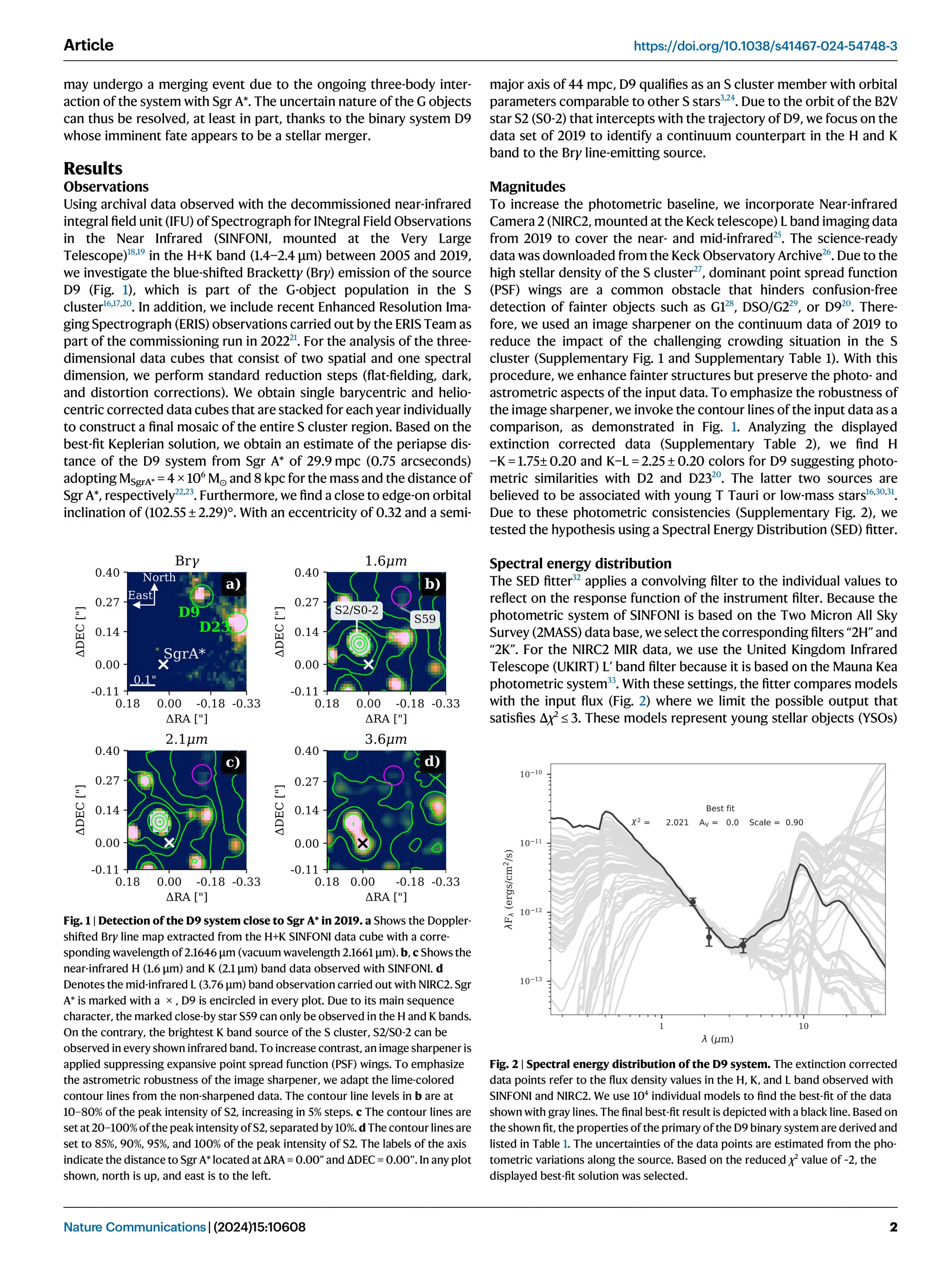
with the input flux (Fig. 2) where we limit the possible output that
satisfies Δχ2
≤ 3. These models represent young stellar objects (YSOs)
Fig. 1 | Detection of the D9 system close to Sgr A* in 2019. a Shows the Doppler-
shifted Brγ line map extracted from the H+K SINFONI data cube with a corre-
sponding wavelength of 2.1646 μm (vacuum wavelength 2.1661 μm). b, c Shows the
near-infrared H (1.6 μm) and K (2.1 μm) band data observed with SINFONI. d
Denotes the mid-infrared L (3.76 μm) band observation carried out with NIRC2. Sgr
A* is marked with a × , D9 is encircled in every plot. Due to its main sequence
character, the marked close-by star S59 can only be observed in the H and K bands.
On the contrary, the brightest K band source of the S cluster, S2/S0-2 can be
observed in every shown infrared band. To increase contrast, an image sharpener is
applied suppressing expansive point spread function (PSF) wings. To emphasize
the astrometric robustness of the image sharpener, we adapt the lime-colored
contour lines from the non-sharpened data. The contour line levels in b are at
10–80% of the peak intensity of S2, increasing in 5% steps. c The contour lines are
set at 20–100% of the peak intensity of S2, separated by 10%. d The contour lines are
set to 85%, 90%, 95%, and 100% of the peak intensity of S2. The labels of the axis
indicate the distance to Sgr A* located at ΔRA = 0.00” and ΔDEC = 0.00''. In any plot
shown, north is up, and east is to the left.
Fig. 2 | Spectral energy distribution of the D9 system. The extinction corrected
data points refer to the flux density values in the H, K, and L band observed with
SINFONI and NIRC2. We use 104
individual models to find the best-fit of the data
shown with gray lines. The final best-fit result is depicted with a black line. Based on
the shown fit, the properties of the primary of the D9 binary system are derived and
listed in Table 1. The uncertainties of the data points are estimated from the pho-
tometric variations along the source. Based on the reduced χ2
value of ~2, the
displayed best-fit solution was selected.
Article https://doi.org/10.1038/s41467-024-54748-3
Nature Communications| (2024)15:10608 2
and are composed of a stellar core, an accretion disk, and a dusty
envelope. These typical components constitute a YSO and can be
traced in the near- and mid-infrared parts of the spectrum. As input
parameters, we used the H (0.8 ± 0.1 mJy), K (0.3 ± 0.1 mJy), and L
(0.4 ± 0.1 mJy) band flux densities estimated from the continuum
detection presented in Fig. 1. Considering common YSO models, the H
and K band emission traces the core components of the system,
whereas the L band emission can be associated with a dusty envelope.
Based on a photometric comparison with 104
individual models, the
best-fit of the SED fitter results in a stellar temperature of 1.2 × 10⁴
K
and a corresponding luminosity of approximately 93 L⊙, which are
associated with a stellar mass of 2.8 ± 0.5 M⊙ (see Table 1).
Periodic pattern
While finalizing the analysis of D9, a pattern of radial velocity came to
our attention. By inspecting the SINFONI mosaics that depict every
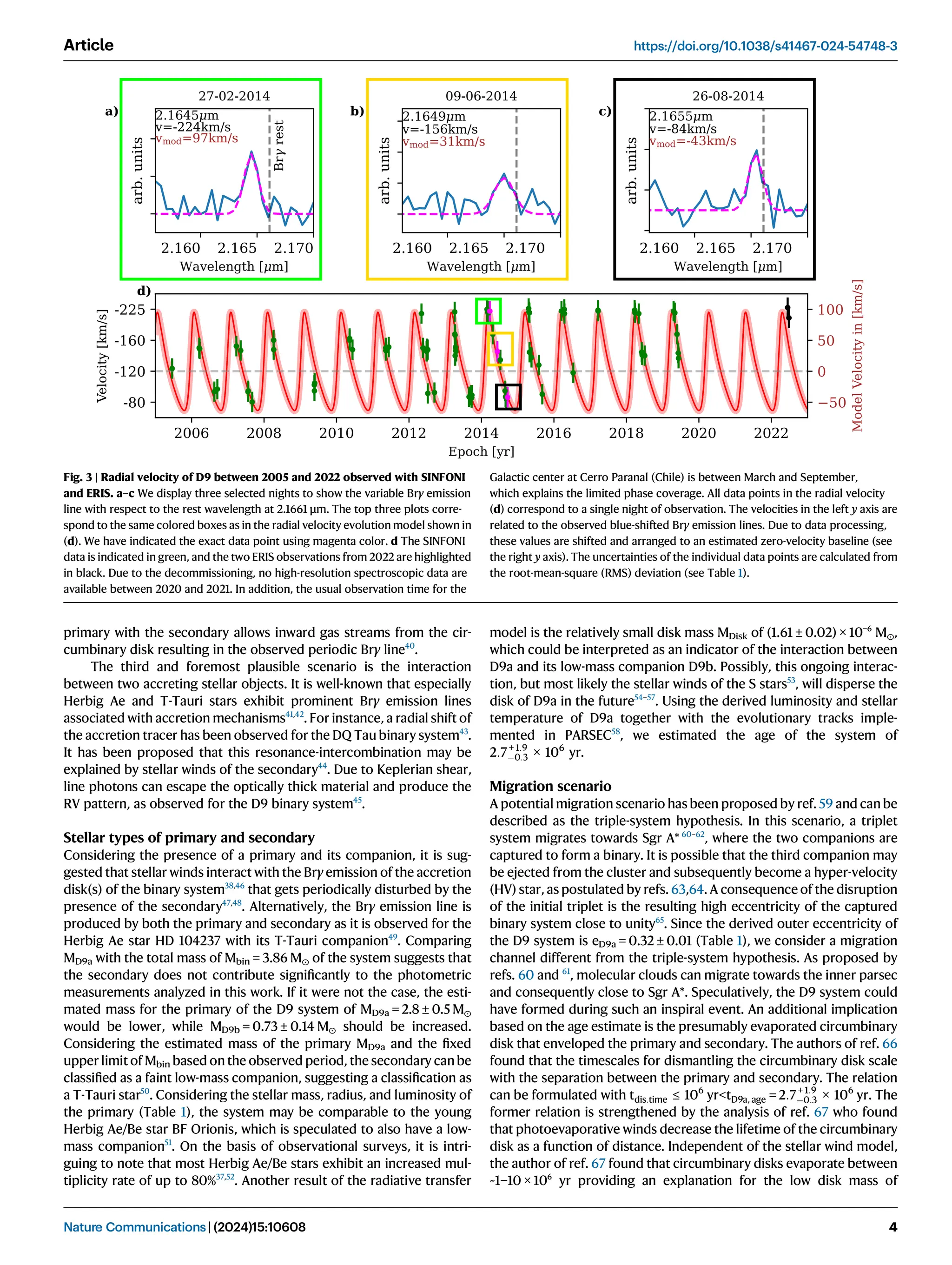
observed night between 2005 and 2019, we found a clear periodic
signal shown in Fig. 3 between −67 km/s and −225 km/s using the
Doppler-shifted Brγ emission line with respect to its rest wavelength at
2.1661 μm. A comparison of the periodic pattern of D9 with
the Doppler-shifted Brγ emission line of D23 demonstrates that the
signal is not an artifact (Supplementary Fig. 3). From the orbital fit
and the related inclination of i = (102.55 ± 2.29)°, we know that D9 is
moving on an almost edge-on orbit with a proper motion of
vprop = 249.43 ± 5.01 km/s.SinceS2 (S0-2) moves with a proper motion
of almost 800 km/s34
, the comparable slow velocity of D9 implies that
the intrinsic RV baseline vbase of the system, estimated with
(vmin + vmax)/2, will not change significantly between 2005 and 2019.
We normalize all observed velocities vobs to this baseline with vobs-vbase
to obtain vnorm, which is the input quantity for the fit of the binary
system performed with Exo-Stricker35
. Due to the poor phase coverage
before 2013, we split the data to perform an independent sanity check.
The fit displayed in Fig. 3 resembles the epochs between 2013 and
2019, where we used a false-alarm probability of 10−3
similar to that
used by ref. 14. The data baseline between 2005 and 2012 represents a
non-correlated parameter to the Keplerian model of the binary pro-
vided by Exo-Striker, which is in agreement with the fit that is based on
the epochs between 2013 and 2019 (Fig. 3). With a similar motivation,
we incorporate the ERIS observations from 2022 that show a satis-
factory agreement with the RV model and the expected LOS velocity of
the binary, consisting of a primary and a secondary. Regarding the
possible impact of a variable baseline vbase (i.e., the LOS velocity vobs of
D9 increases), we measure a difference of ± 15km/s between 2013 and
2019, which is consistent with the estimated uncertainty of ± 17km/s
from the fit. We conclude that a variation of vbase over the complete
data baseline is inside the uncertainties and does not impact the ana-
lysis significantly. However, a forthcoming analysis of the binary sys-
tem D9 should take this adaptation into account because it is expected
that an alteration of the intrinsic LOS velocity will exceed the uncer-
tainty range of the individual measurements of the periodic signal
within the next decade.
In the subsequent analysis, we will refer to the primary as D9a,
whereas the secondary companion will be denoted as D9b. With the
binary orbiting Sgr A*, this three-body system is divided into an inner
and outer binary. The inner binary describes D9a and D9b, while the
outer one represents the D9 system orbiting Sgr A*.
The best-fit result includes an offset of vbase with RVoff =
−29.19±3.00 km s−1
due to the eccentricity of the secondary eD9b of
0.45 ± 0.01, which causes an asymmetric distribution of the LOS velocity
around the baseline. With this offset, we obtain vmod = vnorm + RVoff as
displayed in Fig. 3. The related Keplerian parameters of the secondary
orbiting its primary are listed in Table 1. From the fit but also evident in
the periodic RV data points (Fig. 3), we find an orbital period for the
secondary of PD9b = 372.30±3.65 days = 1.02 ± 0.01 yr, which can be
transferred to a total mass of the system of about Mbin = 3.86 ± 0.07 M⊙,
considerably above the derived D9 (i.e., the primary) mass of
MD9a = 2.8 ± 0.5 M⊙. The difference in mass for MD9a and Mbin cannot be
explained solely by the uncertainty range. However, inspecting
m sinðiD9bÞ = 0:73 M and the assumed inclination of the secondary of
90° results in the maximum mass of the companion. The assumed
inclination of the secondary is motivated by an almost edge-on orbit of
D9 (Table 1). Although the circumprimary disk does not necessarily have
to be aligned with the orbit of the binary as is found for T-Tauri systems36
,
surveys of Herbig Ae/Be stars suggest a tendency towards a coplanar
arrangement37
.Assumingthatthe orbitofthe secondaryis approximately
aligned with the circumprimary disk with an intrinsic inclination of the
primary D9a of iintrinsic = (75±19)° (Table 1), we are allowed to transfer the
related uncertainties to m sinðiD9bÞ. Following this assumption, we find a
mass for the secondary of MD9b = 0.73 ± 0.14 M⊙ consistent with the
derived primary mass of MD9a = 2.8 ± 0.5 M⊙ and the total mass
Mbin = 3.86 ± 0.07 M⊙ of the system.
Discussion
Radiation mechanism
Taking into account the periodic variation of Brγ emission, we want to
highlight three different scenarios as a possible origin of the periodic
Brγ signal.
Firstly, the emission of the Brγ line is solely the result of a com-
bination between the gaseous accretion disk and stellar winds of the
primary38,39
. In this scenario, the secondary disturbs this emission by its
intrinsic Keplerian orbit around the primary.
Secondly, a possible origin of the Brγ line could be the presence of
a circumbinary disk around the D9 binary system enveloping the pri-
mary and the secondary. In this case, the interaction between the
Table 1 | Best-fit parameters of the D9 system
Secondary Keplerian Parameter
PD9b [year] 1.02 ± 0.01
eD9b 0.45 ± 0.01
ωD9b [deg] 311.75 ± 1.65
aD9b [au] 1.59 ± 0.01
iD9b [deg] 90.00
m sinðiD9bÞ [M⊙] 0.73
RVoff [km s−1
] −29.19 ± 3.00
χ2
ν
0.31
rms [km s−1
] 16.38
Keplerian parameter for D9 orbiting Sgr A*
eD9a 0.32 ± 0.01
iD9a [deg] 102.55 ± 2.29
aD9a [mpc] 44.00 ± 2.42
ωD9a [deg] 127.19 ± 7.50
ΩD9a [deg] 257.25 ± 1.61
PD9a [yr] 432.62 ± 0.01
Radiative transfer model
iintrinsic [deg] 75.0 ± 19.0
R [R⊙] 2.00 ±l 0.13
log(L/L⊙) 1.86 ± 0.14
log(TD9a[K]) 4.07 ± 0.05
MD9a [M⊙] 2.80 ± 0.50
MDisk [10−6
M⊙] 1.61 ± 0.02
We list the orbital parameters for the binary of D9 together with the motion of the system around
Sgr A*. In addition, the best-fit stellar properties based on the SED fitter are included. The
uncertainties of the binary parameter and the radiation transfer model are based on the reduced
χ2
. For the Keplerian elements, we use MCMC simulations to estimate the uncertainty range.
Since the inclination of the secondary is assumed to be iD9b = 90°, no uncertainty for
m sinðiD9bÞ = 0:73 M⊙ is given.
Article https://doi.org/10.1038/s41467-024-54748-3
Nature Communications| (2024)15:10608 3
primary with the secondary allows inward gas streams from the cir-
cumbinary disk resulting in the observed periodic Brγ line40
.
The third and foremost plausible scenario is the interaction
between two accreting stellar objects. It is well-known that especially
Herbig Ae and T-Tauri stars exhibit prominent Brγ emission lines
associated with accretion mechanisms41,42
. For instance, a radial shift of
the accretion tracer has been observed for the DQ Tau binary system43
.
It has been proposed that this resonance-intercombination may be
explained by stellar winds of the secondary44
. Due to Keplerian shear,
line photons can escape the optically thick material and produce the
RV pattern, as observed for the D9 binary system45
.
Stellar types of primary and secondary
Considering the presence of a primary and its companion, it is sug-
gested that stellar winds interact with the Brγ emission of the accretion
disk(s) of the binary system38,46
that gets periodically disturbed by the
presence of the secondary47,48
. Alternatively, the Brγ emission line is
produced by both the primary and secondary as it is observed for the
Herbig Ae star HD 104237 with its T-Tauri companion49
. Comparing
MD9a with the total mass of Mbin = 3.86 M⊙ of the system suggests that
the secondary does not contribute significantly to the photometric
measurements analyzed in this work. If it were not the case, the esti-
mated mass for the primary of the D9 system of MD9a = 2.8 ± 0.5 M⊙
would be lower, while MD9b = 0.73 ± 0.14 M⊙ should be increased.
Considering the estimated mass of the primary MD9a and the fixed
upper limit of Mbin based on the observed period, the secondary can be
classified as a faint low-mass companion, suggesting a classification as
a T-Tauri star50
. Considering the stellar mass, radius, and luminosity of
the primary (Table 1), the system may be comparable to the young
Herbig Ae/Be star BF Orionis, which is speculated to also have a low-
mass companion51
. On the basis of observational surveys, it is intri-
guing to note that most Herbig Ae/Be stars exhibit an increased mul-
tiplicity rate of up to 80%37,52
. Another result of the radiative transfer
model is the relatively small disk mass MDisk of (1.61 ± 0.02) × 10−6
M⊙,
which could be interpreted as an indicator of the interaction between
D9a and its low-mass companion D9b. Possibly, this ongoing interac-
tion, but most likely the stellar winds of the S stars53
, will disperse the
disk of D9a in the future54–57
. Using the derived luminosity and stellar
temperature of D9a together with the evolutionary tracks imple-
mented in PARSEC58
, we estimated the age of the system of
2:7+ 1:9
0:3 × 10⁶
yr.
Migration scenario
A potential migration scenario has been proposed by ref. 59 and can be
described as the triple-system hypothesis. In this scenario, a triplet
system migrates towards Sgr A* 60–62
, where the two companions are
captured to form a binary. It is possible that the third companion may
be ejected from the cluster and subsequently become a hyper-velocity
(HV) star, as postulated by refs. 63,64. A consequence of the disruption
of the initial triplet is the resulting high eccentricity of the captured
binary system close to unity65
. Since the derived outer eccentricity of
the D9 system is eD9a = 0.32 ± 0.01 (Table 1), we consider a migration
channel different from the triple-system hypothesis. As proposed by
refs. 60 and 61
, molecular clouds can migrate towards the inner parsec
and consequently close to Sgr A*. Speculatively, the D9 system could
have formed during such an inspiral event. An additional implication
based on the age estimate is the presumably evaporated circumbinary
disk that enveloped the primary and secondary. The authors of ref. 66
found that the timescales for dismantling the circumbinary disk scale
with the separation between the primary and secondary. The relation
can be formulated with tdis:time ≤ 106
yrtD9a, age = 2:7+ 1:9
0:3 × 10⁶
yr. The
former relation is strengthened by the analysis of ref. 67 who found
that photoevaporative winds decrease the lifetime of the circumbinary
disk as a function of distance. Independent of the stellar wind model,
the author of ref. 67 found that circumbinary disks evaporate between
~1−10 × 106
yr providing an explanation for the low disk mass of
Fig. 3 | Radial velocity of D9 between 2005 and 2022 observed with SINFONI
and ERIS. a–c We display three selected nights to show the variable Brγ emission
line with respect to the rest wavelength at 2.1661 μm. The top three plots corre-
spond to the same colored boxes as in the radial velocity evolution model shown in
(d). We have indicated the exact data point using magenta color. d The SINFONI
data is indicated in green, and the two ERIS observations from 2022 are highlighted
in black. Due to the decommissioning, no high-resolution spectroscopic data are
available between 2020 and 2021. In addition, the usual observation time for the
Galactic center at Cerro Paranal (Chile) is between March and September,
which explains the limited phase coverage. All data points in the radial velocity
(d) correspond to a single night of observation. The velocities in the left y axis are
related to the observed blue-shifted Brγ emission lines. Due to data processing,
these values are shifted and arranged to an estimated zero-velocity baseline (see
the right y axis). The uncertainties of the individual data points are calculated from
the root-mean-square (RMS) deviation (see Table 1).
Article https://doi.org/10.1038/s41467-024-54748-3
Nature Communications| (2024)15:10608 4
(1.61 ± 0.02) × 10−6
M⊙ found for the D9 binary system. Between 2005
and 2022, the D9 binary system has remained stable in the gravita-
tional potential dominated by Sgr A*. This is evident from the obser-
vable periodic RV signal for almost 20 years. The conditions for the
dynamical stability of the binary can be extracted directly from the
Keplerian orbital fit and binary mass estimate by calculating the tidal
(Hill) radius.
For the periapse distance rp of approximately 30 mpc corre-
sponding to 6200 AU, we find the tidal (Hill) radius for D9 of
rHill = rpðMbin=3MSgrA*Þ1=3
= 42:4 AU. The effective orbital radius of the
inner binary system is reff = 1.26 ± 0.01 AU using the Keplerian orbital
parameters for the secondary listed in Table 1. Therefore, the system
remains in a stable, mildly eccentric orbit around Sgr A*, and it can be
further described as a hard binary. This is expected since the evolution
of the outer orbit of the system D9-Sgr A* is dominated by the grav-
itational potential of the SMBH. However, because of its age and
potential interaction with the dense environment, the question of
binary destruction timescales should be addressed. It is plausible that
the inner system D9a-D9b will actually become even harder and the
components will eventually merge68
. This is due to the interaction of
the D9 system with Sgr A*, which acts as a distant massive perturber
that alters the orbital parameters through the von Zeipel-Lidov-Kozai
(vZLK) mechanism69–71
. Due to the young age of the binary system and,
therefore, the short time in the S cluster (compared to the evolved
stars), we will focus in the following section on the vZLK and other
effects induced by the dark cusp of the S cluster.
Dynamical processes and stellar populations
The lifetime of the D9 system with its estimated age of 2:7+ 1:9
0:3 × 10⁶
yr
and the semi-major axis of about 44 mpc can be compared with basic
dynamical processes and their timescales as well as with other known
stellar populations in the central parsec in the distance-timescale plot.
Such a plot (see e.g., ref. 72) can be used to infer which dynamical
processes can be relevant for the current and the future orbital evo-
lution of D9 at a given distance. We use the timescales for the two-
body non-resonant relaxation τNR, scalar and vector resonant relaxa-
tion τs
RR and τv
RR, respectively, and the vZLK mechanism driving
inclination-eccentricity oscillations taking place on the vZLK timescale
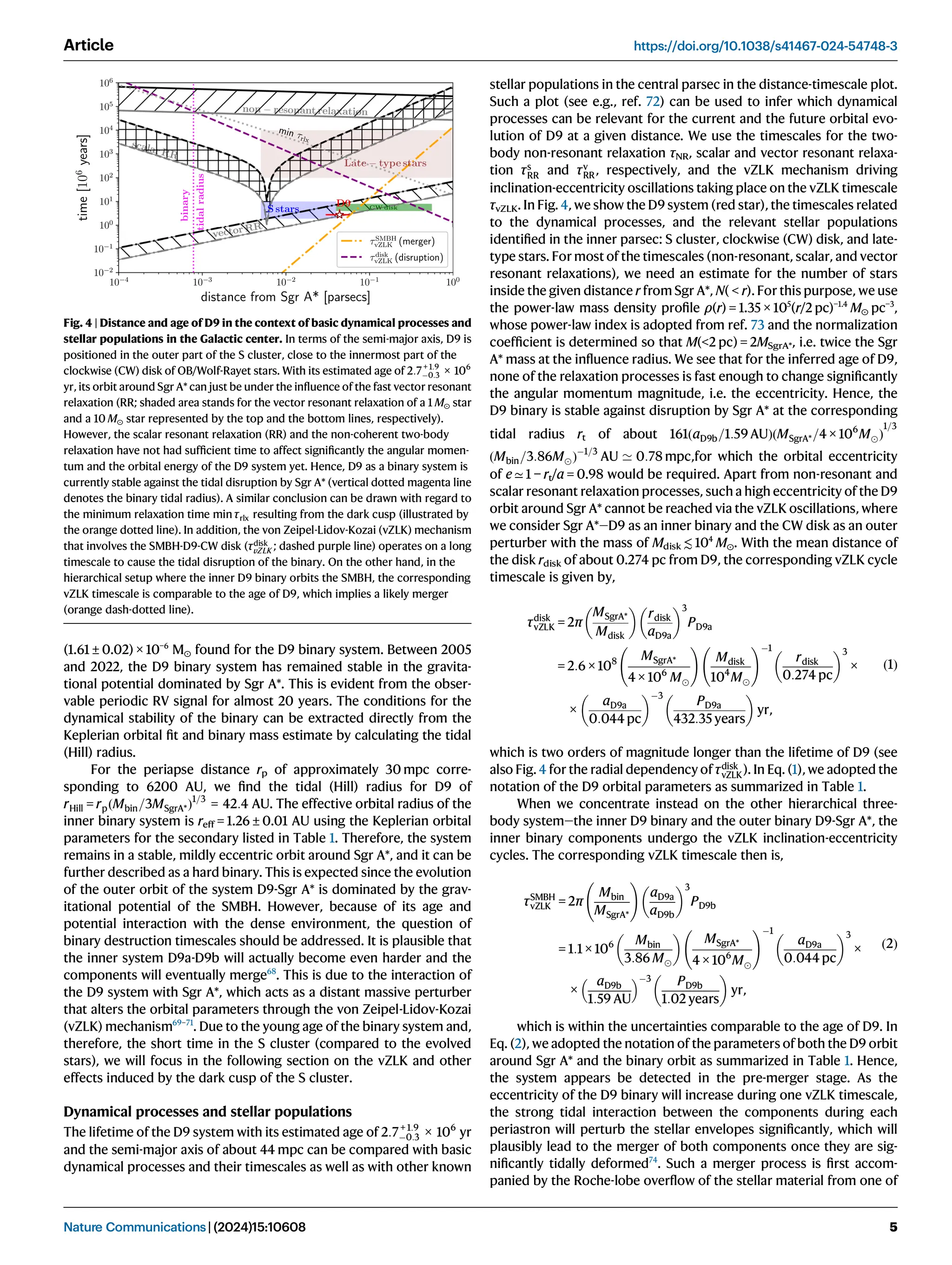
τvZLK. In Fig. 4, we show the D9 system (red star), the timescales related
to the dynamical processes, and the relevant stellar populations
identified in the inner parsec: S cluster, clockwise (CW) disk, and late-
type stars. For most of the timescales (non-resonant, scalar, and vector
resonant relaxations), we need an estimate for the number of stars
inside the given distance r from Sgr A*, N(  r). For this purpose, we use
the power-law mass density profile ρ(r) = 1.35 × 10⁵
(r/2 pc)−1.4
M⊙ pc−3
,
whose power-law index is adopted from ref. 73 and the normalization
coefficient is determined so that M(2 pc) = 2MSgrA*, i.e. twice the Sgr
A* mass at the influence radius. We see that for the inferred age of D9,
none of the relaxation processes is fast enough to change significantly
the angular momentum magnitude, i.e. the eccentricity. Hence, the
D9 binary is stable against disruption by Sgr A* at the corresponding
tidal radius rt of about 161ðaD9b=1:59 AUÞðMSgrA*=4 × 10⁶
MÞ
1=3
ðMbin=3:86MÞ1=3
AU ’ 0:78 mpc,for which the orbital eccentricity
of e ≃ 1 − rt/a = 0.98 would be required. Apart from non-resonant and
scalar resonant relaxation processes, such a high eccentricity of the D9
orbit around Sgr A* cannot be reached via the vZLK oscillations, where
we consider Sgr A*—D9 as an inner binary and the CW disk as an outer
perturber with the mass of Mdisk ≲ 104
M⊙. With the mean distance of
the disk rdisk of about 0.274 pc from D9, the corresponding vZLK cycle
timescale is given by,
τdisk
vZLK = 2π
MSgrA*
Mdisk
 
rdisk
aD9a
 3
PD9a
= 2:6 × 10⁸ MSgrA*
4 × 10⁶
M
!
Mdisk
104
M
!1
rdisk
0:274 pc
 3
×
×
aD9a
0:044 pc
 3
PD9a
432:35 years
 
yr,
ð1Þ
which is two orders of magnitude longer than the lifetime of D9 (see
also Fig. 4 for the radial dependency of τdisk
vZLK). In Eq. (1), we adopted the
notation of the D9 orbital parameters as summarized in Table 1.
When we concentrate instead on the other hierarchical three-
body system—the inner D9 binary and the outer binary D9-Sgr A*, the
inner binary components undergo the vZLK inclination-eccentricity
cycles. The corresponding vZLK timescale then is,
τSMBH
vZLK = 2π
Mbin
MSgrA*
!
aD9a
aD9b
 3
PD9b
= 1:1 × 10⁶ Mbin
3:86 M
 
MSgrA*
4 × 10⁶
M
!1
aD9a
0:044 pc
 3
×
×
aD9b
1:59 AU
 3 PD9b
1:02 years
 
yr,
ð2Þ
which is within the uncertainties comparable to the age of D9. In
Eq. (2), we adopted the notation of the parameters of both the D9 orbit
around Sgr A* and the binary orbit as summarized in Table 1. Hence,
the system appears be detected in the pre-merger stage. As the
eccentricity of the D9 binary will increase during one vZLK timescale,
the strong tidal interaction between the components during each
periastron will perturb the stellar envelopes significantly, which will
plausibly lead to the merger of both components once they are sig-
nificantly tidally deformed74
. Such a merger process is first accom-
panied by the Roche-lobe overflow of the stellar material from one of
Fig. 4 | Distance and age of D9 in the context of basic dynamical processes and
stellar populations in the Galactic center. In terms of the semi-major axis, D9 is
positioned in the outer part of the S cluster, close to the innermost part of the
clockwise (CW) disk of OB/Wolf-Rayet stars. With its estimated age of 2:7+ 1:9
0:3 × 10⁶
yr, its orbit around Sgr A* can just be under the influence of the fast vector resonant
relaxation (RR; shaded area stands for the vector resonant relaxation of a 1 M⊙ star
and a 10 M⊙ star represented by the top and the bottom lines, respectively).
However, the scalar resonant relaxation (RR) and the non-coherent two-body
relaxation have not had sufficient time to affect significantly the angular momen-
tum and the orbital energy of the D9 system yet. Hence, D9 as a binary system is
currently stable against the tidal disruption by Sgr A* (vertical dotted magenta line
denotes the binary tidal radius). A similar conclusion can be drawn with regard to
the minimum relaxation time min τrlx resulting from the dark cusp (illustrated by
the orange dotted line). In addition, the von Zeipel-Lidov-Kozai (vZLK) mechanism
that involves the SMBH-D9-CW disk (τdisk
vZLK ; dashed purple line) operates on a long
timescale to cause the tidal disruption of the binary. On the other hand, in the
hierarchical setup where the inner D9 binary orbits the SMBH, the corresponding
vZLK timescale is comparable to the age of D9, which implies a likely merger
(orange dash-dotted line).
Article https://doi.org/10.1038/s41467-024-54748-3
Nature Communications| (2024)15:10608 5
the components and then a subsequent merger of the stellar cores (see
e.g., ref. 75). At the same time, the common envelope is progressively
inflated to several thousand Solar radii. As it cools down, the infrared
excess increases considerably. In this way, some or all of the G objects
observed in the Galactic center could be produced, and the D9 system
would represent a unique pre-merger stage, which is also hinted by the
smaller near-infrared excess in comparison with other G objects17
.
Fate of the binary
Considering the age and presence of the binary system in the S
cluster, we will examine the impact of the dark cusp. Old and faint
stars have migrated into the S cluster from a distance of a few
parsecs6
and might alter the orbits of the young and bright cluster
members7,68,76
. With the detection of the binary system D9, we con-
vert its stellar parameters (Table 1) and age of TD9a = 2:7+ 1:9
0:3 × 10⁶
yr
to a lower limit for the minimum two-body relaxation timescale of
min trlx = 4:8ðMSgrA*=MbinÞðaD9b=aD9aÞTD9a resulting in about
874 × TD9a yr76
, equivalent to approximately 109
yr exceeding the
lifetime of the binary by three orders of magnitude. This suggests
that the dark cusp does not have any significant imprint on the
D9 system independent of its time in the cluster. Given that the
assumed inclination is a geometrical parameter contingent upon the
observer, it is reasonable to conclude that it will have, such as the
dark cusp, no impact on the dynamical evolution of the binary sys-
tem. We will now examine the evolutionary path that is described by
the vZLK mechanism where D9 is the inner binary and D9-Sgr A*
represents the outer binary74
. For this hierarchical setup, the vZLK
timescale is τSMBH
vZLK = 1:1 × 10⁶
yr, see Fig. 4 and Eq. (2), which is
comparable with the approximate lifetime of the binary of
TD9a = 2.7 × 10⁶
yr. It is reasonable to assume that the ongoing inter-
action between the primary, secondary, and Sgr A* is reflected in
altering the eccentricity of the D9 binary, which very likely results in a
merger. This supports the idea that the G-object population17
has a
contribution from recently merged binary systems, as proposed by
ref. 16. Considering the vZLK timescale τSMBH
vZLK of about 106
yr and the
age of D9 of 2:7+ 1:9
0:3 × 10⁶
yr, the system could have migrated to its
current location and may soon merge to become a G-object. D9 thus
offers a glimpse on one potential evolutionary path of the S stars.
Taking into account that the bright and massive B-type S stars with an
average age of 6 × 10⁶
yr8,9
may have formed as binary systems12
, it is
suggested that these young S cluster members might have lost their
putative companions in the immediate vicinity of Sgr A* assuming an
ex-situ formation. In refs. 11 and 14, the authors explored the prob-
ability density for the young stars in and outside the S cluster. The
authors propose that the probability of a binary system is sig-
nificantly higher outside the central arcsecond (≥72% compared to
≤17% at 68% confidence interval). If we consider the recent detection
of the new G-object X7.277
, we estimate with R = NB/(2Nm) a binary
fraction of the central 0.1 pc to be ~10 % using the Ansatz of ref. 16,
where NB = 8620,77
represents the assumed number of binaries and
Nm = 47816
the amount of low-mass stars in the S cluster using the
initial mass function derived by ref. 8. This implies that the majority
of expected binaries in the S cluster should be among the G objects20
.
Regardless of the formation or migration scenarios, we can esti-
mate that the B-type stars of the S cluster reside in their environment
for at least 1.1 × 10⁶
years due to the absence of their expected com-
panion stars11,12
. The estimated vZLK timescale is compatible with the
predicted decrease of binaries for a possible star-formation episode in
the Galactic center 6 × 10⁶
yr ago8,74
. This suggests that the vZLK
mechanism may be the driving force of the decrease in binary fraction
in the dense S cluster7,68,78
.
Alternative explanations
The number of detected binaries in the Galactic center is sur-
prisingly low. Only five confirmed binaries have been found,
which is, considering an approximate number of stars in the NSC
of ~1061
, a negligible fraction of the overall population (Supple-
mentary Table 3). Although the multiplicity fraction in the NSC
should be higher74,78
, other possible scenarios that explain the
periodic RV pattern displayed in Fig. 3 should be taken into
account. One possible alternative explanation for the periodic
variations of RV could be stellar pulsations79
. This scenario was
initially used to explain the photometric variability of IRS
16SW80,81
. However, it was later confirmed that the Ofpe/WN9 star
IRS 16SW is indeed a massive binary by conducting IFU observa-
tions with SINFONI82
analyzing the Brγ emission line. Considering
the binary period of the D9 system of ~372 days, stellar pulsations
are rather unlikely, since they occur on daily timescales83
. Alter-
natively, the Brγ emission could be related to the rotation of the
accretion disk of D9. Although ionized hydrogen and disk winds
are associated with YSOs38,46
, the dimensions of the disk itself and
the spectral resolution of the instrument pose a strong constraint
on the detectability of the system.
Methods
Age of the system
For an age estimate of the D9 binary system, we use the temperature
and radius listed in Table 1 with stellar evolutionary tracks from
PARSEC58
. Considering the low mid-infrared flux in the L band of
0.4 ± 0.1 mJy compared to the K band of 0.8 ± 0.1 mJy, questions the
proposed classification for D9 as a candidate Class I YSO as suggested
by ref. 17. Taking into account the derived stellar mass of the system in
combination with the hydrogen emission line, alternative explanations
are required to classify the binary system. As outlined before, it is
known that the Brγ line is a tracer for accretion disks of Herbig Ae/Be
stars39
. Similar to Herbig Ae/Be surveys84
, we use the PARSEC
isochrones58
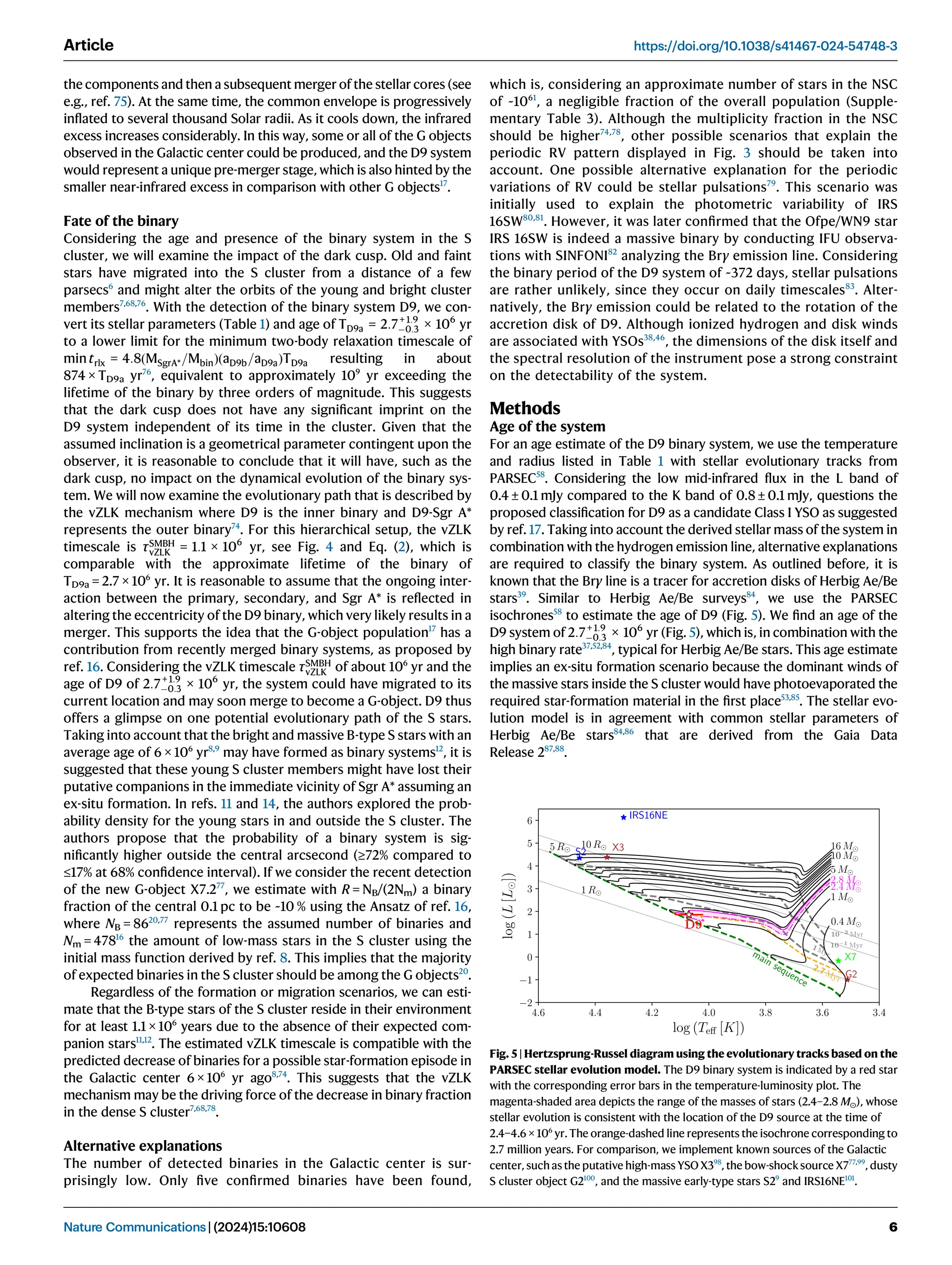
to estimate the age of D9 (Fig. 5). We find an age of the
D9 system of 2:7+ 1:9
0:3 × 10⁶
yr (Fig. 5), which is, in combination with the
high binary rate37,52,84
, typical for Herbig Ae/Be stars. This age estimate
implies an ex-situ formation scenario because the dominant winds of
the massive stars inside the S cluster would have photoevaporated the
required star-formation material in the first place53,85
. The stellar evo-
lution model is in agreement with common stellar parameters of
Herbig Ae/Be stars84,86
that are derived from the Gaia Data
Release 287,88
.
Fig. 5 | Hertzsprung-Russel diagram using the evolutionary tracks based on the
PARSEC stellar evolution model. The D9 binary system is indicated by a red star
with the corresponding error bars in the temperature-luminosity plot. The
magenta-shaded area depicts the range of the masses of stars (2.4–2.8 M⊙), whose
stellar evolution is consistent with the location of the D9 source at the time of
2.4−4.6 × 10⁶
yr. The orange-dashed line represents the isochrone corresponding to
2.7 million years. For comparison, we implement known sources of the Galactic
center, suchas the putative high-mass YSO X398
, the bow-shock source X777,99
, dusty
S cluster object G2100
, and the massive early-type stars S29
and IRS16NE101
.
Article https://doi.org/10.1038/s41467-024-54748-3
Nature Communications| (2024)15:10608 6
Keplerian orbit
Using the well-known orbit of S2 (S0-2)89,90
, we determine the position
of Sgr A*. Since the intrinsic proper motion of Sgr A*, vprop, SgrA* , is only
a fraction of a pixel per epoch91
and thus several orders of magnitude
smaller than the distance to D9, we neglect this velocity term. The
rejection of vprop, SgrA* is motivated by the typical astrometric uncer-
tainties of ±12.5 mas that exceed the intrinsic proper motion of Sgr A*
with vprop, SgrA* = 0:3 mas=yr. From the fixed position of Sgr A*, we use
the astrometric information of D9 to derive a related Keplerian orbital
solution. We incorporate the LOS velocity of D9 using the estimated
baseline of ~150 km/s and a corresponding uncertainty range of
±15 km/s. Comparing the statistical significance of the Keplerian fit
with and without the LOS velocity results in a difference of almost one
magnitude for the reduced χ2
. We estimate χ2
red to be about 10 for the
sole astrometric measurements while we find a robust fit for χ2
red of
approximately 2 by maximizing the parameter space, that is, including
the LOS velocity. With a mass of MSgrA* = 4 × 10⁶
M for Sgr A*22,23
, we
display the resulting Keplerian orbit in Fig. 6 and list the corresponding
orbital elements in Table 1. As is evident from the plot displayed in
Fig. 6, D9 moves on the descending part of its Keplerian orbit, which
results in the mentioned slow velocity. Intriguingly, the relative loca-
tion and its intrinsic velocity of D9 with respect to Sgr A* ensure a
confusion-free detection of the binary system. Detecting the
binary would most likely be hindered if it was in its ascending part of
the orbit.
Statistical analysis
The Limited-memory Broyden, Fletcher, Goldfarb, and Shannon box
constraints (L-BFGS-B) algorithm forms the basis of the Keplerian
fit92,93
. The Keplerian fit relies on the L-BFGS-B algorithm, which is an
iterative method that identifies free parameters within a given range
and aims to minimize the gap between the data points and the priors
(i.e., initial guess). The Keplerian equations of motion describe the
model underlying the algorithm. The algorithm iteratively finds the
orbital solution that best fits the data points with high accuracy, i.e.,
the minimized χ2
.
The best-fit parameters are then used as a prior for the Markow-
Chain-Monte-Carlo (MCMC) simulations. The MCMC algorithm was
used by the implementation of the emcee PYTHON package developed
by ref. 94. When inspecting the distribution of the measured data
points, it is evident that the D9 system moves with a comparable slow
velocity in the S cluster, which translates into an almost (projected)
linear motion. Hence, it is not entirely unexpected that the MCMC
simulations are in high agreement with the best-fit results of the
Keplerian approximation (Table 2). We can conclude that the orbital
solution presented in Table 2 is robust and should provide a suitable
basis for future high-angular resolution observations.
Uniqueness of the IFU data points
The line maps of the three-dimensional data cubes observed with
SINFONI and ERIS act as a response actor, which is interpreted as a
measure of the influence of nearby sources and the imprint of the
background. It is important to note that sporadic background fluc-
tuations do not result in a line map emission counterpart. In other
words, the line emission with spatially limited origin (i.e. noise) does
not produce a (compact) line map signal comparable to, e.g., G229
. This
is due to the flux required to produce a signal above the sensitivity
level of the detector. Vice versa, only spatially extended emission with
sufficient line emission produces a spectroscopic signal (Supplemen-
tary Fig. 4 and Supplementary Fig. 5). This interplay between line
emission and line maps reduces the chance of detecting false positives
of any kind. Mathematically speaking, the mentioned interplay
between the two parameter spaces (spatial and spectroscopic) of
detecting a real signal is a necessary condition. In this sense, one
cannot claim the existence of a source based on one parameter space.
Taking into account the Keplerian orbit of D9 further reduces the
probability of a false positive, which occurs only at the expected orbit
position, by several magnitudes. Refs. 95 and 27
calculated the prob-
ability of detecting an artificial source on a Keplerian orbit to be in the
range of a fraction of a percent. This can only be considered an upper
limit because the probability relates to a time span of 5 years and
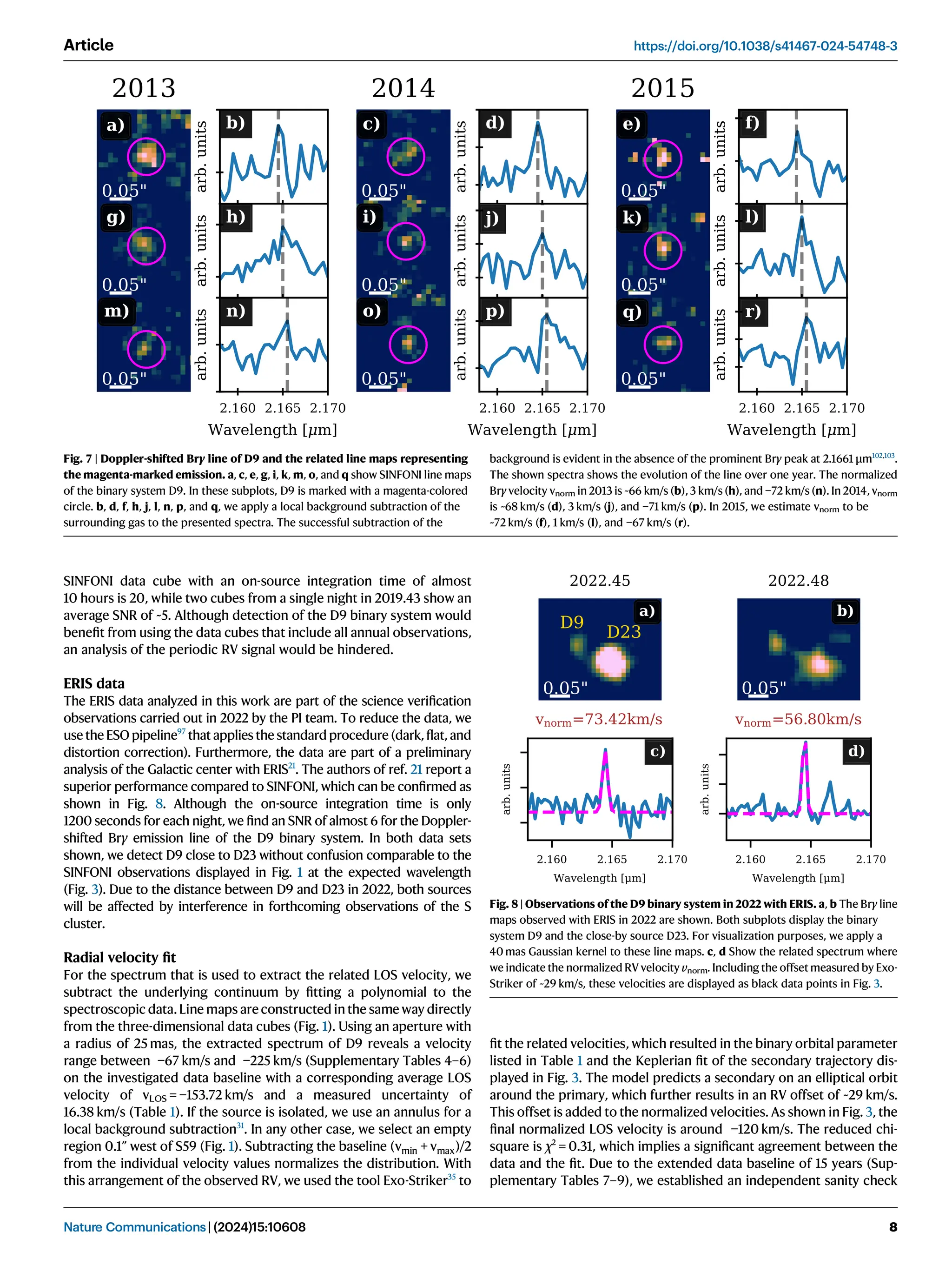
covers solely astrometric data. In Fig. 7, we show an overview of
selected epochs to demonstrate the interplay between the observed
Brγ emission line and the line maps. These line maps are created by
selecting a wavelength range of ~0.0015 μm, which corresponds to
three channels in total (out of 2172 channels in total). A crucial pillar of
the binary detection presented in this work is the analysis of individual
nights observed with SINFONI and ERIS. Therefore, it is expected that
the quality of the data will differ not only due to variable weather
conditions but also to the number (i.e., on-source integration time) of
observations executed at the telescope (Fig. 7). Of course, the impact
of these boundary conditions is reduced by stacking individual cubes,
as has been done for the analysis presented, for example, in
refs. 20,29,96. Since the RV signal of the D9 system changes on a daily
basis, stacking these single night data cubes affects the signal-to-noise
ratio (SNR) of the Brγ line emission of the D9 system (Supplementary
Fig. 4). For example, the signal-to-noise ratio for the stacked 2019
Table 2 | Comparison of best-fit Keplerian approximation and
MCMC simulations
Parameter Best-fit MCMC Standard deviation
aD9a [mpc] 44.00 45.55 1.15
eD9a 0.32 0.31 0.01
iD9a [°] 102.55 103.30 1.14
ωD9a [°] 127.19 130.96 8.02
ΩD9a [°] 257.25 258.40 1.71
tclosest [years] 2309.13 2315.83 7.01
Since the standard deviation does not satisfactorily reflect the astrometric precision that can be
achieved with SINFONI, we will use the standard deviation of the combined MCMC posteriors.
These orbital elements are related to the outer binary system D9-Sgr A*. We refer to ref. 29 for a
detailed explanation of the background fluctuations of the SINFONI data.
Fig. 6 | Keplerian orbit of the D9 system. a The projected on-sky trajectory of the
D9 binary system is shown. b, c Shows the R.A. and DEC. position as a function of
time. b, c The low proper motion is eminent. Every blue-colored data point in this
figure is related to one observational epoch. From this plot and the related incli-
nation of iorb = (102.55 ± 2.29)°, it is suggested that the trajectory of the binary
system is close to edge-on. The size of the blue data points is related to the
astrometric uncertainty of ±0.006 arcsecond (as).
Article https://doi.org/10.1038/s41467-024-54748-3
Nature Communications| (2024)15:10608 7
SINFONI data cube with an on-source integration time of almost
10 hours is 20, while two cubes from a single night in 2019.43 show an
average SNR of ~5. Although detection of the D9 binary system would
benefit from using the data cubes that include all annual observations,
an analysis of the periodic RV signal would be hindered.
ERIS data
The ERIS data analyzed in this work are part of the science verification
observations carried out in 2022 by the PI team. To reduce the data, we
use the ESO pipeline97
that applies the standard procedure (dark, flat, and
distortion correction). Furthermore, the data are part of a preliminary
analysis of the Galactic center with ERIS21
. The authors of ref. 21 report a
superior performance compared to SINFONI, which can be confirmed as
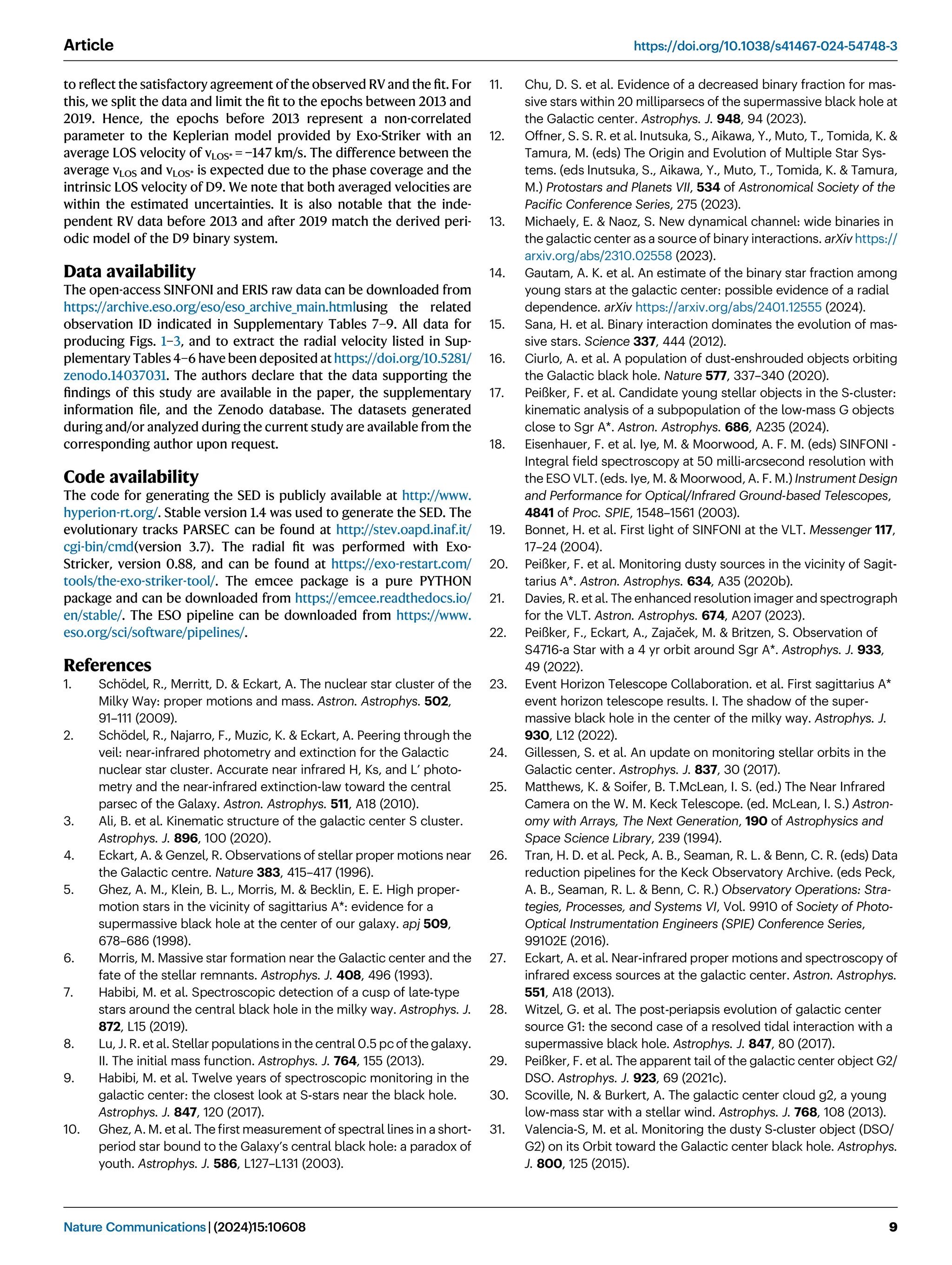
shown in Fig. 8. Although the on-source integration time is only
1200 seconds for each night, we find an SNR of almost 6 for the Doppler-
shifted Brγ emission line of the D9 binary system. In both data sets
shown, we detect D9 close to D23 without confusion comparable to the
SINFONI observations displayed in Fig. 1 at the expected wavelength
(Fig. 3). Due to the distance between D9 and D23 in 2022, both sources
will be affected by interference in forthcoming observations of the S
cluster.
Radial velocity fit
For the spectrum that is used to extract the related LOS velocity, we
subtract the underlying continuum by fitting a polynomial to the
spectroscopic data.Line maps areconstructed in the same way directly
from the three-dimensional data cubes (Fig. 1). Using an aperture with
a radius of 25 mas, the extracted spectrum of D9 reveals a velocity
range between −67 km/s and −225 km/s (Supplementary Tables 4–6)
on the investigated data baseline with a corresponding average LOS
velocity of vLOS = −153.72 km/s and a measured uncertainty of
16.38 km/s (Table 1). If the source is isolated, we use an annulus for a
local background subtraction31
. In any other case, we select an empty
region 0.1” west of S59 (Fig. 1). Subtracting the baseline (vmin + vmax)/2
from the individual velocity values normalizes the distribution. With
this arrangement of the observed RV, we used the tool Exo-Striker35
to
fit the related velocities, which resulted in the binary orbital parameter
listed in Table 1 and the Keplerian fit of the secondary trajectory dis-
played in Fig. 3. The model predicts a secondary on an elliptical orbit
around the primary, which further results in an RV offset of ~29 km/s.
This offset is added to the normalized velocities. As shown in Fig. 3, the
final normalized LOS velocity is around −120 km/s. The reduced chi-
square is χ2
= 0.31, which implies a significant agreement between the
data and the fit. Due to the extended data baseline of 15 years (Sup-
plementary Tables 7–9), we established an independent sanity check
Fig. 8 | Observations of the D9 binary system in 2022 with ERIS. a, b The Brγ line
maps observed with ERIS in 2022 are shown. Both subplots display the binary
system D9 and the close-by source D23. For visualization purposes, we apply a
40 mas Gaussian kernel to these line maps. c, d Show the related spectrum where
we indicate the normalized RV velocity vnorm. Including the offset measured by Exo-
Striker of ~29 km/s, these velocities are displayed as black data points in Fig. 3.
Fig. 7 | Doppler-shifted Brγ line of D9 and the related line maps representing
the magenta-marked emission. a, c, e, g, i, k, m, o, and q show SINFONI line maps
of the binary system D9. In these subplots, D9 is marked with a magenta-colored
circle. b, d, f, h, j, l, n, p, and q, we apply a local background subtraction of the
surrounding gas to the presented spectra. The successful subtraction of the
background is evident in the absence of the prominent Brγ peak at 2.1661 μm102,103
.
The shown spectra shows the evolution of the line over one year. The normalized
Brγ velocity vnorm in 2013 is ~66 km/s (b), 3 km/s (h), and −72 km/s (n). In 2014, vnorm
is ~68 km/s (d), 3 km/s (j), and −71 km/s (p). In 2015, we estimate vnorm to be
~72 km/s (f), 1 km/s (l), and −67 km/s (r).
Article https://doi.org/10.1038/s41467-024-54748-3
Nature Communications| (2024)15:10608 8
to reflect the satisfactory agreement of the observed RV and the fit. For
this, we split the data and limit the fit to the epochs between 2013 and
2019. Hence, the epochs before 2013 represent a non-correlated
parameter to the Keplerian model provided by Exo-Striker with an
average LOS velocity of vLOS* = −147 km/s. The difference between the
average vLOS and vLOS* is expected due to the phase coverage and the
intrinsic LOS velocity of D9. We note that both averaged velocities are
within the estimated uncertainties. It is also notable that the inde-
pendent RV data before 2013 and after 2019 match the derived peri-
odic model of the D9 binary system.
Data availability
The open-access SINFONI and ERIS raw data can be downloaded from
https://archive.eso.org/eso/eso_archive_main.htmlusing the related
observation ID indicated in Supplementary Tables 7–9. All data for
producing Figs. 1–3, and to extract the radial velocity listed in Sup-
plementary Tables 4–6 have been deposited at https://doi.org/10.5281/
zenodo.14037031. The authors declare that the data supporting the
findings of this study are available in the paper, the supplementary
information file, and the Zenodo database. The datasets generated
during and/or analyzed during the current study are available from the
corresponding author upon request.
Code availability
The code for generating the SED is publicly available at http://www.
hyperion-rt.org/. Stable version 1.4 was used to generate the SED. The
evolutionary tracks PARSEC can be found at http://stev.oapd.inaf.it/
cgi-bin/cmd(version 3.7). The radial fit was performed with Exo-
Stricker, version 0.88, and can be found at https://exo-restart.com/
tools/the-exo-striker-tool/. The emcee package is a pure PYTHON
package and can be downloaded from https://emcee.readthedocs.io/
en/stable/. The ESO pipeline can be downloaded from https://www.
eso.org/sci/software/pipelines/.
References
1. Schödel, R., Merritt, D.  Eckart, A. The nuclear star cluster of the
Milky Way: proper motions and mass. Astron. Astrophys. 502,
91–111 (2009).
2. Schödel, R., Najarro, F., Muzic, K.  Eckart, A. Peering through the
veil: near-infrared photometry and extinction for the Galactic
nuclear star cluster. Accurate near infrared H, Ks, and L’ photo-
metry and the near-infrared extinction-law toward the central
parsec of the Galaxy. Astron. Astrophys. 511, A18 (2010).
3. Ali, B. et al. Kinematic structure of the galactic center S cluster.
Astrophys. J. 896, 100 (2020).
4. Eckart, A.  Genzel, R. Observations of stellar proper motions near
the Galactic centre. Nature 383, 415–417 (1996).
5. Ghez, A. M., Klein, B. L., Morris, M.  Becklin, E. E. High proper-
motion stars in the vicinity of sagittarius A*: evidence for a
supermassive black hole at the center of our galaxy. apj 509,
678–686 (1998).
6. Morris, M. Massive star formation near the Galactic center and the
fate of the stellar remnants. Astrophys. J. 408, 496 (1993).
7. Habibi, M. et al. Spectroscopic detection of a cusp of late-type
stars around the central black hole in the milky way. Astrophys. J.
872, L15 (2019).
8. Lu, J. R. et al. Stellar populations in the central 0.5 pc of the galaxy.
II. The initial mass function. Astrophys. J. 764, 155 (2013).
9. Habibi, M. et al. Twelve years of spectroscopic monitoring in the
galactic center: the closest look at S-stars near the black hole.
Astrophys. J. 847, 120 (2017).
10. Ghez, A. M. et al. The first measurement of spectral lines in a short-
period star bound to the Galaxy’s central black hole: a paradox of
youth. Astrophys. J. 586, L127–L131 (2003).
11. Chu, D. S. et al. Evidence of a decreased binary fraction for mas-
sive stars within 20 milliparsecs of the supermassive black hole at
the Galactic center. Astrophys. J. 948, 94 (2023).
12. Offner, S. S. R. et al. Inutsuka, S., Aikawa, Y., Muto, T., Tomida, K. 
Tamura, M. (eds) The Origin and Evolution of Multiple Star Sys-
tems. (eds Inutsuka, S., Aikawa, Y., Muto, T., Tomida, K.  Tamura,
M.) Protostars and Planets VII, 534 of Astronomical Society of the
Pacific Conference Series, 275 (2023).
13. Michaely, E.  Naoz, S. New dynamical channel: wide binaries in
the galactic center as a source of binary interactions. arXiv https://
arxiv.org/abs/2310.02558 (2023).
14. Gautam, A. K. et al. An estimate of the binary star fraction among
young stars at the galactic center: possible evidence of a radial
dependence. arXiv https://arxiv.org/abs/2401.12555 (2024).
15. Sana, H. et al. Binary interaction dominates the evolution of mas-
sive stars. Science 337, 444 (2012).
16. Ciurlo, A. et al. A population of dust-enshrouded objects orbiting
the Galactic black hole. Nature 577, 337–340 (2020).
17. Peißker, F. et al. Candidate young stellar objects in the S-cluster:
kinematic analysis of a subpopulation of the low-mass G objects
close to Sgr A*. Astron. Astrophys. 686, A235 (2024).
18. Eisenhauer, F. et al. Iye, M.  Moorwood, A. F. M. (eds) SINFONI -
Integral field spectroscopy at 50 milli-arcsecond resolution with
the ESO VLT. (eds. Iye, M.  Moorwood, A. F. M.) Instrument Design
and Performance for Optical/Infrared Ground-based Telescopes,
4841 of Proc. SPIE, 1548–1561 (2003).
19. Bonnet, H. et al. First light of SINFONI at the VLT. Messenger 117,
17–24 (2004).
20. Peißker, F. et al. Monitoring dusty sources in the vicinity of Sagit-
tarius A*. Astron. Astrophys. 634, A35 (2020b).
21. Davies, R. et al. The enhanced resolution imager and spectrograph
for the VLT. Astron. Astrophys. 674, A207 (2023).
22. Peißker, F., Eckart, A., Zajaček, M.  Britzen, S. Observation of
S4716-a Star with a 4 yr orbit around Sgr A*. Astrophys. J. 933,
49 (2022).
23. Event Horizon Telescope Collaboration. et al. First sagittarius A*
event horizon telescope results. I. The shadow of the super-
massive black hole in the center of the milky way. Astrophys. J.
930, L12 (2022).
24. Gillessen, S. et al. An update on monitoring stellar orbits in the
Galactic center. Astrophys. J. 837, 30 (2017).
25. Matthews, K.  Soifer, B. T.McLean, I. S. (ed.) The Near Infrared
Camera on the W. M. Keck Telescope. (ed. McLean, I. S.) Astron-
omy with Arrays, The Next Generation, 190 of Astrophysics and
Space Science Library, 239 (1994).
26. Tran, H. D. et al. Peck, A. B., Seaman, R. L.  Benn, C. R. (eds) Data
reduction pipelines for the Keck Observatory Archive. (eds Peck,
A. B., Seaman, R. L.  Benn, C. R.) Observatory Operations: Stra-
tegies, Processes, and Systems VI, Vol. 9910 of Society of Photo-
Optical Instrumentation Engineers (SPIE) Conference Series,
99102E (2016).
27. Eckart, A. et al. Near-infrared proper motions and spectroscopy of
infrared excess sources at the galactic center. Astron. Astrophys.
551, A18 (2013).
28. Witzel, G. et al. The post-periapsis evolution of galactic center
source G1: the second case of a resolved tidal interaction with a
supermassive black hole. Astrophys. J. 847, 80 (2017).
29. Peißker, F. et al. The apparent tail of the galactic center object G2/
DSO. Astrophys. J. 923, 69 (2021c).
30. Scoville, N.  Burkert, A. The galactic center cloud g2, a young
low-mass star with a stellar wind. Astrophys. J. 768, 108 (2013).
31. Valencia-S, M. et al. Monitoring the dusty S-cluster object (DSO/
G2) on its Orbit toward the Galactic center black hole. Astrophys.
J. 800, 125 (2015).
Article https://doi.org/10.1038/s41467-024-54748-3
Nature Communications| (2024)15:10608 9
32. Robitaille, T. P. A modular set of synthetic spectral energy dis-
tributions for young stellar objects. Astron. Astrophys. 600,
A11 (2017).
33. Leggett, S. K. et al. L’ and M’ standard stars for the Mauna Kea
observatories near-infrared system. Mon. Not. R. Astron. Soc. 345,
144–152 (2003).
34. Eckart, A., Genzel, R., Ott, T.  Schödel, R. Stellar orbits near
sagittarius A*. Mon. Not. R. Astron. Soc. 331, 917–934 (2002).
35. Trifonov, T. The Exo-Striker: transit and radial velocity interactive
fitting tool for orbital analysis and N-body simulations. Astro-
physics Source Code Library, https://ui.adsabs.harvard.edu/abs/
2019ascl.soft06004T/abstract (2019).
36. Bally, J.  Zinnecker, H. The birth of high-mass stars: accretion
and/or mergers? Astron. J. 129, 2281–2293 (2005).
37. Baines, D., Oudmaijer, R. D., Porter, J. M.  Pozzo, M. On the
binarity of Herbig Ae/Be stars. Mon. Not. R. Astron. Soc. 367,
737–753 (2006).
38. Tanaka, K. E. I., Tan, J. C.  Zhang, Y. Outflow-confined HII regions.
I. First signposts of massive star formation. Astrophys. J. 818,
52 (2016).
39. Tambovtseva, L. V., Grinin, V. P.  Weigelt, G. Brackett γ radiation
from the inner gaseous accretion disk, magnetosphere, and disk
wind region of Herbig AeBe stars. Astron. Astrophys. 590,
A97 (2016).
40. Fateeva, A. M., Bisikalo, D. V., Kaygorodov, P. V.  Sytov, A. Y.
Gaseous flows in the inner part of the circumbinary disk of the T
Tauri star. Astrophys. Space Sci. 335, 125–129 (2011).
41. Muzerolle, J., Hartmann, L.  Calvet, N. A brgamma probe of disk
accretion in T Tauri stars and embedded young stellar objects.
Astron. J. 116, 2965–2974 (1998).
42. Grant, S. L., Espaillat, C. C., Brittain, S., Scott-Joseph, C.  Calvet,
N. Tracing accretion onto herbig Ae/Be stars using the Brγ line.
Astrophys. J. 926, 229 (2022).
43. Fiorellino, E., Park, S., Kóspál, Á.  Ábrahám, P. The accretion
process in the DQ tau binary system. Astrophys. J. 928, 81
(2022).
44. Friedjung, M., Mikołajewska, J., Zajczyk, A.  Eriksson, M. UV
emission line shifts of symbiotic binaries. Astron. Astrophys. 512,
A80 (2010).
45. Horne, K.  Marsh, T. R. Emission line formation in accretion discs.
Mon. Not. R. Astron. Soc. 218, 761–773 (1986).
46. Kraus, S. et al. Gas distribution, kinematics, and excitation struc-
ture in the disks around the classical be stars β canis minoris and ζ
Tauri. Astrophys. J. 744, 19 (2012).
47. Kraus, S. et al. Tracing the young massive high-eccentricity binary
system θ1^Orionis C through periastron passage. Astron. Astro-
phys. 497, 195–207 (2009).
48. Frost, A. J. et al. HR 6819 is a binary system with no black hole.
Revisiting the source with infrared interferometry and optical
integral field spectroscopy. Astron. Astrophys. 659, L3 (2022).
49. Garcia, P. J. V. et al. Pre-main-sequence binaries with tidally dis-
rupted discs: the Brγ in HD 104237. Mon. Not. R. Astron. Soc. 430,
1839–1853 (2013).
50. Hartmann, L., Calvet, N., Gullbring, E.  D’Alessio, P. Accretion
and the evolution of T Tauri disks. Astrophys. J. 495, 385–400
(1998).
51. Grinin, V. P., Rostopchina, A. N., Barsunova, O. Y.  Demidova, T. V.
Mechanism for cyclical activity of the Herbig Ae star BF Ori.
Astrophysics 53, 367–372 (2010).
52. Wheelwright, H. E., Oudmaijer, R. D.  Goodwin, S. P. The mass
ratio and formation mechanisms of Herbig Ae/Be star binary sys-
tems. Mon. Not. R. Astron. Soc. 401, 1199–1218 (2010).
53. Lützgendorf, N., Helm, Evd, Pelupessy, F. I.  Portegies Zwart, S.
Stellar winds near massive black holes - the case of the S-stars.
Mon. Not. R. Astron. Soc. 456, 3645–3654 (2016).
54. Hollenbach, D., Johnstone, D., Lizano, S.  Shu, F. Photo-
evaporation of disks around massive stars and application to
ultracompact H II regions. Astrophys. J. 428, 654 (1994).
55. Johnstone, D., Hollenbach, D.  Bally, J. Photoevaporation of disks
and clumps by nearby massive stars: application to disk destruc-
tion in the orion nebula. Astrophys. J. 499, 758–776 (1998).
56. Messina, S. Evidence from stellar rotation for early disc dispersal
owing to close companions. Astron. Astrophys. 627, A97 (2019).
57. Alves, F. O. et al. Gas flow and accretion via spiral streamers and
circumstellar disks in a young binary protostar. Science 366,
90–93 (2019).
58. Bressan, A. et al. PARSEC: stellar tracks and isochrones with the
PAdova and TRieste stellar evolution code. Mon. Not. R. Astron.
Soc. 427, 127–145 (2012).
59. Fragione, G.  Gualandris, A. Tidal breakup of triple stars in the
Galactic centre. Mon. Not. R. Astron. Soc. 475, 4986–4993 (2018).
60. Bonnell, I. A.  Rice, W. K. M. Star formation around supermassive
black holes. Science 321, 1060 (2008).
61. Jalali, B. et al. Star formation in the vicinity of nuclear black holes:
young stellar objects close to Sgr A*. Mon. Not. R. Astron. Soc.
444, 1205–1220 (2014).
62. Zajaček, M. et al. Nature of the Galactic centre NIR-excess sources.
I. What can we learn from the continuum observations of the DSO/
G2 source? Astron. Astrophys. 602, A121 (2017).
63. Hills, J. G. Hyper-velocity and tidal stars from binaries disrupted by
a massive Galactic black hole. Nature 331, 687–689 (1988).
64. Yu, Q.  Tremaine, S. Ejection of hypervelocity stars by the (binary)
black hole in the Galactic center. Astrophys. J. 599, 1129–1138
(2003).
65. Zajaček, M., Karas, V.  Eckart, A. Dust-enshrouded star near
supermassive black hole: predictions for high-eccentricity pas-
sages near low-luminosity galactic nuclei. Astron. Astrophys. 565,
A17 (2014).
66. Armitage, P. J., Clarke, C. J.  Palla, F. Dispersion in the lifetime and
accretion rate of T Tauri discs. Mon. Not. R. Astron. Soc. 342,
1139–1146 (2003).
67. Alexander, R. The dispersal of protoplanetary disks around binary
stars. Astrophys. J. 757, L29 (2012).
68. Rose, S. C. et al. On socially distant neighbors: using binaries to
constrain the density of objects in the galactic center. Astrophys. J.
904, 113 (2020).
69. von Zeipel, H. Sur l’application des séries de M. Lindstedt à l’étude
du mouvement des comètes périodiques. Astron. Nachr. 183,
345 (1910).
70. Lidov, M. L. The evolution of orbits of artificial satellites of planets
under the action of gravitational perturbations of external bodies.
Planet. Space Sci. 9, 719–759 (1962).
71. Kozai, Y. Secular perturbations of asteroids with high inclination
and eccentricity. Astron. J. 67, 591–598 (1962).
72. Hopman, C.  Alexander, T. Resonant relaxation near a massive
black hole: the stellar distribution and gravitational wave sources.
Astrophys. J. 645, 1152–1163 (2006).
73. Gallego-Cano, E. et al. The distribution of stars around the Milky
Way’s central black hole. I. Deep star counts. Astron. Astrophys.
609, A26 (2018).
74. Stephan, A. P. et al. Merging binaries in the Galactic Center: the
eccentric Kozai-Lidov mechanism with stellar evolution. Mon. Not.
R. Astron. Soc. 460, 3494–3504 (2016).
75. Soker, N.  Tylenda, R. Main-sequence stellar eruption model for
V838 monocerotis. Astrophys. J. 582, L105–L108 (2003).
76. Alexander, T.  Pfuhl, O. Constraining the dark cusp in the galactic
center by long-period binaries. Astrophys. J. 780, 148 (2014).
77. Ciurlo, A. et al. The swansong of the galactic center source X7: an
extreme example of tidal evolution near the supermassive black
hole. Astrophys. J. 944, 136 (2023).
Article https://doi.org/10.1038/s41467-024-54748-3
Nature Communications| (2024)15:10608 10
78. Stephan, A. P. et al. The fate of binaries in the Galactic center: the
mundane and the exotic. Astrophys. J. 878, 58 (2019).
79. Paxton, B. et al. Modules for experiments in stellar astrophysics
(MESA). Astrophys. J. 192, 3 (2011).
80. Ott, T., Eckart, A.  Genzel, R. Variable and embedded stars in the
Galactic center. Astrophys. J. 523, 248–264 (1999).
81. DePoy, D. L. et al. The nature of the variable galactic center source
IRS 16SW. Astrophys. J. 617, 1127–1130 (2004).
82. Martins, F. et al. GCIRS 16SW: a massive eclipsing binary in the
Galactic center. Astrophys. J. 649, L103–L106 (2006).
83. Paxton, B. et al. Modules for experiments in stellar astrophysics
(MESA): pulsating variable stars, rotation, convective boundaries,
and energy conservation. Astrophys. J. 243, 10 (2019).
84. Vioque, M., Oudmaijer, R. D., Baines, D., Mendigutía, I.  Pérez-
Martínez, R. Gaia DR2 study of Herbig Ae/Be stars. Astron. Astro-
phys. 620, A128 (2018).
85. McKee, C. F.  Ostriker, E. C. Theory of star formation. Annu. Rev.
Astron. Astrophys. 45, 565–687 (2007).
86. Wichittanakom, C. et al. The accretion rates and mechanisms of
Herbig Ae/Be stars. Mon. Not. R. Astron. Soc. 493, 234–249 (2020).
87. Gaia Collaboration. et al. The Gaia mission. Astron. Astrophys. 595,
A1 (2016).
88. Gaia Collaboration. et al. Gaia data release 2. Summary of the
contents and survey properties. Astron. Astrophys. 616, A1 (2018).
89. Schödel, R. et al. A star in a 15.2-year orbit around the super-
massive black hole at the centre of the Milky Way. Nature 419,
694–696 (2002).
90. Do, T. et al. Relativistic redshift of the star S0-2 orbiting the
Galactic Center supermassive black hole. Science 365,
664–668 (2019).
91. Parsa, M. et al. Investigating the relativistic motion of the stars near
the supermassive black hole in the galactic center. Astrophys. J.
845, 22 (2017).
92. Liu, D. C.  Nocedal, J. On the limited memory bfgs method for
large scale optimization. Math. Program. 45, 503–528 (1989).
93. Zhu, C., Byrd, R. H., Lu, P.  Nocedal, J. Algorithm 778: L-bfgs-b:
Fortran subroutines for large-scale bound-constrained optimiza-
tion. ACM Trans. Math. Softw. 23, 550–560 (1997).
94. Foreman-Mackey, D., Hogg, D. W., Lang, D.  Goodman, J. emcee:
the MCMC Hammer. Publ. Astron. Soc. Pac. 125, 306 (2013).
95. Sabha, N. et al. The S-star cluster at the center of the Milky Way.
On the nature of diffuse NIR emission in the inner tenth of a parsec.
Astron. Astrophys. 545, A70 (2012).
96. Peißker, F. et al. New bow-shock source with bipolar morphology
in the vicinity of Sgr A*. Astron. Astrophys. 624, A97 (2019).
97. Freudling, W. et al. Automated data reduction workflows for
astronomy. The ESO Reflex environment. Astron. Astrophys. 559,
A96 (2013).
98. Peißker, F. et al. X3: a high-mass young stellar object close to the
supermassive black hole Sgr A*. Astrophys. J. 944, 231 (2023b).
99. Peißker, F. et al. First observed interaction of the circumstellar
envelope of an S-star with the environment of Sgr A*. Astrophys. J.
909, 62 (2021a).
100. Shahzamanian, B. et al. Polarized near-infrared light of the dusty
S-cluster object (DSO/G2) at the galactic center. Astron. Astro-
phys. 593, A131 (2016).
101. Najarro, F. et al. Quantitative spectroscopy of the HeI cluster in the
galactic center. Astron. Astrophys. 325, 700–708 (1997).
102. Peißker, F., Eckart, A., Sabha, N. B., Zajaček, M.  Bhat, H. Near- and
mid-infrared observations in the inner tenth of a parsec of the
galactic center detection of proper motion of a filament very close
to Sgr A*. Astrophys. J. 897, 28 (2020c).
103. Ciurlo, A. et al. Upper limit on brackett-γ emission from the
immediate accretion flow onto the galactic black hole. Astrophys.
J. 910, 143 (2021).
Acknowledgements
F.P., L.L., and E.B. gratefully acknowledge the Collaborative Research
Center 1601 funded by the Deutsche Forschungsgemeinschaft (DFG,
German Research Foundation)—SFB 1601 [sub-project A3]—
500700252. MZ acknowledges the financial support of the Czech Sci-
ence Foundation Junior Star grant no. GM24-10599M. VK acknowledges
the Czech Science Foundation (ref. 21-06825X).
Author contributions
F.P. discovered the binary system, performed most of the analysis, and
led the writing of the manuscript. M.Z. provided the HR diagram and was
responsible for the analysis and calculation of dynamic processes. L.L.,
A.E., and V.K. contributed to the interpretation of the data. E.B. provided
contributions to the background of binaries close to massive stars. M.M.
contributed to the SED analysis. M.Z., E.B., M.M., and V.K. improved the
text. All authors contributed to the writing of the manuscript.
Funding
Open Access funding enabled and organized by Projekt DEAL.
Competing interests
The authors declare no competing interests.
Additional information
Supplementary information The online version contains
supplementary material available at
https://doi.org/10.1038/s41467-024-54748-3.
Correspondence and requests for materials should be addressed to
Florian Peißker.
Peer review information Nature Communications thanks the anon-
ymous reviewers for their contribution to the peer review of this work. A
peer review file is available.
Reprints and permissions information is available at
http://www.nature.com/reprints
Publisher’s note Springer Nature remains neutral with regard to jur-
isdictional claims in published maps and institutional affiliations.
Open Access This article is licensed under a Creative Commons
Attribution 4.0 International License, which permits use, sharing,
adaptation, distribution and reproduction in any medium or format, as
long as you give appropriate credit to the original author(s) and the
source, provide a link to the Creative Commons licence, and indicate if
changes were made. The images or other third party material in this
article are included in the article’s Creative Commons licence, unless
indicated otherwise in a credit line to the material. If material is not
included in the article’s Creative Commons licence and your intended
use is not permitted by statutory regulation or exceeds the permitted
use, you will need to obtain permission directly from the copyright
holder. To view a copy of this licence, visit http://creativecommons.org/
licenses/by/4.0/.
© The Author(s) 2024
Article https://doi.org/10.1038/s41467-024-54748-3
Nature Communications| (2024)15:10608 11

A binary system in the S cluster close to the supermassive black hole Sagittarius A*

  • 1.
    Article https://doi.org/10.1038/s41467-024-54748-3 A binarysystem in the S cluster close to the supermassive black hole Sagittarius A* Florian Peißker 1 , Michal Zajaček 1,2 , Lucas Labadie 1 , Emma Bordier 1 , Andreas Eckart 1,3 , Maria Melamed1 & Vladimír Karas 4 High-velocity stars and peculiar G objects orbit the central supermassive black hole (SMBH) Sagittarius A* (Sgr A*). Together, the G objects and high-velocity stars constitute the S cluster. In contrast with theoretical predictions, no bin- ary system near Sgr A* has been identified. Here, we report the detection of a spectroscopic binary system in the S cluster with the masses of the compo- nents of 2.80 ± 0.50 M⊙ and 0.73 ± 0.14 M⊙, assuming an edge-on config- uration. Based on periodic changes in the radial velocity, we find an orbital period of 372±3 days for the two components. The binary system is stable against the disruption by Sgr A* due to the semi-major axis of the secondary being 1.59±0.01 AU, which is well below its tidal disruption radius of approximately 42.4 AU. The system, known as D9, shows similarities to the G objects. We estimate an age for D9 of 2:7+ 1:9 0:3 × 10⁶ yr that is comparable to the timescale of the SMBH-induced von Zeipel-Lidov-Kozai cycle period of about 106 yr, causing the system to merge in the near future. Consequently, the population of G objects may consist of pre-merger binaries and post-merger products. The detection of D9 implies that binary systems in the S cluster have the potential to reside in the vicinity of the supermassive black hole Sgr A* for approximately 106 years. The central parsec around the supermassive black hole (SMBH) Sgr A* contains a large number of stars that constitute the Nuclear Star Cluster (NSC)1 , which is one of the densest and most massive stellar systems in the Galaxy. These stars vary in terms of their ages, masses, sizes, and luminosities2 . In the vicinity of Sgr A* of about 40 mpc, there is a high concentration of stars3 that orbit the black hole at velocities of up to several thousand km/s4,5 inside the S cluster. The presence of stars close the Sgr A* is not surprising because it was expected that old and evolved stars would gradually descend towards Sgr A* due to the cluster relaxation timescale of ~1010 yr6 . This is because star formation is significantly inhibited by tidal forces and high energetic radiation in the vicinity of the SMBH. In fact, a cusp of late-type stars with stellar ages of 3 × 10⁹ yr was identified7 . Interestingly, these late-type stars coexist with massive early-type S cluster members that exhibit an average age of ~4−6 × 10⁶ yr8,9 , resulting in the formulation of the “paradox of youth”10 . Until now, no companions have been identified for these young B-type stars11 , although binary rates close to 100% have been proposed12 . Therefore, the presence of binary systems in the S cluster is a crucial question to investigate the dynamical evolution of stars in the vicinity of Sgr A*13,14 . Given that the evolution of high-mass stars is altered by their binary interactions15 , it is important to under- stand the prevalence of putative binary systems in this cluster. In this work, we present the detection of a spectroscopic binary in the S cluster. Based on the photometric characteristics of the binary system, known as D9, it can be considered to be a member of the G-object population16,17 . The age of the system is ~2.7 × 10⁶ yr, which is comparable to the von Zeipel-Lidov-Kozai cycle period of approxi- mately 106 years. The dusty source D9 is most likely composed of a Herbig Ae/Be star associated with the primary. The lower-mass com- panion can be classified as a T-Tauri star. In the near future, the binary Received: 26 April 2024 Accepted: 18 November 2024 Check for updates 1 1.Physikalisches Institut, Universität zu Köln, Zülpicher Str. 77, Cologne 50937, Germany. 2 Department of Theoretical Physics and Astrophysics, Masaryk University, Kotlářpská 2, Brno 61137, Czech Republic. 3 Max-Plank-Institut für Radioastronomie, Max-Planck-Gesellschaft, Auf dem Hügel 69, Bonn 53121, Germany. 4 Astronomical Institute, Czech Academy of Sciences, Boční II 1401, Prague 141 00, Czech Republic. e-mail: peissker@ph1.uni-koeln.de Nature Communications| (2024)15:10608 1 1234567890():,; 1234567890():,;
  • 2.
    may undergo amerging event due to the ongoing three-body inter- action of the system with Sgr A*. The uncertain nature of the G objects can thus be resolved, at least in part, thanks to the binary system D9 whose imminent fate appears to be a stellar merger. Results Observations Using archival data observed with the decommissioned near-infrared integral field unit (IFU) of Spectrograph for INtegral Field Observations in the Near Infrared (SINFONI, mounted at the Very Large Telescope)18,19 in the H+K band (1.4−2.4 μm) between 2005 and 2019, we investigate the blue-shifted Brackettγ (Brγ) emission of the source D9 (Fig. 1), which is part of the G-object population in the S cluster16,17,20 . In addition, we include recent Enhanced Resolution Ima- ging Spectrograph (ERIS) observations carried out by the ERIS Team as part of the commissioning run in 202221 . For the analysis of the three- dimensional data cubes that consist of two spatial and one spectral dimension, we perform standard reduction steps (flat-fielding, dark, and distortion corrections). We obtain single barycentric and helio- centric corrected data cubes that are stacked for each year individually to construct a final mosaic of the entire S cluster region. Based on the best-fit Keplerian solution, we obtain an estimate of the periapse dis- tance of the D9 system from Sgr A* of 29.9 mpc (0.75 arcseconds) adopting MSgrA* = 4 × 10⁶ M⊙ and 8 kpc for the mass and the distance of Sgr A*, respectively22,23 . Furthermore, we find a close to edge-on orbital inclination of (102.55 ± 2.29)°. With an eccentricity of 0.32 and a semi- major axis of 44 mpc, D9 qualifies as an S cluster member with orbital parameters comparable to other S stars3,24 . Due to the orbit of the B2V star S2 (S0-2) that intercepts with the trajectory of D9, we focus on the data set of 2019 to identify a continuum counterpart in the H and K band to the Brγ line-emitting source. Magnitudes To increase the photometric baseline, we incorporate Near-infrared Camera 2 (NIRC2, mounted at the Keck telescope) L band imaging data from 2019 to cover the near- and mid-infrared25 . The science-ready data was downloaded from the Keck Observatory Archive26 . Due to the high stellar density of the S cluster27 , dominant point spread function (PSF) wings are a common obstacle that hinders confusion-free detection of fainter objects such as G128 , DSO/G229 , or D920 . There- fore, we used an image sharpener on the continuum data of 2019 to reduce the impact of the challenging crowding situation in the S cluster (Supplementary Fig. 1 and Supplementary Table 1). With this procedure, we enhance fainter structures but preserve the photo- and astrometric aspects of the input data. To emphasize the robustness of the image sharpener, we invoke the contour lines of the input data as a comparison, as demonstrated in Fig. 1. Analyzing the displayed extinction corrected data (Supplementary Table 2), we find H −K = 1.75± 0.20 and K−L = 2.25 ± 0.20 colors for D9 suggesting photo- metric similarities with D2 and D2320 . The latter two sources are believed to be associated with young T Tauri or low-mass stars16,30,31 . Due to these photometric consistencies (Supplementary Fig. 2), we tested the hypothesis using a Spectral Energy Distribution (SED) fitter. Spectral energy distribution The SED fitter32 applies a convolving filter to the individual values to reflect on the response function of the instrument filter. Because the photometric system of SINFONI is based on the Two Micron All Sky Survey (2MASS) data base, we select the corresponding filters “2H” and “2K”. For the NIRC2 MIR data, we use the United Kingdom Infrared Telescope (UKIRT) L’ band filter because it is based on the Mauna Kea photometric system33 . With these settings, the fitter compares models with the input flux (Fig. 2) where we limit the possible output that satisfies Δχ2 ≤ 3. These models represent young stellar objects (YSOs) Fig. 1 | Detection of the D9 system close to Sgr A* in 2019. a Shows the Doppler- shifted Brγ line map extracted from the H+K SINFONI data cube with a corre- sponding wavelength of 2.1646 μm (vacuum wavelength 2.1661 μm). b, c Shows the near-infrared H (1.6 μm) and K (2.1 μm) band data observed with SINFONI. d Denotes the mid-infrared L (3.76 μm) band observation carried out with NIRC2. Sgr A* is marked with a × , D9 is encircled in every plot. Due to its main sequence character, the marked close-by star S59 can only be observed in the H and K bands. On the contrary, the brightest K band source of the S cluster, S2/S0-2 can be observed in every shown infrared band. To increase contrast, an image sharpener is applied suppressing expansive point spread function (PSF) wings. To emphasize the astrometric robustness of the image sharpener, we adapt the lime-colored contour lines from the non-sharpened data. The contour line levels in b are at 10–80% of the peak intensity of S2, increasing in 5% steps. c The contour lines are set at 20–100% of the peak intensity of S2, separated by 10%. d The contour lines are set to 85%, 90%, 95%, and 100% of the peak intensity of S2. The labels of the axis indicate the distance to Sgr A* located at ΔRA = 0.00” and ΔDEC = 0.00''. In any plot shown, north is up, and east is to the left. Fig. 2 | Spectral energy distribution of the D9 system. The extinction corrected data points refer to the flux density values in the H, K, and L band observed with SINFONI and NIRC2. We use 104 individual models to find the best-fit of the data shown with gray lines. The final best-fit result is depicted with a black line. Based on the shown fit, the properties of the primary of the D9 binary system are derived and listed in Table 1. The uncertainties of the data points are estimated from the pho- tometric variations along the source. Based on the reduced χ2 value of ~2, the displayed best-fit solution was selected. Article https://doi.org/10.1038/s41467-024-54748-3 Nature Communications| (2024)15:10608 2
  • 3.
    and are composedof a stellar core, an accretion disk, and a dusty envelope. These typical components constitute a YSO and can be traced in the near- and mid-infrared parts of the spectrum. As input parameters, we used the H (0.8 ± 0.1 mJy), K (0.3 ± 0.1 mJy), and L (0.4 ± 0.1 mJy) band flux densities estimated from the continuum detection presented in Fig. 1. Considering common YSO models, the H and K band emission traces the core components of the system, whereas the L band emission can be associated with a dusty envelope. Based on a photometric comparison with 104 individual models, the best-fit of the SED fitter results in a stellar temperature of 1.2 × 10⁴ K and a corresponding luminosity of approximately 93 L⊙, which are associated with a stellar mass of 2.8 ± 0.5 M⊙ (see Table 1). Periodic pattern While finalizing the analysis of D9, a pattern of radial velocity came to our attention. By inspecting the SINFONI mosaics that depict every observed night between 2005 and 2019, we found a clear periodic signal shown in Fig. 3 between −67 km/s and −225 km/s using the Doppler-shifted Brγ emission line with respect to its rest wavelength at 2.1661 μm. A comparison of the periodic pattern of D9 with the Doppler-shifted Brγ emission line of D23 demonstrates that the signal is not an artifact (Supplementary Fig. 3). From the orbital fit and the related inclination of i = (102.55 ± 2.29)°, we know that D9 is moving on an almost edge-on orbit with a proper motion of vprop = 249.43 ± 5.01 km/s.SinceS2 (S0-2) moves with a proper motion of almost 800 km/s34 , the comparable slow velocity of D9 implies that the intrinsic RV baseline vbase of the system, estimated with (vmin + vmax)/2, will not change significantly between 2005 and 2019. We normalize all observed velocities vobs to this baseline with vobs-vbase to obtain vnorm, which is the input quantity for the fit of the binary system performed with Exo-Stricker35 . Due to the poor phase coverage before 2013, we split the data to perform an independent sanity check. The fit displayed in Fig. 3 resembles the epochs between 2013 and 2019, where we used a false-alarm probability of 10−3 similar to that used by ref. 14. The data baseline between 2005 and 2012 represents a non-correlated parameter to the Keplerian model of the binary pro- vided by Exo-Striker, which is in agreement with the fit that is based on the epochs between 2013 and 2019 (Fig. 3). With a similar motivation, we incorporate the ERIS observations from 2022 that show a satis- factory agreement with the RV model and the expected LOS velocity of the binary, consisting of a primary and a secondary. Regarding the possible impact of a variable baseline vbase (i.e., the LOS velocity vobs of D9 increases), we measure a difference of ± 15km/s between 2013 and 2019, which is consistent with the estimated uncertainty of ± 17km/s from the fit. We conclude that a variation of vbase over the complete data baseline is inside the uncertainties and does not impact the ana- lysis significantly. However, a forthcoming analysis of the binary sys- tem D9 should take this adaptation into account because it is expected that an alteration of the intrinsic LOS velocity will exceed the uncer- tainty range of the individual measurements of the periodic signal within the next decade. In the subsequent analysis, we will refer to the primary as D9a, whereas the secondary companion will be denoted as D9b. With the binary orbiting Sgr A*, this three-body system is divided into an inner and outer binary. The inner binary describes D9a and D9b, while the outer one represents the D9 system orbiting Sgr A*. The best-fit result includes an offset of vbase with RVoff = −29.19±3.00 km s−1 due to the eccentricity of the secondary eD9b of 0.45 ± 0.01, which causes an asymmetric distribution of the LOS velocity around the baseline. With this offset, we obtain vmod = vnorm + RVoff as displayed in Fig. 3. The related Keplerian parameters of the secondary orbiting its primary are listed in Table 1. From the fit but also evident in the periodic RV data points (Fig. 3), we find an orbital period for the secondary of PD9b = 372.30±3.65 days = 1.02 ± 0.01 yr, which can be transferred to a total mass of the system of about Mbin = 3.86 ± 0.07 M⊙, considerably above the derived D9 (i.e., the primary) mass of MD9a = 2.8 ± 0.5 M⊙. The difference in mass for MD9a and Mbin cannot be explained solely by the uncertainty range. However, inspecting m sinðiD9bÞ = 0:73 M and the assumed inclination of the secondary of 90° results in the maximum mass of the companion. The assumed inclination of the secondary is motivated by an almost edge-on orbit of D9 (Table 1). Although the circumprimary disk does not necessarily have to be aligned with the orbit of the binary as is found for T-Tauri systems36 , surveys of Herbig Ae/Be stars suggest a tendency towards a coplanar arrangement37 .Assumingthatthe orbitofthe secondaryis approximately aligned with the circumprimary disk with an intrinsic inclination of the primary D9a of iintrinsic = (75±19)° (Table 1), we are allowed to transfer the related uncertainties to m sinðiD9bÞ. Following this assumption, we find a mass for the secondary of MD9b = 0.73 ± 0.14 M⊙ consistent with the derived primary mass of MD9a = 2.8 ± 0.5 M⊙ and the total mass Mbin = 3.86 ± 0.07 M⊙ of the system. Discussion Radiation mechanism Taking into account the periodic variation of Brγ emission, we want to highlight three different scenarios as a possible origin of the periodic Brγ signal. Firstly, the emission of the Brγ line is solely the result of a com- bination between the gaseous accretion disk and stellar winds of the primary38,39 . In this scenario, the secondary disturbs this emission by its intrinsic Keplerian orbit around the primary. Secondly, a possible origin of the Brγ line could be the presence of a circumbinary disk around the D9 binary system enveloping the pri- mary and the secondary. In this case, the interaction between the Table 1 | Best-fit parameters of the D9 system Secondary Keplerian Parameter PD9b [year] 1.02 ± 0.01 eD9b 0.45 ± 0.01 ωD9b [deg] 311.75 ± 1.65 aD9b [au] 1.59 ± 0.01 iD9b [deg] 90.00 m sinðiD9bÞ [M⊙] 0.73 RVoff [km s−1 ] −29.19 ± 3.00 χ2 ν 0.31 rms [km s−1 ] 16.38 Keplerian parameter for D9 orbiting Sgr A* eD9a 0.32 ± 0.01 iD9a [deg] 102.55 ± 2.29 aD9a [mpc] 44.00 ± 2.42 ωD9a [deg] 127.19 ± 7.50 ΩD9a [deg] 257.25 ± 1.61 PD9a [yr] 432.62 ± 0.01 Radiative transfer model iintrinsic [deg] 75.0 ± 19.0 R [R⊙] 2.00 ±l 0.13 log(L/L⊙) 1.86 ± 0.14 log(TD9a[K]) 4.07 ± 0.05 MD9a [M⊙] 2.80 ± 0.50 MDisk [10−6 M⊙] 1.61 ± 0.02 We list the orbital parameters for the binary of D9 together with the motion of the system around Sgr A*. In addition, the best-fit stellar properties based on the SED fitter are included. The uncertainties of the binary parameter and the radiation transfer model are based on the reduced χ2 . For the Keplerian elements, we use MCMC simulations to estimate the uncertainty range. Since the inclination of the secondary is assumed to be iD9b = 90°, no uncertainty for m sinðiD9bÞ = 0:73 M⊙ is given. Article https://doi.org/10.1038/s41467-024-54748-3 Nature Communications| (2024)15:10608 3
  • 4.
    primary with thesecondary allows inward gas streams from the cir- cumbinary disk resulting in the observed periodic Brγ line40 . The third and foremost plausible scenario is the interaction between two accreting stellar objects. It is well-known that especially Herbig Ae and T-Tauri stars exhibit prominent Brγ emission lines associated with accretion mechanisms41,42 . For instance, a radial shift of the accretion tracer has been observed for the DQ Tau binary system43 . It has been proposed that this resonance-intercombination may be explained by stellar winds of the secondary44 . Due to Keplerian shear, line photons can escape the optically thick material and produce the RV pattern, as observed for the D9 binary system45 . Stellar types of primary and secondary Considering the presence of a primary and its companion, it is sug- gested that stellar winds interact with the Brγ emission of the accretion disk(s) of the binary system38,46 that gets periodically disturbed by the presence of the secondary47,48 . Alternatively, the Brγ emission line is produced by both the primary and secondary as it is observed for the Herbig Ae star HD 104237 with its T-Tauri companion49 . Comparing MD9a with the total mass of Mbin = 3.86 M⊙ of the system suggests that the secondary does not contribute significantly to the photometric measurements analyzed in this work. If it were not the case, the esti- mated mass for the primary of the D9 system of MD9a = 2.8 ± 0.5 M⊙ would be lower, while MD9b = 0.73 ± 0.14 M⊙ should be increased. Considering the estimated mass of the primary MD9a and the fixed upper limit of Mbin based on the observed period, the secondary can be classified as a faint low-mass companion, suggesting a classification as a T-Tauri star50 . Considering the stellar mass, radius, and luminosity of the primary (Table 1), the system may be comparable to the young Herbig Ae/Be star BF Orionis, which is speculated to also have a low- mass companion51 . On the basis of observational surveys, it is intri- guing to note that most Herbig Ae/Be stars exhibit an increased mul- tiplicity rate of up to 80%37,52 . Another result of the radiative transfer model is the relatively small disk mass MDisk of (1.61 ± 0.02) × 10−6 M⊙, which could be interpreted as an indicator of the interaction between D9a and its low-mass companion D9b. Possibly, this ongoing interac- tion, but most likely the stellar winds of the S stars53 , will disperse the disk of D9a in the future54–57 . Using the derived luminosity and stellar temperature of D9a together with the evolutionary tracks imple- mented in PARSEC58 , we estimated the age of the system of 2:7+ 1:9 0:3 × 10⁶ yr. Migration scenario A potential migration scenario has been proposed by ref. 59 and can be described as the triple-system hypothesis. In this scenario, a triplet system migrates towards Sgr A* 60–62 , where the two companions are captured to form a binary. It is possible that the third companion may be ejected from the cluster and subsequently become a hyper-velocity (HV) star, as postulated by refs. 63,64. A consequence of the disruption of the initial triplet is the resulting high eccentricity of the captured binary system close to unity65 . Since the derived outer eccentricity of the D9 system is eD9a = 0.32 ± 0.01 (Table 1), we consider a migration channel different from the triple-system hypothesis. As proposed by refs. 60 and 61 , molecular clouds can migrate towards the inner parsec and consequently close to Sgr A*. Speculatively, the D9 system could have formed during such an inspiral event. An additional implication based on the age estimate is the presumably evaporated circumbinary disk that enveloped the primary and secondary. The authors of ref. 66 found that the timescales for dismantling the circumbinary disk scale with the separation between the primary and secondary. The relation can be formulated with tdis:time ≤ 106 yrtD9a, age = 2:7+ 1:9 0:3 × 10⁶ yr. The former relation is strengthened by the analysis of ref. 67 who found that photoevaporative winds decrease the lifetime of the circumbinary disk as a function of distance. Independent of the stellar wind model, the author of ref. 67 found that circumbinary disks evaporate between ~1−10 × 106 yr providing an explanation for the low disk mass of Fig. 3 | Radial velocity of D9 between 2005 and 2022 observed with SINFONI and ERIS. a–c We display three selected nights to show the variable Brγ emission line with respect to the rest wavelength at 2.1661 μm. The top three plots corre- spond to the same colored boxes as in the radial velocity evolution model shown in (d). We have indicated the exact data point using magenta color. d The SINFONI data is indicated in green, and the two ERIS observations from 2022 are highlighted in black. Due to the decommissioning, no high-resolution spectroscopic data are available between 2020 and 2021. In addition, the usual observation time for the Galactic center at Cerro Paranal (Chile) is between March and September, which explains the limited phase coverage. All data points in the radial velocity (d) correspond to a single night of observation. The velocities in the left y axis are related to the observed blue-shifted Brγ emission lines. Due to data processing, these values are shifted and arranged to an estimated zero-velocity baseline (see the right y axis). The uncertainties of the individual data points are calculated from the root-mean-square (RMS) deviation (see Table 1). Article https://doi.org/10.1038/s41467-024-54748-3 Nature Communications| (2024)15:10608 4
  • 5.
    (1.61 ± 0.02)× 10−6 M⊙ found for the D9 binary system. Between 2005 and 2022, the D9 binary system has remained stable in the gravita- tional potential dominated by Sgr A*. This is evident from the obser- vable periodic RV signal for almost 20 years. The conditions for the dynamical stability of the binary can be extracted directly from the Keplerian orbital fit and binary mass estimate by calculating the tidal (Hill) radius. For the periapse distance rp of approximately 30 mpc corre- sponding to 6200 AU, we find the tidal (Hill) radius for D9 of rHill = rpðMbin=3MSgrA*Þ1=3 = 42:4 AU. The effective orbital radius of the inner binary system is reff = 1.26 ± 0.01 AU using the Keplerian orbital parameters for the secondary listed in Table 1. Therefore, the system remains in a stable, mildly eccentric orbit around Sgr A*, and it can be further described as a hard binary. This is expected since the evolution of the outer orbit of the system D9-Sgr A* is dominated by the grav- itational potential of the SMBH. However, because of its age and potential interaction with the dense environment, the question of binary destruction timescales should be addressed. It is plausible that the inner system D9a-D9b will actually become even harder and the components will eventually merge68 . This is due to the interaction of the D9 system with Sgr A*, which acts as a distant massive perturber that alters the orbital parameters through the von Zeipel-Lidov-Kozai (vZLK) mechanism69–71 . Due to the young age of the binary system and, therefore, the short time in the S cluster (compared to the evolved stars), we will focus in the following section on the vZLK and other effects induced by the dark cusp of the S cluster. Dynamical processes and stellar populations The lifetime of the D9 system with its estimated age of 2:7+ 1:9 0:3 × 10⁶ yr and the semi-major axis of about 44 mpc can be compared with basic dynamical processes and their timescales as well as with other known stellar populations in the central parsec in the distance-timescale plot. Such a plot (see e.g., ref. 72) can be used to infer which dynamical processes can be relevant for the current and the future orbital evo- lution of D9 at a given distance. We use the timescales for the two- body non-resonant relaxation τNR, scalar and vector resonant relaxa- tion τs RR and τv RR, respectively, and the vZLK mechanism driving inclination-eccentricity oscillations taking place on the vZLK timescale τvZLK. In Fig. 4, we show the D9 system (red star), the timescales related to the dynamical processes, and the relevant stellar populations identified in the inner parsec: S cluster, clockwise (CW) disk, and late- type stars. For most of the timescales (non-resonant, scalar, and vector resonant relaxations), we need an estimate for the number of stars inside the given distance r from Sgr A*, N( r). For this purpose, we use the power-law mass density profile ρ(r) = 1.35 × 10⁵ (r/2 pc)−1.4 M⊙ pc−3 , whose power-law index is adopted from ref. 73 and the normalization coefficient is determined so that M(2 pc) = 2MSgrA*, i.e. twice the Sgr A* mass at the influence radius. We see that for the inferred age of D9, none of the relaxation processes is fast enough to change significantly the angular momentum magnitude, i.e. the eccentricity. Hence, the D9 binary is stable against disruption by Sgr A* at the corresponding tidal radius rt of about 161ðaD9b=1:59 AUÞðMSgrA*=4 × 10⁶ MÞ 1=3 ðMbin=3:86MÞ1=3 AU ’ 0:78 mpc,for which the orbital eccentricity of e ≃ 1 − rt/a = 0.98 would be required. Apart from non-resonant and scalar resonant relaxation processes, such a high eccentricity of the D9 orbit around Sgr A* cannot be reached via the vZLK oscillations, where we consider Sgr A*—D9 as an inner binary and the CW disk as an outer perturber with the mass of Mdisk ≲ 104 M⊙. With the mean distance of the disk rdisk of about 0.274 pc from D9, the corresponding vZLK cycle timescale is given by, τdisk vZLK = 2π MSgrA* Mdisk rdisk aD9a 3 PD9a = 2:6 × 10⁸ MSgrA* 4 × 10⁶ M ! Mdisk 104 M !1 rdisk 0:274 pc 3 × × aD9a 0:044 pc 3 PD9a 432:35 years yr, ð1Þ which is two orders of magnitude longer than the lifetime of D9 (see also Fig. 4 for the radial dependency of τdisk vZLK). In Eq. (1), we adopted the notation of the D9 orbital parameters as summarized in Table 1. When we concentrate instead on the other hierarchical three- body system—the inner D9 binary and the outer binary D9-Sgr A*, the inner binary components undergo the vZLK inclination-eccentricity cycles. The corresponding vZLK timescale then is, τSMBH vZLK = 2π Mbin MSgrA* ! aD9a aD9b 3 PD9b = 1:1 × 10⁶ Mbin 3:86 M MSgrA* 4 × 10⁶ M !1 aD9a 0:044 pc 3 × × aD9b 1:59 AU 3 PD9b 1:02 years yr, ð2Þ which is within the uncertainties comparable to the age of D9. In Eq. (2), we adopted the notation of the parameters of both the D9 orbit around Sgr A* and the binary orbit as summarized in Table 1. Hence, the system appears be detected in the pre-merger stage. As the eccentricity of the D9 binary will increase during one vZLK timescale, the strong tidal interaction between the components during each periastron will perturb the stellar envelopes significantly, which will plausibly lead to the merger of both components once they are sig- nificantly tidally deformed74 . Such a merger process is first accom- panied by the Roche-lobe overflow of the stellar material from one of Fig. 4 | Distance and age of D9 in the context of basic dynamical processes and stellar populations in the Galactic center. In terms of the semi-major axis, D9 is positioned in the outer part of the S cluster, close to the innermost part of the clockwise (CW) disk of OB/Wolf-Rayet stars. With its estimated age of 2:7+ 1:9 0:3 × 10⁶ yr, its orbit around Sgr A* can just be under the influence of the fast vector resonant relaxation (RR; shaded area stands for the vector resonant relaxation of a 1 M⊙ star and a 10 M⊙ star represented by the top and the bottom lines, respectively). However, the scalar resonant relaxation (RR) and the non-coherent two-body relaxation have not had sufficient time to affect significantly the angular momen- tum and the orbital energy of the D9 system yet. Hence, D9 as a binary system is currently stable against the tidal disruption by Sgr A* (vertical dotted magenta line denotes the binary tidal radius). A similar conclusion can be drawn with regard to the minimum relaxation time min τrlx resulting from the dark cusp (illustrated by the orange dotted line). In addition, the von Zeipel-Lidov-Kozai (vZLK) mechanism that involves the SMBH-D9-CW disk (τdisk vZLK ; dashed purple line) operates on a long timescale to cause the tidal disruption of the binary. On the other hand, in the hierarchical setup where the inner D9 binary orbits the SMBH, the corresponding vZLK timescale is comparable to the age of D9, which implies a likely merger (orange dash-dotted line). Article https://doi.org/10.1038/s41467-024-54748-3 Nature Communications| (2024)15:10608 5
  • 6.
    the components andthen a subsequent merger of the stellar cores (see e.g., ref. 75). At the same time, the common envelope is progressively inflated to several thousand Solar radii. As it cools down, the infrared excess increases considerably. In this way, some or all of the G objects observed in the Galactic center could be produced, and the D9 system would represent a unique pre-merger stage, which is also hinted by the smaller near-infrared excess in comparison with other G objects17 . Fate of the binary Considering the age and presence of the binary system in the S cluster, we will examine the impact of the dark cusp. Old and faint stars have migrated into the S cluster from a distance of a few parsecs6 and might alter the orbits of the young and bright cluster members7,68,76 . With the detection of the binary system D9, we con- vert its stellar parameters (Table 1) and age of TD9a = 2:7+ 1:9 0:3 × 10⁶ yr to a lower limit for the minimum two-body relaxation timescale of min trlx = 4:8ðMSgrA*=MbinÞðaD9b=aD9aÞTD9a resulting in about 874 × TD9a yr76 , equivalent to approximately 109 yr exceeding the lifetime of the binary by three orders of magnitude. This suggests that the dark cusp does not have any significant imprint on the D9 system independent of its time in the cluster. Given that the assumed inclination is a geometrical parameter contingent upon the observer, it is reasonable to conclude that it will have, such as the dark cusp, no impact on the dynamical evolution of the binary sys- tem. We will now examine the evolutionary path that is described by the vZLK mechanism where D9 is the inner binary and D9-Sgr A* represents the outer binary74 . For this hierarchical setup, the vZLK timescale is τSMBH vZLK = 1:1 × 10⁶ yr, see Fig. 4 and Eq. (2), which is comparable with the approximate lifetime of the binary of TD9a = 2.7 × 10⁶ yr. It is reasonable to assume that the ongoing inter- action between the primary, secondary, and Sgr A* is reflected in altering the eccentricity of the D9 binary, which very likely results in a merger. This supports the idea that the G-object population17 has a contribution from recently merged binary systems, as proposed by ref. 16. Considering the vZLK timescale τSMBH vZLK of about 106 yr and the age of D9 of 2:7+ 1:9 0:3 × 10⁶ yr, the system could have migrated to its current location and may soon merge to become a G-object. D9 thus offers a glimpse on one potential evolutionary path of the S stars. Taking into account that the bright and massive B-type S stars with an average age of 6 × 10⁶ yr8,9 may have formed as binary systems12 , it is suggested that these young S cluster members might have lost their putative companions in the immediate vicinity of Sgr A* assuming an ex-situ formation. In refs. 11 and 14, the authors explored the prob- ability density for the young stars in and outside the S cluster. The authors propose that the probability of a binary system is sig- nificantly higher outside the central arcsecond (≥72% compared to ≤17% at 68% confidence interval). If we consider the recent detection of the new G-object X7.277 , we estimate with R = NB/(2Nm) a binary fraction of the central 0.1 pc to be ~10 % using the Ansatz of ref. 16, where NB = 8620,77 represents the assumed number of binaries and Nm = 47816 the amount of low-mass stars in the S cluster using the initial mass function derived by ref. 8. This implies that the majority of expected binaries in the S cluster should be among the G objects20 . Regardless of the formation or migration scenarios, we can esti- mate that the B-type stars of the S cluster reside in their environment for at least 1.1 × 10⁶ years due to the absence of their expected com- panion stars11,12 . The estimated vZLK timescale is compatible with the predicted decrease of binaries for a possible star-formation episode in the Galactic center 6 × 10⁶ yr ago8,74 . This suggests that the vZLK mechanism may be the driving force of the decrease in binary fraction in the dense S cluster7,68,78 . Alternative explanations The number of detected binaries in the Galactic center is sur- prisingly low. Only five confirmed binaries have been found, which is, considering an approximate number of stars in the NSC of ~1061 , a negligible fraction of the overall population (Supple- mentary Table 3). Although the multiplicity fraction in the NSC should be higher74,78 , other possible scenarios that explain the periodic RV pattern displayed in Fig. 3 should be taken into account. One possible alternative explanation for the periodic variations of RV could be stellar pulsations79 . This scenario was initially used to explain the photometric variability of IRS 16SW80,81 . However, it was later confirmed that the Ofpe/WN9 star IRS 16SW is indeed a massive binary by conducting IFU observa- tions with SINFONI82 analyzing the Brγ emission line. Considering the binary period of the D9 system of ~372 days, stellar pulsations are rather unlikely, since they occur on daily timescales83 . Alter- natively, the Brγ emission could be related to the rotation of the accretion disk of D9. Although ionized hydrogen and disk winds are associated with YSOs38,46 , the dimensions of the disk itself and the spectral resolution of the instrument pose a strong constraint on the detectability of the system. Methods Age of the system For an age estimate of the D9 binary system, we use the temperature and radius listed in Table 1 with stellar evolutionary tracks from PARSEC58 . Considering the low mid-infrared flux in the L band of 0.4 ± 0.1 mJy compared to the K band of 0.8 ± 0.1 mJy, questions the proposed classification for D9 as a candidate Class I YSO as suggested by ref. 17. Taking into account the derived stellar mass of the system in combination with the hydrogen emission line, alternative explanations are required to classify the binary system. As outlined before, it is known that the Brγ line is a tracer for accretion disks of Herbig Ae/Be stars39 . Similar to Herbig Ae/Be surveys84 , we use the PARSEC isochrones58 to estimate the age of D9 (Fig. 5). We find an age of the D9 system of 2:7+ 1:9 0:3 × 10⁶ yr (Fig. 5), which is, in combination with the high binary rate37,52,84 , typical for Herbig Ae/Be stars. This age estimate implies an ex-situ formation scenario because the dominant winds of the massive stars inside the S cluster would have photoevaporated the required star-formation material in the first place53,85 . The stellar evo- lution model is in agreement with common stellar parameters of Herbig Ae/Be stars84,86 that are derived from the Gaia Data Release 287,88 . Fig. 5 | Hertzsprung-Russel diagram using the evolutionary tracks based on the PARSEC stellar evolution model. The D9 binary system is indicated by a red star with the corresponding error bars in the temperature-luminosity plot. The magenta-shaded area depicts the range of the masses of stars (2.4–2.8 M⊙), whose stellar evolution is consistent with the location of the D9 source at the time of 2.4−4.6 × 10⁶ yr. The orange-dashed line represents the isochrone corresponding to 2.7 million years. For comparison, we implement known sources of the Galactic center, suchas the putative high-mass YSO X398 , the bow-shock source X777,99 , dusty S cluster object G2100 , and the massive early-type stars S29 and IRS16NE101 . Article https://doi.org/10.1038/s41467-024-54748-3 Nature Communications| (2024)15:10608 6
  • 7.
    Keplerian orbit Using thewell-known orbit of S2 (S0-2)89,90 , we determine the position of Sgr A*. Since the intrinsic proper motion of Sgr A*, vprop, SgrA* , is only a fraction of a pixel per epoch91 and thus several orders of magnitude smaller than the distance to D9, we neglect this velocity term. The rejection of vprop, SgrA* is motivated by the typical astrometric uncer- tainties of ±12.5 mas that exceed the intrinsic proper motion of Sgr A* with vprop, SgrA* = 0:3 mas=yr. From the fixed position of Sgr A*, we use the astrometric information of D9 to derive a related Keplerian orbital solution. We incorporate the LOS velocity of D9 using the estimated baseline of ~150 km/s and a corresponding uncertainty range of ±15 km/s. Comparing the statistical significance of the Keplerian fit with and without the LOS velocity results in a difference of almost one magnitude for the reduced χ2 . We estimate χ2 red to be about 10 for the sole astrometric measurements while we find a robust fit for χ2 red of approximately 2 by maximizing the parameter space, that is, including the LOS velocity. With a mass of MSgrA* = 4 × 10⁶ M for Sgr A*22,23 , we display the resulting Keplerian orbit in Fig. 6 and list the corresponding orbital elements in Table 1. As is evident from the plot displayed in Fig. 6, D9 moves on the descending part of its Keplerian orbit, which results in the mentioned slow velocity. Intriguingly, the relative loca- tion and its intrinsic velocity of D9 with respect to Sgr A* ensure a confusion-free detection of the binary system. Detecting the binary would most likely be hindered if it was in its ascending part of the orbit. Statistical analysis The Limited-memory Broyden, Fletcher, Goldfarb, and Shannon box constraints (L-BFGS-B) algorithm forms the basis of the Keplerian fit92,93 . The Keplerian fit relies on the L-BFGS-B algorithm, which is an iterative method that identifies free parameters within a given range and aims to minimize the gap between the data points and the priors (i.e., initial guess). The Keplerian equations of motion describe the model underlying the algorithm. The algorithm iteratively finds the orbital solution that best fits the data points with high accuracy, i.e., the minimized χ2 . The best-fit parameters are then used as a prior for the Markow- Chain-Monte-Carlo (MCMC) simulations. The MCMC algorithm was used by the implementation of the emcee PYTHON package developed by ref. 94. When inspecting the distribution of the measured data points, it is evident that the D9 system moves with a comparable slow velocity in the S cluster, which translates into an almost (projected) linear motion. Hence, it is not entirely unexpected that the MCMC simulations are in high agreement with the best-fit results of the Keplerian approximation (Table 2). We can conclude that the orbital solution presented in Table 2 is robust and should provide a suitable basis for future high-angular resolution observations. Uniqueness of the IFU data points The line maps of the three-dimensional data cubes observed with SINFONI and ERIS act as a response actor, which is interpreted as a measure of the influence of nearby sources and the imprint of the background. It is important to note that sporadic background fluc- tuations do not result in a line map emission counterpart. In other words, the line emission with spatially limited origin (i.e. noise) does not produce a (compact) line map signal comparable to, e.g., G229 . This is due to the flux required to produce a signal above the sensitivity level of the detector. Vice versa, only spatially extended emission with sufficient line emission produces a spectroscopic signal (Supplemen- tary Fig. 4 and Supplementary Fig. 5). This interplay between line emission and line maps reduces the chance of detecting false positives of any kind. Mathematically speaking, the mentioned interplay between the two parameter spaces (spatial and spectroscopic) of detecting a real signal is a necessary condition. In this sense, one cannot claim the existence of a source based on one parameter space. Taking into account the Keplerian orbit of D9 further reduces the probability of a false positive, which occurs only at the expected orbit position, by several magnitudes. Refs. 95 and 27 calculated the prob- ability of detecting an artificial source on a Keplerian orbit to be in the range of a fraction of a percent. This can only be considered an upper limit because the probability relates to a time span of 5 years and covers solely astrometric data. In Fig. 7, we show an overview of selected epochs to demonstrate the interplay between the observed Brγ emission line and the line maps. These line maps are created by selecting a wavelength range of ~0.0015 μm, which corresponds to three channels in total (out of 2172 channels in total). A crucial pillar of the binary detection presented in this work is the analysis of individual nights observed with SINFONI and ERIS. Therefore, it is expected that the quality of the data will differ not only due to variable weather conditions but also to the number (i.e., on-source integration time) of observations executed at the telescope (Fig. 7). Of course, the impact of these boundary conditions is reduced by stacking individual cubes, as has been done for the analysis presented, for example, in refs. 20,29,96. Since the RV signal of the D9 system changes on a daily basis, stacking these single night data cubes affects the signal-to-noise ratio (SNR) of the Brγ line emission of the D9 system (Supplementary Fig. 4). For example, the signal-to-noise ratio for the stacked 2019 Table 2 | Comparison of best-fit Keplerian approximation and MCMC simulations Parameter Best-fit MCMC Standard deviation aD9a [mpc] 44.00 45.55 1.15 eD9a 0.32 0.31 0.01 iD9a [°] 102.55 103.30 1.14 ωD9a [°] 127.19 130.96 8.02 ΩD9a [°] 257.25 258.40 1.71 tclosest [years] 2309.13 2315.83 7.01 Since the standard deviation does not satisfactorily reflect the astrometric precision that can be achieved with SINFONI, we will use the standard deviation of the combined MCMC posteriors. These orbital elements are related to the outer binary system D9-Sgr A*. We refer to ref. 29 for a detailed explanation of the background fluctuations of the SINFONI data. Fig. 6 | Keplerian orbit of the D9 system. a The projected on-sky trajectory of the D9 binary system is shown. b, c Shows the R.A. and DEC. position as a function of time. b, c The low proper motion is eminent. Every blue-colored data point in this figure is related to one observational epoch. From this plot and the related incli- nation of iorb = (102.55 ± 2.29)°, it is suggested that the trajectory of the binary system is close to edge-on. The size of the blue data points is related to the astrometric uncertainty of ±0.006 arcsecond (as). Article https://doi.org/10.1038/s41467-024-54748-3 Nature Communications| (2024)15:10608 7
  • 8.
    SINFONI data cubewith an on-source integration time of almost 10 hours is 20, while two cubes from a single night in 2019.43 show an average SNR of ~5. Although detection of the D9 binary system would benefit from using the data cubes that include all annual observations, an analysis of the periodic RV signal would be hindered. ERIS data The ERIS data analyzed in this work are part of the science verification observations carried out in 2022 by the PI team. To reduce the data, we use the ESO pipeline97 that applies the standard procedure (dark, flat, and distortion correction). Furthermore, the data are part of a preliminary analysis of the Galactic center with ERIS21 . The authors of ref. 21 report a superior performance compared to SINFONI, which can be confirmed as shown in Fig. 8. Although the on-source integration time is only 1200 seconds for each night, we find an SNR of almost 6 for the Doppler- shifted Brγ emission line of the D9 binary system. In both data sets shown, we detect D9 close to D23 without confusion comparable to the SINFONI observations displayed in Fig. 1 at the expected wavelength (Fig. 3). Due to the distance between D9 and D23 in 2022, both sources will be affected by interference in forthcoming observations of the S cluster. Radial velocity fit For the spectrum that is used to extract the related LOS velocity, we subtract the underlying continuum by fitting a polynomial to the spectroscopic data.Line maps areconstructed in the same way directly from the three-dimensional data cubes (Fig. 1). Using an aperture with a radius of 25 mas, the extracted spectrum of D9 reveals a velocity range between −67 km/s and −225 km/s (Supplementary Tables 4–6) on the investigated data baseline with a corresponding average LOS velocity of vLOS = −153.72 km/s and a measured uncertainty of 16.38 km/s (Table 1). If the source is isolated, we use an annulus for a local background subtraction31 . In any other case, we select an empty region 0.1” west of S59 (Fig. 1). Subtracting the baseline (vmin + vmax)/2 from the individual velocity values normalizes the distribution. With this arrangement of the observed RV, we used the tool Exo-Striker35 to fit the related velocities, which resulted in the binary orbital parameter listed in Table 1 and the Keplerian fit of the secondary trajectory dis- played in Fig. 3. The model predicts a secondary on an elliptical orbit around the primary, which further results in an RV offset of ~29 km/s. This offset is added to the normalized velocities. As shown in Fig. 3, the final normalized LOS velocity is around −120 km/s. The reduced chi- square is χ2 = 0.31, which implies a significant agreement between the data and the fit. Due to the extended data baseline of 15 years (Sup- plementary Tables 7–9), we established an independent sanity check Fig. 8 | Observations of the D9 binary system in 2022 with ERIS. a, b The Brγ line maps observed with ERIS in 2022 are shown. Both subplots display the binary system D9 and the close-by source D23. For visualization purposes, we apply a 40 mas Gaussian kernel to these line maps. c, d Show the related spectrum where we indicate the normalized RV velocity vnorm. Including the offset measured by Exo- Striker of ~29 km/s, these velocities are displayed as black data points in Fig. 3. Fig. 7 | Doppler-shifted Brγ line of D9 and the related line maps representing the magenta-marked emission. a, c, e, g, i, k, m, o, and q show SINFONI line maps of the binary system D9. In these subplots, D9 is marked with a magenta-colored circle. b, d, f, h, j, l, n, p, and q, we apply a local background subtraction of the surrounding gas to the presented spectra. The successful subtraction of the background is evident in the absence of the prominent Brγ peak at 2.1661 μm102,103 . The shown spectra shows the evolution of the line over one year. The normalized Brγ velocity vnorm in 2013 is ~66 km/s (b), 3 km/s (h), and −72 km/s (n). In 2014, vnorm is ~68 km/s (d), 3 km/s (j), and −71 km/s (p). In 2015, we estimate vnorm to be ~72 km/s (f), 1 km/s (l), and −67 km/s (r). Article https://doi.org/10.1038/s41467-024-54748-3 Nature Communications| (2024)15:10608 8
  • 9.
    to reflect thesatisfactory agreement of the observed RV and the fit. For this, we split the data and limit the fit to the epochs between 2013 and 2019. Hence, the epochs before 2013 represent a non-correlated parameter to the Keplerian model provided by Exo-Striker with an average LOS velocity of vLOS* = −147 km/s. The difference between the average vLOS and vLOS* is expected due to the phase coverage and the intrinsic LOS velocity of D9. We note that both averaged velocities are within the estimated uncertainties. It is also notable that the inde- pendent RV data before 2013 and after 2019 match the derived peri- odic model of the D9 binary system. Data availability The open-access SINFONI and ERIS raw data can be downloaded from https://archive.eso.org/eso/eso_archive_main.htmlusing the related observation ID indicated in Supplementary Tables 7–9. All data for producing Figs. 1–3, and to extract the radial velocity listed in Sup- plementary Tables 4–6 have been deposited at https://doi.org/10.5281/ zenodo.14037031. The authors declare that the data supporting the findings of this study are available in the paper, the supplementary information file, and the Zenodo database. The datasets generated during and/or analyzed during the current study are available from the corresponding author upon request. Code availability The code for generating the SED is publicly available at http://www. hyperion-rt.org/. Stable version 1.4 was used to generate the SED. The evolutionary tracks PARSEC can be found at http://stev.oapd.inaf.it/ cgi-bin/cmd(version 3.7). The radial fit was performed with Exo- Stricker, version 0.88, and can be found at https://exo-restart.com/ tools/the-exo-striker-tool/. The emcee package is a pure PYTHON package and can be downloaded from https://emcee.readthedocs.io/ en/stable/. The ESO pipeline can be downloaded from https://www. eso.org/sci/software/pipelines/. References 1. Schödel, R., Merritt, D. Eckart, A. The nuclear star cluster of the Milky Way: proper motions and mass. Astron. Astrophys. 502, 91–111 (2009). 2. Schödel, R., Najarro, F., Muzic, K. Eckart, A. Peering through the veil: near-infrared photometry and extinction for the Galactic nuclear star cluster. Accurate near infrared H, Ks, and L’ photo- metry and the near-infrared extinction-law toward the central parsec of the Galaxy. Astron. Astrophys. 511, A18 (2010). 3. Ali, B. et al. Kinematic structure of the galactic center S cluster. Astrophys. J. 896, 100 (2020). 4. Eckart, A. Genzel, R. Observations of stellar proper motions near the Galactic centre. Nature 383, 415–417 (1996). 5. Ghez, A. M., Klein, B. L., Morris, M. Becklin, E. E. High proper- motion stars in the vicinity of sagittarius A*: evidence for a supermassive black hole at the center of our galaxy. apj 509, 678–686 (1998). 6. Morris, M. Massive star formation near the Galactic center and the fate of the stellar remnants. Astrophys. J. 408, 496 (1993). 7. Habibi, M. et al. Spectroscopic detection of a cusp of late-type stars around the central black hole in the milky way. Astrophys. J. 872, L15 (2019). 8. Lu, J. R. et al. Stellar populations in the central 0.5 pc of the galaxy. II. The initial mass function. Astrophys. J. 764, 155 (2013). 9. Habibi, M. et al. Twelve years of spectroscopic monitoring in the galactic center: the closest look at S-stars near the black hole. Astrophys. J. 847, 120 (2017). 10. Ghez, A. M. et al. The first measurement of spectral lines in a short- period star bound to the Galaxy’s central black hole: a paradox of youth. Astrophys. J. 586, L127–L131 (2003). 11. Chu, D. S. et al. Evidence of a decreased binary fraction for mas- sive stars within 20 milliparsecs of the supermassive black hole at the Galactic center. Astrophys. J. 948, 94 (2023). 12. Offner, S. S. R. et al. Inutsuka, S., Aikawa, Y., Muto, T., Tomida, K. Tamura, M. (eds) The Origin and Evolution of Multiple Star Sys- tems. (eds Inutsuka, S., Aikawa, Y., Muto, T., Tomida, K. Tamura, M.) Protostars and Planets VII, 534 of Astronomical Society of the Pacific Conference Series, 275 (2023). 13. Michaely, E. Naoz, S. New dynamical channel: wide binaries in the galactic center as a source of binary interactions. arXiv https:// arxiv.org/abs/2310.02558 (2023). 14. Gautam, A. K. et al. An estimate of the binary star fraction among young stars at the galactic center: possible evidence of a radial dependence. arXiv https://arxiv.org/abs/2401.12555 (2024). 15. Sana, H. et al. Binary interaction dominates the evolution of mas- sive stars. Science 337, 444 (2012). 16. Ciurlo, A. et al. A population of dust-enshrouded objects orbiting the Galactic black hole. Nature 577, 337–340 (2020). 17. Peißker, F. et al. Candidate young stellar objects in the S-cluster: kinematic analysis of a subpopulation of the low-mass G objects close to Sgr A*. Astron. Astrophys. 686, A235 (2024). 18. Eisenhauer, F. et al. Iye, M. Moorwood, A. F. M. (eds) SINFONI - Integral field spectroscopy at 50 milli-arcsecond resolution with the ESO VLT. (eds. Iye, M. Moorwood, A. F. M.) Instrument Design and Performance for Optical/Infrared Ground-based Telescopes, 4841 of Proc. SPIE, 1548–1561 (2003). 19. Bonnet, H. et al. First light of SINFONI at the VLT. Messenger 117, 17–24 (2004). 20. Peißker, F. et al. Monitoring dusty sources in the vicinity of Sagit- tarius A*. Astron. Astrophys. 634, A35 (2020b). 21. Davies, R. et al. The enhanced resolution imager and spectrograph for the VLT. Astron. Astrophys. 674, A207 (2023). 22. Peißker, F., Eckart, A., Zajaček, M. Britzen, S. Observation of S4716-a Star with a 4 yr orbit around Sgr A*. Astrophys. J. 933, 49 (2022). 23. Event Horizon Telescope Collaboration. et al. First sagittarius A* event horizon telescope results. I. The shadow of the super- massive black hole in the center of the milky way. Astrophys. J. 930, L12 (2022). 24. Gillessen, S. et al. An update on monitoring stellar orbits in the Galactic center. Astrophys. J. 837, 30 (2017). 25. Matthews, K. Soifer, B. T.McLean, I. S. (ed.) The Near Infrared Camera on the W. M. Keck Telescope. (ed. McLean, I. S.) Astron- omy with Arrays, The Next Generation, 190 of Astrophysics and Space Science Library, 239 (1994). 26. Tran, H. D. et al. Peck, A. B., Seaman, R. L. Benn, C. R. (eds) Data reduction pipelines for the Keck Observatory Archive. (eds Peck, A. B., Seaman, R. L. Benn, C. R.) Observatory Operations: Stra- tegies, Processes, and Systems VI, Vol. 9910 of Society of Photo- Optical Instrumentation Engineers (SPIE) Conference Series, 99102E (2016). 27. Eckart, A. et al. Near-infrared proper motions and spectroscopy of infrared excess sources at the galactic center. Astron. Astrophys. 551, A18 (2013). 28. Witzel, G. et al. The post-periapsis evolution of galactic center source G1: the second case of a resolved tidal interaction with a supermassive black hole. Astrophys. J. 847, 80 (2017). 29. Peißker, F. et al. The apparent tail of the galactic center object G2/ DSO. Astrophys. J. 923, 69 (2021c). 30. Scoville, N. Burkert, A. The galactic center cloud g2, a young low-mass star with a stellar wind. Astrophys. J. 768, 108 (2013). 31. Valencia-S, M. et al. Monitoring the dusty S-cluster object (DSO/ G2) on its Orbit toward the Galactic center black hole. Astrophys. J. 800, 125 (2015). Article https://doi.org/10.1038/s41467-024-54748-3 Nature Communications| (2024)15:10608 9
  • 10.
    32. Robitaille, T.P. A modular set of synthetic spectral energy dis- tributions for young stellar objects. Astron. Astrophys. 600, A11 (2017). 33. Leggett, S. K. et al. L’ and M’ standard stars for the Mauna Kea observatories near-infrared system. Mon. Not. R. Astron. Soc. 345, 144–152 (2003). 34. Eckart, A., Genzel, R., Ott, T. Schödel, R. Stellar orbits near sagittarius A*. Mon. Not. R. Astron. Soc. 331, 917–934 (2002). 35. Trifonov, T. The Exo-Striker: transit and radial velocity interactive fitting tool for orbital analysis and N-body simulations. Astro- physics Source Code Library, https://ui.adsabs.harvard.edu/abs/ 2019ascl.soft06004T/abstract (2019). 36. Bally, J. Zinnecker, H. The birth of high-mass stars: accretion and/or mergers? Astron. J. 129, 2281–2293 (2005). 37. Baines, D., Oudmaijer, R. D., Porter, J. M. Pozzo, M. On the binarity of Herbig Ae/Be stars. Mon. Not. R. Astron. Soc. 367, 737–753 (2006). 38. Tanaka, K. E. I., Tan, J. C. Zhang, Y. Outflow-confined HII regions. I. First signposts of massive star formation. Astrophys. J. 818, 52 (2016). 39. Tambovtseva, L. V., Grinin, V. P. Weigelt, G. Brackett γ radiation from the inner gaseous accretion disk, magnetosphere, and disk wind region of Herbig AeBe stars. Astron. Astrophys. 590, A97 (2016). 40. Fateeva, A. M., Bisikalo, D. V., Kaygorodov, P. V. Sytov, A. Y. Gaseous flows in the inner part of the circumbinary disk of the T Tauri star. Astrophys. Space Sci. 335, 125–129 (2011). 41. Muzerolle, J., Hartmann, L. Calvet, N. A brgamma probe of disk accretion in T Tauri stars and embedded young stellar objects. Astron. J. 116, 2965–2974 (1998). 42. Grant, S. L., Espaillat, C. C., Brittain, S., Scott-Joseph, C. Calvet, N. Tracing accretion onto herbig Ae/Be stars using the Brγ line. Astrophys. J. 926, 229 (2022). 43. Fiorellino, E., Park, S., Kóspál, Á. Ábrahám, P. The accretion process in the DQ tau binary system. Astrophys. J. 928, 81 (2022). 44. Friedjung, M., Mikołajewska, J., Zajczyk, A. Eriksson, M. UV emission line shifts of symbiotic binaries. Astron. Astrophys. 512, A80 (2010). 45. Horne, K. Marsh, T. R. Emission line formation in accretion discs. Mon. Not. R. Astron. Soc. 218, 761–773 (1986). 46. Kraus, S. et al. Gas distribution, kinematics, and excitation struc- ture in the disks around the classical be stars β canis minoris and ζ Tauri. Astrophys. J. 744, 19 (2012). 47. Kraus, S. et al. Tracing the young massive high-eccentricity binary system θ1^Orionis C through periastron passage. Astron. Astro- phys. 497, 195–207 (2009). 48. Frost, A. J. et al. HR 6819 is a binary system with no black hole. Revisiting the source with infrared interferometry and optical integral field spectroscopy. Astron. Astrophys. 659, L3 (2022). 49. Garcia, P. J. V. et al. Pre-main-sequence binaries with tidally dis- rupted discs: the Brγ in HD 104237. Mon. Not. R. Astron. Soc. 430, 1839–1853 (2013). 50. Hartmann, L., Calvet, N., Gullbring, E. D’Alessio, P. Accretion and the evolution of T Tauri disks. Astrophys. J. 495, 385–400 (1998). 51. Grinin, V. P., Rostopchina, A. N., Barsunova, O. Y. Demidova, T. V. Mechanism for cyclical activity of the Herbig Ae star BF Ori. Astrophysics 53, 367–372 (2010). 52. Wheelwright, H. E., Oudmaijer, R. D. Goodwin, S. P. The mass ratio and formation mechanisms of Herbig Ae/Be star binary sys- tems. Mon. Not. R. Astron. Soc. 401, 1199–1218 (2010). 53. Lützgendorf, N., Helm, Evd, Pelupessy, F. I. Portegies Zwart, S. Stellar winds near massive black holes - the case of the S-stars. Mon. Not. R. Astron. Soc. 456, 3645–3654 (2016). 54. Hollenbach, D., Johnstone, D., Lizano, S. Shu, F. Photo- evaporation of disks around massive stars and application to ultracompact H II regions. Astrophys. J. 428, 654 (1994). 55. Johnstone, D., Hollenbach, D. Bally, J. Photoevaporation of disks and clumps by nearby massive stars: application to disk destruc- tion in the orion nebula. Astrophys. J. 499, 758–776 (1998). 56. Messina, S. Evidence from stellar rotation for early disc dispersal owing to close companions. Astron. Astrophys. 627, A97 (2019). 57. Alves, F. O. et al. Gas flow and accretion via spiral streamers and circumstellar disks in a young binary protostar. Science 366, 90–93 (2019). 58. Bressan, A. et al. PARSEC: stellar tracks and isochrones with the PAdova and TRieste stellar evolution code. Mon. Not. R. Astron. Soc. 427, 127–145 (2012). 59. Fragione, G. Gualandris, A. Tidal breakup of triple stars in the Galactic centre. Mon. Not. R. Astron. Soc. 475, 4986–4993 (2018). 60. Bonnell, I. A. Rice, W. K. M. Star formation around supermassive black holes. Science 321, 1060 (2008). 61. Jalali, B. et al. Star formation in the vicinity of nuclear black holes: young stellar objects close to Sgr A*. Mon. Not. R. Astron. Soc. 444, 1205–1220 (2014). 62. Zajaček, M. et al. Nature of the Galactic centre NIR-excess sources. I. What can we learn from the continuum observations of the DSO/ G2 source? Astron. Astrophys. 602, A121 (2017). 63. Hills, J. G. Hyper-velocity and tidal stars from binaries disrupted by a massive Galactic black hole. Nature 331, 687–689 (1988). 64. Yu, Q. Tremaine, S. Ejection of hypervelocity stars by the (binary) black hole in the Galactic center. Astrophys. J. 599, 1129–1138 (2003). 65. Zajaček, M., Karas, V. Eckart, A. Dust-enshrouded star near supermassive black hole: predictions for high-eccentricity pas- sages near low-luminosity galactic nuclei. Astron. Astrophys. 565, A17 (2014). 66. Armitage, P. J., Clarke, C. J. Palla, F. Dispersion in the lifetime and accretion rate of T Tauri discs. Mon. Not. R. Astron. Soc. 342, 1139–1146 (2003). 67. Alexander, R. The dispersal of protoplanetary disks around binary stars. Astrophys. J. 757, L29 (2012). 68. Rose, S. C. et al. On socially distant neighbors: using binaries to constrain the density of objects in the galactic center. Astrophys. J. 904, 113 (2020). 69. von Zeipel, H. Sur l’application des séries de M. Lindstedt à l’étude du mouvement des comètes périodiques. Astron. Nachr. 183, 345 (1910). 70. Lidov, M. L. The evolution of orbits of artificial satellites of planets under the action of gravitational perturbations of external bodies. Planet. Space Sci. 9, 719–759 (1962). 71. Kozai, Y. Secular perturbations of asteroids with high inclination and eccentricity. Astron. J. 67, 591–598 (1962). 72. Hopman, C. Alexander, T. Resonant relaxation near a massive black hole: the stellar distribution and gravitational wave sources. Astrophys. J. 645, 1152–1163 (2006). 73. Gallego-Cano, E. et al. The distribution of stars around the Milky Way’s central black hole. I. Deep star counts. Astron. Astrophys. 609, A26 (2018). 74. Stephan, A. P. et al. Merging binaries in the Galactic Center: the eccentric Kozai-Lidov mechanism with stellar evolution. Mon. Not. R. Astron. Soc. 460, 3494–3504 (2016). 75. Soker, N. Tylenda, R. Main-sequence stellar eruption model for V838 monocerotis. Astrophys. J. 582, L105–L108 (2003). 76. Alexander, T. Pfuhl, O. Constraining the dark cusp in the galactic center by long-period binaries. Astrophys. J. 780, 148 (2014). 77. Ciurlo, A. et al. The swansong of the galactic center source X7: an extreme example of tidal evolution near the supermassive black hole. Astrophys. J. 944, 136 (2023). Article https://doi.org/10.1038/s41467-024-54748-3 Nature Communications| (2024)15:10608 10
  • 11.
    78. Stephan, A.P. et al. The fate of binaries in the Galactic center: the mundane and the exotic. Astrophys. J. 878, 58 (2019). 79. Paxton, B. et al. Modules for experiments in stellar astrophysics (MESA). Astrophys. J. 192, 3 (2011). 80. Ott, T., Eckart, A. Genzel, R. Variable and embedded stars in the Galactic center. Astrophys. J. 523, 248–264 (1999). 81. DePoy, D. L. et al. The nature of the variable galactic center source IRS 16SW. Astrophys. J. 617, 1127–1130 (2004). 82. Martins, F. et al. GCIRS 16SW: a massive eclipsing binary in the Galactic center. Astrophys. J. 649, L103–L106 (2006). 83. Paxton, B. et al. Modules for experiments in stellar astrophysics (MESA): pulsating variable stars, rotation, convective boundaries, and energy conservation. Astrophys. J. 243, 10 (2019). 84. Vioque, M., Oudmaijer, R. D., Baines, D., Mendigutía, I. Pérez- Martínez, R. Gaia DR2 study of Herbig Ae/Be stars. Astron. Astro- phys. 620, A128 (2018). 85. McKee, C. F. Ostriker, E. C. Theory of star formation. Annu. Rev. Astron. Astrophys. 45, 565–687 (2007). 86. Wichittanakom, C. et al. The accretion rates and mechanisms of Herbig Ae/Be stars. Mon. Not. R. Astron. Soc. 493, 234–249 (2020). 87. Gaia Collaboration. et al. The Gaia mission. Astron. Astrophys. 595, A1 (2016). 88. Gaia Collaboration. et al. Gaia data release 2. Summary of the contents and survey properties. Astron. Astrophys. 616, A1 (2018). 89. Schödel, R. et al. A star in a 15.2-year orbit around the super- massive black hole at the centre of the Milky Way. Nature 419, 694–696 (2002). 90. Do, T. et al. Relativistic redshift of the star S0-2 orbiting the Galactic Center supermassive black hole. Science 365, 664–668 (2019). 91. Parsa, M. et al. Investigating the relativistic motion of the stars near the supermassive black hole in the galactic center. Astrophys. J. 845, 22 (2017). 92. Liu, D. C. Nocedal, J. On the limited memory bfgs method for large scale optimization. Math. Program. 45, 503–528 (1989). 93. Zhu, C., Byrd, R. H., Lu, P. Nocedal, J. Algorithm 778: L-bfgs-b: Fortran subroutines for large-scale bound-constrained optimiza- tion. ACM Trans. Math. Softw. 23, 550–560 (1997). 94. Foreman-Mackey, D., Hogg, D. W., Lang, D. Goodman, J. emcee: the MCMC Hammer. Publ. Astron. Soc. Pac. 125, 306 (2013). 95. Sabha, N. et al. The S-star cluster at the center of the Milky Way. On the nature of diffuse NIR emission in the inner tenth of a parsec. Astron. Astrophys. 545, A70 (2012). 96. Peißker, F. et al. New bow-shock source with bipolar morphology in the vicinity of Sgr A*. Astron. Astrophys. 624, A97 (2019). 97. Freudling, W. et al. Automated data reduction workflows for astronomy. The ESO Reflex environment. Astron. Astrophys. 559, A96 (2013). 98. Peißker, F. et al. X3: a high-mass young stellar object close to the supermassive black hole Sgr A*. Astrophys. J. 944, 231 (2023b). 99. Peißker, F. et al. First observed interaction of the circumstellar envelope of an S-star with the environment of Sgr A*. Astrophys. J. 909, 62 (2021a). 100. Shahzamanian, B. et al. Polarized near-infrared light of the dusty S-cluster object (DSO/G2) at the galactic center. Astron. Astro- phys. 593, A131 (2016). 101. Najarro, F. et al. Quantitative spectroscopy of the HeI cluster in the galactic center. Astron. Astrophys. 325, 700–708 (1997). 102. Peißker, F., Eckart, A., Sabha, N. B., Zajaček, M. Bhat, H. Near- and mid-infrared observations in the inner tenth of a parsec of the galactic center detection of proper motion of a filament very close to Sgr A*. Astrophys. J. 897, 28 (2020c). 103. Ciurlo, A. et al. Upper limit on brackett-γ emission from the immediate accretion flow onto the galactic black hole. Astrophys. J. 910, 143 (2021). Acknowledgements F.P., L.L., and E.B. gratefully acknowledge the Collaborative Research Center 1601 funded by the Deutsche Forschungsgemeinschaft (DFG, German Research Foundation)—SFB 1601 [sub-project A3]— 500700252. MZ acknowledges the financial support of the Czech Sci- ence Foundation Junior Star grant no. GM24-10599M. VK acknowledges the Czech Science Foundation (ref. 21-06825X). Author contributions F.P. discovered the binary system, performed most of the analysis, and led the writing of the manuscript. M.Z. provided the HR diagram and was responsible for the analysis and calculation of dynamic processes. L.L., A.E., and V.K. contributed to the interpretation of the data. E.B. provided contributions to the background of binaries close to massive stars. M.M. contributed to the SED analysis. M.Z., E.B., M.M., and V.K. improved the text. All authors contributed to the writing of the manuscript. Funding Open Access funding enabled and organized by Projekt DEAL. Competing interests The authors declare no competing interests. Additional information Supplementary information The online version contains supplementary material available at https://doi.org/10.1038/s41467-024-54748-3. Correspondence and requests for materials should be addressed to Florian Peißker. Peer review information Nature Communications thanks the anon- ymous reviewers for their contribution to the peer review of this work. A peer review file is available. Reprints and permissions information is available at http://www.nature.com/reprints Publisher’s note Springer Nature remains neutral with regard to jur- isdictional claims in published maps and institutional affiliations. Open Access This article is licensed under a Creative Commons Attribution 4.0 International License, which permits use, sharing, adaptation, distribution and reproduction in any medium or format, as long as you give appropriate credit to the original author(s) and the source, provide a link to the Creative Commons licence, and indicate if changes were made. The images or other third party material in this article are included in the article’s Creative Commons licence, unless indicated otherwise in a credit line to the material. If material is not included in the article’s Creative Commons licence and your intended use is not permitted by statutory regulation or exceeds the permitted use, you will need to obtain permission directly from the copyright holder. To view a copy of this licence, visit http://creativecommons.org/ licenses/by/4.0/. © The Author(s) 2024 Article https://doi.org/10.1038/s41467-024-54748-3 Nature Communications| (2024)15:10608 11