Expected Salary:
MYR 8.6k++ (Nego)
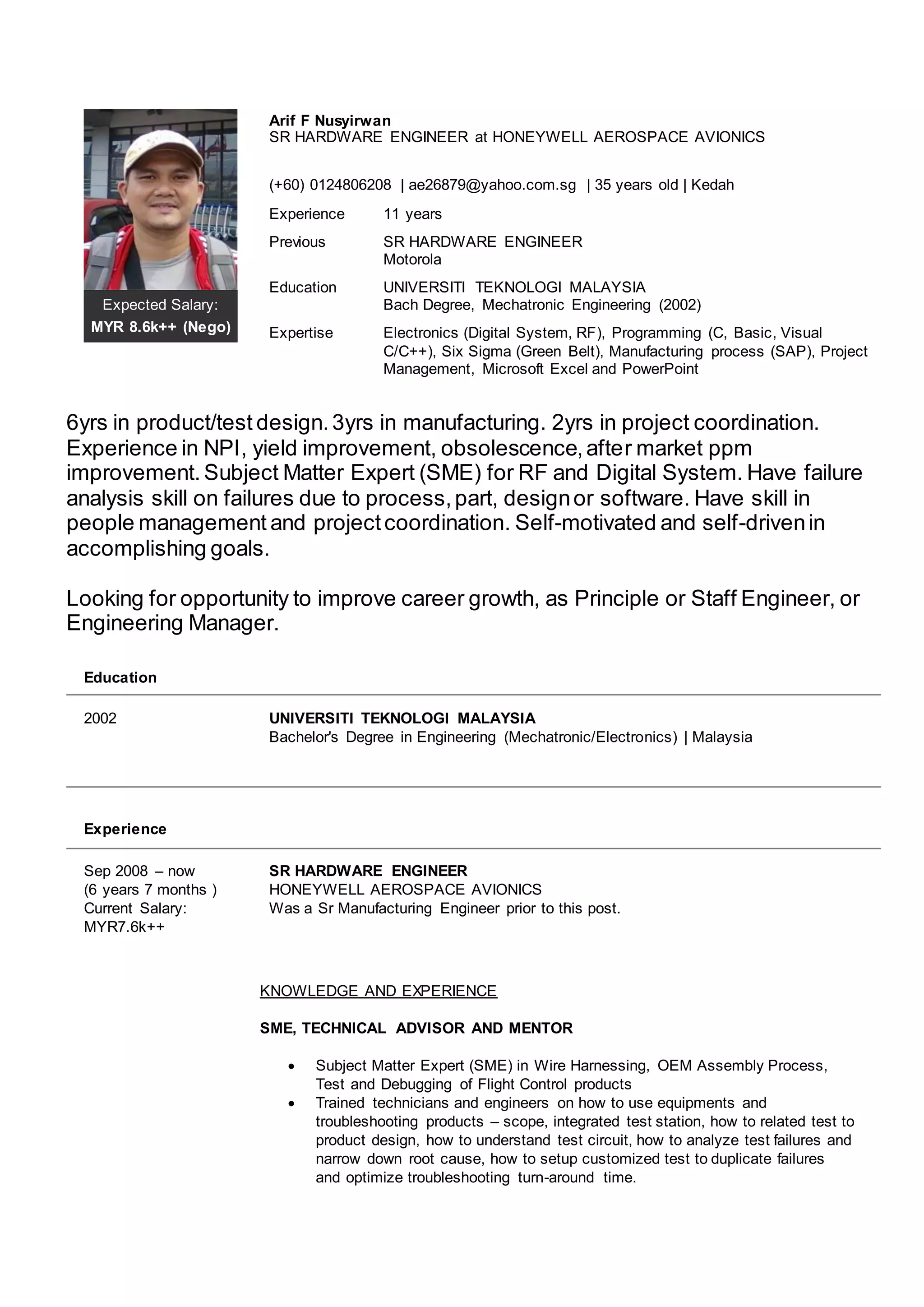
Arif F Nusyirwan
SR HARDWARE ENGINEER at HONEYWELL AEROSPACE AVIONICS
(+60) 0124806208 | ae26879@yahoo.com.sg | 35 years old | Kedah
Experience 11 years
Previous SR HARDWARE ENGINEER
Motorola
Education UNIVERSITI TEKNOLOGI MALAYSIA
Bach Degree, Mechatronic Engineering (2002)
Expertise Electronics (Digital System, RF), Programming (C, Basic, Visual
C/C++), Six Sigma (Green Belt), Manufacturing process (SAP), Project
Management, Microsoft Excel and PowerPoint
6yrs in product/test design.3yrs in manufacturing. 2yrs in project coordination.
Experience in NPI, yield improvement, obsolescence,after market ppm
improvement. Subject Matter Expert (SME) for RF and Digital System. Have failure
analysis skill on failures due to process,part, designor software. Have skill in
people management and projectcoordination. Self-motivated and self-drivenin
accomplishing goals.
Looking for opportunity to improve career growth, as Principle or Staff Engineer, or
Engineering Manager.
Education
2002 UNIVERSITI TEKNOLOGI MALAYSIA
Bachelor's Degree in Engineering (Mechatronic/Electronics) | Malaysia
Experience
Sep 2008 – now
(6 years 7 months )
Current Salary:
MYR7.6k++
SR HARDWARE ENGINEER
HONEYWELL AEROSPACE AVIONICS
Was a Sr Manufacturing Engineer prior to this post.
KNOWLEDGE AND EXPERIENCE
SME, TECHNICAL ADVISOR AND MENTOR
ď‚· Subject Matter Expert (SME) in Wire Harnessing, OEM Assembly Process,
Test and Debugging of Flight Control products
ď‚· Trained technicians and engineers on how to use equipments and
troubleshooting products – scope, integrated test station, how to related test to
product design, how to understand test circuit, how to analyze test failures and
narrow down root cause, how to setup customized test to duplicate failures
and optimize troubleshooting turn-around time.
ď‚· Developed troubleshooting guide and tools, and trained technicians and
engineers on how to use them.
LEAN MANUFACTURING PROCESS, YIELD AND CAPACITY ANALYSIS
ď‚· Developed manufacturing process flow, optimization of process flow using
FMEA methodology.
 Developed SOP for manufacturing processes – translation of technical
requirements from engineering documents to clear and simple instructions for
assemblers and technicians.
 Developed troubleshooting guide for technicians – translate test document and
product design document, into an excel tools, using formulas to analyse cause
of fault based on the input/output relationship.
ď‚· Upgraded the quality monitoring system to have more meaningful data
collection, and reduced manual data entry to improve data accuracy during
fault recording.
 Developed an excel tool to analyse production yield and inventory piling –
improved focus and effective use of resources, by knowing which issues tops
the highest points in impact to business list, knowing the details of issues and
possible solutions, and work with the team to resolve the first top five.
POWER CONVERSIONS
ď‚· DC-DC using 100KHz PWM modulation scheme for step-down and step-up
conversions, for low/hi loading application.
ď‚· AC Voltage rectification using half-wave/full-wave bridge circuit.
ď‚· Cost reduction analysis by studying options/alternatives of available
technologies for power conversions – PWM, rectifiers, low/hi efficiency
regulators, adjustable/fixed out regulators etc.
POWER CONTROL AND DISTRIBUTION
ď‚· Sequential and delayed power-up of DC supplies for digital system initialization
– critical in supporting the boot-up sequence for digital systems, and power
saving strategy to reduce power consumption of battery dependent devices.
ď‚· Short and over-voltage protection circuit for high current load, or lengthy power
line – critical in preventing major damage and safety hazards during fault
occurrence.
ď‚· Cost reduction analysis by studying the options of thermal distribution for high-
current regulators – application of heat-sinks and thermal grease, circuit
techniques: current/N-regulators, auto-shutdown etc.
AMD29K-BASED PROCESSOR SYSTEM FOR INTER-MODULE DATA
PROCESSING IN AVIONICS FLIGHT CONTROLLER PRODUCTS
ď‚· Address Mapping for memories and registers
ď‚· Event computation processing based on control and condition bits in registers,
or data at specified address.
ď‚· Data integrity check for instruction/address bus and data bus of two redundant
channels, using EDC, Parity or CRC.
ď‚· External events management by use of Discrete inputs and outputs for
external interrupts monitoring (Discrete Inputs), and also for external event
trigger (Discrete Outputs).
ď‚· Multi-clock generators to support external communication of sub-processing
system with client systems, and provide synchronization between core
processor and sub-processors.
HARDWARE AND SOFTWARE DESIGN FOR INTER-SYSTEM COMMUNICATION
PROTOCOL - ETHERNET, ARINC 429/629
ď‚· 10Mbps Ethernet design, with speed selection between FCC and SCC
channels.
ď‚· SW configuration and hardware setup for test and application of ARINC
429/629 using ASIC.
ACHIEVEMENTS
1) Pioneered the factory transfer project from US to Penang in 2009. Responsible to
transfer a wire harnessing station and a flight contol product. Successfully
commissioned the wire harnessing station to support 2 different systems (project
task was to integrate the wire harnessing system from 2 different site in US, into
one system), after 6months transfer. Also improved the yield of transferred
product from 50% to 75%, after identifying issue with test application and change
the test software. Become SME for one product in 2010, and SME for 7 different
types of product in 2014. In 2013, improved another product yield from 60% to
80%, after identified issues related to board manufacturing process by the
supplier.
2) Improved yield from 50% to 75% of a newly transferred product. Used FMEA
methodology and identified cause of faults was due to in-compatibility of relay to
support a communication card of the test equipment. Findings validated by using
a modified the test script. New test were released and no similar faults were
recorded since implementation.
3) Solved a case of a unique part has gone obsolete, and posed a $600k business
risk to ISC. Only one candidate for replacement is available, but was not working
with the current design and test. Developed a customized test setup and
successfully characterised the failing parameter of the candidate. Part
manufacturer took the input and change their design. Risks were mitigated within
one month, after successfully completed the qualification tests with the next
version of candidate.
4) Solved a case of ceramic capacitor burn at the field. The component was
damaged badly and could not be subjected to Failure Analysis. The burn only
exists at one terminal, and there is no short on the capacitor. Over-stressed due
to application were ruled out, as no damage found on the protection circuit, and
other components. Design was ruled out due to fallout rate is very low (1 in 3000
units), and the application margin is wide. Drive a few group sessions with CCA
supplier, part manufacturer, ISC and Engineering team and found that the CCA
supplier process has induced damage to component and caused the burn. No re-
occurrence recorded since implementation of process change at supplier.
5) Solved an issue with an order from a critical customer. The product test system
was running on very old UNIX system and not user friendly. Developers of
product and test were no longer working with company, and no troubleshooting
guide available. After 1 weeks reading reverse engineering the test script, and
having more understanding of how the test works, I have developed method to
utilise the manual tools of the test software, duplicate failure in 10mins compared
to normal test of 45mins, and successfully weed-out the cause of failure. Orders
were fulfilled within 2 weeks.
Jul 2005 - Aug 2008
(3 years 1 month )
SR HARDWARE ENGINEER
Motorola
KNOWLEDGE AND EXPERIENCE
1. RF OSCILLATOR DESIGN
ď‚· Voltage Controlled Crystal Oscillator, or VCXO, design with PLL and Tank
circuit – performance analysis of the carrier frequency generated by VCXO
includes, phase noise analysis, frequency accuracy (ppm), linearlity of
Voltage-vs-Frequency, and overall performance variation over temperature.
Performance optimisation thru selection of capacitance/inductive value,
selection RF transistor gain-mode (common-collector @ common-emitter)
response, placement of components, signal trace path and ground path
effects, open-loop response, feedback-loop response and frequency-vs-time
response.
2. RF RX/TX DESIGN
ď‚· Super-heterodyne receiver for VHF and UHF portable and mobile walkie
talkie - matching antenna load to AGC impedance, before filtering out signals
outside the bandpass region, and down-convert from Carrier frequency Fc to
Intermediate Frequency. The sampling resolution carried by Fc-modulated
signal is reduced when converted to IF-modulated signal, but still sufficient to
maintain the integrity of signal. Down-conversion to IF is important for
demodulation process because it is not practical to do digital processing with
multiple Fc's, especially when the receiver requirement is to process a range
of frequencies. Down converting all Fc's to one IF, prior to demod process, fix
this problem.
ď‚· Transmitter line-up, including PA and antenna switch (shared antenna with
receiver), for 1W to 10W power output - the challenge to design transmitter
(after signal has been modulated with Fc) is to reduced the gain loss due to
signal paths (energy loss at filters, power amplifier, Balun transformers, diode
switch, etc) and the minimise the noise affects of each component, and pwb
trace, when the high frequency signal is passing thru the signal path.
Reducing signal loss by validating the gain matching of impedance between
each stage, could help to improve the battery life of a portable walkie talkie.
By selecting the right component (type, power rating, impedance at operating
frequency, etc), or the placement of component (inductive effect of trace and
components), these two are from a few list of factors that could help to
minimise the un-intended noise generation, which could make an RF product
non-compliance to the EMC requirements.
3. RF POWER SYSTEM DESIGN
ď‚· Minimise battery consumption by complying to load matching requirement of
RF signal path, especially at the oscillators, RX and TX line-ups.
ď‚· Battery capacity monitoring to prevent over-current at high-powered devices,
due to low voltage
ď‚· Selection of battery terminal locations on the board layout, and the common
layer of the pwb, to minimise the current-path effect, to the RF signal noise
level.
4. EMC COMPLIANT DESIGN FOR HIGH POWER RF APPLICATION
ď‚· Selection of capacitors and inductors types and values, for maximum EMI
suppression on radiated and conducted EMI
ď‚· Selection of the most effective location for maximum EMI suppression for
radiated and conducted EMI
ď‚· Selection between LC parts, or shield, for EMI suppression. Selection is
based on overall cost vs overall performance.
ď‚· Prevent lengthy traces, sharp curve traces, and small trace width for high
current lines, to minimise un-intended radiation from charge flow on the
traces.
Jul 2004 - Jul 2005
(1 year )
DESIGN ENGINEER
SONY EMCS
KNOWLEDGE AND EXPERIENCE
1) AUDIO DESIGN
ď‚· Equalizer/Auto-level circuit design
ď‚· Op-amp application for active-filter design, in the selection of audio frequency
response characteristic
ď‚· Multi-channel audio outputs with Class B amplifier - no current-control feature.
ď‚· Implemented output splitter for speaker load type (4ohms, 8ohms) and
headphone type (300ohms).
2) EMC COMPLIANT DESIGN FOR DIGITAL AUDIO AND HIGH POWER AUDIO
APPLICATION
ď‚· Selection of capacitors and inductors types and values, for maximum EMI
suppression on radiated and conducted EMI
ď‚· Selection of the most effective location for maximum EMI suppression for radiated
and conducted EMI
ď‚· Prevent lengthy traces, sharp curve traces, and small trace width for high current
lines, to minimise un-intended radiation from charge flow on the traces.
Skills
TECHNICAL SKILLS:
1) STANDARDS AND REGULATORIES
- FCC – compliances to the Federal Communication Commission (FCC) requirements and guidelines for EMI
generated by RF walkie-talkies made by Motorola, is achieve by providing measurement test results of EMI
test conducted in an ETSI certified semi-anechoic chamber. The certification by FCC is the proof of
conformance, of Motorola products, are complying with the EMI limits set by FCC and allowed to be used in
United States.
- ETSI – European Telecommunication Standards Institute is the equivalent of FCC, but on international level.
The communication standards mainly covers the European countries, and as well as United States and Asia.
Compliance to ETSI standards is required for marketing products in countries registered to this body. For
devices with wireless broadcast features, aside from EMI, the conformity scope extended to the
communication performance of the communication technology (GSM, TETRA, 3G, 4G, etc). Motorola also
obtained the ETSI certification for non-US market.
- IEC – The standards of the International Electrotechnical Commission body, are widely used, when it comes
to the selection of symbols for circuit/schematic design, reading the markings on
components/modules/product, selection of component packaging or orientation format, etc. The list of
standards is very long, due to the wide variations of electrical/electronic components available in the
industry. And due to the standards, the industry able to expend progressively by having the luxury to choose
options – supplier, type components, ratings of component, price etc – especially when it comes to new
product design, where the balance between cost and performance needs to be achieved for sustainable
profit. Most of the components used by Honeywell, Motorola and Sony, are manufactured per IEC standards.
- UL – The UL marking on many Sony products, are proof of UL certification that the products have been
tested, and complied with the safety requirements of the UL (also known as Underwriters Laboratories)
standards. The list of UL standards is long, but only a few are related to products manufactured by Sony,
and most of them are related to the safety hazard posed by high-voltage and high-current application.
- IP (INTERNATIONAL PROTECTION) – this is one of the IEC standards, defining the protection level of an
en-capsulated product, against intrusion of foreign materials (dust, air, water, debris etc) into the interior of
the product. For example, the difference between an IP-4 walkie talkie, and IP-65 walkie talkie, is the
condition of product after tested with both IP-4 and IP-65 test condition. A product with IP-4 level will still
function well after being splashed with water from any direction, but will mal-function after being shot with a
high-pressurized water jets. For an IP-65 level walkie talkie, the product will still be in good condition, after
being splashed, and after being shot by a high-pressure water jets.
- MIL-STD – Aeropsace products carry very high safety risk, because of the consequence of having one of the
products become mal-functioned during flight, could resulted in the lost of many lives. Therefore, MIL-STD
(short form of Military Standards) or sometimes called MilSpecs, were used by the Aerospace industry, to
ensure all processes, procedures, practices and methods are at a level which satisfy the Airworthiness
requirements of the product. MIL-STDs were developed for the United States Department of Defense,
aiming to establish a standard interfacing/design/manufacturing process/test methods, which are realistic
and practical, and yet with the highest reliability.
- FAA – All aerospace products, regardless of the design origin, or manufacturing origin of the product, if it is
operating inside the boundaries and jurisdiction of United States of America, are subjected to full compliance
of all regulations and requirements composed by the Federal Aviation Administration (FAA) of United States.
Heavy penalties await for any violation of the regulations and requirements. Honeywell Aerospace products
are subjected to FAA approvals in-terms of Airworthiness, and the most common certifications are Technical
Standard Order (TSO) and PMA (Parts Manufacturer Approval). TSO is the declaration of product
performance by the product manufacturer, which has met the minimum performance standards of FAA. PMA
the approval grant by FAA, to a manufacturer of an aircraft, which approves the installation of a specific
product, manufactured by a specific manufacturer, into a specific aircraft. It is a critical violation for an aircraft
to install parts which are not PMA’ed for it. Aside from TSO and PMA, there are also Aerospace Policies
(AP) and Aerospace Guidelines (AG) documents, which provides more comprehensive details of processes
and procedures, for Honeywell to follow, in order to meet all the regulations and requirements from FAA.
- ICAO – International Civil Aviation Organization is one the agencies in United Nations, which specializes on
Aviations and Aerospace issues around the globe. Protocols for investigation of air accidents and plane
crash, defining codes and regulation for Air safety and Flight Planning, and Flight Traffic management’s
procedures, are part of the defined standards in ICAO. All communication products manufactured by
Honeywell, which has broadcast and transceiver features, are required to comply to ICAO standards, such
as AMHS (Aeronautical Message Handling System) and CNS/ATM (Communication, Navigation,
Surveillance / Air Traffic Management) systems.
- AS9100 – The current Aerospace industry referenced AS9100 as the guidelines of their Quality
Management System, a system developed by the joint ventures of Aerospace companies such as Boeing,
Lockheed Martin, and GE (just to name a few), after a few weakness and loop-holes were found with the
previous system, which were implemented based on two military specifications – MIL-Q-9858A and MIL-I-
45208A. The current AS9100 standard is at Rev C, and includes more critical areas in QMS which are weak,
such as strong emphasis on the risk management, conformance to product requirements, delivery
performance, and the root cause and corrective action process. Honeywell performance matrix and tools
were developed based on the AS9100 requirements, such OTTR (On Time To Receive) for delivery
performance matrix, and Quality PPM for Customer Escape matrix. A Corrective Action Request (CAR) tool
is the recording system to capture all the activities and processes to address customer quality issues.
- ARINC – At the beginning, this is a company name (Aeronautical Radio, Incorporated), which established
many communication technologies across eight industries, including aviation/aerospace. FCC charted the
company to serve the airline industry, and later extended the service to wider scale – as the main provider of
ARINC communication technology. In Honeywell, many communication protocols are ARINC based, due to
the numerous advantages of this technology. Most common application of ARINC technologies in Flight
Platforms and Flight Management Systems are – ARINC 615, ARINC 429 and ARINC 629.
- IPC – Known as Institute for Printed Circuits in the beginning, before it changed to IPC with a tagline
Association Connecting Electronics Industries, is a trade association with goals to standardize the assembly
and manufacturing requirements of electronic assemblies. IPC-A-610 is one of the standards developed by
this association, and commonly referred by Honeywell. It defines the acceptability requirements for
Electronic Assembly. Per this standard, the result of an assembly process can fall under either one of 3
dispositions: Acceptable, Reject or a Process Indicator. The disposition is also depends on the classification
of the product. Aerospace products are Class 3 products, and in many cases, a Class 1 Acceptable could a
Class 3 Reject, where the requirement of Class 3 product is much more stringent compared to Class 1 and
Class 2.
2) SOFTWARE
- SAP for manufacturing data recording and analysis:
Extensive use of many transaction codes, or T-codes, to execute data recording, and retrieving records. Use
Business Objects (SAP BO) features to extract raw manufacturing data, for Fault Analysis investigation.
Used many types of formula (database, math, statistics etc) to do several Paretos of Fault vs resources
(which tester, which module, which batch etc) for more perspectives of the problem, before defining the
problem statement, and identifying the solution.
- Application software development using C language:
Developed unique header files, include voids and return function calls, and writes application scripts using
data structure (struct), local and global variables, using C language on the Visual C++ platform, to develop
window-based netmeeting-like remote control software, with video-camera access feature, and remote
control of a wheeled-robot thru TCP-IP communication.
- Macros in Microsoft Excel:
Develop unique function calls in Basic language, to support the automatic-backup file system for archiving
files.
- Data Simulation and Analysis using Microsoft Excel:
Create formulas and macro, to simulate the mathematical model of a complex circuit, using Microsoft Excel
to develop time domain and frequency domain simulation tool, for signal analysis. Implemented a feature
where certain parameters or inputs, can be modified, to ease the observation of change on signal
characteristic, of the simulated signal. Feature is critical to identify the range of design performance
variations, due to the variation attributed by each component in the circuit. A simple example, a 10%
tolerance of 1kohm resistor can have a value within 900ohms to 1100ohms.
- Digital System analysis using Microsoft Excel:
Used the statistical and binary tools of Microsoft Excel to create formulas, and analyse digital data from the
digital system, by determining the definition of each bits, or bit set, of a data from an address or registers,
and summarized the condition of the system, when the fault occurred.
- Debugging test software failures:
Modified test scripts made by other programmer, by changing certain bits or register contents, or read/write a
specific data, or data set, to specific address, or range of address, or disabling/by-passing non-related
function calls, to reduce turnaround time when investigating a digital system fault.
- Circuit simulation using Matlab, ADS, PSpice, Orcad:
Passive/Active filters, Closed-loop tank circuits, Audio response circuits, Sequential power-up circuits etc.
The simulation tools are much more advance than the excel tool I created. They are with built-in engines for
characterising each component of the circuit, and faster processing time to generate signal simulation.
- CAD using AutoCAD, Pro-Engineer:
Masking design for PWB etching process
- Test System setup using EADS-TestStand and Labview:
equipment integration and test software validation.
- PWB design using Mentor Graphics and Fujitsu.
3) CIRCUIT DESIGN
- PWB design for Audio board, RF board, Digital System board:
critical consideration for designing the trace path of sensitive signals are: 1) ground separation point using
star configuration, to prevent noise from a noisy circuit (such as DC-DC PWM circuit, Transmitter circuit)
from offsetting the noise level at receiver. 2) Always have the transmitter output path as short as possible,
and as wide as possible, to reduce generation of un-intended interference to the other systems on the board.
3) Minimise the use of thru holes and VIAs, to reduce PWB cost. 4) Do not cross low power/low frequency
lines with high/power high frequency lines – cross-talks usually occurs when this happens. 5) FR-4 is widely
use for PWB design. For RF circuit, it is important to consider the trace width and length, and the material
used in PWB fabrication, when doing the signal simulation analysis.
- Schematic design for Audio System, VCO+RX+TX for RF System, Discrete Logic gates for Digital
Processing, Address bus and Data bus for Digital System:
Frequency response, logic valid signals, and also gain/attenuations control using passive/active circuits, are
common techniques in design, to convert a specific input signals, to the desired output. This is called
function response, and is the basic structure of the circuit. In managing highly sensitive signals, at some
point, the several common ground points are labelled differently, but connected at main supply source, or a
filtering capacitor if the main supply is too far. To ship a product, there are also other considerations before
finalising a schematic design, such as, fault protection, variations in component tolerance, over/under
voltage conditions, EMI, temperature effects etc – most of these are features not requested by the end-user,
but instead, are parts of the regulatory requirements. Aside from functioning well, the product must also able
to pass the regulatory and qualification test, prior to entering the market.
4) EQUIPMENTS
- Labview Test System Intregration and Test Application software development:
Developed hand-shake protocol to enable equipment identification and enumeration of multiple equipment.
Developed configuration files for data management of equipment setup and function calls for read/write
actions on registers. Developed function calls to execute test initialisation, test computation based on setup
inputs, and data from registers, prior to displaying test results. GPIB-supported equipment such DMM, Wave
Analyser, Power Supply, Signal Generator, Spectrum/Network Analyser, TETRA System Analyser, ICT and
Flying probe.
- Manual Test System Integration, (without automation using test software):
Develop manual test jig/fixture, test procedure and test setup, mostly for prototype testing and verification,
and also for low level troubleshooting. Common equipment used are Oscilloscope, Logic Analyser, Data-
logger, Signal Generator.
-
Other System: Ethernet, CAN Analyser – verification of communication setup between UUT and Tester.
5) HANDS-ON
- Test System setup and verification of test equipments and test software.
- Product rework and modification. Can do hand soldering for SMT or thru hole parts - IPC certified
- Wire harnessing
MANAGEMENT SKILLS
1) MILESTONES, TIME-LINE PLANNING, EXECUTION AND PROGRESS MONITORING
- Breakdown a project goal of releasing a design change due to obsolescence, into sub-goals of the project:
o Engineering verification test and qualification of the replacement candidate with new design,
o Procuring engineering samples and production stock,
o Manufacturing build verification and Quality buy-off.
- Thenassignthe specialistasteammembersof eachsub-goals:
o Engineeringforverificationtestandqualification,
o Procurementformaterial readiness,and
o Operation for Manufacturing build and test readiness
- Breakdown the sub-goals to realistic action plan. Example: Verification Test to be broken down to:
o System Functional Test,
o Reliability Test, and
o Regulatory Requirement Tests,
and determine the lead time for each action item, the required resources and the expert/process owner.
- Integrate all action plans into a Gant Chart, and create a time-line for execution and completion of each
action.
- Period length of lead-time-dependent action items should be realistic, and should be based on past
experience. Examples: lead-time for procuring parts is 4weeks, lead time for completing regulatory tests is 2
weeks, and lead-time for manufacturing builds and test is 0.5weeks.
- Integrate the action items, action owners, and time-line into a Gant Chart for progress monitoring.
- Cost should always be factored-in, of each action item or resources – for business justification to do the
project.
2) DRIVING THE TEAM
- Making sure every team member understand the importance of achieving the business goal – to them and to
the company.
- Alignments of action plans should be completed prior to finalising the Gant Chart – each team member
should review the 1st draft of the assigned action items, making sure the resources are available, the
capability is there, and the time-line is reasonable. Each member should raise up any concern related to the
action plan, so the action plan could be revised, or come-up with a contingency plan. Commit to the plan,
only after getting the consensus of each team.
3) WORKING WITH CROSS-FUNCTIONAL TEAM
- Business team – knowing the needs of the market and customers, is very critical, as that is how the business
makes the profit. Delivering products to customer, with satisfactory performance, and when it is requested, is
the basic of maintaining sustainable reputation, and profit. Frequent engagement with the business team is
important, as they are the expert of understanding the needs of the market and customer.
- Quality – A company reputation is most displayed by the quality of the product, then after-market service,
aside from full-filling the demands. Engagement and alignment with all 3 major Quality groups (Supplier,
Product and Customer) effectively, could significantly improve the flow of cash to the business, by predicting
and monitoring for quality road-blocks, provide predictive action plans, and immediate response on
corrective actions.
- Manufacturing and Planning – Many critical roles are played by the Manufacturing department in meeting
both the customer demands and the quality of the product. Managing the manufacturing process it-self is
already a hard job, because of the challenge in managing the technical requirements of the product and
process, and managing the people who work on the process: assemblers and technicians. They also need to
provide first level of reporting on yield issues, based manufacturing data collection and analysis. It is critical
to make sure, any process or product requirement are written clearly and precisely, to prevent delayed in
implementation due to vague instruction. Need to ensure the message conveyed, is the same as the
message understood.
- Test System Engineering – Having bad products to escape to the customers, makes bad reputation of the
company. To prevent this, only people with the correct expertise and knowledge has the capability to
develop a system which can filter out all the bad apples, before they make it to the shipping bay. It is
important to know that experts are only effective because of their systematic thought process. For them to
effectively contribute to the business, the cross-functional integration between various teams, should be
manage systematically. Data are only meaningful when they are organized and systematic, and make
sense. All the technical knowledge and expertise will be a waste, when the problem statement provided is
miss-leading. Therefore, it is important for the project coordinator, to be someone with the capability to
conceptualize a problem statement correctly, in a way that can be understood by all team members.
- Logistics – Transportation and inventory is a big deal for all big companies. Many cost saving initiatives has
focused on revising the policies and process management of their transportation and inventory. Also, many
cases of business loss were also contributed by miss-management of transportation and inventories. It is
very critical to involve Logistic in every stage of the project, because logistics knows how to make sure all
the goods are received on time, and all the products we are selling are properly packaged and shipped on
time.
- Finance – Finance people are the ones knows how the company is performing, since a business is all about
sustaining profits. The goal of a project is always about making more profit; therefore it is critical to align with
Finance on the progress of each project, and to provide the justification for both long-term and short-term
profit.
- Document Control and Configuration Management – Engineering document change process, revision
controls process, approvals of document change process; all of these are some of the very critical process
controls, which need to be managed by this group, before releasing a document which constitute the
requirements and contracts of a product, which must be complied prior to delivery to the customer.
- Engineering and Technology Group – This group is build-up by experts of many fields - Electronics Design ,
System Design, Manufacturing Process Experts – and they worked well with the test group, compared to
other groups, due to the similarity of skills, thought process and job-nature of this group. In that sense, the
same approach applied to this group, when working with them as part of the team, for a project cross -
functional team members.
- Component Engineering – This group supports Product Design Engineering group on issues related to
component design and specification, and also supports the supply chain for issues like searching for
alternate sources of a component, or follow-up with the component manufacturer for batch related issues.
This group has their own Configuration Management system and process, as they are managing suppliers,
not customers, and in a way, this group work scope is similar to project management.
About Me
More about Me Full Name: Arif Fadillah bin Nusyirwan
NRIC: 790826-71-5029
Home Address: 287, Persiaran Utama 1/8, Taman Kulim Utama, 09000 Kulim, Kedah
Home Phone: (+60) 04 492 4299
Status: Married. Have 3 boys (aged 6yr, 4yr and 1week)
Personality
1) organized, systematic and simple
2) Self-driven in improving skills and knowledge – especially in areas related to work
or family.
3) Self-motivated in achieving goals, and always drive to exceed expectation.
4) Not very good at remembering names, labels, terms etc – language, history and
biology are not favourite subjects.
5) No problem mixing with people of different personality, with common value of
integrity and ethics.
6) Always have a lot in mind, and is not afraid to try and fail, to learn more.
7) Always try to be nice to people – sometimes this is a hard thing to do.
8) Not good at doing nothing.
Hobby
1) Sit in-front of PC, and come-up with a new tools, or improve existing tools –
simulation tool, project planning tool, new design/techniquie/idea – to improve
productivity
2) Handiwork - house wiring, carpenting, house renovation,
3) Small-scale gardening – just started.
4) Cooking – just started.
5) Reading or watching anything informative/inspirational - medical, history,
discoveries, fictional movies, comics
6) Fishing, soccer/futsal, badminton
Referrals 1) Mohd Khamar Mat Esa – Test Engineer at Intel (012-4689271)
2) Mohd Khairi Salleh – Test Engineer at Intel (019-5749559)
3) Fadzil, Ashraf Fathan – Operation Manager at Honeywell (012-5148885)
4) Chang SK – Test Engineer at Honeywell (012-4478358)
5) Annuar Abu Bakar – SDE at Celestica (019-4133265)
6) Mark Vasudavan – Director at Celestica (012-2958982)
7) Tim Henning – Director at Honeywell (017-4070788)
8) Suhaizar Ibrahim – Test Engineer at Thales (017-4605706)
9) NorHasnifarina bt Jamadin – Product Support Engineer at Honeywell (017-
4818152)
10) Lee Chin Hin – Manufacturing Engineer at Honeywell (019-4446638)

CV Arif Nusyirwan - 20150510

  • 1.
    Expected Salary: MYR 8.6k++(Nego) Arif F Nusyirwan SR HARDWARE ENGINEER at HONEYWELL AEROSPACE AVIONICS (+60) 0124806208 | ae26879@yahoo.com.sg | 35 years old | Kedah Experience 11 years Previous SR HARDWARE ENGINEER Motorola Education UNIVERSITI TEKNOLOGI MALAYSIA Bach Degree, Mechatronic Engineering (2002) Expertise Electronics (Digital System, RF), Programming (C, Basic, Visual C/C++), Six Sigma (Green Belt), Manufacturing process (SAP), Project Management, Microsoft Excel and PowerPoint 6yrs in product/test design.3yrs in manufacturing. 2yrs in project coordination. Experience in NPI, yield improvement, obsolescence,after market ppm improvement. Subject Matter Expert (SME) for RF and Digital System. Have failure analysis skill on failures due to process,part, designor software. Have skill in people management and projectcoordination. Self-motivated and self-drivenin accomplishing goals. Looking for opportunity to improve career growth, as Principle or Staff Engineer, or Engineering Manager. Education 2002 UNIVERSITI TEKNOLOGI MALAYSIA Bachelor's Degree in Engineering (Mechatronic/Electronics) | Malaysia Experience Sep 2008 – now (6 years 7 months ) Current Salary: MYR7.6k++ SR HARDWARE ENGINEER HONEYWELL AEROSPACE AVIONICS Was a Sr Manufacturing Engineer prior to this post. KNOWLEDGE AND EXPERIENCE SME, TECHNICAL ADVISOR AND MENTOR  Subject Matter Expert (SME) in Wire Harnessing, OEM Assembly Process, Test and Debugging of Flight Control products  Trained technicians and engineers on how to use equipments and troubleshooting products – scope, integrated test station, how to related test to product design, how to understand test circuit, how to analyze test failures and narrow down root cause, how to setup customized test to duplicate failures and optimize troubleshooting turn-around time.
  • 2.
     Developed troubleshootingguide and tools, and trained technicians and engineers on how to use them. LEAN MANUFACTURING PROCESS, YIELD AND CAPACITY ANALYSIS  Developed manufacturing process flow, optimization of process flow using FMEA methodology.  Developed SOP for manufacturing processes – translation of technical requirements from engineering documents to clear and simple instructions for assemblers and technicians.  Developed troubleshooting guide for technicians – translate test document and product design document, into an excel tools, using formulas to analyse cause of fault based on the input/output relationship.  Upgraded the quality monitoring system to have more meaningful data collection, and reduced manual data entry to improve data accuracy during fault recording.  Developed an excel tool to analyse production yield and inventory piling – improved focus and effective use of resources, by knowing which issues tops the highest points in impact to business list, knowing the details of issues and possible solutions, and work with the team to resolve the first top five. POWER CONVERSIONS  DC-DC using 100KHz PWM modulation scheme for step-down and step-up conversions, for low/hi loading application.  AC Voltage rectification using half-wave/full-wave bridge circuit.  Cost reduction analysis by studying options/alternatives of available technologies for power conversions – PWM, rectifiers, low/hi efficiency regulators, adjustable/fixed out regulators etc. POWER CONTROL AND DISTRIBUTION  Sequential and delayed power-up of DC supplies for digital system initialization – critical in supporting the boot-up sequence for digital systems, and power saving strategy to reduce power consumption of battery dependent devices.  Short and over-voltage protection circuit for high current load, or lengthy power line – critical in preventing major damage and safety hazards during fault occurrence.  Cost reduction analysis by studying the options of thermal distribution for high- current regulators – application of heat-sinks and thermal grease, circuit techniques: current/N-regulators, auto-shutdown etc. AMD29K-BASED PROCESSOR SYSTEM FOR INTER-MODULE DATA PROCESSING IN AVIONICS FLIGHT CONTROLLER PRODUCTS  Address Mapping for memories and registers  Event computation processing based on control and condition bits in registers, or data at specified address.  Data integrity check for instruction/address bus and data bus of two redundant channels, using EDC, Parity or CRC.  External events management by use of Discrete inputs and outputs for external interrupts monitoring (Discrete Inputs), and also for external event trigger (Discrete Outputs).  Multi-clock generators to support external communication of sub-processing system with client systems, and provide synchronization between core processor and sub-processors.
  • 3.
    HARDWARE AND SOFTWAREDESIGN FOR INTER-SYSTEM COMMUNICATION PROTOCOL - ETHERNET, ARINC 429/629 ď‚· 10Mbps Ethernet design, with speed selection between FCC and SCC channels. ď‚· SW configuration and hardware setup for test and application of ARINC 429/629 using ASIC. ACHIEVEMENTS 1) Pioneered the factory transfer project from US to Penang in 2009. Responsible to transfer a wire harnessing station and a flight contol product. Successfully commissioned the wire harnessing station to support 2 different systems (project task was to integrate the wire harnessing system from 2 different site in US, into one system), after 6months transfer. Also improved the yield of transferred product from 50% to 75%, after identifying issue with test application and change the test software. Become SME for one product in 2010, and SME for 7 different types of product in 2014. In 2013, improved another product yield from 60% to 80%, after identified issues related to board manufacturing process by the supplier. 2) Improved yield from 50% to 75% of a newly transferred product. Used FMEA methodology and identified cause of faults was due to in-compatibility of relay to support a communication card of the test equipment. Findings validated by using a modified the test script. New test were released and no similar faults were recorded since implementation. 3) Solved a case of a unique part has gone obsolete, and posed a $600k business risk to ISC. Only one candidate for replacement is available, but was not working with the current design and test. Developed a customized test setup and successfully characterised the failing parameter of the candidate. Part manufacturer took the input and change their design. Risks were mitigated within one month, after successfully completed the qualification tests with the next version of candidate. 4) Solved a case of ceramic capacitor burn at the field. The component was damaged badly and could not be subjected to Failure Analysis. The burn only exists at one terminal, and there is no short on the capacitor. Over-stressed due to application were ruled out, as no damage found on the protection circuit, and other components. Design was ruled out due to fallout rate is very low (1 in 3000 units), and the application margin is wide. Drive a few group sessions with CCA supplier, part manufacturer, ISC and Engineering team and found that the CCA supplier process has induced damage to component and caused the burn. No re- occurrence recorded since implementation of process change at supplier. 5) Solved an issue with an order from a critical customer. The product test system was running on very old UNIX system and not user friendly. Developers of product and test were no longer working with company, and no troubleshooting guide available. After 1 weeks reading reverse engineering the test script, and having more understanding of how the test works, I have developed method to utilise the manual tools of the test software, duplicate failure in 10mins compared to normal test of 45mins, and successfully weed-out the cause of failure. Orders were fulfilled within 2 weeks.
  • 5.
    Jul 2005 -Aug 2008 (3 years 1 month ) SR HARDWARE ENGINEER Motorola KNOWLEDGE AND EXPERIENCE 1. RF OSCILLATOR DESIGN  Voltage Controlled Crystal Oscillator, or VCXO, design with PLL and Tank circuit – performance analysis of the carrier frequency generated by VCXO includes, phase noise analysis, frequency accuracy (ppm), linearlity of Voltage-vs-Frequency, and overall performance variation over temperature. Performance optimisation thru selection of capacitance/inductive value, selection RF transistor gain-mode (common-collector @ common-emitter) response, placement of components, signal trace path and ground path effects, open-loop response, feedback-loop response and frequency-vs-time response. 2. RF RX/TX DESIGN  Super-heterodyne receiver for VHF and UHF portable and mobile walkie talkie - matching antenna load to AGC impedance, before filtering out signals outside the bandpass region, and down-convert from Carrier frequency Fc to Intermediate Frequency. The sampling resolution carried by Fc-modulated signal is reduced when converted to IF-modulated signal, but still sufficient to maintain the integrity of signal. Down-conversion to IF is important for demodulation process because it is not practical to do digital processing with multiple Fc's, especially when the receiver requirement is to process a range of frequencies. Down converting all Fc's to one IF, prior to demod process, fix this problem.  Transmitter line-up, including PA and antenna switch (shared antenna with receiver), for 1W to 10W power output - the challenge to design transmitter (after signal has been modulated with Fc) is to reduced the gain loss due to signal paths (energy loss at filters, power amplifier, Balun transformers, diode switch, etc) and the minimise the noise affects of each component, and pwb trace, when the high frequency signal is passing thru the signal path. Reducing signal loss by validating the gain matching of impedance between each stage, could help to improve the battery life of a portable walkie talkie. By selecting the right component (type, power rating, impedance at operating frequency, etc), or the placement of component (inductive effect of trace and components), these two are from a few list of factors that could help to minimise the un-intended noise generation, which could make an RF product non-compliance to the EMC requirements. 3. RF POWER SYSTEM DESIGN  Minimise battery consumption by complying to load matching requirement of RF signal path, especially at the oscillators, RX and TX line-ups.  Battery capacity monitoring to prevent over-current at high-powered devices, due to low voltage  Selection of battery terminal locations on the board layout, and the common layer of the pwb, to minimise the current-path effect, to the RF signal noise level. 4. EMC COMPLIANT DESIGN FOR HIGH POWER RF APPLICATION  Selection of capacitors and inductors types and values, for maximum EMI suppression on radiated and conducted EMI  Selection of the most effective location for maximum EMI suppression for radiated and conducted EMI
  • 6.
    ď‚· Selection betweenLC parts, or shield, for EMI suppression. Selection is based on overall cost vs overall performance. ď‚· Prevent lengthy traces, sharp curve traces, and small trace width for high current lines, to minimise un-intended radiation from charge flow on the traces. Jul 2004 - Jul 2005 (1 year ) DESIGN ENGINEER SONY EMCS KNOWLEDGE AND EXPERIENCE 1) AUDIO DESIGN ď‚· Equalizer/Auto-level circuit design ď‚· Op-amp application for active-filter design, in the selection of audio frequency response characteristic ď‚· Multi-channel audio outputs with Class B amplifier - no current-control feature. ď‚· Implemented output splitter for speaker load type (4ohms, 8ohms) and headphone type (300ohms). 2) EMC COMPLIANT DESIGN FOR DIGITAL AUDIO AND HIGH POWER AUDIO APPLICATION ď‚· Selection of capacitors and inductors types and values, for maximum EMI suppression on radiated and conducted EMI ď‚· Selection of the most effective location for maximum EMI suppression for radiated and conducted EMI ď‚· Prevent lengthy traces, sharp curve traces, and small trace width for high current lines, to minimise un-intended radiation from charge flow on the traces.
  • 7.
    Skills TECHNICAL SKILLS: 1) STANDARDSAND REGULATORIES - FCC – compliances to the Federal Communication Commission (FCC) requirements and guidelines for EMI generated by RF walkie-talkies made by Motorola, is achieve by providing measurement test results of EMI test conducted in an ETSI certified semi-anechoic chamber. The certification by FCC is the proof of conformance, of Motorola products, are complying with the EMI limits set by FCC and allowed to be used in United States. - ETSI – European Telecommunication Standards Institute is the equivalent of FCC, but on international level. The communication standards mainly covers the European countries, and as well as United States and Asia. Compliance to ETSI standards is required for marketing products in countries registered to this body. For devices with wireless broadcast features, aside from EMI, the conformity scope extended to the communication performance of the communication technology (GSM, TETRA, 3G, 4G, etc). Motorola also obtained the ETSI certification for non-US market. - IEC – The standards of the International Electrotechnical Commission body, are widely used, when it comes to the selection of symbols for circuit/schematic design, reading the markings on components/modules/product, selection of component packaging or orientation format, etc. The list of standards is very long, due to the wide variations of electrical/electronic components available in the industry. And due to the standards, the industry able to expend progressively by having the luxury to choose options – supplier, type components, ratings of component, price etc – especially when it comes to new product design, where the balance between cost and performance needs to be achieved for sustainable profit. Most of the components used by Honeywell, Motorola and Sony, are manufactured per IEC standards. - UL – The UL marking on many Sony products, are proof of UL certification that the products have been tested, and complied with the safety requirements of the UL (also known as Underwriters Laboratories) standards. The list of UL standards is long, but only a few are related to products manufactured by Sony, and most of them are related to the safety hazard posed by high-voltage and high-current application. - IP (INTERNATIONAL PROTECTION) – this is one of the IEC standards, defining the protection level of an en-capsulated product, against intrusion of foreign materials (dust, air, water, debris etc) into the interior of the product. For example, the difference between an IP-4 walkie talkie, and IP-65 walkie talkie, is the condition of product after tested with both IP-4 and IP-65 test condition. A product with IP-4 level will still function well after being splashed with water from any direction, but will mal-function after being shot with a high-pressurized water jets. For an IP-65 level walkie talkie, the product will still be in good condition, after being splashed, and after being shot by a high-pressure water jets. - MIL-STD – Aeropsace products carry very high safety risk, because of the consequence of having one of the products become mal-functioned during flight, could resulted in the lost of many lives. Therefore, MIL-STD (short form of Military Standards) or sometimes called MilSpecs, were used by the Aerospace industry, to ensure all processes, procedures, practices and methods are at a level which satisfy the Airworthiness requirements of the product. MIL-STDs were developed for the United States Department of Defense, aiming to establish a standard interfacing/design/manufacturing process/test methods, which are realistic and practical, and yet with the highest reliability. - FAA – All aerospace products, regardless of the design origin, or manufacturing origin of the product, if it is operating inside the boundaries and jurisdiction of United States of America, are subjected to full compliance of all regulations and requirements composed by the Federal Aviation Administration (FAA) of United States. Heavy penalties await for any violation of the regulations and requirements. Honeywell Aerospace products are subjected to FAA approvals in-terms of Airworthiness, and the most common certifications are Technical
  • 8.
    Standard Order (TSO)and PMA (Parts Manufacturer Approval). TSO is the declaration of product performance by the product manufacturer, which has met the minimum performance standards of FAA. PMA the approval grant by FAA, to a manufacturer of an aircraft, which approves the installation of a specific product, manufactured by a specific manufacturer, into a specific aircraft. It is a critical violation for an aircraft to install parts which are not PMA’ed for it. Aside from TSO and PMA, there are also Aerospace Policies (AP) and Aerospace Guidelines (AG) documents, which provides more comprehensive details of processes and procedures, for Honeywell to follow, in order to meet all the regulations and requirements from FAA. - ICAO – International Civil Aviation Organization is one the agencies in United Nations, which specializes on Aviations and Aerospace issues around the globe. Protocols for investigation of air accidents and plane crash, defining codes and regulation for Air safety and Flight Planning, and Flight Traffic management’s procedures, are part of the defined standards in ICAO. All communication products manufactured by Honeywell, which has broadcast and transceiver features, are required to comply to ICAO standards, such as AMHS (Aeronautical Message Handling System) and CNS/ATM (Communication, Navigation, Surveillance / Air Traffic Management) systems. - AS9100 – The current Aerospace industry referenced AS9100 as the guidelines of their Quality Management System, a system developed by the joint ventures of Aerospace companies such as Boeing, Lockheed Martin, and GE (just to name a few), after a few weakness and loop-holes were found with the previous system, which were implemented based on two military specifications – MIL-Q-9858A and MIL-I- 45208A. The current AS9100 standard is at Rev C, and includes more critical areas in QMS which are weak, such as strong emphasis on the risk management, conformance to product requirements, delivery performance, and the root cause and corrective action process. Honeywell performance matrix and tools were developed based on the AS9100 requirements, such OTTR (On Time To Receive) for delivery performance matrix, and Quality PPM for Customer Escape matrix. A Corrective Action Request (CAR) tool is the recording system to capture all the activities and processes to address customer quality issues. - ARINC – At the beginning, this is a company name (Aeronautical Radio, Incorporated), which established many communication technologies across eight industries, including aviation/aerospace. FCC charted the company to serve the airline industry, and later extended the service to wider scale – as the main provider of ARINC communication technology. In Honeywell, many communication protocols are ARINC based, due to the numerous advantages of this technology. Most common application of ARINC technologies in Flight Platforms and Flight Management Systems are – ARINC 615, ARINC 429 and ARINC 629. - IPC – Known as Institute for Printed Circuits in the beginning, before it changed to IPC with a tagline Association Connecting Electronics Industries, is a trade association with goals to standardize the assembly and manufacturing requirements of electronic assemblies. IPC-A-610 is one of the standards developed by this association, and commonly referred by Honeywell. It defines the acceptability requirements for Electronic Assembly. Per this standard, the result of an assembly process can fall under either one of 3 dispositions: Acceptable, Reject or a Process Indicator. The disposition is also depends on the classification of the product. Aerospace products are Class 3 products, and in many cases, a Class 1 Acceptable could a Class 3 Reject, where the requirement of Class 3 product is much more stringent compared to Class 1 and Class 2. 2) SOFTWARE - SAP for manufacturing data recording and analysis: Extensive use of many transaction codes, or T-codes, to execute data recording, and retrieving records. Use Business Objects (SAP BO) features to extract raw manufacturing data, for Fault Analysis investigation. Used many types of formula (database, math, statistics etc) to do several Paretos of Fault vs resources (which tester, which module, which batch etc) for more perspectives of the problem, before defining the problem statement, and identifying the solution. - Application software development using C language: Developed unique header files, include voids and return function calls, and writes application scripts using data structure (struct), local and global variables, using C language on the Visual C++ platform, to develop window-based netmeeting-like remote control software, with video-camera access feature, and remote control of a wheeled-robot thru TCP-IP communication.
  • 9.
    - Macros inMicrosoft Excel: Develop unique function calls in Basic language, to support the automatic-backup file system for archiving files. - Data Simulation and Analysis using Microsoft Excel: Create formulas and macro, to simulate the mathematical model of a complex circuit, using Microsoft Excel to develop time domain and frequency domain simulation tool, for signal analysis. Implemented a feature where certain parameters or inputs, can be modified, to ease the observation of change on signal characteristic, of the simulated signal. Feature is critical to identify the range of design performance variations, due to the variation attributed by each component in the circuit. A simple example, a 10% tolerance of 1kohm resistor can have a value within 900ohms to 1100ohms. - Digital System analysis using Microsoft Excel: Used the statistical and binary tools of Microsoft Excel to create formulas, and analyse digital data from the digital system, by determining the definition of each bits, or bit set, of a data from an address or registers, and summarized the condition of the system, when the fault occurred. - Debugging test software failures: Modified test scripts made by other programmer, by changing certain bits or register contents, or read/write a specific data, or data set, to specific address, or range of address, or disabling/by-passing non-related function calls, to reduce turnaround time when investigating a digital system fault. - Circuit simulation using Matlab, ADS, PSpice, Orcad: Passive/Active filters, Closed-loop tank circuits, Audio response circuits, Sequential power-up circuits etc. The simulation tools are much more advance than the excel tool I created. They are with built-in engines for characterising each component of the circuit, and faster processing time to generate signal simulation. - CAD using AutoCAD, Pro-Engineer: Masking design for PWB etching process - Test System setup using EADS-TestStand and Labview: equipment integration and test software validation. - PWB design using Mentor Graphics and Fujitsu. 3) CIRCUIT DESIGN - PWB design for Audio board, RF board, Digital System board: critical consideration for designing the trace path of sensitive signals are: 1) ground separation point using star configuration, to prevent noise from a noisy circuit (such as DC-DC PWM circuit, Transmitter circuit) from offsetting the noise level at receiver. 2) Always have the transmitter output path as short as possible, and as wide as possible, to reduce generation of un-intended interference to the other systems on the board. 3) Minimise the use of thru holes and VIAs, to reduce PWB cost. 4) Do not cross low power/low frequency lines with high/power high frequency lines – cross-talks usually occurs when this happens. 5) FR-4 is widely use for PWB design. For RF circuit, it is important to consider the trace width and length, and the material used in PWB fabrication, when doing the signal simulation analysis. - Schematic design for Audio System, VCO+RX+TX for RF System, Discrete Logic gates for Digital Processing, Address bus and Data bus for Digital System: Frequency response, logic valid signals, and also gain/attenuations control using passive/active circuits, are common techniques in design, to convert a specific input signals, to the desired output. This is called function response, and is the basic structure of the circuit. In managing highly sensitive signals, at some point, the several common ground points are labelled differently, but connected at main supply source, or a filtering capacitor if the main supply is too far. To ship a product, there are also other considerations before finalising a schematic design, such as, fault protection, variations in component tolerance, over/under voltage conditions, EMI, temperature effects etc – most of these are features not requested by the end-user,
  • 10.
    but instead, areparts of the regulatory requirements. Aside from functioning well, the product must also able to pass the regulatory and qualification test, prior to entering the market. 4) EQUIPMENTS - Labview Test System Intregration and Test Application software development: Developed hand-shake protocol to enable equipment identification and enumeration of multiple equipment. Developed configuration files for data management of equipment setup and function calls for read/write actions on registers. Developed function calls to execute test initialisation, test computation based on setup inputs, and data from registers, prior to displaying test results. GPIB-supported equipment such DMM, Wave Analyser, Power Supply, Signal Generator, Spectrum/Network Analyser, TETRA System Analyser, ICT and Flying probe. - Manual Test System Integration, (without automation using test software): Develop manual test jig/fixture, test procedure and test setup, mostly for prototype testing and verification, and also for low level troubleshooting. Common equipment used are Oscilloscope, Logic Analyser, Data- logger, Signal Generator. - Other System: Ethernet, CAN Analyser – verification of communication setup between UUT and Tester. 5) HANDS-ON - Test System setup and verification of test equipments and test software. - Product rework and modification. Can do hand soldering for SMT or thru hole parts - IPC certified - Wire harnessing MANAGEMENT SKILLS 1) MILESTONES, TIME-LINE PLANNING, EXECUTION AND PROGRESS MONITORING - Breakdown a project goal of releasing a design change due to obsolescence, into sub-goals of the project: o Engineering verification test and qualification of the replacement candidate with new design, o Procuring engineering samples and production stock, o Manufacturing build verification and Quality buy-off. - Thenassignthe specialistasteammembersof eachsub-goals: o Engineeringforverificationtestandqualification, o Procurementformaterial readiness,and o Operation for Manufacturing build and test readiness - Breakdown the sub-goals to realistic action plan. Example: Verification Test to be broken down to: o System Functional Test, o Reliability Test, and o Regulatory Requirement Tests, and determine the lead time for each action item, the required resources and the expert/process owner. - Integrate all action plans into a Gant Chart, and create a time-line for execution and completion of each action. - Period length of lead-time-dependent action items should be realistic, and should be based on past experience. Examples: lead-time for procuring parts is 4weeks, lead time for completing regulatory tests is 2 weeks, and lead-time for manufacturing builds and test is 0.5weeks. - Integrate the action items, action owners, and time-line into a Gant Chart for progress monitoring. - Cost should always be factored-in, of each action item or resources – for business justification to do the project.
  • 11.
    2) DRIVING THETEAM - Making sure every team member understand the importance of achieving the business goal – to them and to the company. - Alignments of action plans should be completed prior to finalising the Gant Chart – each team member should review the 1st draft of the assigned action items, making sure the resources are available, the capability is there, and the time-line is reasonable. Each member should raise up any concern related to the action plan, so the action plan could be revised, or come-up with a contingency plan. Commit to the plan, only after getting the consensus of each team. 3) WORKING WITH CROSS-FUNCTIONAL TEAM - Business team – knowing the needs of the market and customers, is very critical, as that is how the business makes the profit. Delivering products to customer, with satisfactory performance, and when it is requested, is the basic of maintaining sustainable reputation, and profit. Frequent engagement with the business team is important, as they are the expert of understanding the needs of the market and customer. - Quality – A company reputation is most displayed by the quality of the product, then after-market service, aside from full-filling the demands. Engagement and alignment with all 3 major Quality groups (Supplier, Product and Customer) effectively, could significantly improve the flow of cash to the business, by predicting and monitoring for quality road-blocks, provide predictive action plans, and immediate response on corrective actions. - Manufacturing and Planning – Many critical roles are played by the Manufacturing department in meeting both the customer demands and the quality of the product. Managing the manufacturing process it-self is already a hard job, because of the challenge in managing the technical requirements of the product and process, and managing the people who work on the process: assemblers and technicians. They also need to provide first level of reporting on yield issues, based manufacturing data collection and analysis. It is critical to make sure, any process or product requirement are written clearly and precisely, to prevent delayed in implementation due to vague instruction. Need to ensure the message conveyed, is the same as the message understood. - Test System Engineering – Having bad products to escape to the customers, makes bad reputation of the company. To prevent this, only people with the correct expertise and knowledge has the capability to develop a system which can filter out all the bad apples, before they make it to the shipping bay. It is important to know that experts are only effective because of their systematic thought process. For them to effectively contribute to the business, the cross-functional integration between various teams, should be manage systematically. Data are only meaningful when they are organized and systematic, and make sense. All the technical knowledge and expertise will be a waste, when the problem statement provided is miss-leading. Therefore, it is important for the project coordinator, to be someone with the capability to conceptualize a problem statement correctly, in a way that can be understood by all team members. - Logistics – Transportation and inventory is a big deal for all big companies. Many cost saving initiatives has focused on revising the policies and process management of their transportation and inventory. Also, many cases of business loss were also contributed by miss-management of transportation and inventories. It is very critical to involve Logistic in every stage of the project, because logistics knows how to make sure all the goods are received on time, and all the products we are selling are properly packaged and shipped on time. - Finance – Finance people are the ones knows how the company is performing, since a business is all about sustaining profits. The goal of a project is always about making more profit; therefore it is critical to align with Finance on the progress of each project, and to provide the justification for both long-term and short-term profit. - Document Control and Configuration Management – Engineering document change process, revision controls process, approvals of document change process; all of these are some of the very critical process
  • 12.
    controls, which needto be managed by this group, before releasing a document which constitute the requirements and contracts of a product, which must be complied prior to delivery to the customer. - Engineering and Technology Group – This group is build-up by experts of many fields - Electronics Design , System Design, Manufacturing Process Experts – and they worked well with the test group, compared to other groups, due to the similarity of skills, thought process and job-nature of this group. In that sense, the same approach applied to this group, when working with them as part of the team, for a project cross - functional team members. - Component Engineering – This group supports Product Design Engineering group on issues related to component design and specification, and also supports the supply chain for issues like searching for alternate sources of a component, or follow-up with the component manufacturer for batch related issues. This group has their own Configuration Management system and process, as they are managing suppliers, not customers, and in a way, this group work scope is similar to project management. About Me More about Me Full Name: Arif Fadillah bin Nusyirwan NRIC: 790826-71-5029 Home Address: 287, Persiaran Utama 1/8, Taman Kulim Utama, 09000 Kulim, Kedah Home Phone: (+60) 04 492 4299 Status: Married. Have 3 boys (aged 6yr, 4yr and 1week) Personality 1) organized, systematic and simple 2) Self-driven in improving skills and knowledge – especially in areas related to work or family. 3) Self-motivated in achieving goals, and always drive to exceed expectation. 4) Not very good at remembering names, labels, terms etc – language, history and biology are not favourite subjects. 5) No problem mixing with people of different personality, with common value of integrity and ethics. 6) Always have a lot in mind, and is not afraid to try and fail, to learn more. 7) Always try to be nice to people – sometimes this is a hard thing to do. 8) Not good at doing nothing. Hobby 1) Sit in-front of PC, and come-up with a new tools, or improve existing tools – simulation tool, project planning tool, new design/techniquie/idea – to improve productivity 2) Handiwork - house wiring, carpenting, house renovation, 3) Small-scale gardening – just started. 4) Cooking – just started. 5) Reading or watching anything informative/inspirational - medical, history, discoveries, fictional movies, comics 6) Fishing, soccer/futsal, badminton
  • 13.
    Referrals 1) MohdKhamar Mat Esa – Test Engineer at Intel (012-4689271) 2) Mohd Khairi Salleh – Test Engineer at Intel (019-5749559) 3) Fadzil, Ashraf Fathan – Operation Manager at Honeywell (012-5148885) 4) Chang SK – Test Engineer at Honeywell (012-4478358) 5) Annuar Abu Bakar – SDE at Celestica (019-4133265) 6) Mark Vasudavan – Director at Celestica (012-2958982) 7) Tim Henning – Director at Honeywell (017-4070788) 8) Suhaizar Ibrahim – Test Engineer at Thales (017-4605706) 9) NorHasnifarina bt Jamadin – Product Support Engineer at Honeywell (017- 4818152) 10) Lee Chin Hin – Manufacturing Engineer at Honeywell (019-4446638)