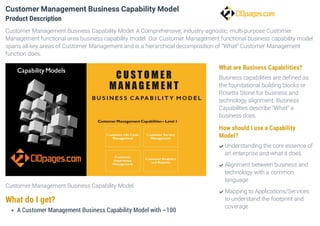
Customer Management Business Capability Model
What do I get?
A Customer Management Business Capability Model with ~100
What are Business Capabilities?
Business capabilities are defined as
the foundational building blocks or
Rosetta Stone for business and
technology alignment. Business
Capabilities describe “What” a
business does.
How should I use a Capability
Model?
Customer Management Business Capability Model
Product Description
Customer Management Business Capability Model: A Comprehensive, industry-agnostic, multi-purpose Customer
Management functional area business capability model. Our Customer Management functional business capability model
spans all key areas of Customer Management and is a hierarchical decomposition of “What” Customer Management
function does.
Understanding the core essence of
an enterprise and what it does.

Alignment between business and
technology with a common
language

Mapping to Applications/Services
to understand the footprint and
coverage

 Spreadsheet  Presentation Slides
 Word processing document
capabilities
Formats:
Capability Management in a Box
DETAILS
Looking for more? Try our Capability Management in a Box…or
rather in a Spreadsheet
Why do we need a Customer Management Business
Capability Model?
Business capabilities are invaluable as they help bridge the gap between
business and IT, help understand the essence of what a business does, and
align development efforts to strategic priorities, which helps evolve and
enhance capabilities.
Ideally, your firm should have a structured and well-defined enterprise business
capability model, and as an integral part of the enterprise model, there should
be a Customer Management model. And furthermore, for the capability model
to the actionable, it should be decomposed to a slightly granular level of
capabilities (Level 3 or 4) for it to be practical and to be able to leverage in IT
enablement projects.
One of the core functions of an enterprise is Customer Management. In today’s
But, our Company is unique – will it
fit us?
Of course, each company is slightly
different in terms of some capabilities
as well as how they are executed.
However, while there may be
divergence at the edges, there is a lot
of convergence at the core between
most firms. The differences may be
in part due to differences in industry,
geography, types of products and
services, and business model.
Furthermore, the relative emphasis of
the key value streams and absence
Creating a gap analysis between
current state and future state
based on Capability maturity

Understanding business needs for
IT enablement based on stable
entities

Conducting vendor analysis using
capabilities to compare apples and
apples

Leveraging in M&A to compare
capabilities and their maturity
between two firms

highly competitive market, managing all aspects of a customer, and keeping
them delighted is of paramount importance. To help with these objectives,well-
decomposed customer management business capability model provides
visibility and structure for planning.
CIOPages Customer Management Capability model intends to capture a
detailed view and a nuanced perspective of what Customer Management
function does. It includes the nuts and bolts functional capabilities, as well as
emerging and value-add functions/capabilities.
The customer management capability map will help provide a jumpstart to
envision a future state, conduct gap analysis, identify capabilities which are
needed/improved, and help focus efforts on capabilities that matter!
What’s a Customer Management Business Capability
Model?
The Customer Management Business capability model is decomposed to a
minimum of two levels across the spectrum of Customer Management
Capabilities, and many a time to levels 3 and 4 as well, depending on the
granularity and modularity required.
The customer management business capability model is structurally sound,
internally coherent and maintains principles of MECE (mutually exclusive and
collectively exhaustive), to the most part.
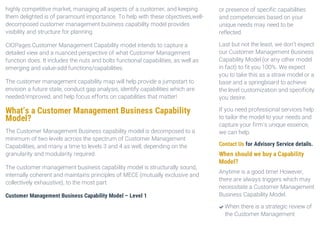
Customer Management Business Capability Model – Level 1
or presence of specific capabilities
and competencies based on your
unique needs may need to be
reflected.
Last but not the least, we don’t expect
our Customer Management Business
Capability Model (or any other model
in fact) to fit you 100%. We expect
you to take this as a straw model or a
base and a springboard to achieve
the level customization and specificity
you desire.
If you need professional services help
to tailor the model to your needs and
capture your firm’s unique essence,
we can help.
Contact Us for Advisory Service details.
When should we buy a Capability
Model?
Anytime is a good time! However,
there are always triggers which may
necessitate a Customer Management
Business Capability Model.
When there is a strategic review of
the Customer Management

Customer Strategy and
Planning
Customer Execution
Customer Resource
Management
Customer Compliance
Management
Customer and Social
Analytics
Example Decomposition of a sliver of the Customer
Management Capability Model
Level 1
Customer Life Cycle
Management
Customer Service
Management
Customer Experience
Management
Customer Analytics and
Reports
Level 2
Customer Support
Case Management
Self-Help
Community Help
Level 3
Call Center
Automated Voice Help
Customer
Account/Support
Teams
Online Real Time
Assistance
Level 4
Agent Co Browing
Remote Access
Click to Chat
Click to Call
Social Media Help
Caveats:
But, we have a Business Capability
Model already?
Well, in that case either you can go
with it, or if you require validation and
cross-reference, you will still find our
model valuable. After all, the price is
less than the one-hour of the
collective time spent by the combined
brain power assembled in the room.
What is my ROI?
The Value of Time Spent:
As the Customer Management Business Capability Model is a digital product, there are
absolutely NO Returns.

function for transformation
When Customer Management
systems replacement or re-
architecture is being considered.

When Customer Management
processes are being considered for
reengineering.

When there is an endeavor to
create an enterprise business
architecture and a part of that the a
specific Customer Management
function needs to be represented
and included.

Need Customization Help?
CONTACT US
Typically, it takes a team of 4-5 to
draft a Business Capability Model:
Now you can multiply the average
hourly cost of the team and the hours
spent and you’ll get the story.
Opportunity Cost:
In addition to the time spent and the
associated costs of drafting routine
Capabilities, you also have an
opportunity cost.
By quickly adding/deleting/modifying
the base set of Business Capabilities,
it will allow you the luxury of spending
the balance of your quality time in
conceptualizing and crafting the
unique and specific Capabilities,
which capture the core essence of
your company and its practices,
Depending on your industry, the type of processes, policies and practices you follow, and
the scope of the functional footprint, some of the Capabilities may not be relevant to you.

If you are a consultant or a consulting company, there is a different pricing license and
terms.

Sold on an as-is basis and no warranties
This sale does not include customization help or support. If you need professional
services assistance, please contact us.

Please review our standard terms of service.
Product Manager
Business Architect
Enterprise Architect
Functional Experts – 2 or 3 to
represent the broad spectrum of
functional areas.

principles and perspectives.
Of course, let’s not forget the “Day
Job” each of the SMEs (subject
matter experts) could be doing.
Acceleration:
Instead of spending countless hours
stretched across weeks or months,
you can have a baseline of
Capabilities in a couple of sittings.
That helps you expedite and
accelerate the transformation.

Customer Management Business Capability Model

  • 1.
    Customer Management BusinessCapability Model What do I get? A Customer Management Business Capability Model with ~100 What are Business Capabilities? Business capabilities are defined as the foundational building blocks or Rosetta Stone for business and technology alignment. Business Capabilities describe “What” a business does. How should I use a Capability Model? Customer Management Business Capability Model Product Description Customer Management Business Capability Model: A Comprehensive, industry-agnostic, multi-purpose Customer Management functional area business capability model. Our Customer Management functional business capability model spans all key areas of Customer Management and is a hierarchical decomposition of “What” Customer Management function does. Understanding the core essence of an enterprise and what it does.  Alignment between business and technology with a common language  Mapping to Applications/Services to understand the footprint and coverage 
  • 2.
     Spreadsheet Presentation Slides  Word processing document capabilities Formats: Capability Management in a Box DETAILS Looking for more? Try our Capability Management in a Box…or rather in a Spreadsheet Why do we need a Customer Management Business Capability Model? Business capabilities are invaluable as they help bridge the gap between business and IT, help understand the essence of what a business does, and align development efforts to strategic priorities, which helps evolve and enhance capabilities. Ideally, your firm should have a structured and well-defined enterprise business capability model, and as an integral part of the enterprise model, there should be a Customer Management model. And furthermore, for the capability model to the actionable, it should be decomposed to a slightly granular level of capabilities (Level 3 or 4) for it to be practical and to be able to leverage in IT enablement projects. One of the core functions of an enterprise is Customer Management. In today’s But, our Company is unique – will it fit us? Of course, each company is slightly different in terms of some capabilities as well as how they are executed. However, while there may be divergence at the edges, there is a lot of convergence at the core between most firms. The differences may be in part due to differences in industry, geography, types of products and services, and business model. Furthermore, the relative emphasis of the key value streams and absence Creating a gap analysis between current state and future state based on Capability maturity  Understanding business needs for IT enablement based on stable entities  Conducting vendor analysis using capabilities to compare apples and apples  Leveraging in M&A to compare capabilities and their maturity between two firms 
  • 3.
    highly competitive market,managing all aspects of a customer, and keeping them delighted is of paramount importance. To help with these objectives,well- decomposed customer management business capability model provides visibility and structure for planning. CIOPages Customer Management Capability model intends to capture a detailed view and a nuanced perspective of what Customer Management function does. It includes the nuts and bolts functional capabilities, as well as emerging and value-add functions/capabilities. The customer management capability map will help provide a jumpstart to envision a future state, conduct gap analysis, identify capabilities which are needed/improved, and help focus efforts on capabilities that matter! What’s a Customer Management Business Capability Model? The Customer Management Business capability model is decomposed to a minimum of two levels across the spectrum of Customer Management Capabilities, and many a time to levels 3 and 4 as well, depending on the granularity and modularity required. The customer management business capability model is structurally sound, internally coherent and maintains principles of MECE (mutually exclusive and collectively exhaustive), to the most part. Customer Management Business Capability Model – Level 1 or presence of specific capabilities and competencies based on your unique needs may need to be reflected. Last but not the least, we don’t expect our Customer Management Business Capability Model (or any other model in fact) to fit you 100%. We expect you to take this as a straw model or a base and a springboard to achieve the level customization and specificity you desire. If you need professional services help to tailor the model to your needs and capture your firm’s unique essence, we can help. Contact Us for Advisory Service details. When should we buy a Capability Model? Anytime is a good time! However, there are always triggers which may necessitate a Customer Management Business Capability Model. When there is a strategic review of the Customer Management 
  • 4.
    Customer Strategy and Planning CustomerExecution Customer Resource Management Customer Compliance Management Customer and Social Analytics Example Decomposition of a sliver of the Customer Management Capability Model Level 1 Customer Life Cycle Management Customer Service Management Customer Experience Management Customer Analytics and Reports Level 2 Customer Support Case Management Self-Help Community Help Level 3 Call Center Automated Voice Help Customer Account/Support Teams Online Real Time Assistance Level 4 Agent Co Browing Remote Access Click to Chat Click to Call Social Media Help Caveats: But, we have a Business Capability Model already? Well, in that case either you can go with it, or if you require validation and cross-reference, you will still find our model valuable. After all, the price is less than the one-hour of the collective time spent by the combined brain power assembled in the room. What is my ROI? The Value of Time Spent: As the Customer Management Business Capability Model is a digital product, there are absolutely NO Returns.  function for transformation When Customer Management systems replacement or re- architecture is being considered.  When Customer Management processes are being considered for reengineering.  When there is an endeavor to create an enterprise business architecture and a part of that the a specific Customer Management function needs to be represented and included. 
  • 5.
    Need Customization Help? CONTACTUS Typically, it takes a team of 4-5 to draft a Business Capability Model: Now you can multiply the average hourly cost of the team and the hours spent and you’ll get the story. Opportunity Cost: In addition to the time spent and the associated costs of drafting routine Capabilities, you also have an opportunity cost. By quickly adding/deleting/modifying the base set of Business Capabilities, it will allow you the luxury of spending the balance of your quality time in conceptualizing and crafting the unique and specific Capabilities, which capture the core essence of your company and its practices, Depending on your industry, the type of processes, policies and practices you follow, and the scope of the functional footprint, some of the Capabilities may not be relevant to you.  If you are a consultant or a consulting company, there is a different pricing license and terms.  Sold on an as-is basis and no warranties This sale does not include customization help or support. If you need professional services assistance, please contact us.  Please review our standard terms of service. Product Manager Business Architect Enterprise Architect Functional Experts – 2 or 3 to represent the broad spectrum of functional areas. 
  • 6.
    principles and perspectives. Ofcourse, let’s not forget the “Day Job” each of the SMEs (subject matter experts) could be doing. Acceleration: Instead of spending countless hours stretched across weeks or months, you can have a baseline of Capabilities in a couple of sittings. That helps you expedite and accelerate the transformation.