From Customer Engagement to Customer Advocacy
Jane Hiscock
@janehiscock
President, Farland Group
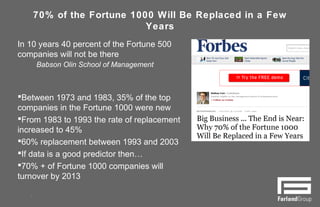
70% of the Fortune 1000 Will Be Replaced in a Few Years
In 10 years 40 percent of the Fortune 500
companies will not be there
Babson Olin School of Management
Between 1973 and 1983, 35% of the top
companies in the Fortune 1000 were new
From 1983 to 1993 the rate of replacement
increased to 45%
60% replacement between 1993 and 2003
If data is a good predictor then…
70% + of Fortune 1000 companies will
turnover by 2013
2
3
Why is this
Happening?
“You can’t just ask the
customer what they want and
then give it to them.”
“You’ve got to start with the customer
experience and work back toward
technology – not the other way around.”
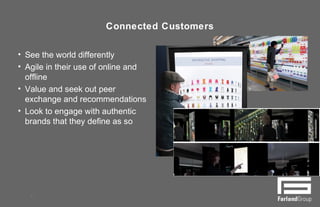
Connected Customers
• See the world differently
• Agile in their use of online and
offline
• Value and seek out peer
exchange and recommendations
• Look to engage with authentic
brands that they define as so
4
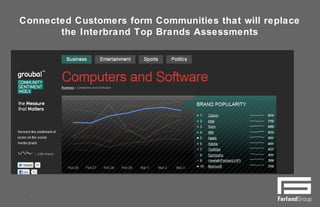
Connected Customers form Communities that will replace the
Interbrand Top Brands Assessments
5
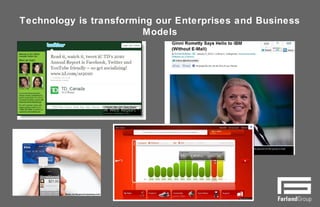
Technology is transforming our Enterprises and Business
Models
6
Engaging customers require commitment from the entire
company – and a redefined organization. McKinsey & Co, July 2011
7
Customer Engagement and Performance
– Organizations that optimize for customer engagement outperform their
competitors by 26% in gross margin and 85% in sales growth. (Gallup)
– Actively disengaged customers represent a 13% discount in gross
margin and sales growth. (Gallup)
New Leadership Mandates Required
– A $500M firm will lose about $62M per year due to poor partner
relationships and $55M per year due to poor customer relationships.
(Kellogg)
– 63% of executives feel underprepared to deal with the shifts taking
place in their customer demographics. (IBM)
Go here for more on how Customer Engagement Strategies Deliver Revenue
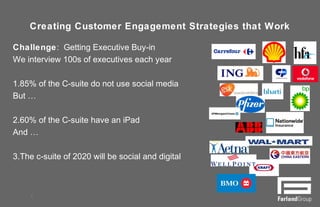
Creating Customer Engagement Strategies that Work
Challenge: Getting Executive Buy-in
We interview 100s of executives each year
1.85% of the C-suite do not use social media
But …
2.60% of the C-suite have an iPad
And …
3.The c-suite of 2020 will be social and digital
8
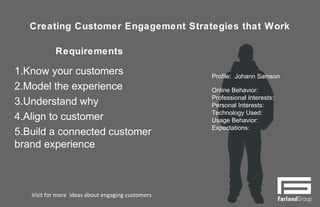
Creating Customer Engagement Strategies that Work
Requirements
1. Know your customers
2. Model the experience
3. Understand why
4. Align to customer
5. Build a connected customer
brand experience
9
Profile: Johann Samson
Online Behavior:
Professional Interests:
Personal Interests:
Technology Used:
Usage Behavior:
Expectations:
Visit for more ideas about engaging customers
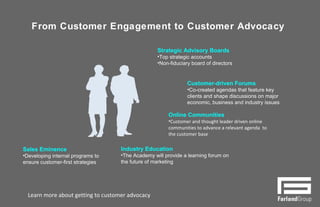
From Customer Engagement to Customer Advocacy
Strategic Advisory Boards
• Top strategic accounts
• Non-fiduciary board of directors
Online Communities
• Customer and thought leader driven online
communities to advance a relevant agenda to
the customer base
Industry Education
• The Academy will provide a learning forum
on the future of marketing
Customer-driven Forums
• Co-created agendas that feature key
clients and shape discussions on major
economic, business and industry issues
Sales Eminence
• Developing internal programs to
ensure customer-first strategies
Learn more about getting to customer advocacy
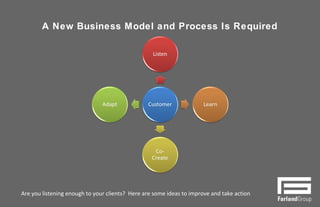
A New Business Model and Process Is Required
Customer
Listen
Learn
Co-
Create
Adapt
11
Are you listening enough to your clients? Here are some ideas to improve and take action
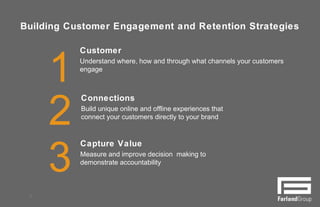
Building Customer Engagement and Retention Strategies
12
Customer
Understand where, how and through what channels your customers
engage
1
2
Connections
Build unique online and offline experiences that
connect your customers directly to your brand
3
Capture Value
Measure and improve decision making to
demonstrate accountability
Maximizing Customer Engagement and Retention
Jane Hiscock
@janehiscock
President, Farland Group
www.farlandgroup.com

Customer Engagement and Retention: Getting to Success

  • 1.
    From Customer Engagementto Customer Advocacy Jane Hiscock @janehiscock President, Farland Group
  • 2.
    70% of theFortune 1000 Will Be Replaced in a Few Years In 10 years 40 percent of the Fortune 500 companies will not be there Babson Olin School of Management Between 1973 and 1983, 35% of the top companies in the Fortune 1000 were new From 1983 to 1993 the rate of replacement increased to 45% 60% replacement between 1993 and 2003 If data is a good predictor then… 70% + of Fortune 1000 companies will turnover by 2013 2
  • 3.
    3 Why is this Happening? “Youcan’t just ask the customer what they want and then give it to them.” “You’ve got to start with the customer experience and work back toward technology – not the other way around.”
  • 4.
    Connected Customers • Seethe world differently • Agile in their use of online and offline • Value and seek out peer exchange and recommendations • Look to engage with authentic brands that they define as so 4
  • 5.
    Connected Customers formCommunities that will replace the Interbrand Top Brands Assessments 5
  • 6.
    Technology is transformingour Enterprises and Business Models 6
  • 7.
    Engaging customers requirecommitment from the entire company – and a redefined organization. McKinsey & Co, July 2011 7 Customer Engagement and Performance – Organizations that optimize for customer engagement outperform their competitors by 26% in gross margin and 85% in sales growth. (Gallup) – Actively disengaged customers represent a 13% discount in gross margin and sales growth. (Gallup) New Leadership Mandates Required – A $500M firm will lose about $62M per year due to poor partner relationships and $55M per year due to poor customer relationships. (Kellogg) – 63% of executives feel underprepared to deal with the shifts taking place in their customer demographics. (IBM) Go here for more on how Customer Engagement Strategies Deliver Revenue
  • 8.
    Creating Customer EngagementStrategies that Work Challenge: Getting Executive Buy-in We interview 100s of executives each year 1.85% of the C-suite do not use social media But … 2.60% of the C-suite have an iPad And … 3.The c-suite of 2020 will be social and digital 8
  • 9.
    Creating Customer EngagementStrategies that Work Requirements 1. Know your customers 2. Model the experience 3. Understand why 4. Align to customer 5. Build a connected customer brand experience 9 Profile: Johann Samson Online Behavior: Professional Interests: Personal Interests: Technology Used: Usage Behavior: Expectations: Visit for more ideas about engaging customers
  • 10.
    From Customer Engagementto Customer Advocacy Strategic Advisory Boards • Top strategic accounts • Non-fiduciary board of directors Online Communities • Customer and thought leader driven online communities to advance a relevant agenda to the customer base Industry Education • The Academy will provide a learning forum on the future of marketing Customer-driven Forums • Co-created agendas that feature key clients and shape discussions on major economic, business and industry issues Sales Eminence • Developing internal programs to ensure customer-first strategies Learn more about getting to customer advocacy
  • 11.
    A New BusinessModel and Process Is Required Customer Listen Learn Co- Create Adapt 11 Are you listening enough to your clients? Here are some ideas to improve and take action
  • 12.
    Building Customer Engagementand Retention Strategies 12 Customer Understand where, how and through what channels your customers engage 1 2 Connections Build unique online and offline experiences that connect your customers directly to your brand 3 Capture Value Measure and improve decision making to demonstrate accountability
  • 13.
    Maximizing Customer Engagementand Retention Jane Hiscock @janehiscock President, Farland Group www.farlandgroup.com

Editor's Notes

  • #2 Good afternoon I know that I ’m the only thing standing between you and the outdoors but I feel passionately about this topic and I hope to learn a lot from you in the next 45 minutes I hope I can shed some data and content to help you build your customer engagement and retention strategies to be even stronger. My name is Jane Hiscock and I am honored to speak with such a wonderful group of CMOs. My company specializes in customer engagement and retention strategies and in particular we have a deep expertise in executive customer engagement for b2b companies. I ’m not going to talk a lot today about what Farland Group does I really want to talk to you about the experiences that we’ve seen from customer engagement and hopefully that will give you some good stories to take home. And in fact moving customer engagement to advocacy
  • #3 And these decisions that are being made inside of large corporations without testing the customer desire or will are in fact the exact corporations that are leaving themselves open to disintermediation if they don ’t find ways to shift the model to one that is nimble and flexible to meet the requirements and changing needs of the customers. Based on this data how many of us in this room will be working for the business we work for today? What is clear is that no company is too big to fail and no company is too small to succeed
  • #4 Customer are connecting to one another and sharing experiences about you every day. Problem is, you either don ’t know or aren’t doing anything about it and that says everything about how you value people Customer behavior and expectations are evolving. They expect to engage your business and all it represents in new channels and in their way. In our work with Executives we constantly hear executives pull out the Steve Jobs Quote “ you can’t ask the customer what they want and give it to them because they don’t know until the see it” Well that is true if you are Steve Jobs but last time I checked there aren’t a lot of Steve Jobs in the world and Steve Jobs also said “You’ve got to start with the customer experience and work back toward technology not the other way around. So what do you think is happening why are these shifts happening in your businesses? MY list for back up: Disparity between business and customers Fear of the unknown Inability to ask and listen Relevancy
  • #5 Over-time the customer-experience and the brand is created by connected customers Connected customers are a new breed – they likely are many of you in this room. You make decisions based on several types of media and if you could engage in interactive shopping while shopping in person you grab QR codes, you read reviews and go to your own networks to make decisions The connected customer is one that is making changes to how your brand is perceived and you may not even be aware of it.
  • #6 This is Groubal a community that tracks the sentiment of social media. This is realtime Interbrand these people are not waiting for the Fortune top companies to watch list to come out to shape their thinking on your brand. Do you monitor groubal? Your customers likely may or if they don ’t they will in the future. And this is just grabbing the instant experiences of your customers based on an interaction they just had with your Intel channel rep or a real time experience with Microsoft software. All the while if you are not building in-person, online and connected strategies for engaging this customer you are going to continue to receive low sentiment. Worse if you aren’t paying attention to your customer base you don’t even know that Groubal exists.
  • #7 Technology is a leading transformation agent for the enterprise and that is not just social, it is mobile and location and analytics and the fact that customers want everything in real-time. So how do we as marketers keep up? We need to optimize to one customer one experience, but social media is only the beginning This must affect our internal processes to have influence. We need to establish new governance, processes, systems and philosophies. As we make our brands more engaging to our customers and employees and as we have them help shape our brands it is absolutely critical that as marketers we don ’t just begin a set of activities – this is not a campaign this is a new model of doing business and it must be authentic. As a result it needs to start from within. Creating a customer-first enterprise is hard work and it is not something that you can do alone or that can happen overnight. We have clients that have started and stopped to only start again purely because they haven ’t had all of the critical elements for success: So let ’s look deeper at this…..
  • #8 In the middle of last year McKinsey came out with a warning call study stating that companies that were looking to engage their customers needed a commitment not just from marketing but from the entire company. And the fact is that if you can successfully move your business to this path it pays off: Organizations that engage their customers outperform by 26% in gross margin and 85% in sales growth. But our work is cut out for us because the c-suite is not prepared – to me this is an opportunity to me this is the future of marketing as the transformation agents of the future of business
  • #9 70% of the C-suite do not understand or use social media – worse they fear it 60% of the C-suite have an iPad If the Fortune prediction is true the c-suite will not be today ’s c-suite it will be a social c-suite by 2020 For all of you in this room this is good news because our battle is going to be short – the customer is going to win and quickly and the c-suite will either get in line or be replaced For those of you in B2B companies that dpend on the CIO, CFO, CEO to influence your buy here is what we know about them: They are highly influenced by peers if you aren ’t doing advisory boards that are purely strategic executive clients and your most senior executives you should be they have enormous value They spend enormous amounts of money and time and people on research and it has a very strong primary influence on buy (second to peer) They are looking for return on invested time – because they have very little of it – this is the challenge for your marketing campaigns and your sales people They look to sellers and marketers that can help them sell things internally – that understand their c-suite peers Looking for connections to experts and higher value thinking
  • #10 1. Begin with your executive team – find ways through data to help them see the business value of customer-engagement strategies – I ’ve given you a lot of data today and I’m happy to share the reports. Know your customer. As marketers we know this it is in our training in our core to know our audience but do you really know them. Depending on whether you are b2b or b2c you may think you know them but in my business we call on your customers daily and we talk to them for 30 minutes and all we do is listen and when we feed back what we hear to our clients they are shocked by what we learn. We learn where their customers convene, what they read, what they love and hate in general and about your brands, who influences them and why … you have to have a deep understanding of your customers before you build a customer engagement strategy. Understand their needs and what they do at each phase of the buying journey. In fact understand what their buying journey is because every person and every business is different. In fact in B2B we are always amazed at how long the cycle is before you or your sales team is even aware – making online critical. Align your information and offerings to the customer journey Connect the channels and track the paths Created a connected customer brand experience meaning online and offline experiences and experiences that affect them and those that influence them. Secrets Executive team engagement is critical Requires inspiring leadership and is difficult and time consuming Forget the word transaction You will discover breakthrough innovation
  • #12 Listen = engage with the market and customer to uncover and understand the changes that are taking place Take every input and determine what it means for your organization – what did you learn – is it something to take or leave Co-creation Could also be engagement = working with customer to create the future and consider the next steps – your customer will not always be right but they often will have part of the solution Adapt / Change = culture – listening and then acting is difficult for companies but if a company as large as IBM can do it so can yours. The key is not to react to each customer input. We develop customer engagement strategies with very clear points in time where we make change.
  • #13 Three steps for building a customer engagement strategy that will power your marketing goals Know your customers and where they engage – pretend they are your children and get to know their paths so that you don ’t miss a tweet, school dance, conference or Facebook like Remember that your employees are an extension of your customers (e.g. public tweet) Connections: This is not simple it requires you to think about digital channels as well as in person channels it requires you to understand the context for creating connections that matter and the content that will make these connections long-lasting. Critical to this is that it is a strategy for connections not something that is one-off and transactional or campaign based in nature – clients will see through that instantly Capture Value: We are campaign based by nature – we move from program to program and if we are honest we motivate our staff, organizations even our clients by being campaign based – but this isn ’t enough any more. Create the outcomes and use advanced analytics to help you make better decisions and drive newer forms of engagement.