Curriculum
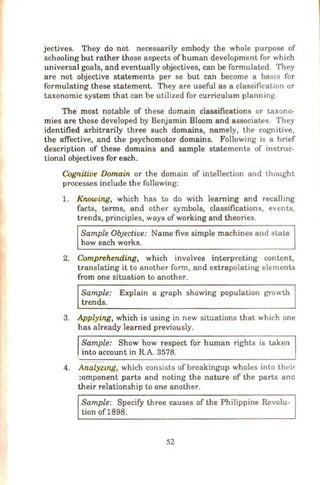
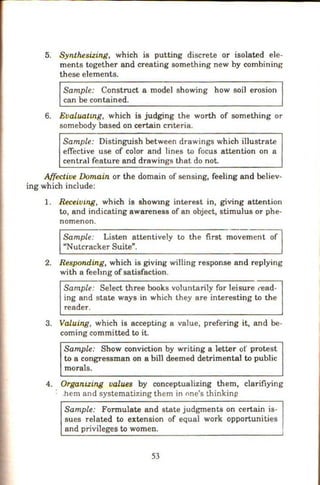
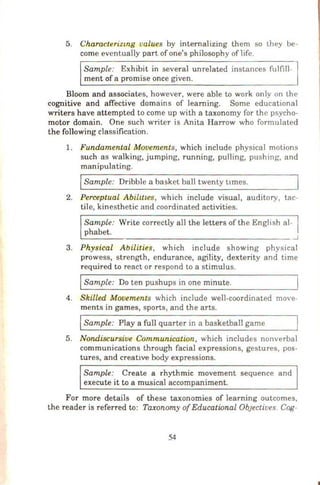
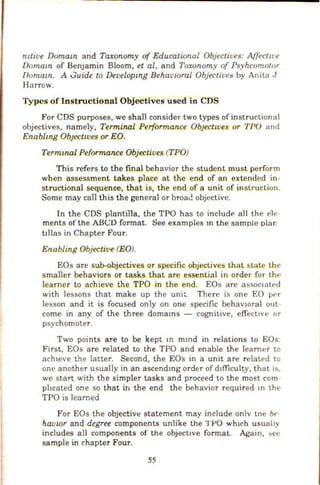
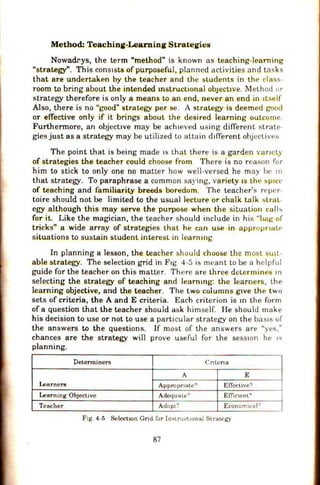
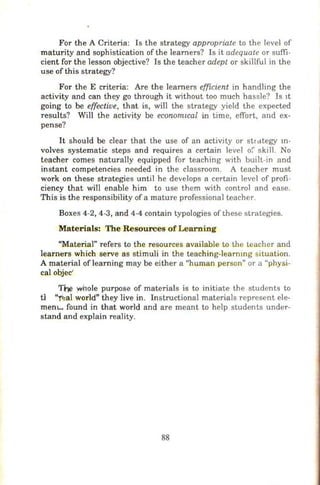
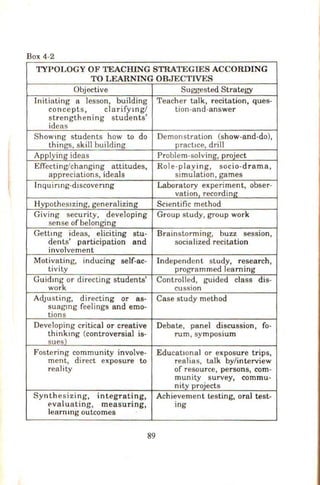
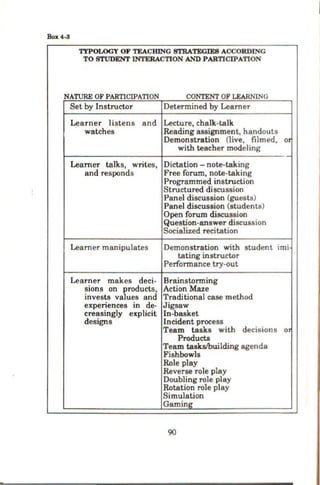
Development
System
A HANDBOOK FOR
SCHOOL PRACTITIONERS
IN BASIC EDUCATION
Curriculul11
Develop111ent
Syste111
A HANDBOOK FOR
SCHOOL PRACTITIONERS
IN BASIC EDUCATION
•JESUS C. PALMA
rfdimtd
Book Store
Quad Alpha Centrum Bldg.
125 Ptoneer St., Mandaluyong City
Published by
t{dimtd
Book Store
COPYRIGHT, 1992 by
Nalional Book Store, Inc. &
Jesus C. Palma
First Year ofPublication, 1992
All rights reserved,
No part ofthis book may be
reproduced in mryform or by
mry means, except briefquotations
for a rev:ew, without permission
in writing from the Publisher.
PCPM Certificate of
Registration No. SP 594
Cover Design by
Joey SalvadiJr
Primed l7y
24K Printing Co.. Inc.
33 Acebo St., Marulas
Valenzuela, Metro Manila ISBN 971-08-5128-4
DEDICATION
To my beloved wife
LEONIDA
my daughters
MA. ASUNCION IRENE
MA. RESURRECCION
MA. CECILIA PRESENTATION
and my granddaughter
MA. AINA KATHRINA CONCEPCION
and grandson
GABRIEL IGNACIO
for their abiding
love and understanding
OVERVIEW
CHAPTER ONE: CDS CONCEPI'UAL FRAMEWORK 1
CHAPI'ER TWO: SCHOOL PURPOSE 26
CHAPTER THREE: CURRICULUM CONTENT 58 r
CHAPI'ER FOUR: LEARNING EXPERIENCES
AND RESOURCES 77
CHAPI'ER FIVE: EVALUATION OF LEARNING 113
vii
T A BLE OF CONTENTS
Prologue
CHAPrER ONE:CDS CONCEPTUAL FRAMEWORK o
oooooo
.....OOoooOOooooooo 1
CDS: The WHAT of It0
0
0oooo•·····................ooooo000................o
.............0
0
...1
Curriculum ....................................................................0
......0
...1
I>evelopment .........oo...........o
.......000.....................ooooo..ooo•o•ooo•ooo•o3
System •o
oooo....o
..o•o..•oooooooo..ooooo•o•o•oooo•o•o•....•ooooooo•o•oooo...o.ooooooooooo...4
A Conceptual Base: The Tyler Rationale ooo•o••oo•o•o•o...ooo..oooo....o6
The Curriculum System: A Linear Model ooooooooooo•o•o.....ooooo..o
•o8
CDS: The WliY of It ...oo0
..ooooooo..oooooooooo•oooo.............000..oo...00ooo..oooooo
ooo.10
CDS: The HOW of lt .oo.....o
...................oo•ooo.....oo..·oo•o•o...o
o
•o...o
o
.........o12
Conceptualizing Phase oooo..oooo•ooooooooooo•oo..oo•..oo•oooooo•ooo•o•oo•ooo•oool2
Contextualizing Phase oo..ooooooooooooooooooo...o
..o
..•oo..ooo..o••o..•oo...o.ooo 15
Operationaliring Phase oooooooooooooooooo•o•..•oo...o
...ooo•oooooo•ooo•oooooo•o•18
Institutionaltring Phase oooooo•oo..oooo......oo•o..oo..o•o..•oo..ooooo...oo•o•oo23
CHAPI'ER TWO: SCHOOL PlJRPOSE .o.ooooooo0oo...o
..........o
......o
....o.o...oo•oo26
Curriculum and School Purpose .................o
....oo........ooo•o•o•o..o
ooo
•oo•ooooooo 26
School Purpose: Mearungs and Applications .....................oo...oo...o
..o
...29
School Goals .....o
...o
......oo.......o
.....o.o•o.....o
..oooo•o•oo....o.oo•Ooooooo............o.oo•ooo30
Sources of School Goals ..............o
..oooo..o
.....o
.....0
.........................o
o
•33
Data on the Learner .........................................0
.....0
..0
0
00000..o
o
•33
Data on Comtemporary Society 0000..0
......0
..................o
...........35
The Fund ofKnowledge .........................................................37
Screening ofGoe.ls ..........................o
o
.......oo...o
.....000
o•.......o
........0
..o
•.37
Levels of School Goals o
o
••oo
.......o.o•00....0
....o•••o•oo......o
..ooo..o••·......o
......40
ix
) ' -
Instructlonal Objectives .....................................................................41
Limitat10ns and Some Con81derat10ns .....................................42
Charactenstics oflnstruct10nal Objectives . ............................44
Format: Writing lnstrucbonal Objectives .................... .. .... . ... 49
Classification oflnstructional ObJecttves .................... . .... ......51
Types of Ob;ectwes Used in CDS ................................ .. ...55
CHAPI'ER THREE: CURRICULUM CONTENT ................ .. . . . 58
What Is Learning Content?................. ............................ . ..... 59
Sources ofLearmng Content ................... . .. .. ........... . . . . 59
Fram Sciences to Subject Areas· The School Cun1culum .. ........ ..... 61
Selection ofLearning Content ............................................................62
Orpnization ofLearning Content ...................................................... 68
Lay-out ofLearning Content ................................................... .. .... 71
Scope and Sequence Grid ......... .................. .... .. . .....
Unit Plan or Plantdla ....... ........... .... ... ................
CHAPI'ER FOUR: LEARNING EXPERIENCES
AND RESOURCES ................................ ..
Curnculum and Instruction .................................................
. 71
. .... 74
.....77
.. ..78
Teaching and Learning ........................................................................80
What is Learning? ...................................... ................. .........81
What is Teaching? ............................................................. .. .... 83
The 8 M's ofTeaching and Learning ................................................... 84
Milieu: The Learning Envtronment .............................................85
Matter: The Subject Content ........................................................ 86
Method: Teadung-Learnmg Strategles ...................................... 87
Materiala: The Resources ofLearning .................................... ...88
Media: Communicabon in Teaching and Learrung........... ......100
Motivation: ArouSJng and Sustammg Interest in Learmng 101
)(
Mastery: The Be-all and End-all of Learning...... ....................102
Measuremf'nt: ~tbng EVIdence of Learning ...........................105
The 8 M's Vis-a-vis the Plantllla .......................................................107
CHAPTER FIVE: EVALUATION OF LEARNING ........................11 3
What Is Evaluation? ........ .......... .. ..... .. ......... ll4
Types of Evaluation .......................................................................115
Chnractenst1cs of EvnluAtlon Instrument ............................. ..... 115
Rationale for Eva!untlor. ................. ...............................................11 7
Process ofEvaluat10n of lnstructJOnal Outcomes .............................119
PreparatiOn PhaSE> .. .. ... ...... ............ .......................................119
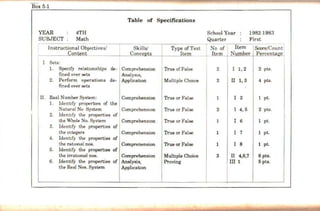
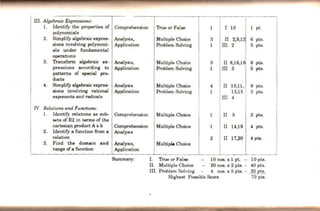
Making a Table ofSpec1ficationa ........... ............................119
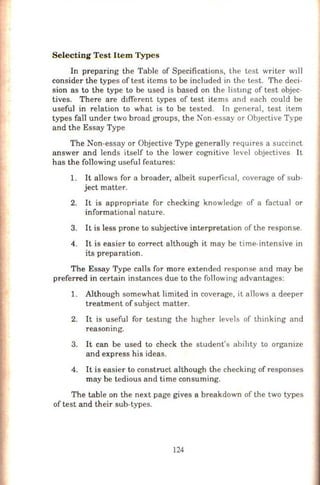
Selecting Test Item Types ..................................................124
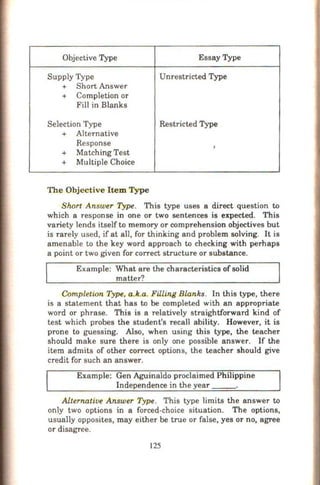
The OhJectlve ltern Type ............................................... ..125
The Essay Type ....... ......................................................129
V..1uch 'Type to Use? ........................................................... 130
WntlngTest Items ..............................................................131
Assembling the Test ..........................................................132
Admirustrat1on Phase ..............................................................135
Test Schedule ......... .............................................................135
Test Conditlons ...................................................................135
Ut!IJzatlon Phase .......................................................................138
Chedung TE>st Re~mlts ....................................................... 138
Translatlng T£>st Scores Into Grades .................................139
Reporting Student Aduevement ...................................... 142
Makmg Admm1stratwe Dec1s1ons .......................................142
Evaluating the CDS Program ............................................................ 145
gpilogue .............................. ........................................................149
Append1x A: Glossary of CDS Terms ........................................................ 151
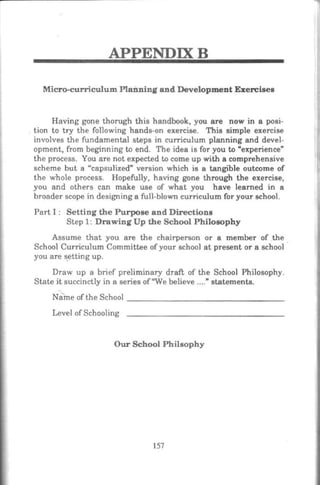
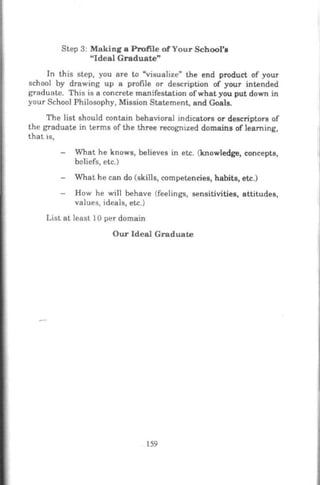
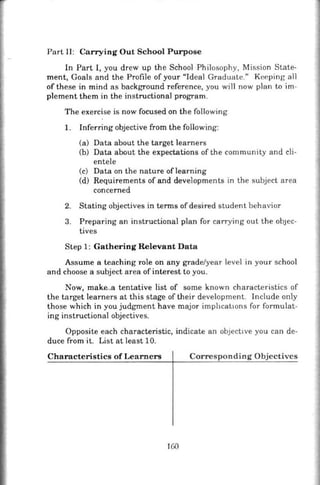
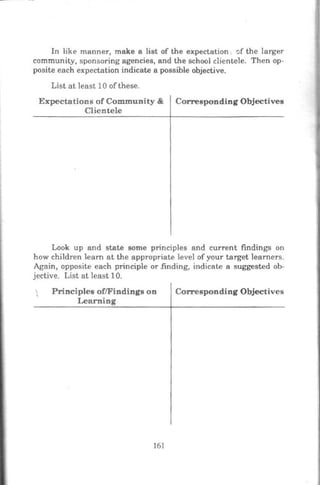
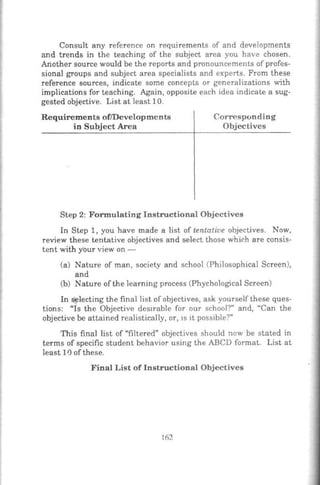
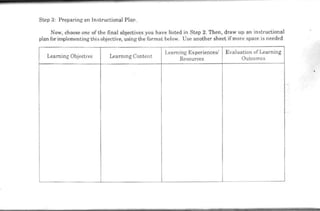
Append1x B: Ex:erc1se in M!cro-cumculum Formulation .........................157
Index ....................................................................................164
XI
PROLOGUE
This handbook evolved from the random notes compiled and
collated by the writer for the numerous seminar-worshops on cur-
riculum and instruction he has conducted in various elementary
and secondary school settings in different parts of the country for
almost a decade. What started as a professional outreach activity
in commemoration of the quadricentennial of the coming of the
Jesuits to the Philippines in 1980, became an on-going, long-play-
ing series brought about by the enthusiastic response of many
schools and professional organizations. After a while, the writer
finally acceded to the recurring suggestion of many well-meaning
beneficiaries of the program to put the notes in print form "for
posterity" and to reach a wider audience. Hence, this opus.
This handbook does not aim to replicate the countless works
that have been written about curriculum and curriculum develop-
ment. It is more of a manual of prescriptions, or if you may, a
recipe book, intended for school practitioners in basic education -
administrators, coordinators, teachers and all those who should be
involved in curriculum making or re-making.
No doubt, we need the expertise of curriculum experts espe-
cially to provide us with a sound conceptual base for curriculum
building. But, nobody can be a better judge as to how to make the
curriculum truly relevant and operational in the day-to-day reali-
xiii
ltCS m the classroom than the implementors of the rurn<'ulum.
nnmely, the school pr>rsonn<'l themselves Aristotle aptl_ appotnlc-cl
1'"liS out centuries ago. when he said that "the user of th<' hou~c
!'hould have more to say about the house than the huddt·r of thE'
house," or some words to thall.!rfcct.
Jn pullmg this work L
og<'lher, we have tried to incorf.)orall• the
princ1ples of both curriculum plannmg and those of sound orgnn-
lzational management. The reader will probably find noth111~ Ill''''
or profound between the covers of this book The onh dtflht·ncc·,
perhaps, will be in the approach used in orgamzmg lhl' malt·nals.
The unique features of the approach used in this volunw an• the
following:
SYSTEMIC, that is, holistic. The idea is to view the cur
riculum in its totality, to look at the "big picture," so to speak.
It is useful to look at curriculum as a system, to study parts as
subsystems, to recogrize their relationship with one another
and how each part contributes to the overarching function or
purpose of the whole enterprise.
COLLEGIAL, or participatory. Just as the curnculum It-
self is a system, the whole process of making and •mpro.. mg
the curriculum should be systemic and systemat.1c w1th all
school segments concerned taking an active part 1n a collaho-
rative manner towards the attainment of the common end.
DEVELOPMENTAL, that is, dynamic and growth -ori-
ented. The curriculum is an instrument of change, of growth.
It should be in a con stant state of evolution that would bring
the school organization to mcreasingly higher levels of excel-
lence.
RELEVANT. Relevant to what? Relevant to the realities
of the central purpose of schooling. The curriculum should
provide the substance of teaching and learning as it fleshes
out the School Vision and M1ssion.
This approach explains the chosen nomenclature of this opus,
namely, CURRICULUM DEVELOPMENT SYSTEM, a manage-
ment-oriented approach to curriculum development. Orginally con-
ceived and pilot-tested in the Ateneo de Manila Grade School, the
XIV
schPmc has been adopted by and adapted to nuances of different
schools in Manila and other parts such as As!'mmption, St. Paul,
Holy Spirit, Immaculate Conception Academy, Greenhills, lo name
a few. It is hoped other schools could benefit from tfns approach to
curriculum development.
The writer wishes to take this occasion to thank the nameless
and countless teachers and collaborators in the field who have pro-
vided the inspiration for this modest work. Truly, they are the
unsung heroes, the brave defenders of the academic ramparts that
IS the school. To them this work is humbly dedicated.
Chapter ONE:
CDS CONCEPTUAL FRAMEWORK
CDS: THE WHAT OF IT
CDS is an acronym that ~tands for CURRICULUM DEVEL-
OPMENT SYSTEM. The best way to define 1t tS to take each term
and explain briefly the concept behind 1t.
CURRICULUM
The term come'> from the Latin root, "currere," which
means "to run." In educational usage, the "course of the
race," w1th t1me came to stand for the "course of study."
Nowadays, curriculum could have different meanings for dif-
ferent people depending on how 1t is used.
As far as this handbook is concerned, curriculum is not
considered to be any of the following:
A list of subject areas as in the New Elementary
School Curnculum (NESC) or the New Secondary School
Curriculum (NSSC) as these arc mere listings of titles
The content or minimum requirements of each subject
area taught in school since these may exist only on paper
and may not necessarily become part of the lives of
learners
The course of study wh1ch JS just a gUJde, an outili1P
designed to help the teacher in planning and executing lhf•
curriculum
The textbook senes masmuch a!> the curr1t·ulum
should come before textbooks and not the other ''<I'
around and textbooks are but one of the means of 11npl(•·
menting the curriculum
For CDS purposes, curriculum sha ll be taken to mean:
The sum of all learning content, expenences and resource~
that are purposely selected, organ1zed and implemenwd by th<'
school in pur sUit of tts pecuhar mandate as a disltnct mstJtuuon of'
learning and human development
Such a definition skirts the is~ue of whether curriculum
should be concerned with learnmg content or learmng expencncc<;,
the WHAT or the HOW of human formation. It 1s our contentiOn
that curriculum is not an e1ther-or proposition, that it should be m-
clusive ofboth.
The other point to note in th1
s defi nition IS that it glVes a
narrower perspective and hm1ts curnculum to selected and struc-
tured learning content and expenences for which the school1s will-
ing to accept responsibility. Tl11s ISm keepmg  ll.h the hole
concept of school accountab!ltty. Understar.dably, the school can-
not and should not be held responsible for all aspects of lht'
student's life. The school, however, holds itself accountahl(' for
those aspects of the development of the young specified in 1ts man-
date or mission.
In the end, the whole question of school accountab1htv bode;
down to two overridmg questions:
1. Is the school doing what it says it ought to do'>
2 How wel1 1s 1t doing what 1t is supposed to do?
School accountability defines clearly the scope and paranwt<"rs
of programs and operations of the institution qua special phu·<' of
learning and formation. It also bnngs to the fore the que~L1on of
how well the school is in control of 1ts d1rection. The curnculum 1s
2
the ~chool's locus of control Lacking this control mechamsm, the
school can be compared to a rudderless boat that drifts w1th every
pas~mg wavf' of educallonal fads and fnlls It can be m very much
the same »JtuallOll as the person m the account below related by a
Bucldh1st monk to Henn Nouwen.
Therr was a man on a horse gallopmg along the road. An
old farmf'r standing in the fiE'lds, seeing him pass by so
swiftly, caliNI out. "I ley, rider, why are you in such a great
hurry? Where• are you going?" And the nder shouted back,
"Don't ask mt . Ask my horse'"
Developnwnt 1!-. a spc•c1fic word that connotes change. Change
means any all c•rnat10n or mod1ficat10n 11 the existing order of
thmgs
However, change may not neces.,anly result in development.
Or ly posittve change bnngs about development For change to be
pO')ltlve an•I rc·:..ult m development, it must have the following ch ar-
actenstic-s.
Change must h<> PU RPO~EFUL
PurposefuJ change IS change that IS mtentional or di-
rectJOnnl There must be clearly spec1fied targets or obJeC-
tivt'- Th1s kind of change is somethmg that one wills or
cauS('" to happen, not somethmg that happens willy-nilly
It therefor£' <>ubsumes control over or respons1b1lily for the
effects brought about. by the change.
Change must be PLANNED
Planning in th1s case means two thtngs. First, there is
a scncs of systematic and sequential steps leading to a
target. Secondly, these are executed over a period oftime.
Planned change then takes time. It requires an orderly
progrf'ssion of schE'duled activities and tasks. It allows no
shortcutc; lt demands a disciplined execution.
Change must be PROGRESSIVE
Positive change brings about improvement. It takes a
person or a group to higher levels of perfection.
Curriculum development. then should be concerned with the
drawing up of plans for teaching and leammg acllvit1es in class-
room situations that will bring about positive changes in the lives
of the learners. It is based on the school's Mission and goals and
dentifies ways of translating these into a coherent. and coordi
nated program of meamngful experiences and conditions elicitmg
responses that will lead to the tranformation of the learners into
authentic, warm and sensitive human beings.
SYSTEM
According to the 1986 edition of Webster Collegiate Du:twnary,
a system is "an assemblage of objects in some form of regular inter-
dependence or interaction; an orgamc organized whole, as, th~ so-
lar system or a telephone system." In maoageroent, system would
be generally defined as some form of structure or operatiOn, con-
cept or function, composed of united and integrated parts.
From systems theory, we can glean the following characteris-
tics of a system:
Boundary. A system has well-defined limits. The boundary
defines clearly what parts are mcluded in and what are exc~uded
from the unit. Boundary gives the system its ident:ly.
Environment. A system operates in a specific t1me-and-space
context. The external environment of a system includes everythmg
outside its boundary. Furthermore, the system is affected by its
environment even as it affects that selfsame environment.
Tenston. By its nature, a system implies existence and activ-
ity. It is therefore subject to stress and strain, wear and tear,
change and conflict as it interacts with forces in the environment.
Equilibrium. A system strives to maintain a steady state so it
can continue to function. It avoids entropy or a state of disorder or
disharmony which could lead to its extinction. Thus, it seeks to
accommodate itself to changes and exigencies in the environment.
4
HLerarchy. Systems come in different stzes. There are small
(micro) and big (macro) systems. A system may be a subsystem or
part of a bigger system or it may be a suprasystem havmg its own
parts or subsystems.
Feedback. Every system has a communication network
whereby it is able to maintain coordination among its constituent
parts, monitor its operat10n, and make improvements or correc-
tions of any dysfunction in the system.
Synergy. This, simply put is "the whole is greater than the
sum of its parts." This suggests a certain perspective, namely, the
necessity of viewing the system conceptually as a whole for a better
understanding of its processes and outputs.
Interdependence. In the systems context, the word suggests
that the elements of a system cannot act on their own They can-
not operate unilaterally without regard for the other parts. Also,
whatever affects any element of the system in some way affects
every other element. The action then of any system element must
be seen as an outcome of the system operation rather than of the
element itself or of some isolated causal element or elements acting
independently of the system.
For our purposes, we shall define SYSTEM simply as the inte-
gration of separate but interdependent and interacting parts into
an organic whole which is meant to accomplish a certain purpose or
perform a specific function . ThereforE', the three important fea-
tures of a system are:
Parts:
Whole:
To have a system, we need parts. But these parts
must come together in a network of mteract10n
and relationships.
In a system, what counts more ts the totahty, not
so much the separate parts. The parts do not ex-
actly lose their identity and importance but are
subsumed under the larger entity.
Function: What is really significant in a system is both how
the individual parts work and how they all work
together as one to bring about the intended func-
5
tion of the whole system. The key word is "inter-
relatedness.n
Put together then, CDS spells out Curriculum Development
System which we shall define as - an integrated, coherent and
comprehensive program for continually updatmg and improving
curriculum and instruction in a school so that it can better attain
its purpose.
A CONCEPTUAL BASE: THE TYLER RATIONALE
The technique of inventorying, organizing, and presenting the
substance of a curnculum finds refinement in Ralph Tyler's four-
step analysis of formal education or schooling which has come to be
known as the "Tyler Rationale..,
Tyler posited four basic questions for the school, namely,
1. What educational purposes should the school seek to at-
tain?
2. What educational experiences can be provided that are
likely to attain these purposes?
3. How can these educational experiences be effectively or-
ganized?
4. How can we determine whether these purposes are being
attained or not?
By addressing the assessment of curriculum development sys-
tematically, Tyler introduced the concept of a structural cycle
whereby evaluation can lead to a reconsideration of purpose. Such
a cycle reduces the somewhat cumbersome process of plannmg and
makes it possible to treat curriculum-making in a systemic man-
ner.
Viewed from this perspective then, the school curriculum has
three fundamental elements:
Purpose which indicates the goals and directions the
school should take;
6
Means which suggest the teaming experiences and re-
sources that are to be selected, organized. and implemented in
pursuit of the purpose; and
Assessment of Outcomes, which measures the degree to
which purposes have been met.
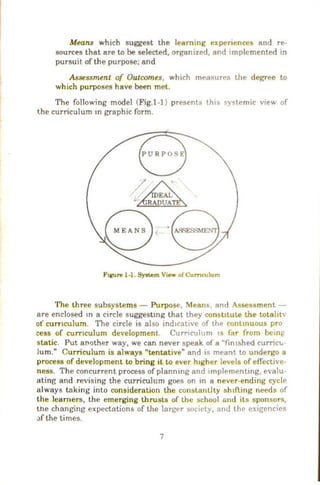
The following model (Fig.l -1) presents this ~ystemic view of
the curriculum m graphic form.
F~gure 1·1. System View of Cumculum
The three subsystems - Purpose, Means. and Assessment -
are enclosed m a circle suggestmg that they constitute the totaltt'r
of curnculum. The circle is also indtcatJVe of the contmuous pro
cess of curnculum development Curriculum IS far from bemg
static. Put another way, we can never speak of a "fimshed curricu-
lum." Curriculum is always "tentative" and 1s meant to undergo a
process of development to bring it to ever htgher levels of effective-
ness. The concurrent process of planning and 1mplementmg, evalu-
ating and revising the curriculum goes on in a never-ending cycle
always taking into consideration the constantlty sh1fl.ing needs of
the learners, the emerging thrusts of the school and its sponsors,
the changing expectations of the larger society, and t.h<' exigencies
1>f the times.
7
The two-way arrows indicate the dynamic interaction and re-
lationships that should exist a mong the subsystems if the system is
to function well. The arrowheads in the outer circle going counter-
clockwise indicate the nonnal sequence in the process of curricu-
lum planning and development. Logically, the first step should be
the detennination of purpose and objectives. However, in curncu-
lum development it is possible that one can start with any step
One might even begin with the assessment or evaluation phase
Using the result of this evaluation or assessment we can examine
and make adjustments in the purpose and the means of attaining
this purpose.
Finally, the all-important process of curriculum development
has one and only one function , and that is, the formation of the
uJdeal Graduate." This becomes the ultimate measure of the sue
cess or failure of the total school enterprise. It should be pomted
out, however, that lh e conception of the uldeal Graduate" will vary
since it depends on the school's perculiar clientele, ecology and
thrusts.
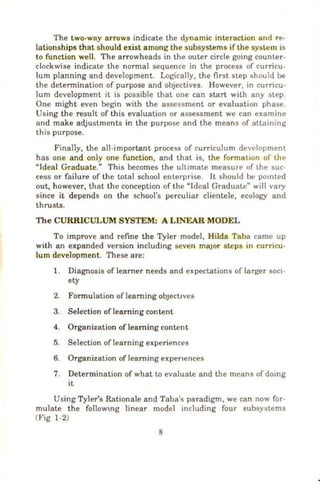
The CURRICULUM SYSTEM: A LINEAR MODEL
To improve and refine the Tyler model, Hilda Taba came up
with an expanded version including seven major steps in curricu-
lum development. These are:
1. Diagnosis of Ieamer needs and expectations of larger soci-
ety
2. Fonnulation oflearning ObJeCtives
3. Selection of learning content
4. Organization of team ing content
5. Selection of learning experiences
6. Organization of teaming expenences
7. Determination of what to evaluate and the means of doing
it
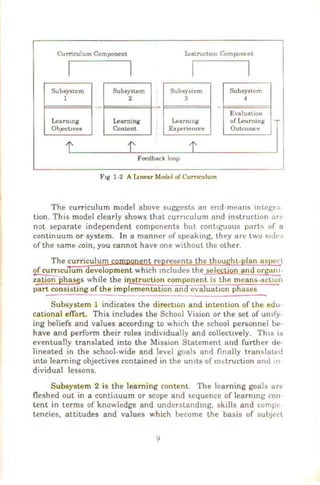
Using Tyler's Rationale and Taba's paradigm, we can now for-
mulate the followmg linear model including four subsystems
Wig 1-2)
8
Curriculum Component InstructiOn Compon~;nl
Subsystem Subsyst-em Subsystem Suh!lystcm
1 2 3 4
Evalunllon
Learmng Learning Learmog of Lenrning
ObJectJVes Content Experiences Outcome<~
1' 1' t
Feedback loop
F1g 1-2 A Lmear Model of Curnculum
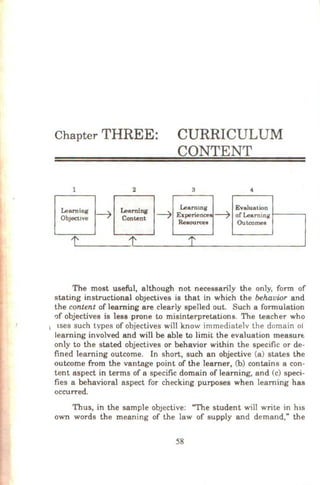
The curriculum model above suggests an end-mcnns 1ntegra
lion. This model clearly shows that curnculum and mstruction an
not separate independent components but cont1guous part~ of a
continuum or system. In a manner of speaking, they arc two Sl IPs
of the same .:oin, you cannot have one without the other.
The curriculum c nt re resents the thou ht- lan as ect
~rr1cu urn evelopment which mcludes the selection and organt-
zation phas~s while the instruction component is the means-act:on
part consisting of the implementa
tion ancTeValuatiOn phases
Subsystem 1 indicates the direct1on and intention of the edu-
cational effort. This includes the School Vision or the set of umfy-
ing beliefs and values accordmg to which the school personnel be-
have and perform their roles indiVldually and collect1vely. Thts is
eventually translated into the Mission Statement a nd further de-
lineated in the school-wide and level goals and finally translated
into learning objectives contained in the untts of Jn&truction and n
dividual lessons.
Subsystem 2 is the learning content. The learning goals are
neshed out in a continuum or scope and sequence of lcarmng con-
tent in terms of knowledge and understandmg, skills and compt·
tencies, attitudes and values which become the basis of subJect
9
matter for instruction and mastery. As one student puts it matter-
of-factly, this is the "stuff that kids must learn in school." The
school expects every student to master these basic requirements of
school learning content which define the standards agamst which
every prospective graduate will be measured.
Subsystem 3 is made up of learning experiences, activities and
resources which constitute the wherewithal for attainmg the learn-
ing objectives. Working on the princ1ple that "he who wants the
end, wants the means," the school employs the most relevant and
effective strategies and resources that will ensure mastery of learn-
ing content. All these are indicated in a plan of instruction, both
on the unit and the lesson level, to be carried out in the classroom.
Subsystem 4 has to do with measurement and evaluation of
learning outcomes. The evaluation reveals whether the objectives
are being attained or not and at what level. And more importan tly,
if objectives are not being met according to acceptable levels or
standards, why these are not being met and what should be done
about it. This is indicated by the feedback loop.
This model provides the' conceptual framework for the Cur-
riculum Development System (CDS) proposed in tlais handbook.
CDS: The WHY ofIt
Every school worthy of the name needs to keep on improving."
True, a school can get by with the barest minimum in terms of
curricular requirements. For some school, the adopt10n of an RTU
(ready-to-use) curriculum in the form of an adopted commercial
textbook series becomes the standard mode of curnculum planning
and implementing. Thus, the question may be raised: If schools
have existed this way for so long, why talk about curriculum devel-
opment now, let alone curriculum development system?
It is our strong contention and firm conviction that a curricu-
lum development system such as the one advocated in this hand-
book with its premium on system and participation is needed by a
school that seeks to ensure the triple thrusts of umty, continULty,
and quality.
UNI'IY. Some schools have little if any control over what
goes on in the classrooms. Teachers are left pretty much to
10
their own devices and just do their thing unmindful of what
goes on in the other classrooms. This lack of articulation and
coordination results in glaring "gaps" and "overlaps" in the
program of studies. Often, instead of correcting this situation,
the teachers resort to the "'blaming syndrome", pointing an
accusing finger at one another for the ineffectiveness of school
instruction. A coordinated, coherent curriculum system brings
the school staff together to articulate expected learning out-
comes for different levels and make everybody "pull in the
same direction." The principal's role is to "orchestrate" or "di-
rect'' the varied contributions of the staff members according
to a cooperatively drawn-up and mutually accepted education
"libretto" or "script."
CONTINUITY. Again, in many schools, curriculum is the
exclusive domain of the principal or academ1c coodinator or, in
some instances, a "chosen few." The teachers are reduced to
mere implementors or purveyors with nothing to say in its
improvement, let alone planning. In such a case, the curricu-
lum can be likened to a flower pot that the principal brings
with him to his new assignment. A curriculum of this sort
does not provide the staff a sense of"collective ownership" that
will give the incentive to work for its success. Besides, the in-
evitable departure from the scene of the curriculum initiator
or proponent brings about a "vacuum" which necessitates put-
ting m a "new" curriculum by the successor in a vicious cycle.
Consequently, the school never moves onward. It takes a few
steps forward only to fall back and start all over again every
time a new princ1pal takes over, following the dictum, "'bagong
hari, bagong gawi; bagong factotum, bagong kurikulum." This
culture of discontinuity not only negates whatever gains may
have been made but can also be very demoralizing to the staff
who must bear the brunt of the constant change and continu-
ing overhaul of the program.
QUALI'IY. Finally, if we are in the business of education
for quality, we cannot afford to do our work in a disorganized,
cavalier manner. Quality implies plannmg, development and
control. If we spend so much money, time and effort to ensure
high quality in the production of material products, should we
not be more concerned with quality when forming the "human
II
product" - our students of today and graduates of tomorrow?
Since the improvement of our society depends in large meas-
ure on the quality of our graduates, we have a grave moral
responsibility to make a conscious effort to systematize our
curriculum and instruction so as to tum out the kind of gradu-
ates who will bring about the kind of society we expect and
deserve, no less.
CDS: The HOW ofIt
At this, point, the question can be asked: How can unity, conti-
nuity, and quality be achieved through the school curriculum? It is
our contention that the systematic and collaborativt process of
CDS will be an answer to the question . The four stages involved in
the initiation and implementation of CDS are all meant to bring
about these triple thrusts.
The stages involved in the process are the follwing:
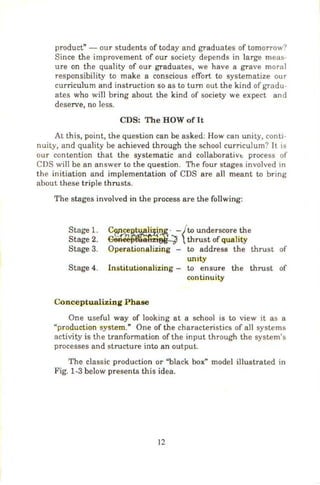
Stage 1.
Stage 2.
Stage 3.
Stage 4.
c~~~ . -{tounderscore _
the
66Ree~t* ~ thrust of quahty
Operationalizing - to address the thrust of
untty
Institutionalizing - to ensure the thrust of
continuity
Conceptualizing Phase
One useful way of looking at a school is to view it as a
"production system." One of the characteristics of all systems
activity is the tranfonnation of the input through the system's
processes and structure into an output.
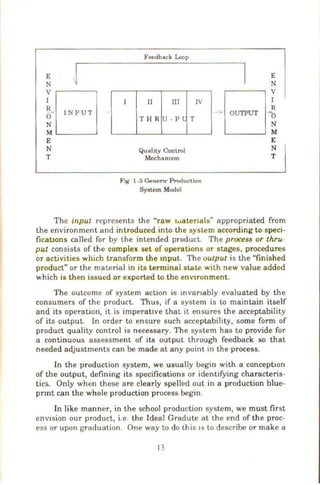
The classic production or "black box" model illustrated in
Fig. 1-3 below presents this idea.
12
E
N
iB
E
N
T
I
Feedback Loop
II III
THR U - Pl
Quality Control
Mecha01sm
IV
T
Fig 1-3 Genenc Production
System Model
E
N
--1 O~UT l
?
i
E
N
T
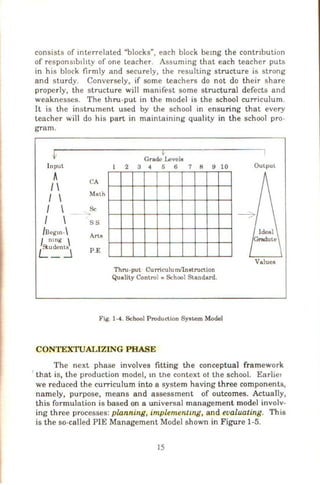
The input represents the "raw 1uaterials" appropriated from
the environment and introduced into the system according to speci-
ficatJOns called for by the intended product. The process or thru-
put consists of the complex set of operations or stages, procedures
or activities which transform the mput. The output is the "finished
product" or the material in its terminal state with new value added
which is then issued or exported to the enVlronment.
The outcome of system action is invanably evaluated by the
consumers of the product. Thus, if a system is to maintain itself
and its operation, it is imperabve that it ensures the acceptability
of its output. In order to ensure such acceptability, some form of
product quality control is necessary. The system has to provide for
a continuous assessment of its output through feedback so that
needed adjustments can be made at any point in the process.
In the production system, we usually begin with a concept10n
of the output, defining its specifications or identifying characteris-
tics. Only when these are clearly spelled out in a production blue-
prmt can the whole production process begin.
In like manner, in the school production system, we must first
enVlsion our product, i.e. the Ideal Gradute at the end of the proc-
ess or upon graduation. One way to do this 1s to describe or make a
13
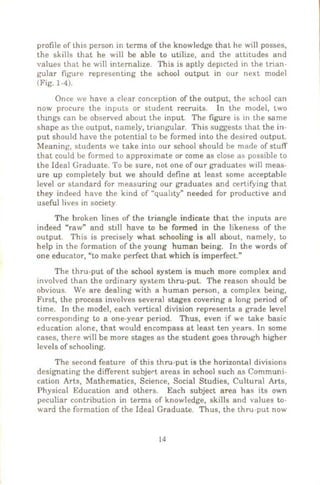
profile of this person in terms of the knowledge that he wil1 posses,
the skills that he will be able to utilize, and the attitudes and
values that he will internalize. This is aptly dep1cted in the trian-
gular figure representing the school output in our next model
(Fig. 1-4).
Once we have a clear conception of the output, the school can
now procure the inputs or student recruits. In the model, two
trungs can be observed about the input. The figure is m the same
shape as the output, namely, triangular. This suggests that the in-
put should have the potential to be formed into the desired output.
Meaning, students we take into our school should be made of stuff
that could be formed to approximate or come as close as possible to
the Ideal Graduate. To be sure, not one of our graduates will meas-
ure up completely but we should define at least some acceptable
level or standard for measuring our graduates and certifying that
they indeed have the kind of "quahty" needed for productive and
useful lives in society
The broken lines of the triangle indicate that the inputs are
indeed "raw" and stlll have to be fonned in the likeness of the
output. This is precisely what schooling is all about, namely, to
help in the formation of the young human being. In the words of
one educator, "to make perfect that which is imperfect."
The thru-put of the school system is much more complex and
involved than the ordinary system thru-put. The reason should be
obvious. We are dealing with a human person, a complex being,
Ftrst, the process involves several stages covering a long period of
time. In the model, each vertical division represents a grade level
corresponding to a one-year period. Thus, even if we take basic
education alone, that would encompass at least ten years. ln some
cases, there will be more stages as the student goes through higher
levels of schooling.
The second feature of this thru-put is the horizontal divisions
designating the different subje~'t areas in school such as Communi-
cation Arts, Mathematics, Science, Social Studies, Cultural Arts,
Physical Education and others. Each subject area has its own
peculiar contribution in terms of knowledge, skills and values to-
ward the formation of the Ideal Graduate. Thus, the thru put now
14
consists of interrelated "blocks", each block bemg the contnbution
of respons1bd1Ly of one teacher. Assuming that each teacher puts
in his block firmly and securely, the resulting structure is strong
and sturdy. Conversely, if some teachers do not do their share
properly, the structure will manifest some structural defects and
weaknesses. The thru-put in the model is the school curriculum.
It is the instrument used by the school in ensuring that every
teacher will do his part in maintaining quality in the school pro-
gram.
,f""
Input
A
1
I 
I 
I 
/Begin-
/ omg 
audents
L _ _j
CA
Mnth
Sc
-ss
Arts
P.E
"'·
Grade Levels
1 2 3 4 5 6 7 8 9 10
Thru-put Curriculu mllnstruction
Quality Control =School Standard.
Fig. 1-4. School Production System Model
CONTEXTUALIZING PHASE
Output
Ideal
Gradute
Values
The next phase involves fitting the conceptual framework
' that is, the production model, m the context ot the school. Earliel
we reduced the curriculum into a system having three components,
namely, purpose, means and assessment of outcomes. Actually,
this formulation is based on a universal management model involv-
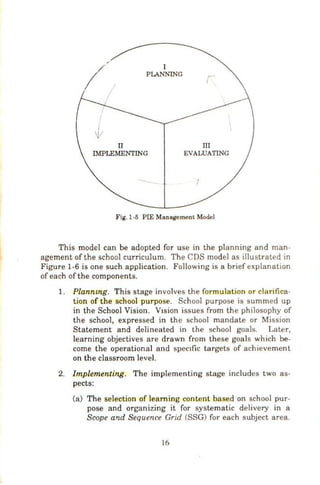
ing three processes: planning, implementmg, and evaluating. This
is the so-called PIE Management Model shown in Figure 1-5.
15
I
PLANNING
II
IMPLEMENTING
III
EVALUATING
I
Fig. 1-5 PIE Management Model
This model can be adopted for use in the planning and man·
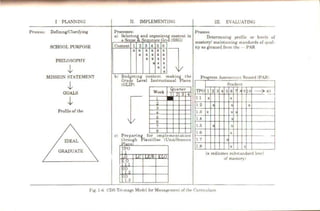
agement of the school curriculum. The CDS model as illustrated in
Figure 1-6 is one such application. Following is a brief explanation
of each of the components.
1. Plannzng. This stage involves the formulation or clarifica·
tion of the school purpose. School purpose is summed up
in the School Vision. Vtsion issues from the philosophy of
the school, expressed in the school mandate or Mission
Statement and delineated in the school goals. Later,
learning objectives are drawn from these goals which be-
come the operational and spec1fic targets of achievement
on the classroom level.
2. Implementing. The implementing stage includes two as·
pects:
(a) The selection of learning content based on school pur-
pose and organizing it for systematic delivery in a
Scope and Sequence Grid (SSG) for each subject area.
16
I PLANNlNG II. IMPLEMENTING III. EVALUATTNG
ProCClili: Defuung!Clanfying Processes: Process
a) Sclect1niand organiz1n~ conlcol in Detenruning prolilt· or lcvcls of
a Scope )cqucnce Gn (SSG)
mastery/ maintaining stundard~ of qulll-
SCHOOL PURPOSE Content 1 2 3 4 5 6 1ty as gleaned from the PAR
a x X X X X
1
a X X X X
PHILOSOPHY a x X X
a X X
t a x
a
MISSION STATEMENT b) Bud3,et1ng content makin'J> the Progress Asscssm•.·nt Rc<:ord (PAR •
t
Gra c Level lnstrucllonal lans
<GLIP> Student
GOALS Week
Quarter TPO 1 2 3 4 5 6 1-. f •1po -7 41) !
1 2 3 .. --!
t
r - 11 X X
2 1 2 ) X X
3
Pror.Ieofthe 4 1.3 X X
5 1.4
6
7 1.5 ) X
8 1 6 X
c) Prcparin~ for 1mplcmenl al1on -
IDEAL through lantillas (Un1UScss1on 1 7 )
PlAne:)
TPO
1.8 X _x
GRADUATE It (x Indicat-es sub~tand~trd l(•vc•l
[,( LEIR ELO of ma~U'ryt
If.0.1
H.2
EO
1 1.3
- ----
Fll(. 1-6 ens Tri-stagc Model for MaDIII(l'mcnl of tht> Curm-ulum
This serves as the master plan or blueprint of the in-
structional program ofthe school. From the SSG, each
grade level or year level prepares an academic budget
or allocation of subject matter of instruction or the
Grade Level Instructional Plan C
GLIP) in each subject
area for each grading period. Most schools would do
this on a quarterly basis.
(b) The preparation for immediate implementation of the
GLIP through the unit and session (lesson) plans or
Plantillas for use in classroom instruction.
3. Evaluating. The results of instruction are measured and
evaluated vis-a-vis specified learning objectives through a
teacher-made mastery test at the end of every unit of in-
struction. These serve as the indicators of the level of
learning. The data are recorded in the Progress Assess-
ment Record (PAR). The PAR enables the teacher to keep
track ofthe profile of mastery of each unit as well as of the
progress or lack of progress of individual students in any
given academic quarter.
The nuts and bolts of these processes are explained in some
detail in the next section.
OPERATIONALIZING PHASE
Assuming that a school is sold on the idea of launching CDS,
how does it go about initiating and carrying it out? Figure 1-7 on
the following page shows the rational framework and flow of activi-
ties and tasks to be undertaken when a school decides to adopt the
scheme.
1. Preparation ofSclwol Staff. Adoptation of CDS represents
a major shift in the management of the academic program
of the school. Such a change is crucial as this will neces-
sarily have a far-reaching effect on the school staff who
will carry the brunt of the change. It is therefore impera-
tive that the school staff be involved in its inception to
ensure their whole-hearted support and cooperation. The
teachers have to be put in a state of readiness to bring
about greater receptiveness to the new program. The eli-
18
1. 2 3.
Preparing School StalTI
-----7
Clanfymg
-----7
Settmg up SubJect
--
Acquiring knowhow &-h(Wll Purpose Area Task Forces
(STFs)
4. 6.
Allocating subJect
-----7
Translating subJect
matter/learn1ng matter into Un1t/
content Sesston plana
6. 7. 8
Piloting/field test1og
-----7
Evaluating/Revising
-----7 Go10g IDtO 3-year
the scheme draft documents development cycles
Fig 1-7 Operol10nahzing CDS 10 School ~l-up
mate or osvchological tone of the school must be conduc•vc
to staff commitment. The level of commitment should be
sucl-- that the teachers Wlll not mmd the extra l• me and
effort tnat will be required to put the new scheme m place.
This preparation may take the form of a retreat or a senes
of recollection/prayer sessions focused on the theme of
comm1tment to the vocation of teaching. commun1ty and
service.
2. ClanfyingIDefintng School Vision and Misswn. Th1s calls
for the school staff going over the school purpose· phlio"o-
phy, mission, goals and its final vision, in groups or en
bane. This is necessary in order to ensure that thcsf'
school beliefs and values are clearly understood and ac-
cepted by everyone. This IS a good occasion to clarify and
update some pertinent aspects of institutiOnal purpose to
make them more relevant to the times. The culmination
of this step is the drawing up and presentation of the pro-
file of the school's "Ideal Graduate" in terms of spec1fic in-
dicators ofknowledge, skills, and values.
3. Settwg up of Sub;ect Area Task Forces. The teachers are
grouped into the Subject Area Task Force (STF), one per
subject area. Each STF is made up of teachers represent-
mg the different grade or year levels. If there are not
enough teachers, a teacher may represent two cont1guous
levels The most important criterion for assigning teach-
ers in the STFs is that they have adequate knowledge of
and/or experience in the subject area and are familiar with
the developmental needs and characteristics of the learn-
ers on a specific level. Th STF is tasked with the framing
of the Scope and Sequence Grid (SSG) for the subject
area. When all the subJect area grids are ready, the STFs
of related subject areas like English and Filipino Commu-
nication Arts, Mathematics and Science, have joint ses-
sions for purposes of "aligning" subject matter by identify-
ing points of correlation. This is meant to help umfy and
strengthen the learning experiences of students at appro-
priate levels. For instance, if colors are introduced for-
mally in Math in Grade 1, this matter should also be
20
taken up on this level in Science so that common concepts
and skills are reinforced and rendered more meaningfut
and useful.
4. Allocatmg Subject Matter for Instruction. The purpose of
the Scope and Sequence Grid is to provide an orderly pro-
gression of learning content and to allocate this content to
the different levels of instructiOn Once this is accom-
plished, there is now a need to spread out or budget the
content allocation for each level over the school year. This
way the staff is able to plan ahead of time just how the
content will fit into the instructlonal timetable. Generally,
schools use a quarterly division of the school year. Given
40 weeks of schooling, there should be more or less ten
weeks for every quarter. Although, realistically, only 7 or
8 of these will be used for actual instruction counting out
non-teaching days and holidays as well as unforeseen sus-
pension of classes. So, if the school plans on 8 weeks per
quarter, this will mean some 32 weeks in all. Subject
matter assigned to the level can then be organized into
units of instruction corresponding more or less to a week.
per unit. So, there may be around 32 units for the whole
year. These units are given a code for proper identifica-
tion. l"or instance Unit 1.1 is the unit for the 1st quarter,
tirst week. Unit 1.2 is for the 1st quarter, week 2, and s::
and so forth.
This becomes the Grade (Year) Level Instructional Plan
(GLIP) for the subject area.
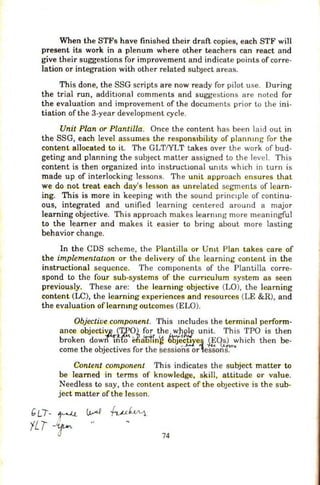
5. Preparing the Unit ISession Plans. From the STF, the
work shifts to the Grade Level Team (GLT) or Year Level
Team (YLT) as the case may be. The GLT or YLT is made
up of teachers on the same level teaching the same sub-
ject. The team is responsible f-or fleshing out the subject
matter in the Unit Plans or "Plantillas." Assuming that a
subject is taught on a daily basis, there should be 5 days
available for every unit of instruction. However, again to
be realistic, we can plan only on a maximum of 4 or evMl 3
days of actual teaching. If a teacher takes up a new lesson
each day, there will be 3 to 4 sesston or lesson plans per
21
unit. The lessons are about related aspects of the instruc-
tional unit and together contribute to the mastery of the
whole unit. This follows the concept of "chain learning"
which ensures that learning outcomes become meaningful
and more lasting than when lessons are disparate and
segmented. Each unit ends with an evaluation to deter-
mine mastery of the unit objective just as each lesson has
its own evaluation. The units, in turn, are related to one
another.
6. Piloting or Field Testing. It is suggested that when the
first draft of the Scope & Sequence Grid made by the STFs
and the Plantillas prepared by the GLTs or YLTs are
ready, they should undergo a try-out period of at least one
school year involving some selected or volunteer classes on
each level. The try-out is monitored and revisions or al-
terations to be made should be noted. These observations
and suggestions are taken into account in the periodic
assessement and adjustment sessions as well as in the
final evaluation of the draft documents at the end of the
try-out period.
7. Evaluating and Revising Draft Documents. After the pilot
run, the Scope and Sequence Grid goes back to the STFs
and the Plantillas to the GLTs or YLTs for review. The
suggested revisions are put in final form to be adopted for
school-wide use. This does not mean that the documents
are final. As mentioned earlier, curriculum development
is a continuing process. So, as these documents are being
used, the teachers should keep a journal where marginal
notes are entered and serve as inputs for the periodic
evaluation and modification of the documents.
8. Going into the 3-Year Development Cycle. The try-out may
take a year or two. Once the documents have been
fine-tuned, they may be adopted on a school-wide basis.
rhe school can then go into a 3.year development cycle
which will ensure the systematic, continuing development
of the program. This will be explained further in the next
phase.
22
Institutionalizing Phase
It is on~ thing to initiate a new curriculum, another to make it
take root and flourish in a school. Thus, the need to institutional-
ize the program. This means having 1t accepted as something
legitimate and, therefore, the right thing to do This will ensure its
continuous school-wide utilization for many years to come.
To do this, we need to ingrain the scheme in the culture of the
school. This can come about only if the school staff accepts curricu-
lum development as a participative process which calls for "collec-
tive ownership" of the enterprise.
After the pilot-testing stage, the school can go into the 3-year
development cycle. This is depicted in the model in Figure 1-8.
The moment the school decides on a school-wide adoption of the
CDS the total efforts of the teachers and administrators must be
geared towards making the program work. However, in order not
to dissipate energy and spread their effort thin, they can make use
of the 3-year development cycle. In this approach, the school
staff focuses its attention on one component at a time in tenns of
reviewing, updating, and revising that component in line with cur-
rent developments in the needs and interests of the learners, the
emerging thrusts of society, and the new trends in the subject
areas.
In the first year of a cycle, attention is concentrated on review-
ing and updating school purpose fonnulations and the correspond-
ing learning objectives and content as delineated in the Scope and
Sequence Grid. This is not to say that no attention is given to the
other two components of the system. In the second year of the
cycle, the attention shifts to the second component, namely, the
learning experiences and resources as found in the Plantillas or
unitilesson plans. For this year, all efforts are expended in incorpo-
rating state-of-the art teaching strategies and instructional re-
sources and materials. In the final year, the evaluation of learning
outcomes becomes the focal point of updating. The school looks
into the tesing instruments used in measuring student learning as
well as the markmg system. In th1s scheme, the major thrusts of
the in-service traimng during the school year will be on updating
and upgrading of the component on focus for that year.
23
The development effort comes full cycle after three years but
the work of improvement continues with a series of 3-year develop-
ment cycles ad infinitum in the never-ending process of curriculum
development. It should be obvious that in such a scheme, the
school moves on to higher levels of excellence after turnmg a full
~ycle. This 1s concededly better than the situation when~ ma11~
3chools find themselves in now, wherein they go to square onE'
every time a new administrator assumes office and finds no ration-
alized, built-in scheme of curriculum development.
Ptlol yeor (s)
3-year development
cycles
Cycles I· Focus of
Improvement
S Y 1: Subsystem 1
S.Y. 2 Subsystem 2
S Y. 3. Subsystem 3
Cycle Il
S.Y l : Subsystem l
S Y. 2 Subsystem 2
S.Y 3· Subsystem 3
... and so on
ad m/initum
Fig 1-8 CDS 3-yeor Development Cycle
24
REFERENCES
Armstrong, David G. Developing and Documentmg the Curricu-
lum. Boston: Allyn and Bacon, Inc., 1989.
Bean, James A, Conrad F. Toepfer, Jr., and Samuel J . Alessi, Jr.
Curriculum Planning and Development. Boston: Allyn
and Bacon, Inc., 1986
Doll, Ronald. Curriculum Improvement: Dectsion-making and
Process, 7th ed. Boston: Allyn and Bacon, Inc., 1989.
Immergart, Glenn L. and Francis Pilecki. An Introduction to Sys-
tem for Educational Administrators. Reading, Mass: Ad-
dison-Wesley Publishing Company, 1983.
Leese, Joseph, Kenneth Frasure and Mauritz Johnson, Jr. The
Teacher and Curriculum-Making. New York: Harper and
Row, Publishers, 1981.
Roche, Edward F. de. An Administrator's Guide for Evaluating Pro-
grams and Personnel. Boston: Allyn and Bacon, Inc.,
1981.
Saylor, J . Galen, William M. Alexander, and Arthur J . Lewis.
Curriculum Planning for Better Teaching and Learning,
4th ed., New York: Holt, Rinehart and Wmston, 1981.
Schubert, William H. Curriculum:Perspective, Paradtgm, and Pos-
sibilities. New York: Macmillan Pubhshing Company,
1986.
Taba, Hilda. Curnculum Development: Theory and Practice. New
York: Harcourt Brace Jovanovich, 1962.
Tyler, Ralph. Basic Principles of Curriculum and Instruction. Chi-
cago: University of Chicago Press, 1960.
Tanner, Daniel and Laurel Tanner. Curriculum Development: The-
ory into Practice, New York: Macmillan Publishing Com-
pany, 1980.
Wiles, Jon and Joseph Bondi. Curriculum Development: A Guide to
Practtce, 2nd ed., New York: Macmillan Pubhshing Com-
pany, 1984.
Wulf, Kathleen and Barbara Schave. Curnculum Deszgn: A Hand -
book for Educators. Illinois: Scott Foresman Company,
1984.
25
Chapter TWO: SCHOOL PURPOSE
1 2 3
Learni.ug Learning Learning Evaluation
Objective --7 Content --7 Experiences --7 of Learning
Re110urces Outoomea
1' 1' 1'
CURRICULUM AND SCHOOL PURPOSE
The contemporary school, like Joseph's multi-colored coat, has
many facets. Among these facets are curriculum design, organiza-
tion for instruction, support services, personnel, financial opera-
tions, school plant and facilities, and school-community relations.
Everyday, professional decisions are being made on these facets of
school organization. If these decisions are to be viable and effec-
tive, they have to be viewed in a broader perspective, namely, the
purpose ofthe whole enterprise.
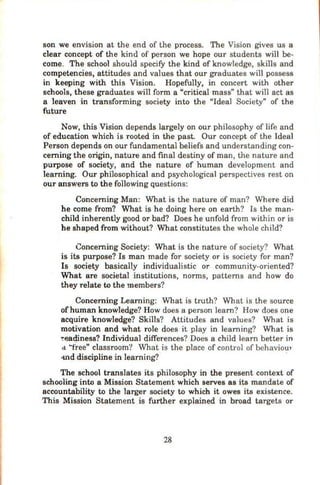
The model on the next page (Fig. 2-1) presents this perspec-
tive. The model has two main components, namely Purpose and
Programs. The Purpose provides the rationale, the raison d' etre,
the end-all and he-all of schooling.
The purpose is projected into the future as a Vision of the
finished product of the proces.s of schooling, namely, the Ideal Per-
26
(
PAST PRESENT FUTURE - - - -
Philoeopby SCHOOL PURPOSE Vision
Miaioo Statement
'.
Goal Statement 7
Objectives Feedback
t
SCHOOL PROGRAMS
Fig. 2-1 . School Purpoae and Programs
son we envision at the end of the process. The Vision gives us a
clear concept of the kind of person we hope our students will be-
come. The sch ool should specify the kind ofknowledge, skills and
competencies, attitudes and values that our graduates will possess
in keeping with this Vision. Hopefully, in concert with other
schools, these graduates wiH form a "critical mass" that will act as
a leaven in transforming society into the "Ideal Society" of the
future
Now, this Vision depends largely on our philosophy of life and
of education which is rooted in the past. Our concept of the Ideal
Person depends on our fundamental beliefs and understanding con-
cerning the origin, nature and final destiny of man, the nature and
purpose of society, and the nature of human development and
learning. Our philosophical and psychological perspectives rest on
our answers to the following questions:
Concerning Man: What is the nature of man? Where did
he come from? What is he doing here on earth? Is the man-
child inherently good or bad? Does he unfold from within or is
he shaped from without? What constitutes the whole child?
Concerning Society: What is the nature of society? What
is its purpose? Is man made for society or is society for man?
Is society basically individualistic or community-oriented?
What are societal institutions, norms, patterns and how do
they relate to the members?
Concerning Learning: What is truth? What is th e source
ofhuman knowledge? How does a person learn? How does one
acquire knowledge? Skills? Attitudes and values? What is
motivation and what role does it play in learning? What is
-r~;aq.iness? Individual differences? Does a child learn better in
d ··free" classroom? What is the place of control of behaviour-
-md discipline in learning? ·
The school translates its philosophy in the present context of
schooling into a Mission Statement which serves as its mandate of
accountability to the larger society to which it owes its existence.
This Mission Statement is further explained in broad targets or
28
goal statements These goals are reduced to more specific targets
in terms of objectives in the different programs of school opera-
tions.
School programs reflect and implement school purpose. These
programs are means of carrying out the School Mission and Vision.
These are divided into two groups: the academic programs and the
administrative programs. The acedemic programs include curricu-
lum, instructwn, the co-curriculum, and the support services such
as guidance and hbrary. The non-academic or administrative pro-
grams are made up of school organization, personnel, finance,
school plant and facilitaes, and school-community relations. All
these programs exist only for one reason, namely, to contribute to
the attainment of the school purpose.
The curriculum, our focal concern in this book, is perhaps the
most vital of all the school programs, the school being an institu-
tion of learning. The school goals based on our shared beliefs
concerning man, society, and learning become the bases of deci-
sions in dealing with the following questaons: What kind of in-
structional program is most effective? How are the learners to be
orgamzed for learning? Is the self-contained classroom preferable
to the departmental scheme? Is it better to have homogeneous
groups or heterogeneous groups for instruction? How should sub-
ject area content be orgamzed for teaching and learning? Should
we orgamze content around subject matter, the needs of the lear·
:'ler or societal considerations? Obviously, the school cannot answer
these questions decisively un Jess ItS purpose is clearly spelled out.
School Purpose: Meanings and Applications
The term "purpose" simply means direction, intention or de-
sired end. It is an inclus1ve term used generally to mean the
reason for which something exists or is done.
However, in educational jargon, we come across synonyms or
variations of this term and 1t is important for practitioners to get a
clear idea of what each term means specifically. One thing though
should be kept in mind, and that is, all these terms are derivatives
of and have to do with school purpose.
29
The following are the terms:
Vision. This is the end product envisioned at the conclu-
sion of the educational effort based on shared beliefs and val-
ues culled from one's philosophy. It provides the focal point or
unifying element according to which the school staff behave or
perform, individually and collectively.
Philosophy. This is a composite statement of concepts,
beliefs, and values concerning two important realities, MAN
and SOCIETY, and their relationship.
Mission or Mission Statement. This a is set of very broad
statements that spell out what the school is all about and how
it intends to carry out its Vision in its educational effort.
Goal or Goal Statements. These are broad targets or state-
ments ofintent or direction delineating the Mission Statement
in the different domains or areas of schooling. Goals are gen-
eral and "timeless" and are not concerned with any particular
achievement within a prescibed period of time.
Objectives. This is the most specific of the terms denoting
purpose. An objective is a specific target or accomplishment
that can be verified at a designated time and under specifi-
able conditions which, if attained, advances the school toward
the achievement of a corresponding goal.
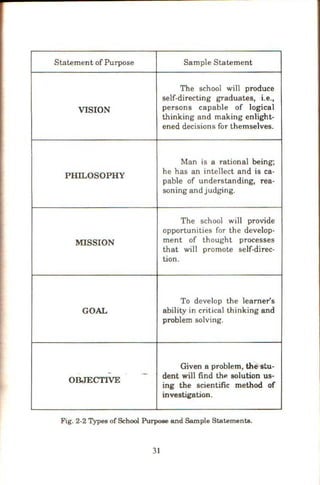
Figure 2-2 on the next page gives an example for each of
these terms for further clanfication.
School Goals
School goals are general statements that delineate the out-
comes of schooling. The scope of the educational program of a
school can be summed up in the goal statements of that school.
Goals are the basic elements or building blocks of educational plan-
ning. The reflection of individual and societal needs and expecta-
tions in goal setting results in statements describing different cate-
gories or areas of human development or behavior.
Thus, goal statements may encompass the following aspects of
the total development of a human person: spiritual, moral, intellec-
30
Statement of Purpose
VISION
PHIT..OSOPHY
MISSION
GOAL
OBJECTIVE
Sample Statement
The school will produce
self-directing graduates, i.e.,
persons capable of logical
thinking and making enlight-
ened decisions for themselves.
Man is a rational being;
he has an intellect and is ca-
pable of understanding, rea-
soning and judging.
The school will provide
opportunities for the develop-
ment of thought processes
that will promote self-direc-
tion.
To develop the Ieamer's
ability in critical thinking and
problem solving.
Given a problem, t}~·stu­
dent will find thP. solution us-
ing the scientific method of
investigation.
Fig. 2-2 Types of School Purpose and Sample Statements.
31
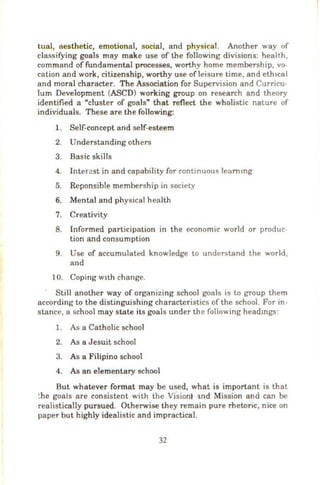
tual, aesthetic, emotional, social, and physical. Another way of
c1assifying goals may make use of the fol1owing divisions: health,
command of fundamental processes, worthy home membership, vo
cation and work, citizenship, worthy use ofleisure time, and eth1cal
and moral character. The Association for Supervision and Curricu-
lum Development (ASCD) working group on research and theory
identified a "cluster of goals" that reflect the wholistic nature of
individuals. These are the fo11owing:
1. Self-concept and self-esteem
2. Understanding others
3. Basic skills
4 . Interest in and capability for continuous leam mg
5. Reponsible membership in society
6. Mental and physical health
7. Creativity
8. Informed participation in the economic world or produc
tion and consumption
9. Use of accumulated knowledge to understand the world,
and
10. Coping w1th change.
Still another way of organizing school goals is to group them
according to the distinguishing characteristics of the school. For in-
stance, a school may state its goals under the following headmgs:
1. As a Catholic school
2. As a J esuit school
3. As a Filipino school
4. As an elementary school
But whatever format may be used, what is important is that
~he goals are consistent with the Vi.siont :tnd Mission and can be
realistical1y pursued. Otherwise they remain pure rhetoric, nice on
paper but highly idealistic and impractical.
32
Sources of Sch ool Goals
As previously stated, goals provide a philosophically-based
structure that unifies and relates all aspects of school leammg
from the development of an overall curriculum blueprint to the
lesson plans used in the classrooms. The question may be asked,
however: What are the valid sources of school goals? Where do we
derive these goals?
Literature on curriculum planning and studies on goal formu-
lation will reveal divergent views as to the best sources of goals.
In the final analysis, goals are a matter of cho1ce and may be
considered as a form of value judgment of those responsible for the
school. Hopefully, such a decision will not be arbitrary or whimsi-
cal, predicated on the preference of an indtvidual or a group.
Rather, it should be based on an understandmg of what schooling
is all about, in general, and what role curriculum plays in school-
ing, in particular.
Clearly, the final chmce of goals reqUJres certain kinds of
inputs for enlightened decis10n-making in curriculum planning. Ty-
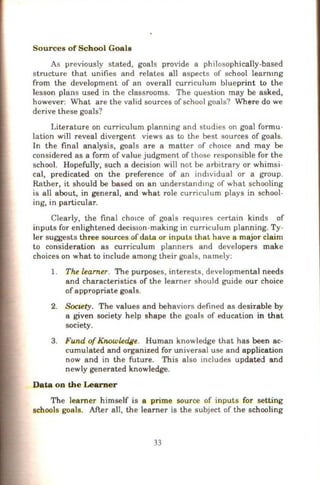
ler suggests three sources of data or inputs that have a major claim
to consideration as curriculum planners and developers make
choices on what to include among their goals, namely:
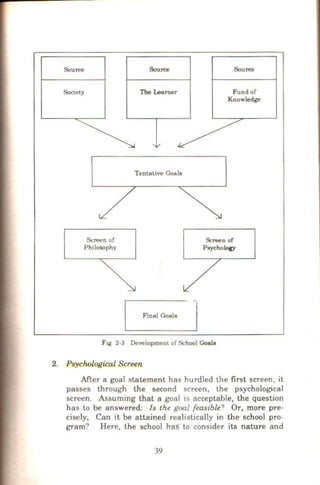
1. The learner. The purposes, interests, developmental needs
and characteristics of the learner should gu.ide our choice
ofappropriate goals.
2. soc,ety. The values and behaviors defined as desirable by
a given society help shape the goals of education in that
society.
3. Fund ofKnowledge. Human knowledge that has been ac-
cumulated and organized for universal use and application
now and in the future. This also includes updated and
newly generated knowledge.
Data on the Learner
The learner himself is a prime source of inputs for setting
schools goals. After all, the learner is the subject of the schooling
33
process. Data on the learner may be culled from different theories
in developmental psychological on "needs." and "interests" of learn-
ers.
The term "need" is a psychological construct indicating a cer-
tain lack or deficiency which creates a tension in the individual.
Needs have to be satisfied for the individual to function effectively
in life. These needs are present in varying degrees at the different
stages of the individual's life cycle, from infancy to adulthood.
They manifest themselves in the different aspects of human devel-
opment- physical, intellectual, emotional, social, moral and spiri-
tual.
Another set of data on the learner that can be taken into
account are those borne out by the studies on learner interests.
This is speciaJly relevant in the light of the proposition that a
learner learns best those things that are of interest to him. Both
learner needs and interests are central to motivation in any kind of
learning.
One problem that school practitioners face in this regard is the
paucity of studies on Filipino children and youth. Hence, we have
only a sketchy idea of the personality mold of the young in our
classrooms. Curriculum planners and teachers depend a lot on a
good old intuition, common sense and conventional wisdom. Too,
the fact that our schooling system tends to be rather centralized
and structured militates against teacher initiative to be more ac-
tive in gathering such data. Be that as it may, it should not stop
our school people from a systematic gathering of data through
painstaking observation, questionnaire mtd interview, and re-
search so we can build a data base for curriculum planning.
At any rate, the following points should be considered when
studying learner inputs as a basis for goal setting:
1. Learner characteristics should include all of the learner's
personal needs, interests, and all aspects of his develop-
ment- physical, motor, mental, emotional, social, moral
and spiritual; environmental influences, and social orien-
tation.
34
2. Data on learner characteristics do not automatically lend
themselves to goal formulations; they must be interpreted
in the ligth ofcertain desirable norms and values.
3. Determination of goals from these inputs involves per-
sonal judgment on the part of the school staff. As was
• stated earlier, goals are, in the end, a matter of choice
based on philosophical grounds.
4. There are needs and needs. Some may be appropriately
addressed by the school. Others may be served better by
other social institutions and agencies like the horne, the
church, the government, etc.
Data on Contemporary Society
Society has certain expectations of its members. More specifi-
cally, civil society or the state, expects its citizens to learn some
basic human functions and tasks that will make them contributing
and productive adult members. These include socio-cultural, eco-
nomic, political, and vocational-technological tasks.
Contemporary life in society 1s becoming more and more com-
plex. The school needs to be attuned to contemporary developments
in society in order to be able to gear its efforts to the critical aspects
of living in contemporary society. Demographic trends, changes in
family and community living, and scientific and technological
changes are some of the sensitive areas that need to be studied and
reflected in the curriculum.
However, as in the case of data on the learner, the school
should exercise care in interpreting these inputs. An identification
of characteristics of society or of conten-;Jorary events will not nec-
essarily indicate desirability for inclusion in the curriculum. It may
well be that these data reflect adult preferences and biases but
may not serve well the interest of the learners. It must be made
clear that current knowledge is tentative and subject to further
verification and modification. Schools have been cnticized for en-
couraging the cult of "presentism" or "conformism". The school
should also be concerned about the future world that the learners
of today will inherit and inhabit. Anthropologist Margaret Mead
stresses the point that our schools should prepare our children for
35
the world of tomorrow that we cannot even imagine. As the poet-
philosopher, Khalil Gibran puts it, these children will live in "the
house of tomorrow which we cannot visit even in our dreams."
It is imperative then that the curriculum designer must con-
sider both the real and ideal order of things in society. While
bound by the limits of actual social forces operating at present, we
are obligated to seek ways and means of carving out the "better
life" and the "good society" of the future. In doing so, the curricu-
lum planners should take the following soc.ietal factors into consid-
eration:
1. Health, family, recreation, vocation, religion, cil:izenship,
special groups, etc.
2. Dominant ideas, values, problems, issues, etc.
3. Natural and human resources, population changes and
movements, patten1s of migration, etc.
4. Careers and vocations open to graduates, increased leisure
time, general education vs. specialized education, etc.
5. Mechanization, urbanization, complexity, specialization of
functions and services, etc.
6. Political trends, polarization (left, center, right), human
rights, civic duties, governmental functions, constitutional
guarantees, non-governmental organizations, etc.
7. Economic development, production and consumption, con-
sumerism, social justice, countryside development, indus
trialization, equal access to the wealth of the nation, GNP,
etc.
8. Regional and local divisions and governance, inter-group
conflicts, interdependence, etc.
9. International cooperation, cosmopolitan interests, foreign
affairs, reliance on foreign loans and assit>tance, national
sovereignty multi-national operations, etc.
10. Technological advances, impact of mass media, instant
communication, computerization, etc.
36
The Fund of Knowledge
Another source of data in developing goals are those coming
from the sciences and humanities which form the core of the school
subjects. This is in fact the most common and readily available
source of school goals. This source has become all the more impor-
tant in the light of the so-called "explos1on of knowledge" and the
ever-expanding fund of knowledge in the different domains of hu-
man learning. With so much new knowledge being added, the
inevitable question is: Which should be included in the curricu-
lum? Obviously, we cannot include everything. There must be
l!aretul selection to include only that which is relevant to and
•oecessary at the level of maturity of the learner.
Thts is where goals are important in limitmg what should find
their way into our curriculum. To be sure, there are basic knowl-
edge, skills and processes, appreciations, attitudes and values, that
need to be considered in setting up the curriculum at this level. In
this, we can be guided by the pronouncements of experts on con-
temporary trends and developments in the different disciplines.
Such pronouncements can be found in professional literature, stud-
ies and reports of different associations and groups dealing with
special fields both here and abroad. Again, &s in the case of data
on the learner, we may not have as much data on local trends and
developments in the different subject areas but we can rely on
whatever has been dorie by such groups as the Philippine Society
for Curriculum Development (PSCD), the Philippine Association of
Language Teaching (PALT), the Philippine Social Science Council
(PSSC), the Mathematics Society of the Phihppmes (MSP), and
others.
One relevant source of content is the learning content contin-
uum formulated by the Department of Education, Culture and
Sports (DECS). This could provide the core of curriculum content
although the schools could include other matters they deem neces-
sary and relevant.
Screening of Goals
Using the foregoing as well as other sources, the school can
proceed and list down a good number af goals statements. How-
ever, these goals remain tentative and should be subject to verifica-
37
tion for ac~ptability and feasibility. This is done by subjecting the
preliminary set of goals to two screens before they are finally
adopted and become the basis for the formulation oflearning objec-
tives (Fig. 2-3).
1. Philosophical Screen
As we have seen, a school operates on a number of
philosophical assumptions and values. It is against these
beliefs and values that school goals should be validated.
The question to be asked here is: Is this goal desirable?
Philosophy tries to define the nature of the "good life"
or the "good society". For instance, we would expect our
educational philosophy to reflect values consistent with
the aspirations of our people for a democratic way of life
coupled with socio-economic development and social jus-
tice for all.
Principally, the philosophical basis of Philippine edu-
cation may be found in our fundamental law, the
Constitution. Expressions of this philosophy may also be
culled from educational legislation, judicial interpretations
and decisions on educational matters, and executive or-
ders. They may also be found in periodic reports of duly
constituted bodies which specify the major thrusts of the
Philippine educational system such as the Department of
Education, Culture and Sports (DECS) and its instrumen-
talities, educational commissions and the annual Educa-
tors Congress.
Additionally, if the school is a church-related institu-
tion, the philosophical screen will also include the corre-
sponding educational philosophy of the Church as well as
contemporary Church pronouncements on the role of the
school vis-a-vis its members. Schools run by a religious
congregation will also have the consider the specific
charism and thrusts of the Order in screening school
goals.
38
Source
SoCiety
Screen of
Phtlosophy
Source
The Learner
Tentative Goals
Final Goals
Source
Fund of
Knowledge
Screen of
PsychoJocy
Ftg 2-3 Development of School Goals
2. Psychological Screen
After a goal statement has hurdled the first screen, it
passes through the second screen, the psychological
screen. Assuming that a goal is acceptable, the question
has to be answered: Is the goal feasible? Or, more pre-
cisely, Can it be attained realistically in the school pro-
gram? Here, the school has to consider its nature and
39
capabilities as well as the level of maturity and develop-
ment of the learners, and nature of the learning process on
that level.
The psychological screen enables the curriculum plan-
ners to do the following:
a. Distinguish between changes in behavior which
can result from the learning process and those
that cannot.
b. Distinguish what can be done from what cannot be
done because they will take much time at the age
level in question.
c. Determine prerequisite conditions for certain
types of learning.
d. Suggest length of time over which goals should be
pursued and emphasized.
e. Determine goals that are consistent with time-
tested principles and practices of teaching and
learning.
Levels of School Goals
School goals are broad targets of accomplishment contempora-
neous with the schooling period. However, goals may be stated at
several levels of generality or specificity depending on the range of
coverage.
For this purpose, school goals may be categorized in hierarchi-
cal order as follows:
Institutional Goals. These goals are formulated for the
whole institution as inspired by its Vision and Mission as well
as its peculiar thrusts. Each school usually comes up with its
own set of goal statements consistent with its philosophy with
a view to developing its "Ideal Graduate." These goals may
have some similarities with those of other schools but will
usually contain unique statements owing to the school's pecu-
liar orientation and emphasis.
40
School Level or Department Goals. These are amplifica-
tions of institutional goals as they apply to specific levels of in-
struction, i.e., tertiary, secondary, elementary or pre-elemen-
tary vis-a-vis the developmental characteristics of learners at
those levels.
Program or Curricular Goals. These are goals specific to
each curriculum strand or subject area such as Communica-
tion Arts, Mathematics, Science Studies, etc. They spell out
the peculiar contribution of the subject to the development of
the "Ideal Graduate" of the school.
Course or Year Level Goals. These are goals of subject
areas appropriate for each grade or year level. They provide
the yardstick according to whi<:h the student is measured and
deemed to have met the desired competencies at the end of the
school year and is therefore eligible for promotion to the next
higher level.
Classroom or Instructional Level. On this level, we no
longer use the term "goal". The more appropriate term used is
"objective" as the purpose of instruction must be very specific
and verifiable.
Instructional Objectives
Benjamin Bloom defines educational objectives as "explicit for-
mulations of the ways in which students are expected to be
changed by the educative process." Robert Mager, for his part,
states that an instructional objective is "an intent communicated
by a statement describing a proposed change in a learner; of what
the learner is to be like when he has successfully completed a
learning experience."
It should be noted that the common element in the two defini-
tions above is "change". Purposeful human learning should result
in some habitual change in behavior . If schooling is to bring about
the desired or intended learning in a person, it must specify the
kind of new behavior that should result from planned experiences
and activities in the curriculum. This is where instructional objec-
tives are useful.
41
Instructional objectives ideotify and state the specific overt
change that is expected to huppen as a result of a teachmg-learnu1g
unit or lesson. These obJectives delineate more explic1tly the gen-
eral goals indicated by the school for purposes of the 1mmediate
planning of day-to-day instruction in the classroom.
Clearly understood, instructional objectlves may serve the fol-
lowing useful purposes in curnculum planning:
1. Define the direction m which desired growth and develop-
ment should take place. While it is an accepted fact that
learning takes place even outside of the school, much of
this learning may lack focus and direction because the
experiences are not planned and pointed towards spec1fic
intended learnings. Objectives in the context of curricu-
lum and instruction precisely serve the purpose of direct-
ing all learnings toward the attainment of the goals and
Mission of the school.
2. Provide a basis for the selection of learning experumces.
There are many variegated things that the learner can
and must learn. Hence, the need for a basis for selecting
the most appropriate experiences at a certam level of de-
velopment and for organizing such experiences. Th1s can
be done by drawing up a relevant and comprehensive hst
of instructional objectives.
3. Prouule a basis for evaluatmg learning outcomes. Instruc-
tional objectives spec1fy the facts and information, ideas
and understandmgs, skills and habits, attitudes and ide-
als, values and behavior patterns that the school deems
important and therefore to be learned by its students. In
this connection, the school sets the levels of mastery or
standards of achievement which students are expected to
attain. Evaluation of the results of the instructional proc-
ess is geared towards determining the progress or lack of
progress of each student vis-a-vis these objective norms.
Limitations and Some Considerations
While it may seem that instructional objectives are generally
useful in planning curriculum and instruction, we have to be cogni-
42
zant of certain problems and issues. Three such considerations are
as follows:
1. The difficulty of defining exactly what instructional objec-
tive really means. Does the objective refer to the behavior
of the learner while in the process of learning or to his
behavior at the end ofthe learning sequence? Does it refer
to the immediate result of learning or the long-range use?
What is the real test of learning - at the end of instruc-
tion or in real life situations?
2. The dif{LCulty ofspecifying the instructional objective in the
fullness of details. A single behavioral act consists of
many contributory elements. Often these elements are
not easy to identify as distinct parts of a complex behavior.
Also, these elements may vary from situation to situation.
On the other hand, if they are left out altogether, the
terminal behavior may not be adequately identified.
3. The problem of specifying the appropriate level of habitual
change in behavwr. This may be easier to do when it
comes to factual knowledge and skills but may be difficult
to determine when it comes to the affective states, i.e.,
appreciations, attitudes, ideals and values. Admittedly,
writing instructional objectives of the affective variety is
the most difficult because these changes do not readily
admit of quantification and verification. As one educa-
tional wag pointed out, "some immeasurables are immeas-
urably important."
It should be borne in mind that behavioral outcomes of in-
struction are only the proximate objectives of learning. These ob-
jectives are rather isolated modifications ofknowledge/ and under-
standing, skills, attitudes and values which induce the new behav-
ior and make it possible for habitual use in the future. To stress
the behavior as an end in itself rather than as a means to an end is
somewhat inaccurate and misleading.
Why use objectives then? We resort to objectives that are
overt and observable simply on the ground that knowledge, under-
standing, skills, attitudes and values are internal passive states
which we can assess only by eliciting behavior indicative of or re-
43
suiting from them. Hence, the behavior exhibited in instruction by
the Ieamer is a useful indicator of the inner dispositions or quali-
ties of the learner resulting from instruction.
With these considerations and caveats in mind and in the
absence of a better device, instructional objectives can serve a use-
ful purpose for curriculum planners and implementors, especially
teachers.
Characteristics of Instructional Objectives
It may be helpful to use a set of criteria in judging the appro-
priateness of instructional objectives. The following guidelines are
culled from the working papers of the Presidential Commission to
Survey Philippine Education (PSCPE) set up in 1971.
1. Are the objectives clearly stated? Do they specify what the
learner must be able to do or perform when he is exhibit-
ing mastery of the Abjective? Do they specify unobservable
(covert) or observable (overt) student behavior which if
present indicates attainment of objective?
2. Are they limited to those which clearly the school has a
reasonable chance of achieving?
3. Have they been understood and accepted by those whose
work they are supposed to influence?
4. Do they reflect both individual and group needs?
5. Are they reasonably comprehensive but concise?
6. Do they have unity and consistency?
7. Do they lend themselves easily to evaluation of outcomes?
From the foregoing guidelines, we may draw up the following
characteristics of a well-written objective.
1. Specificity. As indicated, objectives provide external evi-
dence oflearning, either knowing or feeling. This evidence
must be observable and verifiable. Objectives are state-
ments descnbing what the learner is doing when he is
learning or what he should be able to do at the end of the
44
learning activity. We need to describe precisely what this
desired behavior is in order to preclude misinterpretation.
Thus, the key to writing apt objectives is to use action
words that describe specific behaviors of the learner.
Hence, the use of the word "know" and "appreciate" is not
appropriate because they do not describe exactly what new
behavior is learned. The question may be raised. How do
we know that he knows or appreciates something? How
can we check?
For examples of acceptable terms used in writing instructional
objectives, the reader is referred to the list that follows:
The following suggested ways of stating behavioral objectives
are based on Bloom's classification or taxonomy of objectives into
three domains - cognitive, affective and psychomotor.
I. COGNITIVE
A. Knowledge objectives. At the end of the lesson or unit, the
learner will be able to:
1. recall, recognize data, concepts and generalizations
2. deduce that - - - - - - - - - -- - --
3. id~ntify or recognize that-- - -- -- - - -
4. distinguish from-- - -- - -
B. Inquiry and Skill Objectives. At the end of the lesson or
unit, the learner will be able to :
1. describe and compare - - - - -- -- - - - -
2. explain how
3. demonstrate how
4. distinguish
5. consider and use
6. plan carefully
7. conceive varied ways of
8. formulate - - - - - --- effectively
9. give evidence or proofof
10. weigh the validity of
11. use of variety of
45
12. locate, gather, appraise, summarize and report tht>
13. read ______ ___ critically
14. compare, interpret the abstract _ _____ _ _
15. conclude from available supporting evidence that
16. express ideas effectively ------ -----
17. organize materials from several sources _ ____
18. note sequence ofevents
19. examine critically
20. consider every aspect of
21. recall experiences partinent to
22. state clearly
23 select materials relevant to
24 classify
25. analyze
26. differentiate
27. define clearly
28. infer or deduce that
29. arrange
30. correlate to
31. discuss intelligently __
32. establish that
33. emphasize that
34. predict that
35. observe keenly
36. specify
37. record accurately
38. list down
39. examine carefully
40. disseminate
46
II. AFFECTIVE
A. Attitudes, appreciations, ideals, interest. At the end of
the lesson or unit, the learner will be able to:
1. assume responsibility for - - - - - - -- --
2. utilize wisely and effectively
3. observe strictly
4. listen critically and purposively to - - - -- --
5. participate actively in - - - - -- - -- - -
6. sustain interest in - -- -- -- - - -- --
7. share with - -- - - -- - - - -- - --
8. tolerate--- - - - - -- -- -- - - --
9. comply with - -- - - - -- - -- - --
10. accept
11. find pleasure in
12. formsoundjudgment - - - - - - -- - - -
13. venerate - -- -- -- - - -- - -- - -
14. control
15. equalize - - -- - - -- -- - - -- - -
16. admire - - -- - -- -- -- - -- - - -
17. appreciate --- -- -- - - - - - -- - -
18. follow - - - - -- -- - -- - -- - -
19. a~ust _____ ______ _ ___ _ _
20. vruue ______ ___________ _ _
21. satisry --- - - -- - - - -- - ------
22. visit ------- -- - -- - -- - - --
23. conserve ---- - - -- - - - - -- - --
24. maintain
25. show respect for ---- - - -- -- - - - -
26. stren~en - - - - - -- - -- - - - --
27. initiate worthwhile projects ---- -- - - - -
28. commemorate --- - - - - -- - - - -- -
29. intensify----- - - -- - - -- -- - -
30. sharpen
47
31. exert effort in - -- - -----------
32. generate _______ _ ___________
III. PSYCHOMOTOR
A Skills. At the end of the lesson or unit, the learner will be
able to:
1. construct-- - - -- - -- - - - - - - -
2. manipulate - - - -- -- - --------
3. use - - - - - -- -- ----------
4. perform
5. measure
6. operate
7. handle
8. execute
9. install
10. connect
11. experiment
12. assemble
13. copy
2. Performance Standard. The objective must include the
minimum level of acceptable performance of the learner.
It is not enough that the students is able to exhibit the
behavior. We must also be able to tell how well he is doing
it in relation to expected levels of mastery. Two levels
may be set:
a. Individual Student Level. This is an explanation of
how well an individual student should be able to per-
form a particular behavior e.g., given 20 words ran-
domly selected, the student will spell out correctly at
least 15.
b. Class Level. This indicates what percentage of the
class must perform at a specified minimal level ofmas-
tery, e.g., at least 70% of the class will spel1 correctly
all 20 spelling words.
48
3. Attainability. In setting up our standards, there is a need
for us to know the ability level of the learners for whom
the objectives are mtended in the first place. Objectives
are for students and not the other way around. A good
knowledge of student characteristics and abilities help in
setting realistic expectations. It is well to consider also
the entry prerequisites and readiness level of the learners
when formulating objectives to ensure attainment. The
exhortation not to give "too much, too soon," is appopos in
this regard.
4. Measurability. If we are to detennine levels of perfonn-
ance against standards, we should be able to quantify the
behavior and consequently measure it. Objectives are use-
less unless some fonn of assessment of learning outcomes
is undertaken. At the end of the learning sequence, we
must look for the evidence of learning in relation to the
standards we have set. This is only possible by using a
tool for measurement which is usually but not exclusively
in the form of a quiz or test.
Format: Writing Instructional Objectives
We have seen that objectives are statements describing what
the learner is doing during or will be doing upon completion of
learning. An acceptable objective lets the student know what is
exactly expected of him. It also enables the teacher to measure the
effectiveness of his own work.
A well-written instructional objective contains the following
essential elements:
1. The terminal behavior must be identified by name. An ob-
servable behavior must be stated that shows exactly what
sort of learning has taken place.
2. The important external conditions under which the behav-
ior is expected to occur should be included.
3. The criteria of acceptable performance should be
specified.
49
A simple method of stating a complete objective statement is
through the use of the so-called ABCD format, where -
"A" is for "audience" or the target group of learners who
wi11 learn the new behavior in terms of knowledge to be
gained, skill to be perfected, or attitude/value to be imbided.
The point to stress is that an objective is meant for a specific
group of learners with unique characteristics, interests and
needs. Hence, a "to-whom-it-may-eoncern" type of obJective
wilJ not serve the purpose.
"B" is for "behavior" that the learners will perform or ex-
hibit to indicate achievement of the objective. This must be
described in clear, concise, and concrete terms.
"C" is for "condition" under which the behavior will be per-
formed by the learners. In other words, any given or restric-
tion that will obtain when the learner exhibits the desired
behavior should be identified and specified.
"D" is for "degree" of acceptable performance of the behav-
ior, which may either be for the individual student or the·
whole class.
The example below will illustrate this format:
A : Grade 5, Bonifacio section students
B : Wi11 label the relief map of Luzon
C : Without the use oftheir note
Given a reliefmap
D : At least 15 out of 20 provinces
The objective statement will read thus: Given a relief map of
Luzon, the Grade 5-Bonifacio students will be able to label cor-
rectly at least 15 out of20 provinces without the aid of their notes.
For more instructions and details on writing instructional ob-
jectives, the reader should refer to the book of Robert Mager, "How
to Write Instructional Objectives".
Box 2-1 contains some pointers in evaluating instructional ob-
jectives.
50
Box 2-1
Checklist for Evaluating lnstructional ObJeCtives
1. Is the objective clearly related to the goal from which
it is derived?
2. Do~s the objective include only one learning out-
come?
.}. (s the objective stated in terms of student behavior,
not teacher performance?
4. Is the objective stated as a learning product, not
procP.ss or activity?
5. Is the minimum level of performance indicative of
acceptable achievement clearly specified?
6. Does the objective state the circumsta11ces or condi-
tions under which the student will exhibit the de-
sired learning outcome?
Classification ofInstructional Objectives
The advocacy of instructional objectives by those seeking to
clarify educational purpose has met resistance from those who be-
lieve that de&cribing learning outcomes in this fashion is too sim-
plistic and educationally naive since it ignores the interrelatedness
of human experiences. In the early rush to write clear and precise
statements, teachers often chose simple objectives that required
little thinking on the part of their students. These teachers actu-
ally confined their objectives quite narrowly to one domain of
learning, the so-called cognitive or knowledge domain, and at the
lowest levels at that.
Domains of learning in educational jargon designate a large
group of learning opportunities, broad in scope, that are planned to
achieve a single set of closely related educational goals. Domains
then are useful categories of ~or goals and related learning ob-
51
jectives. They do not necessarily embody the whole purpose of
schooling but rather those aspects ofhuman development for which
universal goals, and eventually objectives, can be formulated. They
are not objective statements per se but can become a bas1s for
formulating these statement. They are useful as a classification or
taxonomic system that can be utilized for curriculum planning.
The most notable of these domain classifications or taxono-
mies are those developed by Benjamin Bloom and associates. They
identified arbitrarily three such domains, namely, the cognitive,
the affective, and the psychomotor domains. Following is a brief
description of these domains and sample statements of instruc-
tional objectives for each.
Cognitive Domain or the domain of intellection and thought
processes include the following:
1. Knowing, which has to do with learning and recallmg
facts, terms, and other symbols, classifications, events,
trends, principles, ways of working and theories.
Sample Objective: Name five simple machines and state
how each works.
2. Comprehending, which involves interpreting content ,
translating it to another form, and extrapolating elements
from one situation to another.
Sample: Explain a graph showing population growth
trends.
3. Applying, which is using in new situations that which one
has already learned previously.
Sample: Show how respect for human rights is taken
into account in R.A 3578.
4. An.alyzmg, which consists of breakingup wholes into their
~omponent parts and noting the nature o(the parts anc
their relationship to one another.
Sample: Specify three causes of the Philippine Revolu-
tion of1898.
52
- --------------------------------------------------
5. Synthesizing, which is putting discrete or isolated ele-
ments together and creating something new by combining
these elements.
Sample: Construct a model showing how soil erosion
can be contained.
6. Evaluatmg, which is judging the worth of something or
somebody based on certain cnteria.
Sample: Distinguish between drawings which illustrate
effective use of color and lines to focus attention on a
central feature and drawings that do not.
Affective Domain or the domain of sensing, feeling and believ-
ing which include:
1. Receiumg, which is showmg interest in, giving attention
to, and indicating awareness of an object, stimulus or phe-
nomenon.
Sample: Listen attentively to the first movement of
"Nutcracker Suite".
2. Responding, which is giving willing response and replying
with a feehng ofsatisfaction.
Sample: Select three books voluntarily for leisure t·ead-
ing and state ways in which they are interesting to the
reader.
3. Valuing, which is accepting a value, prefering it, and be-
coming committed to it.
Sample: Show conviction by writing a letter of protest
to a congressman on a bill deemed detrimental to public
morals.
4. Organuing values by conceptualizing them, clarifiying
' .hem and systemati?.ing them in one's thinkin!?
Sample: Formulate and state judgments on certain is-
sues related to extension of equal work opportunities
and privileges to women.
53
5. Characterizmg values by internalizing them so they be-
come eventually part of one's philosophy of life.
Sample: Exhibit in several unrelated instances fulfill-
ment of a promise once given.
Bloom and associates, however, were able to work only on Lhe
cognitive and affective domains of learning. Some educational
writers have attempted to come up with a taxonomy for the psycho-
motor domain. One such writer is Anita Harrow who formulated
the following classification.
1. Fundamental Movements, which include physical motions
such as walking, jumping, running, pulling, pushing, and
manipulating.
Sample: Dribble a basket ball twenty times.
2. Perceptual Abillttes, which include visual, auditory, tac-
tile, kinesthetic and coordinated activities.
Sample: Write correctly all the letters of the English al-
phabet.
~--------------------------------------------~
3. Physical Abilities, which include showing physical
prowess, strength, endurance, agility, dexterity and time
required to react or respond to a stimulus.
ISample: Do ten pushups in one minute.
4. Skilled Movements which include well-coordinated move-
ments in games, sports, and the arts.
Sample: Play a full quarter in a basketball game
5. Nondiscursive Communication, which includes nonverbal
communications through facial expressions, gestures, pos-
tures, and creatlve body expressions.
Sample: Create a rhythmic movement sequence and
execute it to a musical accompaniment.
For more details of these taxonomies of learning outcomes,
the reader is referred to: Taxonomy ofEducational Ob;ectives. Cog-
54
nLtive Domam and Taxonomy of Educational Objectives: Affectwe
Domam of BenJamin Bloom, et al, and Toxonomy of Psyhcomotor
Domatn. A Juide to Developmg Behavioral Objectives by Anita J
Harrow.
Types of Instructional Objectives used in CDS
For CDS purposes, we shall considel" two types of instructional
objectives, namely, Terminal Performance Ob;ectzues or TJ>O and
Enablmg Ob;ectwes or EO.
Termmal Pe{ormance Objectives (TPO)
This refers to the final behavior the student must perform
when assessment takes place at the end of an extended in-
structional sequence, that is, the end of a unit of instruction.
Some may call this the general or hroa(! objective.
In the CDS plantilla, the TPO has to includf' all the ele
ments of the ABCD format. See examples m the sample plar
tJIIas in Chapter Four.
Enabling Objective (EO).
EOs are sub-objectives or specific objectives that. slate the
smaller behaviors or tasks that are essential in order for t.hf'
learner to achieve the TPO in the end. EOs are assocHtecl
wilh lessons that make up the unit. There is one £0 p<'r
lesson and it is focused only on one specific behav1oral out
come in any of the three domams - cognitive, effect1v<> or
psychomoter.
Two points are to be kept 10 mmd in relations to EOs:
First, EOs are related to the TPO and enable the Ieamer to
ach1evc the latter. Second, the EOs in a unit are related to
one another usually in an ascendmg order of d1fficulty, that is,
we start with the simpler tasks and proceed to the most com-
pltcated one so that in the end the behavior required 1n the
TPO is learned
For EOs the objectivt! statement may include onlv tne be
hauwr and degree components unlike the TPO wh1ch usually
includes all components of the object1ve format. Again, ::.ee
sample in chapter Four.
55
A TPO is essential in order that the teacher can plan for the
learners all the necessary activities they must engage in if they are
to acquire the desired new knowledge, skill, attitude or value.
However, in planning the unit of learning, we must be able to
break it down into managable chunks and identify those tasks or
steps that the learner must master in sequence to enable him to
reach the desired behavior at the end of the unit.
For example, if we are planning a unit on writting a simple
paragraph, the TPO, expressed roughly, is: "to wnte a simple para-
graph in correct form." We then break this down into the steps or
tasks student must learn which might include the follow10g· writ-
ing a topic sentence, writing the primary and secondary support,
writing a closing sentence, and putting all these in correct format
using all the proper mechanics of paragraph writing. These be-
come the EOs. If the student learns all the EOs well, it should
follow that they can perform the TPO at the end of the unit. In
sum, mastering the intermediate steps or tasks enables the student
to perform the terminal behavior.
REFERENCES
Bloom, Benjamin S., Editor. Taxonomy of Educational Objectives:
Cognitive Domain. New York: David McKay, Publishers,
1956
Bloom, Benjamin, David Kratwohl and Bert Masia. Taxonomy of
Educatwnal Objectives: Affective Domain. New York:
David McKay, Publishers,1964.
Combs, Arthur, Educational Accountability:Beyond Behavwral Ob-
jectives. Washington, D.C.: Association for Supervision
and Curriculum Development, 1972.
Gronlund, Norman. Stating Objectives for the Classroom, 3rd ed.
New York: Macmillan Publishing Company, 1985.
Harrow, Anita J. Taxonomy of Psychomoter Domain: A Guide for
Developing Behavioral Objectives. New York: David
McKay, Publishers, 1972
Hostrop, Richard W. Managing Education for Results. Palm
Spring Calif.: ETC Publications, 1975
56
Karmel, Marilyn D. and Louis J . Karmel. Growmg and Becommg
Development from Conception through Adolscence Ne.,.,
York: Macmillan Publishing Company, 1984.
Lewis, James Jr. School Management by Objective!!. New York.
Parker Publishmg Company, Inc. 1974.
Mager, Robert F. 1962. Preparing Instructional. Objectives. Palo
Alto, Calif.: Feach Publications, 1962
Popham, James W. Instructional Objectives. Chicago: Rand Mc-
Nally, 1969.
0
57
Chapter THREE:
1 2
ing Learning
IVe ----7 Content ----7
1' 1'
CURRICULUM
CONTENT
3 4
Learmng Evaluation
Experience& ----7 of Learning
Resources Outcome&
1'
The most useful, although not necessarily the only, form of
stating instructional obJectives is that in which the behavior and
the content of learning are clearly spelled out. Such a formulation
of objectives is less prone to misinterpretations. The teacher who
1 tses such types of objectives will know immediatelv the domain o1
learning involved and will be able to limit the evaluation measur~
only to the stated objectives or behavior within the specific or de-
fined learning outcome. In short, such an objective (a) states the
outcome from the vantage point of the learner, (b) contains a con-
tent aspect in terms of a specific domain of learning, and (c) speci-
fies a behavioral aspect for checking purposes when learning has
occurred.
Thus, in the sample obJective: "The student will write in hts
own words the meaning of the law of supply and demand," the
58
content portion is "meaning of the law of supply and demand," and
the behavior aspect is "write in his own words."
What Is Learning Content?
It can be said, in fact, that instructional objectives are not
possible without learning content. Content is the medium through
which the objectives are accomplished. Put another way, instruc-
tional objectives are fleshed out in terms of learning content.
There are three basic questions related to learning content:
1. What knowledge, skills, attitudes or values are most
worthwhile to be taught and learned?
2. Why are they considered worthwhile?
3. How are they acquired?
These represent the most fundamental curriculum questions
and constitute the bottom line of all activities commonly associated
with educational theory and practice.
In dealing with learning content we have to contend with the
so-called "knowledge explosion" phenomenon. Knowledge has ac-
cumulated so fast it is no longer just difficult but simply impossible
to cram our curriculum even with summaries of all existing knowl-
edge. The decision with regard to the selection of content revolves
around the pivotal question: How can a school make a wise selec-
tion of content from the ever-growing body of available human
learning?
Sources of Learning Content
In Chapter Two, we considered the "Fund of Human Knowl-
edge" which represents the repository of the accumulated discover-
ies and inventions of man down the centuries. This fund, some-
times called the "Heritage of the Human Race," is dynamic and
undergoes a constant turnover and updatmg of facts and informa-
tion , ideas, generalizations and concepts as well as the processes
used in acquiring and interpreting these acquisitions.
This fund covers all the known areas of human learning acqui-
sitions and is generally subdivided into the humanities and arts, on
59
the one hand, anrl the sciences, on the other, and the subdivisions
of these two branches. 'fhis fund has been accumulated over a long
period of time owing to man's unceasing exploration of hts world,
especially his four-way relationship<;: vertically, Wlth the Supreme
Being above him and with the physical world below; horizonLally,
with other men, on the one hand, and with himself, on the other
(Fig. 3-1).
GOD
i
metaphysical
t
--4 IMAN I~ [ - 4 10thcrM:]
i
physical
Physical
World
Fig. 3-1. Sources of Human Learning:
MaD's Four-Way Relalionahtpe
Chronologically speaking, the different organized branches of
human learning developed over time starting first with Mathemat-
ics, a man-made science, followed by the physical non-life sciences
(Physics and, Chemistry), then the life sciences (Botany, Zoology an
Physiology), then the Social Sciences (Sociology and Anthropology),
and finally, Psychology. The Social Sciences and Psychology consti-
tute what is popularly known as the behavioral sciences. Fig. 3-2
on the next page illustrates this development of the Sciences.
60
Psychology
SocJOiogy/Anlhropology
(Social Sc1enccs)
Botany, Zoology, Phystology
Chemtsty
Phys1cs
Mathematics
I
Fig. 3-2. Pyrarrud of the Sc1eoccs
From Sciences to Subject Areas: The School Curriculum
A major function of formal education or schoolmg on the ele-
mentary and secondary levels is primarily to transmit organized
knowledge in dis6lled form to a new generatlon of young learners.
In fact, schooling can be considered as a "short ct.t. to life experi-
ence." The traditional sources of what is taught and learned in
school is precisely the fund of human knowledge or the heritage of
learning of the human race. Therefore, the sciences and humani-
ties provide the basis for selecting the content of school learning.
When a branch of human learning is orgamzed and scaled
down into a specific field of study it comes to be known as a "disci-
pline". From the different disciplines have evolved the different
areas in the present-day school curriculum. Each subject area has
its own body of subject matter or learning content which students
are expected to study and master.
61
Traditionally, the following broad subject areas comprise the
curriculum in basic or general education which encompasses the
elementary and secondarry levels of schooling:
Communication Arts, which include the skills of listening,
speaking, reading and writing as well as the effective use of
language in daily living
Mathematics, which includes numeracy and computational
skills, geometry and measurement, algebra and statistics,
logic and reasoning
Science, which includes the major branches of the natural
science (Biology, Chemistry, Physics), exploration and disco-
very dealing with natural phenomena, and the use of the
scientific method of investigation
Social Studies, which include basic elements of Geogra-
;>hy, History, Sociology, Anthi:Qpology, Economics, Civics, Po-
litical Science, and Psychology
Music, which includes basic music theory, practice in lis-
tening, singing, playing musical instrumetns, and music ap-
preciation
Art, which includes different media, forms, and elements
ofgraphic expression ofthe human condition
Physical Education, which includes health and physical
fitness, individual and team sports, spectatorship and wise
use ofleisure time
Vocational Education, which includes psychomotor and
manipulative skills in basic crafts and trades, design, work
ethic and appreciation of manual productive work.
Selection of Learnin.C Content
As we have seen, it is not feasible nor is it desirable to include
the full content of a particular science or discipline in the school
curriculum due to practical psychological considerations. Therefore,
there is a need to make a wise and systematic selection ofappropri-
ate content for learners at given levels of schooling. One useful
62
way of selecting subJect matter is to use a filtenng device such as
the one in Figure 3-3 below.
DISCIPLINE
(Field of Study)
l
l
Screens: Criteria J
Selected content to be included in
Scope & Sequence of SubJ. Area
Fig. 3-3. Model of Selecting Learmng Content
63
Since curriculum planners and developers cannot and should
not use all available knowledge and all the accumulated experi-
ences of mankind, there should be a process for the selection of
relevant topics to be included as content in the curnculum. The
steps in this filtering process include the following:
1. Selection of a discipline to be included in the curriculum
which specifies a part1cular field of inquiry or learning.
These disciplines are predetermined and mandated for
schools as previously cited.
2. Use of a device to narrow the dtscipline for school use.
Jerome Bruner suggests the reduction of the discipline to
its basic "structure". He believes that the fundamental
structure of the subject rather than d1screte elements or
fragments of information should be taught and learned.
By structure, he meant the network of major elements and
sub-elements that unifies a discipline and serves as a use-
ful tool for simplifying and managing current data and
concepts for generating new ones.
These elements and sub-elements that form the struc-
ture of a subject area include the fol1owing:
Facts
Information
Topics
Themes
Skills
Hab1ts
Competencies
Values
Ideas
Concepts
Generali-
zations
Theories
Principles
Axioms
Laws
The diagram below gives a simple example of some ele-
ments and sub-elements that may be found in the structure of
a subject hke Social Studies.
Types of Elements Examples of Each Type
Concept Economic System
t J
Constructs Producllon, Ownership, etc.
t ~
Generalizations Land 18 used in production of food.
1J
Fact.e & Attributes Measurements ofland, )'leld per hectare, etc.
64
Fig. 3-4 gives a detailed illustration of the so-called
"content or concept clusters" that make up the structure
of a subject area like Social Studies. Bruner believes that
organizing content into these clusters provide the follow-
ing advantages in curriculum making: (1) It makes a sub-
ject matter more easily comprehensible; (2) It enables the
learner to more easily retain content learned; (3) It en-
hances transfer of learning; and, (4) It promotes intuitive
thinking or learning by ins1ght.
3. Application of selection screens or criteria to determine
the specific content that is representative of the subJect
area for a particular level of schooling, in this case, gen-
eral education. In general, all things being equal, the fol-
lowing contents are preferred, namely, those that -
(a) Have a high frequency of occurrence and use in com-
mon life
(b) Are of interest and concern to students at apropr i~:tte
levels of instruction
(c) Are suited to the maturity levels and abilities of stu-
dents
(d) Serve as a basis for acquiring more learning
(e) Are within the achievement level and experience of
students
(f) Are of value in meeting the needs and competencies
for a future career
(g) Include an intensive treatment of a small number of
topics rather than an extensive treatment of a large
number oftopics
(h) Include the same topics in the same subjects in suc-
ceeding grade levels only when there are new learning
'>utcomes anticipated.
(i) ' Make possible maximum correlation with other sub
ject areas
(j) Allow for transfer of learning to similar learning expe-
riences and related life situations
65
Box 3-1 on page 68 gives other criteria useful in
selecting content.
4. Selection of the representative content topics (RCTs) from
the content clusters that have been subjected to the crite-
ria screen. Only those that pass the screen should become
part of the curriculum.
5. Delineation of the accepted RCTs into sequent1al order for
instructional purposes in the Scope & Sequence of the sub-
·ect area.
HISTORY
Human Evcnt.s of the Past
Tune Gap
Past Events not observable
I
Records and Other Remain.B
Related lo Human Events
Rcconetraction a.nd interpretation
of Selected Events
I
Structured Around Themes
and Organized Withtn
Penods Areas Topics
ECONOMlCS
Problem: Conf11ct between Wants
and Productive Resoura!s
IEconom1c~
I System I
Scarcity Production
D1vision of Consumption
Labor DLstributlO
n
Spcciallzatioo Supply
Interdependence Demand
Investment I Savmg
Mooer Credit Income
Bank:tng Employment
Public Policies Based on Social Goals
Growth/Stability/Secunty
Equity/Freedom
Employment/Efficiency
66
GEOGRAPHY
Location of Cultural, Phystcal,
and Biotic Elements
I
l Distnbut1
ons I
AsSOClllLOOB l otentctlOn!l
LRegions I
l
Spatiai/Rt'gtonol
Cultu ral/Phys1cal
Hllltoncal
POLITfCAL SCTE!'CE AND LAW
Political Behav1or
~ Culturc!Role/Cootrol ~
I IPoli'""'ls,...m I I
State Due proce<>s
Power Public policy
Authonty Social control
Influence Interest groups
Legtltmacy Decision mak1ng
I I
Government
Tasks/Procesacs/Sctvices
Btnding Dcctstons
Rules/Constttution/Laws
Rooted in Societal Values
ANTHROPOLOGY
Culture
I
Values/Beliefs/Habits
I
Patterns of Behavior
Economic· food
shelter. other
ne<•ds, want<;,
technology
/
Soc1al: household.
k1nsh1p, commumty,
territory, structure

Pohlical social Expressive: art,
control. authority, language, ntual,
Iaw cercmomes
IAcculluraton/Enculturatlon I
Adaptation
Cultural Change I
PSYCHOLOGY
Human Behavior
Ind!.viduals/Groups
Perceiving
Thinkmg
Feehng
Creatmg
Actmg
D10"erenccs
I
I
Group functions
Group processes
Intergroup relations
Soc1al needs, roles
DiO"erences
Learnmg and Development
Cognltlve/AO"ectJve/Motor
SOCIOLOGY
Society
I
Values I Norms Structure
Family
Education
Religion
Busmess
Others
Soc1al
Interaction
----
Role
Status
ExpectatiOns
Norms
Sancotions
~ /
Soc1al
Instttutional &
OrganizatiOns
Social
Aggre~ntcs
Classes Commumt1es Ethnic Groups
Social Change
PHILOSOPHY
l
What 1s true? Good?
Eth1cal
Values
I
Beautiful?
principles
Rtght/Human dignity/Freedom
Duty/Free socJely/Equnhty
Loyalty/Free inqu1ry/JustJce
I
Openmindedness Responstbleness
CooperatiVeness Concern for others
Creattveoess
I
Mak1ng Judgments Reasomng
Dctcctmg lo~rcal fallac1es
Ftg. 3-4 Sug~csted Soc1al ~tudies Concept Clusters (Adapted from Mlchachs,
John. Socwl Stud1es {or Children m a Democracy Prentice-Hall, 1978)
67
Box 3-1
.Key Criteria for Selectinr Learnin1 Content
1. Usefulness in contributing to the attainment of con-
ceptual, process, skill and affective objectives
2. Relevance to significant human experiences, prob-
lems, and issues and frequency and!:riticality of use
3. Reliability, authoritativeness, validity and up-to-dat-
eness
4. Adaptability in terms of learners' abilities and back-
ground
5. Usefulness in planning and organizing instruction, in
generating questions and learning activities, and in
making applications in a variety of situations
6. Usefulness in developing skills and modes, methods,
and processes ofinquiry
7. Usefulness in explaining a wide variety of phenomena
and developing a sense of structure of the field of
study
8. Usefulness in developing competence in clarifying val-
ues, attitudes, and value-laden issues and problems
with social relevance
9. Availability in textbooks, AV resources, and other in-
structional media.
Organization of Learning Content
Curriculum design refers to how the curriculum content is or-
ganized and laid out for purposes of instruction. This is intended
to accomplish orderly and meaningful coverage of content so as to
bring about the cumulative effect of education in terms of residual
or habitual learning. This also ensures econom_y through optimum
68
use of time and effort, ef_Ticiency lhrough an orderly and systematic
progression of learung and illccllYikY in obtaimng the desired
learning outcomes.
In organizing curriculum content, we are usually guided by
the following complementary BASIC principles:
1. Balance. This refers to the eqwtable and fair distribution
of content among the difTerent levels of instr uction to en-
sure that no level is unduly overburdened or underbur-
dened.
2. ArtiCulation. This refers to prOVlSJOns for establishing the
vertical linkage from level to level. This way we can avoid
the glaring "gaps" and wasteful "overlaps" in subject mat-
ter and ensure an unbroken chain of learning. Proper
articulation promotes team work among the instructional
staff and will prevent the perennial ''blaming syndrome"
so prevalent in schools where this principle is not ob-
served.
3. Sequence. This term is used to descnbe the sequential and
graded arrangement of subJccl matter. It refers to a deep-
ening and broadening of content as it is taken up on the
higher levels. The term "spiraling'' h as been used to de-
note this idea of sequence. For mstance, a senior high
school class will take up paragraph writi ng but at a more
sophisticated and advanced level than a first year class
4 . Integration. This denotes the horizontal hnk of content
in related subject areas There IS integration when an
individual is able to connect what he is learning in a sub-
ject area to a related content in another subject area.
Thus concepts and sk11ls learned in Math (e.g. geometr1c
figures) may also be used by a sludent in related topics
in Science. The quality of schooling outcomes improves
as learners are able to integrate the1r learning instead of
acquiring isolated fragments of information. Integration
helps a person to get a unified '"'ew of reality and to use
it to improve h is total behavior pattern and outlook in
life.
69
5. Continuity. This refers to a constant and consistent repe-
tition, review and reenforcement of major learning ele-
ments to bring about mastery or "executive control" of sub-
ject matter. Learning is not a one-shot activity and re-
qujres continuing application of the new knowledge, skill
or attitude or value to ensure habitual use in daily liv1ng
Figure 3-5 below illustrates the three major principles of
continutiy, sequence and integration.
Continuity: provisions for recumng opportunity to repeal content
from level to level
Learning Content Level I
I
Lea.rning ConLent Level II
t
Learning Content Level III
Sequen ce: provision for broadening of content
Learnwg Content Levell
/
I
'
'
_
,
Content Level II
J ~
Content Level III
Inte£ration: provision for tying up related content in dtffcrent subJect
areas
Commumcat1on Arts Soc1al Studies Science
Learning Content L-1
~ i
Learning Content L-1
t
Learning Content L-1
L.C Levclll -<E----7 L.C. Level II ~(:,...----=:>;,. L.C. Level II
t l ~
L.C. Level UI E<---'>
"!> L.C Level III < '3> L C. Level III
Fig. 3-5. IUustrat•on of Cumculum Organization Pnnciplcs
70
For example, if in Communication Arts English the develop-
ment of knowledge and skill of the agreement between subject and
predicate is Jeemed important, it is imperative to have recurring
and continuing opportunities for the application of this knowledge
and skill on the succeeding levels (Principle of Continuity).
These recurring experiences, however, must become more and
more complex and show increasmg breadth and depth in the devel-
opment of the knowledge and skills mvolved. This means that the
explanation and examples on higher levels should not stmply re-
peat or reiterate what has been learned previously but should be
given in greater depth (Principle ofSequence).
Fmally, the importance of knowledge and skills must be em-
phasized by using them not only 10 the CommunicatiOn Arts
classes but also in other fields where English is used as a medmm
of instruction or communication. The elements of the curriculum
are not to be taught singly or in isolation but are to be woven inw
the totahty of the child's learning and liVlng (Principle of Integra-
tion).
Lay-out of Learning Content
In the CDS approach proposed in this handbook, the format or
lay-out of curriculum content selection and organization takes the
form of three interrelated documents, namely, (1) Scope and Se-
fluence, (2) Unit Plan or PlantHla, and (3) Lesson or Session Plan
Scope and Sequence. The scope and sequence document
accomplishes two things. First, it involves the selectwn of con-
tent dehneating the parameters or hm1ts of subject matter w
be learned in a un1t of schoohng, i.e., elementary or secondary
unit or level. This is the "scope" aspect. Secondly, 1t provides
for the organizatwn of content selected through a progressiOn
or graduation 10 difficulty from one level to another within the
school unit. This is the "sequence" aspect.
If scope is the "what" of curriculum, sequence is the "when".
Sequencing refers w the best order of presenting materials,
lessons or activities.
71
There are different ways of laying out the Scope and Se-
quence. The most common way preferred by commercial text-
book publishers is the so-called flowchart format whereby sub-
ject matter is indicated in appropriate grade level blocks. The
layout used in CDS, however, is the grid format. In this for-
mat, the learning content is meticulously outlined indicating
elements and sub-elements in descending order of difficulty
and symbols are used under appropriate grade or year levels
indicating type of instructional activity that is involved. In
the basic model given in Box 3-1, two arbitrary symbols are
used: (@) for formal introductory instruction, and (x) for re-
view, reenforcement or enrichment. However, other symbols
may be used by a school for its own purposes so long as they
are clearly understood and unformly interpreted by all con-
cerned. The grid format makes it easier to pinpoint the ac-
countability of each level for certain designated subject mat-
ter. It also helps ensure adherence to the principles of cur-
riculum design, particularly, those ofbalance, articulation and
sequence.
The steps followed in developing tbe CDS Scope and Sequence
Grid (SSG) follow:
1. The Subject Area Task Force (STF) members sitting ..n
bane determine the major elements of the structure of the
subject area to be included in the SSG.
2. They take each element and break it into its sub-elements,
including only those that are essential, meaningful, and
useful to the learners.
3. They arrange the elements and sub-elements in outhne
form, from the simplest to the most complex.
4. They determine the appropriate level at which each ele-
ment or sub-element is to be introduced formally and on
which levels it will be reviewed or reenforced, putting the
appropriate symbols.
5. They continue the process until the whole SSG draft is
completed.
72
Box 3-1
SCOPE AND SEQUENCE GRID
English Language Arts Elementary Level
Legend: @ - introduce, initiate formally x - reVlew, reinforce, enrich
LEVELS
Learning Coowot K 1 2 3 4 5 6
1. WORDS
'
1.1 Concept: What is a word? @ X X X X X X
1.2 Types of words
1 2.1 S"ht words @ X X X X X X
1 2.2 C- -C words @ X X X X X X
1.2.3 CBl-V-C @ X X X X X
1.2.4 C-V-CBl @ X X X X X
1.25 Words with long vowel
sounds and'stlent final e @ X X X X
1.3 No. of syllables
1.31 One @ X X X X X
1.3.2 Two @ X X X X
1.3.3 Three
• X X X
1.3.4 Four @ X X
1.3.5 Five or more @ X
1.4 Words w1th affixes
1.4.1 Prefixes only @ X X X X
1.4.2 Su!11xee only @ X X X X
1.4.3 Prerl.ll:ee and suf!bes together @ X X X
1.5 Meanmg
1.5.1 Synonyms @ X X X lt
1.5.2 Antonyms @ X X X ll
1.5.3 Homonyms @ X ll X
1.5.4 Homographs (t X X
1.5.5 Compound words @ X X
1.5.6 Multiple meanings @ X
1.5.7 Specialized vocabulary @ X
1.5.8 Technical vocabulary @
1.6 Word family
1.6.1 Generic words @ X X X X X
1.62 Specific words @ X X X X
1.7 Words used as nouns
1 7 1 Concept of a noun
• X X X X l[
1.7.2 Kinds of nouns
1.7.2.1 Proper
• X X X X X
1.7 2.2 Common
• X X X X X
1 7.2.3 Concrete
• X X X X X
1.7.2.4 Abstract @ X X X X
1.7.2.5 Collective @ X X X
1.7.2.6 Mass @ X X X
1.7.3 Forms of nouns
1.7.3.1 Singular @ X X X X X
1.7.3.2 Plural @ X X lt X X
1.7.3.3 Possessive
• X X X X
73
When the STFs have finished their draft copies, each STF will
present its work in a plenum where other teachers can react and
give their suggestions for improvement and indicate points of corre-
lation or integration with other related subject areas.
This done, the SSG scripts are now ready for pilot use. During
the trial run, additlonal comments and suggestions are noted for
the evaluation and improvement of the documents prior to the ini-
tiation of the 3-year development cycle.
Unit Plan or Plantilla. Once the content has been laid out in
the SSG, each level assumes the respons1bihty of planmng for the
content allocated to it. The GLT/YLT takes over the work of bud-
geting and planning the subject matter assigned to the level. This
content is then organized into instruct10nal umts which in turn is
made up of interlocking lessons. The unit approach ensures that
we do not treat each day's lesson as unrelated segments of learn-
ing. This is more in keeping WJth the sound princ1ple of continu-
ous, integrated and unified learning centered around a major
learning objective. This approach makes learnmg more meaningful
to the learner and makes it easier to bring about more lasting
behavior change.
In the CDS scheme, the Plantilla or Umt Plan takes care of
the implementatwn or the delivery of the learning content in the
instructional sequence. The components of the Plantilla corre-
spond to the four sub-systems of the curnculum system as seen
previously. These are: the learning objective (LO), the learning
content (LC), the learning experiences and resources (LE &R), and
the evaluation oflearmng outcomes (ELO).
Objective component. This mcludes the terminal perform-
ance objectiv~ JTJ?Ol for the~R},; unit. This TPO is then
broken down~ efia'Sifn~ bbjec_E.ye.~ ,mos) which then be-
come the objectives for the ~essions or ~esso~
Content component This indicates the subject matter to
be learned in terms of knowledge, skill, attitude or value.
Needless to say, the content aspect of the obJective is the sub-
ject matter of the lesson.
..
74
ExperiencesIResources Component. This includes the
teaching-learning strategies, activities, instructional materials
and media that will be utilized to achieve the objective.
Evaluatwn component. This specifies the assessment tools
and other evaluative devices that will be used to measure
mastery or attainment of the learning objective. There is an
evaluation for each EO at the end of every session and another
for the TPO at the end of the unit of instruction.
The Plantilla as previously noted as a team effort where the
members of the GLTIYLT put their heads together. The Plantillas
for the whole year are ideally done before the school year begins.
They then become the basis for more detailed planning of the ses-
sion plan if this is required by the school.
The Plantilla system proffers the following advantages to the
school: (1) It provides a clear vision and direction as to what will
be taught and learned for the whole school year. (2) It liberates
the teachers from tedious and time-consuming daily planning thus
giving them more time for student counseling and consultation. (3)
It provides a device for continuing instruction even when a teacher
is not around. And, (4) It affords administrators and supervisors a
basis for monitoring the progress of instruction.
Sesswn Plan. The S~st;:tpl;:;;;(t::}are part and parcel of
the Plantilla. The session plan is in itself a complete, self-con-
tained plan of instruction for a single lesson. However, a teacher
may take each of the session plans in the Plantilla and expand or
enrich the third component, i.e., the learning experiences and re-
sources, to suit his particular style of and creativity in teaching.
Or, if so required or desired, he may make a more detailed lesson
plan based on the Plantilla to include the traditional features of a
lesson plan such as the Preparation, Presentation, Application, and
Assimilation aspects. ~owever, all these means should not detract
from, but rather contribute to, the attainment of the learning objec-
tives.
..
REFERENCES
Berenson, David H., et al. The Skills of Teaching: Lesson Plan-
ning. Amherst, Mass.: Human Resources Development
Press, 1978.
Bruner, Jerome. The Process of Education. Boston, Mass.: Har-
vard University Press, 1965.
Hemak, Richard M. Lesson Planning for Meaningful Variety.
Washington, D.C.: National Educational Association,
1980.
Meyen, Edward K. Developing Instructional Units: For the Regu-
lar and Special Teacher, 3rd ed. Dubuque, Brown and
Company, 1980.
Stewart, William J. Transforming Traditional Unit Teaching. Bos-
ton: Amerincan Press, 1982.
Stewart, William J . Unit Teaching: Perspectives and Prospects.
Boston: American Press, 1983.
Taba, Hilda. Curriculum Development: Theory and Practice. New
York: Macmi11an Publishing Company, 1962.
Tanner, Daniel and Laure} Tanner. Curriculum Development:
Theory into PrCU'tice. New York: Macmi1lan Publishing
Company, 1980.
76
Chapter FOUR: LEARNING -_$t~
EXPERIENCES AND
RESOURCES
1
1ng
~11m
ObjCClive ---7
2
Learrung
Content
1'
3 4
~a.mng1 Evaluation
--7 Experience --7 of Learning
Resources Outa>mea
1'
To attain its objectives, the school employs a body of content
and a set of learning experiences associated with the content.
"Learning content" and "learning experiences" are two differ-
ent things. The former refers to aspects of the environment or
reality that a person internalizes as parl of the repertoire he needs
for successful Jiving in society. This inc1udes information and
knowledge, concepts and beliefs, habits and skills, sensitivities and
altitudes, values and ideals prevalent in that society. The latter,
on the other hand, refers to certain activities that the learner un-
dergoes in reaction to the environment with which he has an oppor-
tumty to interact. An experience is persona] to the Ieamer and
what he gets out of it depends a lot on his total personal life space.
77
To illustrate this point, several students in an art class may
be exposed simultaneously to the same painting. The painting
itself constitutes the content of learning. One student may be
attracted more to the color than to other elements. Another may
react more to form. A third to composition. The same situation
will elicit different reactions and consequently different forms and
degrees of learning.
The implication of this is that the essential means of the edu-
cative effort are the experiences provided the students and not ne-
cessarily the content to which they are exposed. The content is
only a means, the experiencP is of more consequence. Since learn-
ing results directly from per~onal experience, the selection of learn-
ing experiences and resources becomes a vital concern in the class-
room. 'l'he r.entral problem of schooling then is t.hat of determining
the kinds of experiences likely to produce the given objectives. The
main concern of the teacher is how to set up situations and condi-
tions in the classroom wh1ch will stimulate the student. to pursue
the objectives laid out before them.
Box 4-1 contains some suggested criteria for selecting mean~
ingfullearning experiences.
Curriculum and Instruction
Earlier on in this book, we defined curriculum as "a set of
learning content and experiences that are selected, organized and
implemented by the school in pursuit of its institutional purpose."
Based on this particular definition, curriculum can be viewed as
having two mutually inclusive components, namely, the blueprint
or master plan of selected and organized learning content which
can be referred to as "curriculum" per se; and, the actual implem-
entation of this plan through contrived experiences in the class-
room, which is "instrurtion." A useful analogy is to look at curricu-
lum as a coin having two sides as in Fig. 4-1 below.
Fig. 4-1 . Two 81dea of the Coin of Curriculum
78
1. Can the experience bring optimum benefit to the learn -
ers?
2. Does the experience help meet the evident needs of the
learners?
3. Are the learners likely to be interested in the expen ·
ence?
4. Does the experience encourage the learners to inquire
further?
5. Does the experience stimulate the learners to engage in
higher levels of thinking and reasoning?
6. Does the experience inv()lve the use of different senses
and sense perceptions?
7. Does the experience approximate real life situations?
8. Is the experience in accord with the hfe patterns of the
learners?
9. How contemporary is the experience? Is it timely and
relevant?
10. How fundamental to mastery of total learning is the ex·
perience?
11. Do the major experiences provide for the attainment of
a range of instructional objectives?
12. Do the experiences prodde opvortunities for both broad
and deep study?
79
Teaching and Learning
The teacher perfonns two very important functions in the edu-
cative process. One function is that of"character formation" which
is carried out through modeling, counseling and the application of
behavior management or discipline. The other important function
of the teacher is that of "instruction". It is incumbent on the
teacher to carry out the requirements of the curriculum efficiently
and effectively in the day-to-day program of learning in the class-
room. And that is why the teachers as implementors of the cur-
riculum should have a hand in its inception and development.
Instruction in the CDS context may be defined as "thatphase
of the curricular process that is concerned with the organization of
tne learners, the learning environment, and the experiences of
learning in order to optimize learning outcomes." Instruction then
consists of a set of experiences and resources that the teacher and
learners utilize to achieve the learning objectives. Viewed this way,
instruction can also be hkened to another coin, albeit smaller, wtth
two sides as in Fig. 4-2.
Fig. 4-2. Two Stdcs of the Cot.n oflnstructtoo
The two aspects of instruction are "teaching" and "learning''.
Teaching is the responsibility of the teacher, a professional adult
person trained for the job. It involves the intelligent arrangement
of the environment and resources of learning that wtll evoke the
right kind of response from the learners, a group of young matur-
ing individuals under the care of the teacher. Learning is done by
the learners by using optimally th..: learning resources and under-
going the planned learning experiences. The common concern of
the teacher and the learners is that curricular requirements are
met and standards of achievement attained so that learners de-
velop according to the profile of the "Ideal Graduate".
80
In the sequence of events in the classroom, teaching comes
first. However, in point of importance it is now generally accepted
that learning is the top priority. If the end result of education is
the betterment of a person, then learning assumes primary signifi-
cance in the educative effort. Learning is an internal activity; it is
the learner who learns. It is what he does which enables him to
learn, not so much what the teacher does. This is not to say that
what the teacher does is inconsequential. Rather, it is supportive,
not causative. There is much wisdom in the Buddhist adage that
"it is more important to learn than to be taught." Teaching or what
the teacher does is important only insofar as it advances the in-
tended learning outcomes.
What Is Learning?
. ---
The DLctionary of Education defines learning as "a change in
response or behavior-Caused partly or wholly by experience..." In
the cnscontext, learning is "the interaction of the learners with
cond.tions in the environment which brings about a change in be-
havior for the better." Lesrning involves a "process" and brings
about an "outcome". Fig. 4-3 illustrates in simplified form the
process and product of learning as gleaned from the psychology of
learning.
All learning begins with a stimulus found in the environment.
A stimulus is any object, person or phenomenon that we
"experience" or that we become aware of through any of our five
senses. In behavioristic psychology, every stimulus elicits a corre-
sponding response which is automatic. Thus, we have the so-called
stimulus response (S-R) bond. This is true of behavior common
among animals which operate on the instinctive or sensitive level.
To some extent it is also true of human beings insofar as their
lower or animal nature is concerned. However, this is not neces-
sarily so when we speak ofhuman conscious or purposeful reaction.
This type of behavior occurs on a higher or the rational-moral
level
According to humanistic psychology, learning on the human .
level takes a different, more circuitous route. The response to the
stimulus is not automatic. The stimulus is first shunted to the
mind, i.e., the intellect and the will, for processing. The conscious
81
I Learn1ng Process
<:
No MIND
1nt.ellcct/W1ll
Yes
Learrung
Out.come
~ "P•n•>oja
lMeaning?"
i~- 'V
0~ r _r - r
~~S
) Sltmulus >
E
6
.,.,.a;v• R""""'" >
Change
in
Behavior
l
N Route _ 1
T
_j
Knowlerfrpoee(ul
Slall Permanent
Alt1tud Progressive
Values
Fig. 4-3. Generic Model orLeamtng
/
mind after receiving thP atimu.luB lhruugh Llw BUIHJCB ru!i:l.tt> a lv
the subconscious. The mind is trying to establish a connection with
previous experiences and learnings, now a part of one's life space.
In effect, the intellect is trying to "discern" the "meaning" of the
new experience as far as the person is concerned. Only when this
new relationship is perceived and the "personal meaning" estab-
lished can the will accept the new experience and make a conscious
and Willful response to 1t.
Subsequently, the conscious, willful repetition of the response
results in the change of behavior that may be in the form of a new
knowledge gained, a new skill acquired, or a new attitutde or value
imbibed. This new behavior which is characterized as permanent
or lasting, purposeful or willful, and progressive, together with
other such changes in behavior become the cumulative, residual
effect or outcome of learning that contribute to the total formation
of the Ideal Person, the end-product of education.
What Is )'eaching?
In school, we are dealing with the young who are immature
and who lack the experiences in life from which learning emanates.
That is why the teacher assumes an important role in their devel-
opment. The learners who are expected to undergo the learning
process just explained cannot do it on their own without adult help
and supervision. That is what teaching is all about. I_! i§_the Rroc-
ess of"helping" the learners learn economically, efficiently, and ef-
fectively. Or;-put-arrother way, it is the process of "facilitating"
learning. A useful analogy at this point would be that of the proc-
ess of "birthgiving". In this process, the mother undergoes the
actual experience of delivering her baby but she needs the assis-
tance of an attending physician or obstetrician who will expertly
facilitate the process. The comfort and ease of delivery depends in
large measure on the competent handling of the situation by the
obstetrician. By the same token, the success of a learning situation
:lcpends to a large extent on the skillful intervention of a profes-
sional person, the teacher.
The schema in Fig. 4-4 presents such intervention points in re-
lation to the learning process. There are five such intervention or
helping points in the continuum: A, B, C, D, and E. These points
83
E
N
v
~~
0 N~
N 8 )
M~
E 8
N
T
A
r-M=o
MIND
J
B
B
~- MATI'ER
I_METHOD
1- MATERIAL
- MEDIA
LEARNIN G
Responee
TEACHINGS
c
I-MOTIVATION
D
r-
/
Change
in
Behavior
MASTERY
Ftr. 4-4. Teaching-Learning Interface: The 8 M's of Teaclung
'-
/
E
r- ~~~
encompass the key elements or the so-called 8 M's of teaching.
These are:
Milieu
Matter
Method
Material
Media
Motivation
Mastery
Measurement
In preparing for teaching, the teacher should tak~ all of these
elements into consideration. These constitute the warp and woof of
a unified unit and session plan or Plantilla.
We shall discuss each element succinctly in the following sec-
tion of this chapter. It is not our intention to give a lengthy trea-
tise since professional literature is replete with materials on these
topics. We will simply rehash each from the perspective of a practi-
tioner, giving a simple definition, a principle or two to keep in
mind, and S<>me helpful tips for teachers.
The 8 M's of Teaching
Milieu: The Learning Environment
"Milieu" is the environment of learning. Since learning is
triggered off by stimuli in the environment, it assumes primary
importance in teaching and learning. The classroom is the usual
although not the exclusive environment of learning at school. The
students spend a good deal of their time in the classroom although
they may also have learning sessions in the laboratory, workshop,
and even outside ofthe classroom and school campus.
An important principle for the teacher to keep in mind then is
that of making the learning environment as "slliruMa_tipg" as
posssible. The teacher should so arrange the classroom setting as
to ensure learning. This means he should see to it that every
stimulus in the classroom contributes to learning. Put another
way, he should remove or exclude any stimulus that distracts the
students or detracts from the learning objective. Very much a part
85
of this environment are the human stimuli, the most important of
whom 1s the teacher himself. A stimulating teacher contnbutes
much to the building of a learning ecology in the classroom. Other
human stimuli include the peers and other significant adults who
may be i~the classroom setting wh ile instruction is going on.
Apart from the human stimuli, the teacher must pay attention
also to the material stimu.li abounding in the classroom. These
include not only objects found in the room but also common routine
activities that may contribute to or detract from learning. This
observation underscores the need for good classroom management
and control of student bahavior so that student attention is con-
stantly focused on the task on hand.
One final note on this point is the necessity of spot checking
the receptors of the learning stimuli, the senses, especially those of
sight and hearing, to make sure that every student is properly
equipped for and disposed to receive the stimuli of learning. Provi-
sons should be made for proper lighting and acoustics as wel1 as for
corrective measures for students who may be impaired somewhat
in this regard.
Matter: The Subject Content
"Matter" refers to the content of learning or what is to be
learned as specified in the instructional objective. This in tum is
all spelled out in the subject area Scope and Sequence Grid.
In the previous chapter, we saw how subject matter is selected
and organized for teach ing and learning. In organizing matter, we
are reminded to follow the B-A-S-1-C principle. One very impor-
tant rule-of-thumb is that of aiming for "mastery" of every lesson
instead of its mere coverage by the class. The teacher should make
sure that the minimum standard or level of proficiency is attained
by the class before moving onto the next lesson or umt. This is the
reason why curriculum workers are advised to be realistic in pro-
jecting subject mat_ter and avoid giving the students "too much, too
soon," and to teach only "little matter, but wel1 mastered."
86
Method: Teachint·Learning Strategies
Nowadr-ys, the term "method" is known as teaching-learning
"strategy". This cons1sts of purposeful, planned activities and tasks
that are undertaken by the teacher and the s-tudents in the class-
room to bring about the intended mstruct10nal obJecttve. Method or
strategy therefore is only a means to an end, neve an end in 1tself
Also, there is no "good" strategy per se. A strategy is deemed good
or effective only if it brings about the desired learning outcome.
Furthermore, an objecttve may be ach1eved using different strate
gies just as a strategy may be utilized to attain d1fTerent objectivE's
The point that is being made IS that there is a garden vancty
of strategies the teacher could choose from There is no reason for
him to stick to only one no matter how well-versed he may he 111
that strategy. To paraphrase a common saying, variety 1
s the !>ptce
of teaching and familiarity breeds boredom. The teacher's r<'per-
toire should not be limited to the usual lecture or chalk talk strat-
egy although this may serve the purpose when the situation cull-.
for it. Like the magician, the teacher should include in his "bag of
tricks" a wide array of strategies that he can use in appro!)nalE>
situations to sustain student inte.rest in learnmg
In planning a lesson, the teacher should choose the most SUit·
able strategy. The selection grid in F1
g 4-5 is meant to be a helpful
guide for the teacher on this matter. There are three determines 1n
selecting the strategy of teaching and learmng: the learners, the
learning objective, and the teacher. The two columns gJVe the two
sets of criteria, the A and E criteria. Each criterion is m the form
of a question that the teacher should ask himself. He should make
his decision to use or not to use a particular strategy on the bas1s of
the answers to the questions. If most of the answers are "yes,"
chances are the strategy will prove useful for the sess1
on he 1c;
planning.
Determiners Cntcna
A E
Learnen~ Appropr111Lc"l EffcclJVc?
Learnmg Obje<:t1ve Adcquate"1 Effictent?
Teacher Adopt? Economtcal'
F tg. 4-5 Sclcclton Gnd for ln-;trucltonal Stral<'gy
87
For the A Criteria: Is the strategy appropriate to the level of
maturity and sophistication of the learners? Is it adequate or suffi-
cient for th e lesson objective? Is the teacher adept or skillful in the
use of this strategy?
For the E criteria: Are the learners efficient in handling the
activity and can they go through it without too much hassle? Is 1t
going to be effective, that is, will the strategy yield the expected
results? Will the activity be economzcal in time, effort, and ex-
pense?
It should be clear that the use of an activity or strategy m-
volves systematic steps and requires a certain level o{' skill. No
teacher comes naturally equipped for teaching with built-in and
instant competencies needed in the classroom. A teacher must
work on these strategies until he develops a certain level of profi-
ciency that will enable him to use them with control and ease.
This is the responsibility of a mature professional teacher.
Boxes 4-2, 4-3, and 4-4 contain typologies of these strategies.
Materials: The Resources ofLearning
"Material" refers to the resources available to the teacher and
learners which serve as stimuli in the teaching-learnmg situation.
A material oflearning may be either a "human person" or a "physi-
cal objec'
~ :whole purpose of materials is to initiate the students to
tl "i~al world" they live in. Instructional materials represent ele-
mem.... found in that world and are meant to help students under-
stand and explain reality.
88
Box 4-2
TYPOLOGY OF TEACHING STRATEGIES ACCORDING
TO LEARNING OBJECTIVES
Objective Suggested Strategy
Initiating a lesson, building Teacher talk, recitation, ques-
concepts, clarifymg/ tion-and-answer
strengthening students'
ideas
Showmg students how to do Demonstration (show-and-do),
things, skill building pract1ce, drill
Applying ideas Problem-solvin_& project
Effecting/changing attitudes, Role-playing, socio-drama,
appreciations, ideals simulation, games
Inquinng-dtscovenng Laboratory experiment, obser-
vation, recording
Hypothesizing, generalizing Sc1entific method
Giving security, developing
sense ofbelonging
Group study, group work
Gettmg ideas, eliciting stu- Brainstorming, buzz session,
dents' participation and socialized recitation
involvement
Motivating, inducing self-ac- Independent study, research,
tivity programmed learning
Guid1ng or directing students' Controlled, guided class dis-
work cussion
AdJusting, directing or as- Case study method
suagmg feelings and emo-
tions
Developing critical or creative Debate, panel discussion, fo-
thinkmg (controversial is- rum, symposium
sues)
Fostering community involve- Educat1onal or exposure trips,
ment, direct exposure to realias, talk by/interview
reality of resource, persons, corn-
munity survey, comrnu-
nity projects
Synthesizing, integrating, Achievement testing, oral test-
E-valuating, measuring, ing
leammg outcomes ·
89
Box4-3
TYPOLOGY OF TEACHING STRATEGIES ACCORDING
TO STUDENT INTERACTION AND PARTICIPATION
NATURE OF PARTICIPATION CONTENT OF LEARNING
Set by Instructor
Learner listens and
watches
Determined by Leamer
Lecture, chalk-talk
Reading assignment, handouts
Demonstration (live, filmed, or
with teacher modeling
~------------------4--------------------------· -
Learner talks, writes,
and responds
Learner manipulates
Learner makes deci-
sions on products,
invests values and
experiences in de-
creasingly explicit
designs
Dictation - note-taking
Free forum, note-taking
Programmed instruction
Structured discussion
Panel discussion (guests)
Panel discussion (students)
Open forum discussion
Question-answer discussion
Socialized recitation
Demonstration with student imi
tating instructor
Performance try-out
Brainstorming
Action Maze
Traditional case method
Jigsaw
In-basket
Incident process
Team tasks with decisions or
Products
Team tasks/building agenda
Fishbowls
Role play
Reverse role play
Doubling role play
Rotation role play
Simulation
Gaming
90
I Box 4-4 '-
-.
Typology ofTeaching Strategies according to Instructional Groupings
LARGE GROUP SMALL GROUP INDIVIDUAL
(30-to-40) (6-to-10) (or one-on-one)
Lecture Small-group discussion Individualized/Personalized
Dictation/note-taking Buzz session Instruction
Chalk Talk Brainstorming Programmed text
A-V Assisted Instruction Laboratory/Experiment Self-learning kits
Recitation Group Project/Exhibit Independent Study
Drill Case Study Book research
Demonstration Committee Work Field research
Educational Games Computer-assisted
Fllm-vie~ Intruction (CAl)
viewing Tutorial (Peer)
Simulation Tutorial (Teacher)
Role Playing/Socio-drama/ Individual Project
Skit
Field Trip/Study Tour
Resource Person
Panel Discussion
Debate
Symposium
...
There are several ways of portraytng reality as shown in Fig.
4-6. The first and the one closest to reality IS a direct expen ence of
the real thmg, using most if not all of the five senses. In teaching
and learning, this would include exposure to reality or true-to-hfe
objects and art1facts, reasource persons in the classroom or in the
field. This is the reason behind an educational field tnp which
proVldes an experience of reality out where learmng should take
place in the first place were it not hazardous and time consuming.
Reality
"Real World"
F1g 4-6. Ways ofPortraymg Rcabty t.o Learners
The second way of depicting reality is through a reproduction.
This is accomplished by a faithful impression of the real thing. This
approach is somewhat hmited to either or both of two senses, see-
ing and heanng. Included in this classification are the so-called
aud1o-visual materials used by teachers such as films and video
casette tapes. The third way is through a representation of reality.
The result may not be too faithful to the original but it conveys the
idea anyway. Th1s approach is limited to only one sense, the sense
of sight. Such materials as illustrations, dioramas, mock-ups, pup-
pets and moppets, maps 8Jld graphs, and the like fall under this
class1fication. The last and probably the 1ea5t effective because the
senses are no longer in use is the abstraction of reality. Here, only
verbal symbols ae used, such as in a lecture or teacher talk.
The importance of direct, sensorial learning JS perhaps
summed up in the following lines from Walt Whitman:
There was a child went forth everyday,
and the first object he looked upon ,
with wonder, pity, love or dread,
that object he became;
92
and the object became part ofh1m 1
for the day or certain part of the day,
or for many years or stretching
cycles of years.
Following the dictum in philosophy that "there is nothing in
the mind that was not first in the senses," we can deduce that with
young learners especially, the preferred approach is that which
uses concrete objects and situations to illustrate ideas and concepts
or the inductive way. Where the deductive method is used, the
teacher should provide ample concrete examples and not just rely
on abstract explanations.
As in the case of teaching-learning strategies, the teacher
should make use of a wide array of instructional materials for more
effective teaching. Box 4-5 presents a list of instructional materials
to choose from. The selection grid used in the choice of strategies
may also be apphed to the selection of instructional materials. Ad-
ditionally, we may include another criterion under the set of A cri-
teria and that is: Is the material readily available to the teacher
for his own use? For a useful resource book on instructional mate-
rials, one may refer to "Audio-visual Methods in Teaching" by
Edgar Dale.
One of the old reliable materials used, sometimes over-used,
by the teacher in the classroom is the textbook. Properly used,
textbooks can be an effective tool of learning. However, the teacher
must remember that the textbook is only one of the purveyors of
learning. One writer estimates the frequency of the use of text-
books at 65% in relation to all other instructional materials used by
the classroom teacher. This may be a rather lopsided approach in
the use of teaching-learning resources especially when we consider
certain limitations of the textbook approach as shown in Figure 4-7
on page 65.
When using textbooks, the teacher may do wen to bear in
mind two injuctions. First, the textbook should fo11ow the curricu-
lum, not the other way around. The textbook therefore should not
be followed slavishly, "from cover to cover." The teacher should use
only those pages or sections of the book that help meet the require-
ments of the Scope and Sequence Grid and the Plantillas, even if
93
Box 4-5
LIST OF MATERIALS OF INSTRUCTION
A. Human and Material Resources
1. Real Things (as m ocular Inspection, field trips, etc )
2. People
(a) Teacher and other people in school
(b) Resource persons m community.
3. Dioramas
4 . Models
5. Mock-ups
6. Rehcs, art1facts, etc.
7. Maps, globes, etc.
8. Others
B. STILL PICTURES/REPRESENTATIONS
1. Flat pictures, illustratwns
2. Transparencies
3. Slides
4. Film strips
5. Opaque projection
6. Chalkboard
7. Charts and posters
8. Maps
9. Bulletin boards
10. Flannel board
11. Magnetic board
12. Others
C. MOTION PICTURES
1. 16 mm films (commercial)
2. 8 mm films (commercial _ single topic or homemade)
3. Television shows (live)- commercial or educatiOnal
4. Television tapes <Betamax)
D-
. AUDIO MATERIALS
1. People (teacher, students, others)
2. Records or d1scs
3. Tape (reel or cassette)
4. Radio programs (educational or commercial)
5. Others
E. PRINT MATERIALS
1. Textbooks (Core and supplementary)
2. Workbooks
3. Reference or resource books (encyclopedia, almanac,
Atlas, etc.)
4. Periodicals (newspapers, supplements, magazines, etc.)
5. Teacher-made handouts
6. Commercial pamphlets, brochures, ads, etc.
7. Prototypes, documents, microfilm, etc.
94
C1!'lt1TI
t A~~III UI
I !IIN Y iml~'tJl"~
Cost-benefit wise, the
texthnok is an efficient way
of provid1ng a large group
w1th identical instructional
mntenals.
2. CONTINUITY
The textbook ensures
contmuat10n and carryover
of instruction even when
there 1s a t.emporary or per-
manent change 10 teaching
perS()nncl 10 the middle of
the school year.
3. CONTROL
The textbook prov1des
a uniform ~ool for keeptng
tab of the progress of a
class in the coverage of cur-
nculum content.
2
3.
lJl.llll 'r
ifti•IIIIIIIIIU,I
The textbook ia necea-
!larily limited to minimum
content. No textbook can
contain all the matter
needed for classroom in-
struction 1n any given
!IChool.
COMMON
DENOMINATOR
The textbook is meant
to cater to all types of stu-
dents. Jt is geared to the
"average" student and uses
standard pacing of learn-
ing There 18 liule proVl·
s1on for individual differ-
ences.
CREATIVITY
The textbook with ita
"cookbook" approach may
k1ll teacher initiative.
With a textbook, the
~cher tends to follow the
path of least resistance.
4 CURRENCY
There 18 always the
constant threat of obeoles-
ccnce of content. Textbook
production takes a long
li me and book• cannot
keep up with fut turnover
of k.nowlodge and informa-
tion.
Fig. 4-7. Balanoo Sheet for Textbooks as lnatructiooal Matenals
95
--
this means not following the order of content found in the book.
Secondly, no textbook will ever satisfy completely the peculiar cur-
riculuar requisites of a school. There is always a need for the
teacher to supplement and enrich the textbook content with mate-
rials drawn from other sources.
At any rate, the adoption of a series of textbooks for a given
subject area should be made on the basis of its ability to meet most
if not all the requirements of the school's curriculum. This should
be the collective decision or recommendatiOn of the Subject Area
Task Force and not just an individual.
Box 4-6 is a useful guide in the selection of appropriate text-
books that may be used by the curriculum committee or task force.
1 2
4

.Jv
:_
__...,
-- . -
-
--
6
........____
Curriculum Development As A Team Effort.
96
Box 4-6
~OOKS~CTIONGUIDE
Title:_ __________ 1Level:
Subject Area: Publisher: ______
Author(s) No. ofPages: _____
Selhng Price: - - - - - -- -
Instructions: Please rate the material per criterion on the
5-point scale: 1-hardly; 2-moderately; 3-adequately; 4-very
adequately; 5-outstandingly
1. PHILOSOPHY AND OBJECTIVES
1.1 Conforms to national development goals
and priorities
1.2 Projects appropriate philosophy of edu-
cation
1.3 Reflects school mission and thrusts
1.4 Covers basic requirements of curricu-
lum/course
1.5 Has clearly defined objectives from the
1.6
viewpoint of Learners
Are realistic and attainable by target
learners
1.7 Are verifiable by a system of evaluation
device to indicate levels of achievement
2. ORGANIZATION
2.1 Has a conceptual framework and umfy-
ing philosophy
2.2 Is consistent with accepted psychologi-
cal and pedagogical principles
2.3 Correlates subject matter with dtfferent
realted subject areas and disciplines
2.4 Follows a logical sequence and grada-
tion of concepts
97
12315
123~fi
12345
12315
12345
12345
l 2 315
1 za4 s
12 315
12345
12345
2. 5 Is articulated or linked with books im-
mediately preceding and suceeding in
the senes
2. 6 Provides for integration of concepts
and sk1lls learned
3. CONTENT: COGNITION AND
COMPETENCIES
3. 1 Contains just enough materials to be
taken up for the year
3. 2 Includes matenals that are suitable,
interesting, current and up-to-date
3. 3 Provides a range of learner interests
and preferences
3. 4 Provides a variety of exercises and
drill for reinforcement and mastery of
concepts and skills
3 5 Includes materials for extension of
learner interests and independent
study
3 6 Has vocabulary and language that are
within the comprehensiOn of the tar-
get learners·
3. 7 Contains illustrative materials that
are appropriate and instructional
3. 8 Defines new and difficult concepts
and terms in context or in a glossary
3. 9 Presents new and unfamiliar materi-
als in a cons1stent, logical manner
3.10 Gives instructions that are easy to un-
derstand and follow
4. CONTENT: AFFECTIVE
4. 1 Includes a wide range of Philippine
experiences - rural, urban and sub-
urban; minority and mainstream; tra-
ditional and modern
98
12345
12345
12345
12345
12345
12345
12345
12345
12345
12345
12345
1 2345
12345
4. 2 Contains a wide range of significant
human experiences: past, present and
future; comic and tragic; old and new;
day-to-day experiences
4. 3 Includes materials that promote cos-
mopolitan outlook: worldview, cross-
cultural, ecumenical
4. 4 Presents relevant traits and values of
contemporary living in a developing
society like our country - self-help,
imtlative, enterpreneurship, planning
vs. Bahala-na-orientation, and the
like.
4. 5 Includes the array of structures and
nuances of Philippine society: family,
and kinship, mores and folkways, cus-
toms and trad1tions, beliefs, values,
ecology, etc.
4. 6 Reflects the thrusts of the govern-
ment: responsible parenthood, tax
consciousness, energy conservation,
cooperatives, etc.
4. 7 Avotds prejudices and biases: sexism,
stereotyping, religious taboo, racial
discrimination, political propaganda,
and the hke.
COMMENTS/SUGGESTIONS:
99
12345
12345
12345
12345
12345
12345
Media: Communication in Teaching and Learning
"Med1
a" in this context pertains to the communication system
in the teaching-learning situation. Such communication serves a
dual purpose: to promote common understanding in instruction
and to set and maintain a healthy psychological climate m the
classroom conducive to leammg
The plural form of the term is used purposely to indicate that
there are various forms of communicating in a human environment
like the classroom. The most common is the verbal form. mostly
through teacher talk. Ned Flanders makes an interesting observa-
tion on this matter. Based on a wide sampling of classroom situ-
ations, he claims that two thirds of class time is preempted by some
form of talk and that two-thirds of the time 1t is the teacher who IS
:ioing the talking.
Since oral communication is inevttable and necessary in teach-
mg. the teacher should keep certain helpful tips 10 mind. F1rst, he
;hould make an effort to use language efficiently and effectively.
He is supposed to serve as a model of a good language user, rega rd-
less of the language used. Every lesson in any subject becomes a
lesson in communication. This is particularly true on the lower
grade levels where the pupils are highly impressionable and learn
much through plain imitation.
Another thmg the teacher should keep in mind is the princ1ple
of parsimony in the use of language. He should strive to keep his
communication clear, concise and comprehensible at all times In
turn, he should expect, even reqwre, his students to communicate
properly. He should encourage them to express their thoughts and
feelings freely. He should give them ample opportumty to engage
in two-way interaction not only with the teacher but also among
themselves so that the classroom becomes a functional laboratory
in effective communication.
One aspect ofverbal communication in the classroom that the
teacher should pay special attention to is that of question-askmg.
The use of questions serves a very important purpose in instruc-
tion, namely, to promote and extend understanding of concepts by
eliciting thoughtful respnse from the students. The teacher should
aim at mastering the art of framing questions to be able to tap the
100
different levels and forms of thinking. He should also develop the
skill in fielding these questions for optimum results. In planning
the lesson, the teacher should formulate his questions and put
them down in the session plan and avoid falling into the habit of
shooting questions "from the hips" or at the spur of the moment.
A second important purpose of communication in the class-
room is that of building rapport with the students. Flanders fur-
ther observes that two-thirds of teacher talk is the kind that bring
about a negative climate. This kind of teacher talk usually takes
the form of directives, reprimands, even sarcasm and ridicule. Rap-
port building, one the other hand, calls for talk that contributes to
the enhancement of the security and self-concept of students. Th1s
comes with positive stroking, encouragement and judicious praise
and recognition. Such an approach gives the student a sense of
well-being and self-respect and this, in tum, goes a long way in
minimizing deviant behavior in the classroom situation.
Finally, aside from verbal communication, the teacher should
also pay attention to the other form of communication, the non:
verbals. In fact, this may be a more influential, albeit more subtle,
form of communication that the teacher can use. Non-verbals in-
clude facial expressions, gestures, body language, proximics, and
even plain silence. A teacher who is able to add non-verbal profi-
ciency to verbal competency will be by far a more effective commu-
nicator in teaching and learning. As in anything, this requires
consistent and conscientious application and improvement on the
job.
1
Motivation: Arousing and Sustaining Interest in Learning
Motivation is a cardinal principle in learning. A learner will
learn only those things he wants to learn. If a student is not
interested in what he is learning, he will simply "go through the
motion," or worse, he will not engage himself in the learning
act at all. Earlier, it was mentioned that it is the learner who
does the learning. Therefore, we need his full cooperation in
the act of learning. But, a learner will cooperate only if has a
motive for learning. The motive, in tum, springs from a need. This
need-motive triggers offand sustains interest in the learning activ-
ity.
101
Motivation in learning then is the learner's perception of a
"personal meaning" or value in the learning act based on a "felt
need" (present gratification) or a "deferred value" (future reward).
Unless the learner is assured of some satisfaction in what he is
doing, he willfind no sense in the task he is being asked to do.
Realizing this, the teacher should usher in every lesson or unit
with some form of motivation. Since as we have seen in the learn-
ing process that motivation depends on "associations" or lmkages,
the teacher should make a conscious effort to connect the current
lesson or unit with any ofthe following:
previous experiences or lessons, preferably those which
the learners found meaningful and satisfying
learning outcomes from related fields or subject areas
real contemporary life situations fam.iliar to the learners
In actual practice, motivational activities may take the form of
stories and anecdotes, pictorials and graphics, newspaper accounts,
television programs, games and songs, and the like dealing with
familiar human experiences. The important thing is that these are
culled from the common day-to-day experiences of the young. An
effective teacher is one who is able "to enter the world of the
young" and draw from it situations that can serve as a motivational
springboard for initiating them into new learning, leading them
from what they already know to what they do not but ought to
know. Such is the function of motivation in teaching and learning.
As teachers, we can take a cue from the Master Teacher Him-
self who, we are told in scriptures, "taught with authority" (Mk.
1,22). How did He teach? Again, scriptures tell us He "taught only
through parables" (Mtt. 13,34), simple homespun stories of things,
people and events from the workaday lives of ordinary folks of His
time. Such was His way that the people whom He taught were in
awe so much so that they asked, "How did He come to such wis-
dom?" (Mtt. 13,54).
Mastery: The Be-all and End-all ofLearnin.r
"Mastery" means the internalization of learning resulting in
automatic or habitual change in behavior through meaningful repe-
tition and application. Mastery comes about through a "fixation" of
what is to be learned, shifting it from short-tenn to long-term
memory, allvwing for ease in use and transfer to new situations in
the future. Some call it "executive control".
-Mastery is the last stage in the learning circle illustrated m
Fig. 4-t!.
Stage 1· U nooo·
8Clous Inoompe·
teooe (Ul)
Stage 4: Uncon-
scious Compe-
tence (UC)
Stage 2: Con-
8CIOUII lnoompe--
tenoe (CD
Stage 3: Con-
IICloua Compe-
tence (CC)
Fig. 4-8. The Circle of Learning
The circle of learning has four stages:
Stage 1: Stage ofUnconscious Incompetence.
On this stage, the individual does not know at all. What is
more, he does not know that he does not know, and•most likely, he
does not care (blissful ignorance)
Stage 2: Stage ofConcious Incompetence
At this juncture, the learner, perhaps accidentally or pro-
videntially, gets to discover that he does not know and realizes that
he needs to know. He now has a "motive" for and consequently an
"interest" in learning (motivation). This situation is referred to as
the "teachable moment".
103
Stage 3. Stage ofConscious Competence
The learner gets instruction from a teacher who explains what
is to be learned (content) and shows him how (coaching). He tries
to do it with the help and encouragement of the teacher (guided
practice), gets immediate correction (feedback), and does 1t again
and again on his own (independent application) over n period of
time.
Stage 4. Stage ofUnconscious Competence
Finally, he reaches a point where he is so profictent that 1t has
become second nature to him and he is able to exhtbtt the new
behavior without conscious effort. He has reached the level of
complete mastery. Learning has taken place.
How is mastery achieved in the teaching-learnin~ situation?
The formula used for mastery principle in learning 1s as follows:
M =f (TD, SAil'S)
Where, M is Mastery
TD is teacher direction
SAlTS is student self-activity with teacher supervision
Hence, mastery is the function of teacher directiOn ttnd stu-
dent self-activity with teacher supervision. This formula uses the
114 rule of teaching and learning, that is, in the allocation of in-
structional time, one fourth of the time is for teacher use, three
fourths is for the students. This rule follows the sound advicf! of
that eminent educator, Comenius, who cautioned that "Lhe teacheJ
:.houh.l teach less so that the student could learn more."
The 114 rule is further delineated in the illustration in Fig. 4-9.
TEACHER DIRECTION STUDENTS SELF-ACTIVITY
(1/4 of Instruction Time) (314) oflnatruction Tune)
Time-oo-t.aak
Explanation, which includes: Exerci~~e~~, iDcluding
motivation oral work
presentation boardwork
Example, through seat.work
demonstration drill
concrete examples homework
Fig. 4-9. The 1/4 Rule of Teaching & Learning Tunc
104
This scheme underscores the essence of learning as a do-it-
yourself activity. The teacher should not preempt instructional
.t1me through tOo-muc'fiteaching, worse, talking. This is espcciall )
true el'nce-the attention spanof young learners is short and no
matter how interesting the teacher tries to be, there comes a point
when student attention wanes. Besides, the students should have
ample time-on-task to practice on and apply the content of learn-
ing. Th~y have to undergo the learning act themselves, through
oral work, boardwork, seatwork, and, at home, homework. The
teacher's (and, at home, the parent's) role at this point is to provide
supervision, guidance and encouragement until the students gain
confidence and can do it on their own without any help.
Mea surement: Getting Evidence of Learning . .L !.o. - '!1.
- ~ 6-<.t.. ~ ~,-.'-""V I sn-t C"'S
"Measurement" is the final element in the teaching-learning
sequence. This part involves the systematic collection of the eVI-
dence of learning. In discussing instructional objectives earlier, we
emphasized the point that learning should result in an overt
change in behavior in terms of new knowledge or slcill, attitude or
value. This change should not only be VIsible but also measurable·.
At the end of the period of instruction, we want to know whether
what was intended t6 be learned was actually learned and how
well.
Measurement then is concerned with the "behavior" aspect of
the objective. We want to measure the change in behavior using an
instrument called a "test" which will yit:ld the evidence in the form
of a "test score". However, the score by itself does not tell us much
unless we relate it to the "degree" aspect of the objective. Hence,
the measurement score has to be "referenced" to the stated crite-
rion or norm so a judgment can be rendered as to the acceptabiHty
or non-acceptability.of the performance. Measurement, then is but
one aspect of a process called "evaluation". This will be discussed
in greater detail in the last chapter of this handbook.
CDS emphasizes one important point, and that is, every unit,
every lesson should culminate in an evaluation of the outcome via a
test for the unit (TPO) or a quiz for the lesson (EO). Without this
device there is no objective basis for deciding whether the unit or
lesson has been mastered according to the prescribed standard.
105
Evaluation is the gauge of the success or lack of success of our
teaching and the concomitant learning of the students. Following
the "mastery dictum," a teacher should never proceed to the next
lesson/unit unless the previous one has been well-mastered by the
students as revealed by the results of evaluation. If the students,
in general, fall short of the standard, there should be provision for
reteaching and reevaluatio~. 1 . • ~ .· • r-:4
•
.... ~ "" JAI..A,4I.. "" - v~
An important principle to observe in evaluation is the so-
called "matching principle". This means there should be a one-to-
one correspondence between the objective and the evaluation com-
ponents of instruction. The evaluation should assess the "behav-
ior" to be performed and the "degree" of performance against the
behavior and degree specified in the objective. For instance, if the
beh avior aspect of the objective is "to enumerate causes of the 1898
-Philippine Revolution," the evaluation should have the students
enumerate the causes, not enumerate and explain. Note that a
new behavior, that is, explain, has been added to the original state-
ment of objective. If the teacher had intended the students not
only to enumerate but also to explain, he should have included this
in the objective beforehand. Likewise, if the criterion of mastery in
the objective is "at least 3 out of 4 causes", the same criterion
should be used in the evaluation at the end of the lesson. The
teacher should not change the criterion arbitrarily and make it "4
out of 4". If he had wanted perfect mastery, he should have put
that criterion in the objective in the first place. Fig. 4-10 shows the
matching principle graphically.
Inatruct10nal Objective Evaluation Component
Component
The student will -
- enumerate in order of impor- Directions: List down in order of impor
tance (behavior) tance the major caueea of the PhilippinE
RevollltJOn of 1898
- at least 3 out 4 major causes Crituwn: At least, S out of 4 item cor
of the Philippine Revolution rect.ly
od 1898 (degree)
Fig. 4-10. Matching Principle: Objective-Evaluation Correspondence
106
The 8 M's of Teachint vis-a -vis the Plantilla
Since the Plantilla is the plan of instruction, it must contain
the elements of teaching. The purpose of this section is to indicate
the appropriate place of each element in the different components
of the Plantilla. It will be noted that one ofthe elements, Milieu, is
not found in any of the components. The reason for this is that the
classroom environment is more or less a constant in teaching and
transcends the confines of the lesson. The teacher has to be atten-
tive to good housekeeping practice all throughout the school year to
ensure that appropriate learning conditions exist for any form of
instruction. Hence, this is almost taken for granted as a prerequi-
site for good instruction.
Fig. 4-11 gives the Plantilla format vis-a-vis the teaching ele-
ments:
Learniog Learning Learning Evaluation
Objective Content Experienceel of Learning
tLO) (LC) Resources Outcomes
(LE/R) (ELO)
Matter Motivation Meuurement
Method
Materiala
Med.!a
Mastery
Fig. 4-11. The Plantilla and the Elements ofTeaching
For sample plantillas, refer to Boxes 4-6 and 4-7 on succeeding
pages.
107
Plantilla
GRADE: First UNIT: Name Words (Noun)
SUBJECT AREA: Language Numbers of Days: 4 days
OBJECTIVE LEARNING CON- LEARNING EXPERI- EVALUATION
COMPONENT TENT COMPONENT ENCE COMPONENT COMPONENT
TPO:
GIVen a Bet of l 0 real
obJects or pictures of ob-
jects, the Gr. 1-Molave pu-
p1is will give the name of at
least 9 of these rorrectly
without the wd of prompt-
ers or cues
EO, Identifying objects Tell story of 'The Little Multiplt CIID~ 5 items
The pupils will iden- Dog Without a Name". The Criterion. 4 rorrect a.rutwen
tuy at least 4 out of 5 ob- 1dea is to show that ever- outof5
body and everythi~ has a
jects the teacher will name. name. G1ve examp ee of ob- DirectiOns: I will say the
}jets and the1r names. name of an object. Put a
ake pupils repeat the
names of ob;ect.a and Btu- check on the picture of that
~~will p01nt to these ob- object in your aJlllwer sheet.
EO, Saymg names of objects Start with pronunciation OrGL Test
The pup1l will give eeeSlon on names of obJ~· Criterion: 4 rorrect answer
names of at least 4 out of 5 Pattern: This is a _ _ 1 outof5
objects that the teacher will Pomt to object or show a Directions: I will call on each
show or point at. picture. one of you. Say the name of
Group recitation the object. using the pattern.
Individual practice What is this?
That is a
LEARNING CON-
OBJECTIVE
COMPONENT I TENT COMPONENT
EO, l Labchng ofobJects
Eighty percent (80%) I
of the pupils will put the
correct label on objects the
teacher will name or show.
EO,
Eighty percent (80%)
of the pupils will write the
names of objects that Lhe
teacher will point at or
show tn a picture/illustra-
tion.
I
I WnL1ng the names of
obJectll
I
LEARNING EXPERI-
ENCE COMPONENT
Class w11l play a game·
"'''ag Me•
One set of pupils have
name tags of objects, the I
others have p1ctures of cor-
responding objeCts. The ob-
ject is for pupils to form
paU'S of object-name.
Drill on putting name tags
on ob)Ccts in the classroom
ReVlew pa11t lessons:
Name~bject ali80Clatlon us-
ing real objects, mock-ups,
or pictures. Towards the
end, remove name tag and
ask pupils to write the
name of object on the
board, others on their pa-
per. Seatwork drill.
EVALUATION
COMPONENT
Mat.ch1ng Test- 5 items
Norm: 100% score for
80% ofclass
Directions: Draw a hoe from
the name to the
picture of the ob-
ject
Example:
'"PV ~ :!!& I
cup ·~ ~
Wntmg Ttsl - 5 items
Norm: 100% score for
80% ofclass
DirectiOOB:
Example:
w
Write the correct
name of the ob-
ject in the pic-
ture
[LJ
'A 1
IYear Level : First Year
P 1 a n t 1 1 a
Quarter : Second
Topic : Socio-econom1c progress
LEARNING OBJECTIVE
EO,
The llt.udenta will state
and e.xplaln at least a fac-
t.ora that hinder eocio«X~­
oomic p~ in an agri-
eult.ural community.
EO,
The llt.udcnta will die-
tlnguish from among 10
1
typ1cal Filipmo character
traits th08o which are help-
ing and tho!IC which are
h10dcring socio-economic
progress.
LEARNING CONTENT
Factars that hinder/
do not contribute t.o the
eocio-«<nomic progreaa of
an agricultural commu-
nity
Filipino character
traJta helpmg or hinder-
ing SOClO-«<OOIIllC prog·
ress 10 a fanning commu-
nity.
Subject : Social StudiesI
Unit/Week No.: 3rd
No. ofDays : 4
J...r;AH.N.I.NV .r;AY.r;tU,.t;l'l,;.r;::;.< IEVALUATIONOF LEAR- I
ACTIVITIES N1NG OUJ'COMESS
Motivational Activity
Discuu the bulletm board
display&- p1ctu rea, llluatrat1ona,
graphs, news clippings, et.c. put up
beforehand lea~ t.o the problem
etatemeot: What a prevenllng IO·
cio-«<AOmX progreee?
Brainat.orming
In small groupe, the llt.udenta
will analyze situatiOn and come up
with suggested facton hmdering
propllll.
Group repol'U - interpolation
Syntheeia
Directions
Below is a set of
statements (1 ) Put a
check (./) before 3 !!late-
menta that pertam t.o 10-
cio«X~noiillc progress in
a farming commuruty.
(2) ExplaJo each llt.ate-
ment in 2 or 3 sentences.
Film llt.np ahowinJ IDirectiOns
'"I'he Ptuhppulee - The Chat- Below are 10 charac1
lcnge of Change ter tra1ts of Fihpmos
SocJahzed reatation: Quellt.ion and wruch may be helpful 0~
answer on- not t.o progress.
- the film stnp Wnte each under th
- previously aSBigned roadmgs: appropnate category head
'"I'hc Good and Bad S1de of the iog
F11ipmo," by Tomas Manalo Helping Hiruknng
ILEARNING OBJE~ i LEARNING CONTENT
0,
The students w11l state
hoice between present ten-
ney system and proposed
and reform scheme and
I Comparing present
t.cnancy systen and pro-
1posed land reform scheme
I(CARP)
pport choice w1th 3 argu-
nls.
EO,
The students will pro-
pose a shceme for ;ust and
equ1lable spread of pro-
duction benefits in a farm-
Ing commumty using the
rr. cnteria:
I
L
Acceptability to all
concerned (30%)
Reasonableness and
fairness (40%)
Practicability (30%) J
Proposed scheme for
a ;ust and fair distribu-
tion of the benefits of
production io an agricul-
tural community.
- - - -
LEARNING EXPERIENCES/ EVALUATIONOF LEAR- I
ACTIVITIES NTNG OUTCOME~S
-
Sundny Inquirer, Vol n, No. 6 GJven the 2 options-
February 13, 1987 l Share-tenancy scheme
Readinglwscussion of "Land
of Bondage, Land of the Free," by
Raul Manglapus.
Case Study
Take up/d1scuss the case of
"Mang Pedro, Share Tenant" in
textbOok, pp. 117-119. Use guide
queat10n11 1n book.
Panel d18CUSBIOD
Problc1111 of tenancy, landlor-
1liam, culture of dependency
Fund10g of land reform
Expencnce of other countries, e.g.,
J apan, Ta1wao, etc.
Stmulatton Game
"Stewardship of the Earth"
Diacusston/proccssmg
Value clanCication
on concept of stewarship vs.
private ownershtp; competitive
free enter prtse/capitahsm vs.
Chnst1an community
Syothes1s
and land reform scheme-
which would you prefer?
GJVC 3 conVIDCing
reasons for your chotce.
Direction11:
Putttng all the ideas
and concepts you have I
learned 1n this unit, pro- I
pose a scheme for the dls-
tnbullon of the benefits
of product1on in a fann·
iog community.
Your proposal will
be evaluated a.q follow'!'
Acceptability (30%)
Rea'IOnablencss (40%)
Pract•cab•hty (30%)
REFERENCES
Banks, James A and Ambrose A Clegg, Jr. Teaching Strategies for
the Social Studies. Reading, Mass.: Addision-Wesley Pub-
lishing Company, 1983.
Biehler, Robert F. Psychology Applied to Teaching, 2nd ed. Boston:
Houghton Mifflin Company, 1982.
Blue, Terry The Teaching and Learning Process. Washington,
D.C.: National Educational Associations, 1981.
Clark, Leonard J . and Irving S. Starr. Secondary and Mui.dle
School Teaching Methods, 5th ed. New York: Macmillan
Publishing Company, 1979.
Dale, Edgar. Audio-Visual Methods in Teaching, 3rd ed. New York;
Holt, Rinehart and Winston, 1969.
Gage, N. L. The Psychology of Teaching Methods. Seventy-Fifth
Yearbook of the National Society for the Study of Educa-
tion (NSSE). Part I. Chicago: University of Chicago Press,
1976.
____ _, Educational Psychology, 3rd ed. Boston: Houghton
Miffiin Company, 1984.
G&gne, Robert R. Conditions of Learning. New York: Holt,
Rinehart and Winston, 1965.
Joyce, Bruce and Marsha Weil. Models ofTeaching, 3rd ed. Engle-
wood Cliffs, N.J.: Prentice-Hall, Inc.,1986
Orlich, Donald C. et al. Teaching Strategles: A Guide to Better
Instruction, 2nd ed. Lexington, Ma: D.C. Heath, 1985.
Popham, James W. Criterion-Preferenced Instruction. Fearon, Pub-
lisher.s, 1975.
Troisi, Nocholas F. Effective Teaching and Student Achievement,
Reston, VA: National Association of Secondary School.
Principals (NASSP), 1983.
112
Chapter FIVE: EVALUATION OF
LEARNING
Learmng
ObjcctJvc
2
Lenrmng
Content
3 4
Learning EYalua.tion
Expenences ---7 : ~r~~,ingl----.
Resources Outcomes··.;:
.•:··
'::·. . ~~~~~~~:1:
_,_
The different components of curriculum point to the impor-
tanoe of the evaluative process in learning. As we have already
seen, the curriculum development process includes the formulation
of learning objective, the selection, organization and utilization of
learning experiences and the evaluation oflearning outputs. Objec-
tives serve as the guides for determining the learning experiences
and resources to be used. In turn, the learning experiences act as
the basis for the evaluative scheme even as they clarify the .-:>bjec-
tives. Finally, the evaluation part validates the objectives and
points out the effectivity and propriety of the learning experiences.
Therefore, evaluation cannot be undertaken apart from teach-
ing It is not to be considered even as a mere adjunct of instruction.
It ts de (acto an integral part, that is part and parcel of the teach-
113
ing-learning process. A teacher who teaches WJthout testing for
results is in much the same situation as a person who prepares a
meal and serves it without benefit of tasting it beforehand. A
popular saying goes, "the test of the pudding is in the enting." By
the same token, the proof of learning 1s seen m the testmg
What is Evaluation?
Benjamin Bloom defines evaluation as "the systematic collec-
tion of evidence to determine whether in fact certam changes are
taking place in the learner as well as to determine the amount or
degree of change in ind1vidual students." Two aspects of evalu-
ation can be gleaned from this definition, the first which is quanti-
tative, namely, the gathering of data on student learning in terms
of scores in a test, the second, qualitative, the judgment as to the
acceptability or non-acceptability of the learning level based on
present standards. The first is referred to as "meac;urement," the
second, "valuation." Thus, the term "evaluation" consists of a
measurement aspect and a valuation aspect (Fig. 5-l). Although
evaluation depends upon accurate measurement, this 1s not the be-
ail and end-all of evaluation. The more important question is: Is
the obtained measure desirable or not, acceptable or not?"
EVALUATION
Measurement Valuation
Aspect Aspect
Quantitative Qualitattve
Uses test and other Uttl.I.Zes "standards,"
measuring devices i.e., critenon or norm
For obtaining data on learning out- For judgmg whether such
comes or gains gains are on acceptable
level or not
Flg 5-l. Components of EvaluatiOn of Learnmg
114
Types of Evaluation
Evaluation may either be "formative" or "summative." The
former refers to that type of evaluation that is given in the process
of instruction, that is, while the students are being "formed" The
latter is used for evaluation that is done at the end of the process to
"sum" up the learning outcomes in a predetermined terminal be-
havior. In the CDS context, formative evaluation is given at the
end of a lesson (a quiz) or at the end of the unit ( a umt test).
Summative evaluation, on the other hand, is given at the end of a
series of related units, midway or at the end of an academic grad-
ing period, say, a quarter or semester (quarterly or semestral ex-
amination).
Evaluation may further be classified as "criterion-referenced"
or "norm-referenced." Criterion-referenced evaluation is meant to
determine whether or not a learner can independently perform a
clearly defined set of behavior samples. In this type of evaluatiOn,
we are "referencing" or comparing the change in learner behavior
resulting from instruction as revealed by his performance in a test
with the terminal behavior and the degree specified in the obJeC-
tive. Norm-referenced evaluation is designed to gauge the learners
level of performance in "reference" to that of a group of learners
who have undergone the same set of learning experiences and the
same test. In short, in this kind of evaluation we are companng
the performance of the learner with that of the class as a whole
to determine his relative position in the normal distribution of
scores.
As in many issues and problems in schooling, this is not a case
of either-or, mutually exclusive type of choice. Actually, both types
have their advantages and limitations as well as their appropriate
uses.
Ch aracteristics of Evaluation Instrument
Books on measurement and evaluation give a comprehens•ve
listing of characteristics of measuring instruments. For our pur-
poses, we shall review briefly three of these, namely: validity,
reliability and objectivity.
115
Validity
A test is given precisely to measure what has been taught
and learned. Hence, when a teacher gives a so-called "sur-
prise test" on some matter that has not been covered in class
or matter still to be taken up, such a test can hardly be consid-
ered as "valid."
Validity is that characteristic of an evaluation instrument
or test whereby it measures what it is supposed to measure.
This put simply in question form is: Is the test appropnate or
not? One may ask, appropriate to what? Well, It should be
appropriate to what has been taught and learned. Thus, tfthe
objective calls for an oral skill in reproducing a certain conso-
nant blend, this is best measured through an oral reproduc-
tion test, not a written one. A Mathematics test, on the other
hand, should measure math concepts or sk11ls. A teacher
could "invalidate" such a test by insisting on deducting points
for misspelling or wrong grammar which are alien to the test
objective.
'
Reliability
An evaluation measure is said to be reliable when it yields
the same results when given to the same group at some other
time or to another comparable group under more or less simi-
lar conditions. The term then refers to the level of "consis-
tency" or "dependability" of the measuring device. Such a
quality renders the test useful for future applications and dis-
tinguishes it from the one-shot, discard-after-use type oftests.
Objectivity
This characteristic refers to the degree of freedom a test
has from factors that could unduly influence the outcomes of
the test. These factors could be "internal" to the testee, i.e.,
conditions in the person himself that could affect. the test-
taking either way, such as his physical condition (health,
alertness, etc.) or psychological state (mood, anxiety, emotions,
etc.). The factors may be "external" or environmental such as
ventilation, lighting, noise, etc. as well as human such as the
socio-emotional climate in the testing environment. Why do
116
we want to control these factors? The reason is that we would
like to be able to attribute the outcomes of testing to one and
only one factor, that is, the level of mastery achievement of
the learner, and nothing else.
Rationale for Evaluation
A ditty going the rounds of the faculty room in one school goes
this way:
Why test yet?
Why is it parents beget,
Children whom teachers regret.
When in school a test they get
The answers they readily forget.
Why test yet?
In the same vein, one professor in a teacher-training institute
asked his class of would-be teachers: What is the difference be-
tween a dull student and a bright one? His answer: The dull
student forgets the answers to the questions before the test,
whereas the bright one forgets them after the test. In either case,
they both forget, sooner or later.
The above observations although meant to be funny may in
fact be based on classroom realities. This may be true in teaching-
learning situations where the stress is on rote learning. In such a
situation, the teacher dishes out facts and information for memory
and treats the lesson as a discrete independent bit of knowledge
rather than aiming at helping students undergo experiences that
help them get a unified view of reality and to use this integrated
learning to improve their behavior and outlook in life. Meaningful
learning is what the school wants to determine through the sys-
tematic and continuing process of evaluatin of instruction.
Benjamin Bloom, in his book, All Our Children Learning, as-
serts that students attempt to learn what they anticipate to see in
the test and on which they will be judged and graded. Teachers, on
the other h and, teach according to evaluation procedures used. If
evaluation is limited to recall, they will teach their students to
memorize. If it deals with application of ideas to new problems,
then they will attempt to develop these kinds of learning in their
I 17
students. In short, students learn what teachers teach and teach-
ers teach what will be given in the test.
Generally speaking, evaluation of learning outcomes in school
can serve the following puTirol't1s<ne""'sr-.- - -------- -
1. From the learner's perspective. We would like to be as-
sured that the learner has mastered the lesson or unit and
that he is ready to tackle the next one. If that is not the
case, then we can give individual students some form of
remediation and, if it is the majority ofthe class who have
not met the criterion of mastery, some form ofreteaching.
2. From the teacher's perspective. Evaluation helps the
teacher make a judgment whether he has taught effec-
tively or not. If not, what has gone wrong? Was the
objective too much? Did he use the appropriate means in
terms of methods and or/materials of instruction? What
can be improved in the future?
3. From the supervisor's perspective. A teacher who shows a
pattern of ineffective teaching as revealed by evaluation
may need more help through supervision or in-service
training.
4. From the perspective of the curriculum task force. The
evaluation results give a picture of how the students are
coping with the learning content of the curriculum. It may
indicate aspects of the curriculum that need revision in
relation to its appropriateness for the level and the readi-
ness of the students to cope with it.
5. From the parents' perspective. Keeping parents abreast of
the results of evaluation will give them an idea as to the
type and intensity of intervention or help their children
need at horne in their horne work assignments and private
study.
6. From the administrators' perspective. Evaluation pro-
vides solid data on which administrative decision can be
firmed up as to the promotion, retention, and even separa-
tion of students in school.
118
Process of Evaluation of Instructional Outcomes
Like ary human and rational undertaking, evaluating the out-
comes of instruction requires careful planning and execution. This
is something that cannot be done haphazardly or at the spur of the
moment. Nothing in our instructional program can be left w
chance. Our currn culum as fleshed out in the Sc:ope and SequencE>
Grid and the Plantillas will all go to naught unless we can measure
the outcomes scientifically and use the data for further improve-
ment.
It must be obvious at this point that the key ingredient in this
process is the measunng instrument. Although there are other
means of measuring and evaluating school learning, the one most
widely used for convenience and efficiency is the paper-and-pencil
test or examination. In this section, we shall focus our attentiOn
more on the summative test instrument although many of the prin-
ciples and guidelines wil1 also have application to the formative
instrument.
Again, it should be pointed out that we shall simply rehash
the process from the lay teacher's point of view as there are many
excellent materials on this subject in professional literature.
The presentation will dwell on the three stages of the process:
before (preparation of test instrument), during (administration of
the instrument), and after (utilization of test results).
Preparation Phase
Making a Table of Specifications. The Table of SpeCJ-
ficabons is the design or blueprint that serves as a gutde to
the test constructor in ensuring a vahd, reliable and objective
test . Through such a device, we ure in a better posttion to
assure a fair and just measurement ofthe outcomes of instruc-
tion as enunciated in our curriculum guides.
One immediate advantage of the use of such a device is
that it ensures an adequate coverage of instructional objec-
tives and content taken up within a certain prescribed time
frame, say, one academic quarter. The Table provides a sys-
tematic procedure for determming a representative sample of
119
expected learner behavior gains in each of the areas to be
measured. Since there is a definite time limit for the test, one
cannot possibly cram a lot of subject matter in it.
Another advantage of the Table is that it enables the test
constructor to determine which of the different TPOs covered
within the period need to be given emphasis and which could
be glossed over. The Table can specifY what could be consid-
ered as "musts" that would constitute 75% of the total value of
the test. These make up the minimum expectations or stan-
dard for "passing" on to the next higher level. The balance of
the test can be given to the "wants" or enrichment matter
meant to challenge the more advanced students and will serve
as a basis for determining honors and distinctions.
A third benefit to be derived from the use of a table such
as this is that it helps in attaining an equitable distribution of
skills measurement. Without a table, a test constructor, fol-
lowing the path of least resistance, may unwittingly concen-
trate more on the lower levels of thinking skills. A table
would make him more conscious ofthe need to spread out this
coverage to include the higher cognitive skills.
For purposes of testing, cognitive skills can be categorized
into the following:
Remembering, which is defined as the ability to simply recall
previously learned information, facts, ideas and principles.
These may include verbatim recall, routine manipulation, or
simple reproduction.
Comprelumding, defined as the ability to restate or interpret
previously learned information. This may include classifica-
tion, application, and translation, in verbal or graphic forms.
Thinking, defmed as a more or less complex intellectual activ-
ity involving analysis, synthesis, and judgment.
A very simple Table of Specifications may simply be a listing
of the content to be tested and indicating which of these skills are
involved (Fig. 5-2).
120
Skill•
Content
Remembering Comprehending Th.i.nkmg
l. Defirution of X
Matter
2. Three forma of X
Matter
3. Changes in X
Malter
Fig 5-2. Simplified Table of Speci&ation.t for a test in Science
For purpose of CDS, we are giving in Box 5-1 a prototypic
model that is simple but comprehensive enough. Following is a
brief description of each ofthe column heading in this format:
ObjectivesI Content. This portion corresponds to the minimum
obJectives set for the academic period concerned.
SkillsIConcepts. This column will include the specific skills
corresponding to the objectives. These could fall under the broader
headings of remembering, understanding, and thinking. If so de-
sired, the sub-skills could be indicated, viz., recall, translation,
analysis, etc.
Type of Test Items. This will indicate the particular test item
type to be used, i.e., objective or essay, and if objective, the specific
fonn, i.e., Completion, Matching, Multiple Choice, etc.
No. of Items. For each type of test, the entry indicates the
number of test items, e.g., 5 or 10 items, as the case may be.
Item No. This indicates the number sequence of the item type
as it will appear in the final form of the test, e.g., Test I, No. 1 to
10, etc.
Score CountIPercentage. This will include the corresponding
weight for the items, e.g., 10 x 2 = 20 pts., that is, 10 items, 2
points per item.
121
Box 5-l
Table of Specifications
YEAR
SUBJECT
4TH
Math
1 Instructional ObJectives/
Content
Skills/
Conce
II.
Sets:
l. Spec1fy relationships
fined over sets
2. Perform operations
fined over sets
Real Number System:
de- I Comprehension
Analysts,
de- IApplication
IComprehension
1. Identify properties of the
Natural No System 1Comprehenston
ldenttfy the properties of I
2.
the Whole No. System , ComprehensiOn
3. Identify the properttes of
the mt.egers IComprehension
4. Identify the properties of
the rat1onal nos. IComprehension
5. Identify the propert1es of
the irrational nos. Comprehension
6. Identify the properties of Analysis,
the Real Nos. System Apphcabon
Type ofTest
Item
True ofFalse
Multiple Ch01ce
ITrue or False
I True or False
I True or False
I True or False
I True or False
IMultiple Choice
Proving
School Year : 1982-1983
Quarter First
No of Item IScore/Count
Item . Number Per~entage
I I 1, 2
I
2 2 pts.
2 I II 1, 3 4 pts.
1 I I 3 1 pt.
2 I I 4,5 2 pts.
1 I I 6 1 pt.
1 I I 7 1 pt.
1 I I 8 1 pt.
3 I II 4,6,7 6 pts.
Illl 5 pts.
III. Algebraic Expressions:
1. Identify the properties of Comprehension
polynomials
2. Simplify algebraic expres- Analysis,
sions involving polynomi- Application
als under fundamental
operations
3. Transfonn algebraic ex- AnalySis,
pressions according to Application
patterns of special ~
ducts
4. Simplify algebraic expres- Analysis
sions involving rational Application
exponents and radlcals
I rv Relations and Fui1CtU>n.B:
1. Identify relabons as sub- Comprehension
sets of R2 in terms of the
cartesian product A x b Comprehension
2. Identify a function from a Analy81s
relation
3. Find the domain and AnalySJs,
range ofa function Application
Summary:
True or False 1
I 1
0 ~
Multtple Choice 3 II 2,9,1
Problem Solving 1 III 2
I
Multiple Choice 3 ll 8,16,1l
Problem Solving 1 Ill 3
Multiple Choice 4 II 10,11,
Problem Solving 1 13,15 1
111 4
~ I !
Mulbple Choice 1 II 5
Multiple Choice 1 II 14,19
2 II 17,20
Multiple Choice
I. True or False - 10 nos. x 1 pt. -
II. Multiple Choice - 20 nos. x 2 pts. -
III. Problem Solving - 4 nos. x 5 pts. -
Highest Possible Score
1
6
5
6
5
8
5
2
4
4
pt.
pts.
pts.
pts.
pts.
pts.
pts.
pts.
pts.
pts.
10 pts.
40 pts.
20 pt!:_
70 pts.
Selecting Test Item Types
In preparing the Table of Specifications, the test writer Will
consider the types of test items to be included in the test. The deci-
sion as to the type to be used is based on the listmg of test objec-
tives. There are d1fferent types of test items and each could be
useful in relation to what is to be tested. In general, test item
types fall under two broad groups, the Non-essay or ObJective Type
and the Essay Type
The Non-essay or Objective Type generally requires a succinct
answer and lends itself to the lower cognitive level objectives It
has the following useful features:
1. It allows for a broader, albeit superfic•al, coverage of sub-
ject matter.
2. It is appropriate for checking knowledge of a factual or
informational nature.
3. It is less prone to subjective interpretation of the response.
4. It is easier to correct although it may be time-intensive in
its preparation.
The Essay Type calls for more extended response and may be
preferred in certain instances due to the fol1owing advantages:
1. Although somewhat limited in coverage, it allows a deeper
treatment of subject matter.
2. It is useful for testmg the h1gher levels of thinking and
reasoning.
3. It can be used to check the student's abihty to organize
and express his ideas.
4. It is easier to construct although the checking of responses
may be tedious and time consuming.
The table on the next page gives a breakdown of the two types
of test and their sub-types.
124
Objective Type Essay Type
Supply Type Unrestricted Type
+ Short Answer
+ Completion or
Fill in Blanks
Selection Type Restricted Type
+ Alternative
Response I
+ Matching Test
+ Multiple Choice
The Objective Item Type
Short Answer Type. This type uses a direct question to
which a response in one or two sentences is expected. This
variety lends itself to memory or comprehension objectives but
is rarely used, if at all, for thinking and problem solving. It is
amenable to the key word approach to checking with perhaps
a point or two given for correct structure or substance.
Example: What are the characteristics of solid
matter?
Completion Type, a.k.a. Filling Blanks. In this type, there
is a statement that has to be completed with an appropriate
word or phrase. This is a relatively straightforward kind of
test which probes the student's recall ability. However, it is
prone to guessing. Also, when using this type, the teacher
should make sure there is only one possible answer. If the
item admits of other correct options, the teacher should give
credit for such an answer.
Example: Gen Aguinaldo proclaimed Philippine
Independence in the year _ __.
Alternative Answer Type. This type limits the answer to
only two options in a forced-choice situation. The options,
usually opposites, may either be true or false, yes or no, agree
or disagree.
125
By its nature, such a test gives a 50% probability of the
student getting the correct response. For this reason, it
may not give a true picture of the student's mastery of matter.
This type should probably be confined to the lower levels
and should not be resorted to except as a last alternative
when time pressure does not allow any other kind of item
types.
Some teachers try to correct the guessing factor with a
modified form by adding such phrase in the test clirections as,
"If the statement is false, underline the word that makes it
false," or "Change the word or words in the sentence that will
make it true," or words to that effect.
How about the use of a right-minus-wrong scheme to dis-
courage guessing? This may be used on the higher levels
where students are more mature for such a deterrent.
The problem with this device is that the student may even end
up with a score deficit. In such a case, the mastery level can-
not be clearly ascertained and the validity factor may be af-
fected.
Example: _ _ _ The square of 4 is 8. True or False
Matching Test Type. In this type, there are two columns.
One column has a list of descriptors or identifiers, the other
has a corresponding list of names, places, objects, dates, ideas,
etc. In this test, the student is to match each item in the first
column with an appropriate item in the second. The second
column would normally include "distractors" or items that are
not among the correct choices to be made.
This test is useful for checking the ability of the student to
associate factual information. It is also a good way of testing
the student's ability to recognize examples of a concept. One
problem is to decide whether to allow a student partial cred1t
if he should put down both a correct and incorrect answer for
an item. To avoid this, 1t is best to indicate in the set of
directions that there should only be one answer per item.
126
Example:
Column A Column B
1. Ftrst president under the a. Pres. Aguinaldo
Malolos Constitution b. Pres. Aquino
c. Pres.
2. First president of the Magsaysay
Commonwealth Govern- d. Pres. Marcos
ment e. Pres. Quezon
f. Pres. Quirino
3. First president after g. Pres. Roxas
Philippine independence
from the United States
4. First president to declare
martial law
Multiple Choice Type. The Multiple Choice Type has an
advantage over other selection type tests in that it gives the
student more options to choose from. It consists of a "stem" or
an incomplete statement and a set of"options," one of which is
the appropriate response. Although guessing is not com-
pletely eliminated, it is at least minimized.
This type of test is preferred and is used in standarized
tests. It is both educationally sound and efficient in terms of
teacher preparation time. It lends itself to item analysis and
could be useful in setting up a test item bank. It is also a
great time saver and yet it fulfills the requirement of testing
knowledge on all levels from simple memory to complex prob-
lem solving. Thus, it offers the convenience of an Objective
Type and the cognitive and metacognitive probing feature of
the Essay Type test. However, it does not test writing or crea-
tive ability and should not be thought of as a substitute for
other kinds of examinations where these skills are an impor-
tant part of the course objectives.
127
It requires a certain amount of skill and practice to come
up with a good Multiple Choice test item. The first task of the
test writer is to think of a full statement and detennine which
will be the stem part and which will be option part. Then
fonnulate other options that will become the "distractors."
One problem is to detennine the number of options per stem
·Since the sb1dent can guess the answer in this type of test, it
is prudent to reduce the probability that a student can pass by
chance. With three alternative answers, the probability is one
out of three or 33%. Four options would reduce the probabil-
ity to 25 %. Increasing the number of options to five lowers
the guess-probability to 20% but increases the difficulty of the
test writer in corning up with plausible but incorrect answers.
Four probably represents the best compromise.
Another problem in this type is thinking of"good" distrac-
tors. The secn:t of a good Multiple Choice type test is pre-
cisely to have options that are close to the correct answer and
may be thought of as possible correct answers themselves. If
the distractors are obviously non-options, we are technically
increasing the probability of guessing by reducing the number
r:options. So we are back where we started.
In general, a Multiple Choice test must consist of only one
option that is acceptable. It is then incumbent on the teacher
to be sure that indeed there is only one possible correct an-
swer. If inadvertently another acceptable option has been
included, this should be credited. Although not advisible,
sometimes the test writer may find it useful or necessary not
to limit himself to but a single correct option or accept more
than one correct answer. The difficulty, however, is that this
may lead to the problem of partial credit. If this approach is
used, the test directions should so indicate it for the benefit of
the student.
Another question that usually crops up with this type of a
test is when to use as an option, "all of the above" or "none of
the above." If multiple answers are accepted as in the frist
case, all that the student has to do is notice that two or three
of the options are correct to conclude that "all of the above" is
the correct choice. As for the other option, "none ofthe above,"
128
properly and judiciously used it can test the student's r ecall,
rather than mere memory. But it must be used sparingly and
w1th great caution and not just to ba1l out the test wnter from
a situation when he has run out ofoptions.
Another thing to observe in a Multiple Choice test is to
locate the correct option in different places in the set of op-
tions and avoid a discenable pattern of correct responses It
has been observed that in a five-option test, the letter "c" is
usually assigned the correct response more times than the
other letters. This is because perhaps test writers are reluc-
tant to put the correct response m "a" or "e" fearing that they
will be conspicuous. A student can easily pick up this pattern
and give himself an advantage by always picking "c" when he
does not know the answer.
To sum up, given its limitations, the Multiple Cho1
ce type
can be an efficient and effective measure for all levels oflearn-
ing and is valuable to the time-pressed teacher who chooses to
learn to use it well.
The Essay Type
The Essay Type invloves a certain degree of thought and re-
quires the student to organize and present these ideas in a coher-
ant way. Unfortunately, many Essay Type of questions do not ac-
complish these goals. This is especially true of the "Unrestncted;' o.
""Extended" type of Essay question. In such a questiou, the student
has almost complete freedom in responding. An example is the
question:
What is the importance of U.S. military bases in the
Philippines?
To this question the student might write a long answer con-
taining some ideas that he has simply memorized without much
understanding and the teacher being impressed with the length of
the response and recognizrng the ideas he has given in class would
give h1m a high score.
129
Such an item could be improved perhaps if formulated thus:
What do you think will happen if the U.S. military bases
are removed from the Philippines?
This kind of a question would stimulate the student to put
together what he knows about U.S. bases in the country, deduce
their importance or lack of it and project what would happen if
they are pulled O'bt. Furthermore, he would have to put his argu-
ments in his own words rather than just parrot the teacher's lec-
ture notes.
Besides the problem of correct wording of the Essay Type
questions, there are two chief difficulties of this type of test,
namely, the great amount of time required to check the answer8
1nd the difficulty of arriving at fair a grade for responses. Tht>
question of fa1rness arises because in any Essay test, students will
have divergent answers and it is difficult to compare these answers
objectively. One way is to prepare a list of all "key ideas" that can
be expected and to check the answers against this list. Another is
to have a set of criteria with corresponding weights to guide the
teacher in checking student responses.
To offset the foregoing problems, it may be better, especially
on the lower levels, to use the "Restricted" variety of Essay Type
questions. In this approach, some limitations are put forth on the
nature, length or organization of the student's response. This en-
sures brevity and focus of response. For instance, the question
given previously may be restricted by restating it thus:
What are two advantages and two disadvantages of the
presence of U.S. military bases in the Philippines? Ex-
plain each advantage or disadvantage briefly.
Which Type to Use?
After considering the different types and subtypes of tests, the
question comes up: Which type should be used? AI; we have said
earlier, this should not be an either-or question. A good test will
have a combination of both Objective and Essay Type test items.
The criteria to be used in deciding as to which types to include in
the examination are the test objectives and the level of maturity of
the students.
130
It may be good school policy to start out with a preponderantly
Objective Type test on the lower levels and then gradually increase
the Essay Type portion on the upper levels. Each school will have
to work out its own scheme based on existing conditions.
The following table glVes a suggested proration ofgeneral item
types.
Level ObJeCtive Type Essay Type
Items Items
Grades 1-2 100% 10%
Grades 3-4 90% 20%
Grades 5-6 80% 20%
Years 1-2 70% 30%
Year 3 60% 40%
Year 4 50% 50%
Such a schema will provide a gradual adjustment of the stu-
dents from the relatively easy ObJective items to the more difficult
Essay items It is also consistent with the developmental patterns
of learning from the simpler, l?wer levels to the higher and more
complicated thought processes. By the time the students get to the
terminal year on the secondary level, they would have been fully
prepared for the college level where they will be expected to synthe-
size and artlculate their ideas through examinations that are pre-
ponderantly of the Essay Type.
Wrting Test Items
In writing test items, one of the test writer's concerns is that
the items call for the particular behavior indicated by the learning
outcomes pertinent to the instructional objectives. This is impera-
tive if we are to accept the student's response to the items as
sufficent eVIdence that the learning outcomes, and consequently
the curricular objectives, have been mastered.
The writing of good test items is both an art and a science. It
is an art in the sense that it calls for a touch of creativity. It is a
science in that it requires a set of skills that can be learned. These
131
are the selfsame skills that are found in effective teaching, such as,
a thorough grasp of subject matter, a clear conception of desired
learning outcomes, a psychological understanding of the learners,
perserverance, sound judgment, and common sense AdditiOnally,
the wnter needs a skillful application of basic rules and caveats
given in materials on test construction.
Norman Groundlund in his excellent book. Measurement and
Evaluation £n Teaching 4th Ed., gives many useful tips in writing
the different item types. He sums it up by reminding the test
writer that the preparation of a relevant test items involves the
following:
1. Matching of items wtth the learning outomes as directly as
possible. This refers to the one-to-one correspondence be-
tween the instructional objective and the test obJeCtive,
although the latter would have greater content generality
and applicability to transfer of learnmg.
2. Obtaining a representative sample of all intended out-
comes.
3. Selecting the proper level of ttem difficulty.
4. Eliminating irrelevant barriers to effective item wnting
such as ambiguous statements, excessive wordings, ddli-
cult vocabulary, complex sentences, and unclear direc-
tions.
5. Avoiding unintended clues to correct reponses such as ver-
bal a~octations, grammatical inconsistencies, use of spe-
cific determiners and revealing patterns of correct re-
sponses.
6. Focusing on the ultimate purpose of testing, that is, im-
proving teaching and learning.
Assembling the Test In preparing the test items, the test
constructor need not do it in one sitting. In fact, some may find it
easier to do this piecemeal as one is moved by the spirit. Writing a
test is much the same as writing a literary piece, one needs grace
and inspiration. Also, the test parts need not be written in se-
quence in which they will appear in the final form. It is good sug-
132
gestion to write the different test parts in separate index cards
which can easily be assembled in sequence for the writing of the
final draft.
In putting the test in final form, the test writer may need to
take thE: following points into consideration. The first is format.
To use a current phrase, the test should be percieved as "user-
friendly." A good test format sets the proper tone and puts the test
taker in the right psychological frame of mind for the test in much
the same way that proper food preparation whets the appetite of
the partaker. A good test layout should have "eye appeal" and
avoid a "cluttered look." It may be wrong application of the prin-
ciples of economy to cram every available space on the test paper
with text. On the lower levels especially, attention will have to be
given to proper spacing and margming w suit eye movement and
motor sk1lls ofyoung children.
One aspect of test format is the proper sequence of test types
or parts In this connection, it is good practice to put the Objective
Type questions ahead of the Essay Type. If there are several Ob-
jective types, it is sound to put the easier ones like Completwn and
Alternative Response ahead of the more difficult ones hke Match-
ing and Multiple Choice. This is to provide motivation to the stu-
dents and to give them an initial feeling of adequacy in tackling the
test. If a student gets bogged down in the earher portion of the
test, it may affect him negatively for the balance of the test.
Another aspect of format is the set of directions for each item
type or part. The purpose of these directions is precisely to tell the
student what needs to be done Since the test IS self-administered
with minimum, if any, teacher intervention, the student has to
decode for himself the instruction. Hence, the importance of mak-
ing these instructions as clear, concise, and comprehensible as pos-
sible. The old KlSS principle of communication in appropriate
here: Keep it short and simple. No frills, no fuss. In fact, in a
given school, it may be good policy and practice to "standardize"
these directions so that the students develop a common under-
standing and avoid confusion that could affect test validity. To get
ideas for writing directions, one will find it useful to look at those
found in standardized tests and those used by testing agencies and
groups. It may also be advisable to indicate the weight for the test
133
part or type after the set of directions so that the student is ap-
prised of the relative importance of the different test parts or
items.
The test writer will also do well to pay particular attention to
the textual and illustrative materials to be used in the test. The
former includes the vocabulary level, sentence length, quality of
printing, and the like. As for illustrations, attention should be
given to clarity of details and accuracy of reproduction especially
where the reponses of the students depend on the material.
When the test draft is assembled the test writer should give it
a once over, considering the test as a whole and reactmg to the fol-
lowing questions:
How is the over-all difficulty of the test?
Is there adequate coverage of subject matter?
Is there any undesirable repetition of matter or concepts
being tested?
Are there important topics that have been omitted or in-
sufficiently emphasized?
Is there a variety and balance of skills and concepts meas-
ured by the test?
How well does the test fulfill the purpose for which it was
designed?
How is the clarity and adequacy of directions?
How appropriate is the length and difficulty of the test in
relation to the testing time?
As the test writer reVlews the test draft, it is a good idea to
answer the items for himself (without reference notes, if possible).
This serves the purpose of making an answer key. At the same
time, it helps the test writer determine the degree of difficulty of
his test. If he himself has a hard time completing the test in half
the time allowed to t~ students, how can he expect them to do it
within the prescribed time?
134
After the review, the test draft should be prepared for print-
mg. However, before it finally goes on print, the test draft needs to
be edited b) a second person for content and style. Usually, this
would be done by the SubJeCt Area Coordinator or Department
Ilead or some other knowledgeable and accountable person. It IS
then given to the typist with instructions for the cuttmg of the
stencil. After it is cut on stenc1l, a final proofreading is necessary
to correct all errors so that when the test is finally printed there
will be minimal, if any, mistakes This 1s especially important
smce as has been mentioned the test is self-administered and the
student is left to his own devices during the exam.
The final point on the preparation of the test is the safekeep-
ing of the test papers prior to admimstration, to guard against any
"leakage" which could invahdate the test. The test paper is like a
roll of film. Once exposed 1t is useless and will not serve its pur-
pose. It is for the same reason that. teachers are cautioned against
conducting a "practice test" or "test rehearsals" as this goes against
the whole purpose of evaluation.
Administration Phase
A summative test is one given at the end of a course or period
of instruction wilhm the course such as a semester or a quarter.
This type of test 1s intended for a comprehcns1ve evaluation of all
learning outcomes for the penod tested and 1s a major basis for as-
signing course grades.
The administration of a summative test w11l take the following
into account:
Test Schedule
In planning the school calendar, prime consideration
should be given to the test schedule. The following questions
need to be addressed:
In what months will the tests be given?
How many days for the set of exams?
How many tests a day?
135
What time of the day?
What is the time limit per test?
Wbat is the test combination, i e., which subject tests
will be given on the same day? Which subject test will
be given first? Next?
These administrative decisions should be arrived at in consul-
tation with the faculty. Students and parents should be apprised of
the schedule ahead of time.
Test Conditions
Students should be properly conditioned for the tests.
Properly presented to and understood by students, tests can
become part of school routine and should not be cause for
undue anxiety.
The best preparation for a test, of course, is diligent and
consistent application to studies. This puts students in a state
of constant readiness so that they have nothing to fear when
made to account for their learning. Another thing that may be
helpful is to teach the students how to take a test (without
tears). This could be part of the school program for teaching
students how to study and learn in their homeroom or guid-
ance period. In this session, the s_tudents get to know the
purpose of a test, how to prepare oneself for a test, how to
follow directions, how to tackle the different types of test,
what to do when one gets stuck on an item, and other relevant
techniques.
On examinatiott days, the school should take pains to cre-
ate and maintain the appropriate climate or mood for test
taking. Without undue strain, the students should be im-
pressed with the fact that the test is a serious matter and
should not be treated lightly. A review of matter to be covered
in the test should be conducted on the days prior to the exam
dates. On exam days, the Silence Rule should prevail. The
test is self-administered and teacher explanation is kept to a
minimum perhaps just to indicate add1tional instructions and
corrections. if any. ln fact, it may be best to write these on the
136
board. The room should be neat and comfortable with ample
light and ventilation. Students should bring with them only
those mateirals needed for the test.
Cheating in an exam is, unfortunately, a fact of academic
life and almost every teacher has to deal with this problem
sooner or later. Whtle, general1y, we want to trust our stu-
dents, we have to contend with their "fallen nature." There
are, of course, ways of preempting and detecting cheating but
the most tmportant factor is the teacher himself. Cheating
can be prevented by an alert, sustained proctoring effort. One
technique is to make sure there is adequate space in between
seats. Another is to reshuffle students in thetr seats to break
up any collusion. Still another, a bit cumbersome though, is to
use two alternative forms of the test and giving each set to
alternate columns so that students having the same form are
set apart and have no opportunity to "share" their answers.
In spite of a11 precautions, we may still have isolated cases
of dishonesty through the use of crib notes, copying from
another's paper, or asking for or passing on answeTs. In such
a case, sanctions will have to be applied. What may be helpful
here is a Test Code, a part of the Code of Discipline in the
Student's Handbook, where all forms of test dishonesty are
listed with their corresponding sanctions. This should be duly
promulgated and explained to the students at the start of the
school year.
In the end, the school has to make a strong statement
about dishonesty in examinations if only to drive home the
point that "he who is dishonest in little things will be dishon-
est in bigger things." Students need to be impressed with the
fact that honesty is a prime virtue in life and that nobody hkes
a dishonest man.
Making the students know about the unequivocal stand of
the school is one matter. Enforcing the policy consistently is
another. It will not help if some teachers interpret the rule to
the letter while others do it diffidently. Whatever the range of
penalties indicated in the code, these must be meted out with-
out any exception. A warning for the first offense may be
137
given where indicated. But subsequent offense must be dealt
with firmly. Otherwise the code could lose 1ts effectivity and
the school its credibility.
Utilization Pha se
After the test has been administered, there remains the task
of gathering the test papers, checking them, translatmg the test
scores into student grades, and using these grades to determine the
status of students and communicating this to the parents.
Checking Test Results
One of the policies to be determined in connection with
test administration is setting the time limit for the exam. In
the primary grades, a time limit of thirty to forty minutes per
test would be ideal. For upper elementary perhaps an hour
and for the secondary level the limit could go to an hour and a
half at the most. This would vary from school to school, of
course.
A more important rule might be to set a minimum time
limit for turning in test papers. The idea is to prevent a
student from hurrying up with his work and to give him ample
time to go over his test paper. An effictent system of collectwn
of papers should be instituted so that the Silence Rule is
maintained and those who are still working on the1r test are
not unduly disturbed and agitated by the departure of the
early finishers.
The next task of the teacher is to check the test papers. In
some schools, correction of papers is a common undertaking
especially in a situation where there is a "common" or depart-
mental examination. Teachers organize a "Correction Bee"
using a kind of an assembly line checking process where each
teacher is responsible for working on a specific part of the test
for all classes. This has the advantage of ensuring fair and
accurate checking particularly for Essay Type questions.
What helps, of course, is the use of a common correction key
by all the teacher-correctors., A third advantage of common
checking is that any questionable response can be threshed
out then and ~ere. This will preclude any arbitrary decision
138
and subJective interpretation. Where indiVldual teachers cor-
rect test papers, a review and double checking by another
party may help ensure accuracy and fairness.
Translating Test Scores into Grades
Thus fnr, we have been concerned with the measurement
part of the evaluation process. Now, comes the more impor-
tant part. The "raw scores" in the test have to be translated
into meaningful grades.
There is no perfect grading system. Put another way, no
grading system is without its share of flaws. The most a
grading system can do is approximate the real level of student
achievement vis-a-vis the course objectives. One of the marks
of a good school and good teaching is a well thought-out ex-
amination and grading system. In a credentials-oriented soci-
ety like ours, students' futures and careers are largely depend-
ent on grades and it is incumbent on the school and teachers
to expend all efforts to develop and maintain an evaluation
system that is efficient, just and humane.
Whatever grading scheme is used, there are certain as-
sumptions that have to be taken into account, such as the
following.
The class represents a normal range and distribution
ofabilities.
The students are exposed to the same curriculum
The students are diligent and motivated.
The teachers teach for mastery.
The tests are valid, reliable and objective.
The grading system is efficient and consistent.
The grading system is ultimately hooked up to the scholas-
tic standard s-et by the school. This standard represents the
school's level of expectations of its students. Standards vary
from school to school since they have varying curricular re-
quirements and emphases but hopefully not within the same
139
school. A witty slogan seen in the faculty room of a school
states: "Ifeverything else fails, lower your standards." Meant
to be funny, this statement hopefully does not reflect a pre-
vailing sentiment among teachers. School standards are vital
in that they are indicators of the kind of "quahty control"
needed to turn out products who approximate the "Ideal
Graduate" of the school.
It does not speak well of a school to have multiple or shift-
'ng standards. In such a case, a grade of 75 or 90 would meat'
lifferent things to diiTercnt teachers. A grade of 90 from E
...eacher who gives 90s left and right and who is prone to giving
the "benefit of the doubt" to low-achieving students "at the
drop of a hat" will mean· much less than a 90 from a teacher
who considers this to be the highest attainable grade and
gives it only "once in a blue moon" and then only to a student
of "export quality." But, of cou.rse, both extremes are to be
avoided and rather than leave this matter to individual con-
science, it behooves the school to work out with the teachers a
"standardized" standard to which every teacher would adhere
as closely as possible.
This is the reason for the adoption of common curriculum
guides like the Scope and Sequence Grid and the Plantillas in
the first place. Another approach that would contribute to this
is the use of a common or departmental examination based on
the curriculum. This test may be constructed either by the
Subject Area Coordinator or Departmental Head or a group of
teachers teaching the subject on the same level. Still another
option is that of a common grading scheme using either raw
scores or transmuted marks.
One device that is useful is the so-called Transmutation
Table. This is a chart which lists equivalence between raw
scores and corresponding percentage points (Box 5-2). Used
judiciouly, the table would correct arbitrariness in grading
and ensure a uniform interpretation of student grades. This is
of great use in a school with several classes on each level. The
uniformity of grading becomes crucial since parents tend to
compare marks given by different teachers. A system like this
would preempt such unwarrented criticism.
140
Box 5-2
Sample Transmutation Table
I 0 ltei1UI 26 ltem.8 26- 88 26 - 76 1 - 60 43 - 74 62 - 84 80 - 92
26- 90 27 - 77 4 - 61 46- 76 63- 86 81 - 93
1- 60 1- 60 27- 92 28 - 79 7 - 62 46- 76 64- 86 82 - 94
2 - 63 2 - 60 28 - 96 29 - 81 10- 63 47 - 77 66- 87 83 - 96
3 - 66 3 - 61 29 - 98 30 - 83 13 - 64 48- 78 66- 88 85 - 96
4 - 69 4- 62 30-100 31 - 84 17 - 66 49 - 79 67 - 89 86 - 97
6 - 72 6- 63 32 - 86 19 - 66 50 - 80 68- 90 87 - 98
6 - 76 6- 64 35ltems 33- 89 22 - 67 51- 81 70 - 91 88 - 98
7 - 79 7- 66 34 - 90 25 - 68 52 - 82 71- 92 89 - 99
8- 86 8- 66 1- 60 35- 91 28 - 69 63- 83 72 - 93 90 - 100
9 - 93 9- 67 2- 61 36 - 93 30 - 70 54- 84 73- 94
10 - 100 10- 68 3- 62 37 - 96 31 - 71 65 - 86 74 - 96 I00 ltenw
11- 69 6- 63 38 - 97 33 - 72 56 - 86 75 - 96
15lt.eme 12- 70 8- 64 39 - 98 36 - 73 67- 87 76 - 97 1 - 60
13- 71 10- 66 .0 - 100 37 - 74 58 - 88 77 - 97 6 - 61
1- 60 14- 72 12- 66 39- 76 69- 89 78 - 98 10 - 62
2- 61 16- 74 13- 67 50 ltema .0- 76 60- 90 79 - 99 16 - 6:l
3- 62 16 - 75 16 - 68 41 - 78 61 - 91 80 - 100 20 - 64
4 - 63 17- 78 18- 70 1 - 60 42 - 79 62- 92 25 - 65
6 - 64 18- 60 19- 71 3 - 61 43 - 80 63- 93 90 ltemJI 30 - 66
6 - 66 19 - 83 20- 72 6 - 62 44 - 81 64 - 94 36 - 67
7 - 68 20- 66 21- 73 7 - 63 46- 82 65- 96 1 - 60 .0 - 68
8 - 70 21- 89 22- 74 9 - 64 46 - 64 66 - 96 2 - 61 46 - 69
9 - 73 22- 92 23- 76 11 - 66 47- 85 67- 97 9 - 62 50 - 70
10- 76 23 - 92 24 - 78 13 - 66 48 - 86 68 - 98 13 - 63 63 - 7l
11- 81 24- 97 26- 80 16 - 67 49 - 87 69- 99 18 - 64 66 - 72
12 - 85 26 -100 26- 82 19 - 68 50 - 88 70 -100 22 - 66 69 - 73
13 - 90 27- 64 22 - 69 61 - 89 27 - 66 62 - 74
14 - 96 30 Items 28- 86 25 - 70 52- 90 80 lte!NI 31 - 67 66 - 76
16 - 100 29- 88 26 - 71 63- 92 36 - 68 66 - 76
1 - 60 30- 90 27 - 72 64 - 93 1- 60 .0 - 69 67 - 77
20 Hem~~ 2 - 60 31- 92 28 - 73 66 - 94 4 - 61 46 - 70 68 - 78
3 - 60 32- 94 30 - 74 66 - 96 8 - 62 47 - 7l 70 - 79
1- 60 4- 60 33- 96 31 - 76 67- 96 12- 63 50 - 72 71 - 80
2 - 61 6- 61 34- 98 33 - 78 58 - 97 16- 64 63 - 73 73 - 81
3 - 62 6 - 62 36-100 36 - 79 69 - 98 20 - 66 66 - 74 74 - 82
4 - 63 7- 63 36 - 80 60 - 100 24 - 66 68 - 76 76 - 83
6- 64 8 - 64 .0 lte!NI 37 - 82 28 - 67 69 - 76 77 - 64
6 - 66 9 - 66 38 - 83 llll&.ellll 32 - 68 60 - 77 78 - 85
7 - 66 10- 66 1- 60 39- 85 36- 69 62 - 78 80 - 86
8- 67 11 - 67 2- 61 .0 - 86 1 - 60 40 - 70 63 - 79 81 - 87
9- 68 12 - 68 4- 62 41 - 87 3 - 61 42- 71 64 - 80 83 - 88
10 - 70 13- 68 6- 63 ~ - 89 7- 62 44- 72 66 - 81 64 - 89
II - 72 14 - 69 8- 64 43 - 90 10- 63 46 - 73 66 - 81 85 - 90
12 - 74 16- 70 10- 66 44 - 92 14 - 64 48- 74 67- 82 87 - 91
13 - 76 16 - 71 12- 66 46 - 93 17 - 66 61 - 76 68 - 83 88 - 92
14 - 79 17 - 72 14- 67 46 - 94 21 - 66 62- 76 69 - 64 89 - 93
16- 82 18 - 74 16- 68 47 - 96 24 - 67 64- 77 71 - 85 91 - 94
16- 86 19 - 75 18- 69 48 - 97 28 - 68 65- 78 72 - 86 93 - 96
17- 89 20 - 76 20- 70 49 - 98 31 - 69 66- 79 73 - 87 94 - 96
18- 93 21 - 79 21 - 71 50 - 100 35 - 70 57 - 80 74 - 88 96 - 97
19 - 96 22 - 81 22- 72 37 - 71 58- 81 76 - 89 97 - 98
20 - 100 23 - 83 24- 73 60 Items 39 - 73 59- 82 77 - 90 98 - 99
24- 85 26- 75 41- 73 60- 83 78- 91 100- 100
141
It should be reiterated at this point, that testmg IS not just for
grading purposes although that is one of its uses. We have seen
earlier that testing serves the important purpose of helping im-
prove instrucbon. When test papers have been corrected, the
teacher would do well to analyze the patterns and trends in stu-
dent responses. This may well indicate certain ambiguities and
weaknesses of instruction that could be remedied in the future. It
is good practice to go over and reteach these points before taking
up new matter in class. Following the dictum, "Strike while the
iron is hot," the teacher should seize the moment and rehearse
matters that need relearning or deepening wh1le these are still
fresh m the minds of the students.
Reporting Stude nt Achievement
An important, although not exclusive, purpose of evaluation is
to ascertaio the academ1c progress or standing of a student. This is
indicated by grades 10 the progress report card. Most schools use
percentage scores w1th 75 as the "passing mark." and 100 as the
highest. Some use letter marks, i.e. A, B, C, etc., ind1catmg catego-
ries of achievement. Some give percentage equivalents (A=93 to
100, B-88 to 92, etc.) while others provide a description (A = Out-
standing, B =Very Good, NI =Needs Improvement, etc.).
Whatever scheme is used, the important thing to remember is
that grades are a form of communication from the school to both
the students and their parents. Therefore they must be under-
standable and ~rovide them with guidance for any future cuurst
or action. lienee, 1t may be helpful to accompany the progress re-
port with some explanation, description or set of recommendations.
A more preferred arrangement is to ask the parents to come for a
one-on-one conference with the teacher when the report cards are
issued. This way, misunderstandings may be avo1ded and the basis
for a joint plan of action can be laid out for the benefit of the
student.
Makina Administrative Decisions
At the end of the school year, the summative evaluation serves
another purpose. This is to help the school authorities arrive at a
definitive decision on the promotion or non·promotion of a student
142
to the next higher level. In most schools, there 1s a laudable prac
t1ce of holding a deliberation or reVlew session on students w1t h
marginal or submarginal grades. This is done by the Academ1r
Standards Board (ASB) which is usually made up of admimstra
tors, teachers, the guidance counselor, and other school personnt>l
who have a professional concern for the students.
Deliberations represent the human and humane side of evalu
ation. In these sessions, questions such as the following are ad
dressed: What do you do with a student who is a point or two short
of the passmg grade? What do you do with a student who starL1~d
out slowly but by the end of the school year was doing well? How-
ever, his early deficienc1es pulled his grade average below the cut
off point. What do you do with a students who was doing well all
along but had one disastrous exam-perhaps he was ind1sposed hut
did not want to miss the exam anrl that one bad stroke pulled h1s
score below the required average point?
These ex aliunde or extenuating "per:.onal factors" are taken
into consideration by the Board togclher .llh the :.tudent's h1ston
cal academic data when recommendmg the action to be taken by
the school administration. It is both defen~ible and JUStifiable un
I er extraordinary conditions to upgrade a student's mark espe
c:1ally when mdications point that he deserves to pass If evaluation
were purely quantitative, a machine would do a better job But
evaluation is a rational and moral activity and human judgment
must play a vital part in it. At any rate, the bottom line question is
Can the student cope with the work on the next higher level? If he
can, in the collective and studied Judgment of the school, the grade
notwithstanding, he should be given a chance to prove h1mself.
However, it is a reality of evaluat10n that some students will
invariably fall short of expectations beyond reasonable doubt. That.
is what school standards are about anyway. If everybody passes
includmg those who cannot tackle the work on the next higher
level, let us forget standards. The school, let alone the teachers,
does not enJoy distnbuting failing grades. Substandard grades
produce a lot of tears, arguments, and even guilt feelings. How
much easier it would be to "give the student a break." After all,
who is harmed if a student is passed even when he does not de-
serve it? The answer, of course is: both the student and the teacher
on the next level.
143
The student himself is harmed because he is not able to come
to terms with his deficiencies and proceeds with a false sense of
competency and adequacy to cope with more difficult matter. If the
student passes underservedly he will not take any action to remedy
his poor study habits and lackadaisical performance. If he then
goes on to the next level and he is not ready to do work on that
level he will keep lagging behind incrementally owing to poor foun-
dation. On the other hand, the teacher of the next level will be
affected because he will spend more time and give more attention
to the student through remedial work. He will also have the odium
of having to retain the student eventually should he not be able
make up for his deficiencies.
Shakespeare in one ofhis plays said, "You have to be cruel to
be kind." Sometimes you have to hurt someone in order to help
him. Non-promotion of a student is an application of this aphorism.
In making such a judgment, it is not as if we are playing gods
visiting vengeance on hapless subjects. The school has a job to do.
It has standards to uphold. No student wil1 publicly thank the
school or a teacher for not being promoted, but if he learns a hard
lesson from this situation and mends his ways that is enough com-
pensation.
At any rate, if appropriate procedures are followed and objec-
tive criteria are used consistently in making decision on non-pro-
motion the school need not be apologetic or defensive about it. The
records will always back up the action and parents will even appre-
ciate the fact that the school has taken time and effort to consider
all options. This would not be the case if the decision had been
done solely and arbitrarily by a teacher. And just to assuage
ruffied feelings and remove any doubt in the minds of the parents,
the school may even institute an appeal system if only to assure
them that the school is ever concious of due process and would like
to see to it that every child is given his "day in court."
144
Evalua ting th e CDS Program
The evaluatiOn of student learning outcomes IS but a part of a
larger undertaking of program evaluation. Any program worth tts
salt needs to be evaluated. Unless objectively assessed, there is no
way we could tell how good a program is. Expressed simply, pro-
gram evaluation is the process by which we try to decide how well
we have done what we have set out to do m the beginning. In the
school context, evaluation goes parri pasu with acountability
Program evaluation, however, cannot occur unless we know
exactly what we are trying to acc_ompltsh, i.e., our school goals. It
reqwres an answer to or a dectston on "how well" we have carried
out these goals. That decision in tum has to be made on the basis
of some particular judgmental norm.
Evaluation of the curriculum keeps track of the progress of
our efforts at achieVlng desired goals Actually, this phase m cur-
riculum work is a "validation" of results to make sure that changes
are occurring as desJTed, that the improvements are directional and
that outcomes are as anticipated by the school.
When all aspects of the procedure are combmed, that 1s,
awareness and understanding of the goal, action taken to attain
the goal, an appropriate norm for analyzing the action, a monttor-
ing device for gathering data on the act1V1ty, and a final judgment
to be rendered on the enterprise, then the evaluatiOn process is
securely in place.
As in the evaluation of learning, there are two types of pro-
gram evaluation, formative and summatiue. Formative program
evaluation consists of periodic feedback arrangements which en-
able the curriculum planners and implementors to make continu-
ous, on-going adjustments during the planning and implementing
phases. Summative program evaluation, on the other hand, comes
at the end of the whole process and deals d1rectly with the assess-
ment of the total curriculum plan. Th1s type of feedback mecha-
nism provides baseline data for the program in the future, wh ~ther
to continue, replace or modify it
For CDS purposes, we suggest the use of a modified form of
Daniel Stuffiebeam's CIPP model of evaluation. Earlier in Chapter
One, we mentioned that the CDS curriculum udergoes a 3-year
cycle of development with a built-in evaluation. The CIPP para-
digm fits in very well with this evaluation scheme, as illustrated m
the model, Fig. 5-3.
145
INPUT
Leanung
Content
Leamcrt1
(School Envmmment)
PROCESS PRODUCT
__ Learning __ Learning
Strawg1es Outcomes
Resoun:es
Ftg. 6-3. CDS/CIPP Program Evaluatton Model
CIPP is an acronym for four program components - Context,
Input, Process, and Product -which need to be evaluated.
Context represents the environment, both internal and ex-
ternal to the school. It includes both the needs and interests
of the clientele, the school child or youth, as well aa the envi-
ronmental and sociological factors affecting the school enter-
prise.
Input in CDS context refers to curriculum content and
learning objectives used in the program and expressed princi-
pally in the Scope and Sequence Grid.
Process consists of the wide range of learning strategies
and resources used in the program as found in the PJantillas
and session plans. It also includes the personnel who carry
out the program following "quahty control" specifications.
Product refers to learning gains of the students as re-
vealed by tests and valuated against th~ school standards em-
bodied in the set of behavioral indicators based on the profile
ofthe "Ideal Graduate."
146
The CIPP model is a wholistic, systemic approach to curncu-
lum evaluation. It takes into account all the components of the
program from incept10n to concluswn.
Context evaluation attempts to examine the nature of the
school population being served and their peculiar ecology. This
involves looking carefully at the nature of the students who are
the intended beneficiaries of the program, not just some vague
group of learners If the curriculum does not serve the actual
needs of the learners and the community, the prospects of its suc-
cess are d1m. Feedback from context evaluation enables the cur-
riculum developers to adJUbL program goals accordingly. It pro-
vides a kind of "reality te.st" that allows the school to ascertain the
validity of its assumptions about the learners and other aspects of
the environment in wh1ch the program operates.
The school also needs to look closely at the means bemg used
to meet the goals of the curnculum. Input evaluation is concerned
with the curriculum content spelled out in the curriculum bluepnnt
or master plan of instruction. The key question here is. Giveu the
goals and the available range of content options for meetmg tht>m ,
have we made the most appropFiate choice? Input evaluation then
attempts to validate the accuracy and adequacy of the cu.rn culum
and instructional des1gn m meetmg program goals.
Process evaluation is concerned with the mechanics of im
p]ementatlon. It looks at the program as it is being earned out
The idea 1s to assess the resources and strategies of the dehvery
package. The school has to reassure itself that the program IS on
track as des1gned. This is espec1ally crucial 10 a large-scale opera-
tion involving the whole school and so many teachers. This phase
calls for frequent and immed1ate feedback to and from those who
are part of the program. This will then enable the school to mtro-
duce contingent or corrective measures for the ongoing improve-
ment of the program.
~roduct evaluation is the last component of the CIPP evalu-
ation process. It answers the quest10n. When all is said and done,
were the goals of the curriculum ach1eved opttmally. This phase
occurs at the end of the program implementation. Data obtained m
this phase may be used as a basis for modifymg the design before
the program lS recycled.
147
REFERENCES
Bellance, James A. Gradmg. Washington, D.C.: National Educa-
tional Association, 1977.
Bloom, BenJamin S , George F. Madaus, and J . Thomas Hastings.
Evaluation to lmprouP Learnmg. New York: McGraw lldl
Book Company, 1981.
Ebel, Robert L. Essential! of Educational Measurement, 3rd ed
Englewood Cliffs, N.J .: Prentice-hall, Inc., 1981.
Gronlund, Norman E. lmprovmg Marking and Reportmg in Class·
room Instruction. New York: Macmillan Publishmg Com-
pany, 1974.
Hopkins, Charles D. and Richard L. Antes. Classroom Measu.re·
ment and Eualuatwn, 2nd ed. Ithaca, Ill.: F.E. Peaccock,
1984.
Measurement and EvaluatLOn in Education, 5lh ed. New York:
Macmillan Publishing Company, 1985.
Mehrens, Wiliam A. and Irvin J . Lehmann. Measurement and
Evaluation in Educatwn and Psychology, 3rd ed. New
York: Holt, Rinehart and Winston, Inc., 1984.
Roche, Edward F. An. Administrator's Guide (or Evaluating Pro-
grams and Personnel. Boston: Allyn And Bacon, Inc.,
1981.
Stufflebeam, Daniel L. Systematic Evaluatwn. Boston: Kluwer-
NijhoffPublishing, 1985.
Tuckman, B.W. Measuring Educational Outcomes: Fundamentals
o(Testing. New York: Harcourt Brace Jovanovich, 1975.
148
EPILOGUE
"Teacher Empowennent" is the catch phrase these days. This
simply means that teachers who are directly affected by the conse-
quences of school decisions should be actively involved in the for-
mulation of such decisions and that they should be provided with
whatever is essentially required in carrying out these decisions.
It has been our contention that teachers should play a more
pivotal role in al1 phases of curriculum-making from initial plan-
ning through development try-out, installation, evaluation and re-
vision. Curriculum is not and should never be the exclusive pre-
serve of specialists. More and more classroom teachers are being
tapped to serve in school curriculum committees and task forces.
Hence, the need for well-prepared and well-motivated teachers who
are conversant with the principles and procedures of curriculum
development and instructional planning.
A perplexed teacher once observed that the curriculum is like
a maze, in his words " a complex situation involving a multiplicity
of considerations that require profound study." It is our contention
that it need not be so. Stripped to its bare essentials, curriculum
making is surprisingly simple. If the reader finds this book not so
"high fallutin," it was really meant to be so. The simplicity is part
of our intention. We have purposely used simple explanations and
149
easy-to-understand terms and cut through the usual educatwnal
jargon prec1sely to reduce the "multiphcity."
This handbook has attempted precisely to provide school prac-
titioners, teachers on the elementary and secondary levels particu-
larly, with pracbcal 1deas and guidelines to enable them to
he1ghten thctr awamess of the scope of curriculum study, learn
more about curriculum procedures, and, in the end, take an active
part in making or re-making the curriculum in their school instead
of merely implementing it. It is hoped that this handbook Wlll also
help prospective practitioners presently in our teacher formation
schools in preparing themselves for the great work of educating
children and youth.
It is our fervent prayer that after going through this book, the
r~ader w!ll no longer say, " I don't know how to make a curricu-
lum," o·r, " I don't know how to begin." As a practitioner and a
professional, you have to do It and you can do it. You only need to
make the first move. Rememb<>r," a journey of a thousand m1les,
beg~ns w1th the first step."
Good luck.
CUJntulum Plnnmng 1mprovcs teacher performance and lends to student progress
150
APPENDIX A
Glossary of CDS Terminology
ABCD Format - a way of writing instructional objectives. The let-
t.ers refer to: Audience, the target group of learners; Jie-
havior, the action or performance to be exhibited by the
learners at the end of instruction; Conditions, circum-
stances under which the behavior is to be exhibited; and,
J2egree, accpetable level ofperformance.
ACCOUNTABILITY - responsibility of the school for accomplish-
mg its a vowed purpose and the degree in which it is ac-
complished.
ACHIEVEMENT TEST - a test given at the end of instruction to
determine the level of mastery of the intended outcomes of
teaching and leami:lg.
CRITERION-REFERENCED TEST- a test designed to determine
whether or not a learner can perform a clearly defined set
of desired behavior changes.
CURRICULUM- sum of learning content and experiences that are
selected, organized, and implemented by the school in pur-
suit of its purpose and for whtch it can be held account-
able.
CURRICULUM CRISIS - confusion in curriculum arising from a
lack of clear-cut definition of accountability in the educa-
tive process.
CURRICULUM DEVELOPMENT SYSTEM (CDS) - a systematic,
developmental process of on-going analysis and improve-
ment of curriculum and instruction in a school the better
for it to attain its purpose.
151
DEVELOPMENT- a deliberate, planned change that brings an en-
terprise or institution to a higher level of perfection or
quality of perfonnance.
DIAGNOSTIC TEST- a test given before instruction to determine
the areas of strengths and weaknesses of the learner
which will guide instruction.
DYSFUNCTIONAL COMPONENT - a component of the system
which is causing dishannony or disorder in the smooth
operation of the system.
EVALUATION - a systematic collection of the evidence of learnmg
to deterrriine whether in fact certain des1red changes are
taking place in the learner as well as the amount or de-
gree ofchange.
EVALUATION OF LEARNING OUTCOMES (ELO) - a component
of CDS curriculum model which is concerned with the in-
ventory and appreciation of the results of the teachmg-
learning process.
FEEDBACK- information or data that is reported back from one
system component to another for correction purposes.
FORMATIVE TEST - 1 test given during or Wlthm ihe instruction
unit where the purpose is to improve student learning.
GOAL - a broad target of achievement, general and long-range in
scope.
IDEAL GRADUATE - the desired end product or output of the
school whose profile may be described m terms of a set of
knowledge, skills, attitudes and values and the corre-
sponding behavioral indicators.
INSTRUCTION - a phase ofthe curriculum process that has some-
thing to do with the organizing of the learning environ-
ment to optimize learning. It has two components: teach-
ing and learning.
152
INSTRUCTIONAL OBJECTIVE - also, Performance Objective, a
statement describing and communicating a specific in-
tended learning outcome. There are two types:
ENABLING OBJECTIVE (EO) - a statement of interme-
diate outcome or behavior which the Ieamer must
accomplish in order to eventually exhibit a termi-
nal behavior.
TERMINAL PERFORMANCE OJECTIVE (TPO) - a
statement which describes the final behavior to be
exhibited by the learner upon successful comple-
tion of an instructional unit. Several related EOs
lead to a TPO.
INSTRUCTIONAL RESOURCES - materials and strategies used
in the teaching-learning sequence.
INSTRUCTIONAL TECHNOWGY - application of systematic
process for the design, implementation and evaluation of
the total instruction and the systematic utilization of hu-
man and material resources to bring about more effective
teaching and learning.
INSTRUCTIONAL UNIT - a block of learning content that may be
broken down into a series of related lessons resulting in
the mastery of a certain concept or generalization, skill or
value.
LEARNING - interaction of the learner with stimuli in the envi-
ronment that results in positive, progressive and perma-
nent change in his behavior.
LEARNING CONTENT- also called Subject Matter, a component
of the CDS curriculum system. This includes univeTSal
truths and beliefs accumulated by man in the Fund of
Knowledge which have been organized, simplified, and en-
capsulized in the different disciplines or subject areas in
the school curriculum.
LEARNING ENVIRONMENT - the physical and human aspects
and conditions of the learner's surroundings specifically
153
..
those found in the classroom and other venues of teaching
and learning.
LEARNING EXPERIENCE -a situation or condition m the teach-
ing-learning sequence that has been purposely set up to
elicit certain desired responses from the Ieamer in line
with the instructional objective.
LEARNING OUTCOMES - intended results of leammg experi-
ences generally expressed in terms of knowledge, skl.lls,
attitudes and values.
MINIMUM REQUIREMENTS -the basic set of learning outcomes
required of a Ieamer in a course or level that will make.
him eligible for a passing grade and/or promotion to the
next higher level.
MISSION STATEMENT - a set of general statements that spe))
out what school ts all about or the direction it intends ro
take in keeping with its Philosophy.
NORM-REFERENCED TEST - a test designed to determine the
learner's performance in relation to that of a group of indi-
viduals who are taking or have taken the same test 01
course.
OBJECTIVE - a spedfic target of accomplishment that can be veri-
fied within a given time and under specifiable conditions,
which, if attained, advances the learner towards a corre-
sponding goal.
OBJECTMTY - that characteristic of a test instrument whereby
it is free from undue influence from internal facrors in the
examinee or external factors in the environment.
PHILOSOPHY- world view, a way of looking at reality; a compos-
ite statement of concepts and beliefs about man and soci-
ety and their relationship.
PLANTIILA, also Unit Plan -A systemic model of planning a unit
of instructjon inoorporating 4 components: Learning Ob-
jective (LO), Learnmg Content (LC), Learning Experiences
and Resources (LFJR), and Evaluation of Learnmg Out-
comes (ELO).
154
RELIABILITY- that charahteristic ofa test instrument whereby it
yields the same results under the same conditions; the
level ofconsistency ofthe testing device.
SCOPE AND SEQUENCE GRID -a global representation oflearn-
ing content showing the extent of coverage and gradation
of subject matter to be learned on the different levels of
schooling.
SESSION PLAN- also, lesson plan, a segment of the Plantilla or
Unit Plan corresponding to one lesson in the Unit of in-
struction.
STANDARD - also called Degree, the level of acceptable perform-
ance or quality of learning deemed necessary for mastery.
This may be expressed either as a "criterion" or a "norm."
SUMMATIVE TEST- a test given at the end of a period of instruc-
tion covering several units used primarily for grading pur-
poses.
SYSTEM- the totality of separate but interdependent parts work-
. ing together as one to achieve a desired outcome.
SYSTEMIC APPROACH TO CURRICULUM - a strategy which
logically accounts for and relates in an orderly fashion the
components of curriculum and instruction for the purpose
of optimizing learning.
SYSTEM DISSONANCE- a disharmony, disorder or malfunction
caused by a dysfunctional component ofthe system.
TAXONOMY OF LEARNING OBJECTIVES - an arbitrary
classification of learning outcomes, from general to par-
ticular, using certain divisions or domains of learning.
Benjamin Bloom's model, for example, has the following
domains:
COGNITIVE DOMAIN - category of learning objectives
connected with the intellectual component of be-
havior; deals with what a learner knows, under-
stands, or comprehends (e.g. an objective that calls
for recall of facts or ideas).
155
AFFECTIVE DOMAIN - category of learning objectives
emanating from the emotional component of be-
havior; concerned with how the learner feels (e.g.
an objective involving increased interest or motiva-
tion in doing a task).
PSYCHOMOTOR DOMAIN - category of learning objec-
tives concerned with how a Ieamer controls or
moves his body (e.g. an objective requiring ma-
nipulation of an object).
TABLE OF SPECIFICATIONS- a blueprint or design used in pre-
paring a test. It nonnally includes the test objectives, the
content to be tested, the type of test items, and the scoring
scheme.
TEACHING - act of intervention by the teacher to help the Ieamer
in the learning process; process offacilitating learning.
TEST ITEM - a specific question or statement in a paper-and-
pencil test to be answered by the examinee.
VALIDITY - that characteristic of a test instrument whereby it
measures what it is supposed to measure; degree to whtth
a test measures what it purports to measure.
VISION - end product envisioned at the conclusion of the educa-
tional effort based on shared beliefs and values of the
school staff.
156
APPENDIXB
Micro-curriculum Planning and Development Ezercises
Having gone thorugh this handbook, you are now in a posi-
tion to try the following hands-on exercise. This simple exercise
involves the fundamental steps in curriculum planning and devel-
opment, from beginning to end. The idea is for you to •experience"
the process. You are not expected to come up with a comprehensive
scheme but a "capsulized" version which is a tangible outcome of
the whole process. Hopefully, having gone through the exercise,
you and others can make use of what you have learned in a
broader scope in designing a full-blown curriculum for your school.
Part I : Setting the Purpose and Directions
Step 1: Drawing Up the School Philosophy
Assume that you are the chairperson or a member of the
School Curriculum Committee of your school at present or a school
you are setting up.
Draw up a brief preliminary draft of the School Philosophy.
State it succinctly in a series of"We believe ...." statements.
NameoftheSchool ______________________________--
Level ofSchooling
Our School Philsophy
157
Step 2: Statement of Mission and Goals
Now, using your school Philosophy as your basts and conside-
ring the level of schooling and the nature of the educands and thl'
expectations of your clientele, state your M1ss1on Statement and a
set of corresponding relevant and realistic goals.
Mission Statement
School Goals
158
Step 3: Making a Profile of Your School's
"Ideal Graduate"
In this step, you are to "visualize" the end product of your
school by drawing up a profile or description of your intended
graduate. This is a concrete manifestation ofwhat you put down in
your School Philosophy, Mission Statement, and Goals.
The list should contain behavioral indicators or descriptors of
the graduate in terms of the three recognized domains of learning,
that IS,
What he knows, believes in etc. (knowledge, concepts,
beliefs, etc.)
What he can do (skills, competencies, habits, etc.)
How he will behave (feelings, sensitivities, attitudes,
values, ideals, etc.)
List at least 10 per domain
Our Ideal Graduate
159
Part II : Carrying Out School Purpose
In Part I, you drew up the School Philosophy, Mission State-
ment, Goals and the Profile of your "Ideal Graduate." Keeping all
of these in mind as background reference, you will now plan to im-
plement them in the instructional program.
The exercise is now focused on the following
1. Inferring objective from the following:
(a) Data about the target learners
(b) Data about the expectations of the community and cli-
entele
(c) Data on the nature oflearning
(d) Requirements of and developments in the subject area
concerned
2. Stating objectives in terms of desired student behavior
3. Preparing an instructional plan for carrying out the obJec-
tives
Step 1: Ga thering Relevant Data
Assume a teaching role on any grade/year level in your school
and choose a subject area of interest to you.
Now, make..a tentative list of some known characteristics of
the target learners at this stage of their development. Include only
those which in you judgment have major implications for formulat-
ing instructional objectives.
Opposite each characteristic, indicate an objective you can de-
duce from it. List at least 10.
Characteristics of Learners Correspon ding Objectives
lGO
In like manner, make a list of the expectation ·. of the larger
community, sponsoring agencies, and the school clientele. Then op-
posite each expectation indicate a possible objective.
List at least 10 of these.
Expectations of Community & Corresponding Objectives
Clientele
Look up and state some principles and current findings on
how children learn at the appropriate level of your target learners.
Again, opposite each principle or finding, indicate a suggested ob-
jective. List at least 10.
Principles of/Findings on
Learning
161
CoJTesponding Objectives
Consult any reference on requirements of and developments
and trends in the teaching of the subject area you have chosen.
Another source would be the reports and pronouncements of profes-
sional groups and subject area specialists and experts. From these
reference sources, indicate some concepts or generalizations with
implications for teaching. Again, opposite each idea indicate a sug-
gested obj~ctive. List at least 10.
Requirements of/Developments
in Subject Area
Corresp(.lnding
Objectives
Step 2: Formulating Instructional Objectives
In Step 1, you have made a list of tentative objectives. Now,
review these tentative objectives and select those which are consis-
tent with y'our view on-
(a) Nature of man, society and school (Philosophical Screen),
and
(b) Nature of the learning process (Phychological Screen)
In selecting the final list of objectives, ask yourself these ques-
tions: "Is the Objective desirable for our school?" and, "Can the
objective be attained realistically, or, 1s it possible?"
This final list of "filtered" objectives should now be stated in
terms of specific student behavior using the ABCD format. List at
least II) of these.
Final List of Instructional Objectives
162
Step 3: Preparing an Instructional Plan .
Now, choose one of the final obJectives you have listed in Step 2. Then, draw up an instructional
plan for implementing this objective, using the format below. Use another sheet if more space is needed
Learning Objecttve Learnmg Content
Learning Experiences/ Evaluation of Learning
Resources Outcomes
INDEX
A
AbstractiOn of reality 92
Academic budget 18
Academic programs 29
Academic Standards
Board (ASB) 143
Accountability of school 2, 145
Administrative programs 29
Answer key, also correction key
134
Art as a school subject 62
Articulation principle in cur-
riculum content organiza-
tion 69
Association for Supervision and
Curriculum Development
CASCD) 32
Association principle in learn-
ing 102
Attatinabihty of objectives 49
Attitudes as outcomes of learn-
ing 43,59, 74,77, 82,105
B
Balance principle in curriculum
content organization 69
BASIC principles of curriculum
content organization 69,86
Blaming syndrome 11
Bloom, Benjamin 41,52,114,
117,155
Bruner, Jerome 64
c
Change in behavior due to
learning 3, 41
Character fonnation 80
Cheating in a test 137
CIPP model of evaluation 145-
147
Classroom communication 100-
101
Cognitive domam 45, 52
Cognitive skills 120
Comenius 104
CommunicatiOn Arts as a school
subject 62
ContextuaiJzing the curriculum
15
Continuity principle in curricu-
lum content organization
70
Correction Bee 138
Course of study 2
Curriculum
as control mechamsm 3
definition 2
documents 22, 71
stages of development 12-
24
164
Curriculum design 68
Curriculum development 3, 113
Curriculum Development Sys-
tem (CDS) 1
Criterion-reference evaluation
or test 115
.
D
Dale, Edgar 93
Deferred value as a motive in
learning 102
Deliberation session, also re-
view session 143
Departmenral examination
138,140
Developmental cycle tn curricu-
lum work 22, 24
Disciplines, also school subjects
61
E
Educators Congress 38
Enabling objectives (EO) 55, 74
Essay Type test 125, 129-130
Evaluation ofleaming outcomes
characteristics 115-117
definition 114
process 119-144
rationale 117-118
types 115
Evaluation of programs 144-147
Examinations 119
Executive control, see Mastery
Experience of reality 92
F
Felt need as motive in learning
102
Field trip, educational 92
Fixation in learning 103
Flanders, Ned 100, 101
Formative evaluation or test
115
Fund ofknowledge 37, 59
G
Gaps in curriculum content 11,
69
Gibran, Kahlil 36
Goal Statements
definition 30
levels 40-41
screens 37-41
sources 33-37
Grade Level Instructional Plans
(GLIP)
Grade Level Team (GLT) also,
Year Level Team (YLT) 21,
74
Grades of students 142
Gronlund, Norman 132
H
Harrow, Anita 54, 55
I
Ideal Graduate 7, 8, 17, 20, 80,
140,146
Ideal Person as end product of
education 26, 84
Ideal Society 28
Institutionalizaing the curricu-
lum 23
Instruction, definition 78
Instructional unit 21, 55, 74
Integration principle i.. curricu-
165
lum content organization
69
Item analysis in tes~s 127
Item bank for tests 127
K
KISS principle of communica-
tion 133
Knowledge as outcome of learn-
ing 43,59, 74,77,82,105
Knowledge explosion 37
L
Leamer as source of school
goals 33-35
Learning
definition 81
relation to needs and inter-
ests 34-35
Learning content
clusters 65
defmition 59
layout 71-75
organization 68-71
selection 62-68
sources 59-60
Learning circle 103-104
Learning domains
Affective 53-54
Cognitive 52-53
Psychvmotor 54
Learning experiences 10, 77,
79
Learning objectives, see In-
structional Objectives
Learnihg outcomes 10
Lesson plan also session plan
75
Life space, use in learning 77,
83
M
Mager, Robert 50
Mastery dictum 106
Mastery formula 104
Matching principle in U>sting
106
Mathematics as a school subJect
62
Mathematical Society of the
Philippines 37
Mead, Margaret 35
Measurability of instructional
objectives 49
Motive, role in learning 103
M's of teaching
Mastery 102--105
Materials 88-99
Matter 86
Measurement 105-106
Media 100-101
Method 87-88
Milteu 85-86
Motivation 101-102
Mus1c as a school subject 62
~eed as a motive m learning
102
Non-verbal communication in
the classroom 101
' Norm~referenced--evaluation or
· - test 1i5
Nouwen, Henri 3
166
0
Objectives, instructional
characteristics 44-49
classification 51-55
definiton 41
format 49-50
limitations 12-44
types 55-56
uses 42
Objectivity of a lest 116-117
Objective Type test 124, 125-
129
Overlaps in curriculum content
11,69
p
Performance standard 48
Persona] experience 77, 102
Personal meaning in learning
82
Philippine Association of Lan-
guage Teaching (PALT) 37
Philippine Social Science Coun-
cil (PSSC) 37
Philippine Society for Curricu-
lum Development (PSCD)
37
Philosophical screen for school
goals 38
Physical Education as a school
subject 62
PIE management model 15-18
Plantillas, also Unit Plans 17,
18, 21-22, 74-75, 85107
Presidental Commission to Sur-
vey Philippine Education
(PCSPE) 44
Proctoring a test 137
Production system 12-15
Promotion of students 118
Progress Assessment Rocord
(PAR) 17,18
Psychologival screen for school
goals 39-40
Q
Qualitative aspect of evaluation
114
Quality control in production
system 15, 140, 146
Quantitative aspect of evalu-
ation 114
Question-asking in teaching
and learning 100-101
Quiz 105,115
R
Readiness as a factor in learn-
ing 118
Realia 92
Reality or real world 92
Rehability of a test 116
Remediatiot. US
Representation of reality 92
Repetition principle in learning
102-103
Reproduction of reality 92
Resource persons 92
Reteaching 118
Retention of students 118
Rote learning 117
167
s
School
accountability 2, 145
goals 16, 17, 30-41
Mission Statement 9, 16,
17,27,30,31,40
Philosophy 17, 27, 30, 31
programs 29
purpose 26, 29-30
Vision 9, 17, 27, 30, 31
Schooling 61
Science as a school subject 62
Scope and Sequence Grid (SSG)
116-117,20,71-73
Separation of students 118
Sequence principle in curricu-
lum content organization
69
Session plan. See lesson plan
Skills as outcomes of learning
43,59, 74, 77,82,105
Society as source of school goals
Specificity of instructional ob-
jectives 35-36
Stimulating teacher 86
Stimulus in learning 81, 82,
8[-86
Stimulus-response (S-R) bond
81
Structure of a subject area 64
Stufflebeam, Daniel 145
Subject Area Task Force (STF)
19,20, 72,96
Summative evaluation or test
115,135
Subject Matter. See learning
content
System
characteristics 4-5
definition 5
features 5
input 13
output 13
process 13
T
Taba. Hilda 8
Taba's paradigm 9
Table of Specificatlons for a test
119-123
Taxonomy of educational objec-
tives 52
Teaching 83-85
Terminal Performance ObJec-
tive (TPO) 55, 74
Tests
code 137
types 124
Textbook 93, 95, 197-99
Textbook series 93, 95, 97-99
Time on task 104
Tyler, Ralph 6, 33
Tyler Rationale 6
Typologies of teaching-learning
strategies 89-91
v
168
Validity ofa test 116
Values as outcomes of learning
43, 59, 74, 77 82, 105
Vocational Education as a
school subject 62
ABOUT THE AUTHOR
DR JESUS C. PALMA gradua ted with a liberal arts degree
magna cum laude from the Atcneo de ~lanila University in 1955.
Since then, he has been in school work as teacher or admmistrator.
He has had experience on all levels of schooling from the elemen-
tary to the graduate school.
Currently, he is an associate professor at the Ateneo Graduate
School of EducatiOn and resident consultant on cun·1culum and the
gifted progra m of the Ateneo Grade School
Dr. Palma obtruned his MA degree from th e same mst1tution
and h1s Ed. D. degree from Centro Escolar Un1versity, majoring in
educational admimstration and curriculum plannmg and develop-
ment
He has been teaching these two courses in the graduate school
for many years now. He conceptual ized and developed the Cu rricu-
lum Development System (CDS), a nwnngemenL·based approach to
curnculum and instruction in 198tl and has s1ncc been selling lhe
idea to d1fferent schools all over the country. l !c is much sought.
after as a speaker/resource person on th1s top1c 111 school in-service
training sessions and professiOnal ouLrcach scmmar-workshops.
He is also involved in school tcxthook and mstructional mate-
rials production Additionally, he sl·n ·es as a consultant Lo differ-
ent private and congregational sthool:; on school organizational de-
velopment, planning and manage ment, curncu lum improvement.
and faculty professional advunccmenl.
n ~ 1
s 78971 e 8~1 287

Curriculum-Development-System-Jesus-C-Palma.pdf

  • 2.
  • 3.
    Curriculul11 Develop111ent Syste111 A HANDBOOK FOR SCHOOLPRACTITIONERS IN BASIC EDUCATION •JESUS C. PALMA rfdimtd Book Store Quad Alpha Centrum Bldg. 125 Ptoneer St., Mandaluyong City
  • 4.
    Published by t{dimtd Book Store COPYRIGHT,1992 by Nalional Book Store, Inc. & Jesus C. Palma First Year ofPublication, 1992 All rights reserved, No part ofthis book may be reproduced in mryform or by mry means, except briefquotations for a rev:ew, without permission in writing from the Publisher. PCPM Certificate of Registration No. SP 594 Cover Design by Joey SalvadiJr Primed l7y 24K Printing Co.. Inc. 33 Acebo St., Marulas Valenzuela, Metro Manila ISBN 971-08-5128-4
  • 5.
    DEDICATION To my belovedwife LEONIDA my daughters MA. ASUNCION IRENE MA. RESURRECCION MA. CECILIA PRESENTATION and my granddaughter MA. AINA KATHRINA CONCEPCION and grandson GABRIEL IGNACIO for their abiding love and understanding
  • 6.
    OVERVIEW CHAPTER ONE: CDSCONCEPI'UAL FRAMEWORK 1 CHAPI'ER TWO: SCHOOL PURPOSE 26 CHAPTER THREE: CURRICULUM CONTENT 58 r CHAPI'ER FOUR: LEARNING EXPERIENCES AND RESOURCES 77 CHAPI'ER FIVE: EVALUATION OF LEARNING 113 vii
  • 7.
    T A BLEOF CONTENTS Prologue CHAPrER ONE:CDS CONCEPTUAL FRAMEWORK o oooooo .....OOoooOOooooooo 1 CDS: The WHAT of It0 0 0oooo•·····................ooooo000................o .............0 0 ...1 Curriculum ....................................................................0 ......0 ...1 I>evelopment .........oo...........o .......000.....................ooooo..ooo•o•ooo•ooo•o3 System •o oooo....o ..o•o..•oooooooo..ooooo•o•o•oooo•o•o•....•ooooooo•o•oooo...o.ooooooooooo...4 A Conceptual Base: The Tyler Rationale ooo•o••oo•o•o•o...ooo..oooo....o6 The Curriculum System: A Linear Model ooooooooooo•o•o.....ooooo..o •o8 CDS: The WliY of It ...oo0 ..ooooooo..oooooooooo•oooo.............000..oo...00ooo..oooooo ooo.10 CDS: The HOW of lt .oo.....o ...................oo•ooo.....oo..·oo•o•o...o o •o...o o .........o12 Conceptualizing Phase oooo..oooo•ooooooooooo•oo..oo•..oo•oooooo•ooo•o•oo•ooo•oool2 Contextualizing Phase oo..ooooooooooooooooooo...o ..o ..•oo..ooo..o••o..•oo...o.ooo 15 Operationaliring Phase oooooooooooooooooo•o•..•oo...o ...ooo•oooooo•ooo•oooooo•o•18 Institutionaltring Phase oooooo•oo..oooo......oo•o..oo..o•o..•oo..ooooo...oo•o•oo23 CHAPI'ER TWO: SCHOOL PlJRPOSE .o.ooooooo0oo...o ..........o ......o ....o.o...oo•oo26 Curriculum and School Purpose .................o ....oo........ooo•o•o•o..o ooo •oo•ooooooo 26 School Purpose: Mearungs and Applications .....................oo...oo...o ..o ...29 School Goals .....o ...o ......oo.......o .....o.o•o.....o ..oooo•o•oo....o.oo•Ooooooo............o.oo•ooo30 Sources of School Goals ..............o ..oooo..o .....o .....0 .........................o o •33 Data on the Learner .........................................0 .....0 ..0 0 00000..o o •33 Data on Comtemporary Society 0000..0 ......0 ..................o ...........35 The Fund ofKnowledge .........................................................37 Screening ofGoe.ls ..........................o o .......oo...o .....000 o•.......o ........0 ..o •.37 Levels of School Goals o o ••oo .......o.o•00....0 ....o•••o•oo......o ..ooo..o••·......o ......40 ix
  • 8.
    ) ' - InstructlonalObjectives .....................................................................41 Limitat10ns and Some Con81derat10ns .....................................42 Charactenstics oflnstruct10nal Objectives . ............................44 Format: Writing lnstrucbonal Objectives .................... .. .... . ... 49 Classification oflnstructional ObJecttves .................... . .... ......51 Types of Ob;ectwes Used in CDS ................................ .. ...55 CHAPI'ER THREE: CURRICULUM CONTENT ................ .. . . . 58 What Is Learning Content?................. ............................ . ..... 59 Sources ofLearmng Content ................... . .. .. ........... . . . . 59 Fram Sciences to Subject Areas· The School Cun1culum .. ........ ..... 61 Selection ofLearning Content ............................................................62 Orpnization ofLearning Content ...................................................... 68 Lay-out ofLearning Content ................................................... .. .... 71 Scope and Sequence Grid ......... .................. .... .. . ..... Unit Plan or Plantdla ....... ........... .... ... ................ CHAPI'ER FOUR: LEARNING EXPERIENCES AND RESOURCES ................................ .. Curnculum and Instruction ................................................. . 71 . .... 74 .....77 .. ..78 Teaching and Learning ........................................................................80 What is Learning? ...................................... ................. .........81 What is Teaching? ............................................................. .. .... 83 The 8 M's ofTeaching and Learning ................................................... 84 Milieu: The Learning Envtronment .............................................85 Matter: The Subject Content ........................................................ 86 Method: Teadung-Learnmg Strategles ...................................... 87 Materiala: The Resources ofLearning .................................... ...88 Media: Communicabon in Teaching and Learrung........... ......100 Motivation: ArouSJng and Sustammg Interest in Learmng 101 )(
  • 9.
    Mastery: The Be-alland End-all of Learning...... ....................102 Measuremf'nt: ~tbng EVIdence of Learning ...........................105 The 8 M's Vis-a-vis the Plantllla .......................................................107 CHAPTER FIVE: EVALUATION OF LEARNING ........................11 3 What Is Evaluation? ........ .......... .. ..... .. ......... ll4 Types of Evaluation .......................................................................115 Chnractenst1cs of EvnluAtlon Instrument ............................. ..... 115 Rationale for Eva!untlor. ................. ...............................................11 7 Process ofEvaluat10n of lnstructJOnal Outcomes .............................119 PreparatiOn PhaSE> .. .. ... ...... ............ .......................................119 Making a Table ofSpec1ficationa ........... ............................119 Selecting Test Item Types ..................................................124 The OhJectlve ltern Type ............................................... ..125 The Essay Type ....... ......................................................129 V..1uch 'Type to Use? ........................................................... 130 WntlngTest Items ..............................................................131 Assembling the Test ..........................................................132 Admirustrat1on Phase ..............................................................135 Test Schedule ......... .............................................................135 Test Conditlons ...................................................................135 Ut!IJzatlon Phase .......................................................................138 Chedung TE>st Re~mlts ....................................................... 138 Translatlng T£>st Scores Into Grades .................................139 Reporting Student Aduevement ...................................... 142 Makmg Admm1stratwe Dec1s1ons .......................................142 Evaluating the CDS Program ............................................................ 145 gpilogue .............................. ........................................................149 Append1x A: Glossary of CDS Terms ........................................................ 151 Append1x B: Ex:erc1se in M!cro-cumculum Formulation .........................157 Index ....................................................................................164 XI
  • 10.
    PROLOGUE This handbook evolvedfrom the random notes compiled and collated by the writer for the numerous seminar-worshops on cur- riculum and instruction he has conducted in various elementary and secondary school settings in different parts of the country for almost a decade. What started as a professional outreach activity in commemoration of the quadricentennial of the coming of the Jesuits to the Philippines in 1980, became an on-going, long-play- ing series brought about by the enthusiastic response of many schools and professional organizations. After a while, the writer finally acceded to the recurring suggestion of many well-meaning beneficiaries of the program to put the notes in print form "for posterity" and to reach a wider audience. Hence, this opus. This handbook does not aim to replicate the countless works that have been written about curriculum and curriculum develop- ment. It is more of a manual of prescriptions, or if you may, a recipe book, intended for school practitioners in basic education - administrators, coordinators, teachers and all those who should be involved in curriculum making or re-making. No doubt, we need the expertise of curriculum experts espe- cially to provide us with a sound conceptual base for curriculum building. But, nobody can be a better judge as to how to make the curriculum truly relevant and operational in the day-to-day reali- xiii
  • 11.
    ltCS m theclassroom than the implementors of the rurn<'ulum. nnmely, the school pr>rsonn<'l themselves Aristotle aptl_ appotnlc-cl 1'"liS out centuries ago. when he said that "the user of th<' hou~c !'hould have more to say about the house than the huddt·r of thE' house," or some words to thall.!rfcct. Jn pullmg this work L og<'lher, we have tried to incorf.)orall• the princ1ples of both curriculum plannmg and those of sound orgnn- lzational management. The reader will probably find noth111~ Ill'''' or profound between the covers of this book The onh dtflht·ncc·, perhaps, will be in the approach used in orgamzmg lhl' malt·nals. The unique features of the approach used in this volunw an• the following: SYSTEMIC, that is, holistic. The idea is to view the cur riculum in its totality, to look at the "big picture," so to speak. It is useful to look at curriculum as a system, to study parts as subsystems, to recogrize their relationship with one another and how each part contributes to the overarching function or purpose of the whole enterprise. COLLEGIAL, or participatory. Just as the curnculum It- self is a system, the whole process of making and •mpro.. mg the curriculum should be systemic and systemat.1c w1th all school segments concerned taking an active part 1n a collaho- rative manner towards the attainment of the common end. DEVELOPMENTAL, that is, dynamic and growth -ori- ented. The curriculum is an instrument of change, of growth. It should be in a con stant state of evolution that would bring the school organization to mcreasingly higher levels of excel- lence. RELEVANT. Relevant to what? Relevant to the realities of the central purpose of schooling. The curriculum should provide the substance of teaching and learning as it fleshes out the School Vision and M1ssion. This approach explains the chosen nomenclature of this opus, namely, CURRICULUM DEVELOPMENT SYSTEM, a manage- ment-oriented approach to curriculum development. Orginally con- ceived and pilot-tested in the Ateneo de Manila Grade School, the XIV
  • 12.
    schPmc has beenadopted by and adapted to nuances of different schools in Manila and other parts such as As!'mmption, St. Paul, Holy Spirit, Immaculate Conception Academy, Greenhills, lo name a few. It is hoped other schools could benefit from tfns approach to curriculum development. The writer wishes to take this occasion to thank the nameless and countless teachers and collaborators in the field who have pro- vided the inspiration for this modest work. Truly, they are the unsung heroes, the brave defenders of the academic ramparts that IS the school. To them this work is humbly dedicated.
  • 13.
    Chapter ONE: CDS CONCEPTUALFRAMEWORK CDS: THE WHAT OF IT CDS is an acronym that ~tands for CURRICULUM DEVEL- OPMENT SYSTEM. The best way to define 1t tS to take each term and explain briefly the concept behind 1t. CURRICULUM The term come'> from the Latin root, "currere," which means "to run." In educational usage, the "course of the race," w1th t1me came to stand for the "course of study." Nowadays, curriculum could have different meanings for dif- ferent people depending on how 1t is used. As far as this handbook is concerned, curriculum is not considered to be any of the following: A list of subject areas as in the New Elementary School Curnculum (NESC) or the New Secondary School Curriculum (NSSC) as these arc mere listings of titles The content or minimum requirements of each subject area taught in school since these may exist only on paper and may not necessarily become part of the lives of learners
  • 14.
    The course ofstudy wh1ch JS just a gUJde, an outili1P designed to help the teacher in planning and executing lhf• curriculum The textbook senes masmuch a!> the curr1t·ulum should come before textbooks and not the other ''<I' around and textbooks are but one of the means of 11npl(•· menting the curriculum For CDS purposes, curriculum sha ll be taken to mean: The sum of all learning content, expenences and resource~ that are purposely selected, organ1zed and implemenwd by th<' school in pur sUit of tts pecuhar mandate as a disltnct mstJtuuon of' learning and human development Such a definition skirts the is~ue of whether curriculum should be concerned with learnmg content or learmng expencncc<;, the WHAT or the HOW of human formation. It 1s our contentiOn that curriculum is not an e1ther-or proposition, that it should be m- clusive ofboth. The other point to note in th1 s defi nition IS that it glVes a narrower perspective and hm1ts curnculum to selected and struc- tured learning content and expenences for which the school1s will- ing to accept responsibility. Tl11s ISm keepmg ll.h the hole concept of school accountab!ltty. Understar.dably, the school can- not and should not be held responsible for all aspects of lht' student's life. The school, however, holds itself accountahl(' for those aspects of the development of the young specified in 1ts man- date or mission. In the end, the whole question of school accountab1htv bode; down to two overridmg questions: 1. Is the school doing what it says it ought to do'> 2 How wel1 1s 1t doing what 1t is supposed to do? School accountability defines clearly the scope and paranwt<"rs of programs and operations of the institution qua special phu·<' of learning and formation. It also bnngs to the fore the que~L1on of how well the school is in control of 1ts d1rection. The curnculum 1s 2
  • 15.
    the ~chool's locusof control Lacking this control mechamsm, the school can be compared to a rudderless boat that drifts w1th every pas~mg wavf' of educallonal fads and fnlls It can be m very much the same »JtuallOll as the person m the account below related by a Bucldh1st monk to Henn Nouwen. Therr was a man on a horse gallopmg along the road. An old farmf'r standing in the fiE'lds, seeing him pass by so swiftly, caliNI out. "I ley, rider, why are you in such a great hurry? Where• are you going?" And the nder shouted back, "Don't ask mt . Ask my horse'" Developnwnt 1!-. a spc•c1fic word that connotes change. Change means any all c•rnat10n or mod1ficat10n 11 the existing order of thmgs However, change may not neces.,anly result in development. Or ly posittve change bnngs about development For change to be pO')ltlve an•I rc·:..ult m development, it must have the following ch ar- actenstic-s. Change must h<> PU RPO~EFUL PurposefuJ change IS change that IS mtentional or di- rectJOnnl There must be clearly spec1fied targets or obJeC- tivt'- Th1s kind of change is somethmg that one wills or cauS('" to happen, not somethmg that happens willy-nilly It therefor£' <>ubsumes control over or respons1b1lily for the effects brought about. by the change. Change must be PLANNED Planning in th1s case means two thtngs. First, there is a scncs of systematic and sequential steps leading to a target. Secondly, these are executed over a period oftime. Planned change then takes time. It requires an orderly progrf'ssion of schE'duled activities and tasks. It allows no shortcutc; lt demands a disciplined execution.
  • 16.
    Change must bePROGRESSIVE Positive change brings about improvement. It takes a person or a group to higher levels of perfection. Curriculum development. then should be concerned with the drawing up of plans for teaching and leammg acllvit1es in class- room situations that will bring about positive changes in the lives of the learners. It is based on the school's Mission and goals and dentifies ways of translating these into a coherent. and coordi nated program of meamngful experiences and conditions elicitmg responses that will lead to the tranformation of the learners into authentic, warm and sensitive human beings. SYSTEM According to the 1986 edition of Webster Collegiate Du:twnary, a system is "an assemblage of objects in some form of regular inter- dependence or interaction; an orgamc organized whole, as, th~ so- lar system or a telephone system." In maoageroent, system would be generally defined as some form of structure or operatiOn, con- cept or function, composed of united and integrated parts. From systems theory, we can glean the following characteris- tics of a system: Boundary. A system has well-defined limits. The boundary defines clearly what parts are mcluded in and what are exc~uded from the unit. Boundary gives the system its ident:ly. Environment. A system operates in a specific t1me-and-space context. The external environment of a system includes everythmg outside its boundary. Furthermore, the system is affected by its environment even as it affects that selfsame environment. Tenston. By its nature, a system implies existence and activ- ity. It is therefore subject to stress and strain, wear and tear, change and conflict as it interacts with forces in the environment. Equilibrium. A system strives to maintain a steady state so it can continue to function. It avoids entropy or a state of disorder or disharmony which could lead to its extinction. Thus, it seeks to accommodate itself to changes and exigencies in the environment. 4
  • 17.
    HLerarchy. Systems comein different stzes. There are small (micro) and big (macro) systems. A system may be a subsystem or part of a bigger system or it may be a suprasystem havmg its own parts or subsystems. Feedback. Every system has a communication network whereby it is able to maintain coordination among its constituent parts, monitor its operat10n, and make improvements or correc- tions of any dysfunction in the system. Synergy. This, simply put is "the whole is greater than the sum of its parts." This suggests a certain perspective, namely, the necessity of viewing the system conceptually as a whole for a better understanding of its processes and outputs. Interdependence. In the systems context, the word suggests that the elements of a system cannot act on their own They can- not operate unilaterally without regard for the other parts. Also, whatever affects any element of the system in some way affects every other element. The action then of any system element must be seen as an outcome of the system operation rather than of the element itself or of some isolated causal element or elements acting independently of the system. For our purposes, we shall define SYSTEM simply as the inte- gration of separate but interdependent and interacting parts into an organic whole which is meant to accomplish a certain purpose or perform a specific function . ThereforE', the three important fea- tures of a system are: Parts: Whole: To have a system, we need parts. But these parts must come together in a network of mteract10n and relationships. In a system, what counts more ts the totahty, not so much the separate parts. The parts do not ex- actly lose their identity and importance but are subsumed under the larger entity. Function: What is really significant in a system is both how the individual parts work and how they all work together as one to bring about the intended func- 5
  • 18.
    tion of thewhole system. The key word is "inter- relatedness.n Put together then, CDS spells out Curriculum Development System which we shall define as - an integrated, coherent and comprehensive program for continually updatmg and improving curriculum and instruction in a school so that it can better attain its purpose. A CONCEPTUAL BASE: THE TYLER RATIONALE The technique of inventorying, organizing, and presenting the substance of a curnculum finds refinement in Ralph Tyler's four- step analysis of formal education or schooling which has come to be known as the "Tyler Rationale.., Tyler posited four basic questions for the school, namely, 1. What educational purposes should the school seek to at- tain? 2. What educational experiences can be provided that are likely to attain these purposes? 3. How can these educational experiences be effectively or- ganized? 4. How can we determine whether these purposes are being attained or not? By addressing the assessment of curriculum development sys- tematically, Tyler introduced the concept of a structural cycle whereby evaluation can lead to a reconsideration of purpose. Such a cycle reduces the somewhat cumbersome process of plannmg and makes it possible to treat curriculum-making in a systemic man- ner. Viewed from this perspective then, the school curriculum has three fundamental elements: Purpose which indicates the goals and directions the school should take; 6
  • 19.
    Means which suggestthe teaming experiences and re- sources that are to be selected, organized. and implemented in pursuit of the purpose; and Assessment of Outcomes, which measures the degree to which purposes have been met. The following model (Fig.l -1) presents this ~ystemic view of the curriculum m graphic form. F~gure 1·1. System View of Cumculum The three subsystems - Purpose, Means. and Assessment - are enclosed m a circle suggestmg that they constitute the totaltt'r of curnculum. The circle is also indtcatJVe of the contmuous pro cess of curnculum development Curriculum IS far from bemg static. Put another way, we can never speak of a "fimshed curricu- lum." Curriculum is always "tentative" and 1s meant to undergo a process of development to bring it to ever htgher levels of effective- ness. The concurrent process of planning and 1mplementmg, evalu- ating and revising the curriculum goes on in a never-ending cycle always taking into consideration the constantlty sh1fl.ing needs of the learners, the emerging thrusts of the school and its sponsors, the changing expectations of the larger society, and t.h<' exigencies 1>f the times. 7
  • 20.
    The two-way arrowsindicate the dynamic interaction and re- lationships that should exist a mong the subsystems if the system is to function well. The arrowheads in the outer circle going counter- clockwise indicate the nonnal sequence in the process of curricu- lum planning and development. Logically, the first step should be the detennination of purpose and objectives. However, in curncu- lum development it is possible that one can start with any step One might even begin with the assessment or evaluation phase Using the result of this evaluation or assessment we can examine and make adjustments in the purpose and the means of attaining this purpose. Finally, the all-important process of curriculum development has one and only one function , and that is, the formation of the uJdeal Graduate." This becomes the ultimate measure of the sue cess or failure of the total school enterprise. It should be pomted out, however, that lh e conception of the uldeal Graduate" will vary since it depends on the school's perculiar clientele, ecology and thrusts. The CURRICULUM SYSTEM: A LINEAR MODEL To improve and refine the Tyler model, Hilda Taba came up with an expanded version including seven major steps in curricu- lum development. These are: 1. Diagnosis of Ieamer needs and expectations of larger soci- ety 2. Fonnulation oflearning ObJeCtives 3. Selection of learning content 4. Organization of team ing content 5. Selection of learning experiences 6. Organization of teaming expenences 7. Determination of what to evaluate and the means of doing it Using Tyler's Rationale and Taba's paradigm, we can now for- mulate the followmg linear model including four subsystems Wig 1-2) 8
  • 21.
    Curriculum Component InstructiOnCompon~;nl Subsystem Subsyst-em Subsystem Suh!lystcm 1 2 3 4 Evalunllon Learmng Learning Learmog of Lenrning ObJectJVes Content Experiences Outcome<~ 1' 1' t Feedback loop F1g 1-2 A Lmear Model of Curnculum The curriculum model above suggests an end-mcnns 1ntegra lion. This model clearly shows that curnculum and mstruction an not separate independent components but cont1guous part~ of a continuum or system. In a manner of speaking, they arc two Sl IPs of the same .:oin, you cannot have one without the other. The curriculum c nt re resents the thou ht- lan as ect ~rr1cu urn evelopment which mcludes the selection and organt- zation phas~s while the instruction component is the means-act:on part consisting of the implementa tion ancTeValuatiOn phases Subsystem 1 indicates the direct1on and intention of the edu- cational effort. This includes the School Vision or the set of umfy- ing beliefs and values accordmg to which the school personnel be- have and perform their roles indiVldually and collect1vely. Thts is eventually translated into the Mission Statement a nd further de- lineated in the school-wide and level goals and finally translated into learning objectives contained in the untts of Jn&truction and n dividual lessons. Subsystem 2 is the learning content. The learning goals are neshed out in a continuum or scope and sequence of lcarmng con- tent in terms of knowledge and understandmg, skills and compt· tencies, attitudes and values which become the basis of subJect 9
  • 22.
    matter for instructionand mastery. As one student puts it matter- of-factly, this is the "stuff that kids must learn in school." The school expects every student to master these basic requirements of school learning content which define the standards agamst which every prospective graduate will be measured. Subsystem 3 is made up of learning experiences, activities and resources which constitute the wherewithal for attainmg the learn- ing objectives. Working on the princ1ple that "he who wants the end, wants the means," the school employs the most relevant and effective strategies and resources that will ensure mastery of learn- ing content. All these are indicated in a plan of instruction, both on the unit and the lesson level, to be carried out in the classroom. Subsystem 4 has to do with measurement and evaluation of learning outcomes. The evaluation reveals whether the objectives are being attained or not and at what level. And more importan tly, if objectives are not being met according to acceptable levels or standards, why these are not being met and what should be done about it. This is indicated by the feedback loop. This model provides the' conceptual framework for the Cur- riculum Development System (CDS) proposed in tlais handbook. CDS: The WHY ofIt Every school worthy of the name needs to keep on improving." True, a school can get by with the barest minimum in terms of curricular requirements. For some school, the adopt10n of an RTU (ready-to-use) curriculum in the form of an adopted commercial textbook series becomes the standard mode of curnculum planning and implementing. Thus, the question may be raised: If schools have existed this way for so long, why talk about curriculum devel- opment now, let alone curriculum development system? It is our strong contention and firm conviction that a curricu- lum development system such as the one advocated in this hand- book with its premium on system and participation is needed by a school that seeks to ensure the triple thrusts of umty, continULty, and quality. UNI'IY. Some schools have little if any control over what goes on in the classrooms. Teachers are left pretty much to 10
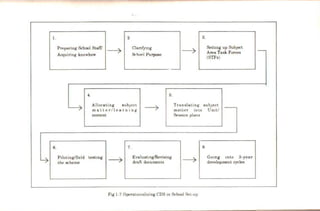
  • 23.
    their own devicesand just do their thing unmindful of what goes on in the other classrooms. This lack of articulation and coordination results in glaring "gaps" and "overlaps" in the program of studies. Often, instead of correcting this situation, the teachers resort to the "'blaming syndrome", pointing an accusing finger at one another for the ineffectiveness of school instruction. A coordinated, coherent curriculum system brings the school staff together to articulate expected learning out- comes for different levels and make everybody "pull in the same direction." The principal's role is to "orchestrate" or "di- rect'' the varied contributions of the staff members according to a cooperatively drawn-up and mutually accepted education "libretto" or "script." CONTINUITY. Again, in many schools, curriculum is the exclusive domain of the principal or academ1c coodinator or, in some instances, a "chosen few." The teachers are reduced to mere implementors or purveyors with nothing to say in its improvement, let alone planning. In such a case, the curricu- lum can be likened to a flower pot that the principal brings with him to his new assignment. A curriculum of this sort does not provide the staff a sense of"collective ownership" that will give the incentive to work for its success. Besides, the in- evitable departure from the scene of the curriculum initiator or proponent brings about a "vacuum" which necessitates put- ting m a "new" curriculum by the successor in a vicious cycle. Consequently, the school never moves onward. It takes a few steps forward only to fall back and start all over again every time a new princ1pal takes over, following the dictum, "'bagong hari, bagong gawi; bagong factotum, bagong kurikulum." This culture of discontinuity not only negates whatever gains may have been made but can also be very demoralizing to the staff who must bear the brunt of the constant change and continu- ing overhaul of the program. QUALI'IY. Finally, if we are in the business of education for quality, we cannot afford to do our work in a disorganized, cavalier manner. Quality implies plannmg, development and control. If we spend so much money, time and effort to ensure high quality in the production of material products, should we not be more concerned with quality when forming the "human II
  • 24.
    product" - ourstudents of today and graduates of tomorrow? Since the improvement of our society depends in large meas- ure on the quality of our graduates, we have a grave moral responsibility to make a conscious effort to systematize our curriculum and instruction so as to tum out the kind of gradu- ates who will bring about the kind of society we expect and deserve, no less. CDS: The HOW ofIt At this, point, the question can be asked: How can unity, conti- nuity, and quality be achieved through the school curriculum? It is our contention that the systematic and collaborativt process of CDS will be an answer to the question . The four stages involved in the initiation and implementation of CDS are all meant to bring about these triple thrusts. The stages involved in the process are the follwing: Stage 1. Stage 2. Stage 3. Stage 4. c~~~ . -{tounderscore _ the 66Ree~t* ~ thrust of quahty Operationalizing - to address the thrust of untty Institutionalizing - to ensure the thrust of continuity Conceptualizing Phase One useful way of looking at a school is to view it as a "production system." One of the characteristics of all systems activity is the tranfonnation of the input through the system's processes and structure into an output. The classic production or "black box" model illustrated in Fig. 1-3 below presents this idea. 12
  • 25.
    E N iB E N T I Feedback Loop II III THRU - Pl Quality Control Mecha01sm IV T Fig 1-3 Genenc Production System Model E N --1 O~UT l ? i E N T The input represents the "raw 1uaterials" appropriated from the environment and introduced into the system according to speci- ficatJOns called for by the intended product. The process or thru- put consists of the complex set of operations or stages, procedures or activities which transform the mput. The output is the "finished product" or the material in its terminal state with new value added which is then issued or exported to the enVlronment. The outcome of system action is invanably evaluated by the consumers of the product. Thus, if a system is to maintain itself and its operation, it is imperabve that it ensures the acceptability of its output. In order to ensure such acceptability, some form of product quality control is necessary. The system has to provide for a continuous assessment of its output through feedback so that needed adjustments can be made at any point in the process. In the production system, we usually begin with a concept10n of the output, defining its specifications or identifying characteris- tics. Only when these are clearly spelled out in a production blue- prmt can the whole production process begin. In like manner, in the school production system, we must first enVlsion our product, i.e. the Ideal Gradute at the end of the proc- ess or upon graduation. One way to do this 1s to describe or make a 13
  • 26.
    profile of thisperson in terms of the knowledge that he wil1 posses, the skills that he will be able to utilize, and the attitudes and values that he will internalize. This is aptly dep1cted in the trian- gular figure representing the school output in our next model (Fig. 1-4). Once we have a clear conception of the output, the school can now procure the inputs or student recruits. In the model, two trungs can be observed about the input. The figure is m the same shape as the output, namely, triangular. This suggests that the in- put should have the potential to be formed into the desired output. Meaning, students we take into our school should be made of stuff that could be formed to approximate or come as close as possible to the Ideal Graduate. To be sure, not one of our graduates will meas- ure up completely but we should define at least some acceptable level or standard for measuring our graduates and certifying that they indeed have the kind of "quahty" needed for productive and useful lives in society The broken lines of the triangle indicate that the inputs are indeed "raw" and stlll have to be fonned in the likeness of the output. This is precisely what schooling is all about, namely, to help in the formation of the young human being. In the words of one educator, "to make perfect that which is imperfect." The thru-put of the school system is much more complex and involved than the ordinary system thru-put. The reason should be obvious. We are dealing with a human person, a complex being, Ftrst, the process involves several stages covering a long period of time. In the model, each vertical division represents a grade level corresponding to a one-year period. Thus, even if we take basic education alone, that would encompass at least ten years. ln some cases, there will be more stages as the student goes through higher levels of schooling. The second feature of this thru-put is the horizontal divisions designating the different subje~'t areas in school such as Communi- cation Arts, Mathematics, Science, Social Studies, Cultural Arts, Physical Education and others. Each subject area has its own peculiar contribution in terms of knowledge, skills and values to- ward the formation of the Ideal Graduate. Thus, the thru put now 14
  • 27.
    consists of interrelated"blocks", each block bemg the contnbution of respons1bd1Ly of one teacher. Assuming that each teacher puts in his block firmly and securely, the resulting structure is strong and sturdy. Conversely, if some teachers do not do their share properly, the structure will manifest some structural defects and weaknesses. The thru-put in the model is the school curriculum. It is the instrument used by the school in ensuring that every teacher will do his part in maintaining quality in the school pro- gram. ,f"" Input A 1 I I I /Begin- / omg audents L _ _j CA Mnth Sc -ss Arts P.E "'· Grade Levels 1 2 3 4 5 6 7 8 9 10 Thru-put Curriculu mllnstruction Quality Control =School Standard. Fig. 1-4. School Production System Model CONTEXTUALIZING PHASE Output Ideal Gradute Values The next phase involves fitting the conceptual framework ' that is, the production model, m the context ot the school. Earliel we reduced the curriculum into a system having three components, namely, purpose, means and assessment of outcomes. Actually, this formulation is based on a universal management model involv- ing three processes: planning, implementmg, and evaluating. This is the so-called PIE Management Model shown in Figure 1-5. 15
  • 28.
    I PLANNING II IMPLEMENTING III EVALUATING I Fig. 1-5 PIEManagement Model This model can be adopted for use in the planning and man· agement of the school curriculum. The CDS model as illustrated in Figure 1-6 is one such application. Following is a brief explanation of each of the components. 1. Plannzng. This stage involves the formulation or clarifica· tion of the school purpose. School purpose is summed up in the School Vision. Vtsion issues from the philosophy of the school, expressed in the school mandate or Mission Statement and delineated in the school goals. Later, learning objectives are drawn from these goals which be- come the operational and spec1fic targets of achievement on the classroom level. 2. Implementing. The implementing stage includes two as· pects: (a) The selection of learning content based on school pur- pose and organizing it for systematic delivery in a Scope and Sequence Grid (SSG) for each subject area. 16
  • 29.
    I PLANNlNG II.IMPLEMENTING III. EVALUATTNG ProCClili: Defuung!Clanfying Processes: Process a) Sclect1niand organiz1n~ conlcol in Detenruning prolilt· or lcvcls of a Scope )cqucnce Gn (SSG) mastery/ maintaining stundard~ of qulll- SCHOOL PURPOSE Content 1 2 3 4 5 6 1ty as gleaned from the PAR a x X X X X 1 a X X X X PHILOSOPHY a x X X a X X t a x a MISSION STATEMENT b) Bud3,et1ng content makin'J> the Progress Asscssm•.·nt Rc<:ord (PAR • t Gra c Level lnstrucllonal lans <GLIP> Student GOALS Week Quarter TPO 1 2 3 4 5 6 1-. f •1po -7 41) ! 1 2 3 .. --! t r - 11 X X 2 1 2 ) X X 3 Pror.Ieofthe 4 1.3 X X 5 1.4 6 7 1.5 ) X 8 1 6 X c) Prcparin~ for 1mplcmenl al1on - IDEAL through lantillas (Un1UScss1on 1 7 ) PlAne:) TPO 1.8 X _x GRADUATE It (x Indicat-es sub~tand~trd l(•vc•l [,( LEIR ELO of ma~U'ryt If.0.1 H.2 EO 1 1.3 - ---- Fll(. 1-6 ens Tri-stagc Model for MaDIII(l'mcnl of tht> Curm-ulum
  • 30.
    This serves asthe master plan or blueprint of the in- structional program ofthe school. From the SSG, each grade level or year level prepares an academic budget or allocation of subject matter of instruction or the Grade Level Instructional Plan C GLIP) in each subject area for each grading period. Most schools would do this on a quarterly basis. (b) The preparation for immediate implementation of the GLIP through the unit and session (lesson) plans or Plantillas for use in classroom instruction. 3. Evaluating. The results of instruction are measured and evaluated vis-a-vis specified learning objectives through a teacher-made mastery test at the end of every unit of in- struction. These serve as the indicators of the level of learning. The data are recorded in the Progress Assess- ment Record (PAR). The PAR enables the teacher to keep track ofthe profile of mastery of each unit as well as of the progress or lack of progress of individual students in any given academic quarter. The nuts and bolts of these processes are explained in some detail in the next section. OPERATIONALIZING PHASE Assuming that a school is sold on the idea of launching CDS, how does it go about initiating and carrying it out? Figure 1-7 on the following page shows the rational framework and flow of activi- ties and tasks to be undertaken when a school decides to adopt the scheme. 1. Preparation ofSclwol Staff. Adoptation of CDS represents a major shift in the management of the academic program of the school. Such a change is crucial as this will neces- sarily have a far-reaching effect on the school staff who will carry the brunt of the change. It is therefore impera- tive that the school staff be involved in its inception to ensure their whole-hearted support and cooperation. The teachers have to be put in a state of readiness to bring about greater receptiveness to the new program. The eli- 18
  • 31.
    1. 2 3. PreparingSchool StalTI -----7 Clanfymg -----7 Settmg up SubJect -- Acquiring knowhow &-h(Wll Purpose Area Task Forces (STFs) 4. 6. Allocating subJect -----7 Translating subJect matter/learn1ng matter into Un1t/ content Sesston plana 6. 7. 8 Piloting/field test1og -----7 Evaluating/Revising -----7 Go10g IDtO 3-year the scheme draft documents development cycles Fig 1-7 Operol10nahzing CDS 10 School ~l-up
  • 32.
    mate or osvchologicaltone of the school must be conduc•vc to staff commitment. The level of commitment should be sucl-- that the teachers Wlll not mmd the extra l• me and effort tnat will be required to put the new scheme m place. This preparation may take the form of a retreat or a senes of recollection/prayer sessions focused on the theme of comm1tment to the vocation of teaching. commun1ty and service. 2. ClanfyingIDefintng School Vision and Misswn. Th1s calls for the school staff going over the school purpose· phlio"o- phy, mission, goals and its final vision, in groups or en bane. This is necessary in order to ensure that thcsf' school beliefs and values are clearly understood and ac- cepted by everyone. This IS a good occasion to clarify and update some pertinent aspects of institutiOnal purpose to make them more relevant to the times. The culmination of this step is the drawing up and presentation of the pro- file of the school's "Ideal Graduate" in terms of spec1fic in- dicators ofknowledge, skills, and values. 3. Settwg up of Sub;ect Area Task Forces. The teachers are grouped into the Subject Area Task Force (STF), one per subject area. Each STF is made up of teachers represent- mg the different grade or year levels. If there are not enough teachers, a teacher may represent two cont1guous levels The most important criterion for assigning teach- ers in the STFs is that they have adequate knowledge of and/or experience in the subject area and are familiar with the developmental needs and characteristics of the learn- ers on a specific level. Th STF is tasked with the framing of the Scope and Sequence Grid (SSG) for the subject area. When all the subJect area grids are ready, the STFs of related subject areas like English and Filipino Commu- nication Arts, Mathematics and Science, have joint ses- sions for purposes of "aligning" subject matter by identify- ing points of correlation. This is meant to help umfy and strengthen the learning experiences of students at appro- priate levels. For instance, if colors are introduced for- mally in Math in Grade 1, this matter should also be 20
  • 33.
    taken up onthis level in Science so that common concepts and skills are reinforced and rendered more meaningfut and useful. 4. Allocatmg Subject Matter for Instruction. The purpose of the Scope and Sequence Grid is to provide an orderly pro- gression of learning content and to allocate this content to the different levels of instructiOn Once this is accom- plished, there is now a need to spread out or budget the content allocation for each level over the school year. This way the staff is able to plan ahead of time just how the content will fit into the instructlonal timetable. Generally, schools use a quarterly division of the school year. Given 40 weeks of schooling, there should be more or less ten weeks for every quarter. Although, realistically, only 7 or 8 of these will be used for actual instruction counting out non-teaching days and holidays as well as unforeseen sus- pension of classes. So, if the school plans on 8 weeks per quarter, this will mean some 32 weeks in all. Subject matter assigned to the level can then be organized into units of instruction corresponding more or less to a week. per unit. So, there may be around 32 units for the whole year. These units are given a code for proper identifica- tion. l"or instance Unit 1.1 is the unit for the 1st quarter, tirst week. Unit 1.2 is for the 1st quarter, week 2, and s:: and so forth. This becomes the Grade (Year) Level Instructional Plan (GLIP) for the subject area. 5. Preparing the Unit ISession Plans. From the STF, the work shifts to the Grade Level Team (GLT) or Year Level Team (YLT) as the case may be. The GLT or YLT is made up of teachers on the same level teaching the same sub- ject. The team is responsible f-or fleshing out the subject matter in the Unit Plans or "Plantillas." Assuming that a subject is taught on a daily basis, there should be 5 days available for every unit of instruction. However, again to be realistic, we can plan only on a maximum of 4 or evMl 3 days of actual teaching. If a teacher takes up a new lesson each day, there will be 3 to 4 sesston or lesson plans per 21
  • 34.
    unit. The lessonsare about related aspects of the instruc- tional unit and together contribute to the mastery of the whole unit. This follows the concept of "chain learning" which ensures that learning outcomes become meaningful and more lasting than when lessons are disparate and segmented. Each unit ends with an evaluation to deter- mine mastery of the unit objective just as each lesson has its own evaluation. The units, in turn, are related to one another. 6. Piloting or Field Testing. It is suggested that when the first draft of the Scope & Sequence Grid made by the STFs and the Plantillas prepared by the GLTs or YLTs are ready, they should undergo a try-out period of at least one school year involving some selected or volunteer classes on each level. The try-out is monitored and revisions or al- terations to be made should be noted. These observations and suggestions are taken into account in the periodic assessement and adjustment sessions as well as in the final evaluation of the draft documents at the end of the try-out period. 7. Evaluating and Revising Draft Documents. After the pilot run, the Scope and Sequence Grid goes back to the STFs and the Plantillas to the GLTs or YLTs for review. The suggested revisions are put in final form to be adopted for school-wide use. This does not mean that the documents are final. As mentioned earlier, curriculum development is a continuing process. So, as these documents are being used, the teachers should keep a journal where marginal notes are entered and serve as inputs for the periodic evaluation and modification of the documents. 8. Going into the 3-Year Development Cycle. The try-out may take a year or two. Once the documents have been fine-tuned, they may be adopted on a school-wide basis. rhe school can then go into a 3.year development cycle which will ensure the systematic, continuing development of the program. This will be explained further in the next phase. 22
  • 35.
    Institutionalizing Phase It ison~ thing to initiate a new curriculum, another to make it take root and flourish in a school. Thus, the need to institutional- ize the program. This means having 1t accepted as something legitimate and, therefore, the right thing to do This will ensure its continuous school-wide utilization for many years to come. To do this, we need to ingrain the scheme in the culture of the school. This can come about only if the school staff accepts curricu- lum development as a participative process which calls for "collec- tive ownership" of the enterprise. After the pilot-testing stage, the school can go into the 3-year development cycle. This is depicted in the model in Figure 1-8. The moment the school decides on a school-wide adoption of the CDS the total efforts of the teachers and administrators must be geared towards making the program work. However, in order not to dissipate energy and spread their effort thin, they can make use of the 3-year development cycle. In this approach, the school staff focuses its attention on one component at a time in tenns of reviewing, updating, and revising that component in line with cur- rent developments in the needs and interests of the learners, the emerging thrusts of society, and the new trends in the subject areas. In the first year of a cycle, attention is concentrated on review- ing and updating school purpose fonnulations and the correspond- ing learning objectives and content as delineated in the Scope and Sequence Grid. This is not to say that no attention is given to the other two components of the system. In the second year of the cycle, the attention shifts to the second component, namely, the learning experiences and resources as found in the Plantillas or unitilesson plans. For this year, all efforts are expended in incorpo- rating state-of-the art teaching strategies and instructional re- sources and materials. In the final year, the evaluation of learning outcomes becomes the focal point of updating. The school looks into the tesing instruments used in measuring student learning as well as the markmg system. In th1s scheme, the major thrusts of the in-service traimng during the school year will be on updating and upgrading of the component on focus for that year. 23
  • 36.
    The development effortcomes full cycle after three years but the work of improvement continues with a series of 3-year develop- ment cycles ad infinitum in the never-ending process of curriculum development. It should be obvious that in such a scheme, the school moves on to higher levels of excellence after turnmg a full ~ycle. This 1s concededly better than the situation when~ ma11~ 3chools find themselves in now, wherein they go to square onE' every time a new administrator assumes office and finds no ration- alized, built-in scheme of curriculum development. Ptlol yeor (s) 3-year development cycles Cycles I· Focus of Improvement S Y 1: Subsystem 1 S.Y. 2 Subsystem 2 S Y. 3. Subsystem 3 Cycle Il S.Y l : Subsystem l S Y. 2 Subsystem 2 S.Y 3· Subsystem 3 ... and so on ad m/initum Fig 1-8 CDS 3-yeor Development Cycle 24
  • 37.
    REFERENCES Armstrong, David G.Developing and Documentmg the Curricu- lum. Boston: Allyn and Bacon, Inc., 1989. Bean, James A, Conrad F. Toepfer, Jr., and Samuel J . Alessi, Jr. Curriculum Planning and Development. Boston: Allyn and Bacon, Inc., 1986 Doll, Ronald. Curriculum Improvement: Dectsion-making and Process, 7th ed. Boston: Allyn and Bacon, Inc., 1989. Immergart, Glenn L. and Francis Pilecki. An Introduction to Sys- tem for Educational Administrators. Reading, Mass: Ad- dison-Wesley Publishing Company, 1983. Leese, Joseph, Kenneth Frasure and Mauritz Johnson, Jr. The Teacher and Curriculum-Making. New York: Harper and Row, Publishers, 1981. Roche, Edward F. de. An Administrator's Guide for Evaluating Pro- grams and Personnel. Boston: Allyn and Bacon, Inc., 1981. Saylor, J . Galen, William M. Alexander, and Arthur J . Lewis. Curriculum Planning for Better Teaching and Learning, 4th ed., New York: Holt, Rinehart and Wmston, 1981. Schubert, William H. Curriculum:Perspective, Paradtgm, and Pos- sibilities. New York: Macmillan Pubhshing Company, 1986. Taba, Hilda. Curnculum Development: Theory and Practice. New York: Harcourt Brace Jovanovich, 1962. Tyler, Ralph. Basic Principles of Curriculum and Instruction. Chi- cago: University of Chicago Press, 1960. Tanner, Daniel and Laurel Tanner. Curriculum Development: The- ory into Practice, New York: Macmillan Publishing Com- pany, 1980. Wiles, Jon and Joseph Bondi. Curriculum Development: A Guide to Practtce, 2nd ed., New York: Macmillan Pubhshing Com- pany, 1984. Wulf, Kathleen and Barbara Schave. Curnculum Deszgn: A Hand - book for Educators. Illinois: Scott Foresman Company, 1984. 25
  • 38.
    Chapter TWO: SCHOOLPURPOSE 1 2 3 Learni.ug Learning Learning Evaluation Objective --7 Content --7 Experiences --7 of Learning Re110urces Outoomea 1' 1' 1' CURRICULUM AND SCHOOL PURPOSE The contemporary school, like Joseph's multi-colored coat, has many facets. Among these facets are curriculum design, organiza- tion for instruction, support services, personnel, financial opera- tions, school plant and facilities, and school-community relations. Everyday, professional decisions are being made on these facets of school organization. If these decisions are to be viable and effec- tive, they have to be viewed in a broader perspective, namely, the purpose ofthe whole enterprise. The model on the next page (Fig. 2-1) presents this perspec- tive. The model has two main components, namely Purpose and Programs. The Purpose provides the rationale, the raison d' etre, the end-all and he-all of schooling. The purpose is projected into the future as a Vision of the finished product of the proces.s of schooling, namely, the Ideal Per- 26
  • 39.
    ( PAST PRESENT FUTURE- - - - Philoeopby SCHOOL PURPOSE Vision Miaioo Statement '. Goal Statement 7 Objectives Feedback t SCHOOL PROGRAMS Fig. 2-1 . School Purpoae and Programs
  • 40.
    son we envisionat the end of the process. The Vision gives us a clear concept of the kind of person we hope our students will be- come. The sch ool should specify the kind ofknowledge, skills and competencies, attitudes and values that our graduates will possess in keeping with this Vision. Hopefully, in concert with other schools, these graduates wiH form a "critical mass" that will act as a leaven in transforming society into the "Ideal Society" of the future Now, this Vision depends largely on our philosophy of life and of education which is rooted in the past. Our concept of the Ideal Person depends on our fundamental beliefs and understanding con- cerning the origin, nature and final destiny of man, the nature and purpose of society, and the nature of human development and learning. Our philosophical and psychological perspectives rest on our answers to the following questions: Concerning Man: What is the nature of man? Where did he come from? What is he doing here on earth? Is the man- child inherently good or bad? Does he unfold from within or is he shaped from without? What constitutes the whole child? Concerning Society: What is the nature of society? What is its purpose? Is man made for society or is society for man? Is society basically individualistic or community-oriented? What are societal institutions, norms, patterns and how do they relate to the members? Concerning Learning: What is truth? What is th e source ofhuman knowledge? How does a person learn? How does one acquire knowledge? Skills? Attitudes and values? What is motivation and what role does it play in learning? What is -r~;aq.iness? Individual differences? Does a child learn better in d ··free" classroom? What is the place of control of behaviour- -md discipline in learning? · The school translates its philosophy in the present context of schooling into a Mission Statement which serves as its mandate of accountability to the larger society to which it owes its existence. This Mission Statement is further explained in broad targets or 28
  • 41.
    goal statements Thesegoals are reduced to more specific targets in terms of objectives in the different programs of school opera- tions. School programs reflect and implement school purpose. These programs are means of carrying out the School Mission and Vision. These are divided into two groups: the academic programs and the administrative programs. The acedemic programs include curricu- lum, instructwn, the co-curriculum, and the support services such as guidance and hbrary. The non-academic or administrative pro- grams are made up of school organization, personnel, finance, school plant and facilitaes, and school-community relations. All these programs exist only for one reason, namely, to contribute to the attainment of the school purpose. The curriculum, our focal concern in this book, is perhaps the most vital of all the school programs, the school being an institu- tion of learning. The school goals based on our shared beliefs concerning man, society, and learning become the bases of deci- sions in dealing with the following questaons: What kind of in- structional program is most effective? How are the learners to be orgamzed for learning? Is the self-contained classroom preferable to the departmental scheme? Is it better to have homogeneous groups or heterogeneous groups for instruction? How should sub- ject area content be orgamzed for teaching and learning? Should we orgamze content around subject matter, the needs of the lear· :'ler or societal considerations? Obviously, the school cannot answer these questions decisively un Jess ItS purpose is clearly spelled out. School Purpose: Meanings and Applications The term "purpose" simply means direction, intention or de- sired end. It is an inclus1ve term used generally to mean the reason for which something exists or is done. However, in educational jargon, we come across synonyms or variations of this term and 1t is important for practitioners to get a clear idea of what each term means specifically. One thing though should be kept in mind, and that is, all these terms are derivatives of and have to do with school purpose. 29
  • 42.
    The following arethe terms: Vision. This is the end product envisioned at the conclu- sion of the educational effort based on shared beliefs and val- ues culled from one's philosophy. It provides the focal point or unifying element according to which the school staff behave or perform, individually and collectively. Philosophy. This is a composite statement of concepts, beliefs, and values concerning two important realities, MAN and SOCIETY, and their relationship. Mission or Mission Statement. This a is set of very broad statements that spell out what the school is all about and how it intends to carry out its Vision in its educational effort. Goal or Goal Statements. These are broad targets or state- ments ofintent or direction delineating the Mission Statement in the different domains or areas of schooling. Goals are gen- eral and "timeless" and are not concerned with any particular achievement within a prescibed period of time. Objectives. This is the most specific of the terms denoting purpose. An objective is a specific target or accomplishment that can be verified at a designated time and under specifi- able conditions which, if attained, advances the school toward the achievement of a corresponding goal. Figure 2-2 on the next page gives an example for each of these terms for further clanfication. School Goals School goals are general statements that delineate the out- comes of schooling. The scope of the educational program of a school can be summed up in the goal statements of that school. Goals are the basic elements or building blocks of educational plan- ning. The reflection of individual and societal needs and expecta- tions in goal setting results in statements describing different cate- gories or areas of human development or behavior. Thus, goal statements may encompass the following aspects of the total development of a human person: spiritual, moral, intellec- 30
  • 43.
    Statement of Purpose VISION PHIT..OSOPHY MISSION GOAL OBJECTIVE SampleStatement The school will produce self-directing graduates, i.e., persons capable of logical thinking and making enlight- ened decisions for themselves. Man is a rational being; he has an intellect and is ca- pable of understanding, rea- soning and judging. The school will provide opportunities for the develop- ment of thought processes that will promote self-direc- tion. To develop the Ieamer's ability in critical thinking and problem solving. Given a problem, t}~·stu­ dent will find thP. solution us- ing the scientific method of investigation. Fig. 2-2 Types of School Purpose and Sample Statements. 31
  • 44.
    tual, aesthetic, emotional,social, and physical. Another way of c1assifying goals may make use of the fol1owing divisions: health, command of fundamental processes, worthy home membership, vo cation and work, citizenship, worthy use ofleisure time, and eth1cal and moral character. The Association for Supervision and Curricu- lum Development (ASCD) working group on research and theory identified a "cluster of goals" that reflect the wholistic nature of individuals. These are the fo11owing: 1. Self-concept and self-esteem 2. Understanding others 3. Basic skills 4 . Interest in and capability for continuous leam mg 5. Reponsible membership in society 6. Mental and physical health 7. Creativity 8. Informed participation in the economic world or produc tion and consumption 9. Use of accumulated knowledge to understand the world, and 10. Coping w1th change. Still another way of organizing school goals is to group them according to the distinguishing characteristics of the school. For in- stance, a school may state its goals under the following headmgs: 1. As a Catholic school 2. As a J esuit school 3. As a Filipino school 4. As an elementary school But whatever format may be used, what is important is that ~he goals are consistent with the Vi.siont :tnd Mission and can be realistical1y pursued. Otherwise they remain pure rhetoric, nice on paper but highly idealistic and impractical. 32
  • 45.
    Sources of School Goals As previously stated, goals provide a philosophically-based structure that unifies and relates all aspects of school leammg from the development of an overall curriculum blueprint to the lesson plans used in the classrooms. The question may be asked, however: What are the valid sources of school goals? Where do we derive these goals? Literature on curriculum planning and studies on goal formu- lation will reveal divergent views as to the best sources of goals. In the final analysis, goals are a matter of cho1ce and may be considered as a form of value judgment of those responsible for the school. Hopefully, such a decision will not be arbitrary or whimsi- cal, predicated on the preference of an indtvidual or a group. Rather, it should be based on an understandmg of what schooling is all about, in general, and what role curriculum plays in school- ing, in particular. Clearly, the final chmce of goals reqUJres certain kinds of inputs for enlightened decis10n-making in curriculum planning. Ty- ler suggests three sources of data or inputs that have a major claim to consideration as curriculum planners and developers make choices on what to include among their goals, namely: 1. The learner. The purposes, interests, developmental needs and characteristics of the learner should gu.ide our choice ofappropriate goals. 2. soc,ety. The values and behaviors defined as desirable by a given society help shape the goals of education in that society. 3. Fund ofKnowledge. Human knowledge that has been ac- cumulated and organized for universal use and application now and in the future. This also includes updated and newly generated knowledge. Data on the Learner The learner himself is a prime source of inputs for setting schools goals. After all, the learner is the subject of the schooling 33
  • 46.
    process. Data onthe learner may be culled from different theories in developmental psychological on "needs." and "interests" of learn- ers. The term "need" is a psychological construct indicating a cer- tain lack or deficiency which creates a tension in the individual. Needs have to be satisfied for the individual to function effectively in life. These needs are present in varying degrees at the different stages of the individual's life cycle, from infancy to adulthood. They manifest themselves in the different aspects of human devel- opment- physical, intellectual, emotional, social, moral and spiri- tual. Another set of data on the learner that can be taken into account are those borne out by the studies on learner interests. This is speciaJly relevant in the light of the proposition that a learner learns best those things that are of interest to him. Both learner needs and interests are central to motivation in any kind of learning. One problem that school practitioners face in this regard is the paucity of studies on Filipino children and youth. Hence, we have only a sketchy idea of the personality mold of the young in our classrooms. Curriculum planners and teachers depend a lot on a good old intuition, common sense and conventional wisdom. Too, the fact that our schooling system tends to be rather centralized and structured militates against teacher initiative to be more ac- tive in gathering such data. Be that as it may, it should not stop our school people from a systematic gathering of data through painstaking observation, questionnaire mtd interview, and re- search so we can build a data base for curriculum planning. At any rate, the following points should be considered when studying learner inputs as a basis for goal setting: 1. Learner characteristics should include all of the learner's personal needs, interests, and all aspects of his develop- ment- physical, motor, mental, emotional, social, moral and spiritual; environmental influences, and social orien- tation. 34
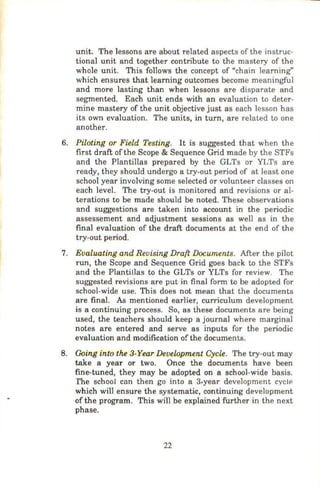
  • 47.
    2. Data onlearner characteristics do not automatically lend themselves to goal formulations; they must be interpreted in the ligth ofcertain desirable norms and values. 3. Determination of goals from these inputs involves per- sonal judgment on the part of the school staff. As was • stated earlier, goals are, in the end, a matter of choice based on philosophical grounds. 4. There are needs and needs. Some may be appropriately addressed by the school. Others may be served better by other social institutions and agencies like the horne, the church, the government, etc. Data on Contemporary Society Society has certain expectations of its members. More specifi- cally, civil society or the state, expects its citizens to learn some basic human functions and tasks that will make them contributing and productive adult members. These include socio-cultural, eco- nomic, political, and vocational-technological tasks. Contemporary life in society 1s becoming more and more com- plex. The school needs to be attuned to contemporary developments in society in order to be able to gear its efforts to the critical aspects of living in contemporary society. Demographic trends, changes in family and community living, and scientific and technological changes are some of the sensitive areas that need to be studied and reflected in the curriculum. However, as in the case of data on the learner, the school should exercise care in interpreting these inputs. An identification of characteristics of society or of conten-;Jorary events will not nec- essarily indicate desirability for inclusion in the curriculum. It may well be that these data reflect adult preferences and biases but may not serve well the interest of the learners. It must be made clear that current knowledge is tentative and subject to further verification and modification. Schools have been cnticized for en- couraging the cult of "presentism" or "conformism". The school should also be concerned about the future world that the learners of today will inherit and inhabit. Anthropologist Margaret Mead stresses the point that our schools should prepare our children for 35
  • 48.
    the world oftomorrow that we cannot even imagine. As the poet- philosopher, Khalil Gibran puts it, these children will live in "the house of tomorrow which we cannot visit even in our dreams." It is imperative then that the curriculum designer must con- sider both the real and ideal order of things in society. While bound by the limits of actual social forces operating at present, we are obligated to seek ways and means of carving out the "better life" and the "good society" of the future. In doing so, the curricu- lum planners should take the following soc.ietal factors into consid- eration: 1. Health, family, recreation, vocation, religion, cil:izenship, special groups, etc. 2. Dominant ideas, values, problems, issues, etc. 3. Natural and human resources, population changes and movements, patten1s of migration, etc. 4. Careers and vocations open to graduates, increased leisure time, general education vs. specialized education, etc. 5. Mechanization, urbanization, complexity, specialization of functions and services, etc. 6. Political trends, polarization (left, center, right), human rights, civic duties, governmental functions, constitutional guarantees, non-governmental organizations, etc. 7. Economic development, production and consumption, con- sumerism, social justice, countryside development, indus trialization, equal access to the wealth of the nation, GNP, etc. 8. Regional and local divisions and governance, inter-group conflicts, interdependence, etc. 9. International cooperation, cosmopolitan interests, foreign affairs, reliance on foreign loans and assit>tance, national sovereignty multi-national operations, etc. 10. Technological advances, impact of mass media, instant communication, computerization, etc. 36
  • 49.
    The Fund ofKnowledge Another source of data in developing goals are those coming from the sciences and humanities which form the core of the school subjects. This is in fact the most common and readily available source of school goals. This source has become all the more impor- tant in the light of the so-called "explos1on of knowledge" and the ever-expanding fund of knowledge in the different domains of hu- man learning. With so much new knowledge being added, the inevitable question is: Which should be included in the curricu- lum? Obviously, we cannot include everything. There must be l!aretul selection to include only that which is relevant to and •oecessary at the level of maturity of the learner. Thts is where goals are important in limitmg what should find their way into our curriculum. To be sure, there are basic knowl- edge, skills and processes, appreciations, attitudes and values, that need to be considered in setting up the curriculum at this level. In this, we can be guided by the pronouncements of experts on con- temporary trends and developments in the different disciplines. Such pronouncements can be found in professional literature, stud- ies and reports of different associations and groups dealing with special fields both here and abroad. Again, &s in the case of data on the learner, we may not have as much data on local trends and developments in the different subject areas but we can rely on whatever has been dorie by such groups as the Philippine Society for Curriculum Development (PSCD), the Philippine Association of Language Teaching (PALT), the Philippine Social Science Council (PSSC), the Mathematics Society of the Phihppmes (MSP), and others. One relevant source of content is the learning content contin- uum formulated by the Department of Education, Culture and Sports (DECS). This could provide the core of curriculum content although the schools could include other matters they deem neces- sary and relevant. Screening of Goals Using the foregoing as well as other sources, the school can proceed and list down a good number af goals statements. How- ever, these goals remain tentative and should be subject to verifica- 37
  • 50.
    tion for ac~ptabilityand feasibility. This is done by subjecting the preliminary set of goals to two screens before they are finally adopted and become the basis for the formulation oflearning objec- tives (Fig. 2-3). 1. Philosophical Screen As we have seen, a school operates on a number of philosophical assumptions and values. It is against these beliefs and values that school goals should be validated. The question to be asked here is: Is this goal desirable? Philosophy tries to define the nature of the "good life" or the "good society". For instance, we would expect our educational philosophy to reflect values consistent with the aspirations of our people for a democratic way of life coupled with socio-economic development and social jus- tice for all. Principally, the philosophical basis of Philippine edu- cation may be found in our fundamental law, the Constitution. Expressions of this philosophy may also be culled from educational legislation, judicial interpretations and decisions on educational matters, and executive or- ders. They may also be found in periodic reports of duly constituted bodies which specify the major thrusts of the Philippine educational system such as the Department of Education, Culture and Sports (DECS) and its instrumen- talities, educational commissions and the annual Educa- tors Congress. Additionally, if the school is a church-related institu- tion, the philosophical screen will also include the corre- sponding educational philosophy of the Church as well as contemporary Church pronouncements on the role of the school vis-a-vis its members. Schools run by a religious congregation will also have the consider the specific charism and thrusts of the Order in screening school goals. 38
  • 51.
    Source SoCiety Screen of Phtlosophy Source The Learner TentativeGoals Final Goals Source Fund of Knowledge Screen of PsychoJocy Ftg 2-3 Development of School Goals 2. Psychological Screen After a goal statement has hurdled the first screen, it passes through the second screen, the psychological screen. Assuming that a goal is acceptable, the question has to be answered: Is the goal feasible? Or, more pre- cisely, Can it be attained realistically in the school pro- gram? Here, the school has to consider its nature and 39
  • 52.
    capabilities as wellas the level of maturity and develop- ment of the learners, and nature of the learning process on that level. The psychological screen enables the curriculum plan- ners to do the following: a. Distinguish between changes in behavior which can result from the learning process and those that cannot. b. Distinguish what can be done from what cannot be done because they will take much time at the age level in question. c. Determine prerequisite conditions for certain types of learning. d. Suggest length of time over which goals should be pursued and emphasized. e. Determine goals that are consistent with time- tested principles and practices of teaching and learning. Levels of School Goals School goals are broad targets of accomplishment contempora- neous with the schooling period. However, goals may be stated at several levels of generality or specificity depending on the range of coverage. For this purpose, school goals may be categorized in hierarchi- cal order as follows: Institutional Goals. These goals are formulated for the whole institution as inspired by its Vision and Mission as well as its peculiar thrusts. Each school usually comes up with its own set of goal statements consistent with its philosophy with a view to developing its "Ideal Graduate." These goals may have some similarities with those of other schools but will usually contain unique statements owing to the school's pecu- liar orientation and emphasis. 40
  • 53.
    School Level orDepartment Goals. These are amplifica- tions of institutional goals as they apply to specific levels of in- struction, i.e., tertiary, secondary, elementary or pre-elemen- tary vis-a-vis the developmental characteristics of learners at those levels. Program or Curricular Goals. These are goals specific to each curriculum strand or subject area such as Communica- tion Arts, Mathematics, Science Studies, etc. They spell out the peculiar contribution of the subject to the development of the "Ideal Graduate" of the school. Course or Year Level Goals. These are goals of subject areas appropriate for each grade or year level. They provide the yardstick according to whi<:h the student is measured and deemed to have met the desired competencies at the end of the school year and is therefore eligible for promotion to the next higher level. Classroom or Instructional Level. On this level, we no longer use the term "goal". The more appropriate term used is "objective" as the purpose of instruction must be very specific and verifiable. Instructional Objectives Benjamin Bloom defines educational objectives as "explicit for- mulations of the ways in which students are expected to be changed by the educative process." Robert Mager, for his part, states that an instructional objective is "an intent communicated by a statement describing a proposed change in a learner; of what the learner is to be like when he has successfully completed a learning experience." It should be noted that the common element in the two defini- tions above is "change". Purposeful human learning should result in some habitual change in behavior . If schooling is to bring about the desired or intended learning in a person, it must specify the kind of new behavior that should result from planned experiences and activities in the curriculum. This is where instructional objec- tives are useful. 41
  • 54.
    Instructional objectives ideotifyand state the specific overt change that is expected to huppen as a result of a teachmg-learnu1g unit or lesson. These obJectives delineate more explic1tly the gen- eral goals indicated by the school for purposes of the 1mmediate planning of day-to-day instruction in the classroom. Clearly understood, instructional objectlves may serve the fol- lowing useful purposes in curnculum planning: 1. Define the direction m which desired growth and develop- ment should take place. While it is an accepted fact that learning takes place even outside of the school, much of this learning may lack focus and direction because the experiences are not planned and pointed towards spec1fic intended learnings. Objectives in the context of curricu- lum and instruction precisely serve the purpose of direct- ing all learnings toward the attainment of the goals and Mission of the school. 2. Provide a basis for the selection of learning experumces. There are many variegated things that the learner can and must learn. Hence, the need for a basis for selecting the most appropriate experiences at a certam level of de- velopment and for organizing such experiences. Th1s can be done by drawing up a relevant and comprehensive hst of instructional objectives. 3. Prouule a basis for evaluatmg learning outcomes. Instruc- tional objectives spec1fy the facts and information, ideas and understandmgs, skills and habits, attitudes and ide- als, values and behavior patterns that the school deems important and therefore to be learned by its students. In this connection, the school sets the levels of mastery or standards of achievement which students are expected to attain. Evaluation of the results of the instructional proc- ess is geared towards determining the progress or lack of progress of each student vis-a-vis these objective norms. Limitations and Some Considerations While it may seem that instructional objectives are generally useful in planning curriculum and instruction, we have to be cogni- 42
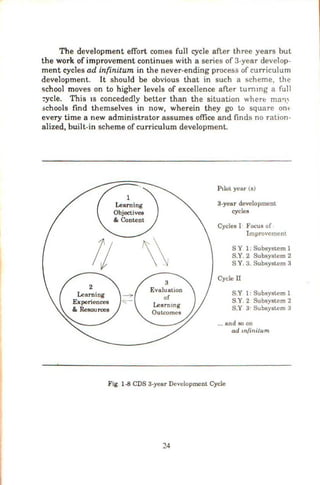
  • 55.
    zant of certainproblems and issues. Three such considerations are as follows: 1. The difficulty of defining exactly what instructional objec- tive really means. Does the objective refer to the behavior of the learner while in the process of learning or to his behavior at the end ofthe learning sequence? Does it refer to the immediate result of learning or the long-range use? What is the real test of learning - at the end of instruc- tion or in real life situations? 2. The dif{LCulty ofspecifying the instructional objective in the fullness of details. A single behavioral act consists of many contributory elements. Often these elements are not easy to identify as distinct parts of a complex behavior. Also, these elements may vary from situation to situation. On the other hand, if they are left out altogether, the terminal behavior may not be adequately identified. 3. The problem of specifying the appropriate level of habitual change in behavwr. This may be easier to do when it comes to factual knowledge and skills but may be difficult to determine when it comes to the affective states, i.e., appreciations, attitudes, ideals and values. Admittedly, writing instructional objectives of the affective variety is the most difficult because these changes do not readily admit of quantification and verification. As one educa- tional wag pointed out, "some immeasurables are immeas- urably important." It should be borne in mind that behavioral outcomes of in- struction are only the proximate objectives of learning. These ob- jectives are rather isolated modifications ofknowledge/ and under- standing, skills, attitudes and values which induce the new behav- ior and make it possible for habitual use in the future. To stress the behavior as an end in itself rather than as a means to an end is somewhat inaccurate and misleading. Why use objectives then? We resort to objectives that are overt and observable simply on the ground that knowledge, under- standing, skills, attitudes and values are internal passive states which we can assess only by eliciting behavior indicative of or re- 43
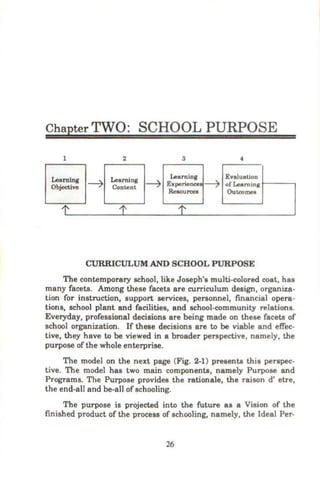
  • 56.
    suiting from them.Hence, the behavior exhibited in instruction by the Ieamer is a useful indicator of the inner dispositions or quali- ties of the learner resulting from instruction. With these considerations and caveats in mind and in the absence of a better device, instructional objectives can serve a use- ful purpose for curriculum planners and implementors, especially teachers. Characteristics of Instructional Objectives It may be helpful to use a set of criteria in judging the appro- priateness of instructional objectives. The following guidelines are culled from the working papers of the Presidential Commission to Survey Philippine Education (PSCPE) set up in 1971. 1. Are the objectives clearly stated? Do they specify what the learner must be able to do or perform when he is exhibit- ing mastery of the Abjective? Do they specify unobservable (covert) or observable (overt) student behavior which if present indicates attainment of objective? 2. Are they limited to those which clearly the school has a reasonable chance of achieving? 3. Have they been understood and accepted by those whose work they are supposed to influence? 4. Do they reflect both individual and group needs? 5. Are they reasonably comprehensive but concise? 6. Do they have unity and consistency? 7. Do they lend themselves easily to evaluation of outcomes? From the foregoing guidelines, we may draw up the following characteristics of a well-written objective. 1. Specificity. As indicated, objectives provide external evi- dence oflearning, either knowing or feeling. This evidence must be observable and verifiable. Objectives are state- ments descnbing what the learner is doing when he is learning or what he should be able to do at the end of the 44
  • 57.
    learning activity. Weneed to describe precisely what this desired behavior is in order to preclude misinterpretation. Thus, the key to writing apt objectives is to use action words that describe specific behaviors of the learner. Hence, the use of the word "know" and "appreciate" is not appropriate because they do not describe exactly what new behavior is learned. The question may be raised. How do we know that he knows or appreciates something? How can we check? For examples of acceptable terms used in writing instructional objectives, the reader is referred to the list that follows: The following suggested ways of stating behavioral objectives are based on Bloom's classification or taxonomy of objectives into three domains - cognitive, affective and psychomotor. I. COGNITIVE A. Knowledge objectives. At the end of the lesson or unit, the learner will be able to: 1. recall, recognize data, concepts and generalizations 2. deduce that - - - - - - - - - -- - -- 3. id~ntify or recognize that-- - -- -- - - - 4. distinguish from-- - -- - - B. Inquiry and Skill Objectives. At the end of the lesson or unit, the learner will be able to : 1. describe and compare - - - - -- -- - - - - 2. explain how 3. demonstrate how 4. distinguish 5. consider and use 6. plan carefully 7. conceive varied ways of 8. formulate - - - - - --- effectively 9. give evidence or proofof 10. weigh the validity of 11. use of variety of 45
  • 58.
    12. locate, gather,appraise, summarize and report tht> 13. read ______ ___ critically 14. compare, interpret the abstract _ _____ _ _ 15. conclude from available supporting evidence that 16. express ideas effectively ------ ----- 17. organize materials from several sources _ ____ 18. note sequence ofevents 19. examine critically 20. consider every aspect of 21. recall experiences partinent to 22. state clearly 23 select materials relevant to 24 classify 25. analyze 26. differentiate 27. define clearly 28. infer or deduce that 29. arrange 30. correlate to 31. discuss intelligently __ 32. establish that 33. emphasize that 34. predict that 35. observe keenly 36. specify 37. record accurately 38. list down 39. examine carefully 40. disseminate 46
  • 59.
    II. AFFECTIVE A. Attitudes,appreciations, ideals, interest. At the end of the lesson or unit, the learner will be able to: 1. assume responsibility for - - - - - - -- -- 2. utilize wisely and effectively 3. observe strictly 4. listen critically and purposively to - - - -- -- 5. participate actively in - - - - -- - -- - - 6. sustain interest in - -- -- -- - - -- -- 7. share with - -- - - -- - - - -- - -- 8. tolerate--- - - - - -- -- -- - - -- 9. comply with - -- - - - -- - -- - -- 10. accept 11. find pleasure in 12. formsoundjudgment - - - - - - -- - - - 13. venerate - -- -- -- - - -- - -- - - 14. control 15. equalize - - -- - - -- -- - - -- - - 16. admire - - -- - -- -- -- - -- - - - 17. appreciate --- -- -- - - - - - -- - - 18. follow - - - - -- -- - -- - -- - - 19. a~ust _____ ______ _ ___ _ _ 20. vruue ______ ___________ _ _ 21. satisry --- - - -- - - - -- - ------ 22. visit ------- -- - -- - -- - - -- 23. conserve ---- - - -- - - - - -- - -- 24. maintain 25. show respect for ---- - - -- -- - - - - 26. stren~en - - - - - -- - -- - - - -- 27. initiate worthwhile projects ---- -- - - - - 28. commemorate --- - - - - -- - - - -- - 29. intensify----- - - -- - - -- -- - - 30. sharpen 47
  • 60.
    31. exert effortin - -- - ----------- 32. generate _______ _ ___________ III. PSYCHOMOTOR A Skills. At the end of the lesson or unit, the learner will be able to: 1. construct-- - - -- - -- - - - - - - - 2. manipulate - - - -- -- - -------- 3. use - - - - - -- -- ---------- 4. perform 5. measure 6. operate 7. handle 8. execute 9. install 10. connect 11. experiment 12. assemble 13. copy 2. Performance Standard. The objective must include the minimum level of acceptable performance of the learner. It is not enough that the students is able to exhibit the behavior. We must also be able to tell how well he is doing it in relation to expected levels of mastery. Two levels may be set: a. Individual Student Level. This is an explanation of how well an individual student should be able to per- form a particular behavior e.g., given 20 words ran- domly selected, the student will spell out correctly at least 15. b. Class Level. This indicates what percentage of the class must perform at a specified minimal level ofmas- tery, e.g., at least 70% of the class will spel1 correctly all 20 spelling words. 48
  • 61.
    3. Attainability. Insetting up our standards, there is a need for us to know the ability level of the learners for whom the objectives are mtended in the first place. Objectives are for students and not the other way around. A good knowledge of student characteristics and abilities help in setting realistic expectations. It is well to consider also the entry prerequisites and readiness level of the learners when formulating objectives to ensure attainment. The exhortation not to give "too much, too soon," is appopos in this regard. 4. Measurability. If we are to detennine levels of perfonn- ance against standards, we should be able to quantify the behavior and consequently measure it. Objectives are use- less unless some fonn of assessment of learning outcomes is undertaken. At the end of the learning sequence, we must look for the evidence of learning in relation to the standards we have set. This is only possible by using a tool for measurement which is usually but not exclusively in the form of a quiz or test. Format: Writing Instructional Objectives We have seen that objectives are statements describing what the learner is doing during or will be doing upon completion of learning. An acceptable objective lets the student know what is exactly expected of him. It also enables the teacher to measure the effectiveness of his own work. A well-written instructional objective contains the following essential elements: 1. The terminal behavior must be identified by name. An ob- servable behavior must be stated that shows exactly what sort of learning has taken place. 2. The important external conditions under which the behav- ior is expected to occur should be included. 3. The criteria of acceptable performance should be specified. 49
  • 62.
    A simple methodof stating a complete objective statement is through the use of the so-called ABCD format, where - "A" is for "audience" or the target group of learners who wi11 learn the new behavior in terms of knowledge to be gained, skill to be perfected, or attitude/value to be imbided. The point to stress is that an objective is meant for a specific group of learners with unique characteristics, interests and needs. Hence, a "to-whom-it-may-eoncern" type of obJective wilJ not serve the purpose. "B" is for "behavior" that the learners will perform or ex- hibit to indicate achievement of the objective. This must be described in clear, concise, and concrete terms. "C" is for "condition" under which the behavior will be per- formed by the learners. In other words, any given or restric- tion that will obtain when the learner exhibits the desired behavior should be identified and specified. "D" is for "degree" of acceptable performance of the behav- ior, which may either be for the individual student or the· whole class. The example below will illustrate this format: A : Grade 5, Bonifacio section students B : Wi11 label the relief map of Luzon C : Without the use oftheir note Given a reliefmap D : At least 15 out of 20 provinces The objective statement will read thus: Given a relief map of Luzon, the Grade 5-Bonifacio students will be able to label cor- rectly at least 15 out of20 provinces without the aid of their notes. For more instructions and details on writing instructional ob- jectives, the reader should refer to the book of Robert Mager, "How to Write Instructional Objectives". Box 2-1 contains some pointers in evaluating instructional ob- jectives. 50
  • 63.
    Box 2-1 Checklist forEvaluating lnstructional ObJeCtives 1. Is the objective clearly related to the goal from which it is derived? 2. Do~s the objective include only one learning out- come? .}. (s the objective stated in terms of student behavior, not teacher performance? 4. Is the objective stated as a learning product, not procP.ss or activity? 5. Is the minimum level of performance indicative of acceptable achievement clearly specified? 6. Does the objective state the circumsta11ces or condi- tions under which the student will exhibit the de- sired learning outcome? Classification ofInstructional Objectives The advocacy of instructional objectives by those seeking to clarify educational purpose has met resistance from those who be- lieve that de&cribing learning outcomes in this fashion is too sim- plistic and educationally naive since it ignores the interrelatedness of human experiences. In the early rush to write clear and precise statements, teachers often chose simple objectives that required little thinking on the part of their students. These teachers actu- ally confined their objectives quite narrowly to one domain of learning, the so-called cognitive or knowledge domain, and at the lowest levels at that. Domains of learning in educational jargon designate a large group of learning opportunities, broad in scope, that are planned to achieve a single set of closely related educational goals. Domains then are useful categories of ~or goals and related learning ob- 51
  • 64.
    jectives. They donot necessarily embody the whole purpose of schooling but rather those aspects ofhuman development for which universal goals, and eventually objectives, can be formulated. They are not objective statements per se but can become a bas1s for formulating these statement. They are useful as a classification or taxonomic system that can be utilized for curriculum planning. The most notable of these domain classifications or taxono- mies are those developed by Benjamin Bloom and associates. They identified arbitrarily three such domains, namely, the cognitive, the affective, and the psychomotor domains. Following is a brief description of these domains and sample statements of instruc- tional objectives for each. Cognitive Domain or the domain of intellection and thought processes include the following: 1. Knowing, which has to do with learning and recallmg facts, terms, and other symbols, classifications, events, trends, principles, ways of working and theories. Sample Objective: Name five simple machines and state how each works. 2. Comprehending, which involves interpreting content , translating it to another form, and extrapolating elements from one situation to another. Sample: Explain a graph showing population growth trends. 3. Applying, which is using in new situations that which one has already learned previously. Sample: Show how respect for human rights is taken into account in R.A 3578. 4. An.alyzmg, which consists of breakingup wholes into their ~omponent parts and noting the nature o(the parts anc their relationship to one another. Sample: Specify three causes of the Philippine Revolu- tion of1898. 52
  • 65.
    - -------------------------------------------------- 5. Synthesizing,which is putting discrete or isolated ele- ments together and creating something new by combining these elements. Sample: Construct a model showing how soil erosion can be contained. 6. Evaluatmg, which is judging the worth of something or somebody based on certain cnteria. Sample: Distinguish between drawings which illustrate effective use of color and lines to focus attention on a central feature and drawings that do not. Affective Domain or the domain of sensing, feeling and believ- ing which include: 1. Receiumg, which is showmg interest in, giving attention to, and indicating awareness of an object, stimulus or phe- nomenon. Sample: Listen attentively to the first movement of "Nutcracker Suite". 2. Responding, which is giving willing response and replying with a feehng ofsatisfaction. Sample: Select three books voluntarily for leisure t·ead- ing and state ways in which they are interesting to the reader. 3. Valuing, which is accepting a value, prefering it, and be- coming committed to it. Sample: Show conviction by writing a letter of protest to a congressman on a bill deemed detrimental to public morals. 4. Organuing values by conceptualizing them, clarifiying ' .hem and systemati?.ing them in one's thinkin!? Sample: Formulate and state judgments on certain is- sues related to extension of equal work opportunities and privileges to women. 53
  • 66.
    5. Characterizmg valuesby internalizing them so they be- come eventually part of one's philosophy of life. Sample: Exhibit in several unrelated instances fulfill- ment of a promise once given. Bloom and associates, however, were able to work only on Lhe cognitive and affective domains of learning. Some educational writers have attempted to come up with a taxonomy for the psycho- motor domain. One such writer is Anita Harrow who formulated the following classification. 1. Fundamental Movements, which include physical motions such as walking, jumping, running, pulling, pushing, and manipulating. Sample: Dribble a basket ball twenty times. 2. Perceptual Abillttes, which include visual, auditory, tac- tile, kinesthetic and coordinated activities. Sample: Write correctly all the letters of the English al- phabet. ~--------------------------------------------~ 3. Physical Abilities, which include showing physical prowess, strength, endurance, agility, dexterity and time required to react or respond to a stimulus. ISample: Do ten pushups in one minute. 4. Skilled Movements which include well-coordinated move- ments in games, sports, and the arts. Sample: Play a full quarter in a basketball game 5. Nondiscursive Communication, which includes nonverbal communications through facial expressions, gestures, pos- tures, and creatlve body expressions. Sample: Create a rhythmic movement sequence and execute it to a musical accompaniment. For more details of these taxonomies of learning outcomes, the reader is referred to: Taxonomy ofEducational Ob;ectives. Cog- 54
  • 67.
    nLtive Domam andTaxonomy of Educational Objectives: Affectwe Domam of BenJamin Bloom, et al, and Toxonomy of Psyhcomotor Domatn. A Juide to Developmg Behavioral Objectives by Anita J Harrow. Types of Instructional Objectives used in CDS For CDS purposes, we shall considel" two types of instructional objectives, namely, Terminal Performance Ob;ectzues or TJ>O and Enablmg Ob;ectwes or EO. Termmal Pe{ormance Objectives (TPO) This refers to the final behavior the student must perform when assessment takes place at the end of an extended in- structional sequence, that is, the end of a unit of instruction. Some may call this the general or hroa(! objective. In the CDS plantilla, the TPO has to includf' all the ele ments of the ABCD format. See examples m the sample plar tJIIas in Chapter Four. Enabling Objective (EO). EOs are sub-objectives or specific objectives that. slate the smaller behaviors or tasks that are essential in order for t.hf' learner to achieve the TPO in the end. EOs are assocHtecl wilh lessons that make up the unit. There is one £0 p<'r lesson and it is focused only on one specific behav1oral out come in any of the three domams - cognitive, effect1v<> or psychomoter. Two points are to be kept 10 mmd in relations to EOs: First, EOs are related to the TPO and enable the Ieamer to ach1evc the latter. Second, the EOs in a unit are related to one another usually in an ascendmg order of d1fficulty, that is, we start with the simpler tasks and proceed to the most com- pltcated one so that in the end the behavior required 1n the TPO is learned For EOs the objectivt! statement may include onlv tne be hauwr and degree components unlike the TPO wh1ch usually includes all components of the object1ve format. Again, ::.ee sample in chapter Four. 55
  • 68.
    A TPO isessential in order that the teacher can plan for the learners all the necessary activities they must engage in if they are to acquire the desired new knowledge, skill, attitude or value. However, in planning the unit of learning, we must be able to break it down into managable chunks and identify those tasks or steps that the learner must master in sequence to enable him to reach the desired behavior at the end of the unit. For example, if we are planning a unit on writting a simple paragraph, the TPO, expressed roughly, is: "to wnte a simple para- graph in correct form." We then break this down into the steps or tasks student must learn which might include the follow10g· writ- ing a topic sentence, writing the primary and secondary support, writing a closing sentence, and putting all these in correct format using all the proper mechanics of paragraph writing. These be- come the EOs. If the student learns all the EOs well, it should follow that they can perform the TPO at the end of the unit. In sum, mastering the intermediate steps or tasks enables the student to perform the terminal behavior. REFERENCES Bloom, Benjamin S., Editor. Taxonomy of Educational Objectives: Cognitive Domain. New York: David McKay, Publishers, 1956 Bloom, Benjamin, David Kratwohl and Bert Masia. Taxonomy of Educatwnal Objectives: Affective Domain. New York: David McKay, Publishers,1964. Combs, Arthur, Educational Accountability:Beyond Behavwral Ob- jectives. Washington, D.C.: Association for Supervision and Curriculum Development, 1972. Gronlund, Norman. Stating Objectives for the Classroom, 3rd ed. New York: Macmillan Publishing Company, 1985. Harrow, Anita J. Taxonomy of Psychomoter Domain: A Guide for Developing Behavioral Objectives. New York: David McKay, Publishers, 1972 Hostrop, Richard W. Managing Education for Results. Palm Spring Calif.: ETC Publications, 1975 56
  • 69.
    Karmel, Marilyn D.and Louis J . Karmel. Growmg and Becommg Development from Conception through Adolscence Ne.,., York: Macmillan Publishing Company, 1984. Lewis, James Jr. School Management by Objective!!. New York. Parker Publishmg Company, Inc. 1974. Mager, Robert F. 1962. Preparing Instructional. Objectives. Palo Alto, Calif.: Feach Publications, 1962 Popham, James W. Instructional Objectives. Chicago: Rand Mc- Nally, 1969. 0 57
  • 70.
    Chapter THREE: 1 2 ingLearning IVe ----7 Content ----7 1' 1' CURRICULUM CONTENT 3 4 Learmng Evaluation Experience& ----7 of Learning Resources Outcome& 1' The most useful, although not necessarily the only, form of stating instructional obJectives is that in which the behavior and the content of learning are clearly spelled out. Such a formulation of objectives is less prone to misinterpretations. The teacher who 1 tses such types of objectives will know immediatelv the domain o1 learning involved and will be able to limit the evaluation measur~ only to the stated objectives or behavior within the specific or de- fined learning outcome. In short, such an objective (a) states the outcome from the vantage point of the learner, (b) contains a con- tent aspect in terms of a specific domain of learning, and (c) speci- fies a behavioral aspect for checking purposes when learning has occurred. Thus, in the sample obJective: "The student will write in hts own words the meaning of the law of supply and demand," the 58
  • 71.
    content portion is"meaning of the law of supply and demand," and the behavior aspect is "write in his own words." What Is Learning Content? It can be said, in fact, that instructional objectives are not possible without learning content. Content is the medium through which the objectives are accomplished. Put another way, instruc- tional objectives are fleshed out in terms of learning content. There are three basic questions related to learning content: 1. What knowledge, skills, attitudes or values are most worthwhile to be taught and learned? 2. Why are they considered worthwhile? 3. How are they acquired? These represent the most fundamental curriculum questions and constitute the bottom line of all activities commonly associated with educational theory and practice. In dealing with learning content we have to contend with the so-called "knowledge explosion" phenomenon. Knowledge has ac- cumulated so fast it is no longer just difficult but simply impossible to cram our curriculum even with summaries of all existing knowl- edge. The decision with regard to the selection of content revolves around the pivotal question: How can a school make a wise selec- tion of content from the ever-growing body of available human learning? Sources of Learning Content In Chapter Two, we considered the "Fund of Human Knowl- edge" which represents the repository of the accumulated discover- ies and inventions of man down the centuries. This fund, some- times called the "Heritage of the Human Race," is dynamic and undergoes a constant turnover and updatmg of facts and informa- tion , ideas, generalizations and concepts as well as the processes used in acquiring and interpreting these acquisitions. This fund covers all the known areas of human learning acqui- sitions and is generally subdivided into the humanities and arts, on 59
  • 72.
    the one hand,anrl the sciences, on the other, and the subdivisions of these two branches. 'fhis fund has been accumulated over a long period of time owing to man's unceasing exploration of hts world, especially his four-way relationship<;: vertically, Wlth the Supreme Being above him and with the physical world below; horizonLally, with other men, on the one hand, and with himself, on the other (Fig. 3-1). GOD i metaphysical t --4 IMAN I~ [ - 4 10thcrM:] i physical Physical World Fig. 3-1. Sources of Human Learning: MaD's Four-Way Relalionahtpe Chronologically speaking, the different organized branches of human learning developed over time starting first with Mathemat- ics, a man-made science, followed by the physical non-life sciences (Physics and, Chemistry), then the life sciences (Botany, Zoology an Physiology), then the Social Sciences (Sociology and Anthropology), and finally, Psychology. The Social Sciences and Psychology consti- tute what is popularly known as the behavioral sciences. Fig. 3-2 on the next page illustrates this development of the Sciences. 60
  • 73.
    Psychology SocJOiogy/Anlhropology (Social Sc1enccs) Botany, Zoology,Phystology Chemtsty Phys1cs Mathematics I Fig. 3-2. Pyrarrud of the Sc1eoccs From Sciences to Subject Areas: The School Curriculum A major function of formal education or schoolmg on the ele- mentary and secondary levels is primarily to transmit organized knowledge in dis6lled form to a new generatlon of young learners. In fact, schooling can be considered as a "short ct.t. to life experi- ence." The traditional sources of what is taught and learned in school is precisely the fund of human knowledge or the heritage of learning of the human race. Therefore, the sciences and humani- ties provide the basis for selecting the content of school learning. When a branch of human learning is orgamzed and scaled down into a specific field of study it comes to be known as a "disci- pline". From the different disciplines have evolved the different areas in the present-day school curriculum. Each subject area has its own body of subject matter or learning content which students are expected to study and master. 61
  • 74.
    Traditionally, the followingbroad subject areas comprise the curriculum in basic or general education which encompasses the elementary and secondarry levels of schooling: Communication Arts, which include the skills of listening, speaking, reading and writing as well as the effective use of language in daily living Mathematics, which includes numeracy and computational skills, geometry and measurement, algebra and statistics, logic and reasoning Science, which includes the major branches of the natural science (Biology, Chemistry, Physics), exploration and disco- very dealing with natural phenomena, and the use of the scientific method of investigation Social Studies, which include basic elements of Geogra- ;>hy, History, Sociology, Anthi:Qpology, Economics, Civics, Po- litical Science, and Psychology Music, which includes basic music theory, practice in lis- tening, singing, playing musical instrumetns, and music ap- preciation Art, which includes different media, forms, and elements ofgraphic expression ofthe human condition Physical Education, which includes health and physical fitness, individual and team sports, spectatorship and wise use ofleisure time Vocational Education, which includes psychomotor and manipulative skills in basic crafts and trades, design, work ethic and appreciation of manual productive work. Selection of Learnin.C Content As we have seen, it is not feasible nor is it desirable to include the full content of a particular science or discipline in the school curriculum due to practical psychological considerations. Therefore, there is a need to make a wise and systematic selection ofappropri- ate content for learners at given levels of schooling. One useful 62
  • 75.
    way of selectingsubJect matter is to use a filtenng device such as the one in Figure 3-3 below. DISCIPLINE (Field of Study) l l Screens: Criteria J Selected content to be included in Scope & Sequence of SubJ. Area Fig. 3-3. Model of Selecting Learmng Content 63
  • 76.
    Since curriculum plannersand developers cannot and should not use all available knowledge and all the accumulated experi- ences of mankind, there should be a process for the selection of relevant topics to be included as content in the curnculum. The steps in this filtering process include the following: 1. Selection of a discipline to be included in the curriculum which specifies a part1cular field of inquiry or learning. These disciplines are predetermined and mandated for schools as previously cited. 2. Use of a device to narrow the dtscipline for school use. Jerome Bruner suggests the reduction of the discipline to its basic "structure". He believes that the fundamental structure of the subject rather than d1screte elements or fragments of information should be taught and learned. By structure, he meant the network of major elements and sub-elements that unifies a discipline and serves as a use- ful tool for simplifying and managing current data and concepts for generating new ones. These elements and sub-elements that form the struc- ture of a subject area include the fol1owing: Facts Information Topics Themes Skills Hab1ts Competencies Values Ideas Concepts Generali- zations Theories Principles Axioms Laws The diagram below gives a simple example of some ele- ments and sub-elements that may be found in the structure of a subject hke Social Studies. Types of Elements Examples of Each Type Concept Economic System t J Constructs Producllon, Ownership, etc. t ~ Generalizations Land 18 used in production of food. 1J Fact.e & Attributes Measurements ofland, )'leld per hectare, etc. 64
  • 77.
    Fig. 3-4 givesa detailed illustration of the so-called "content or concept clusters" that make up the structure of a subject area like Social Studies. Bruner believes that organizing content into these clusters provide the follow- ing advantages in curriculum making: (1) It makes a sub- ject matter more easily comprehensible; (2) It enables the learner to more easily retain content learned; (3) It en- hances transfer of learning; and, (4) It promotes intuitive thinking or learning by ins1ght. 3. Application of selection screens or criteria to determine the specific content that is representative of the subJect area for a particular level of schooling, in this case, gen- eral education. In general, all things being equal, the fol- lowing contents are preferred, namely, those that - (a) Have a high frequency of occurrence and use in com- mon life (b) Are of interest and concern to students at apropr i~:tte levels of instruction (c) Are suited to the maturity levels and abilities of stu- dents (d) Serve as a basis for acquiring more learning (e) Are within the achievement level and experience of students (f) Are of value in meeting the needs and competencies for a future career (g) Include an intensive treatment of a small number of topics rather than an extensive treatment of a large number oftopics (h) Include the same topics in the same subjects in suc- ceeding grade levels only when there are new learning '>utcomes anticipated. (i) ' Make possible maximum correlation with other sub ject areas (j) Allow for transfer of learning to similar learning expe- riences and related life situations 65
  • 78.
    Box 3-1 onpage 68 gives other criteria useful in selecting content. 4. Selection of the representative content topics (RCTs) from the content clusters that have been subjected to the crite- ria screen. Only those that pass the screen should become part of the curriculum. 5. Delineation of the accepted RCTs into sequent1al order for instructional purposes in the Scope & Sequence of the sub- ·ect area. HISTORY Human Evcnt.s of the Past Tune Gap Past Events not observable I Records and Other Remain.B Related lo Human Events Rcconetraction a.nd interpretation of Selected Events I Structured Around Themes and Organized Withtn Penods Areas Topics ECONOMlCS Problem: Conf11ct between Wants and Productive Resoura!s IEconom1c~ I System I Scarcity Production D1vision of Consumption Labor DLstributlO n Spcciallzatioo Supply Interdependence Demand Investment I Savmg Mooer Credit Income Bank:tng Employment Public Policies Based on Social Goals Growth/Stability/Secunty Equity/Freedom Employment/Efficiency 66 GEOGRAPHY Location of Cultural, Phystcal, and Biotic Elements I l Distnbut1 ons I AsSOClllLOOB l otentctlOn!l LRegions I l Spatiai/Rt'gtonol Cultu ral/Phys1cal Hllltoncal POLITfCAL SCTE!'CE AND LAW Political Behav1or ~ Culturc!Role/Cootrol ~ I IPoli'""'ls,...m I I State Due proce<>s Power Public policy Authonty Social control Influence Interest groups Legtltmacy Decision mak1ng I I Government Tasks/Procesacs/Sctvices Btnding Dcctstons Rules/Constttution/Laws Rooted in Societal Values
  • 79.
    ANTHROPOLOGY Culture I Values/Beliefs/Habits I Patterns of Behavior Economic·food shelter. other ne<•ds, want<;, technology / Soc1al: household. k1nsh1p, commumty, territory, structure Pohlical social Expressive: art, control. authority, language, ntual, Iaw cercmomes IAcculluraton/Enculturatlon I Adaptation Cultural Change I PSYCHOLOGY Human Behavior Ind!.viduals/Groups Perceiving Thinkmg Feehng Creatmg Actmg D10"erenccs I I Group functions Group processes Intergroup relations Soc1al needs, roles DiO"erences Learnmg and Development Cognltlve/AO"ectJve/Motor SOCIOLOGY Society I Values I Norms Structure Family Education Religion Busmess Others Soc1al Interaction ---- Role Status ExpectatiOns Norms Sancotions ~ / Soc1al Instttutional & OrganizatiOns Social Aggre~ntcs Classes Commumt1es Ethnic Groups Social Change PHILOSOPHY l What 1s true? Good? Eth1cal Values I Beautiful? principles Rtght/Human dignity/Freedom Duty/Free socJely/Equnhty Loyalty/Free inqu1ry/JustJce I Openmindedness Responstbleness CooperatiVeness Concern for others Creattveoess I Mak1ng Judgments Reasomng Dctcctmg lo~rcal fallac1es Ftg. 3-4 Sug~csted Soc1al ~tudies Concept Clusters (Adapted from Mlchachs, John. Socwl Stud1es {or Children m a Democracy Prentice-Hall, 1978) 67
  • 80.
    Box 3-1 .Key Criteriafor Selectinr Learnin1 Content 1. Usefulness in contributing to the attainment of con- ceptual, process, skill and affective objectives 2. Relevance to significant human experiences, prob- lems, and issues and frequency and!:riticality of use 3. Reliability, authoritativeness, validity and up-to-dat- eness 4. Adaptability in terms of learners' abilities and back- ground 5. Usefulness in planning and organizing instruction, in generating questions and learning activities, and in making applications in a variety of situations 6. Usefulness in developing skills and modes, methods, and processes ofinquiry 7. Usefulness in explaining a wide variety of phenomena and developing a sense of structure of the field of study 8. Usefulness in developing competence in clarifying val- ues, attitudes, and value-laden issues and problems with social relevance 9. Availability in textbooks, AV resources, and other in- structional media. Organization of Learning Content Curriculum design refers to how the curriculum content is or- ganized and laid out for purposes of instruction. This is intended to accomplish orderly and meaningful coverage of content so as to bring about the cumulative effect of education in terms of residual or habitual learning. This also ensures econom_y through optimum 68
  • 81.
    use of timeand effort, ef_Ticiency lhrough an orderly and systematic progression of learung and illccllYikY in obtaimng the desired learning outcomes. In organizing curriculum content, we are usually guided by the following complementary BASIC principles: 1. Balance. This refers to the eqwtable and fair distribution of content among the difTerent levels of instr uction to en- sure that no level is unduly overburdened or underbur- dened. 2. ArtiCulation. This refers to prOVlSJOns for establishing the vertical linkage from level to level. This way we can avoid the glaring "gaps" and wasteful "overlaps" in subject mat- ter and ensure an unbroken chain of learning. Proper articulation promotes team work among the instructional staff and will prevent the perennial ''blaming syndrome" so prevalent in schools where this principle is not ob- served. 3. Sequence. This term is used to descnbe the sequential and graded arrangement of subJccl matter. It refers to a deep- ening and broadening of content as it is taken up on the higher levels. The term "spiraling'' h as been used to de- note this idea of sequence. For mstance, a senior high school class will take up paragraph writi ng but at a more sophisticated and advanced level than a first year class 4 . Integration. This denotes the horizontal hnk of content in related subject areas There IS integration when an individual is able to connect what he is learning in a sub- ject area to a related content in another subject area. Thus concepts and sk11ls learned in Math (e.g. geometr1c figures) may also be used by a sludent in related topics in Science. The quality of schooling outcomes improves as learners are able to integrate the1r learning instead of acquiring isolated fragments of information. Integration helps a person to get a unified '"'ew of reality and to use it to improve h is total behavior pattern and outlook in life. 69
  • 82.
    5. Continuity. Thisrefers to a constant and consistent repe- tition, review and reenforcement of major learning ele- ments to bring about mastery or "executive control" of sub- ject matter. Learning is not a one-shot activity and re- qujres continuing application of the new knowledge, skill or attitude or value to ensure habitual use in daily liv1ng Figure 3-5 below illustrates the three major principles of continutiy, sequence and integration. Continuity: provisions for recumng opportunity to repeal content from level to level Learning Content Level I I Lea.rning ConLent Level II t Learning Content Level III Sequen ce: provision for broadening of content Learnwg Content Levell / I ' ' _ , Content Level II J ~ Content Level III Inte£ration: provision for tying up related content in dtffcrent subJect areas Commumcat1on Arts Soc1al Studies Science Learning Content L-1 ~ i Learning Content L-1 t Learning Content L-1 L.C Levclll -<E----7 L.C. Level II ~(:,...----=:>;,. L.C. Level II t l ~ L.C. Level UI E<---'> "!> L.C Level III < '3> L C. Level III Fig. 3-5. IUustrat•on of Cumculum Organization Pnnciplcs 70
  • 83.
    For example, ifin Communication Arts English the develop- ment of knowledge and skill of the agreement between subject and predicate is Jeemed important, it is imperative to have recurring and continuing opportunities for the application of this knowledge and skill on the succeeding levels (Principle of Continuity). These recurring experiences, however, must become more and more complex and show increasmg breadth and depth in the devel- opment of the knowledge and skills mvolved. This means that the explanation and examples on higher levels should not stmply re- peat or reiterate what has been learned previously but should be given in greater depth (Principle ofSequence). Fmally, the importance of knowledge and skills must be em- phasized by using them not only 10 the CommunicatiOn Arts classes but also in other fields where English is used as a medmm of instruction or communication. The elements of the curriculum are not to be taught singly or in isolation but are to be woven inw the totahty of the child's learning and liVlng (Principle of Integra- tion). Lay-out of Learning Content In the CDS approach proposed in this handbook, the format or lay-out of curriculum content selection and organization takes the form of three interrelated documents, namely, (1) Scope and Se- fluence, (2) Unit Plan or PlantHla, and (3) Lesson or Session Plan Scope and Sequence. The scope and sequence document accomplishes two things. First, it involves the selectwn of con- tent dehneating the parameters or hm1ts of subject matter w be learned in a un1t of schoohng, i.e., elementary or secondary unit or level. This is the "scope" aspect. Secondly, 1t provides for the organizatwn of content selected through a progressiOn or graduation 10 difficulty from one level to another within the school unit. This is the "sequence" aspect. If scope is the "what" of curriculum, sequence is the "when". Sequencing refers w the best order of presenting materials, lessons or activities. 71
  • 84.
    There are differentways of laying out the Scope and Se- quence. The most common way preferred by commercial text- book publishers is the so-called flowchart format whereby sub- ject matter is indicated in appropriate grade level blocks. The layout used in CDS, however, is the grid format. In this for- mat, the learning content is meticulously outlined indicating elements and sub-elements in descending order of difficulty and symbols are used under appropriate grade or year levels indicating type of instructional activity that is involved. In the basic model given in Box 3-1, two arbitrary symbols are used: (@) for formal introductory instruction, and (x) for re- view, reenforcement or enrichment. However, other symbols may be used by a school for its own purposes so long as they are clearly understood and unformly interpreted by all con- cerned. The grid format makes it easier to pinpoint the ac- countability of each level for certain designated subject mat- ter. It also helps ensure adherence to the principles of cur- riculum design, particularly, those ofbalance, articulation and sequence. The steps followed in developing tbe CDS Scope and Sequence Grid (SSG) follow: 1. The Subject Area Task Force (STF) members sitting ..n bane determine the major elements of the structure of the subject area to be included in the SSG. 2. They take each element and break it into its sub-elements, including only those that are essential, meaningful, and useful to the learners. 3. They arrange the elements and sub-elements in outhne form, from the simplest to the most complex. 4. They determine the appropriate level at which each ele- ment or sub-element is to be introduced formally and on which levels it will be reviewed or reenforced, putting the appropriate symbols. 5. They continue the process until the whole SSG draft is completed. 72
  • 85.
    Box 3-1 SCOPE ANDSEQUENCE GRID English Language Arts Elementary Level Legend: @ - introduce, initiate formally x - reVlew, reinforce, enrich LEVELS Learning Coowot K 1 2 3 4 5 6 1. WORDS ' 1.1 Concept: What is a word? @ X X X X X X 1.2 Types of words 1 2.1 S"ht words @ X X X X X X 1 2.2 C- -C words @ X X X X X X 1.2.3 CBl-V-C @ X X X X X 1.2.4 C-V-CBl @ X X X X X 1.25 Words with long vowel sounds and'stlent final e @ X X X X 1.3 No. of syllables 1.31 One @ X X X X X 1.3.2 Two @ X X X X 1.3.3 Three • X X X 1.3.4 Four @ X X 1.3.5 Five or more @ X 1.4 Words w1th affixes 1.4.1 Prefixes only @ X X X X 1.4.2 Su!11xee only @ X X X X 1.4.3 Prerl.ll:ee and suf!bes together @ X X X 1.5 Meanmg 1.5.1 Synonyms @ X X X lt 1.5.2 Antonyms @ X X X ll 1.5.3 Homonyms @ X ll X 1.5.4 Homographs (t X X 1.5.5 Compound words @ X X 1.5.6 Multiple meanings @ X 1.5.7 Specialized vocabulary @ X 1.5.8 Technical vocabulary @ 1.6 Word family 1.6.1 Generic words @ X X X X X 1.62 Specific words @ X X X X 1.7 Words used as nouns 1 7 1 Concept of a noun • X X X X l[ 1.7.2 Kinds of nouns 1.7.2.1 Proper • X X X X X 1.7 2.2 Common • X X X X X 1 7.2.3 Concrete • X X X X X 1.7.2.4 Abstract @ X X X X 1.7.2.5 Collective @ X X X 1.7.2.6 Mass @ X X X 1.7.3 Forms of nouns 1.7.3.1 Singular @ X X X X X 1.7.3.2 Plural @ X X lt X X 1.7.3.3 Possessive • X X X X 73
  • 86.
    When the STFshave finished their draft copies, each STF will present its work in a plenum where other teachers can react and give their suggestions for improvement and indicate points of corre- lation or integration with other related subject areas. This done, the SSG scripts are now ready for pilot use. During the trial run, additlonal comments and suggestions are noted for the evaluation and improvement of the documents prior to the ini- tiation of the 3-year development cycle. Unit Plan or Plantilla. Once the content has been laid out in the SSG, each level assumes the respons1bihty of planmng for the content allocated to it. The GLT/YLT takes over the work of bud- geting and planning the subject matter assigned to the level. This content is then organized into instruct10nal umts which in turn is made up of interlocking lessons. The unit approach ensures that we do not treat each day's lesson as unrelated segments of learn- ing. This is more in keeping WJth the sound princ1ple of continu- ous, integrated and unified learning centered around a major learning objective. This approach makes learnmg more meaningful to the learner and makes it easier to bring about more lasting behavior change. In the CDS scheme, the Plantilla or Umt Plan takes care of the implementatwn or the delivery of the learning content in the instructional sequence. The components of the Plantilla corre- spond to the four sub-systems of the curnculum system as seen previously. These are: the learning objective (LO), the learning content (LC), the learning experiences and resources (LE &R), and the evaluation oflearmng outcomes (ELO). Objective component. This mcludes the terminal perform- ance objectiv~ JTJ?Ol for the~R},; unit. This TPO is then broken down~ efia'Sifn~ bbjec_E.ye.~ ,mos) which then be- come the objectives for the ~essions or ~esso~ Content component This indicates the subject matter to be learned in terms of knowledge, skill, attitude or value. Needless to say, the content aspect of the obJective is the sub- ject matter of the lesson. .. 74
  • 87.
    ExperiencesIResources Component. Thisincludes the teaching-learning strategies, activities, instructional materials and media that will be utilized to achieve the objective. Evaluatwn component. This specifies the assessment tools and other evaluative devices that will be used to measure mastery or attainment of the learning objective. There is an evaluation for each EO at the end of every session and another for the TPO at the end of the unit of instruction. The Plantilla as previously noted as a team effort where the members of the GLTIYLT put their heads together. The Plantillas for the whole year are ideally done before the school year begins. They then become the basis for more detailed planning of the ses- sion plan if this is required by the school. The Plantilla system proffers the following advantages to the school: (1) It provides a clear vision and direction as to what will be taught and learned for the whole school year. (2) It liberates the teachers from tedious and time-consuming daily planning thus giving them more time for student counseling and consultation. (3) It provides a device for continuing instruction even when a teacher is not around. And, (4) It affords administrators and supervisors a basis for monitoring the progress of instruction. Sesswn Plan. The S~st;:tpl;:;;;(t::}are part and parcel of the Plantilla. The session plan is in itself a complete, self-con- tained plan of instruction for a single lesson. However, a teacher may take each of the session plans in the Plantilla and expand or enrich the third component, i.e., the learning experiences and re- sources, to suit his particular style of and creativity in teaching. Or, if so required or desired, he may make a more detailed lesson plan based on the Plantilla to include the traditional features of a lesson plan such as the Preparation, Presentation, Application, and Assimilation aspects. ~owever, all these means should not detract from, but rather contribute to, the attainment of the learning objec- tives. ..
  • 88.
    REFERENCES Berenson, David H.,et al. The Skills of Teaching: Lesson Plan- ning. Amherst, Mass.: Human Resources Development Press, 1978. Bruner, Jerome. The Process of Education. Boston, Mass.: Har- vard University Press, 1965. Hemak, Richard M. Lesson Planning for Meaningful Variety. Washington, D.C.: National Educational Association, 1980. Meyen, Edward K. Developing Instructional Units: For the Regu- lar and Special Teacher, 3rd ed. Dubuque, Brown and Company, 1980. Stewart, William J. Transforming Traditional Unit Teaching. Bos- ton: Amerincan Press, 1982. Stewart, William J . Unit Teaching: Perspectives and Prospects. Boston: American Press, 1983. Taba, Hilda. Curriculum Development: Theory and Practice. New York: Macmi11an Publishing Company, 1962. Tanner, Daniel and Laure} Tanner. Curriculum Development: Theory into PrCU'tice. New York: Macmi1lan Publishing Company, 1980. 76
  • 89.
    Chapter FOUR: LEARNING-_$t~ EXPERIENCES AND RESOURCES 1 1ng ~11m ObjCClive ---7 2 Learrung Content 1' 3 4 ~a.mng1 Evaluation --7 Experience --7 of Learning Resources Outa>mea 1' To attain its objectives, the school employs a body of content and a set of learning experiences associated with the content. "Learning content" and "learning experiences" are two differ- ent things. The former refers to aspects of the environment or reality that a person internalizes as parl of the repertoire he needs for successful Jiving in society. This inc1udes information and knowledge, concepts and beliefs, habits and skills, sensitivities and altitudes, values and ideals prevalent in that society. The latter, on the other hand, refers to certain activities that the learner un- dergoes in reaction to the environment with which he has an oppor- tumty to interact. An experience is persona] to the Ieamer and what he gets out of it depends a lot on his total personal life space. 77
  • 90.
    To illustrate thispoint, several students in an art class may be exposed simultaneously to the same painting. The painting itself constitutes the content of learning. One student may be attracted more to the color than to other elements. Another may react more to form. A third to composition. The same situation will elicit different reactions and consequently different forms and degrees of learning. The implication of this is that the essential means of the edu- cative effort are the experiences provided the students and not ne- cessarily the content to which they are exposed. The content is only a means, the experiencP is of more consequence. Since learn- ing results directly from per~onal experience, the selection of learn- ing experiences and resources becomes a vital concern in the class- room. 'l'he r.entral problem of schooling then is t.hat of determining the kinds of experiences likely to produce the given objectives. The main concern of the teacher is how to set up situations and condi- tions in the classroom wh1ch will stimulate the student. to pursue the objectives laid out before them. Box 4-1 contains some suggested criteria for selecting mean~ ingfullearning experiences. Curriculum and Instruction Earlier on in this book, we defined curriculum as "a set of learning content and experiences that are selected, organized and implemented by the school in pursuit of its institutional purpose." Based on this particular definition, curriculum can be viewed as having two mutually inclusive components, namely, the blueprint or master plan of selected and organized learning content which can be referred to as "curriculum" per se; and, the actual implem- entation of this plan through contrived experiences in the class- room, which is "instrurtion." A useful analogy is to look at curricu- lum as a coin having two sides as in Fig. 4-1 below. Fig. 4-1 . Two 81dea of the Coin of Curriculum 78
  • 91.
    1. Can theexperience bring optimum benefit to the learn - ers? 2. Does the experience help meet the evident needs of the learners? 3. Are the learners likely to be interested in the expen · ence? 4. Does the experience encourage the learners to inquire further? 5. Does the experience stimulate the learners to engage in higher levels of thinking and reasoning? 6. Does the experience inv()lve the use of different senses and sense perceptions? 7. Does the experience approximate real life situations? 8. Is the experience in accord with the hfe patterns of the learners? 9. How contemporary is the experience? Is it timely and relevant? 10. How fundamental to mastery of total learning is the ex· perience? 11. Do the major experiences provide for the attainment of a range of instructional objectives? 12. Do the experiences prodde opvortunities for both broad and deep study? 79
  • 92.
    Teaching and Learning Theteacher perfonns two very important functions in the edu- cative process. One function is that of"character formation" which is carried out through modeling, counseling and the application of behavior management or discipline. The other important function of the teacher is that of "instruction". It is incumbent on the teacher to carry out the requirements of the curriculum efficiently and effectively in the day-to-day program of learning in the class- room. And that is why the teachers as implementors of the cur- riculum should have a hand in its inception and development. Instruction in the CDS context may be defined as "thatphase of the curricular process that is concerned with the organization of tne learners, the learning environment, and the experiences of learning in order to optimize learning outcomes." Instruction then consists of a set of experiences and resources that the teacher and learners utilize to achieve the learning objectives. Viewed this way, instruction can also be hkened to another coin, albeit smaller, wtth two sides as in Fig. 4-2. Fig. 4-2. Two Stdcs of the Cot.n oflnstructtoo The two aspects of instruction are "teaching" and "learning''. Teaching is the responsibility of the teacher, a professional adult person trained for the job. It involves the intelligent arrangement of the environment and resources of learning that wtll evoke the right kind of response from the learners, a group of young matur- ing individuals under the care of the teacher. Learning is done by the learners by using optimally th..: learning resources and under- going the planned learning experiences. The common concern of the teacher and the learners is that curricular requirements are met and standards of achievement attained so that learners de- velop according to the profile of the "Ideal Graduate". 80
  • 93.
    In the sequenceof events in the classroom, teaching comes first. However, in point of importance it is now generally accepted that learning is the top priority. If the end result of education is the betterment of a person, then learning assumes primary signifi- cance in the educative effort. Learning is an internal activity; it is the learner who learns. It is what he does which enables him to learn, not so much what the teacher does. This is not to say that what the teacher does is inconsequential. Rather, it is supportive, not causative. There is much wisdom in the Buddhist adage that "it is more important to learn than to be taught." Teaching or what the teacher does is important only insofar as it advances the in- tended learning outcomes. What Is Learning? . --- The DLctionary of Education defines learning as "a change in response or behavior-Caused partly or wholly by experience..." In the cnscontext, learning is "the interaction of the learners with cond.tions in the environment which brings about a change in be- havior for the better." Lesrning involves a "process" and brings about an "outcome". Fig. 4-3 illustrates in simplified form the process and product of learning as gleaned from the psychology of learning. All learning begins with a stimulus found in the environment. A stimulus is any object, person or phenomenon that we "experience" or that we become aware of through any of our five senses. In behavioristic psychology, every stimulus elicits a corre- sponding response which is automatic. Thus, we have the so-called stimulus response (S-R) bond. This is true of behavior common among animals which operate on the instinctive or sensitive level. To some extent it is also true of human beings insofar as their lower or animal nature is concerned. However, this is not neces- sarily so when we speak ofhuman conscious or purposeful reaction. This type of behavior occurs on a higher or the rational-moral level According to humanistic psychology, learning on the human . level takes a different, more circuitous route. The response to the stimulus is not automatic. The stimulus is first shunted to the mind, i.e., the intellect and the will, for processing. The conscious 81
  • 94.
    I Learn1ng Process <: NoMIND 1nt.ellcct/W1ll Yes Learrung Out.come ~ "P•n•>oja lMeaning?" i~- 'V 0~ r _r - r ~~S ) Sltmulus > E 6 .,.,.a;v• R""""'" > Change in Behavior l N Route _ 1 T _j Knowlerfrpoee(ul Slall Permanent Alt1tud Progressive Values Fig. 4-3. Generic Model orLeamtng /
  • 95.
    mind after receivingthP atimu.luB lhruugh Llw BUIHJCB ru!i:l.tt> a lv the subconscious. The mind is trying to establish a connection with previous experiences and learnings, now a part of one's life space. In effect, the intellect is trying to "discern" the "meaning" of the new experience as far as the person is concerned. Only when this new relationship is perceived and the "personal meaning" estab- lished can the will accept the new experience and make a conscious and Willful response to 1t. Subsequently, the conscious, willful repetition of the response results in the change of behavior that may be in the form of a new knowledge gained, a new skill acquired, or a new attitutde or value imbibed. This new behavior which is characterized as permanent or lasting, purposeful or willful, and progressive, together with other such changes in behavior become the cumulative, residual effect or outcome of learning that contribute to the total formation of the Ideal Person, the end-product of education. What Is )'eaching? In school, we are dealing with the young who are immature and who lack the experiences in life from which learning emanates. That is why the teacher assumes an important role in their devel- opment. The learners who are expected to undergo the learning process just explained cannot do it on their own without adult help and supervision. That is what teaching is all about. I_! i§_the Rroc- ess of"helping" the learners learn economically, efficiently, and ef- fectively. Or;-put-arrother way, it is the process of "facilitating" learning. A useful analogy at this point would be that of the proc- ess of "birthgiving". In this process, the mother undergoes the actual experience of delivering her baby but she needs the assis- tance of an attending physician or obstetrician who will expertly facilitate the process. The comfort and ease of delivery depends in large measure on the competent handling of the situation by the obstetrician. By the same token, the success of a learning situation :lcpends to a large extent on the skillful intervention of a profes- sional person, the teacher. The schema in Fig. 4-4 presents such intervention points in re- lation to the learning process. There are five such intervention or helping points in the continuum: A, B, C, D, and E. These points 83
  • 96.
    E N v ~~ 0 N~ N 8) M~ E 8 N T A r-M=o MIND J B B ~- MATI'ER I_METHOD 1- MATERIAL - MEDIA LEARNIN G Responee TEACHINGS c I-MOTIVATION D r- / Change in Behavior MASTERY Ftr. 4-4. Teaching-Learning Interface: The 8 M's of Teaclung '- / E r- ~~~
  • 97.
    encompass the keyelements or the so-called 8 M's of teaching. These are: Milieu Matter Method Material Media Motivation Mastery Measurement In preparing for teaching, the teacher should tak~ all of these elements into consideration. These constitute the warp and woof of a unified unit and session plan or Plantilla. We shall discuss each element succinctly in the following sec- tion of this chapter. It is not our intention to give a lengthy trea- tise since professional literature is replete with materials on these topics. We will simply rehash each from the perspective of a practi- tioner, giving a simple definition, a principle or two to keep in mind, and S<>me helpful tips for teachers. The 8 M's of Teaching Milieu: The Learning Environment "Milieu" is the environment of learning. Since learning is triggered off by stimuli in the environment, it assumes primary importance in teaching and learning. The classroom is the usual although not the exclusive environment of learning at school. The students spend a good deal of their time in the classroom although they may also have learning sessions in the laboratory, workshop, and even outside ofthe classroom and school campus. An important principle for the teacher to keep in mind then is that of making the learning environment as "slliruMa_tipg" as posssible. The teacher should so arrange the classroom setting as to ensure learning. This means he should see to it that every stimulus in the classroom contributes to learning. Put another way, he should remove or exclude any stimulus that distracts the students or detracts from the learning objective. Very much a part 85
  • 98.
    of this environmentare the human stimuli, the most important of whom 1s the teacher himself. A stimulating teacher contnbutes much to the building of a learning ecology in the classroom. Other human stimuli include the peers and other significant adults who may be i~the classroom setting wh ile instruction is going on. Apart from the human stimuli, the teacher must pay attention also to the material stimu.li abounding in the classroom. These include not only objects found in the room but also common routine activities that may contribute to or detract from learning. This observation underscores the need for good classroom management and control of student bahavior so that student attention is con- stantly focused on the task on hand. One final note on this point is the necessity of spot checking the receptors of the learning stimuli, the senses, especially those of sight and hearing, to make sure that every student is properly equipped for and disposed to receive the stimuli of learning. Provi- sons should be made for proper lighting and acoustics as wel1 as for corrective measures for students who may be impaired somewhat in this regard. Matter: The Subject Content "Matter" refers to the content of learning or what is to be learned as specified in the instructional objective. This in tum is all spelled out in the subject area Scope and Sequence Grid. In the previous chapter, we saw how subject matter is selected and organized for teach ing and learning. In organizing matter, we are reminded to follow the B-A-S-1-C principle. One very impor- tant rule-of-thumb is that of aiming for "mastery" of every lesson instead of its mere coverage by the class. The teacher should make sure that the minimum standard or level of proficiency is attained by the class before moving onto the next lesson or umt. This is the reason why curriculum workers are advised to be realistic in pro- jecting subject mat_ter and avoid giving the students "too much, too soon," and to teach only "little matter, but wel1 mastered." 86
  • 99.
    Method: Teachint·Learning Strategies Nowadr-ys,the term "method" is known as teaching-learning "strategy". This cons1sts of purposeful, planned activities and tasks that are undertaken by the teacher and the s-tudents in the class- room to bring about the intended mstruct10nal obJecttve. Method or strategy therefore is only a means to an end, neve an end in 1tself Also, there is no "good" strategy per se. A strategy is deemed good or effective only if it brings about the desired learning outcome. Furthermore, an objecttve may be ach1eved using different strate gies just as a strategy may be utilized to attain d1fTerent objectivE's The point that is being made IS that there is a garden vancty of strategies the teacher could choose from There is no reason for him to stick to only one no matter how well-versed he may he 111 that strategy. To paraphrase a common saying, variety 1 s the !>ptce of teaching and familiarity breeds boredom. The teacher's r<'per- toire should not be limited to the usual lecture or chalk talk strat- egy although this may serve the purpose when the situation cull-. for it. Like the magician, the teacher should include in his "bag of tricks" a wide array of strategies that he can use in appro!)nalE> situations to sustain student inte.rest in learnmg In planning a lesson, the teacher should choose the most SUit· able strategy. The selection grid in F1 g 4-5 is meant to be a helpful guide for the teacher on this matter. There are three determines 1n selecting the strategy of teaching and learmng: the learners, the learning objective, and the teacher. The two columns gJVe the two sets of criteria, the A and E criteria. Each criterion is m the form of a question that the teacher should ask himself. He should make his decision to use or not to use a particular strategy on the bas1s of the answers to the questions. If most of the answers are "yes," chances are the strategy will prove useful for the sess1 on he 1c; planning. Determiners Cntcna A E Learnen~ Appropr111Lc"l EffcclJVc? Learnmg Obje<:t1ve Adcquate"1 Effictent? Teacher Adopt? Economtcal' F tg. 4-5 Sclcclton Gnd for ln-;trucltonal Stral<'gy 87
  • 100.
    For the ACriteria: Is the strategy appropriate to the level of maturity and sophistication of the learners? Is it adequate or suffi- cient for th e lesson objective? Is the teacher adept or skillful in the use of this strategy? For the E criteria: Are the learners efficient in handling the activity and can they go through it without too much hassle? Is 1t going to be effective, that is, will the strategy yield the expected results? Will the activity be economzcal in time, effort, and ex- pense? It should be clear that the use of an activity or strategy m- volves systematic steps and requires a certain level o{' skill. No teacher comes naturally equipped for teaching with built-in and instant competencies needed in the classroom. A teacher must work on these strategies until he develops a certain level of profi- ciency that will enable him to use them with control and ease. This is the responsibility of a mature professional teacher. Boxes 4-2, 4-3, and 4-4 contain typologies of these strategies. Materials: The Resources ofLearning "Material" refers to the resources available to the teacher and learners which serve as stimuli in the teaching-learnmg situation. A material oflearning may be either a "human person" or a "physi- cal objec' ~ :whole purpose of materials is to initiate the students to tl "i~al world" they live in. Instructional materials represent ele- mem.... found in that world and are meant to help students under- stand and explain reality. 88
  • 101.
    Box 4-2 TYPOLOGY OFTEACHING STRATEGIES ACCORDING TO LEARNING OBJECTIVES Objective Suggested Strategy Initiating a lesson, building Teacher talk, recitation, ques- concepts, clarifymg/ tion-and-answer strengthening students' ideas Showmg students how to do Demonstration (show-and-do), things, skill building pract1ce, drill Applying ideas Problem-solvin_& project Effecting/changing attitudes, Role-playing, socio-drama, appreciations, ideals simulation, games Inquinng-dtscovenng Laboratory experiment, obser- vation, recording Hypothesizing, generalizing Sc1entific method Giving security, developing sense ofbelonging Group study, group work Gettmg ideas, eliciting stu- Brainstorming, buzz session, dents' participation and socialized recitation involvement Motivating, inducing self-ac- Independent study, research, tivity programmed learning Guid1ng or directing students' Controlled, guided class dis- work cussion AdJusting, directing or as- Case study method suagmg feelings and emo- tions Developing critical or creative Debate, panel discussion, fo- thinkmg (controversial is- rum, symposium sues) Fostering community involve- Educat1onal or exposure trips, ment, direct exposure to realias, talk by/interview reality of resource, persons, corn- munity survey, comrnu- nity projects Synthesizing, integrating, Achievement testing, oral test- E-valuating, measuring, ing leammg outcomes · 89
  • 102.
    Box4-3 TYPOLOGY OF TEACHINGSTRATEGIES ACCORDING TO STUDENT INTERACTION AND PARTICIPATION NATURE OF PARTICIPATION CONTENT OF LEARNING Set by Instructor Learner listens and watches Determined by Leamer Lecture, chalk-talk Reading assignment, handouts Demonstration (live, filmed, or with teacher modeling ~------------------4--------------------------· - Learner talks, writes, and responds Learner manipulates Learner makes deci- sions on products, invests values and experiences in de- creasingly explicit designs Dictation - note-taking Free forum, note-taking Programmed instruction Structured discussion Panel discussion (guests) Panel discussion (students) Open forum discussion Question-answer discussion Socialized recitation Demonstration with student imi tating instructor Performance try-out Brainstorming Action Maze Traditional case method Jigsaw In-basket Incident process Team tasks with decisions or Products Team tasks/building agenda Fishbowls Role play Reverse role play Doubling role play Rotation role play Simulation Gaming 90
  • 103.
    I Box 4-4'- -. Typology ofTeaching Strategies according to Instructional Groupings LARGE GROUP SMALL GROUP INDIVIDUAL (30-to-40) (6-to-10) (or one-on-one) Lecture Small-group discussion Individualized/Personalized Dictation/note-taking Buzz session Instruction Chalk Talk Brainstorming Programmed text A-V Assisted Instruction Laboratory/Experiment Self-learning kits Recitation Group Project/Exhibit Independent Study Drill Case Study Book research Demonstration Committee Work Field research Educational Games Computer-assisted Fllm-vie~ Intruction (CAl) viewing Tutorial (Peer) Simulation Tutorial (Teacher) Role Playing/Socio-drama/ Individual Project Skit Field Trip/Study Tour Resource Person Panel Discussion Debate Symposium ...
  • 104.
    There are severalways of portraytng reality as shown in Fig. 4-6. The first and the one closest to reality IS a direct expen ence of the real thmg, using most if not all of the five senses. In teaching and learning, this would include exposure to reality or true-to-hfe objects and art1facts, reasource persons in the classroom or in the field. This is the reason behind an educational field tnp which proVldes an experience of reality out where learmng should take place in the first place were it not hazardous and time consuming. Reality "Real World" F1g 4-6. Ways ofPortraymg Rcabty t.o Learners The second way of depicting reality is through a reproduction. This is accomplished by a faithful impression of the real thing. This approach is somewhat hmited to either or both of two senses, see- ing and heanng. Included in this classification are the so-called aud1o-visual materials used by teachers such as films and video casette tapes. The third way is through a representation of reality. The result may not be too faithful to the original but it conveys the idea anyway. Th1s approach is limited to only one sense, the sense of sight. Such materials as illustrations, dioramas, mock-ups, pup- pets and moppets, maps 8Jld graphs, and the like fall under this class1fication. The last and probably the 1ea5t effective because the senses are no longer in use is the abstraction of reality. Here, only verbal symbols ae used, such as in a lecture or teacher talk. The importance of direct, sensorial learning JS perhaps summed up in the following lines from Walt Whitman: There was a child went forth everyday, and the first object he looked upon , with wonder, pity, love or dread, that object he became; 92
  • 105.
    and the objectbecame part ofh1m 1 for the day or certain part of the day, or for many years or stretching cycles of years. Following the dictum in philosophy that "there is nothing in the mind that was not first in the senses," we can deduce that with young learners especially, the preferred approach is that which uses concrete objects and situations to illustrate ideas and concepts or the inductive way. Where the deductive method is used, the teacher should provide ample concrete examples and not just rely on abstract explanations. As in the case of teaching-learning strategies, the teacher should make use of a wide array of instructional materials for more effective teaching. Box 4-5 presents a list of instructional materials to choose from. The selection grid used in the choice of strategies may also be apphed to the selection of instructional materials. Ad- ditionally, we may include another criterion under the set of A cri- teria and that is: Is the material readily available to the teacher for his own use? For a useful resource book on instructional mate- rials, one may refer to "Audio-visual Methods in Teaching" by Edgar Dale. One of the old reliable materials used, sometimes over-used, by the teacher in the classroom is the textbook. Properly used, textbooks can be an effective tool of learning. However, the teacher must remember that the textbook is only one of the purveyors of learning. One writer estimates the frequency of the use of text- books at 65% in relation to all other instructional materials used by the classroom teacher. This may be a rather lopsided approach in the use of teaching-learning resources especially when we consider certain limitations of the textbook approach as shown in Figure 4-7 on page 65. When using textbooks, the teacher may do wen to bear in mind two injuctions. First, the textbook should fo11ow the curricu- lum, not the other way around. The textbook therefore should not be followed slavishly, "from cover to cover." The teacher should use only those pages or sections of the book that help meet the require- ments of the Scope and Sequence Grid and the Plantillas, even if 93
  • 106.
    Box 4-5 LIST OFMATERIALS OF INSTRUCTION A. Human and Material Resources 1. Real Things (as m ocular Inspection, field trips, etc ) 2. People (a) Teacher and other people in school (b) Resource persons m community. 3. Dioramas 4 . Models 5. Mock-ups 6. Rehcs, art1facts, etc. 7. Maps, globes, etc. 8. Others B. STILL PICTURES/REPRESENTATIONS 1. Flat pictures, illustratwns 2. Transparencies 3. Slides 4. Film strips 5. Opaque projection 6. Chalkboard 7. Charts and posters 8. Maps 9. Bulletin boards 10. Flannel board 11. Magnetic board 12. Others C. MOTION PICTURES 1. 16 mm films (commercial) 2. 8 mm films (commercial _ single topic or homemade) 3. Television shows (live)- commercial or educatiOnal 4. Television tapes <Betamax) D- . AUDIO MATERIALS 1. People (teacher, students, others) 2. Records or d1scs 3. Tape (reel or cassette) 4. Radio programs (educational or commercial) 5. Others E. PRINT MATERIALS 1. Textbooks (Core and supplementary) 2. Workbooks 3. Reference or resource books (encyclopedia, almanac, Atlas, etc.) 4. Periodicals (newspapers, supplements, magazines, etc.) 5. Teacher-made handouts 6. Commercial pamphlets, brochures, ads, etc. 7. Prototypes, documents, microfilm, etc. 94
  • 107.
    C1!'lt1TI t A~~III UI I!IIN Y iml~'tJl"~ Cost-benefit wise, the texthnok is an efficient way of provid1ng a large group w1th identical instructional mntenals. 2. CONTINUITY The textbook ensures contmuat10n and carryover of instruction even when there 1s a t.emporary or per- manent change 10 teaching perS()nncl 10 the middle of the school year. 3. CONTROL The textbook prov1des a uniform ~ool for keeptng tab of the progress of a class in the coverage of cur- nculum content. 2 3. lJl.llll 'r ifti•IIIIIIIIIU,I The textbook ia necea- !larily limited to minimum content. No textbook can contain all the matter needed for classroom in- struction 1n any given !IChool. COMMON DENOMINATOR The textbook is meant to cater to all types of stu- dents. Jt is geared to the "average" student and uses standard pacing of learn- ing There 18 liule proVl· s1on for individual differ- ences. CREATIVITY The textbook with ita "cookbook" approach may k1ll teacher initiative. With a textbook, the ~cher tends to follow the path of least resistance. 4 CURRENCY There 18 always the constant threat of obeoles- ccnce of content. Textbook production takes a long li me and book• cannot keep up with fut turnover of k.nowlodge and informa- tion. Fig. 4-7. Balanoo Sheet for Textbooks as lnatructiooal Matenals 95 --
  • 108.
    this means notfollowing the order of content found in the book. Secondly, no textbook will ever satisfy completely the peculiar cur- riculuar requisites of a school. There is always a need for the teacher to supplement and enrich the textbook content with mate- rials drawn from other sources. At any rate, the adoption of a series of textbooks for a given subject area should be made on the basis of its ability to meet most if not all the requirements of the school's curriculum. This should be the collective decision or recommendatiOn of the Subject Area Task Force and not just an individual. Box 4-6 is a useful guide in the selection of appropriate text- books that may be used by the curriculum committee or task force. 1 2 4 .Jv :_ __..., -- . - - -- 6 ........____ Curriculum Development As A Team Effort. 96
  • 109.
    Box 4-6 ~OOKS~CTIONGUIDE Title:_ __________1Level: Subject Area: Publisher: ______ Author(s) No. ofPages: _____ Selhng Price: - - - - - -- - Instructions: Please rate the material per criterion on the 5-point scale: 1-hardly; 2-moderately; 3-adequately; 4-very adequately; 5-outstandingly 1. PHILOSOPHY AND OBJECTIVES 1.1 Conforms to national development goals and priorities 1.2 Projects appropriate philosophy of edu- cation 1.3 Reflects school mission and thrusts 1.4 Covers basic requirements of curricu- lum/course 1.5 Has clearly defined objectives from the 1.6 viewpoint of Learners Are realistic and attainable by target learners 1.7 Are verifiable by a system of evaluation device to indicate levels of achievement 2. ORGANIZATION 2.1 Has a conceptual framework and umfy- ing philosophy 2.2 Is consistent with accepted psychologi- cal and pedagogical principles 2.3 Correlates subject matter with dtfferent realted subject areas and disciplines 2.4 Follows a logical sequence and grada- tion of concepts 97 12315 123~fi 12345 12315 12345 12345 l 2 315 1 za4 s 12 315 12345 12345
  • 110.
    2. 5 Isarticulated or linked with books im- mediately preceding and suceeding in the senes 2. 6 Provides for integration of concepts and sk1lls learned 3. CONTENT: COGNITION AND COMPETENCIES 3. 1 Contains just enough materials to be taken up for the year 3. 2 Includes matenals that are suitable, interesting, current and up-to-date 3. 3 Provides a range of learner interests and preferences 3. 4 Provides a variety of exercises and drill for reinforcement and mastery of concepts and skills 3 5 Includes materials for extension of learner interests and independent study 3 6 Has vocabulary and language that are within the comprehensiOn of the tar- get learners· 3. 7 Contains illustrative materials that are appropriate and instructional 3. 8 Defines new and difficult concepts and terms in context or in a glossary 3. 9 Presents new and unfamiliar materi- als in a cons1stent, logical manner 3.10 Gives instructions that are easy to un- derstand and follow 4. CONTENT: AFFECTIVE 4. 1 Includes a wide range of Philippine experiences - rural, urban and sub- urban; minority and mainstream; tra- ditional and modern 98 12345 12345 12345 12345 12345 12345 12345 12345 12345 12345 12345 1 2345 12345
  • 111.
    4. 2 Containsa wide range of significant human experiences: past, present and future; comic and tragic; old and new; day-to-day experiences 4. 3 Includes materials that promote cos- mopolitan outlook: worldview, cross- cultural, ecumenical 4. 4 Presents relevant traits and values of contemporary living in a developing society like our country - self-help, imtlative, enterpreneurship, planning vs. Bahala-na-orientation, and the like. 4. 5 Includes the array of structures and nuances of Philippine society: family, and kinship, mores and folkways, cus- toms and trad1tions, beliefs, values, ecology, etc. 4. 6 Reflects the thrusts of the govern- ment: responsible parenthood, tax consciousness, energy conservation, cooperatives, etc. 4. 7 Avotds prejudices and biases: sexism, stereotyping, religious taboo, racial discrimination, political propaganda, and the hke. COMMENTS/SUGGESTIONS: 99 12345 12345 12345 12345 12345 12345
  • 112.
    Media: Communication inTeaching and Learning "Med1 a" in this context pertains to the communication system in the teaching-learning situation. Such communication serves a dual purpose: to promote common understanding in instruction and to set and maintain a healthy psychological climate m the classroom conducive to leammg The plural form of the term is used purposely to indicate that there are various forms of communicating in a human environment like the classroom. The most common is the verbal form. mostly through teacher talk. Ned Flanders makes an interesting observa- tion on this matter. Based on a wide sampling of classroom situ- ations, he claims that two thirds of class time is preempted by some form of talk and that two-thirds of the time 1t is the teacher who IS :ioing the talking. Since oral communication is inevttable and necessary in teach- mg. the teacher should keep certain helpful tips 10 mind. F1rst, he ;hould make an effort to use language efficiently and effectively. He is supposed to serve as a model of a good language user, rega rd- less of the language used. Every lesson in any subject becomes a lesson in communication. This is particularly true on the lower grade levels where the pupils are highly impressionable and learn much through plain imitation. Another thmg the teacher should keep in mind is the princ1ple of parsimony in the use of language. He should strive to keep his communication clear, concise and comprehensible at all times In turn, he should expect, even reqwre, his students to communicate properly. He should encourage them to express their thoughts and feelings freely. He should give them ample opportumty to engage in two-way interaction not only with the teacher but also among themselves so that the classroom becomes a functional laboratory in effective communication. One aspect ofverbal communication in the classroom that the teacher should pay special attention to is that of question-askmg. The use of questions serves a very important purpose in instruc- tion, namely, to promote and extend understanding of concepts by eliciting thoughtful respnse from the students. The teacher should aim at mastering the art of framing questions to be able to tap the 100
  • 113.
    different levels andforms of thinking. He should also develop the skill in fielding these questions for optimum results. In planning the lesson, the teacher should formulate his questions and put them down in the session plan and avoid falling into the habit of shooting questions "from the hips" or at the spur of the moment. A second important purpose of communication in the class- room is that of building rapport with the students. Flanders fur- ther observes that two-thirds of teacher talk is the kind that bring about a negative climate. This kind of teacher talk usually takes the form of directives, reprimands, even sarcasm and ridicule. Rap- port building, one the other hand, calls for talk that contributes to the enhancement of the security and self-concept of students. Th1s comes with positive stroking, encouragement and judicious praise and recognition. Such an approach gives the student a sense of well-being and self-respect and this, in tum, goes a long way in minimizing deviant behavior in the classroom situation. Finally, aside from verbal communication, the teacher should also pay attention to the other form of communication, the non: verbals. In fact, this may be a more influential, albeit more subtle, form of communication that the teacher can use. Non-verbals in- clude facial expressions, gestures, body language, proximics, and even plain silence. A teacher who is able to add non-verbal profi- ciency to verbal competency will be by far a more effective commu- nicator in teaching and learning. As in anything, this requires consistent and conscientious application and improvement on the job. 1 Motivation: Arousing and Sustaining Interest in Learning Motivation is a cardinal principle in learning. A learner will learn only those things he wants to learn. If a student is not interested in what he is learning, he will simply "go through the motion," or worse, he will not engage himself in the learning act at all. Earlier, it was mentioned that it is the learner who does the learning. Therefore, we need his full cooperation in the act of learning. But, a learner will cooperate only if has a motive for learning. The motive, in tum, springs from a need. This need-motive triggers offand sustains interest in the learning activ- ity. 101
  • 114.
    Motivation in learningthen is the learner's perception of a "personal meaning" or value in the learning act based on a "felt need" (present gratification) or a "deferred value" (future reward). Unless the learner is assured of some satisfaction in what he is doing, he willfind no sense in the task he is being asked to do. Realizing this, the teacher should usher in every lesson or unit with some form of motivation. Since as we have seen in the learn- ing process that motivation depends on "associations" or lmkages, the teacher should make a conscious effort to connect the current lesson or unit with any ofthe following: previous experiences or lessons, preferably those which the learners found meaningful and satisfying learning outcomes from related fields or subject areas real contemporary life situations fam.iliar to the learners In actual practice, motivational activities may take the form of stories and anecdotes, pictorials and graphics, newspaper accounts, television programs, games and songs, and the like dealing with familiar human experiences. The important thing is that these are culled from the common day-to-day experiences of the young. An effective teacher is one who is able "to enter the world of the young" and draw from it situations that can serve as a motivational springboard for initiating them into new learning, leading them from what they already know to what they do not but ought to know. Such is the function of motivation in teaching and learning. As teachers, we can take a cue from the Master Teacher Him- self who, we are told in scriptures, "taught with authority" (Mk. 1,22). How did He teach? Again, scriptures tell us He "taught only through parables" (Mtt. 13,34), simple homespun stories of things, people and events from the workaday lives of ordinary folks of His time. Such was His way that the people whom He taught were in awe so much so that they asked, "How did He come to such wis- dom?" (Mtt. 13,54). Mastery: The Be-all and End-all ofLearnin.r "Mastery" means the internalization of learning resulting in automatic or habitual change in behavior through meaningful repe-
  • 115.
    tition and application.Mastery comes about through a "fixation" of what is to be learned, shifting it from short-tenn to long-term memory, allvwing for ease in use and transfer to new situations in the future. Some call it "executive control". -Mastery is the last stage in the learning circle illustrated m Fig. 4-t!. Stage 1· U nooo· 8Clous Inoompe· teooe (Ul) Stage 4: Uncon- scious Compe- tence (UC) Stage 2: Con- 8CIOUII lnoompe-- tenoe (CD Stage 3: Con- IICloua Compe- tence (CC) Fig. 4-8. The Circle of Learning The circle of learning has four stages: Stage 1: Stage ofUnconscious Incompetence. On this stage, the individual does not know at all. What is more, he does not know that he does not know, and•most likely, he does not care (blissful ignorance) Stage 2: Stage ofConcious Incompetence At this juncture, the learner, perhaps accidentally or pro- videntially, gets to discover that he does not know and realizes that he needs to know. He now has a "motive" for and consequently an "interest" in learning (motivation). This situation is referred to as the "teachable moment". 103
  • 116.
    Stage 3. StageofConscious Competence The learner gets instruction from a teacher who explains what is to be learned (content) and shows him how (coaching). He tries to do it with the help and encouragement of the teacher (guided practice), gets immediate correction (feedback), and does 1t again and again on his own (independent application) over n period of time. Stage 4. Stage ofUnconscious Competence Finally, he reaches a point where he is so profictent that 1t has become second nature to him and he is able to exhtbtt the new behavior without conscious effort. He has reached the level of complete mastery. Learning has taken place. How is mastery achieved in the teaching-learnin~ situation? The formula used for mastery principle in learning 1s as follows: M =f (TD, SAil'S) Where, M is Mastery TD is teacher direction SAlTS is student self-activity with teacher supervision Hence, mastery is the function of teacher directiOn ttnd stu- dent self-activity with teacher supervision. This formula uses the 114 rule of teaching and learning, that is, in the allocation of in- structional time, one fourth of the time is for teacher use, three fourths is for the students. This rule follows the sound advicf! of that eminent educator, Comenius, who cautioned that "Lhe teacheJ :.houh.l teach less so that the student could learn more." The 114 rule is further delineated in the illustration in Fig. 4-9. TEACHER DIRECTION STUDENTS SELF-ACTIVITY (1/4 of Instruction Time) (314) oflnatruction Tune) Time-oo-t.aak Explanation, which includes: Exerci~~e~~, iDcluding motivation oral work presentation boardwork Example, through seat.work demonstration drill concrete examples homework Fig. 4-9. The 1/4 Rule of Teaching & Learning Tunc 104
  • 117.
    This scheme underscoresthe essence of learning as a do-it- yourself activity. The teacher should not preempt instructional .t1me through tOo-muc'fiteaching, worse, talking. This is espcciall ) true el'nce-the attention spanof young learners is short and no matter how interesting the teacher tries to be, there comes a point when student attention wanes. Besides, the students should have ample time-on-task to practice on and apply the content of learn- ing. Th~y have to undergo the learning act themselves, through oral work, boardwork, seatwork, and, at home, homework. The teacher's (and, at home, the parent's) role at this point is to provide supervision, guidance and encouragement until the students gain confidence and can do it on their own without any help. Mea surement: Getting Evidence of Learning . .L !.o. - '!1. - ~ 6-<.t.. ~ ~,-.'-""V I sn-t C"'S "Measurement" is the final element in the teaching-learning sequence. This part involves the systematic collection of the eVI- dence of learning. In discussing instructional objectives earlier, we emphasized the point that learning should result in an overt change in behavior in terms of new knowledge or slcill, attitude or value. This change should not only be VIsible but also measurable·. At the end of the period of instruction, we want to know whether what was intended t6 be learned was actually learned and how well. Measurement then is concerned with the "behavior" aspect of the objective. We want to measure the change in behavior using an instrument called a "test" which will yit:ld the evidence in the form of a "test score". However, the score by itself does not tell us much unless we relate it to the "degree" aspect of the objective. Hence, the measurement score has to be "referenced" to the stated crite- rion or norm so a judgment can be rendered as to the acceptabiHty or non-acceptability.of the performance. Measurement, then is but one aspect of a process called "evaluation". This will be discussed in greater detail in the last chapter of this handbook. CDS emphasizes one important point, and that is, every unit, every lesson should culminate in an evaluation of the outcome via a test for the unit (TPO) or a quiz for the lesson (EO). Without this device there is no objective basis for deciding whether the unit or lesson has been mastered according to the prescribed standard. 105
  • 118.
    Evaluation is thegauge of the success or lack of success of our teaching and the concomitant learning of the students. Following the "mastery dictum," a teacher should never proceed to the next lesson/unit unless the previous one has been well-mastered by the students as revealed by the results of evaluation. If the students, in general, fall short of the standard, there should be provision for reteaching and reevaluatio~. 1 . • ~ .· • r-:4 • .... ~ "" JAI..A,4I.. "" - v~ An important principle to observe in evaluation is the so- called "matching principle". This means there should be a one-to- one correspondence between the objective and the evaluation com- ponents of instruction. The evaluation should assess the "behav- ior" to be performed and the "degree" of performance against the behavior and degree specified in the objective. For instance, if the beh avior aspect of the objective is "to enumerate causes of the 1898 -Philippine Revolution," the evaluation should have the students enumerate the causes, not enumerate and explain. Note that a new behavior, that is, explain, has been added to the original state- ment of objective. If the teacher had intended the students not only to enumerate but also to explain, he should have included this in the objective beforehand. Likewise, if the criterion of mastery in the objective is "at least 3 out of 4 causes", the same criterion should be used in the evaluation at the end of the lesson. The teacher should not change the criterion arbitrarily and make it "4 out of 4". If he had wanted perfect mastery, he should have put that criterion in the objective in the first place. Fig. 4-10 shows the matching principle graphically. Inatruct10nal Objective Evaluation Component Component The student will - - enumerate in order of impor- Directions: List down in order of impor tance (behavior) tance the major caueea of the PhilippinE RevollltJOn of 1898 - at least 3 out 4 major causes Crituwn: At least, S out of 4 item cor of the Philippine Revolution rect.ly od 1898 (degree) Fig. 4-10. Matching Principle: Objective-Evaluation Correspondence 106
  • 119.
    The 8 M'sof Teachint vis-a -vis the Plantilla Since the Plantilla is the plan of instruction, it must contain the elements of teaching. The purpose of this section is to indicate the appropriate place of each element in the different components of the Plantilla. It will be noted that one ofthe elements, Milieu, is not found in any of the components. The reason for this is that the classroom environment is more or less a constant in teaching and transcends the confines of the lesson. The teacher has to be atten- tive to good housekeeping practice all throughout the school year to ensure that appropriate learning conditions exist for any form of instruction. Hence, this is almost taken for granted as a prerequi- site for good instruction. Fig. 4-11 gives the Plantilla format vis-a-vis the teaching ele- ments: Learniog Learning Learning Evaluation Objective Content Experienceel of Learning tLO) (LC) Resources Outcomes (LE/R) (ELO) Matter Motivation Meuurement Method Materiala Med.!a Mastery Fig. 4-11. The Plantilla and the Elements ofTeaching For sample plantillas, refer to Boxes 4-6 and 4-7 on succeeding pages. 107
  • 120.
    Plantilla GRADE: First UNIT:Name Words (Noun) SUBJECT AREA: Language Numbers of Days: 4 days OBJECTIVE LEARNING CON- LEARNING EXPERI- EVALUATION COMPONENT TENT COMPONENT ENCE COMPONENT COMPONENT TPO: GIVen a Bet of l 0 real obJects or pictures of ob- jects, the Gr. 1-Molave pu- p1is will give the name of at least 9 of these rorrectly without the wd of prompt- ers or cues EO, Identifying objects Tell story of 'The Little Multiplt CIID~ 5 items The pupils will iden- Dog Without a Name". The Criterion. 4 rorrect a.rutwen tuy at least 4 out of 5 ob- 1dea is to show that ever- outof5 body and everythi~ has a jects the teacher will name. name. G1ve examp ee of ob- DirectiOns: I will say the }jets and the1r names. name of an object. Put a ake pupils repeat the names of ob;ect.a and Btu- check on the picture of that ~~will p01nt to these ob- object in your aJlllwer sheet. EO, Saymg names of objects Start with pronunciation OrGL Test The pup1l will give eeeSlon on names of obJ~· Criterion: 4 rorrect answer names of at least 4 out of 5 Pattern: This is a _ _ 1 outof5 objects that the teacher will Pomt to object or show a Directions: I will call on each show or point at. picture. one of you. Say the name of Group recitation the object. using the pattern. Individual practice What is this? That is a
  • 121.
    LEARNING CON- OBJECTIVE COMPONENT ITENT COMPONENT EO, l Labchng ofobJects Eighty percent (80%) I of the pupils will put the correct label on objects the teacher will name or show. EO, Eighty percent (80%) of the pupils will write the names of objects that Lhe teacher will point at or show tn a picture/illustra- tion. I I WnL1ng the names of obJectll I LEARNING EXPERI- ENCE COMPONENT Class w11l play a game· "'''ag Me• One set of pupils have name tags of objects, the I others have p1ctures of cor- responding objeCts. The ob- ject is for pupils to form paU'S of object-name. Drill on putting name tags on ob)Ccts in the classroom ReVlew pa11t lessons: Name~bject ali80Clatlon us- ing real objects, mock-ups, or pictures. Towards the end, remove name tag and ask pupils to write the name of object on the board, others on their pa- per. Seatwork drill. EVALUATION COMPONENT Mat.ch1ng Test- 5 items Norm: 100% score for 80% ofclass Directions: Draw a hoe from the name to the picture of the ob- ject Example: '"PV ~ :!!& I cup ·~ ~ Wntmg Ttsl - 5 items Norm: 100% score for 80% ofclass DirectiOOB: Example: w Write the correct name of the ob- ject in the pic- ture [LJ 'A 1
  • 122.
    IYear Level :First Year P 1 a n t 1 1 a Quarter : Second Topic : Socio-econom1c progress LEARNING OBJECTIVE EO, The llt.udenta will state and e.xplaln at least a fac- t.ora that hinder eocio«X~­ oomic p~ in an agri- eult.ural community. EO, The llt.udcnta will die- tlnguish from among 10 1 typ1cal Filipmo character traits th08o which are help- ing and tho!IC which are h10dcring socio-economic progress. LEARNING CONTENT Factars that hinder/ do not contribute t.o the eocio-«<nomic progreaa of an agricultural commu- nity Filipino character traJta helpmg or hinder- ing SOClO-«<OOIIllC prog· ress 10 a fanning commu- nity. Subject : Social StudiesI Unit/Week No.: 3rd No. ofDays : 4 J...r;AH.N.I.NV .r;AY.r;tU,.t;l'l,;.r;::;.< IEVALUATIONOF LEAR- I ACTIVITIES N1NG OUJ'COMESS Motivational Activity Discuu the bulletm board display&- p1ctu rea, llluatrat1ona, graphs, news clippings, et.c. put up beforehand lea~ t.o the problem etatemeot: What a prevenllng IO· cio-«<AOmX progreee? Brainat.orming In small groupe, the llt.udenta will analyze situatiOn and come up with suggested facton hmdering propllll. Group repol'U - interpolation Syntheeia Directions Below is a set of statements (1 ) Put a check (./) before 3 !!late- menta that pertam t.o 10- cio«X~noiillc progress in a farming commuruty. (2) ExplaJo each llt.ate- ment in 2 or 3 sentences. Film llt.np ahowinJ IDirectiOns '"I'he Ptuhppulee - The Chat- Below are 10 charac1 lcnge of Change ter tra1ts of Fihpmos SocJahzed reatation: Quellt.ion and wruch may be helpful 0~ answer on- not t.o progress. - the film stnp Wnte each under th - previously aSBigned roadmgs: appropnate category head '"I'hc Good and Bad S1de of the iog F11ipmo," by Tomas Manalo Helping Hiruknng
  • 123.
    ILEARNING OBJE~ iLEARNING CONTENT 0, The students w11l state hoice between present ten- ney system and proposed and reform scheme and I Comparing present t.cnancy systen and pro- 1posed land reform scheme I(CARP) pport choice w1th 3 argu- nls. EO, The students will pro- pose a shceme for ;ust and equ1lable spread of pro- duction benefits in a farm- Ing commumty using the rr. cnteria: I L Acceptability to all concerned (30%) Reasonableness and fairness (40%) Practicability (30%) J Proposed scheme for a ;ust and fair distribu- tion of the benefits of production io an agricul- tural community. - - - - LEARNING EXPERIENCES/ EVALUATIONOF LEAR- I ACTIVITIES NTNG OUTCOME~S - Sundny Inquirer, Vol n, No. 6 GJven the 2 options- February 13, 1987 l Share-tenancy scheme Readinglwscussion of "Land of Bondage, Land of the Free," by Raul Manglapus. Case Study Take up/d1scuss the case of "Mang Pedro, Share Tenant" in textbOok, pp. 117-119. Use guide queat10n11 1n book. Panel d18CUSBIOD Problc1111 of tenancy, landlor- 1liam, culture of dependency Fund10g of land reform Expencnce of other countries, e.g., J apan, Ta1wao, etc. Stmulatton Game "Stewardship of the Earth" Diacusston/proccssmg Value clanCication on concept of stewarship vs. private ownershtp; competitive free enter prtse/capitahsm vs. Chnst1an community Syothes1s and land reform scheme- which would you prefer? GJVC 3 conVIDCing reasons for your chotce. Direction11: Putttng all the ideas and concepts you have I learned 1n this unit, pro- I pose a scheme for the dls- tnbullon of the benefits of product1on in a fann· iog community. Your proposal will be evaluated a.q follow'!' Acceptability (30%) Rea'IOnablencss (40%) Pract•cab•hty (30%)
  • 124.
    REFERENCES Banks, James Aand Ambrose A Clegg, Jr. Teaching Strategies for the Social Studies. Reading, Mass.: Addision-Wesley Pub- lishing Company, 1983. Biehler, Robert F. Psychology Applied to Teaching, 2nd ed. Boston: Houghton Mifflin Company, 1982. Blue, Terry The Teaching and Learning Process. Washington, D.C.: National Educational Associations, 1981. Clark, Leonard J . and Irving S. Starr. Secondary and Mui.dle School Teaching Methods, 5th ed. New York: Macmillan Publishing Company, 1979. Dale, Edgar. Audio-Visual Methods in Teaching, 3rd ed. New York; Holt, Rinehart and Winston, 1969. Gage, N. L. The Psychology of Teaching Methods. Seventy-Fifth Yearbook of the National Society for the Study of Educa- tion (NSSE). Part I. Chicago: University of Chicago Press, 1976. ____ _, Educational Psychology, 3rd ed. Boston: Houghton Miffiin Company, 1984. G&gne, Robert R. Conditions of Learning. New York: Holt, Rinehart and Winston, 1965. Joyce, Bruce and Marsha Weil. Models ofTeaching, 3rd ed. Engle- wood Cliffs, N.J.: Prentice-Hall, Inc.,1986 Orlich, Donald C. et al. Teaching Strategles: A Guide to Better Instruction, 2nd ed. Lexington, Ma: D.C. Heath, 1985. Popham, James W. Criterion-Preferenced Instruction. Fearon, Pub- lisher.s, 1975. Troisi, Nocholas F. Effective Teaching and Student Achievement, Reston, VA: National Association of Secondary School. Principals (NASSP), 1983. 112
  • 125.
    Chapter FIVE: EVALUATIONOF LEARNING Learmng ObjcctJvc 2 Lenrmng Content 3 4 Learning EYalua.tion Expenences ---7 : ~r~~,ingl----. Resources Outcomes··.;: .•:·· '::·. . ~~~~~~~:1: _,_ The different components of curriculum point to the impor- tanoe of the evaluative process in learning. As we have already seen, the curriculum development process includes the formulation of learning objective, the selection, organization and utilization of learning experiences and the evaluation oflearning outputs. Objec- tives serve as the guides for determining the learning experiences and resources to be used. In turn, the learning experiences act as the basis for the evaluative scheme even as they clarify the .-:>bjec- tives. Finally, the evaluation part validates the objectives and points out the effectivity and propriety of the learning experiences. Therefore, evaluation cannot be undertaken apart from teach- ing It is not to be considered even as a mere adjunct of instruction. It ts de (acto an integral part, that is part and parcel of the teach- 113
  • 126.
    ing-learning process. Ateacher who teaches WJthout testing for results is in much the same situation as a person who prepares a meal and serves it without benefit of tasting it beforehand. A popular saying goes, "the test of the pudding is in the enting." By the same token, the proof of learning 1s seen m the testmg What is Evaluation? Benjamin Bloom defines evaluation as "the systematic collec- tion of evidence to determine whether in fact certam changes are taking place in the learner as well as to determine the amount or degree of change in ind1vidual students." Two aspects of evalu- ation can be gleaned from this definition, the first which is quanti- tative, namely, the gathering of data on student learning in terms of scores in a test, the second, qualitative, the judgment as to the acceptability or non-acceptability of the learning level based on present standards. The first is referred to as "meac;urement," the second, "valuation." Thus, the term "evaluation" consists of a measurement aspect and a valuation aspect (Fig. 5-l). Although evaluation depends upon accurate measurement, this 1s not the be- ail and end-all of evaluation. The more important question is: Is the obtained measure desirable or not, acceptable or not?" EVALUATION Measurement Valuation Aspect Aspect Quantitative Qualitattve Uses test and other Uttl.I.Zes "standards," measuring devices i.e., critenon or norm For obtaining data on learning out- For judgmg whether such comes or gains gains are on acceptable level or not Flg 5-l. Components of EvaluatiOn of Learnmg 114
  • 127.
    Types of Evaluation Evaluationmay either be "formative" or "summative." The former refers to that type of evaluation that is given in the process of instruction, that is, while the students are being "formed" The latter is used for evaluation that is done at the end of the process to "sum" up the learning outcomes in a predetermined terminal be- havior. In the CDS context, formative evaluation is given at the end of a lesson (a quiz) or at the end of the unit ( a umt test). Summative evaluation, on the other hand, is given at the end of a series of related units, midway or at the end of an academic grad- ing period, say, a quarter or semester (quarterly or semestral ex- amination). Evaluation may further be classified as "criterion-referenced" or "norm-referenced." Criterion-referenced evaluation is meant to determine whether or not a learner can independently perform a clearly defined set of behavior samples. In this type of evaluatiOn, we are "referencing" or comparing the change in learner behavior resulting from instruction as revealed by his performance in a test with the terminal behavior and the degree specified in the obJeC- tive. Norm-referenced evaluation is designed to gauge the learners level of performance in "reference" to that of a group of learners who have undergone the same set of learning experiences and the same test. In short, in this kind of evaluation we are companng the performance of the learner with that of the class as a whole to determine his relative position in the normal distribution of scores. As in many issues and problems in schooling, this is not a case of either-or, mutually exclusive type of choice. Actually, both types have their advantages and limitations as well as their appropriate uses. Ch aracteristics of Evaluation Instrument Books on measurement and evaluation give a comprehens•ve listing of characteristics of measuring instruments. For our pur- poses, we shall review briefly three of these, namely: validity, reliability and objectivity. 115
  • 128.
    Validity A test isgiven precisely to measure what has been taught and learned. Hence, when a teacher gives a so-called "sur- prise test" on some matter that has not been covered in class or matter still to be taken up, such a test can hardly be consid- ered as "valid." Validity is that characteristic of an evaluation instrument or test whereby it measures what it is supposed to measure. This put simply in question form is: Is the test appropnate or not? One may ask, appropriate to what? Well, It should be appropriate to what has been taught and learned. Thus, tfthe objective calls for an oral skill in reproducing a certain conso- nant blend, this is best measured through an oral reproduc- tion test, not a written one. A Mathematics test, on the other hand, should measure math concepts or sk11ls. A teacher could "invalidate" such a test by insisting on deducting points for misspelling or wrong grammar which are alien to the test objective. ' Reliability An evaluation measure is said to be reliable when it yields the same results when given to the same group at some other time or to another comparable group under more or less simi- lar conditions. The term then refers to the level of "consis- tency" or "dependability" of the measuring device. Such a quality renders the test useful for future applications and dis- tinguishes it from the one-shot, discard-after-use type oftests. Objectivity This characteristic refers to the degree of freedom a test has from factors that could unduly influence the outcomes of the test. These factors could be "internal" to the testee, i.e., conditions in the person himself that could affect. the test- taking either way, such as his physical condition (health, alertness, etc.) or psychological state (mood, anxiety, emotions, etc.). The factors may be "external" or environmental such as ventilation, lighting, noise, etc. as well as human such as the socio-emotional climate in the testing environment. Why do 116
  • 129.
    we want tocontrol these factors? The reason is that we would like to be able to attribute the outcomes of testing to one and only one factor, that is, the level of mastery achievement of the learner, and nothing else. Rationale for Evaluation A ditty going the rounds of the faculty room in one school goes this way: Why test yet? Why is it parents beget, Children whom teachers regret. When in school a test they get The answers they readily forget. Why test yet? In the same vein, one professor in a teacher-training institute asked his class of would-be teachers: What is the difference be- tween a dull student and a bright one? His answer: The dull student forgets the answers to the questions before the test, whereas the bright one forgets them after the test. In either case, they both forget, sooner or later. The above observations although meant to be funny may in fact be based on classroom realities. This may be true in teaching- learning situations where the stress is on rote learning. In such a situation, the teacher dishes out facts and information for memory and treats the lesson as a discrete independent bit of knowledge rather than aiming at helping students undergo experiences that help them get a unified view of reality and to use this integrated learning to improve their behavior and outlook in life. Meaningful learning is what the school wants to determine through the sys- tematic and continuing process of evaluatin of instruction. Benjamin Bloom, in his book, All Our Children Learning, as- serts that students attempt to learn what they anticipate to see in the test and on which they will be judged and graded. Teachers, on the other h and, teach according to evaluation procedures used. If evaluation is limited to recall, they will teach their students to memorize. If it deals with application of ideas to new problems, then they will attempt to develop these kinds of learning in their I 17
  • 130.
    students. In short,students learn what teachers teach and teach- ers teach what will be given in the test. Generally speaking, evaluation of learning outcomes in school can serve the following puTirol't1s<ne""'sr-.- - -------- - 1. From the learner's perspective. We would like to be as- sured that the learner has mastered the lesson or unit and that he is ready to tackle the next one. If that is not the case, then we can give individual students some form of remediation and, if it is the majority ofthe class who have not met the criterion of mastery, some form ofreteaching. 2. From the teacher's perspective. Evaluation helps the teacher make a judgment whether he has taught effec- tively or not. If not, what has gone wrong? Was the objective too much? Did he use the appropriate means in terms of methods and or/materials of instruction? What can be improved in the future? 3. From the supervisor's perspective. A teacher who shows a pattern of ineffective teaching as revealed by evaluation may need more help through supervision or in-service training. 4. From the perspective of the curriculum task force. The evaluation results give a picture of how the students are coping with the learning content of the curriculum. It may indicate aspects of the curriculum that need revision in relation to its appropriateness for the level and the readi- ness of the students to cope with it. 5. From the parents' perspective. Keeping parents abreast of the results of evaluation will give them an idea as to the type and intensity of intervention or help their children need at horne in their horne work assignments and private study. 6. From the administrators' perspective. Evaluation pro- vides solid data on which administrative decision can be firmed up as to the promotion, retention, and even separa- tion of students in school. 118
  • 131.
    Process of Evaluationof Instructional Outcomes Like ary human and rational undertaking, evaluating the out- comes of instruction requires careful planning and execution. This is something that cannot be done haphazardly or at the spur of the moment. Nothing in our instructional program can be left w chance. Our currn culum as fleshed out in the Sc:ope and SequencE> Grid and the Plantillas will all go to naught unless we can measure the outcomes scientifically and use the data for further improve- ment. It must be obvious at this point that the key ingredient in this process is the measunng instrument. Although there are other means of measuring and evaluating school learning, the one most widely used for convenience and efficiency is the paper-and-pencil test or examination. In this section, we shall focus our attentiOn more on the summative test instrument although many of the prin- ciples and guidelines wil1 also have application to the formative instrument. Again, it should be pointed out that we shall simply rehash the process from the lay teacher's point of view as there are many excellent materials on this subject in professional literature. The presentation will dwell on the three stages of the process: before (preparation of test instrument), during (administration of the instrument), and after (utilization of test results). Preparation Phase Making a Table of Specifications. The Table of SpeCJ- ficabons is the design or blueprint that serves as a gutde to the test constructor in ensuring a vahd, reliable and objective test . Through such a device, we ure in a better posttion to assure a fair and just measurement ofthe outcomes of instruc- tion as enunciated in our curriculum guides. One immediate advantage of the use of such a device is that it ensures an adequate coverage of instructional objec- tives and content taken up within a certain prescribed time frame, say, one academic quarter. The Table provides a sys- tematic procedure for determming a representative sample of 119
  • 132.
    expected learner behaviorgains in each of the areas to be measured. Since there is a definite time limit for the test, one cannot possibly cram a lot of subject matter in it. Another advantage of the Table is that it enables the test constructor to determine which of the different TPOs covered within the period need to be given emphasis and which could be glossed over. The Table can specifY what could be consid- ered as "musts" that would constitute 75% of the total value of the test. These make up the minimum expectations or stan- dard for "passing" on to the next higher level. The balance of the test can be given to the "wants" or enrichment matter meant to challenge the more advanced students and will serve as a basis for determining honors and distinctions. A third benefit to be derived from the use of a table such as this is that it helps in attaining an equitable distribution of skills measurement. Without a table, a test constructor, fol- lowing the path of least resistance, may unwittingly concen- trate more on the lower levels of thinking skills. A table would make him more conscious ofthe need to spread out this coverage to include the higher cognitive skills. For purposes of testing, cognitive skills can be categorized into the following: Remembering, which is defined as the ability to simply recall previously learned information, facts, ideas and principles. These may include verbatim recall, routine manipulation, or simple reproduction. Comprelumding, defined as the ability to restate or interpret previously learned information. This may include classifica- tion, application, and translation, in verbal or graphic forms. Thinking, defmed as a more or less complex intellectual activ- ity involving analysis, synthesis, and judgment. A very simple Table of Specifications may simply be a listing of the content to be tested and indicating which of these skills are involved (Fig. 5-2). 120
  • 133.
    Skill• Content Remembering Comprehending Th.i.nkmg l.Defirution of X Matter 2. Three forma of X Matter 3. Changes in X Malter Fig 5-2. Simplified Table of Speci&ation.t for a test in Science For purpose of CDS, we are giving in Box 5-1 a prototypic model that is simple but comprehensive enough. Following is a brief description of each ofthe column heading in this format: ObjectivesI Content. This portion corresponds to the minimum obJectives set for the academic period concerned. SkillsIConcepts. This column will include the specific skills corresponding to the objectives. These could fall under the broader headings of remembering, understanding, and thinking. If so de- sired, the sub-skills could be indicated, viz., recall, translation, analysis, etc. Type of Test Items. This will indicate the particular test item type to be used, i.e., objective or essay, and if objective, the specific fonn, i.e., Completion, Matching, Multiple Choice, etc. No. of Items. For each type of test, the entry indicates the number of test items, e.g., 5 or 10 items, as the case may be. Item No. This indicates the number sequence of the item type as it will appear in the final form of the test, e.g., Test I, No. 1 to 10, etc. Score CountIPercentage. This will include the corresponding weight for the items, e.g., 10 x 2 = 20 pts., that is, 10 items, 2 points per item. 121
  • 134.
    Box 5-l Table ofSpecifications YEAR SUBJECT 4TH Math 1 Instructional ObJectives/ Content Skills/ Conce II. Sets: l. Spec1fy relationships fined over sets 2. Perform operations fined over sets Real Number System: de- I Comprehension Analysts, de- IApplication IComprehension 1. Identify properties of the Natural No System 1Comprehenston ldenttfy the properties of I 2. the Whole No. System , ComprehensiOn 3. Identify the properttes of the mt.egers IComprehension 4. Identify the properties of the rat1onal nos. IComprehension 5. Identify the propert1es of the irrational nos. Comprehension 6. Identify the properties of Analysis, the Real Nos. System Apphcabon Type ofTest Item True ofFalse Multiple Ch01ce ITrue or False I True or False I True or False I True or False I True or False IMultiple Choice Proving School Year : 1982-1983 Quarter First No of Item IScore/Count Item . Number Per~entage I I 1, 2 I 2 2 pts. 2 I II 1, 3 4 pts. 1 I I 3 1 pt. 2 I I 4,5 2 pts. 1 I I 6 1 pt. 1 I I 7 1 pt. 1 I I 8 1 pt. 3 I II 4,6,7 6 pts. Illl 5 pts.
  • 135.
    III. Algebraic Expressions: 1.Identify the properties of Comprehension polynomials 2. Simplify algebraic expres- Analysis, sions involving polynomi- Application als under fundamental operations 3. Transfonn algebraic ex- AnalySis, pressions according to Application patterns of special ~ ducts 4. Simplify algebraic expres- Analysis sions involving rational Application exponents and radlcals I rv Relations and Fui1CtU>n.B: 1. Identify relabons as sub- Comprehension sets of R2 in terms of the cartesian product A x b Comprehension 2. Identify a function from a Analy81s relation 3. Find the domain and AnalySJs, range ofa function Application Summary: True or False 1 I 1 0 ~ Multtple Choice 3 II 2,9,1 Problem Solving 1 III 2 I Multiple Choice 3 ll 8,16,1l Problem Solving 1 Ill 3 Multiple Choice 4 II 10,11, Problem Solving 1 13,15 1 111 4 ~ I ! Mulbple Choice 1 II 5 Multiple Choice 1 II 14,19 2 II 17,20 Multiple Choice I. True or False - 10 nos. x 1 pt. - II. Multiple Choice - 20 nos. x 2 pts. - III. Problem Solving - 4 nos. x 5 pts. - Highest Possible Score 1 6 5 6 5 8 5 2 4 4 pt. pts. pts. pts. pts. pts. pts. pts. pts. pts. 10 pts. 40 pts. 20 pt!:_ 70 pts.
  • 136.
    Selecting Test ItemTypes In preparing the Table of Specifications, the test writer Will consider the types of test items to be included in the test. The deci- sion as to the type to be used is based on the listmg of test objec- tives. There are d1fferent types of test items and each could be useful in relation to what is to be tested. In general, test item types fall under two broad groups, the Non-essay or ObJective Type and the Essay Type The Non-essay or Objective Type generally requires a succinct answer and lends itself to the lower cognitive level objectives It has the following useful features: 1. It allows for a broader, albeit superfic•al, coverage of sub- ject matter. 2. It is appropriate for checking knowledge of a factual or informational nature. 3. It is less prone to subjective interpretation of the response. 4. It is easier to correct although it may be time-intensive in its preparation. The Essay Type calls for more extended response and may be preferred in certain instances due to the fol1owing advantages: 1. Although somewhat limited in coverage, it allows a deeper treatment of subject matter. 2. It is useful for testmg the h1gher levels of thinking and reasoning. 3. It can be used to check the student's abihty to organize and express his ideas. 4. It is easier to construct although the checking of responses may be tedious and time consuming. The table on the next page gives a breakdown of the two types of test and their sub-types. 124
  • 137.
    Objective Type EssayType Supply Type Unrestricted Type + Short Answer + Completion or Fill in Blanks Selection Type Restricted Type + Alternative Response I + Matching Test + Multiple Choice The Objective Item Type Short Answer Type. This type uses a direct question to which a response in one or two sentences is expected. This variety lends itself to memory or comprehension objectives but is rarely used, if at all, for thinking and problem solving. It is amenable to the key word approach to checking with perhaps a point or two given for correct structure or substance. Example: What are the characteristics of solid matter? Completion Type, a.k.a. Filling Blanks. In this type, there is a statement that has to be completed with an appropriate word or phrase. This is a relatively straightforward kind of test which probes the student's recall ability. However, it is prone to guessing. Also, when using this type, the teacher should make sure there is only one possible answer. If the item admits of other correct options, the teacher should give credit for such an answer. Example: Gen Aguinaldo proclaimed Philippine Independence in the year _ __. Alternative Answer Type. This type limits the answer to only two options in a forced-choice situation. The options, usually opposites, may either be true or false, yes or no, agree or disagree. 125
  • 138.
    By its nature,such a test gives a 50% probability of the student getting the correct response. For this reason, it may not give a true picture of the student's mastery of matter. This type should probably be confined to the lower levels and should not be resorted to except as a last alternative when time pressure does not allow any other kind of item types. Some teachers try to correct the guessing factor with a modified form by adding such phrase in the test clirections as, "If the statement is false, underline the word that makes it false," or "Change the word or words in the sentence that will make it true," or words to that effect. How about the use of a right-minus-wrong scheme to dis- courage guessing? This may be used on the higher levels where students are more mature for such a deterrent. The problem with this device is that the student may even end up with a score deficit. In such a case, the mastery level can- not be clearly ascertained and the validity factor may be af- fected. Example: _ _ _ The square of 4 is 8. True or False Matching Test Type. In this type, there are two columns. One column has a list of descriptors or identifiers, the other has a corresponding list of names, places, objects, dates, ideas, etc. In this test, the student is to match each item in the first column with an appropriate item in the second. The second column would normally include "distractors" or items that are not among the correct choices to be made. This test is useful for checking the ability of the student to associate factual information. It is also a good way of testing the student's ability to recognize examples of a concept. One problem is to decide whether to allow a student partial cred1t if he should put down both a correct and incorrect answer for an item. To avoid this, 1t is best to indicate in the set of directions that there should only be one answer per item. 126
  • 139.
    Example: Column A ColumnB 1. Ftrst president under the a. Pres. Aguinaldo Malolos Constitution b. Pres. Aquino c. Pres. 2. First president of the Magsaysay Commonwealth Govern- d. Pres. Marcos ment e. Pres. Quezon f. Pres. Quirino 3. First president after g. Pres. Roxas Philippine independence from the United States 4. First president to declare martial law Multiple Choice Type. The Multiple Choice Type has an advantage over other selection type tests in that it gives the student more options to choose from. It consists of a "stem" or an incomplete statement and a set of"options," one of which is the appropriate response. Although guessing is not com- pletely eliminated, it is at least minimized. This type of test is preferred and is used in standarized tests. It is both educationally sound and efficient in terms of teacher preparation time. It lends itself to item analysis and could be useful in setting up a test item bank. It is also a great time saver and yet it fulfills the requirement of testing knowledge on all levels from simple memory to complex prob- lem solving. Thus, it offers the convenience of an Objective Type and the cognitive and metacognitive probing feature of the Essay Type test. However, it does not test writing or crea- tive ability and should not be thought of as a substitute for other kinds of examinations where these skills are an impor- tant part of the course objectives. 127
  • 140.
    It requires acertain amount of skill and practice to come up with a good Multiple Choice test item. The first task of the test writer is to think of a full statement and detennine which will be the stem part and which will be option part. Then fonnulate other options that will become the "distractors." One problem is to detennine the number of options per stem ·Since the sb1dent can guess the answer in this type of test, it is prudent to reduce the probability that a student can pass by chance. With three alternative answers, the probability is one out of three or 33%. Four options would reduce the probabil- ity to 25 %. Increasing the number of options to five lowers the guess-probability to 20% but increases the difficulty of the test writer in corning up with plausible but incorrect answers. Four probably represents the best compromise. Another problem in this type is thinking of"good" distrac- tors. The secn:t of a good Multiple Choice type test is pre- cisely to have options that are close to the correct answer and may be thought of as possible correct answers themselves. If the distractors are obviously non-options, we are technically increasing the probability of guessing by reducing the number r:options. So we are back where we started. In general, a Multiple Choice test must consist of only one option that is acceptable. It is then incumbent on the teacher to be sure that indeed there is only one possible correct an- swer. If inadvertently another acceptable option has been included, this should be credited. Although not advisible, sometimes the test writer may find it useful or necessary not to limit himself to but a single correct option or accept more than one correct answer. The difficulty, however, is that this may lead to the problem of partial credit. If this approach is used, the test directions should so indicate it for the benefit of the student. Another question that usually crops up with this type of a test is when to use as an option, "all of the above" or "none of the above." If multiple answers are accepted as in the frist case, all that the student has to do is notice that two or three of the options are correct to conclude that "all of the above" is the correct choice. As for the other option, "none ofthe above," 128
  • 141.
    properly and judiciouslyused it can test the student's r ecall, rather than mere memory. But it must be used sparingly and w1th great caution and not just to ba1l out the test wnter from a situation when he has run out ofoptions. Another thing to observe in a Multiple Choice test is to locate the correct option in different places in the set of op- tions and avoid a discenable pattern of correct responses It has been observed that in a five-option test, the letter "c" is usually assigned the correct response more times than the other letters. This is because perhaps test writers are reluc- tant to put the correct response m "a" or "e" fearing that they will be conspicuous. A student can easily pick up this pattern and give himself an advantage by always picking "c" when he does not know the answer. To sum up, given its limitations, the Multiple Cho1 ce type can be an efficient and effective measure for all levels oflearn- ing and is valuable to the time-pressed teacher who chooses to learn to use it well. The Essay Type The Essay Type invloves a certain degree of thought and re- quires the student to organize and present these ideas in a coher- ant way. Unfortunately, many Essay Type of questions do not ac- complish these goals. This is especially true of the "Unrestncted;' o. ""Extended" type of Essay question. In such a questiou, the student has almost complete freedom in responding. An example is the question: What is the importance of U.S. military bases in the Philippines? To this question the student might write a long answer con- taining some ideas that he has simply memorized without much understanding and the teacher being impressed with the length of the response and recognizrng the ideas he has given in class would give h1m a high score. 129
  • 142.
    Such an itemcould be improved perhaps if formulated thus: What do you think will happen if the U.S. military bases are removed from the Philippines? This kind of a question would stimulate the student to put together what he knows about U.S. bases in the country, deduce their importance or lack of it and project what would happen if they are pulled O'bt. Furthermore, he would have to put his argu- ments in his own words rather than just parrot the teacher's lec- ture notes. Besides the problem of correct wording of the Essay Type questions, there are two chief difficulties of this type of test, namely, the great amount of time required to check the answer8 1nd the difficulty of arriving at fair a grade for responses. Tht> question of fa1rness arises because in any Essay test, students will have divergent answers and it is difficult to compare these answers objectively. One way is to prepare a list of all "key ideas" that can be expected and to check the answers against this list. Another is to have a set of criteria with corresponding weights to guide the teacher in checking student responses. To offset the foregoing problems, it may be better, especially on the lower levels, to use the "Restricted" variety of Essay Type questions. In this approach, some limitations are put forth on the nature, length or organization of the student's response. This en- sures brevity and focus of response. For instance, the question given previously may be restricted by restating it thus: What are two advantages and two disadvantages of the presence of U.S. military bases in the Philippines? Ex- plain each advantage or disadvantage briefly. Which Type to Use? After considering the different types and subtypes of tests, the question comes up: Which type should be used? AI; we have said earlier, this should not be an either-or question. A good test will have a combination of both Objective and Essay Type test items. The criteria to be used in deciding as to which types to include in the examination are the test objectives and the level of maturity of the students. 130
  • 143.
    It may begood school policy to start out with a preponderantly Objective Type test on the lower levels and then gradually increase the Essay Type portion on the upper levels. Each school will have to work out its own scheme based on existing conditions. The following table glVes a suggested proration ofgeneral item types. Level ObJeCtive Type Essay Type Items Items Grades 1-2 100% 10% Grades 3-4 90% 20% Grades 5-6 80% 20% Years 1-2 70% 30% Year 3 60% 40% Year 4 50% 50% Such a schema will provide a gradual adjustment of the stu- dents from the relatively easy ObJective items to the more difficult Essay items It is also consistent with the developmental patterns of learning from the simpler, l?wer levels to the higher and more complicated thought processes. By the time the students get to the terminal year on the secondary level, they would have been fully prepared for the college level where they will be expected to synthe- size and artlculate their ideas through examinations that are pre- ponderantly of the Essay Type. Wrting Test Items In writing test items, one of the test writer's concerns is that the items call for the particular behavior indicated by the learning outcomes pertinent to the instructional objectives. This is impera- tive if we are to accept the student's response to the items as sufficent eVIdence that the learning outcomes, and consequently the curricular objectives, have been mastered. The writing of good test items is both an art and a science. It is an art in the sense that it calls for a touch of creativity. It is a science in that it requires a set of skills that can be learned. These 131
  • 144.
    are the selfsameskills that are found in effective teaching, such as, a thorough grasp of subject matter, a clear conception of desired learning outcomes, a psychological understanding of the learners, perserverance, sound judgment, and common sense AdditiOnally, the wnter needs a skillful application of basic rules and caveats given in materials on test construction. Norman Groundlund in his excellent book. Measurement and Evaluation £n Teaching 4th Ed., gives many useful tips in writing the different item types. He sums it up by reminding the test writer that the preparation of a relevant test items involves the following: 1. Matching of items wtth the learning outomes as directly as possible. This refers to the one-to-one correspondence be- tween the instructional objective and the test obJeCtive, although the latter would have greater content generality and applicability to transfer of learnmg. 2. Obtaining a representative sample of all intended out- comes. 3. Selecting the proper level of ttem difficulty. 4. Eliminating irrelevant barriers to effective item wnting such as ambiguous statements, excessive wordings, ddli- cult vocabulary, complex sentences, and unclear direc- tions. 5. Avoiding unintended clues to correct reponses such as ver- bal a~octations, grammatical inconsistencies, use of spe- cific determiners and revealing patterns of correct re- sponses. 6. Focusing on the ultimate purpose of testing, that is, im- proving teaching and learning. Assembling the Test In preparing the test items, the test constructor need not do it in one sitting. In fact, some may find it easier to do this piecemeal as one is moved by the spirit. Writing a test is much the same as writing a literary piece, one needs grace and inspiration. Also, the test parts need not be written in se- quence in which they will appear in the final form. It is good sug- 132
  • 145.
    gestion to writethe different test parts in separate index cards which can easily be assembled in sequence for the writing of the final draft. In putting the test in final form, the test writer may need to take thE: following points into consideration. The first is format. To use a current phrase, the test should be percieved as "user- friendly." A good test format sets the proper tone and puts the test taker in the right psychological frame of mind for the test in much the same way that proper food preparation whets the appetite of the partaker. A good test layout should have "eye appeal" and avoid a "cluttered look." It may be wrong application of the prin- ciples of economy to cram every available space on the test paper with text. On the lower levels especially, attention will have to be given to proper spacing and margming w suit eye movement and motor sk1lls ofyoung children. One aspect of test format is the proper sequence of test types or parts In this connection, it is good practice to put the Objective Type questions ahead of the Essay Type. If there are several Ob- jective types, it is sound to put the easier ones like Completwn and Alternative Response ahead of the more difficult ones hke Match- ing and Multiple Choice. This is to provide motivation to the stu- dents and to give them an initial feeling of adequacy in tackling the test. If a student gets bogged down in the earher portion of the test, it may affect him negatively for the balance of the test. Another aspect of format is the set of directions for each item type or part. The purpose of these directions is precisely to tell the student what needs to be done Since the test IS self-administered with minimum, if any, teacher intervention, the student has to decode for himself the instruction. Hence, the importance of mak- ing these instructions as clear, concise, and comprehensible as pos- sible. The old KlSS principle of communication in appropriate here: Keep it short and simple. No frills, no fuss. In fact, in a given school, it may be good policy and practice to "standardize" these directions so that the students develop a common under- standing and avoid confusion that could affect test validity. To get ideas for writing directions, one will find it useful to look at those found in standardized tests and those used by testing agencies and groups. It may also be advisable to indicate the weight for the test 133
  • 146.
    part or typeafter the set of directions so that the student is ap- prised of the relative importance of the different test parts or items. The test writer will also do well to pay particular attention to the textual and illustrative materials to be used in the test. The former includes the vocabulary level, sentence length, quality of printing, and the like. As for illustrations, attention should be given to clarity of details and accuracy of reproduction especially where the reponses of the students depend on the material. When the test draft is assembled the test writer should give it a once over, considering the test as a whole and reactmg to the fol- lowing questions: How is the over-all difficulty of the test? Is there adequate coverage of subject matter? Is there any undesirable repetition of matter or concepts being tested? Are there important topics that have been omitted or in- sufficiently emphasized? Is there a variety and balance of skills and concepts meas- ured by the test? How well does the test fulfill the purpose for which it was designed? How is the clarity and adequacy of directions? How appropriate is the length and difficulty of the test in relation to the testing time? As the test writer reVlews the test draft, it is a good idea to answer the items for himself (without reference notes, if possible). This serves the purpose of making an answer key. At the same time, it helps the test writer determine the degree of difficulty of his test. If he himself has a hard time completing the test in half the time allowed to t~ students, how can he expect them to do it within the prescribed time? 134
  • 147.
    After the review,the test draft should be prepared for print- mg. However, before it finally goes on print, the test draft needs to be edited b) a second person for content and style. Usually, this would be done by the SubJeCt Area Coordinator or Department Ilead or some other knowledgeable and accountable person. It IS then given to the typist with instructions for the cuttmg of the stencil. After it is cut on stenc1l, a final proofreading is necessary to correct all errors so that when the test is finally printed there will be minimal, if any, mistakes This 1s especially important smce as has been mentioned the test is self-administered and the student is left to his own devices during the exam. The final point on the preparation of the test is the safekeep- ing of the test papers prior to admimstration, to guard against any "leakage" which could invahdate the test. The test paper is like a roll of film. Once exposed 1t is useless and will not serve its pur- pose. It is for the same reason that. teachers are cautioned against conducting a "practice test" or "test rehearsals" as this goes against the whole purpose of evaluation. Administration Phase A summative test is one given at the end of a course or period of instruction wilhm the course such as a semester or a quarter. This type of test 1s intended for a comprehcns1ve evaluation of all learning outcomes for the penod tested and 1s a major basis for as- signing course grades. The administration of a summative test w11l take the following into account: Test Schedule In planning the school calendar, prime consideration should be given to the test schedule. The following questions need to be addressed: In what months will the tests be given? How many days for the set of exams? How many tests a day? 135
  • 148.
    What time ofthe day? What is the time limit per test? Wbat is the test combination, i e., which subject tests will be given on the same day? Which subject test will be given first? Next? These administrative decisions should be arrived at in consul- tation with the faculty. Students and parents should be apprised of the schedule ahead of time. Test Conditions Students should be properly conditioned for the tests. Properly presented to and understood by students, tests can become part of school routine and should not be cause for undue anxiety. The best preparation for a test, of course, is diligent and consistent application to studies. This puts students in a state of constant readiness so that they have nothing to fear when made to account for their learning. Another thing that may be helpful is to teach the students how to take a test (without tears). This could be part of the school program for teaching students how to study and learn in their homeroom or guid- ance period. In this session, the s_tudents get to know the purpose of a test, how to prepare oneself for a test, how to follow directions, how to tackle the different types of test, what to do when one gets stuck on an item, and other relevant techniques. On examinatiott days, the school should take pains to cre- ate and maintain the appropriate climate or mood for test taking. Without undue strain, the students should be im- pressed with the fact that the test is a serious matter and should not be treated lightly. A review of matter to be covered in the test should be conducted on the days prior to the exam dates. On exam days, the Silence Rule should prevail. The test is self-administered and teacher explanation is kept to a minimum perhaps just to indicate add1tional instructions and corrections. if any. ln fact, it may be best to write these on the 136
  • 149.
    board. The roomshould be neat and comfortable with ample light and ventilation. Students should bring with them only those mateirals needed for the test. Cheating in an exam is, unfortunately, a fact of academic life and almost every teacher has to deal with this problem sooner or later. Whtle, general1y, we want to trust our stu- dents, we have to contend with their "fallen nature." There are, of course, ways of preempting and detecting cheating but the most tmportant factor is the teacher himself. Cheating can be prevented by an alert, sustained proctoring effort. One technique is to make sure there is adequate space in between seats. Another is to reshuffle students in thetr seats to break up any collusion. Still another, a bit cumbersome though, is to use two alternative forms of the test and giving each set to alternate columns so that students having the same form are set apart and have no opportunity to "share" their answers. In spite of a11 precautions, we may still have isolated cases of dishonesty through the use of crib notes, copying from another's paper, or asking for or passing on answeTs. In such a case, sanctions will have to be applied. What may be helpful here is a Test Code, a part of the Code of Discipline in the Student's Handbook, where all forms of test dishonesty are listed with their corresponding sanctions. This should be duly promulgated and explained to the students at the start of the school year. In the end, the school has to make a strong statement about dishonesty in examinations if only to drive home the point that "he who is dishonest in little things will be dishon- est in bigger things." Students need to be impressed with the fact that honesty is a prime virtue in life and that nobody hkes a dishonest man. Making the students know about the unequivocal stand of the school is one matter. Enforcing the policy consistently is another. It will not help if some teachers interpret the rule to the letter while others do it diffidently. Whatever the range of penalties indicated in the code, these must be meted out with- out any exception. A warning for the first offense may be 137
  • 150.
    given where indicated.But subsequent offense must be dealt with firmly. Otherwise the code could lose 1ts effectivity and the school its credibility. Utilization Pha se After the test has been administered, there remains the task of gathering the test papers, checking them, translatmg the test scores into student grades, and using these grades to determine the status of students and communicating this to the parents. Checking Test Results One of the policies to be determined in connection with test administration is setting the time limit for the exam. In the primary grades, a time limit of thirty to forty minutes per test would be ideal. For upper elementary perhaps an hour and for the secondary level the limit could go to an hour and a half at the most. This would vary from school to school, of course. A more important rule might be to set a minimum time limit for turning in test papers. The idea is to prevent a student from hurrying up with his work and to give him ample time to go over his test paper. An effictent system of collectwn of papers should be instituted so that the Silence Rule is maintained and those who are still working on the1r test are not unduly disturbed and agitated by the departure of the early finishers. The next task of the teacher is to check the test papers. In some schools, correction of papers is a common undertaking especially in a situation where there is a "common" or depart- mental examination. Teachers organize a "Correction Bee" using a kind of an assembly line checking process where each teacher is responsible for working on a specific part of the test for all classes. This has the advantage of ensuring fair and accurate checking particularly for Essay Type questions. What helps, of course, is the use of a common correction key by all the teacher-correctors., A third advantage of common checking is that any questionable response can be threshed out then and ~ere. This will preclude any arbitrary decision 138
  • 151.
    and subJective interpretation.Where indiVldual teachers cor- rect test papers, a review and double checking by another party may help ensure accuracy and fairness. Translating Test Scores into Grades Thus fnr, we have been concerned with the measurement part of the evaluation process. Now, comes the more impor- tant part. The "raw scores" in the test have to be translated into meaningful grades. There is no perfect grading system. Put another way, no grading system is without its share of flaws. The most a grading system can do is approximate the real level of student achievement vis-a-vis the course objectives. One of the marks of a good school and good teaching is a well thought-out ex- amination and grading system. In a credentials-oriented soci- ety like ours, students' futures and careers are largely depend- ent on grades and it is incumbent on the school and teachers to expend all efforts to develop and maintain an evaluation system that is efficient, just and humane. Whatever grading scheme is used, there are certain as- sumptions that have to be taken into account, such as the following. The class represents a normal range and distribution ofabilities. The students are exposed to the same curriculum The students are diligent and motivated. The teachers teach for mastery. The tests are valid, reliable and objective. The grading system is efficient and consistent. The grading system is ultimately hooked up to the scholas- tic standard s-et by the school. This standard represents the school's level of expectations of its students. Standards vary from school to school since they have varying curricular re- quirements and emphases but hopefully not within the same 139
  • 152.
    school. A wittyslogan seen in the faculty room of a school states: "Ifeverything else fails, lower your standards." Meant to be funny, this statement hopefully does not reflect a pre- vailing sentiment among teachers. School standards are vital in that they are indicators of the kind of "quahty control" needed to turn out products who approximate the "Ideal Graduate" of the school. It does not speak well of a school to have multiple or shift- 'ng standards. In such a case, a grade of 75 or 90 would meat' lifferent things to diiTercnt teachers. A grade of 90 from E ...eacher who gives 90s left and right and who is prone to giving the "benefit of the doubt" to low-achieving students "at the drop of a hat" will mean· much less than a 90 from a teacher who considers this to be the highest attainable grade and gives it only "once in a blue moon" and then only to a student of "export quality." But, of cou.rse, both extremes are to be avoided and rather than leave this matter to individual con- science, it behooves the school to work out with the teachers a "standardized" standard to which every teacher would adhere as closely as possible. This is the reason for the adoption of common curriculum guides like the Scope and Sequence Grid and the Plantillas in the first place. Another approach that would contribute to this is the use of a common or departmental examination based on the curriculum. This test may be constructed either by the Subject Area Coordinator or Departmental Head or a group of teachers teaching the subject on the same level. Still another option is that of a common grading scheme using either raw scores or transmuted marks. One device that is useful is the so-called Transmutation Table. This is a chart which lists equivalence between raw scores and corresponding percentage points (Box 5-2). Used judiciouly, the table would correct arbitrariness in grading and ensure a uniform interpretation of student grades. This is of great use in a school with several classes on each level. The uniformity of grading becomes crucial since parents tend to compare marks given by different teachers. A system like this would preempt such unwarrented criticism. 140
  • 153.
    Box 5-2 Sample TransmutationTable I 0 ltei1UI 26 ltem.8 26- 88 26 - 76 1 - 60 43 - 74 62 - 84 80 - 92 26- 90 27 - 77 4 - 61 46- 76 63- 86 81 - 93 1- 60 1- 60 27- 92 28 - 79 7 - 62 46- 76 64- 86 82 - 94 2 - 63 2 - 60 28 - 96 29 - 81 10- 63 47 - 77 66- 87 83 - 96 3 - 66 3 - 61 29 - 98 30 - 83 13 - 64 48- 78 66- 88 85 - 96 4 - 69 4- 62 30-100 31 - 84 17 - 66 49 - 79 67 - 89 86 - 97 6 - 72 6- 63 32 - 86 19 - 66 50 - 80 68- 90 87 - 98 6 - 76 6- 64 35ltems 33- 89 22 - 67 51- 81 70 - 91 88 - 98 7 - 79 7- 66 34 - 90 25 - 68 52 - 82 71- 92 89 - 99 8- 86 8- 66 1- 60 35- 91 28 - 69 63- 83 72 - 93 90 - 100 9 - 93 9- 67 2- 61 36 - 93 30 - 70 54- 84 73- 94 10 - 100 10- 68 3- 62 37 - 96 31 - 71 65 - 86 74 - 96 I00 ltenw 11- 69 6- 63 38 - 97 33 - 72 56 - 86 75 - 96 15lt.eme 12- 70 8- 64 39 - 98 36 - 73 67- 87 76 - 97 1 - 60 13- 71 10- 66 .0 - 100 37 - 74 58 - 88 77 - 97 6 - 61 1- 60 14- 72 12- 66 39- 76 69- 89 78 - 98 10 - 62 2- 61 16- 74 13- 67 50 ltema .0- 76 60- 90 79 - 99 16 - 6:l 3- 62 16 - 75 16 - 68 41 - 78 61 - 91 80 - 100 20 - 64 4 - 63 17- 78 18- 70 1 - 60 42 - 79 62- 92 25 - 65 6 - 64 18- 60 19- 71 3 - 61 43 - 80 63- 93 90 ltemJI 30 - 66 6 - 66 19 - 83 20- 72 6 - 62 44 - 81 64 - 94 36 - 67 7 - 68 20- 66 21- 73 7 - 63 46- 82 65- 96 1 - 60 .0 - 68 8 - 70 21- 89 22- 74 9 - 64 46 - 64 66 - 96 2 - 61 46 - 69 9 - 73 22- 92 23- 76 11 - 66 47- 85 67- 97 9 - 62 50 - 70 10- 76 23 - 92 24 - 78 13 - 66 48 - 86 68 - 98 13 - 63 63 - 7l 11- 81 24- 97 26- 80 16 - 67 49 - 87 69- 99 18 - 64 66 - 72 12 - 85 26 -100 26- 82 19 - 68 50 - 88 70 -100 22 - 66 69 - 73 13 - 90 27- 64 22 - 69 61 - 89 27 - 66 62 - 74 14 - 96 30 Items 28- 86 25 - 70 52- 90 80 lte!NI 31 - 67 66 - 76 16 - 100 29- 88 26 - 71 63- 92 36 - 68 66 - 76 1 - 60 30- 90 27 - 72 64 - 93 1- 60 .0 - 69 67 - 77 20 Hem~~ 2 - 60 31- 92 28 - 73 66 - 94 4 - 61 46 - 70 68 - 78 3 - 60 32- 94 30 - 74 66 - 96 8 - 62 47 - 7l 70 - 79 1- 60 4- 60 33- 96 31 - 76 67- 96 12- 63 50 - 72 71 - 80 2 - 61 6- 61 34- 98 33 - 78 58 - 97 16- 64 63 - 73 73 - 81 3 - 62 6 - 62 36-100 36 - 79 69 - 98 20 - 66 66 - 74 74 - 82 4 - 63 7- 63 36 - 80 60 - 100 24 - 66 68 - 76 76 - 83 6- 64 8 - 64 .0 lte!NI 37 - 82 28 - 67 69 - 76 77 - 64 6 - 66 9 - 66 38 - 83 llll&.ellll 32 - 68 60 - 77 78 - 85 7 - 66 10- 66 1- 60 39- 85 36- 69 62 - 78 80 - 86 8- 67 11 - 67 2- 61 .0 - 86 1 - 60 40 - 70 63 - 79 81 - 87 9- 68 12 - 68 4- 62 41 - 87 3 - 61 42- 71 64 - 80 83 - 88 10 - 70 13- 68 6- 63 ~ - 89 7- 62 44- 72 66 - 81 64 - 89 II - 72 14 - 69 8- 64 43 - 90 10- 63 46 - 73 66 - 81 85 - 90 12 - 74 16- 70 10- 66 44 - 92 14 - 64 48- 74 67- 82 87 - 91 13 - 76 16 - 71 12- 66 46 - 93 17 - 66 61 - 76 68 - 83 88 - 92 14 - 79 17 - 72 14- 67 46 - 94 21 - 66 62- 76 69 - 64 89 - 93 16- 82 18 - 74 16- 68 47 - 96 24 - 67 64- 77 71 - 85 91 - 94 16- 86 19 - 75 18- 69 48 - 97 28 - 68 65- 78 72 - 86 93 - 96 17- 89 20 - 76 20- 70 49 - 98 31 - 69 66- 79 73 - 87 94 - 96 18- 93 21 - 79 21 - 71 50 - 100 35 - 70 57 - 80 74 - 88 96 - 97 19 - 96 22 - 81 22- 72 37 - 71 58- 81 76 - 89 97 - 98 20 - 100 23 - 83 24- 73 60 Items 39 - 73 59- 82 77 - 90 98 - 99 24- 85 26- 75 41- 73 60- 83 78- 91 100- 100 141
  • 154.
    It should bereiterated at this point, that testmg IS not just for grading purposes although that is one of its uses. We have seen earlier that testing serves the important purpose of helping im- prove instrucbon. When test papers have been corrected, the teacher would do well to analyze the patterns and trends in stu- dent responses. This may well indicate certain ambiguities and weaknesses of instruction that could be remedied in the future. It is good practice to go over and reteach these points before taking up new matter in class. Following the dictum, "Strike while the iron is hot," the teacher should seize the moment and rehearse matters that need relearning or deepening wh1le these are still fresh m the minds of the students. Reporting Stude nt Achievement An important, although not exclusive, purpose of evaluation is to ascertaio the academ1c progress or standing of a student. This is indicated by grades 10 the progress report card. Most schools use percentage scores w1th 75 as the "passing mark." and 100 as the highest. Some use letter marks, i.e. A, B, C, etc., ind1catmg catego- ries of achievement. Some give percentage equivalents (A=93 to 100, B-88 to 92, etc.) while others provide a description (A = Out- standing, B =Very Good, NI =Needs Improvement, etc.). Whatever scheme is used, the important thing to remember is that grades are a form of communication from the school to both the students and their parents. Therefore they must be under- standable and ~rovide them with guidance for any future cuurst or action. lienee, 1t may be helpful to accompany the progress re- port with some explanation, description or set of recommendations. A more preferred arrangement is to ask the parents to come for a one-on-one conference with the teacher when the report cards are issued. This way, misunderstandings may be avo1ded and the basis for a joint plan of action can be laid out for the benefit of the student. Makina Administrative Decisions At the end of the school year, the summative evaluation serves another purpose. This is to help the school authorities arrive at a definitive decision on the promotion or non·promotion of a student 142
  • 155.
    to the nexthigher level. In most schools, there 1s a laudable prac t1ce of holding a deliberation or reVlew session on students w1t h marginal or submarginal grades. This is done by the Academ1r Standards Board (ASB) which is usually made up of admimstra tors, teachers, the guidance counselor, and other school personnt>l who have a professional concern for the students. Deliberations represent the human and humane side of evalu ation. In these sessions, questions such as the following are ad dressed: What do you do with a student who is a point or two short of the passmg grade? What do you do with a student who starL1~d out slowly but by the end of the school year was doing well? How- ever, his early deficienc1es pulled his grade average below the cut off point. What do you do with a students who was doing well all along but had one disastrous exam-perhaps he was ind1sposed hut did not want to miss the exam anrl that one bad stroke pulled h1s score below the required average point? These ex aliunde or extenuating "per:.onal factors" are taken into consideration by the Board togclher .llh the :.tudent's h1ston cal academic data when recommendmg the action to be taken by the school administration. It is both defen~ible and JUStifiable un I er extraordinary conditions to upgrade a student's mark espe c:1ally when mdications point that he deserves to pass If evaluation were purely quantitative, a machine would do a better job But evaluation is a rational and moral activity and human judgment must play a vital part in it. At any rate, the bottom line question is Can the student cope with the work on the next higher level? If he can, in the collective and studied Judgment of the school, the grade notwithstanding, he should be given a chance to prove h1mself. However, it is a reality of evaluat10n that some students will invariably fall short of expectations beyond reasonable doubt. That. is what school standards are about anyway. If everybody passes includmg those who cannot tackle the work on the next higher level, let us forget standards. The school, let alone the teachers, does not enJoy distnbuting failing grades. Substandard grades produce a lot of tears, arguments, and even guilt feelings. How much easier it would be to "give the student a break." After all, who is harmed if a student is passed even when he does not de- serve it? The answer, of course is: both the student and the teacher on the next level. 143
  • 156.
    The student himselfis harmed because he is not able to come to terms with his deficiencies and proceeds with a false sense of competency and adequacy to cope with more difficult matter. If the student passes underservedly he will not take any action to remedy his poor study habits and lackadaisical performance. If he then goes on to the next level and he is not ready to do work on that level he will keep lagging behind incrementally owing to poor foun- dation. On the other hand, the teacher of the next level will be affected because he will spend more time and give more attention to the student through remedial work. He will also have the odium of having to retain the student eventually should he not be able make up for his deficiencies. Shakespeare in one ofhis plays said, "You have to be cruel to be kind." Sometimes you have to hurt someone in order to help him. Non-promotion of a student is an application of this aphorism. In making such a judgment, it is not as if we are playing gods visiting vengeance on hapless subjects. The school has a job to do. It has standards to uphold. No student wil1 publicly thank the school or a teacher for not being promoted, but if he learns a hard lesson from this situation and mends his ways that is enough com- pensation. At any rate, if appropriate procedures are followed and objec- tive criteria are used consistently in making decision on non-pro- motion the school need not be apologetic or defensive about it. The records will always back up the action and parents will even appre- ciate the fact that the school has taken time and effort to consider all options. This would not be the case if the decision had been done solely and arbitrarily by a teacher. And just to assuage ruffied feelings and remove any doubt in the minds of the parents, the school may even institute an appeal system if only to assure them that the school is ever concious of due process and would like to see to it that every child is given his "day in court." 144
  • 157.
    Evalua ting the CDS Program The evaluatiOn of student learning outcomes IS but a part of a larger undertaking of program evaluation. Any program worth tts salt needs to be evaluated. Unless objectively assessed, there is no way we could tell how good a program is. Expressed simply, pro- gram evaluation is the process by which we try to decide how well we have done what we have set out to do m the beginning. In the school context, evaluation goes parri pasu with acountability Program evaluation, however, cannot occur unless we know exactly what we are trying to acc_ompltsh, i.e., our school goals. It reqwres an answer to or a dectston on "how well" we have carried out these goals. That decision in tum has to be made on the basis of some particular judgmental norm. Evaluation of the curriculum keeps track of the progress of our efforts at achieVlng desired goals Actually, this phase m cur- riculum work is a "validation" of results to make sure that changes are occurring as desJTed, that the improvements are directional and that outcomes are as anticipated by the school. When all aspects of the procedure are combmed, that 1s, awareness and understanding of the goal, action taken to attain the goal, an appropriate norm for analyzing the action, a monttor- ing device for gathering data on the act1V1ty, and a final judgment to be rendered on the enterprise, then the evaluatiOn process is securely in place. As in the evaluation of learning, there are two types of pro- gram evaluation, formative and summatiue. Formative program evaluation consists of periodic feedback arrangements which en- able the curriculum planners and implementors to make continu- ous, on-going adjustments during the planning and implementing phases. Summative program evaluation, on the other hand, comes at the end of the whole process and deals d1rectly with the assess- ment of the total curriculum plan. Th1s type of feedback mecha- nism provides baseline data for the program in the future, wh ~ther to continue, replace or modify it For CDS purposes, we suggest the use of a modified form of Daniel Stuffiebeam's CIPP model of evaluation. Earlier in Chapter One, we mentioned that the CDS curriculum udergoes a 3-year cycle of development with a built-in evaluation. The CIPP para- digm fits in very well with this evaluation scheme, as illustrated m the model, Fig. 5-3. 145
  • 158.
    INPUT Leanung Content Leamcrt1 (School Envmmment) PROCESS PRODUCT __Learning __ Learning Strawg1es Outcomes Resoun:es Ftg. 6-3. CDS/CIPP Program Evaluatton Model CIPP is an acronym for four program components - Context, Input, Process, and Product -which need to be evaluated. Context represents the environment, both internal and ex- ternal to the school. It includes both the needs and interests of the clientele, the school child or youth, as well aa the envi- ronmental and sociological factors affecting the school enter- prise. Input in CDS context refers to curriculum content and learning objectives used in the program and expressed princi- pally in the Scope and Sequence Grid. Process consists of the wide range of learning strategies and resources used in the program as found in the PJantillas and session plans. It also includes the personnel who carry out the program following "quahty control" specifications. Product refers to learning gains of the students as re- vealed by tests and valuated against th~ school standards em- bodied in the set of behavioral indicators based on the profile ofthe "Ideal Graduate." 146
  • 159.
    The CIPP modelis a wholistic, systemic approach to curncu- lum evaluation. It takes into account all the components of the program from incept10n to concluswn. Context evaluation attempts to examine the nature of the school population being served and their peculiar ecology. This involves looking carefully at the nature of the students who are the intended beneficiaries of the program, not just some vague group of learners If the curriculum does not serve the actual needs of the learners and the community, the prospects of its suc- cess are d1m. Feedback from context evaluation enables the cur- riculum developers to adJUbL program goals accordingly. It pro- vides a kind of "reality te.st" that allows the school to ascertain the validity of its assumptions about the learners and other aspects of the environment in wh1ch the program operates. The school also needs to look closely at the means bemg used to meet the goals of the curnculum. Input evaluation is concerned with the curriculum content spelled out in the curriculum bluepnnt or master plan of instruction. The key question here is. Giveu the goals and the available range of content options for meetmg tht>m , have we made the most appropFiate choice? Input evaluation then attempts to validate the accuracy and adequacy of the cu.rn culum and instructional des1gn m meetmg program goals. Process evaluation is concerned with the mechanics of im p]ementatlon. It looks at the program as it is being earned out The idea 1s to assess the resources and strategies of the dehvery package. The school has to reassure itself that the program IS on track as des1gned. This is espec1ally crucial 10 a large-scale opera- tion involving the whole school and so many teachers. This phase calls for frequent and immed1ate feedback to and from those who are part of the program. This will then enable the school to mtro- duce contingent or corrective measures for the ongoing improve- ment of the program. ~roduct evaluation is the last component of the CIPP evalu- ation process. It answers the quest10n. When all is said and done, were the goals of the curriculum ach1eved opttmally. This phase occurs at the end of the program implementation. Data obtained m this phase may be used as a basis for modifymg the design before the program lS recycled. 147
  • 160.
    REFERENCES Bellance, James A.Gradmg. Washington, D.C.: National Educa- tional Association, 1977. Bloom, BenJamin S , George F. Madaus, and J . Thomas Hastings. Evaluation to lmprouP Learnmg. New York: McGraw lldl Book Company, 1981. Ebel, Robert L. Essential! of Educational Measurement, 3rd ed Englewood Cliffs, N.J .: Prentice-hall, Inc., 1981. Gronlund, Norman E. lmprovmg Marking and Reportmg in Class· room Instruction. New York: Macmillan Publishmg Com- pany, 1974. Hopkins, Charles D. and Richard L. Antes. Classroom Measu.re· ment and Eualuatwn, 2nd ed. Ithaca, Ill.: F.E. Peaccock, 1984. Measurement and EvaluatLOn in Education, 5lh ed. New York: Macmillan Publishing Company, 1985. Mehrens, Wiliam A. and Irvin J . Lehmann. Measurement and Evaluation in Educatwn and Psychology, 3rd ed. New York: Holt, Rinehart and Winston, Inc., 1984. Roche, Edward F. An. Administrator's Guide (or Evaluating Pro- grams and Personnel. Boston: Allyn And Bacon, Inc., 1981. Stufflebeam, Daniel L. Systematic Evaluatwn. Boston: Kluwer- NijhoffPublishing, 1985. Tuckman, B.W. Measuring Educational Outcomes: Fundamentals o(Testing. New York: Harcourt Brace Jovanovich, 1975. 148
  • 161.
    EPILOGUE "Teacher Empowennent" isthe catch phrase these days. This simply means that teachers who are directly affected by the conse- quences of school decisions should be actively involved in the for- mulation of such decisions and that they should be provided with whatever is essentially required in carrying out these decisions. It has been our contention that teachers should play a more pivotal role in al1 phases of curriculum-making from initial plan- ning through development try-out, installation, evaluation and re- vision. Curriculum is not and should never be the exclusive pre- serve of specialists. More and more classroom teachers are being tapped to serve in school curriculum committees and task forces. Hence, the need for well-prepared and well-motivated teachers who are conversant with the principles and procedures of curriculum development and instructional planning. A perplexed teacher once observed that the curriculum is like a maze, in his words " a complex situation involving a multiplicity of considerations that require profound study." It is our contention that it need not be so. Stripped to its bare essentials, curriculum making is surprisingly simple. If the reader finds this book not so "high fallutin," it was really meant to be so. The simplicity is part of our intention. We have purposely used simple explanations and 149
  • 162.
    easy-to-understand terms andcut through the usual educatwnal jargon prec1sely to reduce the "multiphcity." This handbook has attempted precisely to provide school prac- titioners, teachers on the elementary and secondary levels particu- larly, with pracbcal 1deas and guidelines to enable them to he1ghten thctr awamess of the scope of curriculum study, learn more about curriculum procedures, and, in the end, take an active part in making or re-making the curriculum in their school instead of merely implementing it. It is hoped that this handbook Wlll also help prospective practitioners presently in our teacher formation schools in preparing themselves for the great work of educating children and youth. It is our fervent prayer that after going through this book, the r~ader w!ll no longer say, " I don't know how to make a curricu- lum," o·r, " I don't know how to begin." As a practitioner and a professional, you have to do It and you can do it. You only need to make the first move. Rememb<>r," a journey of a thousand m1les, beg~ns w1th the first step." Good luck. CUJntulum Plnnmng 1mprovcs teacher performance and lends to student progress 150
  • 163.
    APPENDIX A Glossary ofCDS Terminology ABCD Format - a way of writing instructional objectives. The let- t.ers refer to: Audience, the target group of learners; Jie- havior, the action or performance to be exhibited by the learners at the end of instruction; Conditions, circum- stances under which the behavior is to be exhibited; and, J2egree, accpetable level ofperformance. ACCOUNTABILITY - responsibility of the school for accomplish- mg its a vowed purpose and the degree in which it is ac- complished. ACHIEVEMENT TEST - a test given at the end of instruction to determine the level of mastery of the intended outcomes of teaching and leami:lg. CRITERION-REFERENCED TEST- a test designed to determine whether or not a learner can perform a clearly defined set of desired behavior changes. CURRICULUM- sum of learning content and experiences that are selected, organized, and implemented by the school in pur- suit of its purpose and for whtch it can be held account- able. CURRICULUM CRISIS - confusion in curriculum arising from a lack of clear-cut definition of accountability in the educa- tive process. CURRICULUM DEVELOPMENT SYSTEM (CDS) - a systematic, developmental process of on-going analysis and improve- ment of curriculum and instruction in a school the better for it to attain its purpose. 151
  • 164.
    DEVELOPMENT- a deliberate,planned change that brings an en- terprise or institution to a higher level of perfection or quality of perfonnance. DIAGNOSTIC TEST- a test given before instruction to determine the areas of strengths and weaknesses of the learner which will guide instruction. DYSFUNCTIONAL COMPONENT - a component of the system which is causing dishannony or disorder in the smooth operation of the system. EVALUATION - a systematic collection of the evidence of learnmg to deterrriine whether in fact certain des1red changes are taking place in the learner as well as the amount or de- gree ofchange. EVALUATION OF LEARNING OUTCOMES (ELO) - a component of CDS curriculum model which is concerned with the in- ventory and appreciation of the results of the teachmg- learning process. FEEDBACK- information or data that is reported back from one system component to another for correction purposes. FORMATIVE TEST - 1 test given during or Wlthm ihe instruction unit where the purpose is to improve student learning. GOAL - a broad target of achievement, general and long-range in scope. IDEAL GRADUATE - the desired end product or output of the school whose profile may be described m terms of a set of knowledge, skills, attitudes and values and the corre- sponding behavioral indicators. INSTRUCTION - a phase ofthe curriculum process that has some- thing to do with the organizing of the learning environ- ment to optimize learning. It has two components: teach- ing and learning. 152
  • 165.
    INSTRUCTIONAL OBJECTIVE -also, Performance Objective, a statement describing and communicating a specific in- tended learning outcome. There are two types: ENABLING OBJECTIVE (EO) - a statement of interme- diate outcome or behavior which the Ieamer must accomplish in order to eventually exhibit a termi- nal behavior. TERMINAL PERFORMANCE OJECTIVE (TPO) - a statement which describes the final behavior to be exhibited by the learner upon successful comple- tion of an instructional unit. Several related EOs lead to a TPO. INSTRUCTIONAL RESOURCES - materials and strategies used in the teaching-learning sequence. INSTRUCTIONAL TECHNOWGY - application of systematic process for the design, implementation and evaluation of the total instruction and the systematic utilization of hu- man and material resources to bring about more effective teaching and learning. INSTRUCTIONAL UNIT - a block of learning content that may be broken down into a series of related lessons resulting in the mastery of a certain concept or generalization, skill or value. LEARNING - interaction of the learner with stimuli in the envi- ronment that results in positive, progressive and perma- nent change in his behavior. LEARNING CONTENT- also called Subject Matter, a component of the CDS curriculum system. This includes univeTSal truths and beliefs accumulated by man in the Fund of Knowledge which have been organized, simplified, and en- capsulized in the different disciplines or subject areas in the school curriculum. LEARNING ENVIRONMENT - the physical and human aspects and conditions of the learner's surroundings specifically 153
  • 166.
    .. those found inthe classroom and other venues of teaching and learning. LEARNING EXPERIENCE -a situation or condition m the teach- ing-learning sequence that has been purposely set up to elicit certain desired responses from the Ieamer in line with the instructional objective. LEARNING OUTCOMES - intended results of leammg experi- ences generally expressed in terms of knowledge, skl.lls, attitudes and values. MINIMUM REQUIREMENTS -the basic set of learning outcomes required of a Ieamer in a course or level that will make. him eligible for a passing grade and/or promotion to the next higher level. MISSION STATEMENT - a set of general statements that spe)) out what school ts all about or the direction it intends ro take in keeping with its Philosophy. NORM-REFERENCED TEST - a test designed to determine the learner's performance in relation to that of a group of indi- viduals who are taking or have taken the same test 01 course. OBJECTIVE - a spedfic target of accomplishment that can be veri- fied within a given time and under specifiable conditions, which, if attained, advances the learner towards a corre- sponding goal. OBJECTMTY - that characteristic of a test instrument whereby it is free from undue influence from internal facrors in the examinee or external factors in the environment. PHILOSOPHY- world view, a way of looking at reality; a compos- ite statement of concepts and beliefs about man and soci- ety and their relationship. PLANTIILA, also Unit Plan -A systemic model of planning a unit of instructjon inoorporating 4 components: Learning Ob- jective (LO), Learnmg Content (LC), Learning Experiences and Resources (LFJR), and Evaluation of Learnmg Out- comes (ELO). 154
  • 167.
    RELIABILITY- that charahteristicofa test instrument whereby it yields the same results under the same conditions; the level ofconsistency ofthe testing device. SCOPE AND SEQUENCE GRID -a global representation oflearn- ing content showing the extent of coverage and gradation of subject matter to be learned on the different levels of schooling. SESSION PLAN- also, lesson plan, a segment of the Plantilla or Unit Plan corresponding to one lesson in the Unit of in- struction. STANDARD - also called Degree, the level of acceptable perform- ance or quality of learning deemed necessary for mastery. This may be expressed either as a "criterion" or a "norm." SUMMATIVE TEST- a test given at the end of a period of instruc- tion covering several units used primarily for grading pur- poses. SYSTEM- the totality of separate but interdependent parts work- . ing together as one to achieve a desired outcome. SYSTEMIC APPROACH TO CURRICULUM - a strategy which logically accounts for and relates in an orderly fashion the components of curriculum and instruction for the purpose of optimizing learning. SYSTEM DISSONANCE- a disharmony, disorder or malfunction caused by a dysfunctional component ofthe system. TAXONOMY OF LEARNING OBJECTIVES - an arbitrary classification of learning outcomes, from general to par- ticular, using certain divisions or domains of learning. Benjamin Bloom's model, for example, has the following domains: COGNITIVE DOMAIN - category of learning objectives connected with the intellectual component of be- havior; deals with what a learner knows, under- stands, or comprehends (e.g. an objective that calls for recall of facts or ideas). 155
  • 168.
    AFFECTIVE DOMAIN -category of learning objectives emanating from the emotional component of be- havior; concerned with how the learner feels (e.g. an objective involving increased interest or motiva- tion in doing a task). PSYCHOMOTOR DOMAIN - category of learning objec- tives concerned with how a Ieamer controls or moves his body (e.g. an objective requiring ma- nipulation of an object). TABLE OF SPECIFICATIONS- a blueprint or design used in pre- paring a test. It nonnally includes the test objectives, the content to be tested, the type of test items, and the scoring scheme. TEACHING - act of intervention by the teacher to help the Ieamer in the learning process; process offacilitating learning. TEST ITEM - a specific question or statement in a paper-and- pencil test to be answered by the examinee. VALIDITY - that characteristic of a test instrument whereby it measures what it is supposed to measure; degree to whtth a test measures what it purports to measure. VISION - end product envisioned at the conclusion of the educa- tional effort based on shared beliefs and values of the school staff. 156
  • 169.
    APPENDIXB Micro-curriculum Planning andDevelopment Ezercises Having gone thorugh this handbook, you are now in a posi- tion to try the following hands-on exercise. This simple exercise involves the fundamental steps in curriculum planning and devel- opment, from beginning to end. The idea is for you to •experience" the process. You are not expected to come up with a comprehensive scheme but a "capsulized" version which is a tangible outcome of the whole process. Hopefully, having gone through the exercise, you and others can make use of what you have learned in a broader scope in designing a full-blown curriculum for your school. Part I : Setting the Purpose and Directions Step 1: Drawing Up the School Philosophy Assume that you are the chairperson or a member of the School Curriculum Committee of your school at present or a school you are setting up. Draw up a brief preliminary draft of the School Philosophy. State it succinctly in a series of"We believe ...." statements. NameoftheSchool ______________________________-- Level ofSchooling Our School Philsophy 157
  • 170.
    Step 2: Statementof Mission and Goals Now, using your school Philosophy as your basts and conside- ring the level of schooling and the nature of the educands and thl' expectations of your clientele, state your M1ss1on Statement and a set of corresponding relevant and realistic goals. Mission Statement School Goals 158
  • 171.
    Step 3: Makinga Profile of Your School's "Ideal Graduate" In this step, you are to "visualize" the end product of your school by drawing up a profile or description of your intended graduate. This is a concrete manifestation ofwhat you put down in your School Philosophy, Mission Statement, and Goals. The list should contain behavioral indicators or descriptors of the graduate in terms of the three recognized domains of learning, that IS, What he knows, believes in etc. (knowledge, concepts, beliefs, etc.) What he can do (skills, competencies, habits, etc.) How he will behave (feelings, sensitivities, attitudes, values, ideals, etc.) List at least 10 per domain Our Ideal Graduate 159
  • 172.
    Part II :Carrying Out School Purpose In Part I, you drew up the School Philosophy, Mission State- ment, Goals and the Profile of your "Ideal Graduate." Keeping all of these in mind as background reference, you will now plan to im- plement them in the instructional program. The exercise is now focused on the following 1. Inferring objective from the following: (a) Data about the target learners (b) Data about the expectations of the community and cli- entele (c) Data on the nature oflearning (d) Requirements of and developments in the subject area concerned 2. Stating objectives in terms of desired student behavior 3. Preparing an instructional plan for carrying out the obJec- tives Step 1: Ga thering Relevant Data Assume a teaching role on any grade/year level in your school and choose a subject area of interest to you. Now, make..a tentative list of some known characteristics of the target learners at this stage of their development. Include only those which in you judgment have major implications for formulat- ing instructional objectives. Opposite each characteristic, indicate an objective you can de- duce from it. List at least 10. Characteristics of Learners Correspon ding Objectives lGO
  • 173.
    In like manner,make a list of the expectation ·. of the larger community, sponsoring agencies, and the school clientele. Then op- posite each expectation indicate a possible objective. List at least 10 of these. Expectations of Community & Corresponding Objectives Clientele Look up and state some principles and current findings on how children learn at the appropriate level of your target learners. Again, opposite each principle or finding, indicate a suggested ob- jective. List at least 10. Principles of/Findings on Learning 161 CoJTesponding Objectives
  • 174.
    Consult any referenceon requirements of and developments and trends in the teaching of the subject area you have chosen. Another source would be the reports and pronouncements of profes- sional groups and subject area specialists and experts. From these reference sources, indicate some concepts or generalizations with implications for teaching. Again, opposite each idea indicate a sug- gested obj~ctive. List at least 10. Requirements of/Developments in Subject Area Corresp(.lnding Objectives Step 2: Formulating Instructional Objectives In Step 1, you have made a list of tentative objectives. Now, review these tentative objectives and select those which are consis- tent with y'our view on- (a) Nature of man, society and school (Philosophical Screen), and (b) Nature of the learning process (Phychological Screen) In selecting the final list of objectives, ask yourself these ques- tions: "Is the Objective desirable for our school?" and, "Can the objective be attained realistically, or, 1s it possible?" This final list of "filtered" objectives should now be stated in terms of specific student behavior using the ABCD format. List at least II) of these. Final List of Instructional Objectives 162
  • 175.
    Step 3: Preparingan Instructional Plan . Now, choose one of the final obJectives you have listed in Step 2. Then, draw up an instructional plan for implementing this objective, using the format below. Use another sheet if more space is needed Learning Objecttve Learnmg Content Learning Experiences/ Evaluation of Learning Resources Outcomes
  • 176.
    INDEX A AbstractiOn of reality92 Academic budget 18 Academic programs 29 Academic Standards Board (ASB) 143 Accountability of school 2, 145 Administrative programs 29 Answer key, also correction key 134 Art as a school subject 62 Articulation principle in cur- riculum content organiza- tion 69 Association for Supervision and Curriculum Development CASCD) 32 Association principle in learn- ing 102 Attatinabihty of objectives 49 Attitudes as outcomes of learn- ing 43,59, 74,77, 82,105 B Balance principle in curriculum content organization 69 BASIC principles of curriculum content organization 69,86 Blaming syndrome 11 Bloom, Benjamin 41,52,114, 117,155 Bruner, Jerome 64 c Change in behavior due to learning 3, 41 Character fonnation 80 Cheating in a test 137 CIPP model of evaluation 145- 147 Classroom communication 100- 101 Cognitive domam 45, 52 Cognitive skills 120 Comenius 104 CommunicatiOn Arts as a school subject 62 ContextuaiJzing the curriculum 15 Continuity principle in curricu- lum content organization 70 Correction Bee 138 Course of study 2 Curriculum as control mechamsm 3 definition 2 documents 22, 71 stages of development 12- 24 164 Curriculum design 68 Curriculum development 3, 113 Curriculum Development Sys- tem (CDS) 1 Criterion-reference evaluation or test 115
  • 177.
    . D Dale, Edgar 93 Deferredvalue as a motive in learning 102 Deliberation session, also re- view session 143 Departmenral examination 138,140 Developmental cycle tn curricu- lum work 22, 24 Disciplines, also school subjects 61 E Educators Congress 38 Enabling objectives (EO) 55, 74 Essay Type test 125, 129-130 Evaluation ofleaming outcomes characteristics 115-117 definition 114 process 119-144 rationale 117-118 types 115 Evaluation of programs 144-147 Examinations 119 Executive control, see Mastery Experience of reality 92 F Felt need as motive in learning 102 Field trip, educational 92 Fixation in learning 103 Flanders, Ned 100, 101 Formative evaluation or test 115 Fund ofknowledge 37, 59 G Gaps in curriculum content 11, 69 Gibran, Kahlil 36 Goal Statements definition 30 levels 40-41 screens 37-41 sources 33-37 Grade Level Instructional Plans (GLIP) Grade Level Team (GLT) also, Year Level Team (YLT) 21, 74 Grades of students 142 Gronlund, Norman 132 H Harrow, Anita 54, 55 I Ideal Graduate 7, 8, 17, 20, 80, 140,146 Ideal Person as end product of education 26, 84 Ideal Society 28 Institutionalizaing the curricu- lum 23 Instruction, definition 78 Instructional unit 21, 55, 74 Integration principle i.. curricu- 165 lum content organization 69 Item analysis in tes~s 127 Item bank for tests 127
  • 178.
    K KISS principle ofcommunica- tion 133 Knowledge as outcome of learn- ing 43,59, 74,77,82,105 Knowledge explosion 37 L Leamer as source of school goals 33-35 Learning definition 81 relation to needs and inter- ests 34-35 Learning content clusters 65 defmition 59 layout 71-75 organization 68-71 selection 62-68 sources 59-60 Learning circle 103-104 Learning domains Affective 53-54 Cognitive 52-53 Psychvmotor 54 Learning experiences 10, 77, 79 Learning objectives, see In- structional Objectives Learnihg outcomes 10 Lesson plan also session plan 75 Life space, use in learning 77, 83 M Mager, Robert 50 Mastery dictum 106 Mastery formula 104 Matching principle in U>sting 106 Mathematics as a school subJect 62 Mathematical Society of the Philippines 37 Mead, Margaret 35 Measurability of instructional objectives 49 Motive, role in learning 103 M's of teaching Mastery 102--105 Materials 88-99 Matter 86 Measurement 105-106 Media 100-101 Method 87-88 Milteu 85-86 Motivation 101-102 Mus1c as a school subject 62 ~eed as a motive m learning 102 Non-verbal communication in the classroom 101 ' Norm~referenced--evaluation or · - test 1i5 Nouwen, Henri 3 166
  • 179.
    0 Objectives, instructional characteristics 44-49 classification51-55 definiton 41 format 49-50 limitations 12-44 types 55-56 uses 42 Objectivity of a lest 116-117 Objective Type test 124, 125- 129 Overlaps in curriculum content 11,69 p Performance standard 48 Persona] experience 77, 102 Personal meaning in learning 82 Philippine Association of Lan- guage Teaching (PALT) 37 Philippine Social Science Coun- cil (PSSC) 37 Philippine Society for Curricu- lum Development (PSCD) 37 Philosophical screen for school goals 38 Physical Education as a school subject 62 PIE management model 15-18 Plantillas, also Unit Plans 17, 18, 21-22, 74-75, 85107 Presidental Commission to Sur- vey Philippine Education (PCSPE) 44 Proctoring a test 137 Production system 12-15 Promotion of students 118 Progress Assessment Rocord (PAR) 17,18 Psychologival screen for school goals 39-40 Q Qualitative aspect of evaluation 114 Quality control in production system 15, 140, 146 Quantitative aspect of evalu- ation 114 Question-asking in teaching and learning 100-101 Quiz 105,115 R Readiness as a factor in learn- ing 118 Realia 92 Reality or real world 92 Rehability of a test 116 Remediatiot. US Representation of reality 92 Repetition principle in learning 102-103 Reproduction of reality 92 Resource persons 92 Reteaching 118 Retention of students 118 Rote learning 117 167
  • 180.
    s School accountability 2, 145 goals16, 17, 30-41 Mission Statement 9, 16, 17,27,30,31,40 Philosophy 17, 27, 30, 31 programs 29 purpose 26, 29-30 Vision 9, 17, 27, 30, 31 Schooling 61 Science as a school subject 62 Scope and Sequence Grid (SSG) 116-117,20,71-73 Separation of students 118 Sequence principle in curricu- lum content organization 69 Session plan. See lesson plan Skills as outcomes of learning 43,59, 74, 77,82,105 Society as source of school goals Specificity of instructional ob- jectives 35-36 Stimulating teacher 86 Stimulus in learning 81, 82, 8[-86 Stimulus-response (S-R) bond 81 Structure of a subject area 64 Stufflebeam, Daniel 145 Subject Area Task Force (STF) 19,20, 72,96 Summative evaluation or test 115,135 Subject Matter. See learning content System characteristics 4-5 definition 5 features 5 input 13 output 13 process 13 T Taba. Hilda 8 Taba's paradigm 9 Table of Specificatlons for a test 119-123 Taxonomy of educational objec- tives 52 Teaching 83-85 Terminal Performance ObJec- tive (TPO) 55, 74 Tests code 137 types 124 Textbook 93, 95, 197-99 Textbook series 93, 95, 97-99 Time on task 104 Tyler, Ralph 6, 33 Tyler Rationale 6 Typologies of teaching-learning strategies 89-91 v 168 Validity ofa test 116 Values as outcomes of learning 43, 59, 74, 77 82, 105 Vocational Education as a school subject 62
  • 181.
    ABOUT THE AUTHOR DRJESUS C. PALMA gradua ted with a liberal arts degree magna cum laude from the Atcneo de ~lanila University in 1955. Since then, he has been in school work as teacher or admmistrator. He has had experience on all levels of schooling from the elemen- tary to the graduate school. Currently, he is an associate professor at the Ateneo Graduate School of EducatiOn and resident consultant on cun·1culum and the gifted progra m of the Ateneo Grade School Dr. Palma obtruned his MA degree from th e same mst1tution and h1s Ed. D. degree from Centro Escolar Un1versity, majoring in educational admimstration and curriculum plannmg and develop- ment He has been teaching these two courses in the graduate school for many years now. He conceptual ized and developed the Cu rricu- lum Development System (CDS), a nwnngemenL·based approach to curnculum and instruction in 198tl and has s1ncc been selling lhe idea to d1fferent schools all over the country. l !c is much sought. after as a speaker/resource person on th1s top1c 111 school in-service training sessions and professiOnal ouLrcach scmmar-workshops. He is also involved in school tcxthook and mstructional mate- rials production Additionally, he sl·n ·es as a consultant Lo differ- ent private and congregational sthool:; on school organizational de- velopment, planning and manage ment, curncu lum improvement. and faculty professional advunccmenl.
  • 182.
    n ~ 1 s78971 e 8~1 287