Curriculum
IMPLEMENTATION
PREPARED BY:
LOVELY SOTILLO
JEMMEL INTALIGANDO
CURRICULUM
IMPLEMENTATION
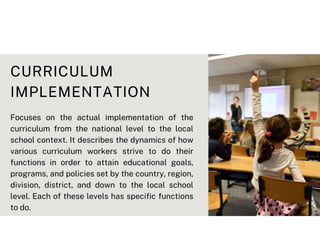
Focuses on the actual implementation of the
curriculum from the national level to the local
school context. It describes the dynamics of how
various curriculum workers strive to do their
functions in order to attain educational goals,
programs, and policies set by the country, region,
division, district, and down to the local school
level. Each of these levels has specific functions
to do.
CURRICULUM
WORKERS
The success or failure of any
curriculum depends on the
people working for its
implementation. Oliva (2005)
identified these people as
curriculum workers.
Teachers - the most visible among the curriculum
workers. Their roles as implementers of the curriculum
are very crucial. It is through their expertise, creativity,
and commitment that any curriculum success is
attributed.
Principals - the chief academic and administrative
officer of the school. They provide curricular and
instructional leadership and supervision to the
teachers and other school personnel in the local school
context.
CURRICULUM WORKERS
Curriculum Consultants - individuals with a rich
experience on doing curriculum projects related to
curriculum planning, curriculum development, and
curriculum evaluation.
District Supervisors - responsible for supervising the
implementation of the curriculum in the district level.
They help public school principals in ensuring that the
programs of the Department of Education are
implemented in their respective schools.
CURRICULUM WORKERS
Education Supervisors - assigned to specific subject areas in
basic education. They help the district office of the
Department of Education in supervising the implementation of
projects and programs specific for each subject area.
Division Superintendents - the chief academic officer of each
division. They supervise the implementation of the DepEd
curriculum, programs, and projects in the division level for both
public and private schools. Usually, each province or a city is
considered a division for DepEd.
Regional Directors - manage the programs and projects of the
Department of Education in the regional level.
CURRICULUM WORKERS
Education Program Specialists - work at the national
level or at the central offices of the Commission on
Higher Education and the Department of Education.
Technical Panels and Technical Committees -
professors and individual experts from different
disciplines and fields that assist the Commission on
Higher Education in developing curriculum,
formulating curriculum policies, and evaluating the
compliance of higher education institutions to CHED
program standards.
CURRICULUM WORKERS
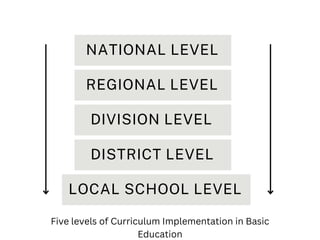
LEVELS OF
CURRICULUM
IMPLEMENTATION
NATIONAL LEVEL
REGIONAL LEVEL
DIVISION LEVEL
DISTRICT LEVEL
LOCAL SCHOOL LEVEL
Five levels of Curriculum Implementation in Basic
Education
• Formulating national educational policies;
• Formulating a national basic education plan;
• Promulgating national educational standards;
• monitoring and assessing national learning outcomes;
• undertaking national educational research and studies;
• enhancing the employment status, professional
competence, welfare, and working conditions of all
personnel of the Department; and
• Enhancing the total development of learners through local
and national programs and/or projects.
A. NATIONAL LEVEL
• Defining a regional educational policy framework which reflects the
values, needs, and expectations of the communities they serve;
• Developing a regional basic education plan;
• Developing regional educational standards with a view toward
benchmarking for international competitiveness;
• monitoring, evaluating, and assessing regional learning outcomes;
• undertaking research projects and developing and managing region-
wide projects which may be funded through official development
assistance and/or or other funding agencies;
• Ensuring strict compliance with prescribed national criteria for the
recruitment, selection, and training of all staff in the region and
divisions;
B. REGIONAL LEVEL
• Formulating, in coordination with the regional development council, the
budget to support the regional educational plan which shall take into
account the educational plans of the divisions and districts;
• determining the organization component of the divisions and districts and
approving the proposed staffing pattern of all employees in the divisions
and districts;
• hiring, placing, and evaluating all employees in the regional office, except
for the position of assistant director;
• Evaluating all school division superintendents and assistant division
superintendents in the region;
• planning and managing the effective and efficient use of all personnel,
physical and fiscal resources of the regional office, including professional
staff development;
• Managing the database and management information system of the
region;
• and approving the establishment of public and private elementary and
high schools and learning centers.
B. REGIONAL LEVEL
• developing and implementing division education development plans;
• planning and managing the effective and efficient use of all personnel, physical,
and fiscal resources of the division, including professional staff development;
• hiring, placing, and evaluating all division supervisors and school district
supervisors as well as all employees in the division, both teaching and non-
teaching personnel, including school heads, except for the assistant division
superintendent;
• monitoring the utilization of funds provided by the national government and the
local government units to the schools and learning centers;
• Ensuring compliance of quality standards for basic education programs and for
this purpose strengthening the role of division supervisors as subject area
specialists;
• promoting awareness of and adherence by all schools and learning centers to
accreditation standards prescribed by the Secretary of Education; and
• Supervising the operations of all public and private elementary, secondary, and
integrated schools, and learning centers.
C. DIVISION LEVEL
• providing professional and
instructional advice and
support to the school heads
and teachers/facilitators of
schools and learning centers
in the district or cluster
thereof; and
• curricula supervision.
D. SCHOOL
DISTRICT
LEVEL
• Setting the mission, vision, goals, and objectives of the school;
• creating an environment within the school that is conducive to
teaching and learning;
• implementing the school curriculum and being accountable for
higher learning outcomes;
• developing the school education program and school
improvement plan
• offering educational programs, projects, and services which
provide equitable opportunities for all learners in the community;
• introducing new and innovative modes of instruction to achieve
higher learning outcomes;
• Administering and managing all personnel, physical, and fiscal
resources of the school;
E. SCHOOL LEVEL
• Recommending the staffing complement of the school
based on its needs;
• Encouraging staff development;
• Establishing school and community networks and
encouraging the active participation of teachers
organizations, non-academic personnel of public schools,
and parents-teachers-community associations; and
• Accepting donations, gifts, bequests, and grants for the
purpose of upgrading teachers' learning facilitators'
competencies, improving and expanding school facilities,
and providing instructional materials and equipment.
E. SCHOOL LEVEL
PA
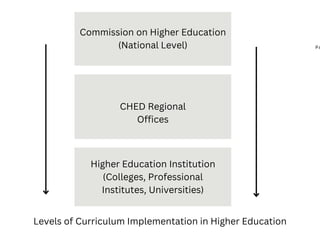
Commission on Higher Education
(National Level)
CHED Regional
Offices
Higher Education Institution
(Colleges, Professional
Institutes, Universities)
Levels of Curriculum Implementation in Higher Education
THINGS TO CONSIDER IN
IMPLEMENTING THE
CURRICULUM
• Government Requirements
• School Philosophy, Vision and
Mission, Core and Values
• Learning environment
• Needs and Demands of the Society
• Needs of the Students
• Faculty Expertise
• The Changing Nature of Knowledge
THANK YOU!!!!
1. Give 2 curriculum workers and explain their
functions.
2. Enumerate the 5 levels of curriculum
implementation in basic education.
3. Enumerate the 3 levels of curriculum
implementation in higher education.
4. Give 2 things to consider in implementing the
curriculum.
Assessment
5. Identify this organizational structure.

Curriculum

  • 1.
  • 2.
    CURRICULUM IMPLEMENTATION Focuses on theactual implementation of the curriculum from the national level to the local school context. It describes the dynamics of how various curriculum workers strive to do their functions in order to attain educational goals, programs, and policies set by the country, region, division, district, and down to the local school level. Each of these levels has specific functions to do.
  • 3.
    CURRICULUM WORKERS The success orfailure of any curriculum depends on the people working for its implementation. Oliva (2005) identified these people as curriculum workers.
  • 4.
    Teachers - themost visible among the curriculum workers. Their roles as implementers of the curriculum are very crucial. It is through their expertise, creativity, and commitment that any curriculum success is attributed. Principals - the chief academic and administrative officer of the school. They provide curricular and instructional leadership and supervision to the teachers and other school personnel in the local school context. CURRICULUM WORKERS
  • 5.
    Curriculum Consultants -individuals with a rich experience on doing curriculum projects related to curriculum planning, curriculum development, and curriculum evaluation. District Supervisors - responsible for supervising the implementation of the curriculum in the district level. They help public school principals in ensuring that the programs of the Department of Education are implemented in their respective schools. CURRICULUM WORKERS
  • 6.
    Education Supervisors -assigned to specific subject areas in basic education. They help the district office of the Department of Education in supervising the implementation of projects and programs specific for each subject area. Division Superintendents - the chief academic officer of each division. They supervise the implementation of the DepEd curriculum, programs, and projects in the division level for both public and private schools. Usually, each province or a city is considered a division for DepEd. Regional Directors - manage the programs and projects of the Department of Education in the regional level. CURRICULUM WORKERS
  • 7.
    Education Program Specialists- work at the national level or at the central offices of the Commission on Higher Education and the Department of Education. Technical Panels and Technical Committees - professors and individual experts from different disciplines and fields that assist the Commission on Higher Education in developing curriculum, formulating curriculum policies, and evaluating the compliance of higher education institutions to CHED program standards. CURRICULUM WORKERS
  • 8.
  • 9.
    NATIONAL LEVEL REGIONAL LEVEL DIVISIONLEVEL DISTRICT LEVEL LOCAL SCHOOL LEVEL Five levels of Curriculum Implementation in Basic Education
  • 11.
    • Formulating nationaleducational policies; • Formulating a national basic education plan; • Promulgating national educational standards; • monitoring and assessing national learning outcomes; • undertaking national educational research and studies; • enhancing the employment status, professional competence, welfare, and working conditions of all personnel of the Department; and • Enhancing the total development of learners through local and national programs and/or projects. A. NATIONAL LEVEL
  • 13.
    • Defining aregional educational policy framework which reflects the values, needs, and expectations of the communities they serve; • Developing a regional basic education plan; • Developing regional educational standards with a view toward benchmarking for international competitiveness; • monitoring, evaluating, and assessing regional learning outcomes; • undertaking research projects and developing and managing region- wide projects which may be funded through official development assistance and/or or other funding agencies; • Ensuring strict compliance with prescribed national criteria for the recruitment, selection, and training of all staff in the region and divisions; B. REGIONAL LEVEL
  • 14.
    • Formulating, incoordination with the regional development council, the budget to support the regional educational plan which shall take into account the educational plans of the divisions and districts; • determining the organization component of the divisions and districts and approving the proposed staffing pattern of all employees in the divisions and districts; • hiring, placing, and evaluating all employees in the regional office, except for the position of assistant director; • Evaluating all school division superintendents and assistant division superintendents in the region; • planning and managing the effective and efficient use of all personnel, physical and fiscal resources of the regional office, including professional staff development; • Managing the database and management information system of the region; • and approving the establishment of public and private elementary and high schools and learning centers. B. REGIONAL LEVEL
  • 16.
    • developing andimplementing division education development plans; • planning and managing the effective and efficient use of all personnel, physical, and fiscal resources of the division, including professional staff development; • hiring, placing, and evaluating all division supervisors and school district supervisors as well as all employees in the division, both teaching and non- teaching personnel, including school heads, except for the assistant division superintendent; • monitoring the utilization of funds provided by the national government and the local government units to the schools and learning centers; • Ensuring compliance of quality standards for basic education programs and for this purpose strengthening the role of division supervisors as subject area specialists; • promoting awareness of and adherence by all schools and learning centers to accreditation standards prescribed by the Secretary of Education; and • Supervising the operations of all public and private elementary, secondary, and integrated schools, and learning centers. C. DIVISION LEVEL
  • 17.
    • providing professionaland instructional advice and support to the school heads and teachers/facilitators of schools and learning centers in the district or cluster thereof; and • curricula supervision. D. SCHOOL DISTRICT LEVEL
  • 19.
    • Setting themission, vision, goals, and objectives of the school; • creating an environment within the school that is conducive to teaching and learning; • implementing the school curriculum and being accountable for higher learning outcomes; • developing the school education program and school improvement plan • offering educational programs, projects, and services which provide equitable opportunities for all learners in the community; • introducing new and innovative modes of instruction to achieve higher learning outcomes; • Administering and managing all personnel, physical, and fiscal resources of the school; E. SCHOOL LEVEL
  • 20.
    • Recommending thestaffing complement of the school based on its needs; • Encouraging staff development; • Establishing school and community networks and encouraging the active participation of teachers organizations, non-academic personnel of public schools, and parents-teachers-community associations; and • Accepting donations, gifts, bequests, and grants for the purpose of upgrading teachers' learning facilitators' competencies, improving and expanding school facilities, and providing instructional materials and equipment. E. SCHOOL LEVEL
  • 21.
    PA Commission on HigherEducation (National Level) CHED Regional Offices Higher Education Institution (Colleges, Professional Institutes, Universities) Levels of Curriculum Implementation in Higher Education
  • 22.
    THINGS TO CONSIDERIN IMPLEMENTING THE CURRICULUM • Government Requirements • School Philosophy, Vision and Mission, Core and Values • Learning environment • Needs and Demands of the Society • Needs of the Students • Faculty Expertise • The Changing Nature of Knowledge
  • 23.
  • 24.
    1. Give 2curriculum workers and explain their functions. 2. Enumerate the 5 levels of curriculum implementation in basic education. 3. Enumerate the 3 levels of curriculum implementation in higher education. 4. Give 2 things to consider in implementing the curriculum. Assessment
  • 25.
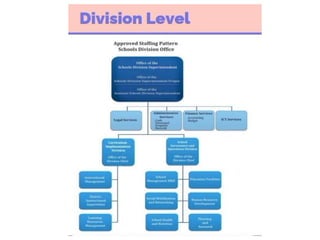
    5. Identify thisorganizational structure.