Current Affairs
Imagesource:Internet[PowerPlugs–TemplateforPowerPoint
Confidential | Copyrighted Material
P
+91 9035001996
Millennium Developmental Goals
• .
Confidential | Copyrighted Material
P
+91 9035001996
Millennium Developmental Goals
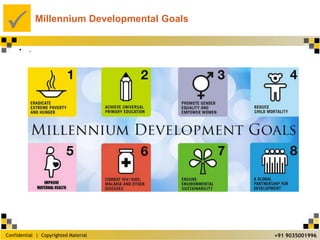
• MDGs are the eight international development goals that were established following the Millennium
Summit of the United Nations in 2000, following the adoption of the United Nations Millennium
Declaration.
• All United Nations member states committed to help achieve the Millennium Development Goals by
2015.
• Eight MDGs have been commonly accepted as a framework for measuring development:
• (1) Eradicate extreme poverty and hunger,
• (2) Achieve universal primary education,
• (3) Promote gender equality and empower women,
• (4) Reduce child mortality rate,
• (5) Improve maternal health,
• (6) Combat HIV/AIDS, malaria, and other diseases,
• (7) Ensure environmental sustainability,
• (8) Develop a global partnership for development.
Confidential | Copyrighted Material
P
+91 9035001996
MDGs – Target to India
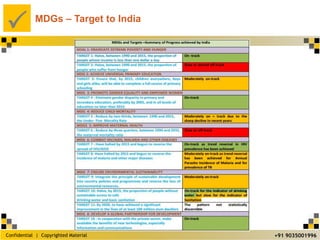
• To achieve Goal-2, India should increase the primary school enrolment rate to 100 percent and wipe
out the drop-outs by 2015 against 41.96 percent in 1991-92.
• To achieve Goal-3, India will have to promote female participation at all levels to reach a female male
proportion of equal level by 2015.
• To achieve Goal 4, India should reduce under five mortality rate (U5MR) from 125 deaths per thousand
live births in 1988-92 to U5MR-42 in 2015.
• To achieve Goal-5, India should reduce maternal mortality (MMR) from 437 deaths per 100,000 live
births in 1991 to MMR-109 by 2015.
• Proportion of population without sustainable access to safe drinking water and sanitation is to be
halved by 2015
Confidential | Copyrighted Material
P
+91 9035001996
MDGs – Target to India
Confidential | Copyrighted Material
P
+91 9035001996
Millennium Developmental Goals -
India
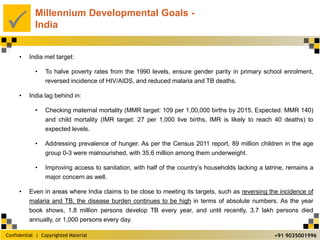
• India met target:
• To halve poverty rates from the 1990 levels, ensure gender parity in primary school enrolment,
reversed incidence of HIV/AIDS, and reduced malaria and TB deaths.
• India lag behind in:
• Checking maternal mortality (MMR target: 109 per 1,00,000 births by 2015, Expected: MMR 140)
and child mortality (IMR target: 27 per 1,000 live births, IMR is likely to reach 40 deaths) to
expected levels.
• Addressing prevalence of hunger. As per the Census 2011 report, 89 million children in the age
group 0-3 were malnourished, with 35.6 million among them underweight.
• Improving access to sanitation, with half of the country’s households lacking a latrine, remains a
major concern as well.
• Even in areas where India claims to be close to meeting its targets, such as reversing the incidence of
malaria and TB, the disease burden continues to be high in terms of absolute numbers. As the year
book shows, 1.8 million persons develop TB every year, and until recently, 3.7 lakh persons died
annually, or 1,000 persons every day.
Confidential | Copyrighted Material
P
+91 9035001996
Sustainable Development Goal
Confidential | Copyrighted Material
P
+91 9035001996
Sustainable Development Goal
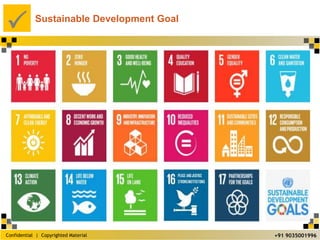
• The Sustainable Development Goals adopted by the United Nations at a summit
meeting in New York on 25th September 2015 lay out a sweeping vision for
improving the lives of people all over the world over the next 15 years.
• The SDGs with 17 goals are more ambitious, and are meant to apply to every
country.
• Stated in broad terms, the goals are accompanied by 169 specific targets meant
to advance the goals in concrete ways.
• The SDGs aim to eradicate poverty, build sustainable cities and combat climate
change.
Confidential | Copyrighted Material
P
+91 9035001996
Need of SDGs
• The MDGs adopted in 2000, have improved the lives of millions of people.
• But much more needs to be done, especially to reach the most marginalized
and vulnerable and put us all on a sustainable-development path. The new
agenda and Goals embody a commitment to leave no one behind.
• One aspect of the Goals is to have strong links to our efforts to foster
international peace and security.
• When hostilities start, so much else comes to a halt: schooling, vaccination
campaigns, economic growth, development itself. At the same time, achieving
the goals would help to prevent instability and violence.
• The new Goals therefore aim to promote just, peaceful and inclusive societies,
access to justice and effective, accountable and inclusive institutions for a safer
and sustainable world.
Confidential | Copyrighted Material
P
+91 9035001996
SDGs vs MDGs
• On MDGs, we heard of them towards the end of the 15-year period during
which they were to be achieved. SDGs have seen much more effective
consultation.
• Unlike the MDGs, which were largely assigned in a top-down manner in New
York and Geneva, the SDGs were conceived more democratically after three
years of deliberation by a group of representatives from 70 countries.
• The SDGs are more elaborate, more ambitious, and more numerous than
the MDGs were.
• SDGs for the first time include specific goals on economic indicators.
• Most significantly, the SDGs are universal — they are for all nations, not just for
the developing world (like MDGs).
Confidential | Copyrighted Material
P
+91 9035001996
Challenges for India
• SDGs include four sets of challenges for India namely
• (i) completing the unfinished MDG agenda with a higher level of ambition of ending –
not just reducing all deprivations;
• (ii) strengthening critical development drivers such as economic growth,
industrialization, employment creation and reduction of inequality within and between
countries, basic infrastructure including energy, and governance and institutions,
without which many social and environmental objectives would not be easy to
reach;
• (iii) strengthening the sustainability dimension to address new and emerging
challenges such as deteriorating environment, unsustainable consumption and
production patterns that are rapidly depleting natural resources, the need to effectively
mitigate and adapt to climate change, and develop livable urban areas; and
• (iv) accessing the means of implementation including transfer of advanced
sustainable technologies from developed countries and harnessing India’s frugal
engineering capabilities for pursuing low carbon development pathways.
Confidential | Copyrighted Material
P
+91 9035001996
Modi’s agenda in the US
• To attend UNGA meeting to adopt Sustainable Development Goals.
• Two-point agenda of domestic economic rejuvenation and India’s security
interests.
• On Security Front:
• Meeting with G4
• On Economic Front:
• Meeting with Silicon valley CEOs – Make In India, Digital India
Confidential | Copyrighted Material
P
+91 9035001996
G4
• The G4, India, Germany, Japan and Brazil, wants expansion of the U.N. Security Council and
permanent seats for themselves.
• The G4 took shape in 2004 when Prime Minister Manmohan Singh, Brazilian President Luiz Inácio Lula
da Silva and Japanese Prime Minister Junichiro Koizumi, along with German Foreign Minister Joska
Fischer, issued a joint statement, kicking off their campaign for U.N. reforms.
• Demand for UN reforms includes more representation for developing countries, both in the permanent
and non-permanent categories, in the UNSC which has 15 members.
• In 2013 and 2014, G4 Foreign Ministers met on the sidelines of the UNGA and called for urgent
reforms.
• On 26th Septemeber, A joint declaration by the G-4 stressed that “the process underway in the UN…
should be conducted, given its urgency, in a fixed time frame” and called for “securing concrete
outcome during the 70th session of the General Assembly”.
Confidential | Copyrighted Material
P
+91 9035001996
G4 meeting outcome
• Emphasised G4 countries are legitimate candidates for permanent membership
in reformed UNSC.
• Pledged to work together with all member-states and to accelerate outreach
towards achieving an early and meaningful reform of the Security Council.
• Raised concern that no substantial progress had been made since the 2005
World Summit – ‘early reform’ of the United Nations.
Confidential | Copyrighted Material
P
+91 9035001996
UNSC transformation
• UNSC was established in 1945 to replace the ineffective League of Nations
(1919), with 5 permanent members and at that time UN has 51 member states.
• Now, the UN has 193 member states and its structure remains stuck in the
world of 1945 with still 5 permanent members in UNSC and 10 non-
permanent members.
• Since then, population has also grown from 2.3 billion to 7 billion now.
• The UNSC, as presently comprised is neither geographically representative
nor effective.
• The recent developments show that UNSC needs to reflect new world realities
and the new geopolitical balance.
Confidential | Copyright
P
+91 9035001996
Contact: ias.focusgroup@gmail.com
Thank You!

CurrentAffairs_presentation1

  • 1.
  • 2.
    Confidential | CopyrightedMaterial P +91 9035001996 Millennium Developmental Goals • .
  • 3.
    Confidential | CopyrightedMaterial P +91 9035001996 Millennium Developmental Goals • MDGs are the eight international development goals that were established following the Millennium Summit of the United Nations in 2000, following the adoption of the United Nations Millennium Declaration. • All United Nations member states committed to help achieve the Millennium Development Goals by 2015. • Eight MDGs have been commonly accepted as a framework for measuring development: • (1) Eradicate extreme poverty and hunger, • (2) Achieve universal primary education, • (3) Promote gender equality and empower women, • (4) Reduce child mortality rate, • (5) Improve maternal health, • (6) Combat HIV/AIDS, malaria, and other diseases, • (7) Ensure environmental sustainability, • (8) Develop a global partnership for development.
  • 4.
    Confidential | CopyrightedMaterial P +91 9035001996 MDGs – Target to India • To achieve Goal-2, India should increase the primary school enrolment rate to 100 percent and wipe out the drop-outs by 2015 against 41.96 percent in 1991-92. • To achieve Goal-3, India will have to promote female participation at all levels to reach a female male proportion of equal level by 2015. • To achieve Goal 4, India should reduce under five mortality rate (U5MR) from 125 deaths per thousand live births in 1988-92 to U5MR-42 in 2015. • To achieve Goal-5, India should reduce maternal mortality (MMR) from 437 deaths per 100,000 live births in 1991 to MMR-109 by 2015. • Proportion of population without sustainable access to safe drinking water and sanitation is to be halved by 2015
  • 5.
    Confidential | CopyrightedMaterial P +91 9035001996 MDGs – Target to India
  • 6.
    Confidential | CopyrightedMaterial P +91 9035001996 Millennium Developmental Goals - India • India met target: • To halve poverty rates from the 1990 levels, ensure gender parity in primary school enrolment, reversed incidence of HIV/AIDS, and reduced malaria and TB deaths. • India lag behind in: • Checking maternal mortality (MMR target: 109 per 1,00,000 births by 2015, Expected: MMR 140) and child mortality (IMR target: 27 per 1,000 live births, IMR is likely to reach 40 deaths) to expected levels. • Addressing prevalence of hunger. As per the Census 2011 report, 89 million children in the age group 0-3 were malnourished, with 35.6 million among them underweight. • Improving access to sanitation, with half of the country’s households lacking a latrine, remains a major concern as well. • Even in areas where India claims to be close to meeting its targets, such as reversing the incidence of malaria and TB, the disease burden continues to be high in terms of absolute numbers. As the year book shows, 1.8 million persons develop TB every year, and until recently, 3.7 lakh persons died annually, or 1,000 persons every day.
  • 7.
    Confidential | CopyrightedMaterial P +91 9035001996 Sustainable Development Goal
  • 8.
    Confidential | CopyrightedMaterial P +91 9035001996 Sustainable Development Goal • The Sustainable Development Goals adopted by the United Nations at a summit meeting in New York on 25th September 2015 lay out a sweeping vision for improving the lives of people all over the world over the next 15 years. • The SDGs with 17 goals are more ambitious, and are meant to apply to every country. • Stated in broad terms, the goals are accompanied by 169 specific targets meant to advance the goals in concrete ways. • The SDGs aim to eradicate poverty, build sustainable cities and combat climate change.
  • 9.
    Confidential | CopyrightedMaterial P +91 9035001996 Need of SDGs • The MDGs adopted in 2000, have improved the lives of millions of people. • But much more needs to be done, especially to reach the most marginalized and vulnerable and put us all on a sustainable-development path. The new agenda and Goals embody a commitment to leave no one behind. • One aspect of the Goals is to have strong links to our efforts to foster international peace and security. • When hostilities start, so much else comes to a halt: schooling, vaccination campaigns, economic growth, development itself. At the same time, achieving the goals would help to prevent instability and violence. • The new Goals therefore aim to promote just, peaceful and inclusive societies, access to justice and effective, accountable and inclusive institutions for a safer and sustainable world.
  • 10.
    Confidential | CopyrightedMaterial P +91 9035001996 SDGs vs MDGs • On MDGs, we heard of them towards the end of the 15-year period during which they were to be achieved. SDGs have seen much more effective consultation. • Unlike the MDGs, which were largely assigned in a top-down manner in New York and Geneva, the SDGs were conceived more democratically after three years of deliberation by a group of representatives from 70 countries. • The SDGs are more elaborate, more ambitious, and more numerous than the MDGs were. • SDGs for the first time include specific goals on economic indicators. • Most significantly, the SDGs are universal — they are for all nations, not just for the developing world (like MDGs).
  • 11.
    Confidential | CopyrightedMaterial P +91 9035001996 Challenges for India • SDGs include four sets of challenges for India namely • (i) completing the unfinished MDG agenda with a higher level of ambition of ending – not just reducing all deprivations; • (ii) strengthening critical development drivers such as economic growth, industrialization, employment creation and reduction of inequality within and between countries, basic infrastructure including energy, and governance and institutions, without which many social and environmental objectives would not be easy to reach; • (iii) strengthening the sustainability dimension to address new and emerging challenges such as deteriorating environment, unsustainable consumption and production patterns that are rapidly depleting natural resources, the need to effectively mitigate and adapt to climate change, and develop livable urban areas; and • (iv) accessing the means of implementation including transfer of advanced sustainable technologies from developed countries and harnessing India’s frugal engineering capabilities for pursuing low carbon development pathways.
  • 12.
    Confidential | CopyrightedMaterial P +91 9035001996 Modi’s agenda in the US • To attend UNGA meeting to adopt Sustainable Development Goals. • Two-point agenda of domestic economic rejuvenation and India’s security interests. • On Security Front: • Meeting with G4 • On Economic Front: • Meeting with Silicon valley CEOs – Make In India, Digital India
  • 13.
    Confidential | CopyrightedMaterial P +91 9035001996 G4 • The G4, India, Germany, Japan and Brazil, wants expansion of the U.N. Security Council and permanent seats for themselves. • The G4 took shape in 2004 when Prime Minister Manmohan Singh, Brazilian President Luiz Inácio Lula da Silva and Japanese Prime Minister Junichiro Koizumi, along with German Foreign Minister Joska Fischer, issued a joint statement, kicking off their campaign for U.N. reforms. • Demand for UN reforms includes more representation for developing countries, both in the permanent and non-permanent categories, in the UNSC which has 15 members. • In 2013 and 2014, G4 Foreign Ministers met on the sidelines of the UNGA and called for urgent reforms. • On 26th Septemeber, A joint declaration by the G-4 stressed that “the process underway in the UN… should be conducted, given its urgency, in a fixed time frame” and called for “securing concrete outcome during the 70th session of the General Assembly”.
  • 14.
    Confidential | CopyrightedMaterial P +91 9035001996 G4 meeting outcome • Emphasised G4 countries are legitimate candidates for permanent membership in reformed UNSC. • Pledged to work together with all member-states and to accelerate outreach towards achieving an early and meaningful reform of the Security Council. • Raised concern that no substantial progress had been made since the 2005 World Summit – ‘early reform’ of the United Nations.
  • 15.
    Confidential | CopyrightedMaterial P +91 9035001996 UNSC transformation • UNSC was established in 1945 to replace the ineffective League of Nations (1919), with 5 permanent members and at that time UN has 51 member states. • Now, the UN has 193 member states and its structure remains stuck in the world of 1945 with still 5 permanent members in UNSC and 10 non- permanent members. • Since then, population has also grown from 2.3 billion to 7 billion now. • The UNSC, as presently comprised is neither geographically representative nor effective. • The recent developments show that UNSC needs to reflect new world realities and the new geopolitical balance.
  • 16.
    Confidential | Copyright P +919035001996 Contact: ias.focusgroup@gmail.com Thank You!