BACKGROUND:
• In September 2015, the General Assembly of the United
Nations adopted the 2030 Agenda for Sustainable
Development. Member States pledged their commitment
to 17 “bold and transformative” Sustainable Development
Goals (SDGs) and 169 targets intended “to ensure that all
human beings can fulfil their potential in dignity and
equality and in a healthy environment”
WHAT ARE MDGs?
• The United Nations Millennium Development Goals are
eight goals that all 191 UN member states have agreed to
try to achieve by the year 2015. The United Nations
Millennium Declaration, signed in September 2000
commits world leaders to combat poverty, hunger,
disease, illiteracy, environmental degradation, and
discrimination against women. The MDGs are derived
from this Declaration, and all have specific targets and
indicators.
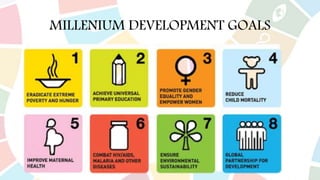
MILLENIUM DEVELOPMENT GOALS
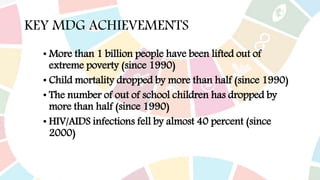
KEY MDG ACHIEVEMENTS
• More than 1 billion people have been lifted out of
extreme poverty (since 1990)
• Child mortality dropped by more than half (since 1990)
• The number of out of school children has dropped by
more than half (since 1990)
• HIV/AIDS infections fell by almost 40 percent (since
2000)
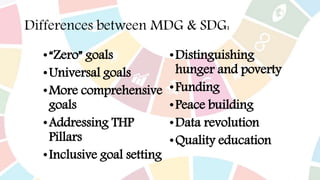
Differences between MDG & SDG:
•“Zero” goals
•Universal goals
•More comprehensive
goals
•Addressing THP
Pillars
•Inclusive goal setting
•Distinguishing
hunger and poverty
•Funding
•Peace building
•Data revolution
•Quality education
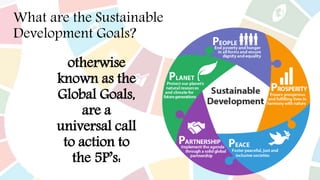
What are the Sustainable
Development Goals?
otherwise
known as the
Global Goals,
are a
universal call
to action to
the 5P’s:
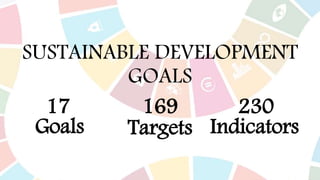
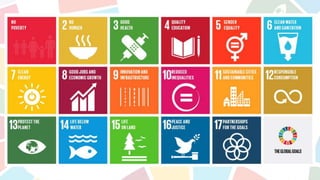
SUSTAINABLE DEVELOPMENT
GOALS
17 169 230
Goals Targets Indicators
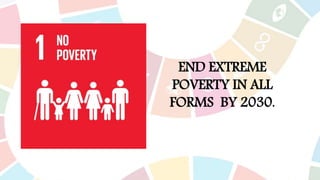
END EXTREME
POVERTY IN ALL
FORMS BY 2030.
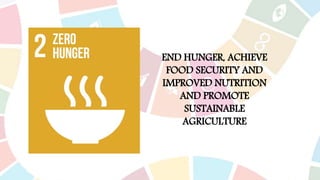
END HUNGER, ACHIEVE
FOOD SECURITY AND
IMPROVED NUTRITION
AND PROMOTE
SUSTAINABLE
AGRICULTURE
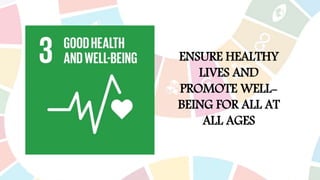
ENSURE HEALTHY
LIVES AND
PROMOTE WELL-
BEING FOR ALL AT
ALL AGES
ENSURE INCLUSIVE AND
EQUITABLE QUALITY
EDUCATION AND
PROMOTE LIFELONG
LEARNING
OPPORTUNITIES FOR ALL
ACHIEVE GENDER
EQUALITY AND
EMPOWER ALL
WOMEN AND GIRLS
ENSURE AVAILABILITY
AND SUSTAINABLE
MANAGEMENT OF
WATER AND
SANITATION FOR ALL
ENSURE ACCESS TO
AFFORDABLE, RELIABLE,
SUSTAINABLE AND MODERN
ENERGY FOR ALL
PROMOTE SUSTAINED,
INCLUSIVE AND
SUSTAINABLE ECONOMIC
GROWTH, FULL AND
PRODUCTIVE EMPLOYMENT
AND DECENT WORK FOR
ALL
BUILD RESILIENT
INFRASTRUCTURE,
PROMOTE INCLUSIVE AND
SUSTAINABLE
INDUSTRIALIZATION AND
FOSTER INNOVATION
REDUCE INEQUALITY
WITHIN AND AMONG
COUNTRIES
MAKE CITIES AND
HUMAN
SETTLEMENTS
INCLUSIVE, SAFE,
RESILIENT AND
SUSTAINABLE
ENSURE SUSTAINABLE
CONSUMPTION AND
PRODUCTION
PATTERNS
TAKE URGENT
ACTION TO COMBAT
CLIMATE CHANGE
AND ITS IMPACT
CONSERVE AND
SUSTAINABLY USE THE
OCEANS, SEAS AND
MARINE RESOURCES
FOR SUSTAINABLE
DEVELOPMENT
PROTECT, RESTORE AND
PROMOTE SUSTAINABLE USE OF
TERRESTRIAL ECOSYSTEMS,
SUSTAINABLY MANAGE
FORESTS, COMBAT
DESERTIFICATION, AND HALT
AND REVERSE LAND
DEGRADATION AND HALT
BIODIVERSITY LOS
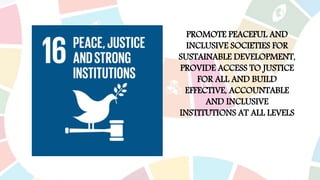
PROMOTE PEACEFUL AND
INCLUSIVE SOCIETIES FOR
SUSTAINABLE DEVELOPMENT,
PROVIDE ACCESS TO JUSTICE
FOR ALL AND BUILD
EFFECTIVE, ACCOUNTABLE
AND INCLUSIVE
INSTITUTIONS AT ALL LEVELS
STRENGTHEN THE MEANS
OF IMPLEMENTATION
AND REVITALIZE THE
GLOBAL PARTNERSHIP
FOR SUSTAINABLE
DEVELOPMENT
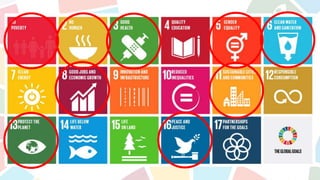
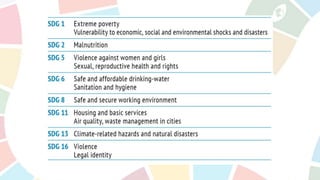
HEALTH-RELATED SDGs
SOURCES:
• https://advocacy.thp.org/2014/08/08/mdgs-to-sdgs/
• https://www.undp.org/content/undp/en/home/sustainable-
development-goals.html
• https://www.who.int/topics/millennium_development_goals/about/
en/
• Regional agenda on achieving the sustainable development goals in
the Western Pacific. Manila, Philippines: World Health Organization
Regional Office for the Western Pacific; 2017.

Sustainable Developmental Goals (Summary)

Editor's Notes

  • #3 It is built upon the foundation of the MDGs. It is designed to finish the job >>>>Remarkable progress was made over the 15 years of the MDG blueprint, but it was also recognized that the gains did not equally benefit all groups in society and that many programmes neglected to build on the connections between the goals
  • #4 The MDGs are inter-dependent; all the MDG influence health, and health influences all the MDGs. 
  • #6 The legacy and achievements of the MDGs provide us with valuable lessons and experience to begin work on the new goals. But for millions of people around the world the job remains unfinished. We need to go the last mile on ending hunger, achieving full gender equality, improving health services and getting every child into school beyond primary. The SDGs are also an urgent call to shift the world onto a more sustainable path.
  • #7 *The Hunger Program Data Revolution: MDGs said nothing about monitoring, evaluation and accountability – the SDGs target by 2020 to “increase significantly the availability of high-quality, timely and reliable data disaggregated by income, gender, age, race, ethnicity, migratory status, disability, geographic location and other characteristics relevant in national contexts.”
  • #8 end poverty, protect the planet and ensure that all people enjoy peace and prosperity.
  • #11 The SDGs are a bold commitment to finish what we started, and end poverty in all forms and dimensions by 2030. This involves targeting the most vulnerable, increasing basic resources and services, and supporting communities affected by conflict and climate-related disasters.
  • #12 The SDGs aim to end all forms of hunger and malnutrition by 2030, making sure all people – especially children – have access to sufficient and nutritious food all year round. This involves promoting sustainable agricultural practices: supporting small scale farmers and allowing equal access to land, technology and markets. It also requires international cooperation to ensure investment in infrastructure and technology to improve agricultural productivity. Together with the other goals set out here, we can end hunger by 2030.
  • #13 The 2030 Agenda reflects and responds to the increasing complexity and interconnectedness of health and development, including widening economic and social inequalities, rapid urbanization, threats to the climate and the environment, the continuing burden of HIV and other infectious diseases and emerging health challenges such as noncommunicable diseases.  Universal health coverage, based on the principles of equity, access and quality, will be integral to achieving SDG 3, ending poverty and reducing inequalities. Emerging global health priorities not explicitly included in the SDGs, including antimicrobial resistance, also demand action.
  • #14 Achieving inclusive and quality education for all reaffirms the belief that education is one of the most powerful and proven vehicles for sustainable development. This goal ensures that all girls and boys complete free primary and secondary schooling by 2030. It also aims to provide equal access to affordable vocational training, to eliminate gender and wealth disparities, and achieve universal access to a quality higher education.
  • #15 Affording women equal rights to economic resources such as land and property are vital targets to realizing this goal. So is ensuring universal access to sexual and reproductive health. Today there are more women in public office than ever before, but encouraging women leaders will help strengthen policies and legislation for greater gender equality.
  • #16 invest in adequate infrastructure, provide sanitation facilities, and encourage hygiene at every level. Protecting and restoring water-related ecosystems such as forests, mountains, wetlands and rivers is essential if we are to mitigate water scarcity. More international cooperation is also needed to encourage water efficiency and support treatment technologies in developing countries.
  • #17 Adopting cost-effective standards for a wider range of technologies could also reduce the global electricity consumption by buildings and industry by 14 percent. 
  • #18 Encouraging entrepreneurship and job creation are key to this, as are effective measures to eradicate forced labour, slavery and human trafficking. 
  • #19 Technological progress is also key to finding lasting solutions to both economic and environmental challenges, such as providing new jobs and promoting energy efficiency. Promoting sustainable industries, and investing in scientific research and innovation
  • #20 Income inequality is a global problem that requires global solutions. This involves improving the regulation and monitoring of financial markets and institutions, encouraging development assistance and foreign direct investment to regions where the need is greatest. Facilitating the safe migration and mobility of people, Adoption of sound policies to empower the bottom percentile of income earners, and promote economic inclusion of all regardless of sex, race or ethnicity.
  • #21 Making cities safe and sustainable means ensuring access to safe and affordable housing, and upgrading slum settlements. It also involves investment in public transport, creating green public spaces, and improving urban planning and management in a way that is both participatory and inclusive.
  • #22 A large share of the world population is still consuming far too little to meet even their basic needs.  Halving the per capita of global food waste at the retailer and consumer levels is also important for creating more efficient production and supply chains. This can help with food security, and shift us towards a more resource efficient economy. The efficient management of our shared natural resources, and the way we dispose of toxic waste and pollutants, are important targets to achieve this goal. Encouraging industries, businesses and consumers to recycle and reduce waste
  • #23 Helping more vulnerable regions, such as land locked countries and island states, adapt to climate change must go hand in hand with efforts to integrate disaster risk measures into national strategies. It is still possible, with the political will and a wide array of technological measures, to limit the increase in global mean temperature to two degrees Celsius above pre-industrial levels.
  • #24 The SDGs aim to sustainably manage and protect marine and coastal ecosystems from pollution, as well as address the impacts of ocean acidification. Enhancing conservation and the sustainable use of ocean-based resources through international law will also help mitigate some of the challenges facing our oceans.
  • #25 The SDGs aim to conserve and restore the use of terrestrial ecosystems such as forests, wetlands, drylands and mountains by 2020. Halting deforestation is also vital to mitigating the impact of climate change. Urgent action must be taken to reduce the loss of natural habitats and biodiversity which are part of our common heritage.
  • #26 The SDGs aim to significantly reduce all forms of violence, and work with governments and communities to find lasting solutions to conflict and insecurity. Strengthening the rule of law and promoting human rights is key to this process, as is reducing the flow of illicit arms and strengthening the participation of developing countries in the institutions of global governance.
  • #27 Improving access to technology and knowledge is an important way to share ideas and foster innovation. Coordinating policies to help developing countries manage their debt, as well as promoting investment for the least developed, is vital to achieve sustainable growth and development. Promoting international trade, and helping developing countries increase their exports.
  • #28 The WHO Constitution defines health not merely as the absence of disease but as a state of complete physical, mental and social well-being. National development plans in the Western Pacific Region have long recognized that health and sustainable development are interdependent. health is influenced by and contributes to all other goals and targets as well. The SDGs call for an integrated approach to “just, rights-based, equitable and inclusive” action to address today’s challenges and promote growth, social development and environmental protection for all.
  • #29 The regional framework Universal Health Coverage: Moving Towards Better Health, endorsed by the WHO Regional Committee for the Western Pacific in October 2015, provides a broad foundation for action. UHC – defined as all people and communities having access to quality health services without suffering the financial hardship associated with paying for care – is a core part of the SDG agenda, bringing together disparate health and development efforts. It is an overarching vision for health systems development and for achieving equitable and sustainable health outcomes