Culture & Civilization
By: Asi Norjannah, April Joy Cadotdot,
Monisah Sultan
Comparison Chart
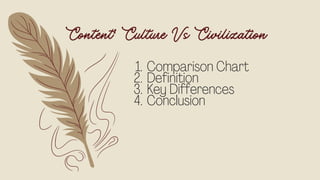
Definition
Key Differences
Conclusion
1.
2.
3.
4.
Content: Culture Vs Civilization
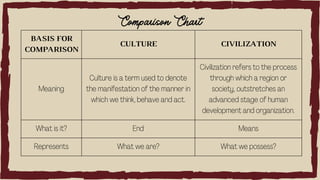
BASIS FOR
COMPARISON
CULTURE CIVILIZATION
Meaning
Culture is a term used to denote
the manifestation of the manner in
which we think, behave and act.
Civilization refers to the process
through which a region or
society, outstretches an
advanced stage of human
development and organization.
What is it? End Means
Represents What we are? What we possess?
Comparison Chart
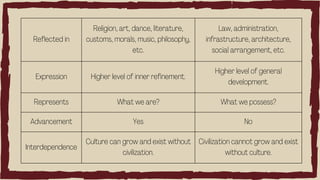
Reflected in
Religion, art, dance, literature,
customs, morals, music, philosophy,
etc.
Law, administration,
infrastructure, architecture,
social arrangement, etc.
Expression Higher level of inner refinement.
Higher level of general
development.
Represents What we are? What we possess?
Advancement Yes No
Interdependence
Culture can grow and exist without
civilization.
Civilization cannot grow and exist
without culture.
Definition of Culture
The term ‘culture’ is a Latin origin of the word ‘cultus’, which refers to cultivating or
refining something, in such a way that it provides admiration and respect. In finer terms,
culture is the way people live, reflected in the language they spoke, the food they eat,
the clothes they wear, and the Deity they follow or worship. It expresses how one thinks
and does things.
Culture includes art, knowledge, belief, customs, traditions, morals, festivals, values,
attitudes, habits and so on which are inherited by a person as a member of society. It is
everything; an individual achieves as a member of a social group. It can be seen in the
literature, music, dance forms, religious practices, dressing style, food habits, ways of
greeting others, recreation, and enjoyment. Different cultures can be found in different
places, as it varies from region to region.
Definition of Civilization
The term ‘civilization’ is derived from the Latin term ‘civis’ which indicates ‘someone who
resides in a town.
The term ‘civilization’ is not confined to town; rather it talks about adopting better ways
of living and making the best possible use of nature’s resources, to satisfy the needs of
the group of people. Further, it stresses on systematizing society into various groups
that work collectively and constantly to improve the quality of life, regarding food,
education, dress, communication, transportation, and the like.
Key Differences Between Culture and Civilization
The term ‘culture’ refers to the embodiment of how we think, behave, and act. On the
contrary, the improved stage of human society, where members have a considerable
amount of social and political organization and development, is called Civilization.
Our culture describes what we are, but our civilization explains what we have or what
we make use of.
Culture is an end; it has no measurement standards. Against this, civilization has precise
measurement standards, because it is a means.
The culture of a particular region can be reflected in religion, art, dance, literature,
customs, morals, music, philosophy, etc. On the other hand, civilization is exhibited in the
law, administration, infrastructure, architecture, social arrangement, etc. of that area.
1.
2.
3.
4.
5. Culture denotes the greatest level of inner refinement, and so it is internal. Unlike, an
external civilization, i.e. it is the expression of the state of the art technology, product,
devices, infrastructure, and so forth.
6. culture change is observed with time, as in the old thoughts and traditions lost with time,
and new ones are added to it which are then transmitted from one generation to another.
On the flip side, civilization is continuously advancing, i.e. the various elements of civilization
like means of transportation, communication, etc. are developing day by day.
7. Culture can evolve and flourish, even if civilization does not exist. In contrast, civilization
cannot grow and exist without culture.
Thank You for
listening!

Culture-and-Civilization.pdf

  • 1.
    Culture & Civilization By:Asi Norjannah, April Joy Cadotdot, Monisah Sultan
  • 2.
  • 3.
    BASIS FOR COMPARISON CULTURE CIVILIZATION Meaning Cultureis a term used to denote the manifestation of the manner in which we think, behave and act. Civilization refers to the process through which a region or society, outstretches an advanced stage of human development and organization. What is it? End Means Represents What we are? What we possess? Comparison Chart
  • 4.
    Reflected in Religion, art,dance, literature, customs, morals, music, philosophy, etc. Law, administration, infrastructure, architecture, social arrangement, etc. Expression Higher level of inner refinement. Higher level of general development. Represents What we are? What we possess? Advancement Yes No Interdependence Culture can grow and exist without civilization. Civilization cannot grow and exist without culture.
  • 5.
    Definition of Culture Theterm ‘culture’ is a Latin origin of the word ‘cultus’, which refers to cultivating or refining something, in such a way that it provides admiration and respect. In finer terms, culture is the way people live, reflected in the language they spoke, the food they eat, the clothes they wear, and the Deity they follow or worship. It expresses how one thinks and does things. Culture includes art, knowledge, belief, customs, traditions, morals, festivals, values, attitudes, habits and so on which are inherited by a person as a member of society. It is everything; an individual achieves as a member of a social group. It can be seen in the literature, music, dance forms, religious practices, dressing style, food habits, ways of greeting others, recreation, and enjoyment. Different cultures can be found in different places, as it varies from region to region.
  • 7.
    Definition of Civilization Theterm ‘civilization’ is derived from the Latin term ‘civis’ which indicates ‘someone who resides in a town. The term ‘civilization’ is not confined to town; rather it talks about adopting better ways of living and making the best possible use of nature’s resources, to satisfy the needs of the group of people. Further, it stresses on systematizing society into various groups that work collectively and constantly to improve the quality of life, regarding food, education, dress, communication, transportation, and the like.
  • 9.
    Key Differences BetweenCulture and Civilization The term ‘culture’ refers to the embodiment of how we think, behave, and act. On the contrary, the improved stage of human society, where members have a considerable amount of social and political organization and development, is called Civilization. Our culture describes what we are, but our civilization explains what we have or what we make use of. Culture is an end; it has no measurement standards. Against this, civilization has precise measurement standards, because it is a means. The culture of a particular region can be reflected in religion, art, dance, literature, customs, morals, music, philosophy, etc. On the other hand, civilization is exhibited in the law, administration, infrastructure, architecture, social arrangement, etc. of that area. 1. 2. 3. 4.
  • 10.
    5. Culture denotesthe greatest level of inner refinement, and so it is internal. Unlike, an external civilization, i.e. it is the expression of the state of the art technology, product, devices, infrastructure, and so forth. 6. culture change is observed with time, as in the old thoughts and traditions lost with time, and new ones are added to it which are then transmitted from one generation to another. On the flip side, civilization is continuously advancing, i.e. the various elements of civilization like means of transportation, communication, etc. are developing day by day. 7. Culture can evolve and flourish, even if civilization does not exist. In contrast, civilization cannot grow and exist without culture.
  • 11.