oAIENIE ZUBAIDAH BT ZUBER-2013494806
oAIMIN AMIRA BT MOKTAR-2013837418
oNUR NADIRAH BT ROSLI-2013654544
SumazauNgajat
Indian
Bharata
Natvam
Branyo
Bamboo
Dance
Chinese
Lion
Dance
Dragon
Dance
Tarian Piring
Minangkabau
Gayong
Otar-otar
Zapin Joget
Malay
Mak Yong
Kuda
Kepang
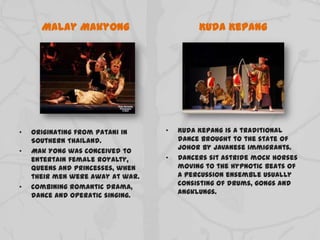
Malay Makyong
• Originating from Patani in
Southern Thailand.
• Mak Yong was conceived to
entertain female royalty,
queens and princesses, when
their men were away at war.
• Combining romantic drama,
dance and operatic singing.
Kuda Kepang
• Kuda Kepang is a traditional
dance brought to the state of
Johor by Javanese immigrants.
• Dancers sit astride mock horses
moving to the hypnotic beats of
a percussion ensemble usually
consisting of drums, gongs and
angklungs.
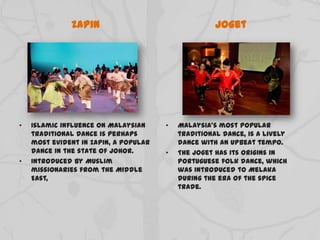
Zapin
• Islamic influence on Malaysian
traditional dance is perhaps
most evident in Zapin, a popular
dance in the state of Johor.
• Introduced by Muslim
missionaries from the Middle
East,
Joget
• Malaysia's most popular
traditional dance, is a lively
dance with an upbeat tempo.
• The Joget has its origins in
Portuguese folk dance, which
was introduced to Melaka
during the era of the spice
trade.
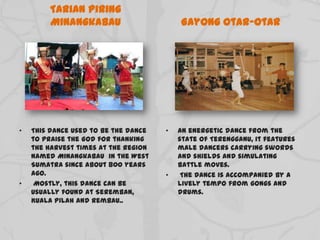
Tarian Piring
Minangkabau
• This dance used to be the dance
to praise the God for thanking
the harvest times at the region
named Minangkabau in the West
Sumatra since about 800 years
ago.
• Mostly, this dance can be
usually found at Seremban,
Kuala Pilah and Rembau..
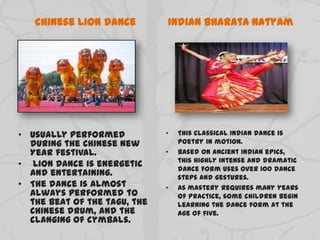
Gayong Otar-Otar
• An energetic dance from the
state of Terengganu, it features
male dancers carrying swords
and shields and simulating
battle moves.
• The dance is accompanied by a
lively tempo from gongs and
drums.
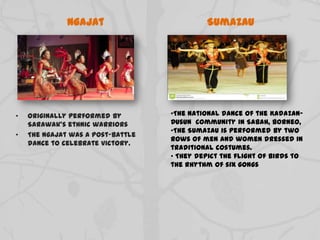
Chinese Lion Dance
• Usually performed
during the Chinese New
Year festival.
• Lion Dance is energetic
and entertaining.
• The dance is almost
always performed to
the beat of the tagu, the
Chinese drum, and the
clanging of cymbals.
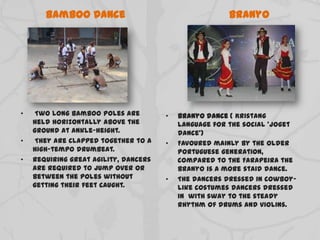
Indian Bharata Natyam
• This classical Indian dance is
poetry in motion.
• Based on ancient Indian epics,
this highly intense and dramatic
dance form uses over 100 dance
steps and gestures.
• As mastery requires many years
of practice, some children begin
learning the dance form at the
age of five.
Ngajat
• Originally performed by
Sarawak’s ethnic warriors
• The Ngajat was a post-battle
dance to celebrate victory.
Sumazau
•The national dance of the Kadazan-
Dusun community in Sabah, Borneo,
•The Sumazau is performed by two
rows of men and women dressed in
traditional costumes.
• They depict the flight of birds to
the rhythm of six gongs
Bamboo Dance
• Two long bamboo poles are
held horizontally above the
ground at ankle-height.
• They are clapped together to a
high-tempo drumbeat.
• Requiring great agility, dancers
are required to jump over or
between the poles without
getting their feet caught.
Branyo
• Branyo dance ( Kristang
language for the social 'joget
dance')
• Favoured mainly by the older
Portuguese generation,
compared to the Farapeira the
Branyo is a more staid dance.
• The dancers dressed in cowboy-
like costumes dancers dressed
in with sway to the steady
rhythm of drums and violins.
Malaysian dance

Malaysian dance

  • 1.
    oAIENIE ZUBAIDAH BTZUBER-2013494806 oAIMIN AMIRA BT MOKTAR-2013837418 oNUR NADIRAH BT ROSLI-2013654544
  • 2.
  • 3.
    Malay Makyong • Originatingfrom Patani in Southern Thailand. • Mak Yong was conceived to entertain female royalty, queens and princesses, when their men were away at war. • Combining romantic drama, dance and operatic singing. Kuda Kepang • Kuda Kepang is a traditional dance brought to the state of Johor by Javanese immigrants. • Dancers sit astride mock horses moving to the hypnotic beats of a percussion ensemble usually consisting of drums, gongs and angklungs.
  • 4.
    Zapin • Islamic influenceon Malaysian traditional dance is perhaps most evident in Zapin, a popular dance in the state of Johor. • Introduced by Muslim missionaries from the Middle East, Joget • Malaysia's most popular traditional dance, is a lively dance with an upbeat tempo. • The Joget has its origins in Portuguese folk dance, which was introduced to Melaka during the era of the spice trade.
  • 5.
    Tarian Piring Minangkabau • Thisdance used to be the dance to praise the God for thanking the harvest times at the region named Minangkabau in the West Sumatra since about 800 years ago. • Mostly, this dance can be usually found at Seremban, Kuala Pilah and Rembau.. Gayong Otar-Otar • An energetic dance from the state of Terengganu, it features male dancers carrying swords and shields and simulating battle moves. • The dance is accompanied by a lively tempo from gongs and drums.
  • 6.
    Chinese Lion Dance •Usually performed during the Chinese New Year festival. • Lion Dance is energetic and entertaining. • The dance is almost always performed to the beat of the tagu, the Chinese drum, and the clanging of cymbals. Indian Bharata Natyam • This classical Indian dance is poetry in motion. • Based on ancient Indian epics, this highly intense and dramatic dance form uses over 100 dance steps and gestures. • As mastery requires many years of practice, some children begin learning the dance form at the age of five.
  • 7.
    Ngajat • Originally performedby Sarawak’s ethnic warriors • The Ngajat was a post-battle dance to celebrate victory. Sumazau •The national dance of the Kadazan- Dusun community in Sabah, Borneo, •The Sumazau is performed by two rows of men and women dressed in traditional costumes. • They depict the flight of birds to the rhythm of six gongs
  • 8.
    Bamboo Dance • Twolong bamboo poles are held horizontally above the ground at ankle-height. • They are clapped together to a high-tempo drumbeat. • Requiring great agility, dancers are required to jump over or between the poles without getting their feet caught. Branyo • Branyo dance ( Kristang language for the social 'joget dance') • Favoured mainly by the older Portuguese generation, compared to the Farapeira the Branyo is a more staid dance. • The dancers dressed in cowboy- like costumes dancers dressed in with sway to the steady rhythm of drums and violins.