Diversity
Learning Outcomes
Explain the meaning and benefits of
employee diversity
Develop an awareness of the unique
perspectives, problems, and issues of diverse
employee groups
Describe the challenges firms may face in the
management of diversity
Describe various approaches that managers
may use to promote employee diversity
What is diversity?
Diversity is all of the ways in which people
are different
Companies are embracing a more
inclusive definition of diversity
– Spectrum of differences: how employees
approach work, interact, approach work,
derive satisfaction and define who they are…
Forms of diversity
Cultural diversity
Age diversity
Religious diversity
Racial diversity
Disability/ability diversity
Pay level/lifestyle diversity
Diversity in sexual orientation
Nationality
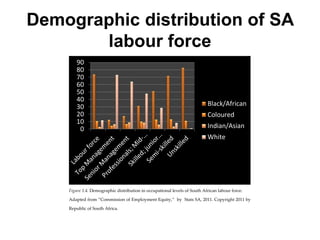
Demographic distribution of SA
labour force
Figure 1.4. Demographic distribution in occupational levels of South African labour force.
Adapted from “Commission of Employment Equity,” by Stats SA, 2011. Copyright 2011 by
Republic of South Africa.
0
10
20
30
40
50
60
70
80
90
Black/African
Coloured
Indian/Asian
White
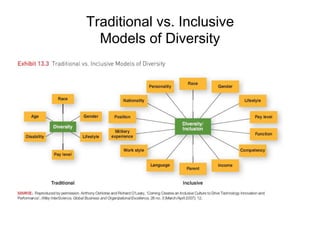
Traditional vs. Inclusive
Models of Diversity
Advantages of embracing
diversity
International competition – firms with
employee diversity are likely to display
cultural sensitivity, understanding and
awareness that will help them succeed in
the global arena e.g.. the Bank of America
conducts business in 37 countries and the
Californian customer call centre speaks 13
languages
Advantages of embracing
diversity
Multiplicity of points of view
People from different backgrounds bring a
variety of experiences, skills, abilities and
information
Diversity fuels innovation and creativity
Advantages of embracing
diversity
Team performance
A diverse team is characterised by
divergent thinking which minimises
groupthink
Diverse group members may learn from,
emulate and internalise the different
strengths of other team members
Advantages of embracing
diversity
Better use of employee talent
Increased understanding of the
marketplace
Enhanced breadth of understanding in
leadership positions
Increased quality of team problem solving
Reduced costs associated with high
turnover, absenteeism, and lawsuits
Challenges of diversity
Pressure towards homogenisation
 Monoculture – the homogenous organisational culture
that results from turnover of dissimilar employees
 Ethnocentrism – a belief that may become prevalent
among majority group employees that their way of doing
things, their values, and their norms are inherently
superior to those of other groups and cultures
 Glass ceiling - the intangible barrier that prevents
women and minority groups from rising to upper levels in
business
 Segmented communication – flows of information within
the firm that are far greater within groups than between
groups
Challenges of diversity
Lower cohesion
It may lead to a lack of commonality of
organisational values and goals
Members must share some common values
and norms to promote coherent actions on
organisational goals
The need for heterogeneity to promote
problem-solving and innovation must be
balanced with the need for organisational
coherence and unity of action to provide
competitive advantage
Challenges of diversity
Interpersonal conflict and tension
As organisations become diverse,
mistrust, lack of understanding and lack of
mutual respect may lead to decreasing
cooperation
It may lead to stress and interpersonal
friction making it difficult to reach
agreement on issues
Challenges of diversity
Confusing employee diversity with affirmative
action
Affirmative action is a government-mandated
program to provide opportunities to women
and minorities
Members of the groups not covered by the
programs have complained about reverse
discrimination
Affirmative action may lead to lowered self-
esteem among the beneficiaries
Challenges of diversity
Diversity presents challenges for HR
Firstly, white males may view a program as a
threat to their own opportunities for advancement
Secondly, the perception of special treatment may
undermine formal procedures, policies, and
enforcement mechanisms of the diversity program
Thirdly, women and minorities in positions of
authority may not receive as much respect as
white/black men
Finally, the organisation may not reap the benefits
of employee diversity
Factors Shaping Personal Bias
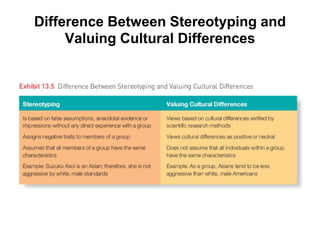
 Stereotypes are often based on folklore, media
portrayals, and other unreliable sources of information
 Stereotypes contain negative connotations
 Stereotypes assume that all members of a group have
the same characteristics
Difference Between Stereotyping and
Valuing Cultural Differences
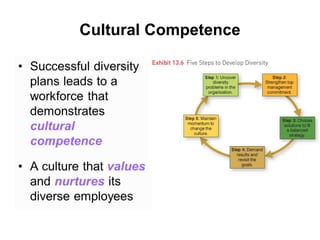
Cultural Competence
Diversity Initiatives and Programs
 Changing Structures and Policies
 Expanding Recruitment Efforts
 Establishing Mentor Relationships
 Senior mentoring
 Apprenticeships
 Diversity learning labs
 Accommodating Special Needs
 Providing Diversity Skills Training
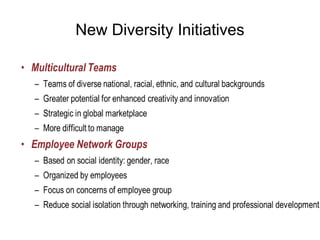
New Diversity Initiatives
Diversity initiatives at WITS
DIVERSITY MANAGER (Department: TRANSFORMATION AND
EMPLOYMENT EQUITY OFFICE)
 The main purpose of this job is to:
 Manage and coordinate the University’s strategy and
obligations in relation to matters of diversity.
 Manage, coordinate and train students and staff on the
objectives and obligations that they have toward the
University’s Social Justice Policies and Procedures
 Manage discrimination complaints and ensure that these are
timeously attended to and that staff and students impacted by
discrimination are aware of their rights and responsibilities
with regard to the resolution of discrimination complaints.
 Oversee appropriate dispute resolution measures throughout
the University
Diversity initiatives at WITS
Wits Centre for Diversity Studies - is
based in the Faculty of Humanities at the
University of the Witwatersrand.
Through interdisciplinary postgraduate
education, courses for the public, and
research, WiCDS aims to build capacity to
meet the challenges of diverse societies,
especially in post-apartheid South Africa.
Antecedents for embracing
diversity
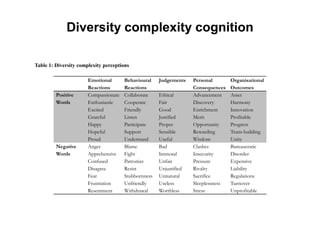
Diversity complexity cognition
 Diversity complexity perceptions assess the degree to which
members of an organisation hold simple or complex views on
workplace diversity. In other words it refers to the degree to
which an individual’s view of diversity is differentiated across
aspects of diversity (Hostager & De Meuse, 2002)
 Perceptual breadth refers to the degree to which an
individual’s view of diversity is differentiated across the 5
categories of diversity reaction identified by De Meuse and
Hostager (2001). Their perceptions are more complex than
those who include one or two of the category
Diversity complexity cognition
 Perceptual depth – the degree to which an individual’s
diversity perceptions are differentiated to include a balanced
view of positive and negative aspects in each of the five
categories
 Diversity complexity cognition - Individuals who display a high
level of diversity complexity cognition are more likely to
recognise emotions in others (Plaut, 2002)
 Individuals who display a high level of diversity complexity
cognition tend to be more moderate in their attitudes have (a)
a heightened tolerance for ambiguity (Streufert, Streufert,
& Castore, 1968); (b) an enhanced ability to adopt the
perspective of others (Triandis, 1977); (c) an improved
ability to resolve conflicts (Eiseman, 1978); and (d) greater
levels of gregariousness, warmth, and nurturance during
social interactions (Coren & Suedfeld, 1995).
Diversity complexity cognition
Emotional
Reactions
Behavioural
Reactions
Judgements Personal
Consequences
Organisational
Outcomes
Positive
Words
Compassionate
Enthusiastic
Excited
Grateful
Happy
Hopeful
Proud
Collaborate
Cooperate
Friendly
Listen
Participate
Support
Understand
Ethical
Fair
Good
Justified
Proper
Sensible
Useful
Advancement
Discovery
Enrichment
Merit
Opportunity
Rewarding
Wisdom
Asset
Harmony
Innovation
Profitable
Progress
Team-building
Unity
Negative
Words
Anger
Apprehensive
Confused
Disagree
Fear
Frustration
Resentment
Blame
Fight
Patronize
Resist
Stubbornness
Unfriendly
Withdrawal
Bad
Immoral
Unfair
Unjustified
Unnatural
Useless
Worthless
Clashes
Insecurity
Pressure
Rivalry
Sacrifice
Sleeplessness
Stress
Bureaucratic
Disorder
Expensive
Liability
Regulations
Turnover
Unprofitable
Table 1: Diversity complexity perceptions
Antecedents for embracing diversity
Emotional intelligence
 Emotional intelligence - emotional intelligence is
positively related to diversity complexity cognition
(Kamps & Engelbrecht, 2011)
 Employees with high levels of EI accordingly maintain
a more positive attitude towards their diverse co-
workers and may experience less interpersonal
conflict than those who have lower levels of EI
(Murphy & Janeke, 2009; Suliman & Al-Shaikh, 2007).
Emotional intelligence is positively related to valuing
individual differences
Antecedents for embracing diversity
Higher education
A management role
Experience abroad lead to a higher
positive towards diversity
http://dergiler.ankara.edu.tr/dergiler/42/1347/15604.pdfe
Thank You

DIVERSITY POWER POINT SLIDES.pptx

  • 1.
  • 2.
    Learning Outcomes Explain themeaning and benefits of employee diversity Develop an awareness of the unique perspectives, problems, and issues of diverse employee groups Describe the challenges firms may face in the management of diversity Describe various approaches that managers may use to promote employee diversity
  • 3.
    What is diversity? Diversityis all of the ways in which people are different Companies are embracing a more inclusive definition of diversity – Spectrum of differences: how employees approach work, interact, approach work, derive satisfaction and define who they are…
  • 4.
    Forms of diversity Culturaldiversity Age diversity Religious diversity Racial diversity Disability/ability diversity Pay level/lifestyle diversity Diversity in sexual orientation Nationality
  • 5.
    Demographic distribution ofSA labour force Figure 1.4. Demographic distribution in occupational levels of South African labour force. Adapted from “Commission of Employment Equity,” by Stats SA, 2011. Copyright 2011 by Republic of South Africa. 0 10 20 30 40 50 60 70 80 90 Black/African Coloured Indian/Asian White
  • 6.
  • 7.
    Advantages of embracing diversity Internationalcompetition – firms with employee diversity are likely to display cultural sensitivity, understanding and awareness that will help them succeed in the global arena e.g.. the Bank of America conducts business in 37 countries and the Californian customer call centre speaks 13 languages
  • 8.
    Advantages of embracing diversity Multiplicityof points of view People from different backgrounds bring a variety of experiences, skills, abilities and information Diversity fuels innovation and creativity
  • 9.
    Advantages of embracing diversity Teamperformance A diverse team is characterised by divergent thinking which minimises groupthink Diverse group members may learn from, emulate and internalise the different strengths of other team members
  • 10.
    Advantages of embracing diversity Betteruse of employee talent Increased understanding of the marketplace Enhanced breadth of understanding in leadership positions Increased quality of team problem solving Reduced costs associated with high turnover, absenteeism, and lawsuits
  • 11.
    Challenges of diversity Pressuretowards homogenisation  Monoculture – the homogenous organisational culture that results from turnover of dissimilar employees  Ethnocentrism – a belief that may become prevalent among majority group employees that their way of doing things, their values, and their norms are inherently superior to those of other groups and cultures  Glass ceiling - the intangible barrier that prevents women and minority groups from rising to upper levels in business  Segmented communication – flows of information within the firm that are far greater within groups than between groups
  • 12.
    Challenges of diversity Lowercohesion It may lead to a lack of commonality of organisational values and goals Members must share some common values and norms to promote coherent actions on organisational goals The need for heterogeneity to promote problem-solving and innovation must be balanced with the need for organisational coherence and unity of action to provide competitive advantage
  • 13.
    Challenges of diversity Interpersonalconflict and tension As organisations become diverse, mistrust, lack of understanding and lack of mutual respect may lead to decreasing cooperation It may lead to stress and interpersonal friction making it difficult to reach agreement on issues
  • 14.
    Challenges of diversity Confusingemployee diversity with affirmative action Affirmative action is a government-mandated program to provide opportunities to women and minorities Members of the groups not covered by the programs have complained about reverse discrimination Affirmative action may lead to lowered self- esteem among the beneficiaries
  • 15.
    Challenges of diversity Diversitypresents challenges for HR Firstly, white males may view a program as a threat to their own opportunities for advancement Secondly, the perception of special treatment may undermine formal procedures, policies, and enforcement mechanisms of the diversity program Thirdly, women and minorities in positions of authority may not receive as much respect as white/black men Finally, the organisation may not reap the benefits of employee diversity
  • 16.
    Factors Shaping PersonalBias  Stereotypes are often based on folklore, media portrayals, and other unreliable sources of information  Stereotypes contain negative connotations  Stereotypes assume that all members of a group have the same characteristics
  • 17.
    Difference Between Stereotypingand Valuing Cultural Differences
  • 18.
  • 19.
    Diversity Initiatives andPrograms  Changing Structures and Policies  Expanding Recruitment Efforts  Establishing Mentor Relationships  Senior mentoring  Apprenticeships  Diversity learning labs  Accommodating Special Needs  Providing Diversity Skills Training
  • 20.
  • 21.
    Diversity initiatives atWITS DIVERSITY MANAGER (Department: TRANSFORMATION AND EMPLOYMENT EQUITY OFFICE)  The main purpose of this job is to:  Manage and coordinate the University’s strategy and obligations in relation to matters of diversity.  Manage, coordinate and train students and staff on the objectives and obligations that they have toward the University’s Social Justice Policies and Procedures  Manage discrimination complaints and ensure that these are timeously attended to and that staff and students impacted by discrimination are aware of their rights and responsibilities with regard to the resolution of discrimination complaints.  Oversee appropriate dispute resolution measures throughout the University
  • 22.
    Diversity initiatives atWITS Wits Centre for Diversity Studies - is based in the Faculty of Humanities at the University of the Witwatersrand. Through interdisciplinary postgraduate education, courses for the public, and research, WiCDS aims to build capacity to meet the challenges of diverse societies, especially in post-apartheid South Africa.
  • 23.
    Antecedents for embracing diversity Diversitycomplexity cognition  Diversity complexity perceptions assess the degree to which members of an organisation hold simple or complex views on workplace diversity. In other words it refers to the degree to which an individual’s view of diversity is differentiated across aspects of diversity (Hostager & De Meuse, 2002)  Perceptual breadth refers to the degree to which an individual’s view of diversity is differentiated across the 5 categories of diversity reaction identified by De Meuse and Hostager (2001). Their perceptions are more complex than those who include one or two of the category
  • 24.
    Diversity complexity cognition Perceptual depth – the degree to which an individual’s diversity perceptions are differentiated to include a balanced view of positive and negative aspects in each of the five categories  Diversity complexity cognition - Individuals who display a high level of diversity complexity cognition are more likely to recognise emotions in others (Plaut, 2002)  Individuals who display a high level of diversity complexity cognition tend to be more moderate in their attitudes have (a) a heightened tolerance for ambiguity (Streufert, Streufert, & Castore, 1968); (b) an enhanced ability to adopt the perspective of others (Triandis, 1977); (c) an improved ability to resolve conflicts (Eiseman, 1978); and (d) greater levels of gregariousness, warmth, and nurturance during social interactions (Coren & Suedfeld, 1995).
  • 25.
    Diversity complexity cognition Emotional Reactions Behavioural Reactions JudgementsPersonal Consequences Organisational Outcomes Positive Words Compassionate Enthusiastic Excited Grateful Happy Hopeful Proud Collaborate Cooperate Friendly Listen Participate Support Understand Ethical Fair Good Justified Proper Sensible Useful Advancement Discovery Enrichment Merit Opportunity Rewarding Wisdom Asset Harmony Innovation Profitable Progress Team-building Unity Negative Words Anger Apprehensive Confused Disagree Fear Frustration Resentment Blame Fight Patronize Resist Stubbornness Unfriendly Withdrawal Bad Immoral Unfair Unjustified Unnatural Useless Worthless Clashes Insecurity Pressure Rivalry Sacrifice Sleeplessness Stress Bureaucratic Disorder Expensive Liability Regulations Turnover Unprofitable Table 1: Diversity complexity perceptions
  • 26.
    Antecedents for embracingdiversity Emotional intelligence  Emotional intelligence - emotional intelligence is positively related to diversity complexity cognition (Kamps & Engelbrecht, 2011)  Employees with high levels of EI accordingly maintain a more positive attitude towards their diverse co- workers and may experience less interpersonal conflict than those who have lower levels of EI (Murphy & Janeke, 2009; Suliman & Al-Shaikh, 2007). Emotional intelligence is positively related to valuing individual differences
  • 27.
    Antecedents for embracingdiversity Higher education A management role Experience abroad lead to a higher positive towards diversity http://dergiler.ankara.edu.tr/dergiler/42/1347/15604.pdfe
  • 28.