LODEN’S DIVERSITY
WHEEL
ED-205 Foundations of Special
Education and Inclusive Education
Reporters:
MECHAILA NACASABOG
ARIES LABUYO
BSED 2-C
1
2
3
Today,
you’ll
learn
about the
following:
Discuss the
meaning and
significance of
diversity
Demonstrate the use
of Loden’s Wheel of
Diversity
Support diversity
as a positive
component of
relationships,
educations and
organizations
WHAT IS DIVERSITY?
What is diversity?
-it means understanding each individual is unique and recognizing our
individual differences.
-It is the practice or equity of including or involving people from a
range of different genders.
WHAT IS DIVERSITY
WHEEL?
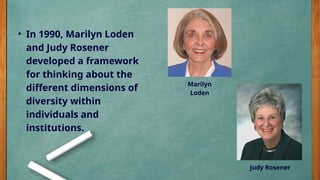
• In 1990, Marilyn Loden
and Judy Rosener
developed a framework
for thinking about the
different dimensions of
diversity within
individuals and
institutions.
Marilyn
Loden
Judy Rosener
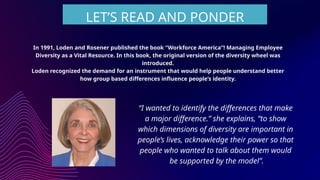
In 1991, Loden and Rosener published the book “Workforce America”! Managing Employee
Diversity as a Vital Resource. In this book, the original version of the diversity wheel was
introduced.
Loden recognized the demand for an instrument that would help people understand better
how group based differences influence people’s identity.
LET’S READ AND PONDER
“I wanted to identify the differences that make
a major difference.” she explains, “to show
which dimensions of diversity are important in
people’s lives, acknowledge their power so that
people who wanted to talk about them would
be supported by the model”.
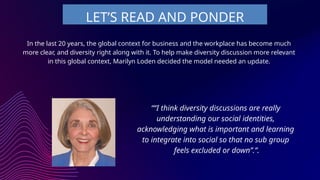
In the last 20 years, the global context for business and the workplace has become much
more clear, and diversity right along with it. To help make diversity discussion more relevant
in this global context, Marilyn Loden decided the model needed an update.
LET’S READ AND PONDER
““I think diversity discussions are really
understanding our social identities,
acknowledging what is important and learning
to integrate into social so that no sub group
feels excluded or down”.”.
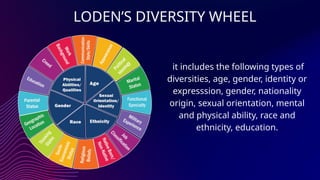
it includes the following types of
diversities, age, gender, identity or
expresssion, gender, nationality
origin, sexual orientation, mental
and physical ability, race and
ethnicity, education.
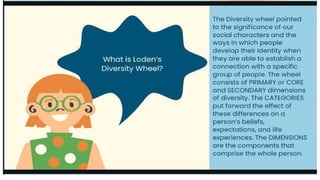
LODEN’S DIVERSITY WHEEL
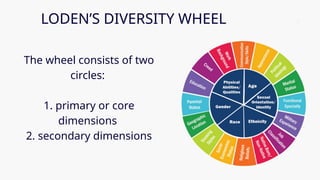
The wheel consists of two
circles:
1. primary or core
dimensions
2. secondary dimensions
LODEN’S DIVERSITY WHEEL
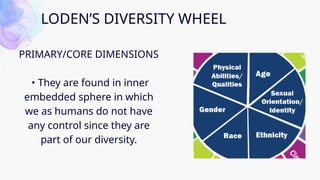
PRIMARY/CORE DIMENSIONS
• They are found in inner
embedded sphere in which
we as humans do not have
any control since they are
part of our diversity.
LODEN’S DIVERSITY WHEEL
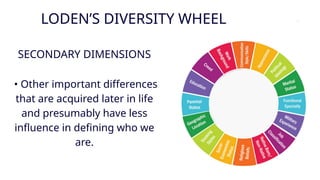
SECONDARY DIMENSIONS
• Other important differences
that are acquired later in life
and presumably have less
influence in defining who we
are.
Diverse groups
have a greater
range of
perspectives and
also able to
generate more
high solutions.
Groups with
greater diversity
were shown to
have greater
innovation and
creativity
Greater opportunity
as individual and in
professional
growth.
POSITIVE
Different
understanding
of professional
etiquettes.
A lot of
communications
or difficult to
understand
across
language and
cultures.
Some may be less
likely to let their
voices be heard
NEGATIVE
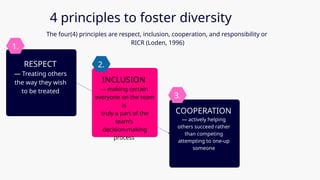
RESPECT
— Treating others
the way they wish
to be treated
1.
4 principles to foster diversity
The four(4) principles are respect, inclusion, cooperation, and responsibility or
RICR (Loden, 1996)
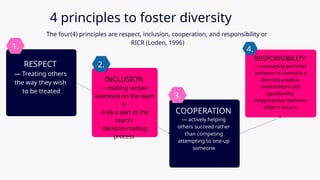
4 principles to foster diversity
RESPECT
— Treating others
the way they wish
to be treated
The four(4) principles are respect, inclusion, cooperation, and responsibility or
RICR (Loden, 1996)
INCLUSION
— making certain
everyone on the team
is
truly a part of the
team’s
decision-making
process
1.
2.
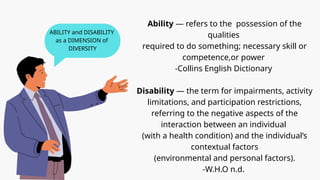
4 principles to foster diversity
RESPECT
— Treating others
the way they wish
to be treated
The four(4) principles are respect, inclusion, cooperation, and responsibility or
RICR (Loden, 1996)
INCLUSION
— making certain
everyone on the team
is
truly a part of the
team’s
decision-making
process
COOPERATION
— actively helping
others succeed rather
than competing
attempting to one-up
someone
1.
2.
3.
4 principles to foster diversity
RESPECT
— Treating others
the way they wish
to be treated
The four(4) principles are respect, inclusion, cooperation, and responsibility or
RICR (Loden, 1996)
INCLUSION
— making certain
everyone on the team
is
truly a part of the
team’s
decision-making
process
COOPERATION
— actively helping
others succeed rather
than competing
attempting to one-up
someone
RESPONSIBILITY
— managing personal
behavior to maintain a
diversity-positive
environment and
questioning
inappropriate behavior
when it occurs
1.
2.
3.
4.
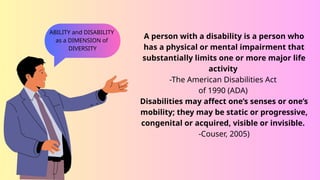
Ability — refers to the possession of the
qualities
required to do something; necessary skill or
competence,or power
-Collins English Dictionary
Disability — the term for impairments, activity
limitations, and participation restrictions,
referring to the negative aspects of the
interaction between an individual
(with a health condition) and the individual’s
contextual factors
(environmental and personal factors).
-W.H.O n.d.
ABILITY and DISABILITY
as a DIMENSION of
DIVERSITY
A person with a disability is a person who
has a physical or mental impairment that
substantially limits one or more major life
activity
-The American Disabilities Act
of 1990 (ADA)
Disabilities may affect one’s senses or one’s
mobility; they may be static or progressive,
congenital or acquired, visible or invisible.
-Couser, 2005)
ABILITY and DISABILITY
as a DIMENSION of
DIVERSITY
A person’s disability makes him or her a unique individual who is at times,
shunned from places and activities. They have to be acknowledged as a part
of spectrum of diversity.
They have to be recognized as human beings who should not be
discriminated against, but rather understood and tolerated. They have to be
accorded to their rights
LET’S READ AND PONDER
In this aged of fast paced development
where diversity plays a unique role, there
are still challenges that confront a lot of
people who been identified as “different”. In
some workplace, women and people of color
are still discriminated against and not given
positions in management or administration.
People of a certain race are stereotyped to
be of a specific character. Children from
indigenous groups have to go through an
educational system that does not consider
their ethnic background, needs, and values
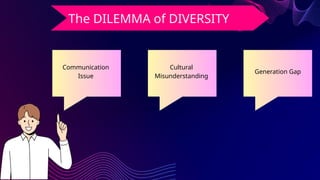
The DILEMMA of
DIVERSITY
Communication
Issue
The DILEMMA of DIVERSITY
Communication
Issue
Cultural
Misunderstanding
The DILEMMA of DIVERSITY
Communication
Issue
Cultural
Misunderstanding
Generation Gap
The DILEMMA of DIVERSITY
Diversity is an issue we have to face and conquer. As our communities become
more diverse, it is imperative that we make an effort to
understand the different dimension of diversity, which is not just all about
accepting, understanding, and tolerating one’s uniqueness. Accepting and
celebrating the uniqueness of each individual will allow for respecting
different experiences and qualities of individuals that will open up more avenues
to solve problems and innovate. Collaboration and communication are skills that
are needed to develop and succeed. it is therefore, important that we
understand our differences and master howthese could be used to harness
tolerance, cooperation, and unity that will lead to productivity
THANK YOU
ABIGAIL PAGADO
REFERENCES:
*Loden, M., & Rosener, J. (1991).* Workforce America! Managing Employee Diversity as a Vital
Resource. (https://www.goodreads.com/book/show/1330075.Workforce_America)
*Loden, M. (1996).* Implementing Diversity.(
https://www.goodreads.com/book/show/1416262.Implementing_Diversity)
*World Health Organization (WHO).* Disability(https://www.who.int/health-topics/disability)
*The American Disabilities Act of 1990 (ADA).(https://www.ada.gov/)
*Harvard Business Review (2018).* How Diversity Can Drive Innovation.(
https://hbr.org/2018/01/how-diversity-can-drive-innovation)
*Society for Human Resource Management (SHRM).* Managing Organizational Diversity.(
https://www.shrm.org/resourcesandtools/hr-topics/behavioral-competencies/global-and-cultural-eff
ectiveness/pages/managing-organizational-diversity.aspx
)

LODEN'S DIVERSITY WHEEL. powerpoint presentation

  • 1.
    LODEN’S DIVERSITY WHEEL ED-205 Foundationsof Special Education and Inclusive Education Reporters: MECHAILA NACASABOG ARIES LABUYO BSED 2-C
  • 2.
    1 2 3 Today, you’ll learn about the following: Discuss the meaningand significance of diversity Demonstrate the use of Loden’s Wheel of Diversity Support diversity as a positive component of relationships, educations and organizations
  • 3.
  • 4.
    What is diversity? -itmeans understanding each individual is unique and recognizing our individual differences. -It is the practice or equity of including or involving people from a range of different genders.
  • 5.
  • 9.
    • In 1990,Marilyn Loden and Judy Rosener developed a framework for thinking about the different dimensions of diversity within individuals and institutions. Marilyn Loden Judy Rosener
  • 10.
    In 1991, Lodenand Rosener published the book “Workforce America”! Managing Employee Diversity as a Vital Resource. In this book, the original version of the diversity wheel was introduced. Loden recognized the demand for an instrument that would help people understand better how group based differences influence people’s identity. LET’S READ AND PONDER “I wanted to identify the differences that make a major difference.” she explains, “to show which dimensions of diversity are important in people’s lives, acknowledge their power so that people who wanted to talk about them would be supported by the model”.
  • 11.
    In the last20 years, the global context for business and the workplace has become much more clear, and diversity right along with it. To help make diversity discussion more relevant in this global context, Marilyn Loden decided the model needed an update. LET’S READ AND PONDER ““I think diversity discussions are really understanding our social identities, acknowledging what is important and learning to integrate into social so that no sub group feels excluded or down”.”.
  • 12.
    it includes thefollowing types of diversities, age, gender, identity or expresssion, gender, nationality origin, sexual orientation, mental and physical ability, race and ethnicity, education. LODEN’S DIVERSITY WHEEL
  • 13.
    LODEN’S DIVERSITY WHEEL Thewheel consists of two circles: 1. primary or core dimensions 2. secondary dimensions
  • 14.
    LODEN’S DIVERSITY WHEEL PRIMARY/COREDIMENSIONS • They are found in inner embedded sphere in which we as humans do not have any control since they are part of our diversity.
  • 15.
    LODEN’S DIVERSITY WHEEL SECONDARYDIMENSIONS • Other important differences that are acquired later in life and presumably have less influence in defining who we are.
  • 16.
    Diverse groups have agreater range of perspectives and also able to generate more high solutions. Groups with greater diversity were shown to have greater innovation and creativity Greater opportunity as individual and in professional growth. POSITIVE
  • 17.
    Different understanding of professional etiquettes. A lotof communications or difficult to understand across language and cultures. Some may be less likely to let their voices be heard NEGATIVE
  • 18.
    RESPECT — Treating others theway they wish to be treated 1. 4 principles to foster diversity The four(4) principles are respect, inclusion, cooperation, and responsibility or RICR (Loden, 1996)
  • 19.
    4 principles tofoster diversity RESPECT — Treating others the way they wish to be treated The four(4) principles are respect, inclusion, cooperation, and responsibility or RICR (Loden, 1996) INCLUSION — making certain everyone on the team is truly a part of the team’s decision-making process 1. 2.
  • 20.
    4 principles tofoster diversity RESPECT — Treating others the way they wish to be treated The four(4) principles are respect, inclusion, cooperation, and responsibility or RICR (Loden, 1996) INCLUSION — making certain everyone on the team is truly a part of the team’s decision-making process COOPERATION — actively helping others succeed rather than competing attempting to one-up someone 1. 2. 3.
  • 21.
    4 principles tofoster diversity RESPECT — Treating others the way they wish to be treated The four(4) principles are respect, inclusion, cooperation, and responsibility or RICR (Loden, 1996) INCLUSION — making certain everyone on the team is truly a part of the team’s decision-making process COOPERATION — actively helping others succeed rather than competing attempting to one-up someone RESPONSIBILITY — managing personal behavior to maintain a diversity-positive environment and questioning inappropriate behavior when it occurs 1. 2. 3. 4.
  • 22.
    Ability — refersto the possession of the qualities required to do something; necessary skill or competence,or power -Collins English Dictionary Disability — the term for impairments, activity limitations, and participation restrictions, referring to the negative aspects of the interaction between an individual (with a health condition) and the individual’s contextual factors (environmental and personal factors). -W.H.O n.d. ABILITY and DISABILITY as a DIMENSION of DIVERSITY
  • 23.
    A person witha disability is a person who has a physical or mental impairment that substantially limits one or more major life activity -The American Disabilities Act of 1990 (ADA) Disabilities may affect one’s senses or one’s mobility; they may be static or progressive, congenital or acquired, visible or invisible. -Couser, 2005) ABILITY and DISABILITY as a DIMENSION of DIVERSITY
  • 24.
    A person’s disabilitymakes him or her a unique individual who is at times, shunned from places and activities. They have to be acknowledged as a part of spectrum of diversity. They have to be recognized as human beings who should not be discriminated against, but rather understood and tolerated. They have to be accorded to their rights LET’S READ AND PONDER
  • 25.
    In this agedof fast paced development where diversity plays a unique role, there are still challenges that confront a lot of people who been identified as “different”. In some workplace, women and people of color are still discriminated against and not given positions in management or administration. People of a certain race are stereotyped to be of a specific character. Children from indigenous groups have to go through an educational system that does not consider their ethnic background, needs, and values The DILEMMA of DIVERSITY
  • 26.
  • 27.
  • 28.
  • 29.
    Diversity is anissue we have to face and conquer. As our communities become more diverse, it is imperative that we make an effort to understand the different dimension of diversity, which is not just all about accepting, understanding, and tolerating one’s uniqueness. Accepting and celebrating the uniqueness of each individual will allow for respecting different experiences and qualities of individuals that will open up more avenues to solve problems and innovate. Collaboration and communication are skills that are needed to develop and succeed. it is therefore, important that we understand our differences and master howthese could be used to harness tolerance, cooperation, and unity that will lead to productivity
  • 30.
  • 31.
    REFERENCES: *Loden, M., &Rosener, J. (1991).* Workforce America! Managing Employee Diversity as a Vital Resource. (https://www.goodreads.com/book/show/1330075.Workforce_America) *Loden, M. (1996).* Implementing Diversity.( https://www.goodreads.com/book/show/1416262.Implementing_Diversity) *World Health Organization (WHO).* Disability(https://www.who.int/health-topics/disability) *The American Disabilities Act of 1990 (ADA).(https://www.ada.gov/) *Harvard Business Review (2018).* How Diversity Can Drive Innovation.( https://hbr.org/2018/01/how-diversity-can-drive-innovation) *Society for Human Resource Management (SHRM).* Managing Organizational Diversity.( https://www.shrm.org/resourcesandtools/hr-topics/behavioral-competencies/global-and-cultural-eff ectiveness/pages/managing-organizational-diversity.aspx )

Editor's Notes

  • #14 The PRIMARY CORE is the most powerful and sustaining differences. Loden presented six(6) primary dimensions: age, ethnicity, physical abilities/qualities, race, and sexual orientation.
  • #15 SECONDARY DIMENSION defined the other important differences that acquired later in life. The secondary dimension included: educational background, income, marital status, work experience, military experience, religion and geographic loacation.