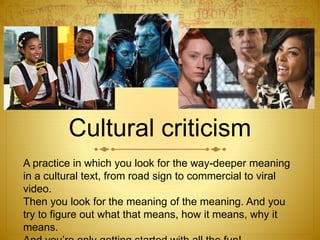
Cultural criticism
A practice in which you look for the way-deeper meaning
in a cultural text, from road sign to commercial to viral
video.
Then you look for the meaning of the meaning. And you
try to figure out what that means, how it means, why it
means.
Criticism versus cynicism
 A media cynic decides a bit of media sucks or that
news is "fake” or “biased” without careful examination.
 A media critic makes a hypothesis about media's
value, tests the hypothesis through careful
observation, crafts a detailed analysis and comes to
an informed conclusion. The critic might decide that
a film sucks or that news is fake. But they will be able
to back up that conclusion with supportive evidence.
 In this class, we will strive to be critics, not cynics.
Many theories and critical modes
 A reader response mode of criticism allowed for
individual ways of thinking about a text. Remember
the English-class maxim that “there is no right
answer”? This is that way of thinking.
 But reader response criticism was too mushy for folks
who preferred a more structured, almost scientific
approach to the cultural text.
 Formalists suggested that a text contained within it all
the needed clues to an exact interpretation.
More theories
 Other critics and scholars tried to ascertain what the
media maker intended to say with her or his work by
putting it in historic context.
 Scholars tried to tie works to the media maker’s own
life, using a biographic criticism.
 Marxist critics looked at economics, critiquing the
capitalist forces that drive the narrative (and sales of
the media).
And even more!
 Deconstructionists studied how meaning could be
derived only from contextual oppositions, always in flux.
 Psychoanalysts studied the text as a revelation of our
inner psyches.
 Archetypal critics read a text like it was a deck of tarot
cards.
 Phenomenologists looked for the epiphanous moments
and barbaric yawps.
 (Many critics would now accuse me of being reductive, with
regards to their sophisticated and complex theories.)
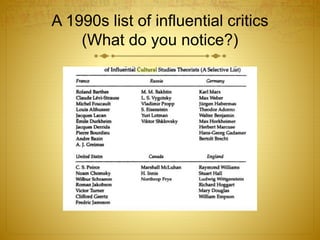
A 1990s list of influential critics
(What do you notice?)
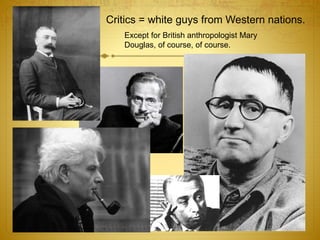
Critics = white guys from Western nations.
Except for British anthropologist Mary
Douglas, of course, of course.
The problem with Eurocentrism
 Eurocentrism as the term for an ideology was coined
by Samir Amin in the 1970s.
 A Eurocentric view privileges Western culture
(European and Euro-based U.S. and Canadian
cultures).
 Critics develop analytical systems from their cultural
perspectives.
 More perspectives = a richer, more inclusive criticism
– for us, a wider, more useful understanding of the
role of mass media messages and their influence on
our thinking and our actions.
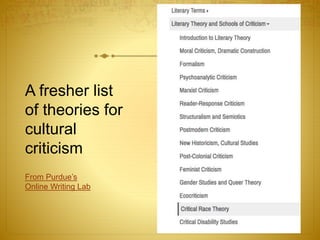
A fresher list
of theories for
cultural
criticism
From Purdue’s
Online Writing Lab
Feminist criticism
 Feminist critics look at how texts – mass
media messages, included, reinforce the
economic, political, social, and psychological
oppression of women" (Tyson 83).
 For cultural criticism, feminist criticism
examines patriarchal (male dominated) media
messages and aims to expose misogyny.
(From Purdue’s OWL.)
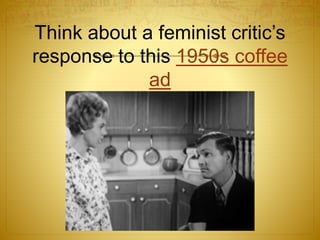
Think about a feminist critic’s
response to this 1950s coffee
ad
Critical Race Theory
 “Critical Race Theory, or CRT, examines
the appearance of race and racism
across cultural expressions including
mass media messages.
 “CRT scholars attempt to understand
how victims of systemic racism are
affected by cultural perceptions of race
and how they are able to represent
themselves to counter prejudice.”
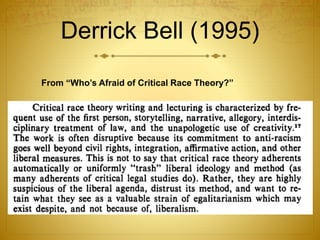
Derrick Bell (1995)
From “Who’s Afraid of Critical Race Theory?”
Ecocriticism
 Ecocriticism embraces a principle of “relevance” in
literature, which can began looking at texts as stored
energy – renewable, sustainable
 “The problem now, as most ecologists agree, is to find
ways of keeping the human community from
destroying the natural community, and with it the
human community.”
 “Energy comes from the creative imagination.”
Branches of ecocriticism
Ecocriticism, criticism via literary ecology, sprawled out
into its own sub-fields of criticism, including:
 Ecofeminism
 Ecocriticism and social justice
 Eco-phenomenology
 Eco-psychology
 Animal studies

Cultural criticism slides 2021

  • 1.
    Cultural criticism A practicein which you look for the way-deeper meaning in a cultural text, from road sign to commercial to viral video. Then you look for the meaning of the meaning. And you try to figure out what that means, how it means, why it means.
  • 2.
    Criticism versus cynicism A media cynic decides a bit of media sucks or that news is "fake” or “biased” without careful examination.  A media critic makes a hypothesis about media's value, tests the hypothesis through careful observation, crafts a detailed analysis and comes to an informed conclusion. The critic might decide that a film sucks or that news is fake. But they will be able to back up that conclusion with supportive evidence.  In this class, we will strive to be critics, not cynics.
  • 3.
    Many theories andcritical modes  A reader response mode of criticism allowed for individual ways of thinking about a text. Remember the English-class maxim that “there is no right answer”? This is that way of thinking.  But reader response criticism was too mushy for folks who preferred a more structured, almost scientific approach to the cultural text.  Formalists suggested that a text contained within it all the needed clues to an exact interpretation.
  • 4.
    More theories  Othercritics and scholars tried to ascertain what the media maker intended to say with her or his work by putting it in historic context.  Scholars tried to tie works to the media maker’s own life, using a biographic criticism.  Marxist critics looked at economics, critiquing the capitalist forces that drive the narrative (and sales of the media).
  • 5.
    And even more! Deconstructionists studied how meaning could be derived only from contextual oppositions, always in flux.  Psychoanalysts studied the text as a revelation of our inner psyches.  Archetypal critics read a text like it was a deck of tarot cards.  Phenomenologists looked for the epiphanous moments and barbaric yawps.  (Many critics would now accuse me of being reductive, with regards to their sophisticated and complex theories.)
  • 6.
    A 1990s listof influential critics (What do you notice?)
  • 7.
    Critics = whiteguys from Western nations. Except for British anthropologist Mary Douglas, of course, of course.
  • 8.
    The problem withEurocentrism  Eurocentrism as the term for an ideology was coined by Samir Amin in the 1970s.  A Eurocentric view privileges Western culture (European and Euro-based U.S. and Canadian cultures).  Critics develop analytical systems from their cultural perspectives.  More perspectives = a richer, more inclusive criticism – for us, a wider, more useful understanding of the role of mass media messages and their influence on our thinking and our actions.
  • 9.
    A fresher list oftheories for cultural criticism From Purdue’s Online Writing Lab
  • 10.
    Feminist criticism  Feministcritics look at how texts – mass media messages, included, reinforce the economic, political, social, and psychological oppression of women" (Tyson 83).  For cultural criticism, feminist criticism examines patriarchal (male dominated) media messages and aims to expose misogyny. (From Purdue’s OWL.)
  • 11.
    Think about afeminist critic’s response to this 1950s coffee ad
  • 12.
    Critical Race Theory “Critical Race Theory, or CRT, examines the appearance of race and racism across cultural expressions including mass media messages.  “CRT scholars attempt to understand how victims of systemic racism are affected by cultural perceptions of race and how they are able to represent themselves to counter prejudice.”
  • 13.
    Derrick Bell (1995) From“Who’s Afraid of Critical Race Theory?”
  • 14.
    Ecocriticism  Ecocriticism embracesa principle of “relevance” in literature, which can began looking at texts as stored energy – renewable, sustainable  “The problem now, as most ecologists agree, is to find ways of keeping the human community from destroying the natural community, and with it the human community.”  “Energy comes from the creative imagination.”
  • 15.
    Branches of ecocriticism Ecocriticism,criticism via literary ecology, sprawled out into its own sub-fields of criticism, including:  Ecofeminism  Ecocriticism and social justice  Eco-phenomenology  Eco-psychology  Animal studies