Literary criticism
 Literary criticism helps interpret the meaning of a short story, poem, or
play.
 Literary criticism is an attempt to understand and ultimately
evaluate what a literay work.
Major schools of criticisms or
approaches
 There are many critical approaches, or literary schools; however here are
some major ones to which we may be referring:
Reader Response
Criticism
Text-------Meaning------Reader
Reader Response Criticism
In this approach, it is the reader who creates his or her
own meaning of the text under study:
This approach considers that:
 Literature does not exist separate from those who
read it;
 Readers bring emotions, concerns, life experiences,
and knowledge to their reading; therefore, each
interpretation is subjective and unique.
 stresses the importance of the reader's role in
interpreting texts.
 Attempts to describe what happens in the reader’s
mind while reading a text
Formalist / or
“New” Criticism
The whole text and nothing but the text
Formalist / or “New” Criticism
This approach primarily looks at the work
itself, separate from context in which it was
written, or who wrote it.
• It involves a Close reading of the words in
the text ;
And it examine the text only, not allowing any
influences outside the text to influence the
reader’s interpretation.
Formalist Criticism
 Strongly examines
elements such as plot,
character, style and
tone, irony, symbol, etc.
 Believes that studying
these elements is the
most significant way to
find meaning about the
text
 Seeks to examine a work
in isolation from
 the reader,
 the author,
 the context in which it
was written
Feminist Criticism
It’s all about gender -or- gender means nothing
Feminist Criticism
 Feminist criticism grew out of the women’s movement
that followed World War II.
 Feminist critics analyze the role of gender in works of
literature. Leading critic Elaine Showalter describes two
purposes of feminist criticism:
 Feminist critique: The analysis of works by male authors,
especially in the depiction of women’s writing
 Gynocriticism: The study of women’s writing
Feminist Criticism
 Considers that all literature reflects or promotes patriarchy (Men
control a disproportionately large share of power)
 that the text reflects society’s
view of women as outsiders or
inferiors in terms of their place
with men
 that women are sociologically
underrepresented
Feminist Criticism
reinforces the idea that
literature is a profound
element in the maintenance of
male power and privilege.
Marxist Criticism
To have or have not
Marxist Criticism
What is Marxism?
 Marxism is an economic and social system based upon the political
and economic theories of Karl Marx and Friedrich Engels. Their
beliefs include the following:
 Value is based on labor.
 The working class will eventually overthrow the capitalist middle class.
 In the meantime, the middle class exploits the working class.
 Most institutions—religious, legal, educational, and governmental—are
corrupted by middle-class capitalists.
Marxist Criticism
Marxist literary critics focus upon:
 economic issues
plight of working class
 capitalist control
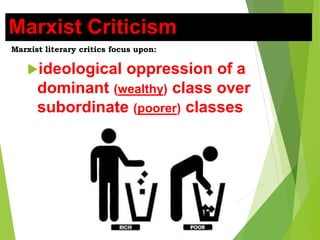
Marxist literary critics focus upon:
ideological oppression of a
dominant (wealthy) class over
subordinate (poorer) classes
Marxist Criticism
Marxist Criticism
What do Marxist literary critics do with texts?
 Examine class structure and living conditions of the poor, working class
 Look for indications that the working poor are oppressed
Marxist Criticism
A Marxist critic might ask the following questions:
 Does the text reflect a dominant capitalist ideology?
 Does the main character accept or resist bourgeoisie values?
Marxist Criticism
 Are lower economic groups ignored or devalued?
 Are values that support the dominant economic group given privilege?
Historical Criticism
Historical accuracy is key
 Historical critics believe it is necessary to know about the political,
economical, and sociological context of the stories to truly understand the
meaning. How the time and place of a story’s creation affect its meaning
 Historical Critics examine a piece of literature in terms of what it says
about a specific time/place in history.
Historical Criticism
 Seeks to understand a literary work by investigating the social, cultural, and
intellectual context that produced it
 Context includes author’s biography
Critics examine actual historical settingcontext.
 Historical critics see works as the reflection of the characters' life and times.
Historical Criticism
Psychoanalytic Criticism
It’s all in your mind
Psychoanalytic critics view literature through
the lens of psychology
They apply psychological
theory about the
workings of the human
mind to a story’s
characters
Psychoanalytic Criticism
Psychological critics
 Analyzes literature to reveal insights about the way the human
mind works.
• examine psychological
motivations of characters
Psychoanalytic Criticism
Psychological Criticism
 Psychological criticism deals with a work of literature
primarily as an expression, in fictional form, of the
personality, state of mind, feelings, and desires of its
author.
 The assumption of psychoanalytic critics is that a work of
literature is correlated with its author's mental traits.
 1. Reference to the author's personality is used to explain
and interpret a literary work.
 2. Reference to literary works is made in order to establish,
biographically, the personality of the author.
 3. The mode of reading a literary work itself is a way of
experiencing the distinctive subjectivity or consciousness of
its author.
Psychological Criticism
 Emphasizes the underlying meaning in literature in
relationship to psychological components
 Sexual symbols, dreams, repressed feelings, an individual
character’s conscious and/or subconscious motives, etc.
 The critic might look at a character’s psychological
make-up, sanity, etc.
Psychoanalytic critics ask:
why the author created such a text, particularly focusing on what
may have been unconscious motivations
whythe character acted a certain way, again particularly focusing
on unconscious motivations
• how the reader’s unconscious “motivated” a particular reaction to the
text
Basic Freudian Concepts
 Is based on the work of Sigmund Freud and his disciples.
 All actions are influenced by the unconscious.
 Human beings must repress many of their desires to live
peacefully with others.
 Repressed desires often surface in the unconscious,
motivating actions.
Basic Freudian Concepts
 The mind has three major areas of activity:
 Id: Area in the unconscious that works for gratification
through the pleasure principle
 Superego: An internal censor bringing social pressures to
bear on the id.
 Ego: Area in the consciousness that mediates among
demands of social pressure, the id, and the superego.
Authorial/ Biographical
Criticism
To know the meaning, you must know the author
Authorial Criticism
Authorial critics see works as the reflection of the author's life and times
This approach relates author’s life to the text for meaning;
 Examines how details and people in author’s life have affected a work
 Might examine the events of writer’s life, and use them to better understand
their texts.
Authorial Criticism
Authorial critics study the biography of the author and...
 Examine the author’s acquaintances,
friends, and relatives for character
origins;
 Attempt to determine what facts from
the author’s life appear in the text
Sociological Criticism
 This approach examines literature in the cultural,
economic, and political context in which is it written or
received
 Looks at the relationship of the artist and society
 How the social classes of characters influence their
outcomes
 The political or social statements a work offers
Cultural Studies
 No central methodology is used
 Interdisciplinary field
 Primary looks at the nature of social power as revealed
in “texts”
 Commercials
 Literature
 Seeks to identify the overt and covert values reflected
in a cultural practice
In Summary…
A quick review…
In Summary...
Literary criticism attempts to explain and evaluate literature. Critics attempt
to create meaning by examining many factors.
In Summary... Types of Literary Criticism include:
Reader-Response Criticism
Formalist/New Criticism
Feminist Criticism
Marxist Criticism
Historical Criticism
Psychoanalytic Criticism
Authorial Criticism
Sociological Criticism
Cultural Studies

Some Explanation for Unit One Presentation.pptx

  • 1.
    Literary criticism  Literarycriticism helps interpret the meaning of a short story, poem, or play.  Literary criticism is an attempt to understand and ultimately evaluate what a literay work.
  • 2.
    Major schools ofcriticisms or approaches  There are many critical approaches, or literary schools; however here are some major ones to which we may be referring:
  • 3.
  • 4.
    Reader Response Criticism Inthis approach, it is the reader who creates his or her own meaning of the text under study: This approach considers that:  Literature does not exist separate from those who read it;  Readers bring emotions, concerns, life experiences, and knowledge to their reading; therefore, each interpretation is subjective and unique.  stresses the importance of the reader's role in interpreting texts.  Attempts to describe what happens in the reader’s mind while reading a text
  • 5.
    Formalist / or “New”Criticism The whole text and nothing but the text
  • 6.
    Formalist / or“New” Criticism This approach primarily looks at the work itself, separate from context in which it was written, or who wrote it. • It involves a Close reading of the words in the text ; And it examine the text only, not allowing any influences outside the text to influence the reader’s interpretation.
  • 7.
    Formalist Criticism  Stronglyexamines elements such as plot, character, style and tone, irony, symbol, etc.  Believes that studying these elements is the most significant way to find meaning about the text  Seeks to examine a work in isolation from  the reader,  the author,  the context in which it was written
  • 8.
    Feminist Criticism It’s allabout gender -or- gender means nothing
  • 9.
    Feminist Criticism  Feministcriticism grew out of the women’s movement that followed World War II.  Feminist critics analyze the role of gender in works of literature. Leading critic Elaine Showalter describes two purposes of feminist criticism:  Feminist critique: The analysis of works by male authors, especially in the depiction of women’s writing  Gynocriticism: The study of women’s writing
  • 10.
    Feminist Criticism  Considersthat all literature reflects or promotes patriarchy (Men control a disproportionately large share of power)  that the text reflects society’s view of women as outsiders or inferiors in terms of their place with men  that women are sociologically underrepresented
  • 11.
    Feminist Criticism reinforces theidea that literature is a profound element in the maintenance of male power and privilege.
  • 12.
  • 13.
    Marxist Criticism What isMarxism?  Marxism is an economic and social system based upon the political and economic theories of Karl Marx and Friedrich Engels. Their beliefs include the following:  Value is based on labor.  The working class will eventually overthrow the capitalist middle class.  In the meantime, the middle class exploits the working class.  Most institutions—religious, legal, educational, and governmental—are corrupted by middle-class capitalists.
  • 14.
    Marxist Criticism Marxist literarycritics focus upon:  economic issues plight of working class  capitalist control
  • 15.
    Marxist literary criticsfocus upon: ideological oppression of a dominant (wealthy) class over subordinate (poorer) classes Marxist Criticism
  • 16.
    Marxist Criticism What doMarxist literary critics do with texts?  Examine class structure and living conditions of the poor, working class  Look for indications that the working poor are oppressed
  • 17.
    Marxist Criticism A Marxistcritic might ask the following questions:  Does the text reflect a dominant capitalist ideology?  Does the main character accept or resist bourgeoisie values?
  • 18.
    Marxist Criticism  Arelower economic groups ignored or devalued?  Are values that support the dominant economic group given privilege?
  • 19.
  • 20.
     Historical criticsbelieve it is necessary to know about the political, economical, and sociological context of the stories to truly understand the meaning. How the time and place of a story’s creation affect its meaning  Historical Critics examine a piece of literature in terms of what it says about a specific time/place in history. Historical Criticism
  • 21.
    Historical Criticism  Seeksto understand a literary work by investigating the social, cultural, and intellectual context that produced it  Context includes author’s biography Critics examine actual historical settingcontext.  Historical critics see works as the reflection of the characters' life and times. Historical Criticism
  • 22.
  • 23.
    Psychoanalytic critics viewliterature through the lens of psychology They apply psychological theory about the workings of the human mind to a story’s characters Psychoanalytic Criticism
  • 24.
    Psychological critics  Analyzesliterature to reveal insights about the way the human mind works. • examine psychological motivations of characters Psychoanalytic Criticism
  • 25.
    Psychological Criticism  Psychologicalcriticism deals with a work of literature primarily as an expression, in fictional form, of the personality, state of mind, feelings, and desires of its author.  The assumption of psychoanalytic critics is that a work of literature is correlated with its author's mental traits.  1. Reference to the author's personality is used to explain and interpret a literary work.  2. Reference to literary works is made in order to establish, biographically, the personality of the author.  3. The mode of reading a literary work itself is a way of experiencing the distinctive subjectivity or consciousness of its author.
  • 26.
    Psychological Criticism  Emphasizesthe underlying meaning in literature in relationship to psychological components  Sexual symbols, dreams, repressed feelings, an individual character’s conscious and/or subconscious motives, etc.  The critic might look at a character’s psychological make-up, sanity, etc.
  • 27.
    Psychoanalytic critics ask: whythe author created such a text, particularly focusing on what may have been unconscious motivations whythe character acted a certain way, again particularly focusing on unconscious motivations • how the reader’s unconscious “motivated” a particular reaction to the text
  • 28.
    Basic Freudian Concepts Is based on the work of Sigmund Freud and his disciples.  All actions are influenced by the unconscious.  Human beings must repress many of their desires to live peacefully with others.  Repressed desires often surface in the unconscious, motivating actions.
  • 29.
    Basic Freudian Concepts The mind has three major areas of activity:  Id: Area in the unconscious that works for gratification through the pleasure principle  Superego: An internal censor bringing social pressures to bear on the id.  Ego: Area in the consciousness that mediates among demands of social pressure, the id, and the superego.
  • 30.
    Authorial/ Biographical Criticism To knowthe meaning, you must know the author
  • 31.
    Authorial Criticism Authorial criticssee works as the reflection of the author's life and times This approach relates author’s life to the text for meaning;  Examines how details and people in author’s life have affected a work  Might examine the events of writer’s life, and use them to better understand their texts.
  • 32.
    Authorial Criticism Authorial criticsstudy the biography of the author and...  Examine the author’s acquaintances, friends, and relatives for character origins;  Attempt to determine what facts from the author’s life appear in the text
  • 33.
    Sociological Criticism  Thisapproach examines literature in the cultural, economic, and political context in which is it written or received  Looks at the relationship of the artist and society  How the social classes of characters influence their outcomes  The political or social statements a work offers
  • 34.
    Cultural Studies  Nocentral methodology is used  Interdisciplinary field  Primary looks at the nature of social power as revealed in “texts”  Commercials  Literature  Seeks to identify the overt and covert values reflected in a cultural practice
  • 35.
  • 36.
    In Summary... Literary criticismattempts to explain and evaluate literature. Critics attempt to create meaning by examining many factors.
  • 37.
    In Summary... Typesof Literary Criticism include: Reader-Response Criticism Formalist/New Criticism Feminist Criticism Marxist Criticism Historical Criticism Psychoanalytic Criticism Authorial Criticism Sociological Criticism Cultural Studies