Fayyaz Ahmed
fayaz7522@gmail.com
The basic assumption of this model is that in a difficult
situation nation consider all options and act rationally to
maximize their utility. Rational Actor Model assumes that
Government is primary actor and analyzes the following steps:
Identify problem
Identify and rank goals
Gather information (this can be ongoing)
Identify alternatives for reaching goals
Analyze alternatives by considering consequences and effectiveness
(costs and benefits) of each alternative and probabilities associated with
success
Select alternative that maximizes chances of selecting best alternative
as determined in above mentioned step
Implement decision
Monitor and evaluate
 The United States and the Soviet Union were allies during
the Second World War.
Soon after the War, both the countries developed hostility.
The United States of America (USA) was advocating and
promoting capitalism and democratic values whereas the Union
of Soviet Socialist Republics (USSR) and commonly known as
the Soviet Union being a socialist state was in favor to promote
communism.
The basic motive was to win the race of world domination.
Both nations were feared that the other might launch a military
offensive. Both the countries increased military power to deter
the other.
 The United States made military bases near the Soviet Union
borders in Turkey but Russians had not any military base near
to the USA.
Fidel Castro became the President of Cuba in 1959. He
developed relations with the Soviet Union.
The USA decreased diplomatic relationship with Fidel Castro
and tried to remove him from power. Moreover, in 1961, the
USA also attacked at the Bay of Pigs but failed to overthrow
Fidel Castro from the power. Cuba continued to support
communism in Central America.
 May, 1962: Khrushchev made indirect references to a plot
(How would the U.S. feel to have missiles pointing at them, as
they have missiles pointed at us?)
September: JFK and Congress issued warnings to USSR that
US will deal harshly with any threats to national security
October 14: U2 survey flight over Cuba spoted sites
installing nuclear missiles
October 15: Presence of missiles was confirmed
 October 16: President Kennedy notified
October 16-22: Secret deliberations on what should be done
October 22: Kennedy told nation his plan for blockade and
quarantine
October 23: OAS (The Organization of American States)
endorsed naval quarantine
October 24: Naval quarantine began and successfully changes
course of many Soviet ships
 October 25: One Soviet ship challenged naval quarantine;
Kennedy let it passed
October 25: At the UN, Adlai Stevenson directly challenged
the Soviet ambassador to admit to the existence of missiles,
when the ambassador refuses, Stevenson wheeled out pictures
of the missile sites
October 26: Soviets raised possibility for a deal: if USSR
withdraw missiles will America promise not to invade Cuba?
October 27: Soviets demanded that Americans also withdraw
missiles from Turkey; Major Anderson’s plane was missing
over Cuba, presumably shot down; U.S. survey plane strayed
over Soviet airspace…high tensions
Kennedy told Khrushchev that he will accept the proposal of
the 26th, Kennedy told his brother to tell the Soviet Ambassador
that though the Turkey missiles would not be part of the
bargain, they would be removed in time
October 28: USSR agreed to withdraw missiles
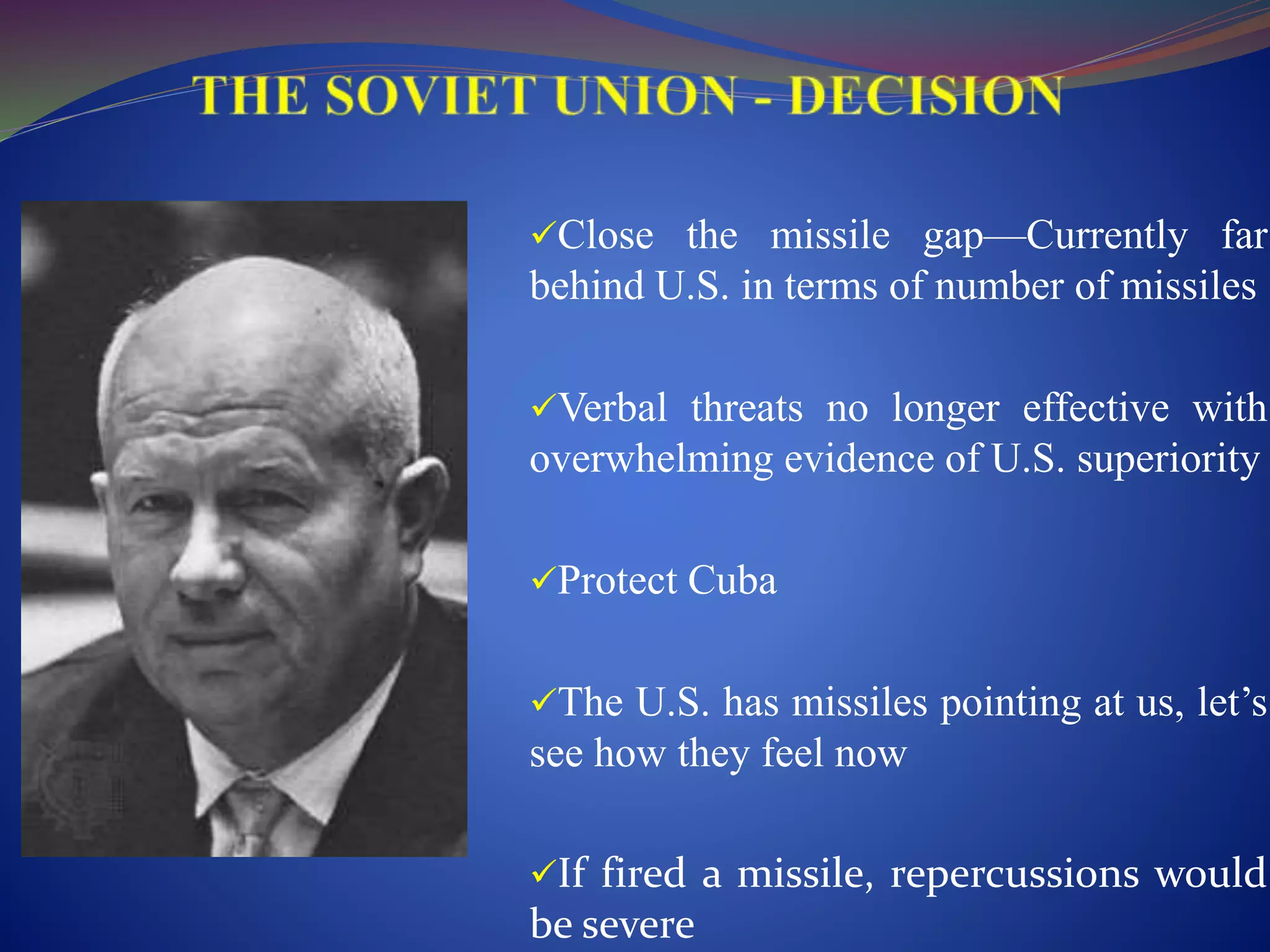
Close the missile gap—Currently far
behind U.S. in terms of number of missiles
Verbal threats no longer effective with
overwhelming evidence of U.S. superiority
Protect Cuba
The U.S. has missiles pointing at us, let’s
see how they feel now
If fired a missile, repercussions would
be severe
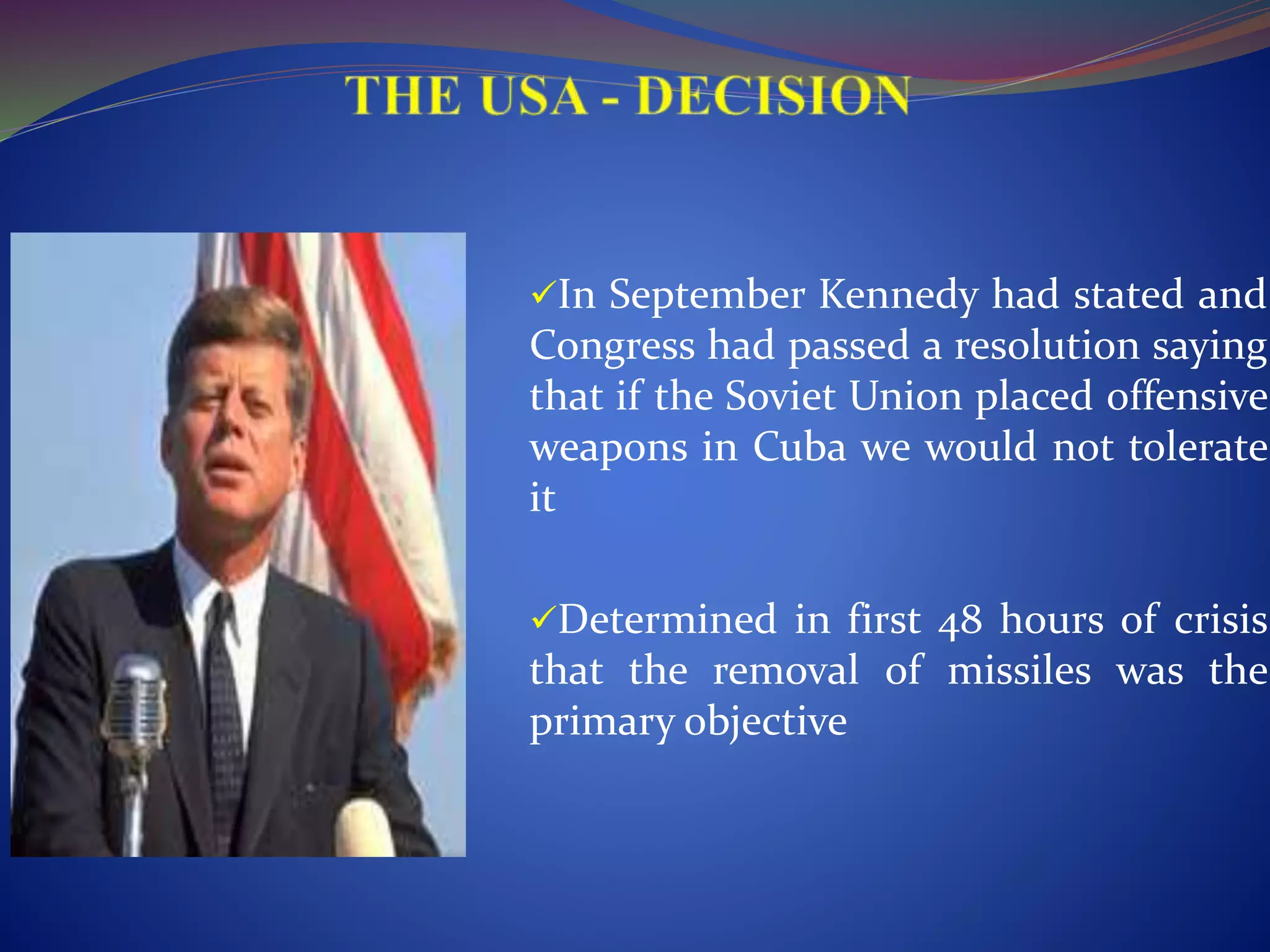
In September Kennedy had stated and
Congress had passed a resolution saying
that if the Soviet Union placed offensive
weapons in Cuba we would not tolerate
it
Determined in first 48 hours of crisis
that the removal of missiles was the
primary objective
Air Strike
 Do Nothing
Diplomacy/Negotiate
 Military Blockade
 Invasion
Nuclear Weapons
What would you have done ?
On October 17th, President Kennedy “made the flat
statement that there would definitely be an air strike, at least
against the missile sites, and perhaps against wider targets”
Reservations from others, airstrike may be using a
“sledgehammer” to kill a “fly
Later that day Robert McNamara (US Secretary of
Defense) suggests policy in between diplomacy and an air
strike
Advocated early on by McNamara and Robert Kennedy
(US Attorney General), blockade would not require instant
killing, but critics feared it would not remove the missiles
and would allow Soviets time to complete what they already
had in Cuba
Douglas Dillon (member of ExComm) strengthened
blockade argument by suggesting that it would only be a
first step, that if Khrushchev did not remove the missiles to
lift it, then more could be done
By Friday the 19th, the committee working on the
blockade adapted it into a quarantine, on Sunday Kennedy
accepted their plan as the course of action
In the context of Cuban Missile Crisis, Rational Actor
Decision Making Approach was very right decision making
model as the President Kennedy adopted because there was
time and complete information. Decision makers involved
sought an optimal solution. They attempted to find a
solution which achieved maximum goal, and minimized risk
of failure.
The President Kennedy chose the option of naval
quarantine in Cuba.
The President Kennedy certainly came out of the crisis
with a reputation greatly enhanced in the west.
CUBAN MISSILE CRISIS AND RATIONAL ACTOR MODEL

CUBAN MISSILE CRISIS AND RATIONAL ACTOR MODEL

  • 1.
  • 2.
    The basic assumptionof this model is that in a difficult situation nation consider all options and act rationally to maximize their utility. Rational Actor Model assumes that Government is primary actor and analyzes the following steps: Identify problem Identify and rank goals Gather information (this can be ongoing) Identify alternatives for reaching goals Analyze alternatives by considering consequences and effectiveness (costs and benefits) of each alternative and probabilities associated with success Select alternative that maximizes chances of selecting best alternative as determined in above mentioned step Implement decision Monitor and evaluate
  • 4.
     The UnitedStates and the Soviet Union were allies during the Second World War. Soon after the War, both the countries developed hostility. The United States of America (USA) was advocating and promoting capitalism and democratic values whereas the Union of Soviet Socialist Republics (USSR) and commonly known as the Soviet Union being a socialist state was in favor to promote communism. The basic motive was to win the race of world domination. Both nations were feared that the other might launch a military offensive. Both the countries increased military power to deter the other.
  • 5.
     The UnitedStates made military bases near the Soviet Union borders in Turkey but Russians had not any military base near to the USA. Fidel Castro became the President of Cuba in 1959. He developed relations with the Soviet Union. The USA decreased diplomatic relationship with Fidel Castro and tried to remove him from power. Moreover, in 1961, the USA also attacked at the Bay of Pigs but failed to overthrow Fidel Castro from the power. Cuba continued to support communism in Central America.
  • 6.
     May, 1962:Khrushchev made indirect references to a plot (How would the U.S. feel to have missiles pointing at them, as they have missiles pointed at us?) September: JFK and Congress issued warnings to USSR that US will deal harshly with any threats to national security October 14: U2 survey flight over Cuba spoted sites installing nuclear missiles October 15: Presence of missiles was confirmed
  • 7.
     October 16:President Kennedy notified October 16-22: Secret deliberations on what should be done October 22: Kennedy told nation his plan for blockade and quarantine October 23: OAS (The Organization of American States) endorsed naval quarantine October 24: Naval quarantine began and successfully changes course of many Soviet ships
  • 8.
     October 25:One Soviet ship challenged naval quarantine; Kennedy let it passed October 25: At the UN, Adlai Stevenson directly challenged the Soviet ambassador to admit to the existence of missiles, when the ambassador refuses, Stevenson wheeled out pictures of the missile sites October 26: Soviets raised possibility for a deal: if USSR withdraw missiles will America promise not to invade Cuba?
  • 9.
    October 27: Sovietsdemanded that Americans also withdraw missiles from Turkey; Major Anderson’s plane was missing over Cuba, presumably shot down; U.S. survey plane strayed over Soviet airspace…high tensions Kennedy told Khrushchev that he will accept the proposal of the 26th, Kennedy told his brother to tell the Soviet Ambassador that though the Turkey missiles would not be part of the bargain, they would be removed in time October 28: USSR agreed to withdraw missiles
  • 10.
    Close the missilegap—Currently far behind U.S. in terms of number of missiles Verbal threats no longer effective with overwhelming evidence of U.S. superiority Protect Cuba The U.S. has missiles pointing at us, let’s see how they feel now If fired a missile, repercussions would be severe
  • 11.
    In September Kennedyhad stated and Congress had passed a resolution saying that if the Soviet Union placed offensive weapons in Cuba we would not tolerate it Determined in first 48 hours of crisis that the removal of missiles was the primary objective
  • 12.
    Air Strike  DoNothing Diplomacy/Negotiate  Military Blockade  Invasion Nuclear Weapons What would you have done ?
  • 13.
    On October 17th,President Kennedy “made the flat statement that there would definitely be an air strike, at least against the missile sites, and perhaps against wider targets” Reservations from others, airstrike may be using a “sledgehammer” to kill a “fly Later that day Robert McNamara (US Secretary of Defense) suggests policy in between diplomacy and an air strike
  • 14.
    Advocated early onby McNamara and Robert Kennedy (US Attorney General), blockade would not require instant killing, but critics feared it would not remove the missiles and would allow Soviets time to complete what they already had in Cuba Douglas Dillon (member of ExComm) strengthened blockade argument by suggesting that it would only be a first step, that if Khrushchev did not remove the missiles to lift it, then more could be done By Friday the 19th, the committee working on the blockade adapted it into a quarantine, on Sunday Kennedy accepted their plan as the course of action
  • 15.
    In the contextof Cuban Missile Crisis, Rational Actor Decision Making Approach was very right decision making model as the President Kennedy adopted because there was time and complete information. Decision makers involved sought an optimal solution. They attempted to find a solution which achieved maximum goal, and minimized risk of failure. The President Kennedy chose the option of naval quarantine in Cuba. The President Kennedy certainly came out of the crisis with a reputation greatly enhanced in the west.