
Fayyaz Ahmed
fayaz7522@gmail.com
BS (Psychology)
INTRODUCTION
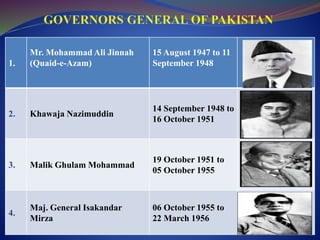
GOVERNORS GERNERAL OF PAKISTAN
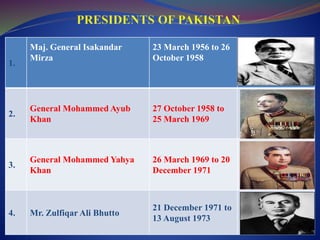
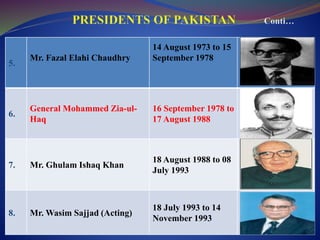
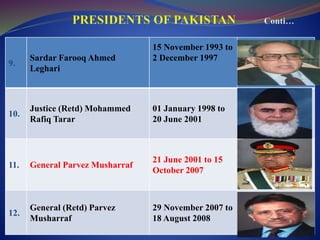
PRESIDENTS OF PAKISTAN
PRIME MINISTERS OF PAKISTAN
THE OBJECTIVES RESOLUTION, 1949
THE CONSTITUTION OF 1956 – MAIN FETURES
THE CONSTITUTION OF 1962 – MAIN FETURES
THE CONSTITUTION OF 1973 – MAIN FETURES
DISCUSSIONS WITH BRIEF BACKGROUND
CONCLUSION
 Pakistan got independence from British rulers as a territory
of the British Commonwealth of Nations.
The Indian Independence Act, 1947 and the Government of
India Act, 1935 played a role of an interim constitution and
governed the newly born state of Pakistan. During early years,
formulating a new constitution for newly emerged state of
Pakistan was very difficult task.
Later on, based on the Objectives Resolution, 1949, three
constitutions in 1956, 1962 and 1973 were framed in order to
maintain political stability and to govern Pakistan.
 The journey of constitutional development of Pakistan
started with some constitutional documents preceding the 1956
Constitution and ended with numbers of amendments in the
Constitution of 1973.
A constitution provides a set of rules as people of the state
agree to live together. The Oxford English Dictionary defines
constitution as basic principles through which a state is
governed. Constitution is a supreme law from which other laws
of the state are emerged.
The process of framing new Constitution started after the
passing of Objectives Resolution in 1959. Islamic and
democratic values were considered as foundations to formulate
constitutions for Pakistan.
1.
Mr. Mohammad Ali Jinnah
(Quaid-e-Azam)
15 August 1947 to 11
September 1948
2. Khawaja Nazimuddin
14 September 1948 to
16 October 1951
3. Malik Ghulam Mohammad
19 October 1951 to
05 October 1955
4.
Maj. General Isakandar
Mirza
06 October 1955 to
22 March 1956
1.
Maj. General Isakandar
Mirza
23 March 1956 to 26
October 1958
2.
General Mohammed Ayub
Khan
27 October 1958 to
25 March 1969
3.
General Mohammed Yahya
Khan
26 March 1969 to 20
December 1971
4. Mr. Zulfiqar Ali Bhutto
21 December 1971 to
13 August 1973
5.
Mr. Fazal Elahi Chaudhry
14 August 1973 to 15
September 1978
6.
General Mohammed Zia-ul-
Haq
16 September 1978 to
17 August 1988
7. Mr. Ghulam Ishaq Khan
18 August 1988 to 08
July 1993
8. Mr. Wasim Sajjad (Acting)
18 July 1993 to 14
November 1993
9.
Sardar Farooq Ahmed
Leghari
15 November 1993 to
2 December 1997
10.
Justice (Retd) Mohammed
Rafiq Tarar
01 January 1998 to
20 June 2001
11. General Parvez Musharraf
21 June 2001 to 15
October 2007
12.
General (Retd) Parvez
Musharraf
29 November 2007 to
18 August 2008
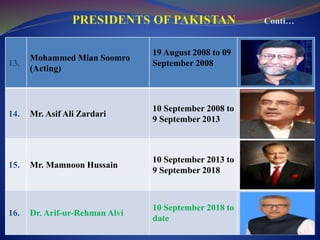
13.
Mohammed Mian Soomro
(Acting)
19 August 2008 to 09
September 2008
14. Mr. Asif Ali Zardari
10 September 2008 to
9 September 2013
15. Mr. Mamnoon Hussain
10 September 2013 to
9 September 2018
16. Dr. Arif-ur-Rehman Alvi
10 September 2018 to
date
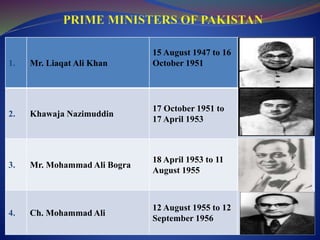
1. Mr. Liaqat Ali Khan
15 August 1947 to 16
October 1951
2. Khawaja Nazimuddin
17 October 1951 to
17 April 1953
3. Mr. Mohammad Ali Bogra
18 April 1953 to 11
August 1955
4. Ch. Mohammad Ali
12 August 1955 to 12
September 1956
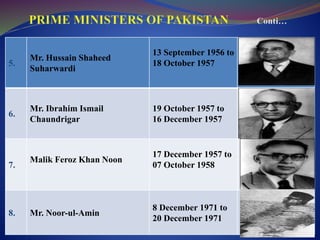
5.
Mr. Hussain Shaheed
Suharwardi
13 September 1956 to
18 October 1957
6.
Mr. Ibrahim Ismail
Chaundrigar
19 October 1957 to
16 December 1957
7.
Malik Feroz Khan Noon
17 December 1957 to
07 October 1958
8. Mr. Noor-ul-Amin
8 December 1971 to
20 December 1971
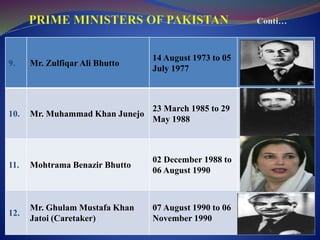
9. Mr. Zulfiqar Ali Bhutto
14 August 1973 to 05
July 1977
10. Mr. Muhammad Khan Junejo
23 March 1985 to 29
May 1988
11. Mohtrama Benazir Bhutto
02 December 1988 to
06 August 1990
12.
Mr. Ghulam Mustafa Khan
Jatoi (Caretaker)
07 August 1990 to 06
November 1990
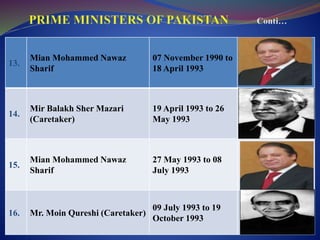
13.
Mian Mohammed Nawaz
Sharif
07 November 1990 to
18 April 1993
14.
Mir Balakh Sher Mazari
(Caretaker)
19 April 1993 to 26
May 1993
15.
Mian Mohammed Nawaz
Sharif
27 May 1993 to 08
July 1993
16. Mr. Moin Qureshi (Caretaker)
09 July 1993 to 19
October 1993
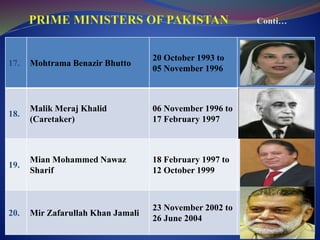
17. Mohtrama Benazir Bhutto
20 October 1993 to
05 November 1996
18.
Malik Meraj Khalid
(Caretaker)
06 November 1996 to
17 February 1997
19.
Mian Mohammed Nawaz
Sharif
18 February 1997 to
12 October 1999
20. Mir Zafarullah Khan Jamali
23 November 2002 to
26 June 2004
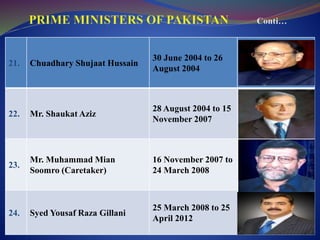
21. Chuadhary Shujaat Hussain
30 June 2004 to 26
August 2004
22. Mr. Shaukat Aziz
28 August 2004 to 15
November 2007
23.
Mr. Muhammad Mian
Soomro (Caretaker)
16 November 2007 to
24 March 2008
24. Syed Yousaf Raza Gillani
25 March 2008 to 25
April 2012
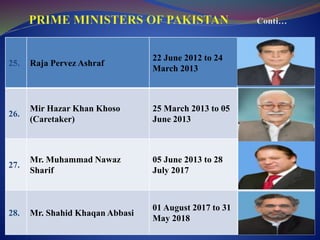
25. Raja Pervez Ashraf
22 June 2012 to 24
March 2013
26.
Mir Hazar Khan Khoso
(Caretaker)
25 March 2013 to 05
June 2013
27.
Mr. Muhammad Nawaz
Sharif
05 June 2013 to 28
July 2017
28. Mr. Shahid Khaqan Abbasi
01 August 2017 to 31
May 2018
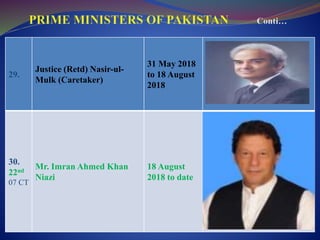
29.
Justice (Retd) Nasir-ul-
Mulk (Caretaker)
31 May 2018
to 18 August
2018
30.
22nd
07 CT
Mr. Imran Ahmed Khan
Niazi
18 August
2018 to date
 In March 1949, the Constituent Assembly passed a
resolution related to Aims and Objects of future constitution of
Pakistan. It has distinctive value and counts as foundation
towards formulating of a Constitution.
Due to its significant nature, the Resolution was incorporated
in all the constitutions of Pakistan as a ‘Preamble’.
After a lot of discussion, arguments, opposition and
consideration, the Objectives Resolution was finally passed and
adopted by the Constituent Assembly on 12th of March 1949.
The points of the Resolution that was finally passed by the
Constituent Assembly are reproduced below:
Whereas sovereignty over the entire universe belongs to Allah Almighty
alone, and the authority which He has delegated to the State of Pakistan
through its people for being exercised within the limits prescribed by Him is a
sacred trust.
This Constituent Assembly representing the people of Pakistan resolves to
frame a Constitution for the sovereign independent State of Pakistan; wherein
the state shall exercise its powers and authority through the chosen
representatives of the people.
Wherein the principles of democracy, freedom, equality, tolerance and social
justice as enunciated by Islam shall be fully observed.
Wherein the Muslims shall be enabled to order their lives in the individual
and collective spheres in accordance with the teachings and requirements of
Islam as set out in the Holy Quran and the Sunnah.
 Wherein adequate provision shall be made for the minorities to freely
profess and practice their religions and develop their cultures.
Whereby the territories now included in or accession with Pakistan and such
territories as may hereafter be included in or accede to Pakistan shall form a
Federation wherein the units will be autonomous with such boundaries and
limitation on their powers and authority as may be prescribed.
Wherein shall be guaranteed fundamental rights including equality of status,
of opportunity before law, social, economic and political justice, and freedom
of thought, expression, belief, faith, worship and association, subject to law
and public morality.
Wherein adequate provisions shall be made to safeguard the legitimate
interests of minorities and backward and depressed classes.
Wherein the independence of Judiciary shall be fully secured.
Wherein the integrity of the territories of the Federation, its independence
and all its rights including its sovereign rights on land, sea and air shall be
safeguarded.
So that the people of Pakistan may prosper and attain their rightful and
honored place amongst the nations of the World and make their full
contribution towards international peace and progress and happiness of
humanity.
After a long struggle of nine years, the first Constitution
of Pakistan was successfully framed. It came into effect on
23rd of March 1956. The country was named as Islamic
Republic of Pakistan. The Constitution was consisting of
234 Articles, having 13 Parts and 6 Schedules.
President of Pakistan would be a Muslim and would be
elected by National Assembly and Provincial Assemblies.
President would appoint Prime Minister but Cabinet will be
elected by the National Assembly
East and West Pakistan would have equal seats in the
legislative Assembly. President had power to dissolve
National Assembly on the advice of the Prime Minister.
Two-third majority was mandatory to pass any bill and
amend the Constitution.
A comprehensive list of fundamental rights with an
Independent Judiciary was provided in the constitution. The
powers between the Centre and the provinces were defined.
For the distribution of subjects between the centre and the
provinces, three lists of subject had been drawn up.
Two National languages Urdu for the West Pakistan and
Bengali for the East Pakistan were declared official
languages. Instead of double citizenship, one citizenship
system was provided for the Federation of Pakistan.
The constitution was silent regarding conducting of
elections both for the Central and the Provincial legislatures.
Principles of provincial autonomy and independence of
judiciary were included. Islamic provisions that guaranteed
legislations of laws in accordance of Islamic injunction
were also incorporated.
The second Constitution of Pakistan was framed after
discussions, feedback from Governors’ Conference and
finally according to the wish of General Muhammad Ayub
Khan.
The Constitution was announced on 01 March 1962 but it
came into effect on 8th of June 1962 after the conducting of
elections of National Assembly and Provincial Assemblies
in April and May 1962 respectively.
The country was named as Republic of Pakistan instead of
Islamic Republic of Pakistan. The Constitution was
consisting of 250 Articles, having 12 Parts and 03
Schedules.
President should be a Muslim and must be 40 years of age
or above. Objectives Resolution was made the Preamble of
the Constitution. Islamic provisions were made part of
Principles of Policy but not the constitution
The President would be elected through indirect elections
for a term of five years. In case the President has held office
for more than 8 years then re-election would be conducted
with the support of the National and Provincial Assemblies.
National Assembly was empowered to charge the President,
but in reality it was impossible.
The President was empowered to dissolve the National
Assembly and then he would undertake re-election. The
President had all the Executive, Legislative, Judicial and
almost financial powers.
The cabinet was responsible to President. The President
had authority to make appointments of all key posts. He was
empowered to promulgate Ordinances and declare
Emergency in the country. National Assembly being of only
House had 150 seats plus 6 seats for women.
The President would be elected through indirect elections
for a term of five years. National Assembly was empowered
to charge the President, but in reality it was impossible.
Although, National Assembly was empowered to
formulate laws but the President was sole authority to adopt
or reject the bill. East Pakistan and West Pakistan were
declared two provinces and only one Central List was
available.
Governors were appointed as head of the provinces
having cabinets and directly under the control of
President. Initially, Political Parties were banned but
later on Political Parties Act was introduced.
After experiencing two failed Constitutions, political
instability, losing of East Pakistan, and doing long
deliberations and compromise, the third Constitution of
Pakistan was successfully framed in 1973.
It came into effect on 14th of August 1973. The country
was named as Islamic Republic of Pakistan. The
Constitution was consisting of 280 Articles, having 12 Parts
and 6 Schedules.
It was a parliamentary constitution with powerful Prime
Minister and weak President. Prime Minister has all
executive authority and President has to act on the advice of
PM.
National Assembly is elected for the duration of five years
and could be dissolved by the President only on the advice
of the Prime Minister. He had power to dissolve the
National Assembly and can appoint a caretaker PM.
President of Pakistan must be at least 45 years of age,
Muslim, qualified to become member of the NA. Parliament
and the Provincial Assemblies elect the President for 5 years
of term.
Upper House called Senate and in this house equal
representation is given to Provinces. Seats in Senate are
reserved for the tribal areas, women and technocrats. The
original strength of Senate was 63, which was later raised to
87 and then to 100. Members of Senate are elected
indirectly. Senate is a permanent House as half of its
members are elected after three years.
National Assembly is elected on population basis. The
original strength of N A was 210 but now it is 342 and is
elected for five years of a term. The members of N A are
elected through direct elections. Voting age for the franchise
is lowered from 21 to 18.
There are two Lists in the Constitution: Federal list and
Concurrent list and residuary powers belong to provinces.
Provincial Governors are appointed by the President on the
advice of the PM and elected Chief Minister exercises
executive powers.
Parliamentary system is there in the provinces and C M
has powers. Islamic provisions are provided in Principles of
Policy. Fundamental Rights are protected in the constitution
and are implemented through the highest court.
The Objectives Resolution was made as the Preamble in
the initial Constitution but later on it was inserted in the
Constitution. Islam was State Religion of Pakistan. Federal
Shariat Court was included.
Urdu is declared National Language but English may be
used for official purposes until preparations would be made
for its replacement by Urdu. Provincial Assemblies were
allowed, for teaching, promotion and use of a provincial
language in addition to the national language.
Later on, National Security Council was added in advisory
capacity. Supreme and High Courts are established. A chain
of lower courts is there under the high courts.
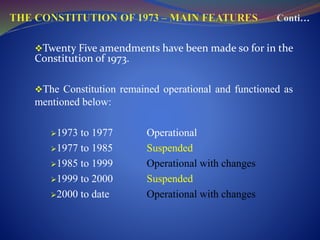
Twenty Five amendments have been made so for in the
Constitution of 1973.
The Constitution remained operational and functioned as
mentioned below:
1973 to 1977 Operational
1977 to 1985 Suspended
1985 to 1999 Operational with changes
1999 to 2000 Suspended
2000 to date Operational with changes
On the basis of two Nations theory, the Muslims of British
India undertook long struggle and demanded a separate
homeland.
The British rulers had no way except to fulfill the demand
of the Muslims of India and, on 14th of August 1947, the
State of Pakistan came into existence under the
Independence Act of 1947.
The newly established state of Pakistan was initially
governed through the Government of India Act, 1935. On
15 August 1947, Quaid-i-Azam Muhammad Ali Jinnah was
appointed as the first Governor General of Pakistan and
remained on this position till his death on 11 September
1948.
On 26 July 1947, first Constituent Assembly of Pakistan
consisting of 69 members was formed and this assembly
was empowered to frame new constitution.
Despite of huge problems like untimely death of Quaid-i-
Azam Muhammad Ali Jinnah, economic, refugees and
Kashmir issues etc. the first Prime Minister of Pakistan
Nawabzada Liaquat Ali Khan moved the Objectives
Resolution in March 1949.
In October 1951, the first Prime Minister was
assassinated. Khawaja Nazimuddin became the next Prime
Minister of Pakistan. In 1954, final draft of the constitution
was ready but at the same time Muhammad Ali Bogra took
over as the Prime Minister.
The draft constitution was ready to place in the House for
discussion and approval, the Governor General Ghulam
Muhammad dissolved the Assembly in October 1954.
The second Constituent Assembly under the premiership
of Choudhary Muhammad Ali passed the first Constitution
of Pakistan in 1956 and was implemented on 23 March
1956. Major General Sikandar Mirza became the first
President.
Issue of floor crossing emerged, resultantly political
instability occurred. On October 07, 1958, President
Iskander Mirza imposed first Martial Law in the country
and abrogated the 1956 Constitution and dissolved the
assemblies.
General Ayub Khan was made the Chief Martial Law
Administrator and on 27 October 1958, he overthrew
Sikandar Mirza and became the second President of
Pakistan.
He introduced the Basic Democracies Order and made
80,000 Basic Democrats as the Electoral College and
through BDs elected himself as President in a referendum
on 14 February 960.
He lifted martial law in June 1962. Through a
Commission, a new second Constitution of Pakistan, 1962
was made and that was implemented on 01 March 1962.
The third National Assembly was formed in June 1962
and all executive authority was held with the President of
Pakistan.
In 1969, Field Marshal Muhammad Ayub Khan imposed
second martial law and abrogated the 1962 Constitution. He
appointed General Yahya Khan new Chief Martial Law
Administrator and handed him over the country.
General Yahya Khan dissolved One Unit. He restored the
former provinces and placed Baluchistan on the status of
province in West Pakistan. He also made a Legal
Framework Order and held elections for the new constituent
assembly in December 1970 on the basis of adult franchise.
Sheikh Mujib-ur-Rehman (Awami League) emerged with
in the National Assembly having majority and Pakistan
People’s Party secured majority in provinces of West
Pakistan.
A crisis surfaced and General Yahya Khan tried to resolve
by force but could not be reconciled. Resultantly, in March
1971, military action stared in East Pakistan. General Yahya
Khan failed to manage the crisis and resulted in the
separation of East Pakistan on 16 December 1971.
General Yahya Khan, on 20 December 1971, resigned and
handed over power to the leader of the Pakistan People's
Party, Zulfikar Ali Bhutto.
Mr. Zulfiqar Ali Bhutto became the next President of
Pakistan and first civil Chief Martial Law Administrator as
well. Mr. Bhutto lifted Martial Law in April 1972. The
National Assembly adopted an interim Constitution in April
1972 and the form of government was also Presidential.
NA passed new third Constitution of the Islamic Republic
of Pakistan, 1973 and came into effect on 14 August 1973.
The Prime Minister has all the executive authority.
Mr. Zulfiqar Ali Bhutto became the Prime Minister and
Mr. Fazal Illahi Choudhary was made next President of
Pakistan. Next General Elections were conducted in March
1977.
In July 1977, General Muhammad Zia-ul-Haq imposed
Martial Law and took over the country as President of
Pakistan. Mr. Zulfiqar Ali Bhutto was hanged to death.
General Elections, on non party basis, for the National and
Provincial Assemblies were conducted in February 1985.
The Constitution was revived after making a lot of
amendments.
Mr. Muhammad Khan Junejo was made the next Prime
Minister of Pakistan. By November 1985, the 8th
Constitutional Amendment was incorporated and the
significant Article 58(2)(b) was added that allowed the
President to dissolve the National Assembly as discretionary
power.
In May 1988, President General Muhammad Zia-ul-Haq
dissolved the Assembly. Meanwhile, he was died in an
aircraft crash in August 1988.
Next General Election was held in November 1988.
Mohtarma Benazir Bhutto was elected as Prime Minister of
Pakistan in December 1988 but President Ghulam Ishaq
Khan again dissolved the Assembly in August 1990.
New General Election was held in October 1990 and Mian
Muhammad Nawaz Sharif was elected as Prime Minister of
Pakistan. But President Ghulam Ishaq Khan again dissolved
the assembly. Supreme Court of Pakistan restored the
assembly in May 1993. Later on the advice of the Prime
Minister, the assembly was again dissolved in July 1993.
Next General Election was conducted in October 1993
and Mohtarma Benizar Bhutto became the Prime Minister
of Pakistan but he President Farooq Ahmad Khan Laghari
dissolved the Assembly again.
New General Election was held in February 1997 and
Mian Muhammad Nawaz Sharif administered the oath as
Prime Minister of Pakistan.
The Article 58(2)(b) was omitted from the Constitution
vide 13th Amendment and the Constitution was made
powerful to check on floor crossing of legislators vide the
fourteenth Amendment in the Constitution.
In October 1999, General Pervaz Musharraf took over the
government and appointed himself as Chief Executive.
Through Provisional Constitutional Order (PCO), he
suspended the Assemblies.
Next General Election was held in October 2002. Mir
Zafar ullah Jamali was elected as PM but he resigned from
his office in June 2004. Chaudhry Shujaat Hussain was
made next PM in June 2004 but later on Mr. Shaukat Aziz
was given the office of the Prime Minister in August 2004.
In November 2007, NA ended its Constitutional term;
General Musharaf resigned as COAS and took oath as
civilian President. Meanwhile, Muhatarma Benazir Bhutto
was assassinated.
Next due General Election was held in 2008 and Syed
Yousaf Raza Gilani was chosen the Prime Minister of
Pakistan. General (Rted) Pervez Musharaf again resigned
from the President office and Mr. Asif Ali Zardari took over
the office of President of Islamic Republic of Pakistan.
The parliament passed 18th and 19th Constitutional
Amendments in 2010 and 2011 respectively. Later on, 20th
Constitutional Amendment was also passed by the
Parliament unanimously in 2012.
Meanwhile, Supreme Court of Pakistan disqualified the
Syed Yousaf Raza Gillani as Prime Minister of Pakistan. In
June 2012, Raja Pervez Ashraf was chosen next Prime
Minister of Pakistan.
The National Assembly completed its tenure in March
2013 and Justice (Rted) Mir Hazar Khan Khoso was
appointed as caretaker Prime Minister of Pakistan.
New General Election was conducted in May 2013 and
Mian Muhammad Nawaz Sharif was elected as third-time
Prime Minister of Pakistan. In September 2013, Mr.
Mamnoon Hussain took over the office of the President of
Pakistan from Mr. Asif Ali Zardari as he completed his five
years tenure.
The year 2013 witnessed a smoothly and democratically
transition of power from one elected government to the
newly elected government.
In July 2017, The Supreme Court of Pakistan five-judge
Bench disqualified Prime Minister Mian Nawaz Sharif for
holding public office.
In August 2017, the ruling party made Mr. Shahid Khaqan
Abbasi the next Prime Minister of Pakistan. The National
Assembly completed its tenure in May 2018 and Justice
(Rted) Nasir-ul-Mulk was appointed as caretaker Prime
Minister of Pakistan.
New General Election was conducted in July 2018 and
Mr. Imran Ahmed Khan Niazi was elected as Prime
Minister of Islamic Republic of Pakistan.
In September 2018, Dr. Arif-ur-Rehman Alvi took over
the office of the President of Pakistan from Mr. Mamnoon
Hussain as he completed his five years tenure.
The year 2018 once again witnessed a smoothly and
democratically transition of power from one elected
government to the newly elected government.
The Second Constituent Assembly passed the first
Constitution, 1956 based on compromises. Resultantly, the
Constitution failed to maintain political stability. The
Constitution was made for parliamentary form of
government but the maximum powers were held with the
President. The Constitution also failed to settle down issues
relating to electorate.
The Constitution only simulated equality but in reality no
equality existed between the East and West Pakistan. No
election was conducted after the implementation the
Constitution as Sikander Mirza disliked Islamic provisions
and provincial autonomy and finally the Martial Law was
imposed on 7th of October 1958. Resultantly, Constitution
was abrogated.
The Constitution worked only from 23 March 1956 to 7
October 1958 about two and half years.
The Constitution of 1962 was quite different from that
which Constitution Commission recommended as General
Muhammad Ayub Khan liked presidential form of
government. The second Constitution of 1962 was framed
according to the mindset of General Muhammad Ayub Khan
and therein parliamentary form of government was
discarded.
The Constitution empowered the President
overwhelmingly and he became a dominated in
constitutional system. Resultantly, one man show was
prevailed in the country. The Constitution worked only from
08 June 1962 to 25 March 1969 as Field Marshal
Muhammad Ayub Khan himself imposed Martial Law and
resultantly, Constitution was abrogated once again.
East and West Pakistan remained unite for 24 years but the two wings
had grave distrust, suspicion and misunderstandings. Although, it was a
difficult political union but it could be maintained by a fair Constitution.
But unfortunately, the flawed Constitutions failed to ensure justice and
trust among the people of two wings as the people have diverse
languages, cultures and ethnicity. The two wings could only be united
under a true Constitution that was acceptable to the people of both
wings.
After experiences of two weak Constitutions, Martial Laws and losing
of East Pakistan, the 1973 Constitution was made with the consent of all
political parties representing in the National Assembly that is why the
Constitution of 1973 is comparatively considered good one. Parliament
under 1973 constitution is a powerful legislative body and enjoys all
legislative powers. Parliament has positive control of the executive
through questions, resolutions, parliamentary committees etc. National
Assembly is more powerful than the Senate as Budget is presented
before NA. Cabinet is answerable to National Assembly.
But unfortunately, President General Muhammad Zial-ul-
Haq incorporated the 8th Constitutional Amendment in
November 1985. This so called significant Article 58(2)(b)
allowed the President to dissolve the National Assembly as
discretionary power. Resultantly, three Presidents of
Pakistan used this power and dissolved National Assemblies
about five times and created political instability in the
country.
Pakistan out of 71 years of age experienced five military
dictators for about 36 years. Forty Nine in number Heads of
State or Heads of Department (4 x Governors General, 15 x
Presidents and 30 x Prime Ministers) took oath to reign the
country. Only during early eleven years, twelve in number
Heads of State or Heads of Departments (4 x Governors
General, 1 x President and 7 x Prime Ministers)
administered the oath to run the government. Two in
number, sitting and former, were assassinated.
One Prime Minister was hanged. Two in number sitting
Prime Ministers were declared disqualified by the court.
East Pakistan was separated due to political instability.
About eight times constitutional assemblies were dissolved.
About three to four times Constitutions were abrogated or
suspended. So many constitutions with numbers of
amendments predict political instability in the history of
Pakistan.
Pakistan could not establish political stability because of
absence of stable democratic system, economic problems
and lack of social growth. About 69 years have been passed
and the country could not rid itself from feudal, tribal or
sectarian issues. During the first ten years of history from
1947 to 1956, it was the weakness of the political players
which invided the military to interfere in politics.
Dr Muhammad Khan (2018) depicted that democracy has
grasped it roots in Pakistan as democratic transformation
has been completed successfully. He expressed that this was
a third time as successful political and democratic
transformation was held in 2018 consecutively in the first
time of 71 years history of Pakistan. Overall, the
transformation took place peacefully.
Besides of other factors, the mature, developed and intact
Constitution plays a major role in order to maintain political
stability in the state. Till to date 25 amendments have been
incorporated in the Constitution of 1973 and not it has been
mature and developed to an extent that is why for last ten
years smoothly and democratically transition of power from
one elected government to the newly elected government is
being done.
Askari Rizvi, Dr. Hassan. Pakistan Studies (PAK 301) Lecture Notes. Virtual University of Pakistan.
Bhatti, Haseeb. “Disqualification under Article 62 (1)(f) is for life, SC rules in historic verdict”,
Dawn.com, April 13, 2017, https://www.dawn.com/news/1401362 (accessed December 02, 2018).
Citizen, A. “Political instability in Pakistan,” Daily Pakistan Observer, November 14, 2016,
https://pakobserver.net/political-instability-in-pakistan/ (accessed December 01, 2018).
Government of Pakistan, http://www.pakistan.gov.pk/ (accessed November 20, 2018).
Kazimi, M. R. A Concise History of Pakistan. Karachi: Oxford University Press, 2012.
Khan, Dr Muhammad. “Political transformation-2018,” Daily Pakistan Observer, August 20, 2018,
https://pakobserver.net/political-transformation-2018/ (accessed December 01, 2018).
Khan, Hamid. Constitutional And Political History Of Pakistan. Karachi: Oxford University Press, 2017.
National Assembly of Pakistan, http://www.na.gov.pk/en/content.php?id=75 (accessed November 02,
2018).
National Assembly of Pakistan, http://www.na.gov.pk/en/governers.php (accessed November 05, 2018).
National Assembly of Pakistan, http://www.na.gov.pk/en/presidents.php (accessed November 08, 2018).
National Assembly of Pakistan, http://www.na.gov.pk/en/primeministers.php (accessed November 12,
2018).
Prime Minister’s Office, http://pmo.gov.pk/former_pms.php (accessed December 01, 2018).
The Constitution of Pakistan, 1973, http://www.pakistancode.gov.pk/english/UY2FqaJw1-apaUY2Fqa-
apaUY2Fvbpw%3D-sg-jjjjjjjjjjjjj (accessed November 25, 2018).
The Gazette of Pakistan, Extraordinary, Islamabad, Tuesday, June, 5 2018.
Constitutional developments

Constitutional developments

  • 1.
  • 2.
    INTRODUCTION GOVERNORS GERNERAL OFPAKISTAN PRESIDENTS OF PAKISTAN PRIME MINISTERS OF PAKISTAN THE OBJECTIVES RESOLUTION, 1949 THE CONSTITUTION OF 1956 – MAIN FETURES THE CONSTITUTION OF 1962 – MAIN FETURES THE CONSTITUTION OF 1973 – MAIN FETURES DISCUSSIONS WITH BRIEF BACKGROUND CONCLUSION
  • 3.
     Pakistan gotindependence from British rulers as a territory of the British Commonwealth of Nations. The Indian Independence Act, 1947 and the Government of India Act, 1935 played a role of an interim constitution and governed the newly born state of Pakistan. During early years, formulating a new constitution for newly emerged state of Pakistan was very difficult task. Later on, based on the Objectives Resolution, 1949, three constitutions in 1956, 1962 and 1973 were framed in order to maintain political stability and to govern Pakistan.
  • 4.
     The journeyof constitutional development of Pakistan started with some constitutional documents preceding the 1956 Constitution and ended with numbers of amendments in the Constitution of 1973. A constitution provides a set of rules as people of the state agree to live together. The Oxford English Dictionary defines constitution as basic principles through which a state is governed. Constitution is a supreme law from which other laws of the state are emerged. The process of framing new Constitution started after the passing of Objectives Resolution in 1959. Islamic and democratic values were considered as foundations to formulate constitutions for Pakistan.
  • 5.
    1. Mr. Mohammad AliJinnah (Quaid-e-Azam) 15 August 1947 to 11 September 1948 2. Khawaja Nazimuddin 14 September 1948 to 16 October 1951 3. Malik Ghulam Mohammad 19 October 1951 to 05 October 1955 4. Maj. General Isakandar Mirza 06 October 1955 to 22 March 1956
  • 6.
    1. Maj. General Isakandar Mirza 23March 1956 to 26 October 1958 2. General Mohammed Ayub Khan 27 October 1958 to 25 March 1969 3. General Mohammed Yahya Khan 26 March 1969 to 20 December 1971 4. Mr. Zulfiqar Ali Bhutto 21 December 1971 to 13 August 1973
  • 7.
    5. Mr. Fazal ElahiChaudhry 14 August 1973 to 15 September 1978 6. General Mohammed Zia-ul- Haq 16 September 1978 to 17 August 1988 7. Mr. Ghulam Ishaq Khan 18 August 1988 to 08 July 1993 8. Mr. Wasim Sajjad (Acting) 18 July 1993 to 14 November 1993
  • 8.
    9. Sardar Farooq Ahmed Leghari 15November 1993 to 2 December 1997 10. Justice (Retd) Mohammed Rafiq Tarar 01 January 1998 to 20 June 2001 11. General Parvez Musharraf 21 June 2001 to 15 October 2007 12. General (Retd) Parvez Musharraf 29 November 2007 to 18 August 2008
  • 9.
    13. Mohammed Mian Soomro (Acting) 19August 2008 to 09 September 2008 14. Mr. Asif Ali Zardari 10 September 2008 to 9 September 2013 15. Mr. Mamnoon Hussain 10 September 2013 to 9 September 2018 16. Dr. Arif-ur-Rehman Alvi 10 September 2018 to date
  • 10.
    1. Mr. LiaqatAli Khan 15 August 1947 to 16 October 1951 2. Khawaja Nazimuddin 17 October 1951 to 17 April 1953 3. Mr. Mohammad Ali Bogra 18 April 1953 to 11 August 1955 4. Ch. Mohammad Ali 12 August 1955 to 12 September 1956
  • 11.
    5. Mr. Hussain Shaheed Suharwardi 13September 1956 to 18 October 1957 6. Mr. Ibrahim Ismail Chaundrigar 19 October 1957 to 16 December 1957 7. Malik Feroz Khan Noon 17 December 1957 to 07 October 1958 8. Mr. Noor-ul-Amin 8 December 1971 to 20 December 1971
  • 12.
    9. Mr. ZulfiqarAli Bhutto 14 August 1973 to 05 July 1977 10. Mr. Muhammad Khan Junejo 23 March 1985 to 29 May 1988 11. Mohtrama Benazir Bhutto 02 December 1988 to 06 August 1990 12. Mr. Ghulam Mustafa Khan Jatoi (Caretaker) 07 August 1990 to 06 November 1990
  • 13.
    13. Mian Mohammed Nawaz Sharif 07November 1990 to 18 April 1993 14. Mir Balakh Sher Mazari (Caretaker) 19 April 1993 to 26 May 1993 15. Mian Mohammed Nawaz Sharif 27 May 1993 to 08 July 1993 16. Mr. Moin Qureshi (Caretaker) 09 July 1993 to 19 October 1993
  • 14.
    17. Mohtrama BenazirBhutto 20 October 1993 to 05 November 1996 18. Malik Meraj Khalid (Caretaker) 06 November 1996 to 17 February 1997 19. Mian Mohammed Nawaz Sharif 18 February 1997 to 12 October 1999 20. Mir Zafarullah Khan Jamali 23 November 2002 to 26 June 2004
  • 15.
    21. Chuadhary ShujaatHussain 30 June 2004 to 26 August 2004 22. Mr. Shaukat Aziz 28 August 2004 to 15 November 2007 23. Mr. Muhammad Mian Soomro (Caretaker) 16 November 2007 to 24 March 2008 24. Syed Yousaf Raza Gillani 25 March 2008 to 25 April 2012
  • 16.
    25. Raja PervezAshraf 22 June 2012 to 24 March 2013 26. Mir Hazar Khan Khoso (Caretaker) 25 March 2013 to 05 June 2013 27. Mr. Muhammad Nawaz Sharif 05 June 2013 to 28 July 2017 28. Mr. Shahid Khaqan Abbasi 01 August 2017 to 31 May 2018
  • 17.
    29. Justice (Retd) Nasir-ul- Mulk(Caretaker) 31 May 2018 to 18 August 2018 30. 22nd 07 CT Mr. Imran Ahmed Khan Niazi 18 August 2018 to date
  • 18.
     In March1949, the Constituent Assembly passed a resolution related to Aims and Objects of future constitution of Pakistan. It has distinctive value and counts as foundation towards formulating of a Constitution. Due to its significant nature, the Resolution was incorporated in all the constitutions of Pakistan as a ‘Preamble’. After a lot of discussion, arguments, opposition and consideration, the Objectives Resolution was finally passed and adopted by the Constituent Assembly on 12th of March 1949.
  • 19.
    The points ofthe Resolution that was finally passed by the Constituent Assembly are reproduced below: Whereas sovereignty over the entire universe belongs to Allah Almighty alone, and the authority which He has delegated to the State of Pakistan through its people for being exercised within the limits prescribed by Him is a sacred trust. This Constituent Assembly representing the people of Pakistan resolves to frame a Constitution for the sovereign independent State of Pakistan; wherein the state shall exercise its powers and authority through the chosen representatives of the people. Wherein the principles of democracy, freedom, equality, tolerance and social justice as enunciated by Islam shall be fully observed.
  • 20.
    Wherein the Muslimsshall be enabled to order their lives in the individual and collective spheres in accordance with the teachings and requirements of Islam as set out in the Holy Quran and the Sunnah.  Wherein adequate provision shall be made for the minorities to freely profess and practice their religions and develop their cultures. Whereby the territories now included in or accession with Pakistan and such territories as may hereafter be included in or accede to Pakistan shall form a Federation wherein the units will be autonomous with such boundaries and limitation on their powers and authority as may be prescribed. Wherein shall be guaranteed fundamental rights including equality of status, of opportunity before law, social, economic and political justice, and freedom of thought, expression, belief, faith, worship and association, subject to law and public morality.
  • 21.
    Wherein adequate provisionsshall be made to safeguard the legitimate interests of minorities and backward and depressed classes. Wherein the independence of Judiciary shall be fully secured. Wherein the integrity of the territories of the Federation, its independence and all its rights including its sovereign rights on land, sea and air shall be safeguarded. So that the people of Pakistan may prosper and attain their rightful and honored place amongst the nations of the World and make their full contribution towards international peace and progress and happiness of humanity.
  • 22.
    After a longstruggle of nine years, the first Constitution of Pakistan was successfully framed. It came into effect on 23rd of March 1956. The country was named as Islamic Republic of Pakistan. The Constitution was consisting of 234 Articles, having 13 Parts and 6 Schedules. President of Pakistan would be a Muslim and would be elected by National Assembly and Provincial Assemblies. President would appoint Prime Minister but Cabinet will be elected by the National Assembly East and West Pakistan would have equal seats in the legislative Assembly. President had power to dissolve National Assembly on the advice of the Prime Minister. Two-third majority was mandatory to pass any bill and amend the Constitution.
  • 23.
    A comprehensive listof fundamental rights with an Independent Judiciary was provided in the constitution. The powers between the Centre and the provinces were defined. For the distribution of subjects between the centre and the provinces, three lists of subject had been drawn up. Two National languages Urdu for the West Pakistan and Bengali for the East Pakistan were declared official languages. Instead of double citizenship, one citizenship system was provided for the Federation of Pakistan. The constitution was silent regarding conducting of elections both for the Central and the Provincial legislatures. Principles of provincial autonomy and independence of judiciary were included. Islamic provisions that guaranteed legislations of laws in accordance of Islamic injunction were also incorporated.
  • 24.
    The second Constitutionof Pakistan was framed after discussions, feedback from Governors’ Conference and finally according to the wish of General Muhammad Ayub Khan. The Constitution was announced on 01 March 1962 but it came into effect on 8th of June 1962 after the conducting of elections of National Assembly and Provincial Assemblies in April and May 1962 respectively. The country was named as Republic of Pakistan instead of Islamic Republic of Pakistan. The Constitution was consisting of 250 Articles, having 12 Parts and 03 Schedules.
  • 25.
    President should bea Muslim and must be 40 years of age or above. Objectives Resolution was made the Preamble of the Constitution. Islamic provisions were made part of Principles of Policy but not the constitution The President would be elected through indirect elections for a term of five years. In case the President has held office for more than 8 years then re-election would be conducted with the support of the National and Provincial Assemblies. National Assembly was empowered to charge the President, but in reality it was impossible. The President was empowered to dissolve the National Assembly and then he would undertake re-election. The President had all the Executive, Legislative, Judicial and almost financial powers.
  • 26.
    The cabinet wasresponsible to President. The President had authority to make appointments of all key posts. He was empowered to promulgate Ordinances and declare Emergency in the country. National Assembly being of only House had 150 seats plus 6 seats for women. The President would be elected through indirect elections for a term of five years. National Assembly was empowered to charge the President, but in reality it was impossible. Although, National Assembly was empowered to formulate laws but the President was sole authority to adopt or reject the bill. East Pakistan and West Pakistan were declared two provinces and only one Central List was available. Governors were appointed as head of the provinces having cabinets and directly under the control of President. Initially, Political Parties were banned but later on Political Parties Act was introduced.
  • 27.
    After experiencing twofailed Constitutions, political instability, losing of East Pakistan, and doing long deliberations and compromise, the third Constitution of Pakistan was successfully framed in 1973. It came into effect on 14th of August 1973. The country was named as Islamic Republic of Pakistan. The Constitution was consisting of 280 Articles, having 12 Parts and 6 Schedules. It was a parliamentary constitution with powerful Prime Minister and weak President. Prime Minister has all executive authority and President has to act on the advice of PM.
  • 28.
    National Assembly iselected for the duration of five years and could be dissolved by the President only on the advice of the Prime Minister. He had power to dissolve the National Assembly and can appoint a caretaker PM. President of Pakistan must be at least 45 years of age, Muslim, qualified to become member of the NA. Parliament and the Provincial Assemblies elect the President for 5 years of term. Upper House called Senate and in this house equal representation is given to Provinces. Seats in Senate are reserved for the tribal areas, women and technocrats. The original strength of Senate was 63, which was later raised to 87 and then to 100. Members of Senate are elected indirectly. Senate is a permanent House as half of its members are elected after three years.
  • 29.
    National Assembly iselected on population basis. The original strength of N A was 210 but now it is 342 and is elected for five years of a term. The members of N A are elected through direct elections. Voting age for the franchise is lowered from 21 to 18. There are two Lists in the Constitution: Federal list and Concurrent list and residuary powers belong to provinces. Provincial Governors are appointed by the President on the advice of the PM and elected Chief Minister exercises executive powers. Parliamentary system is there in the provinces and C M has powers. Islamic provisions are provided in Principles of Policy. Fundamental Rights are protected in the constitution and are implemented through the highest court.
  • 30.
    The Objectives Resolutionwas made as the Preamble in the initial Constitution but later on it was inserted in the Constitution. Islam was State Religion of Pakistan. Federal Shariat Court was included. Urdu is declared National Language but English may be used for official purposes until preparations would be made for its replacement by Urdu. Provincial Assemblies were allowed, for teaching, promotion and use of a provincial language in addition to the national language. Later on, National Security Council was added in advisory capacity. Supreme and High Courts are established. A chain of lower courts is there under the high courts.
  • 31.
    Twenty Five amendmentshave been made so for in the Constitution of 1973. The Constitution remained operational and functioned as mentioned below: 1973 to 1977 Operational 1977 to 1985 Suspended 1985 to 1999 Operational with changes 1999 to 2000 Suspended 2000 to date Operational with changes
  • 32.
    On the basisof two Nations theory, the Muslims of British India undertook long struggle and demanded a separate homeland. The British rulers had no way except to fulfill the demand of the Muslims of India and, on 14th of August 1947, the State of Pakistan came into existence under the Independence Act of 1947. The newly established state of Pakistan was initially governed through the Government of India Act, 1935. On 15 August 1947, Quaid-i-Azam Muhammad Ali Jinnah was appointed as the first Governor General of Pakistan and remained on this position till his death on 11 September 1948.
  • 33.
    On 26 July1947, first Constituent Assembly of Pakistan consisting of 69 members was formed and this assembly was empowered to frame new constitution. Despite of huge problems like untimely death of Quaid-i- Azam Muhammad Ali Jinnah, economic, refugees and Kashmir issues etc. the first Prime Minister of Pakistan Nawabzada Liaquat Ali Khan moved the Objectives Resolution in March 1949. In October 1951, the first Prime Minister was assassinated. Khawaja Nazimuddin became the next Prime Minister of Pakistan. In 1954, final draft of the constitution was ready but at the same time Muhammad Ali Bogra took over as the Prime Minister.
  • 34.
    The draft constitutionwas ready to place in the House for discussion and approval, the Governor General Ghulam Muhammad dissolved the Assembly in October 1954. The second Constituent Assembly under the premiership of Choudhary Muhammad Ali passed the first Constitution of Pakistan in 1956 and was implemented on 23 March 1956. Major General Sikandar Mirza became the first President. Issue of floor crossing emerged, resultantly political instability occurred. On October 07, 1958, President Iskander Mirza imposed first Martial Law in the country and abrogated the 1956 Constitution and dissolved the assemblies.
  • 35.
    General Ayub Khanwas made the Chief Martial Law Administrator and on 27 October 1958, he overthrew Sikandar Mirza and became the second President of Pakistan. He introduced the Basic Democracies Order and made 80,000 Basic Democrats as the Electoral College and through BDs elected himself as President in a referendum on 14 February 960. He lifted martial law in June 1962. Through a Commission, a new second Constitution of Pakistan, 1962 was made and that was implemented on 01 March 1962.
  • 36.
    The third NationalAssembly was formed in June 1962 and all executive authority was held with the President of Pakistan. In 1969, Field Marshal Muhammad Ayub Khan imposed second martial law and abrogated the 1962 Constitution. He appointed General Yahya Khan new Chief Martial Law Administrator and handed him over the country. General Yahya Khan dissolved One Unit. He restored the former provinces and placed Baluchistan on the status of province in West Pakistan. He also made a Legal Framework Order and held elections for the new constituent assembly in December 1970 on the basis of adult franchise.
  • 37.
    Sheikh Mujib-ur-Rehman (AwamiLeague) emerged with in the National Assembly having majority and Pakistan People’s Party secured majority in provinces of West Pakistan. A crisis surfaced and General Yahya Khan tried to resolve by force but could not be reconciled. Resultantly, in March 1971, military action stared in East Pakistan. General Yahya Khan failed to manage the crisis and resulted in the separation of East Pakistan on 16 December 1971. General Yahya Khan, on 20 December 1971, resigned and handed over power to the leader of the Pakistan People's Party, Zulfikar Ali Bhutto.
  • 38.
    Mr. Zulfiqar AliBhutto became the next President of Pakistan and first civil Chief Martial Law Administrator as well. Mr. Bhutto lifted Martial Law in April 1972. The National Assembly adopted an interim Constitution in April 1972 and the form of government was also Presidential. NA passed new third Constitution of the Islamic Republic of Pakistan, 1973 and came into effect on 14 August 1973. The Prime Minister has all the executive authority. Mr. Zulfiqar Ali Bhutto became the Prime Minister and Mr. Fazal Illahi Choudhary was made next President of Pakistan. Next General Elections were conducted in March 1977.
  • 39.
    In July 1977,General Muhammad Zia-ul-Haq imposed Martial Law and took over the country as President of Pakistan. Mr. Zulfiqar Ali Bhutto was hanged to death. General Elections, on non party basis, for the National and Provincial Assemblies were conducted in February 1985. The Constitution was revived after making a lot of amendments. Mr. Muhammad Khan Junejo was made the next Prime Minister of Pakistan. By November 1985, the 8th Constitutional Amendment was incorporated and the significant Article 58(2)(b) was added that allowed the President to dissolve the National Assembly as discretionary power.
  • 40.
    In May 1988,President General Muhammad Zia-ul-Haq dissolved the Assembly. Meanwhile, he was died in an aircraft crash in August 1988. Next General Election was held in November 1988. Mohtarma Benazir Bhutto was elected as Prime Minister of Pakistan in December 1988 but President Ghulam Ishaq Khan again dissolved the Assembly in August 1990. New General Election was held in October 1990 and Mian Muhammad Nawaz Sharif was elected as Prime Minister of Pakistan. But President Ghulam Ishaq Khan again dissolved the assembly. Supreme Court of Pakistan restored the assembly in May 1993. Later on the advice of the Prime Minister, the assembly was again dissolved in July 1993.
  • 41.
    Next General Electionwas conducted in October 1993 and Mohtarma Benizar Bhutto became the Prime Minister of Pakistan but he President Farooq Ahmad Khan Laghari dissolved the Assembly again. New General Election was held in February 1997 and Mian Muhammad Nawaz Sharif administered the oath as Prime Minister of Pakistan. The Article 58(2)(b) was omitted from the Constitution vide 13th Amendment and the Constitution was made powerful to check on floor crossing of legislators vide the fourteenth Amendment in the Constitution.
  • 42.
    In October 1999,General Pervaz Musharraf took over the government and appointed himself as Chief Executive. Through Provisional Constitutional Order (PCO), he suspended the Assemblies. Next General Election was held in October 2002. Mir Zafar ullah Jamali was elected as PM but he resigned from his office in June 2004. Chaudhry Shujaat Hussain was made next PM in June 2004 but later on Mr. Shaukat Aziz was given the office of the Prime Minister in August 2004. In November 2007, NA ended its Constitutional term; General Musharaf resigned as COAS and took oath as civilian President. Meanwhile, Muhatarma Benazir Bhutto was assassinated.
  • 43.
    Next due GeneralElection was held in 2008 and Syed Yousaf Raza Gilani was chosen the Prime Minister of Pakistan. General (Rted) Pervez Musharaf again resigned from the President office and Mr. Asif Ali Zardari took over the office of President of Islamic Republic of Pakistan. The parliament passed 18th and 19th Constitutional Amendments in 2010 and 2011 respectively. Later on, 20th Constitutional Amendment was also passed by the Parliament unanimously in 2012. Meanwhile, Supreme Court of Pakistan disqualified the Syed Yousaf Raza Gillani as Prime Minister of Pakistan. In June 2012, Raja Pervez Ashraf was chosen next Prime Minister of Pakistan.
  • 44.
    The National Assemblycompleted its tenure in March 2013 and Justice (Rted) Mir Hazar Khan Khoso was appointed as caretaker Prime Minister of Pakistan. New General Election was conducted in May 2013 and Mian Muhammad Nawaz Sharif was elected as third-time Prime Minister of Pakistan. In September 2013, Mr. Mamnoon Hussain took over the office of the President of Pakistan from Mr. Asif Ali Zardari as he completed his five years tenure. The year 2013 witnessed a smoothly and democratically transition of power from one elected government to the newly elected government.
  • 45.
    In July 2017,The Supreme Court of Pakistan five-judge Bench disqualified Prime Minister Mian Nawaz Sharif for holding public office. In August 2017, the ruling party made Mr. Shahid Khaqan Abbasi the next Prime Minister of Pakistan. The National Assembly completed its tenure in May 2018 and Justice (Rted) Nasir-ul-Mulk was appointed as caretaker Prime Minister of Pakistan. New General Election was conducted in July 2018 and Mr. Imran Ahmed Khan Niazi was elected as Prime Minister of Islamic Republic of Pakistan.
  • 46.
    In September 2018,Dr. Arif-ur-Rehman Alvi took over the office of the President of Pakistan from Mr. Mamnoon Hussain as he completed his five years tenure. The year 2018 once again witnessed a smoothly and democratically transition of power from one elected government to the newly elected government.
  • 47.
    The Second ConstituentAssembly passed the first Constitution, 1956 based on compromises. Resultantly, the Constitution failed to maintain political stability. The Constitution was made for parliamentary form of government but the maximum powers were held with the President. The Constitution also failed to settle down issues relating to electorate. The Constitution only simulated equality but in reality no equality existed between the East and West Pakistan. No election was conducted after the implementation the Constitution as Sikander Mirza disliked Islamic provisions and provincial autonomy and finally the Martial Law was imposed on 7th of October 1958. Resultantly, Constitution was abrogated. The Constitution worked only from 23 March 1956 to 7 October 1958 about two and half years.
  • 48.
    The Constitution of1962 was quite different from that which Constitution Commission recommended as General Muhammad Ayub Khan liked presidential form of government. The second Constitution of 1962 was framed according to the mindset of General Muhammad Ayub Khan and therein parliamentary form of government was discarded. The Constitution empowered the President overwhelmingly and he became a dominated in constitutional system. Resultantly, one man show was prevailed in the country. The Constitution worked only from 08 June 1962 to 25 March 1969 as Field Marshal Muhammad Ayub Khan himself imposed Martial Law and resultantly, Constitution was abrogated once again.
  • 49.
    East and WestPakistan remained unite for 24 years but the two wings had grave distrust, suspicion and misunderstandings. Although, it was a difficult political union but it could be maintained by a fair Constitution. But unfortunately, the flawed Constitutions failed to ensure justice and trust among the people of two wings as the people have diverse languages, cultures and ethnicity. The two wings could only be united under a true Constitution that was acceptable to the people of both wings. After experiences of two weak Constitutions, Martial Laws and losing of East Pakistan, the 1973 Constitution was made with the consent of all political parties representing in the National Assembly that is why the Constitution of 1973 is comparatively considered good one. Parliament under 1973 constitution is a powerful legislative body and enjoys all legislative powers. Parliament has positive control of the executive through questions, resolutions, parliamentary committees etc. National Assembly is more powerful than the Senate as Budget is presented before NA. Cabinet is answerable to National Assembly.
  • 50.
    But unfortunately, PresidentGeneral Muhammad Zial-ul- Haq incorporated the 8th Constitutional Amendment in November 1985. This so called significant Article 58(2)(b) allowed the President to dissolve the National Assembly as discretionary power. Resultantly, three Presidents of Pakistan used this power and dissolved National Assemblies about five times and created political instability in the country. Pakistan out of 71 years of age experienced five military dictators for about 36 years. Forty Nine in number Heads of State or Heads of Department (4 x Governors General, 15 x Presidents and 30 x Prime Ministers) took oath to reign the country. Only during early eleven years, twelve in number Heads of State or Heads of Departments (4 x Governors General, 1 x President and 7 x Prime Ministers) administered the oath to run the government. Two in number, sitting and former, were assassinated.
  • 51.
    One Prime Ministerwas hanged. Two in number sitting Prime Ministers were declared disqualified by the court. East Pakistan was separated due to political instability. About eight times constitutional assemblies were dissolved. About three to four times Constitutions were abrogated or suspended. So many constitutions with numbers of amendments predict political instability in the history of Pakistan. Pakistan could not establish political stability because of absence of stable democratic system, economic problems and lack of social growth. About 69 years have been passed and the country could not rid itself from feudal, tribal or sectarian issues. During the first ten years of history from 1947 to 1956, it was the weakness of the political players which invided the military to interfere in politics.
  • 52.
    Dr Muhammad Khan(2018) depicted that democracy has grasped it roots in Pakistan as democratic transformation has been completed successfully. He expressed that this was a third time as successful political and democratic transformation was held in 2018 consecutively in the first time of 71 years history of Pakistan. Overall, the transformation took place peacefully. Besides of other factors, the mature, developed and intact Constitution plays a major role in order to maintain political stability in the state. Till to date 25 amendments have been incorporated in the Constitution of 1973 and not it has been mature and developed to an extent that is why for last ten years smoothly and democratically transition of power from one elected government to the newly elected government is being done.
  • 53.
    Askari Rizvi, Dr.Hassan. Pakistan Studies (PAK 301) Lecture Notes. Virtual University of Pakistan. Bhatti, Haseeb. “Disqualification under Article 62 (1)(f) is for life, SC rules in historic verdict”, Dawn.com, April 13, 2017, https://www.dawn.com/news/1401362 (accessed December 02, 2018). Citizen, A. “Political instability in Pakistan,” Daily Pakistan Observer, November 14, 2016, https://pakobserver.net/political-instability-in-pakistan/ (accessed December 01, 2018). Government of Pakistan, http://www.pakistan.gov.pk/ (accessed November 20, 2018). Kazimi, M. R. A Concise History of Pakistan. Karachi: Oxford University Press, 2012. Khan, Dr Muhammad. “Political transformation-2018,” Daily Pakistan Observer, August 20, 2018, https://pakobserver.net/political-transformation-2018/ (accessed December 01, 2018). Khan, Hamid. Constitutional And Political History Of Pakistan. Karachi: Oxford University Press, 2017. National Assembly of Pakistan, http://www.na.gov.pk/en/content.php?id=75 (accessed November 02, 2018). National Assembly of Pakistan, http://www.na.gov.pk/en/governers.php (accessed November 05, 2018). National Assembly of Pakistan, http://www.na.gov.pk/en/presidents.php (accessed November 08, 2018). National Assembly of Pakistan, http://www.na.gov.pk/en/primeministers.php (accessed November 12, 2018). Prime Minister’s Office, http://pmo.gov.pk/former_pms.php (accessed December 01, 2018). The Constitution of Pakistan, 1973, http://www.pakistancode.gov.pk/english/UY2FqaJw1-apaUY2Fqa- apaUY2Fvbpw%3D-sg-jjjjjjjjjjjjj (accessed November 25, 2018). The Gazette of Pakistan, Extraordinary, Islamabad, Tuesday, June, 5 2018.