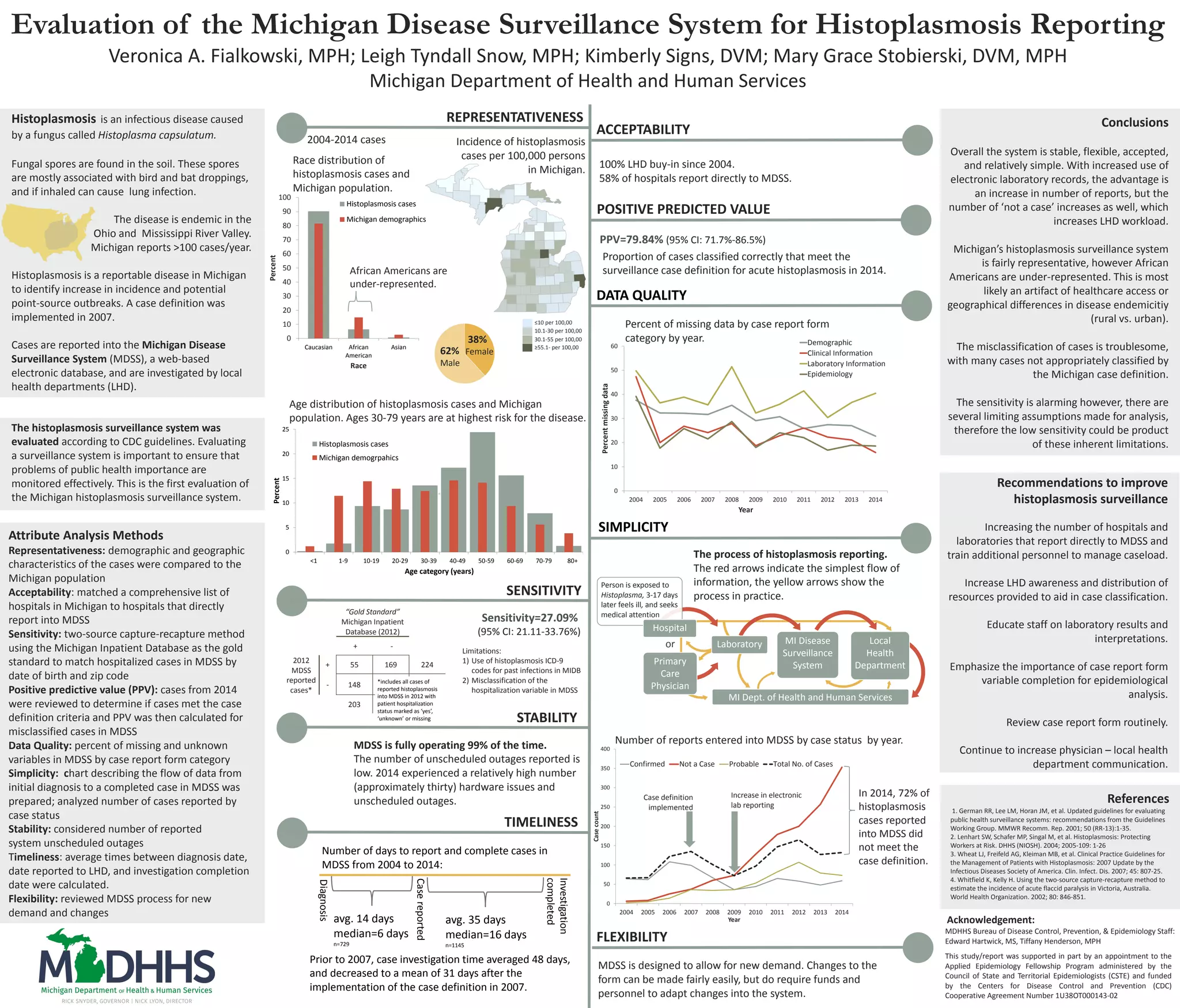
Evaluation of the Michigan Disease Surveillance System for Histoplasmosis Reporting
Veronica A. Fialkowski, MPH; Leigh Tyndall Snow, MPH; Kimberly Signs, DVM; Mary Grace Stobierski, DVM, MPH
Michigan Department of Health and Human Services
Histoplasmosis is an infectious disease caused
by a fungus called Histoplasma capsulatum.
Fungal spores are found in the soil. These spores
are mostly associated with bird and bat droppings,
and if inhaled can cause lung infection.
The disease is endemic in the
Ohio and Mississippi River Valley.
Michigan reports >100 cases/year.
Histoplasmosis is a reportable disease in Michigan
to identify increase in incidence and potential
point-source outbreaks. A case definition was
implemented in 2007.
Cases are reported into the Michigan Disease
Surveillance System (MDSS), a web-based
electronic database, and are investigated by local
health departments (LHD).
Attribute Analysis Methods
Representativeness: demographic and geographic
characteristics of the cases were compared to the
Michigan population
Acceptability: matched a comprehensive list of
hospitals in Michigan to hospitals that directly
report into MDSS
Sensitivity: two-source capture-recapture method
using the Michigan Inpatient Database as the gold
standard to match hospitalized cases in MDSS by
date of birth and zip code
Positive predictive value (PPV): cases from 2014
were reviewed to determine if cases met the case
definition criteria and PPV was then calculated for
misclassified cases in MDSS
Data Quality: percent of missing and unknown
variables in MDSS by case report form category
Simplicity: chart describing the flow of data from
initial diagnosis to a completed case in MDSS was
prepared; analyzed number of cases reported by
case status
Stability: considered number of reported
system unscheduled outages
Timeliness: average times between diagnosis date,
date reported to LHD, and investigation completion
date were calculated.
Flexibility: reviewed MDSS process for new
demand and changes
Conclusions
Overall the system is stable, flexible, accepted,
and relatively simple. With increased use of
electronic laboratory records, the advantage is
an increase in number of reports, but the
number of ‘not a case’ increases as well, which
increases LHD workload.
Michigan’s histoplasmosis surveillance system
is fairly representative, however African
Americans are under-represented. This is most
likely an artifact of healthcare access or
geographical differences in disease endemicitiy
(rural vs. urban).
The misclassification of cases is troublesome,
with many cases not appropriately classified by
the Michigan case definition.
The sensitivity is alarming however, there are
several limiting assumptions made for analysis,
therefore the low sensitivity could be product
of these inherent limitations.
ACCEPTABILITY
TIMELINESS
SENSITIVITY
POSITIVE PREDICTED VALUE
SIMPLICITY
FLEXIBILITY
STABILITY
Prior to 2007, case investigation time averaged 48 days,
and decreased to a mean of 31 days after the
implementation of the case definition in 2007.
Diagnosis
Casereported
Investigation
completed
avg. 14 days
median=6 days
n=729
avg. 35 days
median=16 days
n=1145
Number of days to report and complete cases in
MDSS from 2004 to 2014:
PPV=79.84% (95% CI: 71.7%-86.5%)
MDSS is designed to allow for new demand. Changes to the
form can be made fairly easily, but do require funds and
personnel to adapt changes into the system.
Sensitivity=27.09%
(95% CI: 21.11-33.76%)
This study/report was supported in part by an appointment to the
Applied Epidemiology Fellowship Program administered by the
Council of State and Territorial Epidemiologists (CSTE) and funded
by the Centers for Disease Control and Prevention (CDC)
Cooperative Agreement Number 1U38OT000143-02
“Gold Standard”
Michigan Inpatient
Database (2012)
+ -
2012
MDSS
reported
cases*
+ 55 169 224
- 148
203
The histoplasmosis surveillance system was
evaluated according to CDC guidelines. Evaluating
a surveillance system is important to ensure that
problems of public health importance are
monitored effectively. This is the first evaluation of
the Michigan histoplasmosis surveillance system.
DATA QUALITY
0
5
10
15
20
25
<1 1-9 10-19 20-29 30-39 40-49 50-59 60-69 70-79 80+
Percent
Age category (years)
Histoplasmosis cases
Michigan demogrpahics
0
50
100
150
200
250
300
350
400
2004 2005 2006 2007 2008 2009 2010 2011 2012 2013 2014
Casecount
Year
Confirmed Not a Case Probable Total No. of Cases
In 2014, 72% of
histoplasmosis
cases reported
into MDSS did
not meet the
case definition.
Case definition
implemented
Increase in electronic
lab reporting
0
10
20
30
40
50
60
70
80
90
100
Caucasian African
American
Asian
Percent
Race
Histoplasmosis cases
Michigan demographics
62%
Male
38%
Female
REPRESENTATIVENESS
Recommendations to improve
histoplasmosis surveillance
Increasing the number of hospitals and
laboratories that report directly to MDSS and
train additional personnel to manage caseload.
Increase LHD awareness and distribution of
resources provided to aid in case classification.
Educate staff on laboratory results and
interpretations.
Emphasize the importance of case report form
variable completion for epidemiological
analysis.
Review case report form routinely.
Continue to increase physician – local health
department communication.
100% LHD buy-in since 2004.
58% of hospitals report directly to MDSS.
*includes all cases of
reported histoplasmosis
into MDSS in 2012 with
patient hospitalization
status marked as ‘yes’,
‘unknown’ or missing
Proportion of cases classified correctly that meet the
surveillance case definition for acute histoplasmosis in 2014.
MDSS is fully operating 99% of the time.
The number of unscheduled outages reported is
low. 2014 experienced a relatively high number
(approximately thirty) hardware issues and
unscheduled outages.
0
10
20
30
40
50
60
2004 2005 2006 2007 2008 2009 2010 2011 2012 2013 2014
Percentmissingdata
Year
Demographic
Clinical Information
Laboratory Information
Epidemiology
Person is exposed to
Histoplasma, 3-17 days
later feels ill, and seeks
medical attention
Hospital
Primary
Care
Physician
Laboratory Local
Health
Department
MI Disease
Surveillance
System
MI Dept. of Health and Human Services
or
Percent of missing data by case report form
category by year.
The process of histoplasmosis reporting.
The red arrows indicate the simplest flow of
information, the yellow arrows show the
process in practice.
Number of reports entered into MDSS by case status by year.
Race distribution of
histoplasmosis cases and
Michigan population.
African Americans are
under-represented.
Age distribution of histoplasmosis cases and Michigan
population. Ages 30-79 years are at highest risk for the disease.
≤10 per 100,00
10.1-30 per 100,00
≥55.1- per 100,00
30.1-55 per 100,00
Incidence of histoplasmosis
cases per 100,000 persons
in Michigan.
References
1. German RR, Lee LM, Horan JM, et al. Updated guidelines for evaluating
public health surveillance systems: recommendations from the Guidelines
Working Group. MMWR Recomm. Rep. 2001; 50 (RR-13):1-35.
2. Lenhart SW, Schafer MP, Singal M, et al. Histoplasmosis: Protecting
Workers at Risk. DHHS (NIOSH). 2004; 2005-109: 1-26
3. Wheat LJ, Freifeld AG, Kleiman MB, et al. Clinical Practice Guidelines for
the Management of Patients with Histoplasmosis: 2007 Update by the
Infectious Diseases Society of America. Clin. Infect. Dis. 2007; 45: 807-25.
4. Whitfield K, Kelly H. Using the two-source capture-recapture method to
estimate the incidence of acute flaccid paralysis in Victoria, Australia.
World Health Organization. 2002; 80: 846-851.
Acknowledgement:
MDHHS Bureau of Disease Control, Prevention, & Epidemiology Staff:
Edward Hartwick, MS, Tiffany Henderson, MPH
2004-2014 cases
Limitations:
1) Use of histoplasmosis ICD-9
codes for past infections in MIDB
2) Misclassification of the
hospitalization variable in MDSS

CSTE Conference_2015_Poster_Histoplasmosis_Fialkowski_Final

  • 1.
    Evaluation of theMichigan Disease Surveillance System for Histoplasmosis Reporting Veronica A. Fialkowski, MPH; Leigh Tyndall Snow, MPH; Kimberly Signs, DVM; Mary Grace Stobierski, DVM, MPH Michigan Department of Health and Human Services Histoplasmosis is an infectious disease caused by a fungus called Histoplasma capsulatum. Fungal spores are found in the soil. These spores are mostly associated with bird and bat droppings, and if inhaled can cause lung infection. The disease is endemic in the Ohio and Mississippi River Valley. Michigan reports >100 cases/year. Histoplasmosis is a reportable disease in Michigan to identify increase in incidence and potential point-source outbreaks. A case definition was implemented in 2007. Cases are reported into the Michigan Disease Surveillance System (MDSS), a web-based electronic database, and are investigated by local health departments (LHD). Attribute Analysis Methods Representativeness: demographic and geographic characteristics of the cases were compared to the Michigan population Acceptability: matched a comprehensive list of hospitals in Michigan to hospitals that directly report into MDSS Sensitivity: two-source capture-recapture method using the Michigan Inpatient Database as the gold standard to match hospitalized cases in MDSS by date of birth and zip code Positive predictive value (PPV): cases from 2014 were reviewed to determine if cases met the case definition criteria and PPV was then calculated for misclassified cases in MDSS Data Quality: percent of missing and unknown variables in MDSS by case report form category Simplicity: chart describing the flow of data from initial diagnosis to a completed case in MDSS was prepared; analyzed number of cases reported by case status Stability: considered number of reported system unscheduled outages Timeliness: average times between diagnosis date, date reported to LHD, and investigation completion date were calculated. Flexibility: reviewed MDSS process for new demand and changes Conclusions Overall the system is stable, flexible, accepted, and relatively simple. With increased use of electronic laboratory records, the advantage is an increase in number of reports, but the number of ‘not a case’ increases as well, which increases LHD workload. Michigan’s histoplasmosis surveillance system is fairly representative, however African Americans are under-represented. This is most likely an artifact of healthcare access or geographical differences in disease endemicitiy (rural vs. urban). The misclassification of cases is troublesome, with many cases not appropriately classified by the Michigan case definition. The sensitivity is alarming however, there are several limiting assumptions made for analysis, therefore the low sensitivity could be product of these inherent limitations. ACCEPTABILITY TIMELINESS SENSITIVITY POSITIVE PREDICTED VALUE SIMPLICITY FLEXIBILITY STABILITY Prior to 2007, case investigation time averaged 48 days, and decreased to a mean of 31 days after the implementation of the case definition in 2007. Diagnosis Casereported Investigation completed avg. 14 days median=6 days n=729 avg. 35 days median=16 days n=1145 Number of days to report and complete cases in MDSS from 2004 to 2014: PPV=79.84% (95% CI: 71.7%-86.5%) MDSS is designed to allow for new demand. Changes to the form can be made fairly easily, but do require funds and personnel to adapt changes into the system. Sensitivity=27.09% (95% CI: 21.11-33.76%) This study/report was supported in part by an appointment to the Applied Epidemiology Fellowship Program administered by the Council of State and Territorial Epidemiologists (CSTE) and funded by the Centers for Disease Control and Prevention (CDC) Cooperative Agreement Number 1U38OT000143-02 “Gold Standard” Michigan Inpatient Database (2012) + - 2012 MDSS reported cases* + 55 169 224 - 148 203 The histoplasmosis surveillance system was evaluated according to CDC guidelines. Evaluating a surveillance system is important to ensure that problems of public health importance are monitored effectively. This is the first evaluation of the Michigan histoplasmosis surveillance system. DATA QUALITY 0 5 10 15 20 25 <1 1-9 10-19 20-29 30-39 40-49 50-59 60-69 70-79 80+ Percent Age category (years) Histoplasmosis cases Michigan demogrpahics 0 50 100 150 200 250 300 350 400 2004 2005 2006 2007 2008 2009 2010 2011 2012 2013 2014 Casecount Year Confirmed Not a Case Probable Total No. of Cases In 2014, 72% of histoplasmosis cases reported into MDSS did not meet the case definition. Case definition implemented Increase in electronic lab reporting 0 10 20 30 40 50 60 70 80 90 100 Caucasian African American Asian Percent Race Histoplasmosis cases Michigan demographics 62% Male 38% Female REPRESENTATIVENESS Recommendations to improve histoplasmosis surveillance Increasing the number of hospitals and laboratories that report directly to MDSS and train additional personnel to manage caseload. Increase LHD awareness and distribution of resources provided to aid in case classification. Educate staff on laboratory results and interpretations. Emphasize the importance of case report form variable completion for epidemiological analysis. Review case report form routinely. Continue to increase physician – local health department communication. 100% LHD buy-in since 2004. 58% of hospitals report directly to MDSS. *includes all cases of reported histoplasmosis into MDSS in 2012 with patient hospitalization status marked as ‘yes’, ‘unknown’ or missing Proportion of cases classified correctly that meet the surveillance case definition for acute histoplasmosis in 2014. MDSS is fully operating 99% of the time. The number of unscheduled outages reported is low. 2014 experienced a relatively high number (approximately thirty) hardware issues and unscheduled outages. 0 10 20 30 40 50 60 2004 2005 2006 2007 2008 2009 2010 2011 2012 2013 2014 Percentmissingdata Year Demographic Clinical Information Laboratory Information Epidemiology Person is exposed to Histoplasma, 3-17 days later feels ill, and seeks medical attention Hospital Primary Care Physician Laboratory Local Health Department MI Disease Surveillance System MI Dept. of Health and Human Services or Percent of missing data by case report form category by year. The process of histoplasmosis reporting. The red arrows indicate the simplest flow of information, the yellow arrows show the process in practice. Number of reports entered into MDSS by case status by year. Race distribution of histoplasmosis cases and Michigan population. African Americans are under-represented. Age distribution of histoplasmosis cases and Michigan population. Ages 30-79 years are at highest risk for the disease. ≤10 per 100,00 10.1-30 per 100,00 ≥55.1- per 100,00 30.1-55 per 100,00 Incidence of histoplasmosis cases per 100,000 persons in Michigan. References 1. German RR, Lee LM, Horan JM, et al. Updated guidelines for evaluating public health surveillance systems: recommendations from the Guidelines Working Group. MMWR Recomm. Rep. 2001; 50 (RR-13):1-35. 2. Lenhart SW, Schafer MP, Singal M, et al. Histoplasmosis: Protecting Workers at Risk. DHHS (NIOSH). 2004; 2005-109: 1-26 3. Wheat LJ, Freifeld AG, Kleiman MB, et al. Clinical Practice Guidelines for the Management of Patients with Histoplasmosis: 2007 Update by the Infectious Diseases Society of America. Clin. Infect. Dis. 2007; 45: 807-25. 4. Whitfield K, Kelly H. Using the two-source capture-recapture method to estimate the incidence of acute flaccid paralysis in Victoria, Australia. World Health Organization. 2002; 80: 846-851. Acknowledgement: MDHHS Bureau of Disease Control, Prevention, & Epidemiology Staff: Edward Hartwick, MS, Tiffany Henderson, MPH 2004-2014 cases Limitations: 1) Use of histoplasmosis ICD-9 codes for past infections in MIDB 2) Misclassification of the hospitalization variable in MDSS