Striking a Culturally Acceptable Balance Between Supporting Consumerized IT and Practical Security Boundaries Al Raymond, CIPP, CISSP Chief Privacy Officer & IT Risk Mgmt PHH Corporation
What is ‘Consumerized IT ’? a/k/a… BYOT...  BYOD…  BYOC “ The purchase pattern of a shift toward laptops, tablets and smart phones being bought by consumers, causing corporate products to have shorter and smaller upgrade cycles” “ The increasing influence that our technology experiences as consumers—both hardware and applications—have on the technology that we expect to use at work” A ‘tyranny*’
Why is Consumerized IT here  now ? BYO  is  Consumerized IT  It’s all about productivity via familiarity Growing due to: Better technology @ home vs. work User demand ( I want my MTV ) Business pressure to reduce costs Holy Grail of employee satisfaction (especially Gen X & Y and Millennials)
How Prevalent is BYO? Nov 2010 Ovum report finds : 70% of employees allowed to use corporate devices for personal activities already.  48 % can use personally owned  devices to connect to corporate systems.
Boundaries of a company’s information network are not as clearly defined as in the past Mobile phone is now the mobile office Work  =  Home  =  Work  =  Home How Prevalent is BYO?
Yet, Real Risks Exists …. Consumer devices are rarely adequately secured against malware Losses/thefts not always reported Enables access through these devices to a gaping hole in the company’s otherwise secure firewall .  These risks have led many organizations to firmly resist consumerization by restricting personal devices/consumer electronics into the workplace……
Good luck with that …
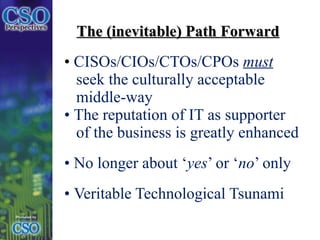
The (inevitable) Path Forward CISOs/CIOs/CTOs/CPOs  must   seek the culturally acceptable  middle-way The reputation of IT as supporter  of the business is greatly enhanced No longer about ‘ yes ’ or ‘ no ’ only Veritable Technological Tsunami
Classic Struggles throughout the Millennia Which brings us to….
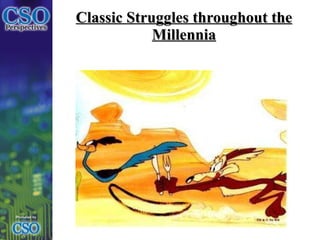
Classic Struggles throughout the Millennia
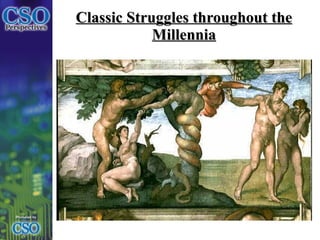
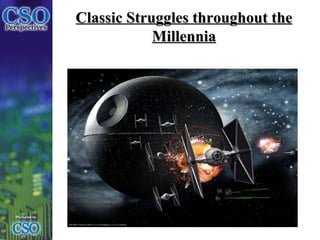
Information Security  Vs.  ‘ The Business ” Bottom Line : It Is Ultimately a Business Risk Decision Classic Struggles throughout the Millennia
Gartner's Top IT Predictions  for 2011  “ Consumerization of IT is no longer a phenomenon to be contained or resisted.”     The attention of users and  IT  organizations will shift from devices, infrastructure and applications - and focus on information and interaction with peers. And this change is expected to herald the start of the post-consumerization era. * Gartner's Top Predictions for IT Organizations and Users, 2011 and Beyond: IT's Growing Transparency  Nov 2010
Gartner's Top IT Predictions  for 2011  Translation : Resistance is Futile * Gartner's Top Predictions for IT Organizations and Users, 2011 and Beyond: IT's Growing Transparency  Nov 2010
Watch for  Continued Convergence Ahead!
 
Designing & Implementing the Balance
Prerequisites!! Tone set at the top Centrally managed risk management plan (DLP, for example) Anti-malware solutions to reduce infections and protect company systems. Firewall and intrusion prevention system (IPS) to monitor traffic to and from key assets
Prerequisites …. continued Policies, Policies, Policies Decision must explicitly include all possible components  (phone, laptop, tablet) Policies must be flexible as new technology becomes available
The policies should make clear: Which devices will be supported  Which apps, or categories of apps, are authorized/forbidden  What company data is allowed on personal devices How & Who to get support from/for devices and applications The policies should also answer: When a device is no longer used or employee leaves, what are the responsibilities for deletion of secure data? Where and how will devices be backed up? Who is responsible for backup? Timely notification of loss or theft Policies
Prerequisites …. continued Sign specially crafted mobile/personal device agreement / acknowledgement Update your incident handling policy  Get buy in from HR & Legal & Internal Audit Decide if you will allow Consumerization – formally or otherwise  (because it  will   happen!) Don’t wait for it to happen and then rush to formulate policy and procedures
Prerequisites …. continued Finally ,……… Decide : Is the consumerization of IT really appropriate/culturally relevant in my company?  Dunder Mifflin?  Probably .  CIA?  Probably not
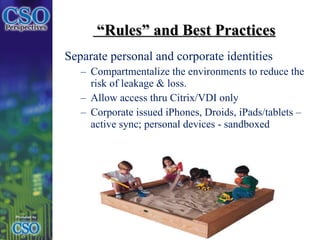
“ Rules” and Best Practices Separate personal and corporate identities Compartmentalize the environments to reduce the risk of leakage & loss. Allow access thru Citrix/VDI only Corporate issued iPhones, Droids, iPads/tablets – active sync; personal devices - sandboxed
Best Practices Remote wipe / kill / lockout Password protected Auto-lock after X minutes Device wipes after X failed log-ins On device encryption  (if supported) SSL encryption of e-mail
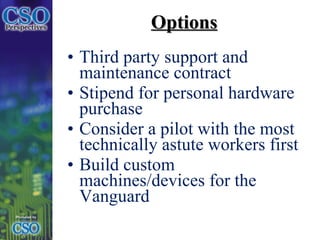
Options Third party support and maintenance contract Stipend for personal hardware purchase Consider a pilot with the most technically astute workers first  Build custom machines/devices for the Vanguard
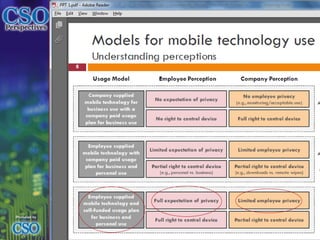
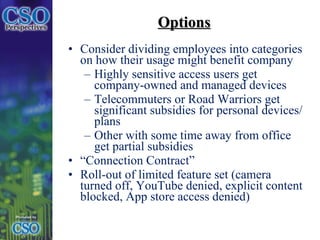
Options Consider dividing employees into categories on how their usage might benefit company Highly sensitive access users get company-owned and managed devices Telecommuters or Road Warriors get significant subsidies for personal devices/plans Other with some time away from office get partial subsidies “ Connection Contract” Roll-out of limited feature set (camera turned off, YouTube denied, explicit content blocked, App store access denied)
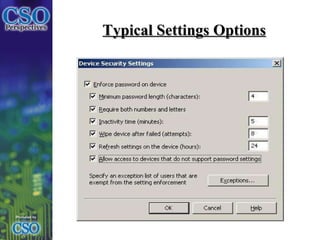
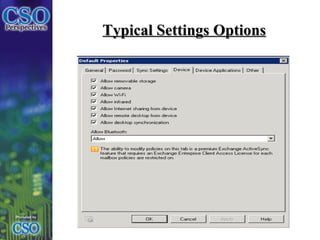
Typical Settings Options
Developing a BYO Culture  Don’t/Can’t say no to “bring your own”:  The toothpaste is out of the tube.  Employees are more productive when they have a vote on the tools they use. Show leadership & get it right so that the company is protected & users are (relatively) happy.  Listen to the end users:  Primary objective of consumerization is  work and personal life on a single device. Tailor policies and guidelines to this end. Research and test your approach:  Consider a pilot program before full rollout. Discover the range and types of best devices as well as what access users will need.  Document and communicate a clear set of policies for end users:  Everyone should know what the company policies are and where to find them. Review all polices as new technologies arrive and raise new issues.
Lastly, consider… For employees : Implicit Presumption:  You can now be reached 24/7 2.  For employers :  Culturally acceptable, but prudent? Worth the trade-off?
Questions?

Csop 2011 Al Raymond

  • 1.
  • 2.
    Striking a CulturallyAcceptable Balance Between Supporting Consumerized IT and Practical Security Boundaries Al Raymond, CIPP, CISSP Chief Privacy Officer & IT Risk Mgmt PHH Corporation
  • 3.
    What is ‘ConsumerizedIT ’? a/k/a… BYOT... BYOD… BYOC “ The purchase pattern of a shift toward laptops, tablets and smart phones being bought by consumers, causing corporate products to have shorter and smaller upgrade cycles” “ The increasing influence that our technology experiences as consumers—both hardware and applications—have on the technology that we expect to use at work” A ‘tyranny*’
  • 4.
    Why is ConsumerizedIT here now ? BYO is Consumerized IT It’s all about productivity via familiarity Growing due to: Better technology @ home vs. work User demand ( I want my MTV ) Business pressure to reduce costs Holy Grail of employee satisfaction (especially Gen X & Y and Millennials)
  • 5.
    How Prevalent isBYO? Nov 2010 Ovum report finds : 70% of employees allowed to use corporate devices for personal activities already. 48 % can use personally owned devices to connect to corporate systems.
  • 6.
    Boundaries of acompany’s information network are not as clearly defined as in the past Mobile phone is now the mobile office Work = Home = Work = Home How Prevalent is BYO?
  • 7.
    Yet, Real RisksExists …. Consumer devices are rarely adequately secured against malware Losses/thefts not always reported Enables access through these devices to a gaping hole in the company’s otherwise secure firewall . These risks have led many organizations to firmly resist consumerization by restricting personal devices/consumer electronics into the workplace……
  • 8.
  • 9.
    The (inevitable) PathForward CISOs/CIOs/CTOs/CPOs must seek the culturally acceptable middle-way The reputation of IT as supporter of the business is greatly enhanced No longer about ‘ yes ’ or ‘ no ’ only Veritable Technological Tsunami
  • 10.
    Classic Struggles throughoutthe Millennia Which brings us to….
  • 11.
  • 12.
  • 13.
  • 14.
    Information Security Vs. ‘ The Business ” Bottom Line : It Is Ultimately a Business Risk Decision Classic Struggles throughout the Millennia
  • 15.
    Gartner's Top ITPredictions for 2011 “ Consumerization of IT is no longer a phenomenon to be contained or resisted.”   The attention of users and IT organizations will shift from devices, infrastructure and applications - and focus on information and interaction with peers. And this change is expected to herald the start of the post-consumerization era. * Gartner's Top Predictions for IT Organizations and Users, 2011 and Beyond: IT's Growing Transparency Nov 2010
  • 16.
    Gartner's Top ITPredictions for 2011 Translation : Resistance is Futile * Gartner's Top Predictions for IT Organizations and Users, 2011 and Beyond: IT's Growing Transparency Nov 2010
  • 17.
    Watch for Continued Convergence Ahead!
  • 18.
  • 19.
  • 20.
    Prerequisites!! Tone setat the top Centrally managed risk management plan (DLP, for example) Anti-malware solutions to reduce infections and protect company systems. Firewall and intrusion prevention system (IPS) to monitor traffic to and from key assets
  • 21.
    Prerequisites …. continuedPolicies, Policies, Policies Decision must explicitly include all possible components (phone, laptop, tablet) Policies must be flexible as new technology becomes available
  • 22.
    The policies shouldmake clear: Which devices will be supported Which apps, or categories of apps, are authorized/forbidden What company data is allowed on personal devices How & Who to get support from/for devices and applications The policies should also answer: When a device is no longer used or employee leaves, what are the responsibilities for deletion of secure data? Where and how will devices be backed up? Who is responsible for backup? Timely notification of loss or theft Policies
  • 23.
    Prerequisites …. continuedSign specially crafted mobile/personal device agreement / acknowledgement Update your incident handling policy Get buy in from HR & Legal & Internal Audit Decide if you will allow Consumerization – formally or otherwise (because it will happen!) Don’t wait for it to happen and then rush to formulate policy and procedures
  • 24.
    Prerequisites …. continuedFinally ,……… Decide : Is the consumerization of IT really appropriate/culturally relevant in my company? Dunder Mifflin? Probably . CIA? Probably not
  • 25.
    “ Rules” andBest Practices Separate personal and corporate identities Compartmentalize the environments to reduce the risk of leakage & loss. Allow access thru Citrix/VDI only Corporate issued iPhones, Droids, iPads/tablets – active sync; personal devices - sandboxed
  • 26.
    Best Practices Remotewipe / kill / lockout Password protected Auto-lock after X minutes Device wipes after X failed log-ins On device encryption (if supported) SSL encryption of e-mail
  • 27.
    Options Third partysupport and maintenance contract Stipend for personal hardware purchase Consider a pilot with the most technically astute workers first Build custom machines/devices for the Vanguard
  • 28.
    Options Consider dividingemployees into categories on how their usage might benefit company Highly sensitive access users get company-owned and managed devices Telecommuters or Road Warriors get significant subsidies for personal devices/plans Other with some time away from office get partial subsidies “ Connection Contract” Roll-out of limited feature set (camera turned off, YouTube denied, explicit content blocked, App store access denied)
  • 29.
  • 30.
  • 31.
    Developing a BYOCulture Don’t/Can’t say no to “bring your own”: The toothpaste is out of the tube. Employees are more productive when they have a vote on the tools they use. Show leadership & get it right so that the company is protected & users are (relatively) happy. Listen to the end users: Primary objective of consumerization is work and personal life on a single device. Tailor policies and guidelines to this end. Research and test your approach: Consider a pilot program before full rollout. Discover the range and types of best devices as well as what access users will need. Document and communicate a clear set of policies for end users: Everyone should know what the company policies are and where to find them. Review all polices as new technologies arrive and raise new issues.
  • 32.
    Lastly, consider… Foremployees : Implicit Presumption: You can now be reached 24/7 2. For employers : Culturally acceptable, but prudent? Worth the trade-off?
  • 33.

Editor's Notes

  • #4 *Dave Codack, vice-president of employee technology and network services at TD Bank Financial Group in Toronto
  • #5 Younger users may be turned off from companies with stodgy technology or draconian policies since many younger workers are using social media sites extensively at home, it is unreasonable to think that they will change their habits at work. After waiting 30 minutes for a ten year old work Pentium PC to boot Windows 98 we can see how the concept of a shiny new notebook you can call your own would be appealing
  • #6 Report: Ovum / European Association for e-Identity and Security (EEMA) – Nov 2010.
  • #10 That terminator is out there. It can't be bargained with. It can't be reasoned with. It doesn't feel pity, or remorse, or fear. And it absolutely will not stop, ever, until you are dead
  • #18 Continued convergance is the use of personal devices at work and work devices for personal use
  • #19 THREE TIPS FOR PROTECTING EMPLOYEE PRIVACY IN AN AGE OF PERSONAL MOBILE DEVICES - 2011 Global IAPP Privacy Summit –Washington, DC Dave Dobrotka, Director, Information Risk Governance United Healthcare; KarriemShakoor, Senior Director, Systems Operations Blue Cross Blue Shield of Michigan, Sean Wessman, Manager, Advisory -IT Risk Transformation Ernst & Young Vicki Kamenova, Manager, Advisory -IT Risk Transformation, Ernst & Young
  • #20 In the corporate sector, the biggest risk is not social media. It is that social networking has shined a bright, white light on the limits of our current security programs.
  • #22 Your policies must contemplate technology advances
  • #26 What can IT live with while still giving users what they want - Boxtone. GoodLink, Symantec
  • #28 Connection Contract is signed when connecting personal device to corporate network. EE agrees to adhere to company controls and his personal privacy will be respected. If not, company has grounds for investigation
  • #29 Connection Contract is signed when connecting personal device to corporate network. EE agrees to adhere to company controls and his personal privacy will be respected. If not, company has grounds for investigation