Mobile Consumerization
Presented By    Clement Low Jun Xian

IS3101 Team 7   Kang Jie Min
                Thomas Lim Kuo Tao
                Ivan Chew Teck Meng
                Jeannel Mah Yu Ting
Agenda


    1. The Mobile Consumerization Trend
    2. Organisational Benefits
    3. Possible Challenges
    4. Example: Successful Adoption of BYOD
    5. Future Potential
The Mobile Consumerization Trend


       What is Consumerization?


                 Mary     Lamb
The Mobile Consumerization Trend


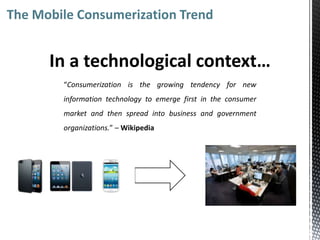
      In a technological context…
        “Consumerization is the growing tendency for new
        information technology to emerge first in the consumer
        market and then spread into business and government
        organizations.” – Wikipedia
The Mobile Consumerization Trend


           Mobile Consumerization
    1.   Lifestyle devices like smartphones and netbooks and tablets
         are adopted by consumers and become increasingly popular.

    2.   Increased usage of these devices will gradually become
         apparent in businesses and organisations, there will be a
         demand from employees to be able to use their own devices in
         the workplace.

    3.   Businesses and organisations will move to adapt to and
         embrace the pervasiveness of consumer-introduced devices
         within them.
Organisational Benefits


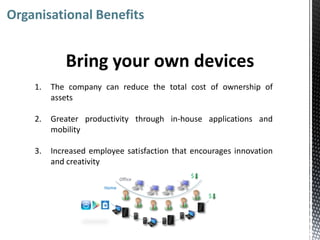
            Bring your own devices
    1.   The company can reduce the total cost of ownership of
         assets

    2.   Greater productivity through in-house applications and
         mobility

    3.   Increased employee satisfaction that encourages innovation
         and creativity
                              Office
                                             $
                       Home
                                                  $
Organisational Benefits


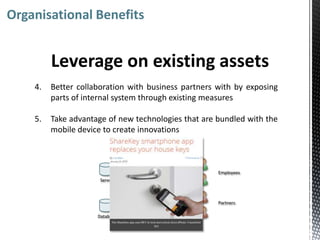
         Leverage on existing assets
    4.   Better collaboration with business partners with by exposing
         parts of internal system through existing measures

    5.   Take advantage of new technologies that are bundled with the
         mobile device to create innovations

                                Internal   External


                                                      Employees
                      Server


                                                      Partners

                     Database
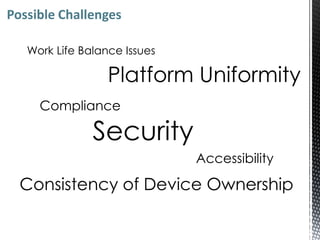
Possible Challenges

   Work Life Balance Issues

                  Platform Uniformity
     Compliance

               Security
                              Accessibility

  Consistency of Device Ownership
Possible Challenges


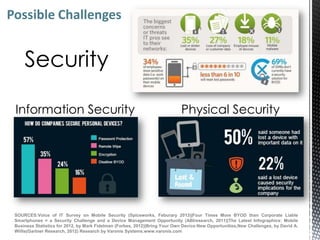
     Security

 Information Security                                                       Physical Security


 SOURCES:Voice of IT Survey on Mobile Security (Spiceworks, Feburary 2013)|Four Times More BYOD than Corporate Liable
 Smartphones = a Security Challenge and a Device Management Opportunity (ABIresearch, 2011)|The Latest Infographics: Mobile
 Business Statistics for 2012, by Mark Fidelman (Forbes, 2012)|Bring Your Own Device:New Opportunities,New Challenges, by David A.
 Willis(Gartner Research, 2012) Research by Varonis Systems.www.varonis.com
Example: Successful Adoption of BYOD
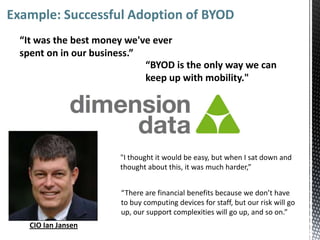
  “It was the best money we've ever
  spent on in our business.”
                             “BYOD is the only way we can
                             keep up with mobility."


                       "I thought it would be easy, but when I sat down and
                       thought about this, it was much harder,”


                       “There are financial benefits because we don’t have
                       to buy computing devices for staff, but our risk will go
                       up, our support complexities will go up, and so on.”
    CIO Ian Jansen
Example: Successful Adoption of BYOD
Background
 • South African company specializing in information
   technology service

 • Over 14,000 employees around the world

 • Dimension Data Australia: over 600 workers at its office in
   Sydney, with 100 additional workers coming in every year.

 • Office is at full capacity

 • Average number of devices per person is around 2.9
                     BYOD journey started two-and-a-half
                     years ago
Example: Successful Adoption of BYOD
  Obtained feedback from the staff about BYOD, staff were
  passionate in providing their suggestions.

                  • Facilitate delivery of applications onto personal
                    devices

                  • Users needed to register their devices through
                    their mobile device management platform

                  • IT support can start as soon as they are logged
                    into Citrix

                  • Cisco collaboration tools for sharing files
                    between work desktops and mobile devices.

                  • No restriction on which devices are allowed!
Example: Successful Adoption of BYOD
 Present and Future
BYOD makes the full office working space sustainable.
      -Hot-Desking
      -Ability for people to go in and out of the office very quickly

Mobility first perspective when acquiring new business applications

Next phase involves connecting all devices with the data at the
back-end of the business

                    "We're going to be able to do things we
                    couldn't do before, some of the value that I’m
                    going to drive in that space is going to be
                    absolutely outstanding!"
Future Potential


                       Future Trend
    Mobile devices flood consumer market

    1.   Human resources
         • Employee expectations changing

    2.   Mobile devices and its data as physical and info resources
         • Critical, expensive to substitute, limited control

    Company (re)actions:
       • Incorporate – Purchase mobile devices for employees
       • Adapt – Loosen policies governing use of mobile devices
       • Adapt – BYOD
Future Potential


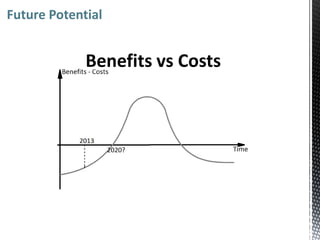
             Benefits vs Costs
Future Potential


                          Potential
    1.   Increased employee availability (Resource)
         • Blurring of work and home (Social) =(

    2.   Increased productivity (?) and innovation
         • Higher return/turnover on assets
         • Work from home =(
         • Improved morale
         • Less application training required

    3.   Mobile arm of information security
         • Hardened systems
         • Improved company infrastructure
         • Improved policies and awareness
Thank you!
Any questions?

IS3101 Tutorial Task 2

  • 1.
    Mobile Consumerization Presented By Clement Low Jun Xian IS3101 Team 7 Kang Jie Min Thomas Lim Kuo Tao Ivan Chew Teck Meng Jeannel Mah Yu Ting
  • 2.
    Agenda 1. The Mobile Consumerization Trend 2. Organisational Benefits 3. Possible Challenges 4. Example: Successful Adoption of BYOD 5. Future Potential
  • 3.
    The Mobile ConsumerizationTrend What is Consumerization? Mary Lamb
  • 4.
    The Mobile ConsumerizationTrend In a technological context… “Consumerization is the growing tendency for new information technology to emerge first in the consumer market and then spread into business and government organizations.” – Wikipedia
  • 5.
    The Mobile ConsumerizationTrend Mobile Consumerization 1. Lifestyle devices like smartphones and netbooks and tablets are adopted by consumers and become increasingly popular. 2. Increased usage of these devices will gradually become apparent in businesses and organisations, there will be a demand from employees to be able to use their own devices in the workplace. 3. Businesses and organisations will move to adapt to and embrace the pervasiveness of consumer-introduced devices within them.
  • 6.
    Organisational Benefits Bring your own devices 1. The company can reduce the total cost of ownership of assets 2. Greater productivity through in-house applications and mobility 3. Increased employee satisfaction that encourages innovation and creativity Office $ Home $
  • 7.
    Organisational Benefits Leverage on existing assets 4. Better collaboration with business partners with by exposing parts of internal system through existing measures 5. Take advantage of new technologies that are bundled with the mobile device to create innovations Internal External Employees Server Partners Database
  • 8.
    Possible Challenges Work Life Balance Issues Platform Uniformity Compliance Security Accessibility Consistency of Device Ownership
  • 9.
    Possible Challenges Security Information Security Physical Security SOURCES:Voice of IT Survey on Mobile Security (Spiceworks, Feburary 2013)|Four Times More BYOD than Corporate Liable Smartphones = a Security Challenge and a Device Management Opportunity (ABIresearch, 2011)|The Latest Infographics: Mobile Business Statistics for 2012, by Mark Fidelman (Forbes, 2012)|Bring Your Own Device:New Opportunities,New Challenges, by David A. Willis(Gartner Research, 2012) Research by Varonis Systems.www.varonis.com
  • 10.
    Example: Successful Adoptionof BYOD “It was the best money we've ever spent on in our business.” “BYOD is the only way we can keep up with mobility." "I thought it would be easy, but when I sat down and thought about this, it was much harder,” “There are financial benefits because we don’t have to buy computing devices for staff, but our risk will go up, our support complexities will go up, and so on.” CIO Ian Jansen
  • 11.
    Example: Successful Adoptionof BYOD Background • South African company specializing in information technology service • Over 14,000 employees around the world • Dimension Data Australia: over 600 workers at its office in Sydney, with 100 additional workers coming in every year. • Office is at full capacity • Average number of devices per person is around 2.9 BYOD journey started two-and-a-half years ago
  • 12.
    Example: Successful Adoptionof BYOD Obtained feedback from the staff about BYOD, staff were passionate in providing their suggestions. • Facilitate delivery of applications onto personal devices • Users needed to register their devices through their mobile device management platform • IT support can start as soon as they are logged into Citrix • Cisco collaboration tools for sharing files between work desktops and mobile devices. • No restriction on which devices are allowed!
  • 13.
    Example: Successful Adoptionof BYOD Present and Future BYOD makes the full office working space sustainable. -Hot-Desking -Ability for people to go in and out of the office very quickly Mobility first perspective when acquiring new business applications Next phase involves connecting all devices with the data at the back-end of the business "We're going to be able to do things we couldn't do before, some of the value that I’m going to drive in that space is going to be absolutely outstanding!"
  • 14.
    Future Potential Future Trend Mobile devices flood consumer market 1. Human resources • Employee expectations changing 2. Mobile devices and its data as physical and info resources • Critical, expensive to substitute, limited control Company (re)actions: • Incorporate – Purchase mobile devices for employees • Adapt – Loosen policies governing use of mobile devices • Adapt – BYOD
  • 15.
    Future Potential Benefits vs Costs
  • 16.
    Future Potential Potential 1. Increased employee availability (Resource) • Blurring of work and home (Social) =( 2. Increased productivity (?) and innovation • Higher return/turnover on assets • Work from home =( • Improved morale • Less application training required 3. Mobile arm of information security • Hardened systems • Improved company infrastructure • Improved policies and awareness
  • 17.

Editor's Notes

  • #11 Now, we are going to introduce a company that has successfully adopted BYOD into their workplace. Dimension Data Australia.These are some of the quotes from the CIO of Dimension Data’s Australian Branch, Mr Ian Jansen, on the adoption of BYOD:“It was the best money we’ve ever spent on in our business.” “BYOD is the only way we can keep up with mobility”But of course, with the implementation, there were also concerns, to quote Mr Jenson: "I thought it would be easy, but when I sat down and thought about this, it was much harder”, and there are financial benefits because we don’t have to buy computing devices for staff, but our risk will go up, our support complexities will go up, and so on.”
  • #12 Dimension data is a IT Service company which started in South Africa but now has 14000 employees in every continent. But for this case, we will only be focusing on their Australian branch, which now has over 600 workers at its office in Sydney, this number growing at a pace of 100 workers a year. Their office is now at full capacity, but moving to a new location would be prohibitive due to the cost and disruption of moving the staff over. Also to note, in the company, the average number of devices per person is currently around 2.9. This trend is set to continue, as the frequency of people moving between devices is increasing, as such, so will the number of devices they are carrying. Due to the lack of space, and the increasing trend of consumerization among their workers, the company implemented their BYOD strategy.
  • #13 To repeat MrJanson’s quote, implementing BYOD is not easy, so he posted the policy on the company’s intranet for the staff to provide their suggestions, and the staff were passionate about this, the ability to use their own devices in the workplace touched them. Thus, with the policy in place, Dimension data rolled out a Citrix infrastructure inside the business to facilitate the delivery of virtual applications onto personal mobile devices. Users also needed to register their personal devices through Dimension Data's mobile device management platform, and support from Dimension Data's internal IT team can start as soon as they logged into Citrix.The company also used Cisco collaboration tools for sharing files between work desktops and mobile devices. This BYOD policy allowed for the ability to not have a restriction on which device workers can bring into the company, and there is only a minimum requirement that devices have to meet.
  • #14 Mobility has become crucial in making their limited office working space sustainable. With BYOD, the trend of Hot-Desking has become popular among their staff, Hot desking is an office organization system which involves multiple workers using a single physical work station or surface during different time periods.The ability to quickly move in and out of the office has become increasingly important for their business, such that they have a number of internal IT projects running in order to make use of the space they haveBYOD has also changed the way Jansen acquires applications into the Dimension Data business. They now look for applications from a mobility first perspective, from someone using a device in the field, rather than someone sitting in an office chair. The next phase of Dimension Data's BYOD journey involves connecting all the mobile devices with the data at the back-end of the business. I’ll end off with a quote from MrJanson,"We're going to be able to do things we couldn't do before, some of the value I'm going to drive in that space is going to be absolutely outstanding."