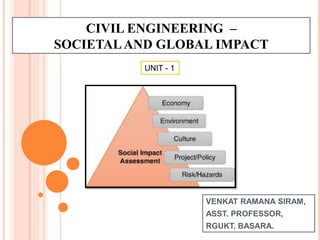
CIVIL ENGINEERING –
SOCIETALAND GLOBAL IMPACT
UNIT - 1
VENKAT RAMANA SIRAM,
ASST. PROFESSOR,
RGUKT, BASARA.
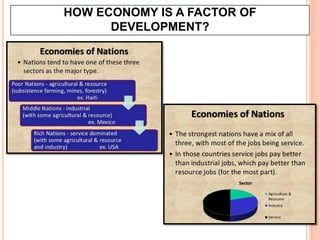
HOW ECONOMY IS A FACTOR OF
DEVELOPMENT?
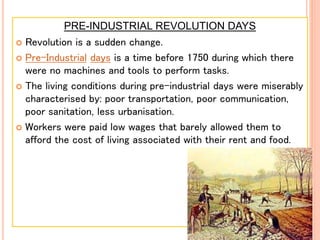
PRE-INDUSTRIAL REVOLUTION DAYS
 Revolution is a sudden change.
 Pre-Industrial days is a time before 1750 during which there
were no machines and tools to perform tasks.
 The living conditions during pre-industrial days were miserably
characterised by: poor transportation, poor communication,
poor sanitation, less urbanisation.
 Workers were paid low wages that barely allowed them to
afford the cost of living associated with their rent and food.
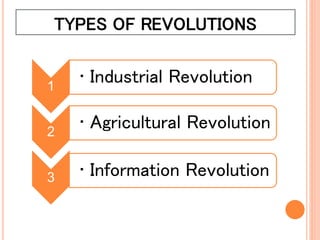
TYPES OF REVOLUTIONS
1
• Industrial Revolution
2
• Agricultural Revolution
3 • Information Revolution
INDUSTRIAL REVOLUTION
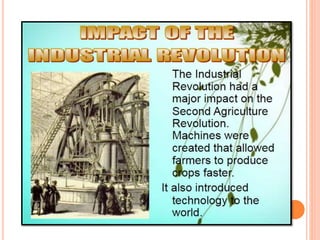
 The Industrial Revolution began after 1750s in Britain,
and spread around the world.
 It was a time when the manufacturing of goods moved
from small shops and homes to large factories.
 Changes in culture as people moved from rural areas
to big cities in order to work.
 Led to increase in urbanisation, increase in population
and increase in living standards.
 Led to the depletion of natural resources.
 Use of chemicals and fuel in factories resulted in
increased air and water pollution and an increased use
of fossil fuels
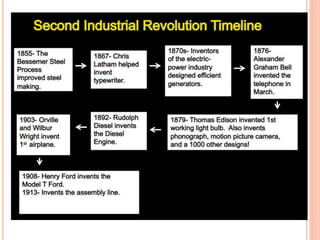
PHASES IN INDUSTRIAL REVOLUTION
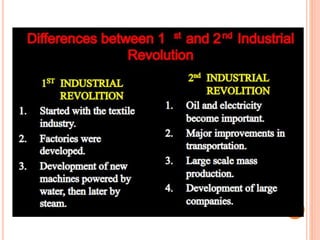
 The Industrial revolution is divided into two phases:
First industrial revolution, which took place between 1750
and 1850 and the second industrial revolution, which took
place between 1850 and 1914.
 While the First Industrial Revolution centered on textile
manufacturing and the innovation of the steam engine,
the Second Industrial Revolution focused instead on steel
production, the automobile, petroleum and advances in
electricity.
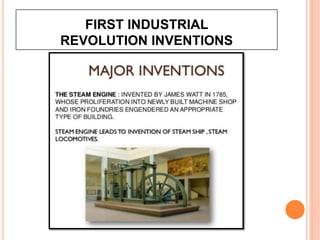
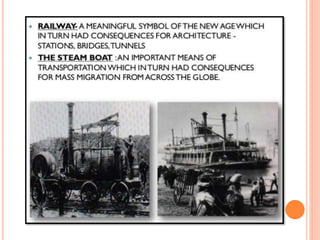
FIRST INDUSTRIAL
REVOLUTION INVENTIONS
ADVANTAGES OF INDUSTRIAL REVOLUTION
 Increase in employment, Urbanization, transportation
facilities and standard of living.
 Led to news ways of thinking for better governance.
 Led way for new inventions.
DISADVANTAGES OF INDUSTRIAL REVOLUTION
 Sudden increase in urbanization and improper
planning of cities led to poor sanitation, there was no
sewage and running water.
 Poor sanitation and sewerage system led to outbreak
of diseases.
 Led to depletion of natural resources and increase in
pollution.
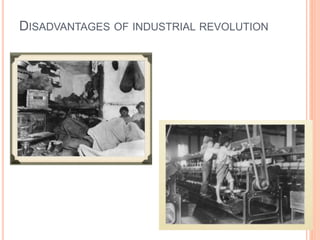
 Led to child labor and women labor giving them low
wages
 Rural people from farming moved to industries for job.
 ‘Iron law of wages’ led to increase in poverty as less
wages were paid saying it would control the
population.
DISADVANTAGES OF INDUSTRIAL REVOLUTION
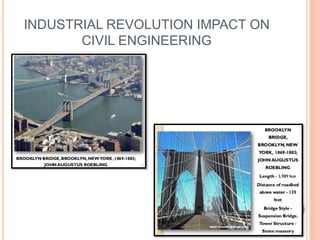
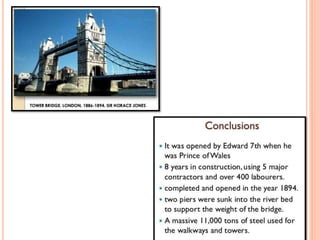
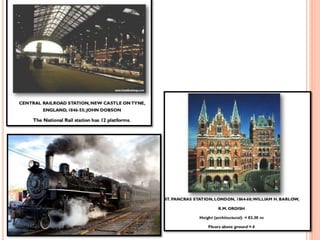
INDUSTRIAL REVOLUTION IMPACT ON
CIVIL ENGINEERING
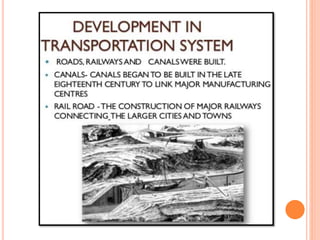
 Construction of Bridges, Tunnels, Canals, Roads,
Dams, Retaining walls, Multi storied buildings,
Airports, Harbors, etc., began.
 Led to new innovations in Engineering and provided
employment to many.
INDUSTRIAL REVOLUTION IMPACT ON
CIVIL ENGINEERING
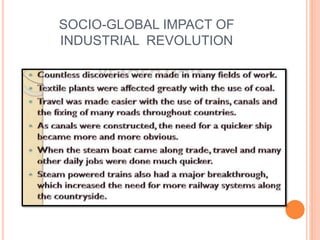
SOCIO-GLOBAL IMPACT OF
INDUSTRIAL REVOLUTION
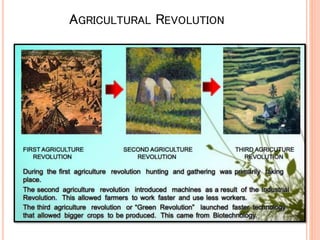
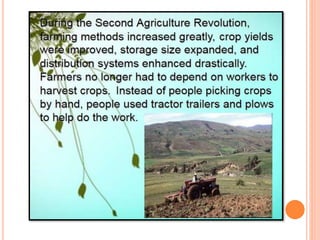
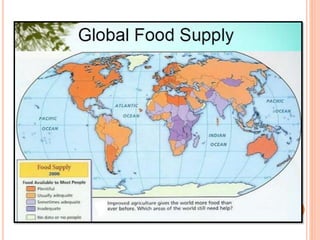
AGRICULTURAL REVOLUTION
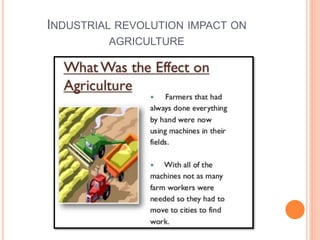
INDUSTRIAL REVOLUTION IMPACT ON
AGRICULTURE
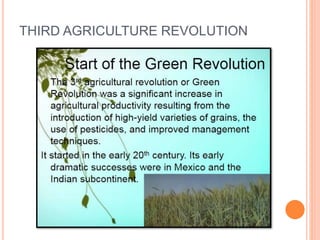
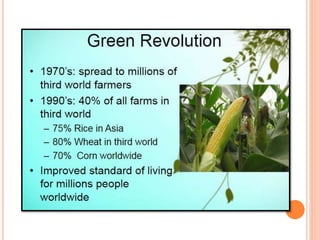
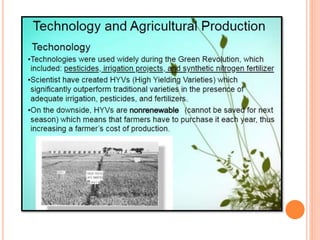
THIRD AGRICULTURE REVOLUTION
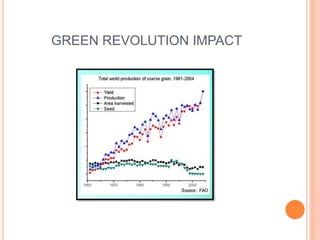
GREEN REVOLUTION IMPACT
NEW INNOVATIONS
ADVANTAGES OF
AGRICULTURE REVOLUTION
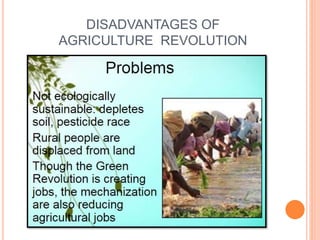
DISADVANTAGES OF
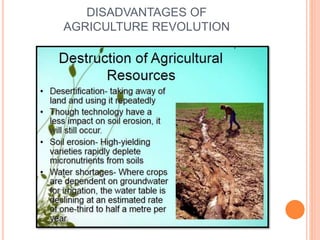
AGRICULTURE REVOLUTION
DISADVANTAGES OF
AGRICULTURE REVOLUTION
IT REVOLUTION
 This revolution made the communication easier.
 Made the complex computations easier.
 Helped in storing the data.
 Helped industries in increasing production.
 Led to new innovations like robust computers to
laptops, telephones to smart phones.
 Led to innovations in nano technology.
 Increased the production and profits in service
sector, Industrial sector and Agricultural sector.
 Provided employment opportunities.
 Led to digitalization.
CIVIL ENGINEERING INNOVATIONS AIMED AT
IMPROVING SUSTAINABILITY
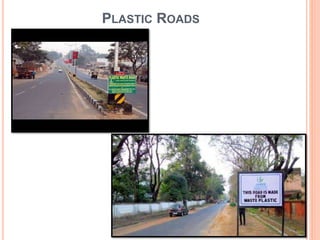
 Plastic Roads
India’s government began experimenting with plastic roads during the early
2000s, with waste plastic being used as a construction material.
An early report by India’s Central Pollution Control Board discovered that even
after four years of use, Jambulingam Street in Chennai—one of the first plastic
roads—had not sustained much damage. The board cited that no potholes,
rutting, ravelling, or edge flaws were discovered during the evaluation.
Although the concept of using waste plastic in roads is still in its early stages,
with very few plastic roads currently existing in the Western world, civil
engineering researchers in countries like the United Kingdom and the United
States are working to design new technologies to support the safe
implementation of waste plastic in road construction.
There are still some concerns regarding hazards that accompany plastic
roads as they age. As these roads gradually deteriorate due to heat and
light, they may dissolve into micro-plastics that give off harmful pollutants,
affecting the functionality and biodiversity of soil and water resources.
PLASTIC ROADS
CIVIL ENGINEERING INNOVATIONS AIMED AT
IMPROVING SUSTAINABILITY
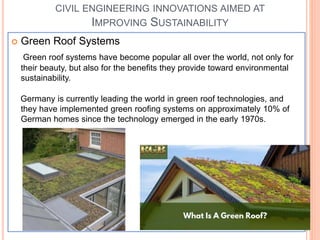
 Green Roof Systems
Green roof systems have become popular all over the world, not only for
their beauty, but also for the benefits they provide toward environmental
sustainability.
Germany is currently leading the world in green roof technologies, and
they have implemented green roofing systems on approximately 10% of
German homes since the technology emerged in the early 1970s.
GREEN ROOF SYSTEMS
Innovations in modern engineering techniques for green roofing system have
allowed the industry to consistently offer the following environmental benefits
to urban communities:
1. Enhanced Urban Biodiversity: Green roofs accommodate new flora, which
may act as new habitats for different species of plants and animals.
2. Cooling of Buildings: The vegetation on the roof acts as thermal insulation,
storing excess heat and decreasing peak temperatures within the building.
This means less energy must be consumed to heat the building, resulting in
decreased energy costs and lower pollutant emissions.
3. Reduced Runoff Quantity: On average, green roofs retain 40-60% of total
rainfall. Storing this rainwater as it falls has been shown to result in runoff
reduction of 34% between September and February, and 67% between
March and August. By reducing runoff, civil engineers that design green roof
systems can limit strain on sewage systems and mitigate the costs of roof
damage.
4. Pollution Control: Green roofs are composed of plants that absorb nitrogen,
lead, zinc, and airborne pollutants like carbon dioxide. This absorption also
reduces the negative effects of acid rain by raising the pH values of acid
rainwater before it becomes runoff water.
CIVIL ENGINEERING INNOVATIONS AIMED AT
IMPROVING SUSTAINABILITY
 Eco Floating Homes
Affordable housing and overcrowding in cities are putting pressure on
urban populations to make changes. To combat these issues, Civil
engineers are designing floating homes—practical living spaces that sit
upon the water.
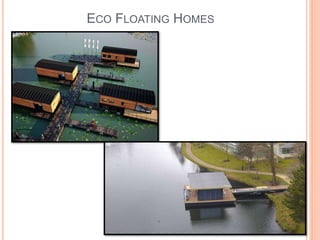
The homes are designed to resist floods by floating on top of water using
a foundation of concrete and Styrofoam, which makes them virtually
unsinkable. This approach means that homes can be built in spaces that
were previously off-limits, like rivers, lakes and other bodies of water.
Introducing this concept in urban environments with large populations will
prove to be somewhat tricky, as structures being built within or on above-
ground water sources could impact environments negatively by disturbing
the natural state of the water.
ECO FLOATING HOMES
CIVIL ENGINEERING INNOVATIONS AIMED AT
IMPROVING SUSTAINABILITY
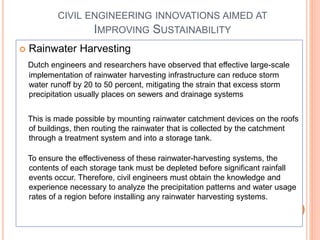
 Rainwater Harvesting
Dutch engineers and researchers have observed that effective large-scale
implementation of rainwater harvesting infrastructure can reduce storm
water runoff by 20 to 50 percent, mitigating the strain that excess storm
precipitation usually places on sewers and drainage systems
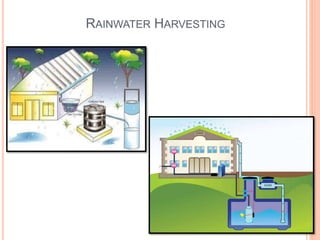
This is made possible by mounting rainwater catchment devices on the roofs
of buildings, then routing the rainwater that is collected by the catchment
through a treatment system and into a storage tank.
To ensure the effectiveness of these rainwater-harvesting systems, the
contents of each storage tank must be depleted before significant rainfall
events occur. Therefore, civil engineers must obtain the knowledge and
experience necessary to analyze the precipitation patterns and water usage
rates of a region before installing any rainwater harvesting systems.
RAINWATER HARVESTING
CIVIL ENGINEERING INNOVATIONS AIMED AT
IMPROVING SUSTAINABILITY
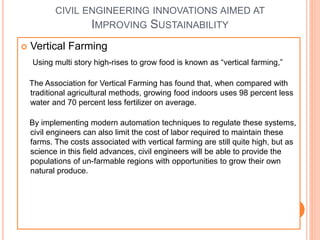
 Vertical Farming
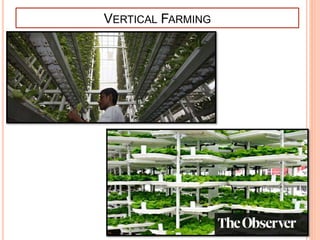
Using multi story high-rises to grow food is known as “vertical farming,”
The Association for Vertical Farming has found that, when compared with
traditional agricultural methods, growing food indoors uses 98 percent less
water and 70 percent less fertilizer on average.
By implementing modern automation techniques to regulate these systems,
civil engineers can also limit the cost of labor required to maintain these
farms. The costs associated with vertical farming are still quite high, but as
science in this field advances, civil engineers will be able to provide the
populations of un-farmable regions with opportunities to grow their own
natural produce.
VERTICAL FARMING
ECOSYSTEMS IN SOCIETY & IN NATURE
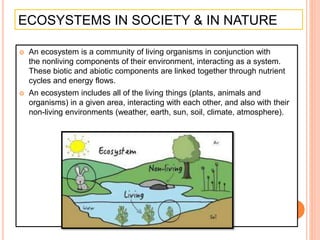
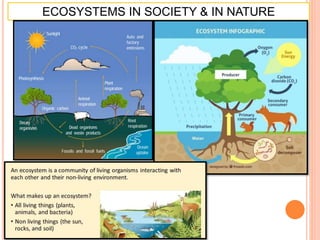
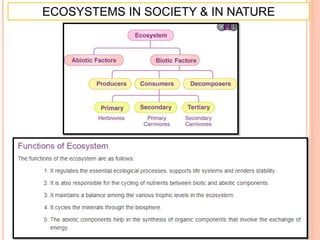
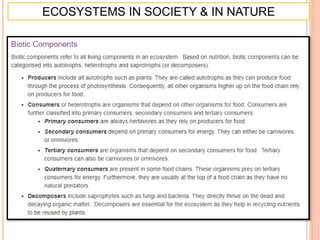
 An ecosystem is a community of living organisms in conjunction with
the nonliving components of their environment, interacting as a system.
These biotic and abiotic components are linked together through nutrient
cycles and energy flows.
 An ecosystem includes all of the living things (plants, animals and
organisms) in a given area, interacting with each other, and also with their
non-living environments (weather, earth, sun, soil, climate, atmosphere).
ECOSYSTEMS IN SOCIETY & IN NATURE
GLOBAL WARMING
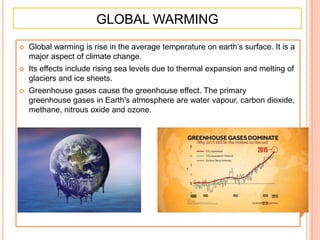
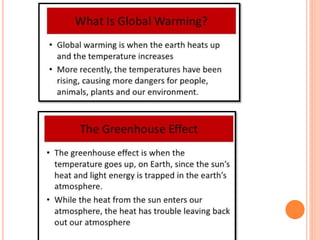
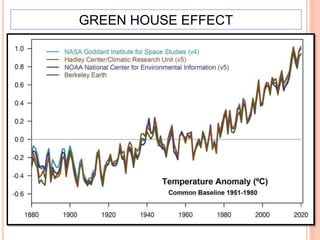
 Global warming is rise in the average temperature on earth’s surface. It is a
major aspect of climate change.
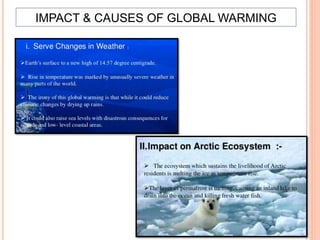
 Its effects include rising sea levels due to thermal expansion and melting of
glaciers and ice sheets.
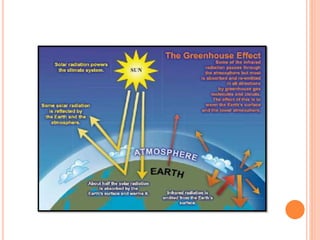
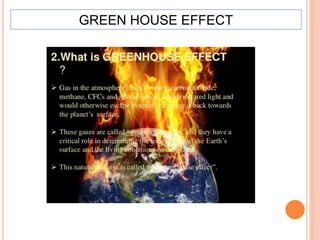
 Greenhouse gases cause the greenhouse effect. The primary
greenhouse gases in Earth's atmosphere are water vapour, carbon dioxide,
methane, nitrous oxide and ozone.
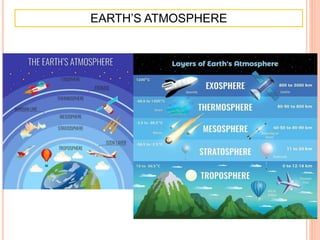
EARTH’S ATMOSPHERE
GREEN HOUSE EFFECT
GREEN HOUSE EFFECT
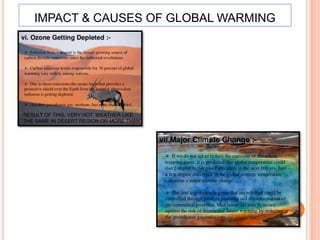
IMPACT & CAUSES OF GLOBAL WARMING
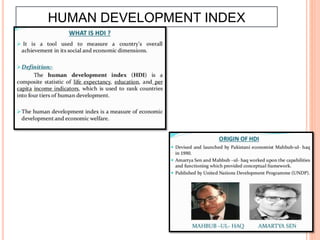
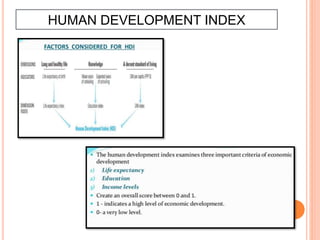
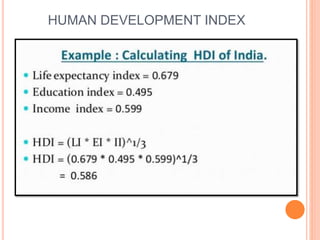
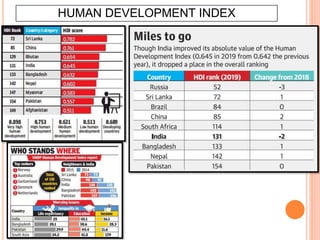
HUMAN DEVELOPMENT INDEX
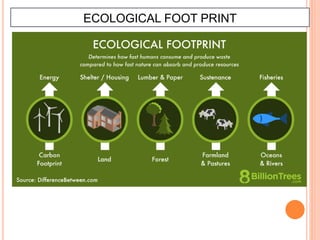
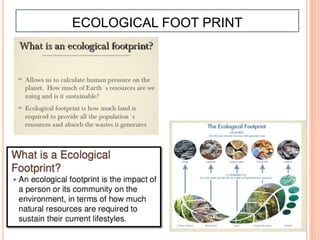
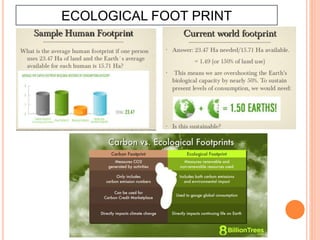
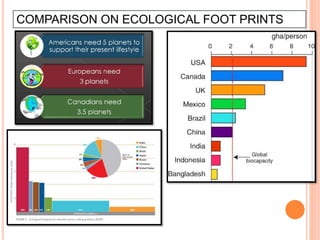
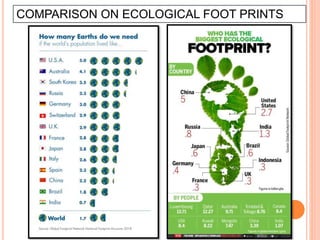
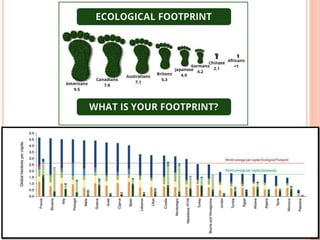
ECOLOGICAL FOOT PRINT
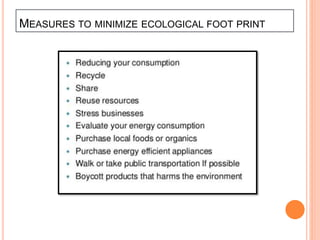
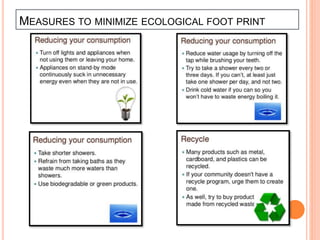
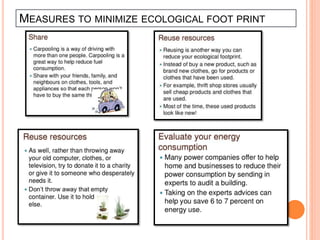
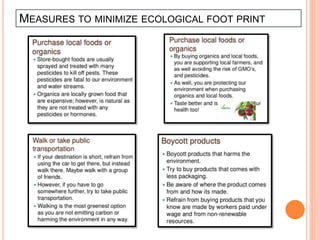
MEASURES TO MINIMIZE ECOLOGICAL FOOT PRINT
COMPARISON ON ECOLOGICAL FOOT PRINTS
CSG__UNIT-1.pptx
CSG__UNIT-1.pptx

CSG__UNIT-1.pptx

  • 1.
    CIVIL ENGINEERING – SOCIETALANDGLOBAL IMPACT UNIT - 1 VENKAT RAMANA SIRAM, ASST. PROFESSOR, RGUKT, BASARA.
  • 2.
    HOW ECONOMY ISA FACTOR OF DEVELOPMENT?
  • 3.
    PRE-INDUSTRIAL REVOLUTION DAYS Revolution is a sudden change.  Pre-Industrial days is a time before 1750 during which there were no machines and tools to perform tasks.  The living conditions during pre-industrial days were miserably characterised by: poor transportation, poor communication, poor sanitation, less urbanisation.  Workers were paid low wages that barely allowed them to afford the cost of living associated with their rent and food.
  • 4.
    TYPES OF REVOLUTIONS 1 •Industrial Revolution 2 • Agricultural Revolution 3 • Information Revolution
  • 5.
    INDUSTRIAL REVOLUTION  TheIndustrial Revolution began after 1750s in Britain, and spread around the world.  It was a time when the manufacturing of goods moved from small shops and homes to large factories.  Changes in culture as people moved from rural areas to big cities in order to work.  Led to increase in urbanisation, increase in population and increase in living standards.  Led to the depletion of natural resources.  Use of chemicals and fuel in factories resulted in increased air and water pollution and an increased use of fossil fuels
  • 6.
    PHASES IN INDUSTRIALREVOLUTION  The Industrial revolution is divided into two phases: First industrial revolution, which took place between 1750 and 1850 and the second industrial revolution, which took place between 1850 and 1914.  While the First Industrial Revolution centered on textile manufacturing and the innovation of the steam engine, the Second Industrial Revolution focused instead on steel production, the automobile, petroleum and advances in electricity.
  • 8.
  • 14.
    ADVANTAGES OF INDUSTRIALREVOLUTION  Increase in employment, Urbanization, transportation facilities and standard of living.  Led to news ways of thinking for better governance.  Led way for new inventions.
  • 15.
    DISADVANTAGES OF INDUSTRIALREVOLUTION  Sudden increase in urbanization and improper planning of cities led to poor sanitation, there was no sewage and running water.  Poor sanitation and sewerage system led to outbreak of diseases.  Led to depletion of natural resources and increase in pollution.  Led to child labor and women labor giving them low wages  Rural people from farming moved to industries for job.  ‘Iron law of wages’ led to increase in poverty as less wages were paid saying it would control the population.
  • 16.
  • 17.
    INDUSTRIAL REVOLUTION IMPACTON CIVIL ENGINEERING  Construction of Bridges, Tunnels, Canals, Roads, Dams, Retaining walls, Multi storied buildings, Airports, Harbors, etc., began.  Led to new innovations in Engineering and provided employment to many.
  • 18.
    INDUSTRIAL REVOLUTION IMPACTON CIVIL ENGINEERING
  • 21.
  • 22.
  • 27.
  • 29.
  • 32.
  • 35.
  • 36.
  • 37.
  • 38.
  • 40.
    IT REVOLUTION  Thisrevolution made the communication easier.  Made the complex computations easier.  Helped in storing the data.  Helped industries in increasing production.  Led to new innovations like robust computers to laptops, telephones to smart phones.  Led to innovations in nano technology.  Increased the production and profits in service sector, Industrial sector and Agricultural sector.  Provided employment opportunities.  Led to digitalization.
  • 41.
    CIVIL ENGINEERING INNOVATIONSAIMED AT IMPROVING SUSTAINABILITY  Plastic Roads India’s government began experimenting with plastic roads during the early 2000s, with waste plastic being used as a construction material. An early report by India’s Central Pollution Control Board discovered that even after four years of use, Jambulingam Street in Chennai—one of the first plastic roads—had not sustained much damage. The board cited that no potholes, rutting, ravelling, or edge flaws were discovered during the evaluation. Although the concept of using waste plastic in roads is still in its early stages, with very few plastic roads currently existing in the Western world, civil engineering researchers in countries like the United Kingdom and the United States are working to design new technologies to support the safe implementation of waste plastic in road construction. There are still some concerns regarding hazards that accompany plastic roads as they age. As these roads gradually deteriorate due to heat and light, they may dissolve into micro-plastics that give off harmful pollutants, affecting the functionality and biodiversity of soil and water resources.
  • 42.
  • 43.
    CIVIL ENGINEERING INNOVATIONSAIMED AT IMPROVING SUSTAINABILITY  Green Roof Systems Green roof systems have become popular all over the world, not only for their beauty, but also for the benefits they provide toward environmental sustainability. Germany is currently leading the world in green roof technologies, and they have implemented green roofing systems on approximately 10% of German homes since the technology emerged in the early 1970s.
  • 44.
    GREEN ROOF SYSTEMS Innovationsin modern engineering techniques for green roofing system have allowed the industry to consistently offer the following environmental benefits to urban communities: 1. Enhanced Urban Biodiversity: Green roofs accommodate new flora, which may act as new habitats for different species of plants and animals. 2. Cooling of Buildings: The vegetation on the roof acts as thermal insulation, storing excess heat and decreasing peak temperatures within the building. This means less energy must be consumed to heat the building, resulting in decreased energy costs and lower pollutant emissions. 3. Reduced Runoff Quantity: On average, green roofs retain 40-60% of total rainfall. Storing this rainwater as it falls has been shown to result in runoff reduction of 34% between September and February, and 67% between March and August. By reducing runoff, civil engineers that design green roof systems can limit strain on sewage systems and mitigate the costs of roof damage. 4. Pollution Control: Green roofs are composed of plants that absorb nitrogen, lead, zinc, and airborne pollutants like carbon dioxide. This absorption also reduces the negative effects of acid rain by raising the pH values of acid rainwater before it becomes runoff water.
  • 45.
    CIVIL ENGINEERING INNOVATIONSAIMED AT IMPROVING SUSTAINABILITY  Eco Floating Homes Affordable housing and overcrowding in cities are putting pressure on urban populations to make changes. To combat these issues, Civil engineers are designing floating homes—practical living spaces that sit upon the water. The homes are designed to resist floods by floating on top of water using a foundation of concrete and Styrofoam, which makes them virtually unsinkable. This approach means that homes can be built in spaces that were previously off-limits, like rivers, lakes and other bodies of water. Introducing this concept in urban environments with large populations will prove to be somewhat tricky, as structures being built within or on above- ground water sources could impact environments negatively by disturbing the natural state of the water.
  • 46.
  • 47.
    CIVIL ENGINEERING INNOVATIONSAIMED AT IMPROVING SUSTAINABILITY  Rainwater Harvesting Dutch engineers and researchers have observed that effective large-scale implementation of rainwater harvesting infrastructure can reduce storm water runoff by 20 to 50 percent, mitigating the strain that excess storm precipitation usually places on sewers and drainage systems This is made possible by mounting rainwater catchment devices on the roofs of buildings, then routing the rainwater that is collected by the catchment through a treatment system and into a storage tank. To ensure the effectiveness of these rainwater-harvesting systems, the contents of each storage tank must be depleted before significant rainfall events occur. Therefore, civil engineers must obtain the knowledge and experience necessary to analyze the precipitation patterns and water usage rates of a region before installing any rainwater harvesting systems.
  • 48.
  • 49.
    CIVIL ENGINEERING INNOVATIONSAIMED AT IMPROVING SUSTAINABILITY  Vertical Farming Using multi story high-rises to grow food is known as “vertical farming,” The Association for Vertical Farming has found that, when compared with traditional agricultural methods, growing food indoors uses 98 percent less water and 70 percent less fertilizer on average. By implementing modern automation techniques to regulate these systems, civil engineers can also limit the cost of labor required to maintain these farms. The costs associated with vertical farming are still quite high, but as science in this field advances, civil engineers will be able to provide the populations of un-farmable regions with opportunities to grow their own natural produce.
  • 50.
  • 51.
    ECOSYSTEMS IN SOCIETY& IN NATURE  An ecosystem is a community of living organisms in conjunction with the nonliving components of their environment, interacting as a system. These biotic and abiotic components are linked together through nutrient cycles and energy flows.  An ecosystem includes all of the living things (plants, animals and organisms) in a given area, interacting with each other, and also with their non-living environments (weather, earth, sun, soil, climate, atmosphere).
  • 52.
  • 53.
  • 54.
  • 55.
    GLOBAL WARMING  Globalwarming is rise in the average temperature on earth’s surface. It is a major aspect of climate change.  Its effects include rising sea levels due to thermal expansion and melting of glaciers and ice sheets.  Greenhouse gases cause the greenhouse effect. The primary greenhouse gases in Earth's atmosphere are water vapour, carbon dioxide, methane, nitrous oxide and ozone.
  • 57.
  • 59.
  • 60.
  • 61.
    IMPACT & CAUSESOF GLOBAL WARMING
  • 62.
    IMPACT & CAUSESOF GLOBAL WARMING
  • 63.
    IMPACT & CAUSESOF GLOBAL WARMING
  • 66.
  • 67.
  • 68.
  • 69.
  • 70.
  • 71.
  • 72.
  • 73.
    MEASURES TO MINIMIZEECOLOGICAL FOOT PRINT
  • 74.
    MEASURES TO MINIMIZEECOLOGICAL FOOT PRINT
  • 75.
    MEASURES TO MINIMIZEECOLOGICAL FOOT PRINT
  • 76.
    MEASURES TO MINIMIZEECOLOGICAL FOOT PRINT
  • 77.
  • 78.