1
Sustainability Report
CIVL 896 – Sustainable Engineering in Remote Areas (SERA)
Department of Civil Engineering
Date of Submission
22 October 2018
Submitted by
Arshia Mousavi
20079128
Submitted to
Prof. Mark F. Green
Assignment 1
Civil Engineering
Queen’s University
2
Sustainability
Let starts with the definition of sustainability in different dictionaries. For instance,
based on Google translate, it means that “Avoidance of the depletion of natural
resources in order to maintain an ecological balance”. While the Cambridge Dictionary
has a better definition of sustainability: “The quality of causing little or no damage to
the environment and therefore able to continue for a long time”. As observed, when
talking or searching about sustainability, it is embedded in most definitions that the
only concern is the environment. While it is tied up with social equity and economic
as well.
Therefore, sustainability can be defined as it is a comprehensive method that
deals with ecological, social and economic aspects because all should be considered for
finding enduring success. It means meeting our needs, and the needs of our next
generations.
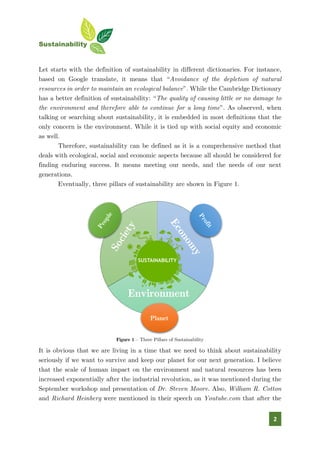
Eventually, three pillars of sustainability are shown in Figure 1.
Figure 1 – Three Pillars of Sustainability
It is obvious that we are living in a time that we need to think about sustainability
seriously if we want to survive and keep our planet for our next generation. I believe
that the scale of human impact on the environment and natural resources has been
increased exponentially after the industrial revolution, as it was mentioned during the
September workshop and presentation of Dr. Steven Moore. Also, William R. Cotton
and Richard Heinberg were mentioned in their speech on Youtube.com that after the
Profit
People
Planet
Econom
y
Environment
Society
3
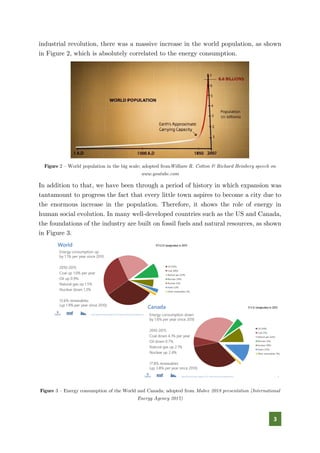
industrial revolution, there was a massive increase in the world population, as shown
in Figure 2, which is absolutely correlated to the energy consumption.
Figure 2 – World population in the big scale; adopted fromWilliam R. Cotton & Richard Heinberg speech on
www.youtube.com
In addition to that, we have been through a period of history in which expansion was
tantamount to progress the fact that every little town aspires to become a city due to
the enormous increase in the population. Therefore, it shows the role of energy in
human social evolution. In many well-developed countries such as the US and Canada,
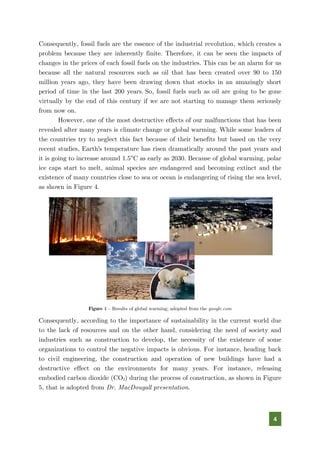
the foundations of the industry are built on fossil fuels and natural resources, as shown
in Figure 3.
Figure 3 – Energy consumption of the World and Canada; adopted from Mabee 2018 presentation (International
Energy Agency 2017)
4
Consequently, fossil fuels are the essence of the industrial revolution, which creates a
problem because they are inherently finite. Therefore, it can be seen the impacts of
changes in the prices of each fossil fuels on the industries. This can be an alarm for us
because all the natural resources such as oil that has been created over 90 to 150
million years ago, they have been drawing down that stocks in an amazingly short
period of time in the last 200 years. So, fossil fuels such as oil are going to be gone
virtually by the end of this century if we are not starting to manage them seriously
from now on.
However, one of the most destructive effects of our malfunctions that has been
revealed after many years is climate change or global warming. While some leaders of
the countries try to neglect this fact because of their benefits but based on the very
recent studies, Earth's temperature has risen dramatically around the past years and
it is going to increase around 1.5°C as early as 2030. Because of global warming, polar
ice caps start to melt, animal species are endangered and becoming extinct and the
existence of many countries close to sea or ocean is endangering of rising the sea level,
as shown in Figure 4.
Figure 4 – Results of global warming; adopted from the google.com
Consequently, according to the importance of sustainability in the current world due
to the lack of resources and on the other hand, considering the need of society and
industries such as construction to develop, the necessity of the existence of some
organizations to control the negative impacts is obvious. For instance, heading back
to civil engineering, the construction and operation of new buildings have had a
destructive effect on the environments for many years. For instance, releasing
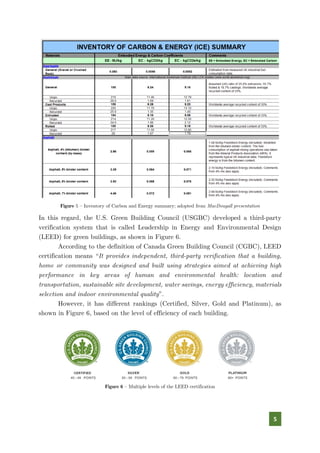
embodied carbon dioxide (CO2) during the process of construction, as shown in Figure
5, that is adopted from Dr. MacDougall presentation.
5
Figure 5 – Inventory of Carbon and Energy summary; adopted from MacDougall presentation
In this regard, the U.S. Green Building Council (USGBC) developed a third-party
verification system that is called Leadership in Energy and Environmental Design
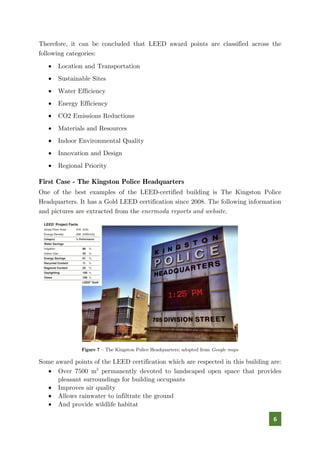
(LEED) for green buildings, as shown in Figure 6.
According to the definition of Canada Green Building Council (CGBC), LEED
certification means “It provides independent, third-party verification that a building,
home or community was designed and built using strategies aimed at achieving high
performance in key areas of human and environmental health: location and
transportation, sustainable site development, water savings, energy efficiency, materials
selection and indoor environmental quality”.
However, it has different rankings (Certified, Silver, Gold and Platinum), as
shown in Figure 6, based on the level of efficiency of each building.
Figure 6 – Multiple levels of the LEED certification
6
Therefore, it can be concluded that LEED award points are classified across the
following categories:
• Location and Transportation
• Sustainable Sites
• Water Efficiency
• Energy Efficiency
• CO2 Emissions Reductions
• Materials and Resources
• Indoor Environmental Quality
• Innovation and Design
• Regional Priority
First Case - The Kingston Police Headquarters
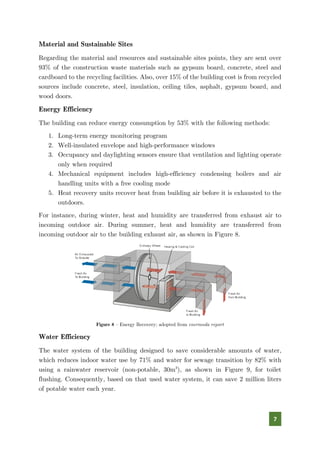
One of the best examples of the LEED-certified building is The Kingston Police
Headquarters. It has a Gold LEED certification since 2008. The following information
and pictures are extracted from the enermoda reports and website.
Figure 7 – The Kingston Police Headquarters; adopted from Google maps
Some award points of the LEED certification which are respected in this building are:
• Over 7500 m2
permanently devoted to landscaped open space that provides
pleasant surroundings for building occupants
• Improves air quality
• Allows rainwater to infiltrate the ground
• And provide wildlife habitat
7
Material and Sustainable Sites
Regarding the material and resources and sustainable sites points, they are sent over
93% of the construction waste materials such as gypsum board, concrete, steel and
cardboard to the recycling facilities. Also, over 15% of the building cost is from recycled
sources include concrete, steel, insulation, ceiling tiles, asphalt, gypsum board, and
wood doors.
Energy Efficiency
The building can reduce energy consumption by 53% with the following methods:
1. Long-term energy monitoring program
2. Well-insulated envelope and high-performance windows
3. Occupancy and daylighting sensors ensure that ventilation and lighting operate
only when required
4. Mechanical equipment includes high-efficiency condensing boilers and air
handling units with a free cooling mode
5. Heat recovery units recover heat from building air before it is exhausted to the
outdoors.
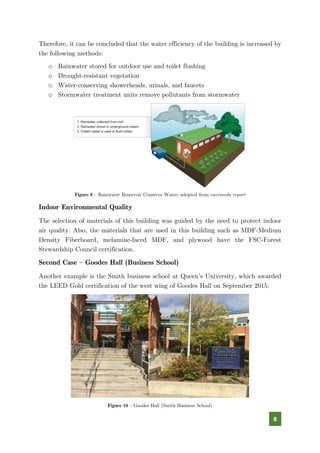
For instance, during winter, heat and humidity are transferred from exhaust air to
incoming outdoor air. During summer, heat and humidity are transferred from
incoming outdoor air to the building exhaust air, as shown in Figure 8.
Figure 8 – Energy Recovery; adopted from enermoda report
Water Efficiency
The water system of the building designed to save considerable amounts of water,
which reduces indoor water use by 71% and water for sewage transition by 82% with
using a rainwater reservoir (non-potable, 30m3
), as shown in Figure 9, for toilet
flushing. Consequently, based on that used water system, it can save 2 million liters
of potable water each year.
8
Therefore, it can be concluded that the water efficiency of the building is increased by
the following methods:
o Rainwater stored for outdoor use and toilet flushing
o Drought-resistant vegetation
o Water-conserving showerheads, urinals, and faucets
o Stormwater treatment units remove pollutants from stormwater
Figure 9 – Rainwater Reservoir Conserve Water; adopted from enermoda report
Indoor Environmental Quality
The selection of materials of this building was guided by the need to protect indoor
air quality. Also, the materials that are used in this building such as MDF-Medium
Density Fiberboard, melamine-faced MDF, and plywood have the FSC-Forest
Stewardship Council certification.
Second Case – Goodes Hall (Business School)
Another example is the Smith business school at Queen’s University, which awarded
the LEED Gold certification of the west wing of Goodes Hall on September 2015.
Figure 10 – Goodes Hall (Smith Business School)
9
The features of this building are:
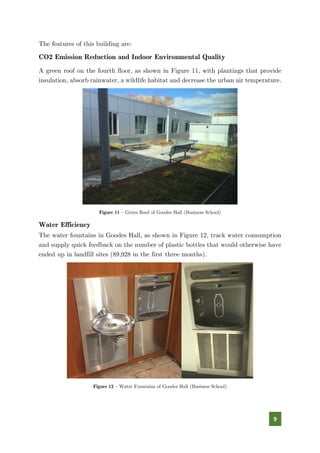
CO2 Emission Reduction and Indoor Environmental Quality
A green roof on the fourth floor, as shown in Figure 11, with plantings that provide
insulation, absorb rainwater, a wildlife habitat and decrease the urban air temperature.
Figure 11 – Green Roof of Goodes Hall (Business School)
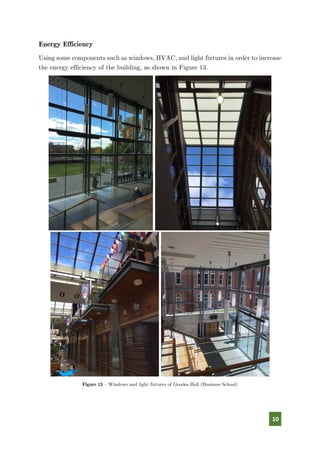
Water Efficiency
The water fountains in Goodes Hall, as shown in Figure 12, track water consumption
and supply quick feedback on the number of plastic bottles that would otherwise have
ended up in landfill sites (89,928 in the first three months).
Figure 12 – Water Fountains of Goodes Hall (Business School)
10
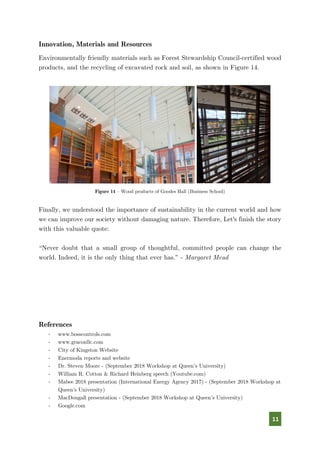
Energy Efficiency
Using some components such as windows, HVAC, and light fixtures in order to increase
the energy efficiency of the building, as shown in Figure 13.
Figure 13 – Windows and light fixtures of Goodes Hall (Business School)
11
Innovation, Materials and Resources
Environmentally friendly materials such as Forest Stewardship Council-certified wood
products, and the recycling of excavated rock and soil, as shown in Figure 14.
Figure 14 – Wood products of Goodes Hall (Business School)
Finally, we understood the importance of sustainability in the current world and how
we can improve our society without damaging nature. Therefore, Let's finish the story
with this valuable quote:
“Never doubt that a small group of thoughtful, committed people can change the
world. Indeed, it is the only thing that ever has.” - Margaret Mead
References
- www.bosscontrols.com
- www.graconllc.com
- City of Kingston Website
- Enermoda reports and website
- Dr. Steven Moore - (September 2018 Workshop at Queen’s University)
- William R. Cotton & Richard Heinberg speech (Youtube.com)
- Mabee 2018 presentation (International Energy Agency 2017) - (September 2018 Workshop at
Queen’s University)
- MacDougall presentation - (September 2018 Workshop at Queen’s University)
- Google.com

Sustainibility Report

  • 1.
    1 Sustainability Report CIVL 896– Sustainable Engineering in Remote Areas (SERA) Department of Civil Engineering Date of Submission 22 October 2018 Submitted by Arshia Mousavi 20079128 Submitted to Prof. Mark F. Green Assignment 1 Civil Engineering Queen’s University
  • 2.
    2 Sustainability Let starts withthe definition of sustainability in different dictionaries. For instance, based on Google translate, it means that “Avoidance of the depletion of natural resources in order to maintain an ecological balance”. While the Cambridge Dictionary has a better definition of sustainability: “The quality of causing little or no damage to the environment and therefore able to continue for a long time”. As observed, when talking or searching about sustainability, it is embedded in most definitions that the only concern is the environment. While it is tied up with social equity and economic as well. Therefore, sustainability can be defined as it is a comprehensive method that deals with ecological, social and economic aspects because all should be considered for finding enduring success. It means meeting our needs, and the needs of our next generations. Eventually, three pillars of sustainability are shown in Figure 1. Figure 1 – Three Pillars of Sustainability It is obvious that we are living in a time that we need to think about sustainability seriously if we want to survive and keep our planet for our next generation. I believe that the scale of human impact on the environment and natural resources has been increased exponentially after the industrial revolution, as it was mentioned during the September workshop and presentation of Dr. Steven Moore. Also, William R. Cotton and Richard Heinberg were mentioned in their speech on Youtube.com that after the Profit People Planet Econom y Environment Society
  • 3.
    3 industrial revolution, therewas a massive increase in the world population, as shown in Figure 2, which is absolutely correlated to the energy consumption. Figure 2 – World population in the big scale; adopted fromWilliam R. Cotton & Richard Heinberg speech on www.youtube.com In addition to that, we have been through a period of history in which expansion was tantamount to progress the fact that every little town aspires to become a city due to the enormous increase in the population. Therefore, it shows the role of energy in human social evolution. In many well-developed countries such as the US and Canada, the foundations of the industry are built on fossil fuels and natural resources, as shown in Figure 3. Figure 3 – Energy consumption of the World and Canada; adopted from Mabee 2018 presentation (International Energy Agency 2017)
  • 4.
    4 Consequently, fossil fuelsare the essence of the industrial revolution, which creates a problem because they are inherently finite. Therefore, it can be seen the impacts of changes in the prices of each fossil fuels on the industries. This can be an alarm for us because all the natural resources such as oil that has been created over 90 to 150 million years ago, they have been drawing down that stocks in an amazingly short period of time in the last 200 years. So, fossil fuels such as oil are going to be gone virtually by the end of this century if we are not starting to manage them seriously from now on. However, one of the most destructive effects of our malfunctions that has been revealed after many years is climate change or global warming. While some leaders of the countries try to neglect this fact because of their benefits but based on the very recent studies, Earth's temperature has risen dramatically around the past years and it is going to increase around 1.5°C as early as 2030. Because of global warming, polar ice caps start to melt, animal species are endangered and becoming extinct and the existence of many countries close to sea or ocean is endangering of rising the sea level, as shown in Figure 4. Figure 4 – Results of global warming; adopted from the google.com Consequently, according to the importance of sustainability in the current world due to the lack of resources and on the other hand, considering the need of society and industries such as construction to develop, the necessity of the existence of some organizations to control the negative impacts is obvious. For instance, heading back to civil engineering, the construction and operation of new buildings have had a destructive effect on the environments for many years. For instance, releasing embodied carbon dioxide (CO2) during the process of construction, as shown in Figure 5, that is adopted from Dr. MacDougall presentation.
  • 5.
    5 Figure 5 –Inventory of Carbon and Energy summary; adopted from MacDougall presentation In this regard, the U.S. Green Building Council (USGBC) developed a third-party verification system that is called Leadership in Energy and Environmental Design (LEED) for green buildings, as shown in Figure 6. According to the definition of Canada Green Building Council (CGBC), LEED certification means “It provides independent, third-party verification that a building, home or community was designed and built using strategies aimed at achieving high performance in key areas of human and environmental health: location and transportation, sustainable site development, water savings, energy efficiency, materials selection and indoor environmental quality”. However, it has different rankings (Certified, Silver, Gold and Platinum), as shown in Figure 6, based on the level of efficiency of each building. Figure 6 – Multiple levels of the LEED certification
  • 6.
    6 Therefore, it canbe concluded that LEED award points are classified across the following categories: • Location and Transportation • Sustainable Sites • Water Efficiency • Energy Efficiency • CO2 Emissions Reductions • Materials and Resources • Indoor Environmental Quality • Innovation and Design • Regional Priority First Case - The Kingston Police Headquarters One of the best examples of the LEED-certified building is The Kingston Police Headquarters. It has a Gold LEED certification since 2008. The following information and pictures are extracted from the enermoda reports and website. Figure 7 – The Kingston Police Headquarters; adopted from Google maps Some award points of the LEED certification which are respected in this building are: • Over 7500 m2 permanently devoted to landscaped open space that provides pleasant surroundings for building occupants • Improves air quality • Allows rainwater to infiltrate the ground • And provide wildlife habitat
  • 7.
    7 Material and SustainableSites Regarding the material and resources and sustainable sites points, they are sent over 93% of the construction waste materials such as gypsum board, concrete, steel and cardboard to the recycling facilities. Also, over 15% of the building cost is from recycled sources include concrete, steel, insulation, ceiling tiles, asphalt, gypsum board, and wood doors. Energy Efficiency The building can reduce energy consumption by 53% with the following methods: 1. Long-term energy monitoring program 2. Well-insulated envelope and high-performance windows 3. Occupancy and daylighting sensors ensure that ventilation and lighting operate only when required 4. Mechanical equipment includes high-efficiency condensing boilers and air handling units with a free cooling mode 5. Heat recovery units recover heat from building air before it is exhausted to the outdoors. For instance, during winter, heat and humidity are transferred from exhaust air to incoming outdoor air. During summer, heat and humidity are transferred from incoming outdoor air to the building exhaust air, as shown in Figure 8. Figure 8 – Energy Recovery; adopted from enermoda report Water Efficiency The water system of the building designed to save considerable amounts of water, which reduces indoor water use by 71% and water for sewage transition by 82% with using a rainwater reservoir (non-potable, 30m3 ), as shown in Figure 9, for toilet flushing. Consequently, based on that used water system, it can save 2 million liters of potable water each year.
  • 8.
    8 Therefore, it canbe concluded that the water efficiency of the building is increased by the following methods: o Rainwater stored for outdoor use and toilet flushing o Drought-resistant vegetation o Water-conserving showerheads, urinals, and faucets o Stormwater treatment units remove pollutants from stormwater Figure 9 – Rainwater Reservoir Conserve Water; adopted from enermoda report Indoor Environmental Quality The selection of materials of this building was guided by the need to protect indoor air quality. Also, the materials that are used in this building such as MDF-Medium Density Fiberboard, melamine-faced MDF, and plywood have the FSC-Forest Stewardship Council certification. Second Case – Goodes Hall (Business School) Another example is the Smith business school at Queen’s University, which awarded the LEED Gold certification of the west wing of Goodes Hall on September 2015. Figure 10 – Goodes Hall (Smith Business School)
  • 9.
    9 The features ofthis building are: CO2 Emission Reduction and Indoor Environmental Quality A green roof on the fourth floor, as shown in Figure 11, with plantings that provide insulation, absorb rainwater, a wildlife habitat and decrease the urban air temperature. Figure 11 – Green Roof of Goodes Hall (Business School) Water Efficiency The water fountains in Goodes Hall, as shown in Figure 12, track water consumption and supply quick feedback on the number of plastic bottles that would otherwise have ended up in landfill sites (89,928 in the first three months). Figure 12 – Water Fountains of Goodes Hall (Business School)
  • 10.
    10 Energy Efficiency Using somecomponents such as windows, HVAC, and light fixtures in order to increase the energy efficiency of the building, as shown in Figure 13. Figure 13 – Windows and light fixtures of Goodes Hall (Business School)
  • 11.
    11 Innovation, Materials andResources Environmentally friendly materials such as Forest Stewardship Council-certified wood products, and the recycling of excavated rock and soil, as shown in Figure 14. Figure 14 – Wood products of Goodes Hall (Business School) Finally, we understood the importance of sustainability in the current world and how we can improve our society without damaging nature. Therefore, Let's finish the story with this valuable quote: “Never doubt that a small group of thoughtful, committed people can change the world. Indeed, it is the only thing that ever has.” - Margaret Mead References - www.bosscontrols.com - www.graconllc.com - City of Kingston Website - Enermoda reports and website - Dr. Steven Moore - (September 2018 Workshop at Queen’s University) - William R. Cotton & Richard Heinberg speech (Youtube.com) - Mabee 2018 presentation (International Energy Agency 2017) - (September 2018 Workshop at Queen’s University) - MacDougall presentation - (September 2018 Workshop at Queen’s University) - Google.com